
Grade 9 Science Worksheets
6,926 worksheets
Electrical Investigations and Circuit Design Worksheets | Grade 9 Science
 Created bythe curious pencil
Learning Objectives
- Develop testable predictions for electrical circuit investigations.
- Identify variables and hazards in a safe circuit test.
- Interpret electrical measurements while considering uncertainty.
Instant download
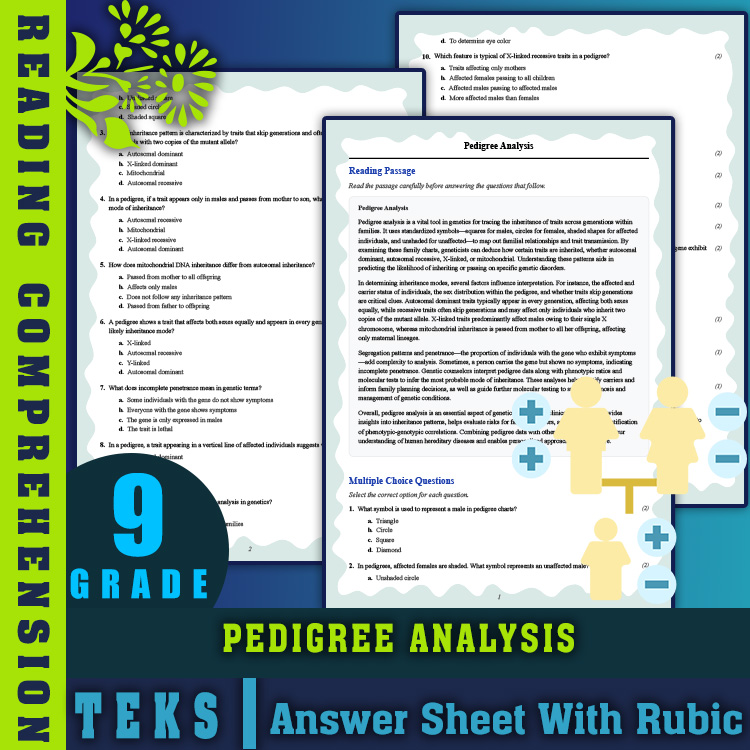
9th Grade Science | Pedigree Analysis Reading Worksheet (PDF + Answer Key)
JCreated byJ.S SheetsLearning Objectives
- Understand the purpose and structure of pedigree charts in genetics.
- Identify inheritance patterns such as autosomal dominant, recessive, X-linked, and mitochondrial.
- Interpret pedigree symbols and relationships to determine inheritance modes.
Instant download
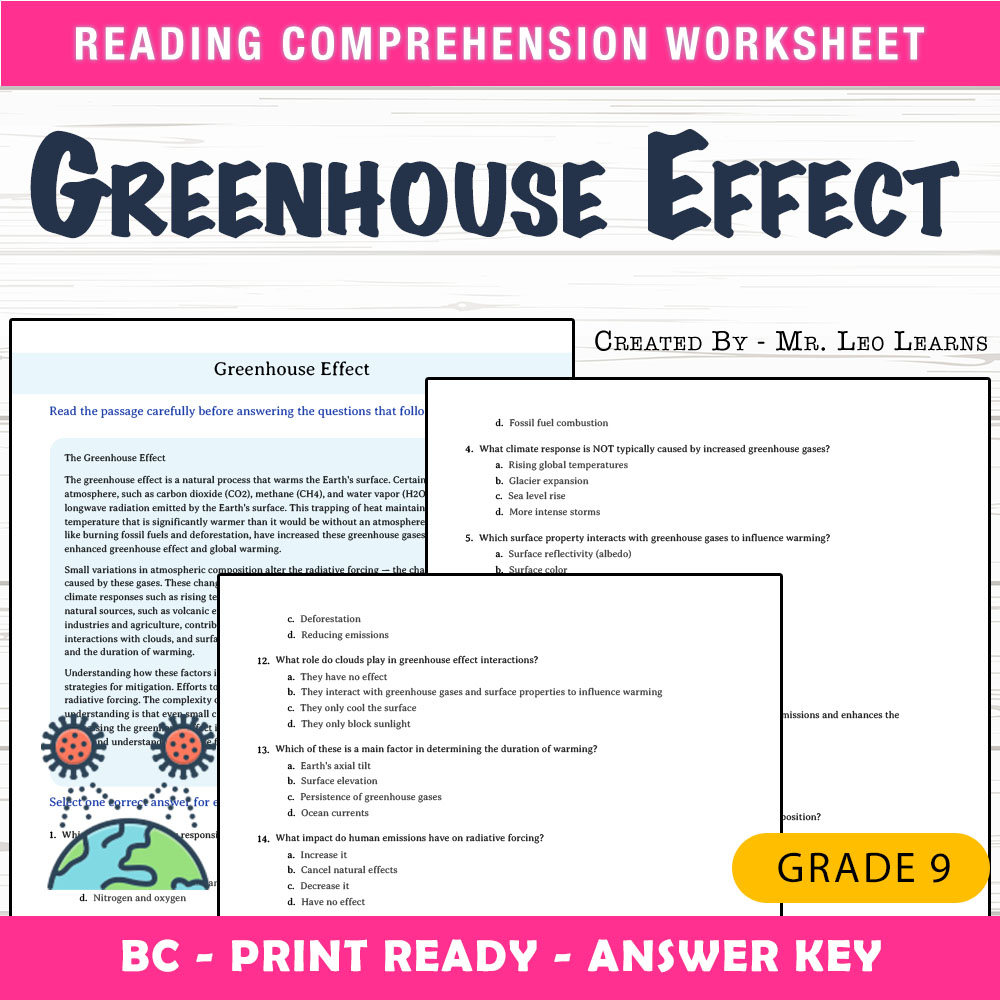
Grade 9 Science — Worksheet MCQ Paper for Mastering Greenhouse Effect
 Created byThe Resource Hub
Learning Objectives
- Understand how gases like carbon dioxide, methane, and water vapor contribute to the greenhouse effect.
- Explain the role of radiative forcing and how small atmospheric changes impact climate.
- Identify natural and human sources of greenhouse gases and their effects on global temperatures.
Also included in: Grade 9 Science | Earth and Space Systems Unit Worksheet Bundle (BC Framework) +1 more
Instant download
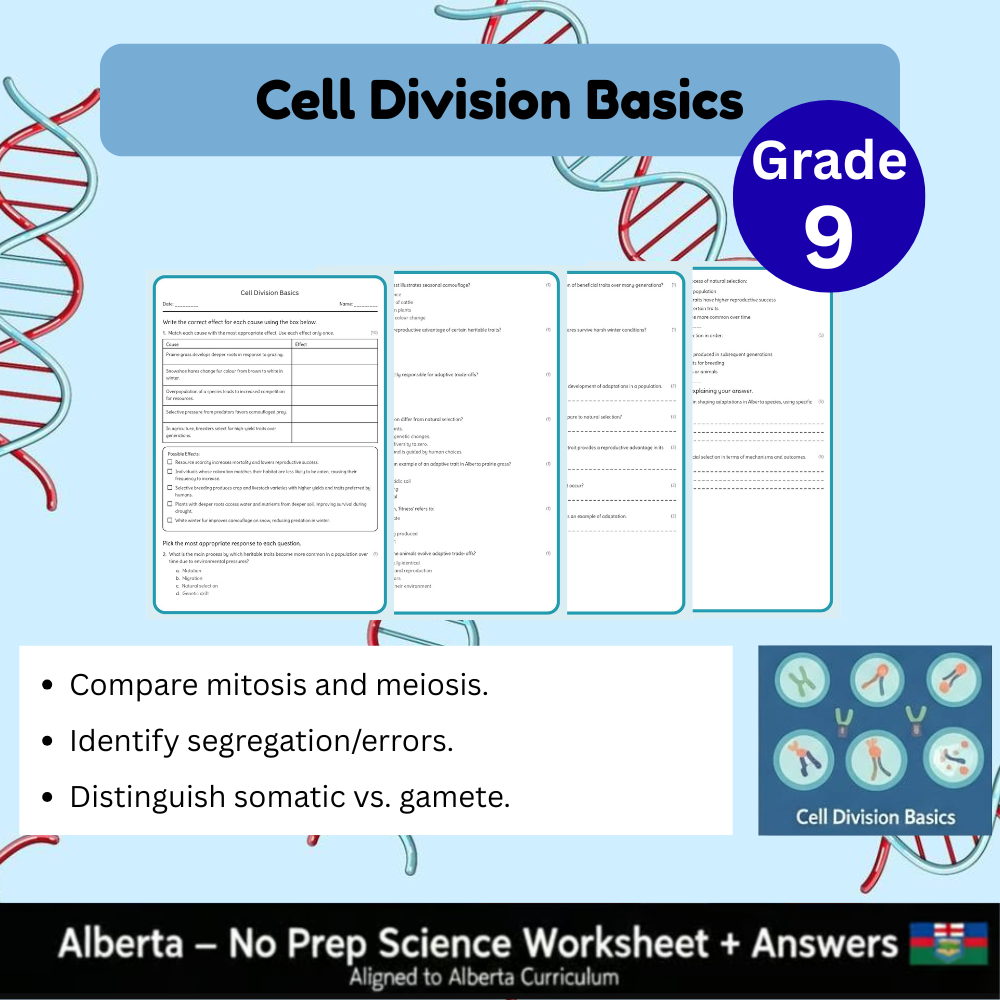
Grade 9 Science | Cell Division Basics Worksheet (PDF) - Alberta Standards
 Created byBright Mind Resources
Learning Objectives
- Understand the roles of mitosis and meiosis in growth, repair, and reproduction.
- Identify key processes such as chromosome pairing, segregation, and errors like nondisjunction.
- Differentiate between somatic cell production and gamete formation.
Instant download
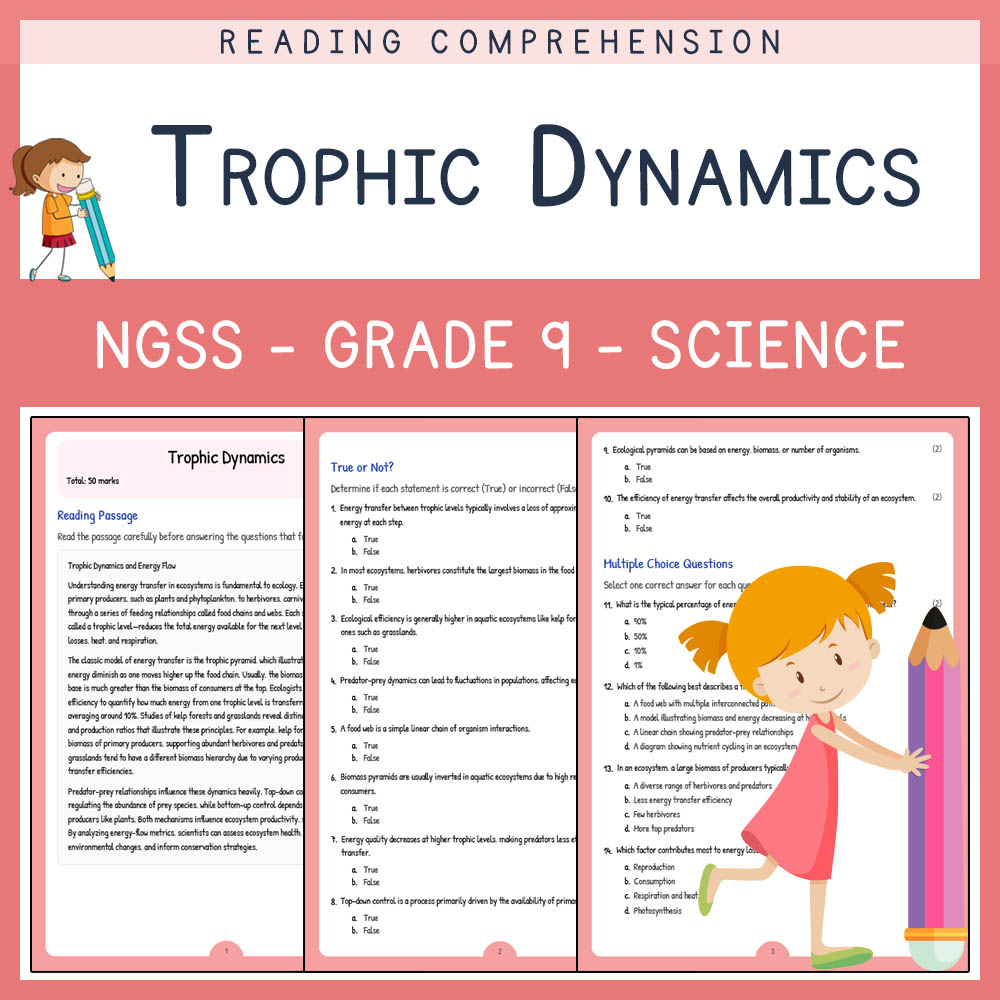
Grade 9 Science | Trophic Dynamics Worksheet (Answer Key) – NGSS Aligned
 Created byLumora Learning
Learning Objectives
- Understand the flow of energy through different trophic levels in an ecosystem.
- Describe the structure of food webs and the significance of biomass distribution.
- Interpret ecological efficiency and the quantification of energy loss across trophic levels.
Instant download
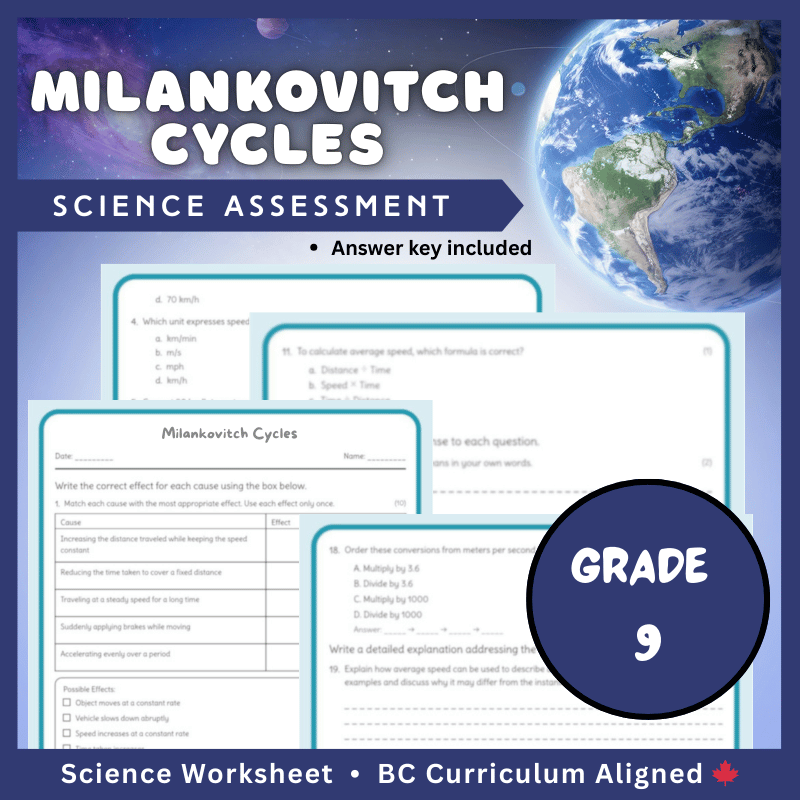
Grade 9 Science | Milankovitch Cycles Worksheet (Answer Key) – Climate & Orbit
Created byBright Mind ResourcesLearning Objectives
- Describe the components of Milankovitch cycles and their effects on Earth's climate.
- Explain how variations in Earth's orbit influence glacial and interglacial periods.
- Identify the three main orbital parameters involved in Milankovitch cycles and their long-term impact.
Instant download
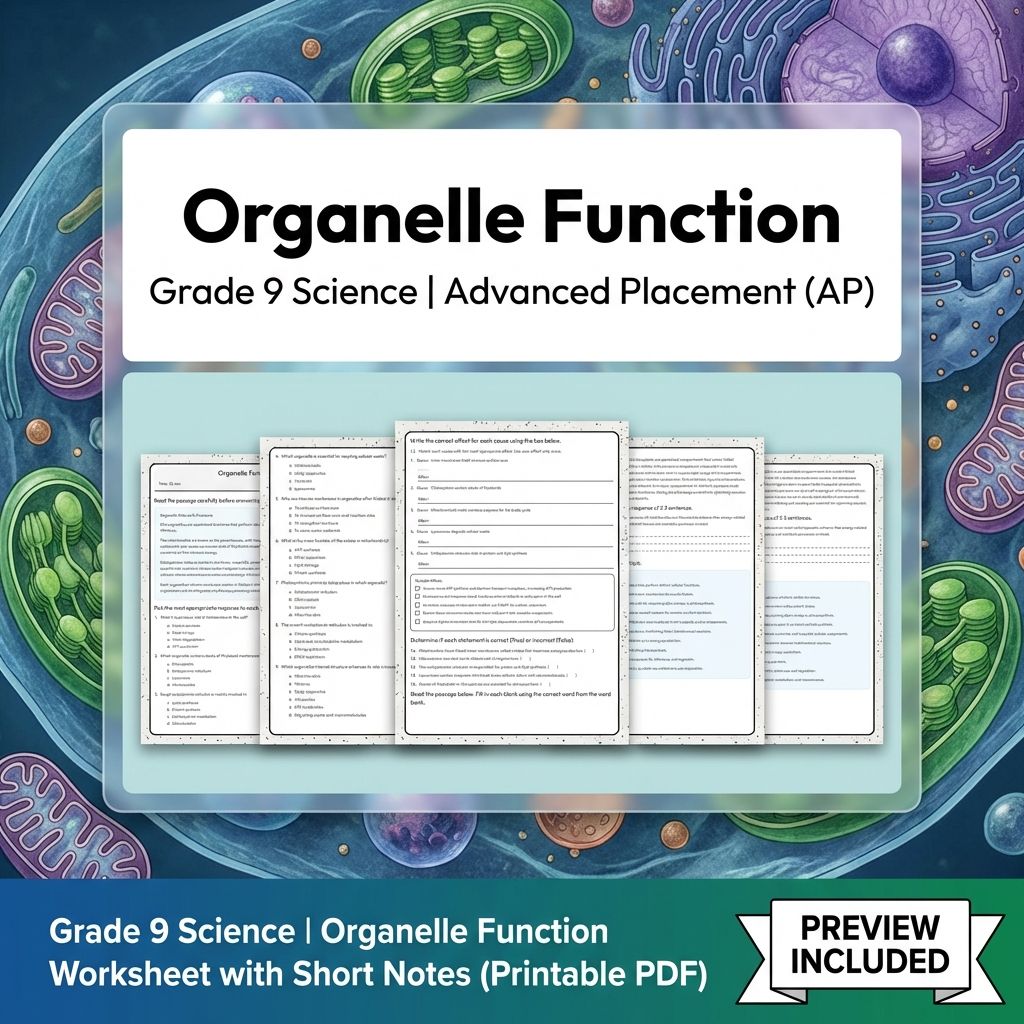
Grade 9 Science | Organelle Function Worksheet with Short Notes (Printable PDF)
 Created byMeadowlark Worksheets
Learning Objectives
- Identify the major organelles in eukaryotic cells and their specific functions.
- Explain how organelle structures relate to their roles in cellular metabolism and maintenance.
- Compare differences between organelle internal membranes such as cristae, thylakoids, and folded membranes.
Also included in: Grade 9 Science Unit | Cellular Processes & Ecosystems Worksheet Pack (PDF) +1 more
Instant download
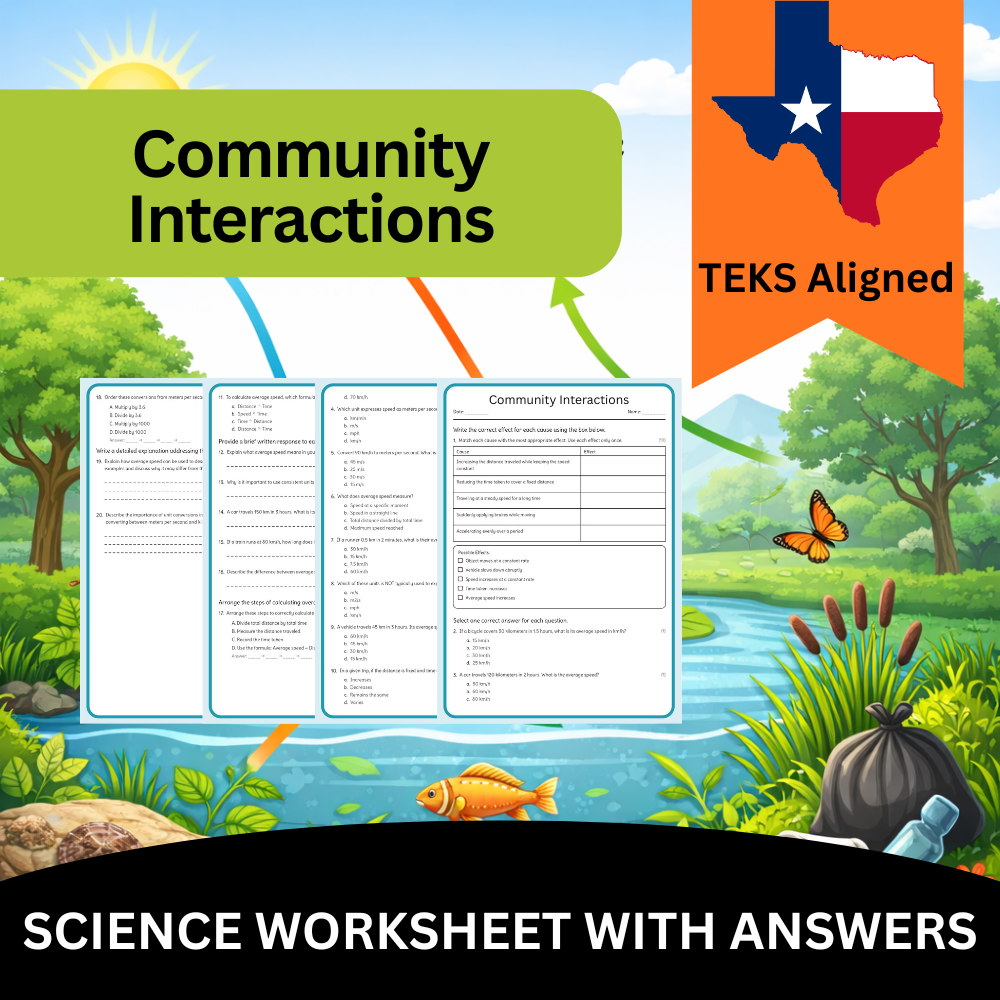
Grade 9 Science | Community Interactions Worksheet (Worksheet + Answer Key) – TEKS Aligned
Created byBright Mind ResourcesLearning Objectives
- Describe different types of species interactions that occur within communities.
- Identify the roles of keystone species and ecosystem engineers.
- Analyze how species interactions influence community structure and ecosystem stability.
Also included in: Grade 9 Science UNIT Bundle | Ecosystems & Biogeochemical Cycles TEKS-Aligned +3 more
Instant download

Grade 9 Science | Balancing Equations - Daily Reading Comprehension
 Created byCoral Reef Learning
Learning Objectives
- Understand the purpose of balancing chemical equations in chemistry.
- Identify unbalanced chemical equations.
- Learn how to use coefficients to balance equations correctly.
Instant download
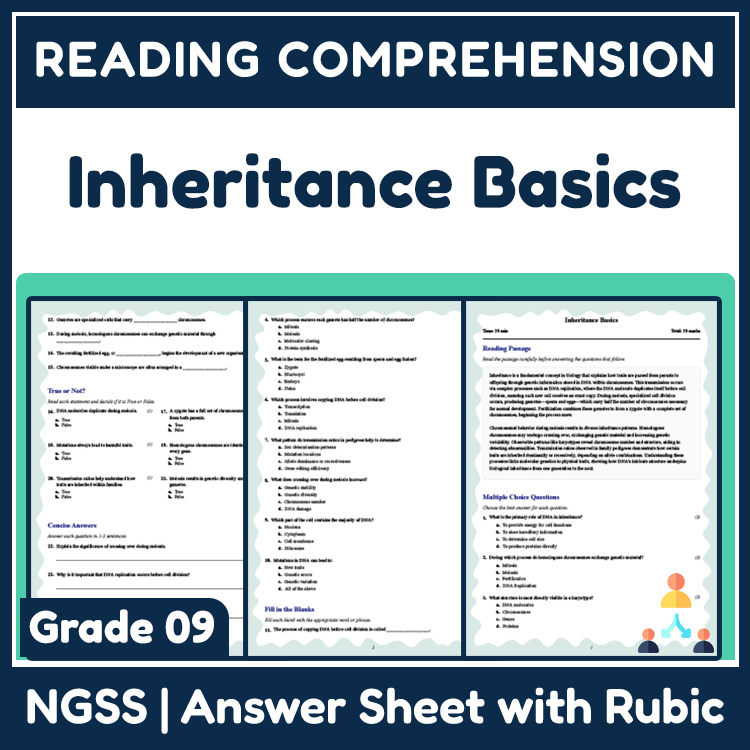
9th Grade Science | Inheritance Basics Reading Worksheets (PDF + Answer Key)
JCreated byJ.S SheetsLearning Objectives
- Understand how DNA is transmitted through replication and meiosis.
- Explain the role of chromosomes and gametes in inheritance.
- Describe observable inheritance patterns such as karyotypes and transmission ratios.
Also included in: Grade 9 Science Unit | Heritable Diversity & Inheritance Worksheets
Instant download

Resilience & Resistance Worksheet | Grade 9 Science TEKS Practice
 Created byPrism Point Learning
Learning Objectives
- Explain the difference between resilience and resistance in ecosystems.
- Describe how thresholds and regime shifts can occur after disturbances.
- Identify factors and feedback processes that influence ecosystem recovery.
Instant download
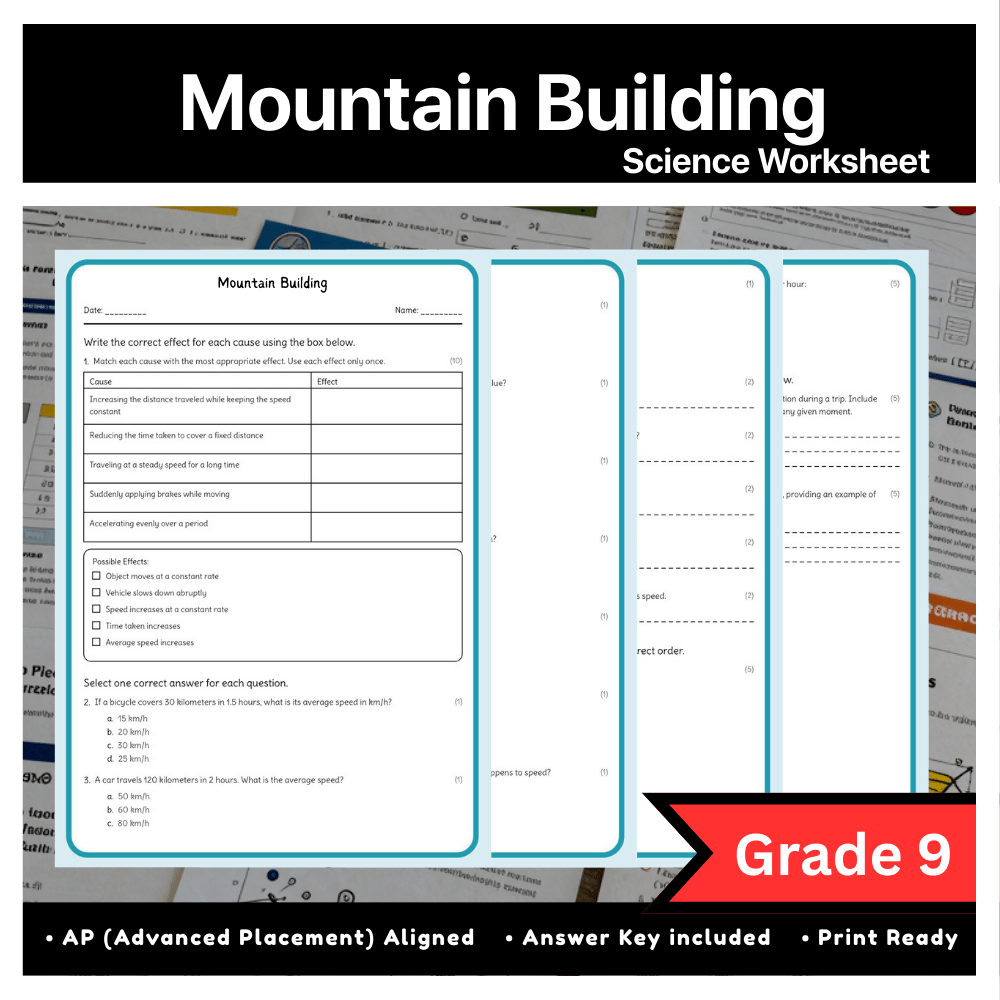
Grade 9 Science – Mountain Building Concepts Worksheet (AP Standards) (PDF)
Created byBright Mind ResourcesLearning Objectives
- Explain the processes involved in mountain formation such as crustal shortening, thickening, and metamorphism.
- Describe how isostatic adjustment affects mountain belts and terrain elevation.
- Analyze the relationship between plate convergence and surface topography.
Instant download
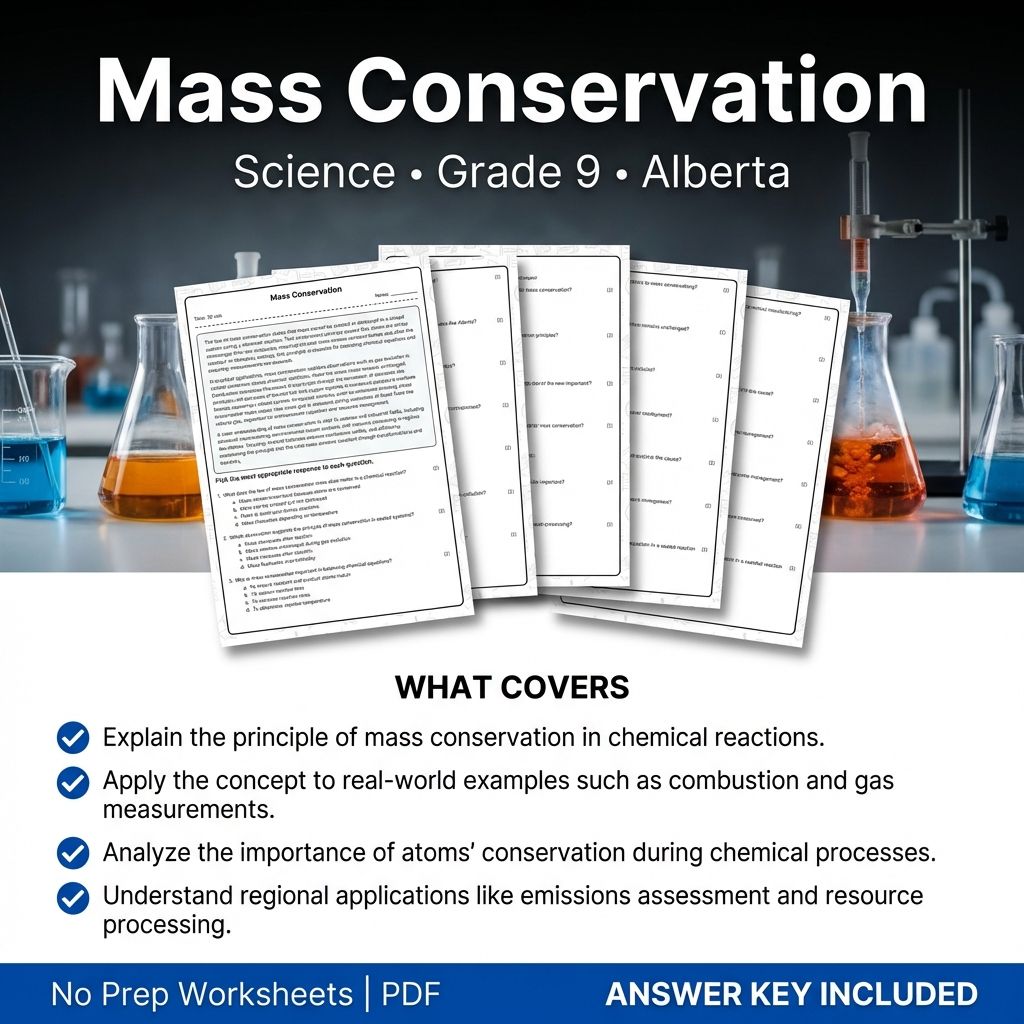
Mass Conservation Worksheet | Science Practice for Grade 9 Alberta Standards
Created byCoral Reef LearningLearning Objectives
- Explain the principle of mass conservation in chemical reactions.
- Apply the concept to real-world examples such as combustion and gas measurements.
- Analyze the importance of atoms' conservation during chemical processes.
Instant download
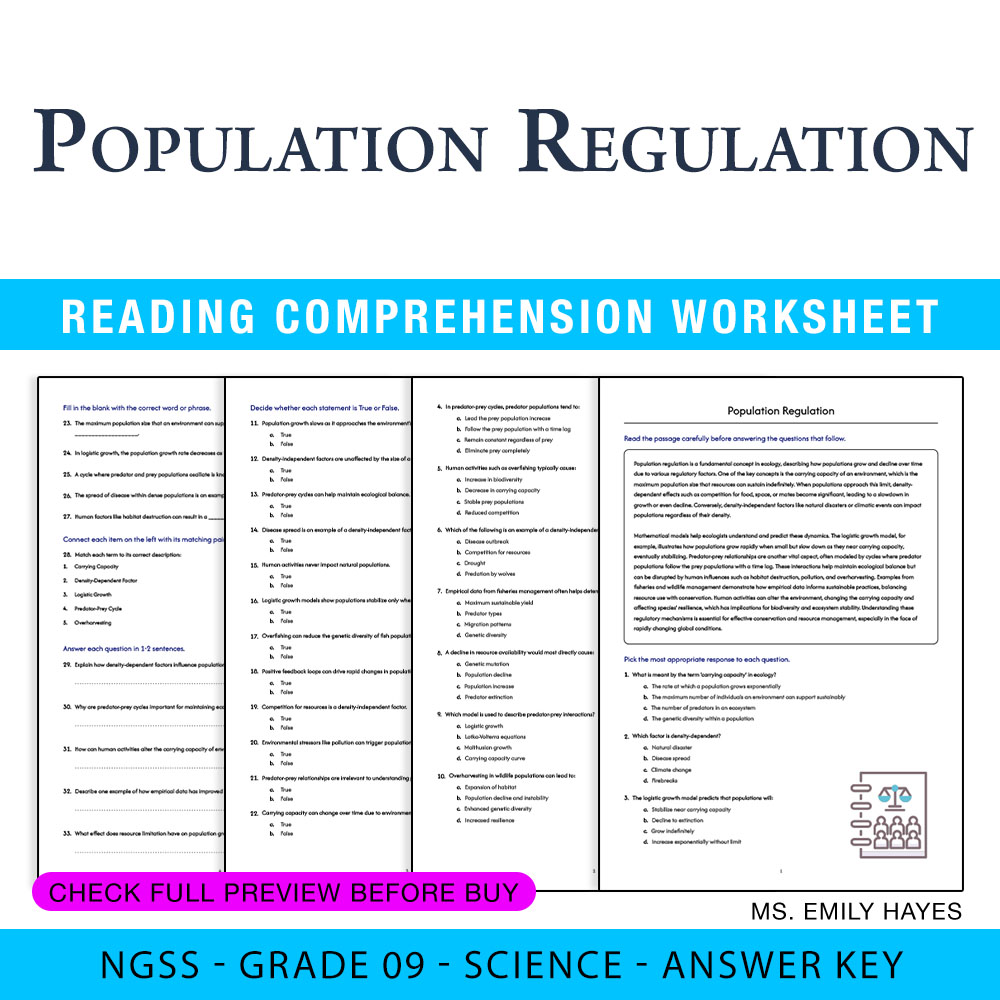
9th Grade Science | Population Regulation Worksheet (PDF+ Answer Key)
 Created byCopper Leaf Classroom
Learning Objectives
- Describe factors that influence population sizes, including carrying capacity, competition, predation, and disease.
- Explain mathematical models such as logistic growth and predator-prey cycles in population dynamics.
- Analyze how human activities affect population resilience and ecosystems.
Instant download

Grade 9 Science – Chemical Changes & Observable Signs | Daily Reading Worksheet
Created byBright Mind ResourcesLearning Objectives
- Identify key indicators of chemical reactions such as gas production, temperature change, precipitate formation, and color change.
- Distinguish between physical and chemical changes based on observable evidence.
- Understand microscopic processes involved in chemical transformations.
Also included in: Grade 9 Chemistry Science Lesson Bundle Daily Reading Worksheets | Ontario +1 more
Instant download

Grade 9 Science – States & Energy Daily Reading Worksheet | Ontario Standards
Created byBright Mind ResourcesLearning Objectives
- Understand the particle arrangements in solids, liquids, and gases.
- Describe how energy transfer causes phase changes such as melting, vaporization, sublimation, and condensation.
- Explain latent heat and how phase transitions occur without changing chemical identity.
Also included in: Grade 9 Chemistry Science Lesson Bundle Daily Reading Worksheets | Ontario +1 more
Instant download

Grade 9 Science – Gas Behaviour & Properties | Daily Reading Worksheet
Created byBright Mind ResourcesLearning Objectives
- Describe the properties of gas particles using the particle model.
- Explain how pressure, volume, and temperature relate to particle motion.
- Connect microscopic particle behavior to macroscopic gas phenomena.
Also included in: Grade 9 Chemistry Science Lesson Bundle Daily Reading Worksheets | Ontario +1 more
Instant download

Grade 9 Science – States of Matter & Particle Theory | Daily Reading Worksheet
Created byBright Mind ResourcesLearning Objectives
- Describe the particle arrangements in solids, liquids, and gases.
- Explain how particle motion varies with temperature and state.
- Relate microscopic particle behavior to observable properties like pressure and diffusion.
Also included in: Grade 9 Chemistry Science Lesson Bundle Daily Reading Worksheets | Ontario +1 more
Instant download

Grade 9 Science – Societal Impacts of Chemicals | Daily Reading Worksheet
Created byBright Mind ResourcesLearning Objectives
- Understand the benefits and risks of common household chemicals
- Analyze how chemical properties affect their environmental and health impacts
- Evaluate the importance of safe handling, disposal, and regulation of chemicals
Also included in: Grade 9 Chemistry Science Lesson Bundle Daily Reading Worksheets | Ontario +1 more
Instant download
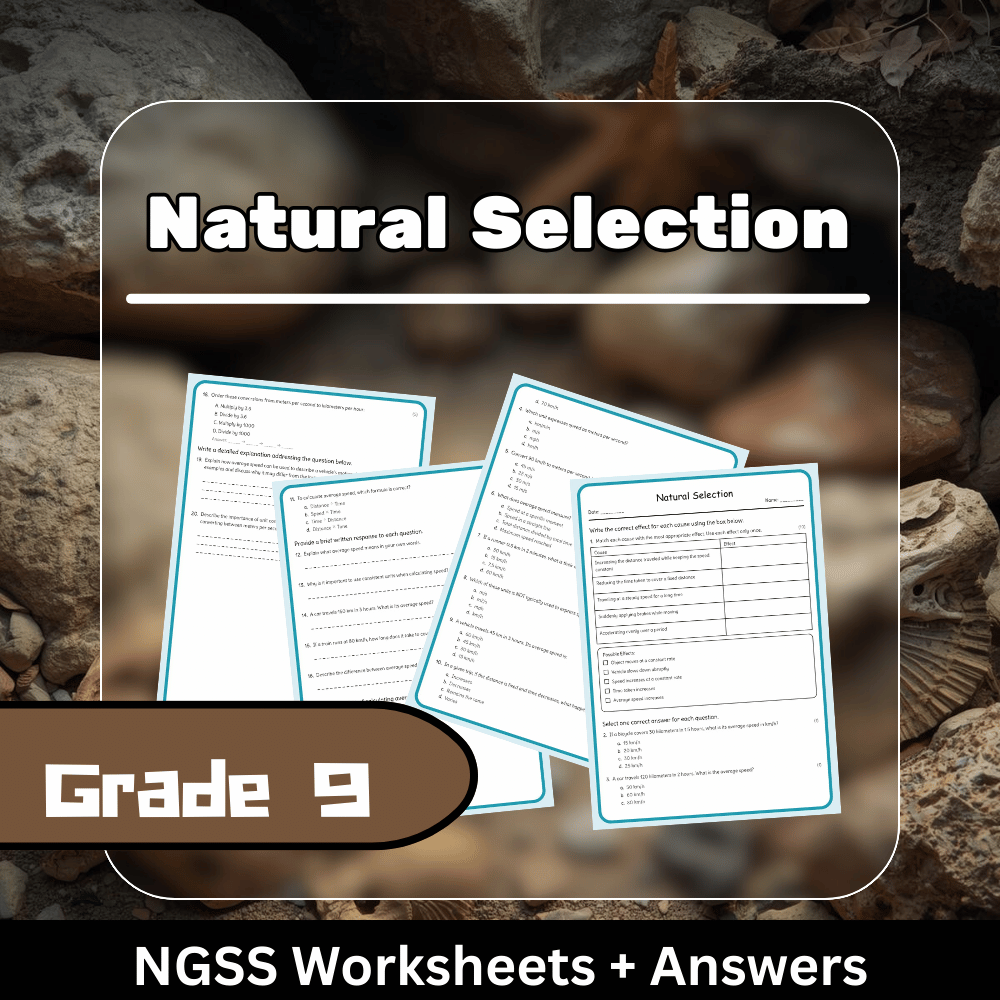
Grade 9 Science | Natural Selection Worksheet (Answer Key) - NGSS Aligned
Created byBright Mind ResourcesLearning Objectives
- Explain how heritable variation leads to differential survival and reproduction.
- Identify examples of natural selection such as beak morphology shifts and antibiotic resistance.
- Understand and interpret models of fitness and allele frequency changes in populations.
Instant download
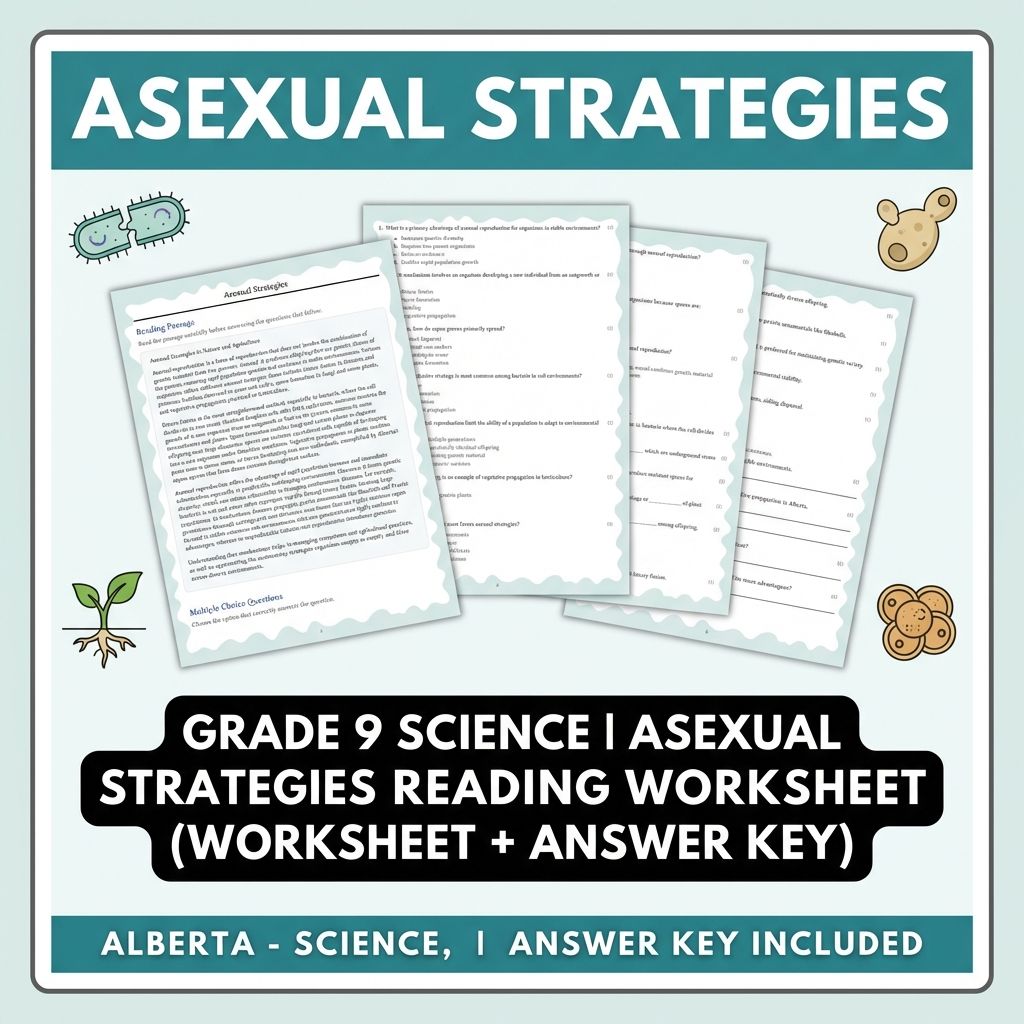
Grade 9 Science | Asexual Strategies Reading Worksheet (Worksheet + Answer Key)
JCreated byJ.S SheetsLearning Objectives
- Describe mechanisms of asexual reproduction including binary fission, budding, spore formation, and vegetative propagation.
- Understand the genetic consequences of producing clones through asexual strategies.
- Compare ecological contexts where asexual versus sexual reproduction is advantageous.
Also included in: Grade 9 Science Unit Bundle | Genetics, Cell Biology & Biotechnology Worksheets +1 more
Instant download

Grade 9 Science Lab Reaction Design and Optimization Worksheet | NGSS
 Created byAmber Owl Education
Learning Objectives
- Explain how temperature, pressure, concentration, and catalysts can change reaction rates and product outcomes
- Use equilibrium and kinetic ideas to predict how changes in conditions affect yield and selectivity
- Apply mass-balance and reaction-rate reasoning to closed-system chemical processes
Also included in: Grade 9 Science Chemical Reactions Lesson Bundle | NGSS +1 more
Instant download

Grade 9 Science – Pedigree Analysis & Genetics | Daily Reading Worksheet
Created byBright Mind ResourcesLearning Objectives
- Understand the symbols and conventions used in pedigree charts.
- Interpret patterns of inheritance such as autosomal, X-linked, and mitochondrial.
- Analyze family trees to determine possible genotypes and inheritance modes.
Also included in: Grade 9 Gene Expression & Genetics Science Daily Reading Lesson Bundle | TEKS +2 more
Instant download

Grade 9 Science – Nucleic Acid Structure & Function | Daily Reading Worksheet
Created byBright Mind ResourcesLearning Objectives
- Identify the basic components of DNA and RNA
- Understand the structural differences between DNA and RNA
- Explain how nucleic acid structures relate to their functions in heredity and cellular processes
Also included in: Grade 9 Gene Expression & Genetics Science Daily Reading Lesson Bundle | TEKS +2 more
Instant download
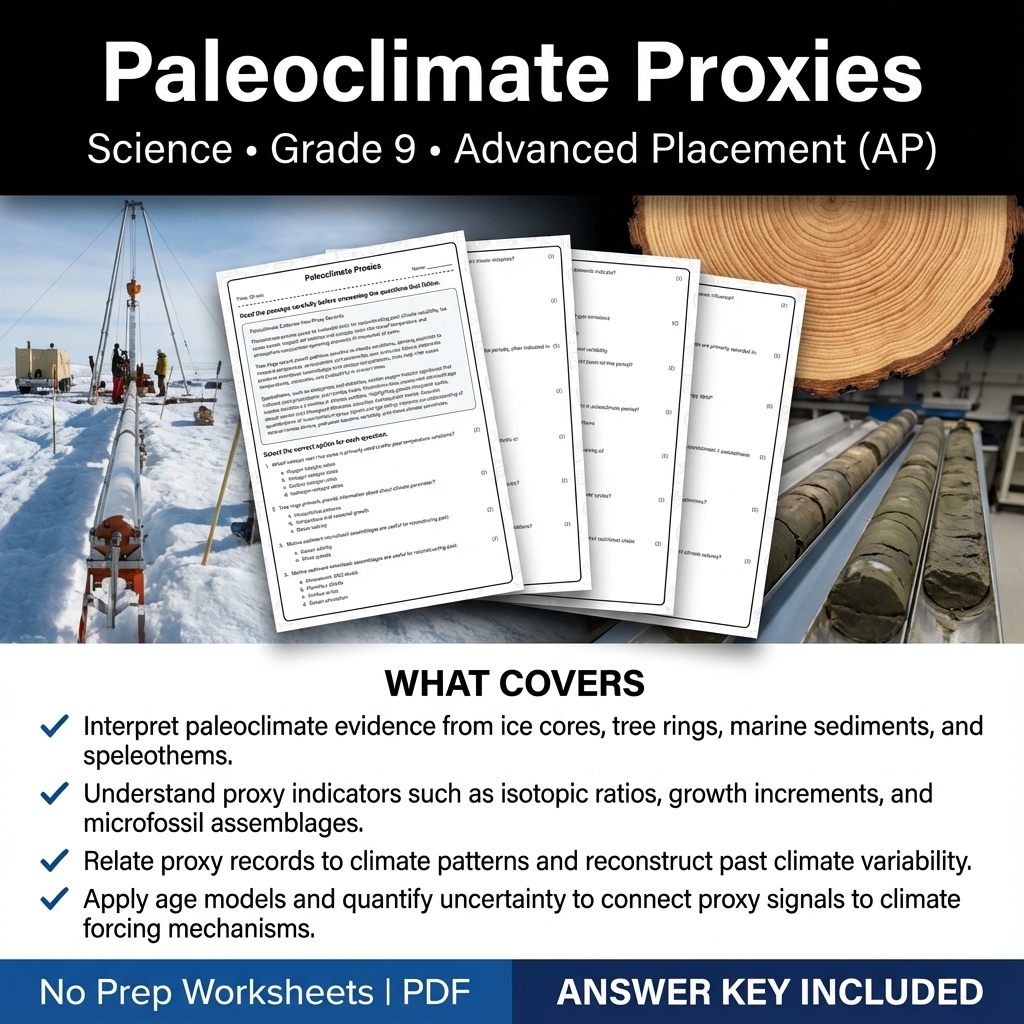
Grade 9 Science | Paleoclimate Proxies Worksheet (Printable PDF + Answer Key)
Created byCoral Reef LearningLearning Objectives
- Interpret paleoclimate evidence from ice cores, tree rings, marine sediments, and speleothems.
- Understand proxy indicators such as isotopic ratios, growth increments, and microfossil assemblages.
- Relate proxy records to climate patterns and reconstruct past climate variability.
Also included in: Grade 9 Science Unit | Earth Processes & Climate Worksheets Pack (PDF & Answer Keys) +2 more
Instant download
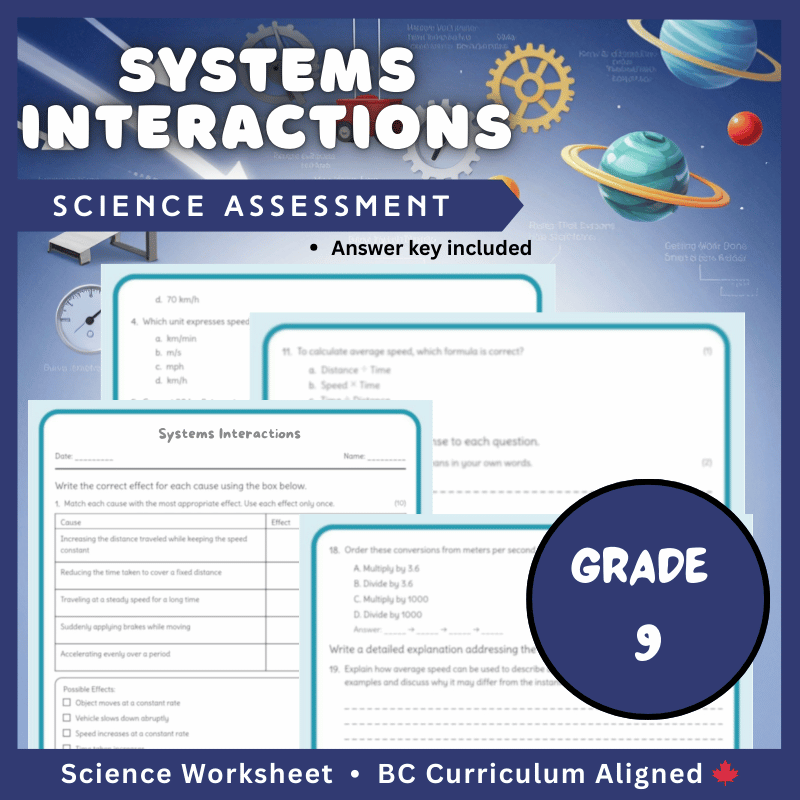
Grade 9 Science | Systems Interactions Worksheet + Answer Key (PDF)
Created byBright Mind ResourcesLearning Objectives
- Understand how multiple bodies and forces interact within mechanical systems.
- Apply Newton’s laws and net force analysis to predict motion outcomes.
- Analyze energy transfer, including losses, during system events like collisions.
Instant download

Grade 9 Science – Reproductive Modes & Strategies | Daily Reading Worksheet
Created byBright Mind ResourcesLearning Objectives
- Understand the differences between sexual and asexual reproduction
- Identify examples of each reproductive strategy in nature
- Analyze ecological trade-offs associated with reproductive methods
Also included in: Grade 9 Genetics & Inheritance Science Daily Reading Lesson Bundle | Alberta +1 more
Instant download
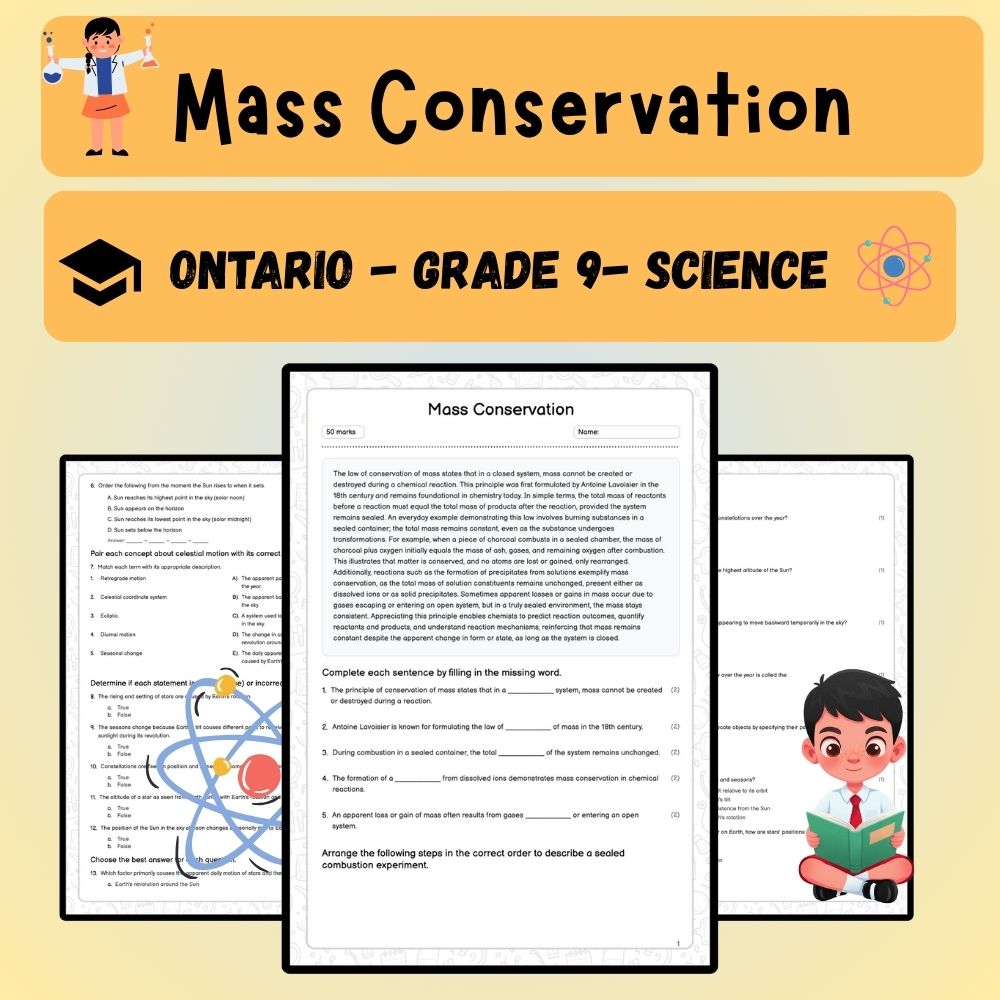
Grade 9 Science | Mass Conservation Worksheet (Answer Key) - Ontario Standards
Created byPrism Point LearningLearning Objectives
- Understand the principle of conservation of mass in closed systems during chemical reactions.
- Identify examples illustrating mass conservation, such as combustion and precipitate formation.
- Differentiate between apparent mass changes due to gas exchange and true mass conservation.
Also included in: Grade 9 Science UNIT Worksheet Pack | Chemical Properties, Energy & Reactions +1 more
Instant download
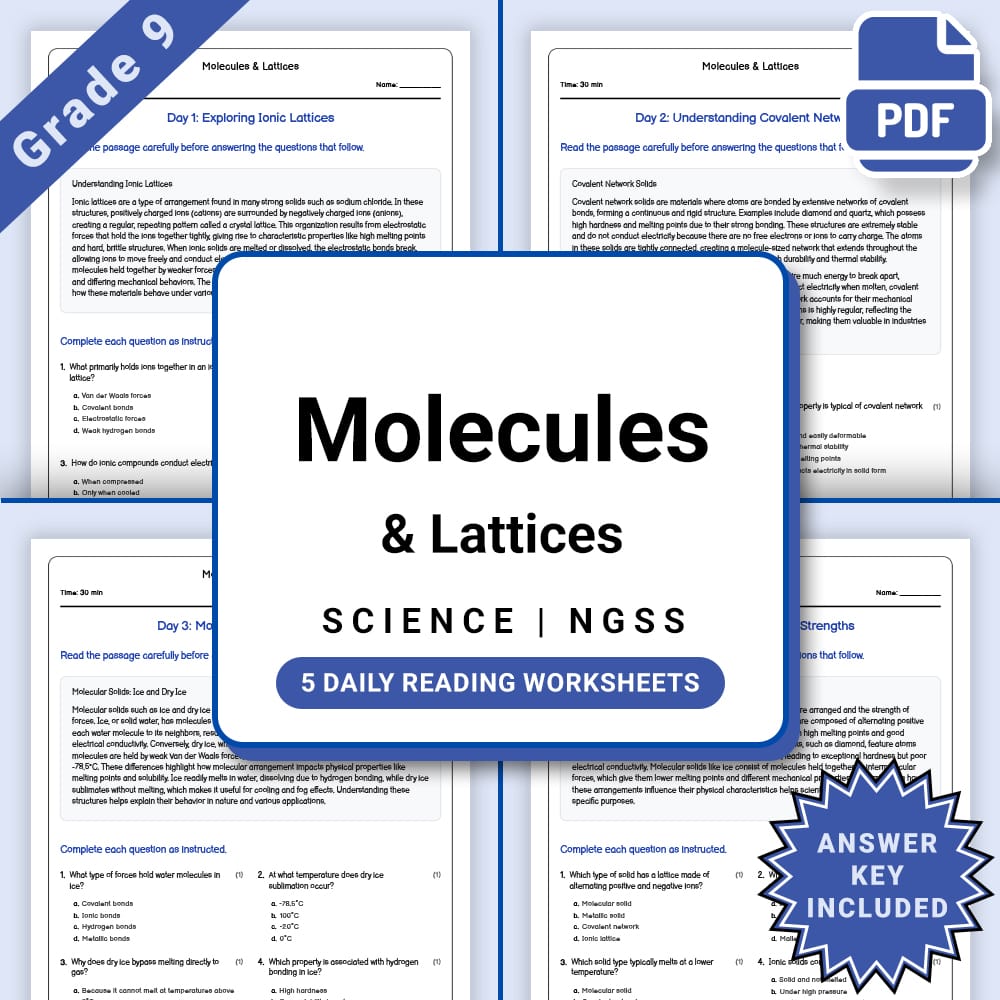
Grade 9 Science – Molecules & Lattices Worksheet(PDF + Answer Key)
Created byCopper Leaf ClassroomLearning Objectives
- Understand the structure of ionic lattices and how they differ from covalent networks and molecular solids.
- Identify the physical properties that reflect the arrangement of particles in different solid structures.
- Explain how electrical forces among particles influence melting points, electrical conductivity, hardness, and solubility.
Instant download
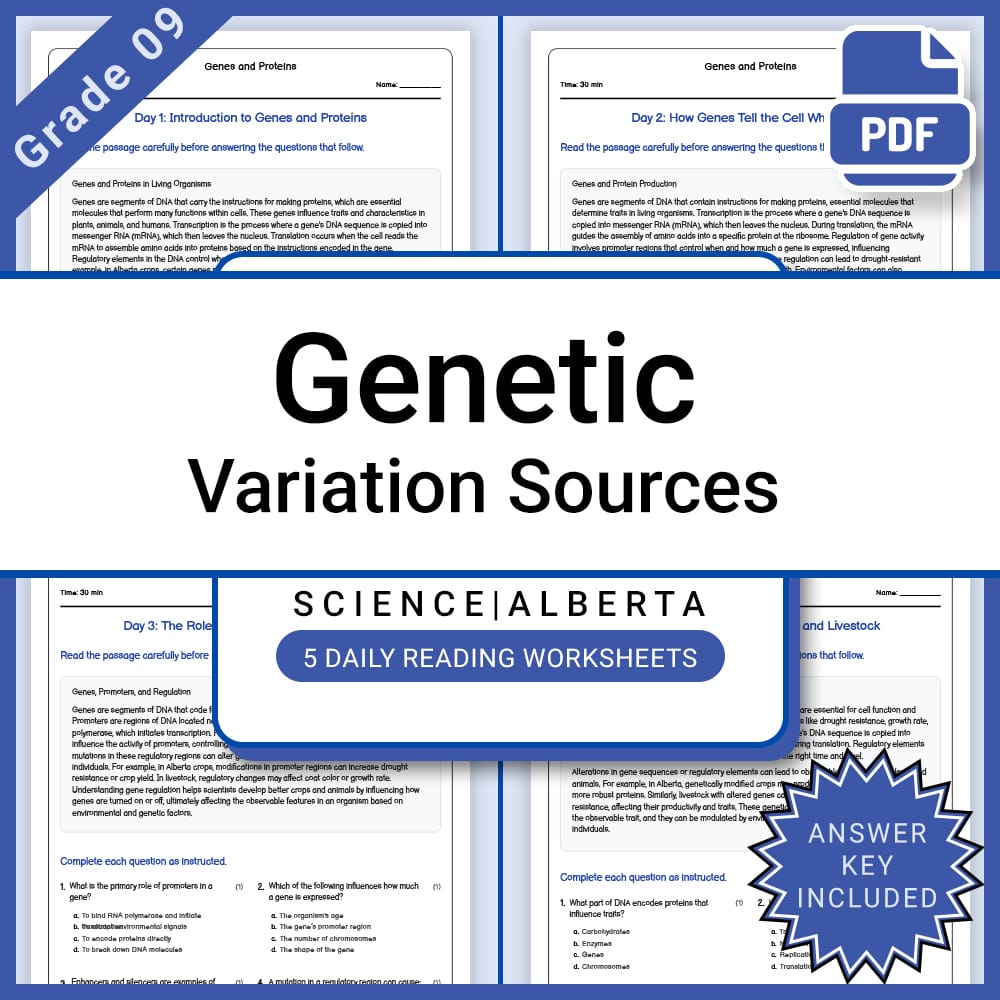
Grade 9 Science – Genetic Variation Sources Daily Reading Worksheet + Answer Key
JCreated byJ.S SheetsLearning Objectives
- Understand key concepts related to Science
- Apply knowledge through practice questions
- Demonstrate comprehension of the material
Also included in: Grade 9 Science Lesson Group | Genetics, Reproduction, and Biotechnology +1 more
Instant download
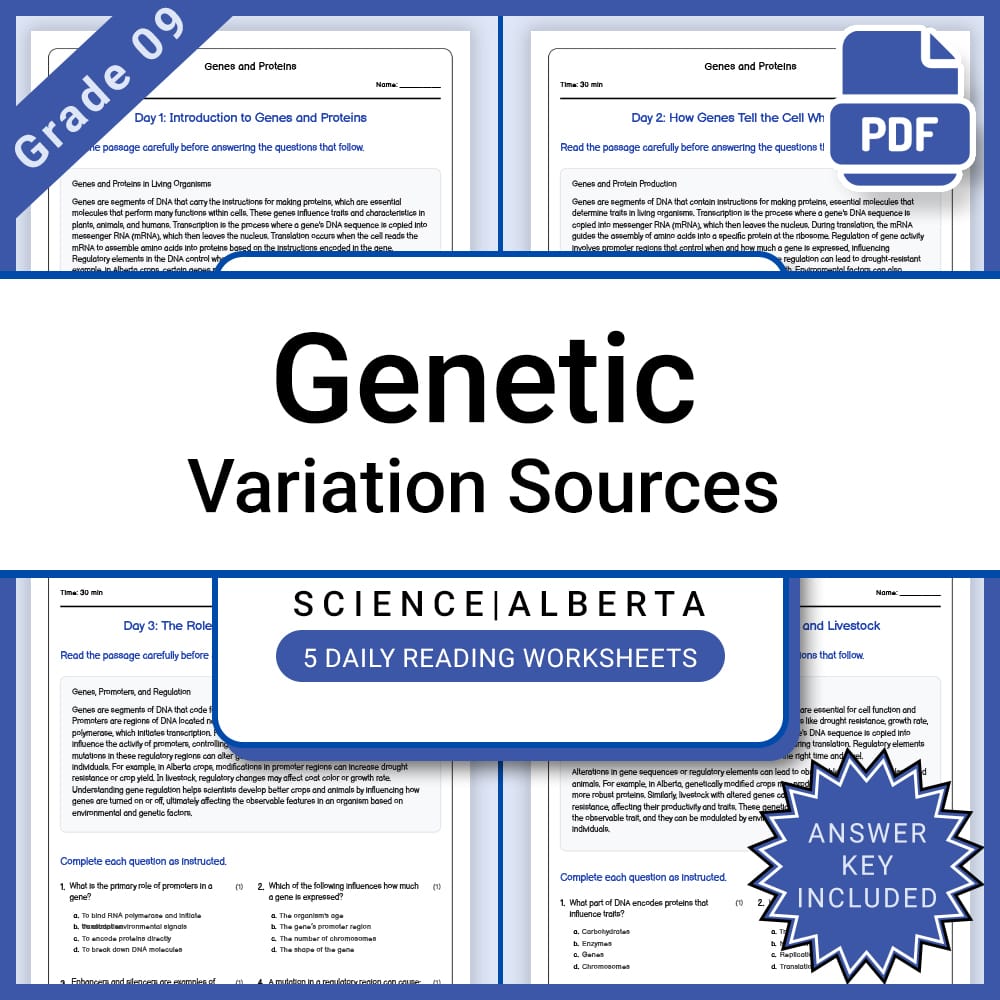
Grade 9 Science – Genes and Proteins Daily Reading Worksheet with Answer Key
JCreated byJ.S SheetsLearning Objectives
- Understand what genes and proteins are and their roles in living organisms.
- Explain the processes of transcription and translation in gene expression.
- Recognize how gene regulation influences traits and phenotypes.
Also included in: Grade 9 Science Lesson Group | Genetics, Reproduction, and Biotechnology +1 more
Instant download
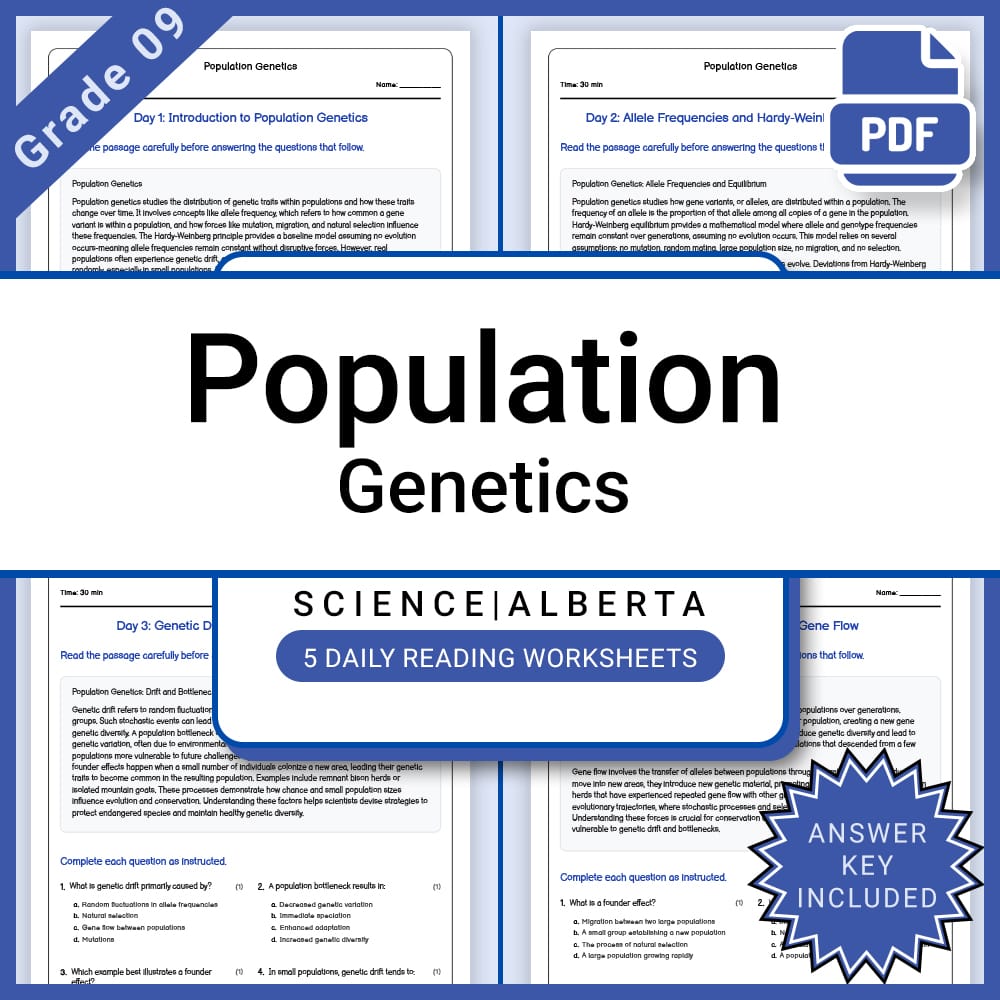
Grade 9 Science – Population Genetics Daily Reading Worksheet + Answer Key
JCreated byJ.S SheetsLearning Objectives
- Understand basic concepts of population genetics, including allele frequency and genetic variation.
- Identify the assumptions of Hardy-Weinberg equilibrium.
- Describe processes such as genetic drift, bottlenecks, and founder effects, and their impact on genetic diversity.
Also included in: Grade 9 Science Lesson Group | Genetics, Reproduction, and Biotechnology +1 more
Instant download
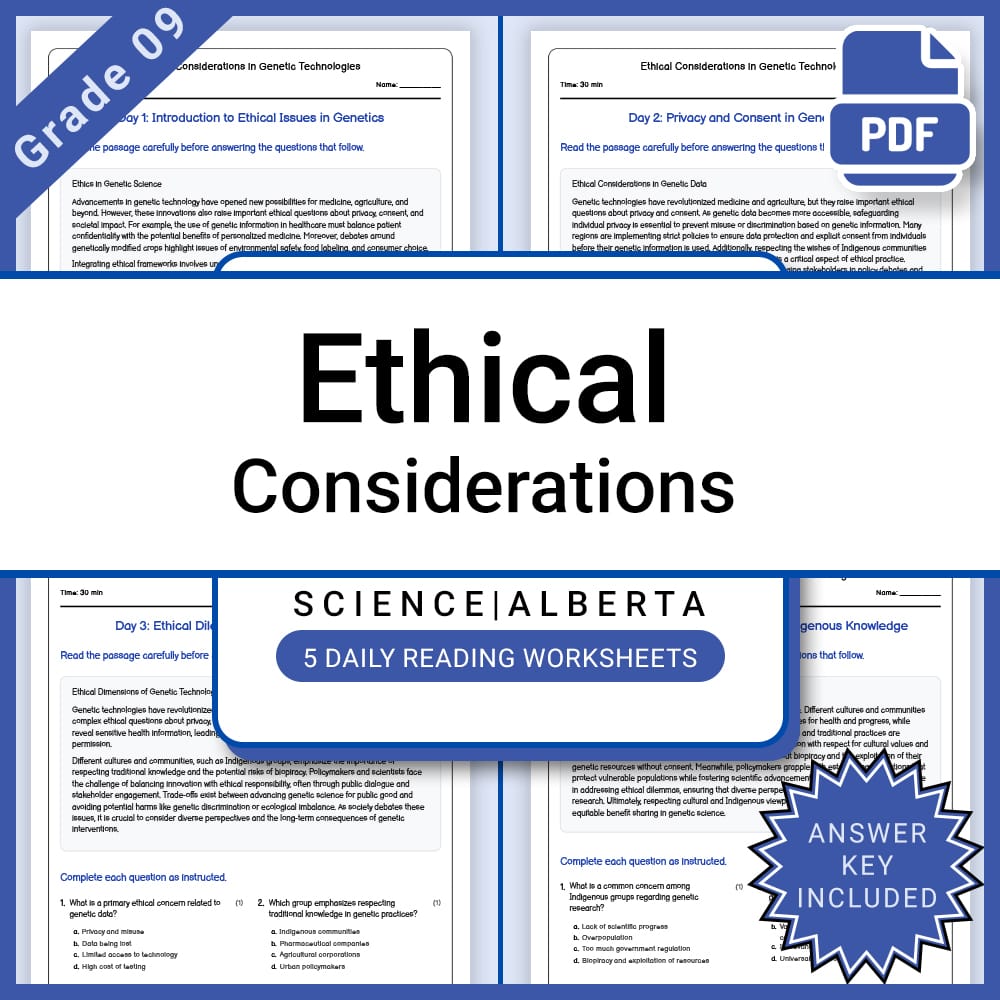
Grade 9 Science – Ethical Considerations Daily Reading Worksheet + Answer Key
JCreated byJ.S SheetsLearning Objectives
- Recognize basic ethical questions related to genetic science
- Understand societal concerns about privacy and consent in genetics
- Identify different perspectives on food labeling and indigenous knowledge
Also included in: Grade 9 Science Lesson Group | Genetics, Reproduction, and Biotechnology +1 more
Instant download
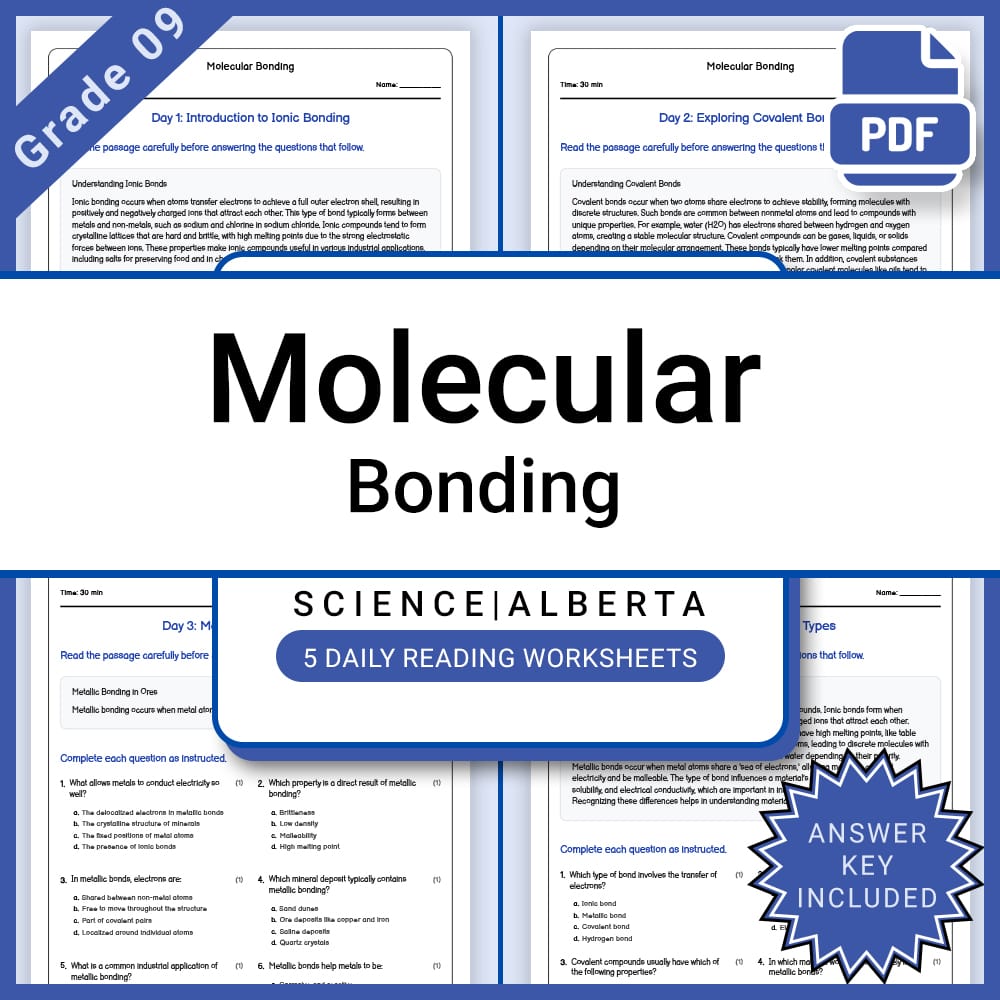
Grade 9 Science – Molecular Bonding Daily Reading Worksheet + Answer Key
JCreated byJ.S SheetsLearning Objectives
- Understand the concept of ionic bonds and their properties
- Identify examples of ionic compounds
- Describe how ionic bonds affect the physical properties of substances
Also included in: Grade 9 Science Lesson Bundle | Alberta Framework +1 more
Instant download

Grade 9 Science – Introduction to Biotechnology Daily Reading Worksheet + Answer Key
JCreated byJ.S SheetsLearning Objectives
- Understand the basic concepts and history of biotechnology
- Identify major genetic technologies and their applications
- Explain mechanisms of trait introduction at molecular and population levels
Also included in: Grade 9 Science Lesson Group | Genetics, Reproduction, and Biotechnology +1 more
Instant download

Grade 9 – Element Symbols and Chemical Formulas Daily Worksheet with Answer Key
JCreated byJ.S SheetsLearning Objectives
- Identify common chemical element symbols.
- Recognize and interpret basic chemical formulas.
- Understand how symbols and formulas communicate chemical composition.
Also included in: Grade 9 Science Lesson Bundle | Alberta Framework +1 more
Instant download
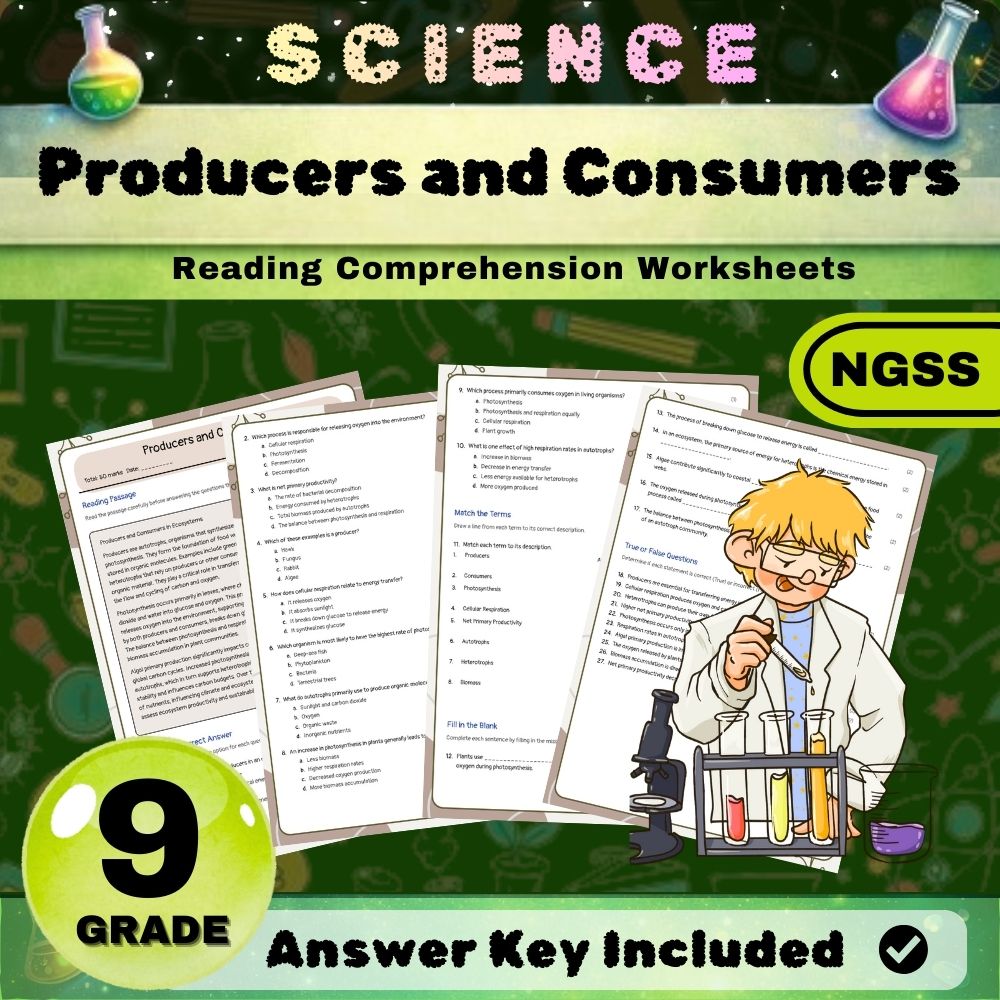
Grade 9 Science | Producers and Consumers Worksheet (NGSS) (PDF)
 Created byMaple Path Learning
Learning Objectives
- Explain the roles of producers and consumers in ecosystems.
- Analyze how photosynthesis and cellular respiration transfer energy and cycle carbon and oxygen.
- Evaluate the impact of net primary productivity on biomass accumulation and energy availability.
Also included in: Grade 9 Science Ecosystems Lesson Bundle | NGSS Interactions & Energy +1 more
Instant download

Grade 9 Science | Power & Efficiency in Mechanical Systems - Reading Practice
Created byCoral Reef LearningLearning Objectives
- Understand the concept of power as the rate of energy transfer
- Explain how efficiency compares useful output energy to input energy
- Recognize the factors that lead to energy loss in systems
Instant download
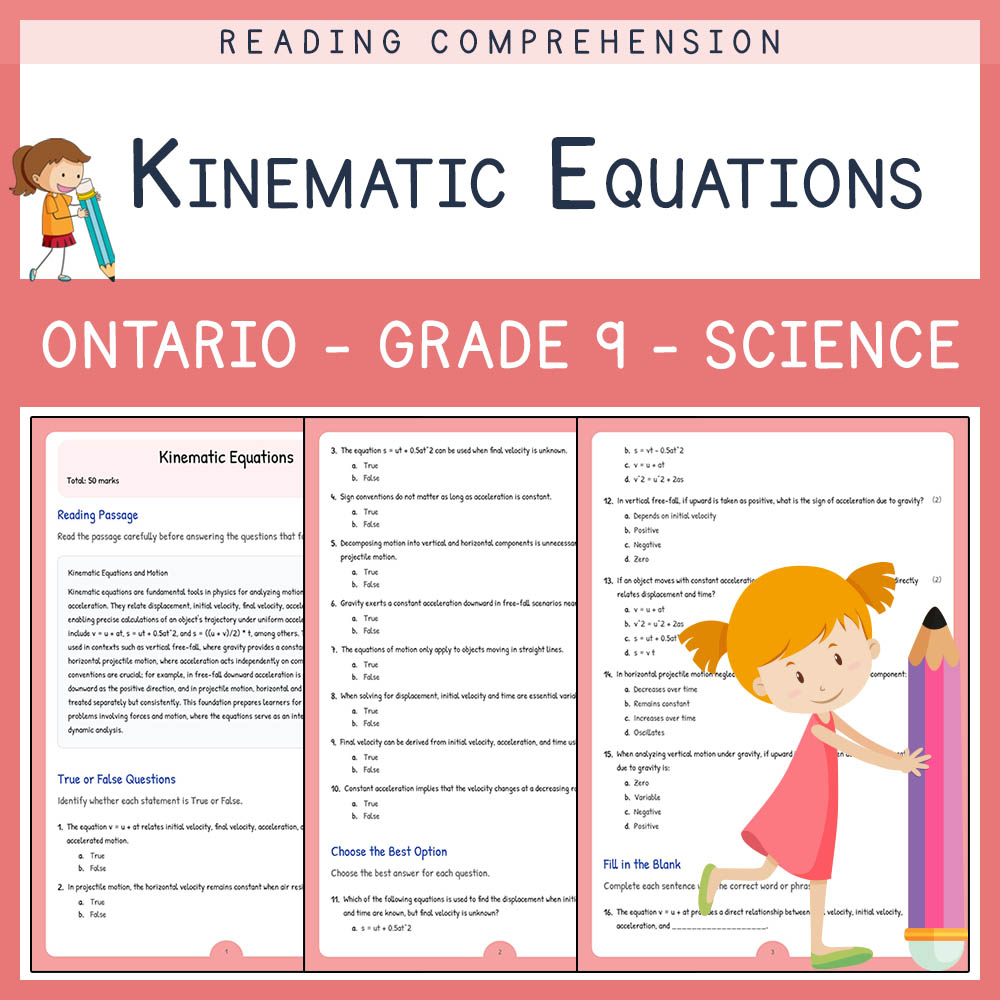
rade 9 Science Physics | Kinematic Equations Worksheet | Ontario Standard
Created byLumora LearningLearning Objectives
- Understand the derivation and form of constant-acceleration kinematic equations.
- Apply kinematic equations to solve problems involving vertical free-fall and projectile motion.
- Interpret sign conventions and component-wise treatment in motion analysis.
Instant download
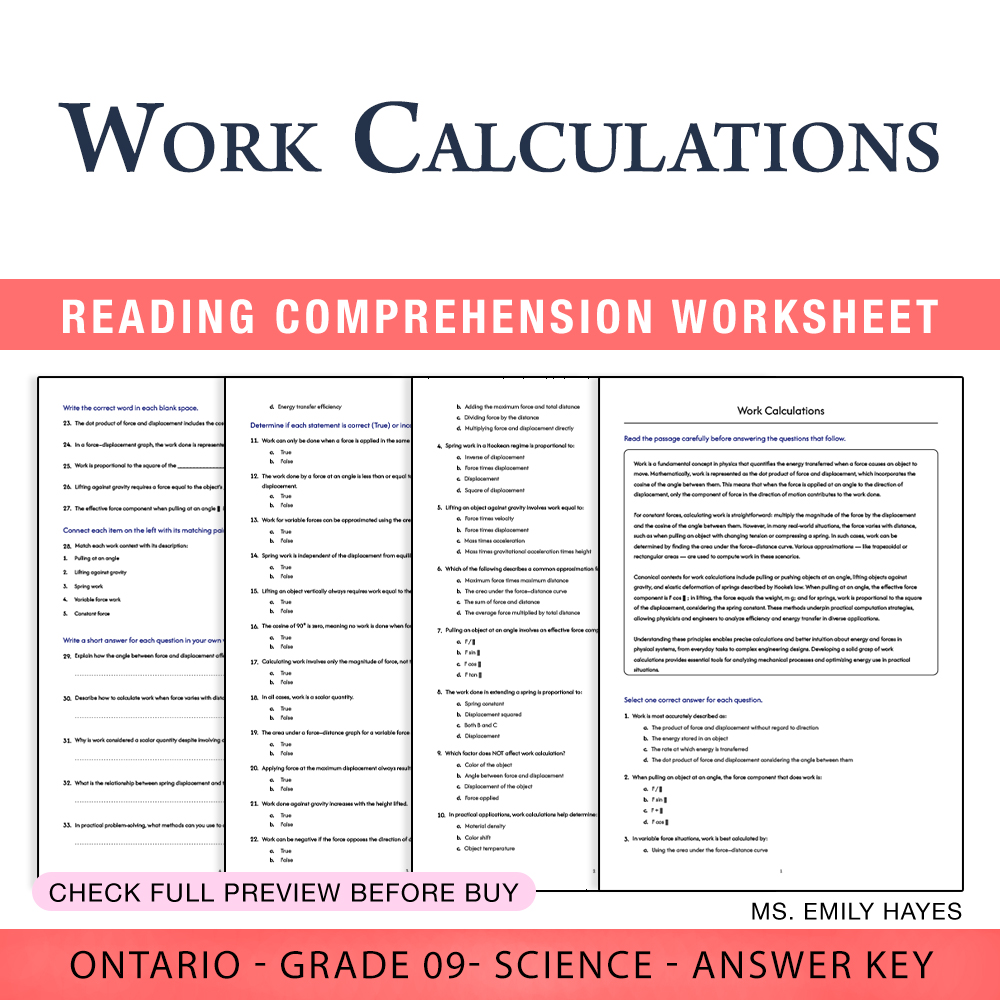
9th Grade Science | Work Calculations Worksheet (PDF + Answer Key)
Created byCopper Leaf ClassroomLearning Objectives
- Understand the concept of work as the dot product of force and displacement, considering the angle between them.
- Calculate work done in various contexts including pulling at an angle, lifting against gravity, and spring work.
- Differentiate methods for calculating work with constant and variable forces, including the area under force–distance curves.
Instant download

Grade 9 Science – Collision Safety & Impact Impulse Daily Reading Worksheet
Created byBright Mind ResourcesLearning Objectives
- Interpret force-time graphs to analyze collision forces
- Calculate impulse from given force and time data
- Understand how various safety devices influence collision outcomes
Also included in: Newtonian Motion Grade 9 Science Daily Reading Worksheets Lesson Bundle | NGSS +2 more
Instant download

Grade 9 Science – Field Dynamics & Magnetism Daily Reading Worksheet
Created byBright Mind ResourcesLearning Objectives
- Understand the concepts of electric and magnetic fields and their vectors.
- Identify the use of field lines to represent magnetic and electric fields.
- Learn how charged particles move in magnetic fields and how forces affect their trajectories.
Also included in: Newtonian Motion Grade 9 Science Daily Reading Worksheets Lesson Bundle | NGSS +2 more
Instant download

Grade 9 Science – Momentum & Conservation | Daily Reading Worksheet
Created byBright Mind ResourcesLearning Objectives
- Define momentum in the context of physics.
- Describe the principle of conservation of linear momentum in isolated systems.
- Differentiate between elastic and inelastic collisions.
Also included in: Newtonian Motion Grade 9 Science Daily Reading Worksheets Lesson Bundle | NGSS +2 more
Instant download
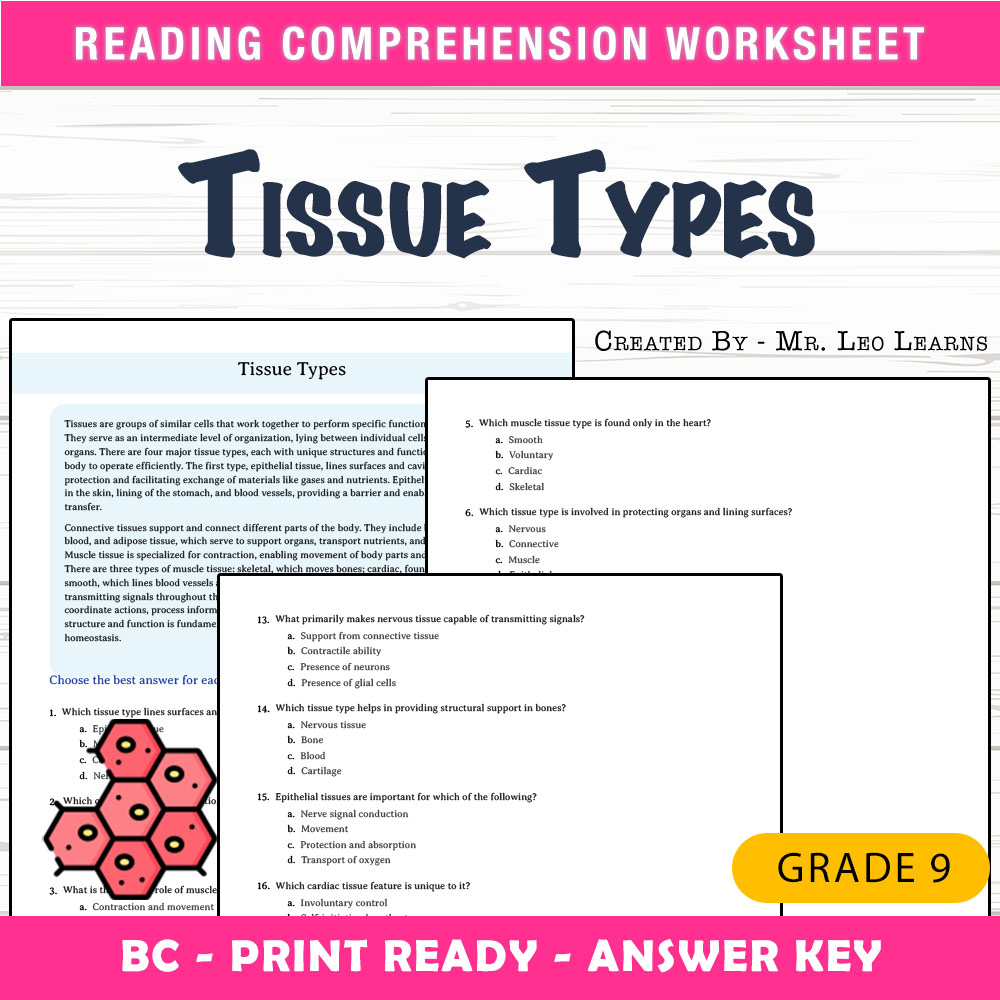
Grade 9 Science — Tissue Types Worksheet MCQ Paper for Master
Created byThe Resource HubLearning Objectives
- Identify and describe the four main tissue types in the human body.
- Understand the functions of epithelial, connective, muscle, and nervous tissues.
- Recognize how tissue structure relates to their specific functions.
Also included in: Grade 9 Science Cells & Body Systems Worksheet Bundle | BC Curriculum Resources +1 more
Instant download
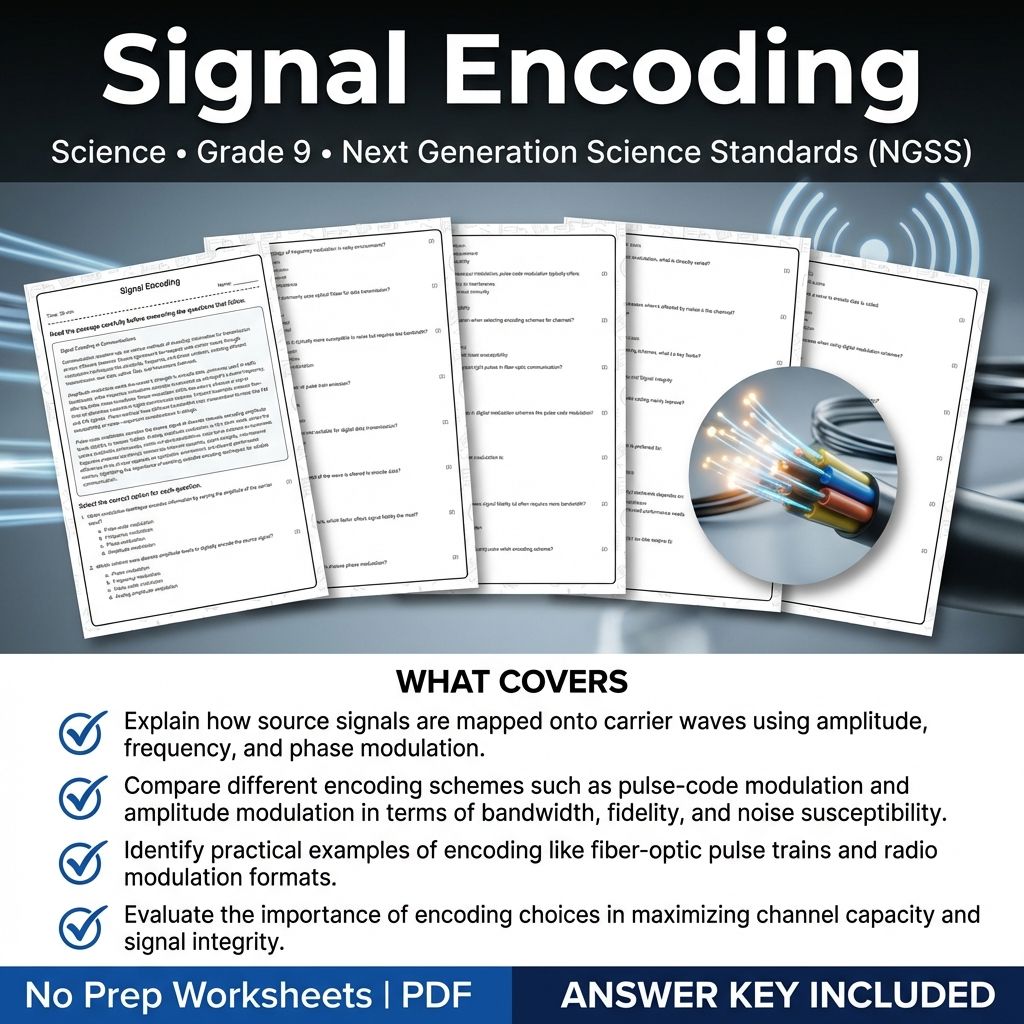
Grade 9 Science | Signal Encoding Worksheet & Answer Key (Printable PDF)
Created byCoral Reef LearningLearning Objectives
- Explain how source signals are mapped onto carrier waves using amplitude, frequency, and phase modulation.
- Compare different encoding schemes such as pulse-code modulation and amplitude modulation in terms of bandwidth, fidelity, and noise susceptibility.
- Identify practical examples of encoding like fiber-optic pulse trains and radio modulation formats.
Also included in: Grade 9 Science | Wave Properties & Electromagnetic Radiation Worksheet Bundle +1 more
Instant download
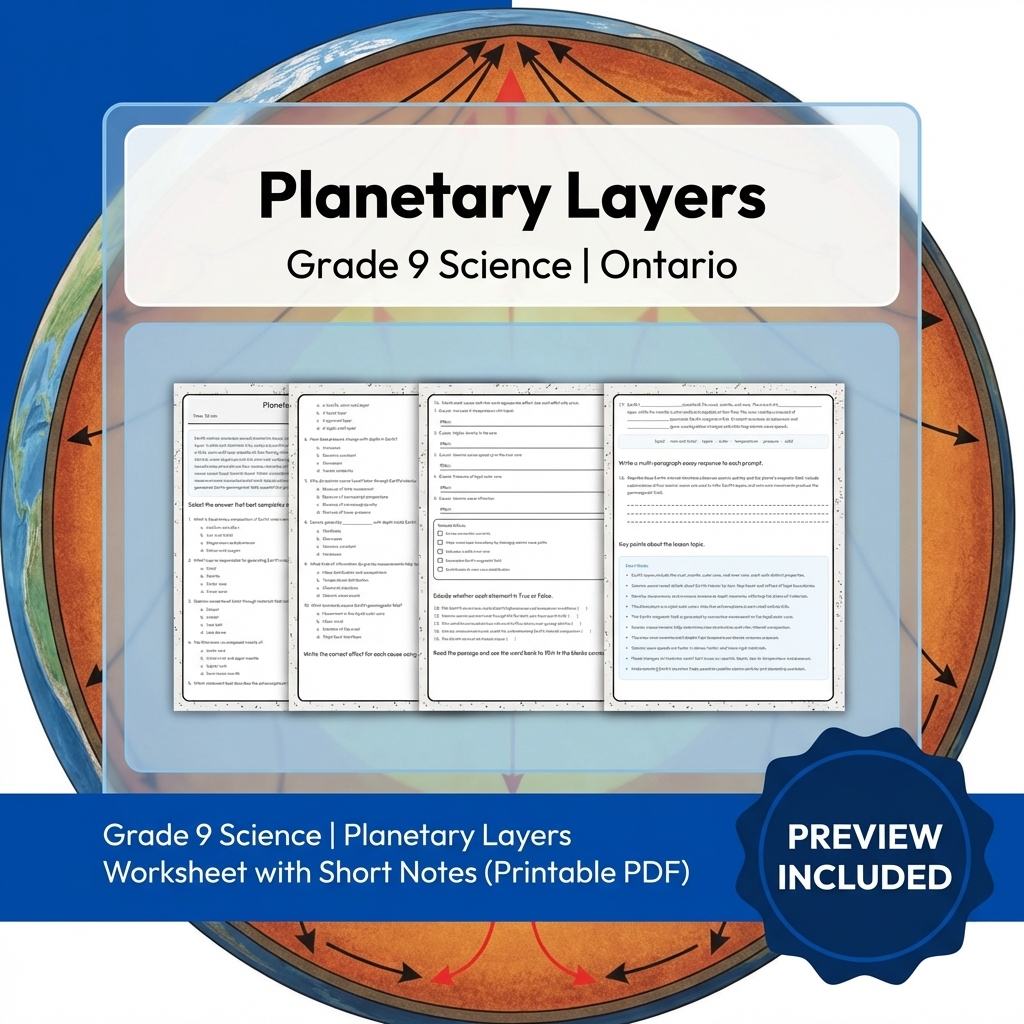
Grade 9 Science | Planetary Layers Worksheet with Short Notes (Printable PDF)
Created byMeadowlark WorksheetsLearning Objectives
- Describe Earth's concentric layers including crust, mantle, and core.
- Compare the mechanical behavior of lithosphere and asthenosphere.
- Explain how density, temperature, and pressure vary with depth and influence material states.
Also included in: Grade 9 Science Lesson Group Bundle | Ontario Curriculum Worksheets
Instant download
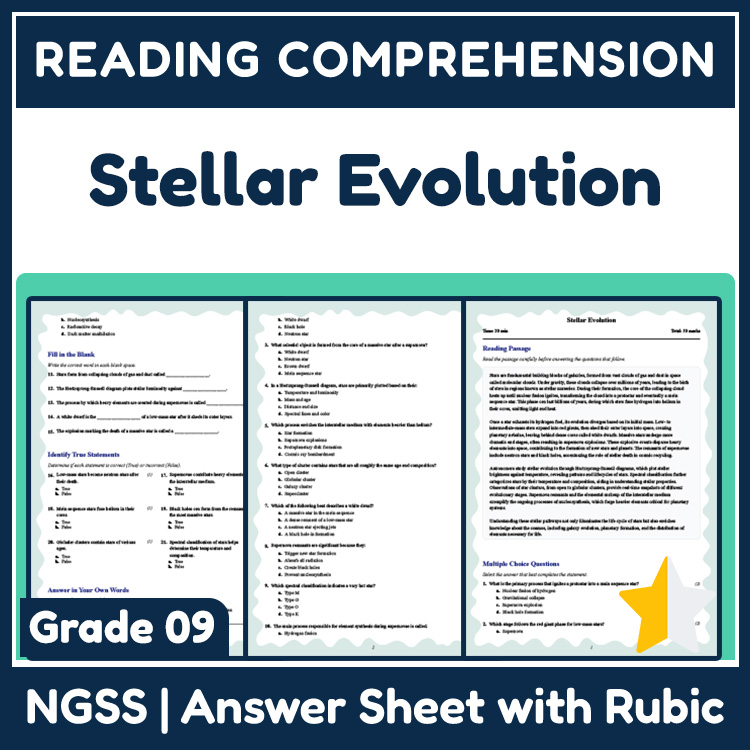
9th Grade Science | Stellar Evolution Reading Worksheet (PDF + Answer Key)
JCreated byJ.S SheetsLearning Objectives
- Describe the main stages of stellar evolution from star formation to end states.
- Interpret Hertzsprung-Russell diagrams and spectral classifications of stars.
- Explain processes such as supernovae and nucleosynthesis that enrich the interstellar medium.
Also included in: Grade 9 Science | Stellar & Cosmic Evolution Unit Worksheet Bundle
Instant download
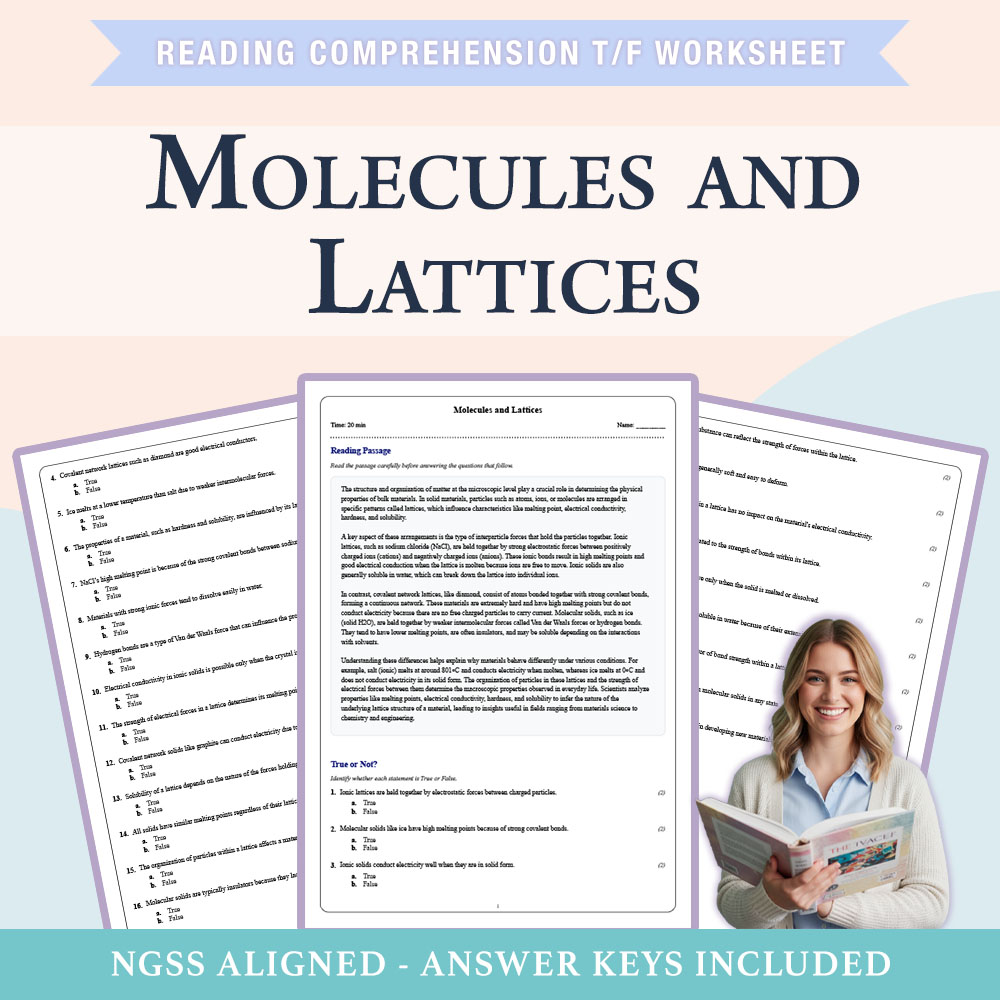
Grade 9 Science | Molecules and Lattices Worksheet (PDF + Answer Key)
Created byCopper Leaf ClassroomLearning Objectives
- Understand the differences between ionic lattices, covalent networks, and molecular solids.
- Identify properties such as melting point, electrical conductivity, hardness, and solubility as indicators of lattice organization.
- Explain how interparticle electrical interactions influence the physical properties of different solid materials.
Also included in: Grade 9 Science | Reaction & Atomic Structure Unit Bundle (PDF + Answer Key) +1 more
Instant download
About Grade 9 Science Worksheets
Find Science worksheets built for Grade 9. All 6,926 cover core skills, practice, and review, each an instant PDF download.
Every worksheet on MyTeachingSheets is created by independent teacher-authors and reviewed before publication. All resources download as printable PDFs for classroom, homework, or at-home practice, and many include answer keys. Preview any worksheet free before buying.