
Grade 9 Science Worksheets
6,926 worksheets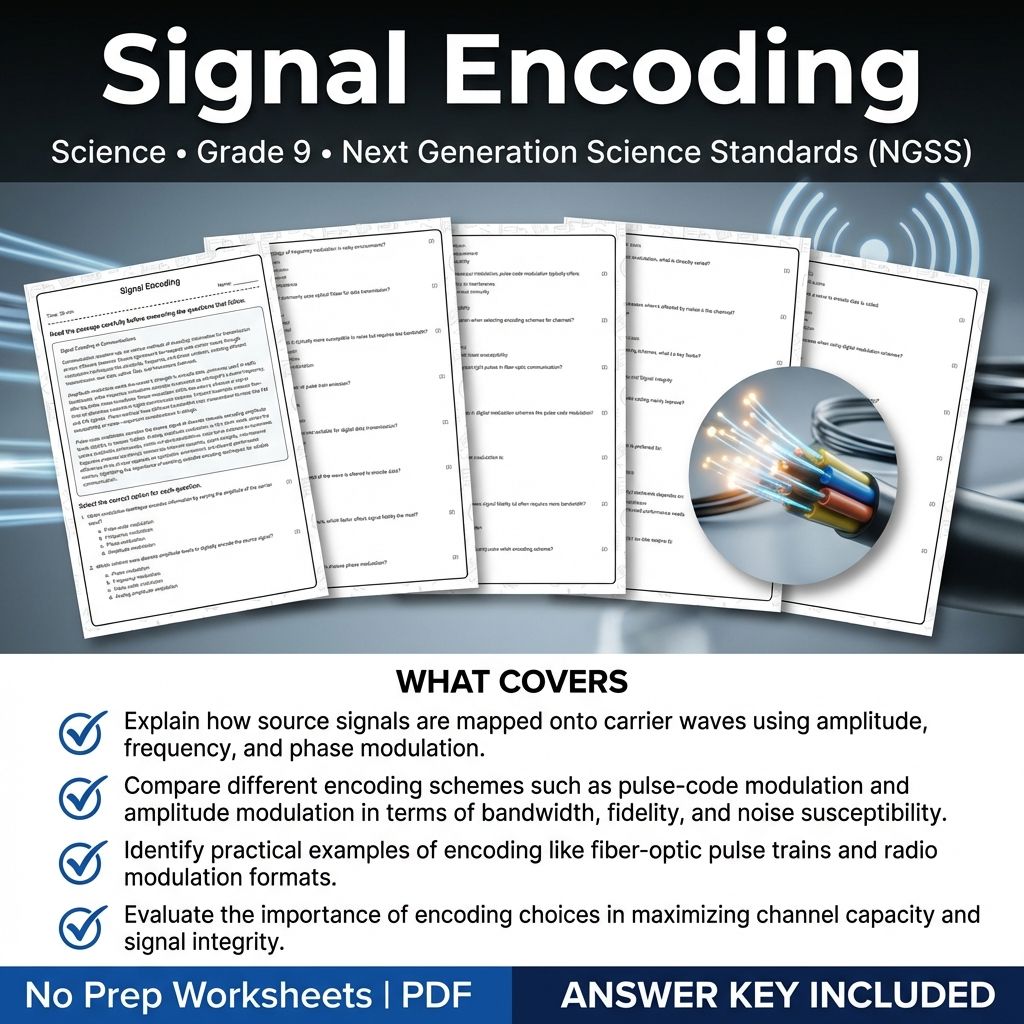
Grade 9 Science | Signal Encoding Worksheet & Answer Key (Printable PDF)
 Created byCoral Reef Learning
Learning Objectives
- Explain how source signals are mapped onto carrier waves using amplitude, frequency, and phase modulation.
- Compare different encoding schemes such as pulse-code modulation and amplitude modulation in terms of bandwidth, fidelity, and noise susceptibility.
- Identify practical examples of encoding like fiber-optic pulse trains and radio modulation formats.
Also included in: Grade 9 Science | Wave Properties & Electromagnetic Radiation Worksheet Bundle +1 more
Instant download
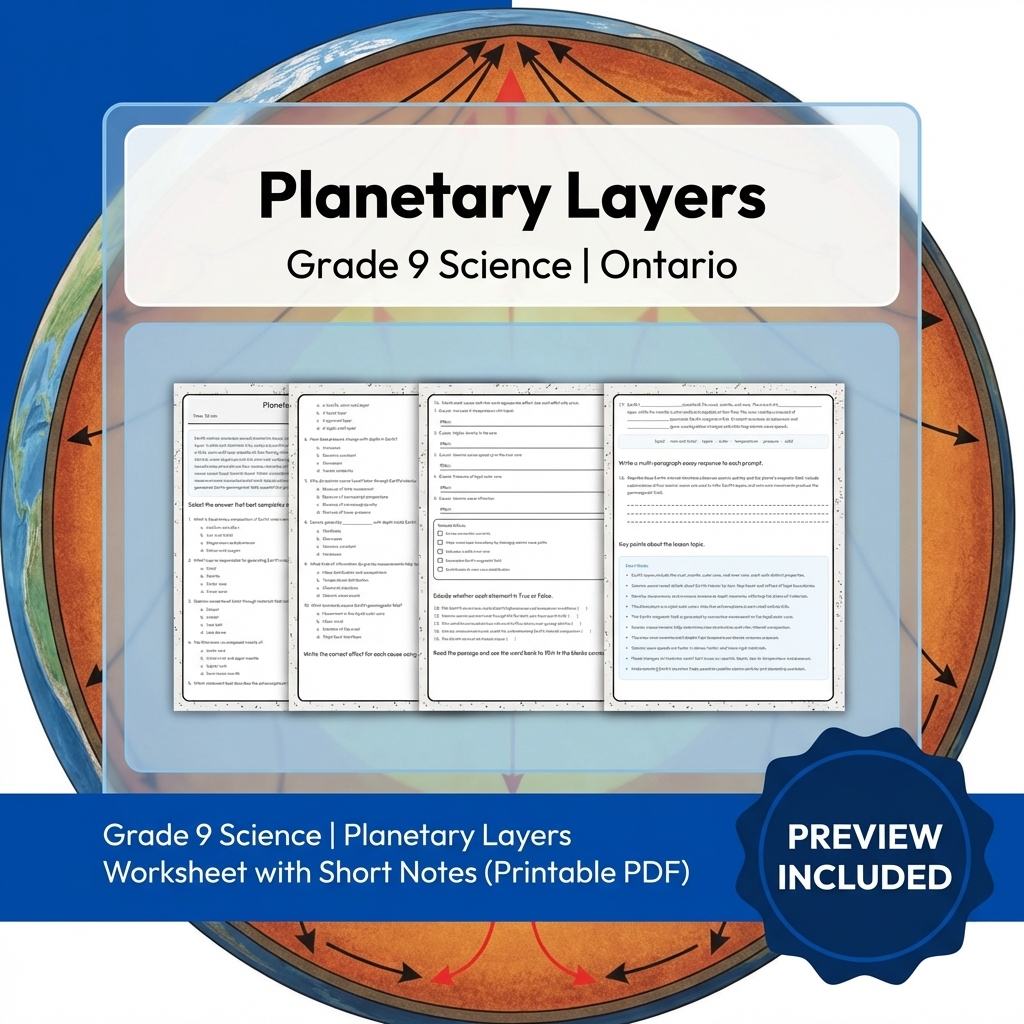
Grade 9 Science | Planetary Layers Worksheet with Short Notes (Printable PDF)
 Created byMeadowlark Worksheets
Learning Objectives
- Describe Earth's concentric layers including crust, mantle, and core.
- Compare the mechanical behavior of lithosphere and asthenosphere.
- Explain how density, temperature, and pressure vary with depth and influence material states.
Also included in: Grade 9 Science Lesson Group Bundle | Ontario Curriculum Worksheets
Instant download
9th Grade Science | Stellar Evolution Reading Worksheet (PDF + Answer Key)
JCreated byJ.S SheetsLearning Objectives
- Describe the main stages of stellar evolution from star formation to end states.
- Interpret Hertzsprung-Russell diagrams and spectral classifications of stars.
- Explain processes such as supernovae and nucleosynthesis that enrich the interstellar medium.
Also included in: Grade 9 Science | Stellar & Cosmic Evolution Unit Worksheet Bundle
Instant download
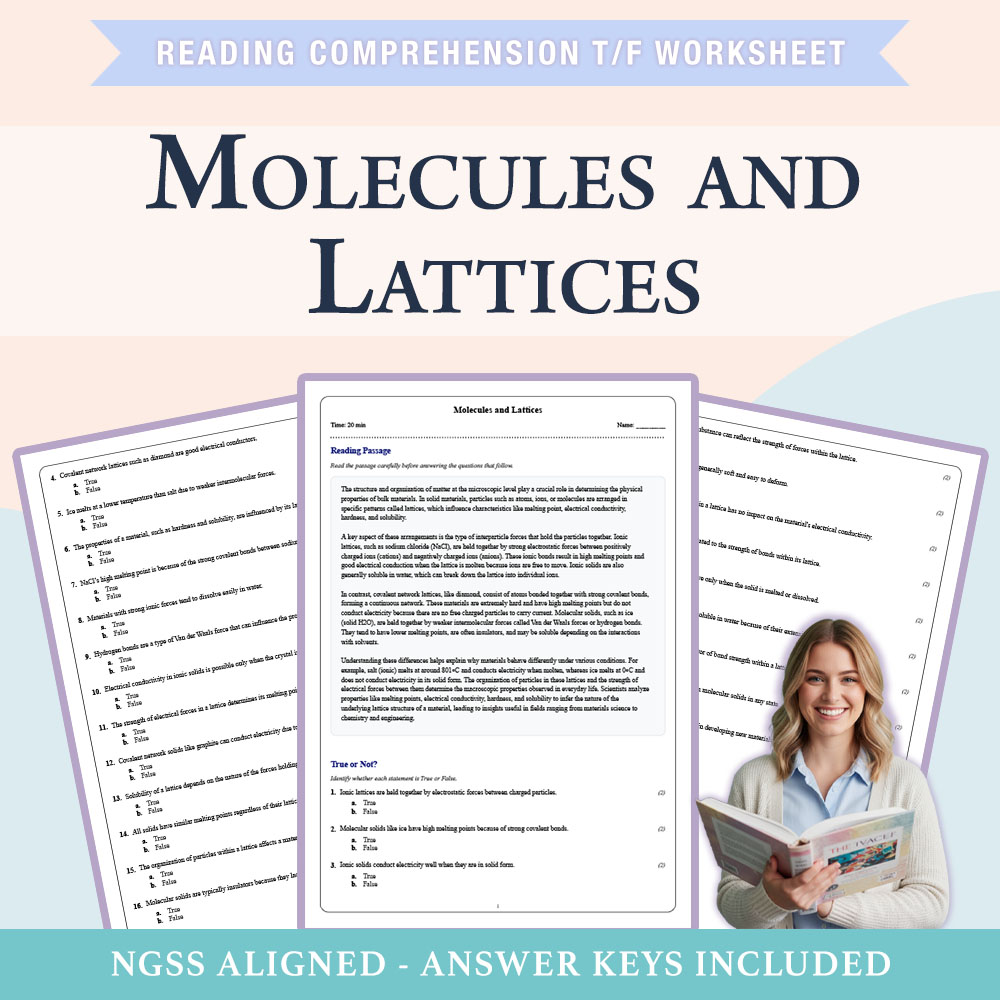
Grade 9 Science | Molecules and Lattices Worksheet (PDF + Answer Key)
 Created byCopper Leaf Classroom
Learning Objectives
- Understand the differences between ionic lattices, covalent networks, and molecular solids.
- Identify properties such as melting point, electrical conductivity, hardness, and solubility as indicators of lattice organization.
- Explain how interparticle electrical interactions influence the physical properties of different solid materials.
Also included in: Grade 9 Science | Reaction & Atomic Structure Unit Bundle (PDF + Answer Key) +1 more
Instant download
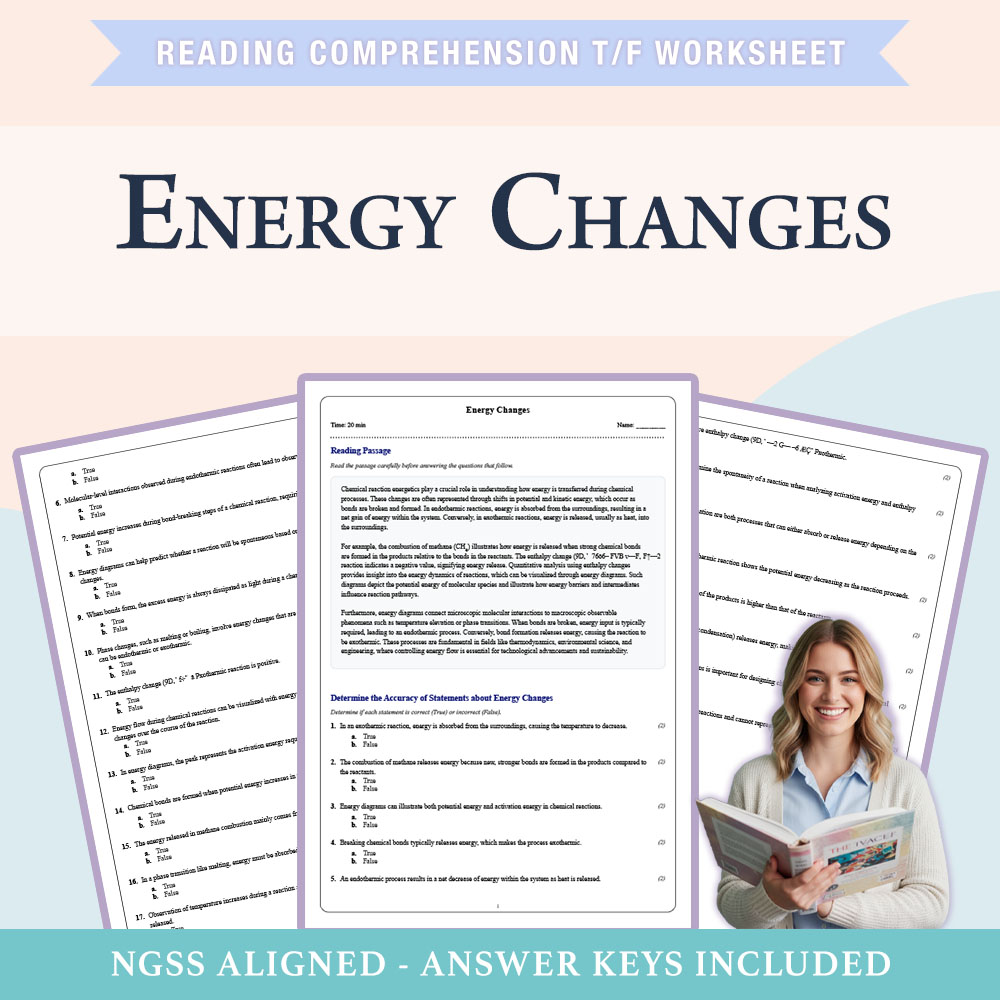
Grade 9 Science | Energy Changes Worksheet (PDF + Answer Key)
Created byCopper Leaf ClassroomLearning Objectives
- Understand how potential and kinetic energy change during chemical reactions.
- Identify processes as endothermic or exothermic based on energy diagrams.
- Relate molecular interactions to observable temperature and phase changes.
Also included in: Grade 9 Science | Reaction & Atomic Structure Unit Bundle (PDF + Answer Key) +1 more
Instant download
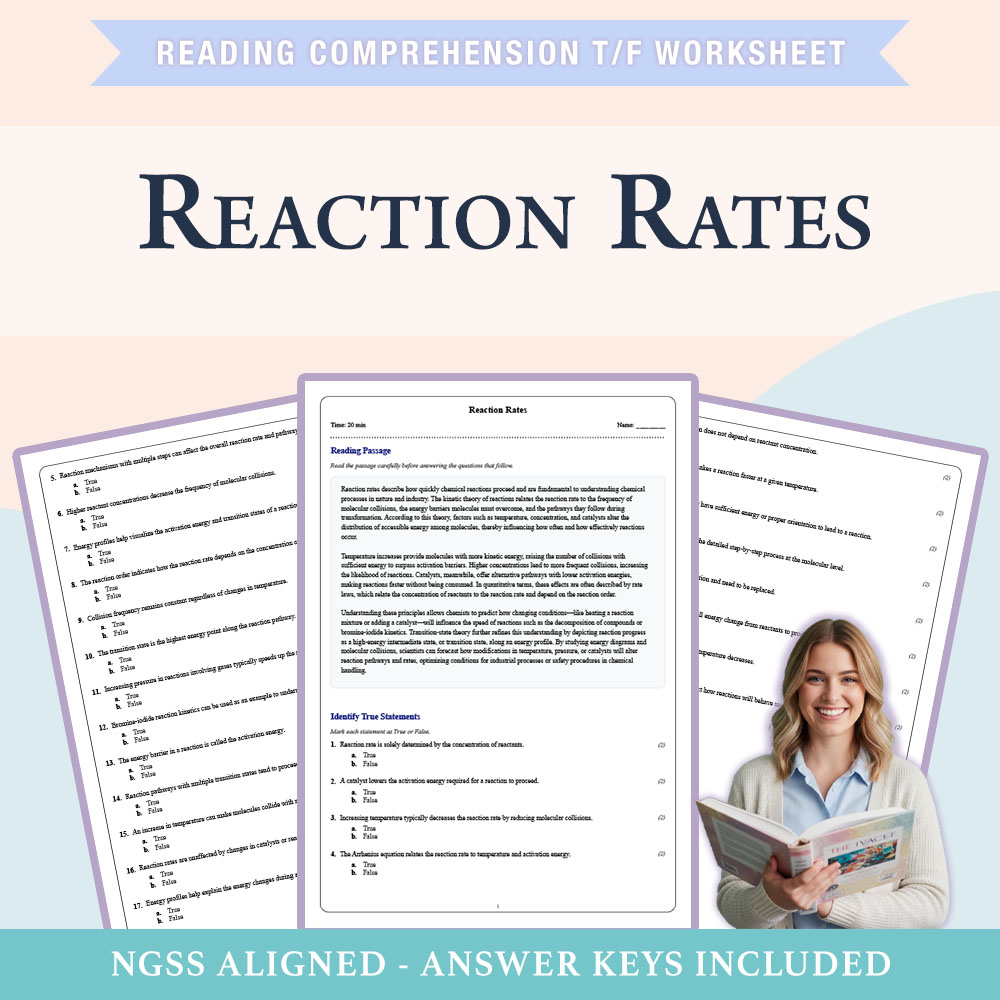
9th Grade Science | Reaction Rates Worksheet (PDF + Answer Key)
Created byCopper Leaf ClassroomLearning Objectives
- Understand how collision frequency, activation energy, and reaction pathways influence reaction rates.
- Explain how temperature, concentration, and catalysts modify energy distributions and affect reaction speed.
- Describe the concepts of rate laws, reaction order, and transition-state theory in relation to reaction kinetics.
Also included in: Grade 9 Science | Reaction & Atomic Structure Unit Bundle (PDF + Answer Key) +1 more
Instant download
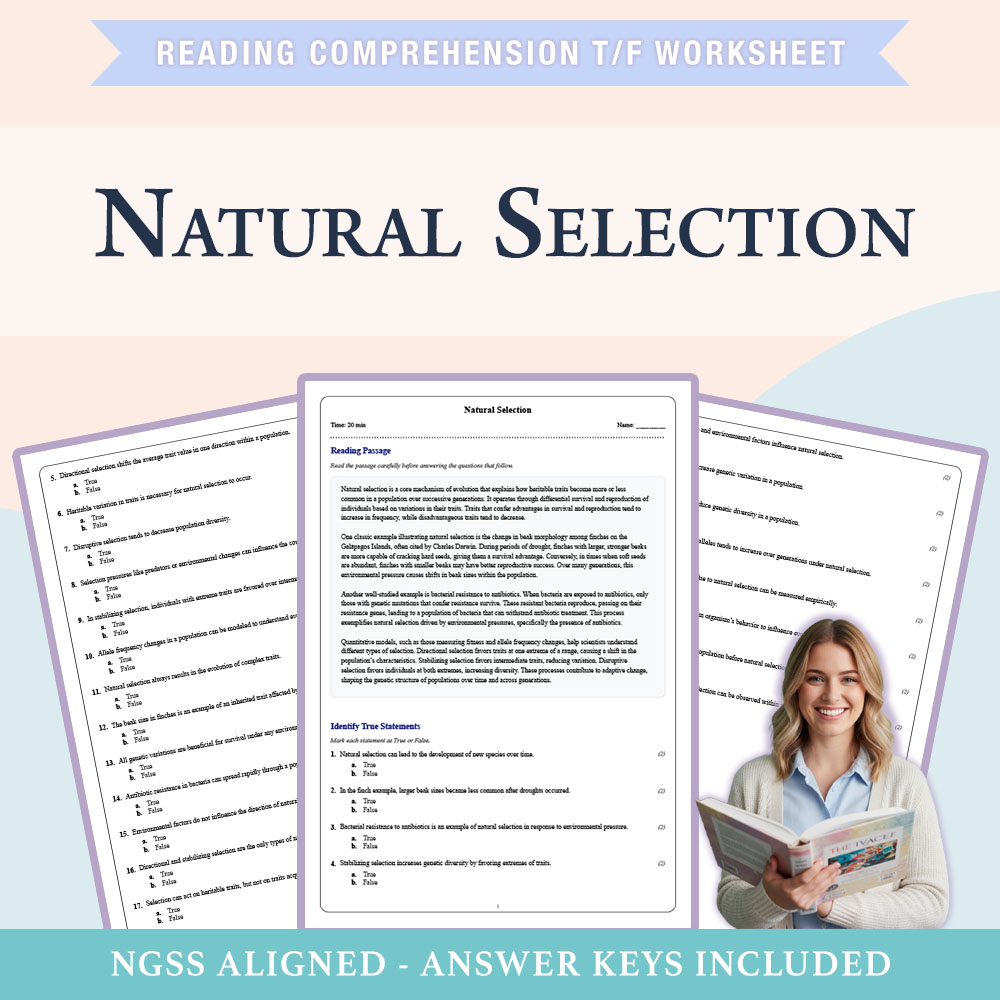
Grade 9 Science | Natural Selection Worksheet (PDF + Answer Key)
Created byCopper Leaf ClassroomLearning Objectives
- Understand the mechanisms of natural selection and how they lead to evolutionary change.
- Identify real-world examples of selection such as finch beak morphology and bacterial resistance.
- Analyze how heritable variation influences differential survival and reproduction.
Also included in: Grade 9 Science | Evolution & Speciation Worksheets Bundle (PDF + Answer Key) +1 more
Instant download
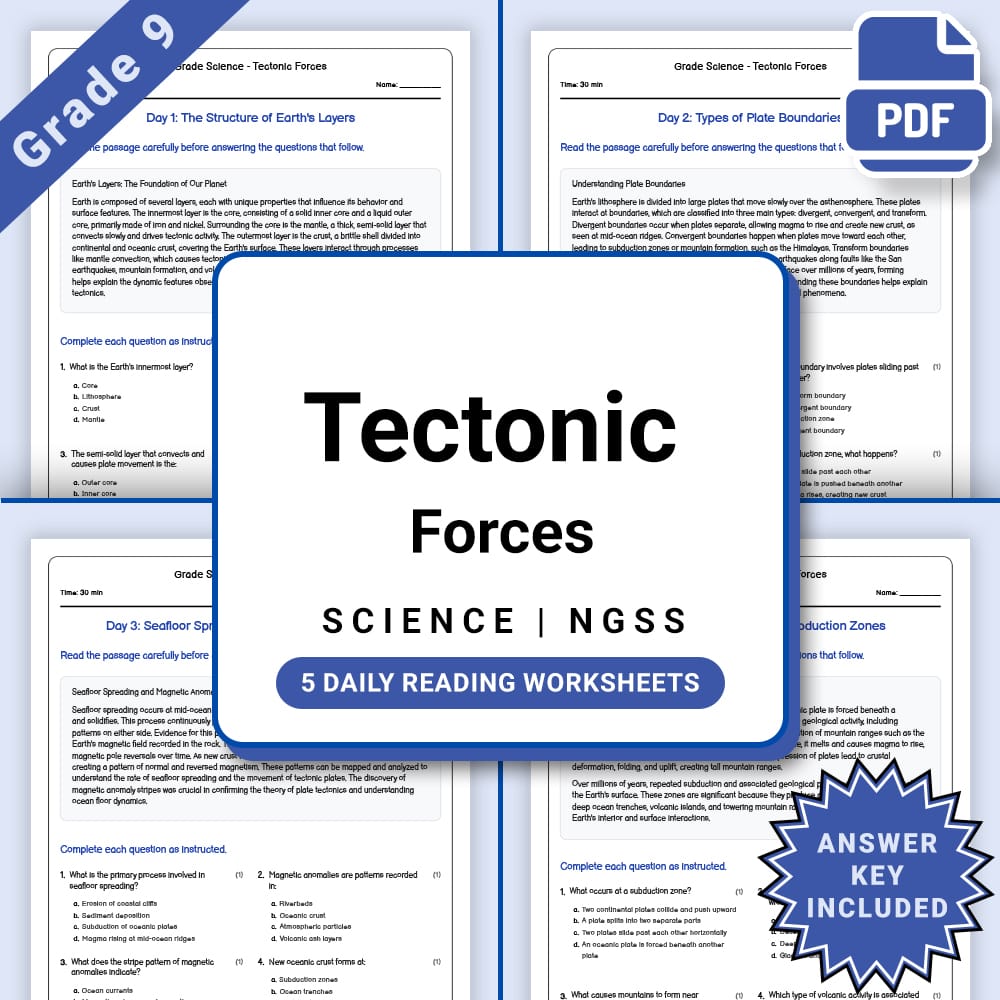
Grade 9 Science – Tectonic Forces Daily Worksheet(PDF + Answer Key)
Created byCopper Leaf ClassroomLearning Objectives
- Identify Earth's internal layers and their characteristics
- Understand how Earth's layers influence surface features
- Describe the processes of plate tectonics, including seafloor spreading and subduction
Instant download
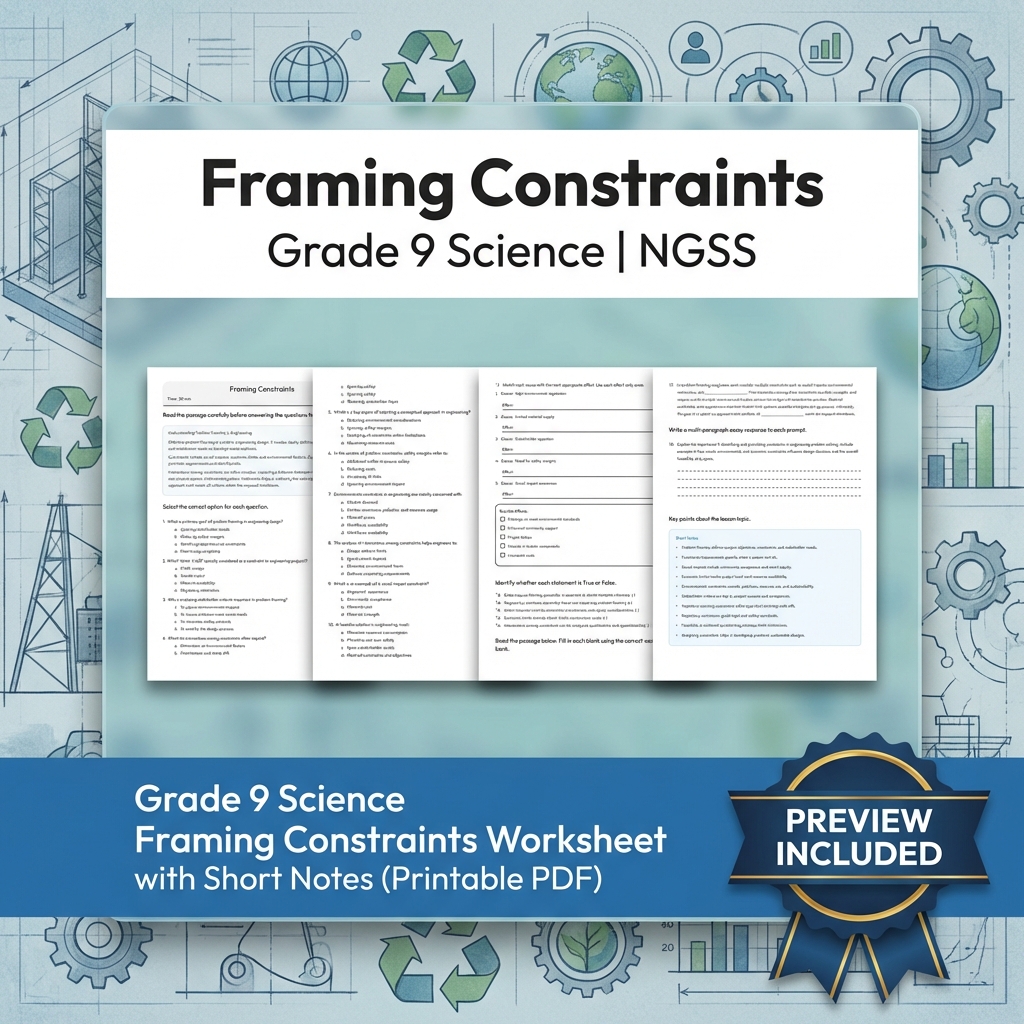
Grade 9 Science Framing Constraints Worksheet with Short Notes (Printable PDF)
Created byMeadowlark WorksheetsLearning Objectives
- Understand key concepts in problem framing for engineering projects.
- Identify and prioritize functional requirements, social impacts, economic limits, and environmental constraints.
- Analyze stakeholder criteria, material availability, and regulatory restrictions.
Also included in: Grade 9 Science NGSS Engineering Design Bundle Prototyping & Evaluation +1 more
Instant download
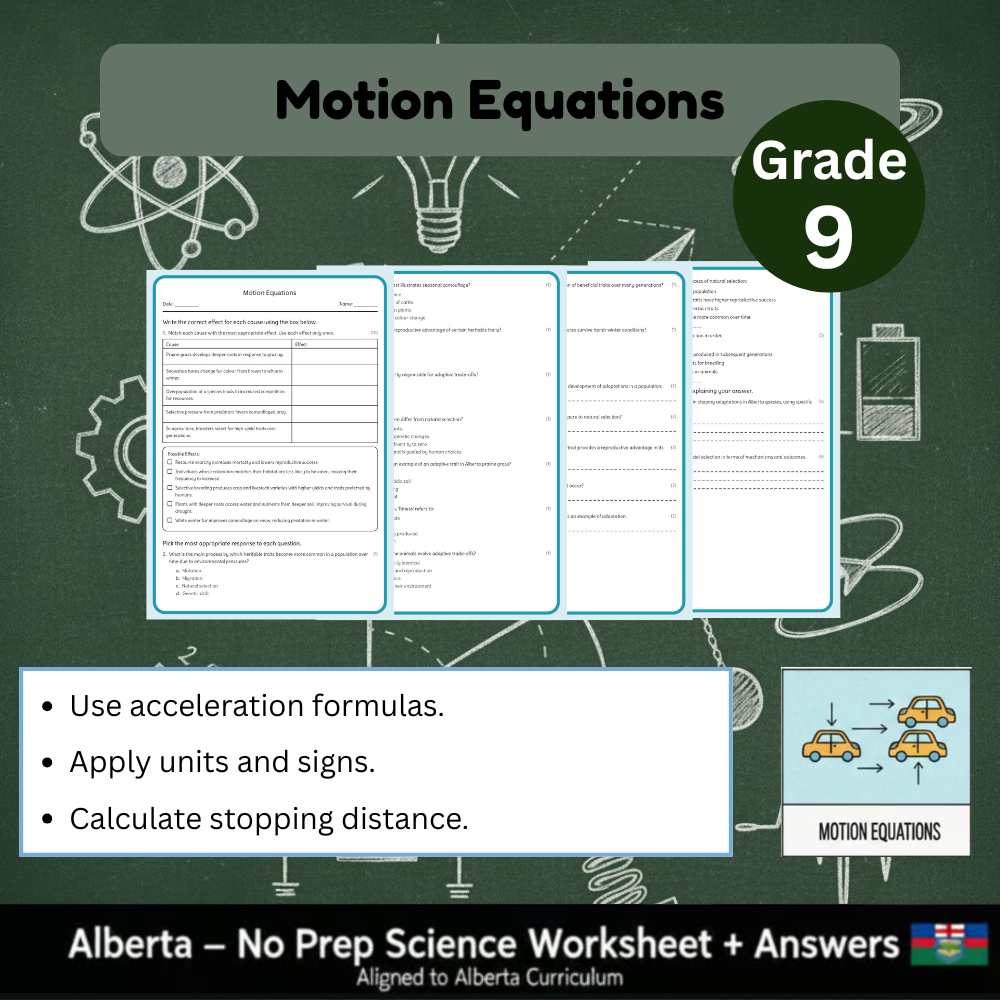
Grade 9 Science | Motion Equations Worksheet (PDF) – Alberta Standards
 Created byBright Mind Resources
Learning Objectives
- Understand how to use constant-acceleration equations to predict object displacement and velocity.
- Apply appropriate units, sign conventions, and algebraic substitution to solve motion problems.
- Interpret real-world scenarios involving vehicle stopping distances, ski slopes, and free fall.
Instant download

Grade 9 Science – Microscopy Basics Daily Reading Worksheet with Answer Key
JCreated byJ.S SheetsLearning Objectives
- Understand the principles of light microscopy.
- Recognize the components and functions of a light microscope.
- Describe the differences between magnification, resolution, and contrast.
Also included in: Grade 9 Science Lesson Group Bundle TEKS Daily Reading Worksheets +1 more
Instant download

Grade 9 Science – Introduction to Cell Membranes Daily Worksheet + Answer Key
JCreated byJ.S SheetsLearning Objectives
- Identify the main components of the cell membrane
- Understand the functions of phospholipids and proteins
- Explain the fluid mosaic model of the membrane
Also included in: Grade 9 Science Lesson Group Bundle TEKS Daily Reading Worksheets +1 more
Instant download
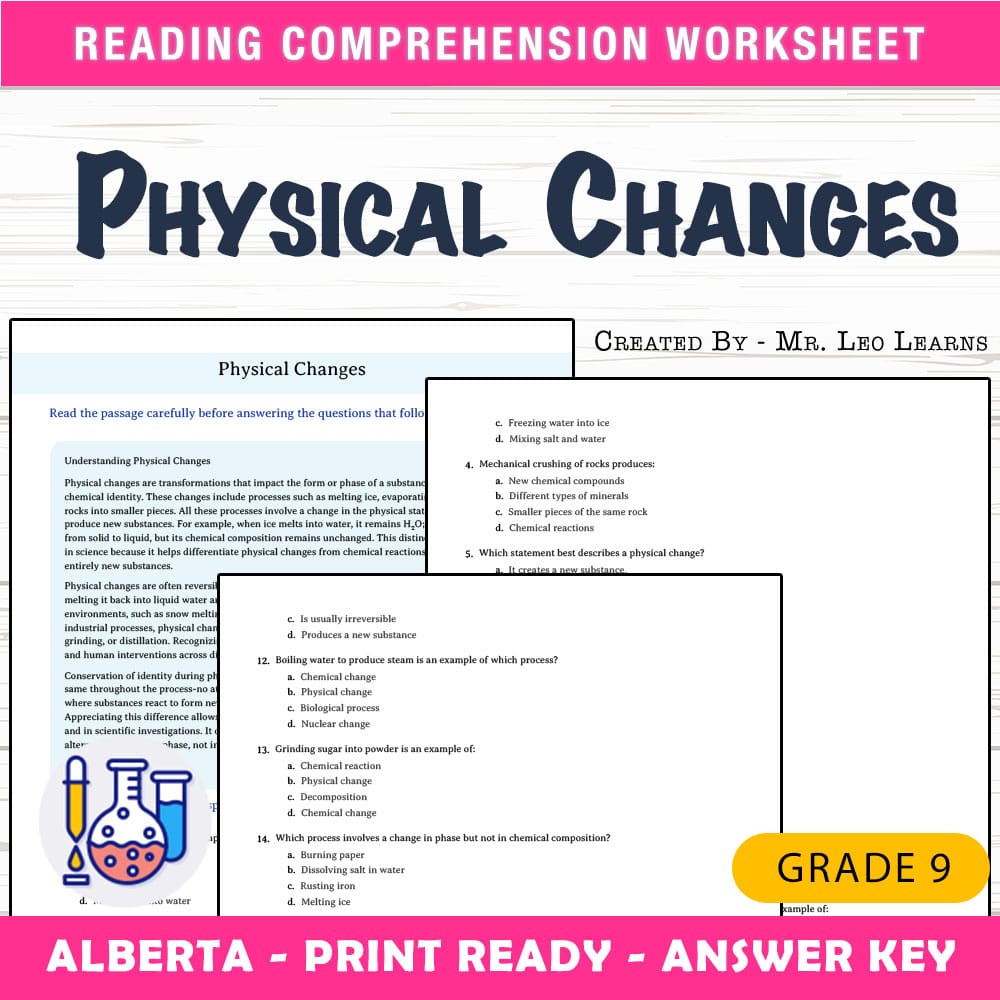
Grade 9 Science — Worksheet MCQ Paper for Mastering Physical Changes
 Created byThe Resource Hub
Learning Objectives
- Understand the concept of physical changes and how they differ from chemical changes.
- Identify examples of physical changes in everyday life and the environment.
- Explain the processes involved in phase changes like melting, freezing, and mechanical alteration.
Also included in: Grade 9 Science Bundle | Matter and Chemical Change Worksheets Pack +1 more
Instant download

Organelle Systems Worksheet | Grade 9 Science Activities
 Created byPrism Point Learning
Learning Objectives
- Explain how multiple organelles work together as an integrated system rather than in isolation.
- Describe how transport and cell structure help move materials between organelles.
- Connect organelle cooperation to metabolism, cell maintenance, and cellular responses.
Instant download
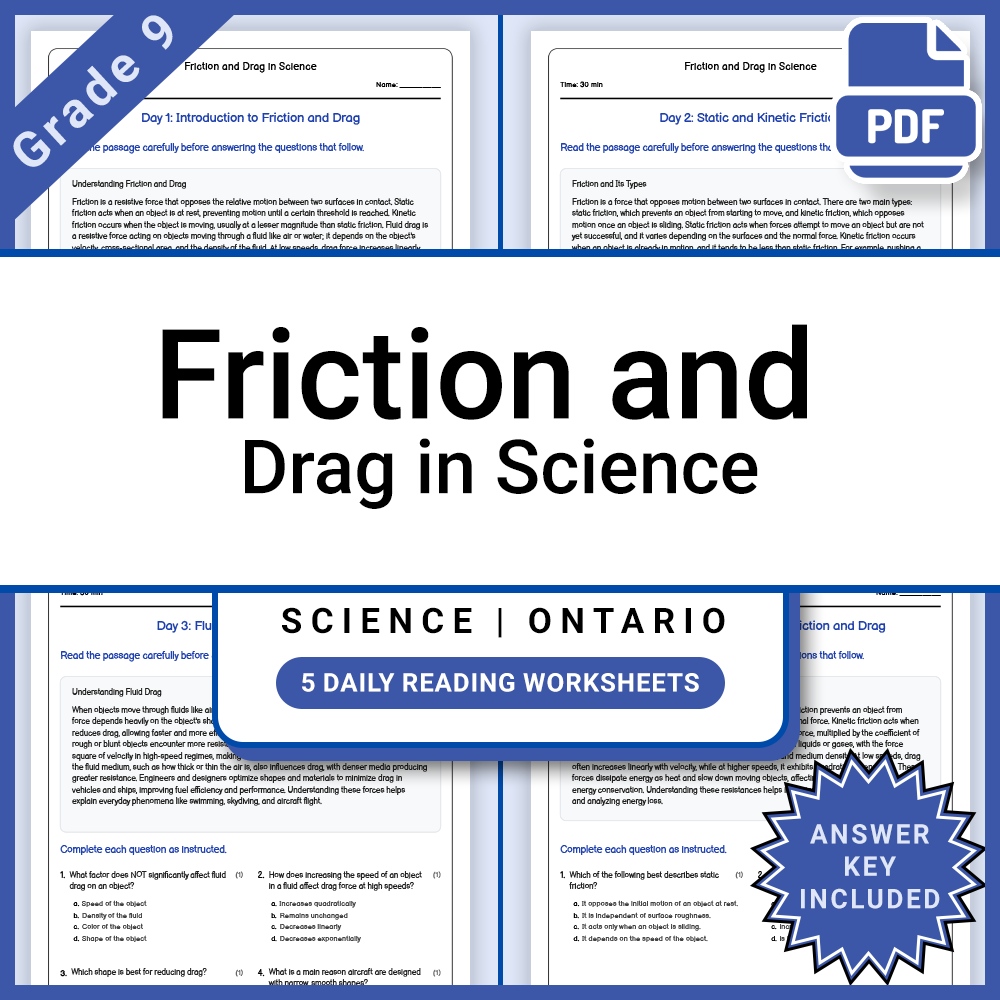
Grade 9 Science – Friction and Drag Daily Reading Worksheet + Answer Key
JCreated byJ.S SheetsLearning Objectives
- Define static and kinetic friction and explain their differences.
- Describe fluid drag and how it depends on velocity, surface area, and medium density.
- Understand the coefficients of friction and their role in force calculations.
Also included in: Grade 9 Science Lesson Group: Physics and Motion Worksheets Bundle +1 more
Instant download
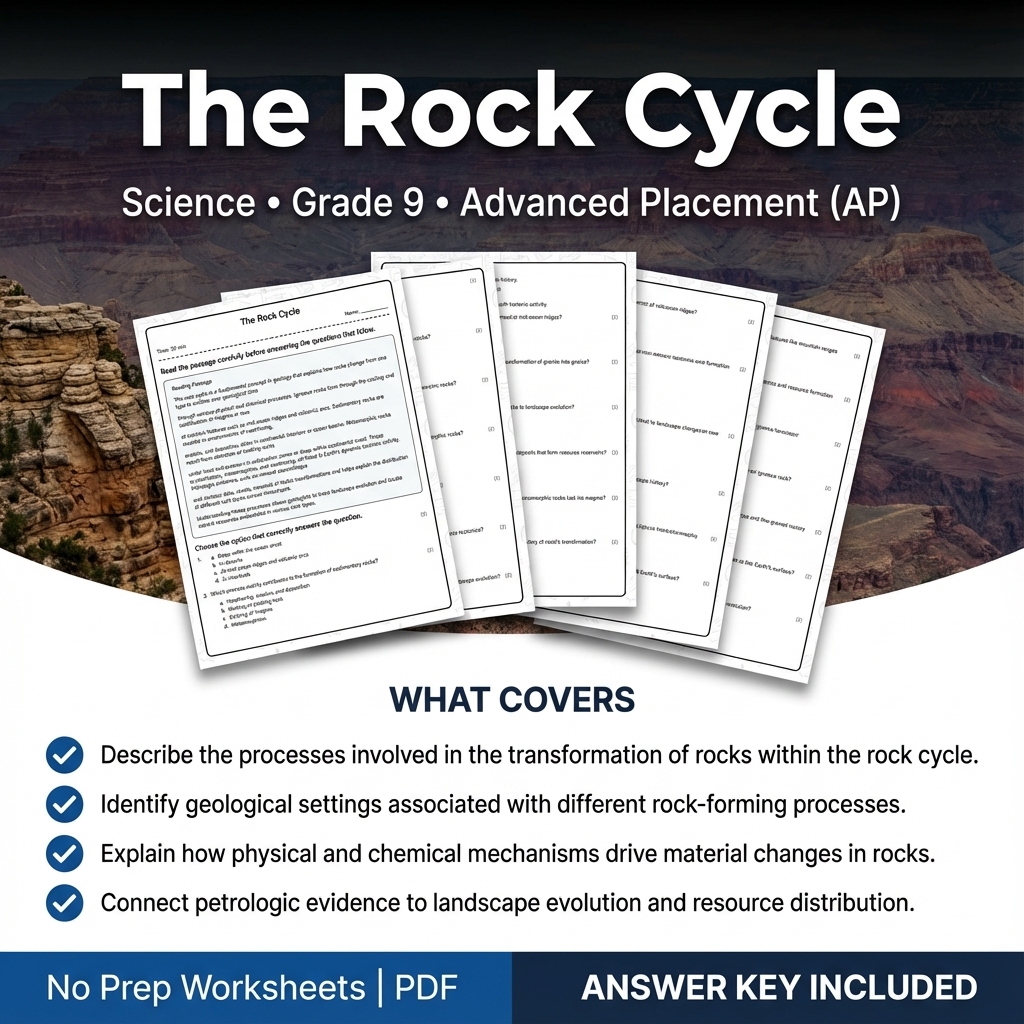
Grade 9 Science | The Rock Cycle Worksheet (Printable PDF + Answer Key)
Created byCoral Reef LearningLearning Objectives
- Describe the processes involved in the transformation of rocks within the rock cycle.
- Identify geological settings associated with different rock-forming processes.
- Explain how physical and chemical mechanisms drive material changes in rocks.
Also included in: Grade 9 Science Unit | Earth Processes & Climate Worksheets Pack (PDF & Answer Keys) +2 more
Instant download

Grade 9 Science – Energy Conversion Systems | Daily Reading Worksheet
Created byBright Mind ResourcesLearning Objectives
- Understand the basic concepts of energy transformation
- Identify different forms of energy involved in conversions
- Explain how energy conservation applies during conversions
Also included in: Science Grade 9 Science Daily Reading Worksheets lesson-bundle | Calif. Stds +1 more
Instant download

Integrated Metabolism Worksheet | Grade 9 Science Activities
Created byPrism Point LearningLearning Objectives
- Explain how catabolic and anabolic pathways coordinate to meet cellular energy demands across tissues
- Describe how hormones and nutrient availability shift metabolic priorities and redistribute intermediates
- Compare short-term (post-translational) and long-term (gene expression/organelles) regulation of metabolism
Instant download
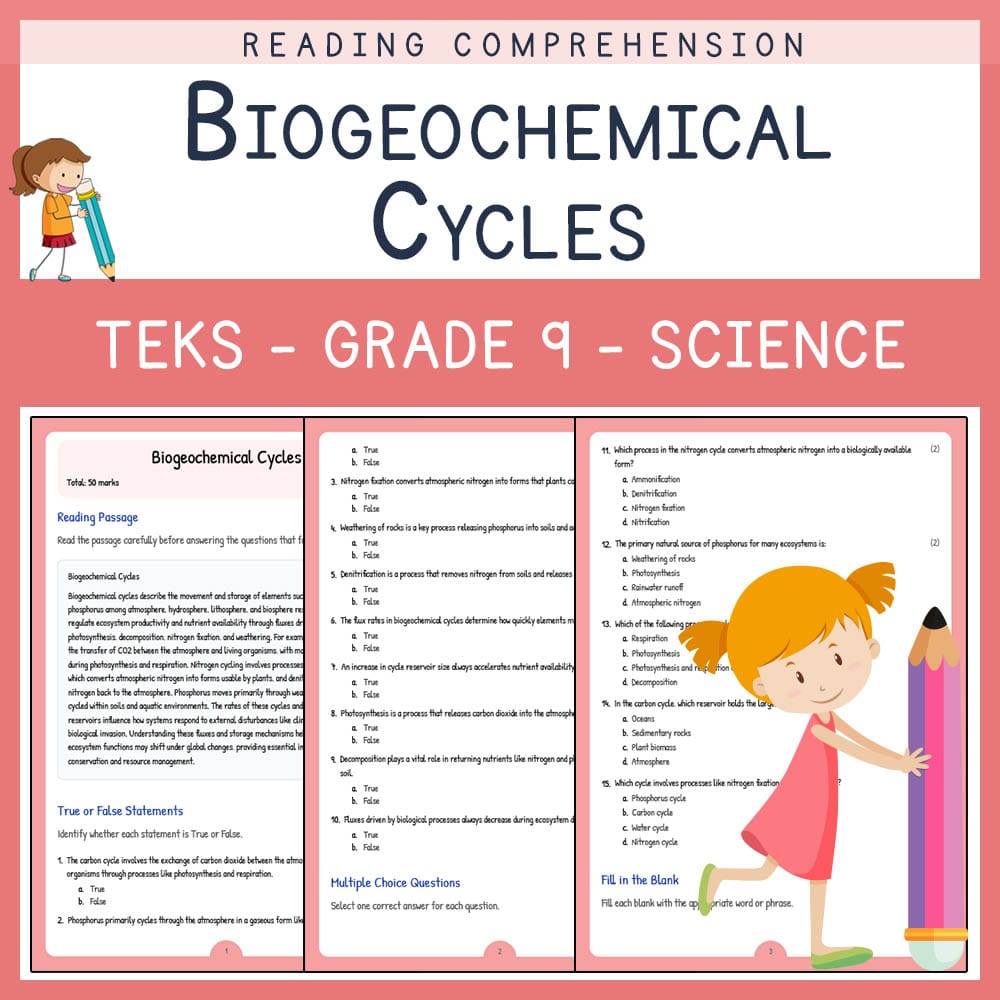
Grade 9 Science | Biogeochemical Cycles Worksheet | TEKS Aligned
 Created byLumora Learning
Learning Objectives
- Describe the major biogeochemical cycles and their role in ecosystems.
- Identify the key processes driving movement of elements like carbon, nitrogen, and phosphorus.
- Explain the impact of fluxes and reservoir sizes on ecosystem responses and climate change.
Instant download

Grade 9 Science Worksheet on Reservoirs and Feedback – General Standards (PDF)
 Created byEvergreen Desk Education
Learning Objectives
- Explain how storage reservoirs and time scales control how fast Earth systems exchange carbon and water.
- Describe how feedbacks can amplify or dampen changes in atmospheric carbon, ocean carbon, and living systems.
- Connect energy flow to evaporation, winds, temperature, and climate-related feedbacks.
Also included in: Grade 9 Earth and Space Science Lesson Bundle (General) Science Worksheets +1 more
Instant download
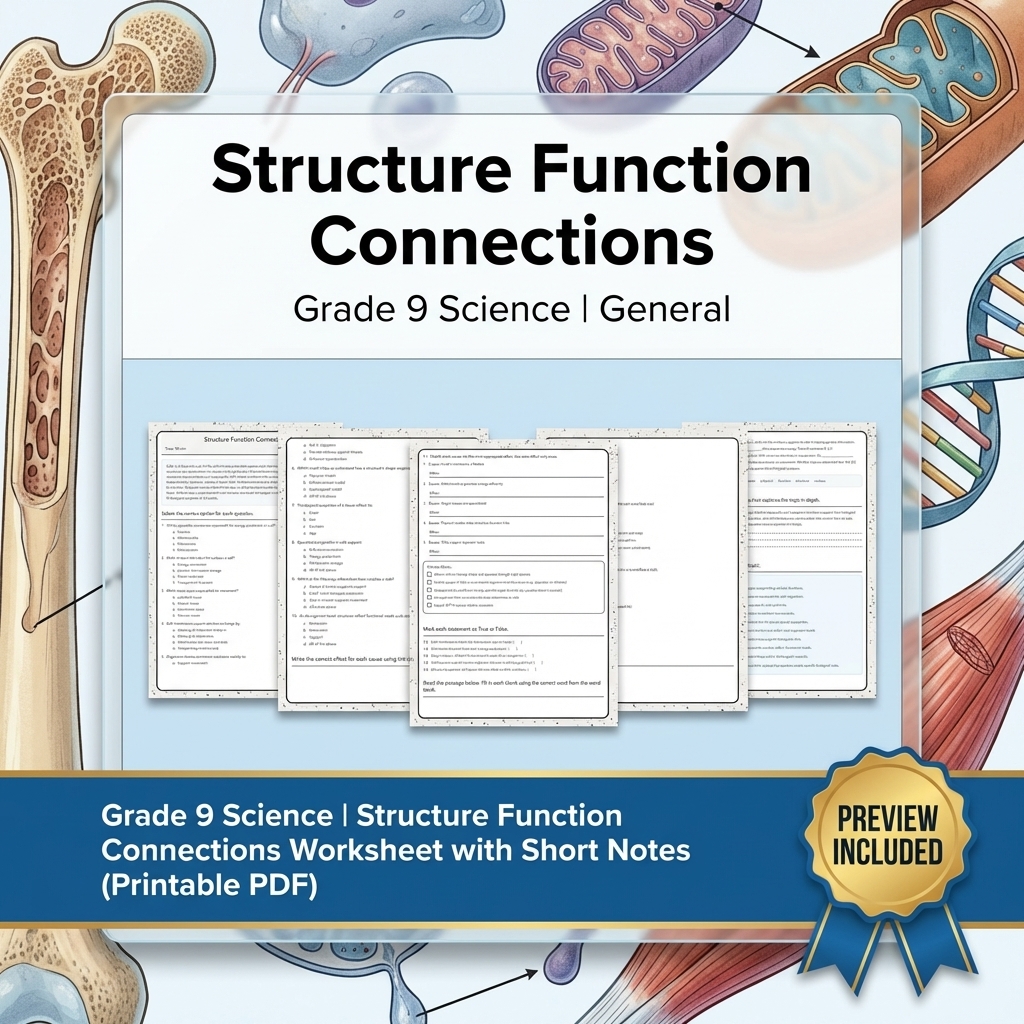
Grade 9 Science | Structure Function Connections Worksheet with Short Notes
Created byMeadowlark WorksheetsLearning Objectives
- Understand how cellular structures relate to their functions within cells.
- Identify examples of organism structures that reflect specific functional needs.
- Explain how models connect physical features to biological roles at cellular and organism levels.
Also included in: Grade 9 Ecology, Genetics & Cells Science Lesson Bundle | General Framework +1 more
Instant download
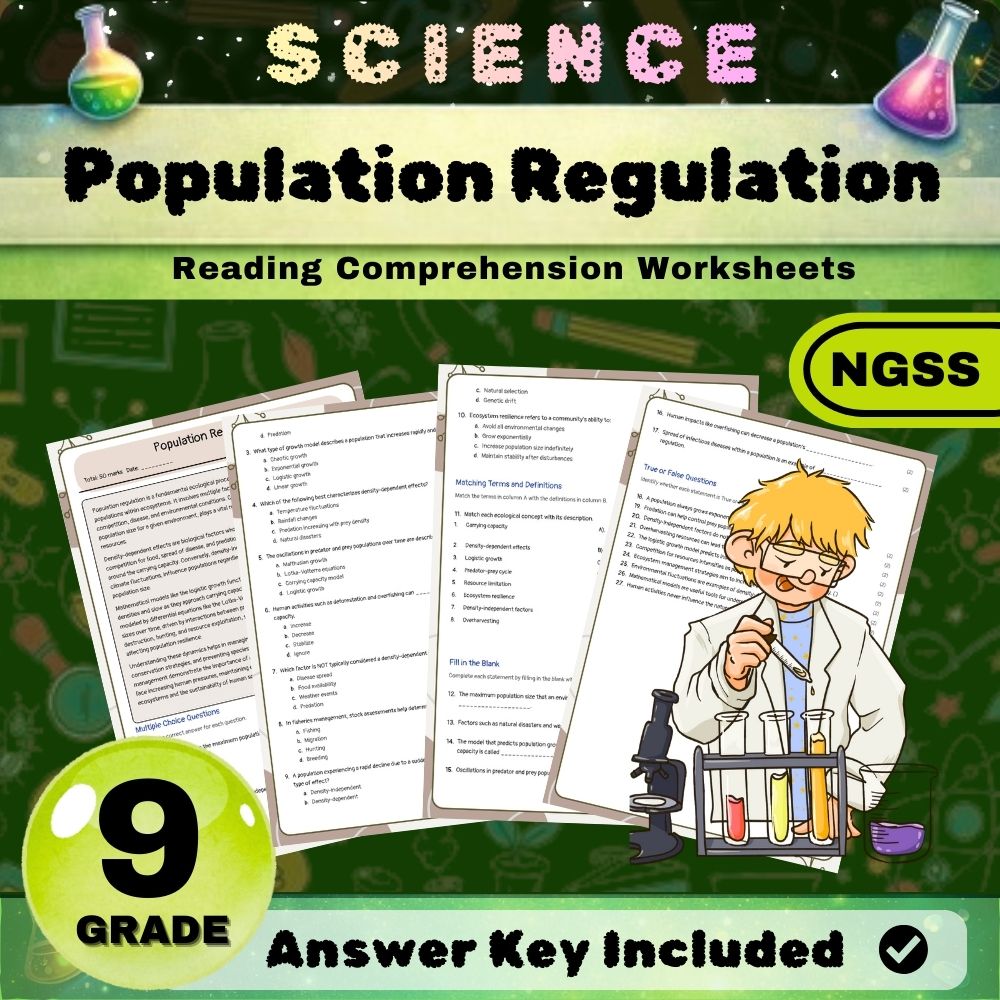
Grade 9 Science | Population Regulation Worksheet (NGSS) PDF
 Created byMaple Path Learning
Learning Objectives
- Understand key concepts of population regulation such as carrying capacity and density-dependent effects.
- Describe factors affecting population sizes including predation, competition, disease, and resource limitations.
- Identify and interpret mathematical models of population dynamics like logistic growth and predator-prey cycles.
Also included in: Grade 9 Science Ecosystems Lesson Bundle | NGSS Interactions & Energy +1 more
Instant download

Motion Graphs Practice Worksheet | Grade 9 Science Assessment
Created byPrism Point LearningLearning Objectives
- Interpret position–time and velocity–time graphs by connecting slopes and areas to physical quantities
- Explain how slope on a position–time graph represents velocity and how slope on a velocity–time graph represents acceleration
- Use graph regions to determine displacement and connect the results to Newtonian ideas about forces
Also included in: Grade 9 Work, Energy & Forces Science Lesson Bundle Ontario Curriculum
Instant download
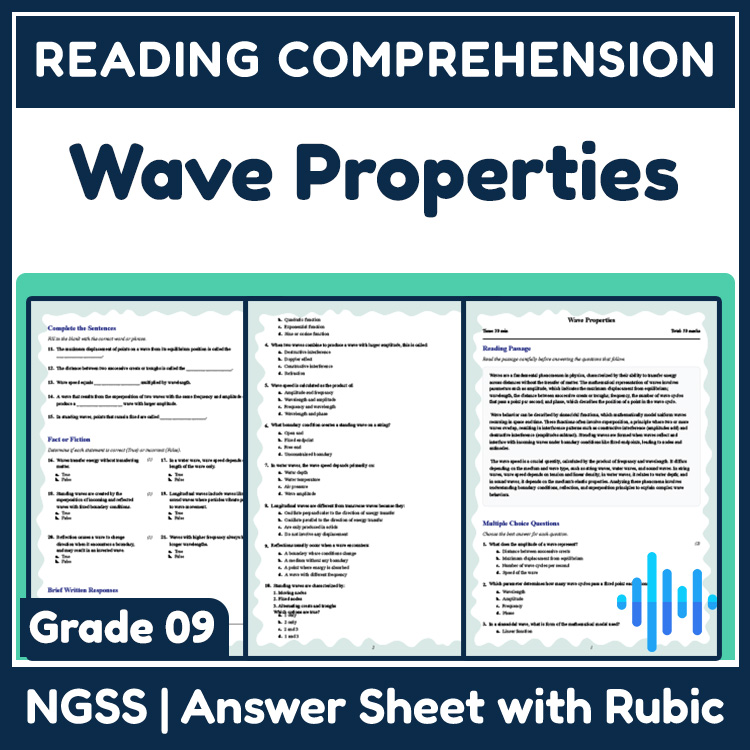
9th Grade Science | Wave Properties Reading Worksheet (PDF & Rubric)
JCreated byJ.S SheetsLearning Objectives
- Explain the mathematical representation of wave behavior through amplitude, frequency, wavelength, and phase.
- Relate wave speed to frequency and wavelength for transverse and longitudinal waves, including examples like string waves, sound waves, and water waves.
- Describe how sinusoidal functions and superposition explain interference and standing waves.
Also included in: Grade 9 Science Unit | Wave & Signal Properties Worksheet Bundle
Instant download
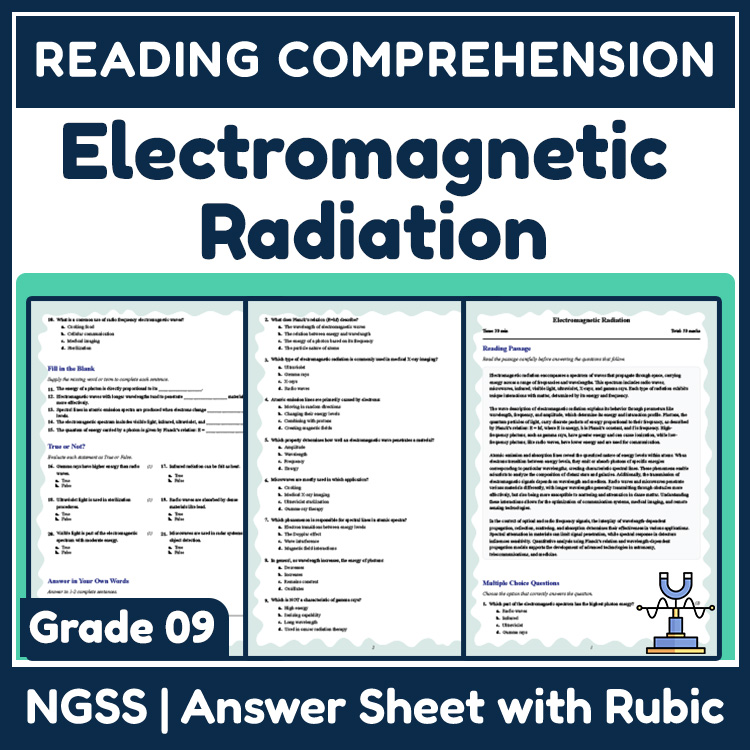
9th Grade Science | Electromagnetic Radiation Reading Worksheet (PDF)
JCreated byJ.S SheetsLearning Objectives
- Explain the spectrum of electromagnetic radiation and its relation to photon energy and wave properties.
- Describe how atomic emission and absorption lines relate to energy–frequency relationships.
- Analyze the transmission and attenuation of electromagnetic signals in different materials and frequencies.
Also included in: Grade 9 Science Unit | Wave & Signal Properties Worksheet Bundle
Instant download
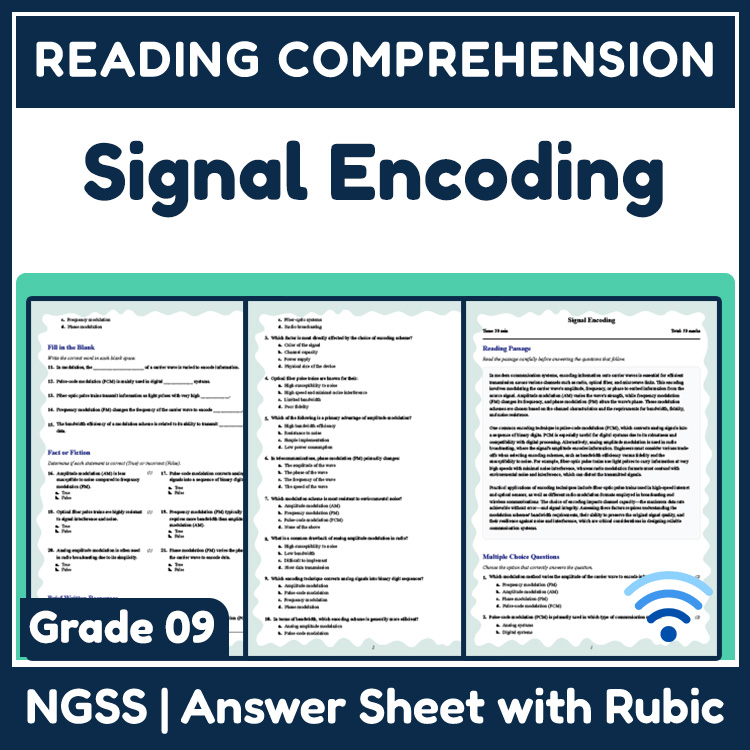
Grade 9 Science | Signal Encoding Reading Worksheet (PDF + Answer Key)
JCreated byJ.S SheetsLearning Objectives
- Understand the principles of information encoding through modulation and multiplexing.
- Compare and contrast different encoding schemes such as pulse-code modulation and amplitude modulation.
- Analyze practical examples of signal encoding in fiber-optic and radio communication channels.
Also included in: Grade 9 Science Unit | Wave & Signal Properties Worksheet Bundle
Instant download
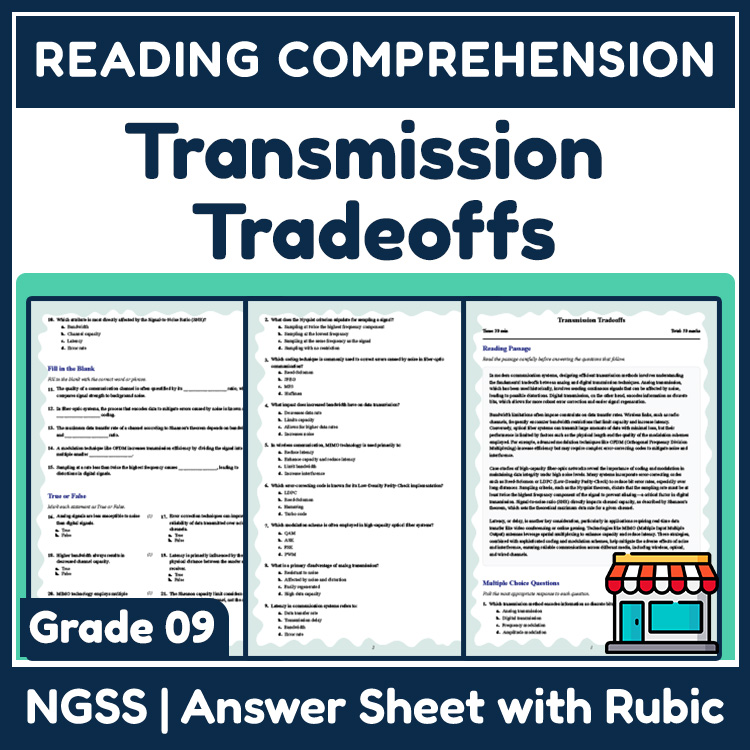
9th Grade Science | Transmission Tradeoffs Reading Worksheet (PDF)
JCreated byJ.S SheetsLearning Objectives
- Understand the principles of digital and analog transmission in communication systems.
- Identify the tradeoffs related to bandwidth, signal-to-noise ratio, and error correction techniques.
- Evaluate the performance limitations of various communication channels such as wireless links and optical fibers.
Also included in: Grade 9 Science Unit | Wave & Signal Properties Worksheet Bundle
Instant download

Grade 9 Science Climate Evidence Worksheet | Standards-Aligned Practice
JCreated byJ.S SheetsLearning Objectives
- Understand the types of natural records used as evidence for climate change.
- Differentiate between weather and climate and their influencing factors.
- Identify key indicators and feedback mechanisms in Earth's climate system.
Also included in: Grade 9 Earth and Space Science Lesson Bundle: California Standards +1 more
Instant download

Microscopy Analysis Worksheet | Grade 9 Science Activities
Created byPrism Point LearningLearning Objectives
- Interpret microscopy images using resolution limits, scale bars, and contrast features
- Use staining and fluorescence patterns to infer specific cellular structures or molecules
- Evaluate image sets over time while accounting for artifacts and measurement errors
Instant download
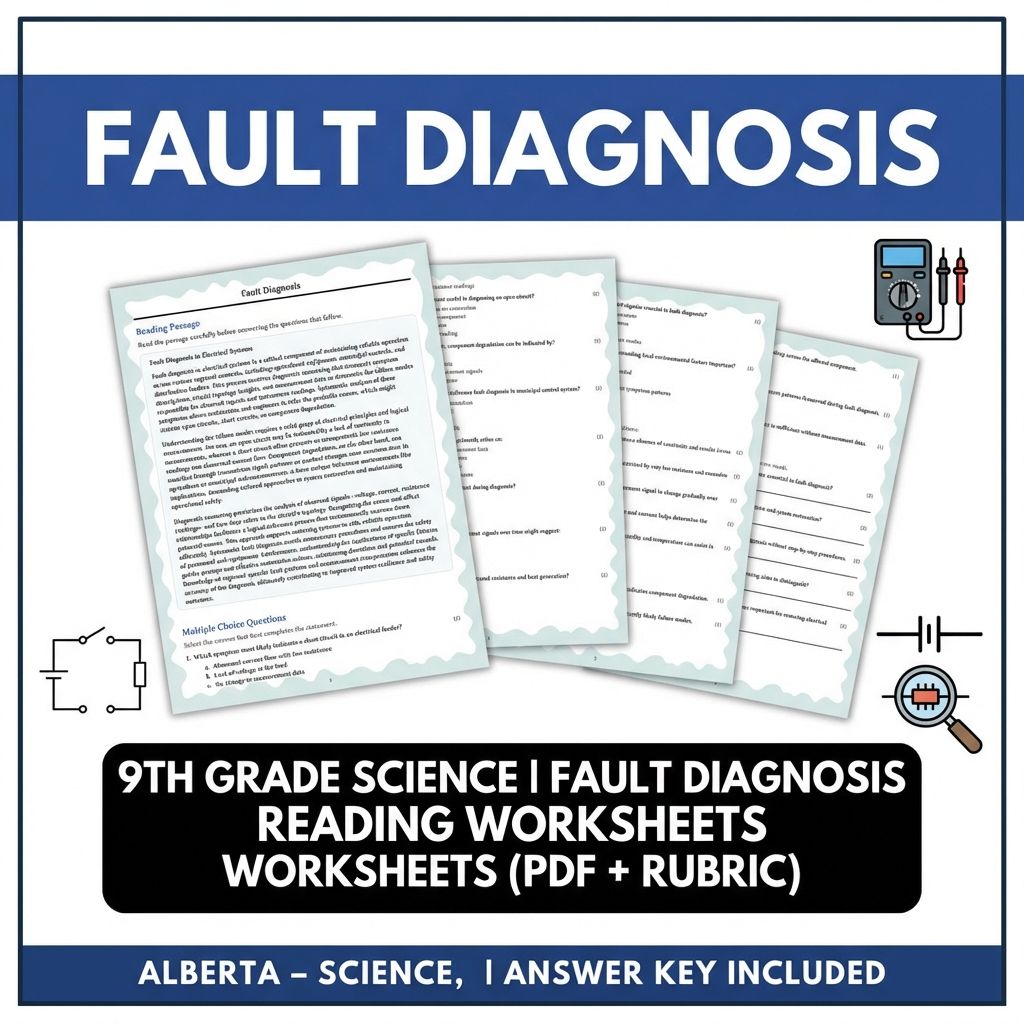
9th Grade Science | Fault Diagnosis Reading Worksheets (PDF + Rubric)
JCreated byJ.S SheetsLearning Objectives
- Understand the principles of diagnostic reasoning in electrical faults.
- Identify symptoms and interpret measurement data to infer failure modes.
- Apply logical inference to diagnoses involving open circuits, short circuits, or component degradation.
Also included in: Grade 9 Science Bundle | Electricity, Energy & Magnetism (PDF + Answer Keys) +1 more
Instant download
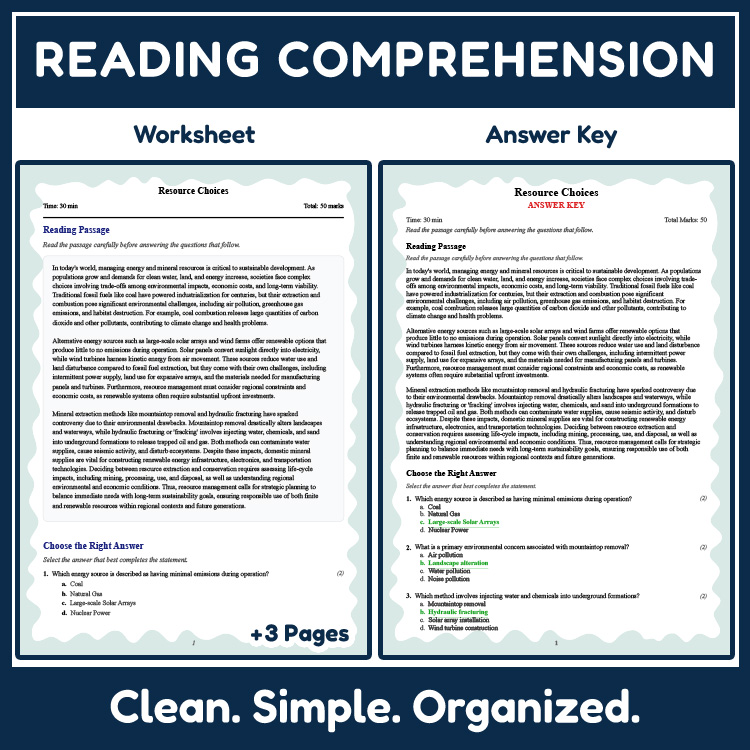
Grade 9 Science Reading Worksheets | Resource Choices – NGSS-Aligned Practice
JCreated byJ.S SheetsLearning Objectives
- Understand different energy and mineral resource options and their management considerations.
- Evaluate the environmental impacts of resource extraction and renewable energy systems.
- Analyze trade-offs involved in resource use, including economic costs, environmental impacts, and sustainability.
Also included in: Grade 9 Science Unit | Climate, Sustainability & Ecosystem Worksheets
Instant download
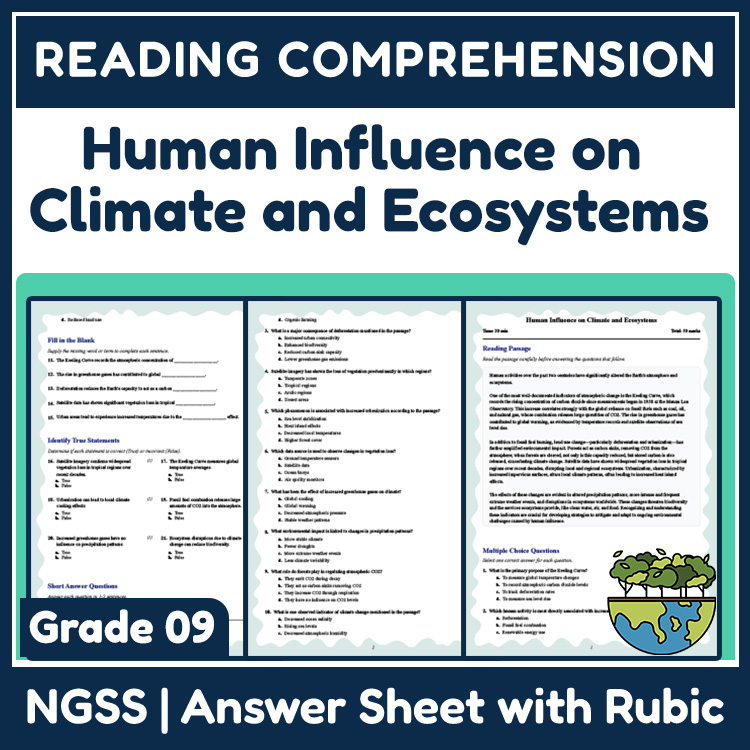
9th Grade Science | Human Influence on Climate and Ecosystems Reading Worksheet
JCreated byJ.S SheetsLearning Objectives
- Understand how human activities such as fossil fuel combustion and deforestation impact climate variables.
- Analyze historical data like the Keeling Curve and satellite imagery to recognize evidence of anthropogenic environmental change.
- Evaluate the effects of human-induced climate change on ecosystems and hydrosphere at regional and global scales.
Also included in: Grade 9 Science Unit | Climate, Sustainability & Ecosystem Worksheets
Instant download
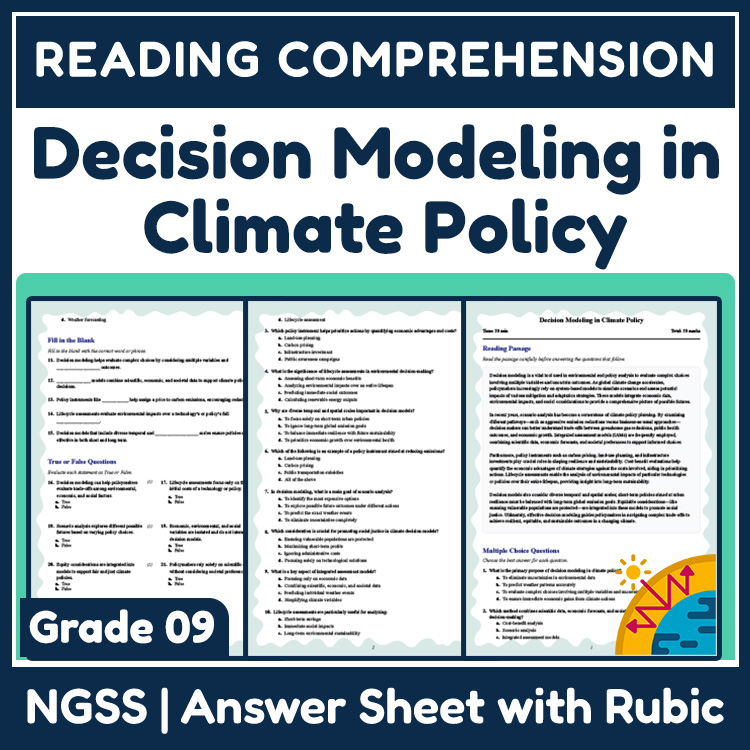
9th Grade Science | Decision Modeling in Climate Policy Reading Worksheet (PDF)
JCreated byJ.S SheetsLearning Objectives
- Understand the application of systems and decision models in evaluating climate mitigation and adaptation strategies.
- Analyze the trade-offs among economic, environmental, and social variables in environmental decision-making.
- Explore scenario analysis, assessment approaches, and policy instruments related to climate resilience and sustainability.
Also included in: Grade 9 Science Unit | Climate, Sustainability & Ecosystem Worksheets
Instant download
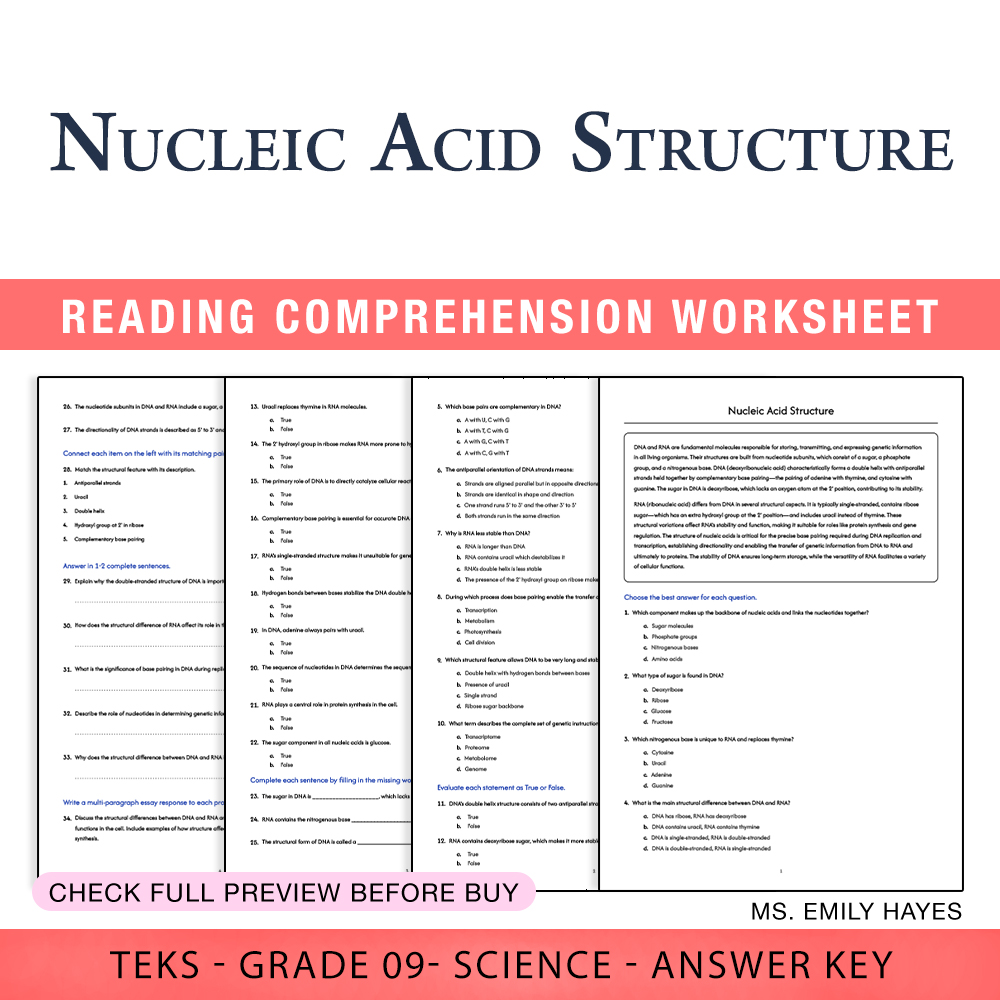
9th Grade Science | Nucleic Acid Structure Printable Worksheet (PDF+ Answer Key)
Created byCopper Leaf ClassroomLearning Objectives
- Describe the chemical structures of DNA and RNA and their nucleotide components.
- Compare the structural features of DNA and RNA, including strand orientation and sugar content.
- Explain how nucleic acid structures enable specific base pairing during processes like replication and transcription.
Instant download
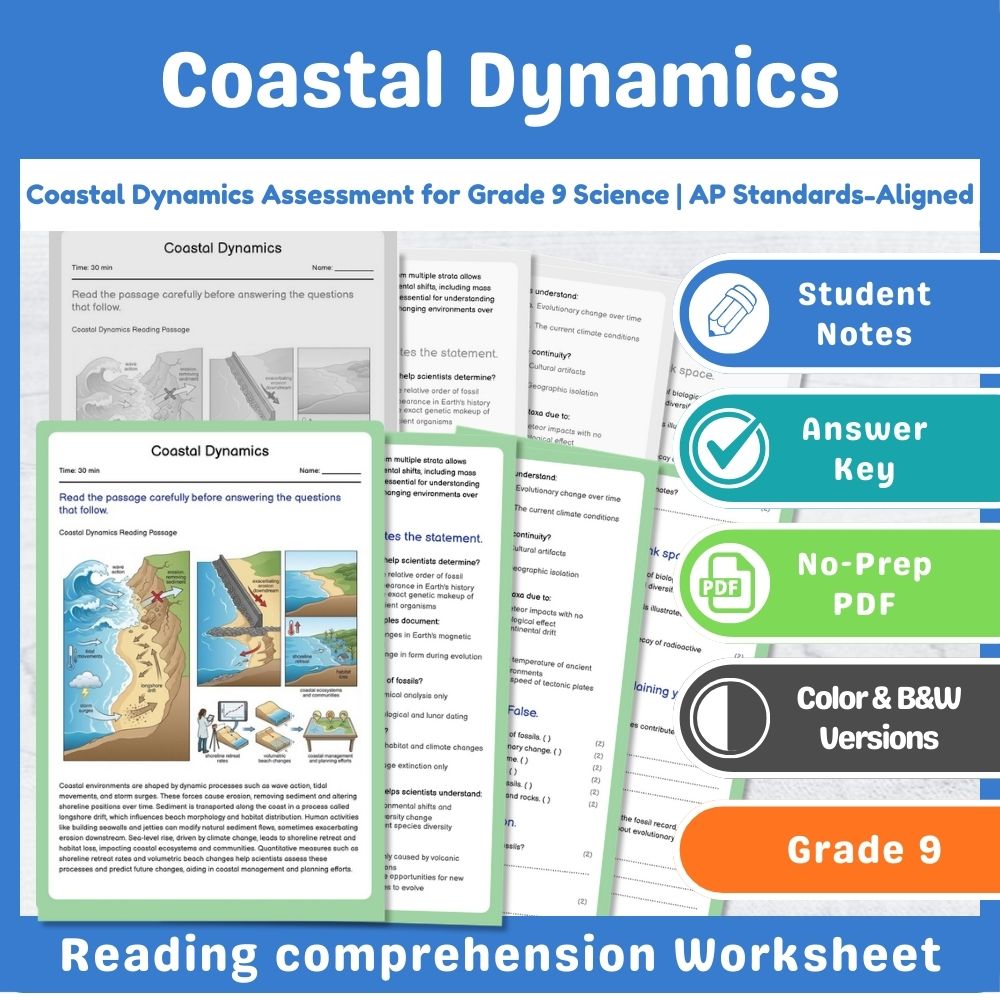
Coastal Dynamics Assessment for Grade 9 Science | AP Standards-Aligned
Created byPrism Point LearningLearning Objectives
- Understand the processes of coastal erosion, sediment transport, and shoreline response to natural forces.
- Analyze the impact of sea-level change on coastal morphology and habitats.
- Interpret quantitative indicators such as shoreline retreat rates and beach volume changes.
Also included in: Grade 9 Science Mini Bundle | Earth and Space Sciences AP Standards
Instant download
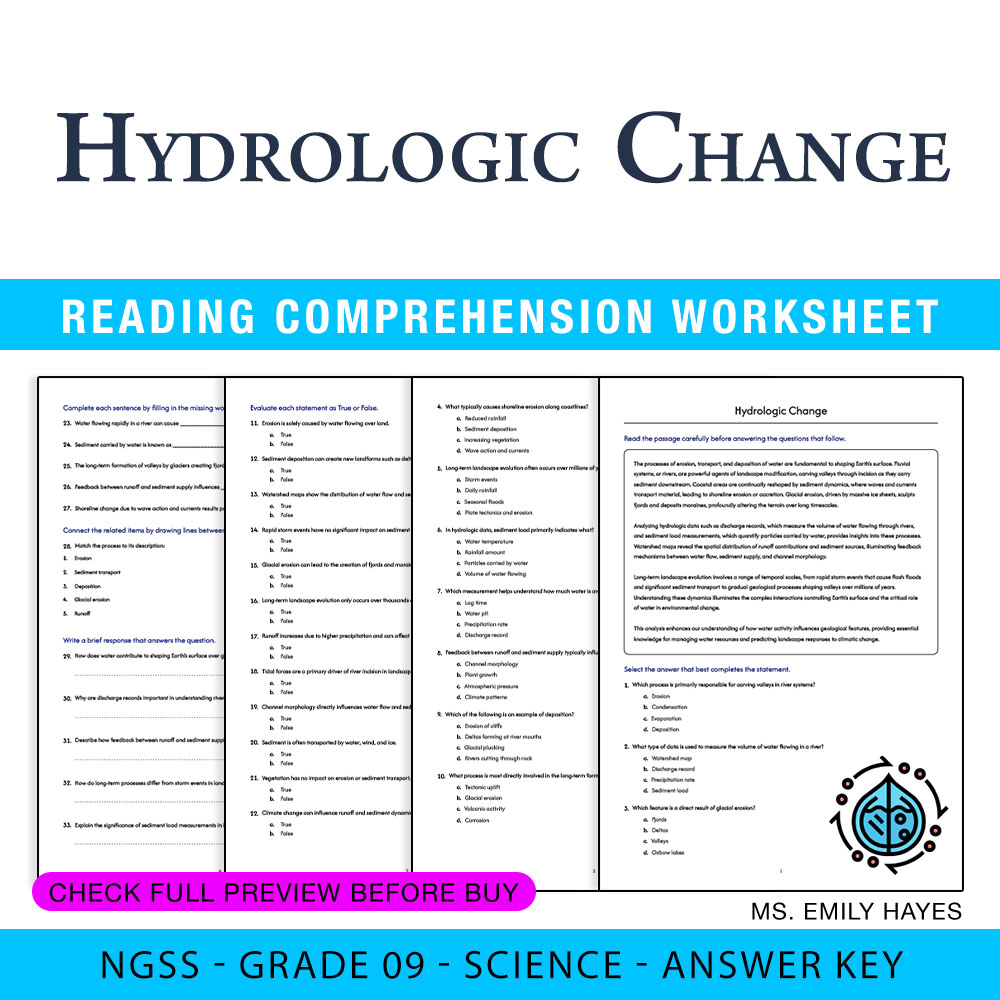
Grade 9 Science | Hydrologic Change Worksheet (PDF+ Answer Key)
Created byCopper Leaf ClassroomLearning Objectives
- Describe how water shapes Earth's surface through erosion, transport, and deposition.
- Analyze hydrologic data such as discharge records and sediment load measurements.
- Explain the feedbacks between runoff, sediment supply, and channel morphology.
Instant download

Newton's Laws Worksheet | Grade 9 Science Practice and Review
Created byPrism Point LearningLearning Objectives
- Explain Newton’s three laws and connect each law to observable motion and forces.
- Use the ideas of net force, acceleration, inertia, and action–reaction pairs to predict outcomes.
- Identify common real-world examples (sports and vehicles) that illustrate Newton’s laws.
Also included in: Forces and Motion Lesson Bundle – Grade 9 Science Framework BC +1 more
Instant download

Resource Choices and Sustainability Worksheet | NGSS Grade 9 Science
 Created byCedar Grove Learning
Learning Objectives
- Compare different energy and mineral resource options based on environmental, economic, and social impacts.
- Analyze trade-offs involved in resource extraction, use, and remediation.
- Evaluate the sustainability of various resource choices within regional and long-term contexts.
Instant download

Stoichiometry Basics Worksheet | Grade 9 Science Practice
Created byPrism Point LearningLearning Objectives
- Explain how balanced chemical equations and conservation of mass connect atoms to measurable amounts.
- Use molar mass to convert between grams and moles of a substance.
- Apply mole ratios from balanced equations to predict relative amounts of reactants and products.
Also included in: Grade 9 Matter and Chemical Change Lesson Bundle | Science | BC +1 more
Instant download

Grade 9 Science | Cellular Metabolism Worksheet with Short Notes (Printable PDF)
Created byMeadowlark WorksheetsLearning Objectives
- Describe the key biochemical pathways involved in cellular metabolism, including glycolysis, the citric acid cycle, and oxidative phosphorylation.
- Explain how ATP is produced and energy is conserved and transferred within cells during metabolic processes.
- Relate organelles such as mitochondria and chloroplasts to their roles in energy metabolism and photosynthesis.
Also included in: Grade 9 Science NGSS From Molecules to Organisms Structures & Processes Bundle +1 more
Instant download

Reaction Essentials Worksheet | Grade 9 Science Activities
Created byPrism Point LearningLearning Objectives
- Explain how chemical reactions transform reactants into products by making and breaking chemical bonds.
- Interpret chemical formulas and symbolic equations, including state symbols and stoichiometric coefficients.
- Connect bond energies to whether a reaction releases or absorbs energy.
Also included in: Grade 9 Matter and Chemical Change Lesson Bundle | Science | BC +1 more
Instant download

Grade 9 Science – Origins of the Solar System Worksheet(PDF + Answer Key)
Created byCopper Leaf ClassroomLearning Objectives
- Explain how the protoplanetary disk contributed to planetary formation.
- Identify key evidence supporting planetary origins, such as meteorites and isotopic dating.
- Describe differences between inner rocky planets and outer gas giants based on formation processes.
Instant download

Classification Foundations Worksheet | Grade 9 Science Activities
Created byPrism Point LearningLearning Objectives
- Explain how hierarchical biological classification helps organize biodiversity.
- Describe traditional taxonomic ranks and how binomial nomenclature supports clear communication.
- Compare how evolutionary relationships and clades are used in modern classification.
Also included in: Grade 9 Evolution & Speciation Lesson Bundle | TEKS Science
Instant download
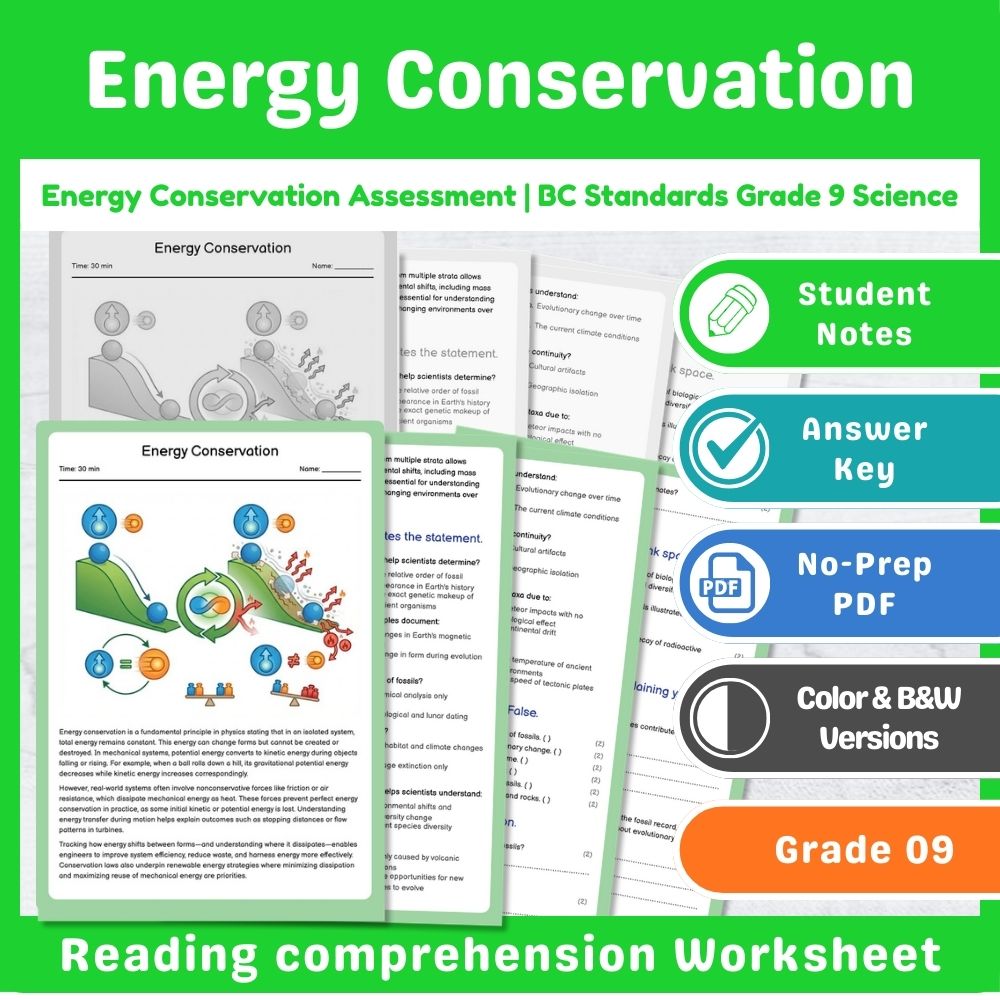
Energy Conservation Assessment | BC Standards Grade 9 Science
Created byPrism Point LearningLearning Objectives
- Explain the principle of conservation of energy in isolated systems.
- Identify different forms of energy and how they interconvert.
- Describe how nonconservative forces like friction dissipate mechanical energy into heat.
Instant download
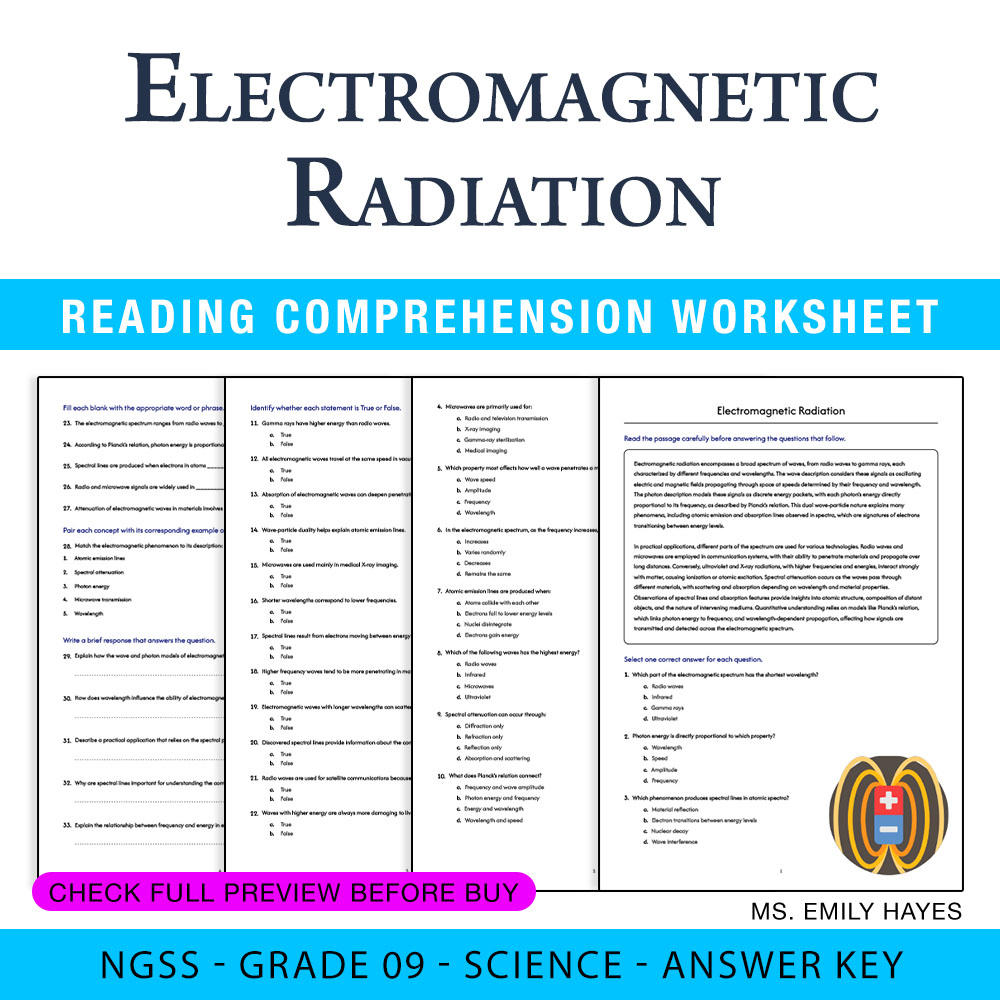
Grade 9 Science | Electromagnetic Radiation Worksheet (PDF+ Answer Key)
Created byCopper Leaf ClassroomLearning Objectives
- Understand the wave and photon descriptions of electromagnetic radiation.
- Relate frequency and wavelength to photon energy and interaction with matter.
- Explain phenomena such as atomic emission and absorption lines, signal transmission, and spectral attenuation.
Instant download
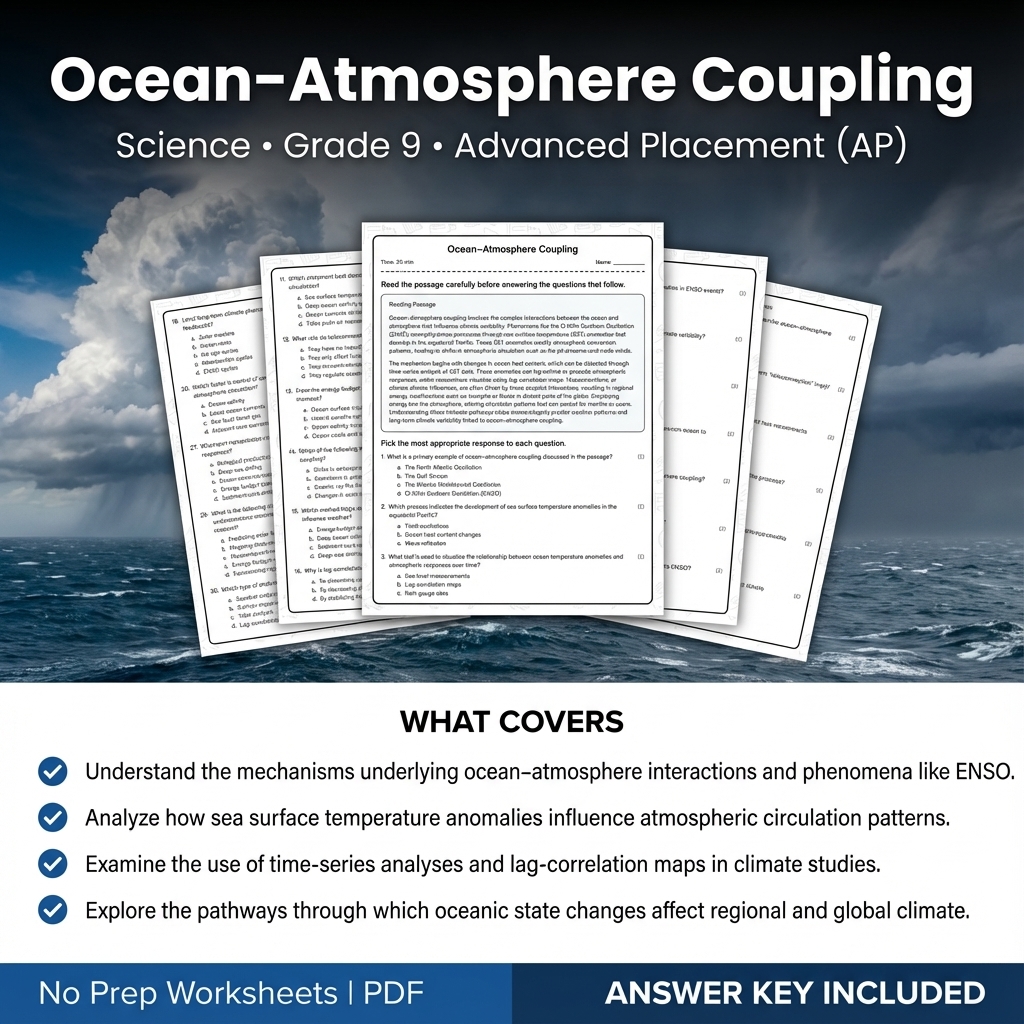
Grade 9 Science | Ocean–Atmosphere Coupling Worksheet (Printable PDF + Answer Key)
Created byCoral Reef LearningLearning Objectives
- Understand the mechanisms underlying ocean–atmosphere interactions and phenomena like ENSO.
- Analyze how sea surface temperature anomalies influence atmospheric circulation patterns.
- Examine the use of time-series analyses and lag-correlation maps in climate studies.
Also included in: Grade 9 Science Unit | Earth Processes & Climate Worksheets Pack (PDF & Answer Keys) +2 more
Instant download

Transport Mechanisms Worksheet | Grade 9 Science Practice
Created byPrism Point LearningLearning Objectives
- Explain how passive transport, facilitated diffusion, and osmosis move substances across cell membranes using concentration gradients.
- Describe how active transport uses membrane proteins and ATP to move substances against gradients.
- Compare vesicular transport (endocytosis and exocytosis) with transport through membrane proteins.
Instant download
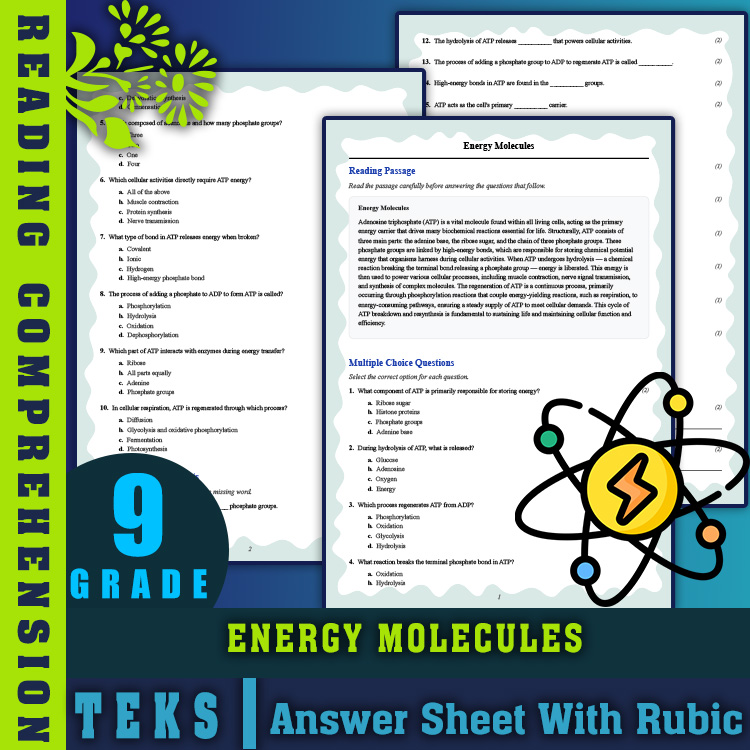
9th Grade Science | Energy Molecules Reading Worksheet & Answer Key (PDF)
JCreated byJ.S SheetsLearning Objectives
- Understand the structure and function of ATP as the cell's primary energy currency.
- Explain how ATP hydrolysis releases energy for cellular processes.
- Describe the process of ATP regeneration through phosphorylation.
Instant download
About Grade 9 Science Worksheets
Find Science worksheets built for Grade 9. All 6,926 cover core skills, practice, and review, each an instant PDF download.
Every worksheet on MyTeachingSheets is created by independent teacher-authors and reviewed before publication. All resources download as printable PDFs for classroom, homework, or at-home practice, and many include answer keys. Preview any worksheet free before buying.