
Grade 9 Science Worksheets
6,986 worksheets
Model-Data Fit Worksheet | Residual Analysis & AP Science Modeling
 Created byPrism Point Learning
Learning Objectives
- Use residuals and diagnostic graphical patterns to judge whether a model matches empirical data.
- Apply goodness-of-fit ideas to decide when a model is acceptable versus when it should be revised.
- Explain how heteroscedasticity and missing-variable clues motivate alternate hypotheses.
Instant download
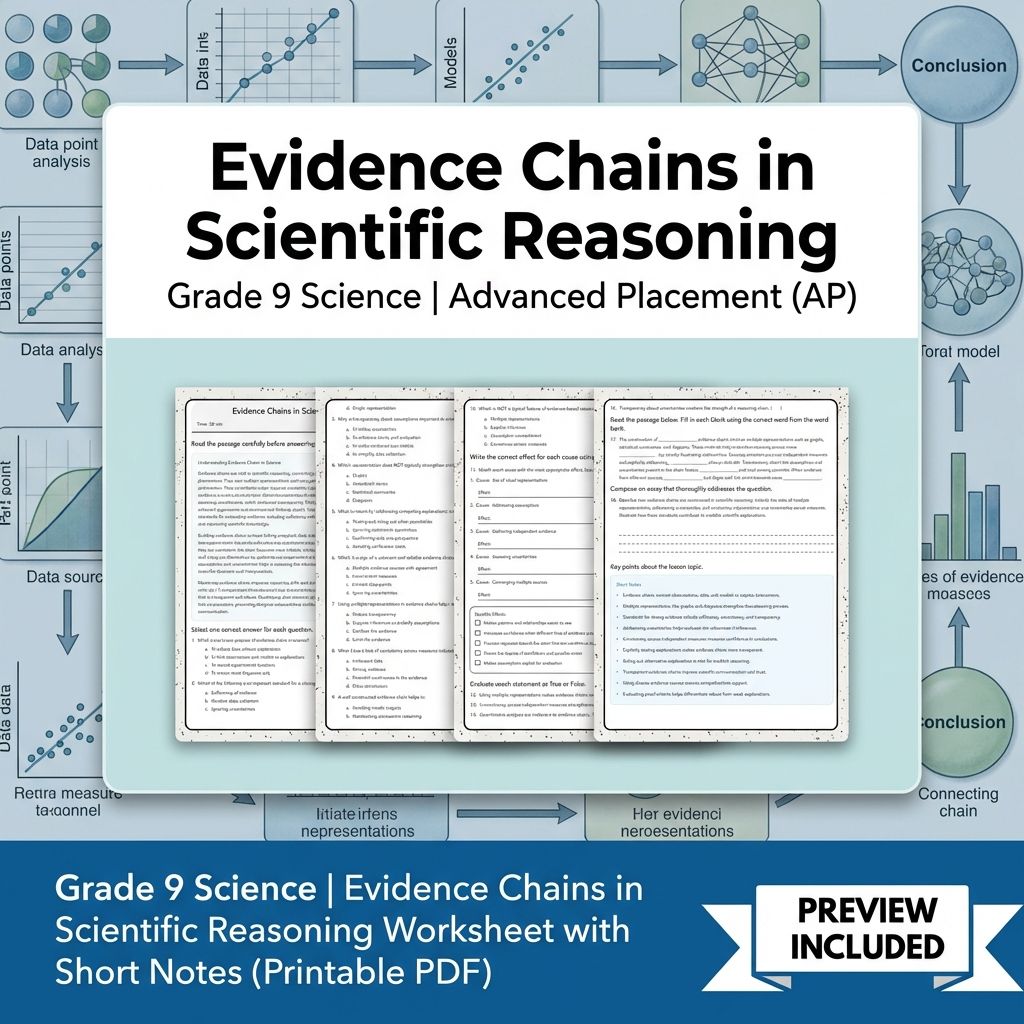
Grade 9 Science | Evidence Chains in Scientific Reasoning Worksheet (PDF)
 Created byMeadowlark Worksheets
Learning Objectives
- Understand the structure of evidence-based reasoning in science.
- Identify different types of evidence and their roles in supporting claims.
- Analyze how multiple representations strengthen inference chains.
Also included in: Grade 9 Science | Critical Thinking & Data Analysis Unit Bundle (Worksheets) +1 more
Instant download

Chemical Changes Test Prep Printables | Grade 9 Science
Created byPrism Point LearningLearning Objectives
- Explain how a chemical change forms new substances with different properties and composition.
- Identify observable evidence of chemical changes such as temperature change, gas formation, and precipitate formation.
- Distinguish chemical evidence from physical rearrangement of matter using the particle-level (microscopic) viewpoint.
Also included in: Grade 9 Chemistry Test Prep Science Lesson Bundle: Ontario Framework
Instant download

Reaction Types Practice Worksheet | Grade 9 Science Review Assessment
Created byPrism Point LearningLearning Objectives
- Identify and distinguish common reaction types: synthesis, decomposition, single/double displacement, and combustion.
- Predict likely products from reactants by using particle and bonding patterns.
- Explain how conservation of mass constrains reaction outcomes and evidence from observations.
Also included in: Grade 9 Chemistry Test Prep Science Lesson Bundle: Ontario Framework
Instant download

Element Identity Test Prep Printables | Grade 9 Science
Created byPrism Point LearningLearning Objectives
- Explain how the number of protons and the chemical symbol identify an element.
- Describe how atomic models help represent the identity of atoms and elements.
- Classify elements as metals or nonmetals and use examples (iron, carbon, oxygen).
Also included in: Grade 9 Chemistry Test Prep Science Lesson Bundle: Ontario Framework
Instant download

Chemical Properties Worksheet Practice and Review | Grade 9 Science
Created byPrism Point LearningLearning Objectives
- Define chemical properties as the tendencies of substances to undergo specific chemical changes.
- Identify evidence of chemical change, such as new substances, gas evolution, precipitate formation, and permanent colour change.
- Distinguish chemical change from physical change using observable reaction outcomes.
Also included in: Grade 9 Chemistry Test Prep Science Lesson Bundle: Ontario Framework
Instant download

Physical Properties Test Prep Printables | Grade 9 Science
Created byPrism Point LearningLearning Objectives
- Define physical properties as observable or measurable characteristics that do not change a substance’s chemical identity.
- Identify and distinguish common intensive and extensive physical properties in everyday materials.
- Explain how physical properties can be used to classify materials and choose separation or testing methods.
Also included in: Grade 9 Chemistry Test Prep Science Lesson Bundle: Ontario Framework
Instant download

Physical Changes Test Prep Worksheets | Grade 9 Science
Created byPrism Point LearningLearning Objectives
- Describe physical changes as changes in state or form that keep the same chemical identity.
- Differentiate reversible and irreversible physical transformations using everyday examples.
- Explain how energy transfer is involved in melting, freezing, evaporation, and condensation.
Also included in: Grade 9 Chemistry Test Prep Science Lesson Bundle: Ontario Framework
Instant download

Compound Formulas Practice Worksheet | Grade 9 Science Review
Created byPrism Point LearningLearning Objectives
- Explain how chemical formulas represent compounds as fixed combinations of elements and relate to the law of definite composition
- Differentiate covalent and ionic bonding and predict how bonding type can affect observable properties
- Use chemical formulas to describe elemental ratios and to distinguish compounds from mixtures
Also included in: Grade 9 Chemistry Test Prep Science Lesson Bundle: Ontario Framework
Instant download

Societal Impacts Test Prep Worksheet | Grade 9 Science
Created byPrism Point LearningLearning Objectives
- Evaluate how everyday chemicals provide benefits while creating risks to health and the environment.
- Use chemical properties and exposure routes to explain why some substances persist or spread.
- Apply evidence-based reasoning to compare safe handling, disposal, and regulatory options.
Also included in: Grade 9 Chemistry Test Prep Science Lesson Bundle: Ontario Framework
Instant download

Mixtures And Separation Test Prep Worksheet | Grade 9 Science
Created byPrism Point LearningLearning Objectives
- Distinguish between homogeneous and heterogeneous mixtures using evidence such as visible phases
- Identify physical methods of separation and match them to differences in particle size, solubility, boiling point, and density
- Explain why physical separation preserves the chemical identity of mixture components
Also included in: Grade 9 Chemistry Test Prep Science Lesson Bundle: Ontario Framework
Instant download

Control Criteria Worksheet | Experimental Design AP Science Grade 9
Created byPrism Point LearningLearning Objectives
- Explain how isolating variables and using reference conditions support causal interpretation.
- Describe why replication and baseline characterization increase the credibility of results.
- Identify how residual confounding and uncontrolled variation weaken causal claims, even when patterns appear.
Instant download
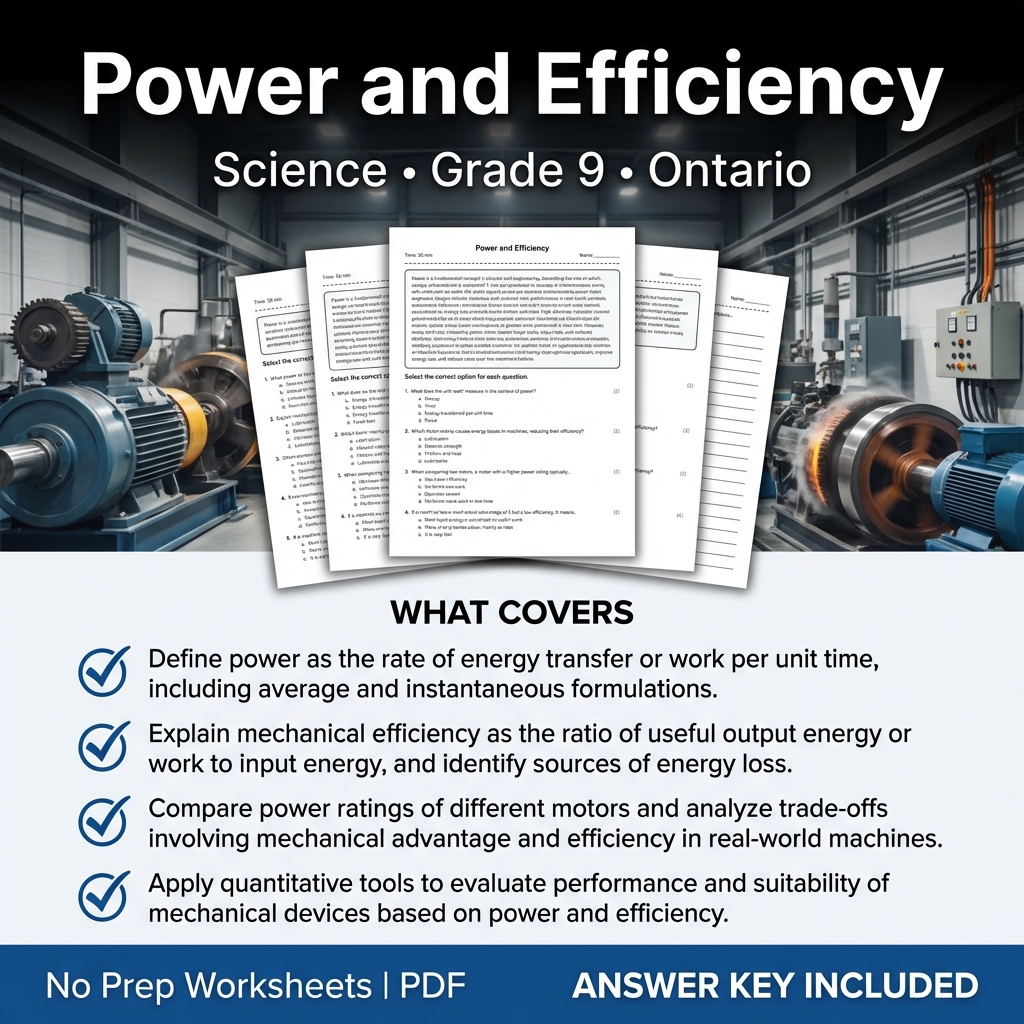
Power and Efficiency Worksheet for Grade 9 Science | Ontario Standards
 Created byCoral Reef Learning
Learning Objectives
- Define power as the rate of energy transfer or work per unit time, including average and instantaneous formulations.
- Explain mechanical efficiency as the ratio of useful output energy or work to input energy, and identify sources of energy loss.
- Compare power ratings of different motors and analyze trade-offs involving mechanical advantage and efficiency in real-world machines.
Instant download
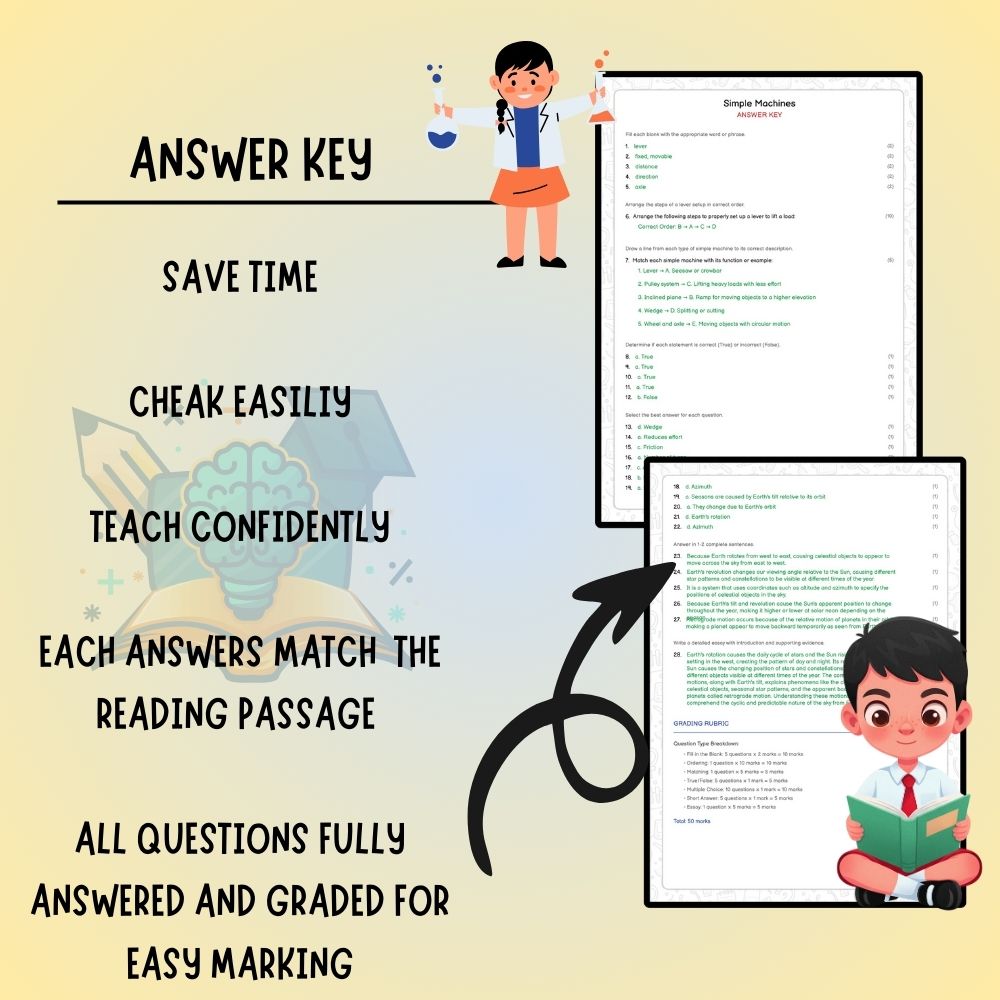
Grade 9 Science | Power and Efficiency Worksheet (PDF) Aligned with Ontario Standards
Created byPrism Point LearningLearning Objectives
- Define power as the rate of energy transfer or work per unit time and understand its units.
- Explain mechanical efficiency and how it quantifies useful output relative to input energy.
- Identify factors such as friction and heat that cause energy losses in machines.
Also included in: Grade 9 Science Unit | Forces, Motion & Energy Worksheets (Ontario Standards) +1 more
Instant download

Pedigree Analysis Worksheet | TEKS Aligned Grade 9 Science Practice
JCreated byJ.S SheetsLearning Objectives
- Interpret pedigrees using standardized symbols and relationship patterns across generations
- Differentiate autosomal dominant, autosomal recessive, X-linked, and mitochondrial inheritance using affected and carrier information
- Apply probability reasoning from pedigrees to estimate risk for relatives
Instant download

Grade 9 Science | Intermolecular Forces Worksheet | BC Aligned
 Created byLumora Learning
Learning Objectives
- Explain the different types of intermolecular forces and how they influence physical properties.
- Compare the strengths of London dispersion forces, dipole–dipole interactions, and hydrogen bonds.
- Relate molecular structure to the behavior and physical properties of substances.
Instant download

Moon Phases and Eclipses Assessment | General Standards | Grade 9 Science
Created byPrism Point LearningLearning Objectives
- Understand the relative motions of the Moon, Earth, and Sun that produce different Moon phases.
- Explain how the geometry of the Earth-Moon-Sun system causes eclipses.
- Describe the reasons why eclipses do not happen every month.
Instant download
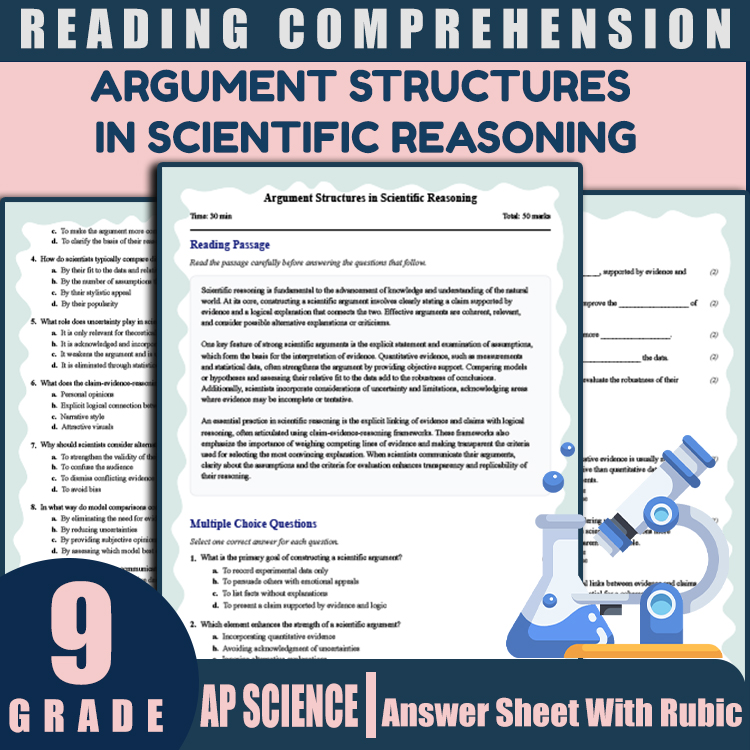
9th Grade Science | Argument Structures in Scientific Reasoning Reading Worksheet
JCreated byJ.S SheetsLearning Objectives
- Understand the components of scientific arguments including claim, evidence, and reasoning.
- Evaluate the coherence, relevance, and strength of evidence in scientific arguments.
- Analyze how quantitative evidence and models contribute to argument strength.
Instant download

Seasons and Day Length Assessment | General Grade 9 Science Standards
Created byPrism Point LearningLearning Objectives
- Understand how Earth's axial tilt and orbit around the Sun cause seasonal changes.
- Explain how the angle of sunlight and day length vary with Earth's position in its orbit.
- Describe the relationship between solar energy received and Earth's seasons.
Instant download

Grade 9 Celestial Motions Worksheet | Earth's Rotation, Orbit & Seasons
 Created byChalk and Compass
Learning Objectives
- Explain how Earth’s rotation and orbital motion produce observable daily and yearly cycles.
- Distinguish solar day and sidereal day and relate them to Earth’s motion around the Sun.
- Describe how geometry and periodic gravitational effects lead to predictable changes in what we observe from Earth.
Also included in: Earth Systems & Space Lesson Bundle – Grade 9 Science Ontario Framework +1 more
Instant download
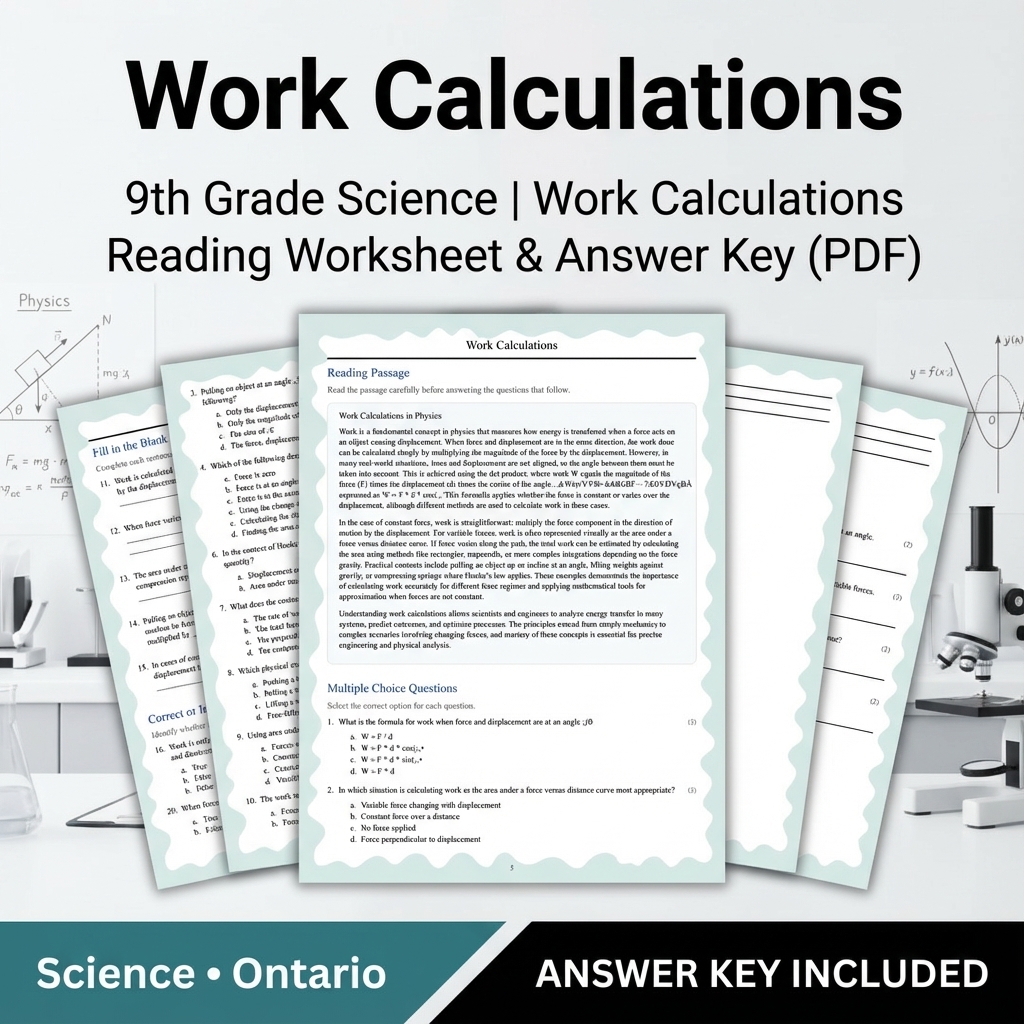
9th Grade Science | Work Calculations Reading Worksheet & Answer Key (PDF)
JCreated byJ.S SheetsLearning Objectives
- Understand how to compute work as the dot product of force and displacement, including the role of the cosine of the angle between them.
- Differentiate between constant force and variable force work calculations.
- Apply area-under-curve methods to approximate work for variable forces.
Also included in: Grade 9 Science Unit | Force, Motion & Energy Worksheets & Answer Keys Bundle +1 more
Instant download
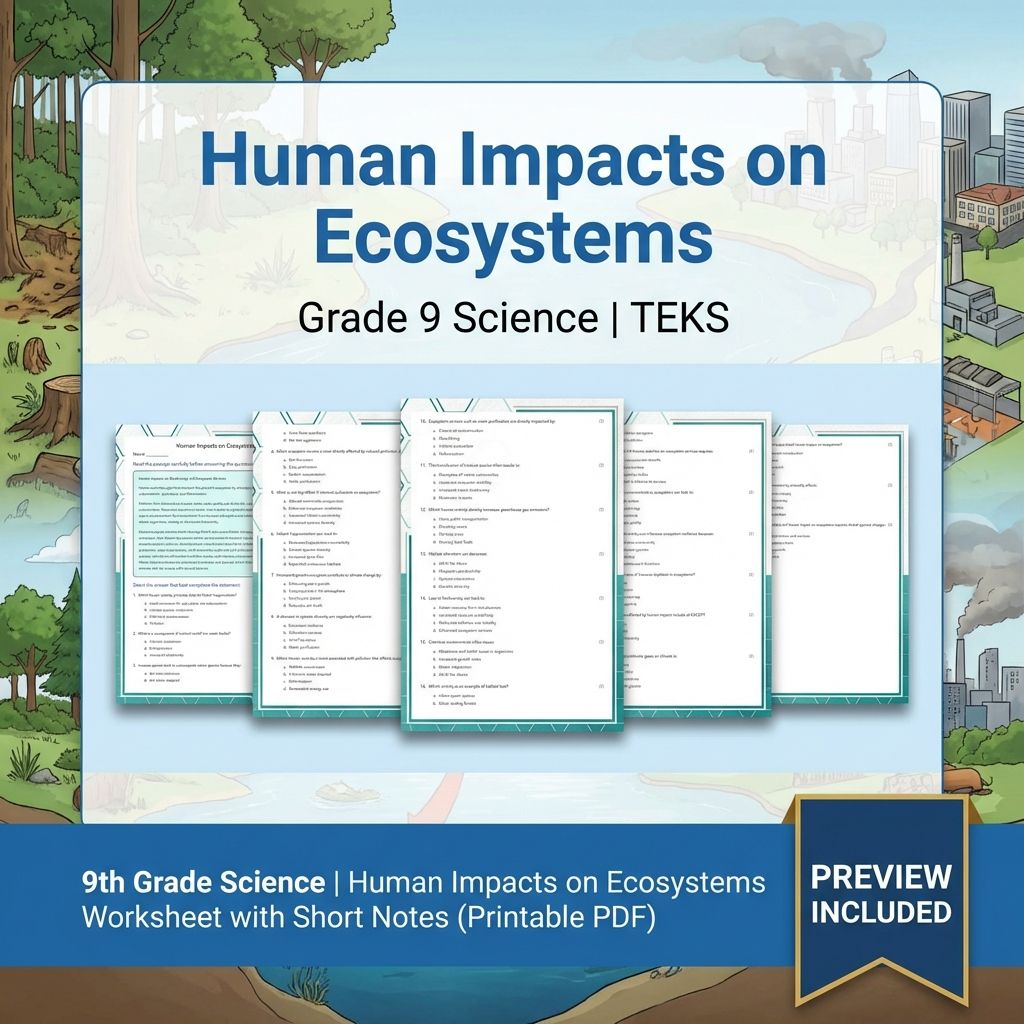
9th Grade Science | Human Impacts on Ecosystems Worksheet with Short Notes (PDF)
Created byMeadowlark WorksheetsLearning Objectives
- Understand how human activities alter biodiversity and ecosystem services.
- Identify different types of land conversion, pollution, and resource extraction impacts.
- Analyze effects of habitat fragmentation and invasive species on ecological community structure.
Instant download
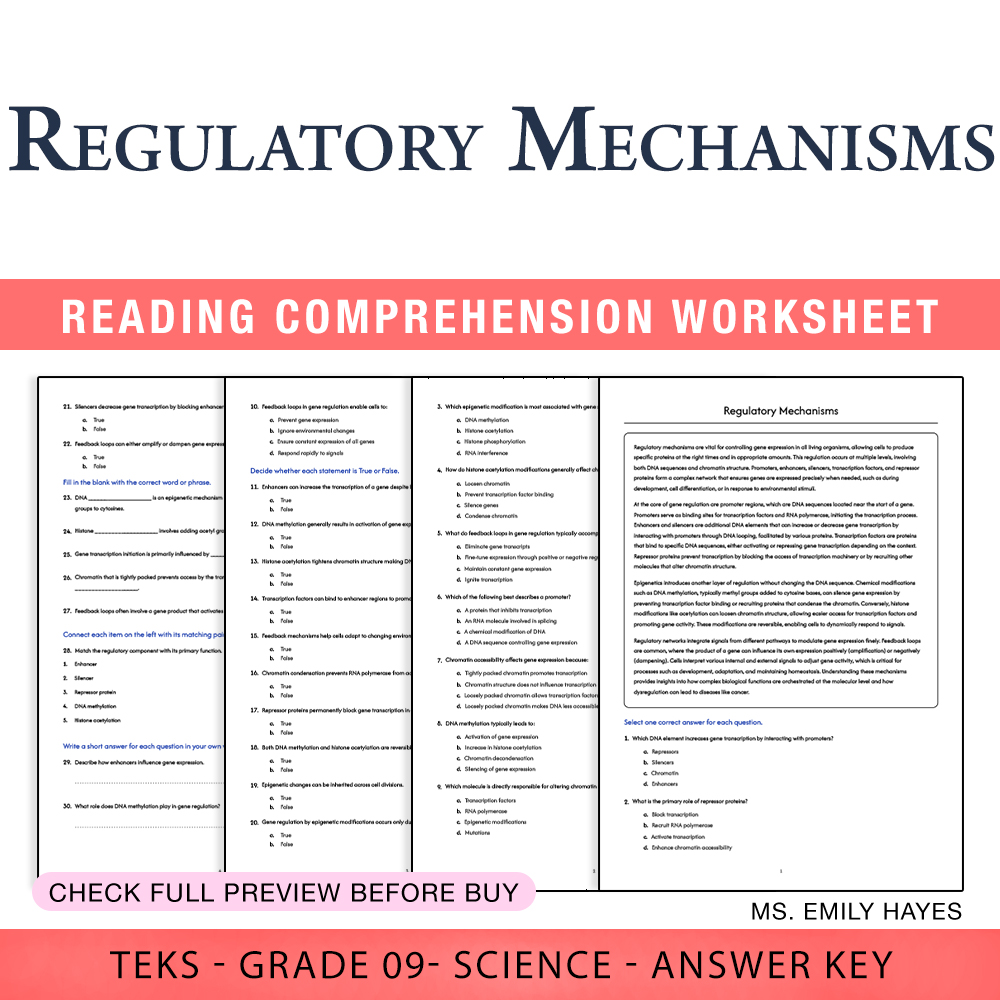
9th Grade Science | Regulatory Mechanisms Worksheet (PDF+ Answer Key)
 Created byCopper Leaf Classroom
Learning Objectives
- Understand how gene expression is regulated through transcription factors, enhancers, and silencers.
- Explain the role of epigenetic modifications such as DNA methylation and histone acetylation in gene regulation.
- Describe how regulatory networks and feedback loops help cells respond to developmental and environmental cues.
Instant download
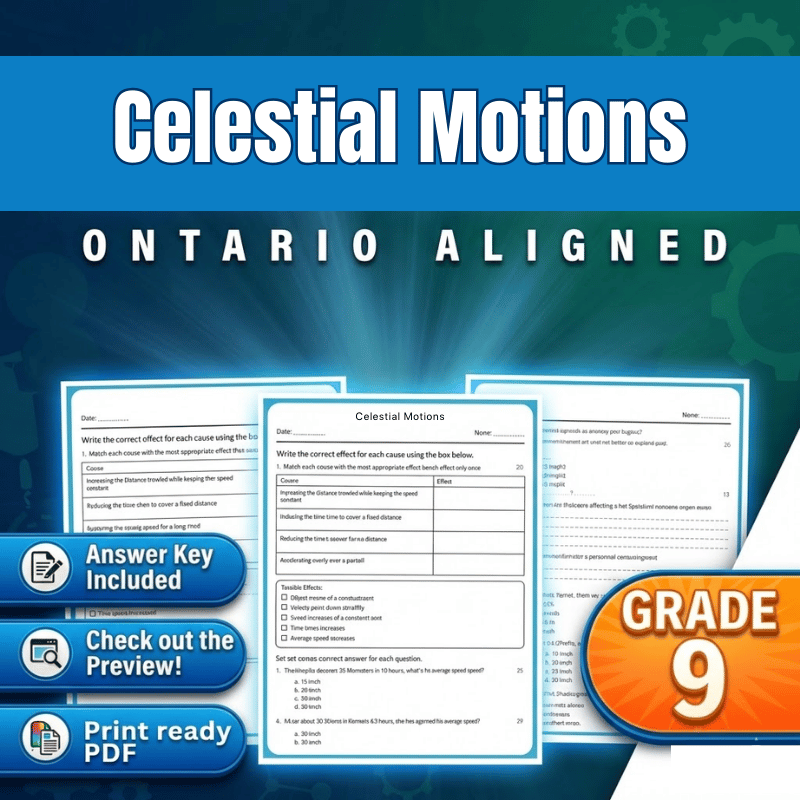
Grade 9 Science | Celestial Motions Worksheet (Ontario) – Science (PDF)
 Created byBright Mind Resources
Learning Objectives
- Describe the orbital motions of Earth, Moon, and Sun and relate them to observable cycles.
- Explain how Earth's rotation causes day-night cycles and distinguish between sidereal and solar periods.
- Connect gravitational interactions among Earth, Moon, and Sun to tidal phenomena and orbital stability.
Instant download

Grade 9 Science | Bond Types in Chemistry - Daily Reading Comprehension
Created byCoral Reef LearningLearning Objectives
- Describe the characteristics of ionic bonds
- Explain how ionic bonds influence material properties
- Identify properties associated with ionic bonds
Instant download
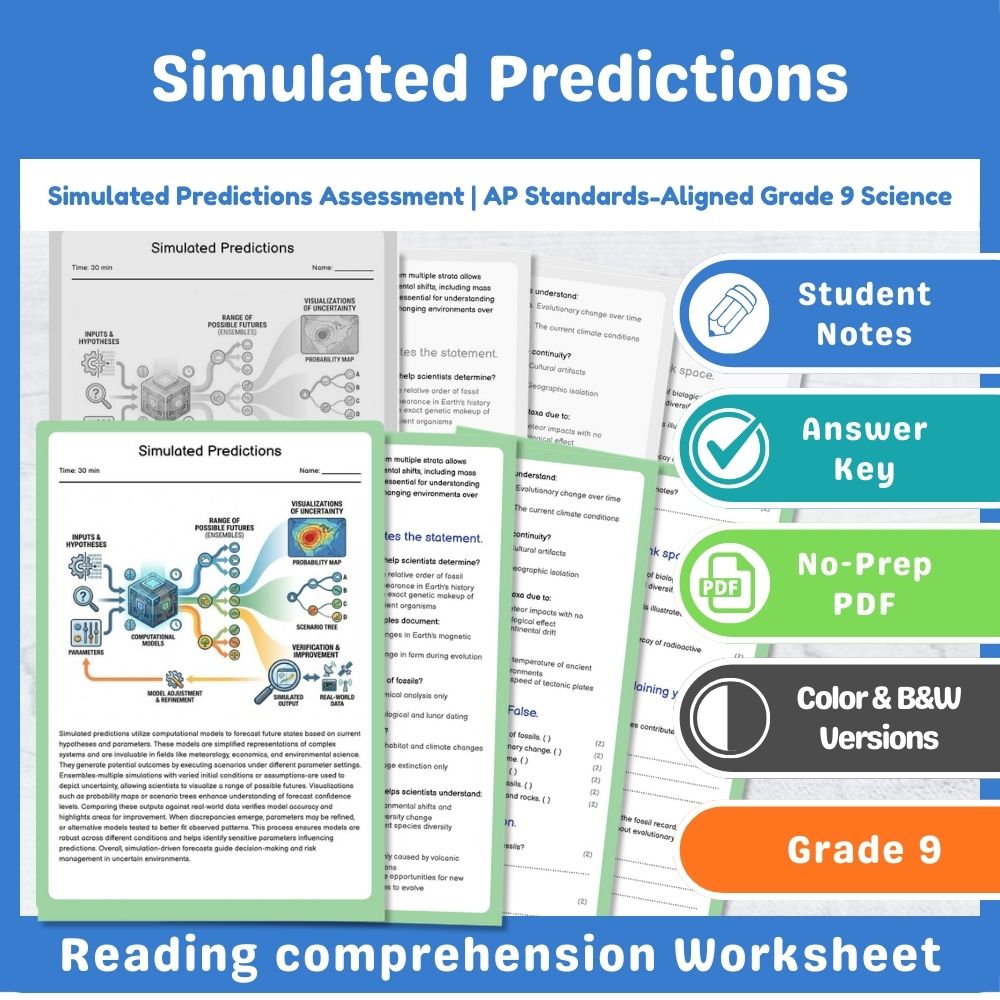
Simulated Predictions Assessment | AP Standards-Aligned Grade 9 Science
Created byPrism Point LearningLearning Objectives
- Explain the role of computational simulations and numerical models in scientific predictions.
- Describe how ensembles and visualizations express uncertainty in forecasts.
- Identify how simulation outputs are compared to empirical data to refine models.
Instant download

Grade 9 Mendelian Genetics Alleles Genotypes Phenotypes Worksheet Alberta
 Created byBRIGHT PATH RESOURCES
Learning Objectives
- Define allele, genotype, and phenotype using correct science vocabulary
- Distinguish dominant and recessive alleles in single-gene crosses
- Use simple Punnett square logic to predict offspring outcomes
Instant download
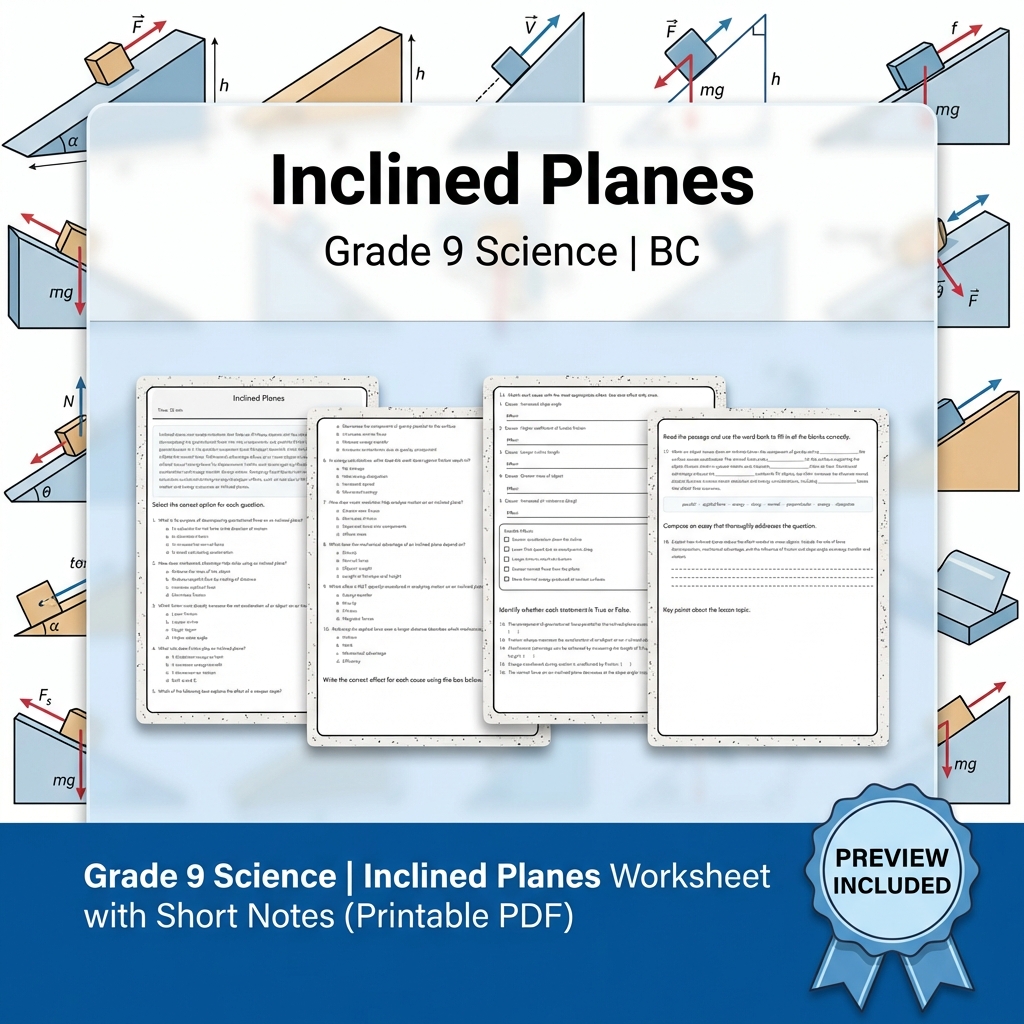
Grade 9 Science | Inclined Planes Worksheet with Short Notes (Printable PDF)
Created byMeadowlark WorksheetsLearning Objectives
- Understand how inclined planes decompose gravitational forces into components.
- Explain the concept of mechanical advantage and how it reduces required force.
- Analyze the effects of friction and slope angle on motion and energy transfer.
Also included in: Grade 9 Science Lesson Bundle | Energy, Forces & Motion Worksheets +1 more
Instant download

Grade 9 Science | Risks & Benefits of Genetic Technologies - Daily Reading
Created byCoral Reef LearningLearning Objectives
- Understand ecological, economic, and health considerations of genetic technologies.
- Evaluate potential risks such as gene flow, resistance, and market impacts.
- Identify benefits including therapeutic opportunities and crop improvements.
Also included in: Reproduction and Heredity Lesson Bundle | Grade 9 Science | Alberta +1 more
Instant download

Evolution Basics Assessment for Grade 9 Science | TEKS Standards
Created byPrism Point LearningLearning Objectives
- Understand the fundamental mechanisms of evolution including natural selection, genetic drift, mutation, and gene flow.
- Explain how these mechanisms influence allele frequencies and lead to changes in populations over generations.
- Describe the long-term effects of evolution on traits and genetic diversity within species.
Instant download

Classification Foundations Assessment for Grade 9 Science | TEKS
Created byPrism Point LearningLearning Objectives
- Understand the hierarchical structure of biological classification systems.
- Identify traditional and modern approaches to classifying living organisms.
- Compare morphological, developmental, and genetic data used in taxonomy.
Instant download

Speciation Introduction Assessment for Grade 9 Science TEKS
Created byPrism Point LearningLearning Objectives
- Define speciation and understand its role in biodiversity.
- Differentiate between allopatric and sympatric speciation.
- Identify reproductive barriers that contribute to speciation.
Instant download

Natural Selection Assessment for Grade 9 Science TEKS Standards
Created byPrism Point LearningLearning Objectives
- Understand the concept of natural selection and its role in evolution.
- Identify examples of natural selection in real-world scenarios.
- Differentiate between types of selection: directional, stabilizing, and disruptive.
Instant download

Evidence Overview Assessment for Grade 9 Science TEKS Standards
Created byPrism Point LearningLearning Objectives
- Understand different lines of evidence supporting evolutionary relationships.
- Identify how fossil, anatomical, and molecular data contribute to understanding biodiversity over time.
- Compare and evaluate various types of evidence used in evolutionary studies.
Instant download

Fossil Records Assessment | TEKS Grade 9 Science Standards
Created byPrism Point LearningLearning Objectives
- Describe how fossils provide evidence for past life and evolutionary history.
- Identify types of fossils and their significance in stratigraphy.
- Explain how stratigraphic context and dating methods determine fossil ages.
Instant download

Grade 9 Science Worksheet | Structure Function Connections (PDF)
 Created byEvergreen Desk Education
Learning Objectives
- Explain how cellular structures support specific functions (information storage, energy conversion, and selective exchange).
- Connect organism-level body structures and tissues to their functional needs (protection, movement, support).
- Use models to justify how a feature’s physical properties enable biological tasks.
Also included in: Grade 9 Ecology, Inheritance, and Cell Functions Science Lesson Bundle (General) +1 more
Instant download

Grade 9 Science | Trait Prediction Across Generations Worksheet (PDF)
Created byEvergreen Desk EducationLearning Objectives
- Explain how allele combinations in parents determine genotype outcomes in offspring using probability.
- Predict expected phenotype frequencies across multiple generations, accounting for dominant and recessive alleles.
- Use evidence from family patterns and cross results to justify trait-frequency predictions.
Also included in: Grade 9 Ecology, Inheritance, and Cell Functions Science Lesson Bundle (General) +1 more
Instant download

Grade 9 Reaction Design in Chemistry Worksheet | NGSS Science Activity
Created byBRIGHT PATH RESOURCESLearning Objectives
- Understand the factors affecting chemical reaction rates and equilibrium.
- Identify how temperature, pressure, concentration, and catalysts influence reaction outcomes.
- Apply principles of kinetics and equilibrium to real-world chemical processes.
Also included in: Atomic Structure & Chemical Reactions Lesson Bundle | Grade 9 Science | NGSS +1 more
Instant download
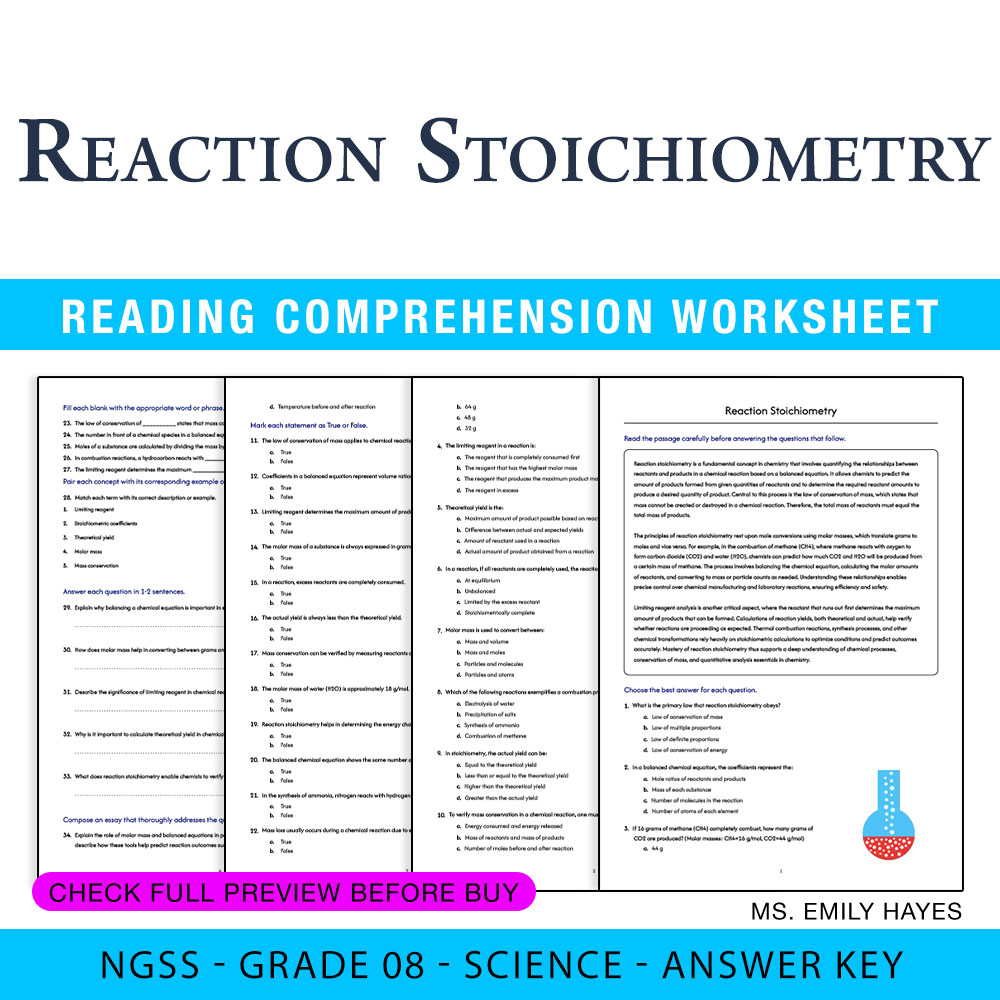
9th Grade Science | Reaction Stoichiometry Worksheet (PDF+ Answer Key)
Created byCopper Leaf ClassroomLearning Objectives
- Understand the concept of reaction stoichiometry and how it relates quantities of reactants and products in chemical reactions.
- Apply molar mass conversions to relate moles, mass, and particle counts in balanced chemical equations.
- Analyze limiting reagents and calculate theoretical yields in chemical reactions.
Instant download
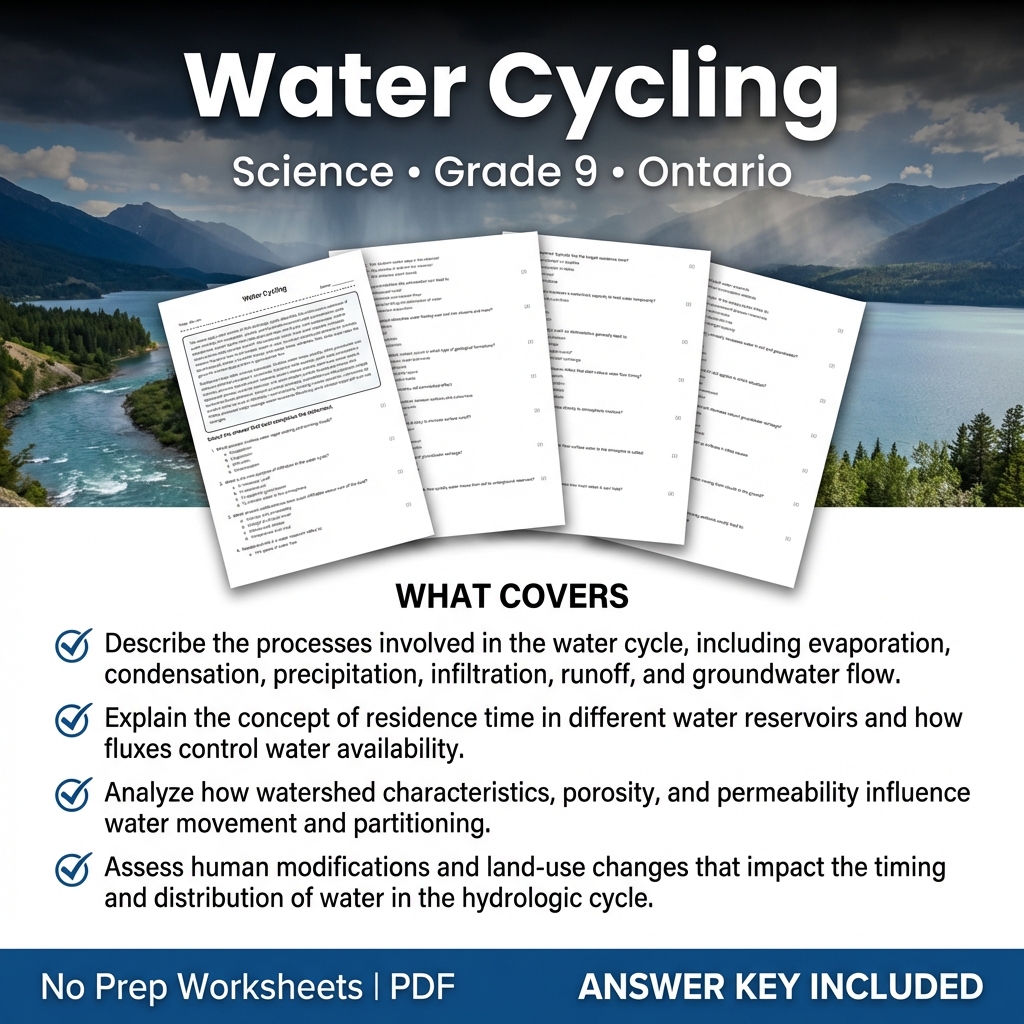
Water Cycling Science Worksheet Grade 9 | Ontario Standards Practice
Created byCoral Reef LearningLearning Objectives
- Describe the processes involved in the water cycle, including evaporation, condensation, precipitation, infiltration, runoff, and groundwater flow.
- Explain the concept of residence time in different water reservoirs and how fluxes control water availability.
- Analyze how watershed characteristics, porosity, and permeability influence water movement and partitioning.
Instant download
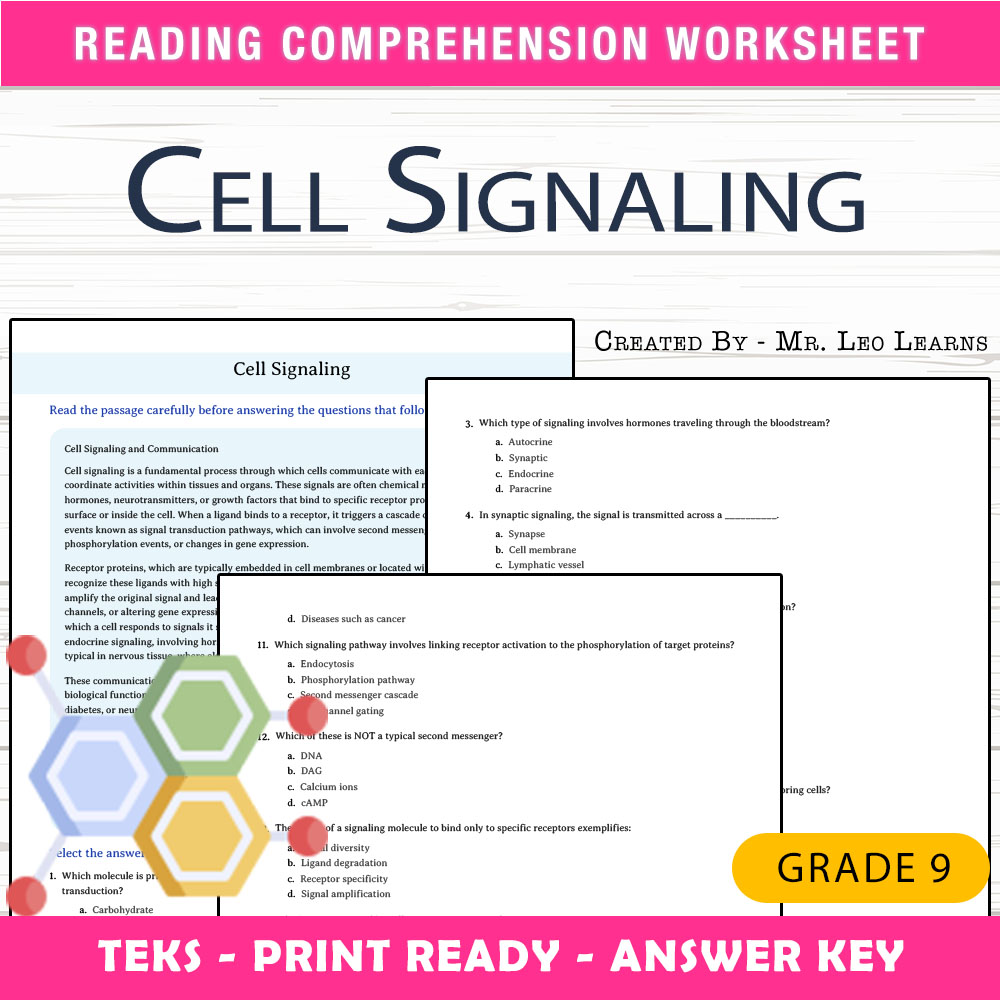
Grade 9 Science – Cell Signaling Worksheet for Mastery | PDF + Answer Key
 Created byThe Resource Hub
Learning Objectives
- Describe how cells communicate using chemical and electrical signals.
- Identify key components of signal transduction pathways.
- Explain the different types of cellular signaling (autocrine, paracrine, endocrine, synaptic).
Also included in: Grade 9 Science Unit | Human Body Systems & Homeostasis Worksheet Bundle +1 more
Instant download
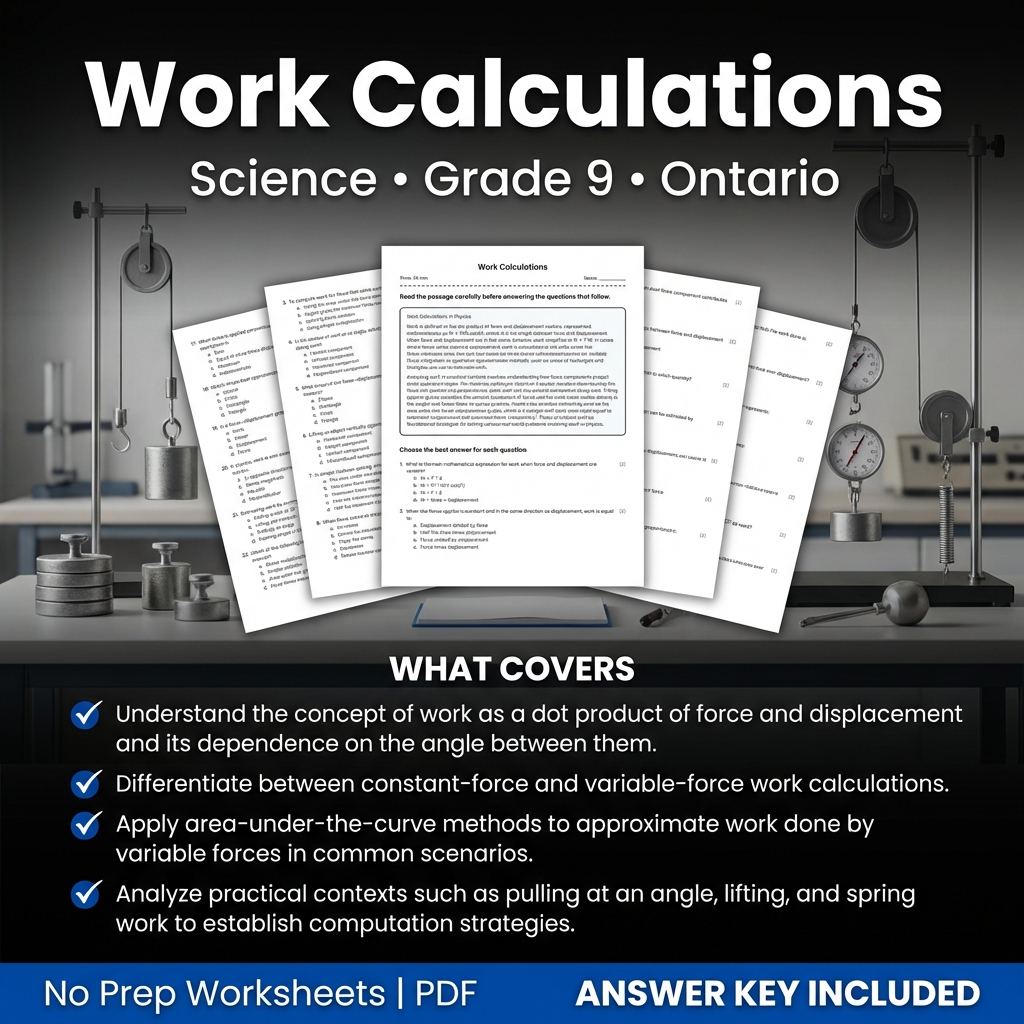
Work Calculations Worksheet for Grade 9 Science – Printable PDF & Answer Key
Created byCoral Reef LearningLearning Objectives
- Understand the concept of work as a dot product of force and displacement and its dependence on the angle between them.
- Differentiate between constant-force and variable-force work calculations.
- Apply area-under-the-curve methods to approximate work done by variable forces in common scenarios.
Instant download

Reaction Stoichiometry Worksheet | NGSS Grade 9 Science Assessment
 Created byCedar Grove Learning
Learning Objectives
- Understand how conservation of mass applies to balanced chemical equations.
- Relate moles, mass, and particle counts through molar mass conversions.
- Perform limiting reagent analysis and calculate theoretical yields.
Instant download

Grade 9 Reaction Stoichiometry Worksheet | NGSS Chemistry Science Activity
Created byBRIGHT PATH RESOURCESLearning Objectives
- Understand the concept of reaction stoichiometry and its basis in conservation of mass.
- Learn to interpret and balance chemical equations correctly.
- Apply mole conversions between mass, moles, and particle counts.
Also included in: Atomic Structure & Chemical Reactions Lesson Bundle | Grade 9 Science | NGSS +1 more
Instant download
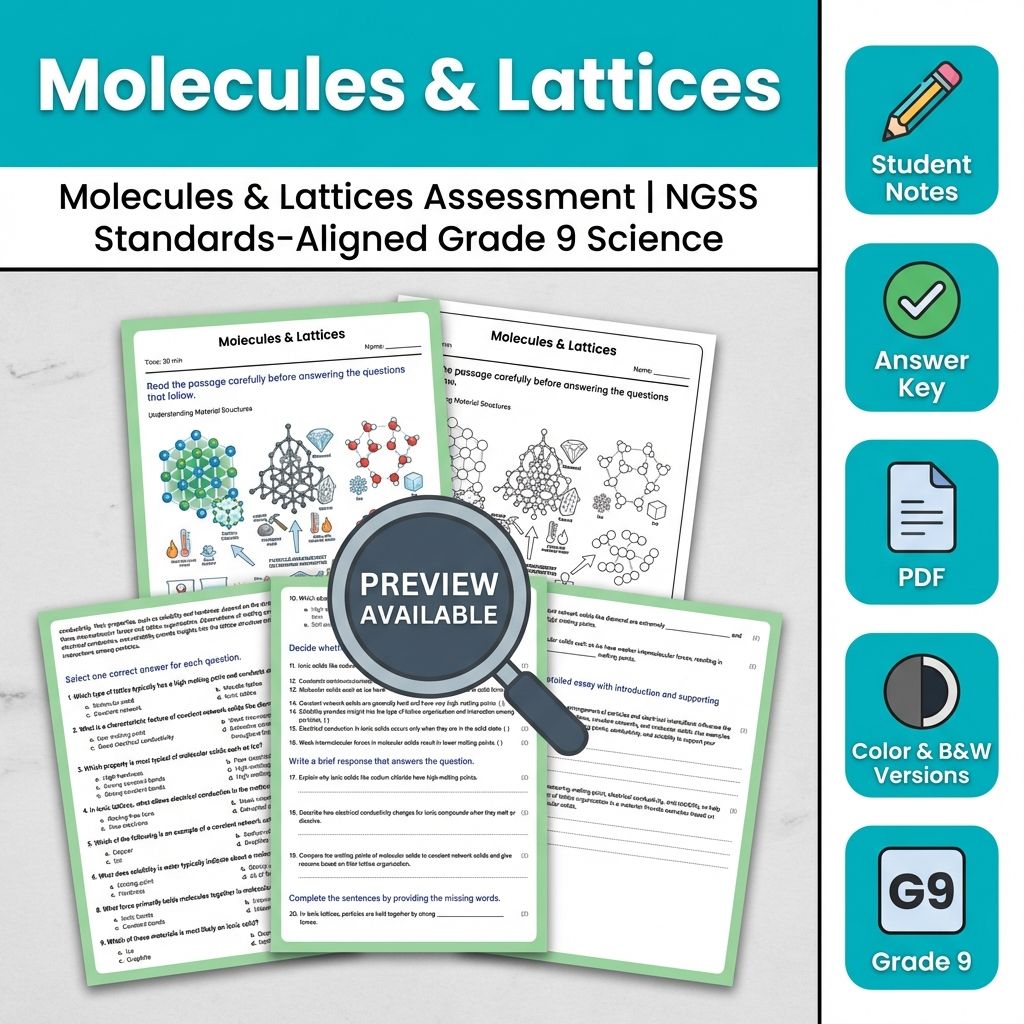
Molecules & Lattices Assessment | NGSS Standards-Aligned Grade 9 Science
Created byPrism Point LearningLearning Objectives
- Understand the relationship between particle arrangement and material properties in different lattice types.
- Identify characteristics of ionic, covalent network, and molecular solids based on their structure and observed physical properties.
- Analyze how melting point, electrical conductivity, hardness, and solubility reflect lattice organization and interparticle forces.
Instant download

Grade 9 Science | Temperature Control Worksheet | BC Aligned
Created byLumora LearningLearning Objectives
- Understand the mechanisms involved in thermoregulation and homeostasis.
- Identify how the hypothalamus detects and orchestrates responses to temperature changes.
- Describe the roles of skin blood flow, sweat production, shivering, and metabolic adjustments in temperature regulation.
Instant download

Grade 9 Science | Organ Structures Worksheet | BC Aligned
Created byLumora LearningLearning Objectives
- Explain the composition and function of various organ tissues.
- Describe how organs and organ systems work together to sustain life.
- Identify examples of organ systems and their key organs.
Instant download

Grade 9 Science | Cell Type Differences Worksheet Elena | BC Standards
Created byLumora LearningLearning Objectives
- Describe key structural differences between prokaryotic and eukaryotic cells.
- Identify components found in eukaryotic cells but absent in prokaryotes.
- Explain how these differences influence cell function and organism complexity.
Instant download
About Grade 9 Science Worksheets
Find Science worksheets built for Grade 9. All 6,986 cover core skills, practice, and review, each an instant PDF download.
Every worksheet on MyTeachingSheets is created by independent teacher-authors and reviewed before publication. All resources download as printable PDFs for classroom, homework, or at-home practice, and many include answer keys. Preview any worksheet free before buying.