
Grade 9 Science Worksheets
6,926 worksheets
Grade 9 Science | Immune Barriers - Daily Reading Comprehension
 Created byCoral Reef Learning
Learning Objectives
- Identify and describe physical barriers that protect the body against pathogens.
- Explain the role of skin and mucous membranes in immune defense.
- Understand the importance of barrier functions in preventing disease.
Instant download

Grade 9 Action Reaction Forces Worksheet | California Science + Answer Key
 Created byEvergreen Desk Education
Learning Objectives
- Explain Newton’s third law using the idea of force pairs acting on different objects
- Predict how forces affect the motion of each interacting object using momentum and direction
- Identify correct examples of action–reaction forces in real-world situations
Instant download

Component Behavior Worksheet Pack | Grade 9 Science Activities
 Created byPrism Point Learning
Learning Objectives
- Describe how different electrical components behave under applied voltage and current, including linear and nonlinear effects.
- Explain how temperature changes affect component resistance and how this impacts real equipment performance.
- Connect component behaviors to power ratings and safe operating limits in circuits.
Also included in: Electrical Systems & Magnetism Lesson Bundle | Grade 9 Science | Alberta
Instant download

Grade 9 Science – Homeostasis & Human Body | Daily Reading Worksheet
 Created byBright Mind Resources
Learning Objectives
- Define homeostasis and explain its importance in maintaining internal stability.
- Identify the main body systems involved in homeostasis.
- Describe how feedback mechanisms help regulate internal conditions.
Also included in: Grade 9 Cell and Human Body Systems Science Daily Reading Lesson Bundle | BC +1 more
Instant download

Population Regulation in Ecosystems Worksheet | Grade 9 NGSS Ecology
 Created byBRIGHT PATH RESOURCES
Learning Objectives
- Understand key concepts related to Science
- Apply knowledge through practice questions
- Demonstrate comprehension of the material
Also included in: Ecosystems Grade 9 Science Daily Reading Worksheets Lesson Bundle | NGSS +1 more
Instant download

Models and Theories Worksheet Grade 9 Science NGSSS Practice Resource
Created byEvergreen Desk EducationLearning Objectives
- Explain how scientific models represent phenomena at different levels of detail
- Differentiate models, explanations, and theories using evidence-based reasoning
- Describe how theories can change when new evidence conflicts with earlier ideas
Instant download

Grade 9 Science Food Web Energy Worksheet | Ecology | Florida NGSSS
Created byEvergreen Desk EducationLearning Objectives
- Explain how energy moves through ecosystems from producers to consumers and why it often decreases at each trophic level.
- Describe the role of trophic levels in energy transfer (primary, secondary, and higher-level consumers).
- Analyze how interconnected feeding relationships form food webs rather than single energy pathways.
Instant download

Grade 9 Science Adaptation Mechanisms Worksheet | NGSSS Aligned Practice
JCreated byJ.S SheetsLearning Objectives
- Explain how inherited traits can increase fitness in a given environment
- Describe how natural selection changes allele frequencies over multiple generations
- Connect adaptation at the population level to evidence such as camouflage or feeding efficiency
Also included in: Grade 9 Evolution, Genetics, and Ecosystems Science Lesson Bundle +1 more
Instant download

Grade 9 Science | Newton’s Second Law Worksheet | California Standards
 Created byLumora Learning
Learning Objectives
- Explain Newton’s second law using net force, mass, and acceleration (Fnet = m a).
- Describe how unbalanced, vector forces determine both the direction and magnitude of acceleration.
- Predict changes in velocity over time using acceleration and the duration of a net force.
Instant download

Cellular Metabolism Worksheet for Grade 9 Science NGSS-Aligned
JCreated byJ.S SheetsLearning Objectives
- Explain the biochemical pathways involved in cellular respiration and photosynthesis.
- Describe the role of ATP in energy transfer within cells.
- Analyze how organelles like mitochondria and chloroplasts contribute to metabolism.
Also included in: Grade 9 Cellular Regulation and Metabolism Science Lesson Bundle: NGSS +1 more
Instant download

Work and Machines Worksheet | Grade 9 Science Practice
Created byPrism Point LearningLearning Objectives
- Explain how work depends on force and distance using the physics definition.
- Describe how simple machines change the magnitude or direction of an applied force.
- Evaluate input–output trade-offs and mechanical advantage in real contexts.
Also included in: Forces, Motion & Energy Lesson Bundle | Grade 9 Science (Alberta)
Instant download

DNA Genes Link Assessment | Florida NGSSS Standards Grade 9 Science
Created byPrism Point LearningLearning Objectives
- Explain how DNA stores genetic information and how genes are organized on chromosomes within cells.
- Describe how chromosomes are passed to offspring during cell division to maintain inherited genetic instructions.
- Connect mutations in DNA to differences in traits among individuals.
Also included in: Grade 9 Evolution & Genetics Science Lesson Bundle – Florida NGSSS
Instant download

Grade 9 Alleles Inheritance Worksheet | Practice & Assessment PDF
 Created byClear Sky Classroom
Learning Objectives
- Explain how alleles in pairs determine phenotypes using dominance relationships
- Interpret inheritance patterns and predict traits from allele combinations
- Describe how multiple genes and allele variation can produce continuous variation
Instant download
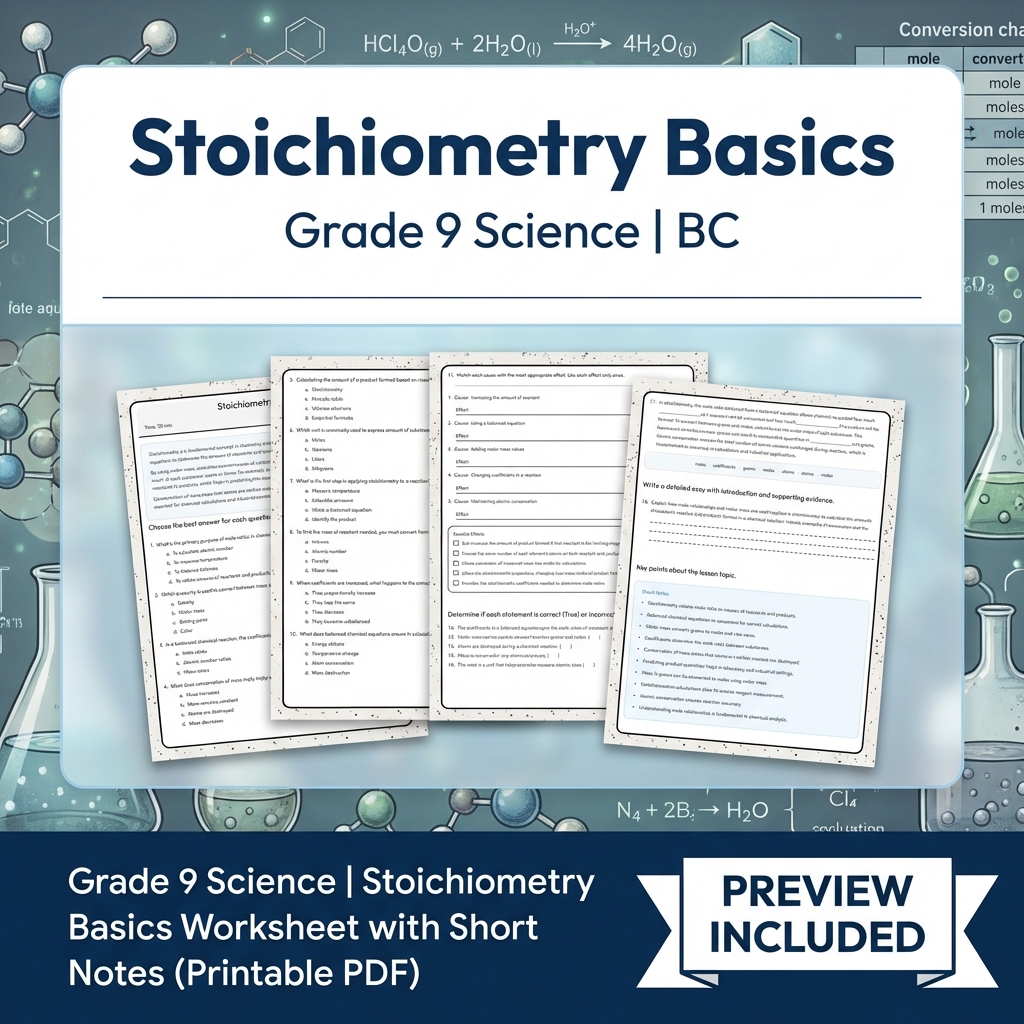
Grade 9 Science | Stoichiometry Basics Worksheet with Short Notes (PDF)
 Created byMeadowlark Worksheets
Learning Objectives
- Understand how mole relationships connect masses of reactants and products in balanced equations.
- Learn to convert between mass and amount of substance using molar mass.
- Apply mole ratios from coefficients to predict quantities of reactants and products.
Also included in: Grade 9 Science Lesson Bundle | BC Framework Focused Worksheets +1 more
Instant download

Grade 9 Science Worksheet | Trophic Transfers And Efficiency (Practice Set)
Created byEvergreen Desk EducationLearning Objectives
- Explain how energy transfer efficiency affects biomass across trophic levels.
- Use evidence such as population size, biomass trends, and nutrient concentrations to interpret trophic transfers.
- Describe how decomposition returns matter to ecosystems and supports continued production.
Also included in: Grade 9 Ecology, Inheritance, and Cell Functions Science Lesson Bundle (General) +1 more
Instant download

Grade 9 Science | Biogeochemical Cycles - Daily Reading Comprehension
Created byCoral Reef LearningLearning Objectives
- Understand the concept of biogeochemical cycles and their importance.
- Identify the main components and processes involved in the carbon cycle.
- Describe how carbon moves between different Earth system reservoirs.
Instant download

Observable Properties Worksheet | Grade 9 Science Activities
Created byPrism Point LearningLearning Objectives
- Identify common observable properties of substances and describe what they reveal about matter.
- Classify samples using observable traits such as colour, hardness, conductivity, density, and solubility.
- Explain how observable properties can support practical decisions in everyday and industrial contexts.
Instant download

Grade 9 Science – Tectonic Plates & Earth's Surface | Daily Reading Worksheet
Created byBright Mind ResourcesLearning Objectives
- Define tectonic plates and identify their main types.
- Explain how tectonic plates move relative to each other.
- Recognize the different types of plate boundaries and their features.
Also included in: Grade 9 Earth Systems Science Daily Reading Worksheets Lesson Bundle | BC +1 more
Instant download

Volcanic Processes Worksheet | Grade 9 Science | AP Standards Practice
JCreated byJ.S SheetsLearning Objectives
- Understand the different magmatic systems and eruptive styles of volcanoes.
- Identify how compositional controls and tectonic settings influence volcanic behavior.
- Explain the impact of volcanic gases and depositional products on landscape and climate.
Instant download

Grade 9 Science – Evidence Chains & Scientific Reasoning | Reading Worksheet
Created byBright Mind ResourcesLearning Objectives
- Understand the structure of evidence-based reasoning.
- Identify links between observations, analyses, and explanations.
- Recognize standards for evaluating evidence, including sufficiency and consistency.
Also included in: Grade 9 Science Data Analysis Daily Reading Worksheets Lesson Bundle | AP +2 more
Instant download
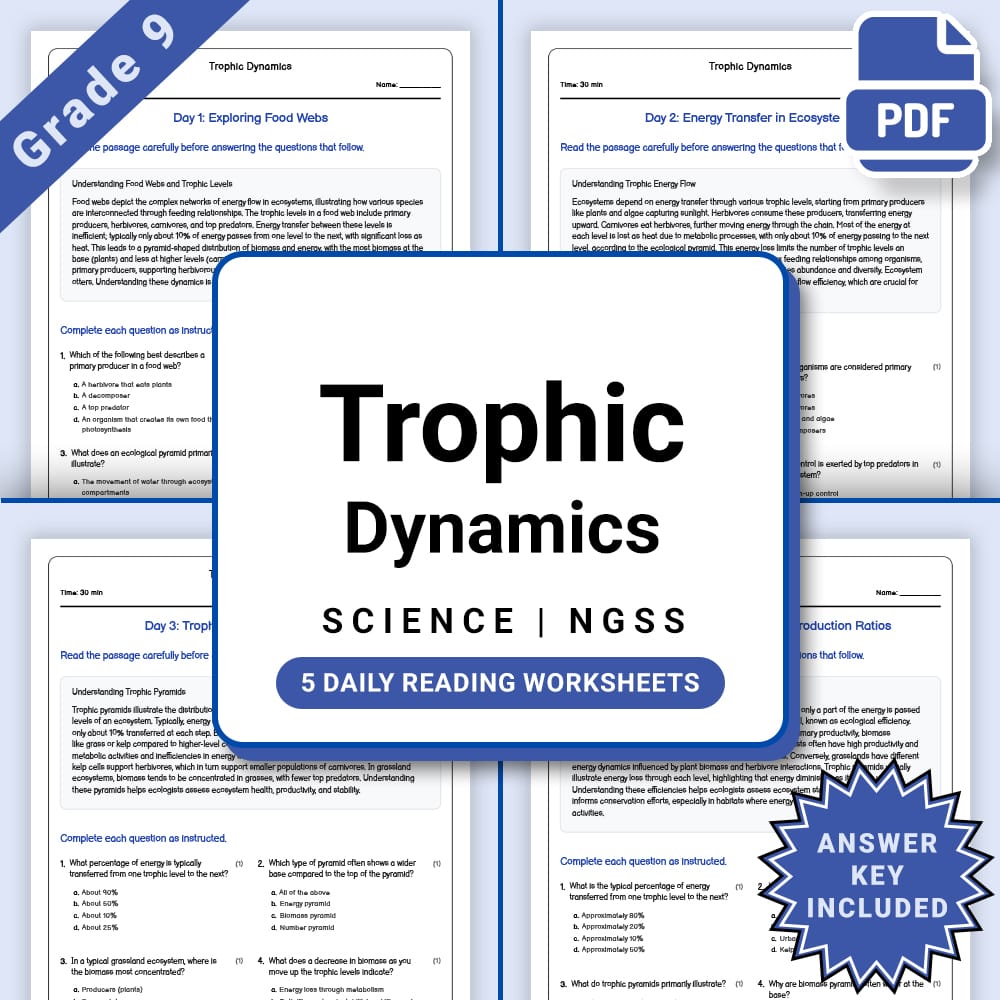
Grade 9 Science – Trophic Dynamics Daily Worksheet(PDF + Answer Key)
 Created byCopper Leaf Classroom
Learning Objectives
- Identify different trophic levels within food webs.
- Understand energy transfer and loss across trophic levels.
- Analyze the structure and functioning of ecological pyramids.
Instant download
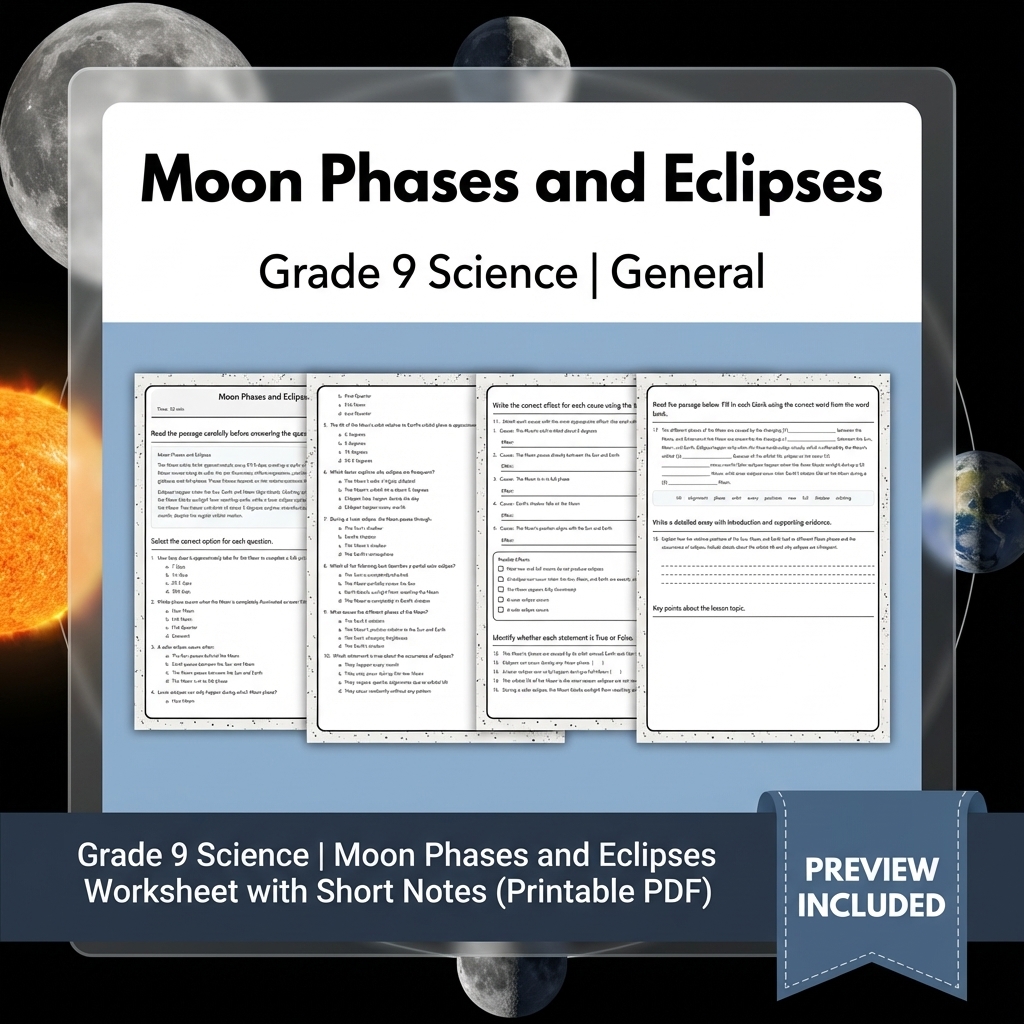
Grade 9 Science | Moon Phases and Eclipses Worksheet with Short Notes
Created byMeadowlark WorksheetsLearning Objectives
- Understand how the Moon's position affects its visible phases from Earth.
- Identify the conditions necessary for solar and lunar eclipses to occur.
- Explain the role of the Moon's orbital tilt in eclipse frequency.
Also included in: Grade 9 Earth Systems Reservoirs & Feedback Science Lesson Bundle: General +1 more
Instant download
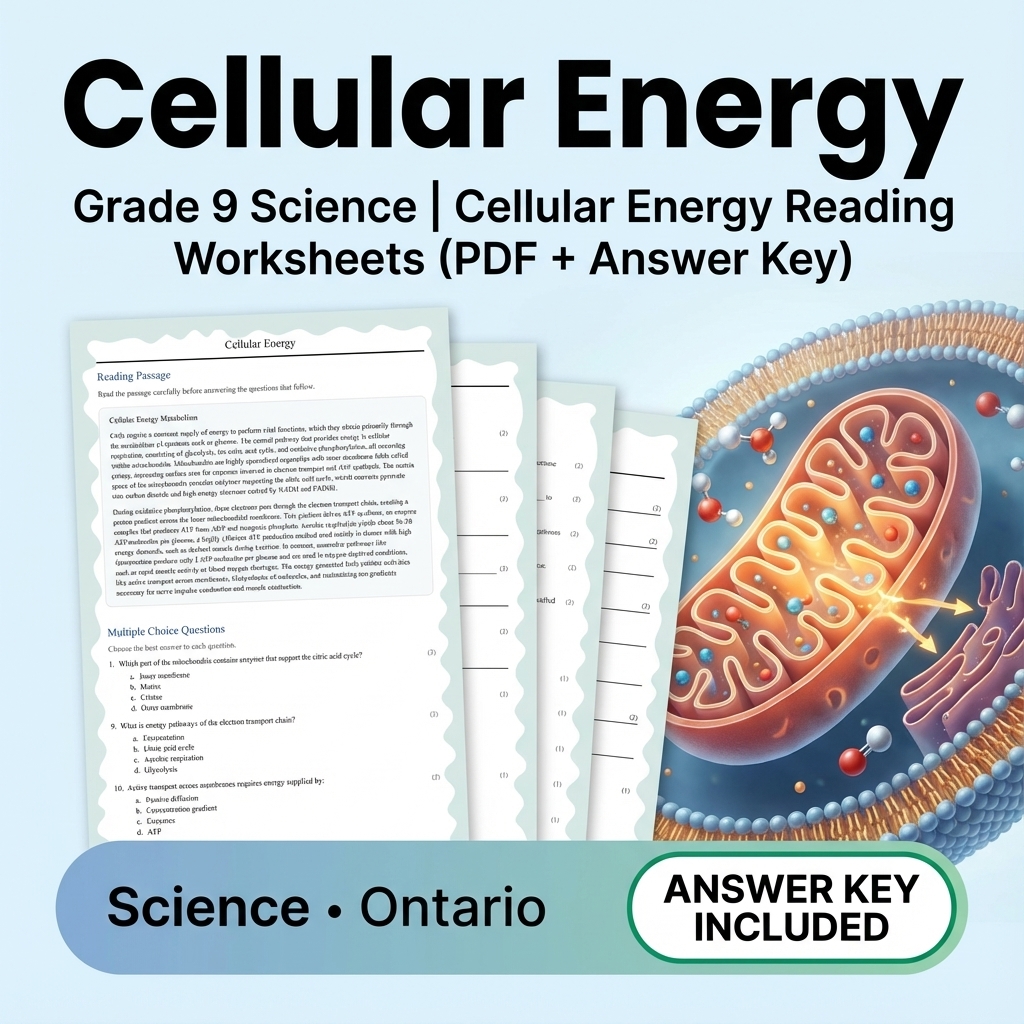
Grade 9 Science | Cellular Energy Reading Worksheets (PDF + Answer Key)
JCreated byJ.S SheetsLearning Objectives
- Describe the processes involved in cellular energy metabolism, including glycolysis, the citric acid cycle, and oxidative phosphorylation.
- Understand how mitochondrial structure supports ATP synthesis and proton gradients.
- Differentiate between aerobic and anaerobic pathways and their tissue-specific roles.
Also included in: Grade 9 Science Unit Bundle | Human Body Systems & Cell Functions +1 more
Instant download

Center Stability Worksheet for Grade 9 Science NGSS Alignment
JCreated byJ.S SheetsLearning Objectives
- Understand how to calculate the center of mass for composite systems.
- Analyze the conditions for static equilibrium involving torque and support bases.
- Evaluate stability criteria for structures and objects based on mass distribution and external forces.
Also included in: Grade 9 Newtonian Motion and Forces Science Lesson Bundle – NGSS Curriculum +1 more
Instant download

Friction and Drag Worksheet Grade 9 Physics Science Activity | NGSSS
Created byPrism Point LearningLearning Objectives
- Explain how friction and drag act as opposing forces to relative motion.
- Predict how changing surface conditions and speed can affect acceleration in real situations.
- Use force ideas to describe why braking, sliding, and coasting behaviors differ from expectations.
Instant download

Grade 9 Molecular Evidence Daily Reading Worksheet | TEKS Biology Science
Created byBRIGHT PATH RESOURCESLearning Objectives
- Extract key ideas about how DNA sequences can indicate shared ancestry.
- Identify evidence from sequence similarity and divergence in a scientific passage.
- Use scientific vocabulary related to homologous genes and molecular clocks.
Also included in: Grade 9 Evolution and Classification Biology Reading Worksheets Bundle | TEKS +1 more
Instant download
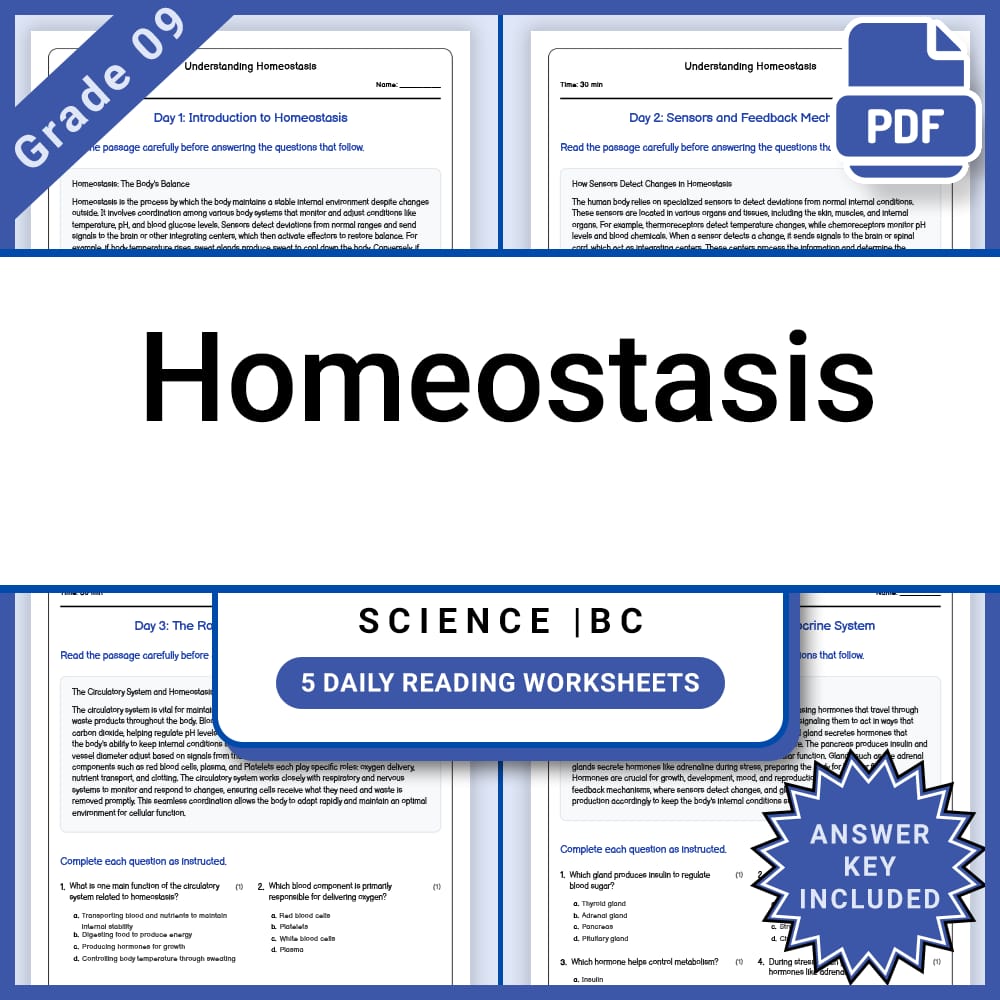
Grade 9 Science – Homeostasis Daily Reading Worksheet with Answer Key
JCreated byJ.S SheetsLearning Objectives
- Define the concept of homeostasis and its importance.
- Identify the key body systems involved in maintaining internal stability.
- Describe feedback mechanisms that regulate internal conditions.
Also included in: Grade 9 Science Lesson Group Bundle | BC Framework Activities & Worksheets +1 more
Instant download

Grade 9 Science – Biotechnology & Genetic Techniques | Daily Reading Worksheet
Created byBright Mind ResourcesLearning Objectives
- Understand key genetic technologies such as selective breeding, hybridization, genetic modification, and gene editing
- Recognize how these technologies are applied in agriculture and livestock
- Learn about the mechanisms of trait introduction and alteration at molecular and population levels
Also included in: Grade 9 Genetics & Inheritance Science Daily Reading Lesson Bundle | Alberta +1 more
Instant download

Glucose Balance Worksheet | Grade 9 Science Activities
Created byPrism Point LearningLearning Objectives
- Explain how insulin and glucagon respond to changes in blood glucose.
- Describe how the liver, muscle, and adipose tissue help maintain blood glucose homeostasis.
- Compare how feeding and fasting affect glucose uptake, storage, and release.
Also included in: Cells and Body Systems Lesson Bundle | Grade 9 Science | BC +1 more
Instant download

Earth Season Causes Assessment | NGSSS Standards Grade 9 Science
Created byPrism Point LearningLearning Objectives
- Explain how Earth’s axial tilt and its orbit around the Sun produce predictable seasonal changes
- Describe how sunlight angle and day length vary by hemisphere over the year
- Connect Sun-Earth geometry to seasonal temperature cycles and related weather patterns
Also included in: Grade 9 Earth Systems Science Lesson Bundle: Florida NGSSS Assessments
Instant download

Feedback Principles Worksheet | Grade 9 Science Practice
Created byPrism Point LearningLearning Objectives
- Explain how homeostatic feedback loops maintain internal stability using sensors, control centers, and effectors.
- Differentiate negative feedback from positive feedback and predict their overall effects on a body variable.
- Describe how signaling pathways and transport processes help transmit information and coordinate responses across tissues.
Instant download

Inertia Explained Worksheet | BC Standards Grade 9 Science Practice
JCreated byJ.S SheetsLearning Objectives
- Define inertia and explain its relationship to an object's mass.
- Describe real-world examples demonstrating inertia in everyday life.
- Understand how forces overcome inertia to change an object's motion.
Instant download

Science Worksheet Weather Data Patterns | Grade 9 Science Practice
JCreated byJ.S SheetsLearning Objectives
- Interpret how temperature, humidity, dew point, wind, and air pressure relate to observable weather patterns.
- Use short-term variability and long-term averages to distinguish typical weather from climate change.
- Analyze how air mass movement and energy exchange near Earth’s surface influence precipitation timing and storm intensity.
Also included in: Grade 9 Earth and Space Science lesson bundle worksheet: General +1 more
Instant download

Endocrine Feedback Grade 9 Science Worksheet Ontario with Answer Key
Created byClear Sky ClassroomLearning Objectives
- Explain how hormones help maintain homeostasis using negative feedback loops.
- Describe how insulin and glucagon regulate glucose homeostasis in different tissues.
- Analyze how thyroid hormones affect metabolic rate through receptor-mediated gene expression changes.
Instant download

Grade 9 Science | Paleoclimate Proxies Worksheet | AP Aligned
Created byLumora LearningLearning Objectives
- Understand how ice cores, tree rings, marine sediments, and speleothems serve as proxies for past climate conditions.
- Interpret proxy indicators such as isotopic ratios, growth increments, and microfossil assemblages to reconstruct climate history.
- Relate proxy records to temporal climate patterns, including glacial-interglacial cycles and abrupt climate events.
Also included in: Grade 9 Science | Earth and Space Science Custom Bundle | AP Aligned
Instant download

Grade 9 Science | Understanding Center of Mass & Stability - Reading Practice
Created byCoral Reef LearningLearning Objectives
- Explain the concept of center of mass in simple and composite systems.
- Calculate the center of mass for various objects and systems.
- Understand the role of torque and equilibrium in rotational stability.
Instant download

Bond Formation Worksheet | Ionic & Covalent Bonding Grade 9 Science
Created byPrism Point LearningLearning Objectives
- Explain how electron behavior leads to ionic and covalent bonding using atomic models
- Compare ionic vs. covalent bonding based on electron transfer vs. shared electron pairs
- Predict how bond structure affects properties such as conductivity and melting point
Instant download

Climate and Controls Worksheet Grade 9 Science NGSSS Earth Science Activity
Created byEvergreen Desk EducationLearning Objectives
- Differentiate climate from weather using evidence from long-term atmospheric patterns
- Explain how latitude, sunlight angle, distance from water, circulation, elevation, and winds influence temperature and precipitation
- Analyze how climate controls ecosystem distribution and surface processes
Instant download
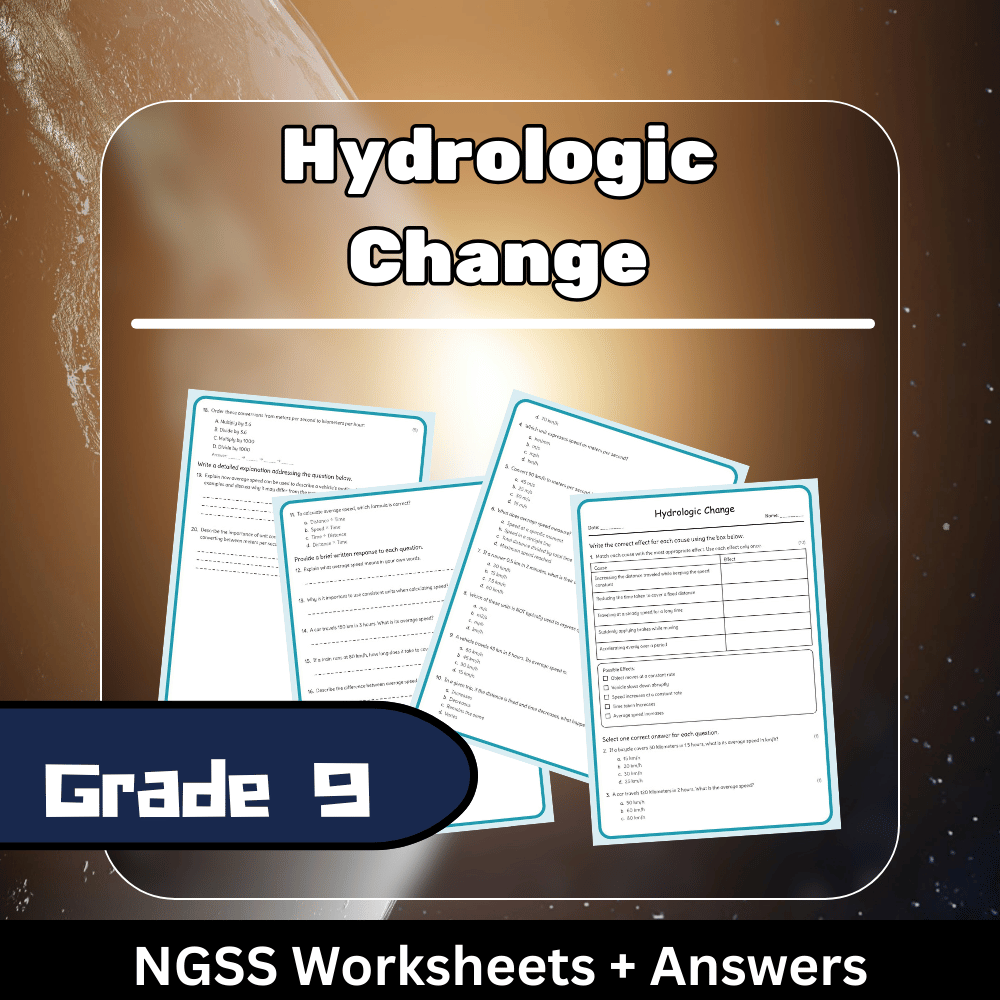
Grade 9 Science | Hydrologic Change Worksheet + Answer Key (NGSS Aligned)
Created byBright Mind ResourcesLearning Objectives
- Analyze hydrologic data to understand water's role in shaping Earth's surface.
- Interpret discharge records, sediment measurements, and watershed maps.
- Examine feedback mechanisms between runoff, sediment supply, and channel morphology.
Instant download

Developmental Variation Worksheet for Grade 9 Science | AP Biology Practice
Created byPrism Point LearningLearning Objectives
- Explain how changes in developmental timing and gene regulation can create phenotypic diversity.
- Describe how regulatory networks and epigenetic modulation influence trait expression during development.
- Use developmental evidence to interpret developmental bias and convergent evolution in evolutionary outcomes.
Instant download

Monitoring Pollution Worksheet | Science Assessment for Grade 9
JCreated byJ.S SheetsLearning Objectives
- Understand the methods used to detect and measure pollution in air and water.
- Identify different indicators and patterns that reveal pollution movement.
- Explain how pollution sources and processes are linked through monitoring data.
Also included in: Grade 9 Earth and Space Science Lesson Bundle: California Standards +1 more
Instant download

Grade 9 Science – Electron Configuration & Atom Structures | Reading Worksheet
Created byBright Mind ResourcesLearning Objectives
- Identify how electrons are arranged in atoms
- Understand valence electrons and their role in chemical bonding
- Learn the order in which electron shells fill
Also included in: Grade 9 Chemical Reactions Science Lesson Bundle: Daily Reading (BC) +1 more
Instant download

Grade 9 Science | Molecular Regulation Worksheet with Short Notes (PDF)
Created byMeadowlark WorksheetsLearning Objectives
- Understand key molecular signaling pathways that regulate gene expression and protein activity.
- Identify canonical mechanisms such as signal transduction, receptor-ligand binding, and hormonal signaling.
- Interpret the effects of molecular perturbations like mutations or pharmacological inhibition on cellular functions.
Also included in: Grade 9 Science NGSS From Molecules to Organisms Structures & Processes Bundle +1 more
Instant download

Grade 9 Science | Transport Mechanisms in Cells - Daily Reading Comprehension
Created byCoral Reef LearningLearning Objectives
- Understand the different passive transport mechanisms crossing cell membranes
- Distinguish between diffusion, facilitated diffusion, and osmosis
- Explain how molecules move along concentration gradients
Instant download

Grade 9 Science Worksheet – Apparent Motion & Celestial Observations (PDF)
Created byEvergreen Desk EducationLearning Objectives
- Explain how Earth’s rotation causes apparent diurnal motion of celestial objects.
- Explain how Earth’s revolution causes apparent seasonal motion and changing visibility of stars.
- Use celestial coordinate ideas to describe rising/setting and interpret altitude and azimuth.
Also included in: Grade 9 Earth and Space Science Lesson Bundle for Ontario Framework +1 more
Instant download

Mechanical Energy Worksheets: Work-Energy & Conservation Grade 9
 Created byTeachers Club
Learning Objectives
- Calculate kinetic and gravitational potential energy from given quantities
- Interpret how speed and height change stored and kinetic energy
- Apply the work-energy relationship to changes in kinetic energy
Also included in: Grade 9 Energy Science Worksheets Bundle | NGSS Energy Unit +1 more
Instant download
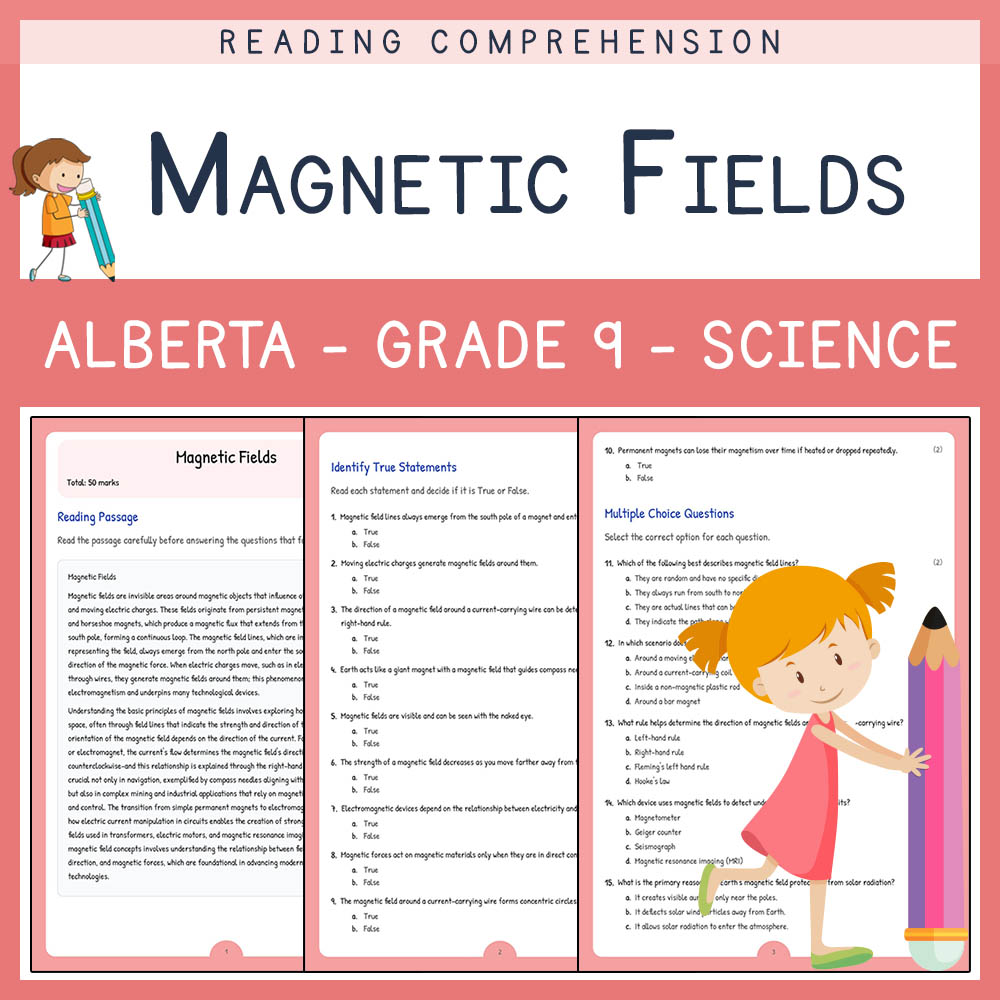
Grade 9 Science | Magnetic Fields Worksheet | Alberta Standards
Created byLumora LearningLearning Objectives
- Understand the origin and characteristics of magnetic fields produced by permanent magnets and moving electric charges.
- Interpret magnetic field lines and their directional properties.
- Recognize real-world applications of magnetic fields such as compass navigation and industrial sensing.
Instant download

Cardiopulmonary Interaction Assessment for Grade 9 Science TEKS
Created byPrism Point LearningLearning Objectives
- Describe the coordination between heart and lung functions in oxygen delivery
- Explain how chemoreceptor feedback influences respiratory and circulatory adjustments
- Identify the roles of pulmonary ventilation and cardiovascular transport in maintaining homeostasis
Also included in: Grade 9 Regulation & Communication Science Assessment Lesson Bundle TEKS
Instant download
About Grade 9 Science Worksheets
Find Science worksheets built for Grade 9. All 6,926 cover core skills, practice, and review, each an instant PDF download.
Every worksheet on MyTeachingSheets is created by independent teacher-authors and reviewed before publication. All resources download as printable PDFs for classroom, homework, or at-home practice, and many include answer keys. Preview any worksheet free before buying.