
Science Worksheets
44,376 subject resources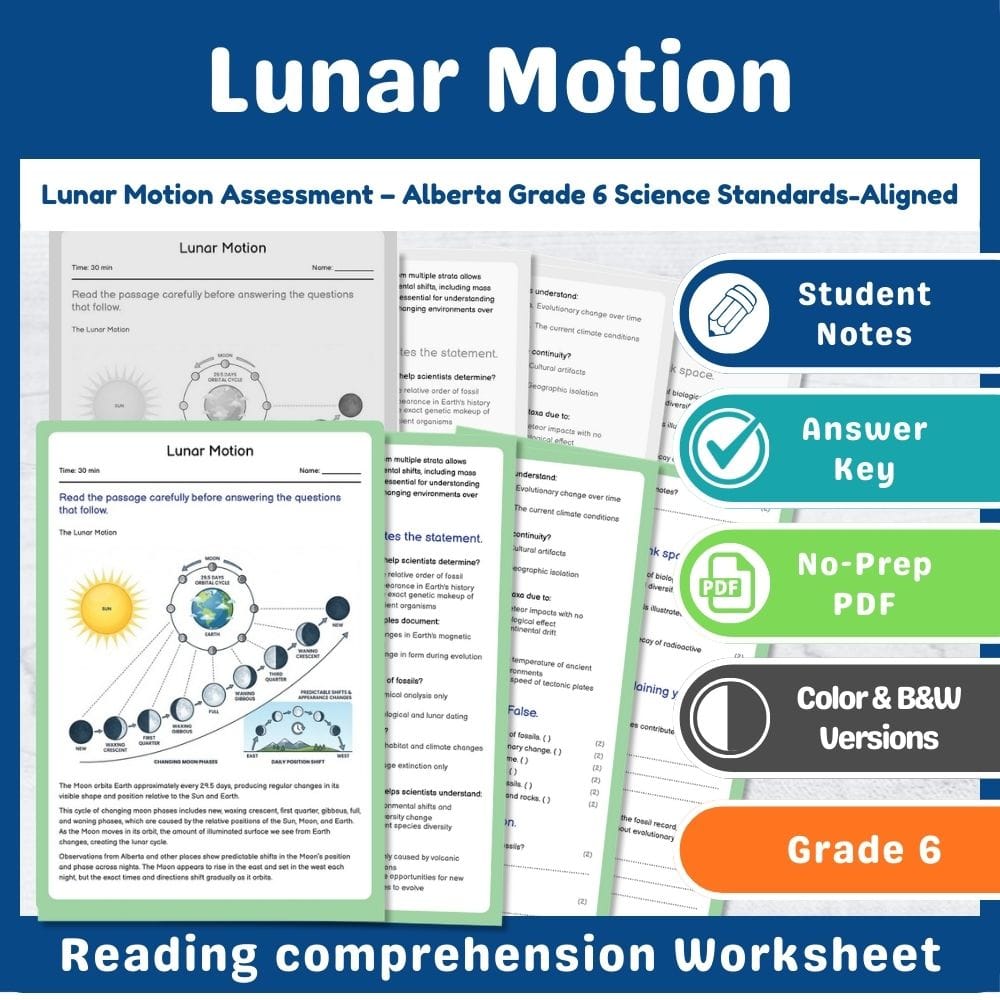
Lunar Motion Assessment – Alberta Grade 6 Science Standards-Aligned
 Created byPrism Point Learning
Learning Objectives
- Describe the Moon's orbit around Earth and how it affects the lunar phases.
- Explain the relationship between the Sun, Earth, and Moon in lunar observations.
- Predict the timing and directional shifts of the Moon as seen from locations like Alberta.
Also included in: Lesson Grade 6 Science Assessment | Celestial & Earth Movements
Instant download
Grade 8 Science | Natural Hazards Worksheet (PDF + Answer Key)
 Created byRiverstone Classroom
Learning Objectives
- Understand how earthquake, volcanic, tsunami, and fault data are used to assess natural hazard risks.
- Interpret geospatial and statistical data to evaluate recurrence intervals and hazard potential.
- Learn how monitoring technologies inform hazard forecasting and mitigation efforts.
Instant download

Science Grade 12 Worksheet Plate Motions | Standards-Aligned Practice
JCreated byJ.S SheetsLearning Objectives
- Explain how Earth’s internal energy drives tectonic plate movement over geologic time
- Compare the main types of plate boundaries (divergent, convergent, transform) and their characteristic geologic features
- Use evidence such as seafloor magnetic stripes, rock age patterns, and earthquake distribution to support the plate motion model
Also included in: Grade 12 Earth and Space Systems Science Lesson Bundle – Florida NGSSS +1 more
Instant download

Energy Profiles Worksheet | Grade 9 Science Practice
Created byPrism Point LearningLearning Objectives
- Explain how reaction-coordinate energy profiles represent activation energy and overall enthalpy change.
- Differentiate exothermic and endothermic reactions using the sign of ΔH.
- Identify the role of transition states in an energy profile and relate them to bond changes.
Also included in: Grade 9 Matter and Chemical Change Lesson Bundle | Science | BC +1 more
Instant download

Magnetic Response and Magnet Properties Worksheets | Grade 8 Science
 Created bySunny Desk Resources
Learning Objectives
- Classify materials as diamagnetic, paramagnetic, or ferromagnetic based on their magnetic response
- Explain how magnetic domains affect coercivity and remanence in permanent magnets
- Describe how choosing soft magnetic and hard magnetic materials improves device performance in transformers, electromagnets, lifting, and separation
Also included in: Electricity and Magnetism Grade 8 Alberta Unit Lesson Bundle +1 more
Instant download

Circuit Components and Series vs Parallel Circuits Worksheets Grade 8
Created bySunny Desk ResourcesLearning Objectives
- Identify the roles of sources, conductors, loads, and control elements in a simple electric circuit.
- Use schematic symbols and component functions to predict circuit behavior.
- Compare how current and voltage behave in series and parallel circuits.
Also included in: Electricity and Magnetism Grade 8 Alberta Unit Lesson Bundle +1 more
Instant download

Grade 11 Science – Collisions & Momentum | Daily Reading Worksheet
 Created byBright Mind Resources
Learning Objectives
- Understand the concept of momentum and its dependence on mass and velocity.
- Differentiate between elastic and inelastic collisions.
- Explain how momentum is conserved in isolated systems during collisions.
Also included in: Physical Science Grade 11 Science Worksheets Lesson Bundle | Florida NGSSS +1 more
Instant download
Grade 8 Science | Magnetic Fields Reading Worksheet & Answer Key (PDF)
JCreated byJ.S SheetsLearning Objectives
- Understand the origin and properties of magnetic fields from different sources.
- Identify and interpret field lines, polarity, and strength in magnetic patterns.
- Explain how ferromagnetic materials and electromagnets are used in technological applications.
Also included in: Grade 8 Science | Electricity & Magnetism Worksheet Bundle (Standards-Aligned) +1 more
Instant download

Science Graphical Representation Worksheet Grade 7 | Standards-Aligned
JCreated byJ.S SheetsLearning Objectives
- Choose an appropriate graph type (bar chart, histogram, line graph, or scatter plot) for categorical vs. continuous data.
- Construct graphs using correct axis labels, sensible scaling, and proportional representation.
- Interpret patterns, slope, and correlation without implying causation.
Instant download
Grade 10 Science | Dynamic Equilibrium Worksheet | Alberta Standards
 Created byLumora Learning
Learning Objectives
- Explain the concept of dynamic chemical equilibrium and how reactions reach balance.
- Describe factors such as concentration, pressure, and temperature that influence equilibrium position.
- Interpret equilibrium constants and predict shifts when systems undergo perturbations.
Instant download
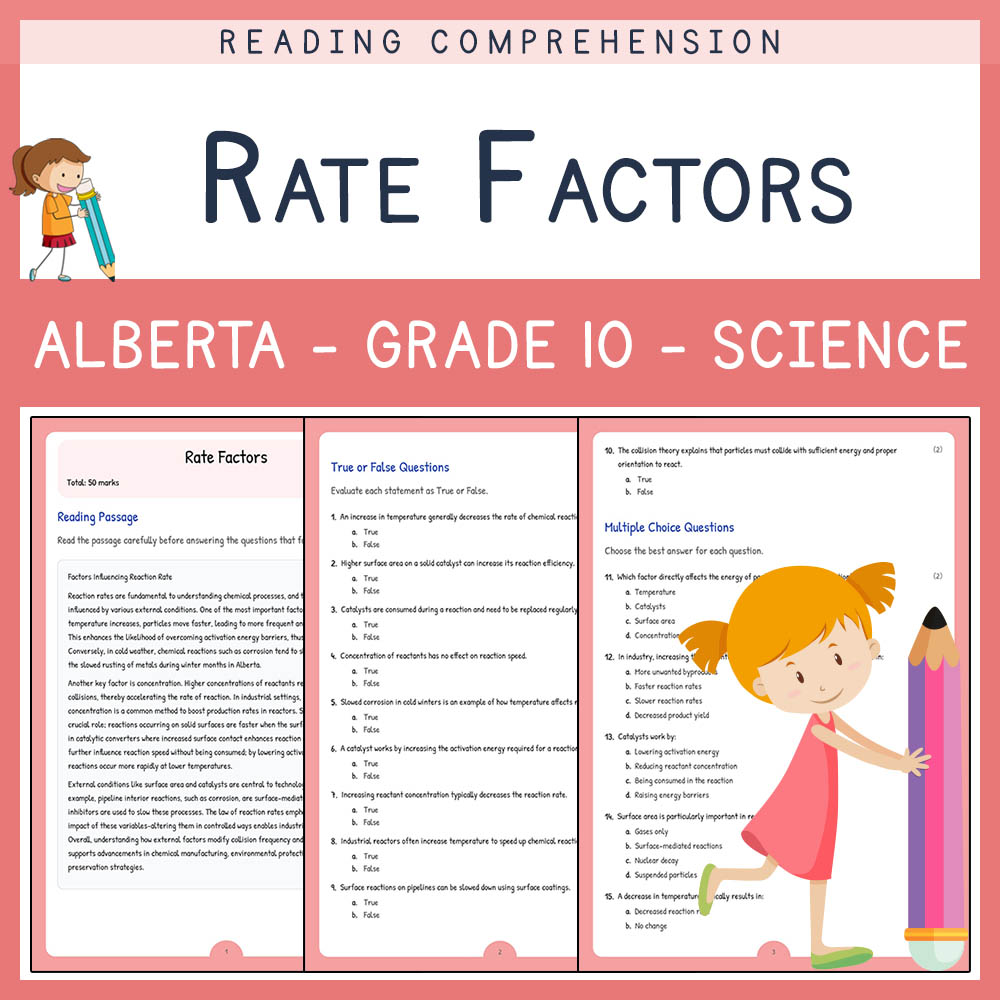
Grade 10 Science Worksheet | Rate Factors | Alberta Standards
Created byLumora LearningLearning Objectives
- Understand how temperature, concentration, surface area, and catalysts influence reaction rates.
- Analyze quantitative effects of rate variables in chemical reactions.
- Describe conceptual relationships between external conditions and reaction speed.
Instant download
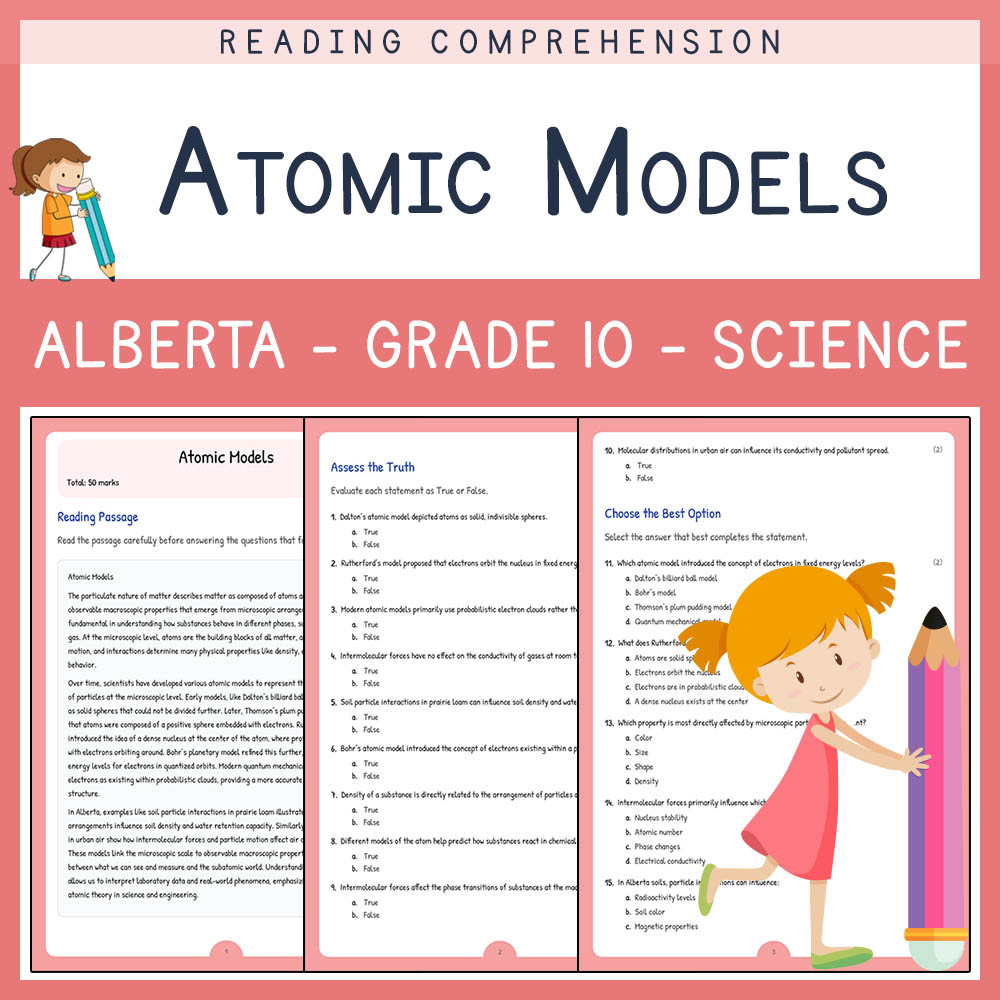
Grade 10 Science | Atomic Models Worksheet | Alberta
Created byLumora LearningLearning Objectives
- Understand the concept of particulate nature of matter at the atomic level.
- Explore various atomic models and their representations of particles and forces.
- Connect microscopic atomic arrangements to macroscopic properties such as density, phase, and conductivity.
Instant download
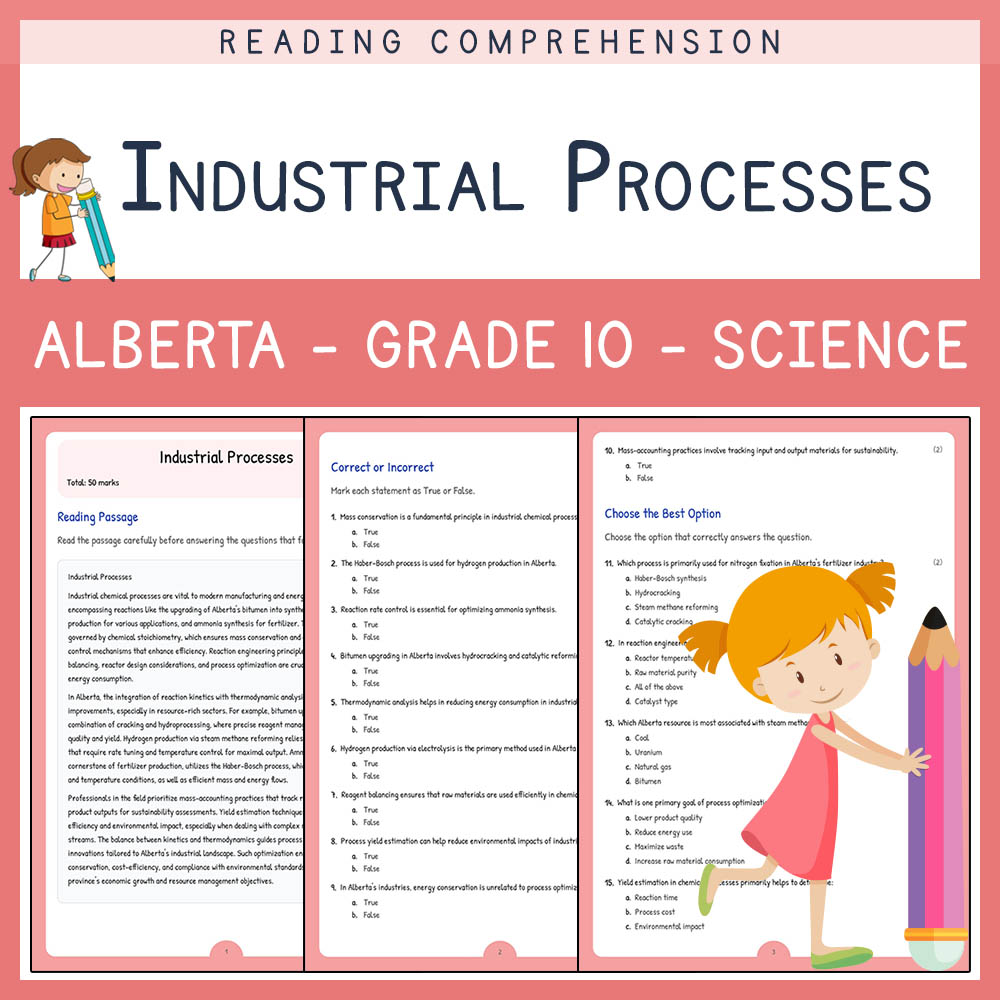
Grade 10 Science Worksheet | Industrial Processes | Alberta Standards
Created byLumora LearningLearning Objectives
- Understand key concepts of stoichiometry and mass conservation in industrial reactions.
- Explore Alberta-specific examples of chemical processes such as bitumen upgrading, hydrogen production, and ammonia synthesis.
- Analyze the role of kinetics and thermodynamics in process optimization.
Instant download
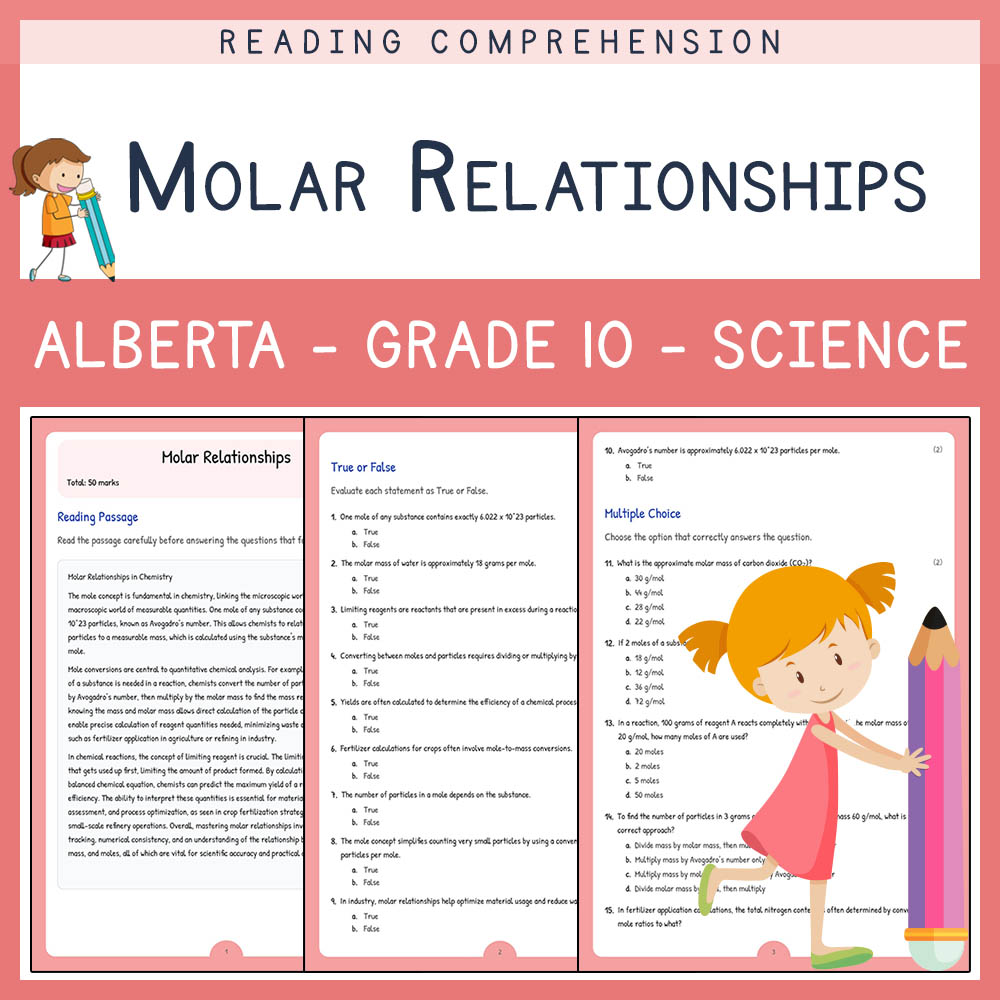
Grade 10 Science | Molar Relationships Worksheet | Alberta Standards
Created byLumora LearningLearning Objectives
- Understand the concept of the mole and its relationship to particle count and mass.
- Perform mole-to-mass, mass-to-mole, and mole-to-mole conversions using molar mass and Avogadro's number.
- Identify limiting reagents in chemical reactions and calculate yields based on mole ratios.
Instant download
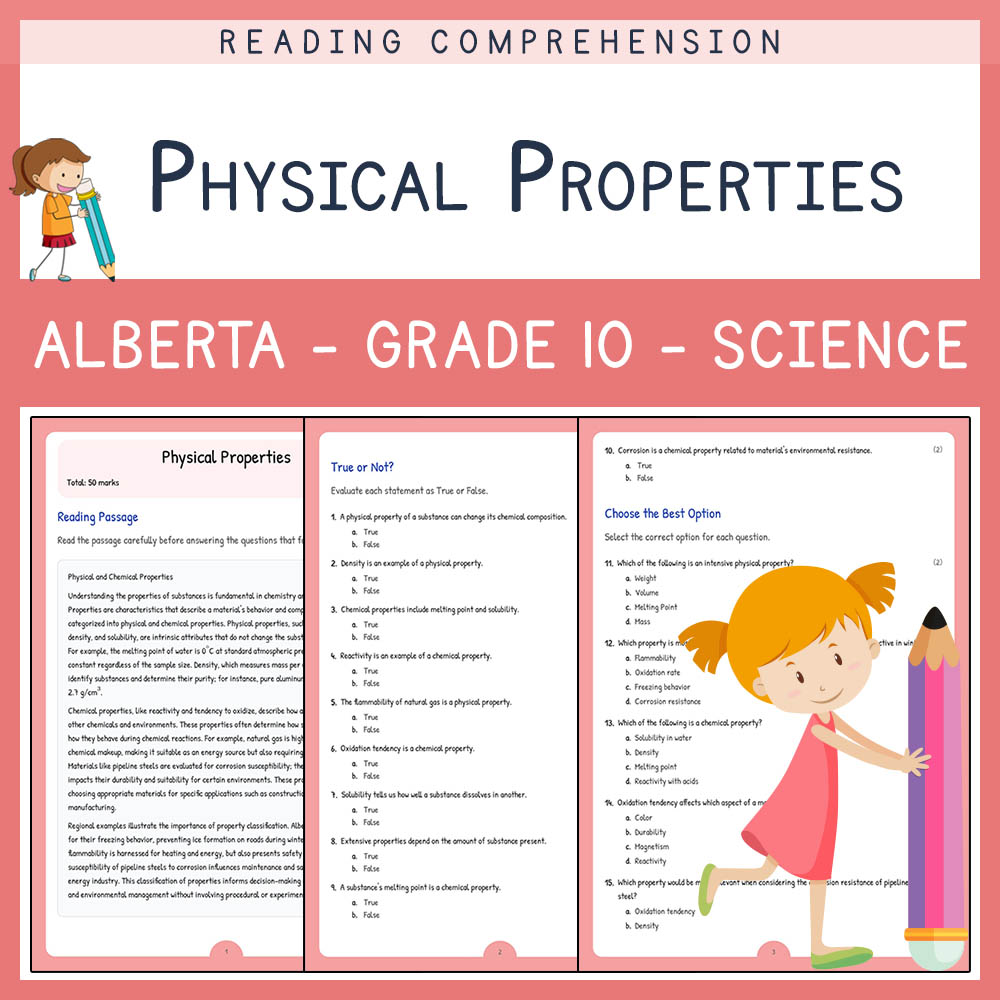
Grade 10 Science | Physical Properties Worksheet | Alberta Standards
Created byLumora LearningLearning Objectives
- Differentiate between physical and chemical properties of substances.
- Identify and classify various physical properties such as melting point, density, and solubility.
- Understand chemical properties like reactivity and oxidation tendency.
Instant download
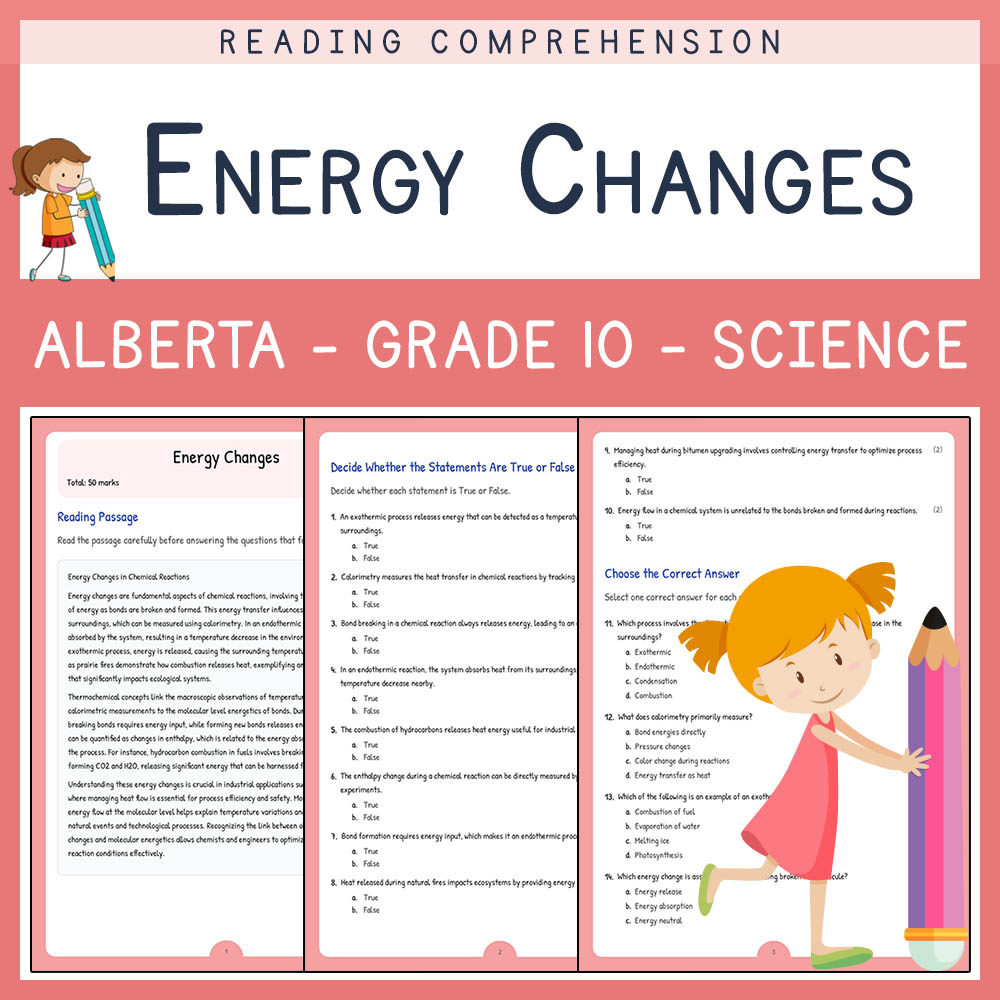
Grade 10 Science | Energy Changes Worksheet | Alberta Aligned
Created byLumora LearningLearning Objectives
- Describe the concepts of endothermic and exothermic energy changes in chemical reactions.
- Relate molecular energetics to macroscopic temperature and calorimetric measurements.
- Identify real-world examples of energy absorption and release in industrial and natural systems.
Instant download
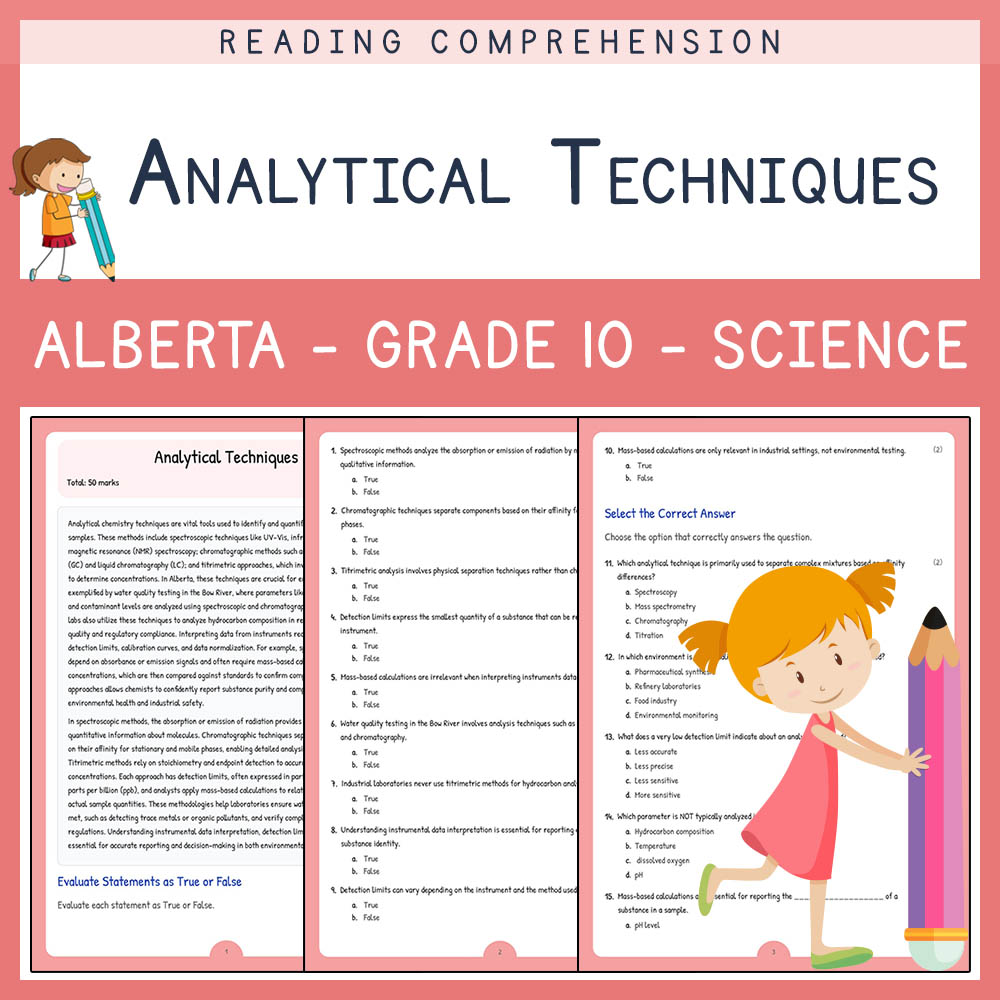
Grade 10 Science | Analytical Techniques Worksheet | Alberta
Created byLumora LearningLearning Objectives
- Understand various spectroscopic, chromatographic, and titrimetric approaches in analytical chemistry.
- Interpret instrumental data and recognize detection limits in substance analysis.
- Apply mass-based calculations to determine substance composition and ensure compliance in environmental and industry contexts.
Instant download

Grade 10 Science | Solution Concentration Worksheet | Alberta Standards
Created byLumora LearningLearning Objectives
- Understand different methods to express solution concentration, including molarity, mass percent, and parts per million.
- Apply formulas and calculations to determine concentration in various contexts.
- Relate concentration measures to environmental and regulatory standards relevant in Alberta.
Instant download
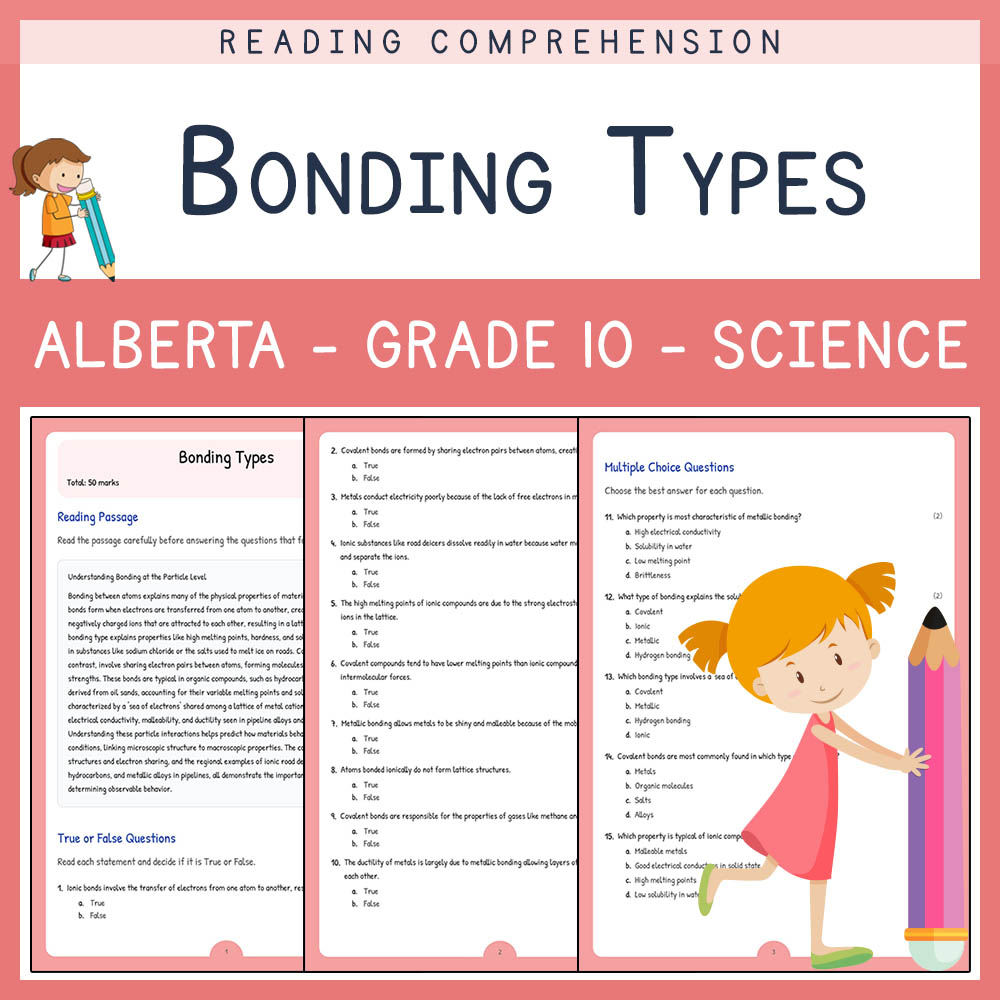
Grade 10 Science | Bonding Types Worksheet | Alberta Standards
Created byLumora LearningLearning Objectives
- Explain the differences between ionic, covalent, and metallic bonding at the particle level.
- Relate bonding types to observable properties such as conductivity, melting point, and solubility.
- Identify examples of each bonding type in real-world materials and applications.
Instant download
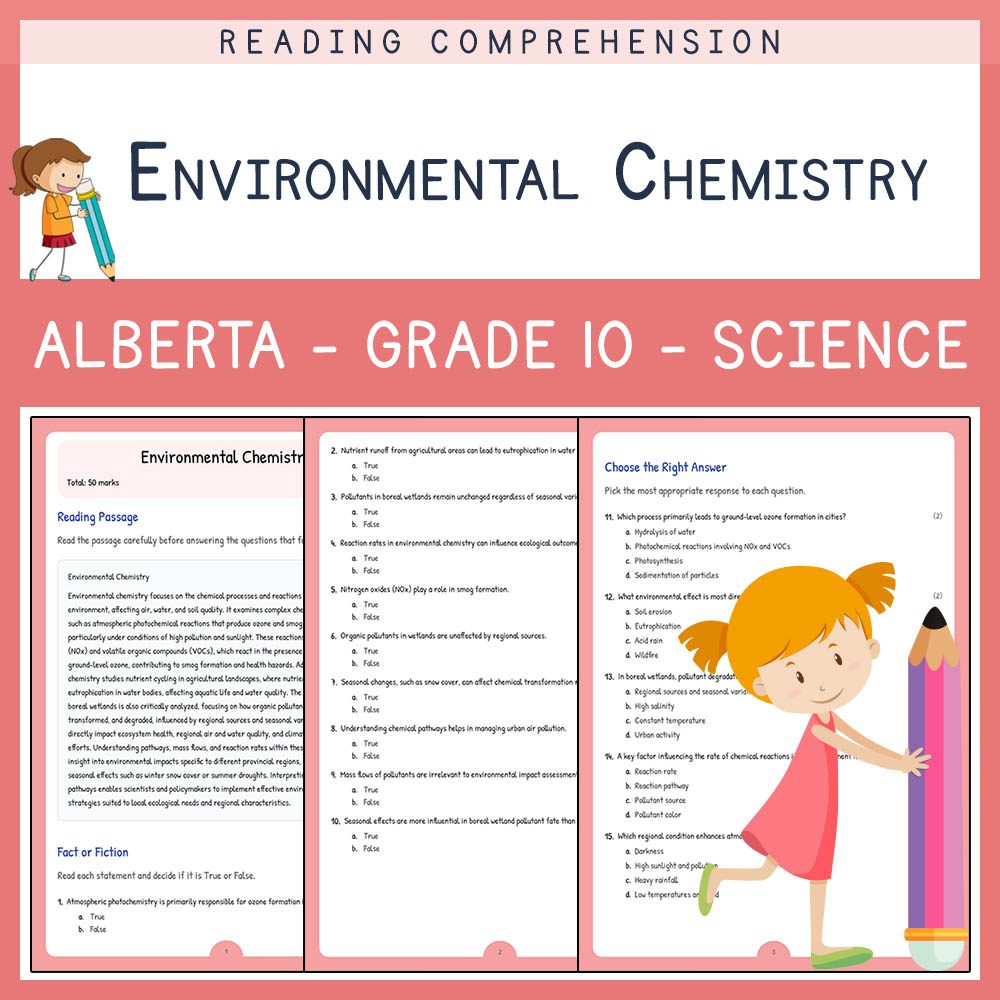
Grade 10 Science | Environmental Chemistry Worksheet | Alberta Standards
Created byLumora LearningLearning Objectives
- Understand chemical transformations and transport affecting air, water, and soil quality.
- Interpret chemical pathways, mass flows, and rate influences in environmental contexts.
- Analyze regional sources and seasonal effects on atmospheric, aquatic, and terrestrial environments.
Instant download

Grade 8 Science | Understanding Gear Trains - Daily Reading Comprehension
 Created byCoral Reef Learning
Learning Objectives
- Identify different types of gears used in gear trains.
- Explain how gear ratios affect speed and torque.
- Describe the function of idler gears in changing gear direction.
Instant download
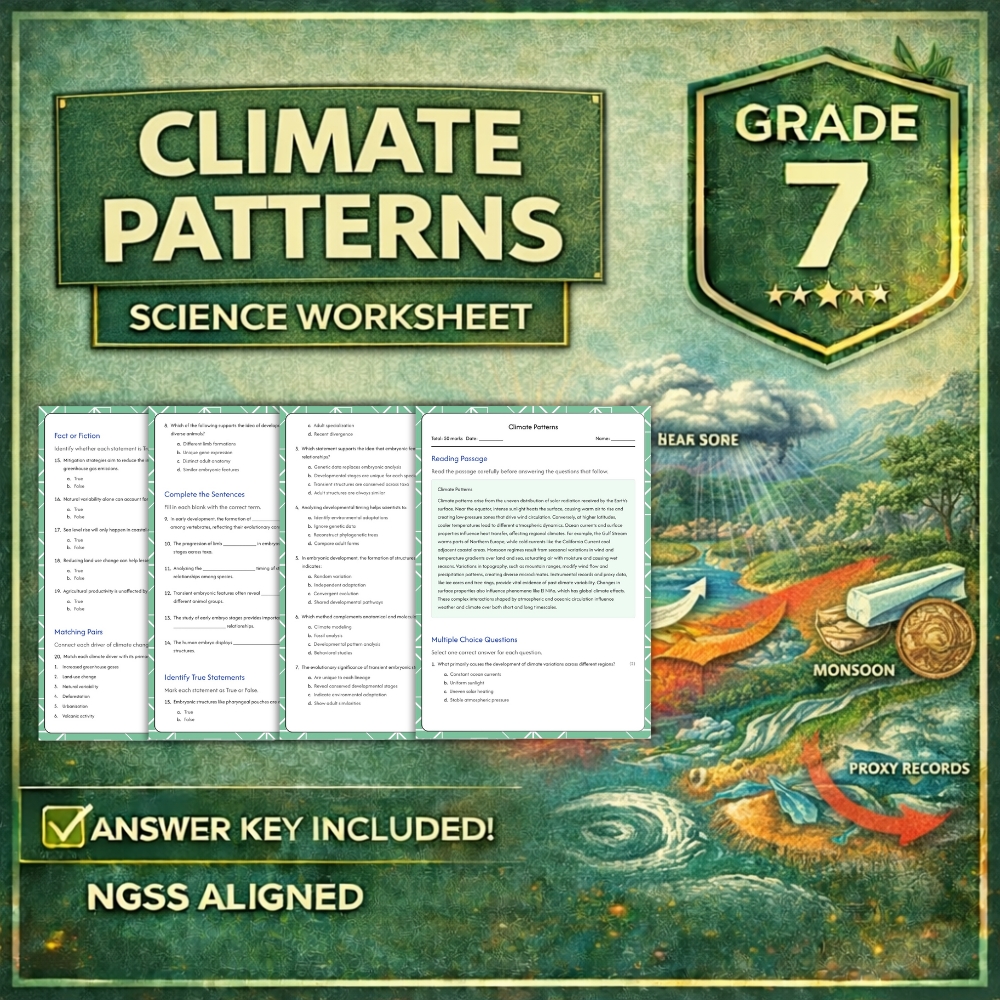
Grade 7 Science | Climate Patterns Worksheet (NGSS + Answer Key)
 Created byCedar Grove Learning
Learning Objectives
- Understand how uneven solar heating influences regional climate variations.
- Identify atmospheric and oceanic circulation patterns such as El Niño and monsoons.
- Analyze the impact of topography and ocean currents on local climate conditions.
Also included in: Grade 7 Science Bundle | Earth Systems & Processes NGSS (Worksheet Pack)
Instant download
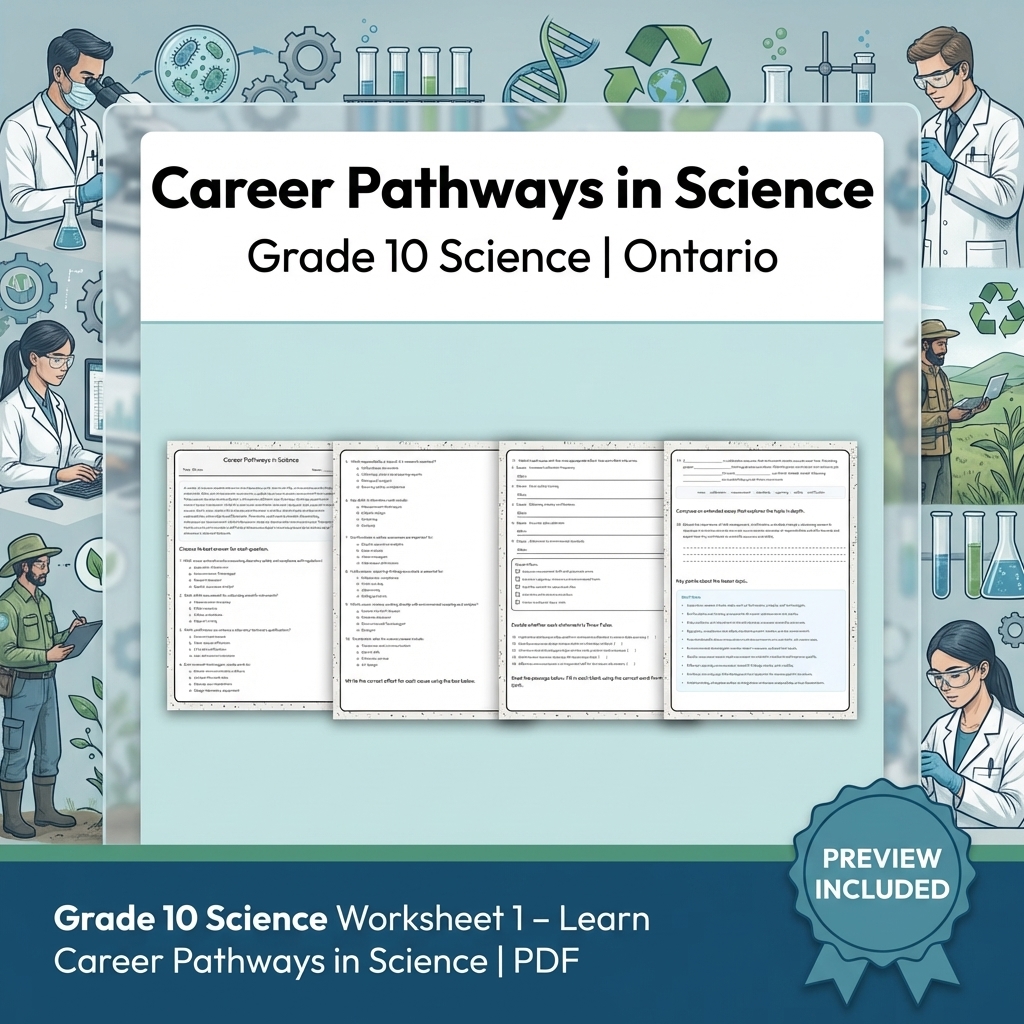
Grade 10 Science Worksheet Learn Career Pathways in Science | PDF
 Created byMeadowlark Worksheets
Learning Objectives
- Identify various career options linked to scientific inquiry and laboratory practices.
- Understand credential pathways, certifications, and key skill development.
- Recognize responsibilities related to data collection, instrument calibration, and compliance.
Also included in: Grade 10 Science Lesson Group Bundle | Ontario Curriculum Worksheets +1 more
Instant download
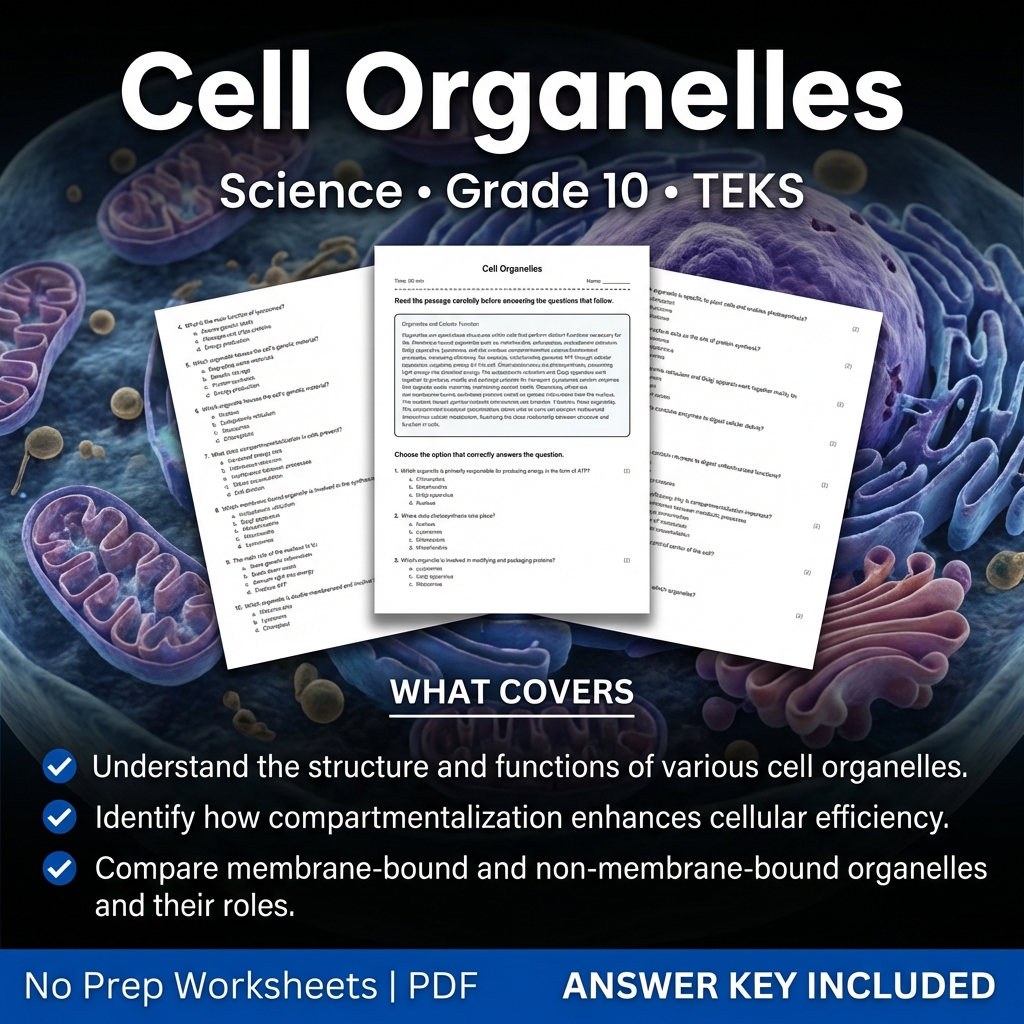
Grade 10 Science Worksheet on Cell Organelles | TEKS Standards
Created byCoral Reef LearningLearning Objectives
- Understand the structure and functions of various cell organelles.
- Identify how compartmentalization enhances cellular efficiency.
- Compare membrane-bound and non-membrane-bound organelles and their roles.
Instant download
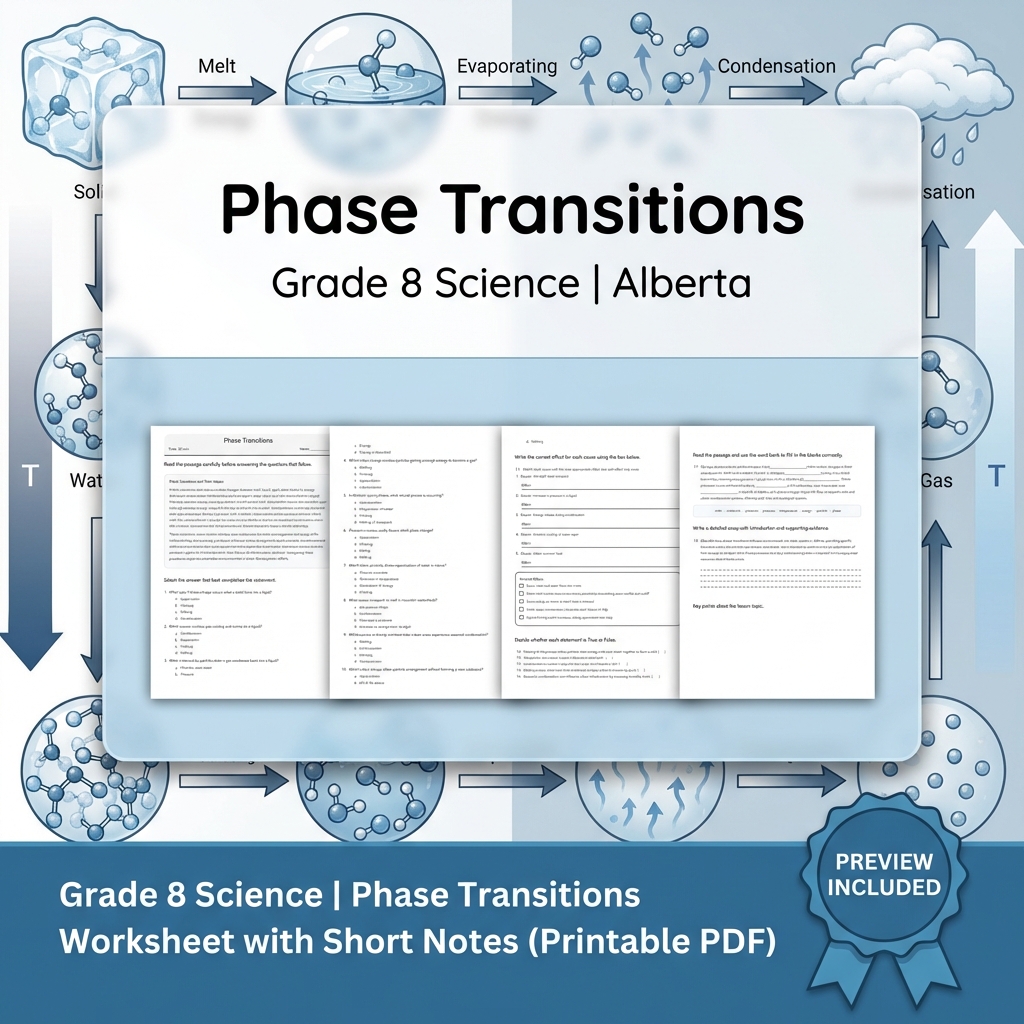
Grade 8 Science | Phase Transitions Worksheet with Short Notes (Printable PDF)
Created byMeadowlark WorksheetsLearning Objectives
- Understand the concept of phase transitions and the particles involved.
- Identify different types of phase changes such as melting, freezing, vaporization, and condensation.
- Explain how energy exchange and pressure influence phase transitions.
Also included in: Grade 8 Science Unit | Matter & Chemical Change Worksheets Pack +1 more
Instant download
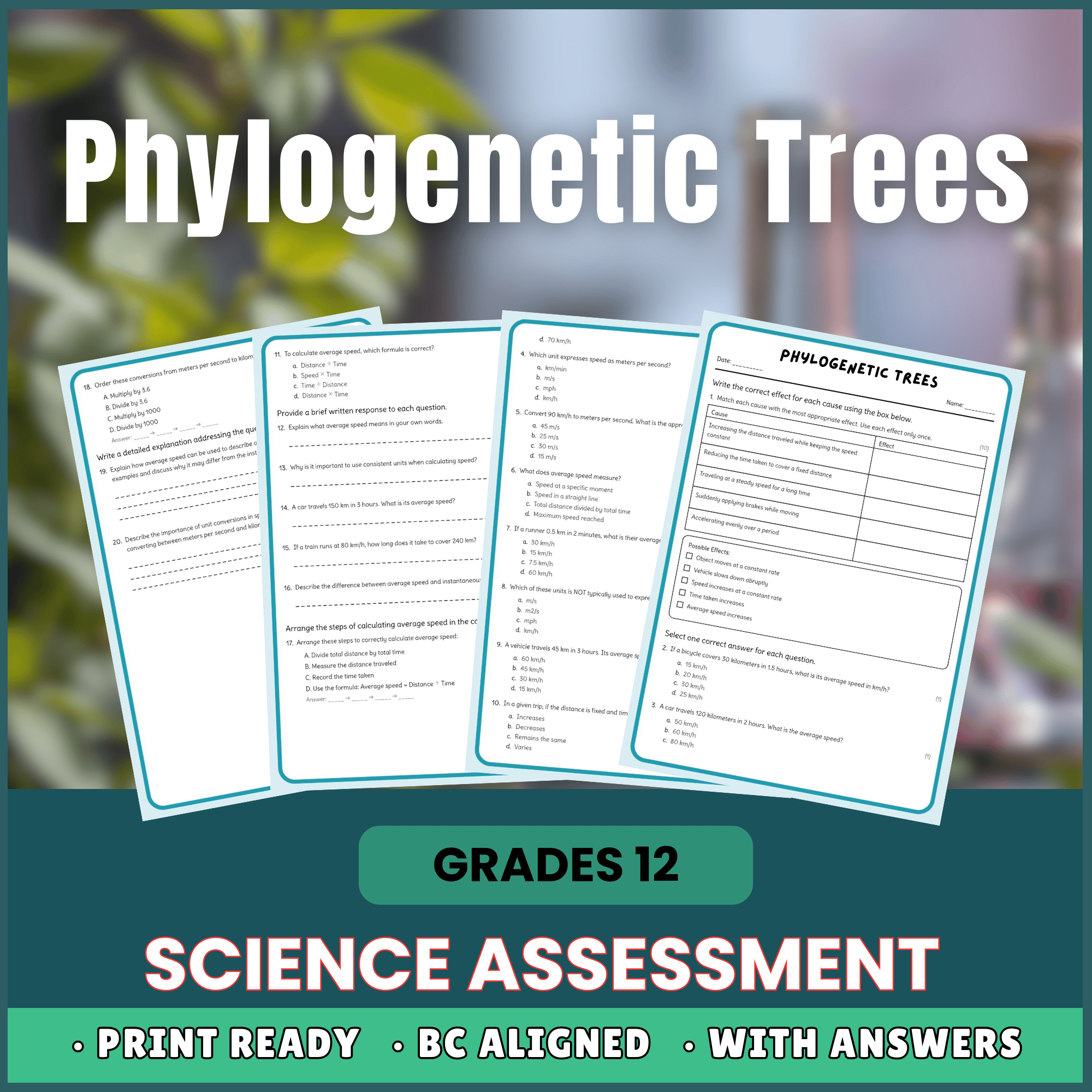
Grade 12 Science | Phylogenetic Trees Practice Worksheet (PDF)
Created byBright Mind ResourcesLearning Objectives
- Understand how phylogenetic trees represent evolutionary relationships among organisms.
- Identify shared derived characters used to construct phylogenies.
- Explain the role of molecular clock models in estimating divergence times.
Instant download
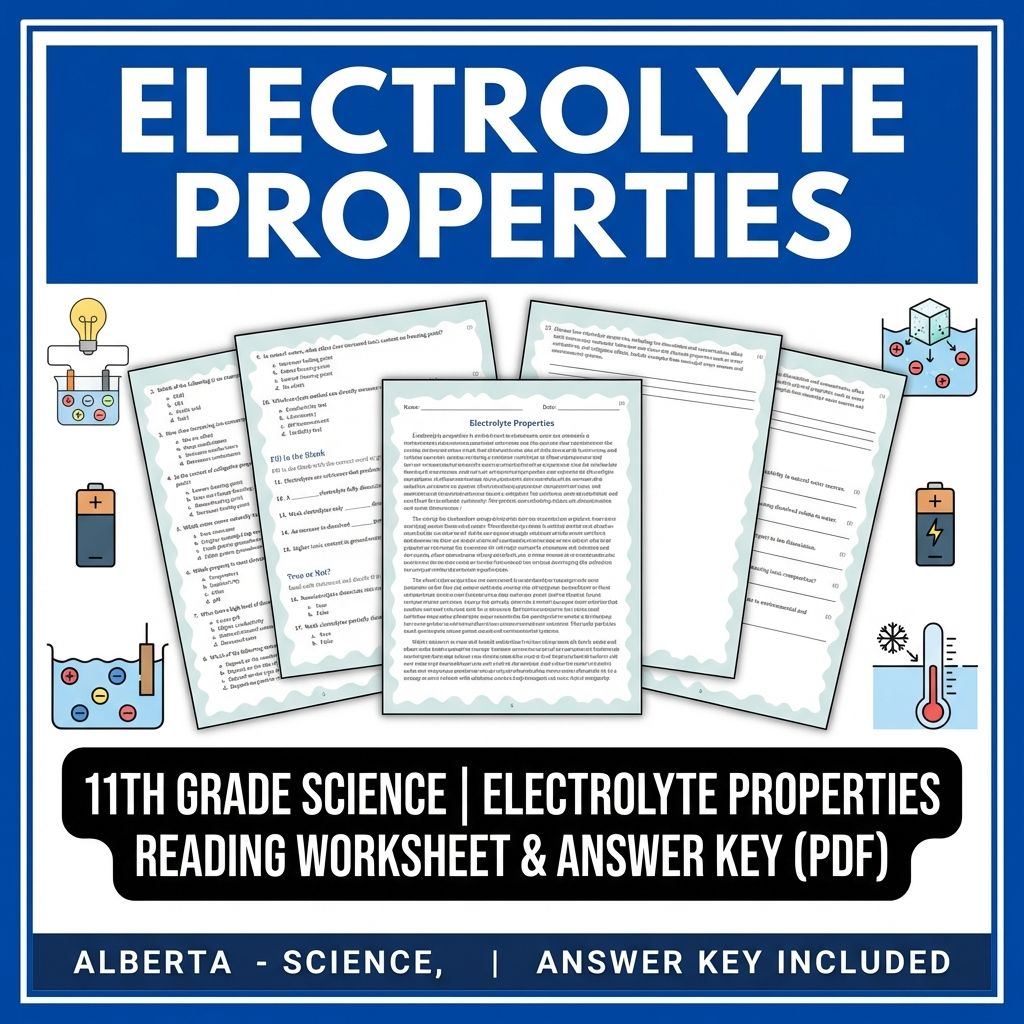
11th Grade Science | Electrolyte Properties Reading Worksheet & Answer Key (PDF)
JCreated byJ.S SheetsLearning Objectives
- Define electrolytes and distinguish between strong and weak electrolytes.
- Explain how ion concentration affects electrical conductance in solutions.
- Describe how solute particles influence colligative properties like freezing point depression.
Instant download
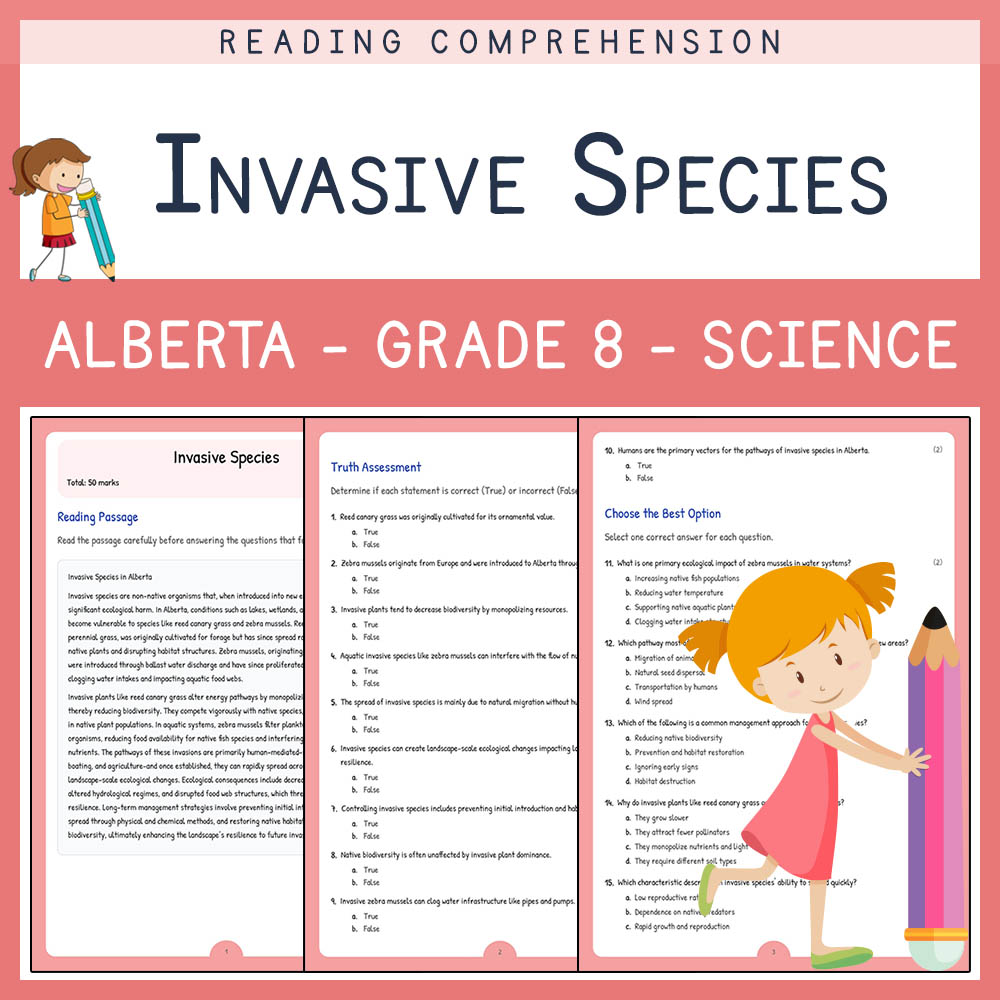
Grade 8 Science | Invasive Species Worksheet | Alberta Standard
Created byLumora LearningLearning Objectives
- Understand the impact of invasive species on native ecosystems in Alberta.
- Identify pathways and mechanisms by which invasive species disrupt native biodiversity.
- Analyze ecological consequences of invasive plants and aquatic organisms.
Instant download
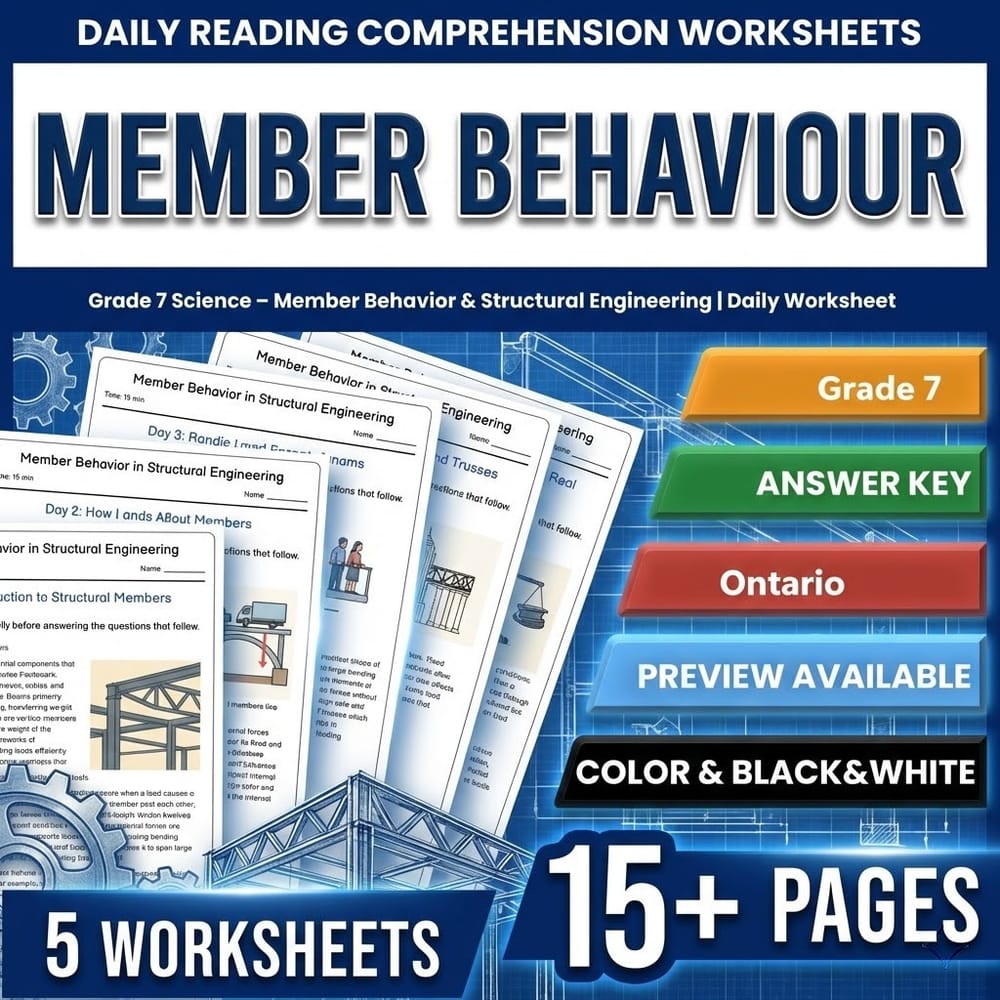
Grade 7 Science – Member Behavior & Structural Engineering | Daily Worksheet
 Created byQuiet Forest Education
Learning Objectives
- Identify different types of structural members such as beams, columns, trusses, and cantilevers.
- Understand how structural members respond to loads through bending, shear, axial force, and torsion.
- Relate geometry and support conditions to internal force distribution in structures.
Also included in: Structural Engineering Grade 7 Science Daily Reading Worksheets Bundle | Ontario +1 more
Instant download
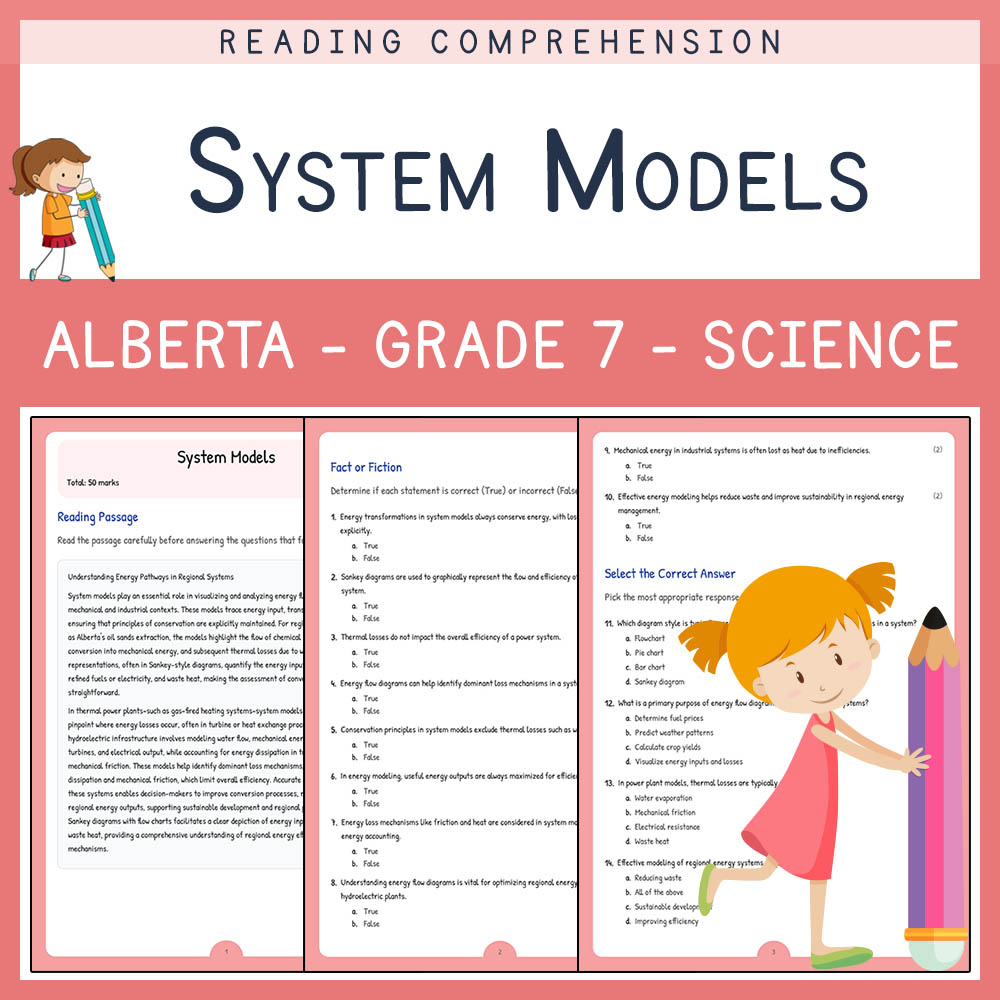
Grade 7 Science | System Models Worksheet | Alberta Standards
Created byLumora LearningLearning Objectives
- Explain how energy pathways are traced and modeled in industrial systems.
- Identify different components and representations used in energy flow diagrams.
- Analyze efficiency and loss mechanisms in regional energy systems such as oil sands extraction and hydroelectric plants.
Instant download
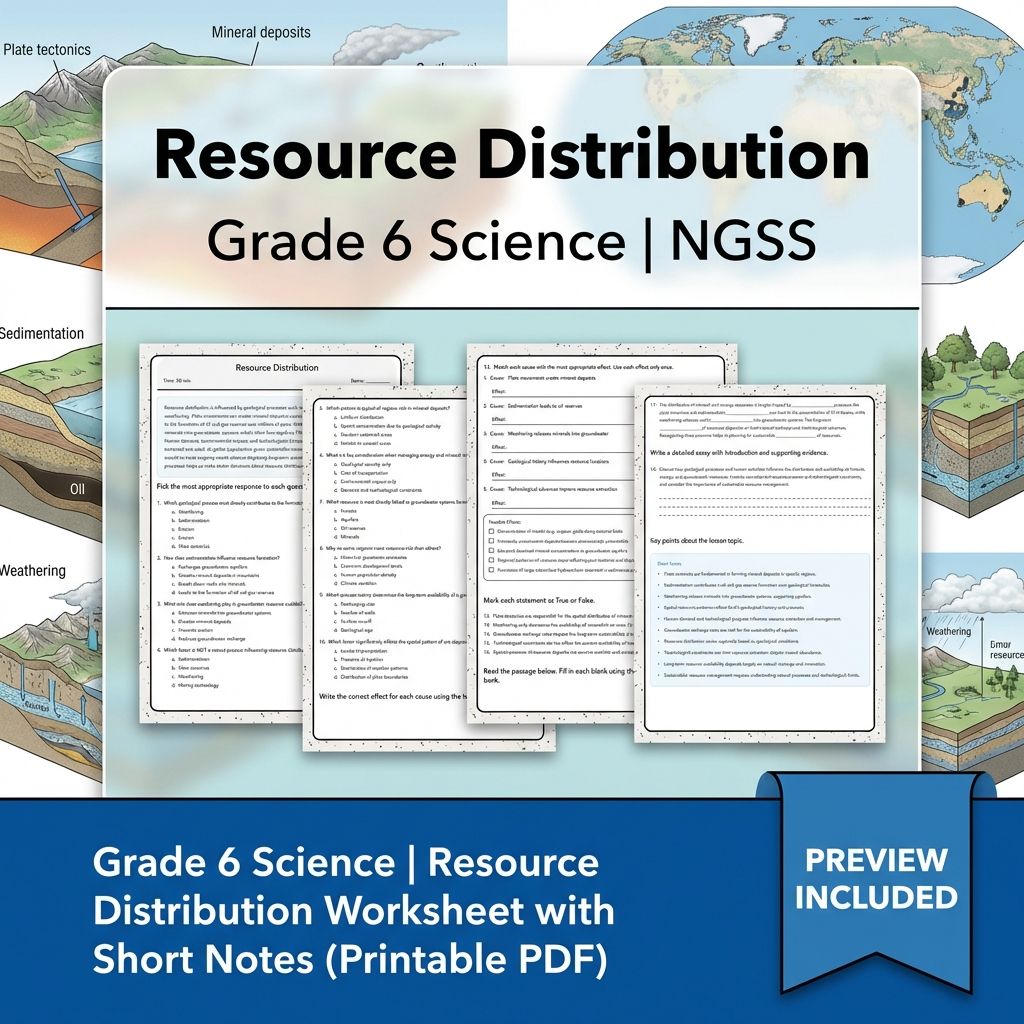
Grade 6 Science | Resource Distribution Worksheet with Short Notes (PDF)
Created byMeadowlark WorksheetsLearning Objectives
- Understand the processes that influence the distribution of mineral, energy, and groundwater resources.
- Identify how geological history affects spatial patterns of resource deposits.
- Analyze the impacts of extraction and technological constraints on resource availability.
Also included in: Grade 6 Science | Earth and Human Activity Unit Bundle – NGSS Standards +1 more
Instant download

Motion Principles Worksheet for Grade 7 Science | Standards-Aligned Practice
JCreated byJ.S SheetsLearning Objectives
- Distinguish speed, velocity, and acceleration using real-life motion examples
- Identify scalar versus vector quantities and explain how direction affects velocity
- Use qualitative reasoning to interpret constant velocity versus changing motion
Instant download
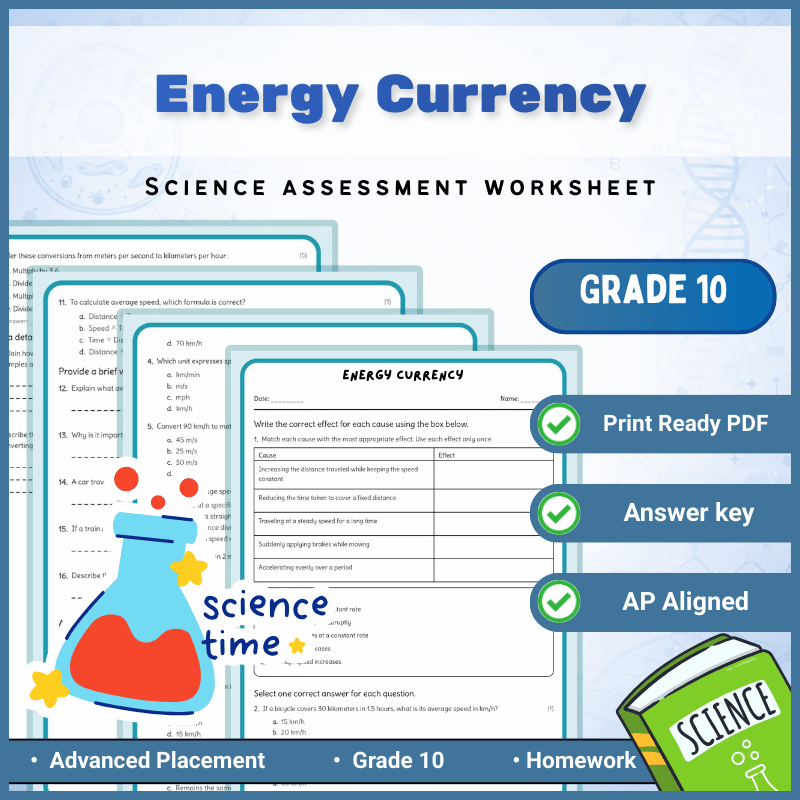
Grade 10 Science | Energy Currency Worksheet (AP) – Science 1 PDF
Created byBright Mind ResourcesLearning Objectives
- Explain the role of adenosine triphosphate (ATP) as the energy currency in biological systems.
- Compare and analyze redox reactions, bond energy changes, and free energy diagrams related to cellular energy transfer.
- Describe how energy transfer supports cellular organization, metabolic coupling, and transient energy storage through phosphorylation.
Instant download

Water Treatment Practice Worksheet | Grade 8 Science Review
Created byPrism Point LearningLearning Objectives
- Describe the main stages of drinking-water and wastewater treatment and the purpose of each stage.
- Explain how treatment removes suspended solids, pathogens, and dissolved contaminants.
- Compare tertiary options such as biological nutrient removal and engineered wetlands for improving water quality.
Also included in: Grade 8 Water Systems Science Lesson Bundle for Ontario Framework
Instant download

Grade 10 Molecular Coding Worksheet | DNA to Protein | NGSS Biology
 Created byAmber Owl Education
Learning Objectives
- Explain how the order of nucleotides in DNA and RNA determines the order of amino acids in a protein
- Describe how transcription and translation connect DNA sequence to protein structure and function
- Analyze how point mutations and frameshifts can change proteins and affect an organism
Instant download
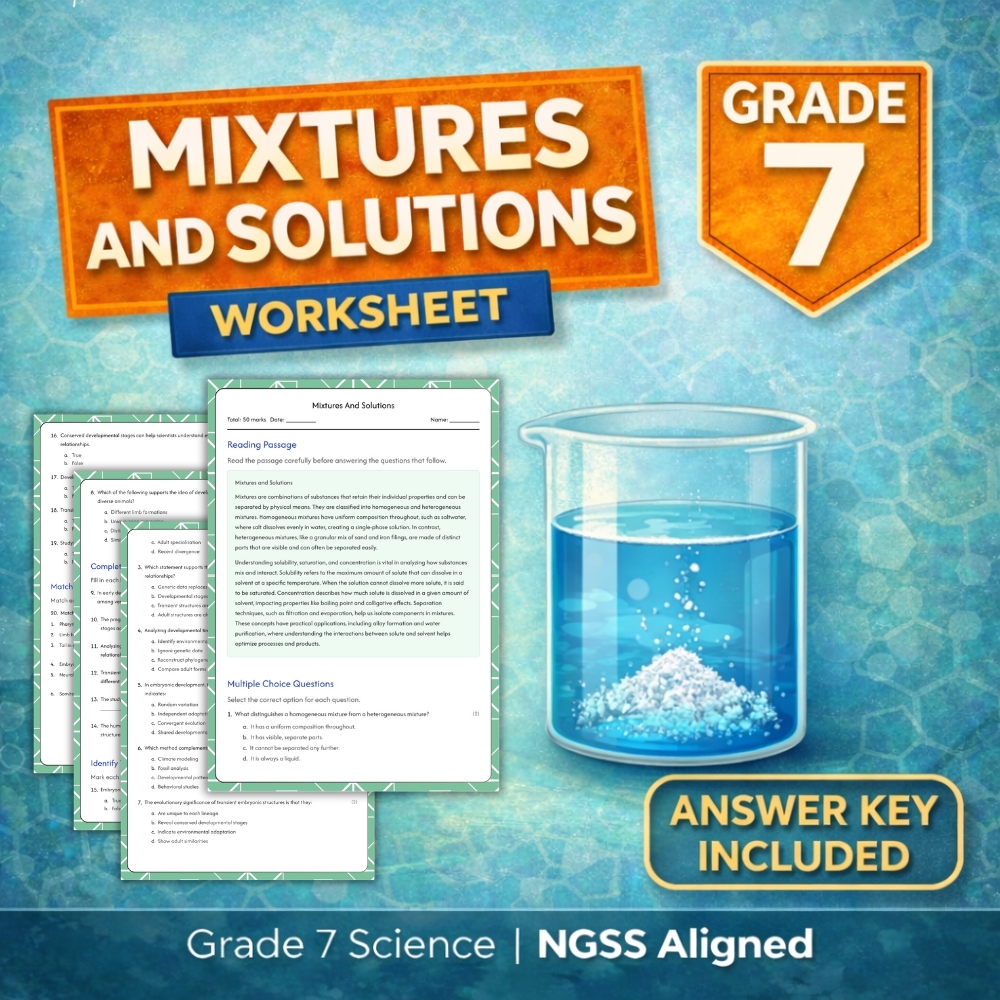
Grade 7 Science | Mixtures And Solutions Worksheet (NGSS Standards + Answer Key)
Created byCedar Grove LearningLearning Objectives
- Differentiate between homogeneous and heterogeneous mixtures based on their properties.
- Explain solubility, saturation, and concentration in solutions.
- Identify practical examples of mixtures and solutions, such as saltwater, oil-water emulsions, and granular mixtures.
Instant download
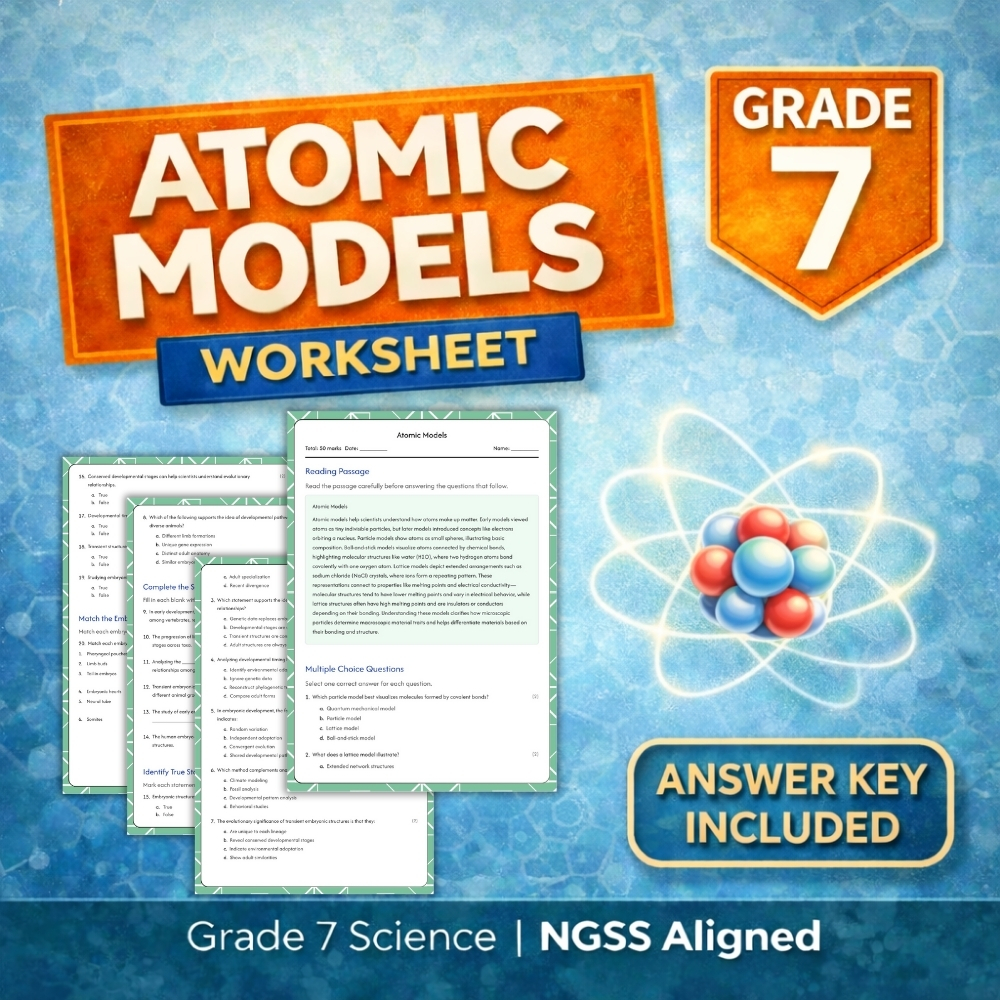
Grade 7 Science – Atomic Models (Worksheet + Answer Key) NGSS Aligned
Created byCedar Grove LearningLearning Objectives
- Describe different representations of atoms, including particle, ball-and-stick, and lattice models.
- Explain how atoms form molecules via covalent and ionic bonding.
- Connect subatomic particles, atomic number, and chemical formulas to the properties of materials.
Instant download
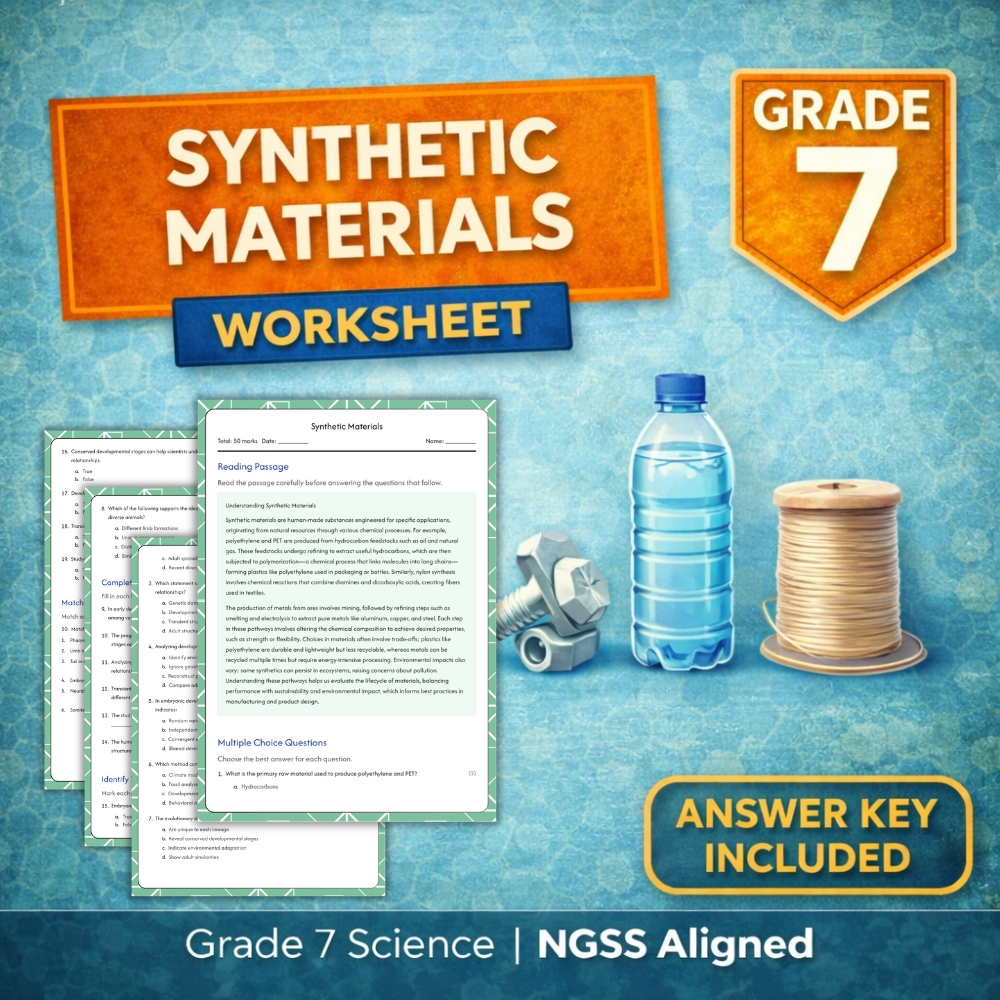
7th Grade Science | Synthetic Materials Worksheet (NGSS) & Answer Key
Created byCedar Grove LearningLearning Objectives
- Describe the production pathways from natural resources to common synthetic materials, including feedstocks, polymerization, and refining steps.
- Identify different synthetic materials like polyethylene, PET, nylon, and metals produced from ores.
- Evaluate trade-offs such as durability, recyclability, and environmental impact linked to material choices.
Instant download

Organelle Architecture in Eukaryotic Cells Worksheet Grade 10 Science
 Created byChalk and Compass
Learning Objectives
- Identify major eukaryotic organelles and describe their structural features using electron microscopy language.
- Compare internal organization in prokaryotic versus eukaryotic cells, focusing on compartmentalization.
- Explain how membrane-bound compartments contribute to cellular complexity without focusing on specific metabolic pathways.
Also included in: Cells, Photosynthesis, Respiration & Microbes Lesson Bundle – Grade 10 Science +1 more
Instant download

Grade 10 Groundwater Systems Worksheet | Aquifers, Flow & Contamination
Created byChalk and CompassLearning Objectives
- Explain how aquifer type and rock properties such as porosity and permeability affect groundwater movement.
- Describe recharge and discharge processes and how groundwater connects to surface water.
- Identify key factors that control vulnerability to contamination, including contaminant transport and aquifer depletion.
Also included in: Grade 10 Science Earth Processes & Resource Use Lesson Bundle | Ontario +1 more
Instant download

Grade 10 Plate Tectonics Worksheet | Boundaries, Evidence & Doodle Note
Created byChalk and CompassLearning Objectives
- Describe the three main types of plate boundaries and the typical geological outcomes of each.
- Explain how mantle convection and slab pull can drive plate motion.
- Identify evidence that supports plate tectonics, including continental fit, palaeomagnetism, and earthquake distribution.
Also included in: Grade 10 Science Earth Processes & Resource Use Lesson Bundle | Ontario +1 more
Instant download
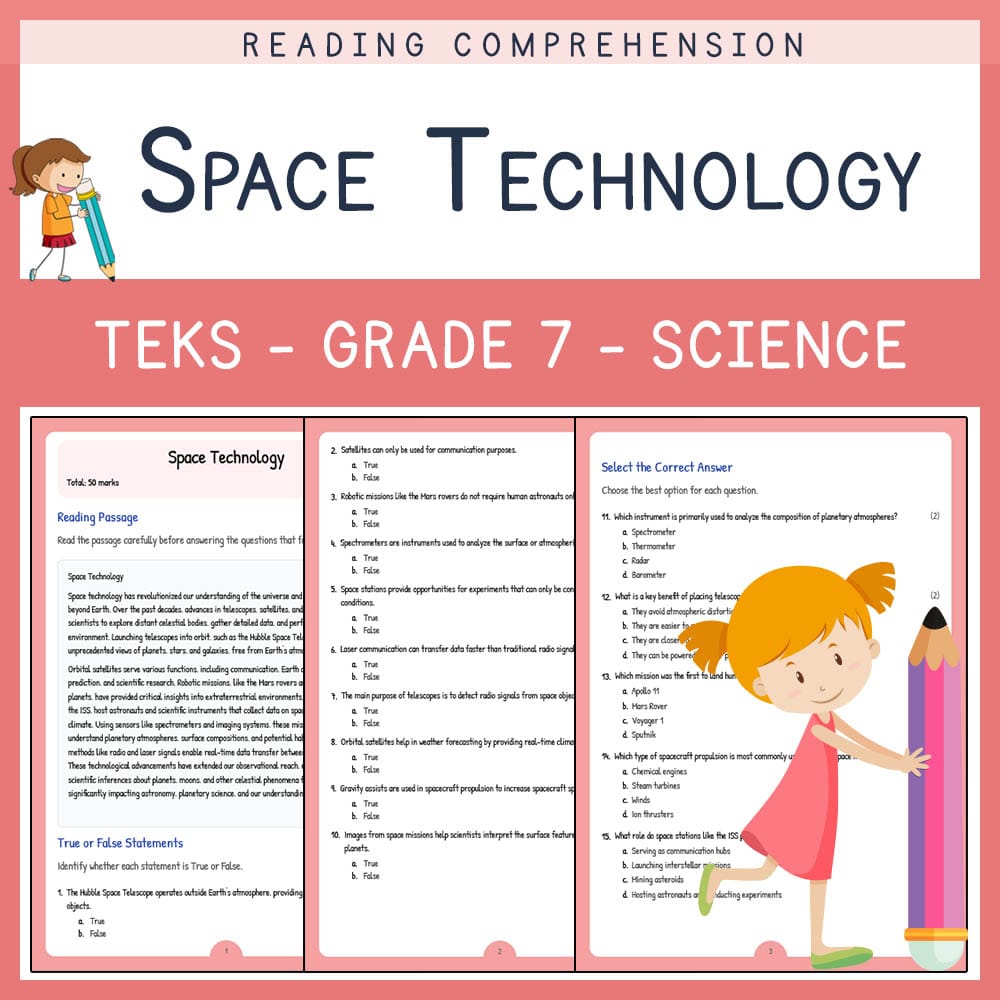
Grade 7 Science | Space Technology Worksheet | TEKS-Aligned
Created byLumora LearningLearning Objectives
- Understand the types of technologies used in space observation and exploration.
- Identify key historical space missions and their contributions.
- Explain how satellites, telescopes, and spacecraft gather data beyond Earth.
Also included in: Grade 7 Science | Earth and Space Systems Unit Bundle | TEKS Standard
Instant download

Ecosystem Roles of Microorganisms Worksheet Grade 10 Science Ontario
Created byChalk and CompassLearning Objectives
- Explain how microorganisms support ecosystem processes such as decomposition and nutrient cycling.
- Describe microbial roles in carbon and nitrogen fluxes, including symbiotic partnerships.
- Use key vocabulary to interpret how microbial community composition affects soil fertility and ecosystem resilience.
Also included in: Cells, Photosynthesis, Respiration & Microbes Lesson Bundle – Grade 10 Science +1 more
Instant download

Grade 10 Sustainable Strategies for Resource Use Science Worksheet Ontario
Created byChalk and CompassLearning Objectives
- Explain circular economy principles that reduce waste during resource extraction and use
- Use life-cycle thinking to compare low-impact extraction and rehabilitation strategies
- Evaluate trade-offs among economic development, community needs, and long-term environmental stewardship
Also included in: Grade 10 Science Earth Processes & Resource Use Lesson Bundle | Ontario +1 more
Instant download

Grade 10 Science Classification Basics States Purity & Mixtures Worksheet
Created byChalk and CompassLearning Objectives
- Classify matter as an element, a compound, or a mixture using chemical formulas and purity criteria.
- Differentiate pure substances from mixtures by using ideas of heterogeneity and homogeneity.
- Connect macroscopic observations to microscopic particle models and symbolic notation.
Also included in: Chemistry Foundations & Chemical Reactions Lesson Bundle: Grade 10 Science +1 more
Instant download

Grade 10 Science Career Pathways Worksheet | Lab Skills & Scientific Reporting
Created byChalk and CompassLearning Objectives
- Survey career roles that rely on scientific inquiry, laboratory practice, and data reporting.
- Describe common responsibilities such as instrument calibration, safety procedures, and regulatory compliance.
- Identify credential and certification pathways and connect them to transferable technical and communication skills.
Also included in: Grade 10 Science Variables & Control Data Analysis Lesson Bundle | Ontario +1 more
Instant download

Grade 10 Science Risk Management Laboratory Safety Worksheet Ontario
Created byChalk and CompassLearning Objectives
- Identify common hazards in chemical, biological, and physical laboratory settings using systematic observation.
- Apply qualitative risk assessment by estimating likelihood and consequence to prioritize controls.
- Select appropriate hazard-reduction measures using the hierarchy of elimination, substitution, engineering controls, and administrative procedures.
Also included in: Grade 10 Science Variables & Control Data Analysis Lesson Bundle | Ontario +1 more
Instant download

Grade 10 One-Dimensional Motion Worksheet | Ontario Science Kinematics
Created byChalk and CompassLearning Objectives
- Classify common forces as contact or non-contact interactions.
- Describe how force direction and magnitude affect the motion of an object.
- Distinguish vector forces from scalar effects using everyday examples.
Also included in: Grade 10 Science Motion, Forces & Momentum Lesson Bundle – Ontario Framework +1 more
Instant download
Browse more categories
About Science Worksheets
Find Science worksheets spanning core skills, practice, and review. All 44,376 resources are instant PDF downloads for the classroom or home.
Every worksheet on MyTeachingSheets is created by independent teacher-authors and reviewed before publication. All resources download as printable PDFs for classroom, homework, or at-home practice, and many include answer keys. Preview any worksheet free before buying.