
Science Worksheets
44,628 subject resources
Grade 8 Science – Control Variables Worksheet (PDF) – General Standards
 Created byEvergreen Desk Education
Learning Objectives
- Identify independent, dependent, and controlled variables in a research scenario.
- Design a fair test by choosing appropriate control variables to reduce confounding factors.
- Select measurable data-collection methods and explain how replication improves reliability.
Also included in: Testable Claims & CER Grade 8 Science Lesson Bundle: General Framework +1 more
Instant download

Grade 8 Science Worksheet | Life-Cycle Tradeoffs with Practice (PDF)
Created byEvergreen Desk EducationLearning Objectives
- Explain how impacts can occur before a product works, during use, and after disposal using a life-cycle perspective.
- Identify trade-offs between stages (materials/manufacturing vs. maintenance vs. end-of-life) when comparing design options.
- Use system-level thinking to justify the “best” option under given constraints (cost, energy, waste, and feasibility).
Also included in: Grade 8 Technology Design Tradeoffs Science Lesson Bundle (General) +1 more
Instant download

Grade 8 Science Worksheet | Data Quality Controls & Accuracy Practice (PDF)
Created byEvergreen Desk EducationLearning Objectives
- Explain how calibration, consistent measurement practices, and replication improve data accuracy and precision.
- Describe how random variation differs from real effects and why replication helps identify each.
- Use justification to manage outliers while preserving data integrity and fairness.
Also included in: Testable Claims & CER Grade 8 Science Lesson Bundle: General Framework +1 more
Instant download

Grade 8 Science | Plate Motion and Surfaces Worksheet (PDF)
Created byEvergreen Desk EducationLearning Objectives
- Explain how divergent, convergent, and transform plate boundaries shape Earth’s surface
- Describe how earthquakes and volcanism provide evidence for plate interactions
- Connect long-term processes (uplift, faulting, and erosion) to changes in topography
Also included in: Grade 8 Earth and Space Science Lesson Bundle - General Framework +1 more
Instant download

Nutrient Cycling Worksheet Practice | Grade 11 Science Assessment
 Created byPrism Point Learning
Learning Objectives
- Explain how carbon and nitrogen cycle through different Earth system compartments (atmosphere, terrestrial, and freshwater).
- Describe key nitrogen-cycle processes: fixation, mineralization, and denitrification, and how they regulate nitrogen availability.
- Compare natural fluxes and human-driven perturbations (fossil fuel emissions and agricultural fertilization) and predict their ecological effects.
Also included in: Grade 11 Ecology and Sustainability Science Lesson Bundle – Ontario
Instant download

Grade 11 Science | Measurement Uncertainty Worksheet | AP Aligned
 Created byLumora Learning
Learning Objectives
- Understand the principles of measurement precision and accuracy.
- Identify sources of measurement uncertainty in scientific experiments.
- Learn how to interpret confidence intervals and error bars in data presentation.
Instant download

Grade 11 Science | Graphical Literacy Worksheet | AP Standards
Created byLumora LearningLearning Objectives
- Understand the principles of designing effective graphical representations in science.
- Interpret data from scatterplots, histograms, box plots, and line graphs.
- Critique graphical displays for potential misrepresentations and biases.
Instant download

Grade 11 Science | Evidence Argumentation Worksheet | AP Standards
Created byLumora LearningLearning Objectives
- Understand the structure of scientific argumentation connecting claims, evidence, and reasoning.
- Identify ways to articulate assumptions and qualify claims with confidence statements.
- Interpret multiple lines of evidence in scientific cases such as climate change and reaction kinetics.
Instant download
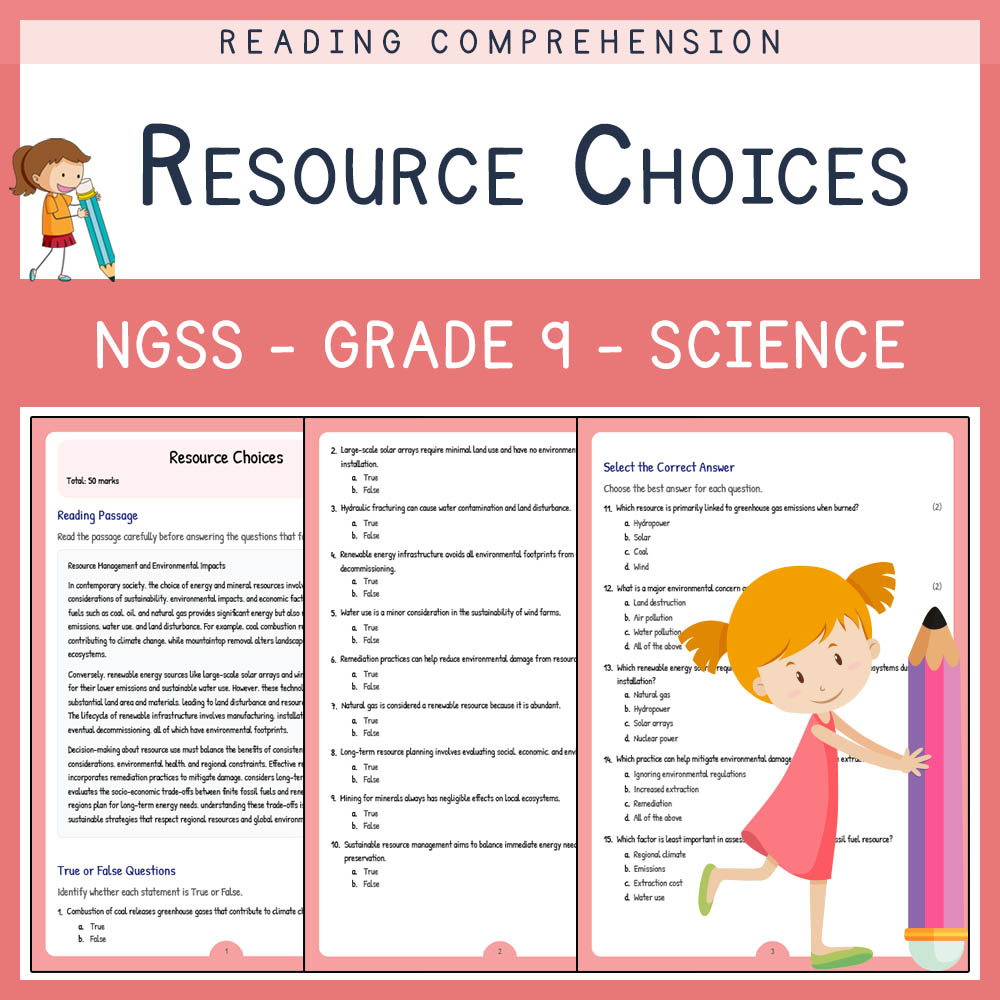
Grade 9 Science | Resource Choices Worksheet with Answer Key – NGSS Aligned
Created byLumora LearningLearning Objectives
- Analyze various energy and mineral resource options focusing on sustainability, environmental impact, and management.
- Compare life-cycle trade-offs, including extraction impacts, water use, land disturbance, and emissions for different resource types.
- Evaluate economic costs, supply constraints, and remediation practices to assess sustainable use of finite and renewable resources.
Instant download
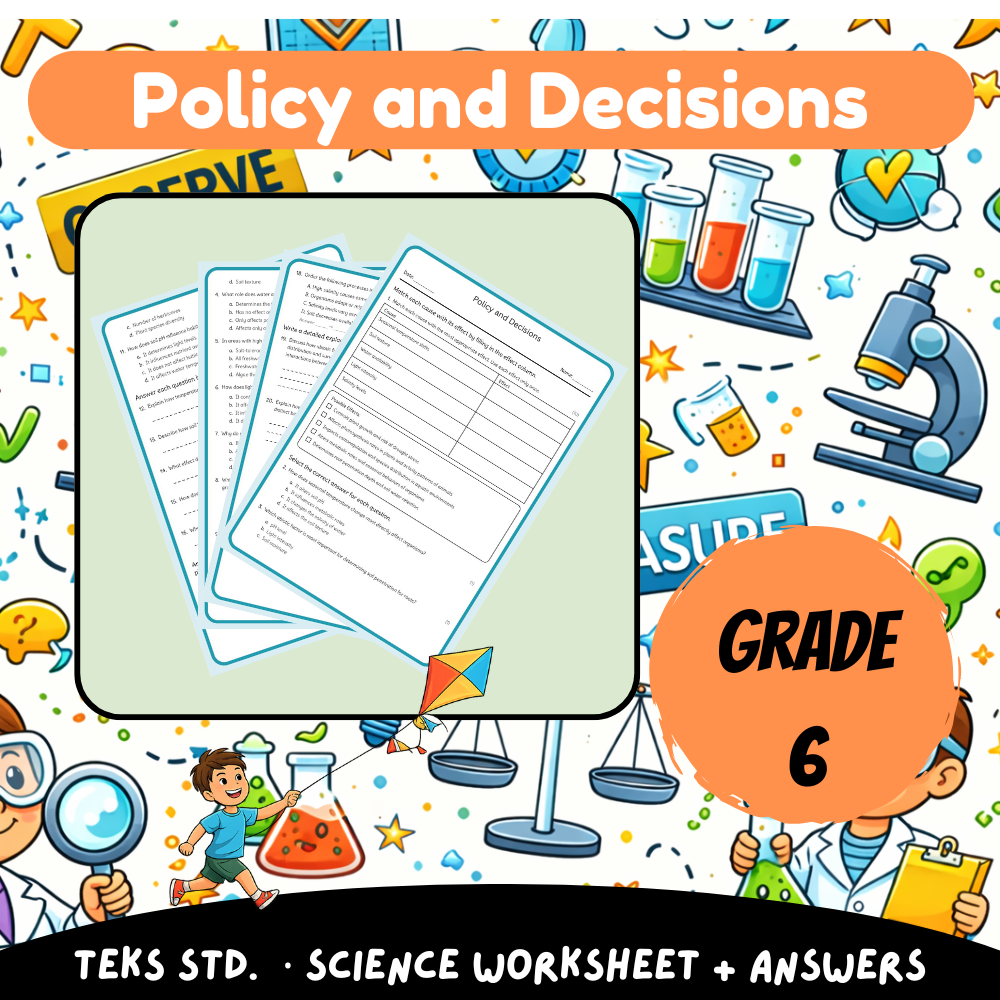
6th Grade Science – Policy and Decisions Worksheet (Worksheet + Answer Key) – TEKS Alignment
 Created byBright Mind Resources
Learning Objectives
- Understand how scientific evidence influences policy and decision-making.
- Identify key factors such as risk assessment, cost-benefit analysis, and stakeholder values.
- Interpret data and weigh uncertainties in societal decisions involving science and technology.
Instant download

Grade 9 Orbital Interactions Worksheet | Ontario Science with Answer Key
 Created byClear Sky Classroom
Learning Objectives
- Explain how eccentricity, axial tilt, and precession change seasonal insolation patterns over time.
- Describe how tidal forcing from the Moon and Sun arises from gravitational gradients and relative geometry.
- Connect orbital dynamics to observable effects such as day-length variations, tidal range changes, and long-term climate modulation.
Instant download
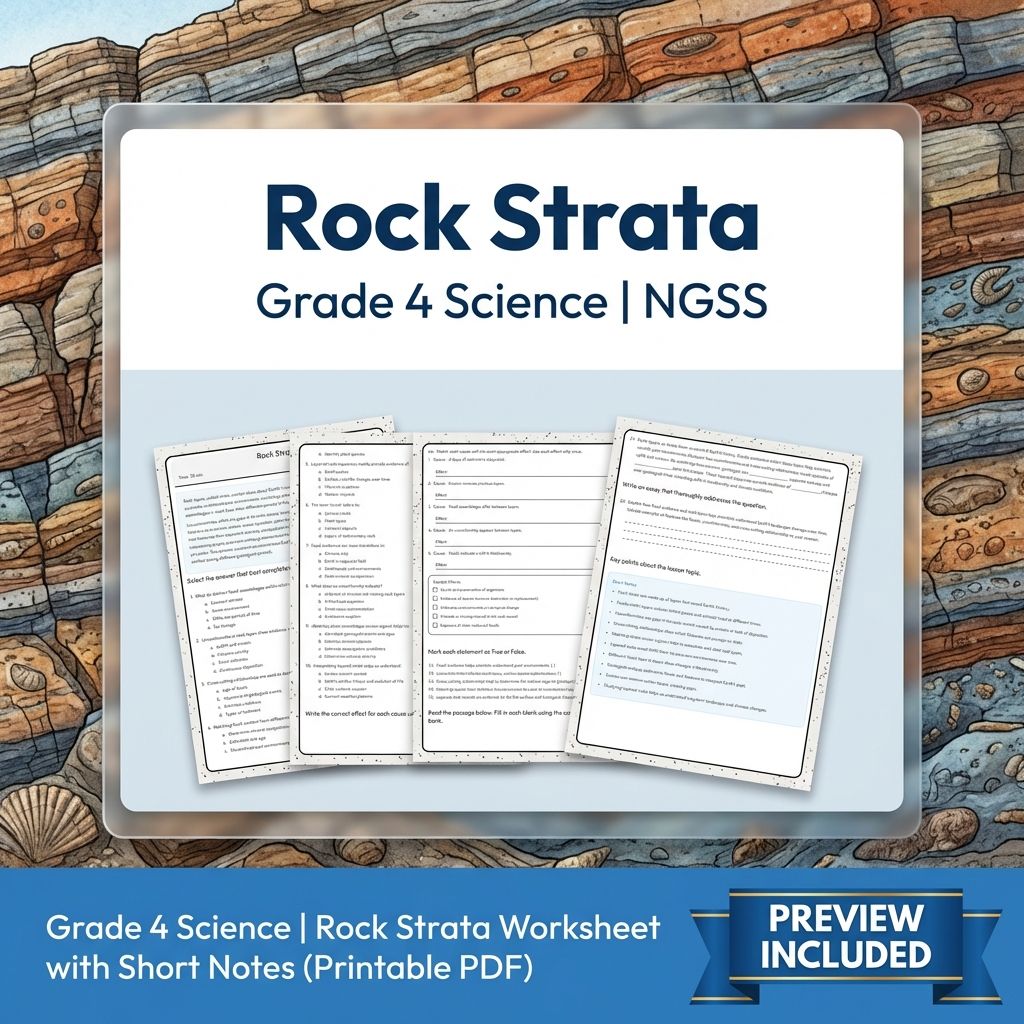
Grade 4 Science | Rock Strata Worksheet with Short Notes (Printable PDF)
 Created byMeadowlark Worksheets
Learning Objectives
- Understand how rock layers and fossils provide evidence of Earth's landscape changes over time.
- Identify features such as fossil assemblages, unconformities, and cross-cutting relationships as indicators of geological events.
- Interpret layered rock records to reconstruct past environments and shifts in biodiversity.
Also included in: Grade 4 Science | Earth's Place in the Universe Unit Bundle +1 more
Instant download
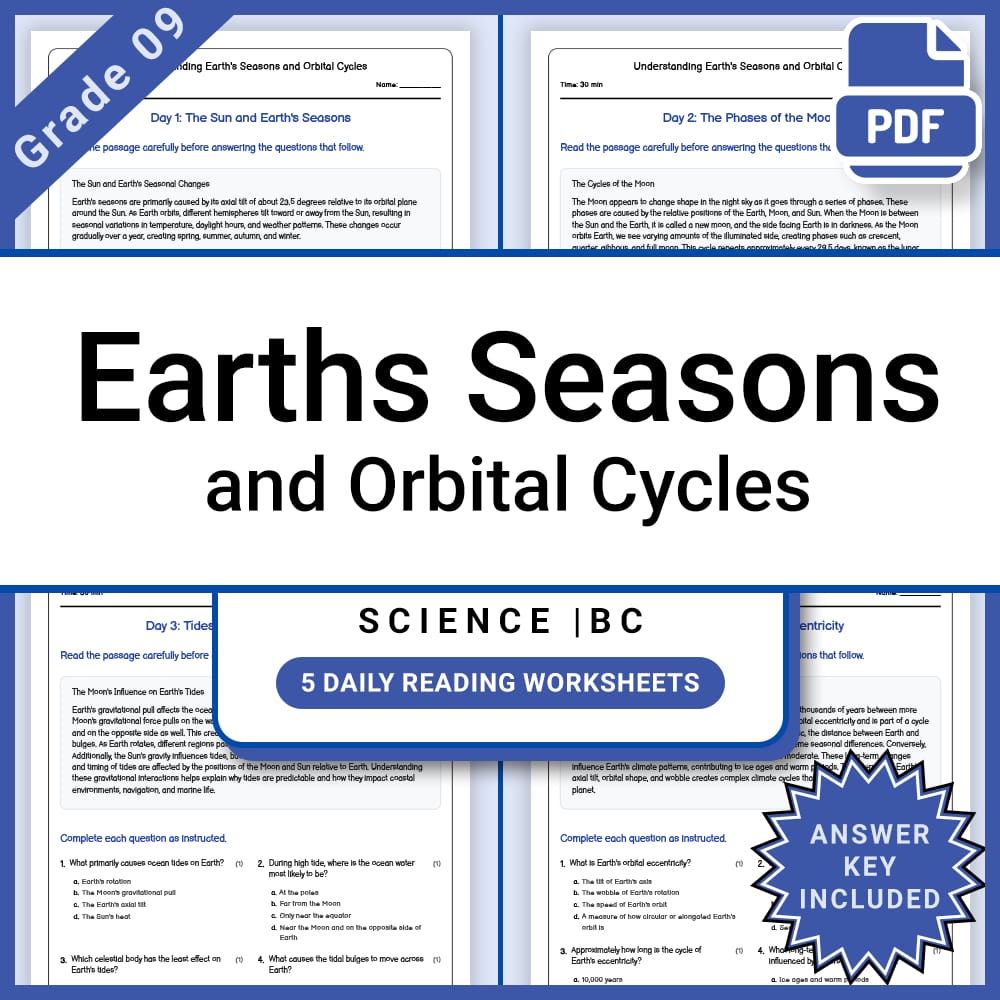
Grade 9 – Earth's Seasons and Orbital Cycles Daily Worksheet + Answer Key
JCreated byJ.S SheetsLearning Objectives
- Explain how Earth's tilt and orbit influence seasonal changes.
- Describe the relationship between the Sun, Earth, and Moon related to lunar phases and tides.
- Identify how orbital eccentricity affects climate patterns.
Also included in: Grade 9 Science Lesson Bundle: Tidal Forces, Tectonic Plates & Climate Physics +1 more
Instant download

Inheritance Basics DNA Chromosomes & Variation Worksheet | Grade 9 NGSS
 Created byAmber Owl Education
Learning Objectives
- Explain how DNA replication and chromosome segregation during meiosis support hereditary continuity
- Describe the roles of gametes and zygote formation in passing genetic information to offspring
- Use inheritance vocabulary to interpret karyotype patterns and basic pedigree ratios
Also included in: Grade 9 Science Genetics & Variation Lesson Bundle: NGSS Aligned +1 more
Instant download

Grade 9 Producers & Consumers Energy & Carbon Cycling Worksheet NGSS
Created byAmber Owl EducationLearning Objectives
- Explain how photosynthesis and cellular respiration transfer energy between producers and consumers.
- Describe how net primary productivity relates to biomass accumulation in autotrophs.
- Use respiration rates to predict how much energy is available to heterotrophs.
Also included in: Grade 9 Science Trophic Dynamics Cycling & Biodiversity Lesson Bundle | ngss +1 more
Instant download

Grade 9 Heat Quantification Worksheet | Thermal Energy Transfer & Specific Heat
Created byAmber Owl EducationLearning Objectives
- Use specific heat capacity, mass, and temperature change to calculate heat transfer.
- Apply sign conventions for heat flow into or out of a system.
- Distinguish conduction, convection, and radiation in terms of how energy is transferred.
Also included in: Grade 9 Science Energy Conservation & Transfer Lesson Bundle – NGSS +1 more
Instant download

Grade 9 Land Sustainability Worksheet | Soil, Water & NGSS Science Activity
Created byAmber Owl EducationLearning Objectives
- Explain how soil conservation and irrigation practices affect land and water systems.
- Identify indicators of ecosystem resilience and long-term land productivity under different land-use choices.
- Describe watershed management trade-offs involving food production, biodiversity, and water quality.
Also included in: Grade 9 Science Sustainability & Climate Risk Lesson Bundle | NGSS +1 more
Instant download

Grade 9 Population Regulation Worksheet | Carrying Capacity & Human Impacts
Created byAmber Owl EducationLearning Objectives
- Explain how carrying capacity and density-dependent factors regulate population size.
- Differentiate between density-dependent and density-independent effects, and give examples.
- Use simple mathematical models (logistic growth) to describe how populations change over time.
Also included in: Grade 9 Science Trophic Dynamics Cycling & Biodiversity Lesson Bundle | ngss +1 more
Instant download

Grade 9 Science – Neural Control & Nervous System | Daily Reading Worksheet
 Created byQuiet Forest Education
Learning Objectives
- Understand the basic structure and function of neurons
- Describe how neurons communicate across synapses
- Explain the propagation of nerve impulses via action potentials
Also included in: Human Body Science Grade 9 Daily Reading Worksheets Bundle | Ontario +1 more
Instant download

Grade 9 Science – Circulatory System & Blood Flow | Daily Reading Worksheet
Created byQuiet Forest EducationLearning Objectives
- Identify the main components of the cardiovascular system
- Describe the structure and function of the heart
- Explain how blood vessels vary in size and function
Also included in: Human Body Science Grade 9 Daily Reading Worksheets Bundle | Ontario +1 more
Instant download

Grade 12 Science | Astronomy Overview Worksheet | TEKS Aligned
Created byLumora LearningLearning Objectives
- Summarize the key processes involved in the formation and evolution of the Solar System.
- Identify observational evidence used in studying planetary characteristics and formation theories.
- Explain the concepts of accretion, planetary differentiation, and protoplanetary disks.
Also included in: Grade 12 Science | Earth and Space Science Lesson Bundle | TEKS Aligned
Instant download
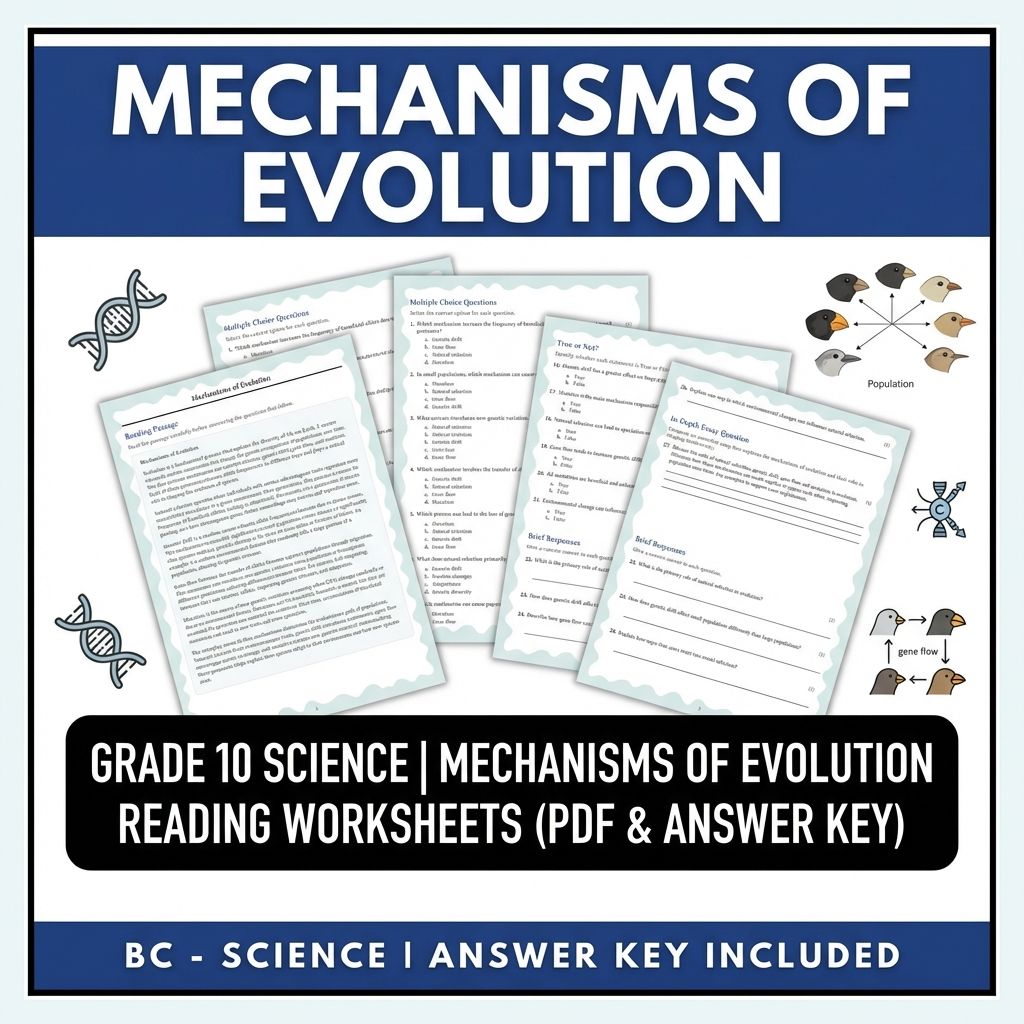
Grade 10 Science | Mechanisms of Evolution Reading Worksheets (PDF & Answer Key)
JCreated byJ.S SheetsLearning Objectives
- Understand the four main mechanisms of evolution: natural selection, genetic drift, gene flow, and mutation.
- Explain how each mechanism alters allele frequencies within populations.
- Describe the role of natural selection in adaptation and reproductive advantage.
Instant download
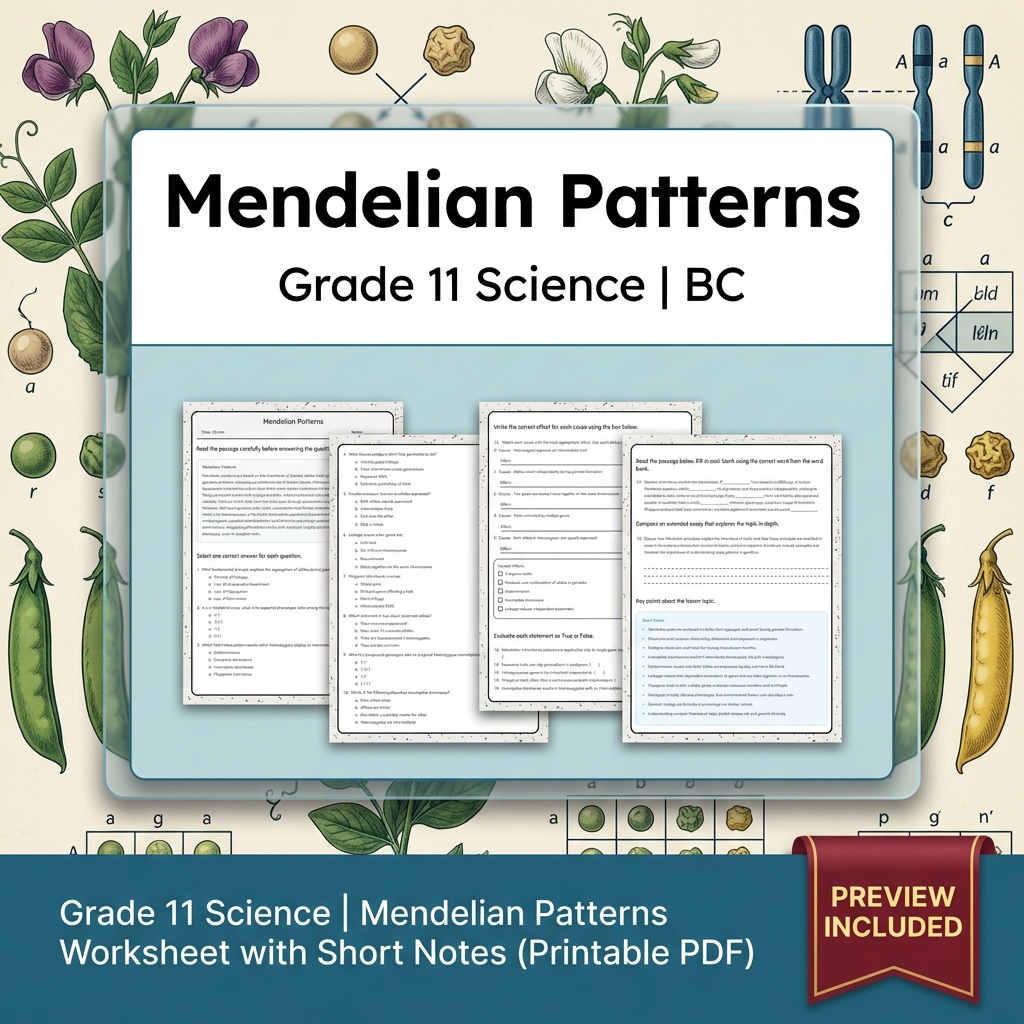
Grade 11 Science | Mendelian Patterns Worksheet with Short Notes (Printable PDF)
Created byMeadowlark WorksheetsLearning Objectives
- Understand the principles of Mendelian inheritance and how alleles segregate and assort.
- Identify the difference between dominant, recessive, incomplete dominance, and codominance.
- Analyze pedigree charts to trace inheritance patterns across generations.
Also included in: Grade 11 Science Lesson Bundle BC Framework Worksheets for Biology and Genetics +1 more
Instant download
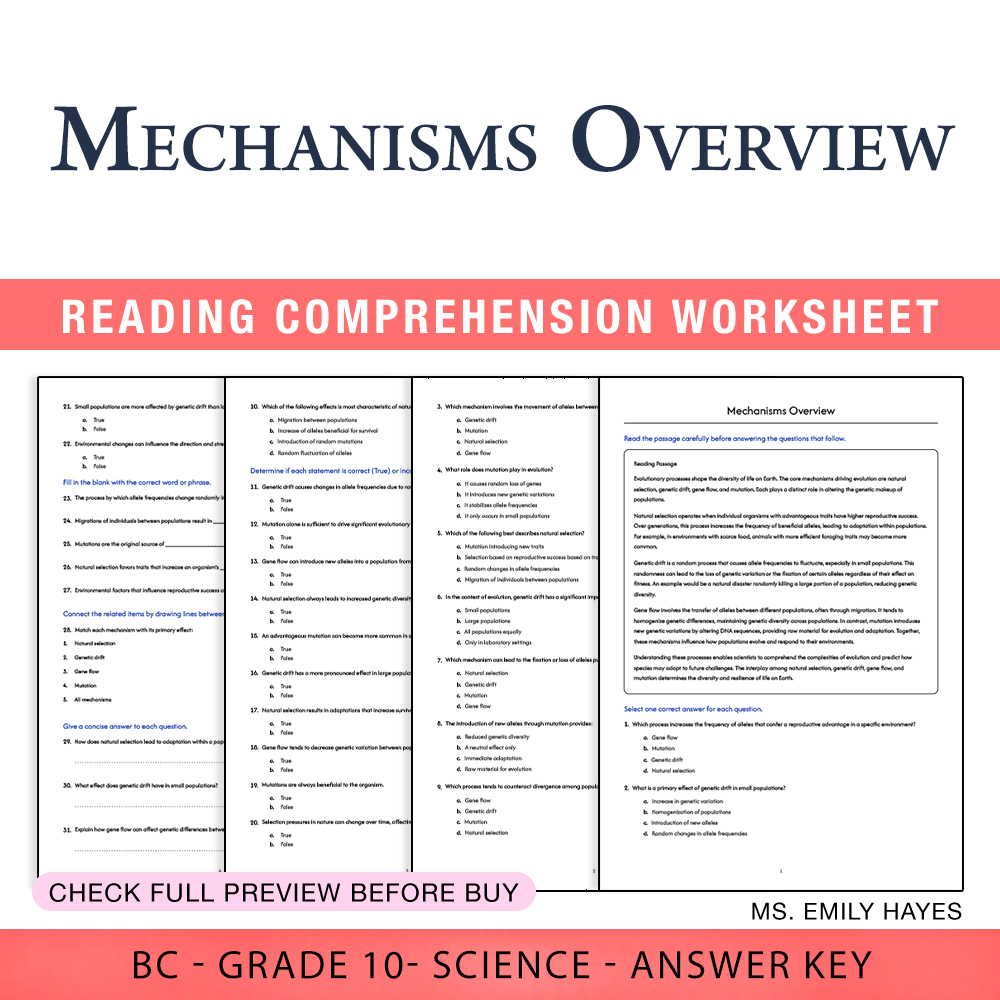
Grade 10 Science | Mechanisms of Evolution Worksheet (PDF+ Answer Key)
 Created byCopper Leaf Classroom
Learning Objectives
- Identify and describe the four main mechanisms of evolution: natural selection, genetic drift, gene flow, and mutation.
- Explain how each mechanism influences allele frequencies within populations.
- Analyze the effects of natural selection and genetic drift on population adaptation and variation.
Also included in: Grade 10 Science BC | Evolution, Biodiversity & Ecology (PDF + Answer Key) +1 more
Instant download
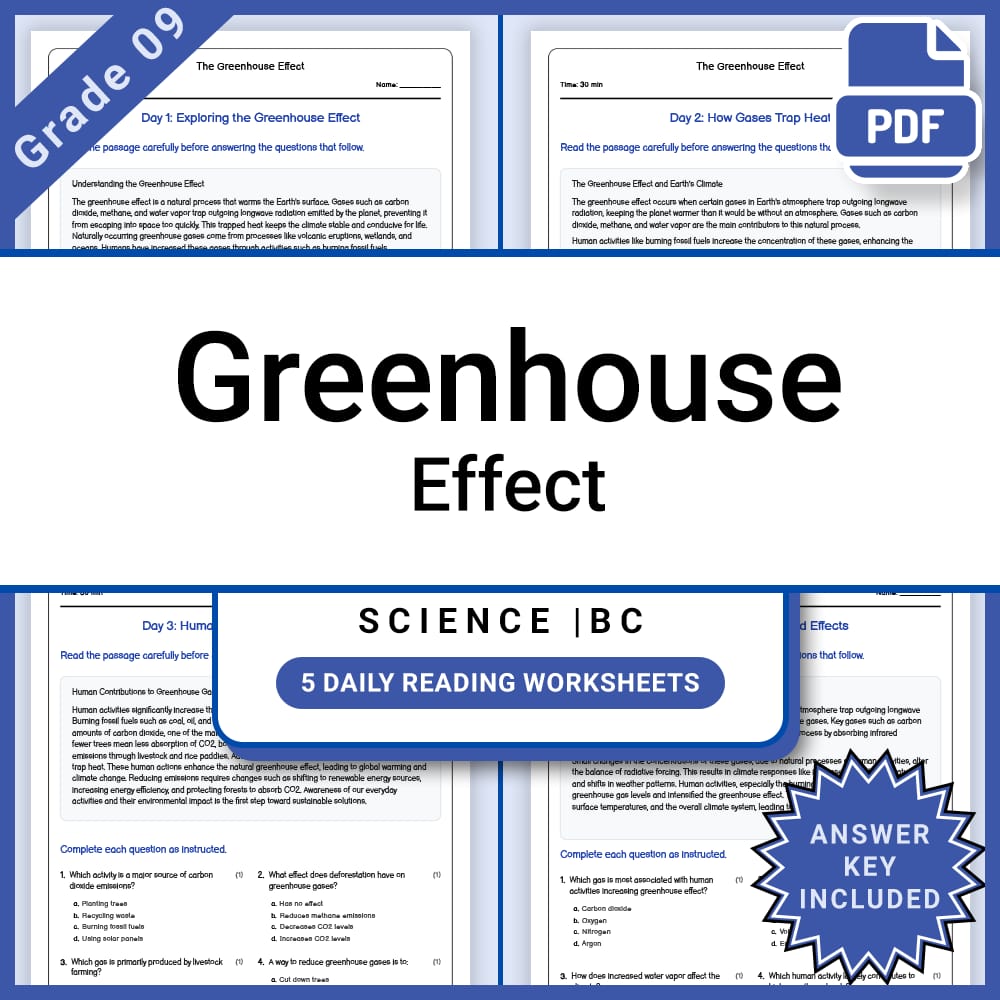
Grade 9 Science – The Greenhouse Effect Daily Reading Worksheet & Answer Key
JCreated byJ.S SheetsLearning Objectives
- Understand what greenhouse gases are and their sources.
- Describe how greenhouse gases trap heat and contribute to Earth's warming.
- Identify natural versus human-made greenhouse gases.
Also included in: Grade 9 Science Lesson Bundle: Tidal Forces, Tectonic Plates & Climate Physics +1 more
Instant download
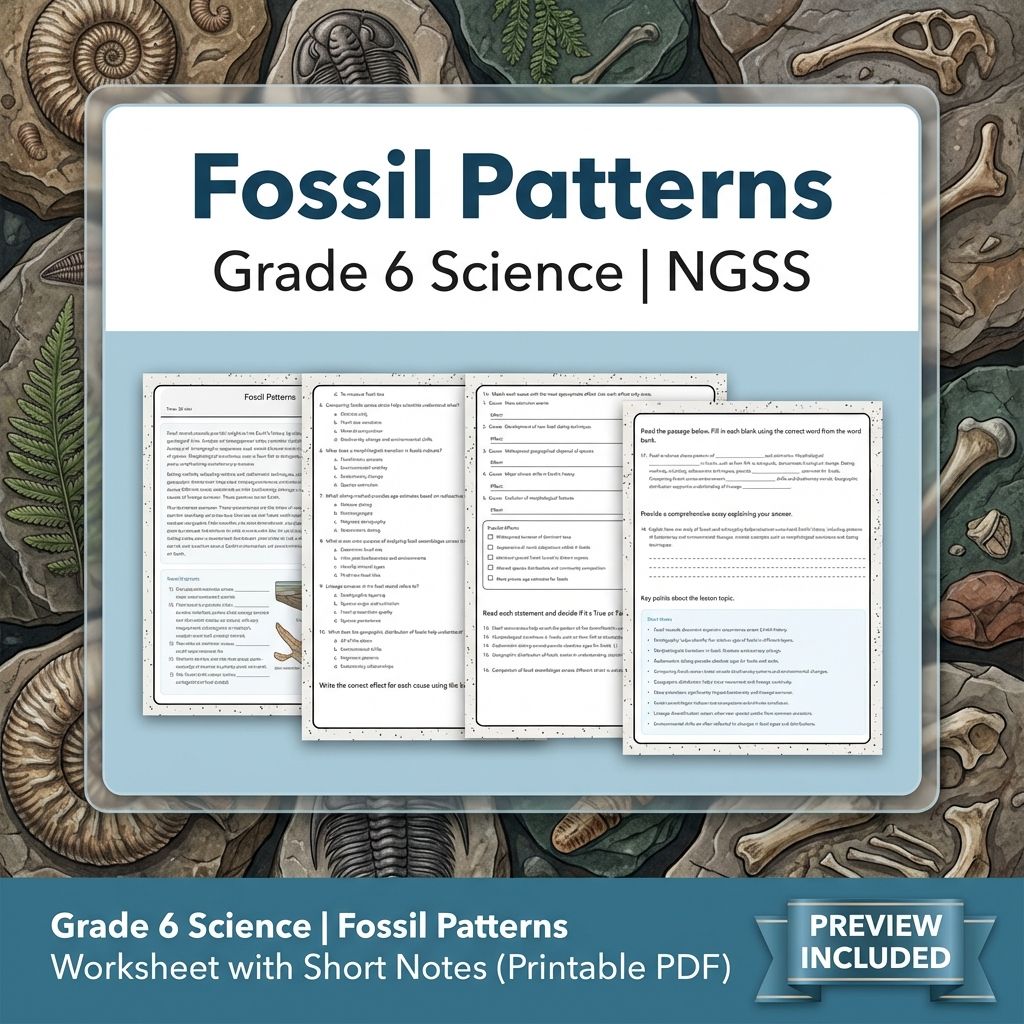
Grade 6 Science | Fossil Patterns Worksheet with Short Notes (Printable PDF)
Created byMeadowlark WorksheetsLearning Objectives
- Understand how fossil occurrences and stratigraphy reveal patterns of biodiversity over time.
- Analyze morphological transitions in the fossil record, such as fish-to-tetrapod evolution.
- Explain the role of dating methods and geographic distribution in tracing lineage continuity.
Also included in: Grade 6 Science | Biological Evolution: Unity and Diversity Unit Bundle +1 more
Instant download
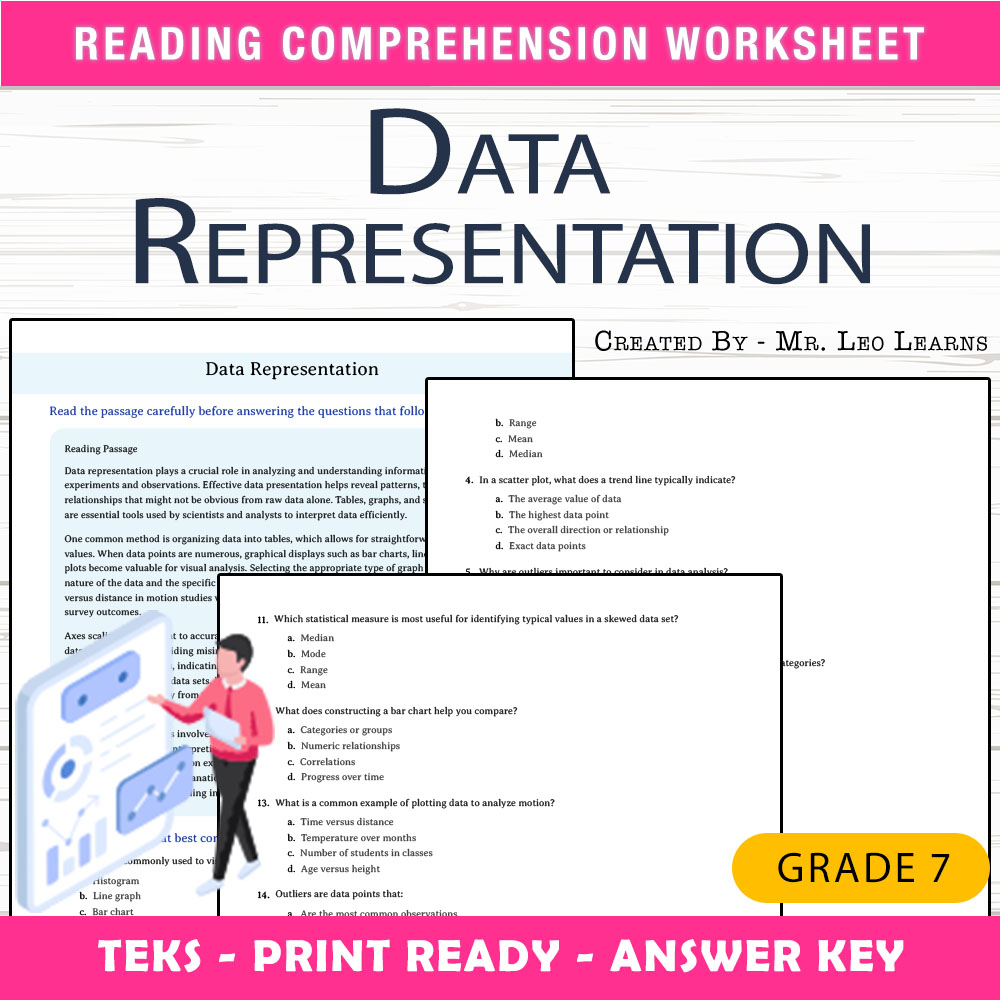
Grade 7 Science – Data Representation Worksheet for Mastery
 Created byThe Resource Hub
Learning Objectives
- Understand how to organize quantitative and qualitative data into tables and graphs.
- Learn to interpret trends and relationships from graphical displays and summary statistics.
- Select appropriate graph types, including axes scaling and trend lines, for data analysis.
Also included in: Grade 7 Science Unit Bundle | Experimental Design & Data Analysis Worksheets +1 more
Instant download
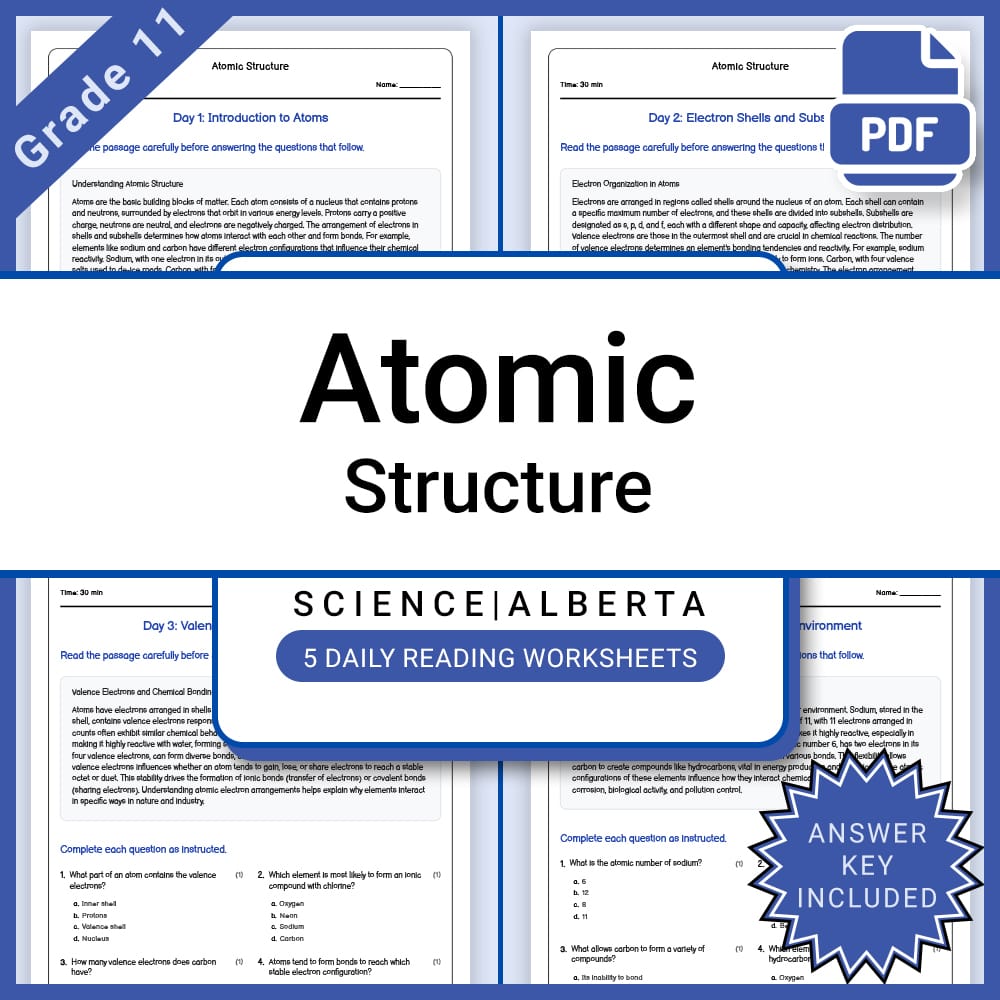
Grade 11 Science – Atomic Structure Daily Reading Worksheet + Answer Key
JCreated byJ.S SheetsLearning Objectives
- Identify the main parts of an atom: protons, neutrons, and electrons.
- Understand how electrons are arranged in shells and subshells.
- Explain how atom structure influences reactivity and bond formation.
Also included in: Grade 11 Science Lesson Bundle | Molecular Structure and Bonding +1 more
Instant download
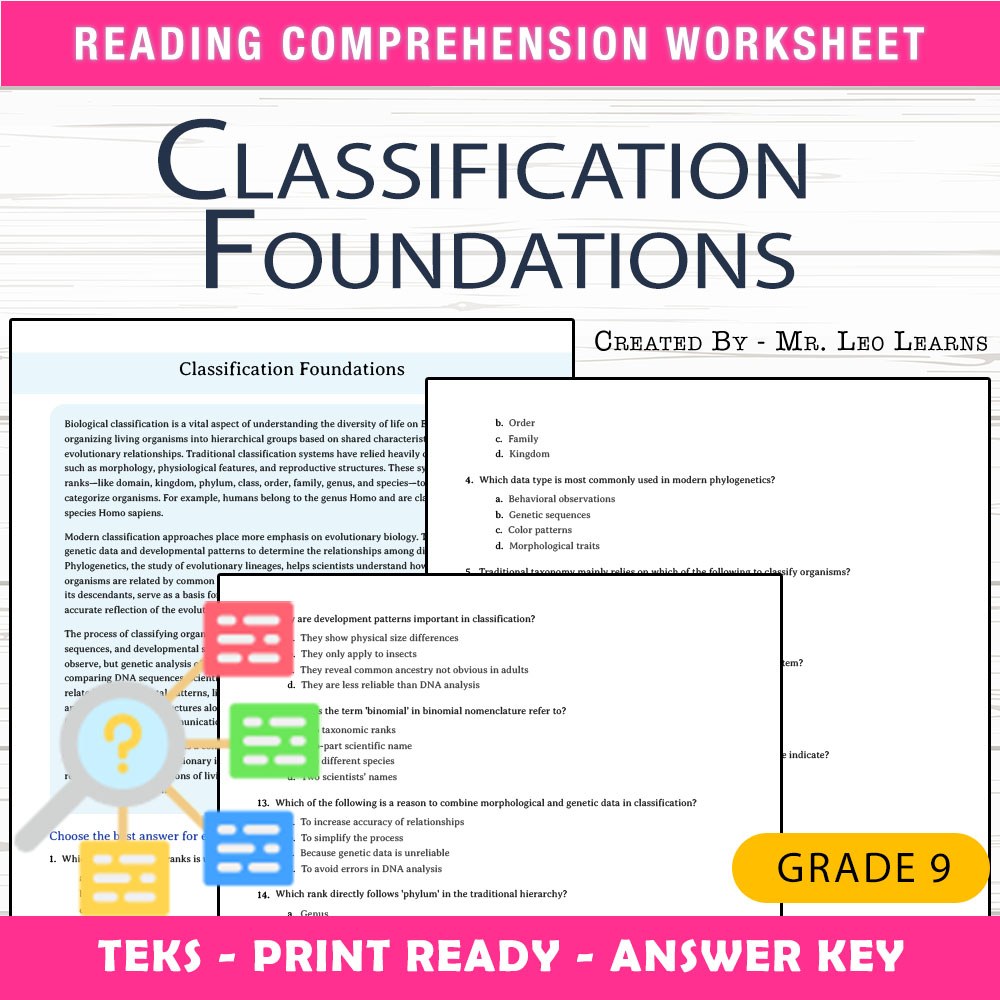
Grade 9 Science | Classification Foundations Worksheet for Mastery
Created byThe Resource HubLearning Objectives
- Understand the hierarchical structure of biological classification systems.
- Identify key taxa such as domain, kingdom, phylum, class, order, family, genus, and species.
- Explain the differences between traditional and modern classification approaches.
Also included in: Grade 9 Science Evolution & Classification Unit Worksheet Pack +1 more
Instant download
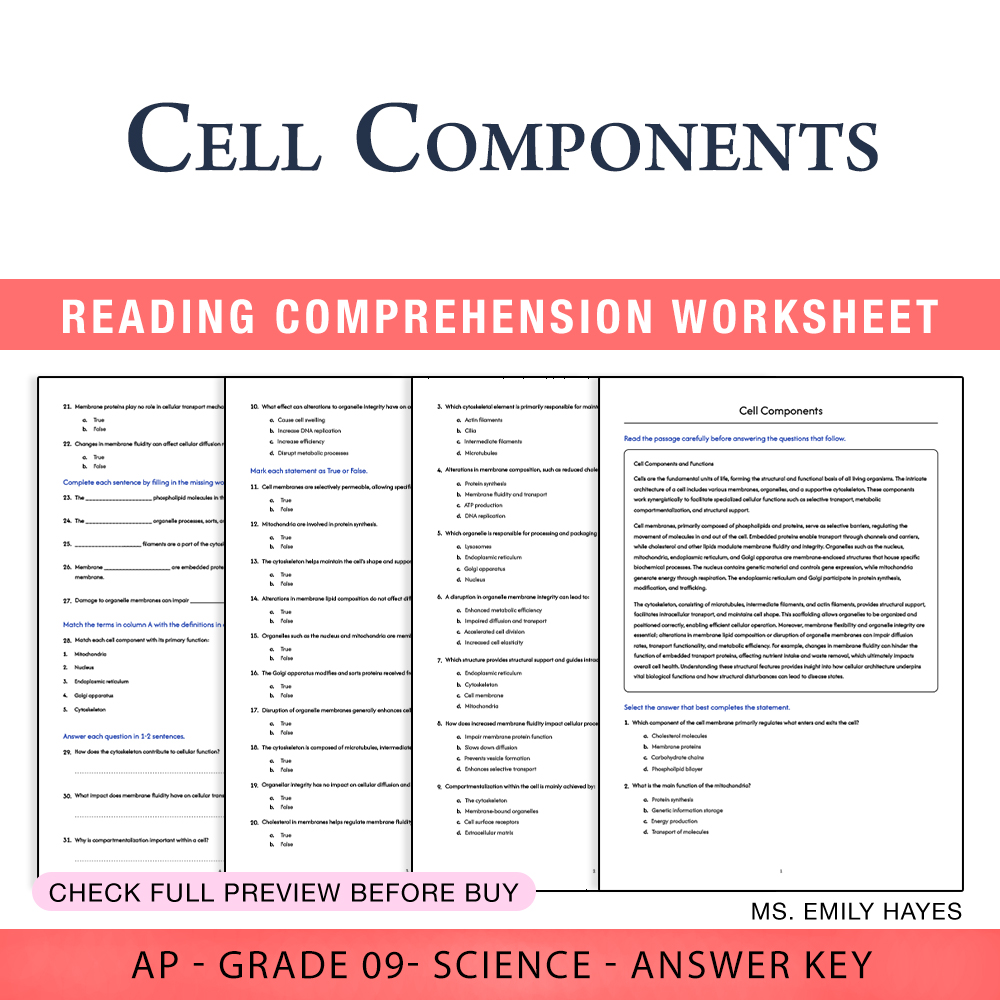
9th Grade Science | Cell Components Worksheet (PDF+ Answer Key)
Created byCopper Leaf ClassroomLearning Objectives
- Describe the structure and function of cellular membranes and organelles.
- Explain how compartmentalization and the cytoskeleton support cellular activities.
- Analyze the effects of membrane composition and organelle integrity on transport and metabolism.
Also included in: Grade 9 Science | Biology & Ecosystems AP Worksheet Bundle (PDF+ Answer Key) +1 more
Instant download

6th Grade Science Atoms & Particles Worksheet | Matter Properties (PDF)
Created byEvergreen Desk EducationLearning Objectives
- Explain how matter can be modeled as particles and how atoms form elements.
- Describe how different particle compositions lead to measurable properties of substances.
- Use particle model ideas to interpret properties like density, melting point, and reactivity.
Instant download
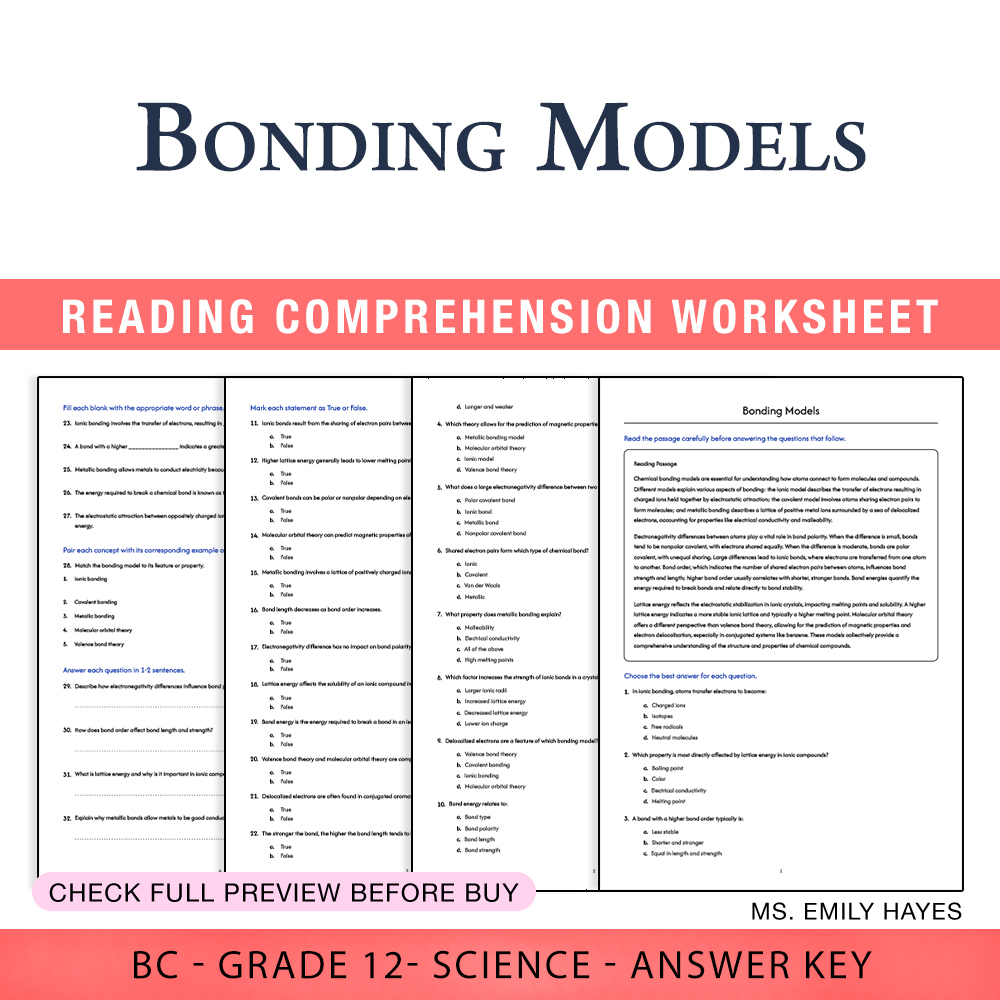
12th Grade Science | Bonding Models Worksheet (PDF + Answer Key)
Created byCopper Leaf ClassroomLearning Objectives
- Explain different types of chemical bonding: ionic, covalent, and metallic.
- Predict bond polarity based on electronegativity differences.
- Describe the concepts of bond order, bond energy, and their relationship to bond strength and length.
Also included in: Grade 12 Science BC – Thermochemistry to Atomic Structures (PDF+ Answer Keys) +1 more
Instant download

Grade 10 Worksheet B: Particle Interactions Practice | NGSS PDF
Created byClear Sky ClassroomLearning Objectives
- Explain how crystal structure and particle arrangement influence bulk properties such as melting point, solubility, and electrical conductivity.
- Compare ionic, molecular (covalent), and metallic solids using intermolecular/interionic forces (lattice energy, dispersion forces, and hydrogen bonding).
- Relate the strength and type of particle attractions to macroscopic phase transitions and electrical behavior.
Also included in: Grade 10 Reaction Rates & Chemical Change Science Lesson Bundle – NGSS +1 more
Instant download

Grade 10 Worksheet B: Chemical Equilibrium and Le Chatelier’s Principle | NGSS
Created byClear Sky ClassroomLearning Objectives
- Explain chemical equilibrium as a dynamic, rate-balanced process and relate it to measurable outcomes.
- Predict how changes in pressure, concentration, and temperature shift equilibria using Le Chatelier’s principle.
- Interpret the equilibrium constant K as a quantitative description of equilibrium composition at a given temperature.
Also included in: Grade 10 Reaction Rates & Chemical Change Science Lesson Bundle – NGSS +1 more
Instant download

Grade 10 Worksheet B: Reaction Evidence Practice | NGSS PDF
Created byClear Sky ClassroomLearning Objectives
- Explain chemical reaction outcomes using conservation of atoms and atomic rearrangement.
- Connect observable evidence (gas, color, temperature, precipitate) to predicted products.
- Use balanced formulations to support evidence-based claims about reactions.
Also included in: Grade 10 Reaction Rates & Chemical Change Science Lesson Bundle – NGSS +1 more
Instant download

Grade 10 Worksheet B: Mass Conservation in Chemical Reactions Practice | NGSS
Created byClear Sky ClassroomLearning Objectives
- Explain mass conservation using balanced chemical equations and atomic accounting.
- Use coefficients, mole concepts, and molar masses to relate reactant and product amounts.
- Verify that total mass of reactants equals total mass of products by tracking atom counts in examples.
Also included in: Grade 10 Reaction Rates & Chemical Change Science Lesson Bundle – NGSS +1 more
Instant download
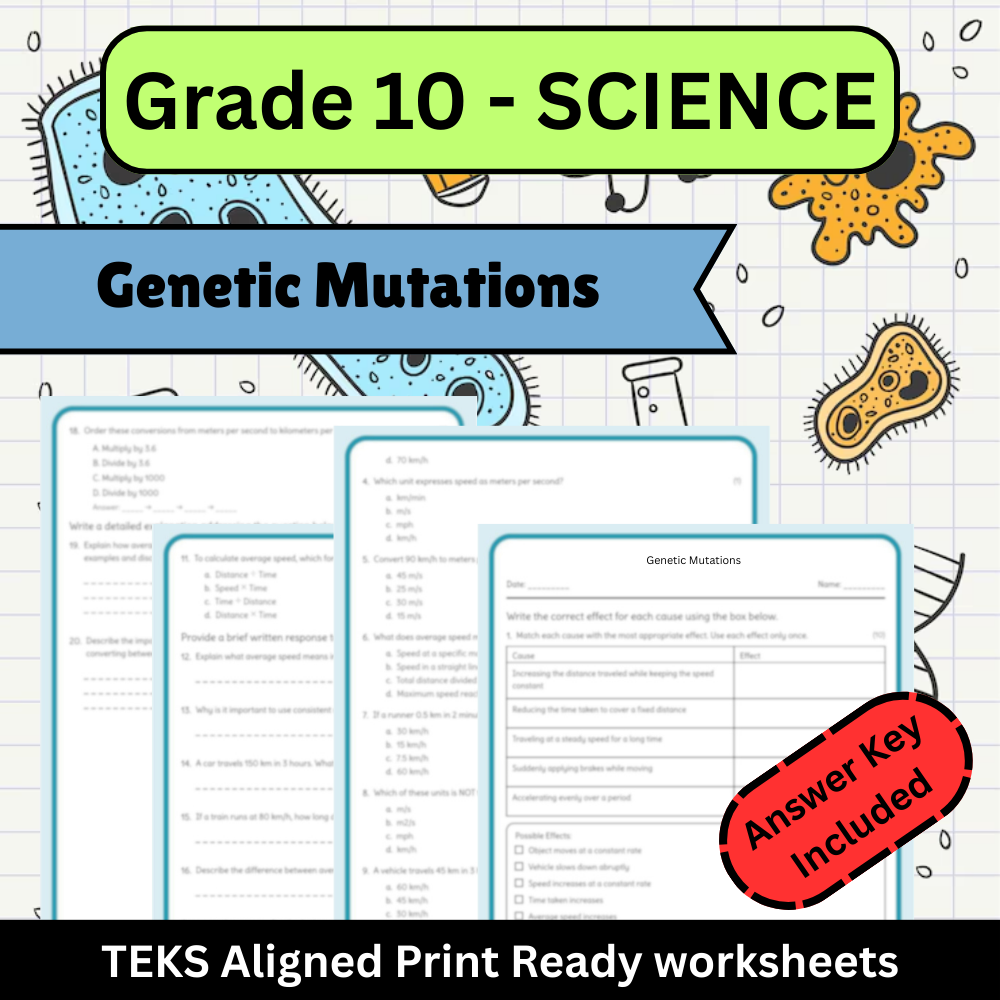
Grade 10 Science | Genetic Mutations Practice Worksheet (Answer Key) – TEKS Aligned
Created byBright Mind ResourcesLearning Objectives
- Understand the different types of genetic mutations and their effects on genes and proteins.
- Identify examples of point mutations, insertions, deletions, and chromosomal alterations.
- Explain how mutations can influence phenotype and hereditary disorders.
Also included in: Grade 10 Science | Genetics & DNA Unit Worksheet Pack (TEKS Aligned) +5 more
Instant download
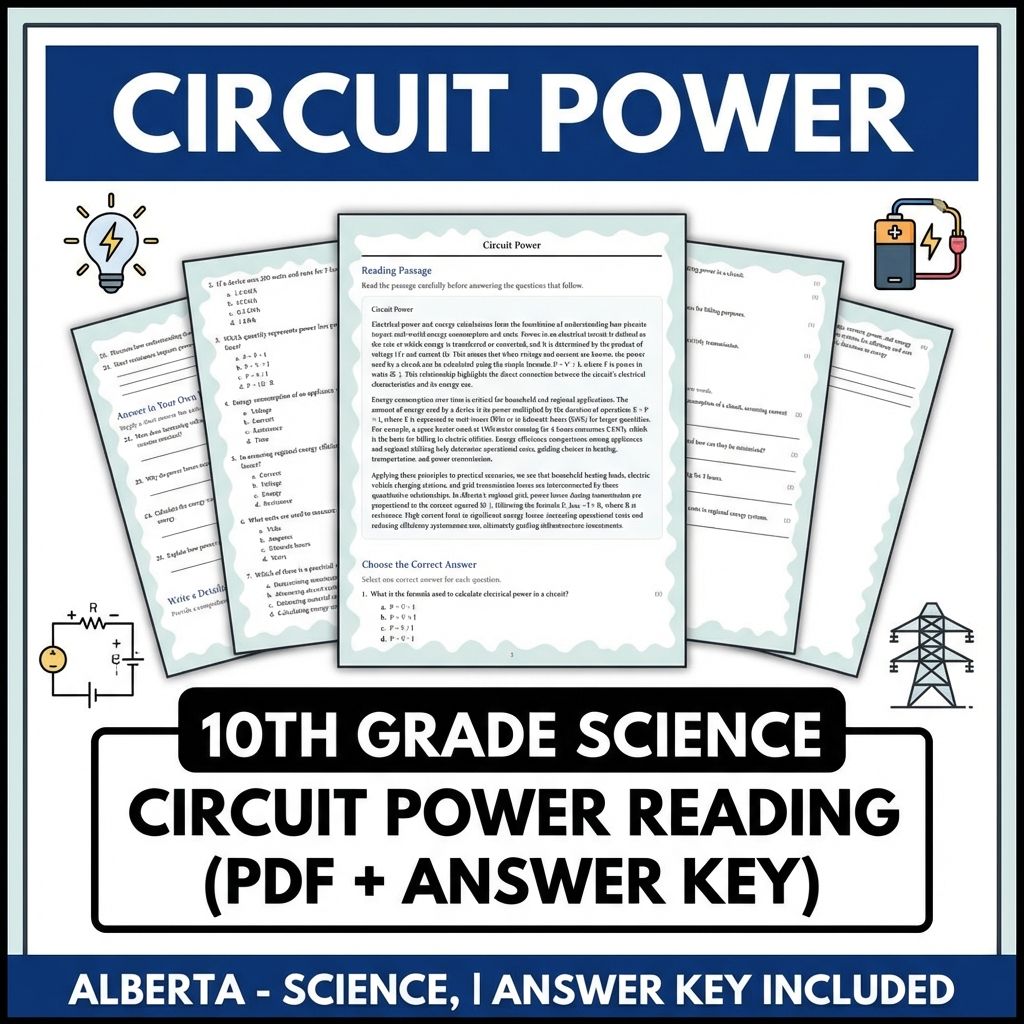
10th Grade Science | Circuit Power Reading Worksheets (PDF + Answer Key)
JCreated byJ.S SheetsLearning Objectives
- Define electrical power in terms of voltage and current.
- Explain how energy consumption relates to circuit quantities over time.
- Apply power and energy calculations to household and regional electrical scenarios.
Also included in: Grade 10 Science Bundle | Energy, Circuits & Mechanics (Answer Keys Included) +1 more
Instant download
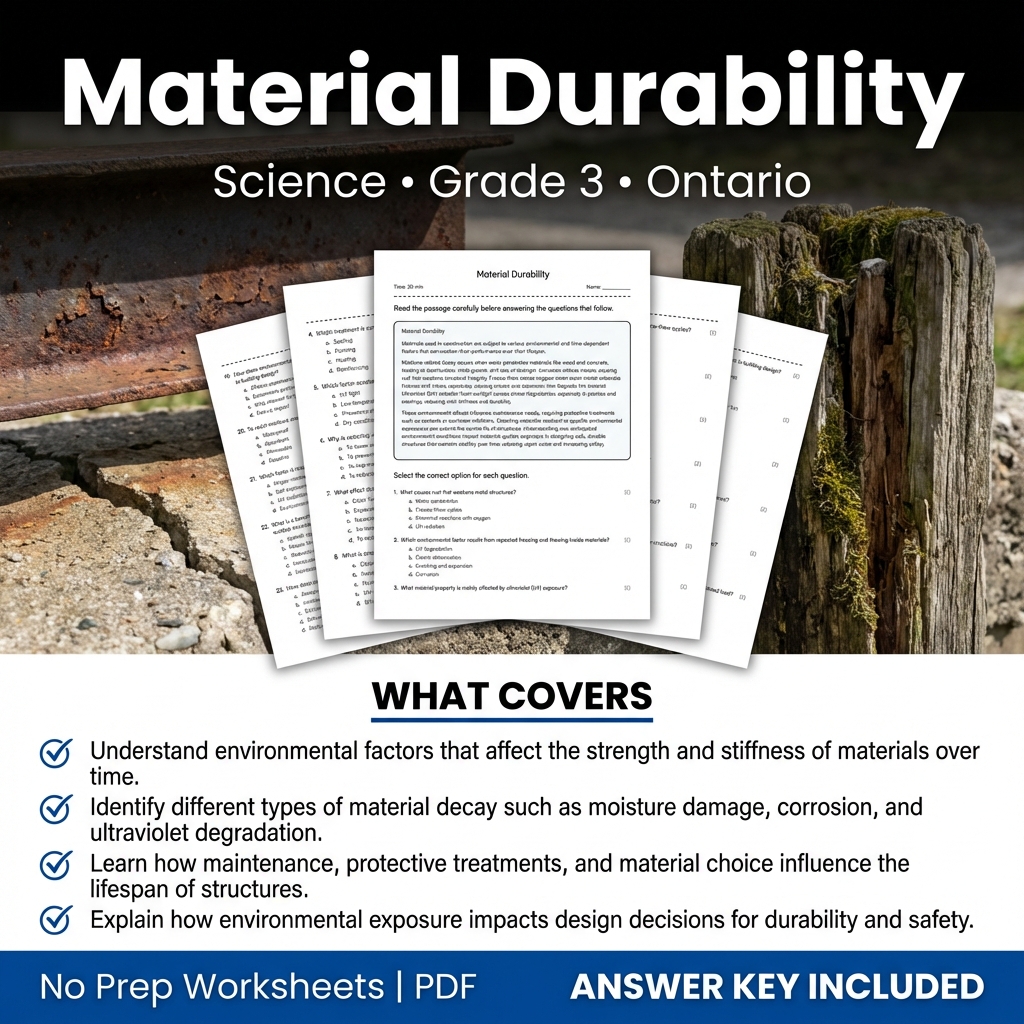
Grade 3 Science Worksheet on Material Durability | Ontario Standards
 Created byCoral Reef Learning
Learning Objectives
- Understand environmental factors that affect the strength and stiffness of materials over time.
- Identify different types of material decay such as moisture damage, corrosion, and ultraviolet degradation.
- Learn how maintenance, protective treatments, and material choice influence the lifespan of structures.
Instant download
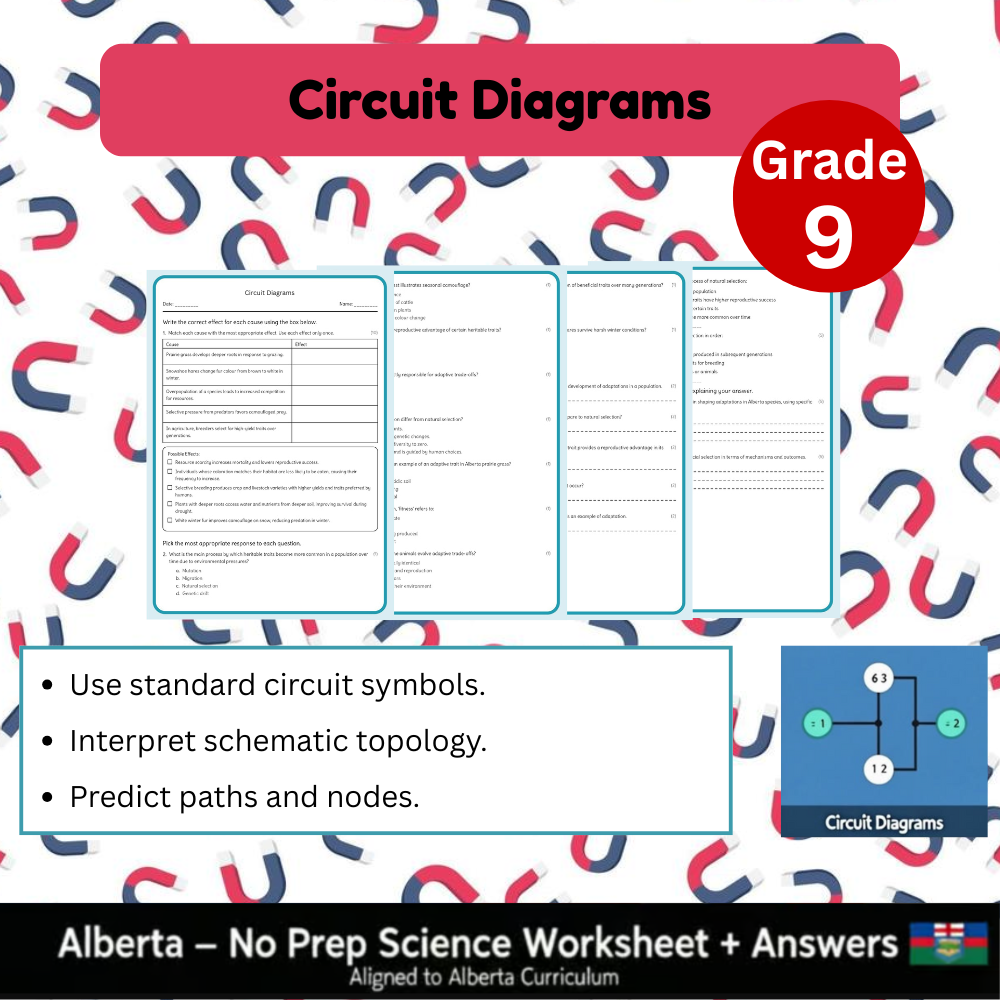
Grade 9 Science – Circuit Diagrams Worksheet (PDF) – Alberta Standards
Created byBright Mind ResourcesLearning Objectives
- Understand standardized symbols used in circuit diagrams.
- Interpret circuit topology from schematic diagrams.
- Predict current paths, voltage drops, and node relationships based on symbols and notation.
Instant download
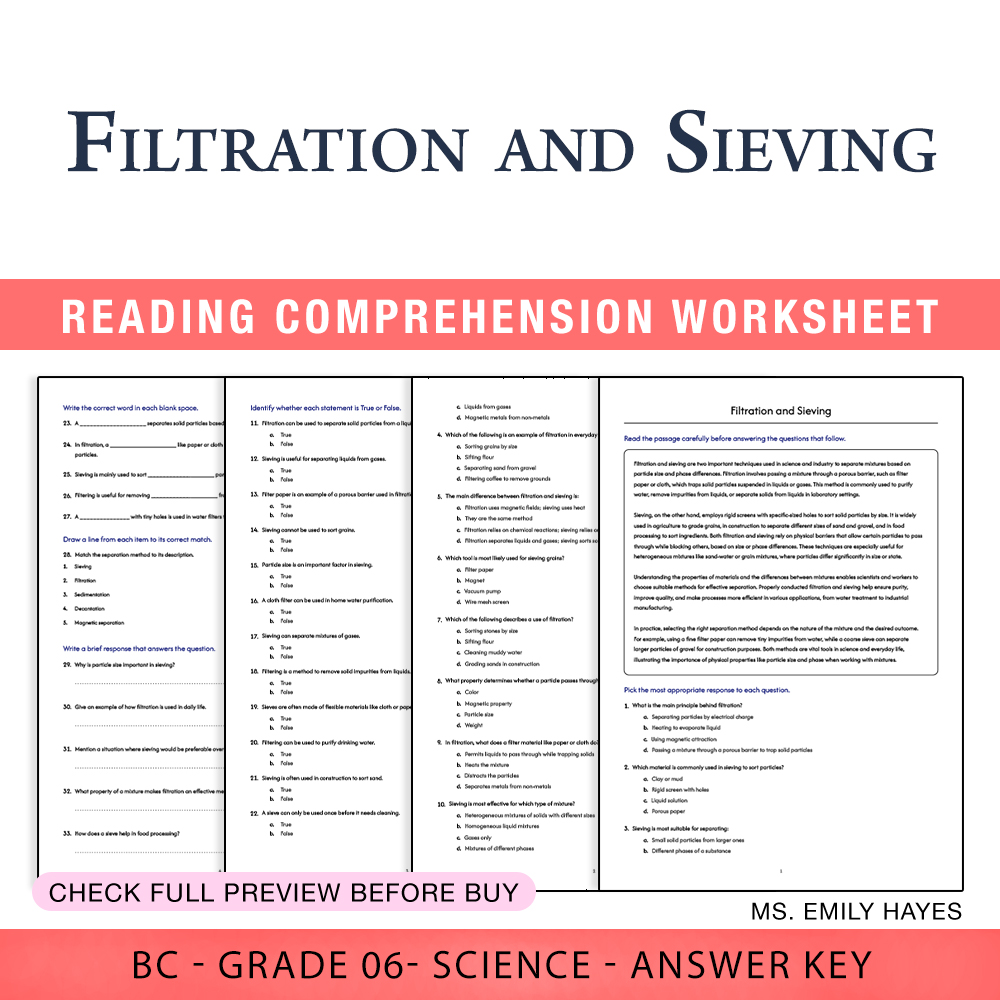
6th Grade Science | Filtration and Sieving Practice Worksheet (PDF+ Answer Key)
Created byCopper Leaf ClassroomLearning Objectives
- Understand the differences between filtration and sieving as methods for separating mixtures.
- Identify suitable materials and techniques used in filtration and sieving processes.
- Explain real-world applications of filtration and sieving in everyday life and industry.
Also included in: Grade 6 Science BC| Reaction Rates & Chemical Properties (PDF+ Answer Keys) +1 more
Instant download

Grade 7 Science – Synthetic Materials Worksheet (NGSS Aligned) PDF
Created byBright Mind ResourcesLearning Objectives
- Describe production pathways from natural resources to common synthetic materials, including feedstocks, polymerization, and refining steps.
- Explain how chemical composition and functional performance are altered during production.
- Identify examples of synthetic materials such as polyethylene, PET, nylon, and metals.
Instant download
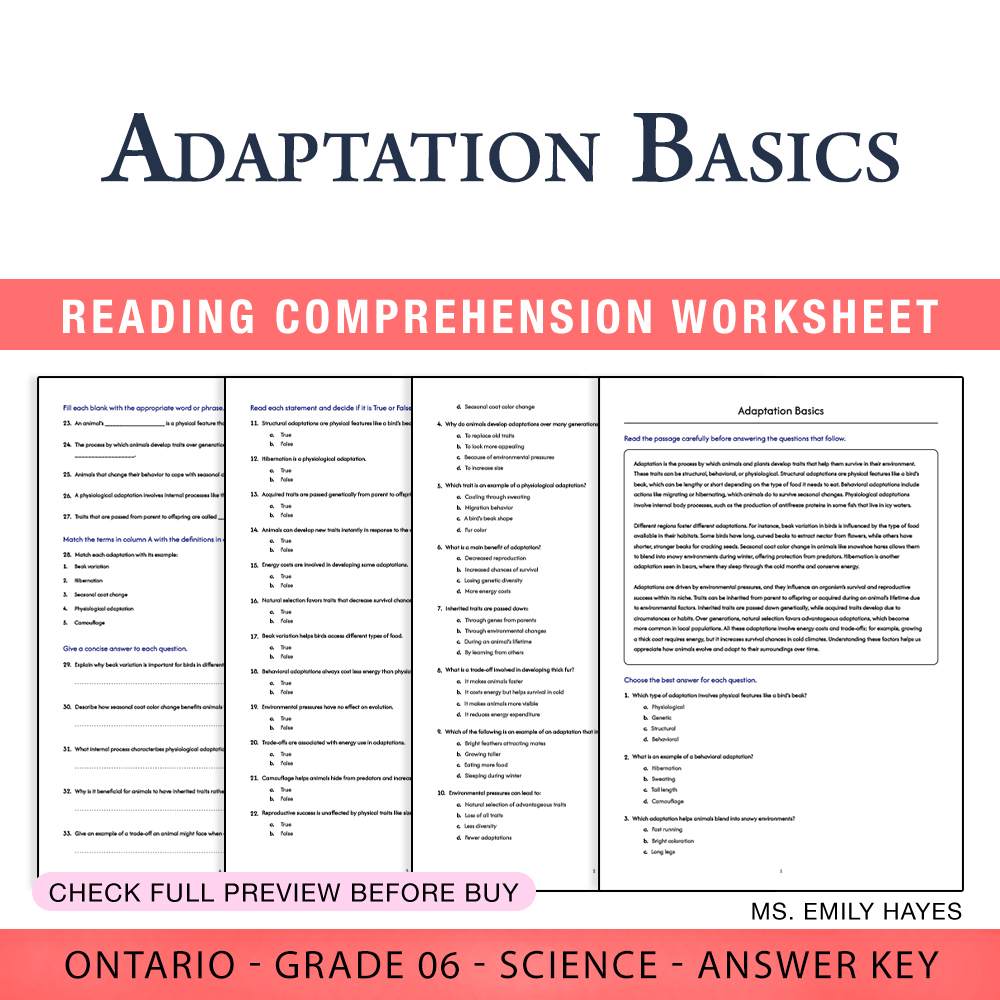
6th Grade Science | Adaptation Basics Worksheet (PDF+ Answer Key)
Created byCopper Leaf ClassroomLearning Objectives
- Understand the three main types of animal adaptations: structural, behavioral, and physiological.
- Identify regional examples of adaptations such as beak variation, seasonal coat color change, and hibernation.
- Explain how adaptations contribute to survival and reproductive success within specific niches.
Instant download
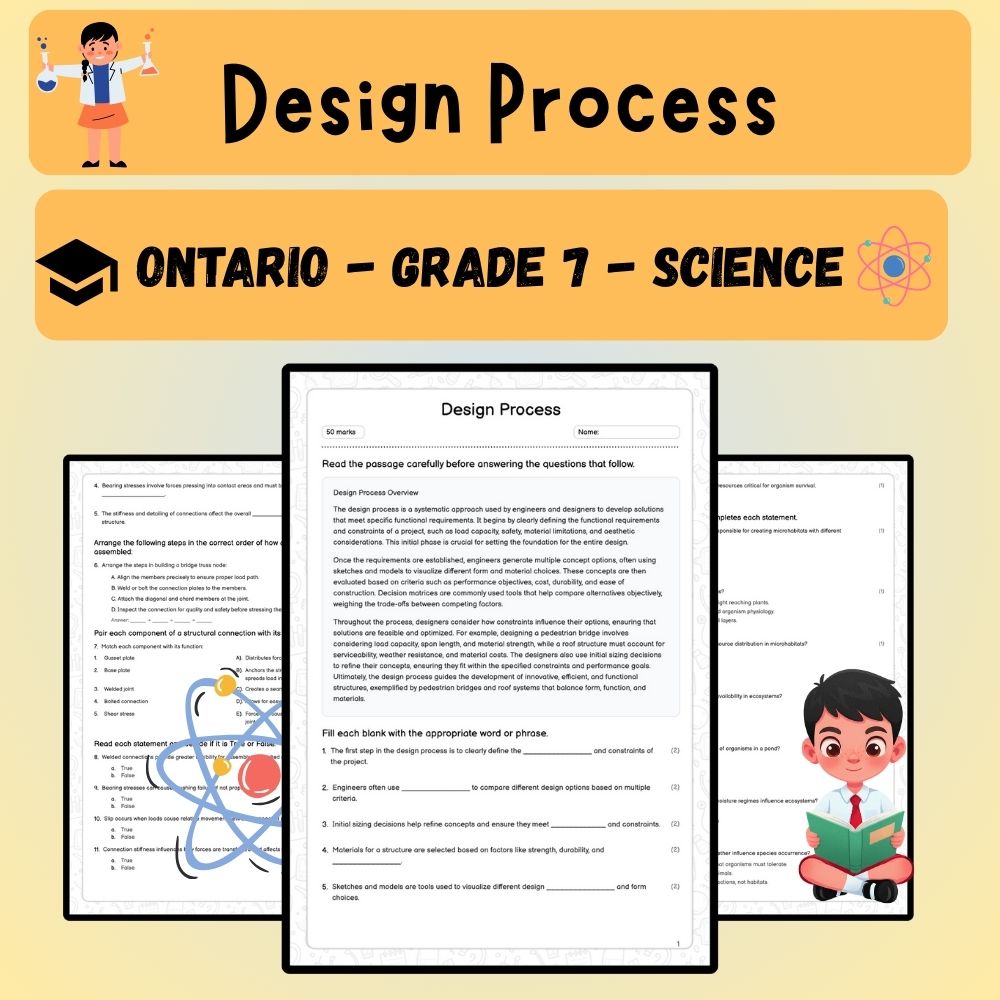
Grade 7 Science - Design Process Worksheet (PDF) – Ontario Standards
Created byPrism Point LearningLearning Objectives
- Understand the steps involved in the design process from defining requirements to selecting solutions.
- Identify key performance objectives and how they influence design choices.
- Apply decision matrices and sketches to compare different design alternatives.
Also included in: Grade 7 Science Unit | Structural Engineering & Material Testing Worksheets Bundle +1 more
Instant download
Human Footprint Worksheet for Grade 10 Science | Alberta Standards
Created byCoral Reef LearningLearning Objectives
- Understand how human activities impact Earth systems including land, water, and atmosphere.
- Identify regional examples of land-use change and resource extraction effects.
- Evaluate the long-term environmental consequences of urban expansion and resource development.
Instant download
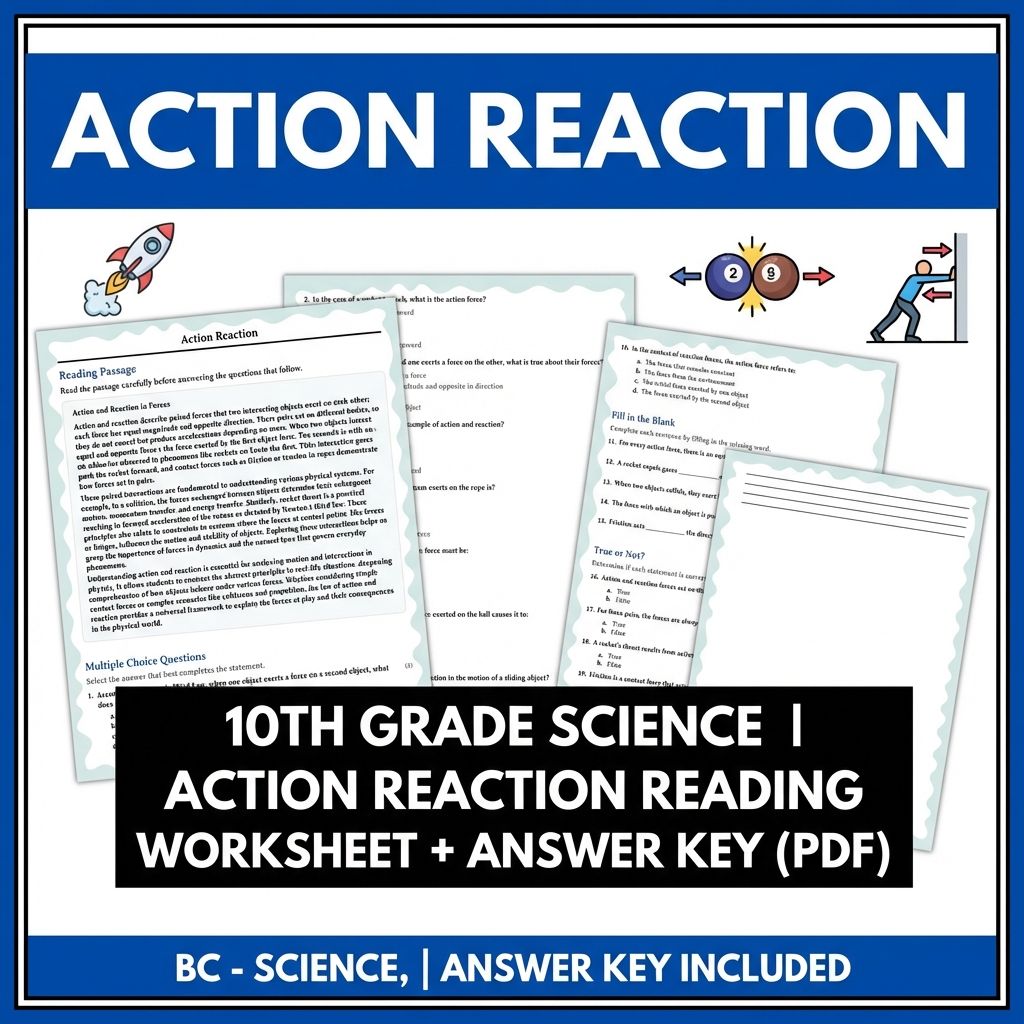
10th Grade Science | Action Reaction Reading Worksheet + Answer Key (PDF)
JCreated byJ.S SheetsLearning Objectives
- Explain the concept of paired forces in action and reaction.
- Describe how equal and opposite forces affect different objects.
- Analyze real-world examples like collisions and rocket thrust using Newton's Third Law.
Instant download
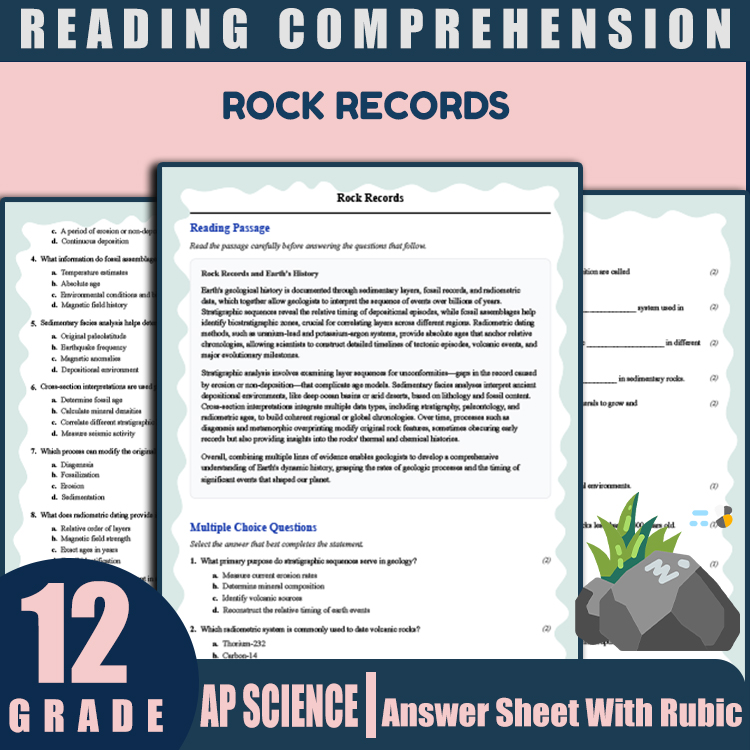
12th Grade Science | Rock Records Worksheet (Answer Key) for AP Standards
JCreated byJ.S SheetsLearning Objectives
- Interpret stratigraphic sequences and fossil assemblages to reconstruct Earth's history.
- Identify how radiometric age data contribute to understanding geologic processes.
- Evaluate sedimentary facies models and cross-section interpretations in correlating depositional environments.
Also included in: Grade 12 Science Unit | Earth Systems & Climate Change Worksheet Bundle (PDF) +1 more
Instant download
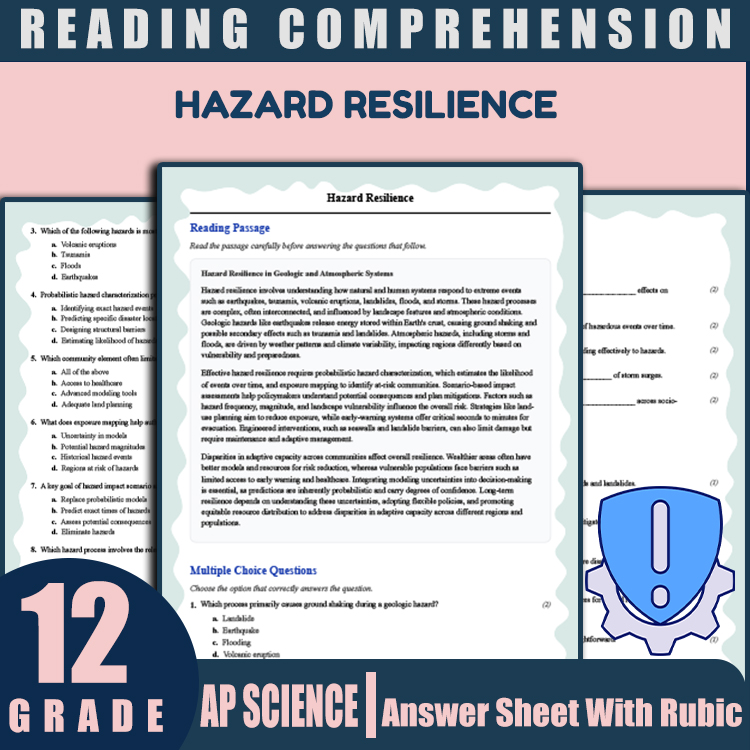
Grade 12 Science | Hazard Resilience Reading Worksheets & Answer Key (PDF)
JCreated byJ.S SheetsLearning Objectives
- Understand the processes behind geologic and atmospheric hazards such as earthquakes, tsunamis, and storms.
- Analyze how hazard probability, landscape vulnerability, and resilience strategies affect risk reduction.
- Evaluate approaches like land-use planning, early-warning systems, and engineered interventions in hazard scenarios.
Also included in: Grade 12 Science Unit | Earth Systems & Climate Change Worksheet Bundle (PDF) +1 more
Instant download
Browse more categories
About Science Worksheets
Find Science worksheets spanning core skills, practice, and review. All 44,628 resources are instant PDF downloads for the classroom or home.
Every worksheet on MyTeachingSheets is created by independent teacher-authors and reviewed before publication. All resources download as printable PDFs for classroom, homework, or at-home practice, and many include answer keys. Preview any worksheet free before buying.