
Science Worksheets
44,628 subject resources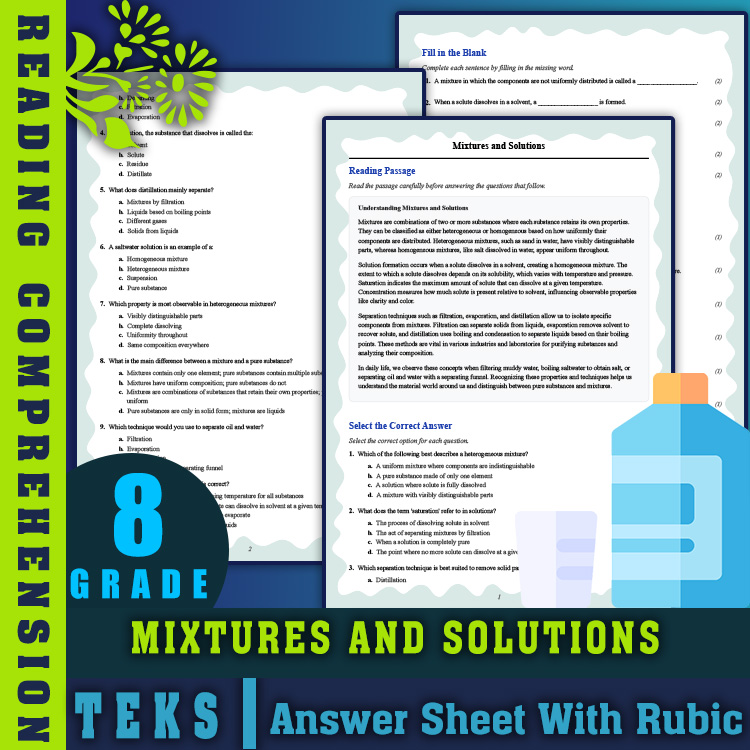
8th Grade Science | Mixtures and Solutions Reading Worksheet (PDF + Answer Key)
JCreated byJ.S SheetsLearning Objectives
- Understand the differences between heterogeneous and homogeneous mixtures.
- Identify common techniques for separating mixtures such as filtration, evaporation, and distillation.
- Explain the concepts of solubility, saturation, and concentration in solutions.
Instant download

Ecosystem Resilience Mechanisms Worksheet | Grade 11 Biology TEKS
 Created byBRIGHT PATH RESOURCES
Learning Objectives
- Identify the main idea of an informational passage about ecosystem resilience
- Define key vocabulary terms related to resilience and ecosystem responses
- Explain how species interactions and feedbacks can buffer disturbances
Instant download
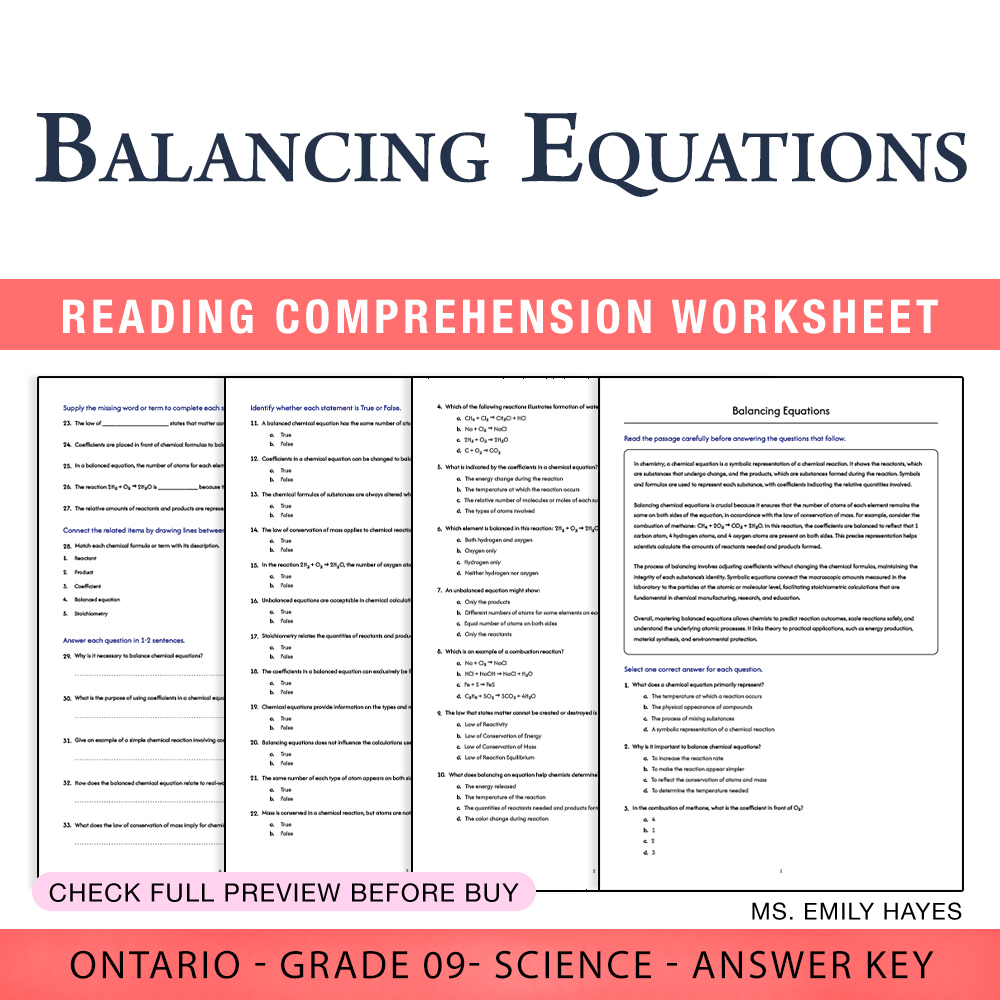
9th Grade Science | Balancing Equations Practice Worksheet (PDF + Answer Key)
 Created byCopper Leaf Classroom
Learning Objectives
- Understand the importance of balancing chemical equations to reflect the law of conservation of mass.
- Recognize the symbols and notation used in chemical equations.
- Demonstrate the ability to balance simple chemical reactions such as combustion and formation of water.
Instant download

Grade 9 Science – Newton's Second Law | Daily Reading Worksheet + Answer Key
JCreated byJ.S SheetsLearning Objectives
- Explain the basic concept of Newton's second law
- Identify the mathematical formula F = ma
- Distinguish between mass and weight
Also included in: Grade 9 Science Lesson Group: Physics and Motion Worksheets Bundle +1 more
Instant download
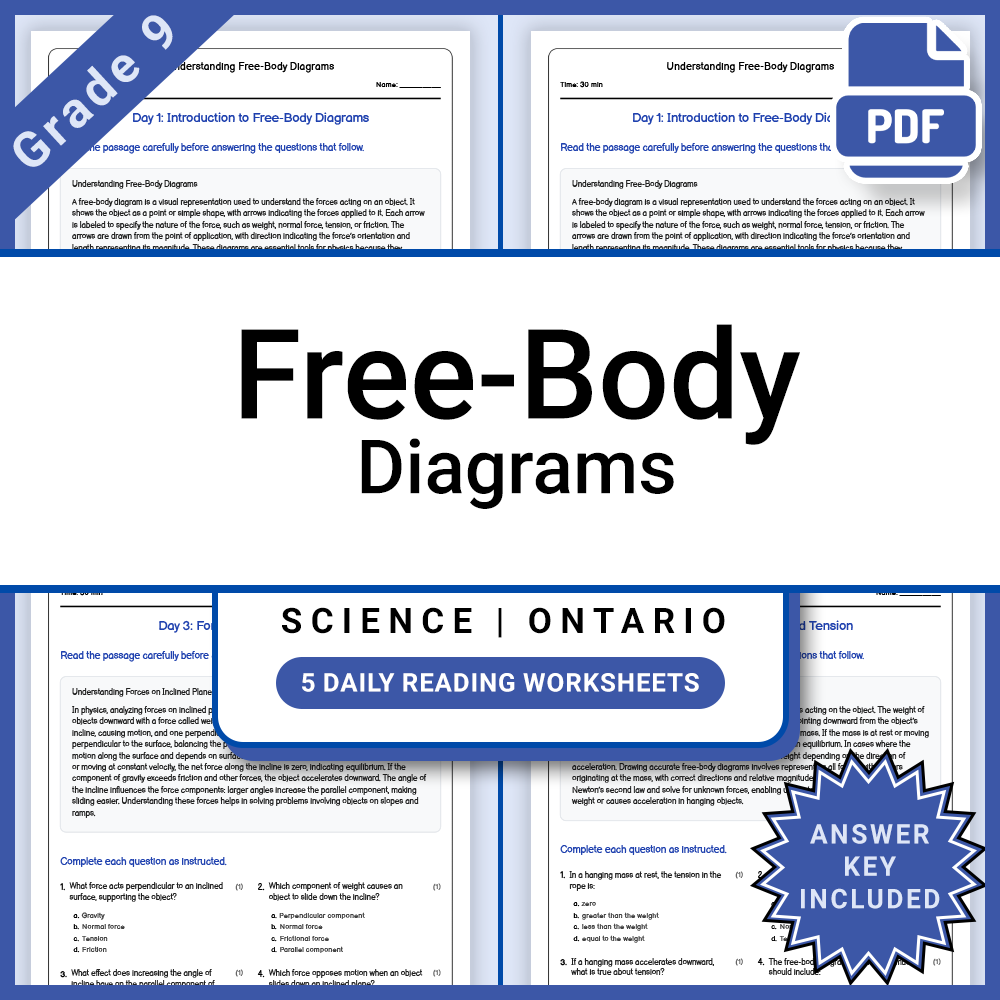
Grade 9 Science – Free-Body Diagrams Daily Reading Worksheet + Answer Key
JCreated byJ.S SheetsLearning Objectives
- Recognize and interpret free-body diagrams for simple objects
- Identify the common forces involved in free-body diagrams
- Understand the conventions for force vectors, points of application, and coordinate systems
Also included in: Grade 9 Science Lesson Group: Physics and Motion Worksheets Bundle +1 more
Instant download
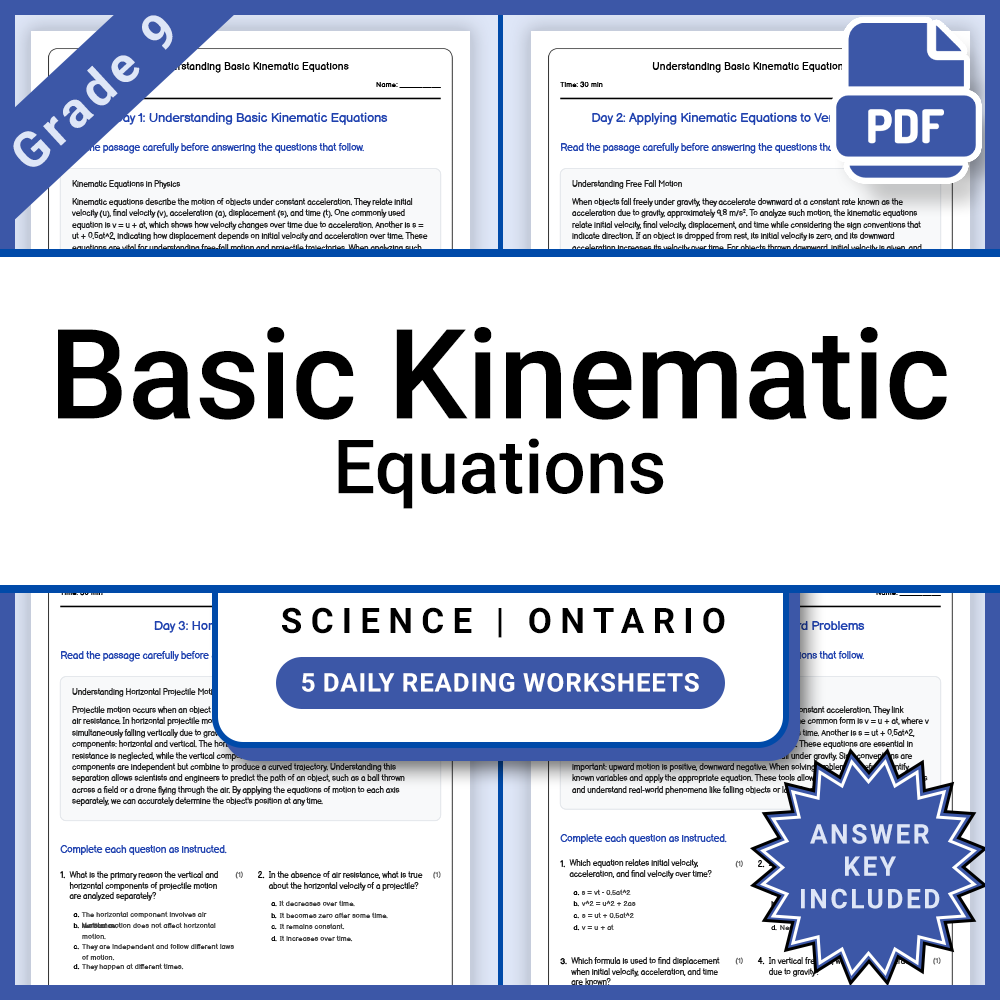
Grade 9 Science – Basic Kinematic Equations Daily Reading Worksheet + Answer Key
JCreated byJ.S SheetsLearning Objectives
- Interpret the fundamental kinematic equations linking displacement, velocity, acceleration, and time.
- Understand the physical meaning of variables u, v, s, a, and t in motion scenarios.
- Apply kinematic equations to different contexts such as free-fall and projectile motion.
Also included in: Grade 9 Science Lesson Group: Physics and Motion Worksheets Bundle +1 more
Instant download
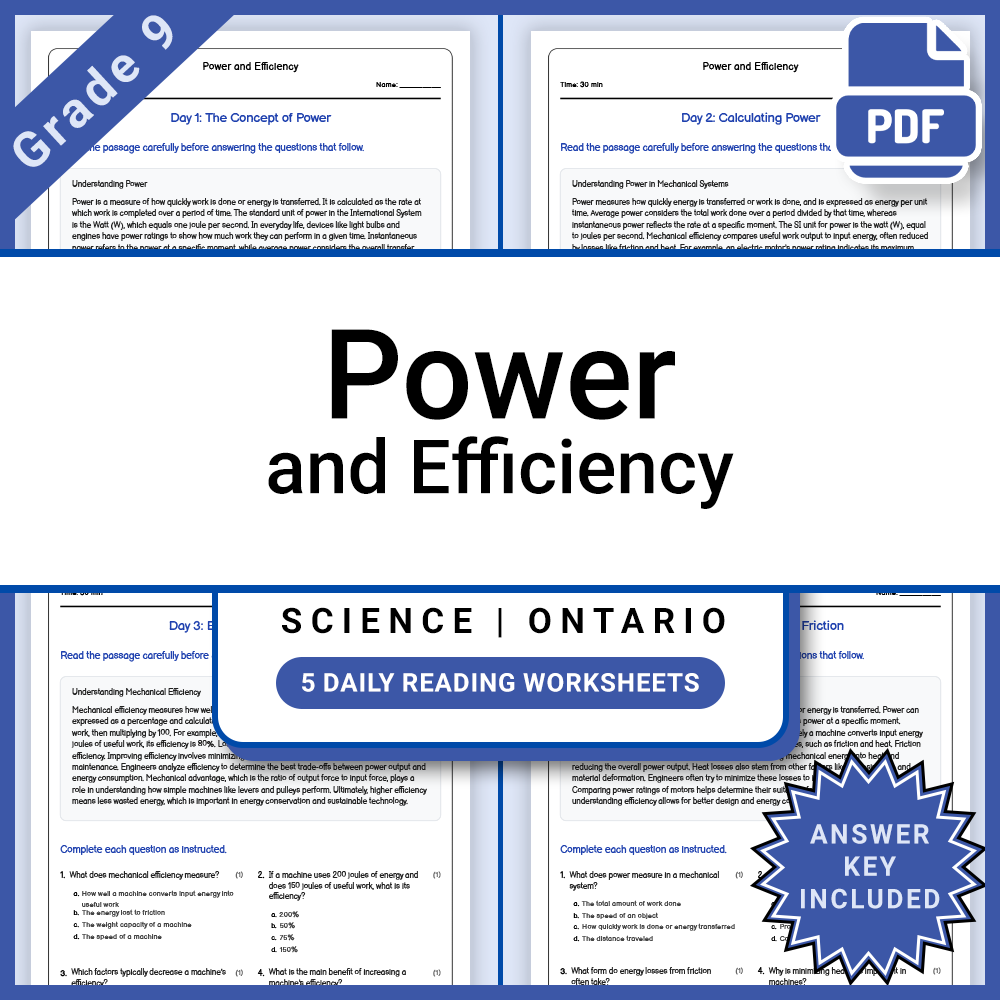
Grade 9 Science Power and Efficiency Daily Reading Worksheet + Answer Key
JCreated byJ.S SheetsLearning Objectives
- Understand the concept of power as the rate of energy transfer or work per unit time.
- Identify the units used to measure power, including Watts.
- Explain the difference between average and instantaneous power.
Also included in: Grade 9 Science Lesson Group: Physics and Motion Worksheets Bundle +1 more
Instant download
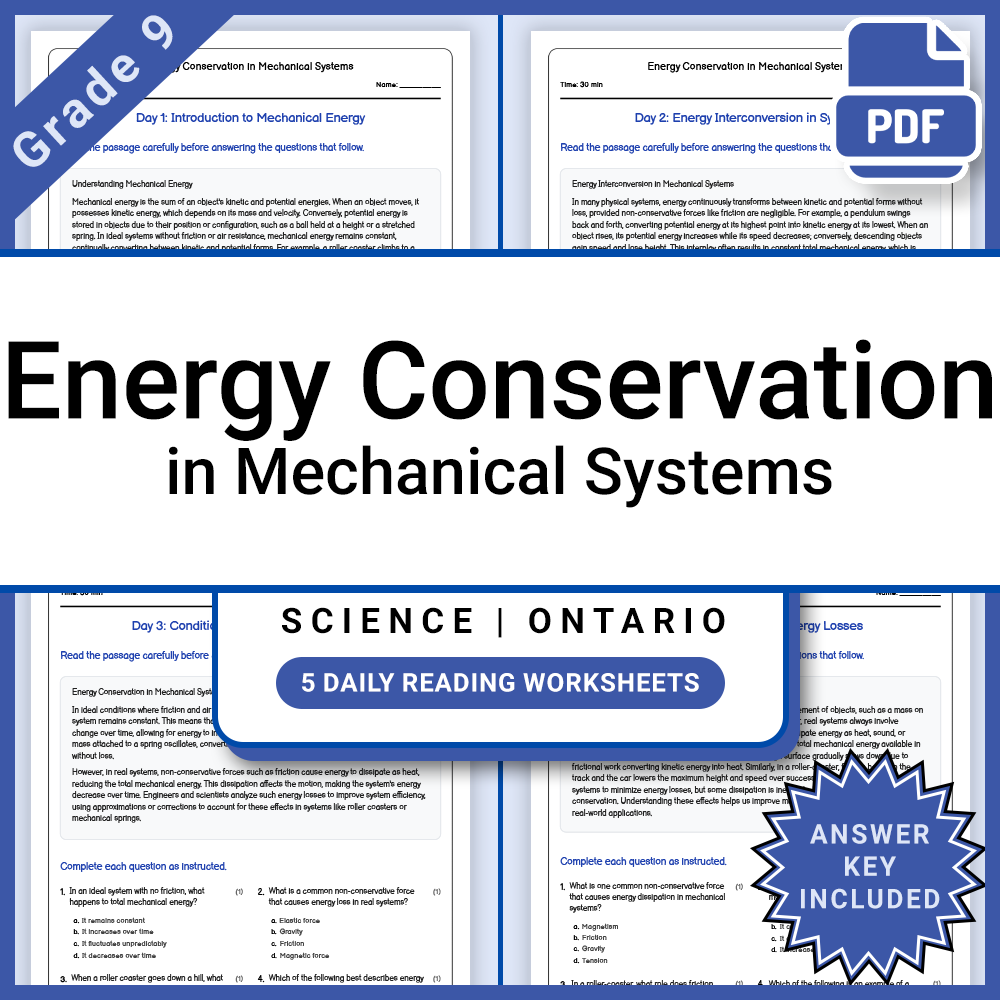
Grade 9 – Energy Conservation in Mechanical Systems Worksheet + Answer Key
JCreated byJ.S SheetsLearning Objectives
- Understand the concepts of kinetic and potential energy.
- Learn how energy transforms between kinetic and potential forms in systems.
- Recognize the impact of non-conservative forces like friction on energy conservation.
Also included in: Grade 9 Science Lesson Group: Physics and Motion Worksheets Bundle +1 more
Instant download
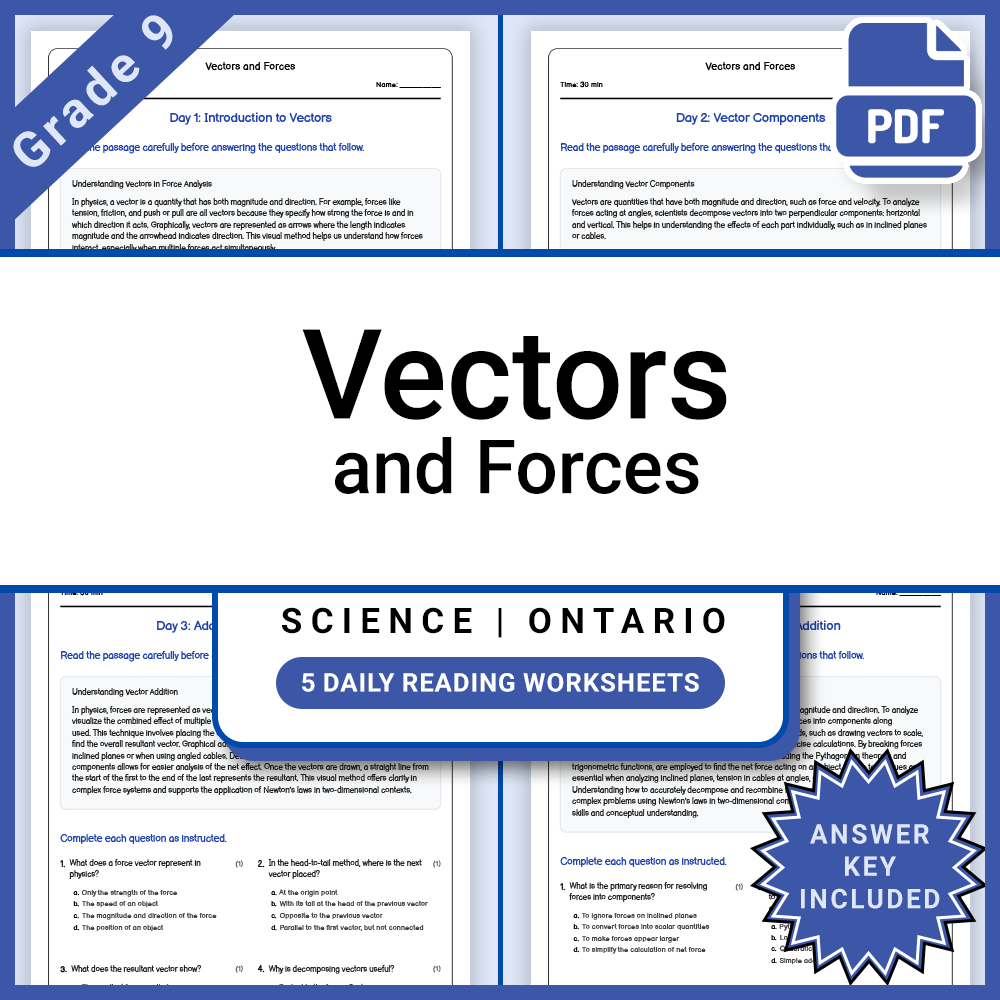
Grade 9 Science – Vectors and Forces Daily Reading Worksheet + Answer Key
JCreated byJ.S SheetsLearning Objectives
- Understand the concept of vectors as quantities with magnitude and direction
- Learn to represent forces graphically using vectors
- Resolve vectors into components along orthogonal axes
Also included in: Grade 9 Science Lesson Group: Physics and Motion Worksheets Bundle +1 more
Instant download
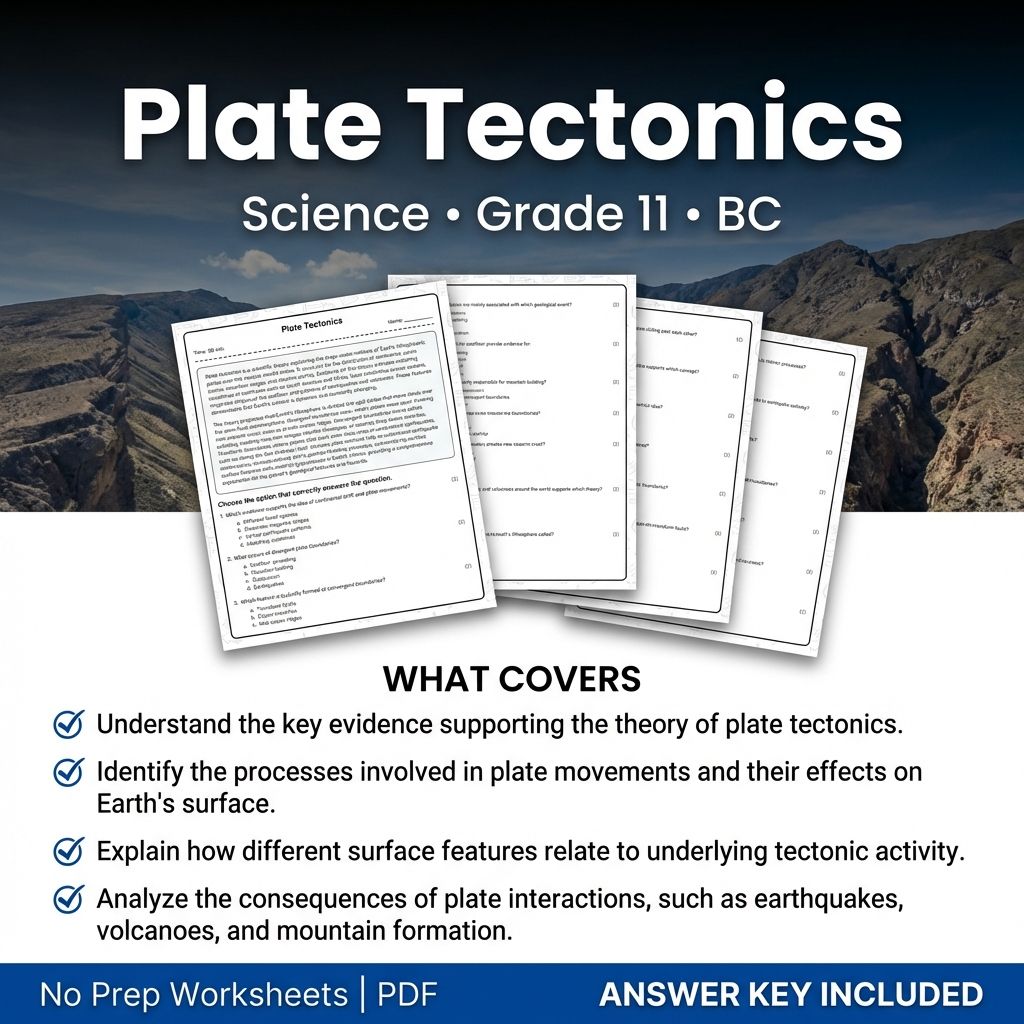
11th Grade Science | Plate Tectonics Worksheet & Answer Key PDF
 Created byCoral Reef Learning
Learning Objectives
- Understand the key evidence supporting the theory of plate tectonics.
- Identify the processes involved in plate movements and their effects on Earth's surface.
- Explain how different surface features relate to underlying tectonic activity.
Instant download
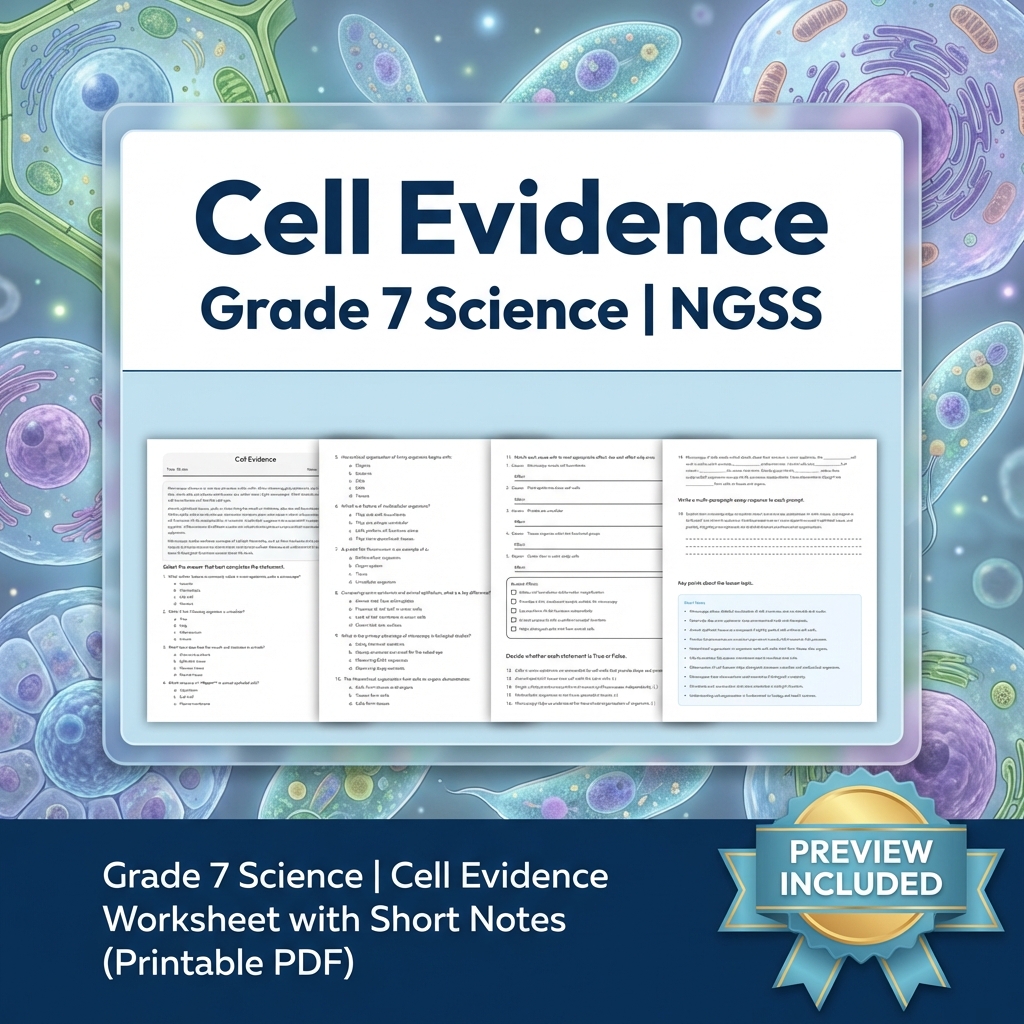
Grade 7 Science | Cell Evidence Worksheet with Short Notes (Printable PDF)
 Created byMeadowlark Worksheets
Learning Objectives
- Understand how microscopy reveals the structure of plant and animal cells.
- Identify and compare features of unicellular and multicellular organisms.
- Recognize cellular components such as cell walls, plasma membranes, and organelles.
Also included in: Grade 7 Science NGSS Unit Bundle Molecules to Organisms: Structures & Processes +1 more
Instant download

6th Grade Science – Design Problem Worksheet (General Standards) (PDF)
 Created byMaple Path Learning
Learning Objectives
- Understand the key components of a design problem, including needs and constraints.
- Learn how to generate solution ideas using sketches, measurements, and goals.
- Explore real-world examples of designing protective cases for fragile items.
Instant download
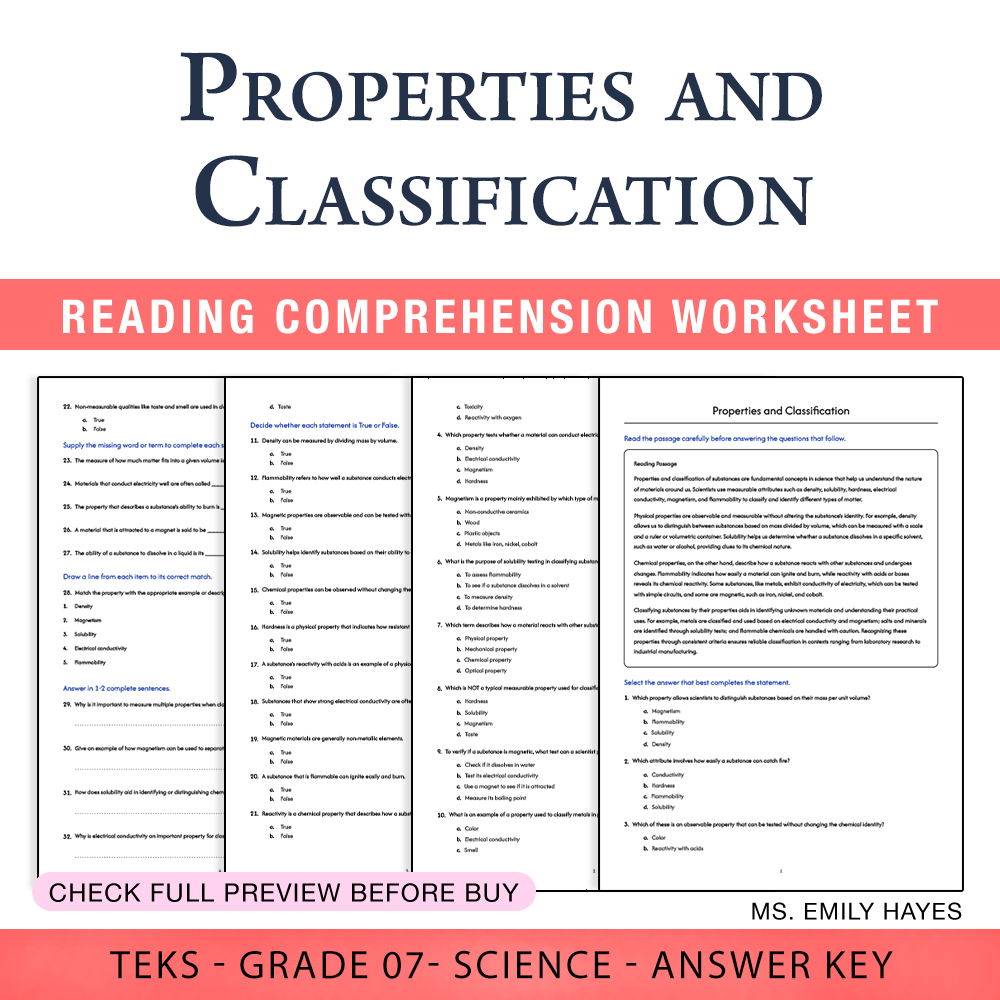
7th Grade Science | Properties and Classification Worksheet (PDF+ Answer Key)
Created byCopper Leaf ClassroomLearning Objectives
- Understand and define physical and chemical properties used to classify substances.
- Identify measurable attributes such as density, solubility, hardness, electrical conductivity, magnetism, and flammability.
- Apply observable and quantitative criteria to distinguish elements, compounds, and mixtures.
Instant download
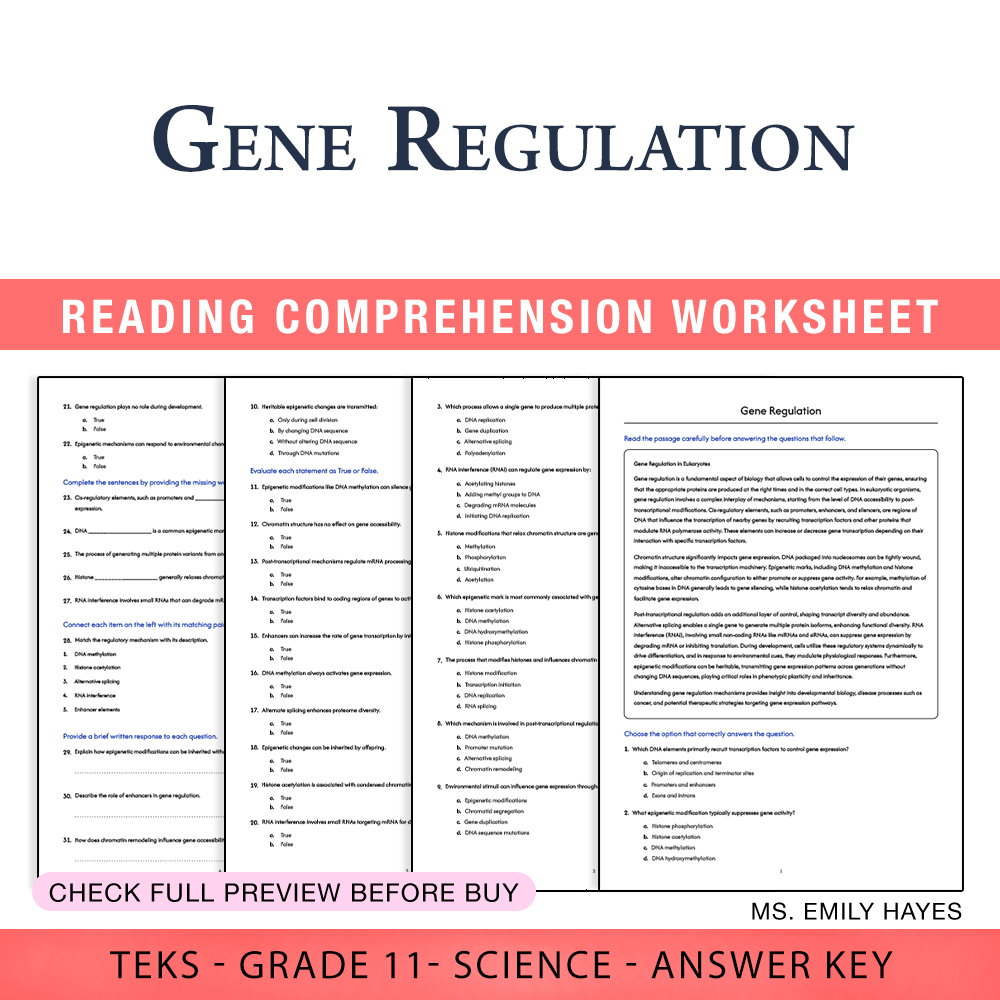
11th Grade Science | Gene Regulation Worksheet (PDF+ Answer Key)
Created byCopper Leaf ClassroomLearning Objectives
- Explain the mechanisms of gene regulation, including cis-regulatory elements and epigenetic modifications.
- Describe how chromatin structure influences gene expression.
- Analyze post-transcriptional regulation processes such as alternative splicing and RNA interference.
Instant download

Grade 9 Science | Vectors & Forces - Daily Reading Comprehension
Created byCoral Reef LearningLearning Objectives
- Understand the concept of vectors representing forces including magnitude and direction
- Learn to resolve forces into their components along orthogonal axes
- Calculate the resultant of multiple forces graphically and analytically
Instant download
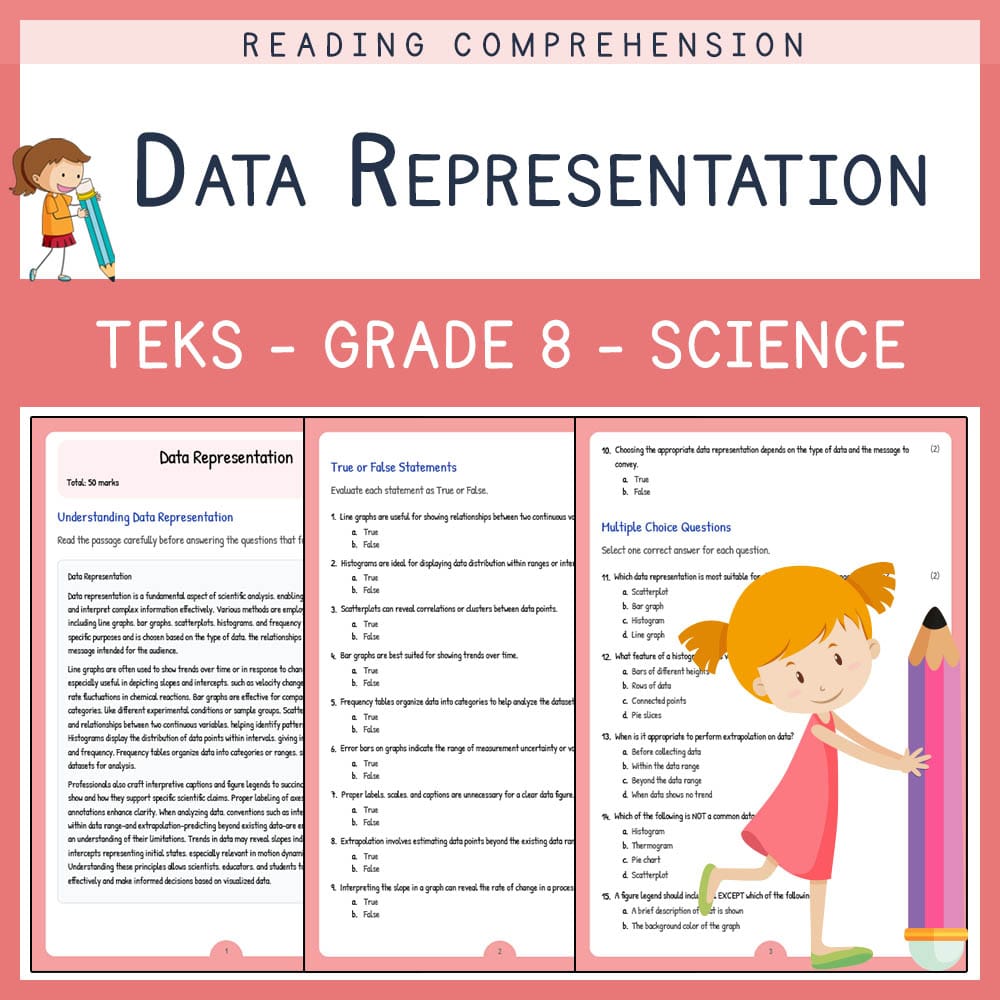
Grade 8 Science | Data Representation Worksheet | TEKS Aligned
 Created byLumora Learning
Learning Objectives
- Understand various graphical and tabular data representations such as line graphs, bar graphs, scatterplots, histograms, and frequency tables.
- Interpret data visualizations and identify trends, slopes, and intercepts in motion or chemical rate contexts.
- Create and analyze captions and figure legends that link data visualizations to scientific claims.
Also included in: Grade 8 Science | Science Concepts/Skills Lesson Bundle | TEKS Aligned
Instant download
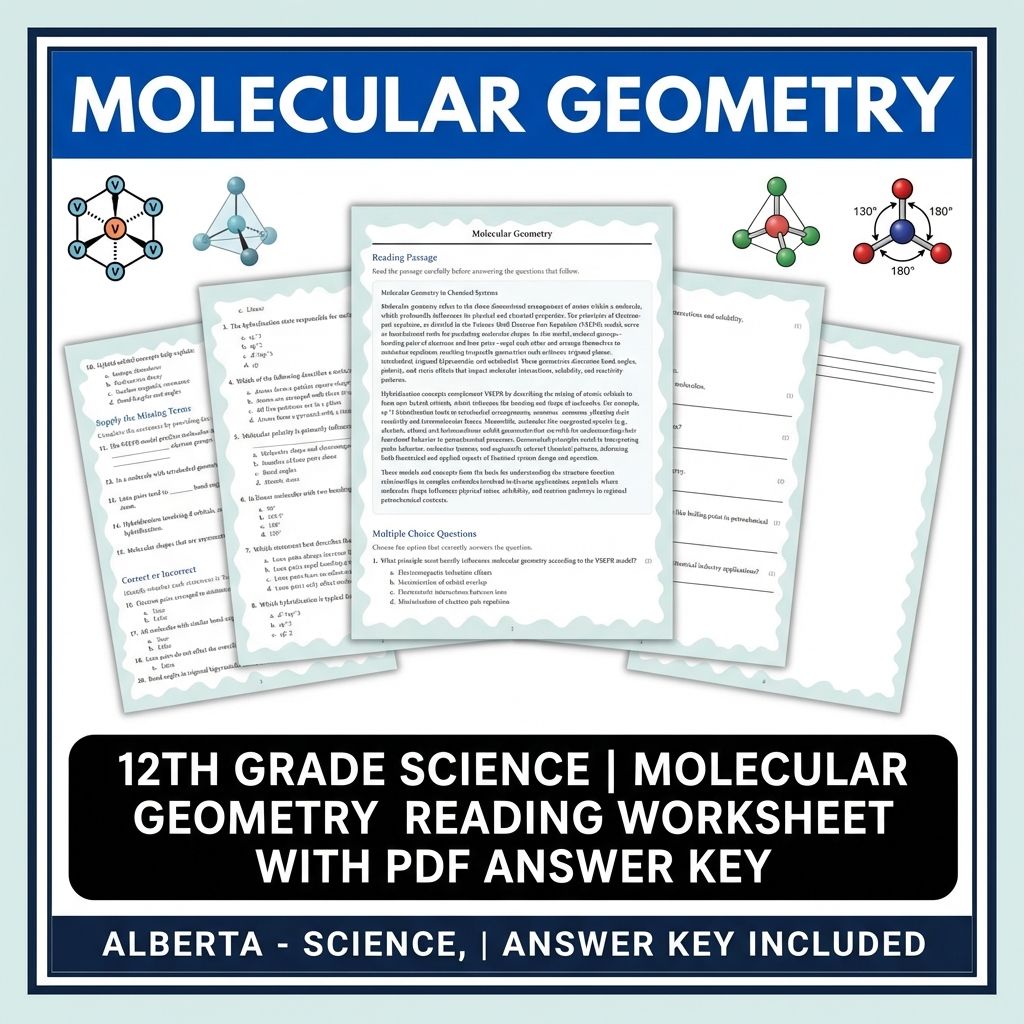
12th Grade Science | Molecular Geometry Reading Worksheet with PDF Answer Key
JCreated byJ.S SheetsLearning Objectives
- Explain the principles of electron-pair repulsion and how they determine molecular shape.
- Identify different molecular geometries based on electron domain and bond angles.
- Describe the impact of molecular geometry on physical properties and reactivity.
Also included in: Grade 12 Science | Atomic Spectra to Chemical Equilibria (PDF + Rubric) +1 more
Instant download

Gene Regulation Worksheet | Grade 11 Science Practice
 Created byPrism Point Learning
Learning Objectives
- Explain how cis-regulatory elements (promoters and enhancers) and transcription factors control gene expression timing and location.
- Describe how chromatin structure and epigenetic marks (DNA methylation and histone modifications) influence gene accessibility.
- Connect post-transcriptional mechanisms (alternative splicing and RNA interference) to changes in transcript abundance and protein output.
Also included in: Genetics & Molecular Biology Lesson Bundle | Grade 11 Science | TEKS
Instant download
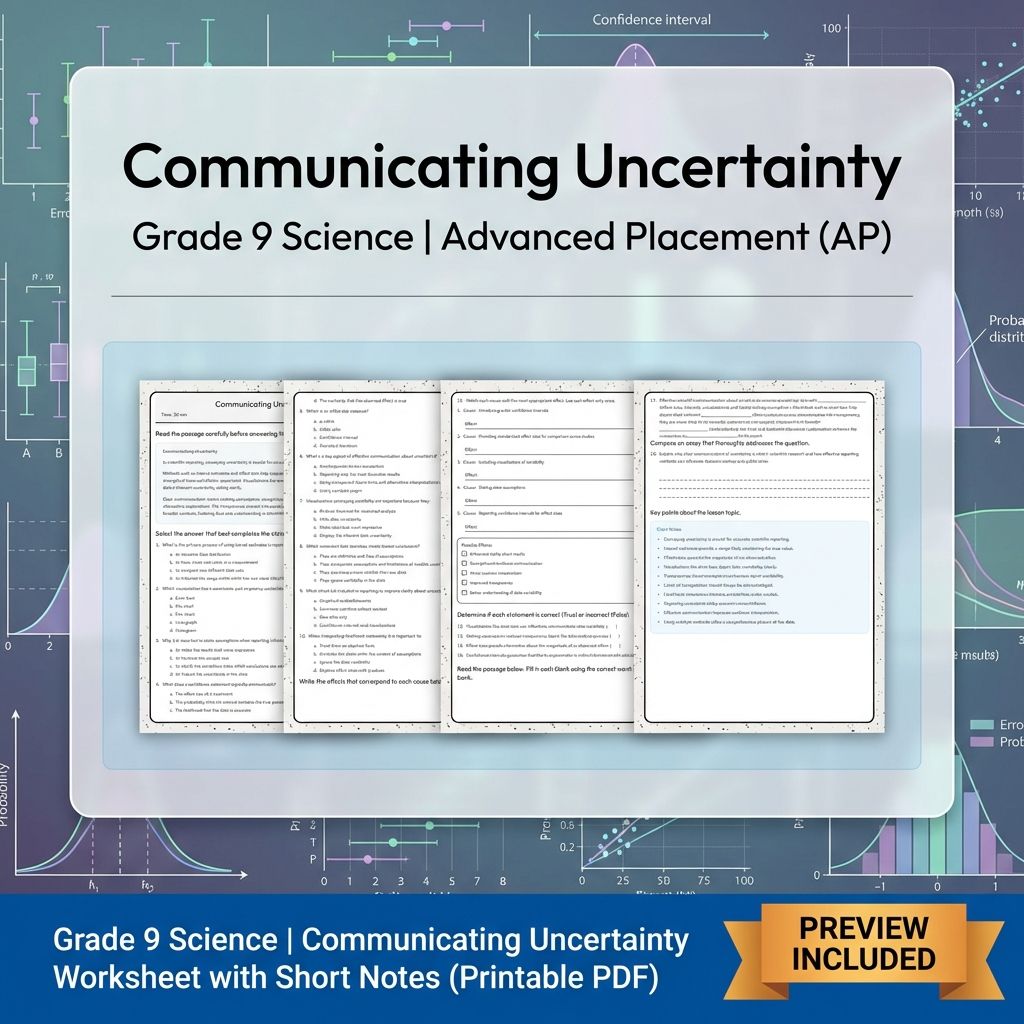
Grade 9 Science | Communicating Uncertainty Worksheet with Short Notes (PDF)
Created byMeadowlark WorksheetsLearning Objectives
- Understanding conventions for conveying quantitative uncertainty and confidence in inferential claims.
- Identifying different methods such as interval estimates, effect sizes, and likelihood statements.
- Recognizing the importance of clarity about assumptions, limits, and interpretations when reporting results.
Also included in: Grade 9 Science | Critical Thinking & Data Analysis Unit Bundle (Worksheets) +1 more
Instant download
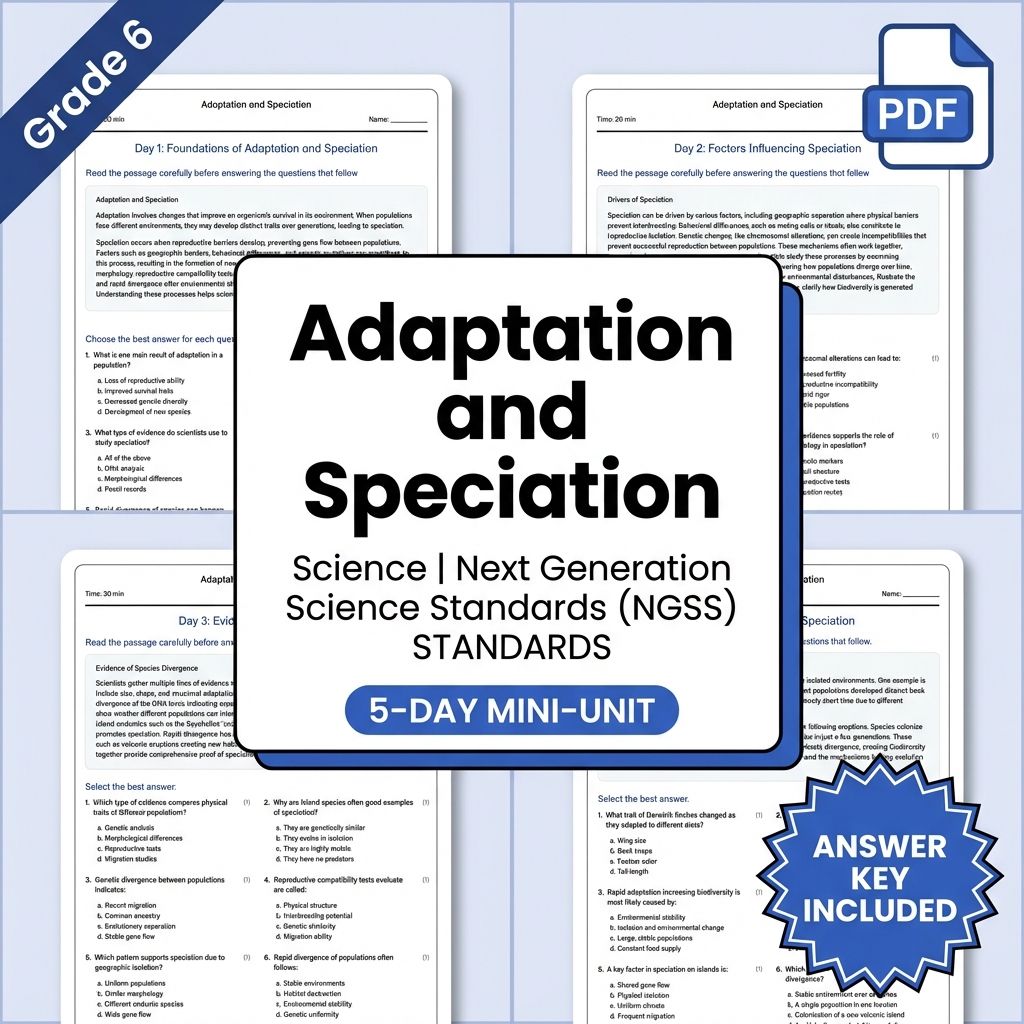
6th Grade Science | Adaptation and Speciation Daily Worksheet (PDF + Answer Key)
Created byCopper Leaf ClassroomLearning Objectives
- Understand the processes of adaptation and how they lead to species divergence.
- Identify the factors contributing to speciation, including geographic and genetic changes.
- Recognize evidence used by scientists to study speciation events.
Instant download

6th Grade Science Worksheet – Climate Data Patterns (PDF)
Created byMaple Path LearningLearning Objectives
- Understand how climate data is collected and organized over long periods.
- Interpret graphs of temperature and precipitation to identify patterns.
- Compare current climate data with historical baselines to detect shifts.
Instant download
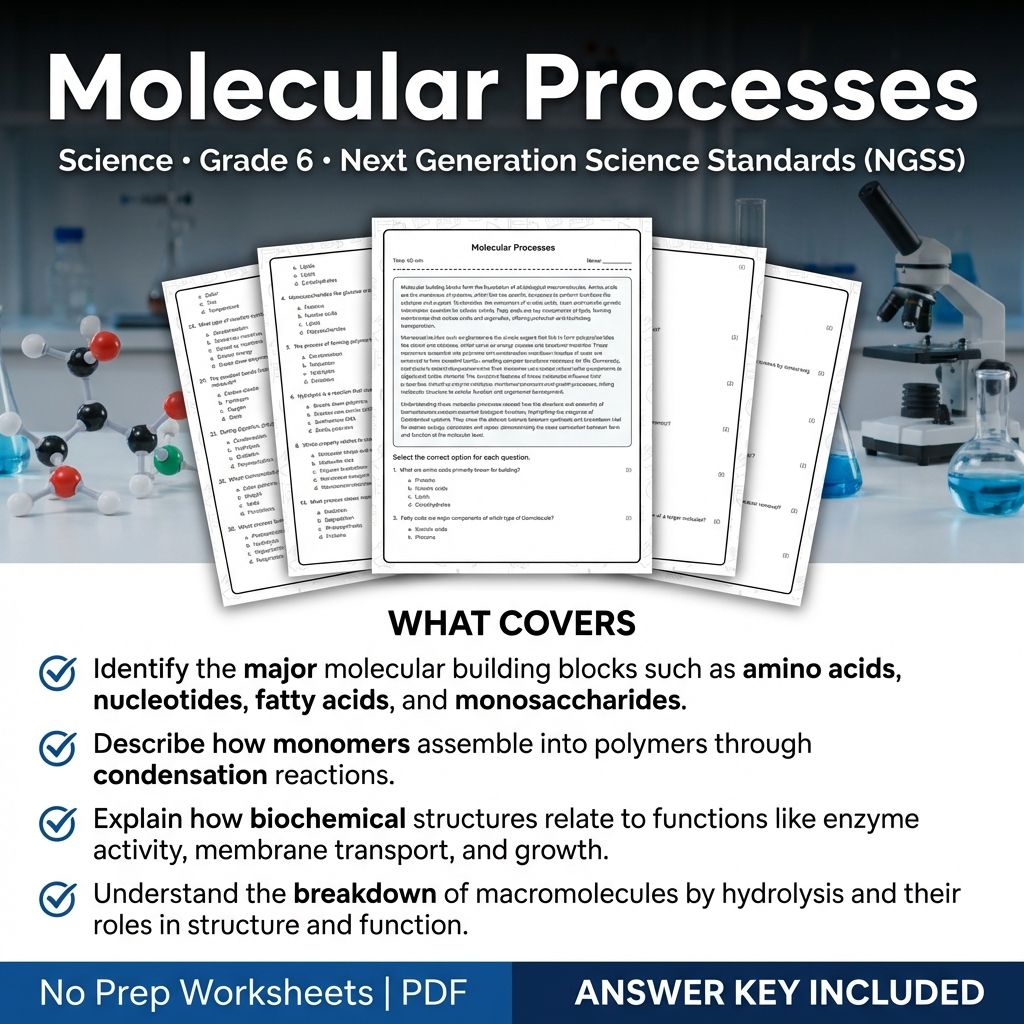
6th Grade Science Worksheet | Molecular Processes NGSS Practice & Review (Printable PDF & Answer Key)
Created byCoral Reef LearningLearning Objectives
- Identify the major molecular building blocks such as amino acids, nucleotides, fatty acids, and monosaccharides.
- Describe how monomers assemble into polymers through condensation reactions.
- Explain how biochemical structures relate to functions like enzyme activity, membrane transport, and growth.
Instant download
6th Grade Science | Producers and Consumers Reading Worksheet (PDF + Answer Key)
JCreated byJ.S SheetsLearning Objectives
- Understand the roles of producers and consumers in ecosystems.
- Identify different types of consumers and their position in food webs.
- Explain how energy transfer efficiency influences population sizes and ecosystem stability.
Instant download
9th Grade Science | Cell Components Worksheet (PDF + Answer Key)
Created byCopper Leaf ClassroomLearning Objectives
- Describe the major organelles of eukaryotic cells and their functions.
- Explain how structural features like membrane folding and compartmentalization influence metabolic rates and exchange across cell boundaries.
- Relate the morphology of cell components to their roles in cellular processes.
Instant download

6th Grade Science | Mass and Density Reading Worksheet (PDF + Rubric)
JCreated byJ.S SheetsLearning Objectives
- Understand the concepts of mass and volume and how they relate through density.
- Learn how to calculate density using sample measurements.
- Interpret density values to distinguish between objects that sink or float.
Instant download
9th Grade Science | Resource Impacts Worksheet (PDF + Answer Key)
Created byCopper Leaf ClassroomLearning Objectives
- Analyze how resource extraction affects ecosystems, landforms, and material cycles.
- Evaluate criteria for sustainability, including resource renewability and environmental trade-offs.
- Understand the environmental effects of mineral mining, fossil fuel extraction, and water withdrawal.
Instant download
8th Grade Science | Conservation Laws Reading Worksheets (Answer Key)
JCreated byJ.S SheetsLearning Objectives
- Understand the principle of conservation of matter and energy during phase changes and chemical reactions.
- Explain how mass remains constant despite transformations.
- Describe energy conservation in processes such as freezing and sublimation.
Instant download
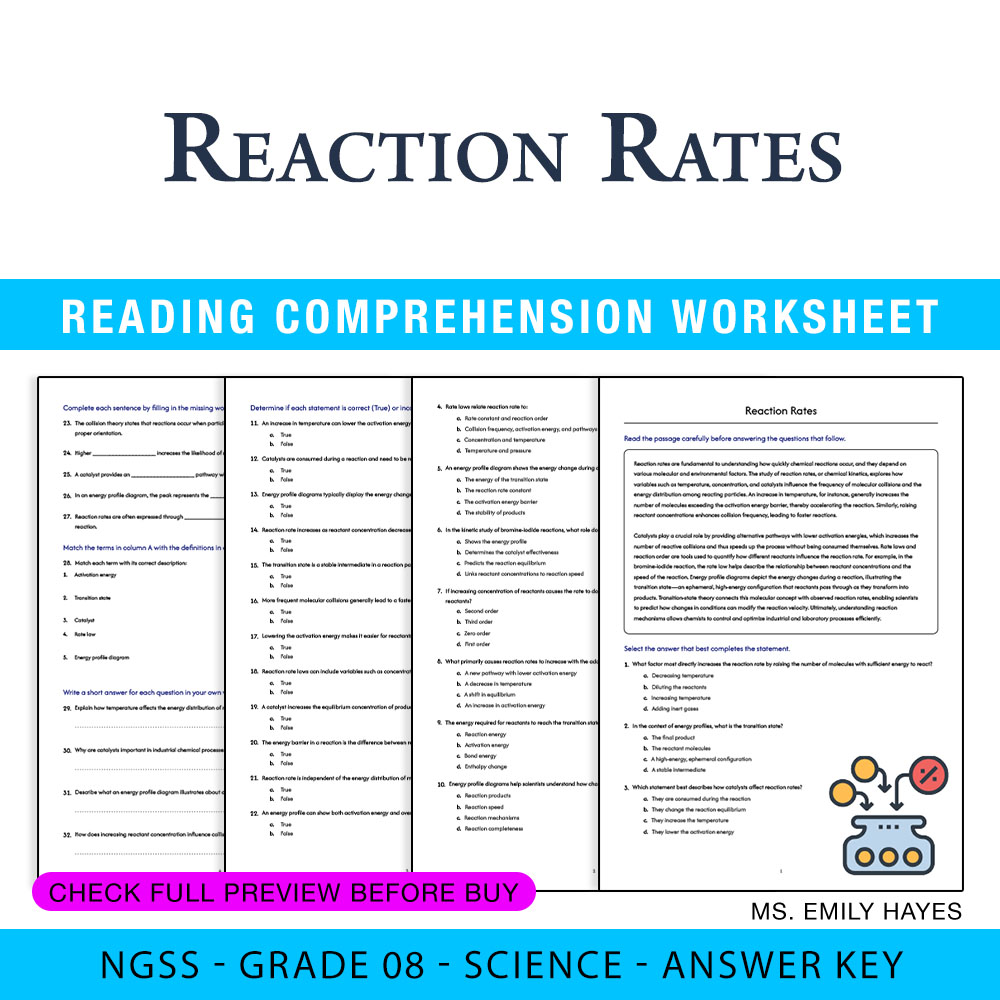
9th Grade Science | Reaction Rates Worksheet (PDF+ Answer Key)
Created byCopper Leaf ClassroomLearning Objectives
- Explain how temperature, concentration, and catalysts affect reaction rates.
- Describe the relationship between collision frequency and reaction speed.
- Interpret rate laws and reaction order in chemical kinetics.
Instant download

Grade 9 Genetic Drift Daily Reading Worksheet | TEKS Science Biology
Created byBRIGHT PATH RESOURCESLearning Objectives
- Explain genetic drift as a random change in allele frequencies.
- Identify key vocabulary including allele and frequency.
- Describe how small populations and chance events can cause allele loss or fixation.
Also included in: Grade 9 Evolution and Classification Biology Reading Worksheets Bundle | TEKS +1 more
Instant download

Grade 12 Science | Momentum Conservation Worksheet Elena | AP Aligned
Created byLumora LearningLearning Objectives
- Define linear momentum and impulse as conserved quantities in isolated systems.
- Explain momentum conservation in elastic and inelastic collisions using algebraic and vector models.
- Relate pre- and post-collision velocities through impulse–momentum relations.
Instant download

Grade 12 Science | Rotational Dynamics Worksheet Elena | AP Aligned
Created byLumora LearningLearning Objectives
- Understand the rotational analogs of linear quantities such as torque, moment of inertia, and angular momentum.
- Develop equations linking net torque to angular acceleration for rigid bodies.
- Analyze energy transfer between translational and rotational modes in rolling and compound systems.
Instant download
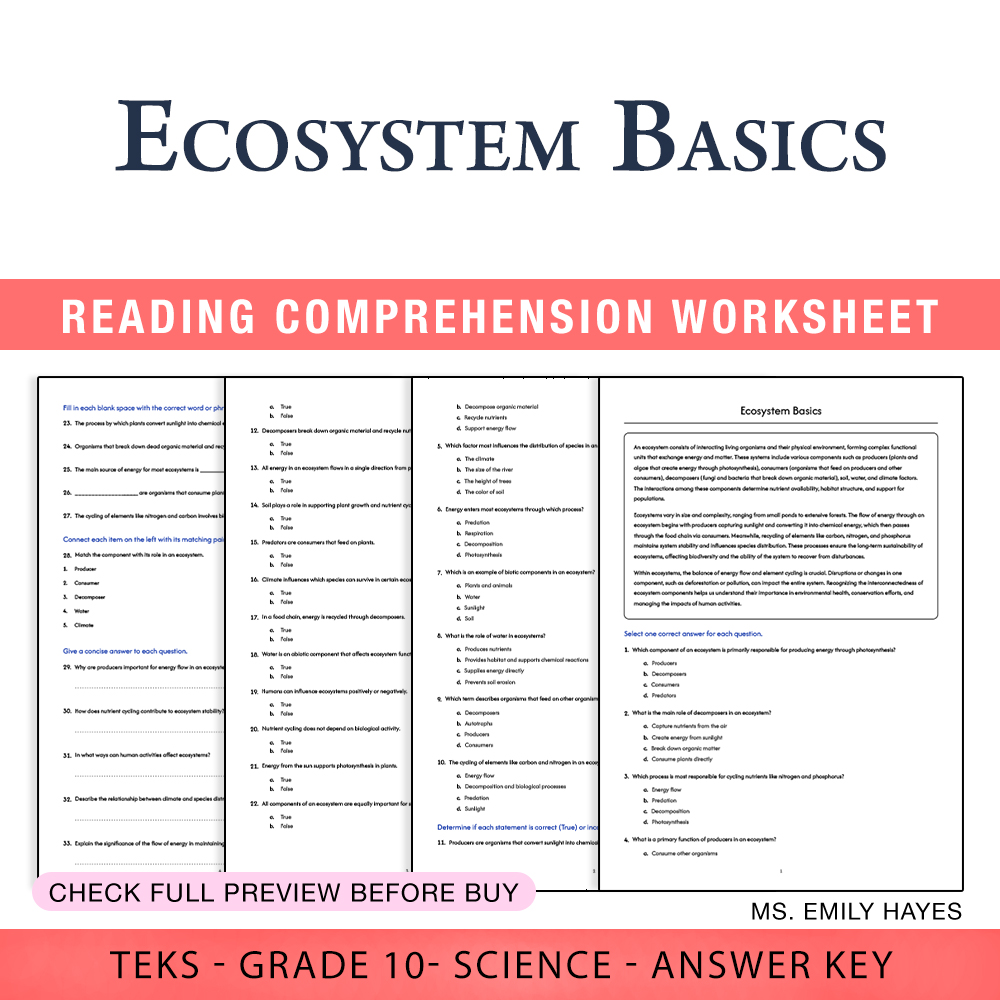
10th Grade Science | Ecosystem Basics Worksheet (PDF+ Answer Key)
Created byCopper Leaf ClassroomLearning Objectives
- Define and describe the components of an ecosystem.
- Explain the interactions among producers, consumers, decomposers, and the environment.
- Identify the flow of energy and cycling of elements within different ecosystems.
Instant download
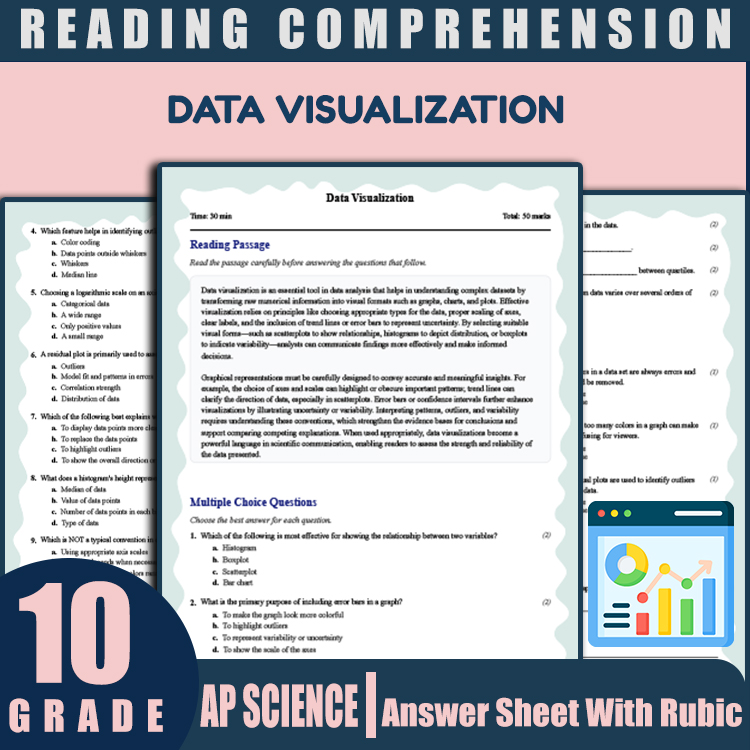
Grade 10 Science | Data Visualization Reading Worksheet (PDF + Rubric)
JCreated byJ.S SheetsLearning Objectives
- Understand principles and conventions of graphical and tabular data representation.
- Identify different types of data visualizations such as scatterplots, histograms, and boxplots.
- Interpret data patterns, variability, outliers, and assess the strength of evidence from visualizations.
Also included in: Grade 10 Science Unit Worksheet Pack – Data Analysis & Scientific Reasoning +1 more
Instant download

Speed Calculations Worksheet | Grade 7 Science Practice
Created byPrism Point LearningLearning Objectives
- Calculate average speed using distance and time, with correct units
- Convert between meters per second (m/s) and kilometers per hour (km/h)
- Distinguish average speed from instantaneous speed using numerical examples
Also included in: Grade 7 Motion, Forces & Energy Science Lesson Bundle for TEKS Practice
Instant download
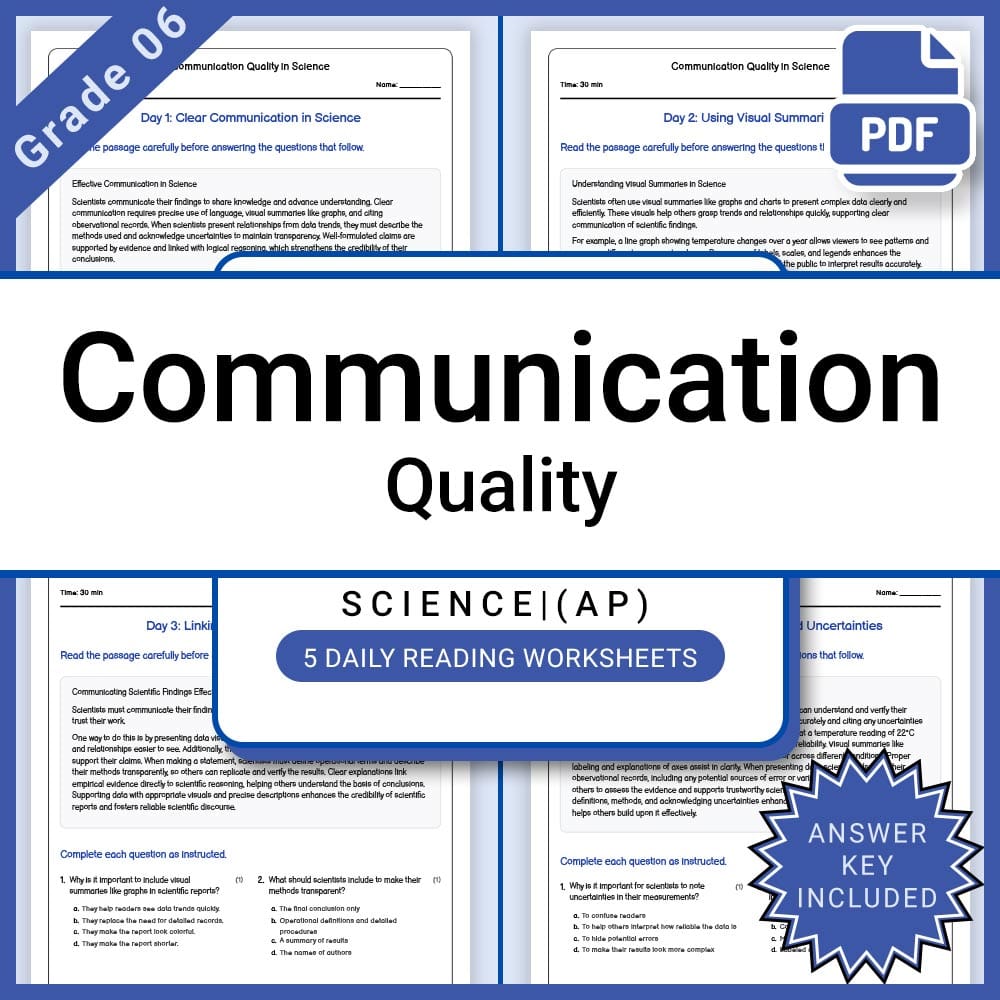
Grade 6 Science – Communication Quality Daily Reading Worksheet + Answer Key
JCreated byJ.S SheetsLearning Objectives
- Understand how to formulate clear scientific claims supported by evidence.
- Learn the importance of visual summaries and proper citation of observations.
- Develop skills to present scientific data transparently and coherently.
Also included in: Grade 6 Science Lesson Group Bundle TEKS Standards +1 more
Instant download
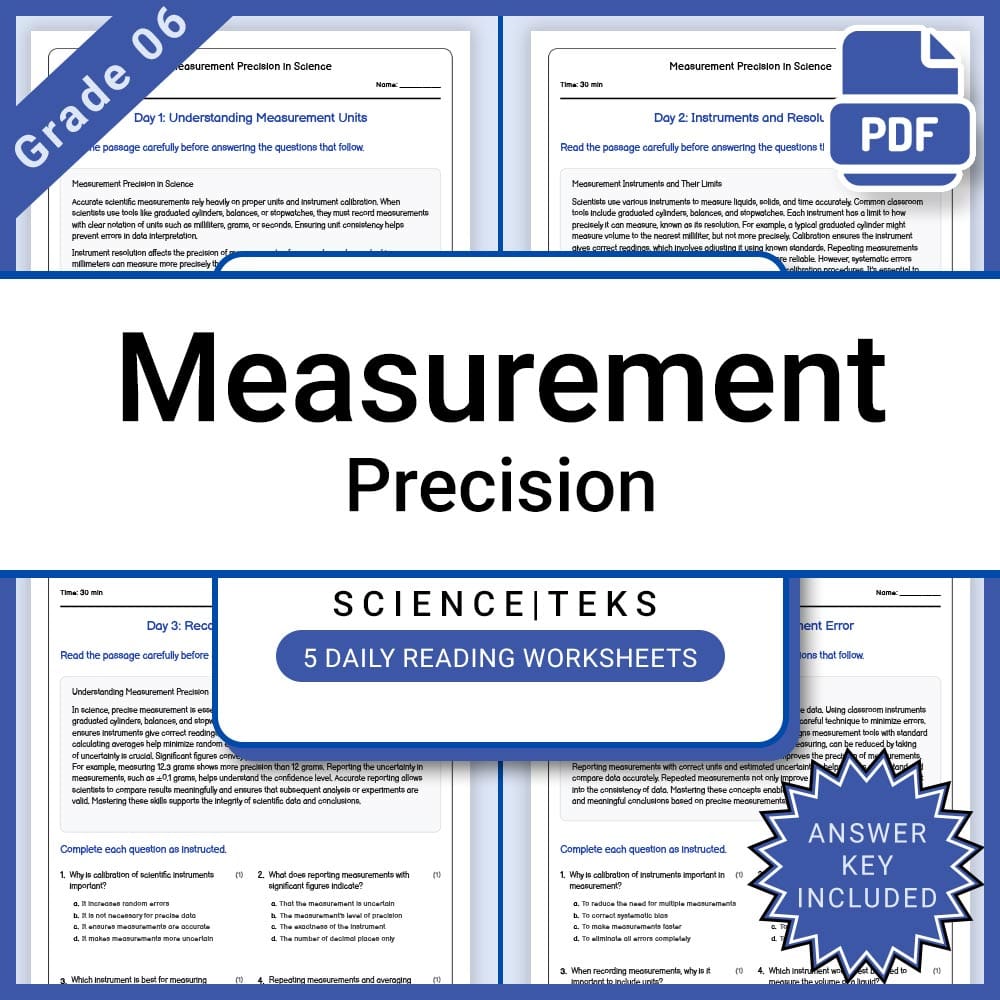
Grade 6 Science – Measurement Precision Daily Reading Worksheet with Answer Key
JCreated byJ.S SheetsLearning Objectives
- Understand the conventions of measurement units in scientific experiments
- Learn how to maintain unit consistency in data collection
- Recognize instrument resolution and its impact on measurement accuracy
Also included in: Grade 6 Science Lesson Group Bundle TEKS Standards +1 more
Instant download
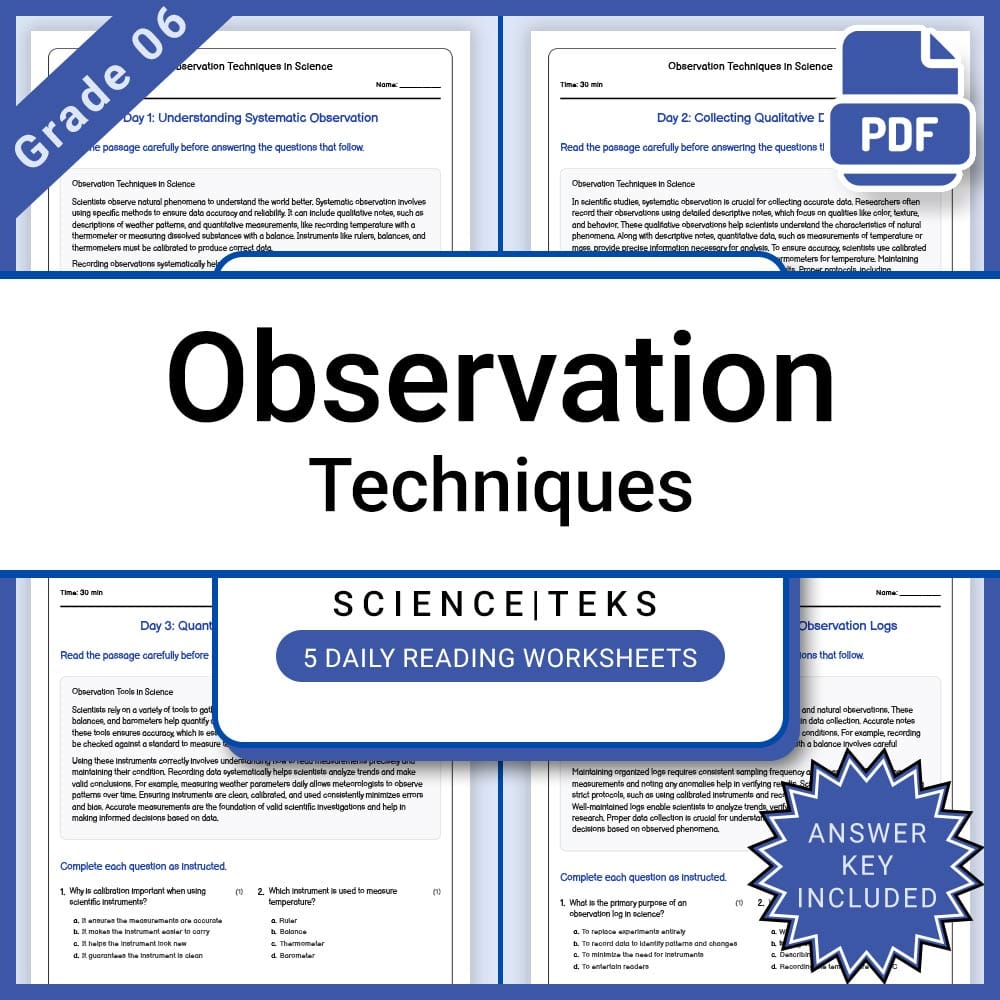
Grade 6 Science Observation Techniques Daily Reading Worksheet with Answer Key
JCreated byJ.S SheetsLearning Objectives
- Understand the concept of systematic observation in scientific studies.
- Differentiate between qualitative notes and quantitative measurements.
- Identify common instruments used in scientific observation such as rulers, balances, and thermometers.
Also included in: Grade 6 Science Lesson Group Bundle TEKS Standards +1 more
Instant download
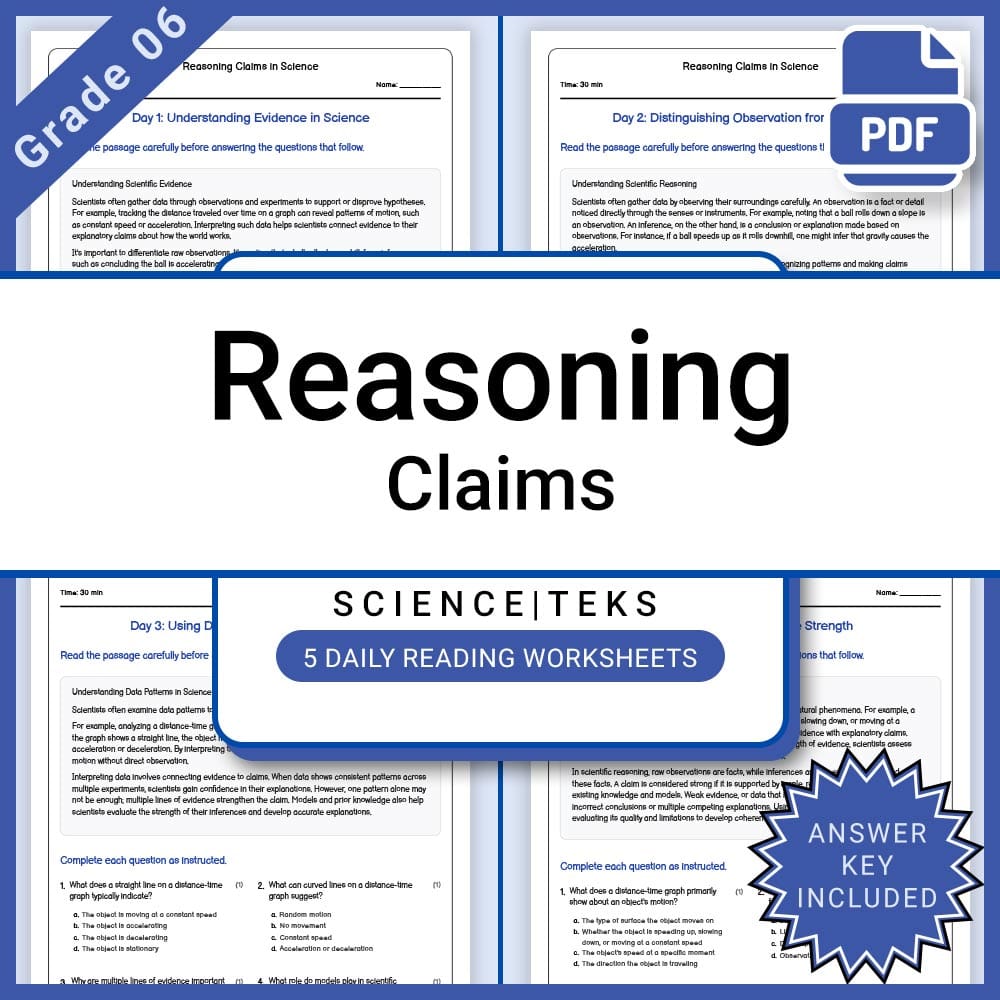
Grade 6 Science – Reasoning Claims Daily Reading Worksheet with Answer Key
JCreated byJ.S SheetsLearning Objectives
- Understand how scientific evidence supports explanatory claims.
- Interpret patterns and data in scientific contexts like graphs.
- Distinguish between raw observations and inferences.
Also included in: Grade 6 Science Lesson Group Bundle TEKS Standards +1 more
Instant download
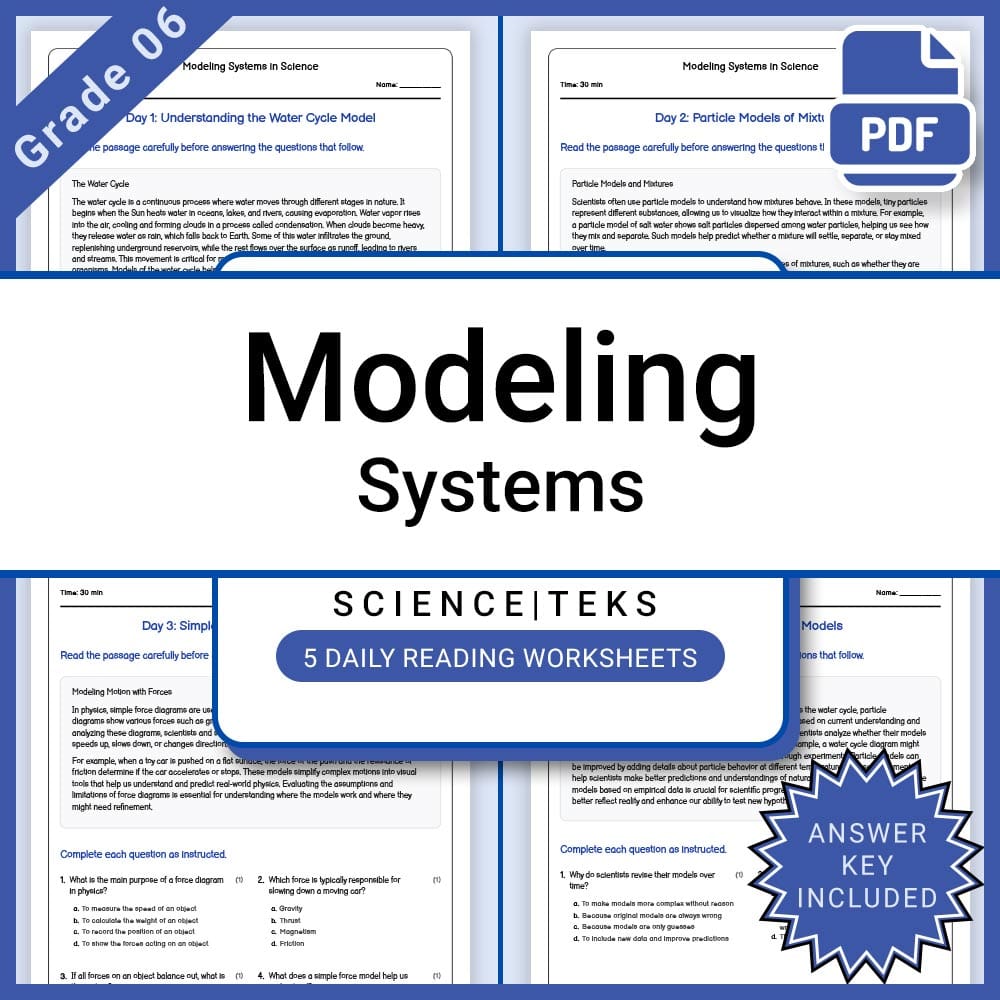
Grade 6 Science – Modeling Systems Daily Reading Worksheet + Answer Key
JCreated byJ.S SheetsLearning Objectives
- Understand how the water cycle model illustrates natural processes
- Interpret diagrams and models used in science to represent systems
- Identify the assumptions and limitations of different scientific models
Also included in: Grade 6 Science Lesson Group Bundle TEKS Standards +1 more
Instant download
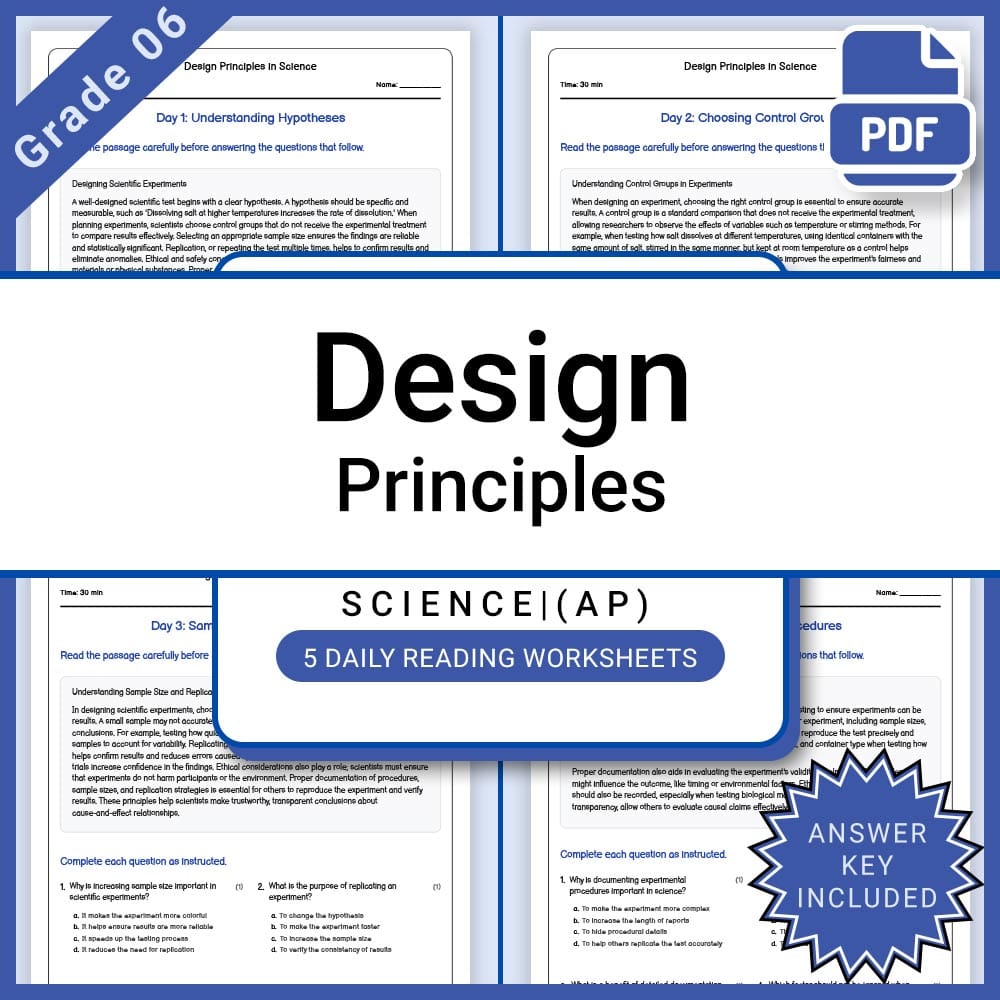
Grade 6 Science – Design Principles Daily Reading Worksheet + Answer Key
JCreated byJ.S SheetsLearning Objectives
- Understand the importance of formulating clear, measurable hypotheses.
- Identify appropriate control groups in experiments.
- Recognize how sample size and replication affect experimental validity.
Also included in: Grade 6 Science Lesson Group Bundle TEKS Standards +1 more
Instant download
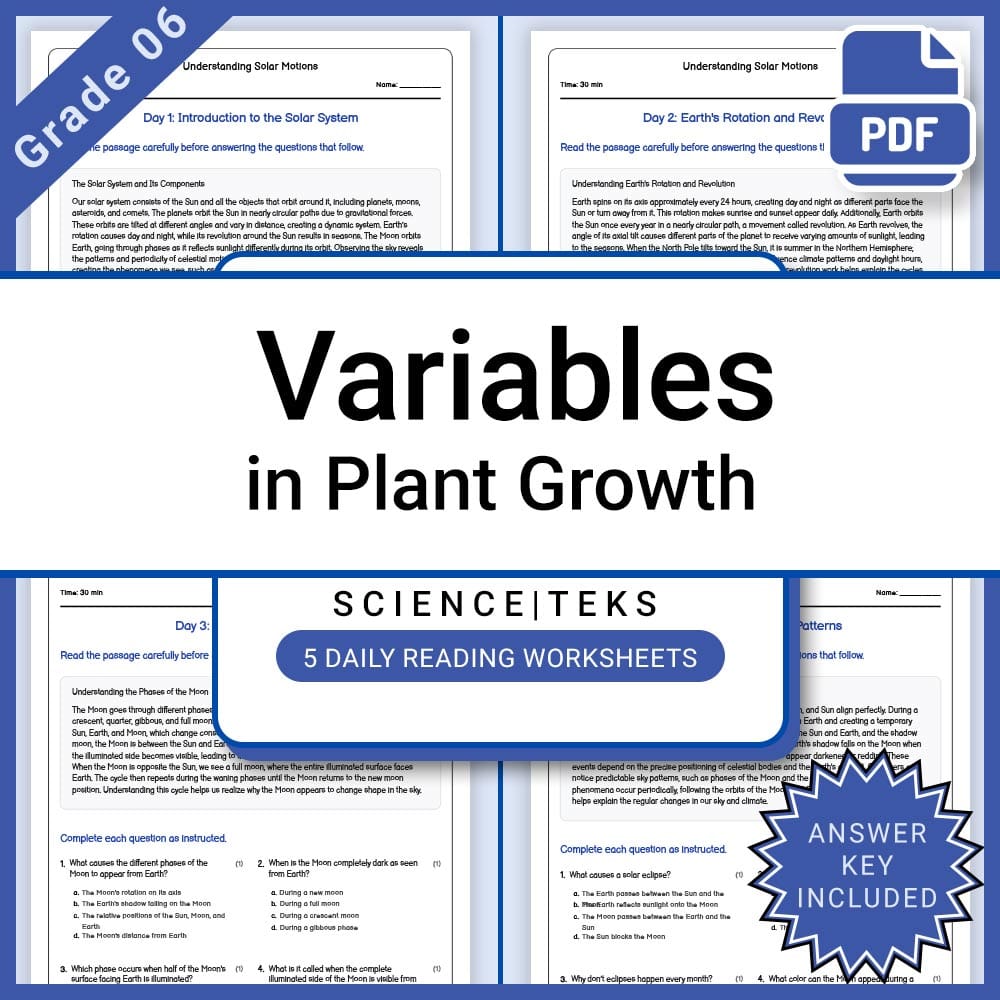
Grade 6 Science – Variables in Plant Growth Daily Reading Worksheet + Answer Key
JCreated byJ.S SheetsLearning Objectives
- Identify independent, dependent, and controlled variables in a scientific experiment.
- Understand the importance of operational definitions in controlled testing.
- Recognize potential confounding variables and how to control them.
Also included in: Grade 6 Science Lesson Group Bundle TEKS Standards +1 more
Instant download
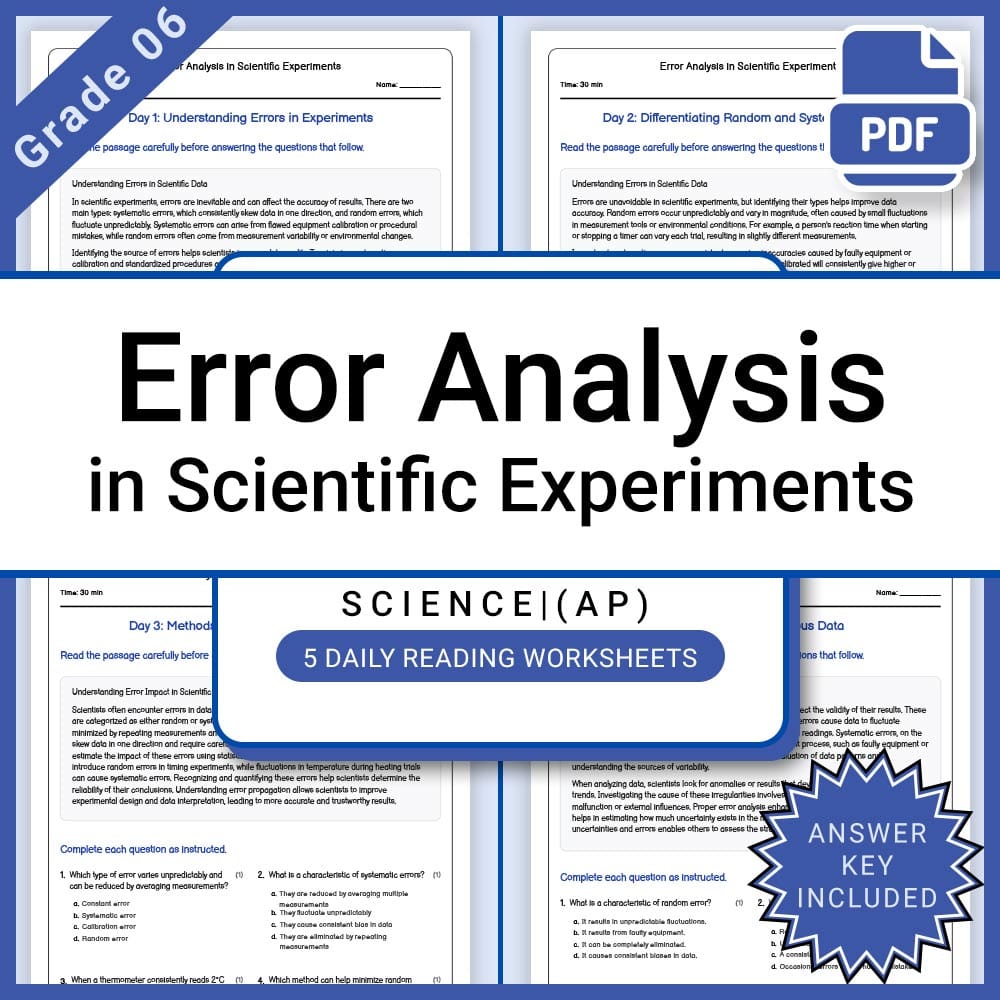
Grade 6 – Error Analysis in Scientific Experiments Worksheet with Answer Key
JCreated byJ.S SheetsLearning Objectives
- Understand the distinction between systematic and random errors.
- Identify common sources of error in experimental data.
- Learn methods to estimate and account for errors in measurements.
Also included in: Grade 6 Science Lesson Group Bundle TEKS Standards +1 more
Instant download
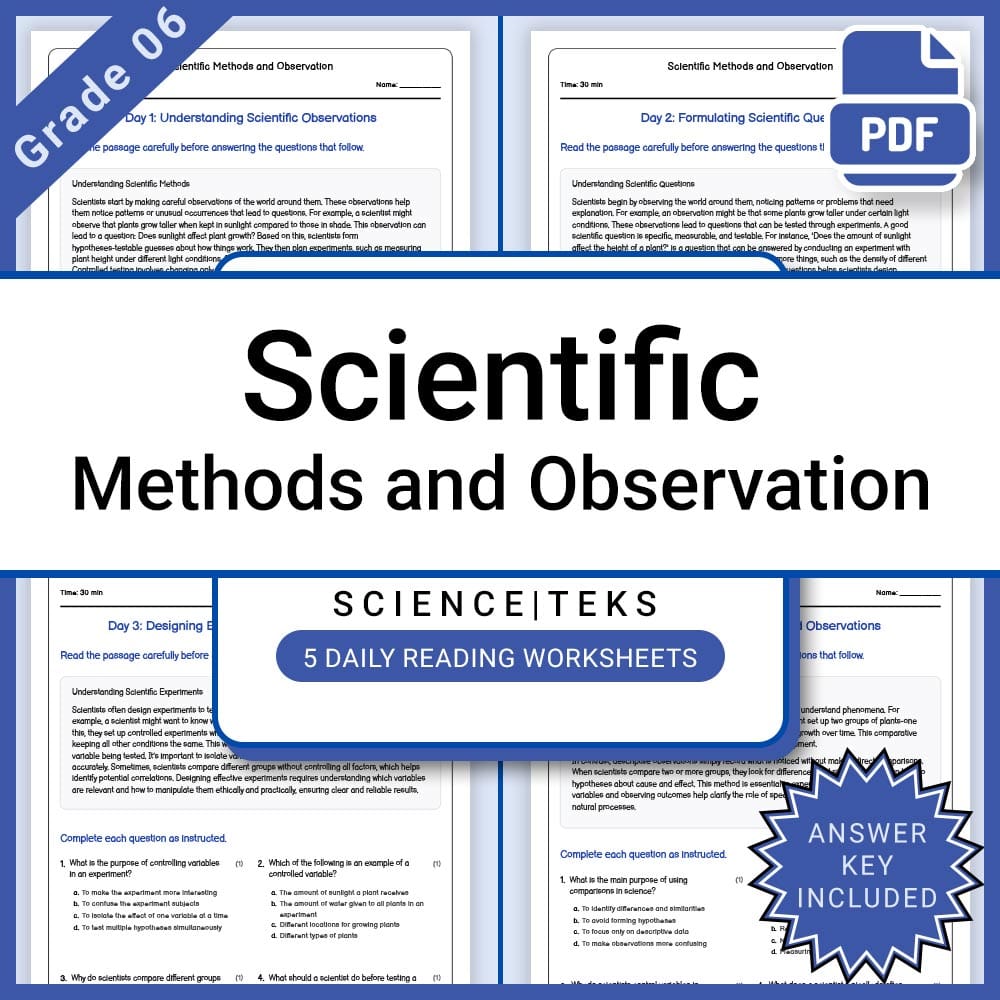
Grade 6 Science – Scientific Methods and Observation Worksheet + Answer Key
JCreated byJ.S SheetsLearning Objectives
- Differentiate between observation and hypothesis in scientific investigations.
- Understand the role of prior observation in forming testable questions.
- Learn how to select appropriate methods like controlled testing and comparative observation based on phenomena.
Also included in: Grade 6 Science Lesson Group Bundle TEKS Standards +1 more
Instant download

Classification Foundations Worksheet for Grade 9 Science | TEKS Aligned
JCreated byJ.S SheetsLearning Objectives
- Describe the purpose of biological classification and how it supports communication about biodiversity
- Explain how traditional taxonomic ranks and binomial nomenclature help organize organisms
- Compare traditional classification with modern approaches that use evolutionary relationships and clades
Instant download

Data Representation Worksheet | TEKS Aligned Grade 6 Science Practice
JCreated byJ.S SheetsLearning Objectives
- Identify how tables and graphs (line, bar, and scatter) represent data and reveal patterns
- Select appropriate axis labels, units, and scales to make graphs accurate and readable
- Interpret trends, relationships, central tendency summaries, and outliers in data displays
Instant download
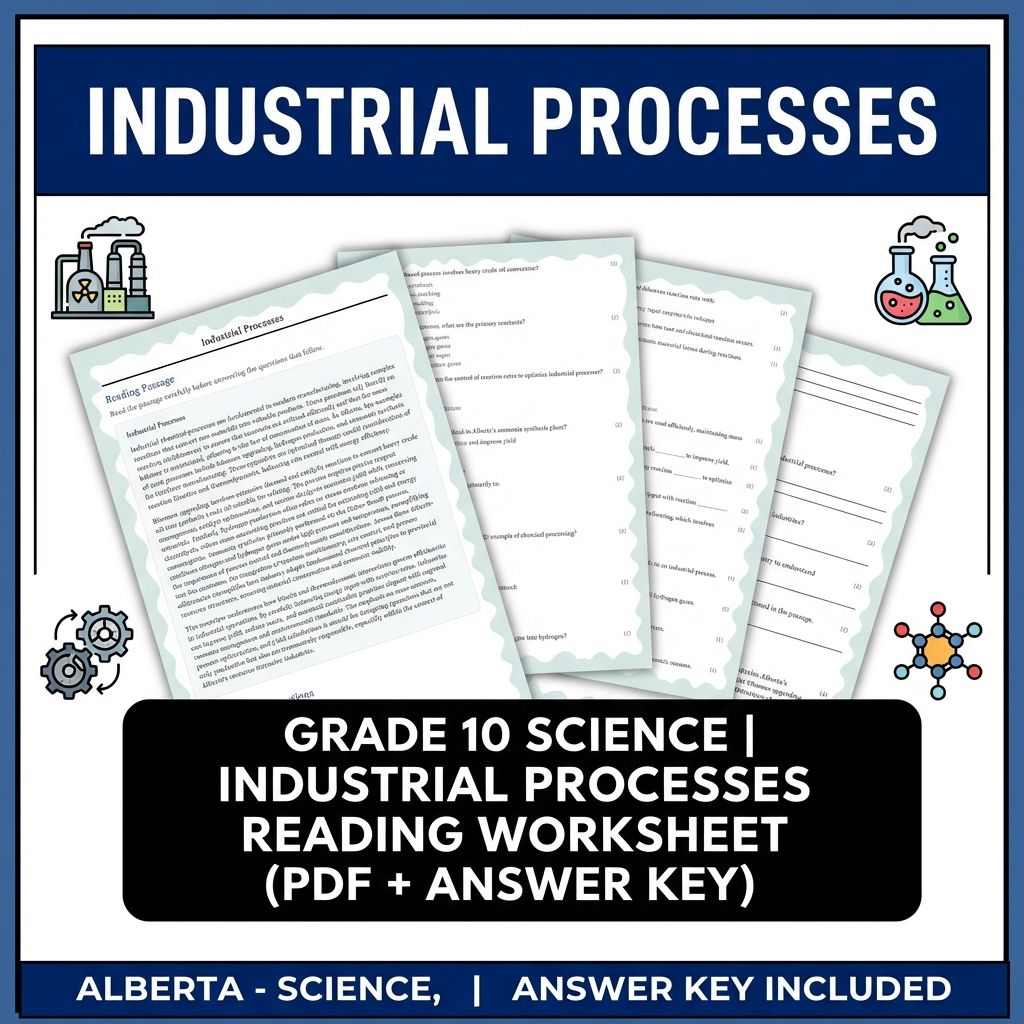
Grade 10 Science | Industrial Processes Reading Worksheet (PDF + Answer Key)
JCreated byJ.S SheetsLearning Objectives
- Understand the role of reaction stoichiometry and mass conservation in industrial chemical processes.
- Identify factors affecting process efficiency, including kinetics and thermodynamics.
- Explore Alberta-specific examples such as bitumen upgrading, hydrogen production, and ammonia synthesis.
Also included in: Grade 10 Science Unit Bundle | Chemical Reactions & Properties Worksheets +1 more
Instant download
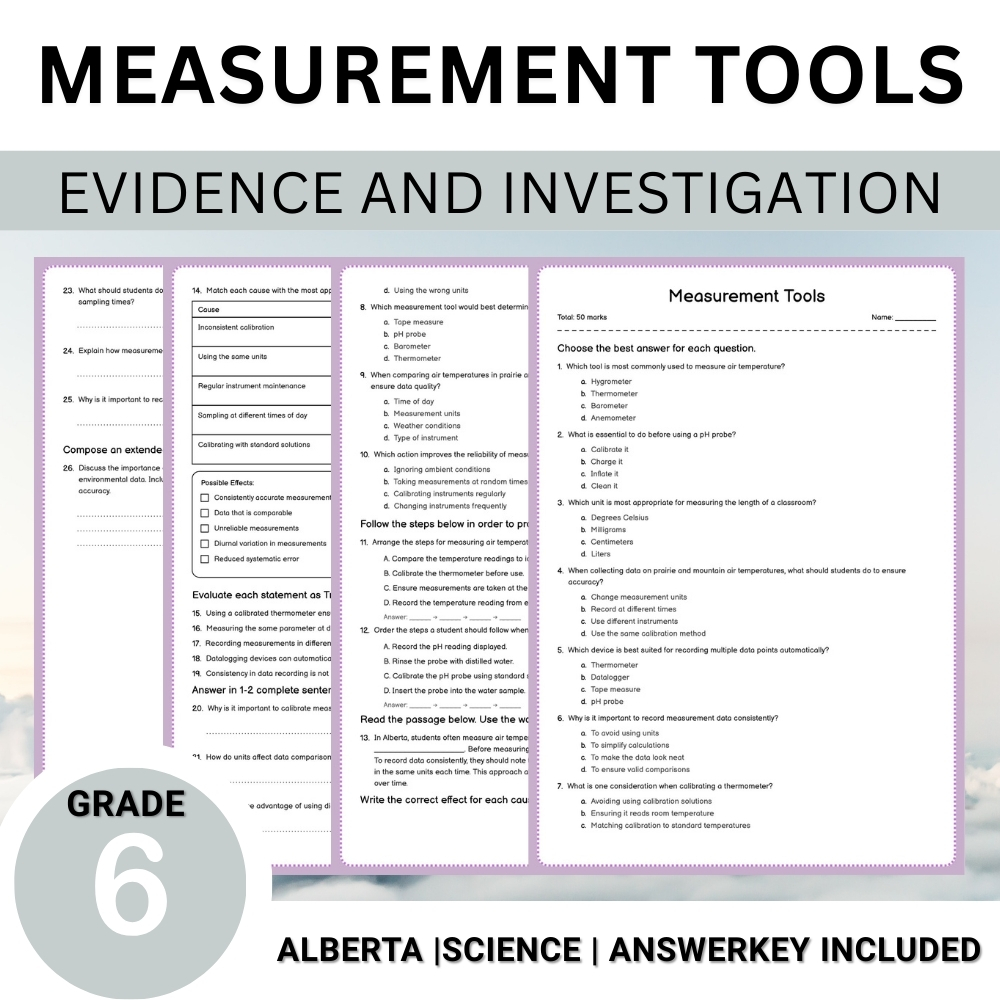
Grade 6 Science | Measurement Tools Worksheet (Printable PDF + Assessment)
Learning Objectives
- Identify common measurement instruments such as thermometers, pH probes, and tape measures.
- Understand how to calibrate and select appropriate units for accurate data collection.
- Learn methods for consistent recording and representation of measurement data.
Also included in: Grade 6 Science Unit | Data & Measurement Worksheets Bundle (Assessment & Practice) +1 more
Instant download
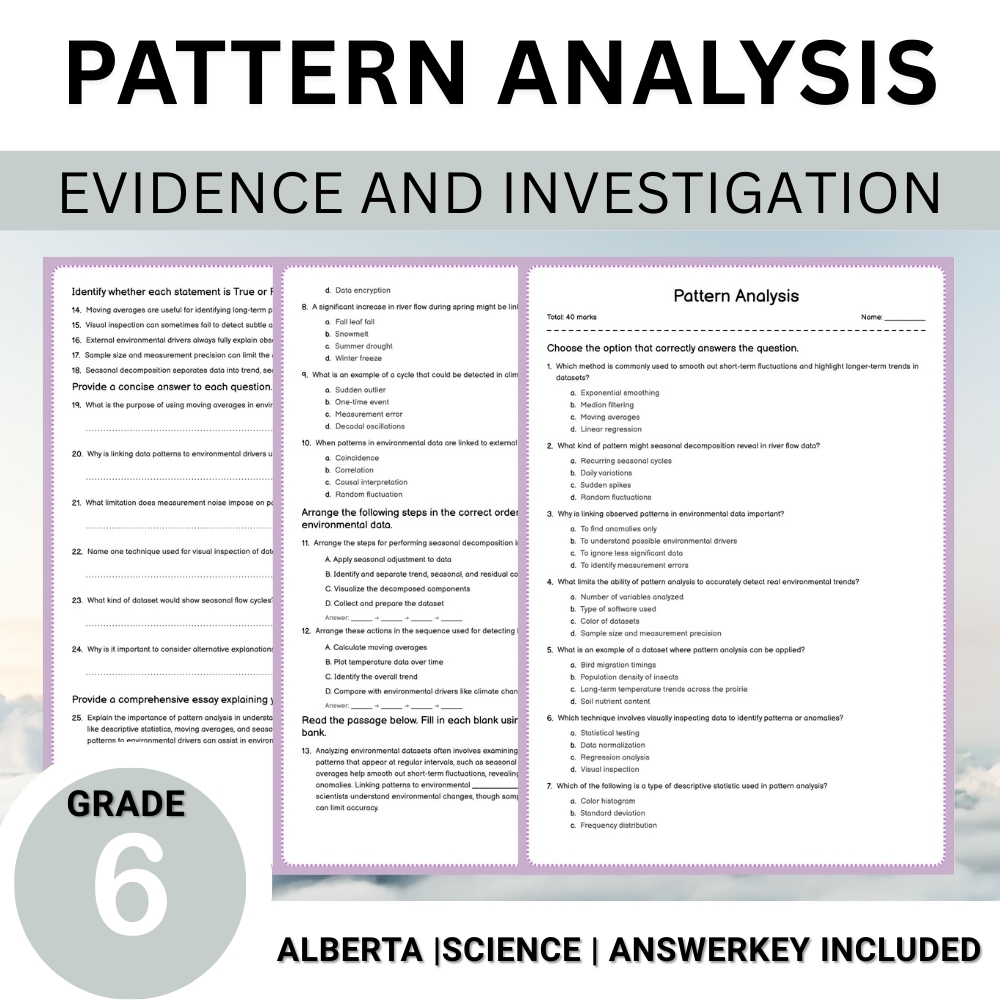
6th Grade Science | Pattern Analysis Worksheet (Answer Key) for Environmental Data
Learning Objectives
- Understand methods for detecting trends, cycles, and anomalies in datasets.
- Learn to interpret simple descriptive statistics and moving averages.
- Apply seasonal decomposition techniques to environmental data examples.
Also included in: Grade 6 Science Unit | Data & Measurement Worksheets Bundle (Assessment & Practice) +1 more
Instant download
Browse more categories
About Science Worksheets
Find Science worksheets spanning core skills, practice, and review. All 44,628 resources are instant PDF downloads for the classroom or home.
Every worksheet on MyTeachingSheets is created by independent teacher-authors and reviewed before publication. All resources download as printable PDFs for classroom, homework, or at-home practice, and many include answer keys. Preview any worksheet free before buying.