
Science Worksheets
44,295 subject resources
Conservation Status Worksheet | Grade 7 Science Activities
 Created byPrism Point Learning
Learning Objectives
- Explain how conservation status is assessed using population trends, threat severity, and recovery potential
- Describe how land use, genetic diversity, and habitat connectivity affect a species’ vulnerability
- Interpret conservation evidence to understand regional species persistence
Also included in: Grade 7 Ecosystems & Biodiversity Science Lesson Bundle | Alberta
Instant download
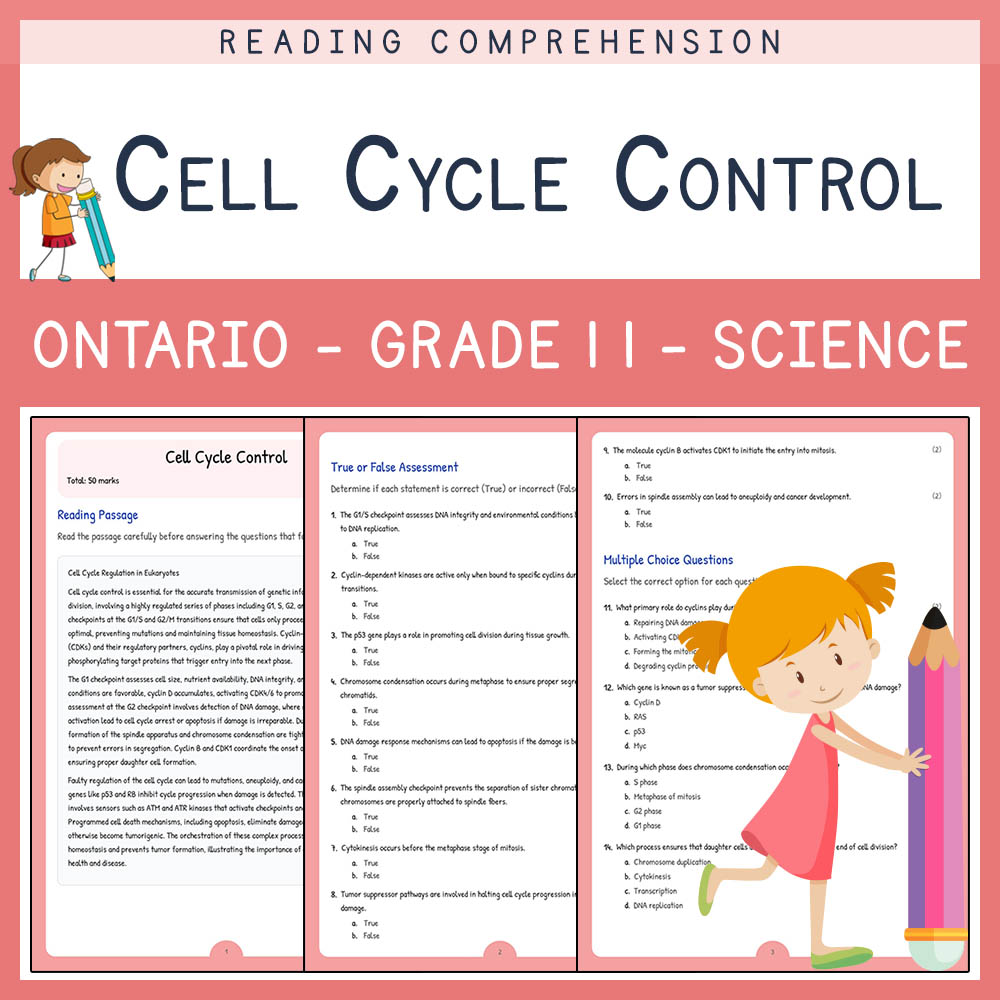
Grade 11 Science Assessment | Cell Cycle Control Worksheet Elena | Ontario
 Created byLumora Learning
Learning Objectives
- Understand the phases of the eukaryotic cell cycle and checkpoints that regulate transitions.
- Describe how cyclin-dependent kinases and regulatory factors orchestrate mitosis.
- Explain mechanisms of DNA damage response, programmed cell death, and tumor suppressor pathways.
Instant download
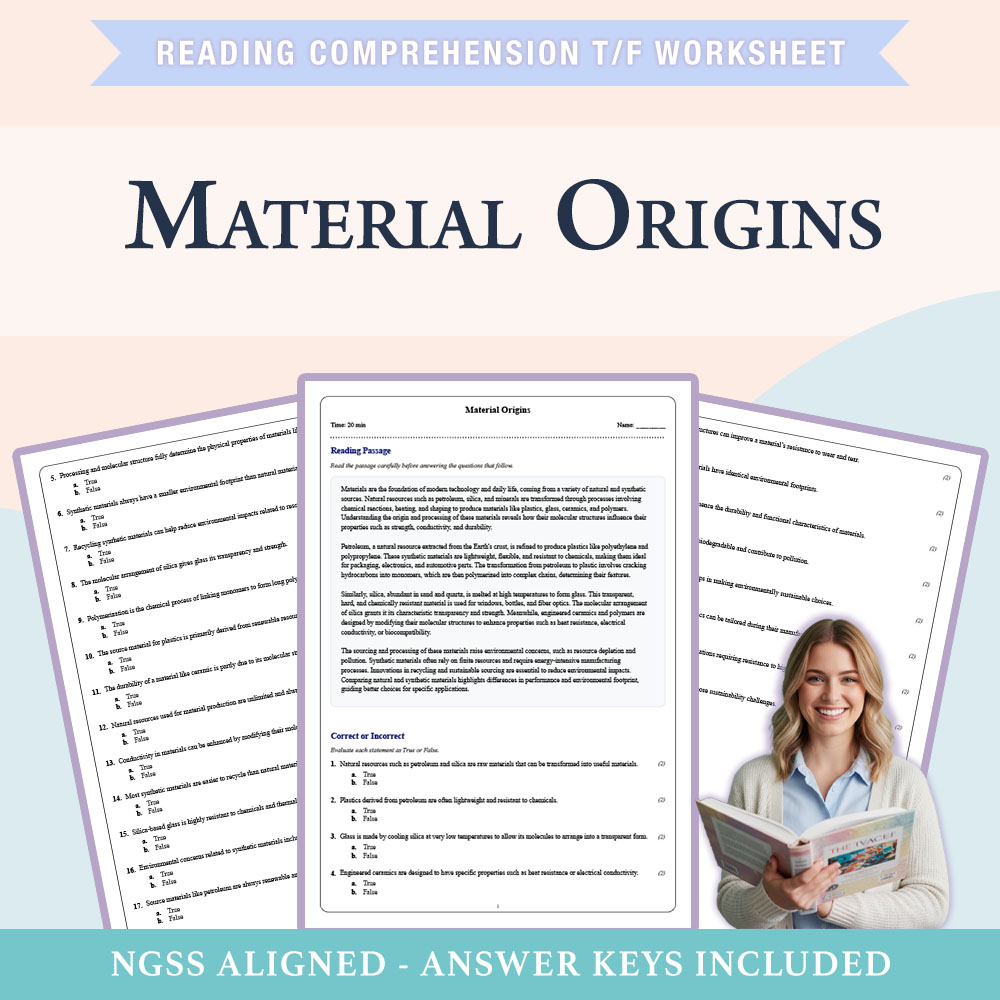
8th Grade Science | Material Origins Worksheet (PDF + Answer Key)
 Created byCopper Leaf Classroom
Learning Objectives
- Understand how natural resources are transformed into synthetic materials.
- Identify examples of materials derived from natural sources.
- Explain how processing and composition influence material properties.
Also included in: Grade 8 Science Bundle| Critical Concepts & Applications Unit (PDF + Answer Key) +1 more
Instant download
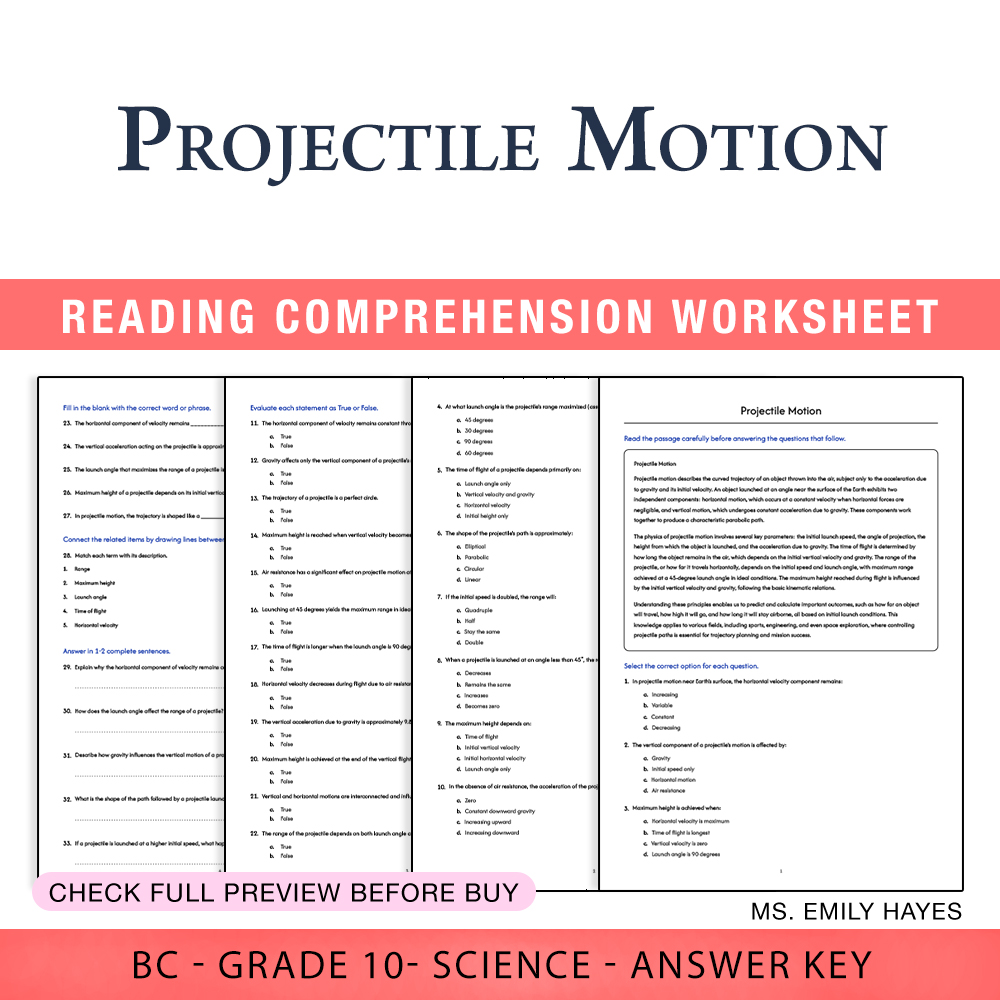
10th Grade Science | Projectile Motion Worksheet (PDF+ Answer Key)
Created byCopper Leaf ClassroomLearning Objectives
- Understand the components of projectile motion and their independence
- Explain how initial velocity and launch angle influence the range and height
- Apply kinematic equations to solve problems involving projectile motion
Also included in: Grade 10 Science BC | Forces, Motion & Fields Worksheets (PDF + Answer Key) +1 more
Instant download
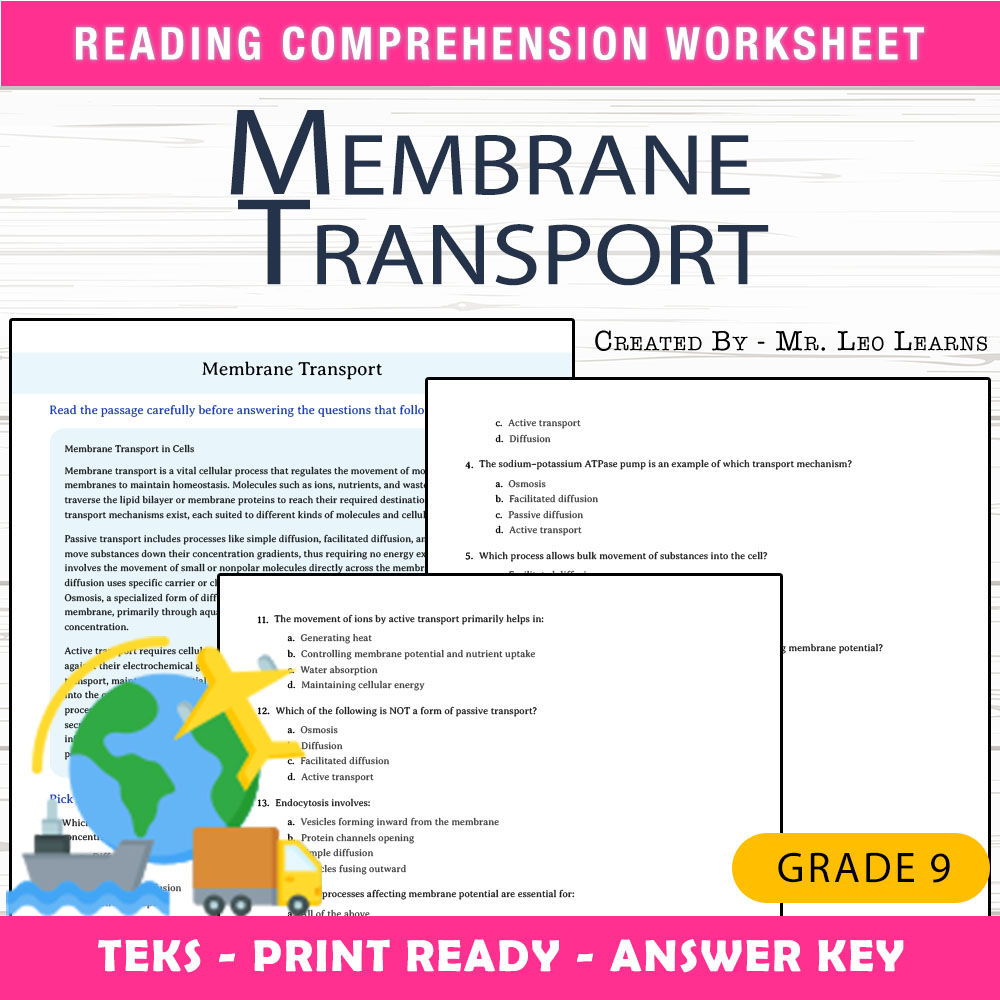
Grade 9 Science – Membrane Transport Worksheet for Mastery
 Created byThe Resource Hub
Learning Objectives
- Understand the different mechanisms of membrane transport including passive and active processes.
- Differentiate between diffusion, facilitated diffusion, osmosis, and active transport.
- Explain the role of vesicular transport such as endocytosis and exocytosis in cellular function.
Also included in: Grade 9 Science Unit | Human Body Systems & Homeostasis Worksheet Bundle +1 more
Instant download

Grade 11 Science | Population Growth - Daily Reading Comprehension
 Created byCoral Reef Learning
Learning Objectives
- Understand the key concepts of population growth, including birth and death rates.
- Identify the differences between exponential and logistic growth models.
- Explain how limiting factors influence population size.
Instant download

Grade 8 Science | Producers & Energy - Daily Reading Comprehension
Created byCoral Reef LearningLearning Objectives
- Identify different types of primary producers in ecosystems.
- Understand the role of producers in converting solar and chemical energy.
- Distinguish between various ecosystems based on producer types and productivity.
Also included in: Interactions and Ecosystems Lesson Bundle Grade 8 Science – Alberta +1 more
Instant download

Grade 8 Science | Population Patterns in Science - Daily Reading Comprehension
Created byCoral Reef LearningLearning Objectives
- Understand the basic concepts of population change.
- Identify the characteristics of exponential growth.
- Recognize factors that influence population dynamics.
Also included in: Interactions and Ecosystems Lesson Bundle Grade 8 Science – Alberta +1 more
Instant download

Grade 11 Science | Problem Definition - Daily Reading Comprehension
Created byCoral Reef LearningLearning Objectives
- Understand the importance of clearly defining societal and global challenges in science and engineering.
- Identify qualitative and quantitative criteria and constraints involved in urban water supply solutions.
- Learn how to formulate measurable criteria and prioritize constraints for complex problems.
Instant download

Grade 12 Science | Orbital Motion Models Worksheet | General Standards
Created byLumora LearningLearning Objectives
- Explain how gravity and motion combine to produce predictable orbital paths
- Use orbital models to relate orbital period, orbital speed, distance, and the mass of the central body
- Interpret how satellites and exoplanets provide evidence for gravitational control of trajectories
Instant download
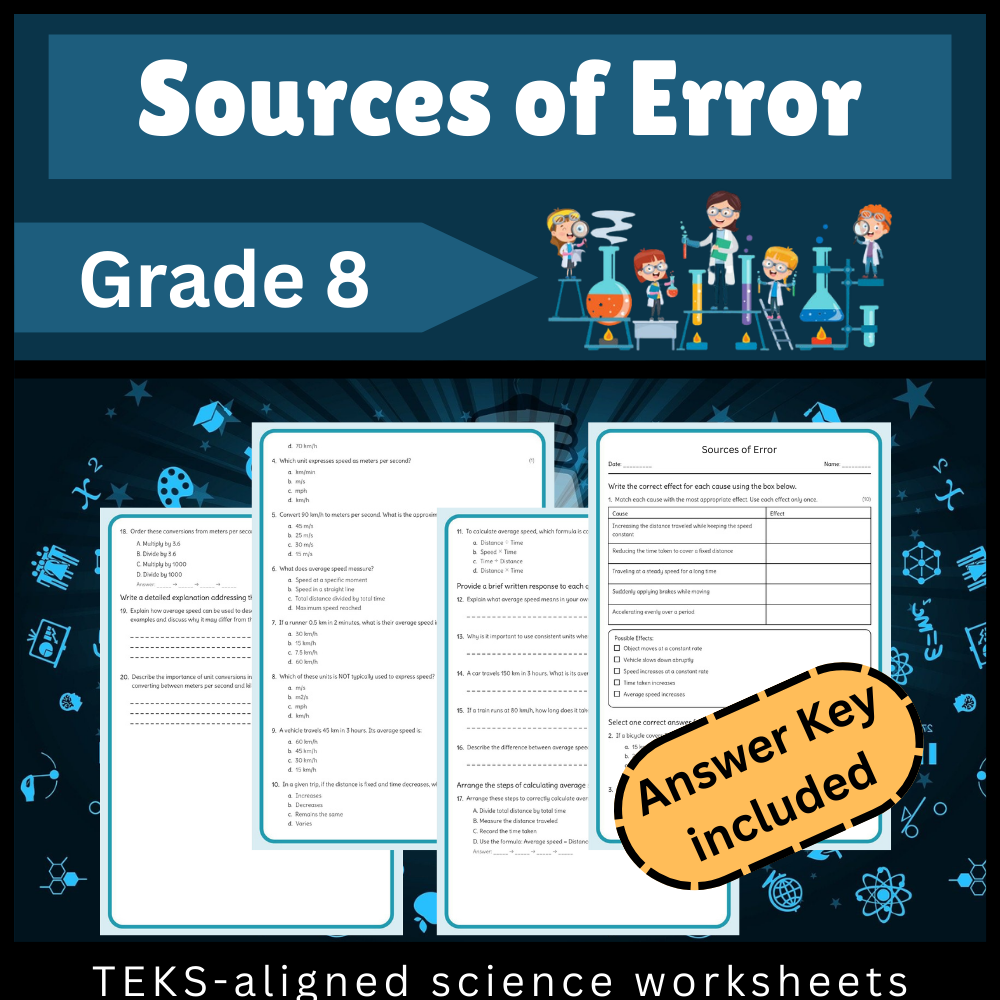
Grade 8 Science | Sources of Error Worksheet (Answer Key) – TEKS Aligned
 Created byBright Mind Resources
Learning Objectives
- Identify different types of errors that occur during measurements.
- Understand methods to quantify and mitigate measurement uncertainties.
- Analyze scenarios involving systematic and random errors in laboratory experiments.
Also included in: Grade 8 Science Unit Bundle | Scientific Inquiry, Data & Measurement Skills +1 more
Instant download
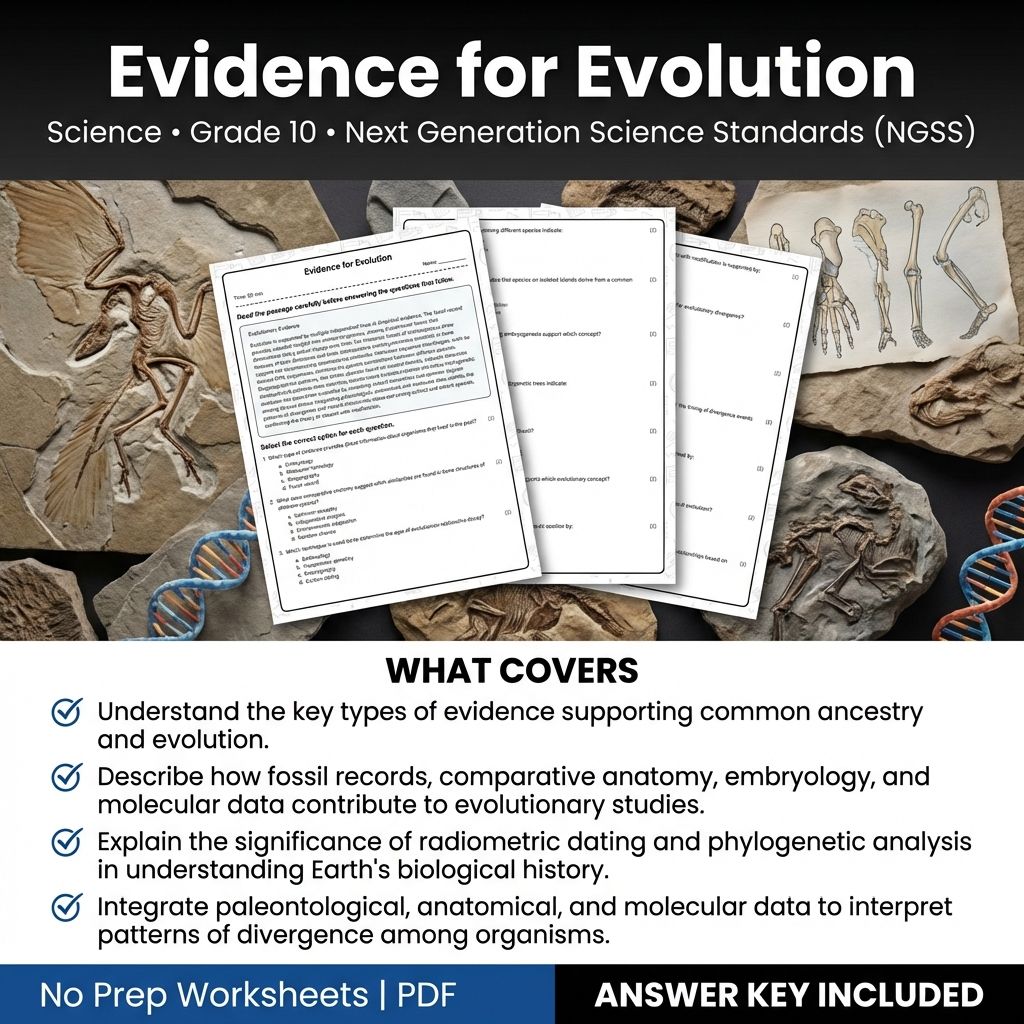
10th Grade Science | Evidence for Evolution Worksheet & Answer Key (PDF)
Created byCoral Reef LearningLearning Objectives
- Understand the key types of evidence supporting common ancestry and evolution.
- Describe how fossil records, comparative anatomy, embryology, and molecular data contribute to evolutionary studies.
- Explain the significance of radiometric dating and phylogenetic analysis in understanding Earth's biological history.
Also included in: Grade 10 Science Unit Worksheet Bundle – Genetics, Evolution & Biodiversity +1 more
Instant download
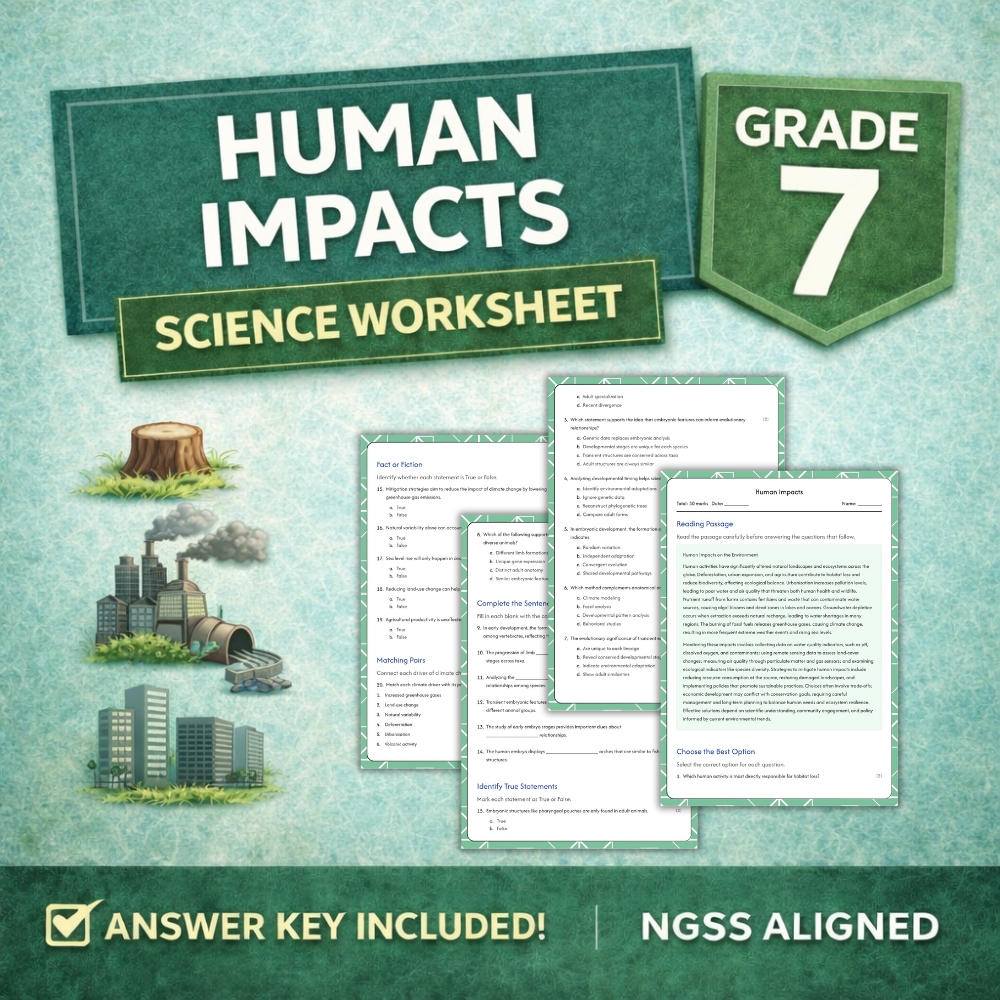
7th Grade Science | Human Impacts Worksheet (NGSS-Aligned Printable PDF)
 Created byCedar Grove Learning
Learning Objectives
- Understand how human activities affect ecosystems and environment.
- Use scientific indicators to monitor environmental changes.
- Evaluate strategies for reducing human impacts on ecosystems.
Instant download
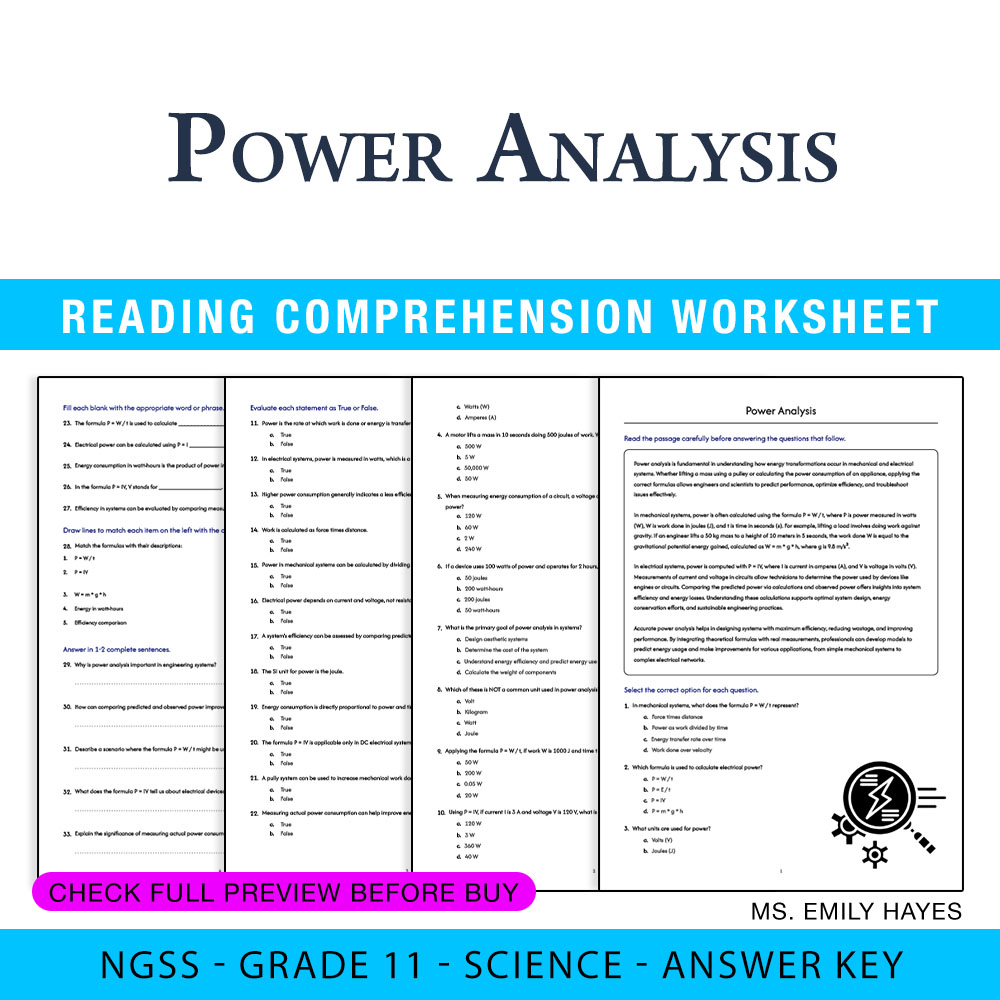
Grade 11 Science | Power Analysis Worksheet (PDF+ Answer Key)
Created byCopper Leaf ClassroomLearning Objectives
- Understand and apply the formula P = W/t to calculate power in mechanical systems
- Use P = IV to compute electrical power and analyze energy consumption
- Create and compare computational models for energy changes in different systems
Instant download
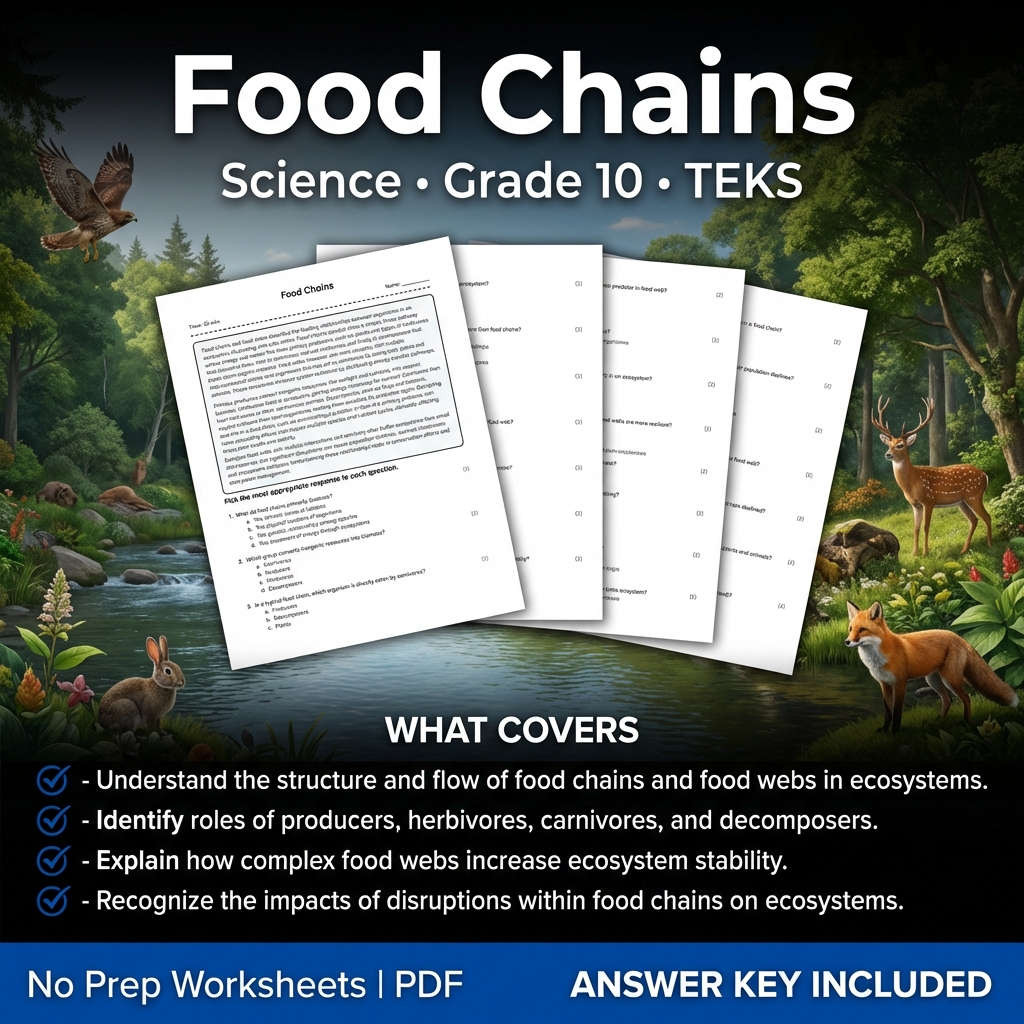
Food Chains Science Worksheet for Grade 10 | TEKS | Printable PDF
Created byCoral Reef LearningLearning Objectives
- Understand the structure and flow of food chains and food webs in ecosystems.
- Identify roles of producers, herbivores, carnivores, and decomposers.
- Explain how complex food webs increase ecosystem stability.
Instant download
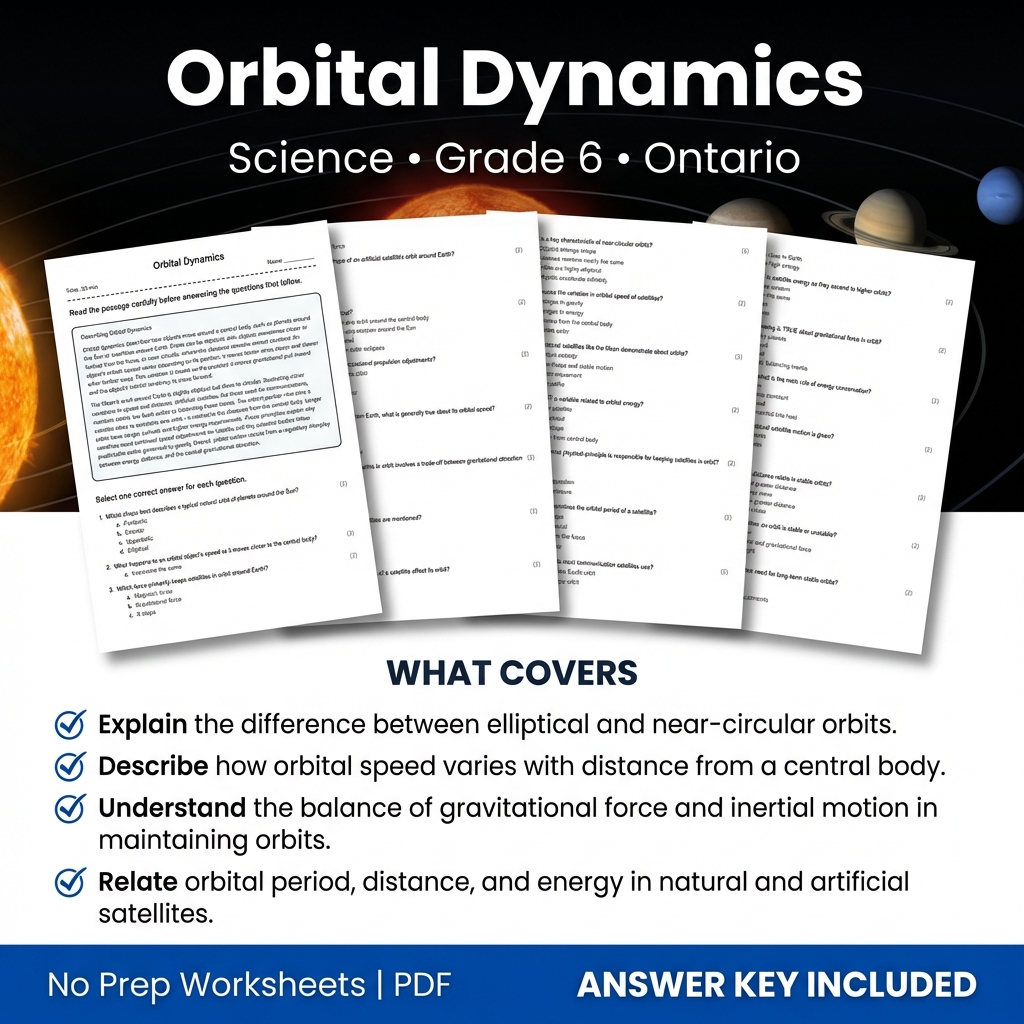
Grade 6 Science Worksheet on Orbital Dynamics | Ontario Standards
Created byCoral Reef LearningLearning Objectives
- Explain the difference between elliptical and near-circular orbits.
- Describe how orbital speed varies with distance from a central body.
- Understand the balance of gravitational force and inertial motion in maintaining orbits.
Instant download
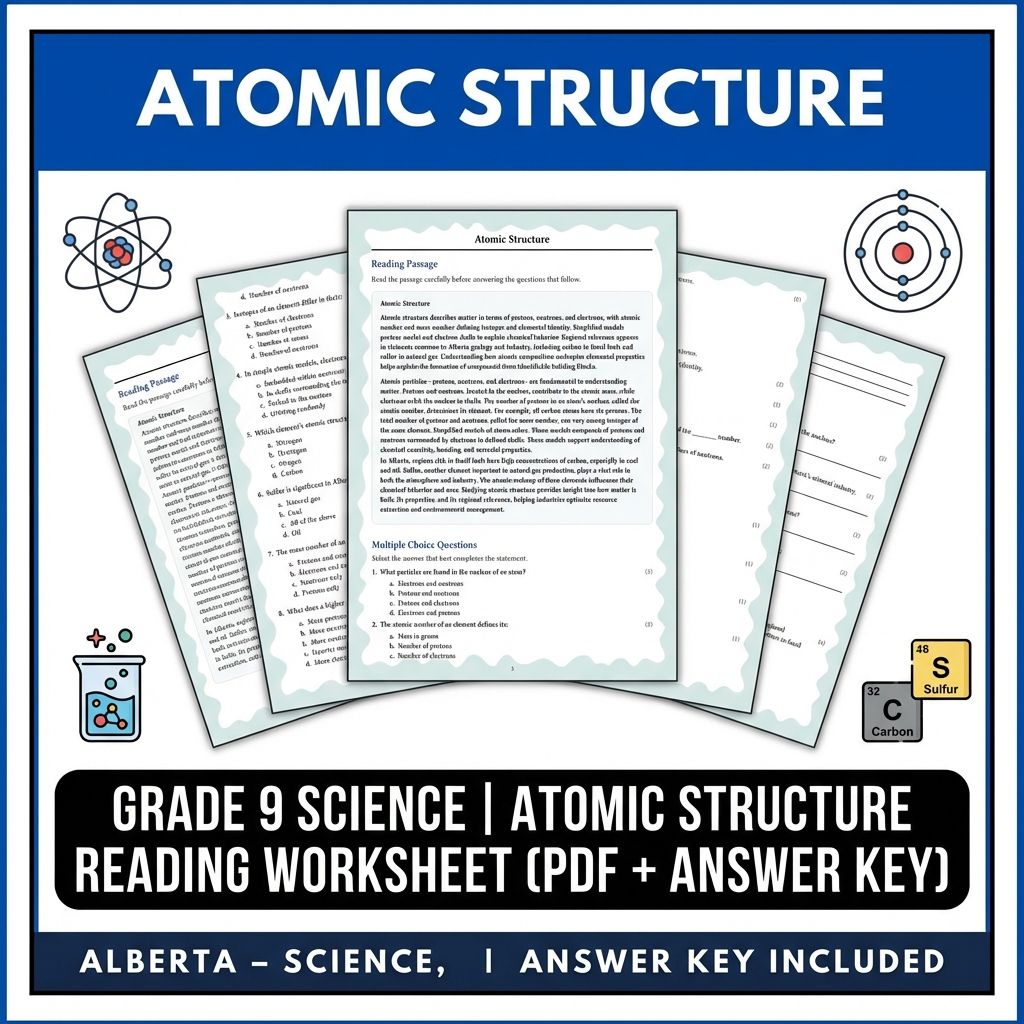
Grade 9 Science | Atomic Structure Reading Worksheet (PDF + Answer Key)
JCreated byJ.S SheetsLearning Objectives
- Explain the basic components of atomic structure: protons, neutrons, and electrons
- Define atomic number and mass number and their significance for isotopes
- Describe simple models of nuclei and electron shells to illustrate chemical behavior
Also included in: Grade 9 Science Unit Bundle – Chemistry, States & Atomic Structure Worksheets +1 more
Instant download
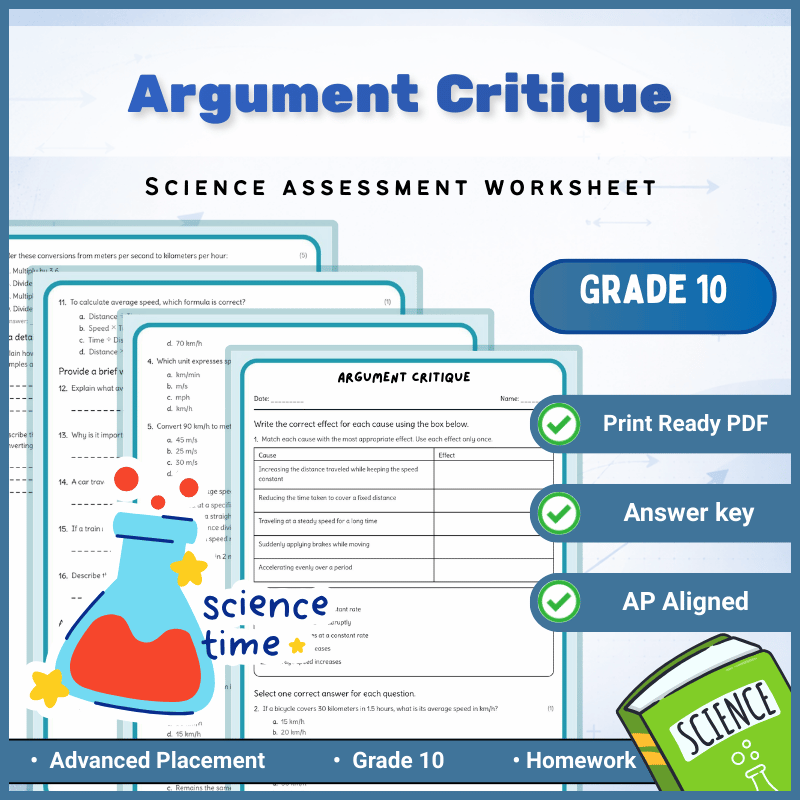
Grade 10 Science | Critical Argument Analysis Worksheet (AP Standard + PDF)
Created byBright Mind ResourcesLearning Objectives
- Evaluate explanatory claims systematically by assessing evidence quality, alternative hypotheses, and reasoning consistency.
- Apply criteria for refutation and corroboration to determine the plausibility of competing explanations.
- Analyze how statistical strength, representational choices, and methodological constraints influence argument persuasiveness.
Instant download

Grade 11 Science | Gene Expression in Eukaryotic Cells - Reading Comprehension
Created byCoral Reef LearningLearning Objectives
- Understand key concepts related to Science
- Apply knowledge through practice questions
- Demonstrate comprehension of the material
Instant download
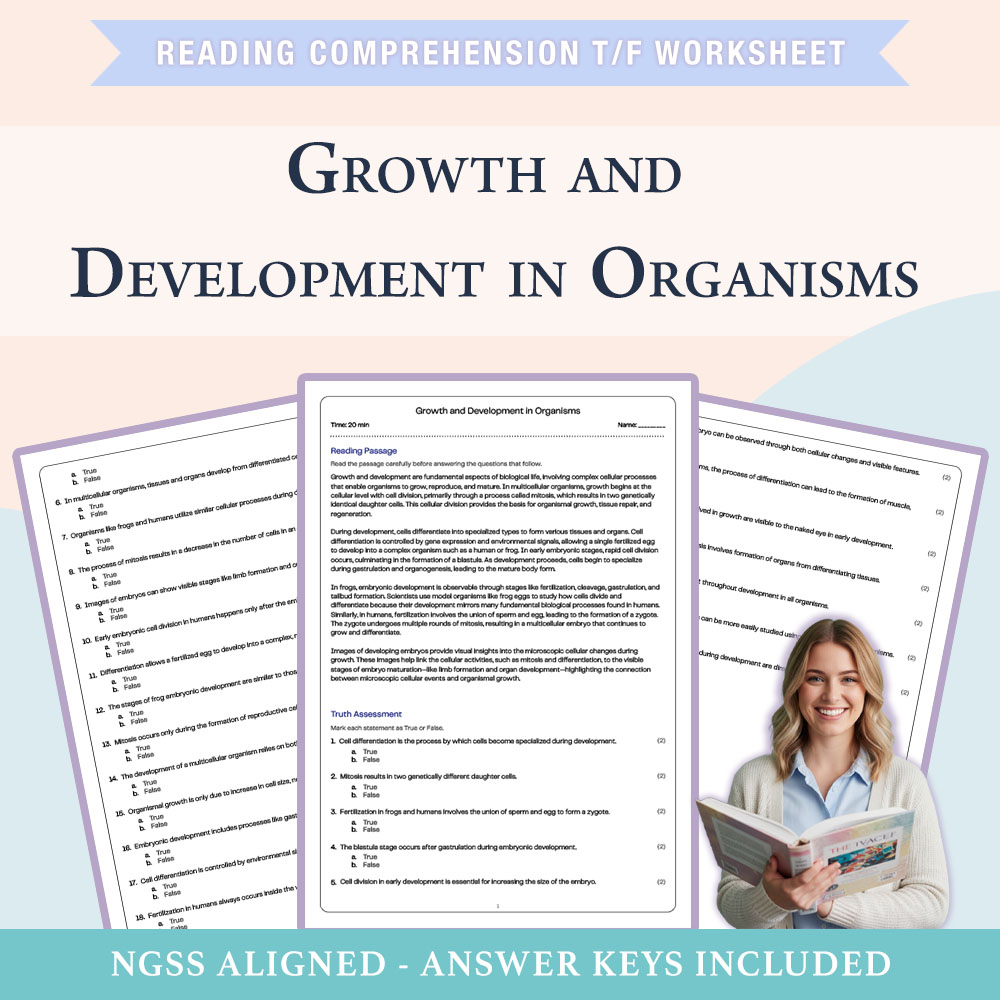
7th Grade Science | Growth and Development in Organisms Worksheet (PDF +Answers)
Created byCopper Leaf ClassroomLearning Objectives
- Understand the process of cell division and differentiation in multicellular organisms
- Describe stages of embryonic development in frogs and humans
- Link microscopic cellular processes to macroscopic growth in organisms
Instant download
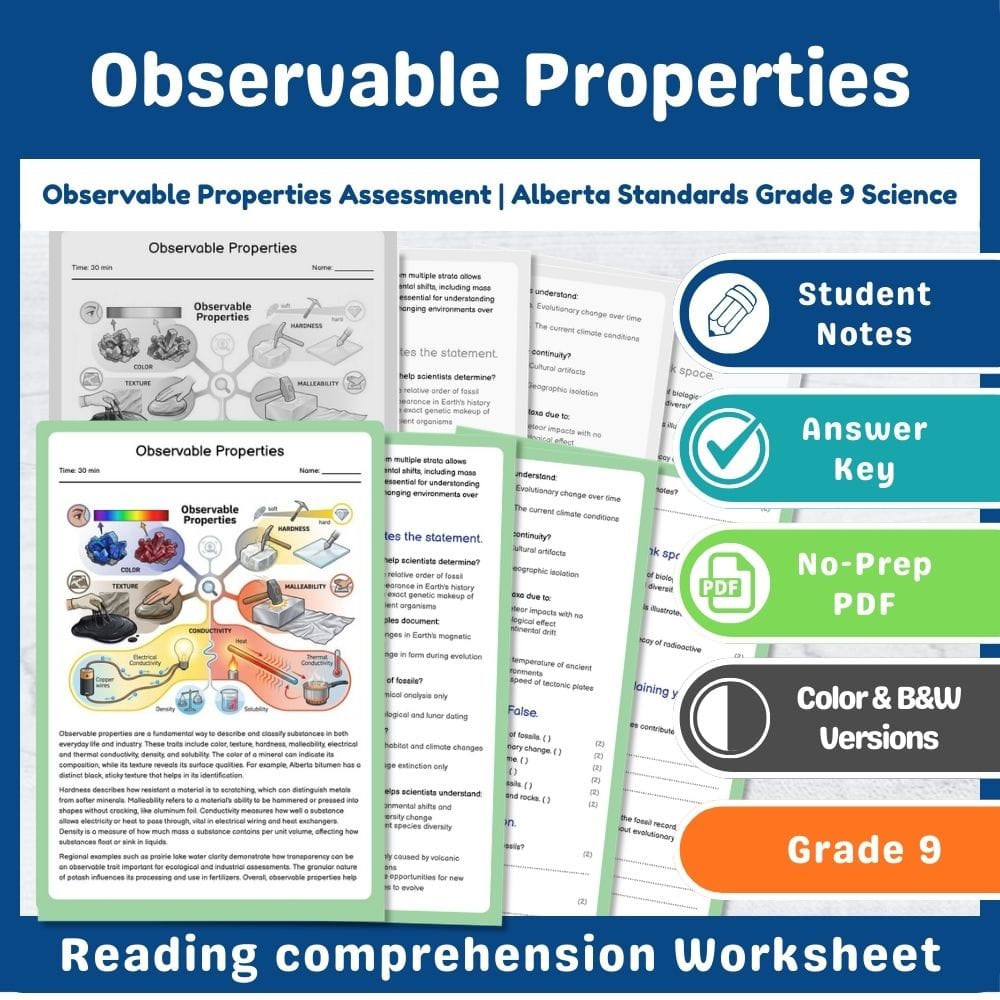
Observable Properties Assessment | Alberta Standards Grade 9 Science
Created byPrism Point LearningLearning Objectives
- Identify and describe various observable properties of substances.
- Understand how observable traits help classify different materials.
- Recognize regional examples illustrating material properties.
Also included in: Grade 9 Matter and Chemical Change Science Lesson Bundle | Alberta +1 more
Instant download
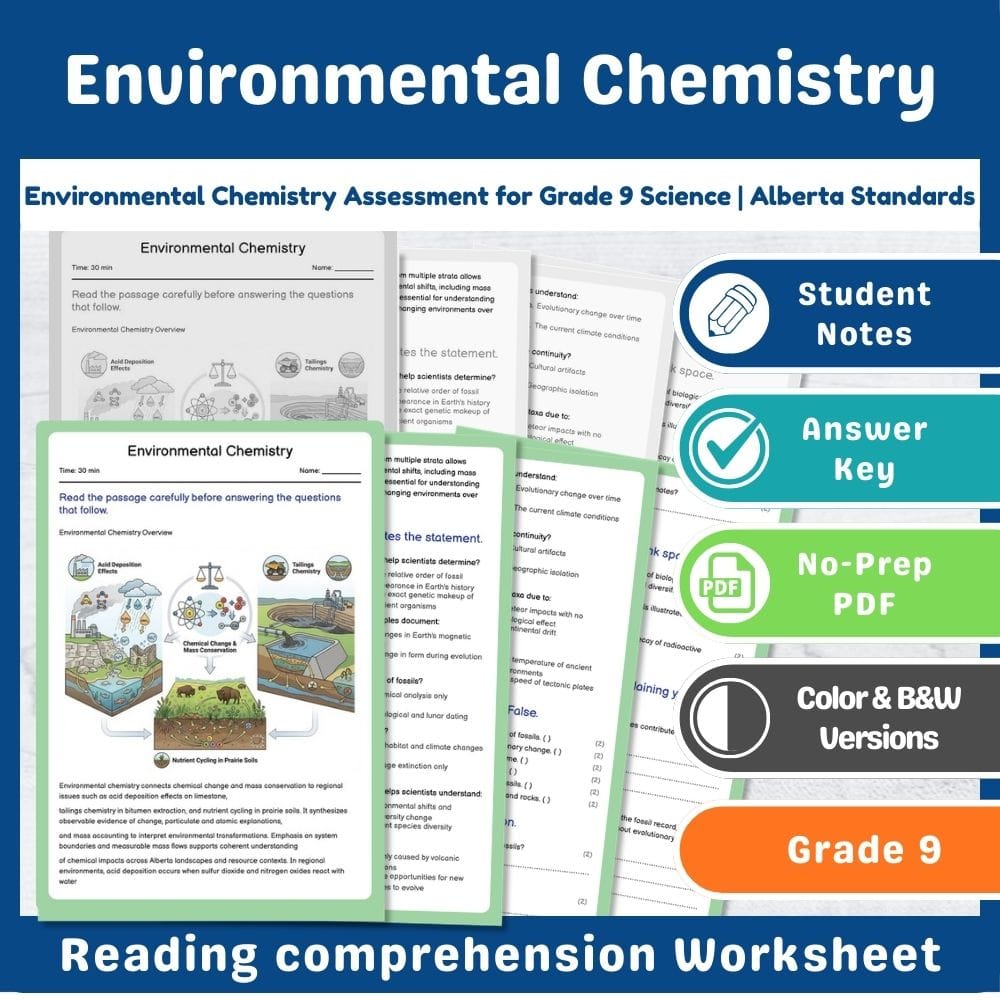
Environmental Chemistry Assessment for Grade 9 Science | Alberta Standards
Created byPrism Point LearningLearning Objectives
- Understand how chemical change and mass conservation relate to environmental issues.
- Analyze regional environmental impacts such as acid deposition and nutrient cycling.
- Interpret observable evidence of environmental transformations through particulate and atomic explanations.
Also included in: Grade 9 Matter and Chemical Change Science Lesson Bundle | Alberta +1 more
Instant download
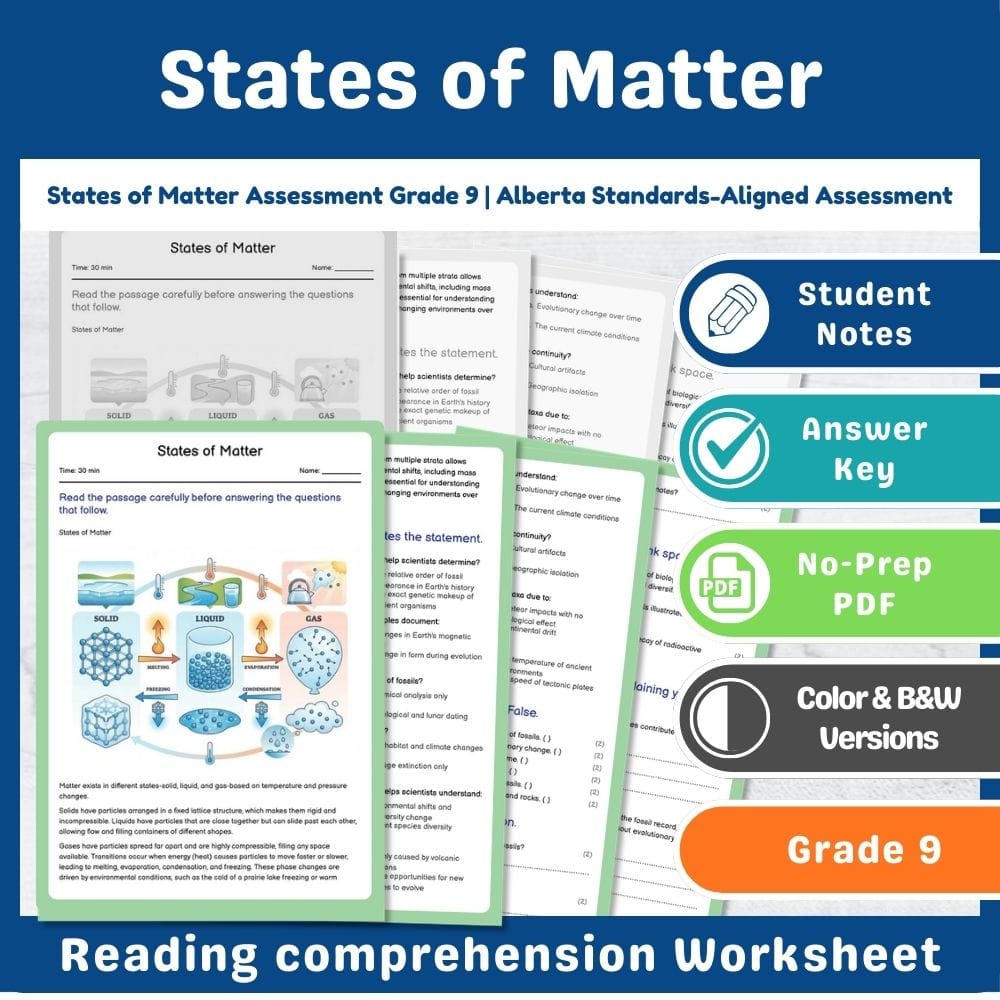
States of Matter Assessment Grade 9 | Alberta Standards-Aligned Assessment
Created byPrism Point LearningLearning Objectives
- Describe the three main states of matter: solid, liquid, and gas.
- Explain how temperature and pressure influence phase transitions.
- Identify the behaviors and properties characteristic of each state of matter.
Also included in: Grade 9 Matter and Chemical Change Science Lesson Bundle | Alberta +1 more
Instant download
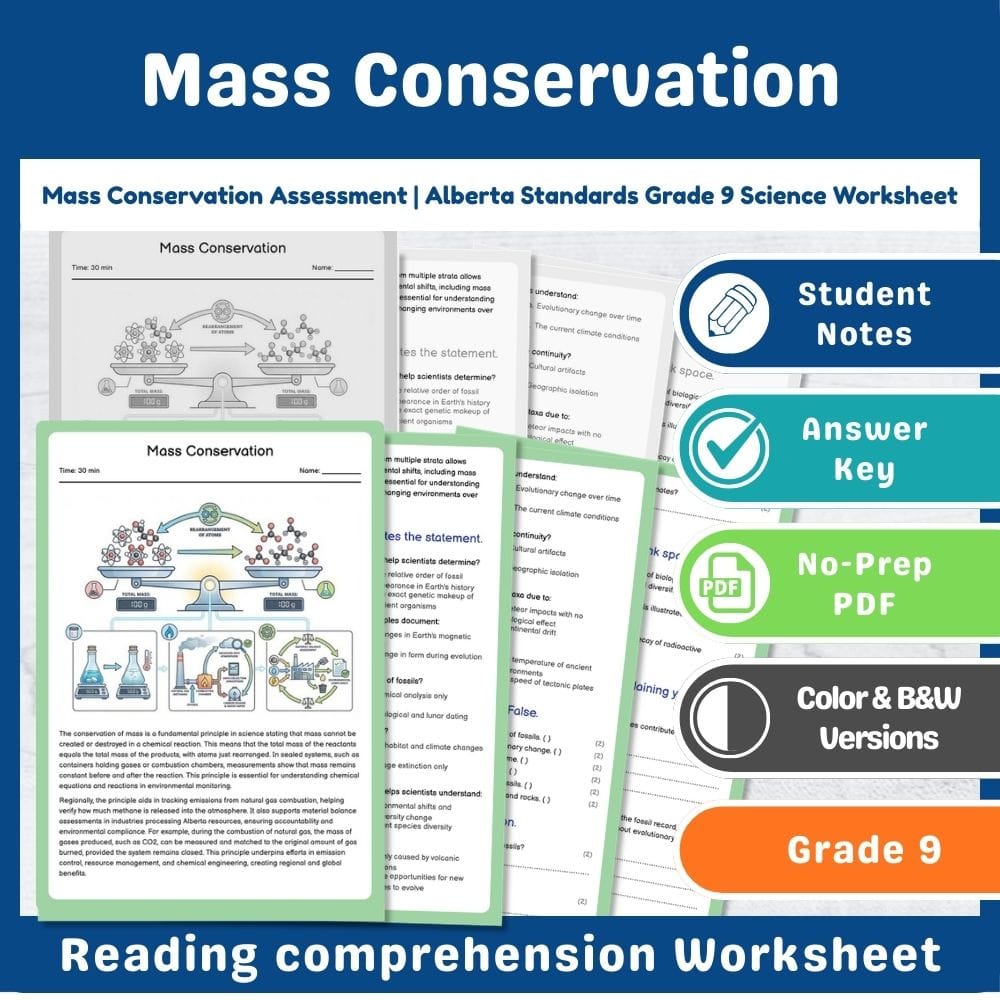
Mass Conservation Assessment | Alberta Standards Grade 9 Science Worksheet
Created byPrism Point LearningLearning Objectives
- Explain the principle of mass conservation in chemical reactions.
- Describe how mass remains constant in closed systems despite chemical changes.
- Identify regional applications of mass conservation in environmental and industrial contexts.
Also included in: Grade 9 Matter and Chemical Change Science Lesson Bundle | Alberta +1 more
Instant download
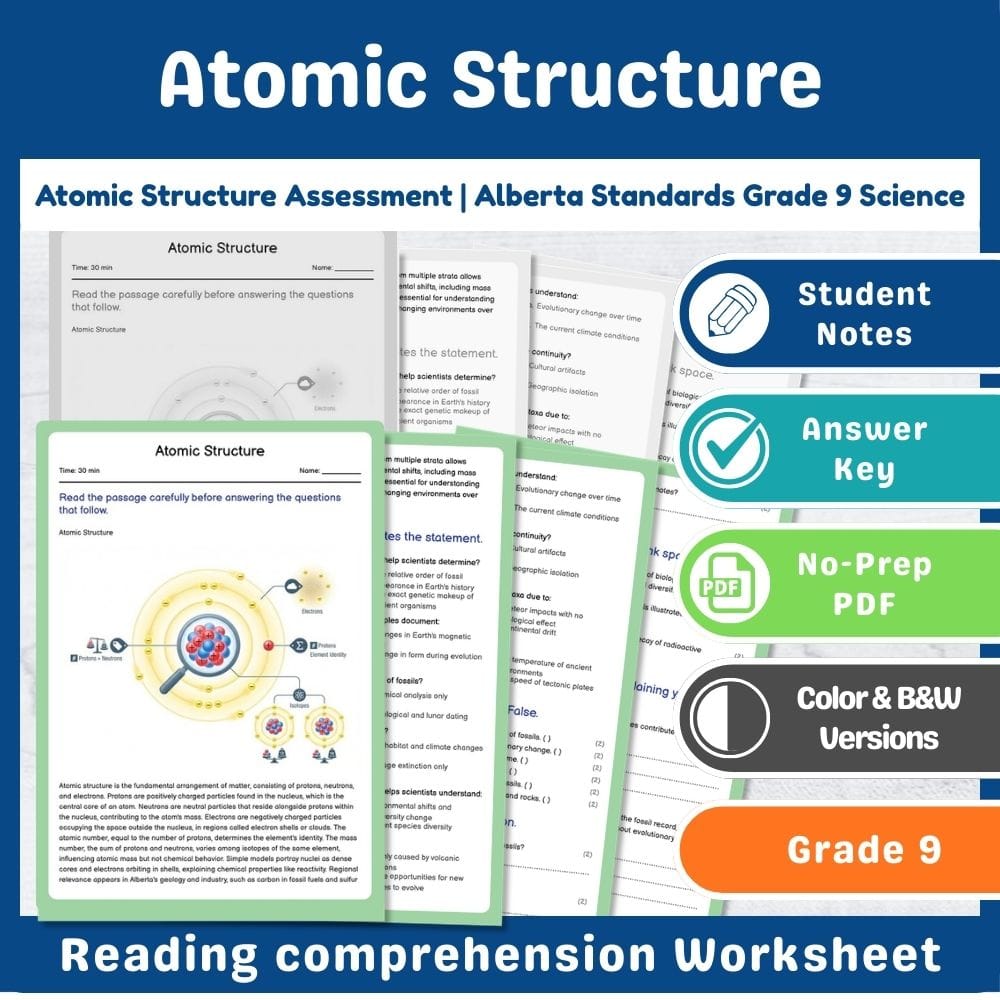
Atomic Structure Assessment | Alberta Standards Grade 9 Science
Created byPrism Point LearningLearning Objectives
- Describe the basic components of an atom: protons, neutrons, and electrons.
- Explain how atomic number and mass number define isotopes and element identity.
- Illustrate simple models of nuclei and electron shells to understand chemical behavior.
Also included in: Grade 9 Matter and Chemical Change Science Lesson Bundle | Alberta +1 more
Instant download
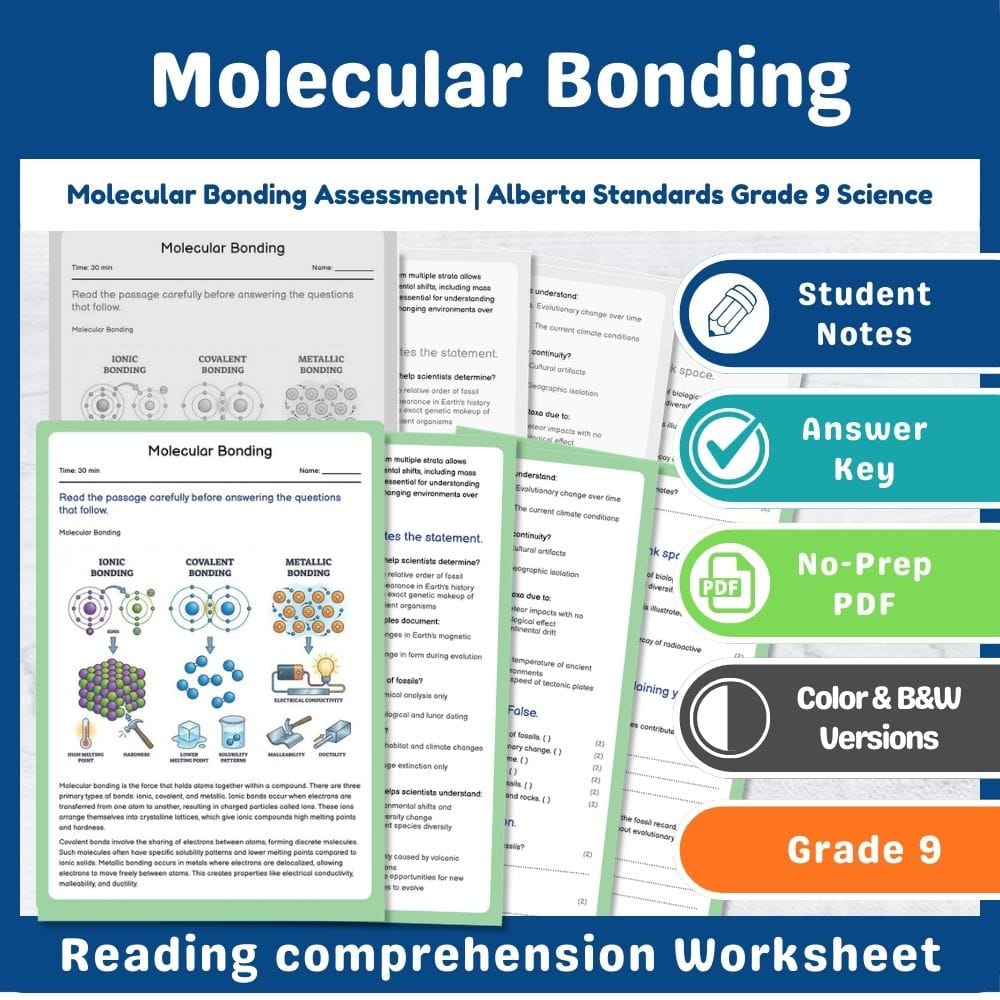
Molecular Bonding Assessment | Alberta Standards Grade 9 Science
Created byPrism Point LearningLearning Objectives
- Describe the different types of chemical bonds: ionic, covalent, and metallic.
- Identify properties of compounds based on their bonding type.
- Explain how bonding influences material properties and applications.
Also included in: Grade 9 Matter and Chemical Change Science Lesson Bundle | Alberta +1 more
Instant download

Mixtures and Solutions Assessment | Alberta Standards Grade 9 Science
Created byPrism Point LearningLearning Objectives
- Differentiate between heterogeneous mixtures and homogeneous solutions.
- Explain the roles of solute and solvent in a solution.
- Describe methods of separating mixture components based on physical properties.
Also included in: Grade 9 Matter and Chemical Change Science Lesson Bundle | Alberta +1 more
Instant download
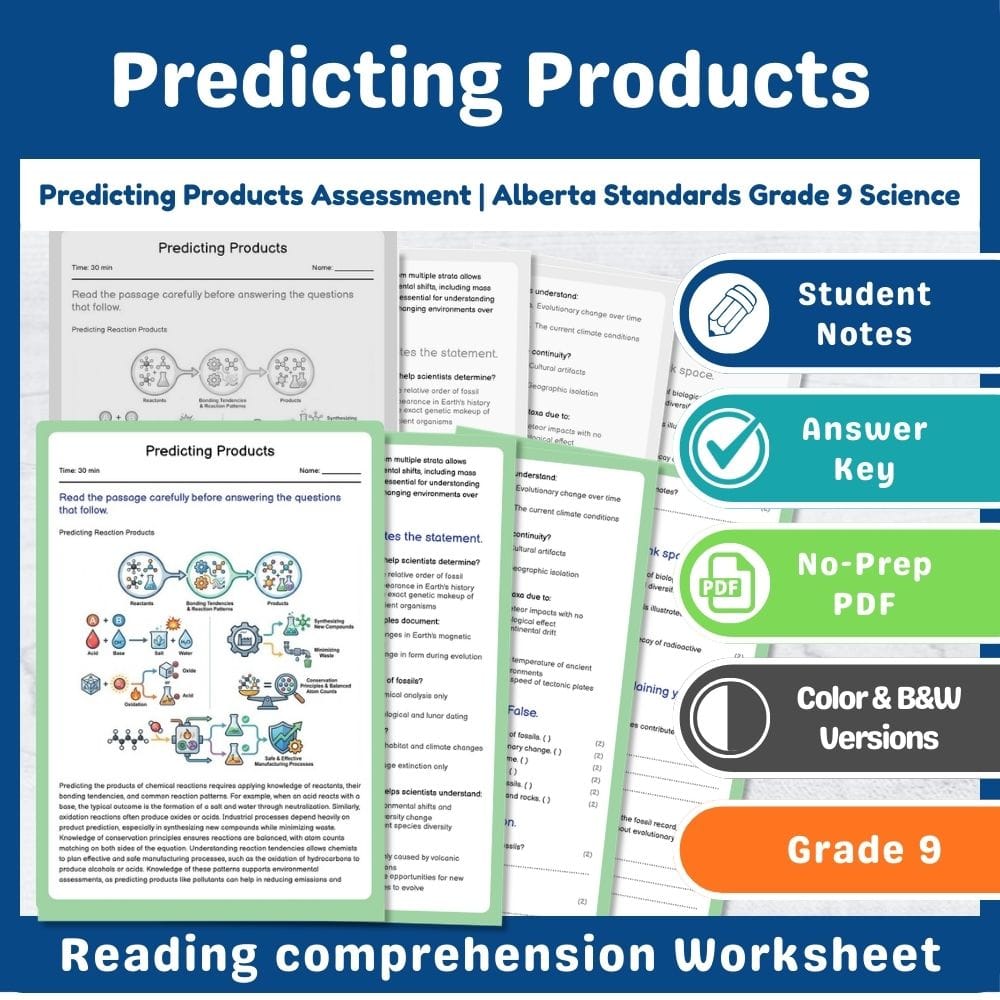
Predicting Products Assessment | Alberta Standards Grade 9 Science
Created byPrism Point LearningLearning Objectives
- Understand patterns of chemical reactions to predict likely products.
- Apply conservation principles and reactant identities in product prediction.
- Analyze industrial examples such as oxidation of hydrocarbons and neutralization reactions.
Also included in: Grade 9 Matter and Chemical Change Science Lesson Bundle | Alberta +1 more
Instant download
Evidence Change Assessment | Alberta Standards Grade 9 Science
Created byPrism Point LearningLearning Objectives
- Identify observable signs that indicate a chemical change has occurred.
- Distinguish between physical and chemical change markers in environmental and industrial contexts.
- Understand examples of chemical change such as rusting, combustion, and scale formation.
Also included in: Grade 9 Matter and Chemical Change Science Lesson Bundle | Alberta +1 more
Instant download
Reaction Quantities Assessment | Alberta Standards-Aligned Grade 9 Science
Created byPrism Point LearningLearning Objectives
- Understand how to interpret and use coefficient ratios in balanced chemical equations.
- Learn to relate mass measurements of reactants and products through proportional relationships.
- Apply relative mass concepts to practical scenarios involving chemical reactions.
Also included in: Grade 9 Matter and Chemical Change Science Lesson Bundle | Alberta +1 more
Instant download
Grade 7 Science | Net Force Worksheet with Short Notes (Printable PDF)
 Created byMeadowlark Worksheets
Learning Objectives
- Define net force as the combination of all forces acting on an object.
- Understand how unbalanced forces cause changes in motion.
- Explore the relationship between net force, mass, and acceleration using diagrams and reasoning.
Also included in: Grade 7 Science | Motion and Stability Forces & Interactions NGSS Unit Bundle +1 more
Instant download
Grade 10 Science | Net Force and Motion Worksheet (PDF + Answer Key)
 Created byRiverstone Classroom
Learning Objectives
- Understand the relationship between net force, mass, and acceleration as described by Newton's second law.
- Analyze how vector summation affects net force in different scenarios, including inclined planes and resistive forces.
- Apply mathematical models to solve problems involving force, motion, and energy concepts in various contexts.
Instant download
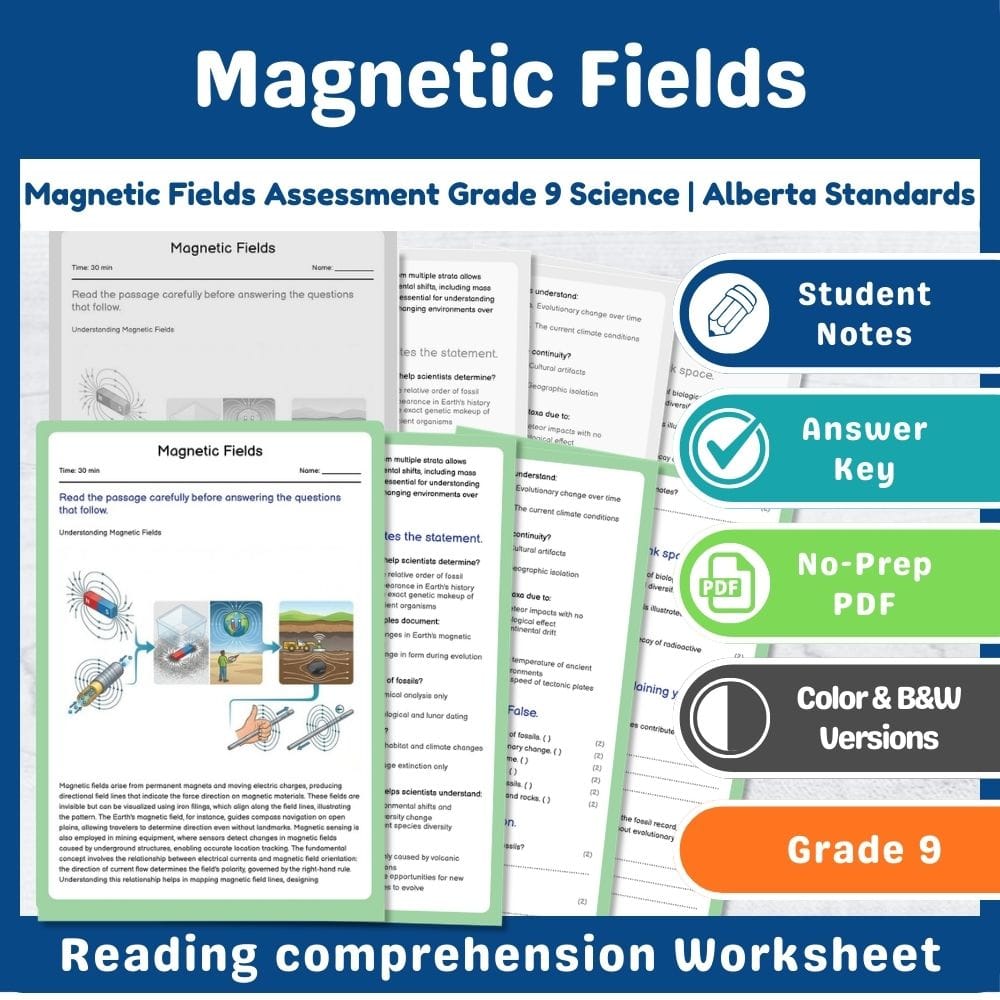
Magnetic Fields Assessment Grade 9 Science | Alberta Standards
Created byPrism Point LearningLearning Objectives
- Explain how magnetic fields are generated by permanent magnets and moving electric charges.
- Describe the concept of magnetic field lines and their directional properties.
- Connect regional phenomena like compass navigation and magnetic sensing in industry to magnetic fields.
Also included in: Grade 9 Electricity and Magnetism Science Lesson Bundle | Alberta Framework +1 more
Instant download
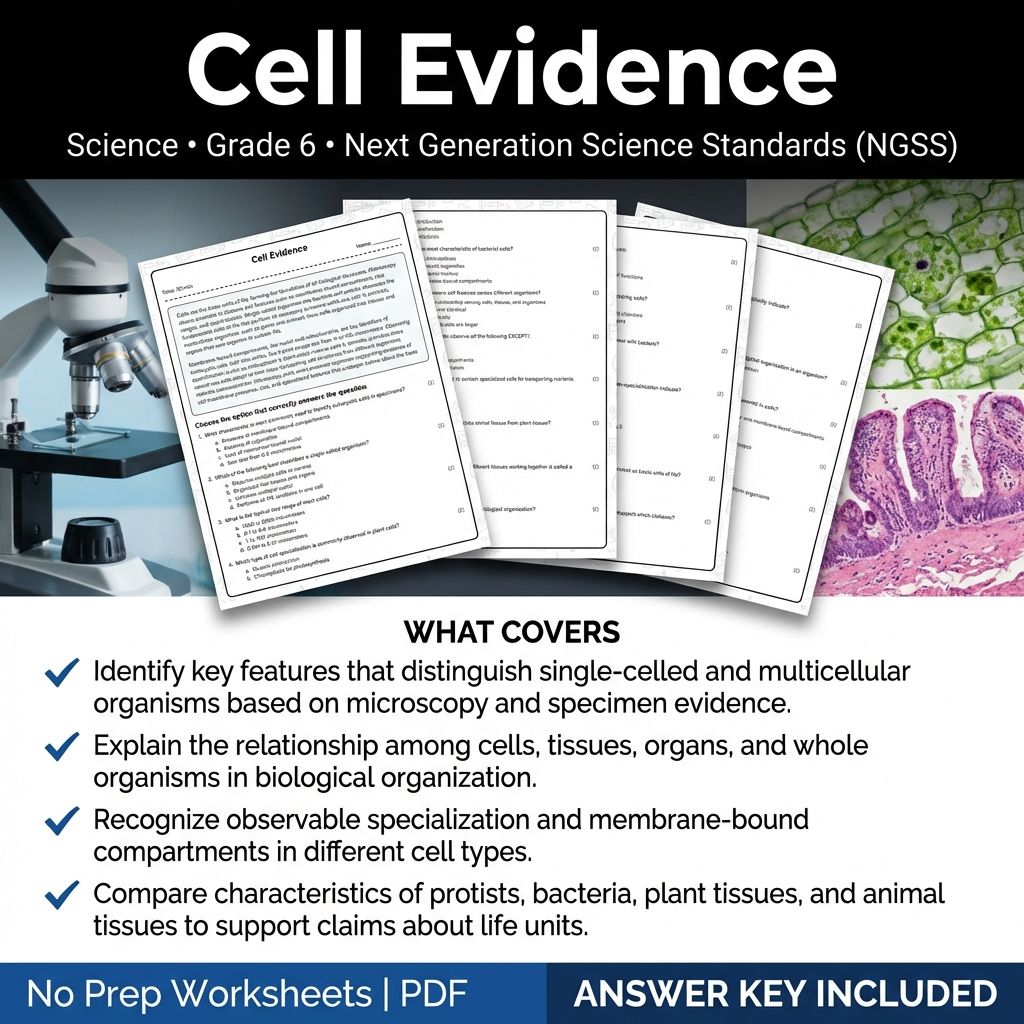
6th Grade Science | Cell Evidence Worksheet with Answer Key (Printable PDF)
Created byCoral Reef LearningLearning Objectives
- Identify key features that distinguish single-celled and multicellular organisms based on microscopy and specimen evidence.
- Explain the relationship among cells, tissues, organs, and whole organisms in biological organization.
- Recognize observable specialization and membrane-bound compartments in different cell types.
Instant download
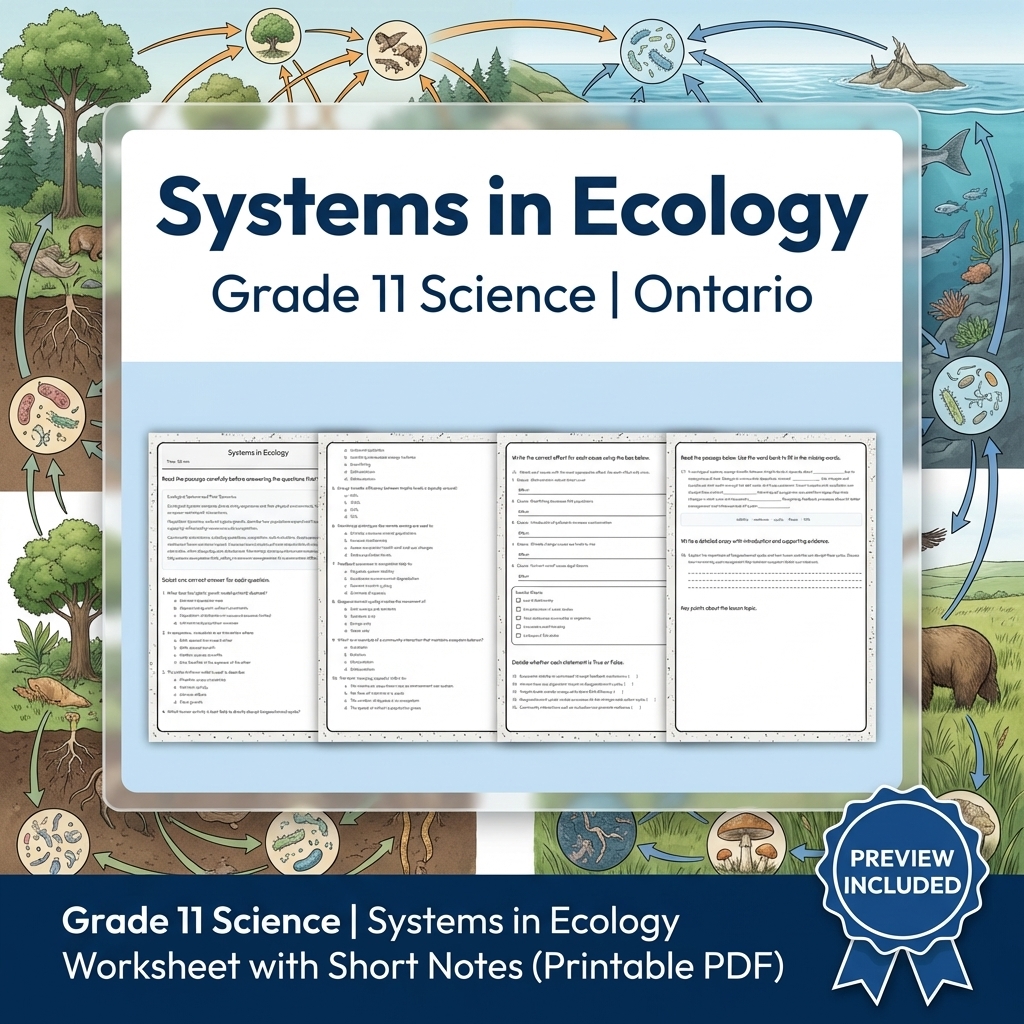
Grade 11 Science | Systems in Ecology Worksheet with Short Notes (Printable PDF)
Created byMeadowlark WorksheetsLearning Objectives
- Understand the key components and interactions within ecological systems.
- Explain the concepts of population dynamics, community interactions, and biogeochemical cycles.
- Apply mathematical models such as logistic growth and Lotka–Volterra interactions to ecological scenarios.
Also included in: Grade 11 Science Lesson Bundle | Ontario Curriculum Topics and Skills +1 more
Instant download

Grade 6 Science | Understanding Testable Questions - Daily Reading Comprehension
Created byCoral Reef LearningLearning Objectives
- Define what makes a scientific question testable.
- Identify variables and evidence in scientific questions.
- Differentiate between testable and non-testable questions.
Instant download

Grade 9 Biodiversity Limits Worksheet | Practice & Assessment PDF
 Created byClear Sky Classroom
Learning Objectives
- Explain how limiting resources and biotic interactions affect population survival and reproduction within a community
- Describe how carrying capacity constrains population size and influences biodiversity over time
- Analyze how environmental changes can shift species abundance and community composition
Instant download
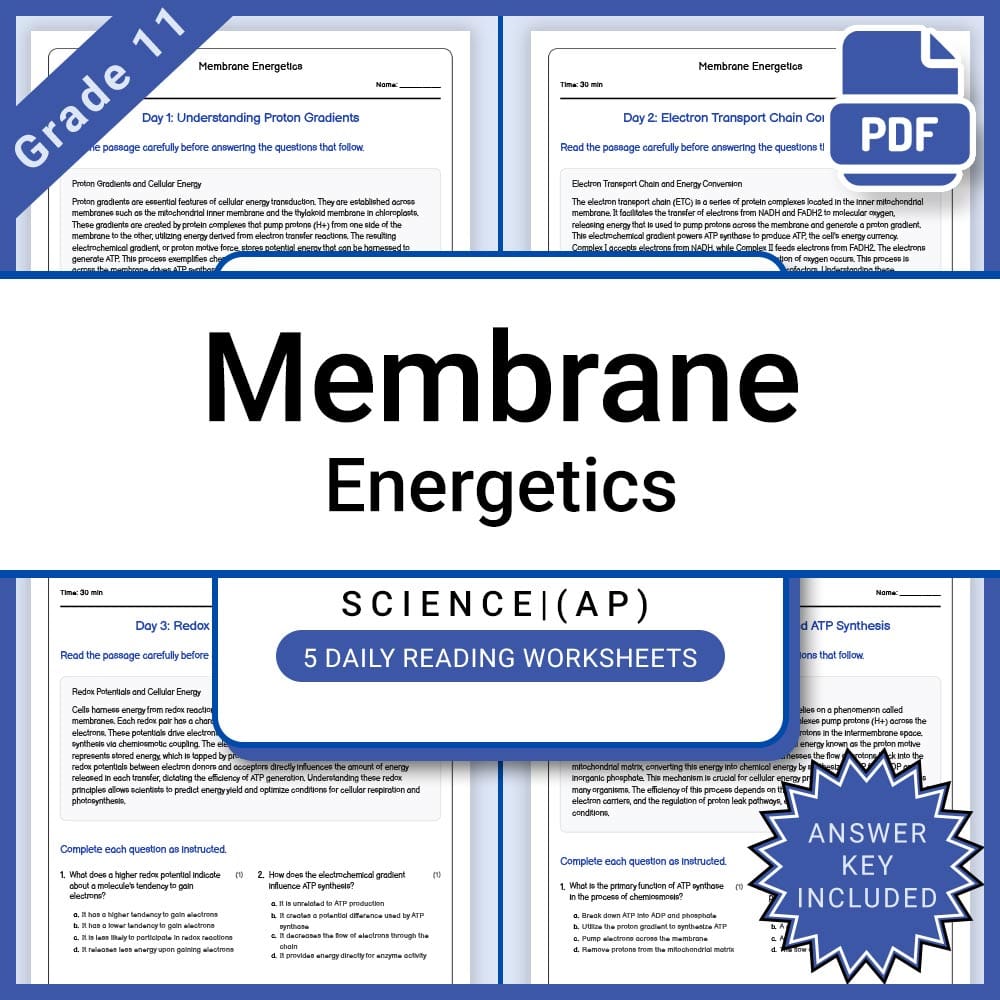
Grade 11 Science – Membrane Energetics Daily Reading Worksheet + Answer Key
JCreated byJ.S SheetsLearning Objectives
- Understand how proton gradients are formed across biological membranes.
- Explain the role of electron transport chains in energy transduction.
- Analyze the electrochemical components of proton motive force.
Also included in: Grade 11 Science Biology and Ecosystems AP Lesson Bundle +1 more
Instant download
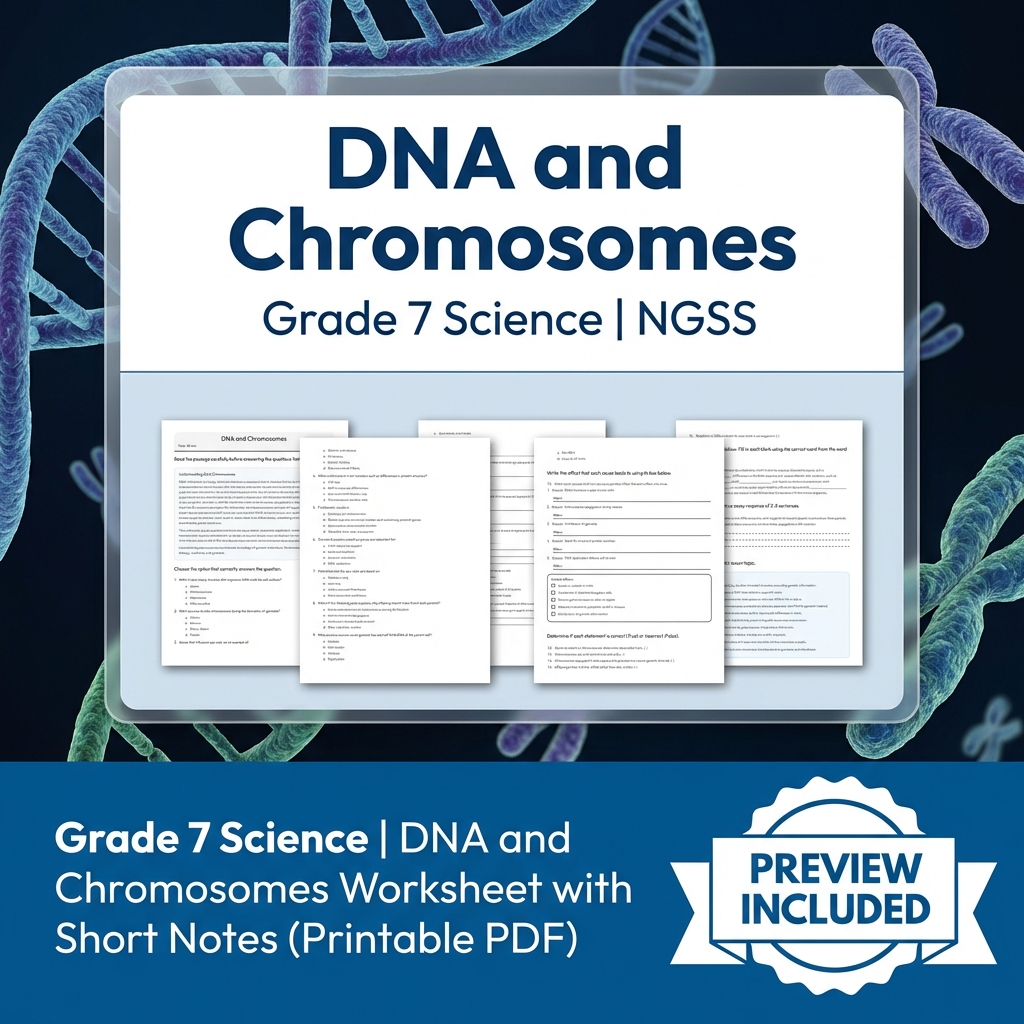
Grade 7 Science | DNA and Chromosomes Worksheet with Short Notes (Printable PDF)
Created byMeadowlark WorksheetsLearning Objectives
- Explain how DNA molecules are organized into chromosomes and how they encode genes that influence observable traits.
- Describe the process of chromosome segregation during gamete formation and fusion.
- Understand how genetic variation underpins trait differences such as eye color or structural proteins.
Also included in: Grade 7 Science | Heredity, Inheritance & Traits NGSS Unit Bundle +1 more
Instant download
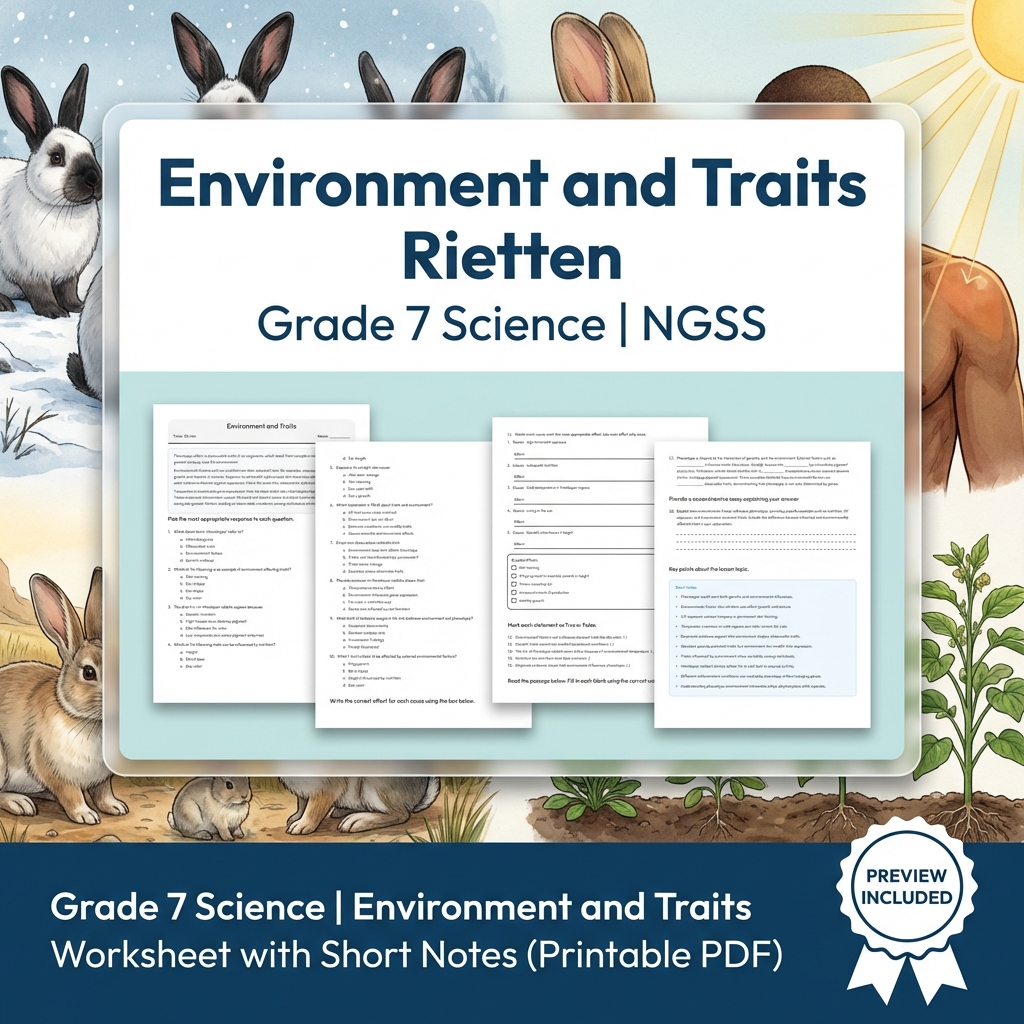
Grade 7 Science | Environment and Traits Worksheet with Short Notes (PDF)
Created byMeadowlark WorksheetsLearning Objectives
- Understand how phenotype results from genetic and environmental interactions.
- Identify examples of traits influenced by environmental factors.
- Distinguish inherited traits from environmentally modulated traits.
Also included in: Grade 7 Science | Heredity, Inheritance & Traits NGSS Unit Bundle +1 more
Instant download
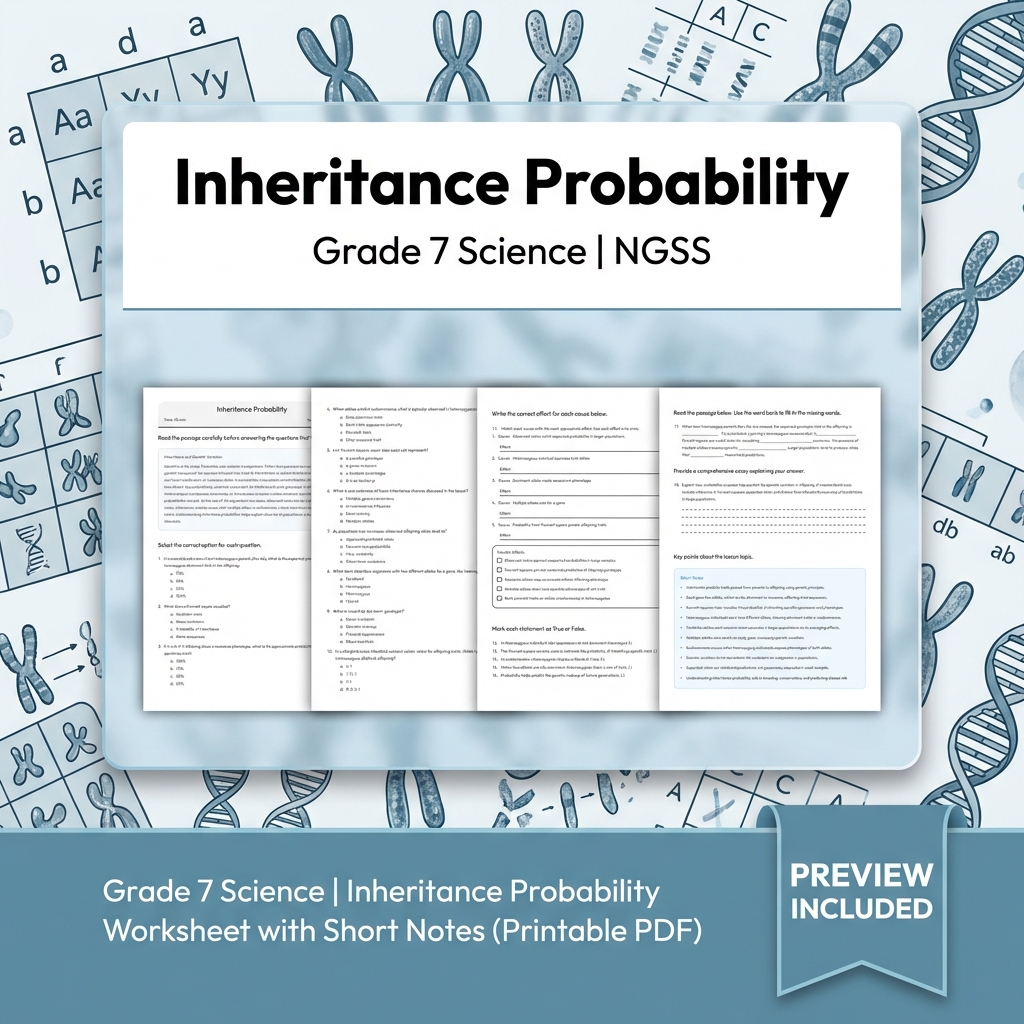
Grade 7 Science | Inheritance Probability Worksheet with Short Notes (PDF)
Created byMeadowlark WorksheetsLearning Objectives
- Understand how probability models predict genetic variation among offspring.
- Interpret Punnett square outcomes to estimate inheritance ratios.
- Calculate expected genotype and phenotype proportions in monohybrid crosses.
Also included in: Grade 7 Science | Heredity, Inheritance & Traits NGSS Unit Bundle +1 more
Instant download

Grade 10 Science | Evidence for Evolution Worksheet with Short Notes (PDF)
Created byMeadowlark WorksheetsLearning Objectives
- Understand the main types of evidence supporting evolution and common ancestry.
- Describe how fossil records, comparative anatomy, embryology, and molecular data support evolutionary theory.
- Explain the importance of radiometric dating and molecular sequencing in reconstructing evolutionary history.
Also included in: Grade 10 Science NGSS Unit Bundle | Biological Evolution & Diversity Worksheets +1 more
Instant download
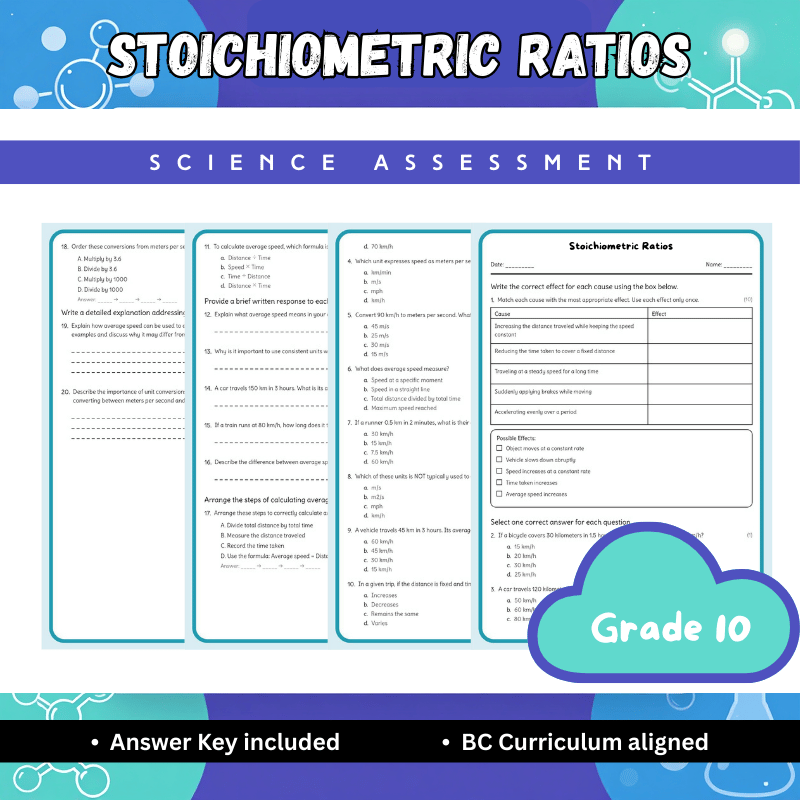
Grade 10 Science | Stoichiometric Ratios Worksheet (Answer Key) PDF
Created byBright Mind ResourcesLearning Objectives
- Understand how to interpret and use molar ratios from balanced chemical equations.
- Apply molar mass conversions to relate mass and moles of reactants and products.
- Calculate expected yields and required reactant amounts using stoichiometric ratios.
Instant download

Grade 8 Science | Limiting Factors Worksheet (PDF) - BC Standards
 Created byEvergreen Desk Education
Learning Objectives
- Explain how limiting factors determine the maximum population size (carrying capacity) in an ecosystem.
- Describe how biotic and abiotic factors can change over time and affect population growth and stability.
- Use evidence from a scenario to identify likely limiting factors and predict population outcomes.
Instant download
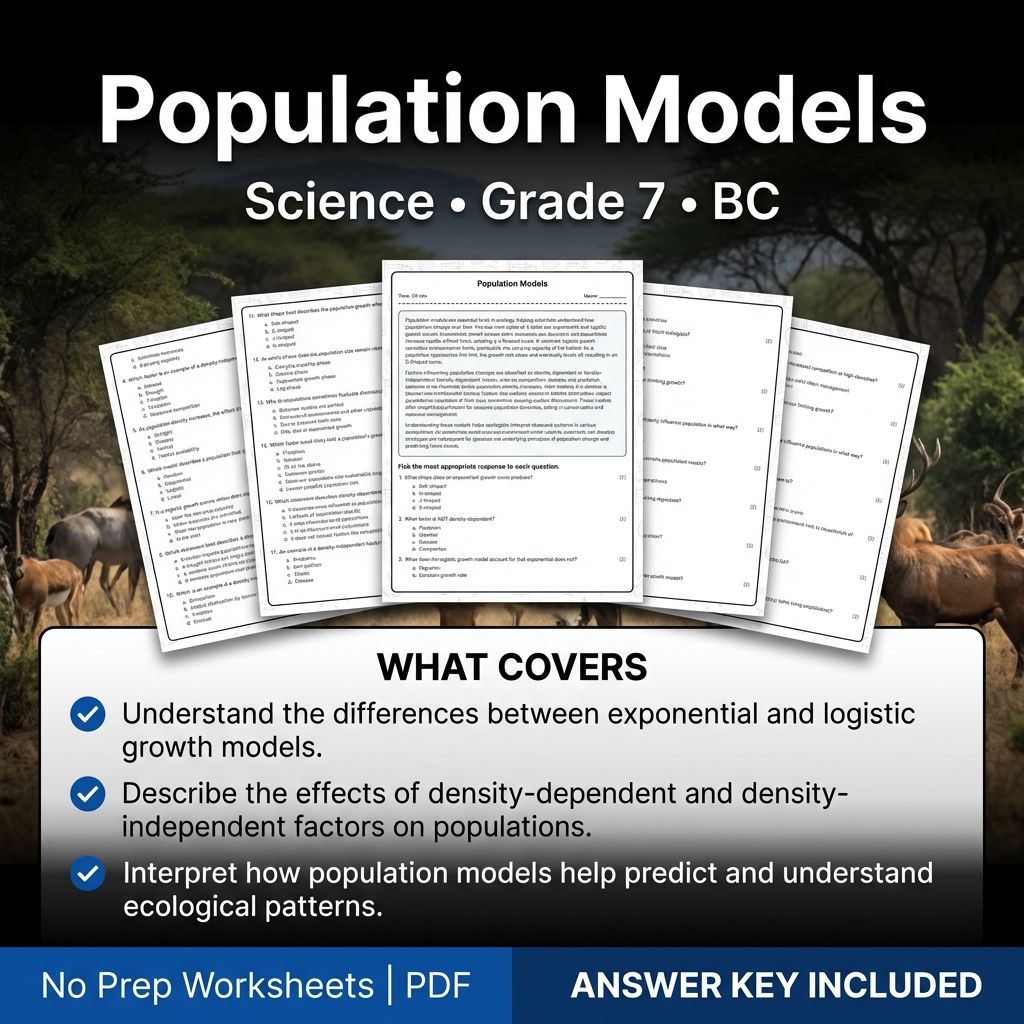
7th Grade Science Worksheet | Population Models Practice & Answer Key (Printable PDF)
Created byCoral Reef LearningLearning Objectives
- Understand the differences between exponential and logistic growth models.
- Describe the effects of density-dependent and density-independent factors on populations.
- Interpret how population models help predict and understand ecological patterns.
Instant download
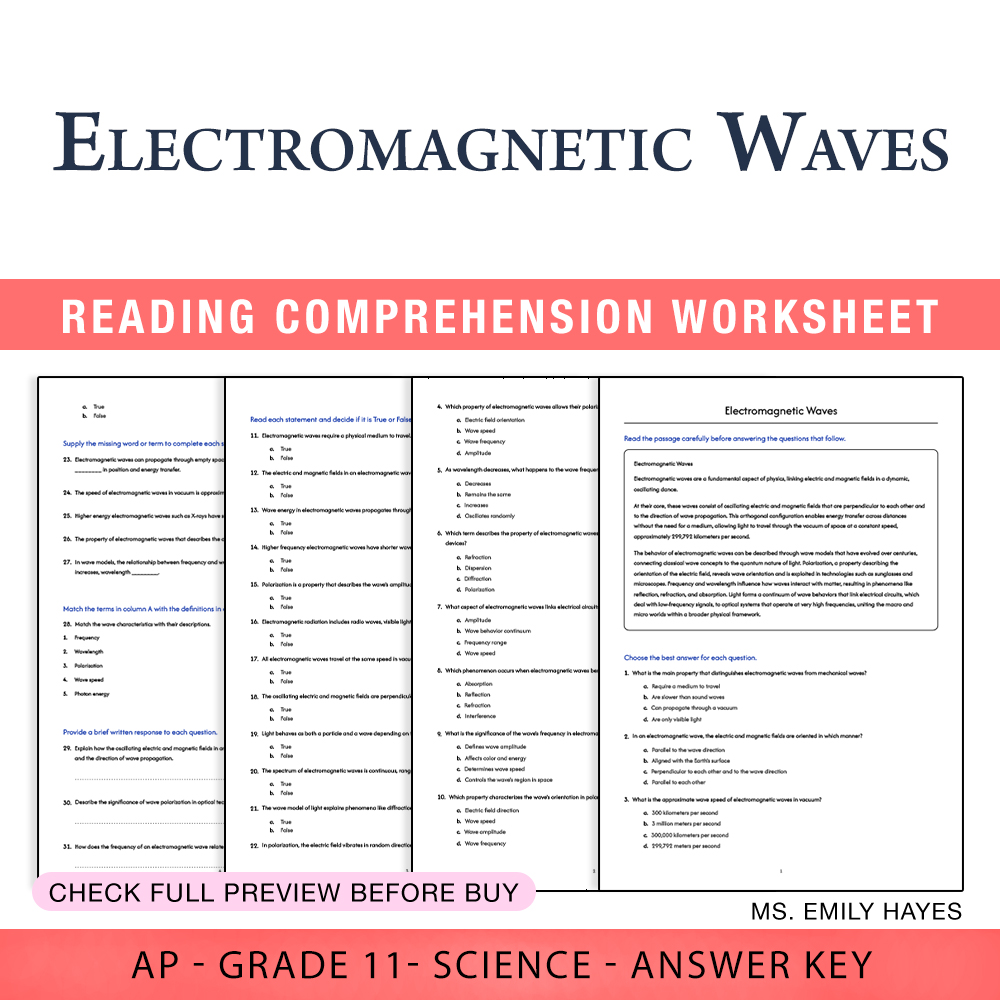
Grade 11 Science | Electromagnetic Waves Worksheet (PDF+ Answer Key)
Created byCopper Leaf ClassroomLearning Objectives
- Understand the oscillating nature of electric and magnetic fields in electromagnetic waves.
- Describe the wave structure and how electric and magnetic fields are oriented relative to each other.
- Explain the concept of wave speed in vacuum and how energy propagates via electromagnetic waves.
Also included in: Grade 11 Science | Physics Principles Worksheet Bundle (PDF+ Answer Key)) +1 more
Instant download

Grade 6 Science – Streamlining & Aerodynamics | Daily Reading Worksheet
Created byBright Mind ResourcesLearning Objectives
- Understand the basic principles of streamlining and how it reduces air resistance.
- Identify key design features that improve aerodynamic flow like tapered tails and rounded noses.
- Explain how shape affects pressure distribution and energy consumption in flight.
Also included in: Aerodynamics Grade 6 Science Daily Reading Worksheets Lesson Bundle | Alberta +2 more
Instant download
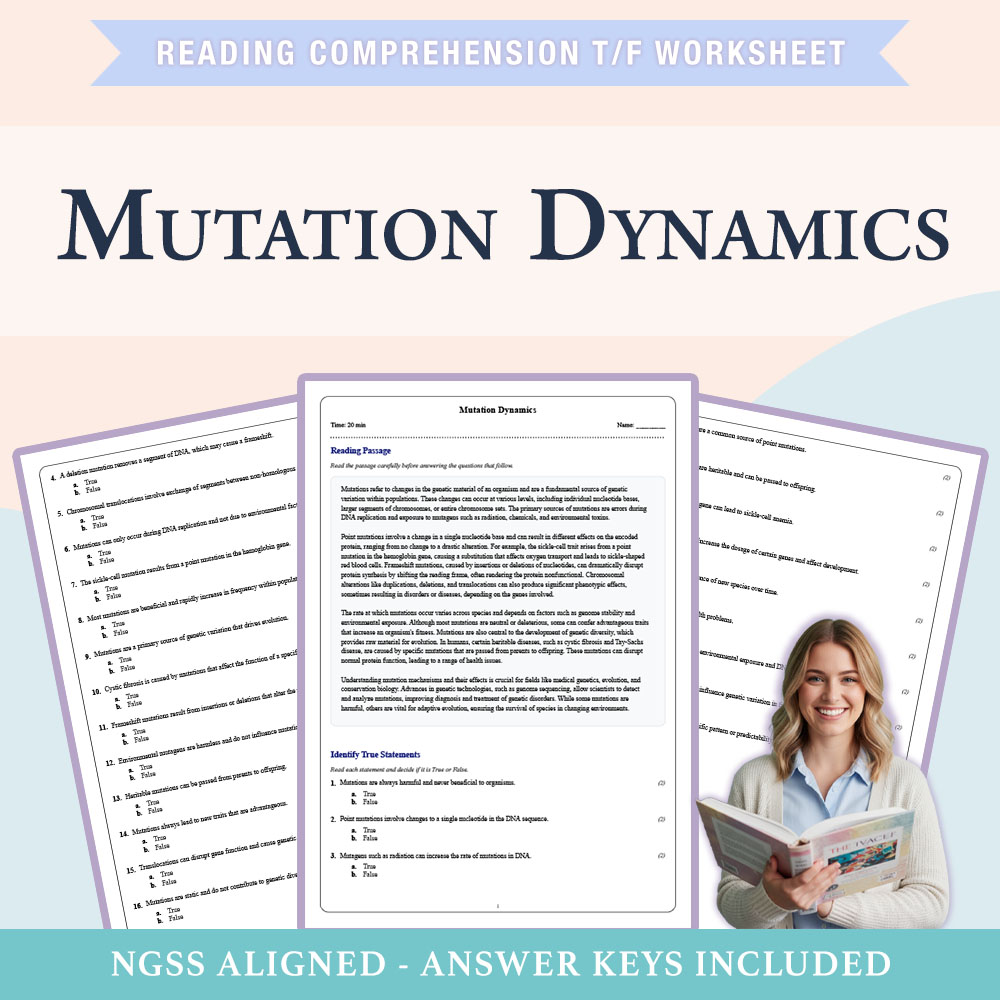
11th Grade Science | Mutation Dynamics Worksheet (PDF + Answer Key)
Created byCopper Leaf ClassroomLearning Objectives
- Understand the sources and mechanisms of genetic mutations and chromosomal alterations.
- Analyze the consequences of various mutation types on protein function and phenotypic traits.
- Evaluate the role of mutations in genetic diversity and heritable diseases within populations.
Also included in: Grade 11 Science | Genetics & Mutation Dynamics Bundle (PDF +Answer Keys) +1 more
Instant download
Browse more categories
About Science Worksheets
Find Science worksheets spanning core skills, practice, and review. All 44,295 resources are instant PDF downloads for the classroom or home.
Every worksheet on MyTeachingSheets is created by independent teacher-authors and reviewed before publication. All resources download as printable PDFs for classroom, homework, or at-home practice, and many include answer keys. Preview any worksheet free before buying.