
Science Worksheets
44,628 subject resources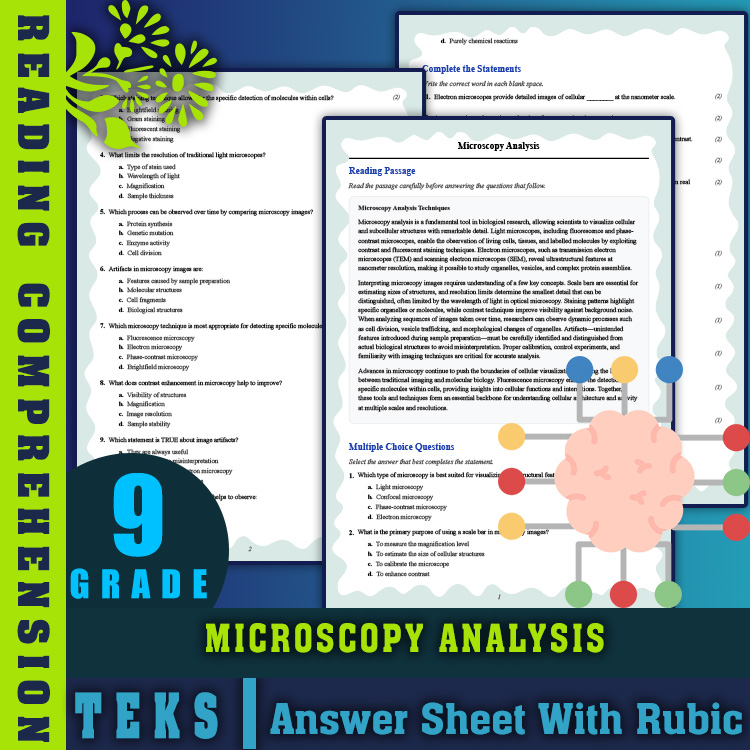
9th Grade Science | Microscopy Analysis Reading Worksheets (PDF + Rubric)
JCreated byJ.S SheetsLearning Objectives
- Interpret visual data from microscopy images, including scale bars and resolution limits.
- Identify cellular structures and processes using staining and contrast techniques.
- Differentiate between effects of artifacts and real biological features in microscopy images.
Instant download
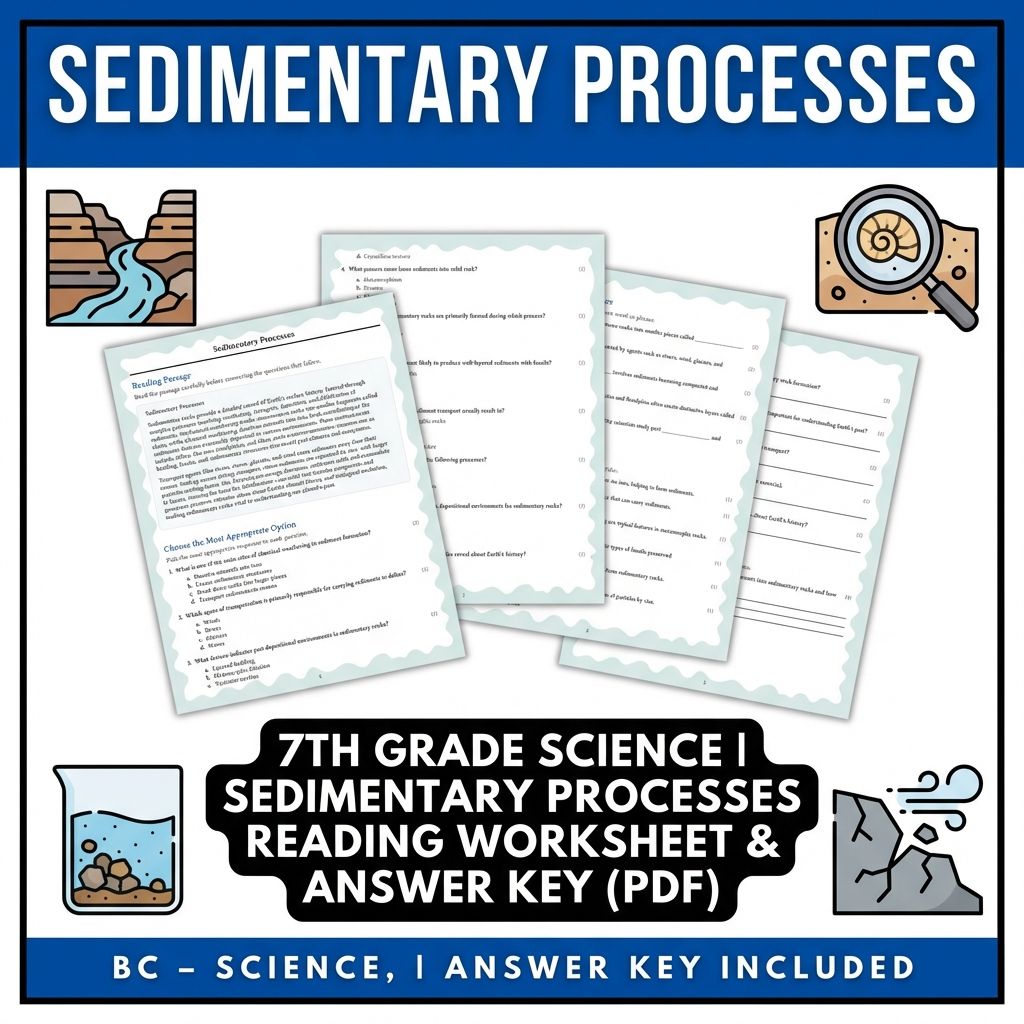
7th Grade Science | Sedimentary Processes Reading Worksheet & Answer Key (PDF)
JCreated byJ.S SheetsLearning Objectives
- Describe the key steps involved in the formation of sedimentary rocks.
- Identify different types of weathering and deposition environments.
- Explain how sediments are transported, sorted, and turned into rock through lithification.
Instant download

Explanation Development Worksheet | Grade 8 Science NGSSS Writing Key
 Created byEvergreen Desk Education
Learning Objectives
- Explain how scientific evidence supports a cause-and-effect relationship or a causal mechanism.
- Distinguish correlation from causation when developing scientific explanations.
- Use models and multiple lines of evidence to strengthen explanations about natural phenomena.
Instant download

Grade 12 Science | Energy Transformation Worksheet | NGSSS Aligned
 Created byLumora Learning
Learning Objectives
- Explain how mechanical and thermal energy change form during real physical interactions.
- Apply the concept of energy conservation to predict outcomes from initial and final energy states.
- Use observable quantities (speed, height, temperature) to identify likely energy transformations.
Instant download

Durability Factors Worksheet Grade 7 Science | Ontario STEM
 Created byChalk and Compass
Learning Objectives
- Explain how corrosion, rot and moisture uptake, freeze–thaw cycling, and UV degradation reduce material durability over time
- Describe protective measures (coatings, cathodic protection, concrete cover) that slow or prevent environmental damage
- Relate expected lifespan to service environment and maintenance/inspection routines for bridge decks and exterior roofing
Also included in: Grade 7 Science Structural Engineering Design & Materials Lesson Bundle |Ontario +1 more
Instant download
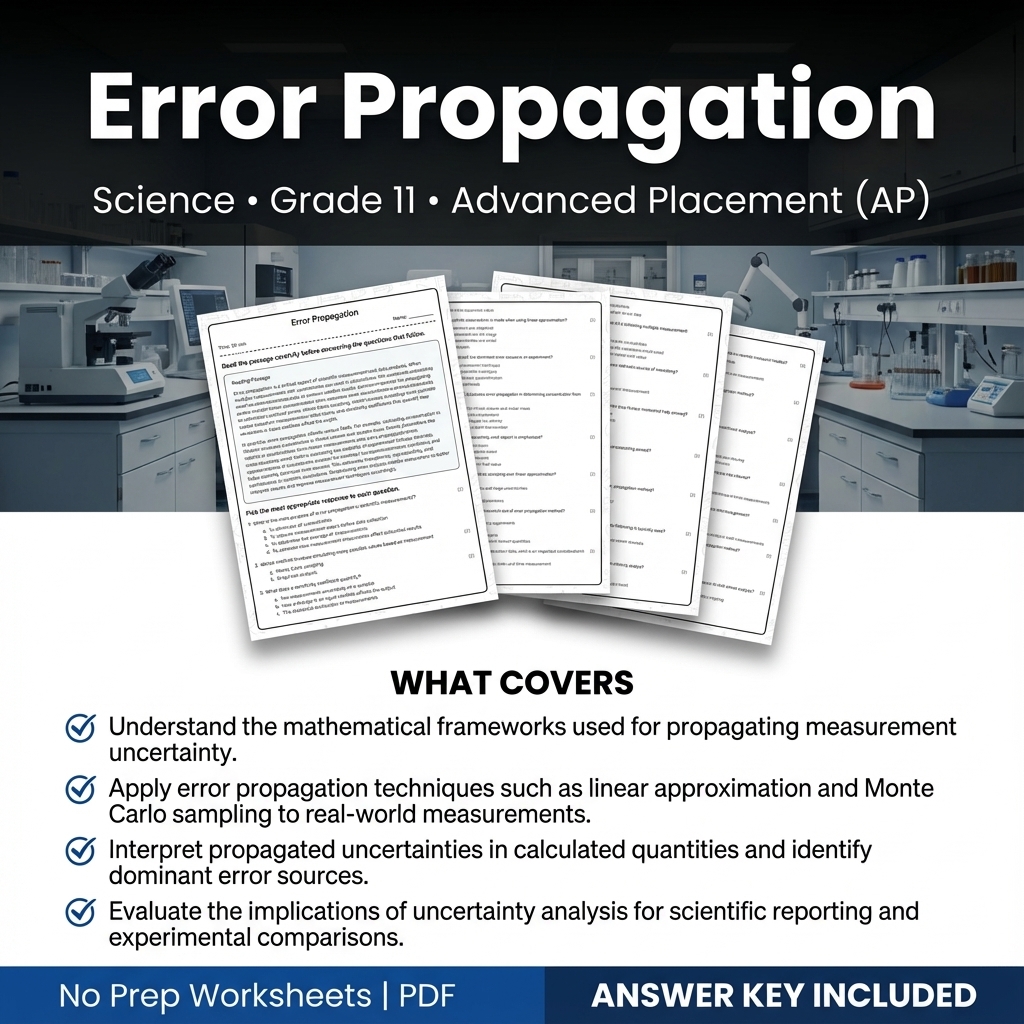
11th Grade Science | Error Propagation Worksheet (Printable PDF + Answer Key)
 Created byCoral Reef Learning
Learning Objectives
- Understand the mathematical frameworks used for propagating measurement uncertainty.
- Apply error propagation techniques such as linear approximation and Monte Carlo sampling to real-world measurements.
- Interpret propagated uncertainties in calculated quantities and identify dominant error sources.
Also included in: Grade 11 Science Unit | Scientific Analysis & Data Skills Worksheet Pack +1 more
Instant download
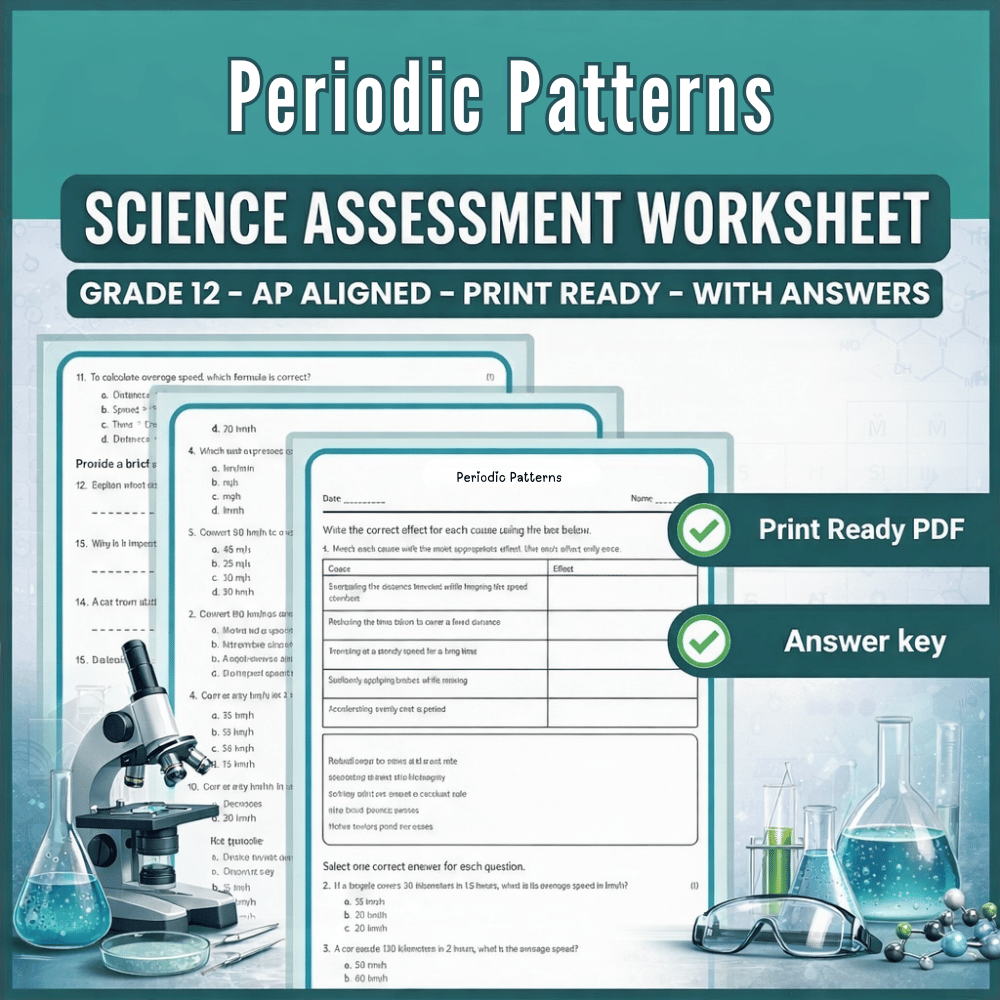
Grade 12 Science | Periodic Patterns AP Worksheet (PDF) for Science
 Created byBright Mind Resources
Learning Objectives
- Understand how properties such as atomic radius, ionization energy, electronegativity, and effective nuclear charge vary across the periodic table.
- Relate periodic trends to electronic structure and observable chemical properties like metallic character and reactivity.
- Interpret tabular and graphical data to predict element behavior based on their position in the periodic table.
Instant download

Grade 9 Inherited Trait Origins Worksheet | Practice & PDF
 Created byClear Sky Classroom
Learning Objectives
- Explain how meiosis and sexual reproduction form gametes that carry inherited alleles
- Describe how genetic variation arises from chromosome combinations and heritable mutations
- Connect the behavior of chromosomes and DNA information to patterns of trait inheritance
Instant download

Grade 11 Science – Adaptive Radiation Worksheet (TEKS) (PDF)
Created byEvergreen Desk EducationLearning Objectives
- Explain how adaptive radiation leads to rapid diversification from a single ancestral lineage into multiple species
- Describe how ecological niches and key innovations drive niche partitioning and specialization
- Interpret how phylogenetic patterns can support adaptive radiation as an evolutionary process
Instant download

Sun Earth Moon Assessment Printable Worksheet | Grade 6 Science
 Created byPrism Point Learning
Learning Objectives
- Describe the relative sizes, masses, and mean distances of the Sun, Earth, and Moon.
- Explain how gravitational interactions shape orbital motion and why stable orbits can form.
- Describe how the Earth–Moon barycenter influences their mutual motion and how the Sun dominates the system’s overall gravity.
Also included in: Grade 6 Space Systems Science Lesson Bundle for Ontario (10 Worksheets)
Instant download
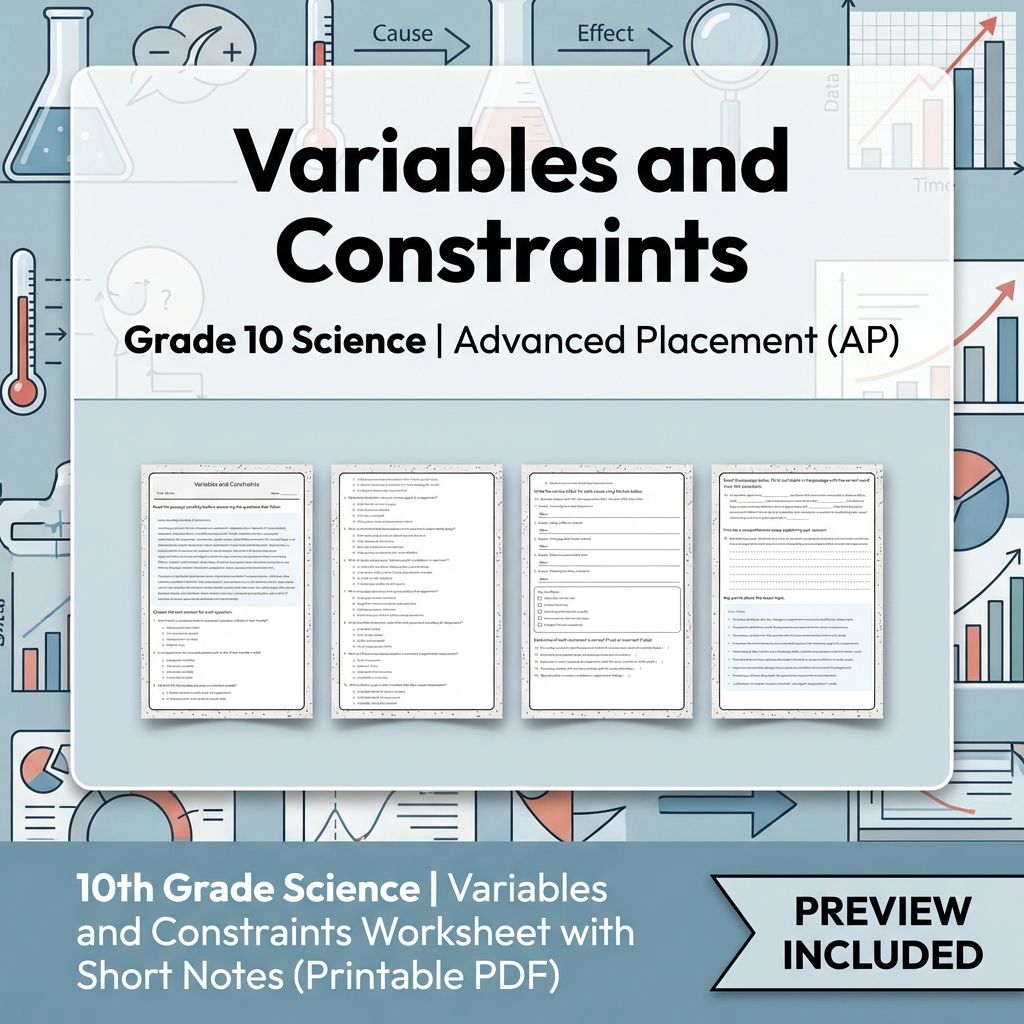
10th Grade Science | Variables and Constraints Worksheet with Short Notes (PDF)
 Created byMeadowlark Worksheets
Learning Objectives
- Classify variables into independent, dependent, and controlled factors in experiments.
- Understand the importance of boundary conditions and operational definitions in scientific measurements.
- Analyze the criteria used to select variables that isolate causal relationships.
Also included in: Grade 10 Science Unit | Data Analysis, Modelling Worksheet Pack
Instant download
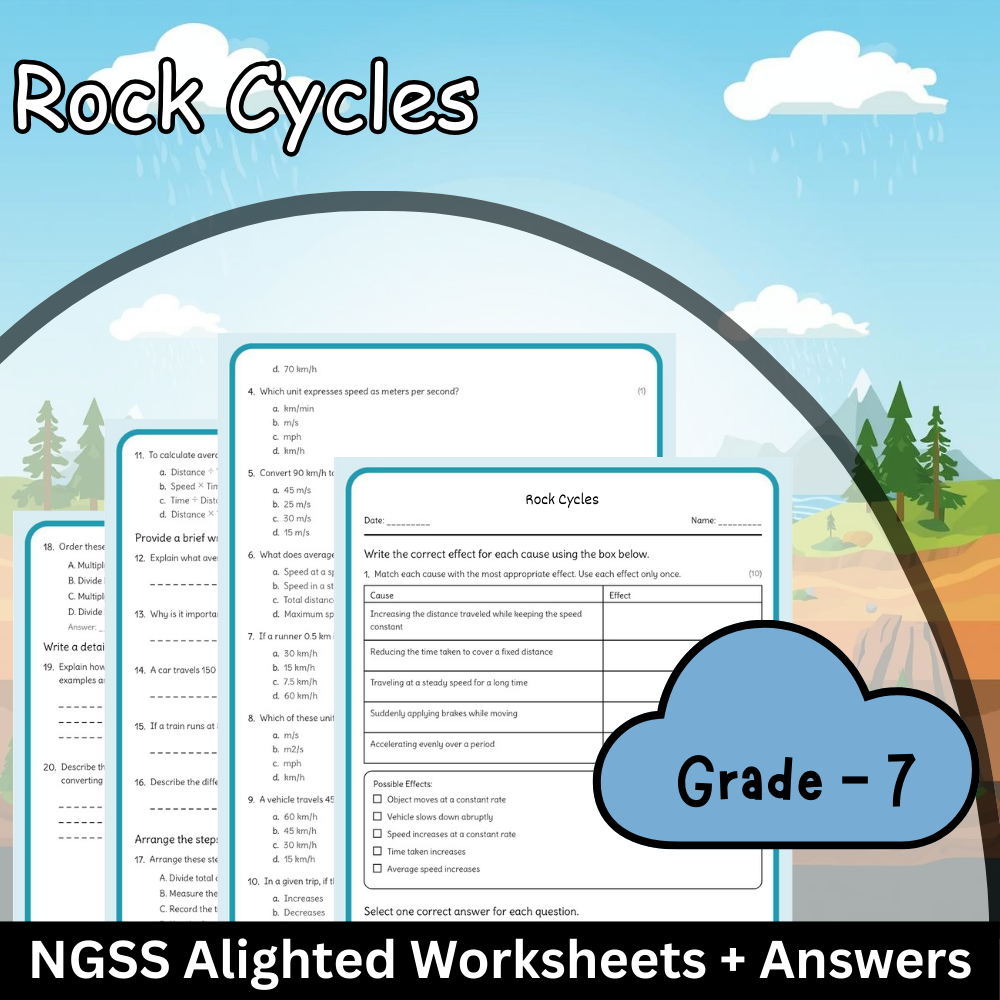
7th Grade Science | Rock Cycles Worksheet (NGSS aligned) – Science (PDF)
Created byBright Mind ResourcesLearning Objectives
- Understand the processes involved in the rock cycle, including melting, crystallization, weathering, and metamorphism.
- Identify canonical examples of geological transformations among igneous, sedimentary, and metamorphic rocks.
- Explain the material pathways and timescales in Earth's rock transformations.
Instant download
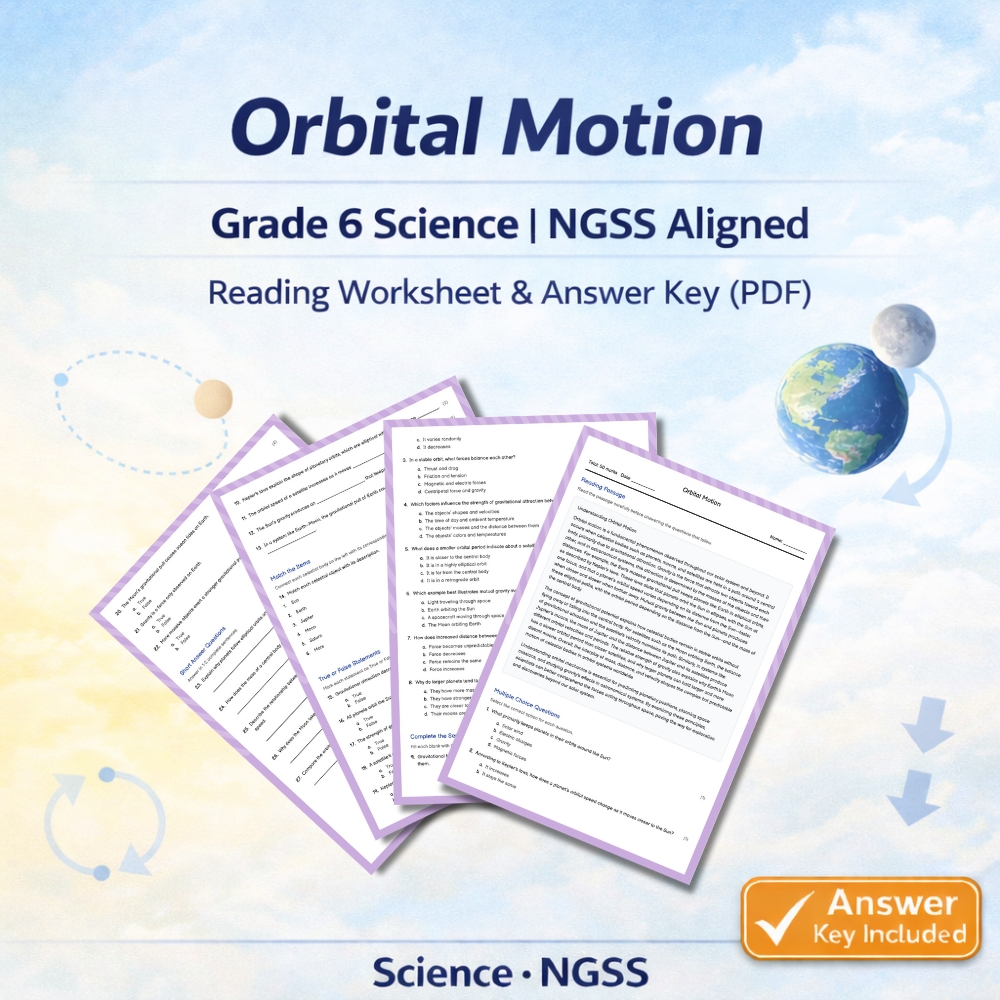
6th Grade Science | Orbital Motion | NGSS ( Worksheet + Answer Key )
 Created byCedar Grove Learning
Learning Objectives
- Explain how gravitational attraction governs planetary motion and orbital paths within the solar system.
- Describe the relationship between mass, distance, and the strength of gravitational forces in orbital systems.
- Compare different orbital systems such as Earth–Moon and Jupiter–satellite to understand relative influences.
Also included in: Grade 6 Science Unit Bundle | Space, Motion & Earth Cycles NGSS Worksheets +1 more
Instant download
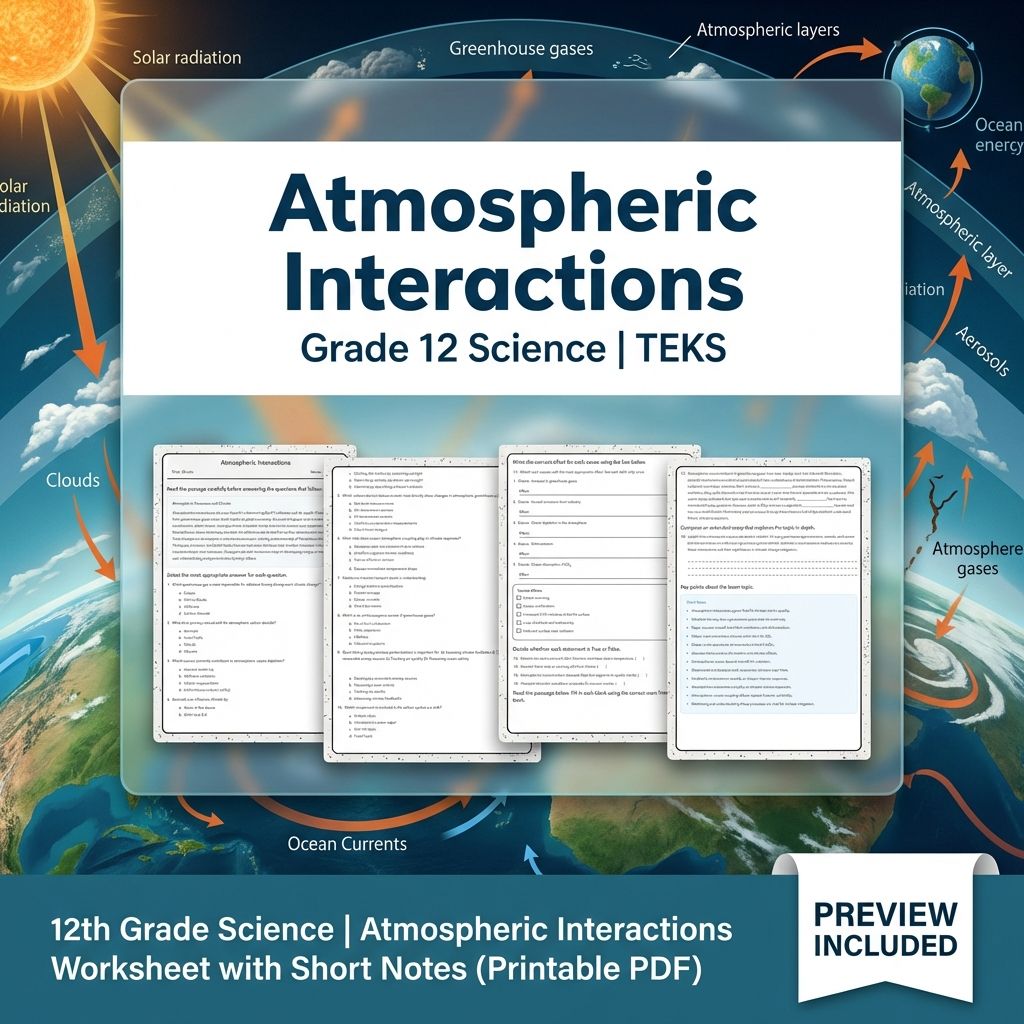
12th Grade Science | Atmospheric Interactions Worksheet with Short Notes (PDF)
Created byMeadowlark WorksheetsLearning Objectives
- Understand key atmospheric processes influencing climate and air quality.
- Interpret observational datasets related to atmospheric concentrations and emissions.
- Explain concepts such as radiative forcing, greenhouse gases, aerosols, and ozone chemistry.
Also included in: Grade 12 Science Unit | Environmental Management & Biodiversity Worksheets +2 more
Instant download

Grade 10 Worksheet B: Reaction Rates (Collision Theory & Rate Laws) | NGSS
Created byClear Sky ClassroomLearning Objectives
- Explain how collision theory and activation energy affect reaction rate.
- Predict how changes in temperature, concentration, surface area, and catalysts influence reaction speed.
- Connect molecular collision frequency to observed rate constants using quantitative reasoning.
Also included in: Grade 10 Reaction Rates & Chemical Change Science Lesson Bundle – NGSS +1 more
Instant download
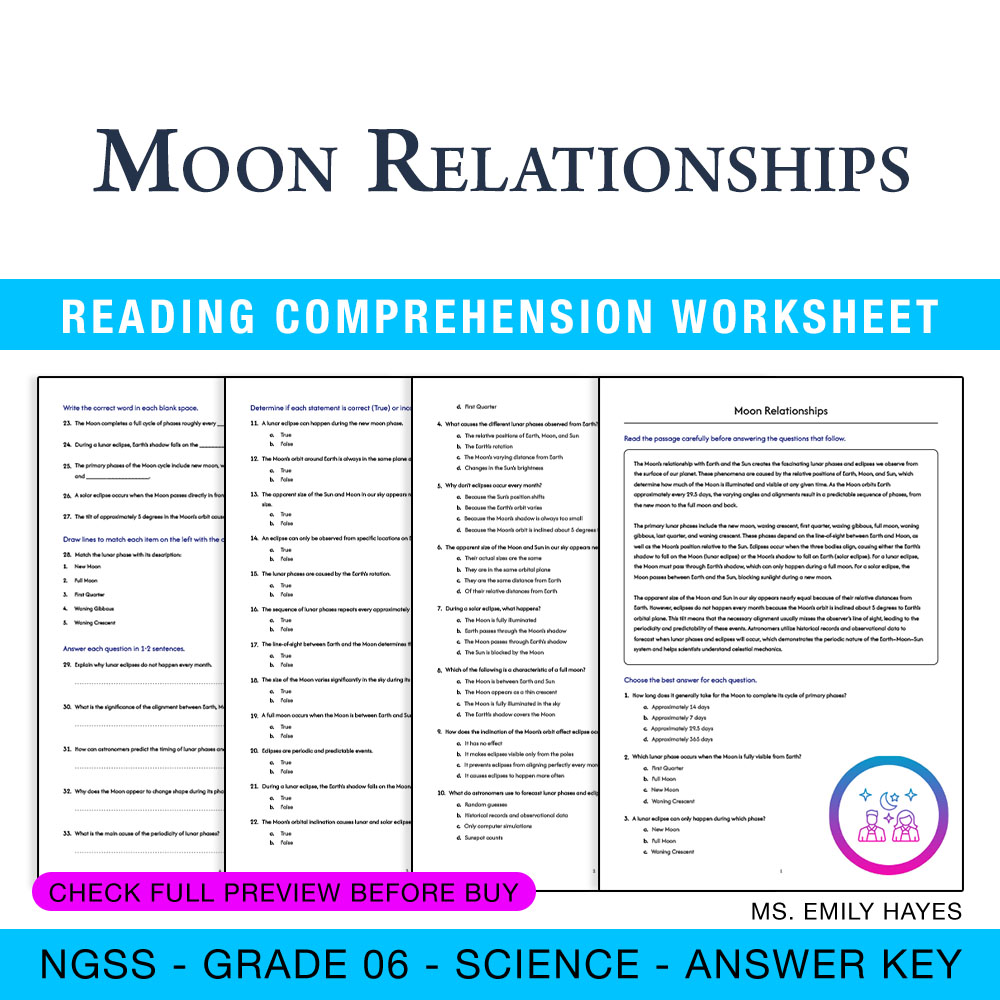
6th Grade Science | Moon Relationships Worksheet (PDF + Answer Key)
 Created byCopper Leaf Classroom
Learning Objectives
- Describe the geometric relationships among Earth, Moon, and Sun that produce lunar phases and eclipses.
- Explain the sequence of primary lunar phases and conditions for solar and lunar eclipses.
- Identify the apparent size and alignment constraints involved in lunar phenomena.
Also included in: Grade 6 Science Unit Bundle | Space, Moon & Seasons (PDF + Answer Key)
Instant download

Grade 9 Science Worksheet on Energy Pathways – AP Standards Practice (PDF)
Created byEvergreen Desk EducationLearning Objectives
- Explain how radiative balance, conduction, latent heat, and convection move energy through the atmosphere and oceans.
- Interpret global energy budget ideas using flux comparisons and diagrams to predict circulation patterns.
- Connect energy partitioning to observable climate indicators like surface temperature distributions and sea surface temperature anomalies.
Also included in: Earth Systems & Climate Grade 9 Science Lesson Bundle AP Worksheets +1 more
Instant download

Grade 9 Science | Ocean–Atmosphere Coupling Worksheet (AP Standards) (PDF)
Created byEvergreen Desk EducationLearning Objectives
- Explain how changes in sea surface temperature (SST) can influence atmospheric convection and winds.
- Describe how ENSO works as a canonical example of ocean–atmosphere coupling and why its effects are delayed.
- Use lag-correlation and teleconnection ideas to relate ocean states to regional climate patterns.
Also included in: Earth Systems & Climate Grade 9 Science Lesson Bundle AP Worksheets +1 more
Instant download

Grade 9 Science – Integrated Modeling Worksheet (AP Standards) (PDF)
Created byEvergreen Desk EducationLearning Objectives
- Explain how integrated models couple geosphere, hydrosphere, atmosphere, and biosphere processes using variables and parameters.
- Identify how model structure affects outputs when testing parameter sensitivity and scenario assumptions.
- Describe how uncertainty can be propagated to produce indicator-based predictions for environmental change.
Also included in: Earth Systems & Climate Grade 9 Science Lesson Bundle AP Worksheets +1 more
Instant download

Grade 9 Science | Rock Cycle Worksheet (AP Standards + Answer Key) (PDF)
Created byEvergreen Desk EducationLearning Objectives
- Explain how melting, crystallization, weathering, transport, deposition, and metamorphism transform rock materials.
- Distinguish physical vs. chemical mechanisms that drive changes in rock at the surface and in the crust.
- Connect rock-cycle processes to tectonic settings such as mid-ocean ridges, subduction zones, and continental interiors.
Also included in: Earth Systems & Climate Grade 9 Science Lesson Bundle AP Worksheets +1 more
Instant download

Grade 9 Science | Spheres Connectivity Worksheet (AP) PDF
Created byEvergreen Desk EducationLearning Objectives
- Describe how materials and energy move between the geosphere, hydrosphere, atmosphere, and biosphere using conceptual models.
- Use mass-balance thinking and causal chains to explain coupled Earth-system phenomena (e.g., nutrient transport, gas flux, ocean upwelling).
- Interpret surface processes as signals that can change over time using baseline representations.
Also included in: Earth Systems & Climate Grade 9 Science Lesson Bundle AP Worksheets +1 more
Instant download

Grade 9 Science | Volcanic Processes Worksheet (AP Standards) (PDF)
Created byEvergreen Desk EducationLearning Objectives
- Explain how magma composition, viscosity, and dissolved volatiles control eruption style and hazard potential.
- Compare effusive shield volcanoes with explosive stratovolcanoes using tectonic setting and depositional products.
- Interpret how volcanic gas emissions and climate impacts connect to long-term atmospheric and biogeochemical changes.
Also included in: Earth Systems & Climate Grade 9 Science Lesson Bundle AP Worksheets +1 more
Instant download
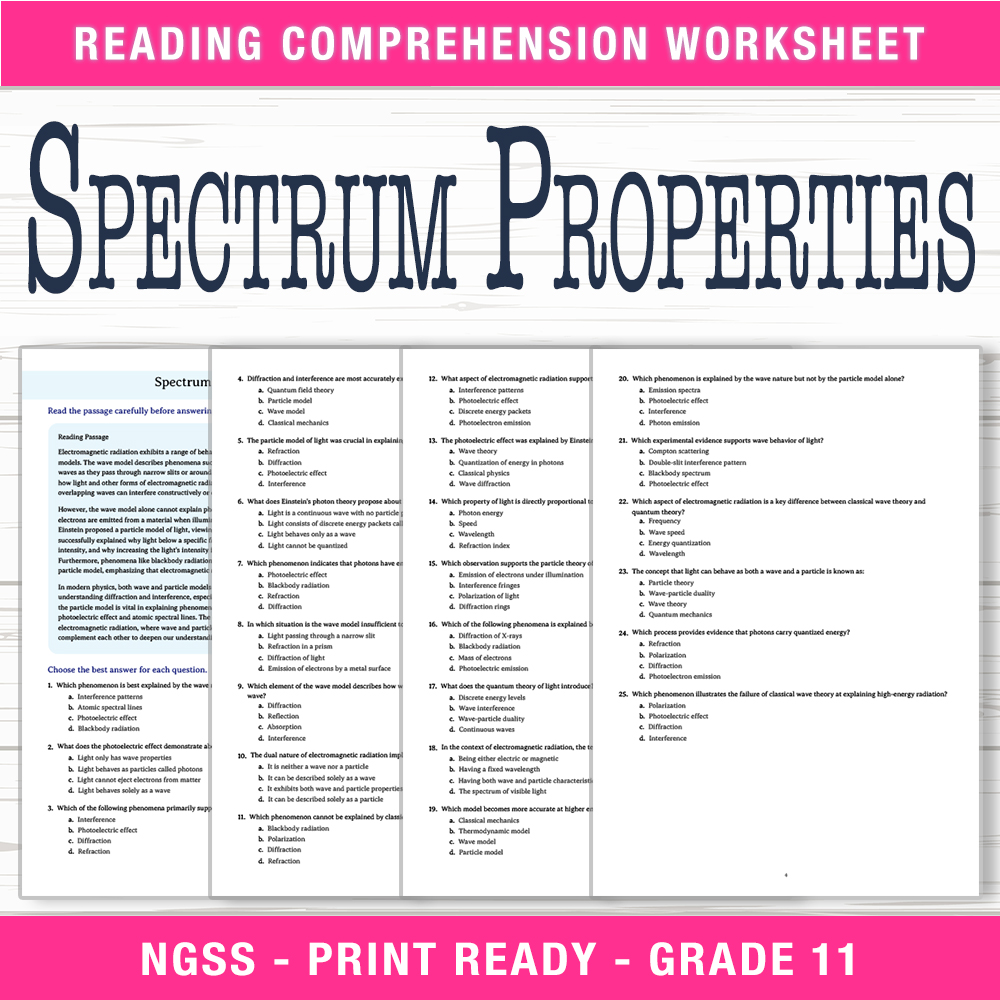
Grade 11 Science | Spectrum Properties Worksheet (PDF + Answer Key)
 Created byRiverstone Classroom
Learning Objectives
- Evaluate evidence supporting wave and particle models of electromagnetic radiation.
- Explain the contexts in which each model accurately describes phenomena and where they break down.
- Analyze phenomena such as interference, diffraction gratings, and the photoelectric effect to distinguish between models.
Instant download

Cosmic Expansion Evidence Worksheet | Grade 12 Space Science NGSSS
Created byPrism Point LearningLearning Objectives
- Explain how galaxy redshifts provide evidence for the expansion of the universe
- Connect spectral line stretching (increasing wavelength) to observable redshift
- Use the distance–redshift relationship to describe how expansion has evolved over time
Also included in: Earth and Space Science Lesson Bundle | Grade 12 Science | Florida NGSSS
Instant download
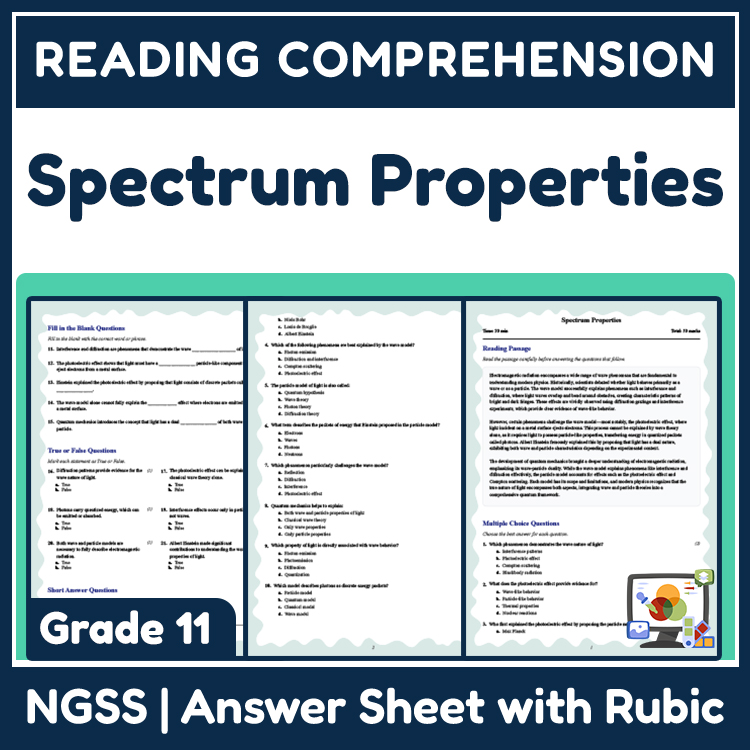
Grade 11 Science | Spectrum Properties Reading Worksheet & Answer Key (PDF)
JCreated byJ.S SheetsLearning Objectives
- Evaluate the evidence for wave and particle models of electromagnetic radiation.
- Describe phenomena such as interference, diffraction gratings, and the photoelectric effect.
- Explain where wave and particle models of electromagnetic radiation work and where they break down.
Instant download

Grade 6 Human Impacts: Deforestation & Carbon Cycles Worksheet | NGSS
 Created byBRIGHT PATH RESOURCES
Learning Objectives
- Understand how deforestation affects carbon storage in forests.
- Identify the environmental consequences of reducing tree populations.
- Analyze causality between human land use and changes in Earth's biogeochemical cycles.
Also included in: Earth & Human Activity Grade6 Science Daily Reading WorksheetsLesson Bundle|NGSS +2 more
Instant download
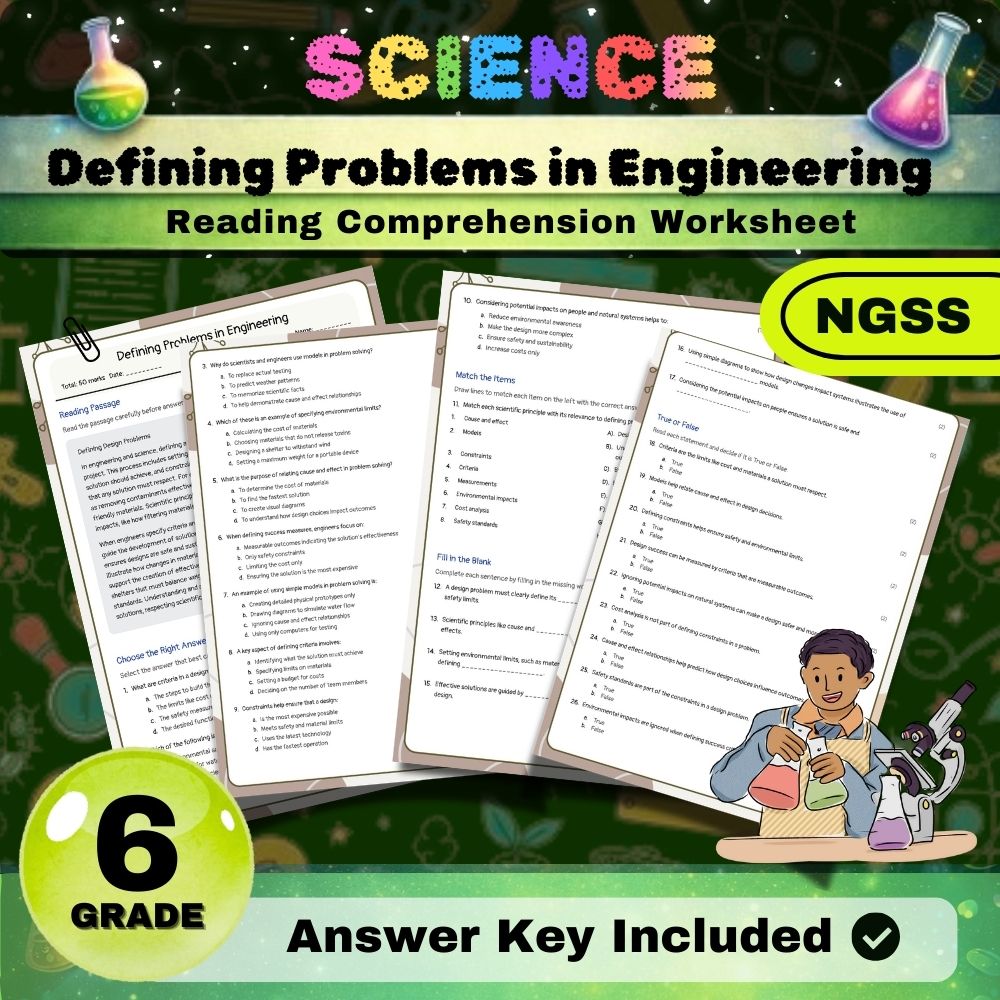
Grade 6 Science | Defining Problems in Engineering NGSS Worksheet (PDF)
 Created byMaple Path Learning
Learning Objectives
- Explain how to define criteria and constraints for a design problem.
- Identify scientific principles and models used to relate cause and effect in problem-solving.
- Apply understanding of criteria, constraints, and scientific principles to real-world examples.
Also included in: Grade 6 Science Engineering Design Unit | NGSS Worksheets Pack +1 more
Instant download
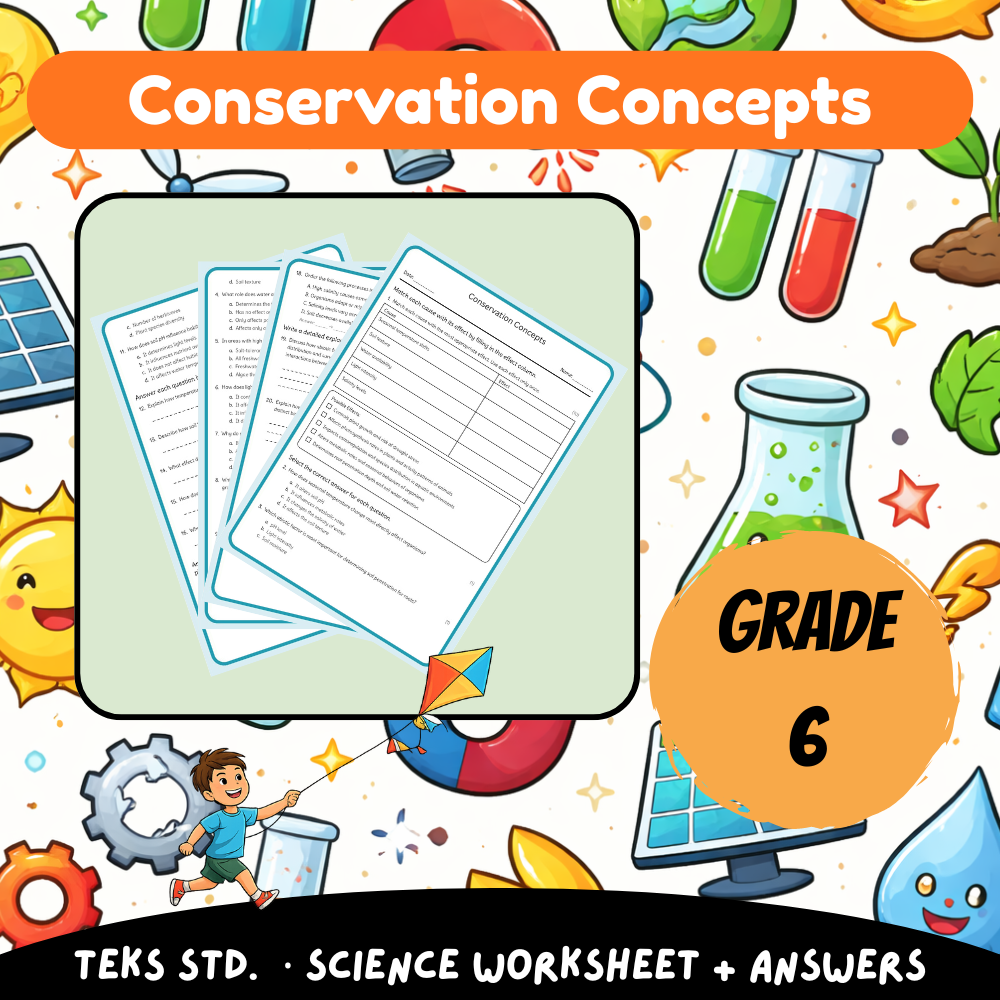
6th Grade Science | Conservation Concepts Worksheet (PDF) – TEKS-Aligned
Created byBright Mind ResourcesLearning Objectives
- Understand the principles of mass conservation in closed systems during physical and chemical changes.
- Identify examples of conservation and non-conservation in real-world scenarios.
- Describe how measurements before and after processes support conservation principles.
Instant download

Grade 7 Science | Population Basics Worksheet | BC-Aligned
Created byLumora LearningLearning Objectives
- Understand the fundamental concepts of population including size, density, and distribution.
- Identify factors affecting population growth and decline.
- Explain how demographic and environmental factors influence populations over time.
Instant download

Grade 7 Science | Trophic Efficiency Worksheet | BC Aligned
Created byLumora LearningLearning Objectives
- Understand the concept of trophic efficiency and energy transfer in ecosystems.
- Explain why energy diminishes at higher trophic levels.
- Identify the visual representation of energy flow in food chains.
Instant download

Grade 7 Science | Keystone Species Worksheet | BC Standards
Created byLumora LearningLearning Objectives
- Understand the concept of keystone species and their impact on ecosystems.
- Identify examples of keystone species and their roles in maintaining ecological balance.
- Analyze how removal or decline of keystone species can affect food webs and biodiversity.
Instant download

Grade 7 Science | Producers and Consumers Worksheet | BC Aligned
Created byLumora LearningLearning Objectives
- Describe the roles of producers and consumers in an ecosystem.
- Explain how energy transfer occurs between trophic levels and why it is inefficient.
- Understand the structure of energy pyramids and population dynamics within a food web.
Instant download

Genetic Traits Evidence Assessment | General Grade 8 Science Standards
Created byPrism Point LearningLearning Objectives
- Understand how observable traits are influenced by genetic instructions and gene variations.
- Explain patterns of dominant and recessive traits and their inheritance across generations.
- Analyze how similarities among related organisms provide evidence of heredity.
Also included in: Grade 8 Life Science Science Lesson Bundle – General Framework Resources
Instant download

Grade 9 Science – Law of Conservation & Reactions | Daily Reading Worksheet
Created byBright Mind ResourcesLearning Objectives
- Define the law of conservation of mass
- Explain how mass is conserved during chemical reactions
- Identify balanced chemical equations that demonstrate mass conservation
Also included in: Grade 9 Chemical Reactions Science Lesson Bundle: Daily Reading (BC) +1 more
Instant download
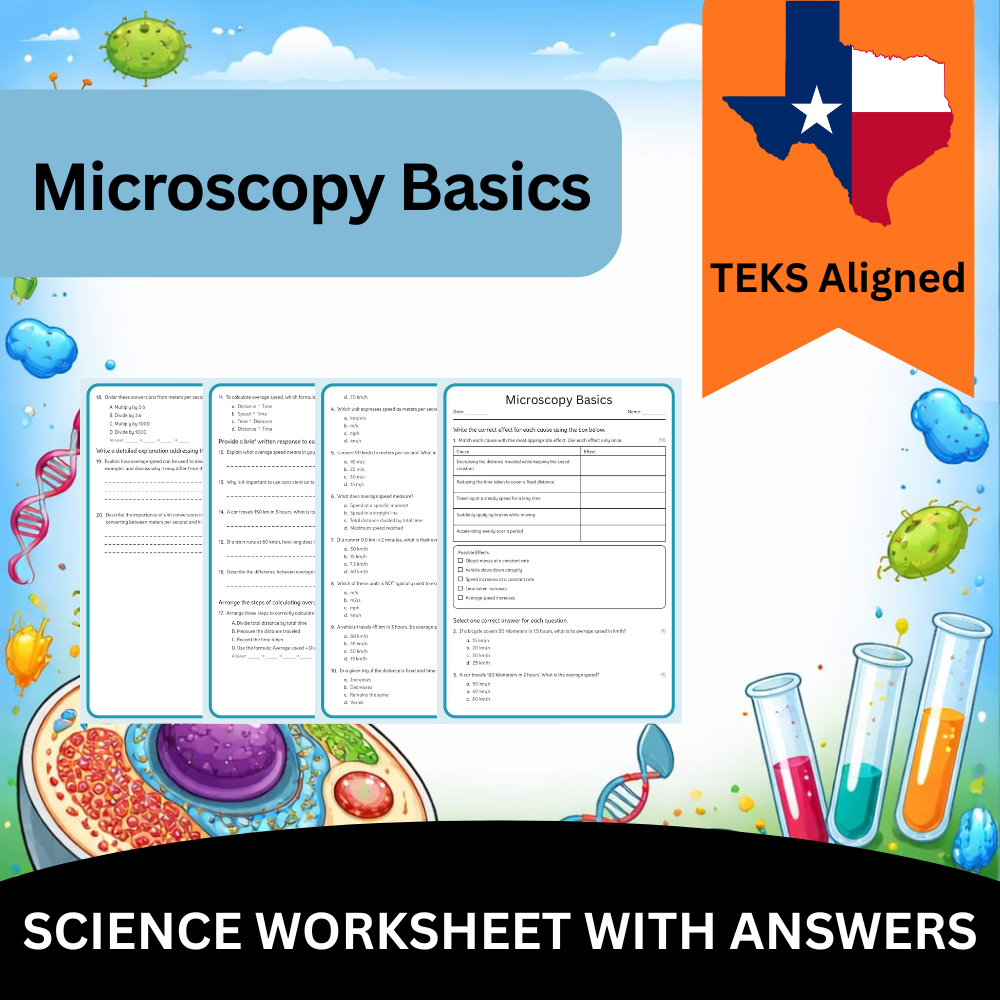
Grade 9 Science | Microscopy Basics Worksheet – TEKS Standards (PDF)
Created byBright Mind ResourcesLearning Objectives
- Understand the principles of optical and electron microscopy.
- Identify the differences between magnification, resolution, and contrast.
- Learn how to interpret microscope images with scale bars and artifacts.
Also included in: Grade 9 Science Unit | Cell Structures & Transport Mechanisms Pack(TEKS-Aligned) +3 more
Instant download
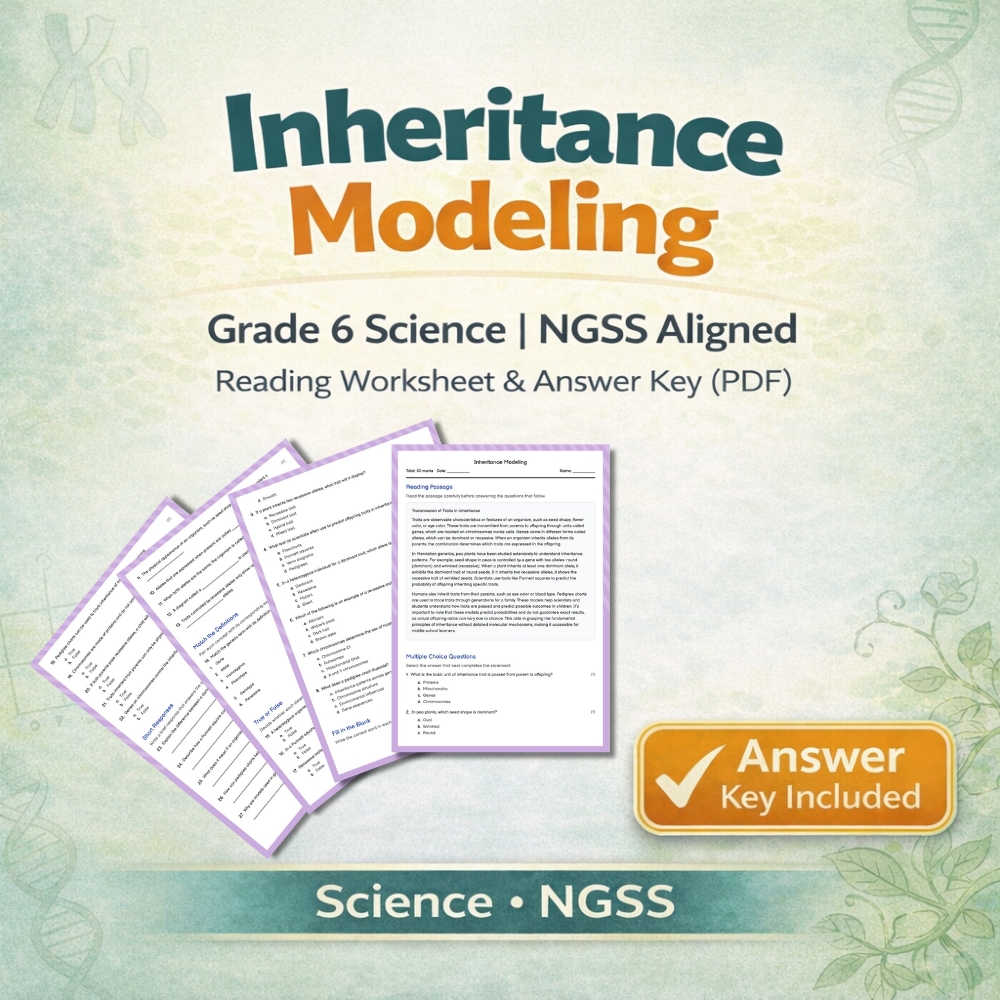
6th Grade Science | Inheritance Modeling | Worksheet & Answer Key (NGSS Aligned)
Created byCedar Grove LearningLearning Objectives
- Understand that traits are transmitted from parents to offspring through genes located on chromosomes.
- Model inheritance patterns using Punnett squares and simple probability.
- Distinguish between dominant and recessive traits through classical Mendelian examples.
Also included in: Grade 6 Science Unit Bundle | Variation Factors & Inheritance NGSS Worksheets +1 more
Instant download
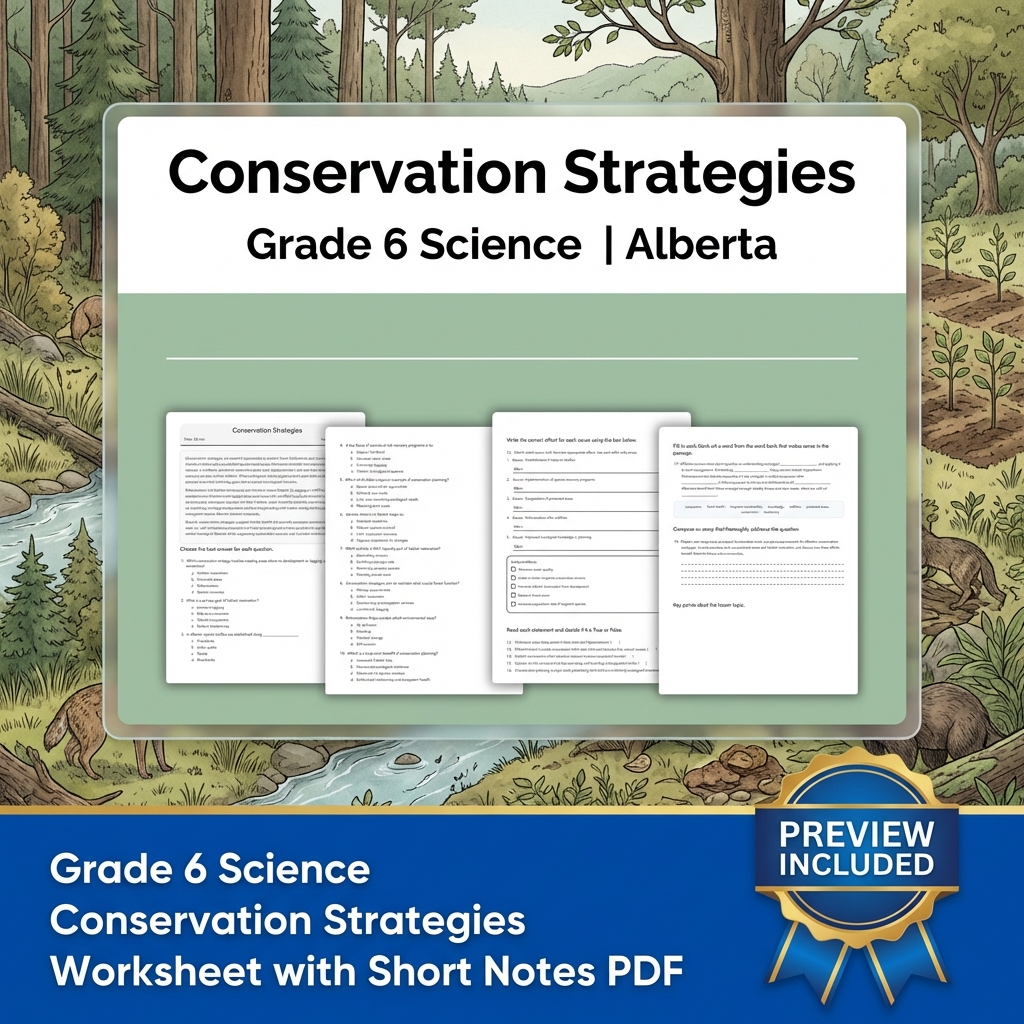
Grade 6 Science Conservation Strategies Worksheet with Short Notes PDF
Created byMeadowlark WorksheetsLearning Objectives
- Understand various conservation strategies used to protect forest biodiversity.
- Identify examples of conservation planning in Alberta landscapes.
- Explain how habitat protection supports ecological functions and species survival.
Also included in: Grade 6 Science | Trees and Forests Unit Worksheet Bundle – Alberta Curriculum +1 more
Instant download

Grade 8 Science | Measurement Practices Worksheet | NGSSS Aligned
Created byLumora LearningLearning Objectives
- Explain why accurate and precise measurements matter in science investigations.
- Choose appropriate tools and units to measure a physical quantity and record results consistently.
- Describe how significant figures and calibration reduce measurement error.
Instant download
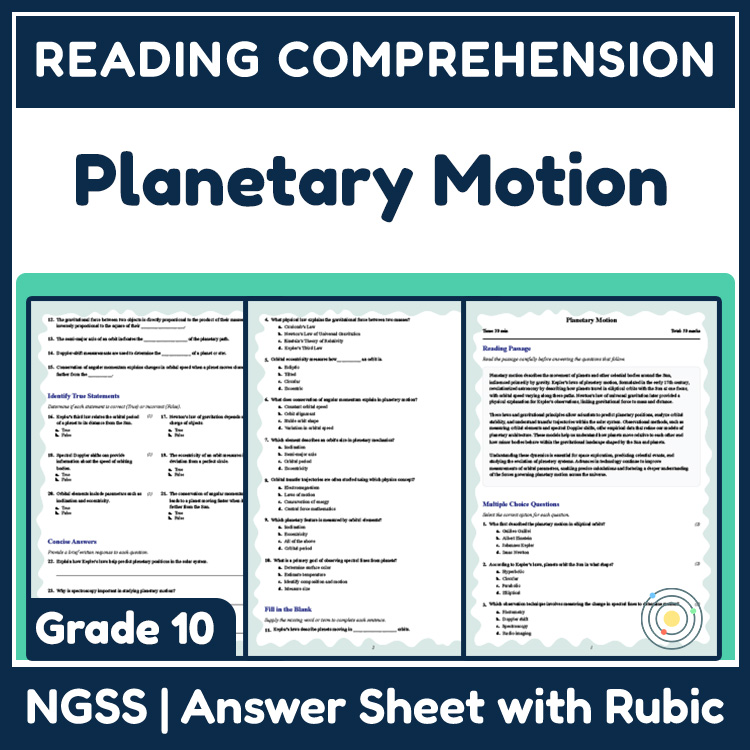
10th Grade Science | Planetary Motion Reading Worksheet with Answer Key (PDF)
JCreated byJ.S SheetsLearning Objectives
- Understand the principles of gravitational dynamics governing planetary orbits
- Explain Kepler's laws and their application to planetary motion
- Relate orbital elements such as eccentricity and semi-major axis to planetary trajectories
Instant download
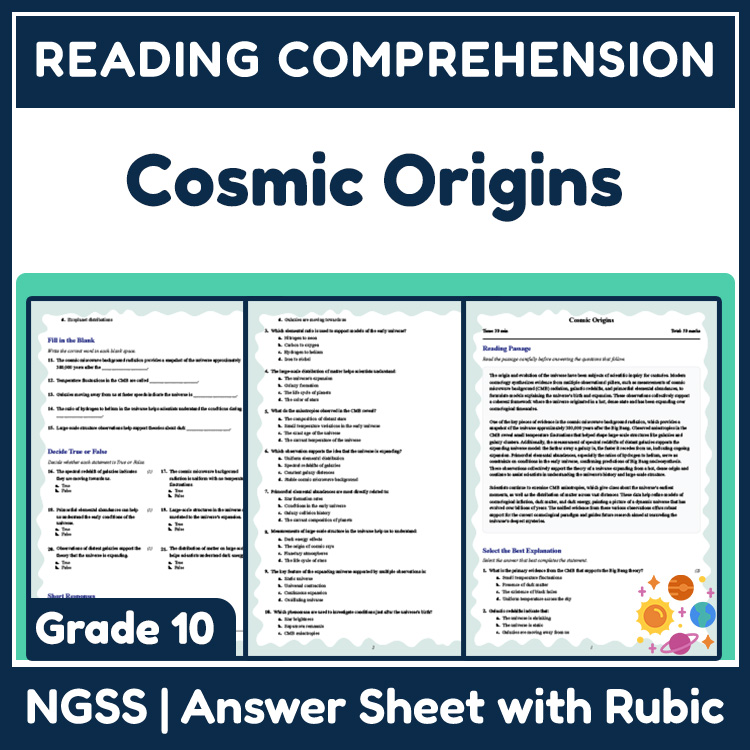
10th Grade Science | Cosmic Origins Reading Worksheets (PDF + Answer Key)
JCreated byJ.S SheetsLearning Objectives
- Understand the evidence supporting models of cosmic origin such as CMB radiation, galactic redshifts, and elemental abundances.
- Explain how measurements like spectral redshift and large-scale structures support the expanding universe theory.
- Describe what CMB anisotropies and hydrogen-to-helium ratios reveal about conditions in the early universe.
Instant download
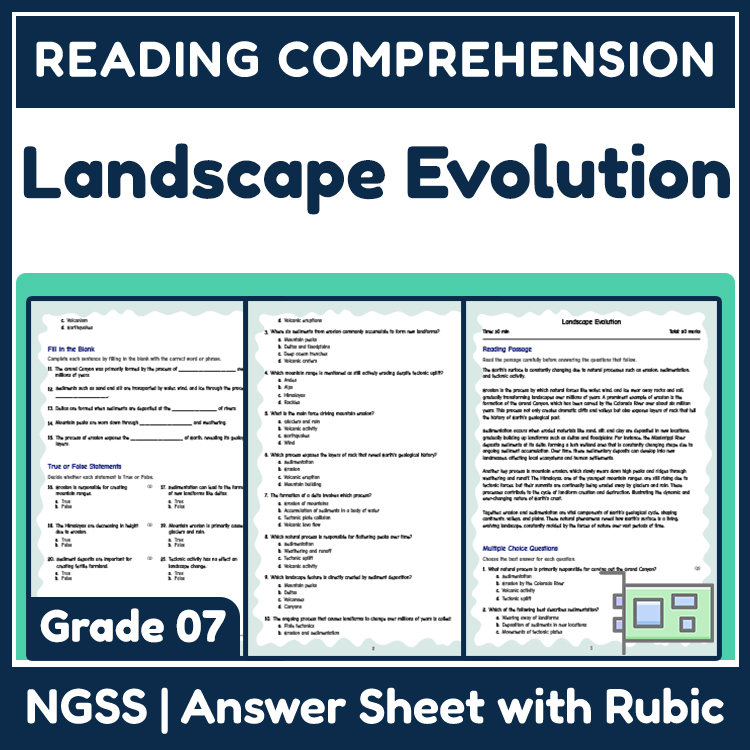
7th Grade Science | Landscape Evolution Reading Worksheets (Answer Key Included)
JCreated byJ.S SheetsLearning Objectives
- Understand how erosion and sedimentation shape Earth's surface over time
- Identify processes like river meandering, delta formation, and mountain erosion
- Connect these processes to Earth's geological cycle and landscape changes
Instant download

Resource Limits Worksheet | NGSS Grade 6 Ecology Activity & Doodle Notes
 Created byAmber Owl Education
Learning Objectives
- Explain how limiting resources (like water, soil nutrients, and light) affect individual organisms and population sizes
- Interpret quantitative observations (counts and patterns across habitats) to describe how carrying capacity relates to resource availability
- Use data and spatial patterns to make claims about species distribution in marsh, desert, and forest environments
Also included in: Grade 6 Science Ecology & Ecosystems Lesson Bundle | NGSS +1 more
Instant download

Grade 10 Atomic Structure Worksheet | NGSS Chemistry Science Activity
Created byBRIGHT PATH RESOURCESLearning Objectives
- Identify the basic subatomic particles of an atom: protons, neutrons, and electrons.
- Understand how electrons are arranged in energy levels and sublevels.
- Describe the composition of the nucleus and its relationship to atomic number and mass.
Also included in: Matter and Its Interactions Grade 10 Science Lesson Bundle | NGSS +1 more
Instant download

Grade 10 Reaction Evidence in Chemistry Worksheet | NGSS Science Activity
Created byBRIGHT PATH RESOURCESLearning Objectives
- Understand the evidence that indicates a chemical reaction has occurred.
- Identify observable changes such as gas evolution, color change, temperature change, and precipitate formation.
- Relate reactant properties to the products formed in chemical reactions.
Also included in: Matter and Its Interactions Grade 10 Science Lesson Bundle | NGSS +1 more
Instant download

Grade 10 Chemical Equilibrium Worksheet | NGSS Chemistry Activity & Notes
Created byBRIGHT PATH RESOURCESLearning Objectives
- Understand the concept of chemical equilibrium and how it is achieved in reactions.
- Identify features of chemical equilibrium in various reactions.
- Recognize how changes in pressure, concentration, and temperature affect equilibrium.
Also included in: Matter and Its Interactions Grade 10 Science Lesson Bundle | NGSS +1 more
Instant download
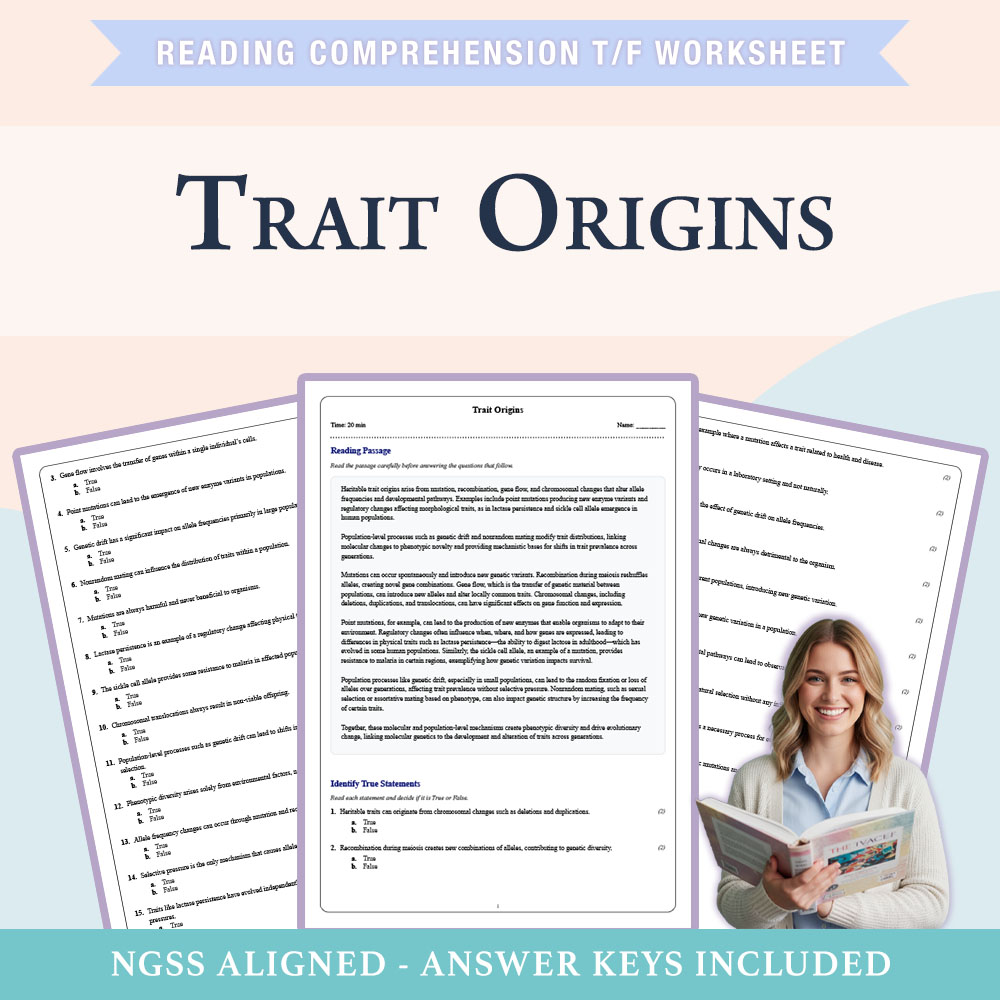
10th Grade Science | Trait Origins Worksheet (PDF + Answer Key)
Created byCopper Leaf ClassroomLearning Objectives
- Understand the molecular and population-level processes that produce heritable traits.
- Identify examples of genetic mutations and population dynamics affecting trait distribution.
- Explain how genetic changes contribute to phenotypic variation and evolution.
Also included in: Grade 10 Science | Evolution & Biodiversity Unit Bundle (PDF + Answer Key) +1 more
Instant download
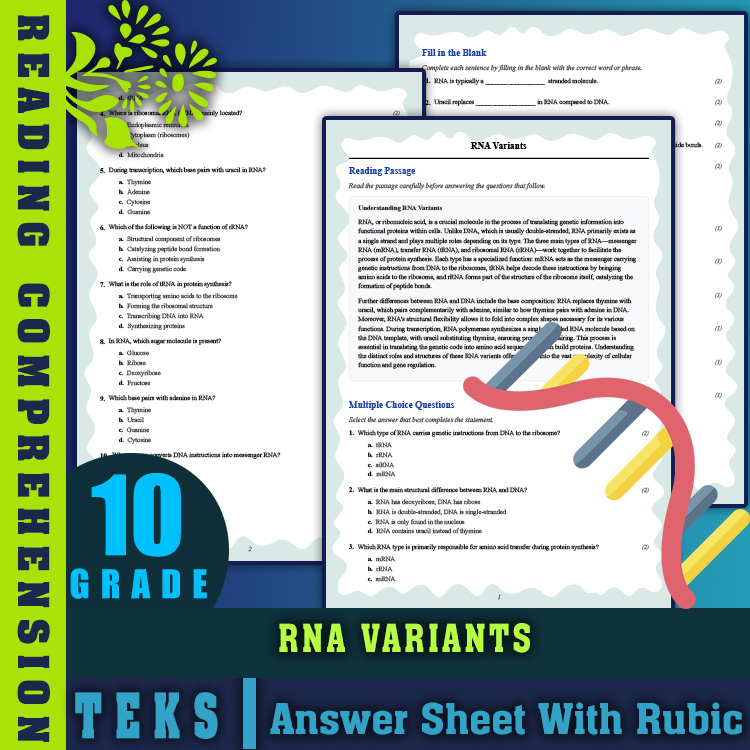
10th Grade Science | RNA Variants Reading Worksheet & Answer Key (PDF)
JCreated byJ.S SheetsLearning Objectives
- Identify the different types of RNA and their functions.
- Explain the structural differences between RNA and DNA.
- Describe the roles of messenger RNA, transfer RNA, and ribosomal RNA in protein synthesis.
Instant download

Grade 10 Particle Interactions and Macroscopic Properties Worksheet | NGSS
Created byAmber Owl EducationLearning Objectives
- Explain how particle attractions relate to bulk properties such as melting point and conductivity
- Compare ionic, molecular, and metallic solids using ideas about lattice structure and forces
- Use particle-interaction vocabulary (dispersion forces, hydrogen bonding, lattice energy) to predict phase-change behavior
Instant download
Browse more categories
About Science Worksheets
Find Science worksheets spanning core skills, practice, and review. All 44,628 resources are instant PDF downloads for the classroom or home.
Every worksheet on MyTeachingSheets is created by independent teacher-authors and reviewed before publication. All resources download as printable PDFs for classroom, homework, or at-home practice, and many include answer keys. Preview any worksheet free before buying.