
Science Worksheets
44,773 subject resources
Equilibrium Grade 7 Science Worksheet | NGSS-Aligned Assessment & Practice
JCreated byJ.S SheetsLearning Objectives
- Understand the concept of equilibrium as the state where forces balance and the vector sum of forces equals zero.
- Differentiate between static and dynamic equilibrium in various physical situations.
- Identify and analyze forces such as normal force, gravitational force, tension, and their role in achieving equilibrium.
Also included in: Grade 7 Forces and Interactions Science Lesson Bundle: NGSS Practice Set +1 more
Instant download
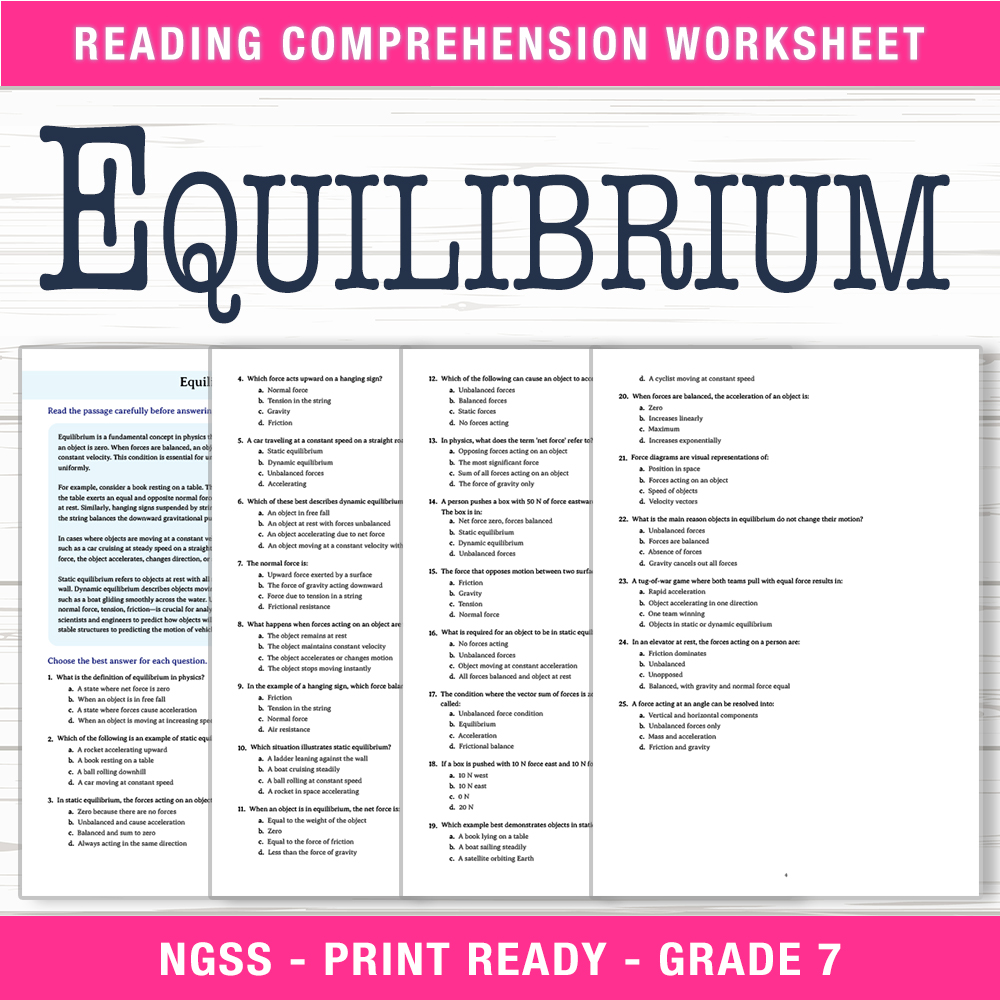
Grade 7 Science – Equilibrium Worksheet (PDF + Answer Key)
 Created byRiverstone Classroom
Learning Objectives
- Describe the concept of equilibrium as the balance of forces acting on an object.
- Differentiate between static and dynamic equilibrium with real-world examples.
- Apply qualitative and simple quantitative analyses to determine if forces are balanced in various situations.
Instant download

Equilibrium Practice Worksheet | Grade 7 Science NGSS Review
 Created byPrism Point Learning
Learning Objectives
- Explain equilibrium as a condition where the vector sum of forces is zero, resulting in constant velocity or rest
- Differentiate static equilibrium and dynamic equilibrium using examples involving normal and gravitational forces
- Use qualitative reasoning to predict how motion changes when net force and net acceleration are (or are not) zero
Also included in: Grade 7 Forces & Interactions Science Lesson Bundle for NGSS Review
Instant download
Grade 7 Science – Equilibrium Concept Worksheet (NGSS Aligned) (PDF)
 Created byBright Mind Resources
Learning Objectives
- Understand the concept of equilibrium as the balance of forces acting on an object.
- Differentiate between static and dynamic equilibrium.
- Identify forces involved in equilibrium such as gravity, normal force, tension, and net zero acceleration.
Instant download

Balanced Forces & Equilibrium Worksheets | Grade 7 Science
 Created bythe curious pencil
Learning Objectives
- Explain equilibrium using the vector sum of forces.
- Distinguish static equilibrium from dynamic equilibrium.
- Identify balanced gravity, normal force, and tension.
Also included in: Motion and Stability Grade 7 Science Worksheets | NGSS Forces Bundle +2 more
Instant download

Grade 7 Science | Equilibrium in Physics - Daily Reading Comprehension
 Created byCoral Reef Learning
Learning Objectives
- Define equilibrium as the state where the net force on an object is zero.
- Differentiate between static and dynamic equilibrium.
- Identify forces such as normal, gravitational, and tension in objects at equilibrium.
Instant download

Grade 7 Equilibrium Forces Worksheet | NGSS Science Activity Pack
 Created byAmber Owl Education
Learning Objectives
- Explain equilibrium as the condition where the vector sum of forces equals zero
- Differentiate static equilibrium from dynamic equilibrium using acceleration and velocity
- Analyze forces such as weight, normal force, and tension to predict an object’s motion
Also included in: Grade 7 Science Forces and Motion Lesson Bundle – NGSS Worksheets +1 more
Instant download

Equilibrium Worksheet | Grade 7 Science Printable PDF | NGSS Aligned
Learning Objectives
- Define and characterize static and dynamic equilibrium in physical systems.
- Identify forces such as gravity, tension, and normal force involved in equilibrium scenarios.
- Use vector principles to analyze whether forces balance in different situations.
Also included in: Grade 7 Science Lesson Bundle | Motion and Stability: Forces and Interactions +1 more
Instant download

Forces and Equilibrium Worksheets: Static & Dynamic Systems Grade 7
 Created byTeachers Club
Learning Objectives
- Describe equilibrium using a vector sum of forces equal to zero
- Differentiate static and dynamic equilibrium using net force
- Relate net force and acceleration to motion outcomes
Also included in: Grade 7 Science Worksheets NGSS Forces and Motion Bundle +2 more
Instant download

Grade 7 Understanding Equilibrium in Science Worksheet | NGSS Activity
 Created byBRIGHT PATH RESOURCES
Learning Objectives
- Define equilibrium and identify conditions under which it occurs.
- Differentiate between static and dynamic equilibrium.
- Recognize forces such as normal, gravitational, and tension forces acting on objects.
Also included in: Forces & Motion Grade 7 Science Daily Reading Worksheets Lesson Bundle | NGSS +2 more
Instant download

Grade 7 Equilibrium Worksheet | NGSS Practice PDF
 Created byClear Sky Classroom
Learning Objectives
- Understand the concept of equilibrium as the balance of forces resulting in constant velocity or rest.
- Identify the differences between static and dynamic equilibrium.
- Apply qualitative and simple quantitative analyses to predict outcomes of objects at rest or moving uniformly.
Also included in: Grade 7 Net Force, Interactions, Collisions Science Lesson Bundle (NGSS) +1 more
Instant download
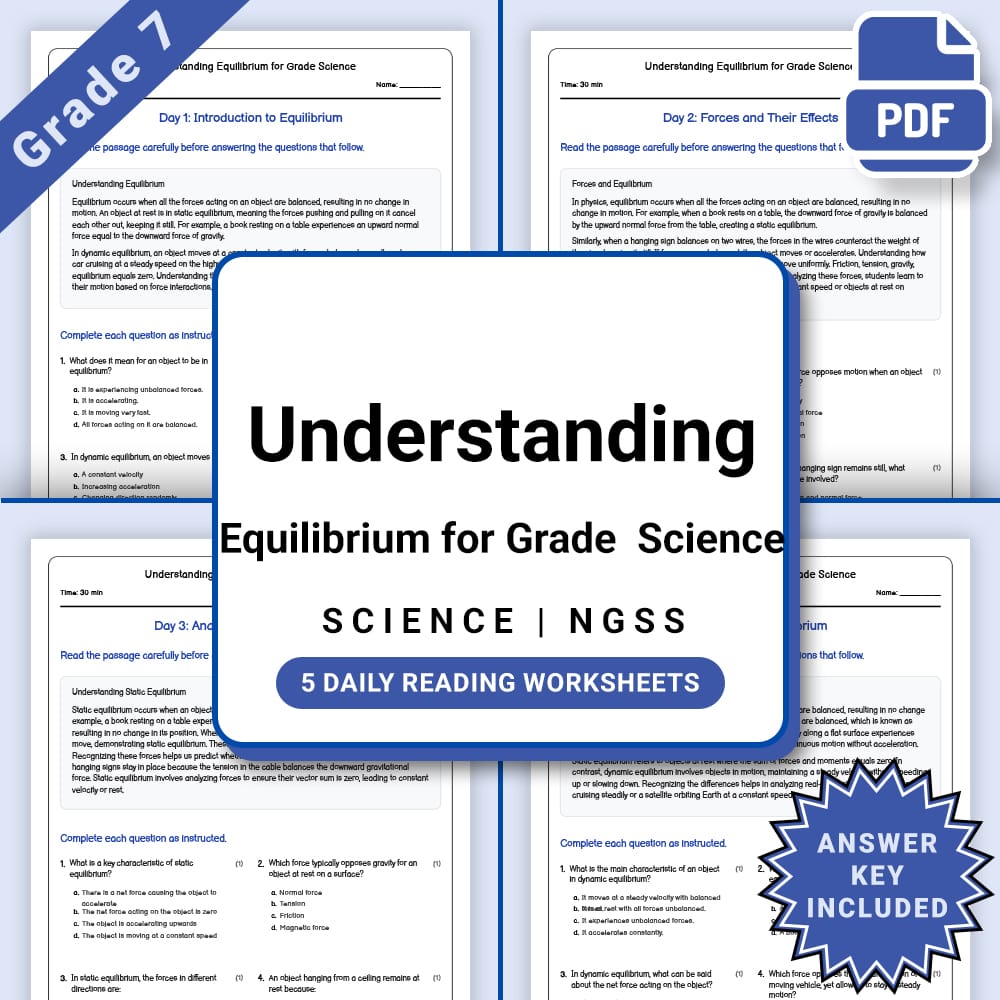
Grade 7 Science – Understanding Equilibrium Worksheet(PDF + Answer Key)
 Created byCopper Leaf Classroom
Learning Objectives
- Define equilibrium and identify its key characteristics.
- Differentiate between static and dynamic equilibrium.
- Recognize forces involved in equilibrium, such as gravity, normal force, and tension.
Instant download
Grade 7 Science | Equilibrium NGSS Worksheet (Answer Key) - PDF
 Created byMaple Path Learning
Learning Objectives
- Define equilibrium as the condition where the vector sum of forces equals zero.
- Distinguish between static and dynamic equilibrium through examples and analysis.
- Describe roles of forces such as normal, gravitational, tension, and net force in achieving equilibrium.
Instant download
Grade 7 Science – Exploring Balance & Equilibrium | Daily Reading Worksheet
 Created byElena Brooks
Learning Objectives
- Understand the concept of equilibrium in forces
- Identify situations where forces are balanced
- Differentiate between static and dynamic equilibrium
Also included in: Force and Motion Grade 7 Science Daily Reading Worksheets Bundle | NGSS +1 more
Instant download
Grade 7 Science Worksheet | Equilibrium Concepts & Practice (PDF + Answer Key)
Created byCoral Reef LearningLearning Objectives
- Understand the concept of equilibrium as a state where forces balance and the vector sum equals zero.
- Identify differences between static and dynamic equilibrium.
- Recognize examples of forces at play in real-world objects at rest or moving at constant velocity.
Instant download
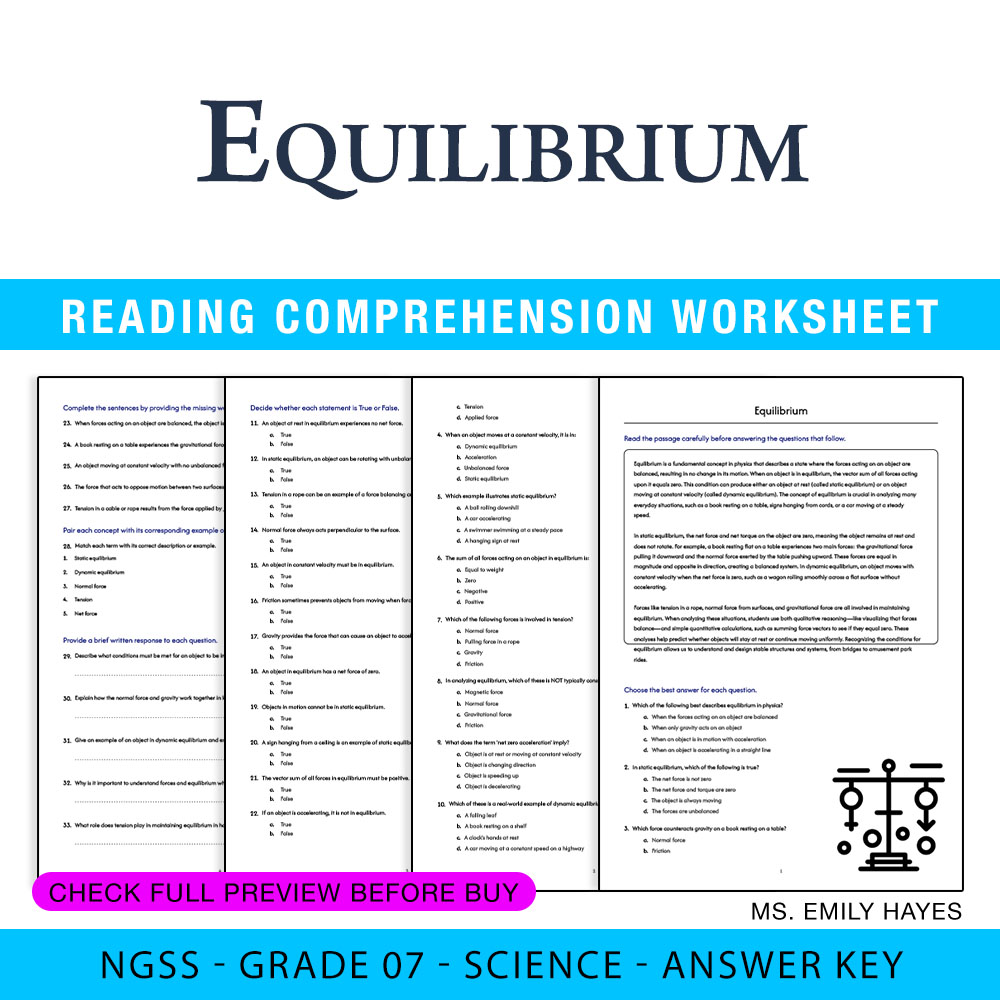
7th Grade Science | Equilibrium Worksheet (PDF+ Answer Key)
Created byCopper Leaf ClassroomLearning Objectives
- Understand the concept of equilibrium as the balance of forces acting on an object
- Differentiate between static and dynamic equilibrium
- Identify real-world examples of equilibrium in everyday objects
Instant download

Science: Equilibrium of Forces Worksheet | NGSS Grade 7 Science Assessment
 Created bySkylark Worksheets
Learning Objectives
- Explain equilibrium as the condition where the vector sum of forces on an object is zero.
- Distinguish between static equilibrium and dynamic equilibrium using evidence from motion.
- Identify how normal force, gravitational force, and tension can combine to produce net zero acceleration.
Also included in: Grade 7 Forces & Motion Science Lesson Bundle: NGSS Worksheets +1 more
Instant download
Grade 7 Science | Understanding Equilibrium Worksheet & Answer Key (PDF)
 Created byLumora Learning
Learning Objectives
- Explain the concept of equilibrium as the balance of forces in an object.
- Differentiate between static and dynamic equilibrium with real-world examples.
- Describe the roles of normal, gravitational forces, tension, and net zero acceleration in equilibrium.
Instant download
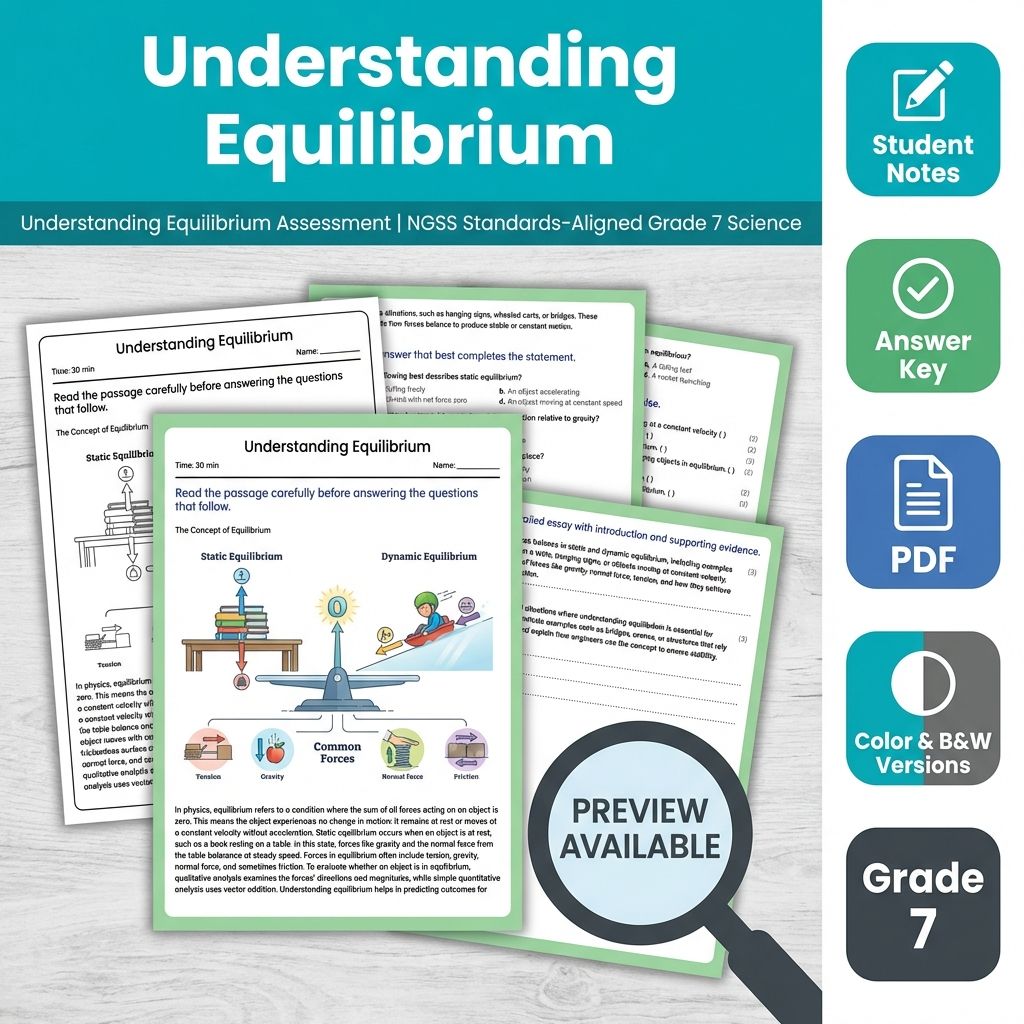
Understanding Equilibrium Assessment | NGSS Standards-Aligned Grade 7 Science
Created byPrism Point LearningLearning Objectives
- Explain the concept of equilibrium as the balance of forces in an object.
- Differentiate between static and dynamic equilibrium in real-world scenarios.
- Apply qualitative and simple quantitative analyses to predict objects' behavior at rest or moving with constant velocity.
Also included in: Grade 7 Science Mini Bundle – Forces & Interactions NGSS Unit (Printable) +1 more
Instant download
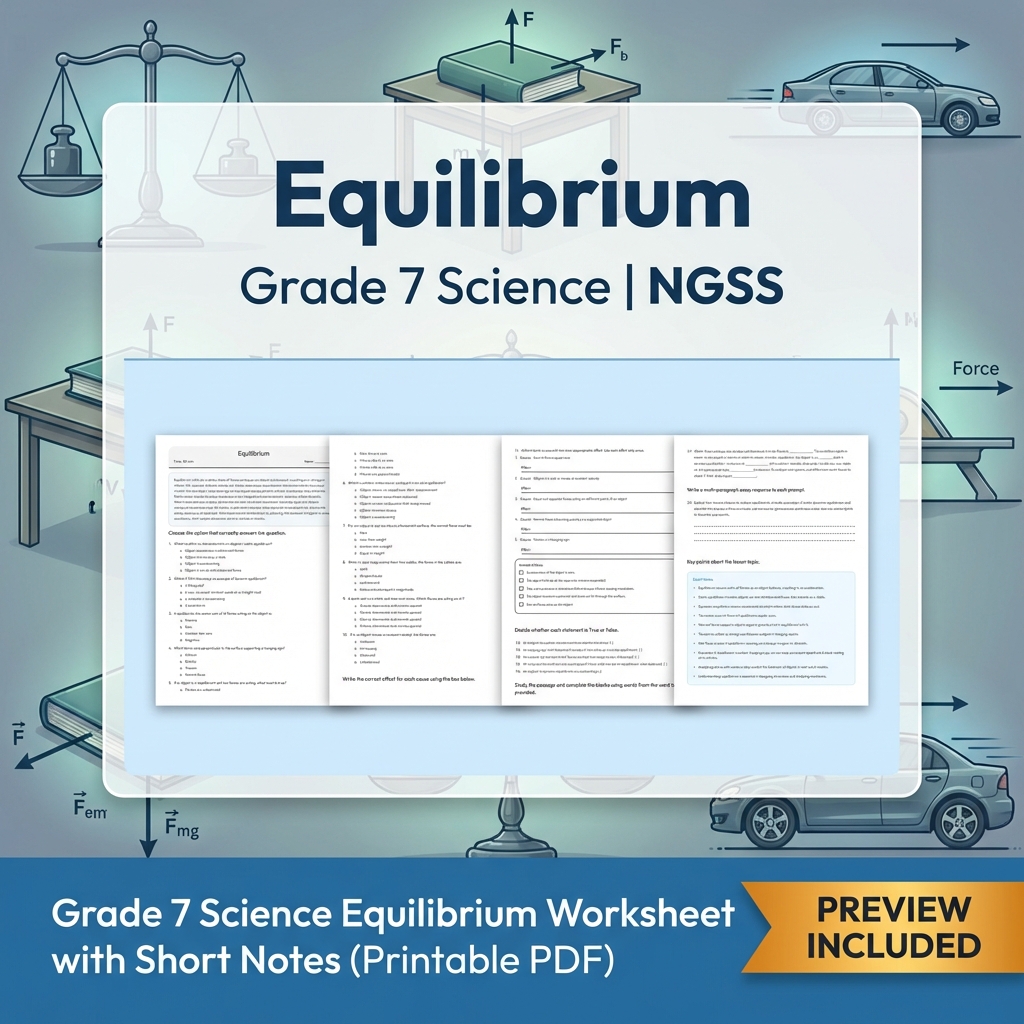
Grade 7 Science Equilibrium Worksheet with Short Notes (Printable PDF)
 Created byMeadowlark Worksheets
Learning Objectives
- Understand the concept of forces in equilibrium and how they balance to produce constant velocity or rest.
- Identify the differences between static and dynamic equilibrium in various scenarios.
- Apply qualitative and simple quantitative analyses to predict outcomes of objects at rest or moving uniformly.
Also included in: Grade 7 Science | Motion and Stability Forces & Interactions NGSS Unit Bundle +1 more
Instant download
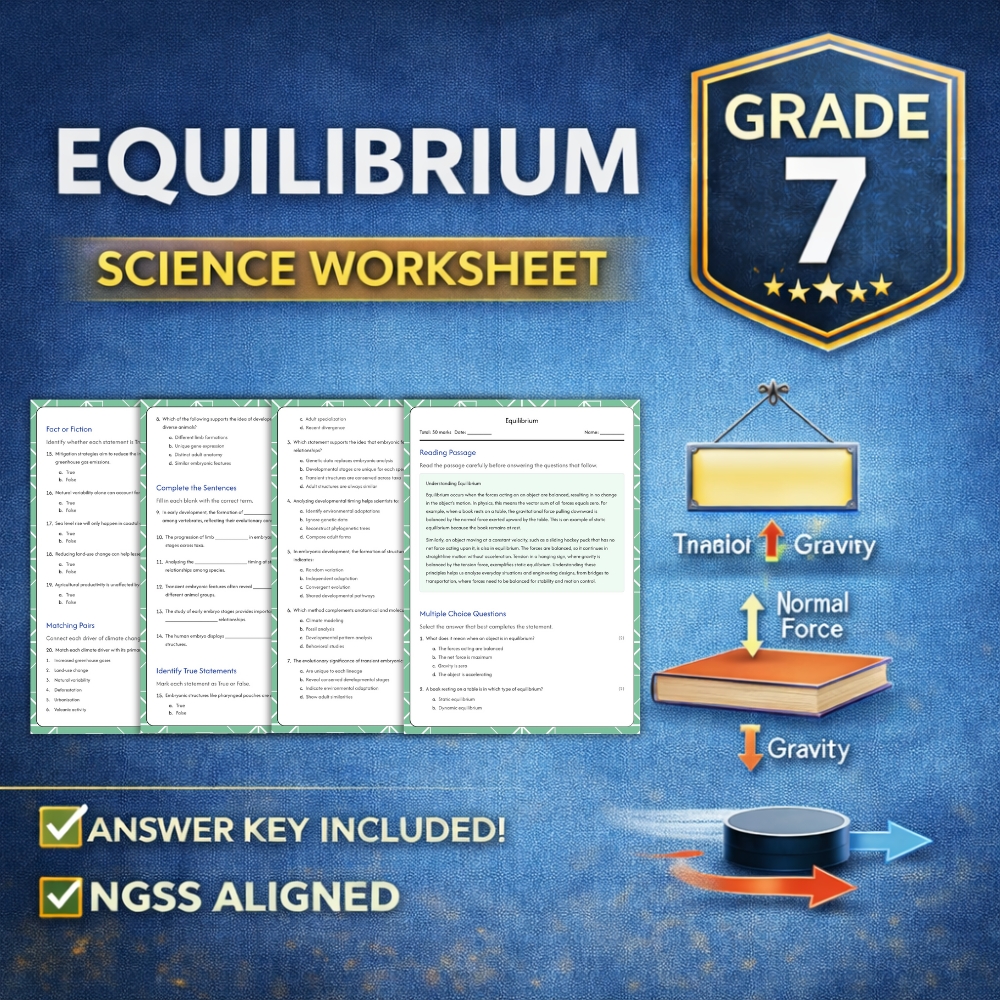
7th Grade Science | Equilibrium Worksheet (NGSS) with Answer Key
 Created byCedar Grove Learning
Learning Objectives
- Describe the concept of equilibrium as a state where forces balance and the vector sum of forces equals zero.
- Differentiate between static and dynamic equilibrium using real-world examples.
- Analyze forces such as normal force, gravitational force, tension, and their roles in maintaining equilibrium.
Instant download

Grade 7 Science Equilibrium Worksheet | NGSS Forces & Balanced Systems
 Created byNorthstar Worksheets
Learning Objectives
- Explain equilibrium as the condition where the net force is zero.
- Differentiate static equilibrium from dynamic equilibrium using acceleration and motion.
- Identify examples of balanced forces, including normal and gravitational forces and tension.
Also included in: Grade 7 Science Forces & Motion Lesson Bundle | NGSS Equilibrium & Collisions +1 more
Instant download
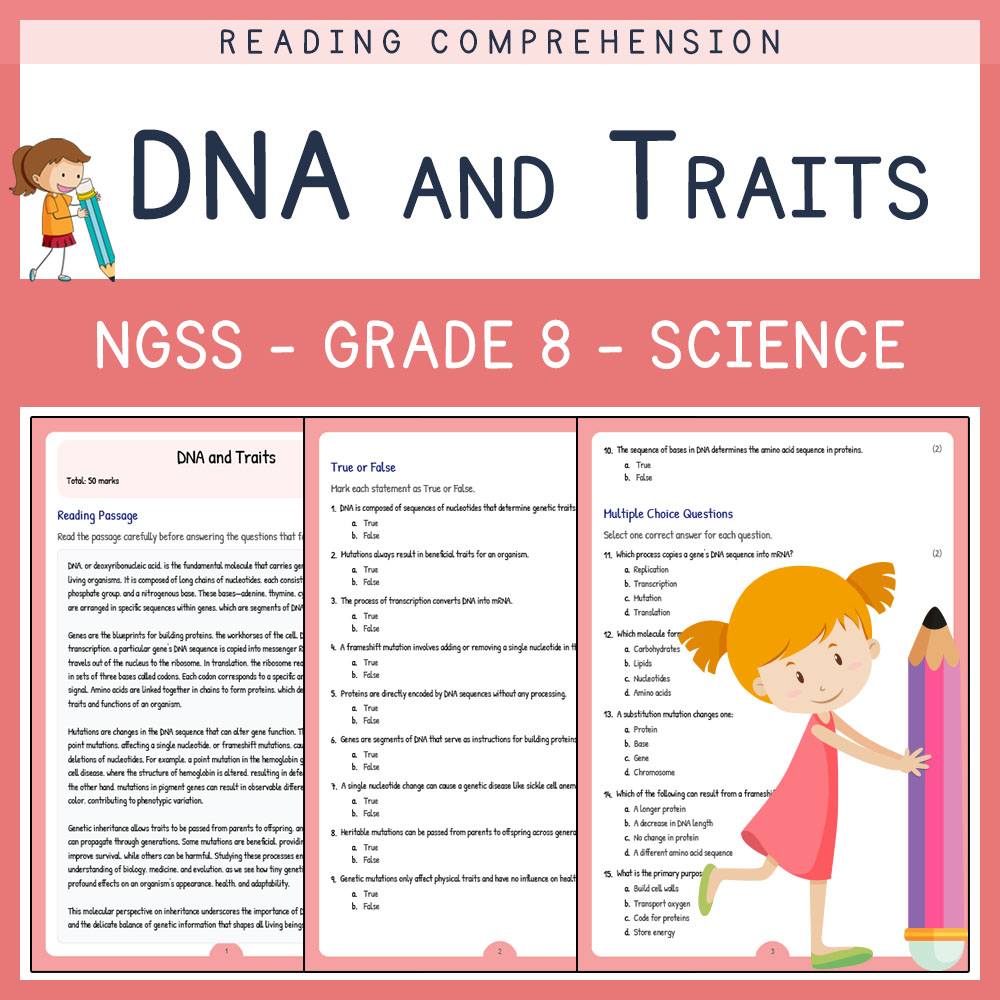
Grade 8 Science | DNA and Traits Worksheet (PDF + Answer Key) NGSS-Aligned
Created byLumora LearningLearning Objectives
- Explain the relationship between DNA sequence and protein structure.
- Describe how gene structure and mutations affect observable traits.
- Illustrate the processes of transcription and translation.
Instant download
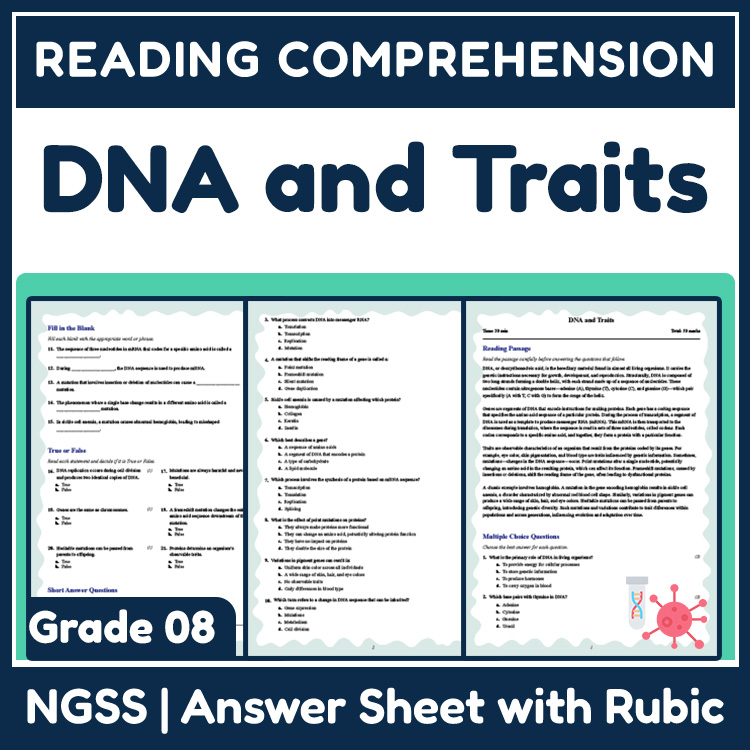
Grade 8 Science | DNA and Traits Reading Worksheet (NGSS Aligned + Answer Key)
JCreated byJ.S SheetsLearning Objectives
- Understand the molecular basis of inheritance and how DNA sequences determine traits
- Learn about gene structure, transcription, translation, and mutations
- Analyze examples of genetic variation and mutation effects on phenotype
Instant download

Grade 8 Science | DNA and Traits NGSS Worksheet (PDF)
Created byMaple Path LearningLearning Objectives
- Explain how DNA sequences determine the proteins and observable traits of an organism.
- Describe the structure of genes and the processes of transcription and translation.
- Analyze how mutations such as point mutations and frameshifts can alter protein function and phenotype.
Also included in: Grade 8 Science | Heredity Unit Bundle – Inheritance & Trait Variation NGSS +1 more
Instant download

Grade 8 DNA and Traits Worksheet | NGSS Genetics Science Activity PDF
Created byBRIGHT PATH RESOURCESLearning Objectives
- Identify and describe the main components of DNA.
- Explain how DNA sequences determine protein structure.
- Understand how gene mutations can alter traits.
Also included in: Genetics DNA Traits Grade 8 Science Daily Reading Worksheets Bundle | NGSS +2 more
Instant download
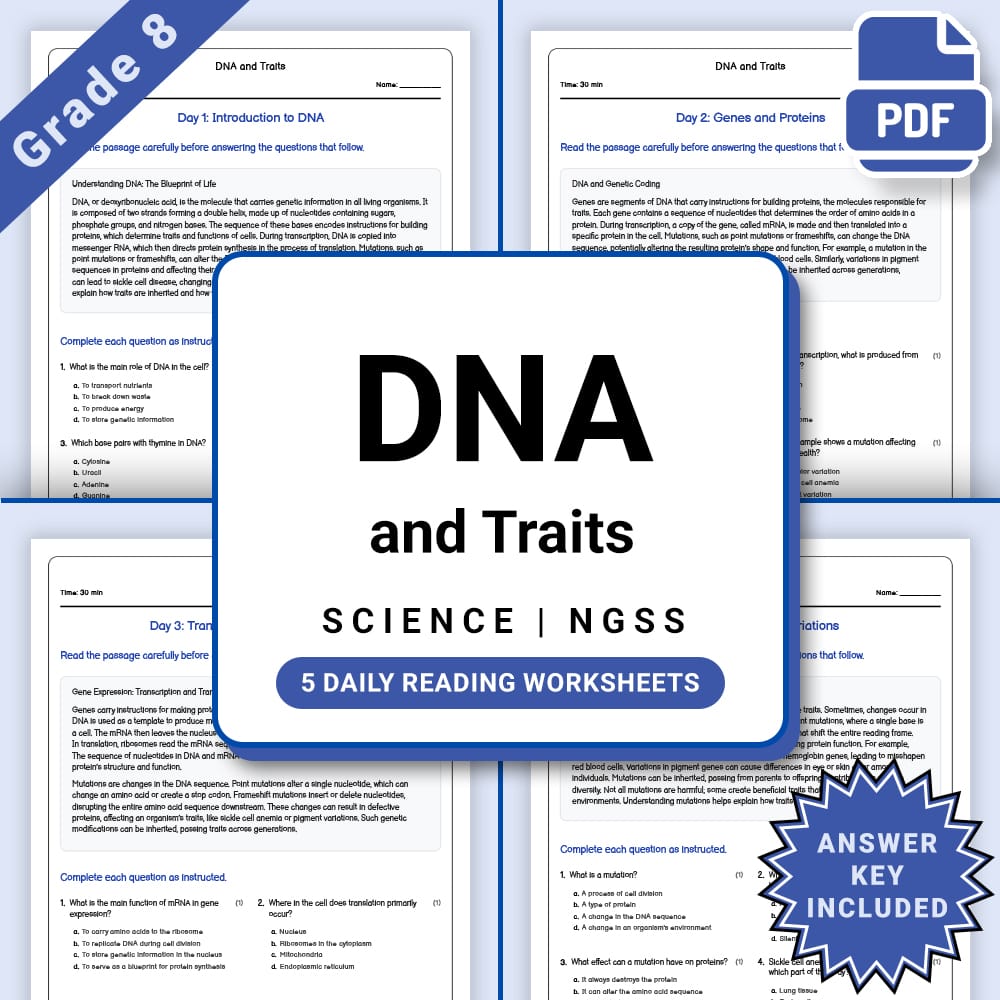
Grade 8 Science – DNA and Traits Daily Reading Worksheet(PDF + Answer Key)
Created byCopper Leaf ClassroomLearning Objectives
- Understand the basic structure and function of DNA
- Explain how DNA sequences determine traits
- Describe the processes of transcription and translation
Instant download
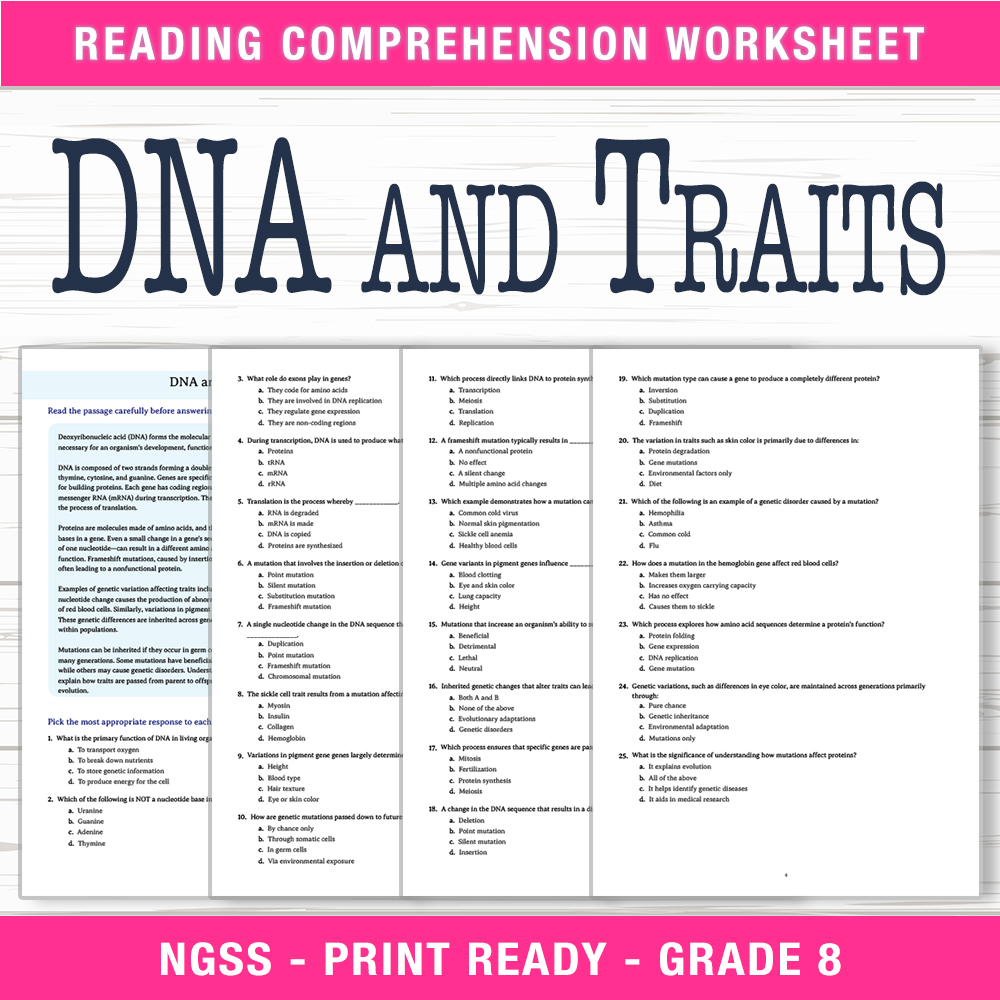
Grade 8 Science | DNA and Traits Worksheet (PDF + Answer Key)
Created byRiverstone ClassroomLearning Objectives
- Explain the molecular basis of inheritance by linking DNA sequences to proteins and observable traits.
- Describe the structure of genes, including coding sequences, and the processes of transcription and translation.
- Analyze how mutations such as point mutations and frameshifts affect amino acid sequences and protein function.
Instant download

Grade 8 Science – DNA & Traits Daily Reading Worksheet | NGSS Aligned
Created byBright Mind ResourcesLearning Objectives
- Understand the structure of DNA and its role in storing genetic information.
- Describe how DNA sequences are transcribed and translated into proteins.
- Explain how mutations can affect protein structure and phenotypes.
Also included in: Grade 8 Genetics Science Daily Reading Worksheets Lesson Bundle | NGSS +1 more
Instant download

DNA Sequences and Inherited Traits: Grade 8 Heredity Worksheets
Created bythe curious pencilLearning Objectives
- Explain how DNA base sequences affect protein amino acid sequences
- Describe how transcription and translation connect DNA to proteins
- Compare point mutations and frameshift mutations
Also included in: Heredity & Inheritance Grade 8 Science Worksheets | NGSS Bundle +2 more
Instant download
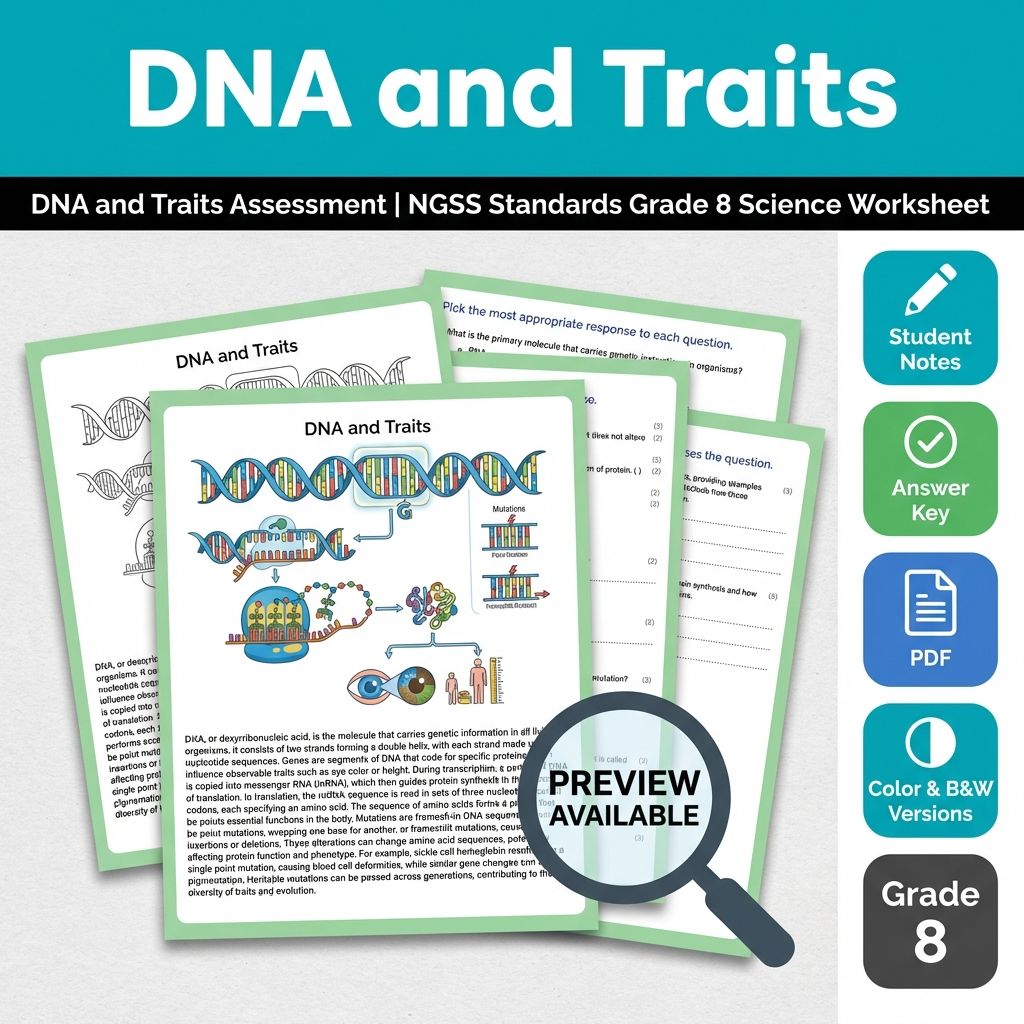
DNA and Traits Assessment | NGSS Standards Grade 8 Science Worksheet
Created byPrism Point LearningLearning Objectives
- Explain the relationship between DNA sequences and protein synthesis.
- Identify how mutations can alter amino acid sequences and affect traits.
- Describe gene structure, transcription, translation, and mutation effects.
Also included in: Grade 8 Science Mini Bundle – Heredity: Inheritance and Variation Not specified +1 more
Instant download
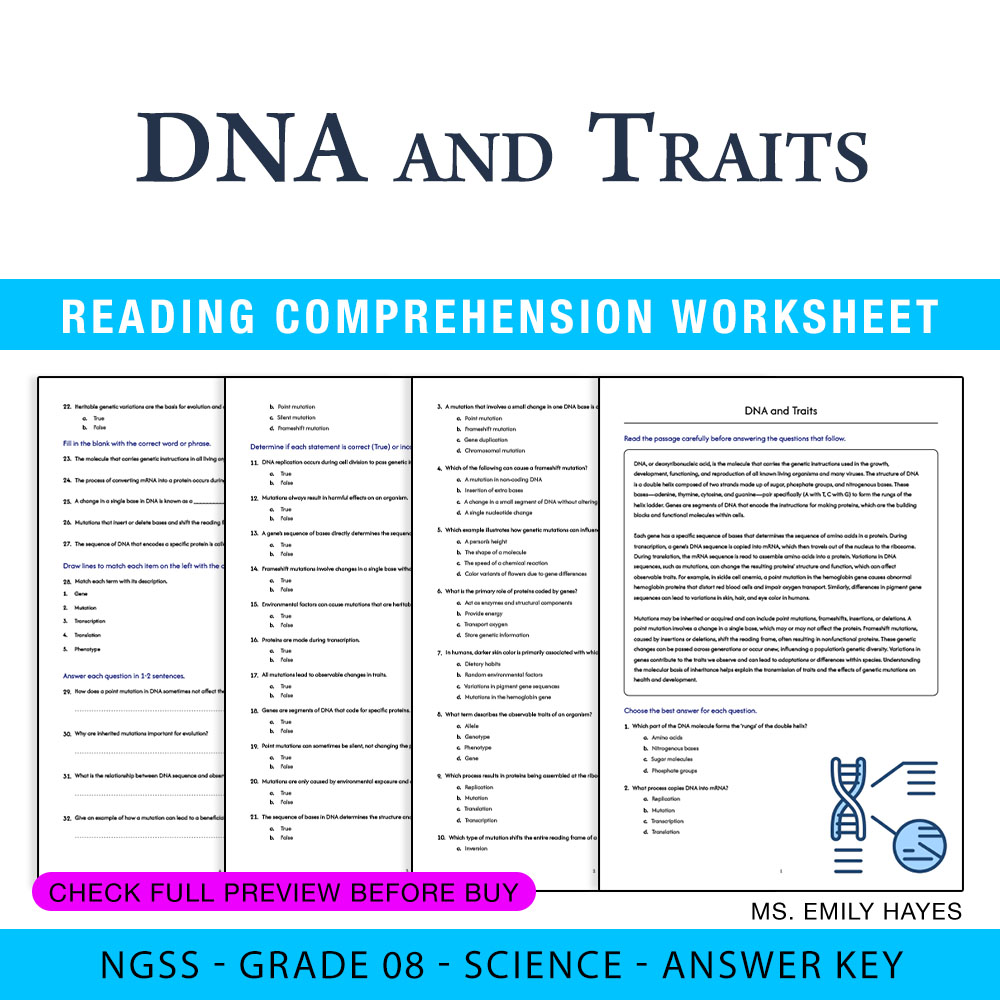
8th Grade Science | DNA and Traits Worksheet (PDF+ Answer Key)
Created byCopper Leaf ClassroomLearning Objectives
- Explain the relationship between DNA sequences, proteins, and observable traits.
- Describe the structure of genes and their role in inheritance.
- Analyze how mutations such as point mutations and frameshifts affect protein function and phenotypes.
Instant download

DNA and Traits Worksheet | NGSS-Aligned Science Practice for Grade 8
JCreated byJ.S SheetsLearning Objectives
- Explain how DNA sequences determine protein structure and observable traits.
- Describe the processes of transcription and translation in gene expression.
- Analyze how mutations such as point mutations and frameshifts can alter amino acid sequences and affect proteins.
Also included in: Grade 8 Genetics and Heredity Science Lesson Bundle | NGSS +1 more
Instant download

DNA and Traits Worksheet | Grade 8 Science Printable PDF Assessment
Learning Objectives
- Explain the molecular basis of inheritance, linking DNA sequence to protein synthesis and traits.
- Describe gene structure, transcription, translation, and how mutations affect proteins.
- Analyze examples like sickle cell anemia and gene variants to see how genetics influence phenotype.
Also included in: Grade 8 Heredity Lesson Bundle | Inheritance and Trait Variation NGSS +1 more
Instant download

DNA and Traits Worksheet | Grade 8 NGSS Genetics Activity with Doodle Note
Created byAmber Owl EducationLearning Objectives
- Explain how DNA sequence information is used to produce proteins and how proteins help determine observable traits.
- Describe the roles of genes, coding sequences, transcription, and translation in the inheritance of traits.
- Model how mutations (point mutations and frameshifts) can change amino acid sequences and affect protein function.
Also included in: Grade 8 Science Genetics Lesson Bundle – Next Generation Science Standards +1 more
Instant download

DNA and Traits Worksheet | NGSS Grade 8 Science Assessment
Created bySkylark WorksheetsLearning Objectives
- Explain how DNA sequences are used to build proteins and how proteins affect observable traits.
- Describe the roles of genes, coding sequences, transcription, and translation in inheritance.
- Model how point mutations and frameshifts can change amino acid sequences and protein function.
Also included in: Grade 8 Heredity: Inheritance and Variation of Traits Science Lesson Bundle NGSS +1 more
Instant download

Grade 8 DNA and Traits Worksheet | NGSS Practice & PDF
Created byClear Sky ClassroomLearning Objectives
- Understand the molecular basis of inheritance and how DNA sequences influence traits.
- Explain gene structure, transcription, translation, and how mutations affect proteins.
- Identify examples of genetic variation and how heritable changes propagate across generations.
Also included in: Grade 8 Mendelian Genetics Science Worksheet B Lesson Bundle NGSS +1 more
Instant download

DNA and Traits Assessment Worksheet | Grade 8 Science NGSS Review
Created byPrism Point LearningLearning Objectives
- Explain how DNA sequence information becomes proteins and then observable traits.
- Describe gene structure and the roles of coding sequences, transcription, and translation.
- Predict how point mutations and frameshifts can change amino acids and protein function.
Also included in: Grade 8 Genetics Lesson Bundle: Mendelian Patterns & DNA Traits (NGSS)
Instant download

DNA and Traits Worksheet | NGSS Grade 8 Science Practice PDF
Created byCedar Grove LearningLearning Objectives
- Explain how DNA sequences determine the production of proteins and observable traits.
- Describe gene structure, transcription, and translation in relation to genetic information.
- Analyze how mutations, such as point mutations and frameshifts, affect protein function and phenotype.
Instant download

Grade 8 Science | DNA and Traits Worksheet (NGSS-Aligned, PDF)
Created byBright Mind ResourcesLearning Objectives
- Describe the relationship between DNA sequences and protein synthesis.
- Explain how mutations can alter amino acid sequences and affect traits.
- Identify key components of gene structure, transcription, and translation.
Also included in: Grade 8 Science Unit | DNA, Traits & Mendelian Patterns Worksheet Bundle - NGSS +2 more
Instant download

Grade 8 Science | DNA & Traits - Daily Reading Comprehension
Created byCoral Reef LearningLearning Objectives
- Identify the basic components of DNA and their functions.
- Understand how DNA sequences encode proteins.
- Explain the processes of transcription and translation.
Instant download
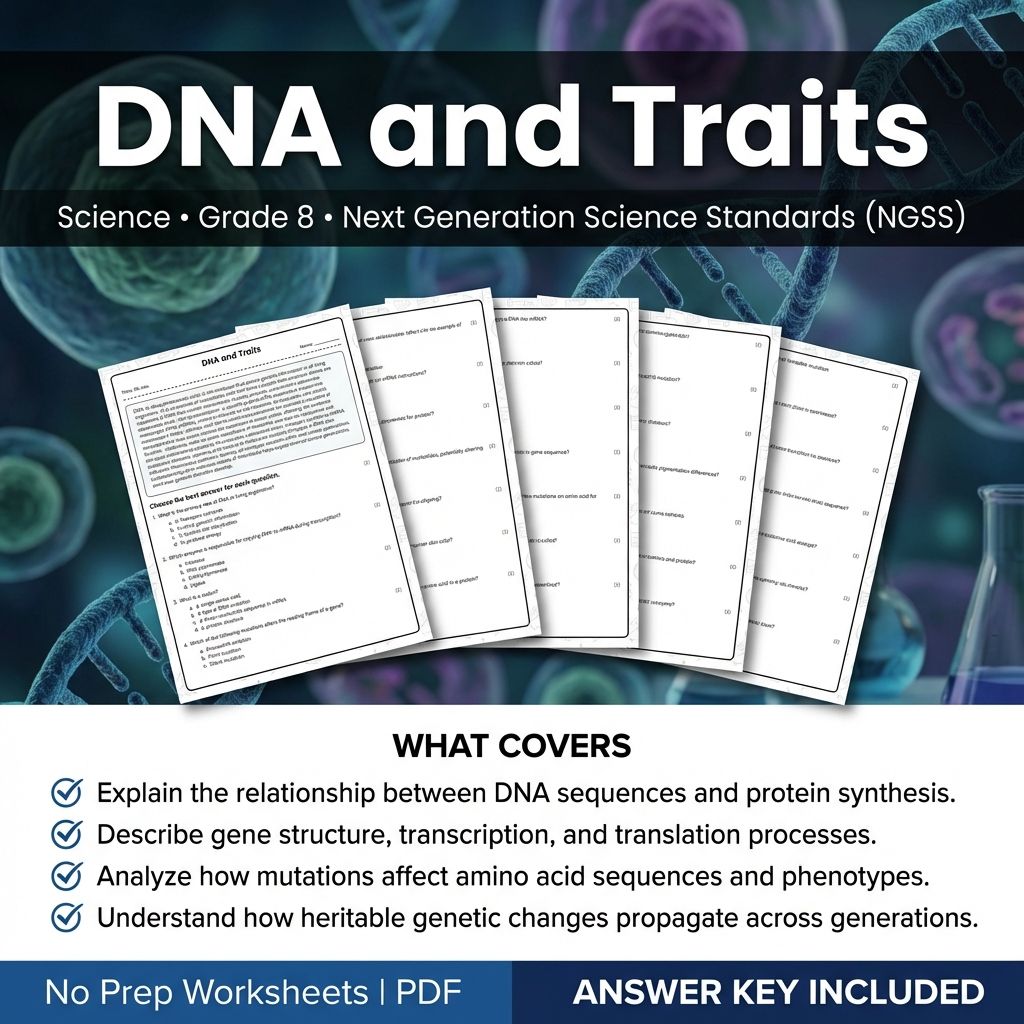
8th Grade Science | DNA and Traits Worksheet with Answer Key (Printable PDF)
Created byCoral Reef LearningLearning Objectives
- Explain the relationship between DNA sequences and protein synthesis.
- Describe gene structure, transcription, and translation processes.
- Analyze how mutations affect amino acid sequences and phenotypes.
Instant download

Grade 8 Science | DNA and Traits Worksheet with Short Notes (Printable PDF)
Created byMeadowlark WorksheetsLearning Objectives
- Explain the molecular basis of inheritance and how DNA sequences determine traits.
- Describe gene structure, transcription, translation, and how mutations affect proteins.
- Use examples like sickle cell hemoglobin to illustrate mutation impacts.
Also included in: Grade 8 Science Heredity: Inheritance & Variation UNIT Bundle (NGSS Worksheets) +1 more
Instant download

DNA Sequence to Traits Worksheets | Grade 8 Heredity & Inheritance
Created byTeachers ClubLearning Objectives
- Explain how DNA coding sequences relate to proteins and traits
- Describe transcription and translation as steps in protein production
- Predict how point mutations can change amino acid sequences
Also included in: Heredity Inheritance and Variation Grade 8 Science NGSS Bundle +2 more
Instant download

Grade 8 Science – DNA & Traits | Daily Reading Worksheet
Created byElena BrooksLearning Objectives
- Identify the basic structure of DNA and the components of nucleotides.
- Explain how DNA encodes genetic information through sequences of bases.
- Understand the process of transcription and translation in protein synthesis.
Instant download
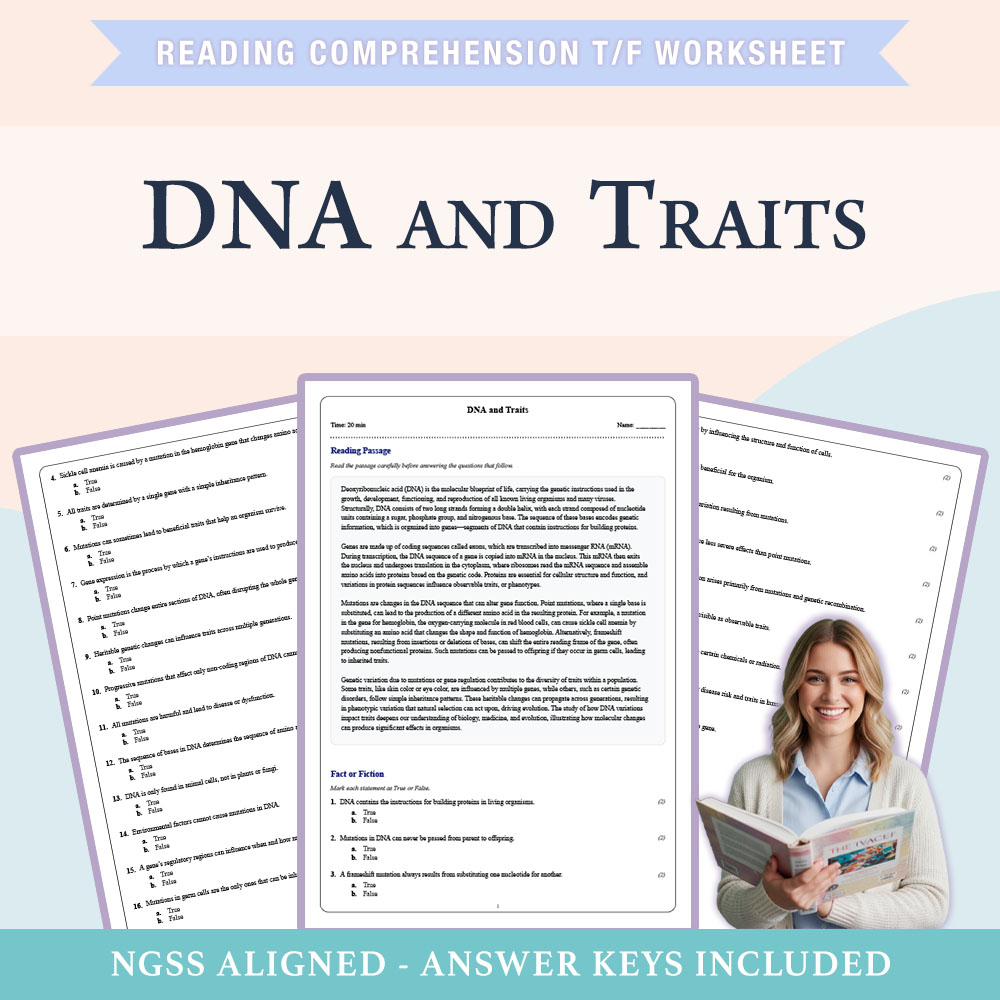
8th Grade Science | DNA and Traits Worksheet (PDF + Answer Key)
Created byCopper Leaf ClassroomLearning Objectives
- Understand the molecular basis of inheritance by linking DNA sequence to proteins and traits.
- Explain gene structure, including coding sequences, transcription, and translation.
- Describe how mutations affect amino acid sequences and protein function.
Also included in: Grade 8 Science | Mendelian Patterns & DNA Traits Worksheet (PDF + Answer Key) +1 more
Instant download

Grade 11 Science – Conservation Laws & Analysis | Daily Reading Worksheet
Created byBright Mind ResourcesLearning Objectives
- Understand the fundamental principles of conservation laws in physics.
- Apply algebraic and vector balances to analyze isolated systems.
- Recognize examples of conservation in collision phenomena and recoil scenarios.
Also included in: Grade 11 Forces & Conservation Laws Science Lesson Bundle Daily Reading | NGSS +2 more
Instant download

Conservation Analysis Worksheet | Grade 11 Science Practice & Review
Created byPrism Point LearningLearning Objectives
- Apply conservation of total linear momentum to analyze collisions in an isolated system
- Use pre- and post-interaction momentum balances to compare outcomes without relying on force details
- Interpret center-of-mass motion and connect it to constituent contributions in a vector framework
Instant download
Browse more categories
About Science Worksheets
Find Science worksheets spanning core skills, practice, and review. All 44,773 resources are instant PDF downloads for the classroom or home.
Every worksheet on MyTeachingSheets is created by independent teacher-authors and reviewed before publication. All resources download as printable PDFs for classroom, homework, or at-home practice, and many include answer keys. Preview any worksheet free before buying.