
Science Worksheets
44,295 subject resources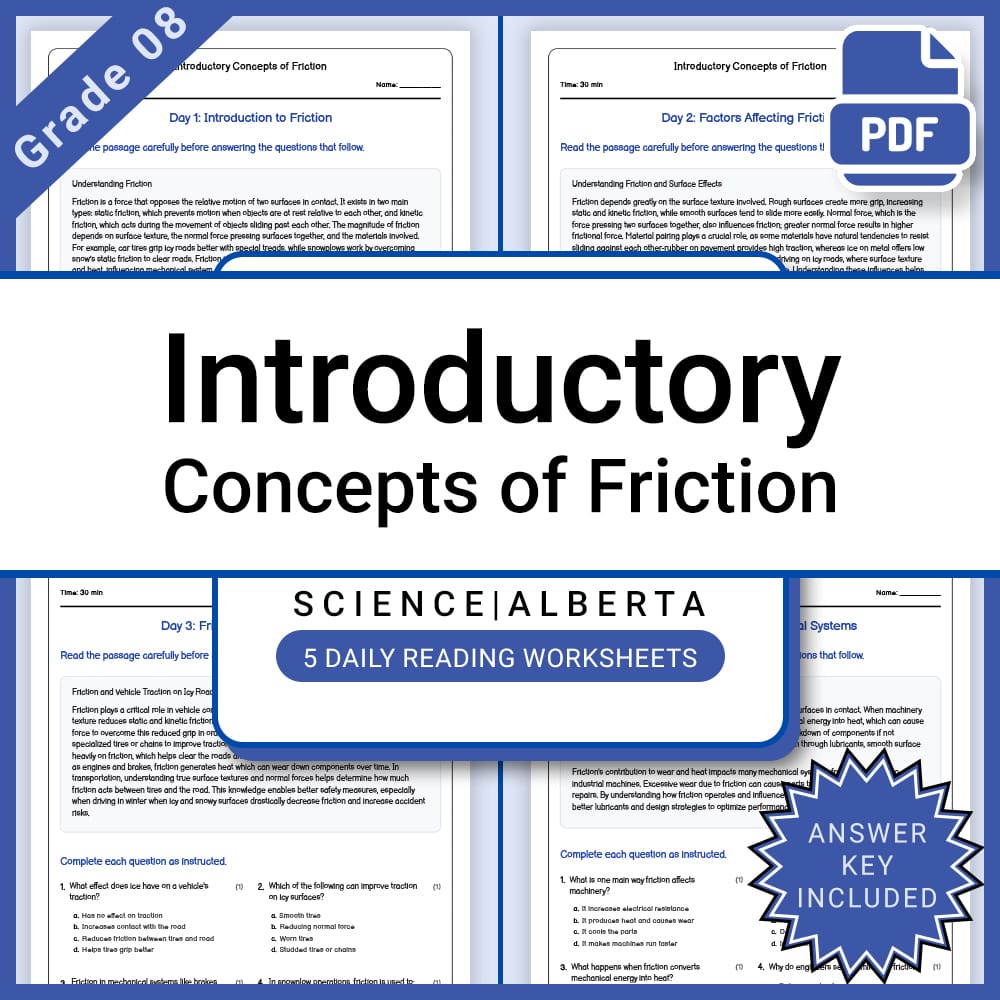
Grade 8 Science – Concepts of Friction | Daily Reading Worksheet + Answer Key
JCreated byJ.S SheetsLearning Objectives
- Define static and kinetic friction
- Identify factors affecting frictional force
- Relate examples of friction in everyday life
Also included in: Grade 8 Science Lesson Bundle | Forces, Motion, and Energy +1 more
Instant download
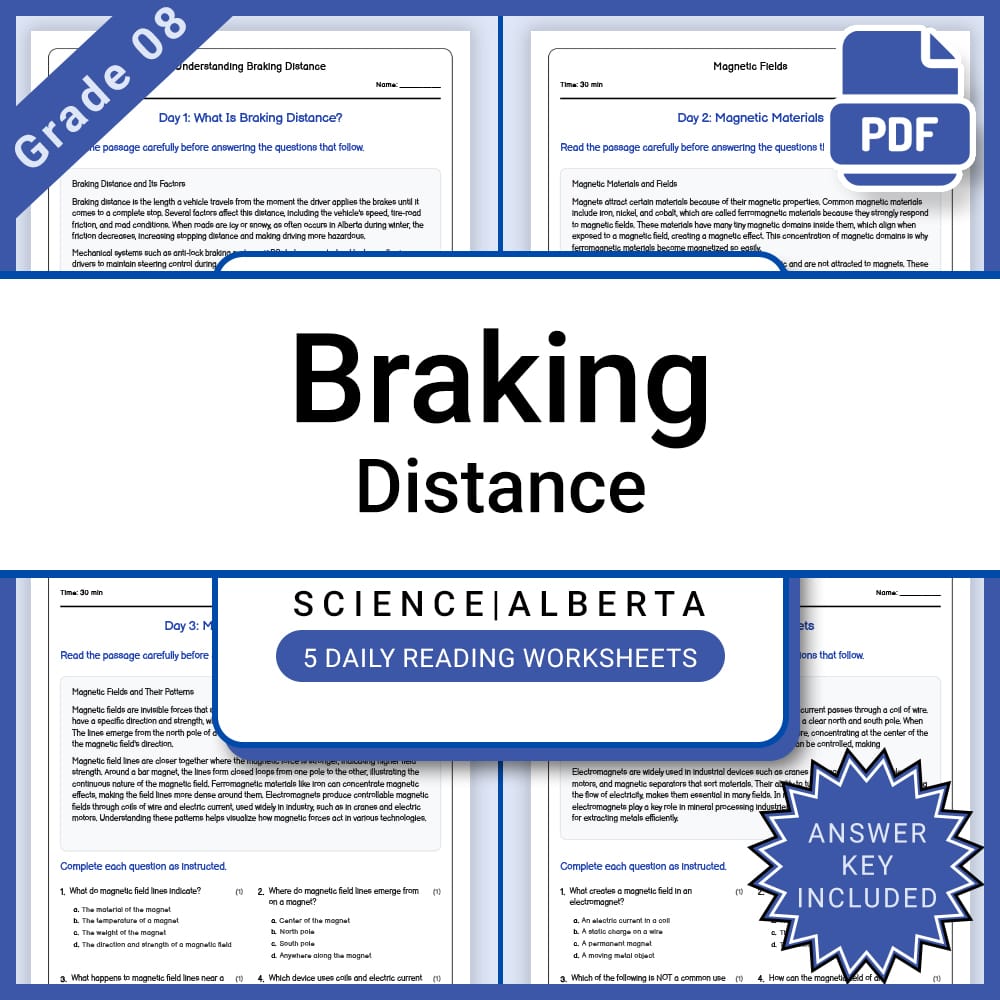
Grade 8 Science – Braking Distance Daily Reading Worksheet + Answer Key
JCreated byJ.S SheetsLearning Objectives
- Define braking distance and identify factors that influence it.
- Explain how tire-road friction affects stopping capability.
- Describe the impact of environmental conditions, such as winter roads, on braking performance.
Also included in: Grade 8 Science Lesson Bundle | Forces, Motion, and Energy +1 more
Instant download
Grade 8 Science – Kinematics Daily Reading Worksheet + Answer Key
JCreated byJ.S SheetsLearning Objectives
- Define speed, velocity, and acceleration accurately
- Differentiate between scalar and vector quantities
- Interpret graphical and tabular data related to motion
Also included in: Grade 8 Science Lesson Bundle | Forces, Motion, and Energy +1 more
Instant download
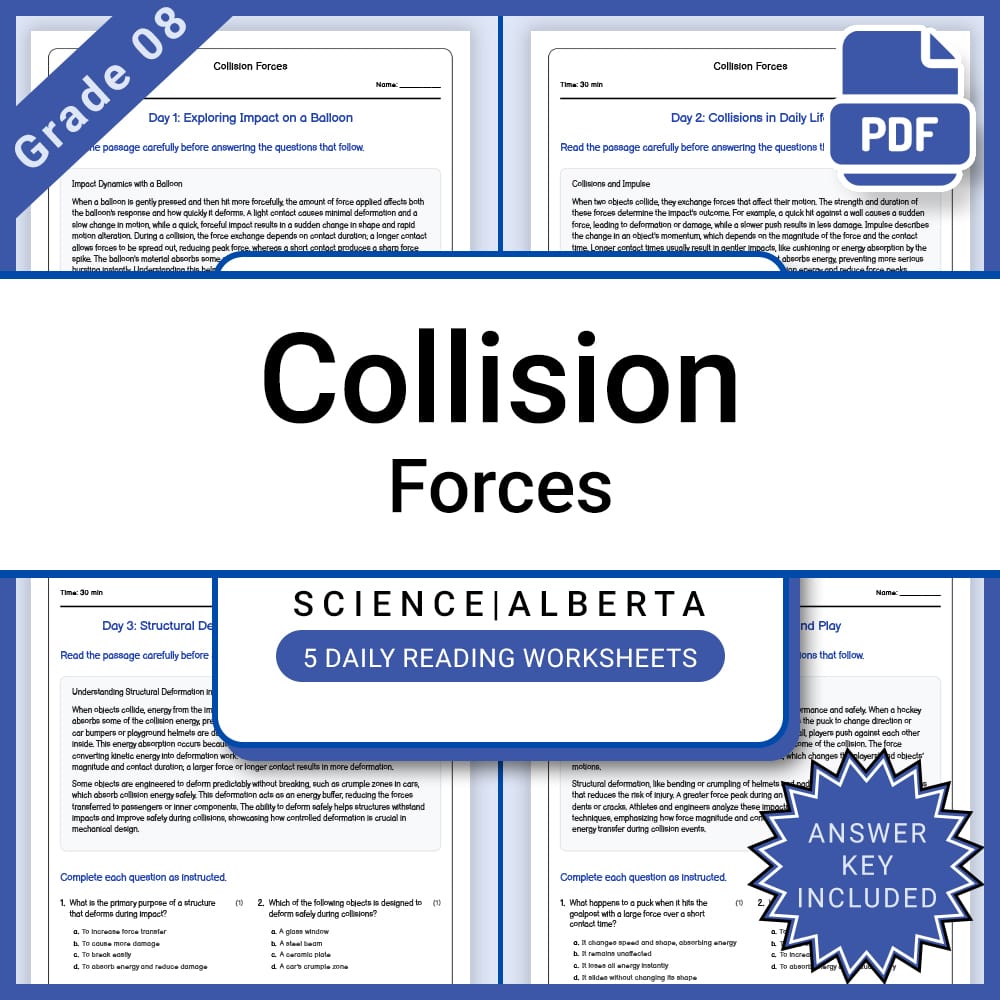
Grade 8 Science – Collision Forces Daily Reading Worksheet + Answer Key
JCreated byJ.S SheetsLearning Objectives
- Understand how forces are exchanged during brief contact events
- Learn the relationship between force magnitude and contact time in collisions
- Identify how structural deformation absorbs energy in impacts
Also included in: Grade 8 Science Lesson Bundle | Forces, Motion, and Energy +1 more
Instant download
Grade 8 Science – Systems Analysis Daily Reading Worksheet + Answer Key
JCreated byJ.S SheetsLearning Objectives
- Understand the components of systems involving forces
- Decompose vector forces into components
- Predict system behavior by analyzing force interactions
Also included in: Grade 8 Science Lesson Bundle | Forces, Motion, and Energy +1 more
Instant download
Grade 8 Science – Newton's Laws Daily Reading Worksheet + Answer Key
JCreated byJ.S SheetsLearning Objectives
- Understand the concept of inertia and how objects resist changes in motion
- Identify how forces affect the movement and behavior of objects
- Predict the effects of forces in real-world scenarios based on Newton's laws
Also included in: Grade 8 Science Lesson Bundle | Forces, Motion, and Energy +1 more
Instant download
Grade 8 – Air Resistance and Aerodynamics | Daily Reading Worksheet + Answer Key
JCreated byJ.S SheetsLearning Objectives
- Understand the concept of aerodynamic drag
- Identify factors affecting air resistance
- Explain real-world applications of reducing drag
Also included in: Grade 8 Science Lesson Bundle | Forces, Motion, and Energy +1 more
Instant download
Grade 8 Science – Circular Motion Daily Reading Worksheet + Answer Key
JCreated byJ.S SheetsLearning Objectives
- Define circular motion and identify key components such as centripetal force.
- Explain how inward force, turning radius, and mass influence the force required for circular motion.
- Analyze regional phenomena involving circular motion, such as road curves and amusement rides.
Also included in: Grade 8 Science Lesson Bundle | Forces, Motion, and Energy +1 more
Instant download
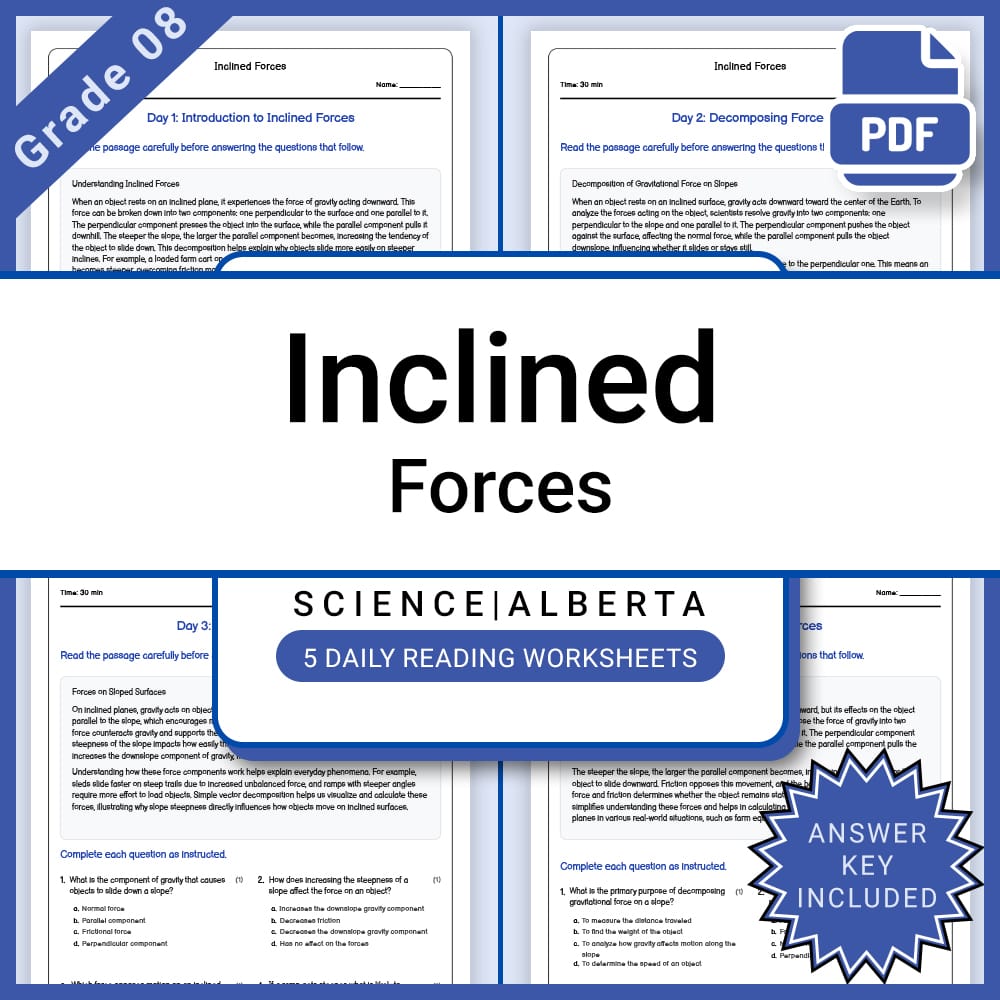
Grade 8 Science – Inclined Forces Daily Reading Worksheet with Answer Key
JCreated byJ.S SheetsLearning Objectives
- Understand how gravity can be resolved into components on an inclined plane.
- Identify the perpendicular and parallel components of gravity on slopes.
- Explain how the slope angle affects the unbalanced forces and potential motion.
Also included in: Grade 8 Science Lesson Bundle | Forces, Motion, and Energy +1 more
Instant download
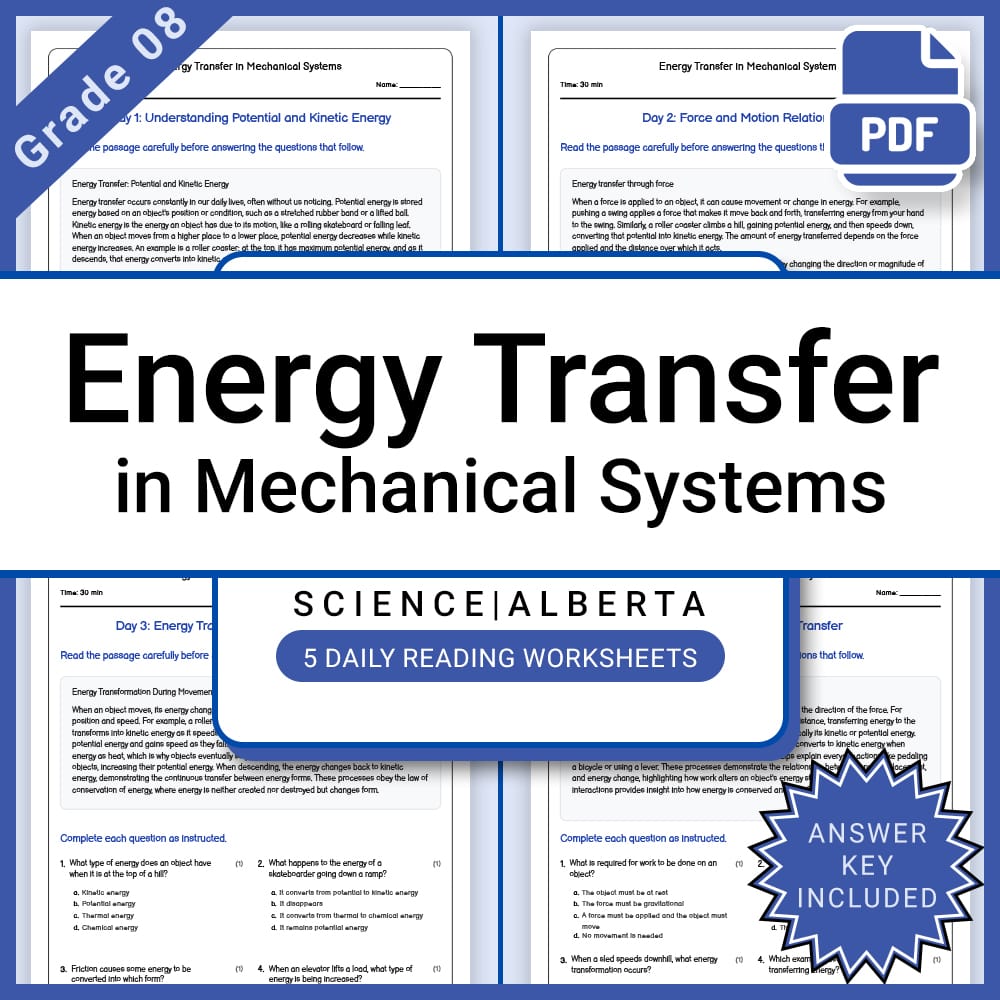
Grade 8 – Energy Transfer in Mechanical Systems Daily Worksheet + Answer Key
JCreated byJ.S SheetsLearning Objectives
- Understand key concepts related to Science
- Apply knowledge through practice questions
- Demonstrate comprehension of the material
Also included in: Grade 8 Science Lesson Bundle | Forces, Motion, and Energy +1 more
Instant download

Grade 12 AC Circuits Worksheet | Alberta Practice & Review PDF
 Created byClear Sky Classroom
Learning Objectives
- Represent series AC circuits using phasors to relate voltage, current, impedance, and phase angle.
- Calculate impedance components (R, X_L, X_C) and use them to determine current magnitude in AC circuits.
- Determine real power, reactive power, apparent power, and power factor for resistive–inductive–capacitive networks.
Instant download
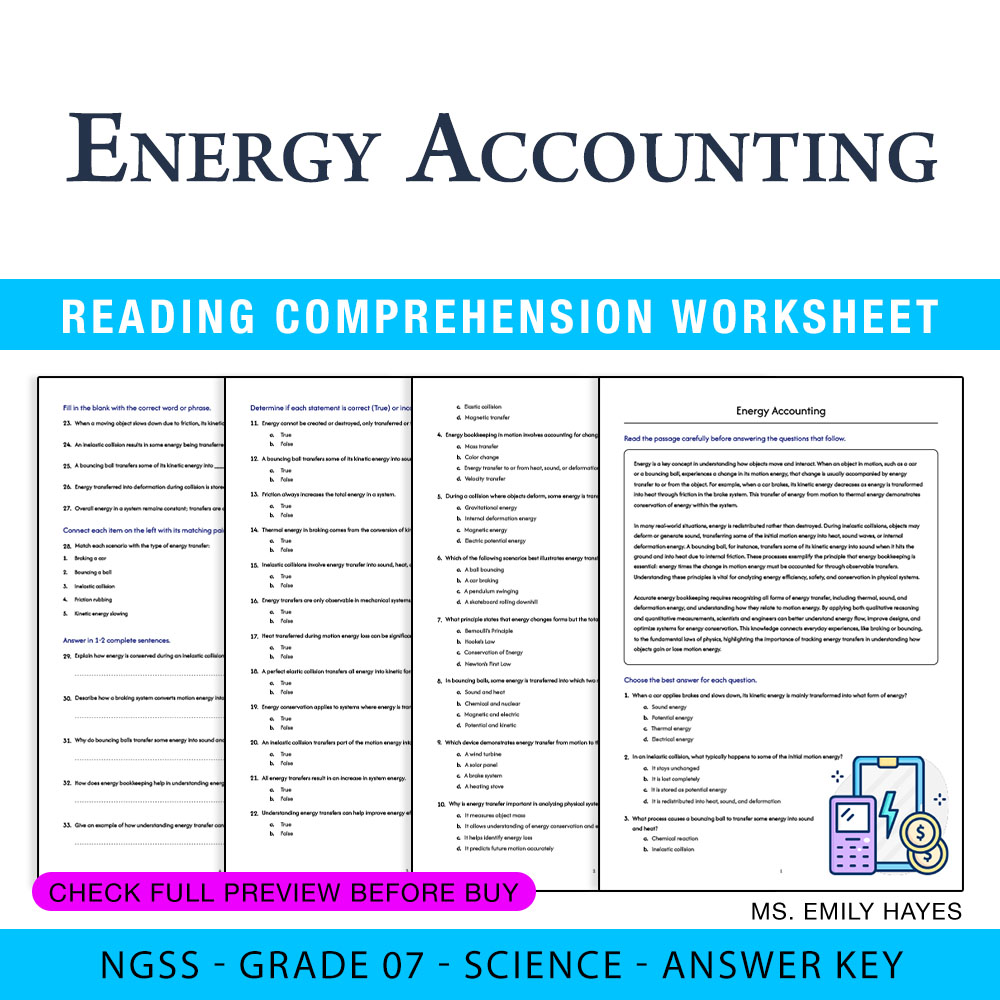
Grade 7 Science | Energy Accounting Worksheet (PDF+ Answer Key)
 Created byCopper Leaf Classroom
Learning Objectives
- Describe how changes in an object's motion energy are linked to energy transfers into or out of the object.
- Analyze scenarios such as braking cars, inelastic collisions, and bouncing balls to identify energy transfers.
- Apply quantitative and qualitative reasoning to understand conservation and transfer of energy in motion.
Instant download

Solution Comparison Worksheet for Grade 8 Science | NGSS Assessment PDF
Learning Objectives
- Understand how to compare different design solutions using evaluation criteria.
- Learn to develop and interpret trade-off matrices for solution selection.
- Differentiate qualitative assessments from quantitative performance indicators.
Also included in: Grade 8 Science Engineering Design Lesson Bundle | NGSS +1 more
Instant download
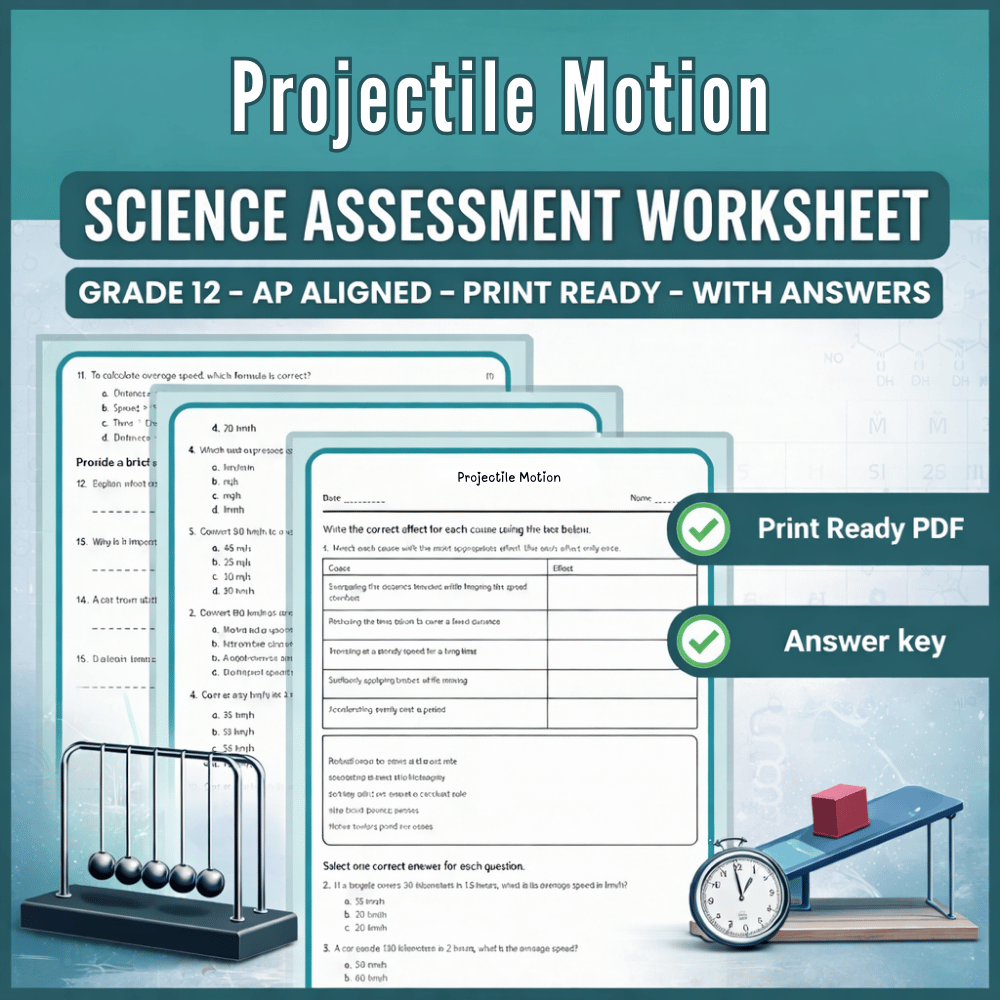
Grade 12 Science – Projectile Motion Worksheet (AP Standard) (PDF)
 Created byBright Mind Resources
Learning Objectives
- Explain the concepts of projectile motion using vector decomposition and parametric equations.
- Analyze two-dimensional motion under gravity to determine range, time of flight, and trajectory shape.
- Apply assumptions like negligible air resistance and choose appropriate coordinate systems to simplify problems.
Instant download

Grade 10 Science – Kinematic Graphs & Motion Analysis | Daily Reading Worksheet
Created byBright Mind ResourcesLearning Objectives
- Understand how position vs. time graphs illustrate an object's motion.
- Interpret the slope of position-time graphs to find velocity.
- Analyze shapes of graphs to determine acceleration and movement patterns.
Also included in: Energy & Systems Interactions Grade 10 Science lesson bundle | Alberta +1 more
Instant download
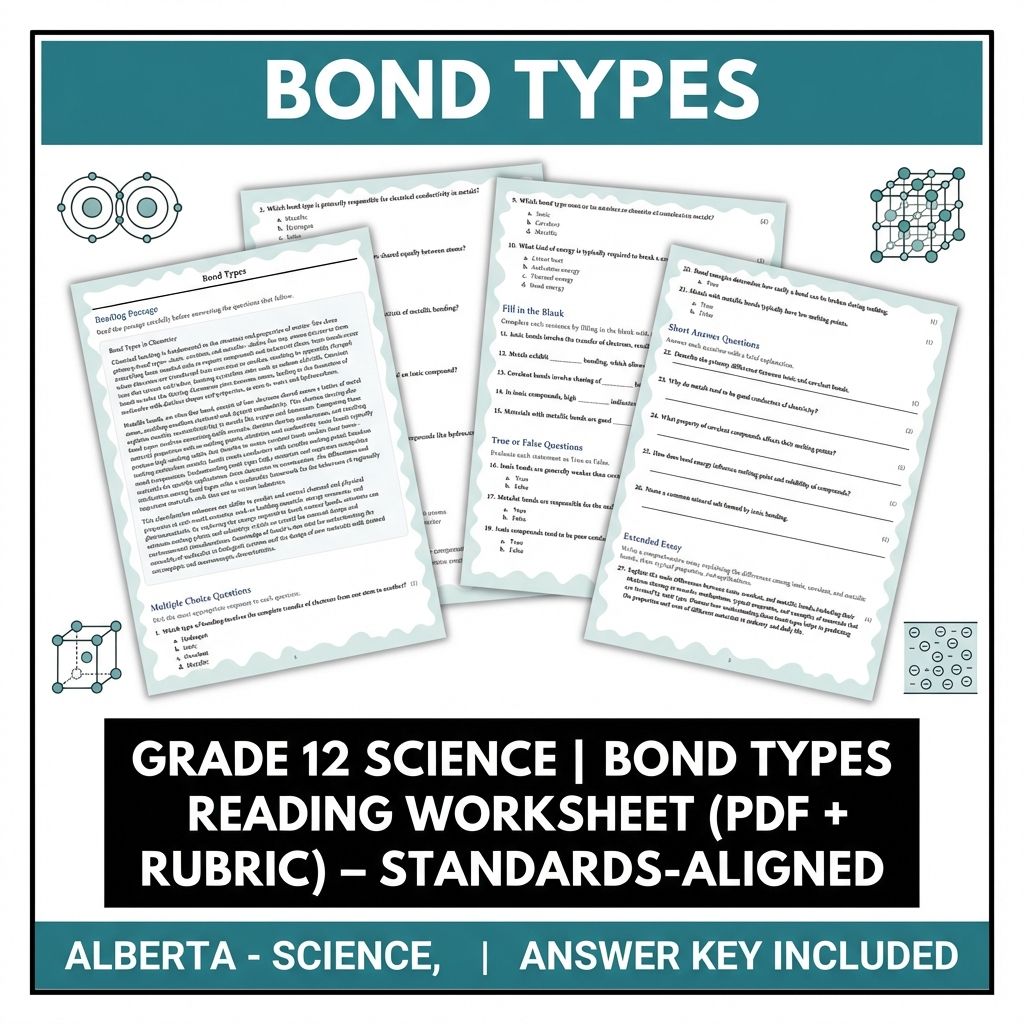
Grade 12 Science | Bond Types Worksheet (PDF + Rubric) – Standards-Aligned
JCreated byJ.S SheetsLearning Objectives
- Understand the three main types of chemical bonds: ionic, covalent, and metallic.
- Explain how atoms share or transfer electrons to form different bond types.
- Compare bond energies, properties, and applications of ionic, covalent, and metallic bonds.
Also included in: Grade 12 Science | Atomic Spectra to Chemical Equilibria (PDF + Rubric) +1 more
Instant download

Grade 10 Science | Work & Power in Physics - Daily Reading Comprehension
 Created byCoral Reef Learning
Learning Objectives
- Understand the concept of work in physics
- Calculate work done by a force through displacement
- Relate work to energy transfer and the work–energy theorem
Instant download
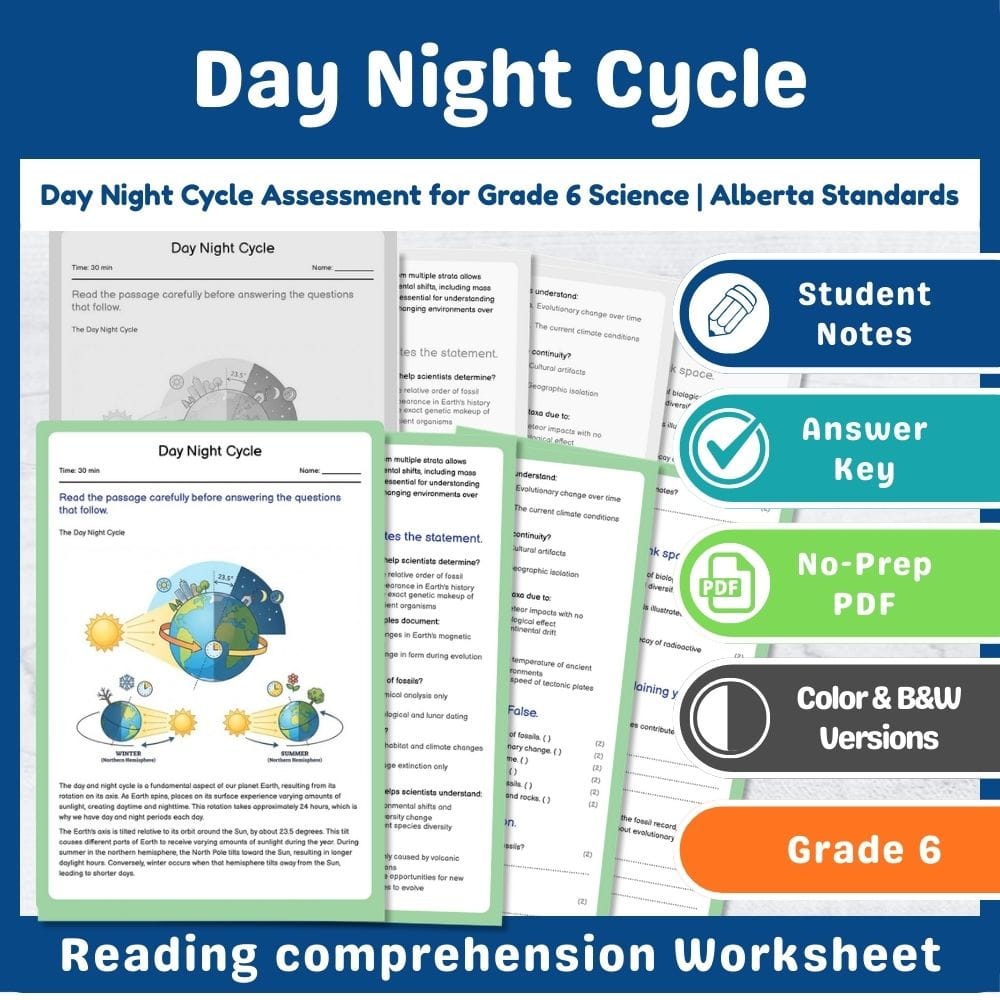
Day Night Cycle Assessment for Grade 6 Science | Alberta Standards
 Created byPrism Point Learning
Learning Objectives
- Explain how Earth's rotation causes day and night.
- Describe the effect of Earth's axial tilt on daylight duration throughout the year.
- Relate observed day length patterns in Alberta to Earth's position and movement around the Sun.
Also included in: Lesson Grade 6 Science Assessment | Celestial & Earth Movements
Instant download

Grade 9 Science | Atomic Structure - Daily Reading Comprehension
Created byCoral Reef LearningLearning Objectives
- Understand the basic components of an atom: protons, neutrons, electrons.
- Learn about electron configurations and quantized energy levels.
- Explore how the periodic table organizes elements based on valence electrons.
Instant download

Grade 5 Science | Physical Changes Worksheet with Short Notes (Printable PDF)
 Created byMeadowlark Worksheets
Learning Objectives
- Define and identify physical changes in materials.
- Differentiate between reversible and irreversible physical changes.
- Understand how measurement of mass, appearance, and texture supports the identification of physical changes.
Also included in: Grade 5 Science Lesson Group: Ontario Curriculum Worksheets Bundle +1 more
Instant download
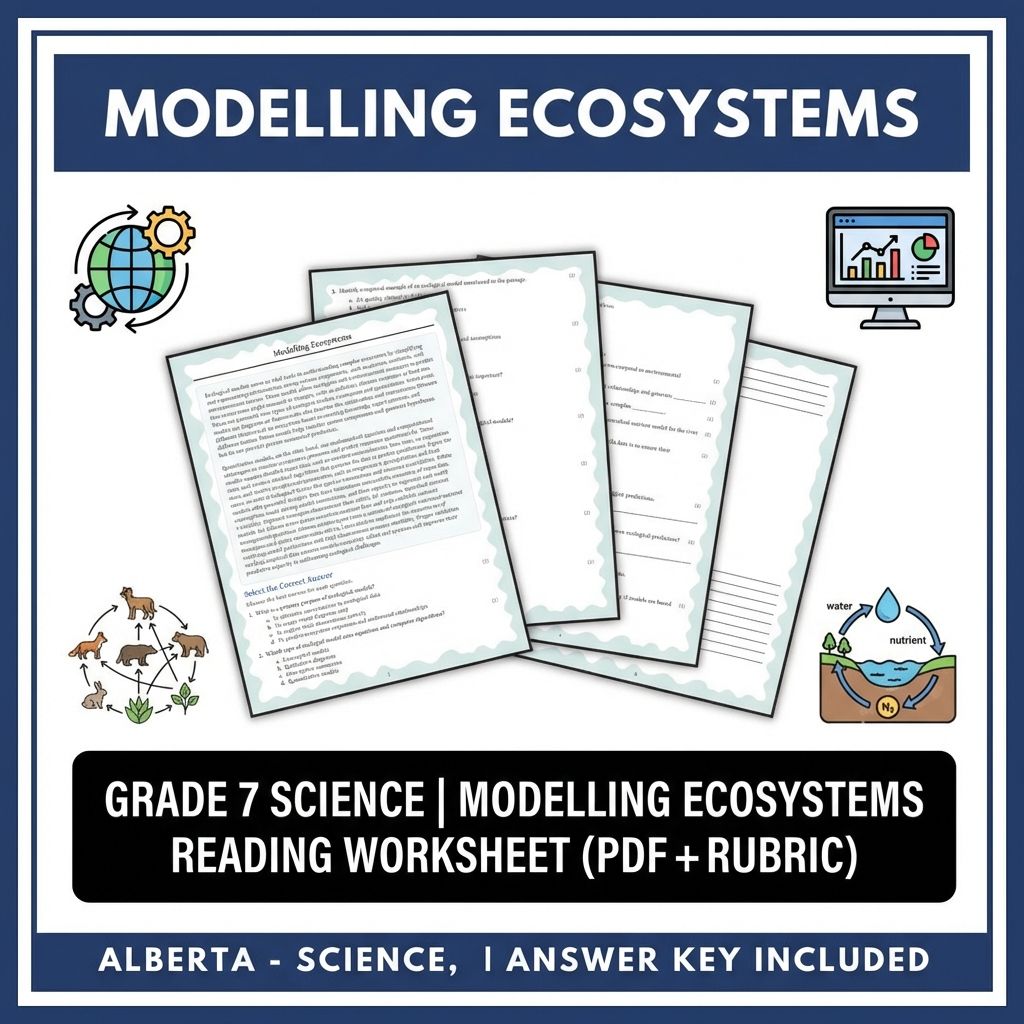
Grade 7 Science | Modelling Ecosystems Reading Worksheet (PDF + Rubric)
JCreated byJ.S SheetsLearning Objectives
- Understand the concept of ecological modelling and its applications.
- Differentiate between conceptual and quantitative models in ecology.
- Identify the inputs, limitations, and regional examples of ecological models.
Also included in: Grade 7 Science Bundle | Ecology, Ecosystems & Environmental Topics (Pack) +1 more
Instant download

Grade 10 Science | Thermodynamic Limits Worksheet + Answer Key (PDF)
Created byBright Mind ResourcesLearning Objectives
- Explain the first and second laws of thermodynamics and their implications on energy conservation and entropy.
- Describe how heat engines and refrigerators operate between temperature reservoirs.
- Calculate the theoretical maximum efficiency of heat engines using Carnot's principles.
Instant download

Grade 9 Science – Energy Molecules Daily Reading Worksheet with Answer Key
JCreated byJ.S SheetsLearning Objectives
- Understand the structure of ATP
- Explain how ATP stores and releases energy
- Describe the process of ATP regeneration
Also included in: Grade 9 Science Lesson Group: Photosynthesis & Metabolism TEKS Bundle +1 more
Instant download
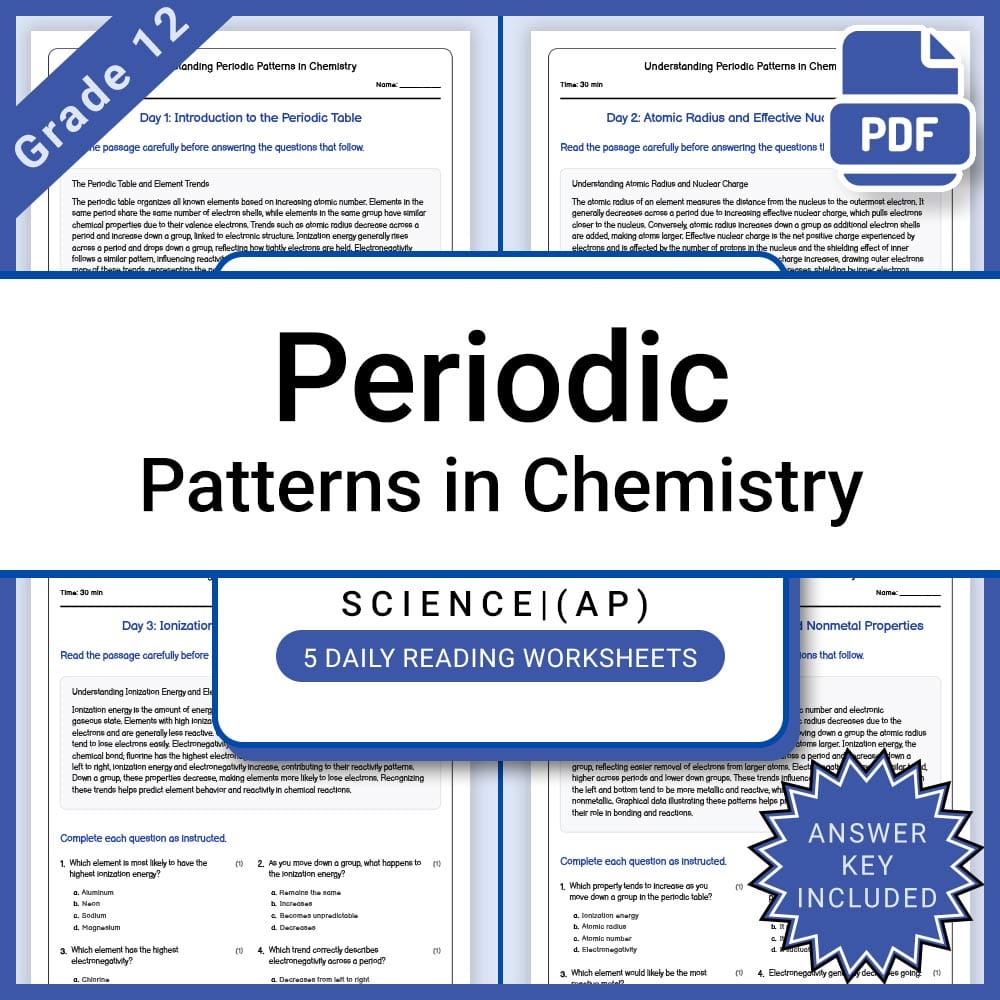
Grade 12 Science – Periodic Patterns in Chemistry Worksheet + Answer Key
JCreated byJ.S SheetsLearning Objectives
- Explain how properties such as atomic radius, ionization energy, electronegativity, and effective nuclear charge vary across the periodic table.
- Relate electronic structure to observable macroscopic properties like metallic character and reactivity.
- Interpret tabular and graphical data to predict element behaviors based on their position in the periodic table.
Also included in: Grade 12 Chemistry Foundations Lesson Bundle – AP Science Activities +1 more
Instant download
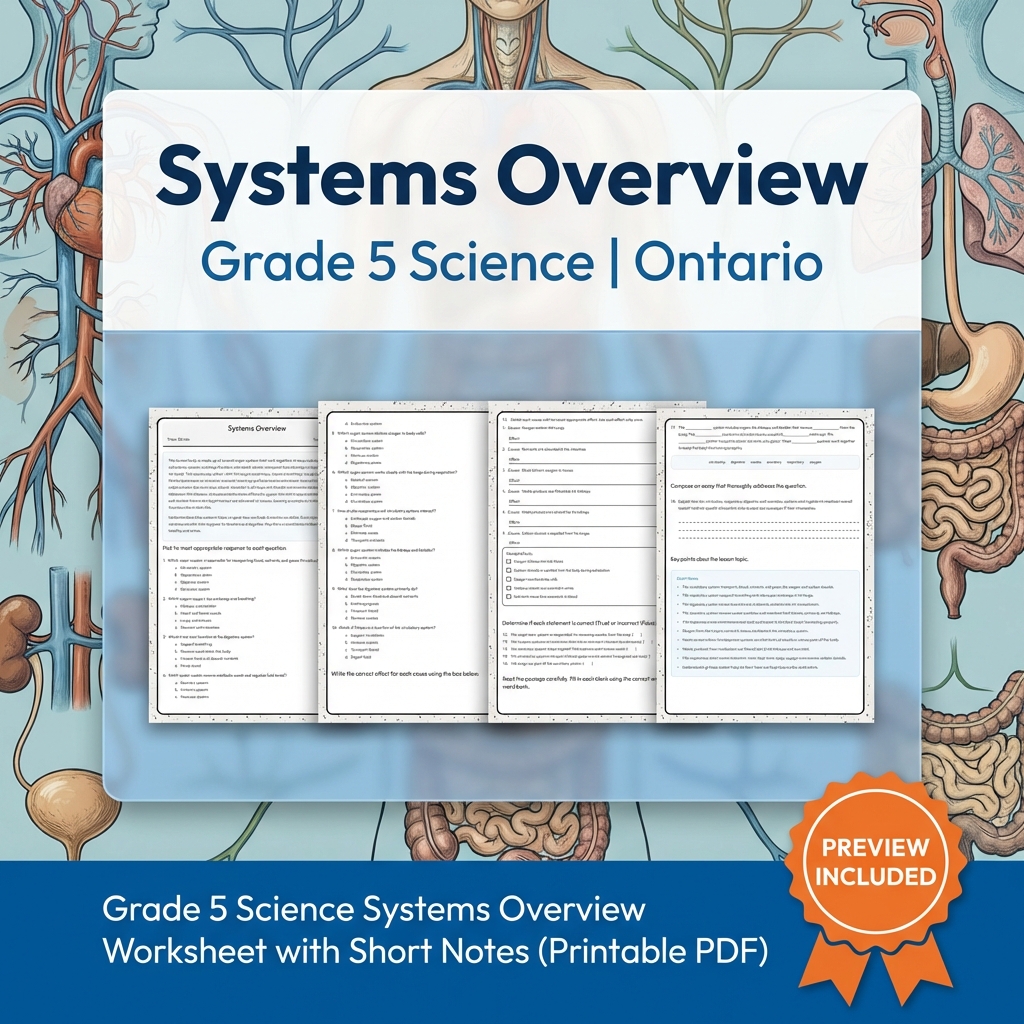
Grade 5 Science Systems Overview Worksheet with Short Notes (Printable PDF)
Created byMeadowlark WorksheetsLearning Objectives
- Describe the major human organ systems and their functions.
- Understand how different systems interact in the body.
- Identify the structure-function relationship in organ systems.
Also included in: Grade 5 Science Lesson Group – Ontario Curriculum Worksheets Bundle +1 more
Instant download

Grade 11 Scientific Inquiry Worksheet | NGSS Practice PDF
Created byClear Sky ClassroomLearning Objectives
- Explain how scientific thinking connects observations to evidence-based explanations.
- Describe how scientific inquiry can proceed non-linearly and incorporate prior knowledge while remaining open to alternative interpretations.
- Identify characteristics of explanations that count as science, including testability and evaluation by others.
Instant download

Grade 8 Science | Energy Conservation in Physics - Daily Reading Comprehension
Created byCoral Reef LearningLearning Objectives
- Understand key concepts related to Science
- Apply knowledge through practice questions
- Demonstrate comprehension of the material
Instant download
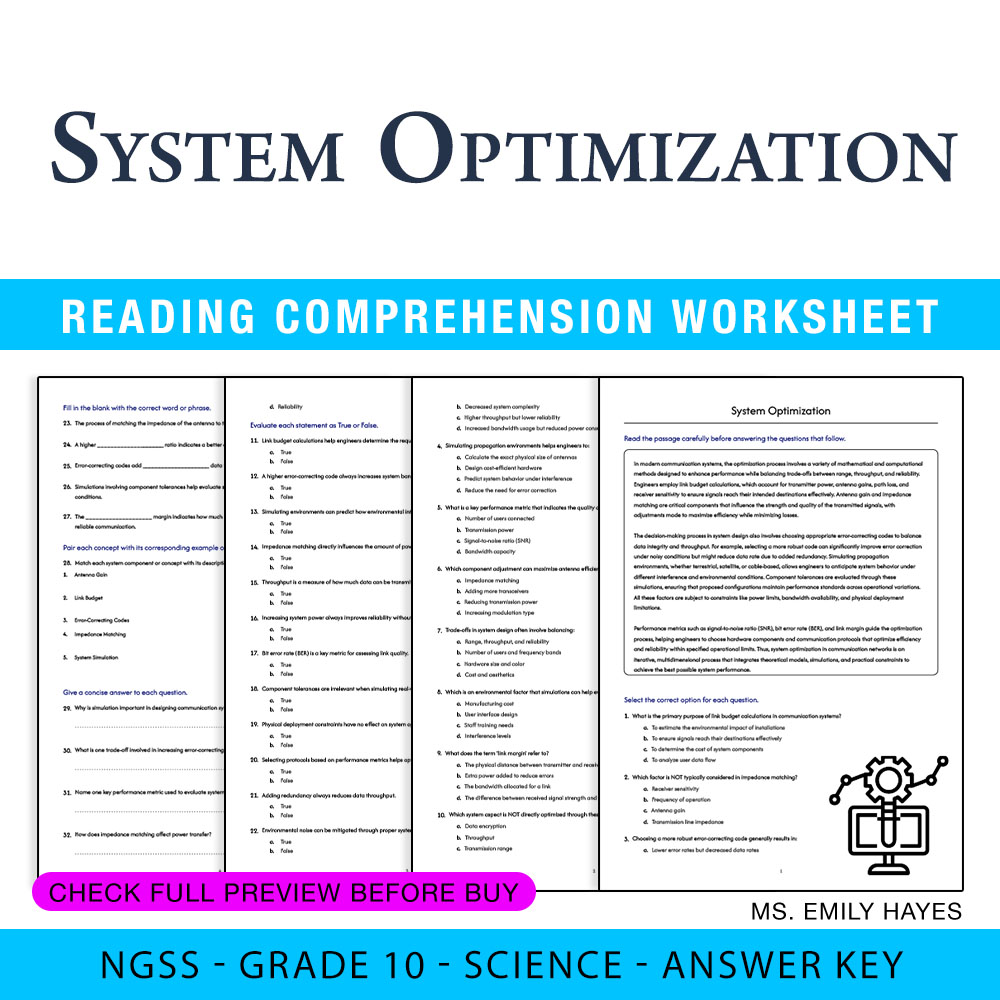
10th Grade Science | System Optimization Worksheet (PDF+ Answer Key)
Created byCopper Leaf ClassroomLearning Objectives
- Understand mathematical models used in communication system optimization
- Analyze the trade-offs involved in system components such as antennas and coding
- Evaluate performance metrics and constraints for communication systems
Instant download
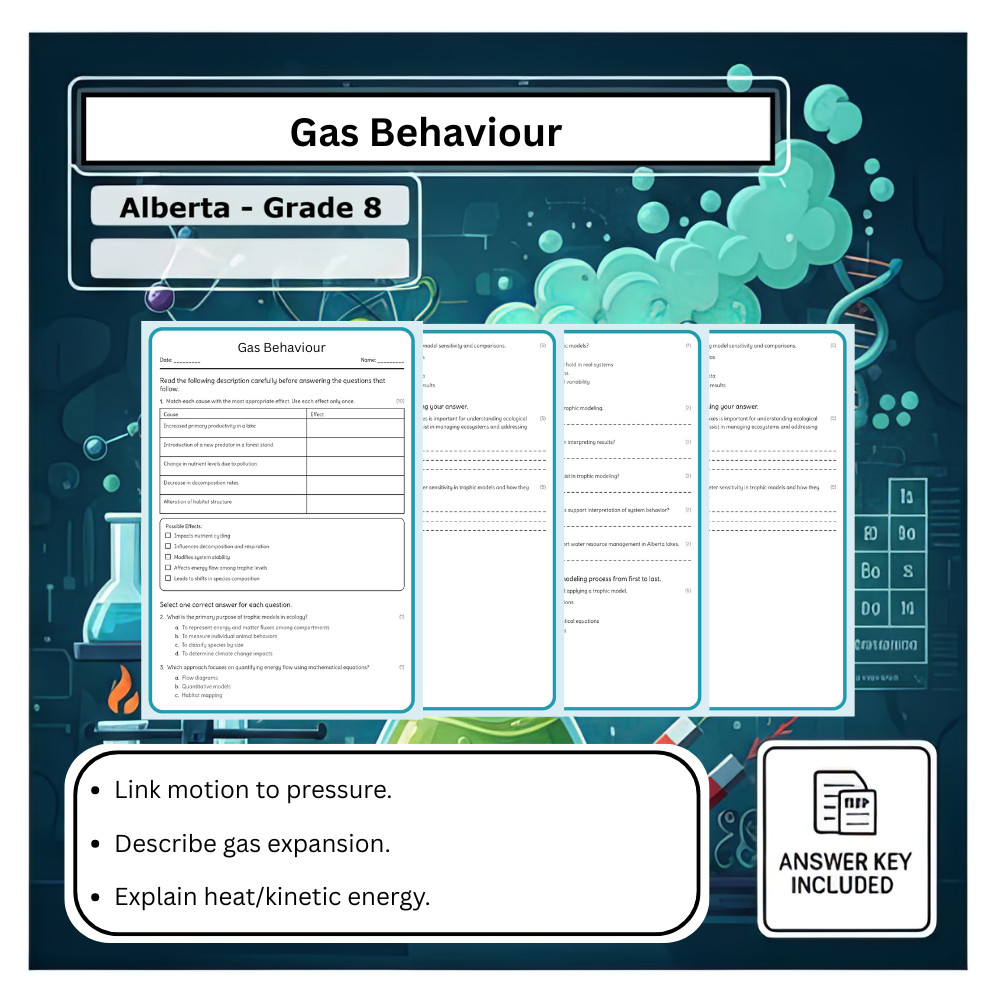
Grade 8 Science – Gas Behaviour Worksheet (Worksheet + Answer Key) | Alberta Standards
Created byBright Mind ResourcesLearning Objectives
- Understand how particle motion affects gas pressure and temperature.
- Describe observable relationships like expansion, compression, and diffusion in gases.
- Explain how changes in temperature influence kinetic energy and pressure in confined systems.
Instant download

Grade 8 Science | Thermal Transfer in Everyday Situations - Comprehension
Created byCoral Reef LearningLearning Objectives
- Describe the three main methods of heat transfer: conduction, convection, and radiation.
- Identify real-world examples of each heat transfer method.
- Explain how material properties influence the rate of thermal energy transfer.
Instant download

Grade 10 Science Worksheet – Matter Conservation (PDF)
 Created byEvergreen Desk Education
Learning Objectives
- Explain how the total amount of matter is conserved during physical and chemical changes using particle and atom models.
- Differentiate particle rearrangement in physical changes from atom rearrangement in chemical changes.
- Use atom or particle counts to predict whether mass and number of atoms match on both sides of a reaction.
Also included in: Grade 10 Conservation Laws in Science Lesson Bundle – General Framework +1 more
Instant download
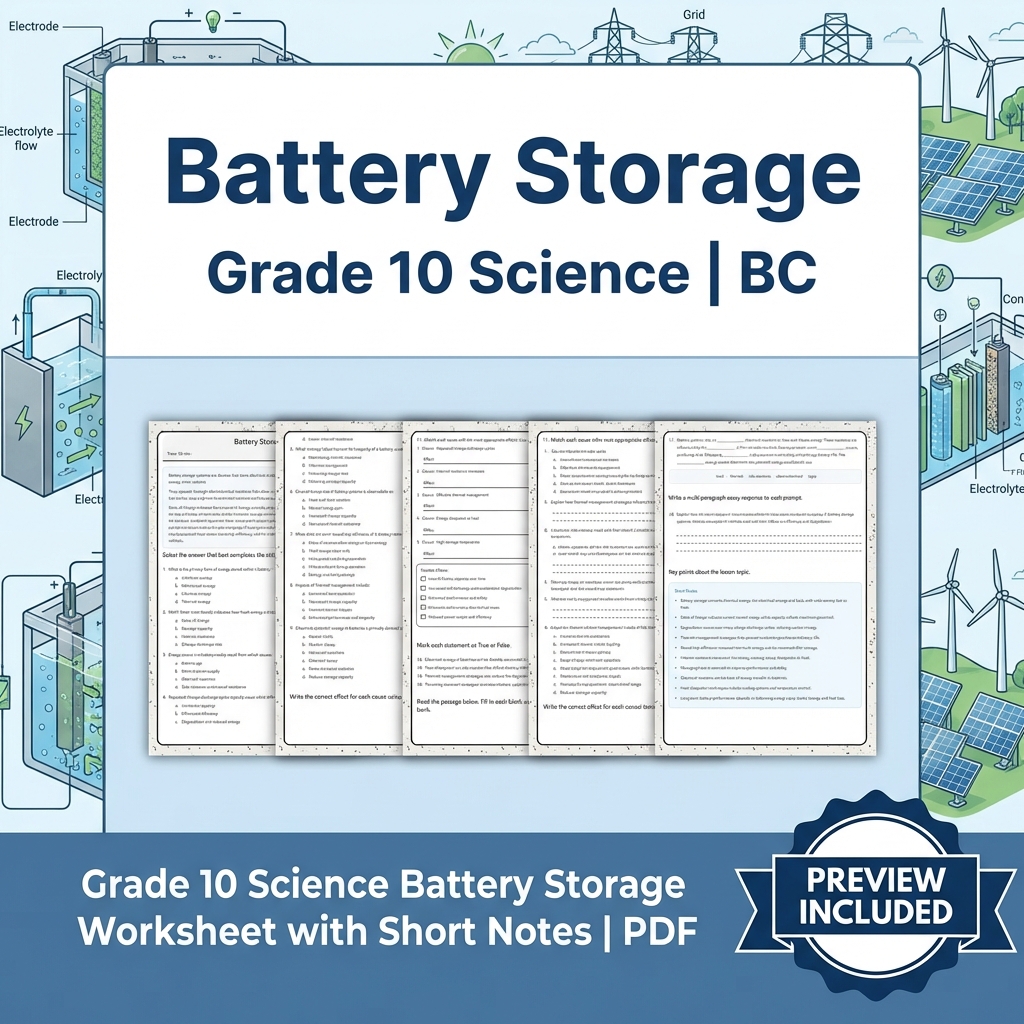
Grade 10 Science Battery Storage Worksheet with Short Notes | PDF
Created byMeadowlark WorksheetsLearning Objectives
- Understand how battery storage converts and maintains energy through chemical and electrical processes.
- Explain the concepts of state of charge, storage capacity, and their significance in battery performance.
- Analyze degradation mechanisms affecting battery life through charge–discharge cycles.
Also included in: Grade 10 Science Lesson Bundle | Energy & Thermodynamics Worksheets +1 more
Instant download
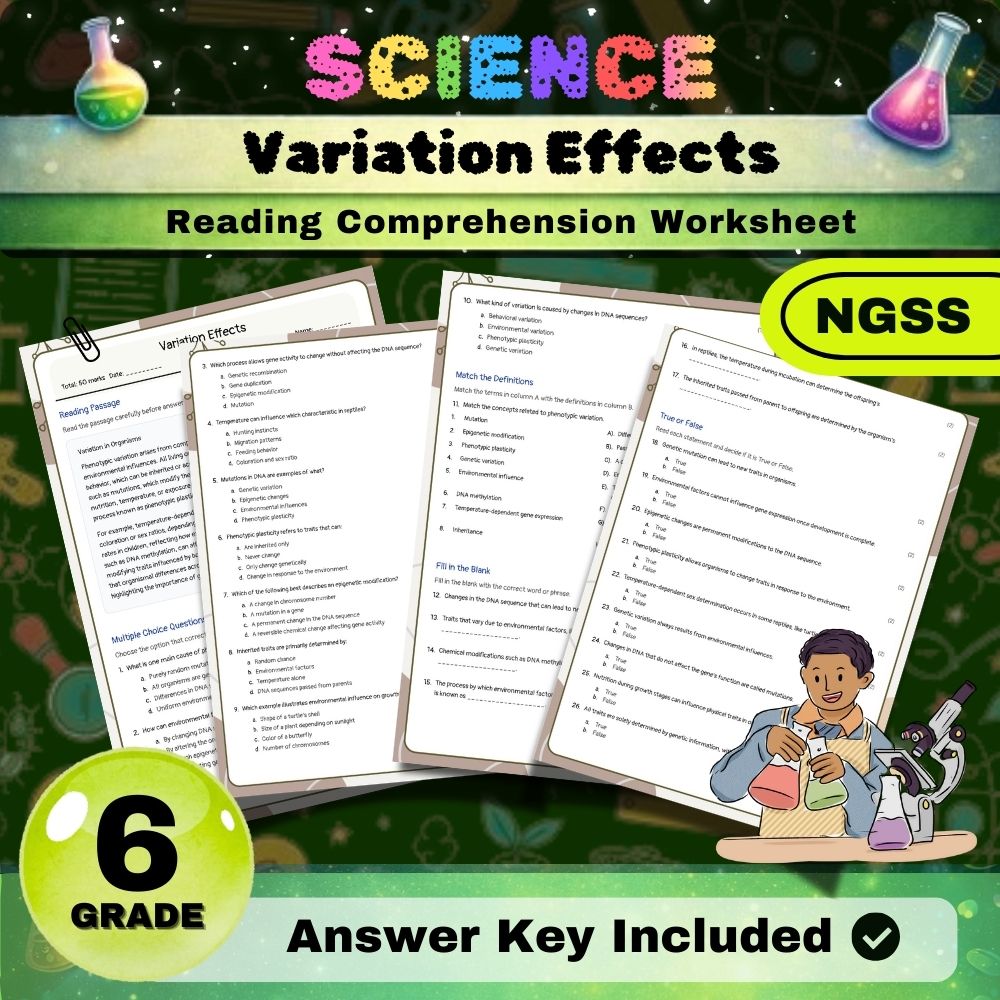
6th Grade Science – Variation Effects SCIENCE NGSS Worksheet (PDF)
 Created byMaple Path Learning
Learning Objectives
- Understand how genetic and environmental factors influence phenotypic variation in organisms.
- Explain the link between DNA sequence variation, gene expression, and observable traits.
- Identify examples of phenotypic variation caused by environmental influences such as temperature and nutrition.
Also included in: Grade 6 Science Unit Bundle – Cell Functions, Energy & Organ Systems Worksheets +1 more
Instant download
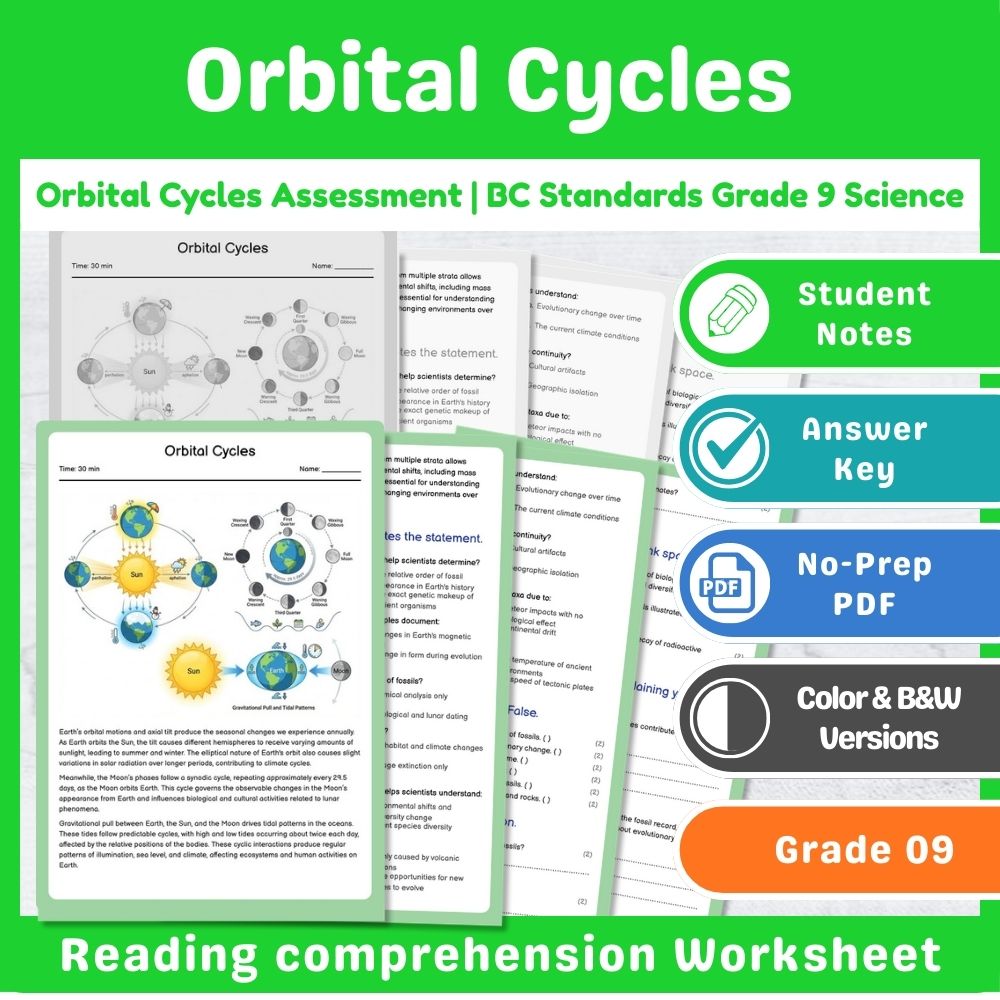
Orbital Cycles Assessment | BC Standards Grade 9 Science
Created byPrism Point LearningLearning Objectives
- Understand how Earth's orbital relationships influence seasons and climate patterns.
- Identify the Moon's phases and the cycles that determine lunar illumination.
- Explain how gravitational interactions between Earth, Moon, and Sun drive tides and cyclic phenomena.
Also included in: Grade 9 Science Mini Bundle – Earth & Space Assessment & Activities
Instant download

Grade 6 Population Change Worksheet | NGSS Practice PDF
Created byClear Sky ClassroomLearning Objectives
- Explain how birth rate, death rate, and resource availability affect population size over time
- Use population data patterns to infer whether a population is increasing or decreasing
- Describe how seasonal changes in resources can change survival and reproduction
Instant download
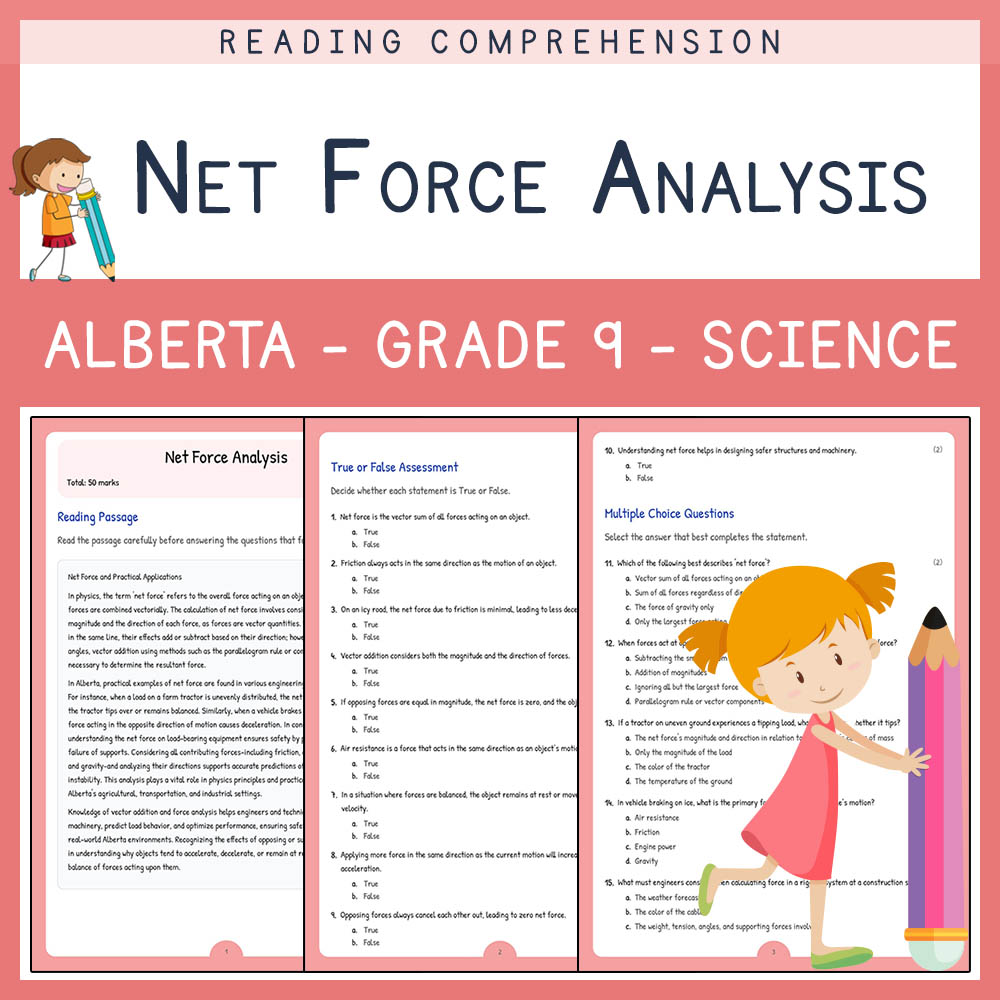
Grade 9 Science | Net Force Analysis Worksheet | Alberta Standards
 Created byLumora Learning
Learning Objectives
- Understand the concept of net force and how vector addition determines the resultant acceleration of objects.
- Analyze real-world scenarios involving opposing forces such as friction, air resistance, and applied loads.
- Calculate net force through vector analysis in practical Alberta situations like load tipping, vehicle deceleration, and rigging.
Instant download
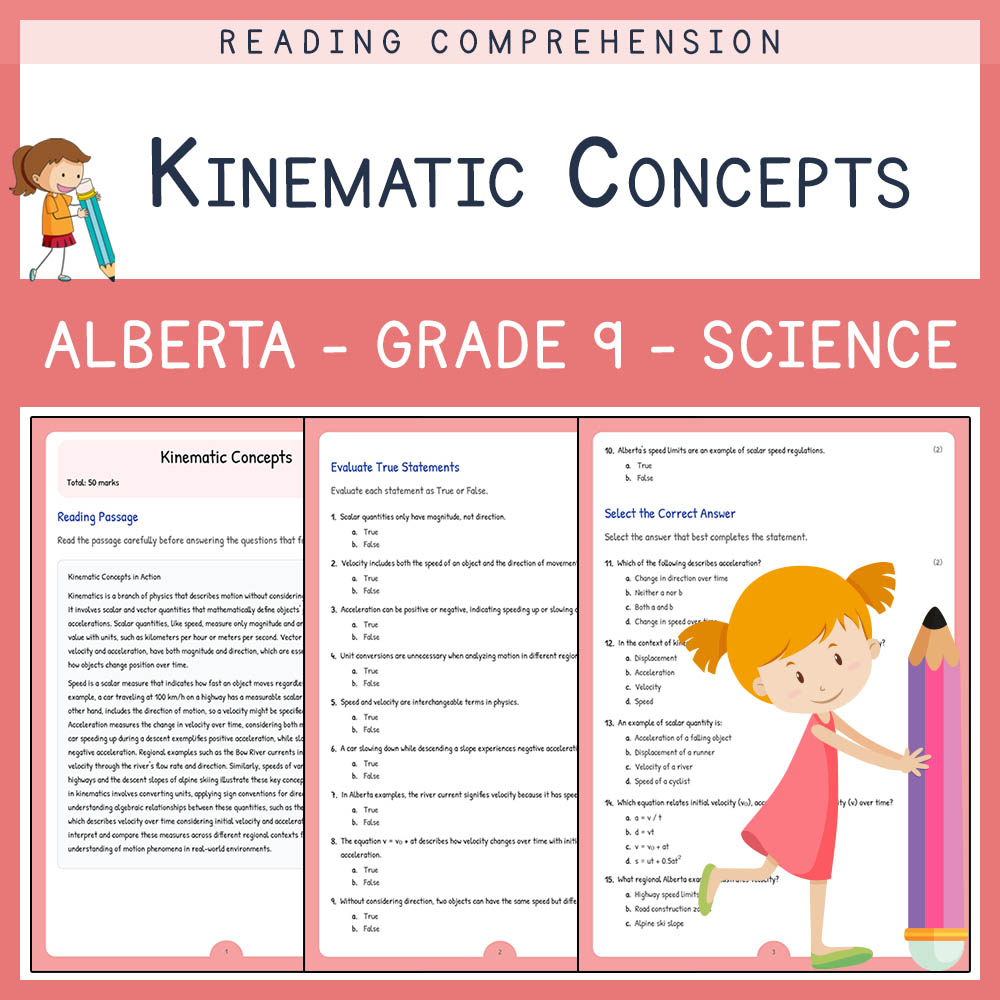
Grade 9 Science | Kinematic Concepts Worksheet | Alberta Standards
Created byLumora LearningLearning Objectives
- Understand how scalar and vector measures describe object motion.
- Identify and differentiate between speed, velocity, and acceleration.
- Apply unit conversions and sign conventions to analyze motion data.
Instant download
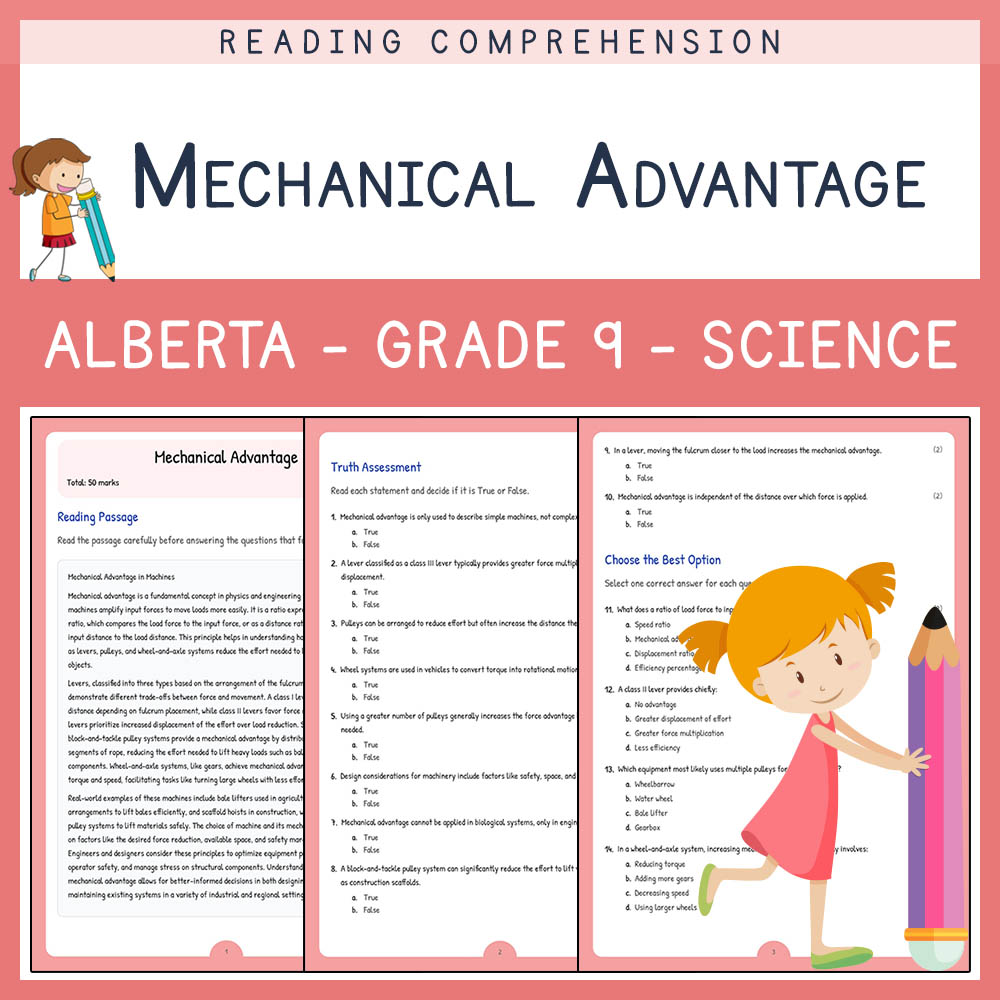
Grade 9 Science | Mechanical Advantage Worksheet | Alberta Standards
Created byLumora LearningLearning Objectives
- Explain the concept of mechanical advantage and how it is used in different machines.
- Calculate mechanical advantage for levers, pulleys, and wheel systems.
- Analyze trade-offs between force reduction and displacement in mechanical systems.
Instant download
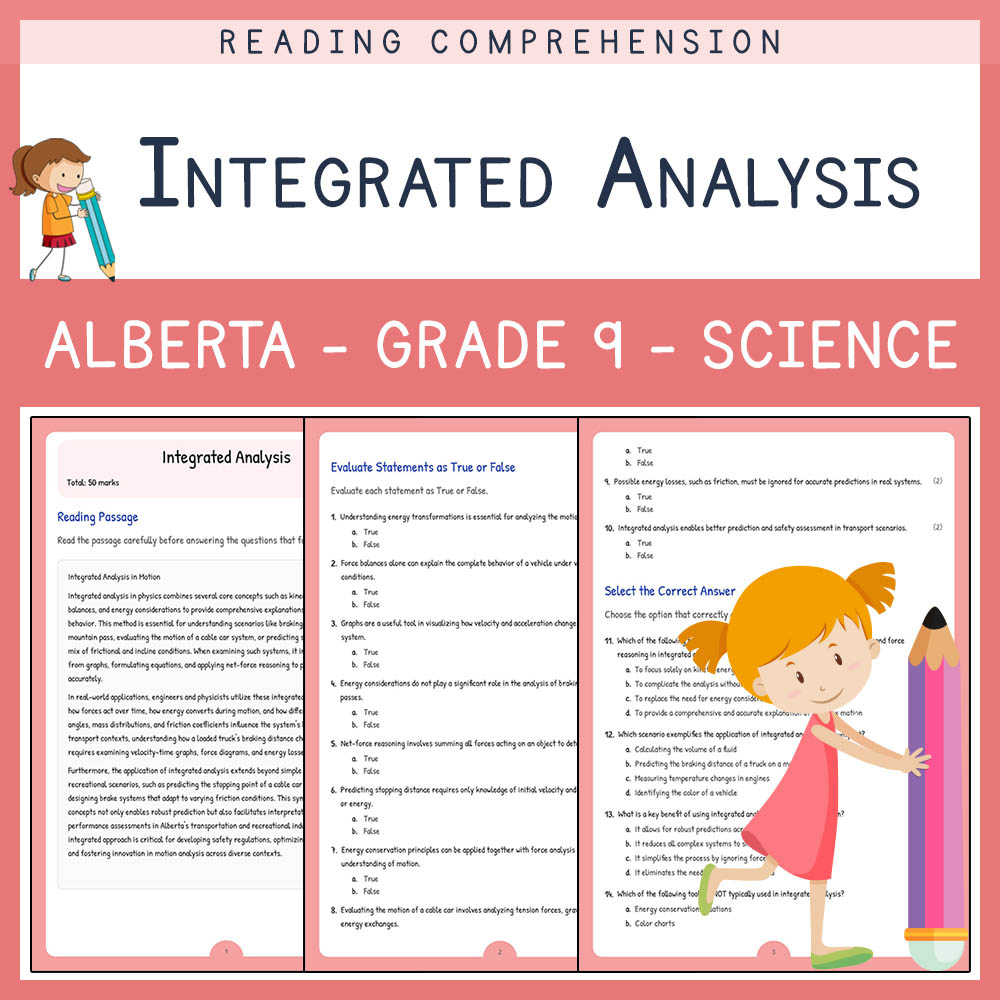
Grade 9 Science Worksheet | Integrated Analysis | Alberta Standards
Created byLumora LearningLearning Objectives
- Understand how to synthesize kinematic descriptions, force balances, and energy considerations in analyzing motion.
- Apply graphs, equations, and net-force reasoning to complex dynamic scenarios.
- Interpret integrated data to predict motion in transport and recreational contexts.
Instant download
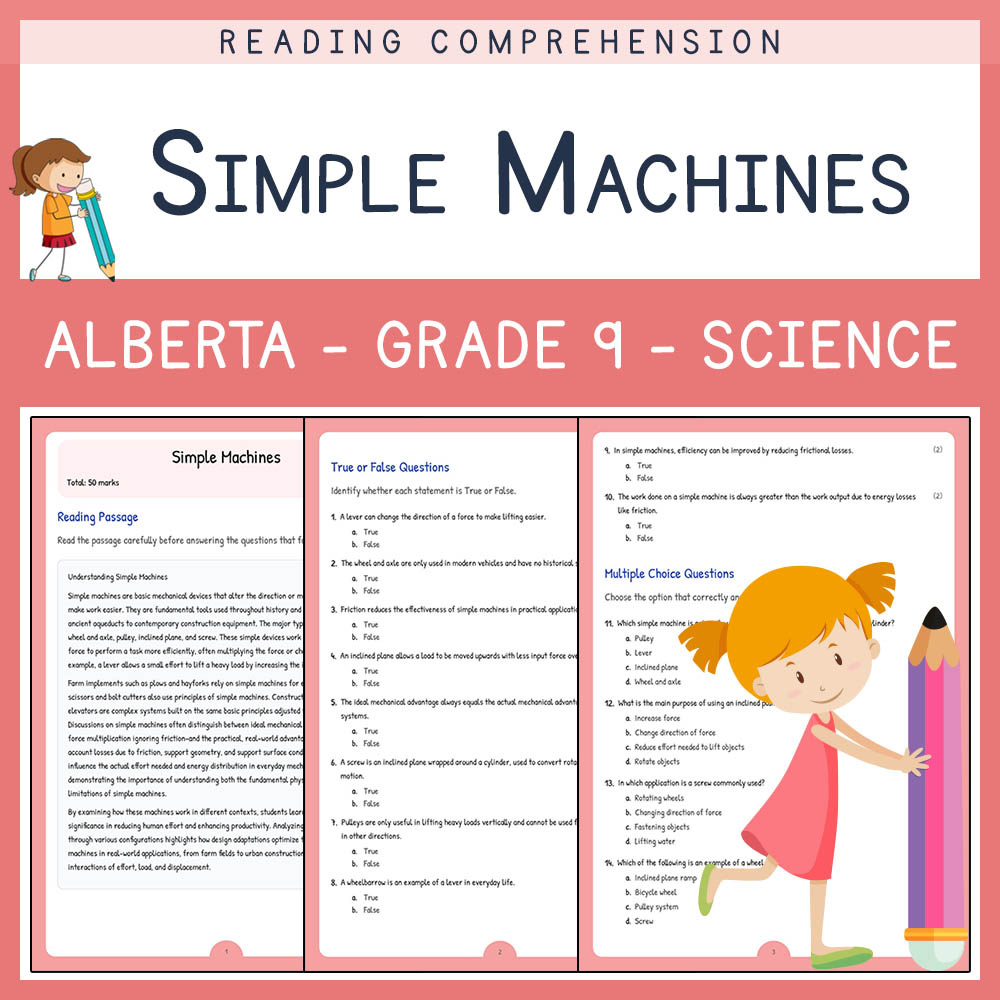
Grade 9 Science | Simple Machines Worksheet | Alberta Standards
Created byLumora LearningLearning Objectives
- Understand the fundamental concepts of simple machines and how they reduce effort.
- Identify common examples and applications of lever, wheel and axle, pulley, inclined plane, and screw.
- Explain the difference between ideal mechanical advantage and actual mechanical advantage considering friction and support geometry.
Instant download
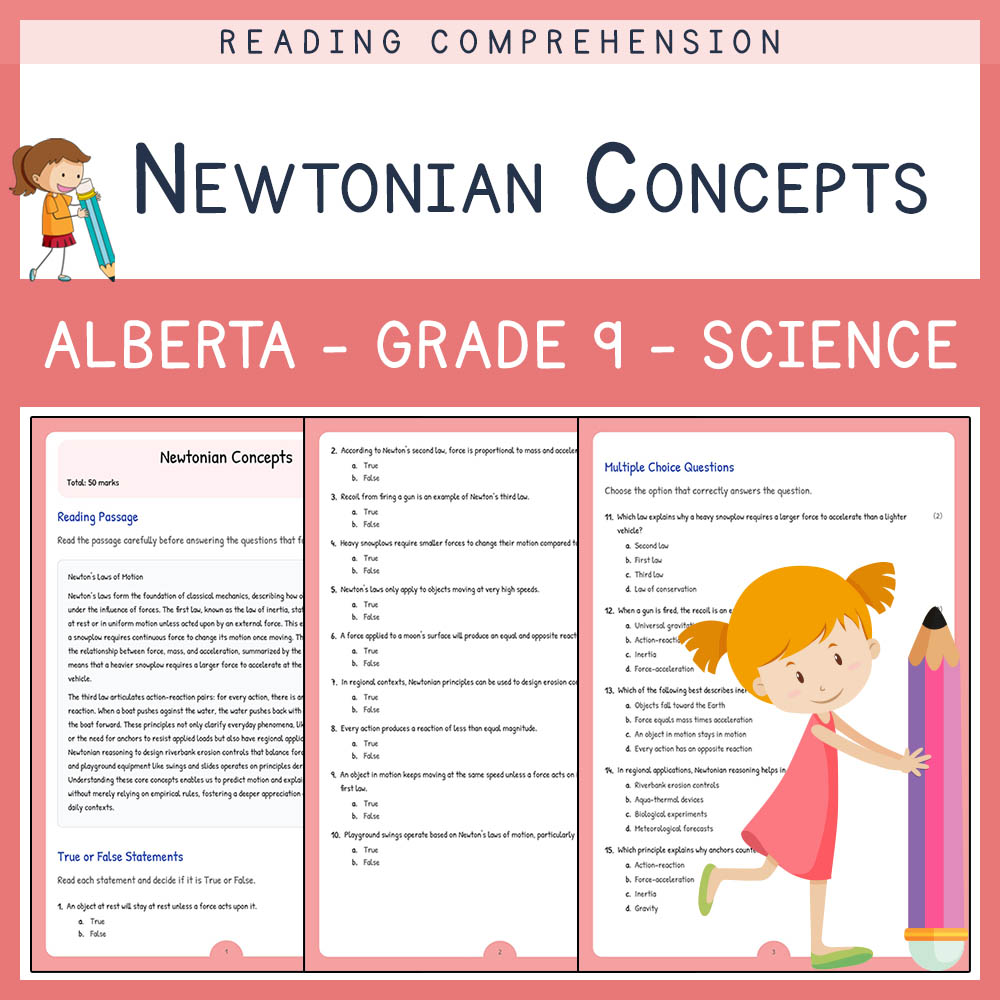
Grade 9 Science | Newtonian Concepts Worksheet | Alberta
Created byLumora LearningLearning Objectives
- Understand Newton's three laws of motion and their applications.
- Explain how forces affect the motion of objects in real-world contexts.
- Analyze and interpret motion patterns using Newtonian principles.
Instant download
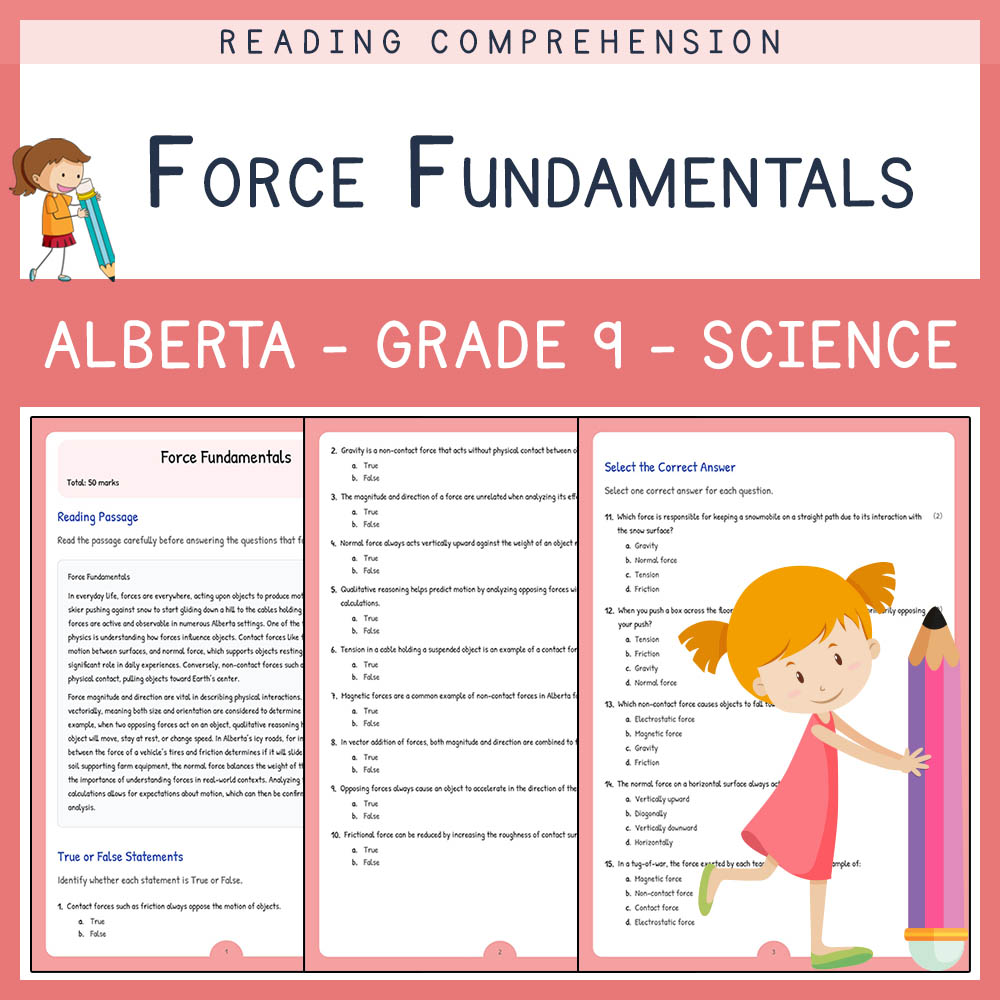
Grade 9 Science | Force Fundamentals Worksheet | Alberta Standards
Created byLumora LearningLearning Objectives
- Explain the concept of force as an interaction capable of changing an object's motion.
- Identify and differentiate between contact and non-contact forces in real-world Alberta settings.
- Describe how magnitude and direction combine vectorially to represent forces.
Instant download
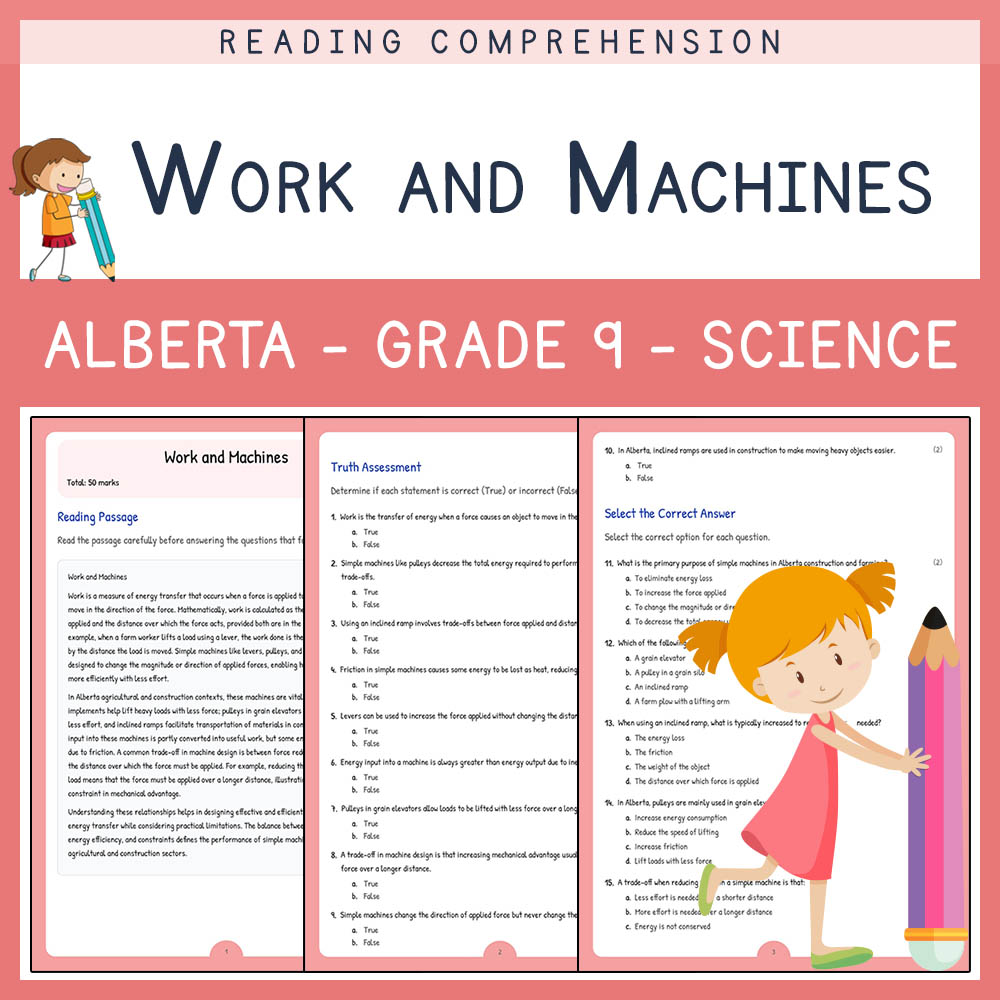
Grade 9 Science | Work and Machines Worksheet | Alberta Standards
Created byLumora LearningLearning Objectives
- Explain how work quantifies energy transfer through force and distance.
- Describe how simple machines modify force and distance to improve work efficiency.
- Identify real-world examples of levers, pulleys, and inclined ramps in Alberta contexts.
Instant download
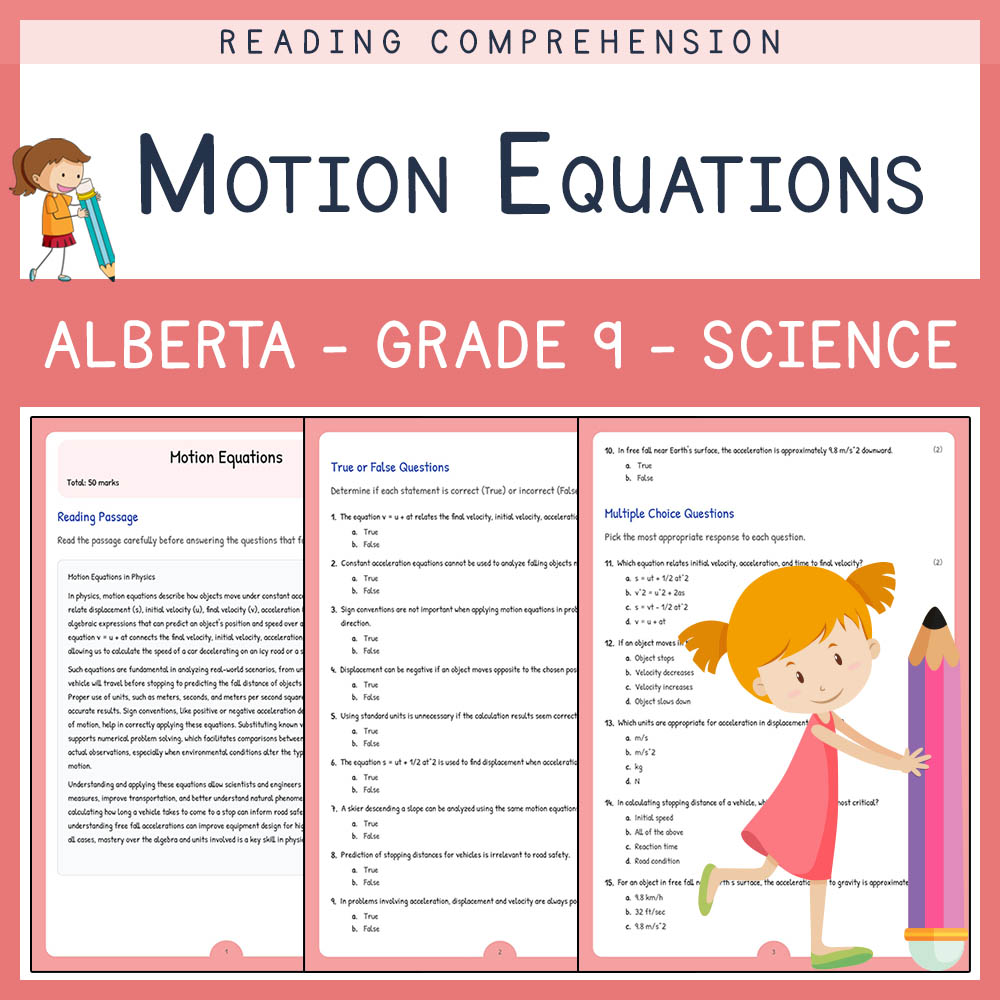
Grade 9 Science | Motion Equations Worksheet | Alberta Standards
Created byLumora LearningLearning Objectives
- Explain the relationship between displacement, velocity, acceleration, and time using constant-acceleration equations.
- Apply standard motion equations to solve numerical problems involving vehicle stopping, ski descents, and falling objects.
- Use proper units and sign conventions when substituting values into motion equations.
Instant download
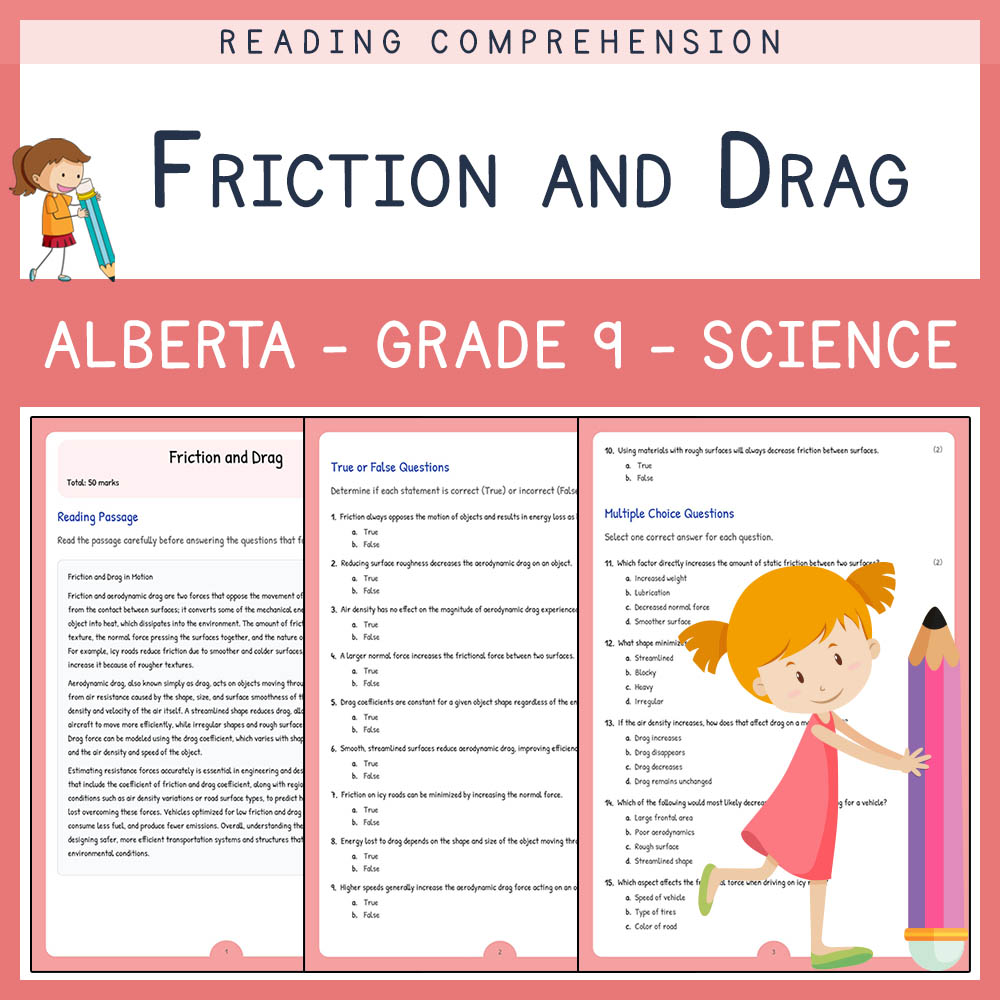
Grade 9 Science | Friction and Drag Worksheet | Alberta Standards
Created byLumora LearningLearning Objectives
- Understand how friction and aerodynamic drag oppose motion and convert mechanical energy into thermal energy.
- Identify factors that influence friction and drag in various scenarios.
- Apply quantitative models using coefficients of friction and drag coefficients to estimate resistance forces.
Instant download

Grade 6 Science | Electrostatic Phenomena - Daily Reading Comprehension
Created byCoral Reef LearningLearning Objectives
- Understand the basic principles of static electricity and charge transfer
- Identify materials that tend to gain or lose electrons
- Describe phenomena such as attraction, repulsion, and sparks caused by static electricity
Instant download
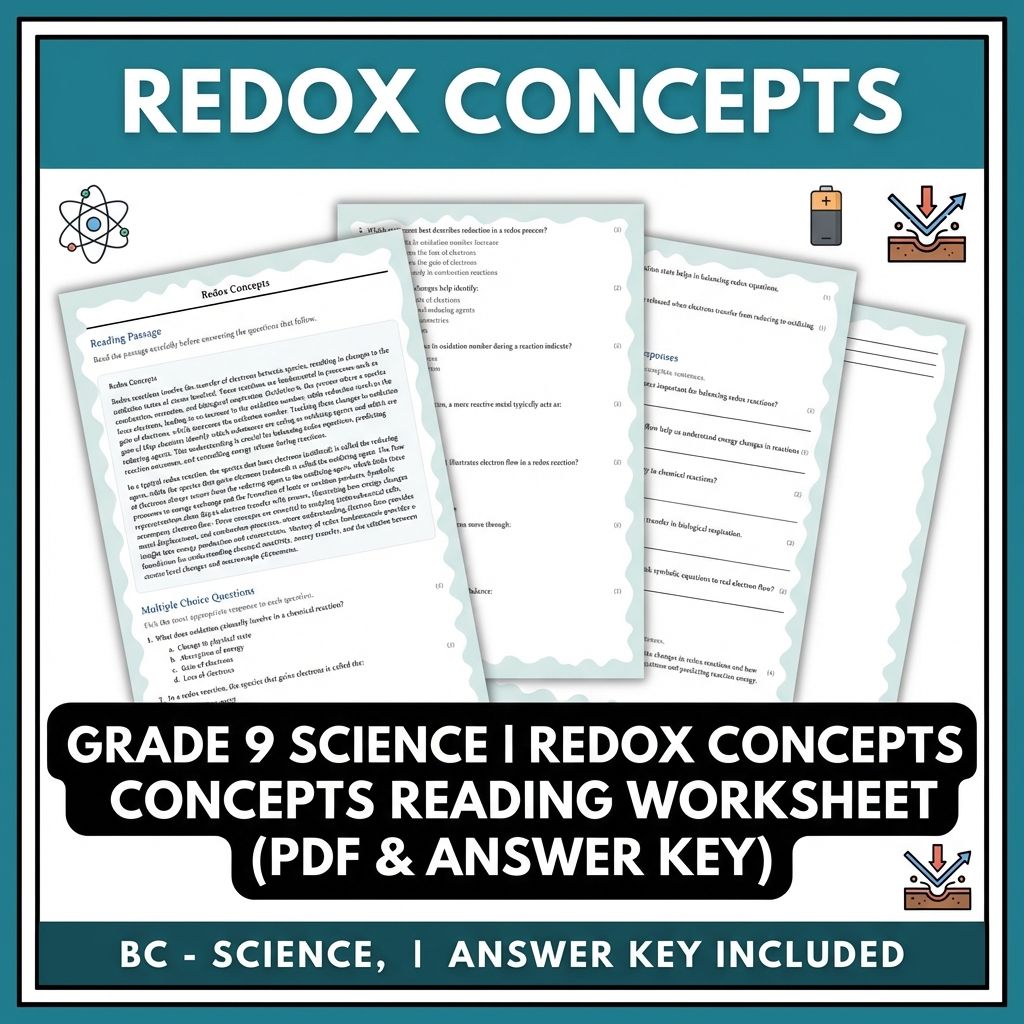
Grade 9 Science | Redox Concepts Reading Worksheet (PDF & Answer Key)
JCreated byJ.S SheetsLearning Objectives
- Understand the fundamental principles of oxidation and reduction in chemical reactions.
- Identify how electron transfer affects oxidation states in redox reactions.
- Track changes in oxidation numbers to determine oxidizing and reducing agents.
Instant download
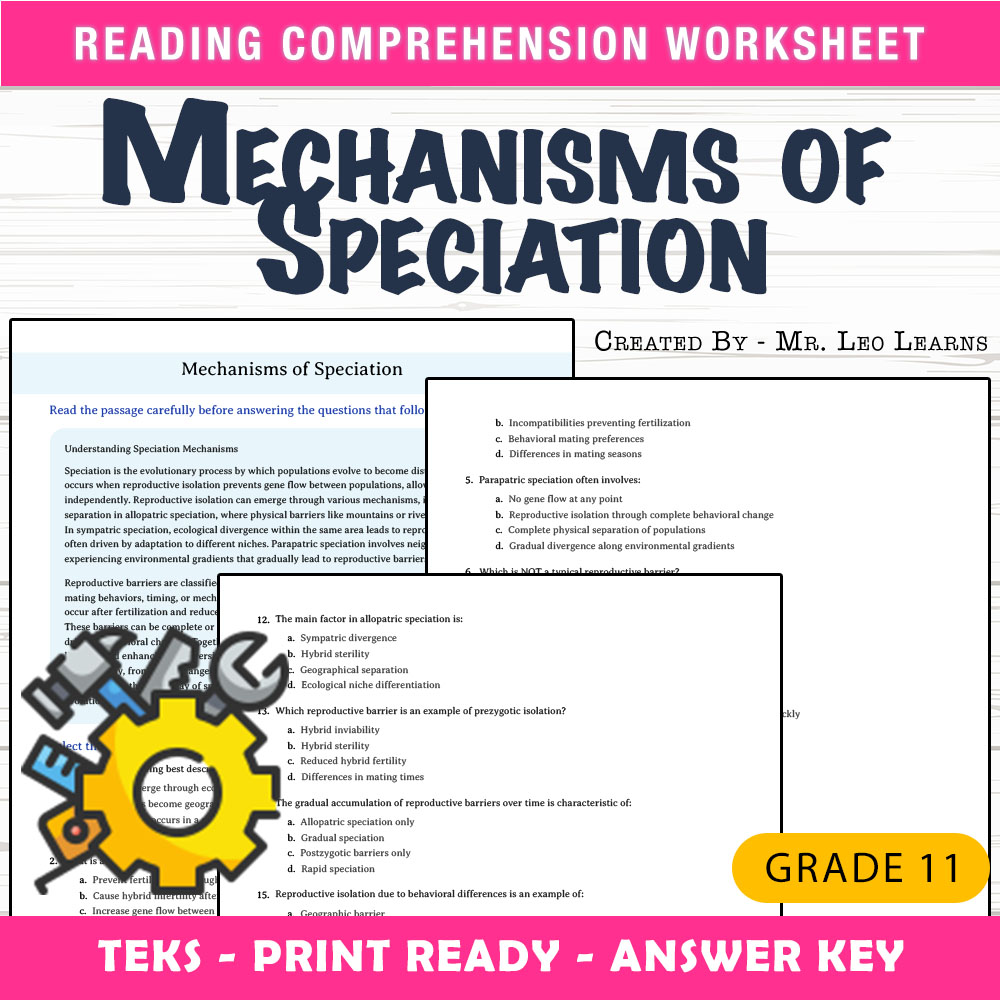
11th Grade Science | Mechanisms of Speciation Worksheet for Mastery
 Created byThe Resource Hub
Learning Objectives
- Understand the processes and mechanisms involved in speciation.
- Identify different reproductive barriers that contribute to speciation.
- Explain how geographic, ecological, and environmental factors lead to reproductive isolation.
Also included in: Grade 11 Science Unit | Evolution & Phylogeny Worksheet Pack +1 more
Instant download
Browse more categories
About Science Worksheets
Find Science worksheets spanning core skills, practice, and review. All 44,295 resources are instant PDF downloads for the classroom or home.
Every worksheet on MyTeachingSheets is created by independent teacher-authors and reviewed before publication. All resources download as printable PDFs for classroom, homework, or at-home practice, and many include answer keys. Preview any worksheet free before buying.