
Science Worksheets
44,295 subject resources
Grade 8 Science – Water Quality Indicators & Temperature | Reading Worksheet
 Created byBright Mind Resources
Learning Objectives
- Understand what water temperature indicates about aquatic environments.
- Interpret temperature data from water samples.
- Recognize the effects of temperature on aquatic life and water use.
Also included in: Grade 8 Water Systems Science Daily Reading Worksheets Lesson Bundle | Ontario +1 more
Instant download

Grade 8 Science – Climate Impacts & Water Systems | Daily Reading Worksheet
Created byBright Mind ResourcesLearning Objectives
- Understand how climate variability affects precipitation patterns and snowpack.
- Identify changes in water runoff and evapotranspiration due to climate change.
- Analyze the consequences of altered water cycles on floods, droughts, and water storage.
Also included in: Grade 8 Water Systems Science Daily Reading Worksheets Lesson Bundle | Ontario +1 more
Instant download

Grade 8 Science – Inclined Planes & Mechanics | Daily Reading Worksheet
Created byBright Mind ResourcesLearning Objectives
- Identify the components of inclined planes and understand their functions.
- Explain the basic physics involved in inclined plane mechanics.
- Calculate the ideal mechanical advantage of ramps and wedges.
Also included in: Grade 8 Mechanical Systems Science Reading Worksheets – Lesson Bundle | Ontario +1 more
Instant download

Grade 8 Science – Watershed Systems & Drainage Basins | Daily Reading Worksheet
Created byBright Mind ResourcesLearning Objectives
- Understand the characteristics of drainage basins and watershed boundaries.
- Describe how land cover, slope, and soil type affect runoff and infiltration.
- Identify the role of lakes, wetlands, and floodplains in flow modulation.
Also included in: Grade 8 Water Systems Science Daily Reading Worksheets Lesson Bundle | Ontario +1 more
Instant download
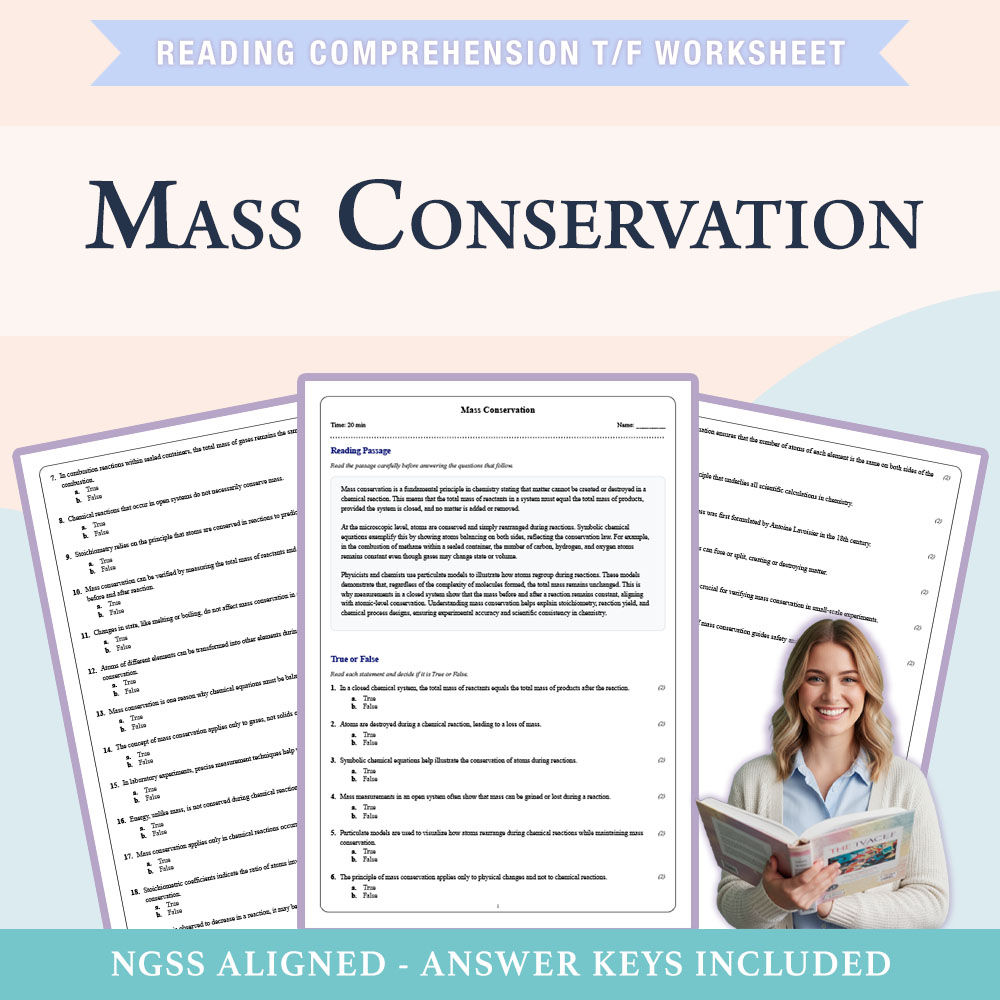
Grade 8 Science | Mass Conservation Worksheet (PDF + Answer Key)
 Created byCopper Leaf Classroom
Learning Objectives
- Understand the principle of mass conservation in chemical reactions
- Connect microscopic atomic behavior to macroscopic mass measurements
- Analyze how closed systems illustrate mass conservation
Also included in: Grade 8 Science Bundle| Critical Concepts & Applications Unit (PDF + Answer Key) +1 more
Instant download
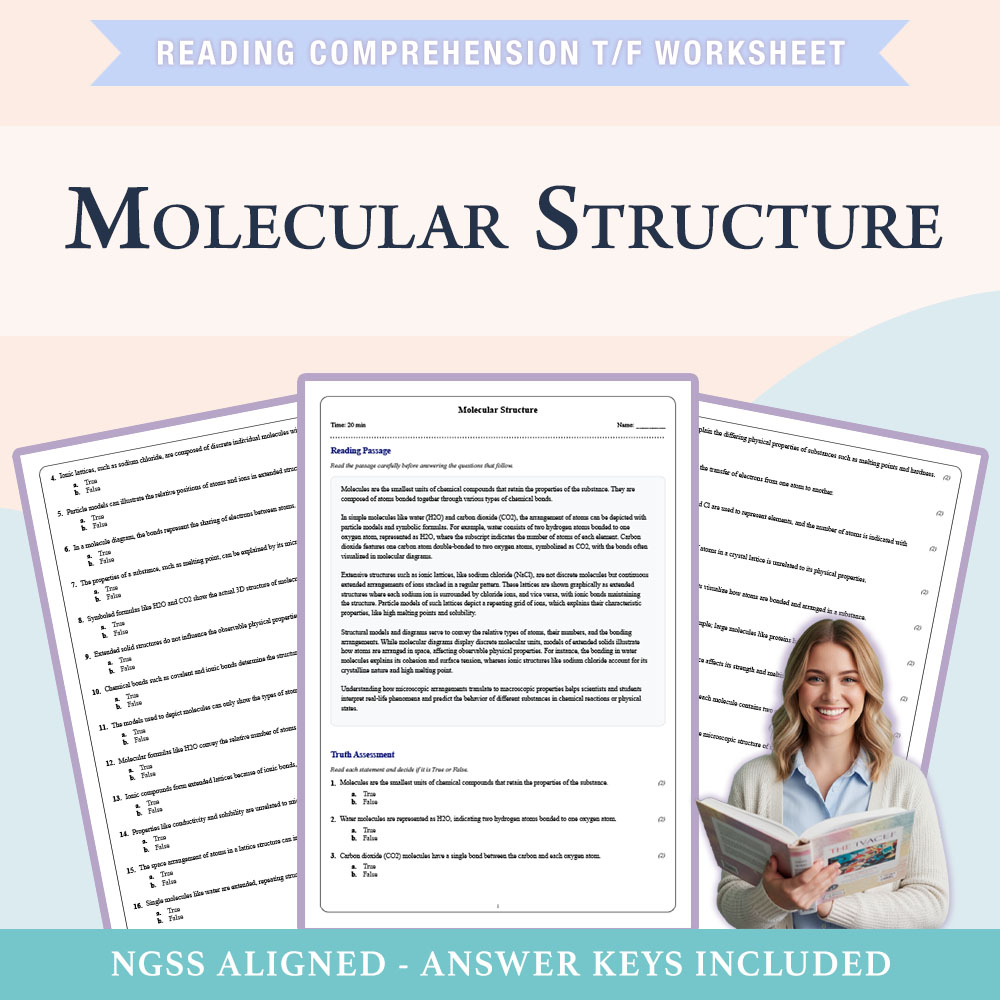
Grade 8 Science | Molecular Structure Worksheet (PDF + Answer Key)
Created byCopper Leaf ClassroomLearning Objectives
- Understand the atomic composition of simple molecules and extended structures.
- Interpret particle models and symbolic formulas of molecules.
- Distinguish between molecular units and extended solids based on microscopic arrangements.
Also included in: Grade 8 Science Bundle| Critical Concepts & Applications Unit (PDF + Answer Key) +1 more
Instant download

Grade 8 Molecular Structure Worksheet | NGSS Atoms & Molecules Activity
 Created byBRIGHT PATH RESOURCES
Learning Objectives
- Identify and describe atoms in simple molecules using particle models and symbolic formulas.
- Understand how molecules like water (H2O) and carbon dioxide (CO2) are represented diagrammatically.
- Differentiate between discrete molecules and extended structures like ionic lattices.
Also included in: Reactions & Matter Grade 8 Science Daily Reading Worksheets Lesson Bundle | NGSS +2 more
Instant download
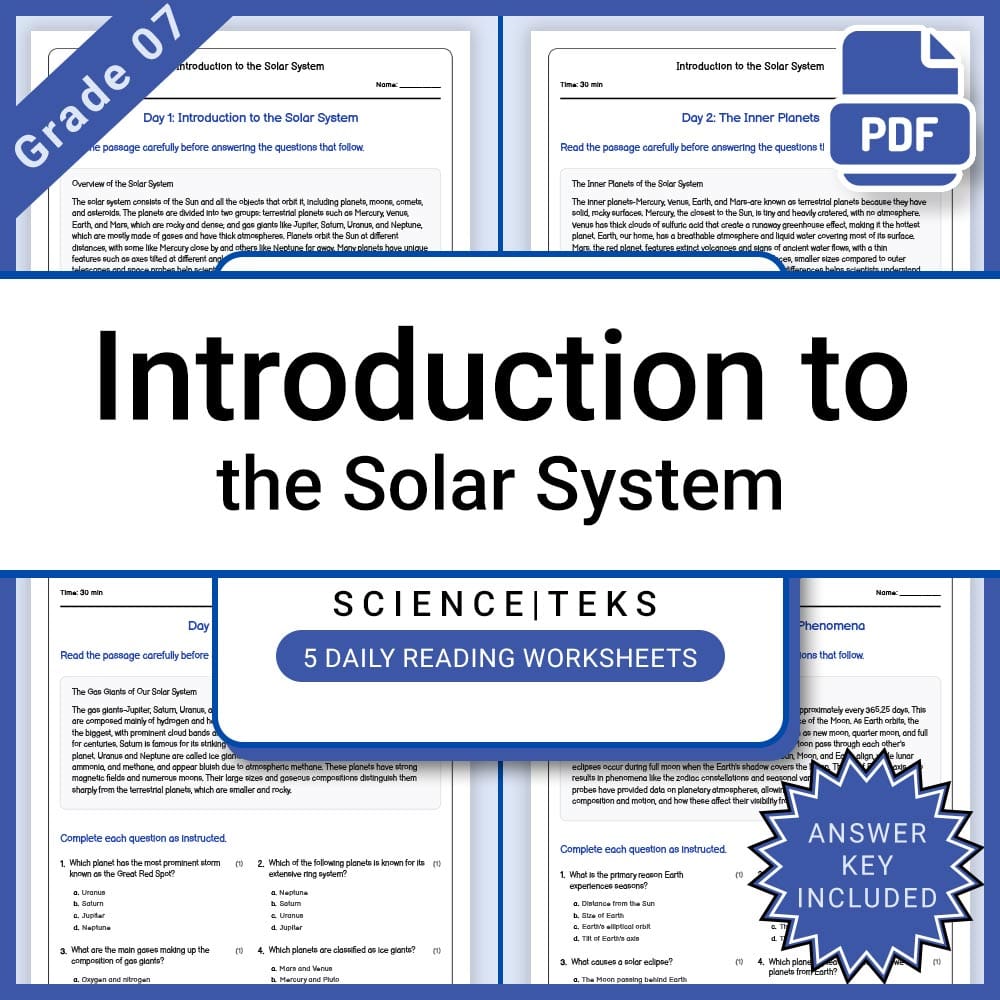
Grade 7 Science – Introduction to the Solar System Worksheet Answer Key
JCreated byJ.S SheetsLearning Objectives
- Understand key concepts related to Science
- Apply knowledge through practice questions
- Demonstrate comprehension of the material
Also included in: Grade 7 Science Lesson Group – TEKS Aligned & Concept-Focused Lesson Bundle +1 more
Instant download

Grade 7 Representations Worksheet | NGSS Practice PDF
 Created byClear Sky Classroom
Learning Objectives
- Identify different types of representations used to convey matter interactions.
- Interpret graphs, equations, and tabulated data in scientific contexts.
- Select appropriate representations for quantitative comparison and communication.
Also included in: Grade 7 Matter and Its Interactions Science Lesson Bundle NGSS Worksheets +1 more
Instant download

Cytoskeleton Roles Worksheet | TEKS-Aligned Grade 10 Science Practice
JCreated byJ.S SheetsLearning Objectives
- Explain how microtubules, microfilaments (actin), and intermediate filaments contribute to cell structure and function
- Describe how motor proteins move vesicles along microtubules and how this supports intracellular transport
- Analyze how actin and microtubules help with cell movement, cytokinesis, and chromosome segregation during mitosis
Instant download

Grade 7 Particle Model Worksheet | Practice & Assessment PDF
Created byClear Sky ClassroomLearning Objectives
- Explain how matter can be described as made of particles too small to see
- Relate temperature to the average motion of particles
- Describe how particle spacing and collisions affect properties such as pressure and diffusion
Instant download
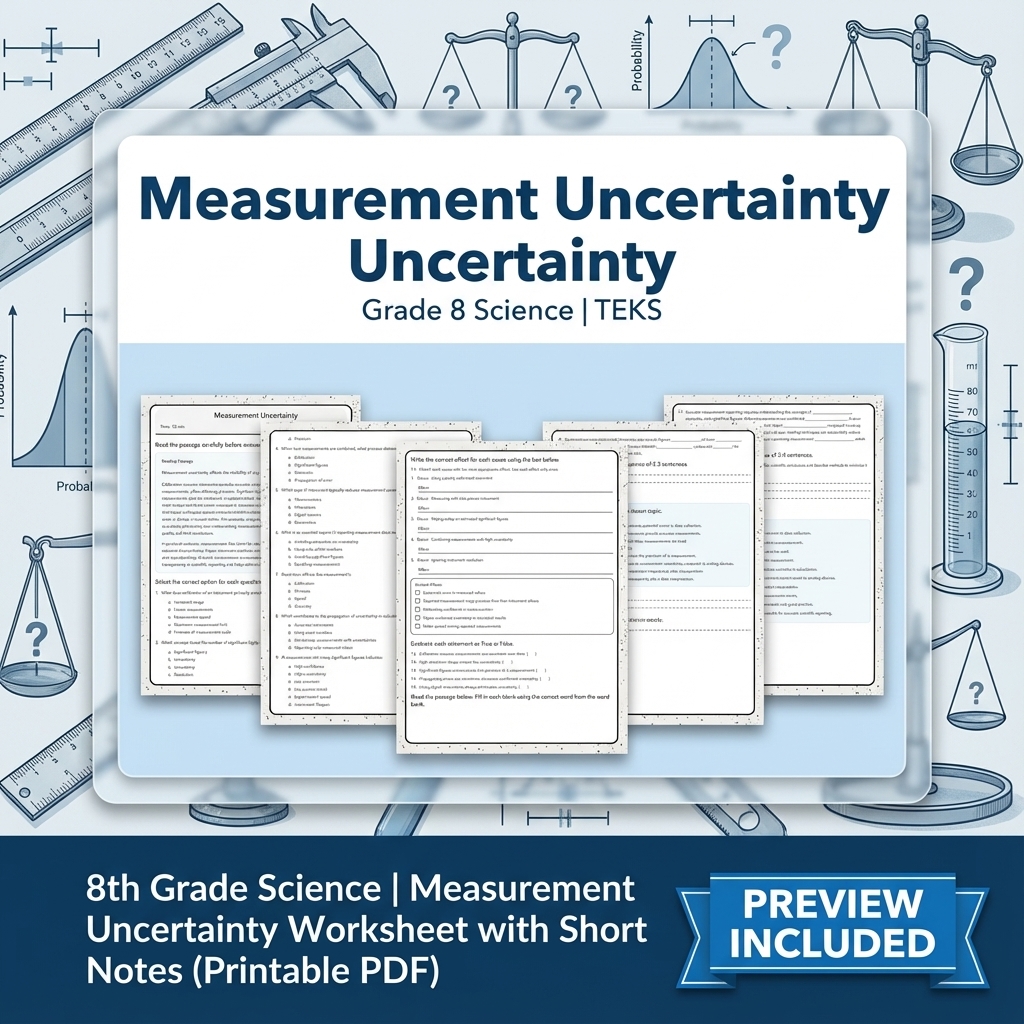
8th Grade Science Measurement Uncertainty Worksheet with Short Notes (PDF)
 Created byMeadowlark Worksheets
Learning Objectives
- Define measurement uncertainty and explain its significance in scientific measurements.
- Identify factors affecting precision, accuracy, and reliability of measurements.
- Apply principles of calibration, resolution, and significant figures to reporting data.
Instant download
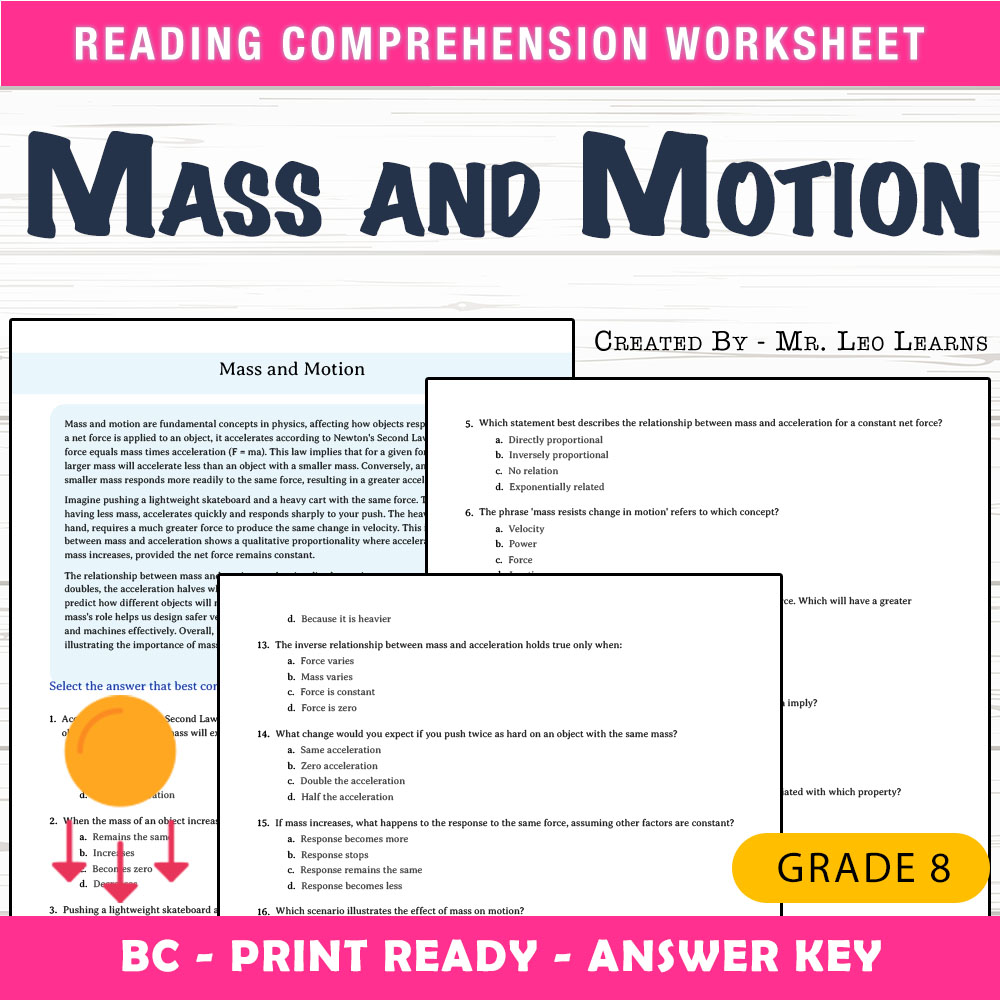
Grade 8 Science — Mass and Motion Worksheet MCQ Paper for Mastery
 Created byThe Resource Hub
Learning Objectives
- Understand how mass influences the acceleration of objects under net force.
- Recognize the inverse relationship between mass and acceleration for a given force.
- Compare responses of objects with different masses when pushed with the same force.
Also included in: Grade 8 Science Forces, Motion & Energy UNIT Bundle +1 more
Instant download

Forces and Acceleration Worksheet | Standards-Aligned Grade 10 Science Practice
JCreated byJ.S SheetsLearning Objectives
- Understand how net force, mass, and acceleration are related through Newton's second law.
- Identify and interpret free-body diagrams illustrating different forces acting on objects.
- Use algebraic and vector component analysis to predict motion changes under various force conditions.
Instant download
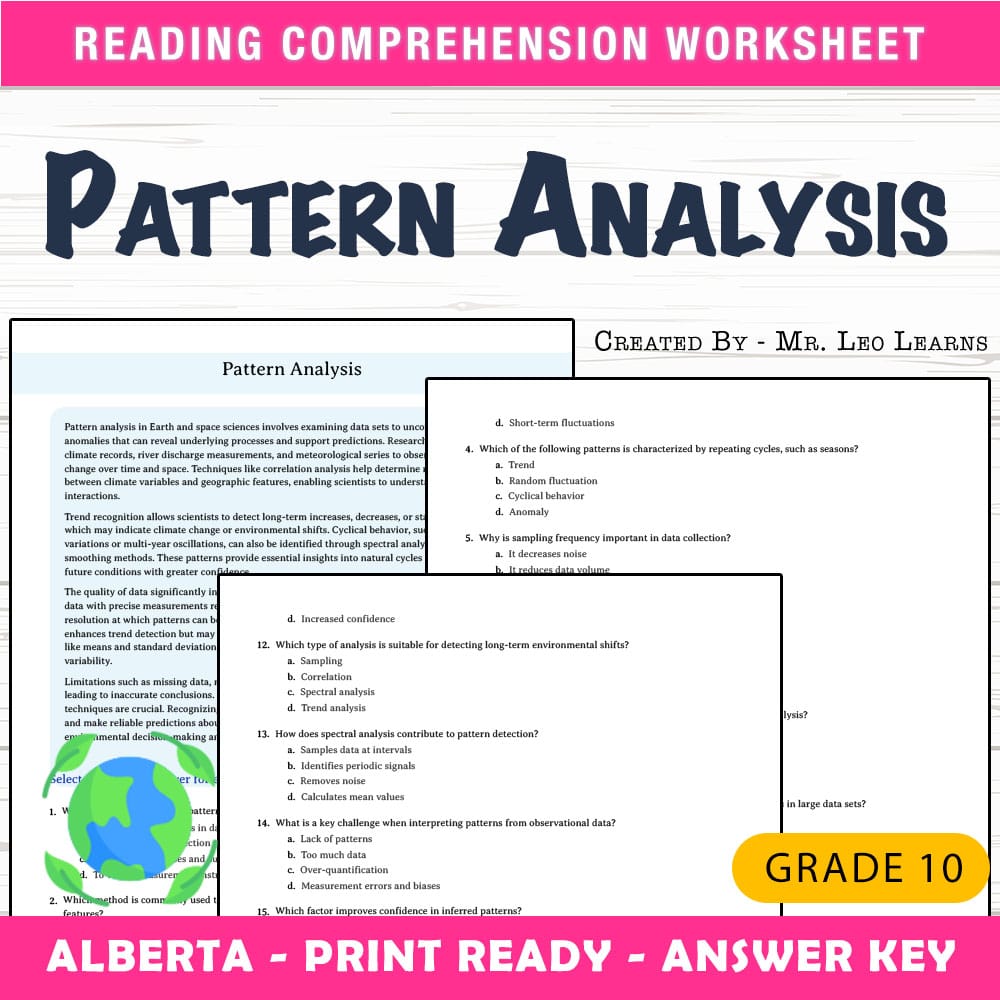
Grade 10 Science — Pattern Analysis Worksheet MCQ Pape
Created byThe Resource HubLearning Objectives
- Understand methods for identifying temporal and spatial patterns in Earth and space phenomena.
- Learn how data quality, sampling, and statistical summaries affect pattern detection.
- Apply correlation, trend recognition, and cyclical analysis to climate and river data.
Also included in: Grade 10 Science Bundle | Earth and Space Systems Worksheets +1 more
Instant download

Grade 6 Evidence and Reasoning Worksheet | NGSSS Science CER Practice
 Created byEvergreen Desk Education
Learning Objectives
- Explain how evidence supports a scientific claim using relevant observations, measurements, and data patterns.
- Differentiate correlation from causation when interpreting relationships in data.
- Use consistent units and clear reasoning to evaluate how well evidence supports a conclusion.
Instant download
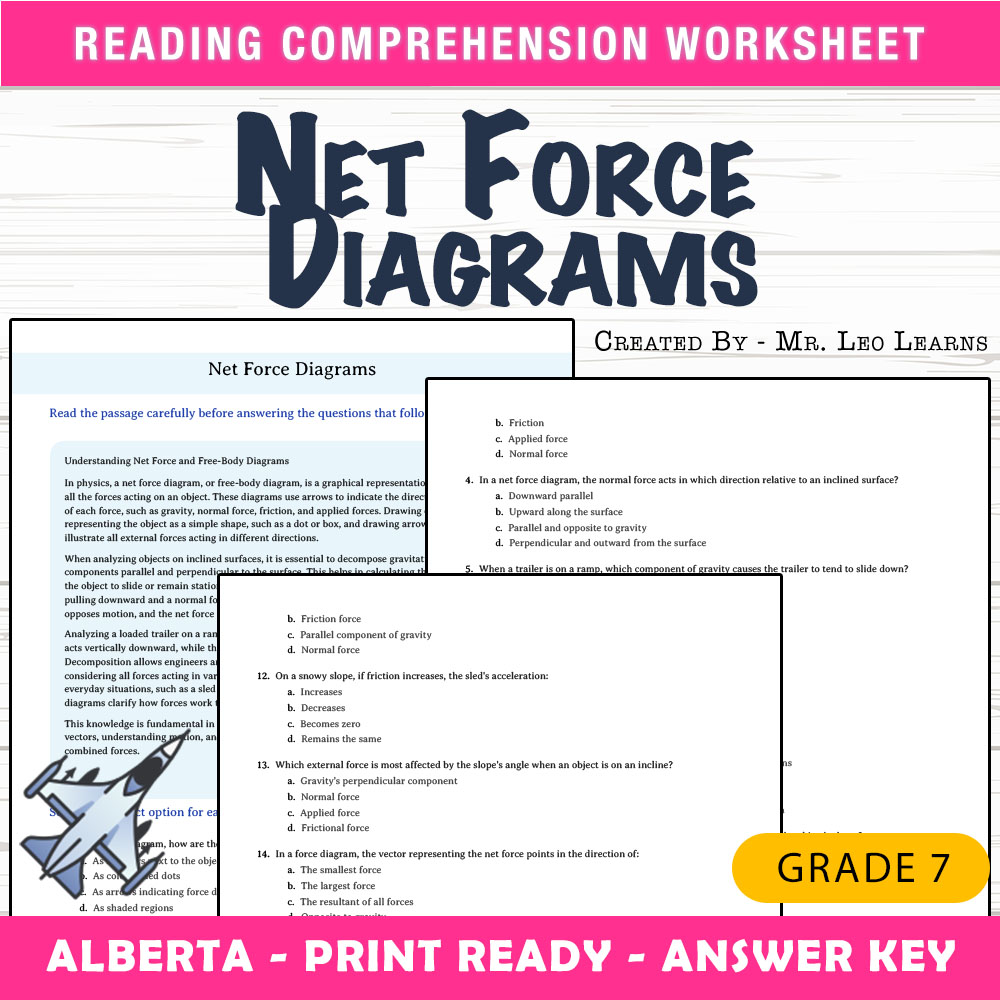
Grade 7 Science — Net Force Diagrams Worksheet for Mastery
Created byThe Resource HubLearning Objectives
- Understand the purpose and drawing conventions of free-body diagrams.
- Identify the components of forces acting on objects on inclined surfaces.
- Apply vector addition to determine net force and acceleration.
Also included in: Grade 7 Science Alberta Forces Structures and Motion Worksheet Bundle +1 more
Instant download
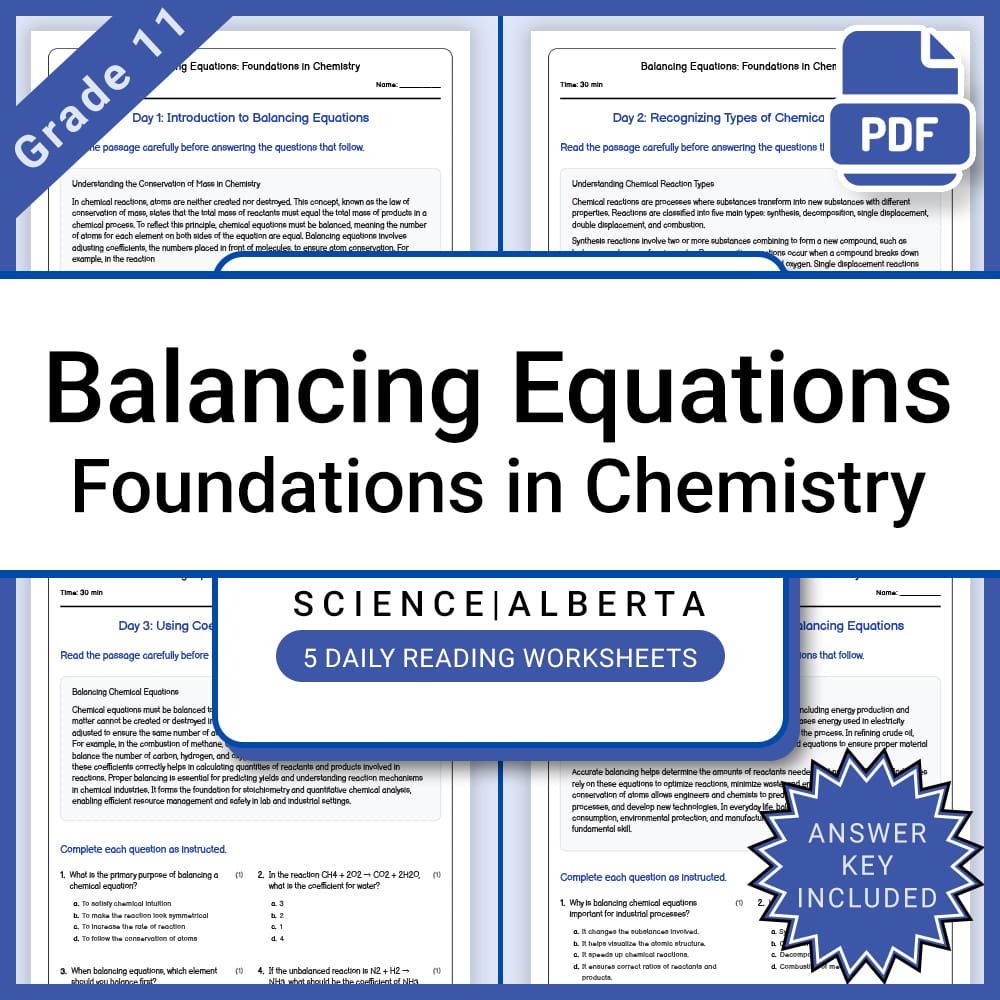
Grade 11 Science – Balancing Equations Daily Reading Worksheet + Answer Key
JCreated byJ.S SheetsLearning Objectives
- Understand the law of conservation of mass in chemical reactions
- Explain why chemical equations must be balanced
- Identify the different types of chemical reactions
Also included in: Grade 11 Science Lesson Bundle | Core Concepts & Theories in Chemistry & Physics +1 more
Instant download
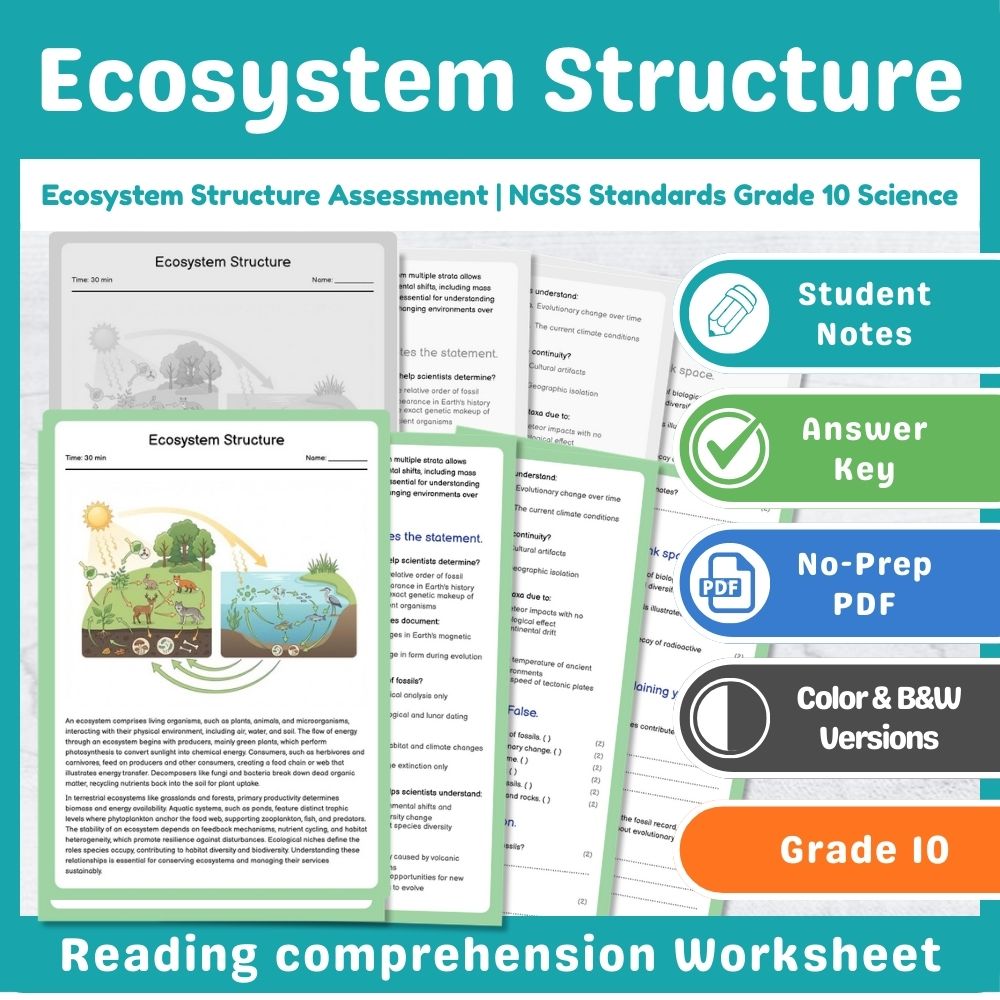
Ecosystem Structure Assessment for Grade 10 Science NGSS Standards
 Created byPrism Point Learning
Learning Objectives
- Explain the roles of biotic and abiotic components in ecosystems.
- Identify and analyze food webs, trophic levels, and energy flow within ecosystems.
- Understand the concepts of ecosystem stability, feedback loops, and ecological niches.
Instant download
Grade 6 Science | Conservation Strategies Reading Worksheets (PDF + Answer Key)
JCreated byJ.S SheetsLearning Objectives
- Understand different conservation strategies used to maintain forest biodiversity.
- Identify provincial examples of conservation approaches in Alberta.
- Explain how ecological knowledge is integrated into conservation planning.
Also included in: Grade 6 Science Unit Bundle | Ecosystems and Biodiversity (Answer Keys Included) +1 more
Instant download
10th Grade Science | One-Dimensional Motion Reading Worksheet & Answer Key
JCreated byJ.S SheetsLearning Objectives
- Define and relate fundamental kinematic quantities along a single axis.
- Differentiate between average and instantaneous velocity and acceleration.
- Apply constant-acceleration equations to free-fall and uniformly accelerated motion.
Also included in: Grade 10 Science Unit Bundle – Motion, Forces & Mechanics (Answer Keys Included) +1 more
Instant download
10th Grade Science | Population Patterns Reading Worksheet with Answer Key (PDF)
JCreated byJ.S SheetsLearning Objectives
- Understand the factors that influence population structure, including birth and death rates.
- Describe how carrying capacity and density-dependent interactions affect populations.
- Analyze population models and interpret age-structure diagrams to explain population dynamics.
Also included in: Grade 10 Science Unit | Cell Biology, Genetics, & Ecosystems Worksheet Pack +1 more
Instant download

Grade 9 Net Acceleration Worksheet | California Standards Practice PDF
Created byClear Sky ClassroomLearning Objectives
- Explain Newton’s second law using net force, mass, and acceleration
- Predict the direction and magnitude of acceleration from unbalanced forces
- Apply vector ideas to describe how multiple forces combine to produce net acceleration
Instant download

Natural Selection Worksheet | Evolution, Adaptation & Genetics Activities
Created byPrism Point LearningLearning Objectives
- Explain how heritable differences can change allele frequencies over generations
- Use evidence-based reasoning to describe adaptation at the population level
- Compare convergent and divergent outcomes from different or similar selective pressures
Instant download

Grade 9 Glucose Regulation Science Daily Reading TEKS Biology Worksheet
Created byBRIGHT PATH RESOURCESLearning Objectives
- Identify how insulin and glucagon change blood glucose levels.
- Explain the negative feedback loop idea using hormones and body tissues.
- Use key terms (insulin, glucagon, glycogenolysis, gluconeogenesis, beta cells, alpha cells) in context.
Also included in: Grade 9 Homeostasis and Body Systems Biology Worksheets Bundle | TEKS +1 more
Instant download

11th Grade Science | Classification Methods Worksheet (PDF+ Answer Key)
Created byCopper Leaf ClassroomLearning Objectives
- Understand various classification methods used in biology to organize biodiversity.
- Differentiate between cladistic, phenetic, and phylogenomics approaches.
- Explain how hierarchical taxonomic systems represent evolutionary relationships.
Instant download

Grade 10 Science – Negative Feedback Worksheet (TEKS) PDF
Created byEvergreen Desk EducationLearning Objectives
- Explain how negative feedback systems maintain internal stability using sensors, control centers, and effectors.
- Interpret how deviations from a set point trigger antagonistic (opposite) corrective responses.
- Compare negative feedback to positive feedback using temperature, blood glucose, and blood pressure examples.
Instant download

Body Temperature Grade 10 Science Worksheet | TEKS-Aligned Practice
JCreated byJ.S SheetsLearning Objectives
- Explain how the hypothalamus acts as a control center to regulate body temperature.
- Describe how the nervous, circulatory, muscular, and integumentary systems work together to maintain thermal equilibrium.
- Interpret examples of feedback mechanisms (heat production, heat loss, and behavioral adjustments) in daily life.
Instant download
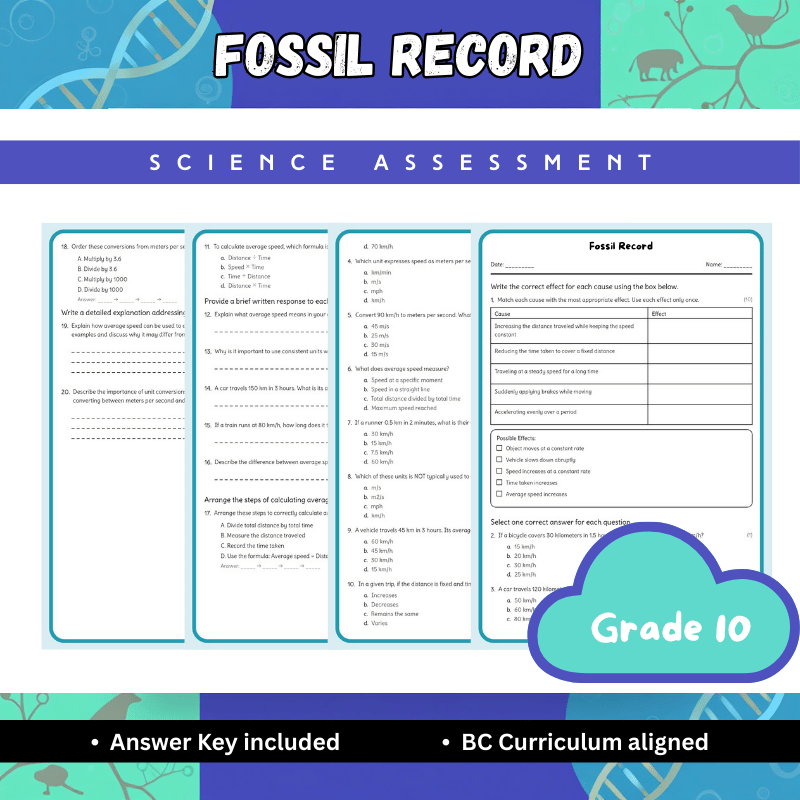
Grade 10 Science | Fossil Record Worksheet + Answer Key (PDF) for BC Standards
Created byBright Mind ResourcesLearning Objectives
- Understand how the fossil record documents evolutionary change over geological time.
- Interpret stratigraphic context and radiometric dating to place fossils in chronological order.
- Analyze patterns of morphological change and extinction events through fossil evidence.
Instant download
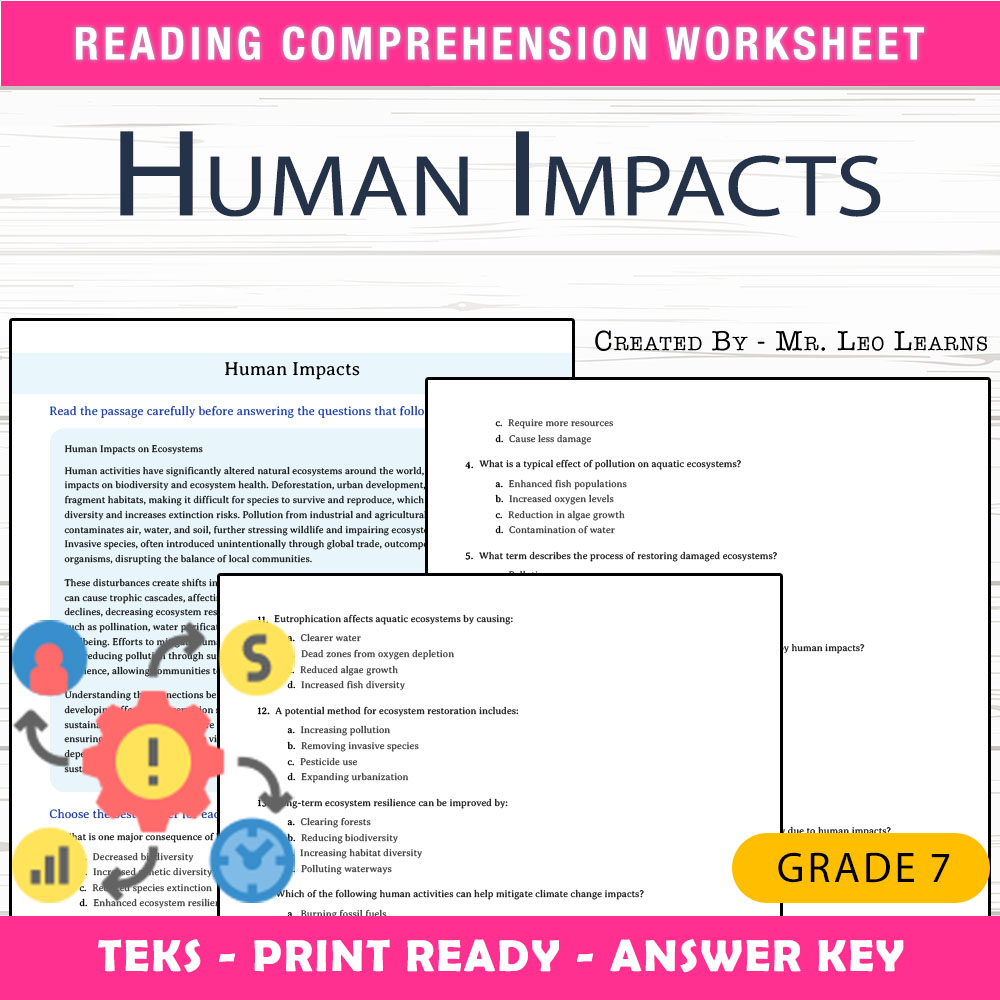
Grade 7 Science — Human Impacts Worksheet for Mastery
Created byThe Resource HubLearning Objectives
- Identify major human-induced environmental changes such as habitat fragmentation, pollution, and invasive species.
- Explain the effects of human impacts on biodiversity, ecosystem services, and trophic structures.
- Describe approaches to mitigate and restore ecosystems affected by human activities.
Also included in: Grade 7 Science Unit Bundle – Ecosystems, Cells & Adaptations Worksheet Pack +1 more
Instant download
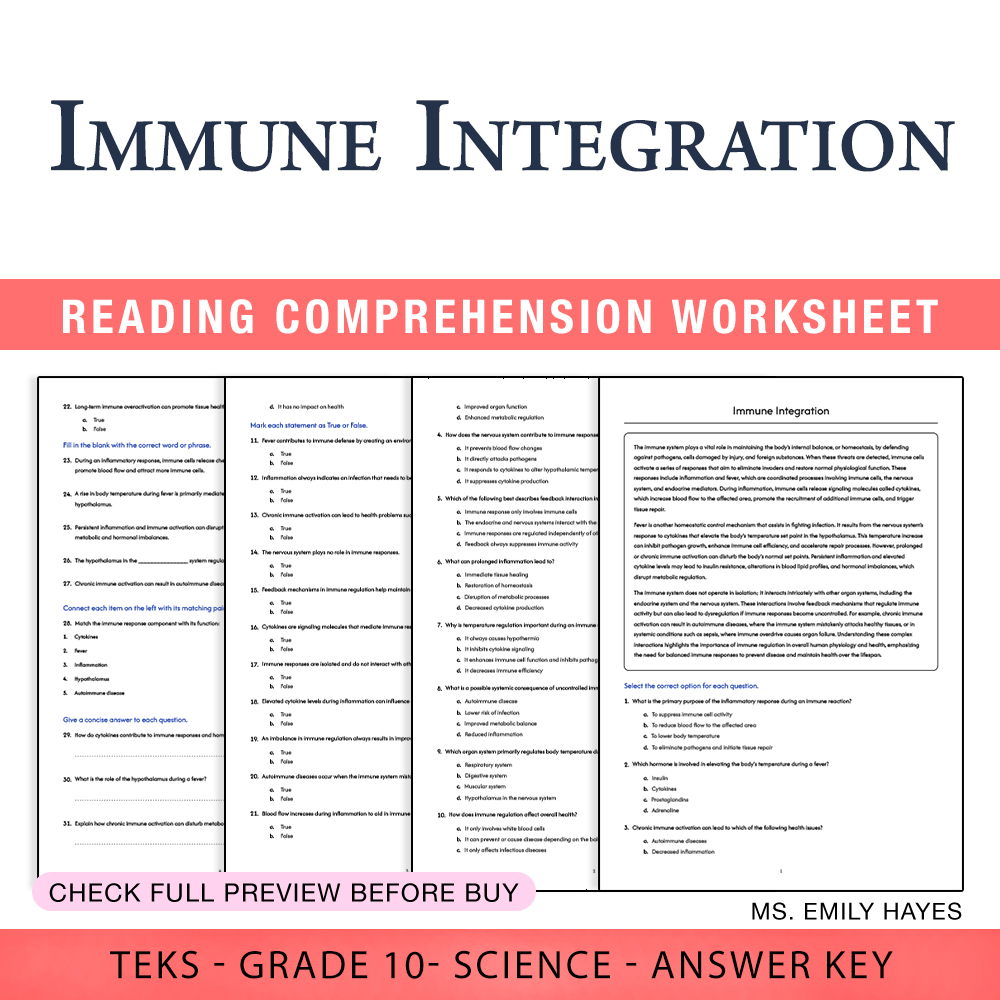
10th Grade Science | Immune System Mastery Worksheet (PDF+ Answer Key)
Created byCopper Leaf ClassroomLearning Objectives
- Understand how the immune system contributes to maintaining homeostasis.
- Identify responses of the immune system during inflammation and fever.
- Learn how immune regulation interacts with other organ systems.
Instant download

Grade 7 Science | Action-Reaction Forces - Daily Reading Comprehension
 Created byCoral Reef Learning
Learning Objectives
- Explain the concept of action-reaction forces.
- Identify examples of action-reaction forces in daily life.
- Describe how the forces are equal and opposite regardless of object movement.
Instant download

Mass Wasting Assessment for Grade 6 Science | Standards-Aligned
Created byPrism Point LearningLearning Objectives
- Understand the processes involved in mass wasting such as rockfalls, landslides, and slumps.
- Identify factors that trigger surface movements like rainfall, freeze-thaw cycles, and earthquakes.
- Explain how debris deposition affects drainage and erosion patterns.
Also included in: Grade 6 Life Science Science Lesson Bundle – General Framework Unit
Instant download

Grade 11 Science | Understanding Weathering & Erosion - Daily Reading
Created byCoral Reef LearningLearning Objectives
- Identify the processes of weathering and erosion.
- Explain how physical and chemical weathering contribute to landscape change.
- Describe the transport and deposition of sediments by natural agents.
Instant download
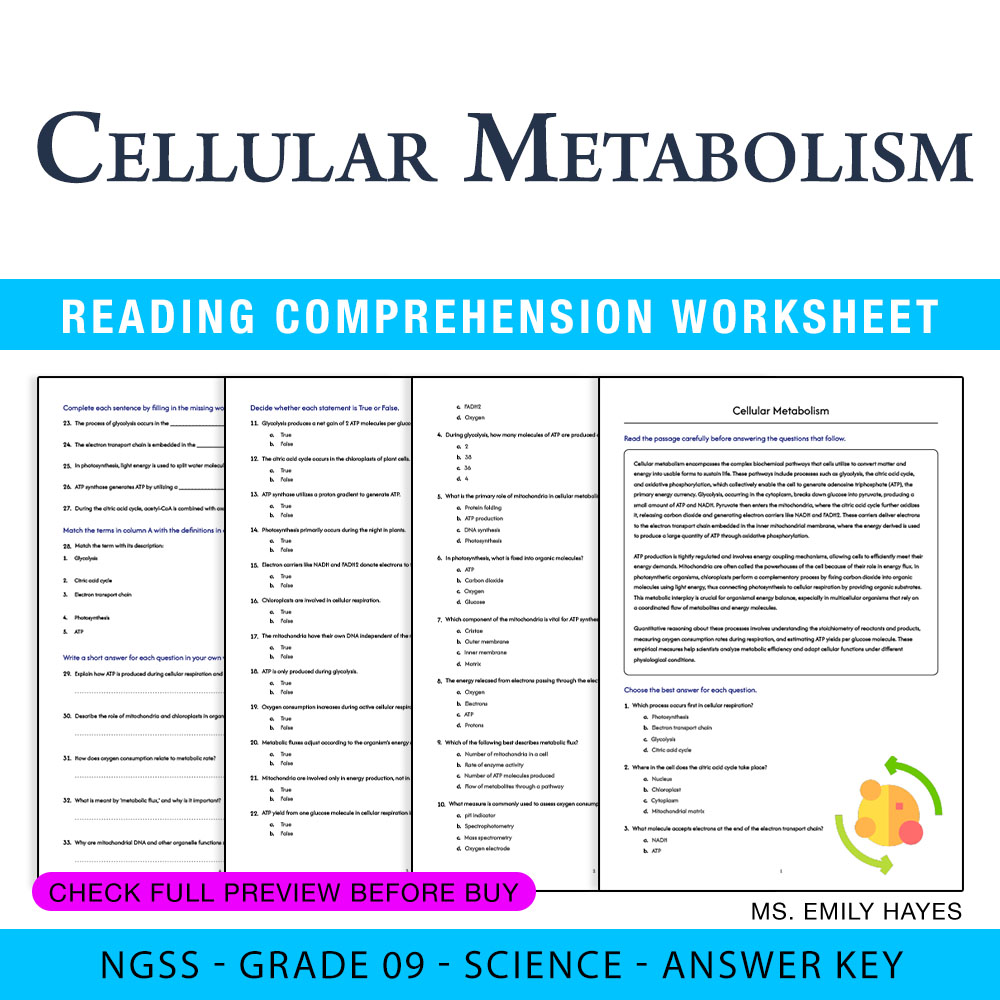
Grade 9 Science | Cellular Metabolism Worksheet (PDF+ Answer Key)
Created byCopper Leaf ClassroomLearning Objectives
- Describe the biochemical pathways involved in cellular respiration, including glycolysis, the citric acid cycle, and electron transport chain.
- Explain the role of ATP in energy coupling within cells.
- Relate mitochondrial and chloroplast functions to metabolic fluxes and organismal energy balance.
Instant download
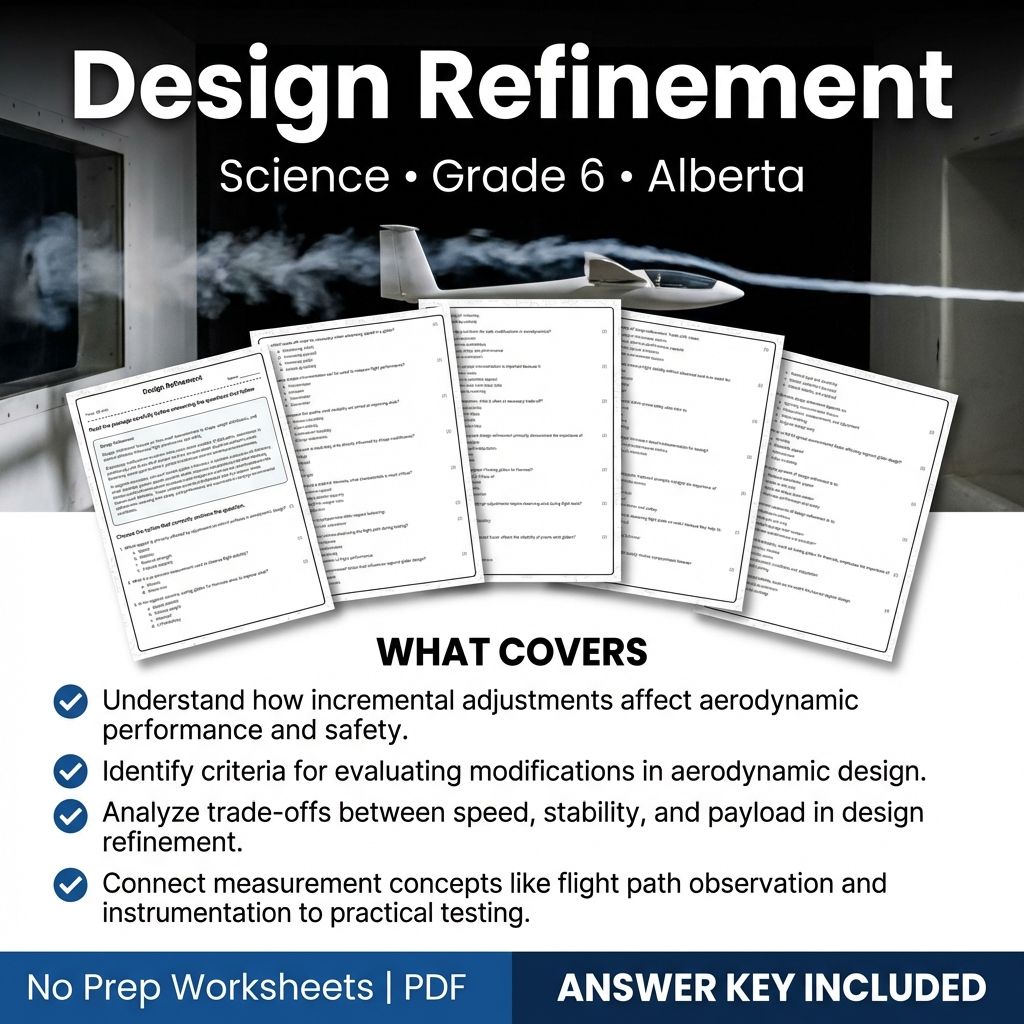
Design Refinement Worksheet for Grade 6 Science | Alberta Standards Practice
Created byCoral Reef LearningLearning Objectives
- Understand how incremental adjustments affect aerodynamic performance and safety.
- Identify criteria for evaluating modifications in aerodynamic design.
- Analyze trade-offs between speed, stability, and payload in design refinement.
Instant download
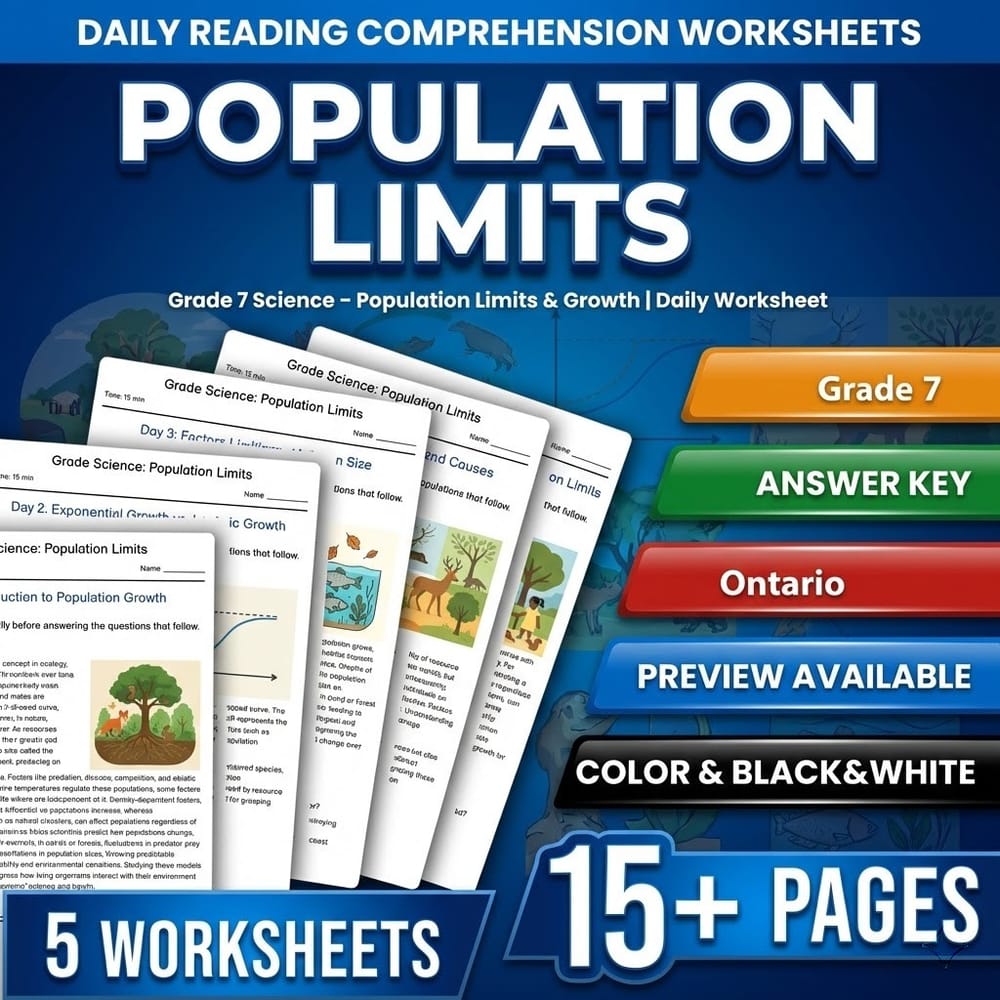
Grade 7 Science – Population Limits & Growth | Daily Worksheet
 Created byQuiet Forest Education
Learning Objectives
- Understand basic concepts of population growth models
- Distinguish between exponential and logistic growth
- Identify limiting factors influencing population size
Also included in: Ecosystem Dynamics Grade 7 Science Daily Reading Worksheets Bundle | Ontario +1 more
Instant download
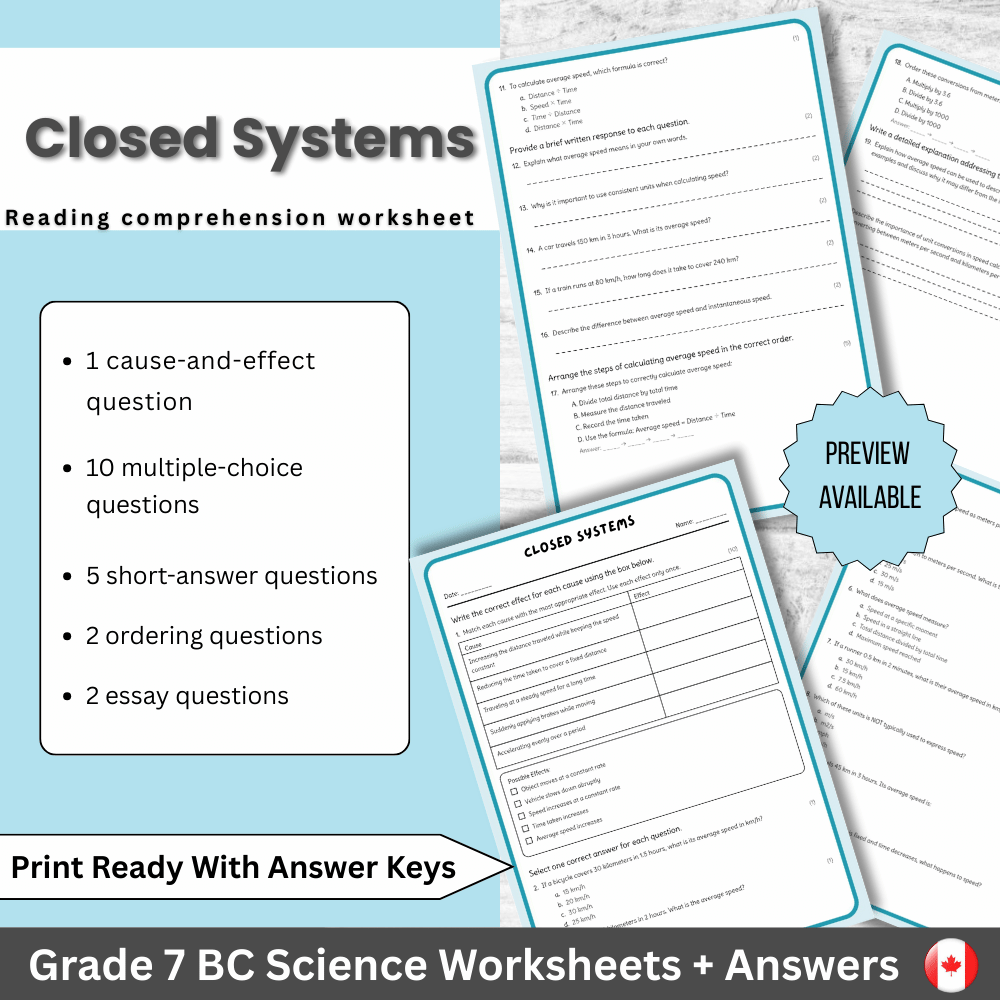
Grade 7 Science – Closed Systems Worksheet (Answer Key) | BC Standards
Created byBright Mind ResourcesLearning Objectives
- Understand the difference between closed and open systems regarding matter transfer.
- Recognize the importance of system boundaries in interpreting mass during reactions.
- Identify examples of closed and open systems in real-world scenarios.
Instant download

Grade 7 Science: Energy and Matter in Living Systems Worksheet | BC Practice PDF
Created byClear Sky ClassroomLearning Objectives
- Explain the roles of photosynthesis and cellular respiration in transferring energy in plants
- Use vocabulary correctly to describe gas exchange and energy conversion
- Identify the main idea of scientific paragraphs and choose supporting concepts
Instant download

Grade 8 Science | Reaction Evidence - Daily Reading Comprehension
Created byCoral Reef LearningLearning Objectives
- Identify observable indicators of chemical reactions
- Differentiate between physical and chemical changes using observable signs
- Understand examples such as rusting, combustion, and effervescence
Instant download
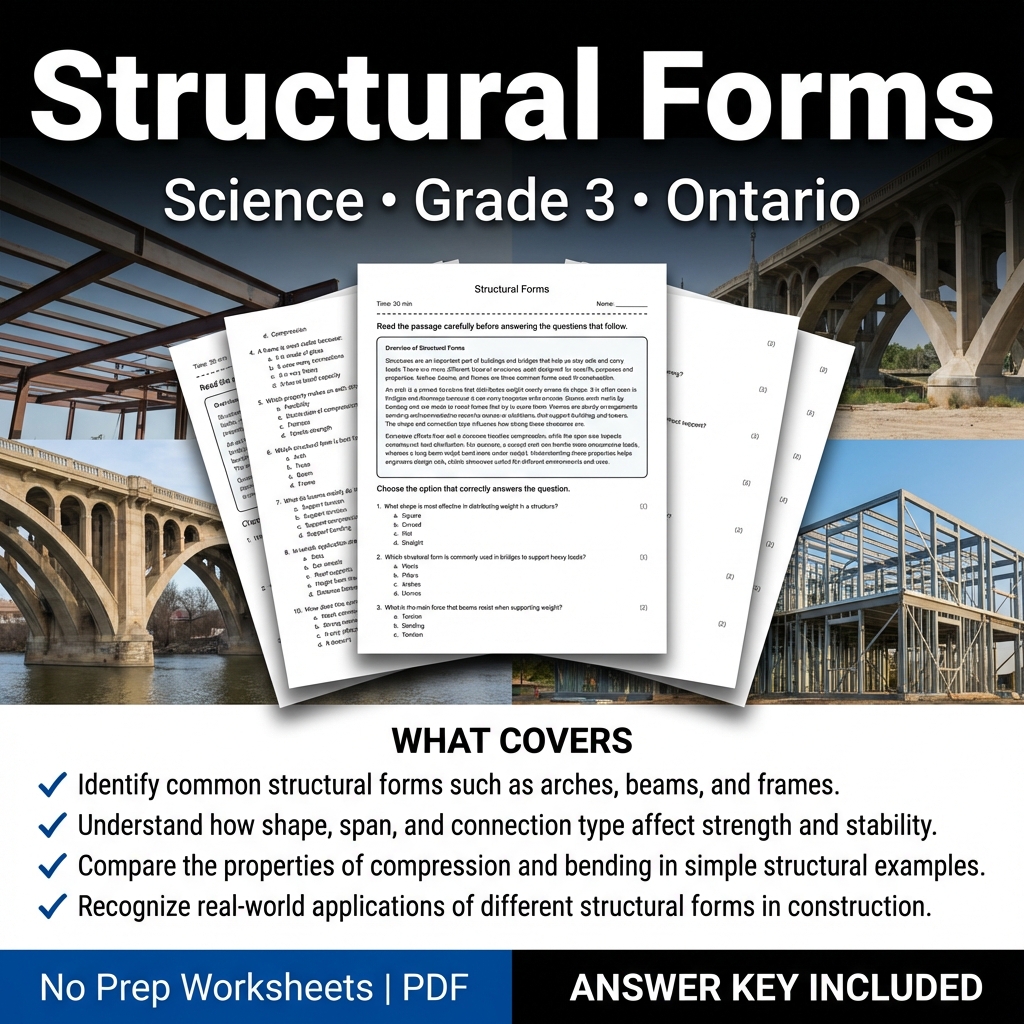
Grade 3 Science Worksheet on Structural Forms | Ontario Standards
Created byCoral Reef LearningLearning Objectives
- Identify common structural forms such as arches, beams, and frames.
- Understand how shape, span, and connection type affect strength and stability.
- Compare the properties of compression and bending in simple structural examples.
Instant download
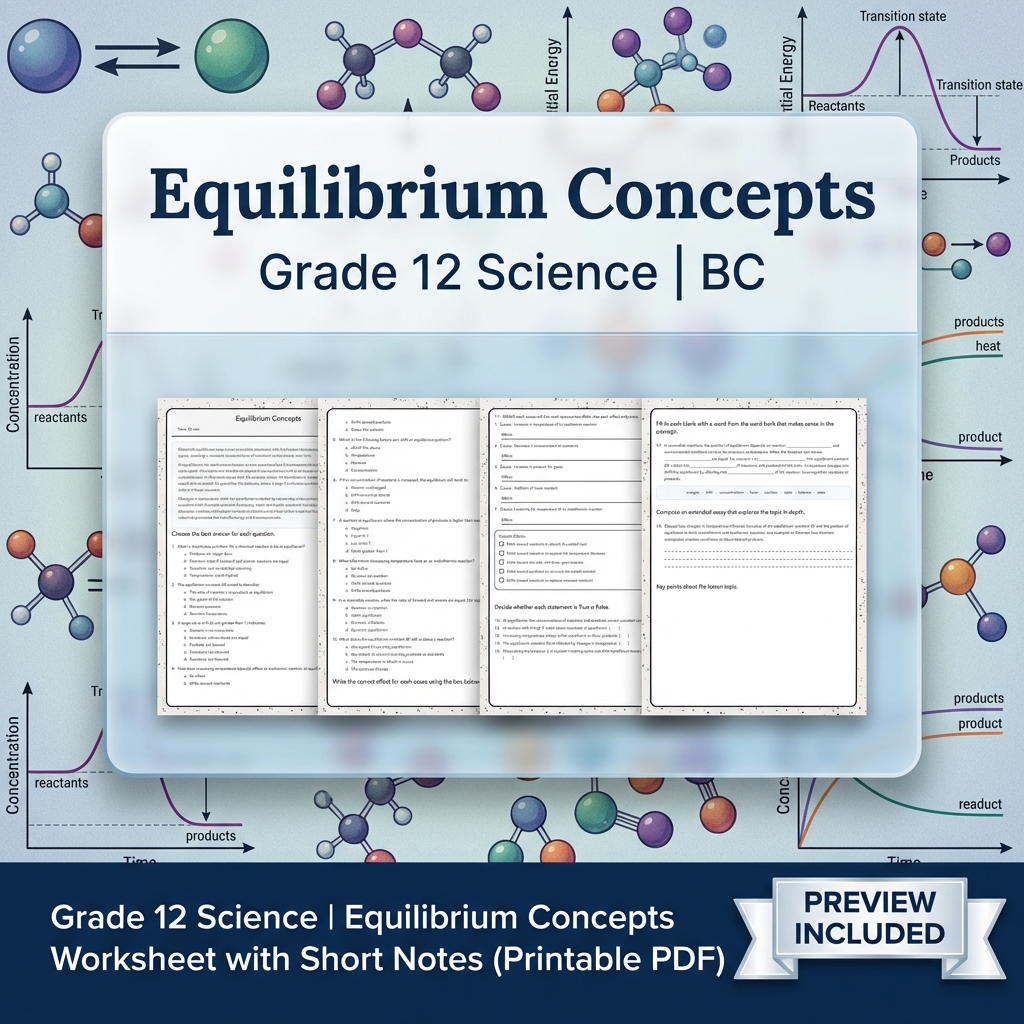
Grade 12 Science | Equilibrium Concepts Worksheet with Short Notes (PDF)
Created byMeadowlark WorksheetsLearning Objectives
- Understand the principle of chemical equilibrium and its characteristics.
- Explain how the equilibrium constant relates concentrations of reactants and products.
- Analyze how reaction conditions such as temperature influence equilibrium.
Also included in: Grade 12 Science Lesson Bundle | BC Framework Thermochemistry & More +1 more
Instant download

Grade 6 Science – Pattern From Graphs Daily Reading Worksheet
Created byBright Mind ResourcesLearning Objectives
- Identify steady or constant trends in graphs.
- Describe patterns such as increasing, decreasing, and steady lines.
- Analyze graph shapes to understand relationships between variables.
Also included in: Variables & Experiments Data Grade 6 Science Worksheets Lesson Bundle | General +1 more
Instant download
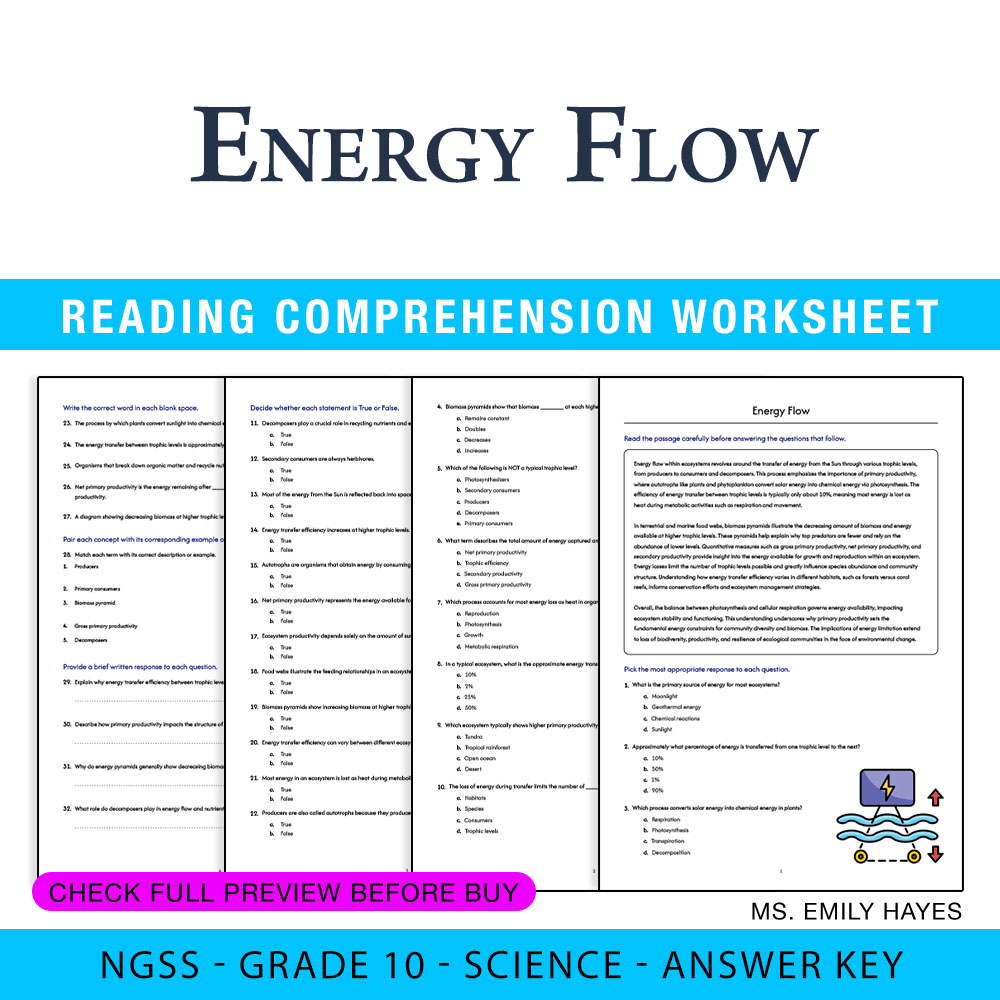
11th Grade Science | Energy Flow Worksheet (PDF+ Answer Key)
Created byCopper Leaf ClassroomLearning Objectives
- Understand the concept of energy transfer among producers, consumers, and decomposers within food webs.
- Analyze the roles of trophic levels, biomass pyramids, and energy loss through metabolic processes.
- Calculate and interpret efficiencies of trophic transfer and primary productivity in different ecosystems.
Instant download
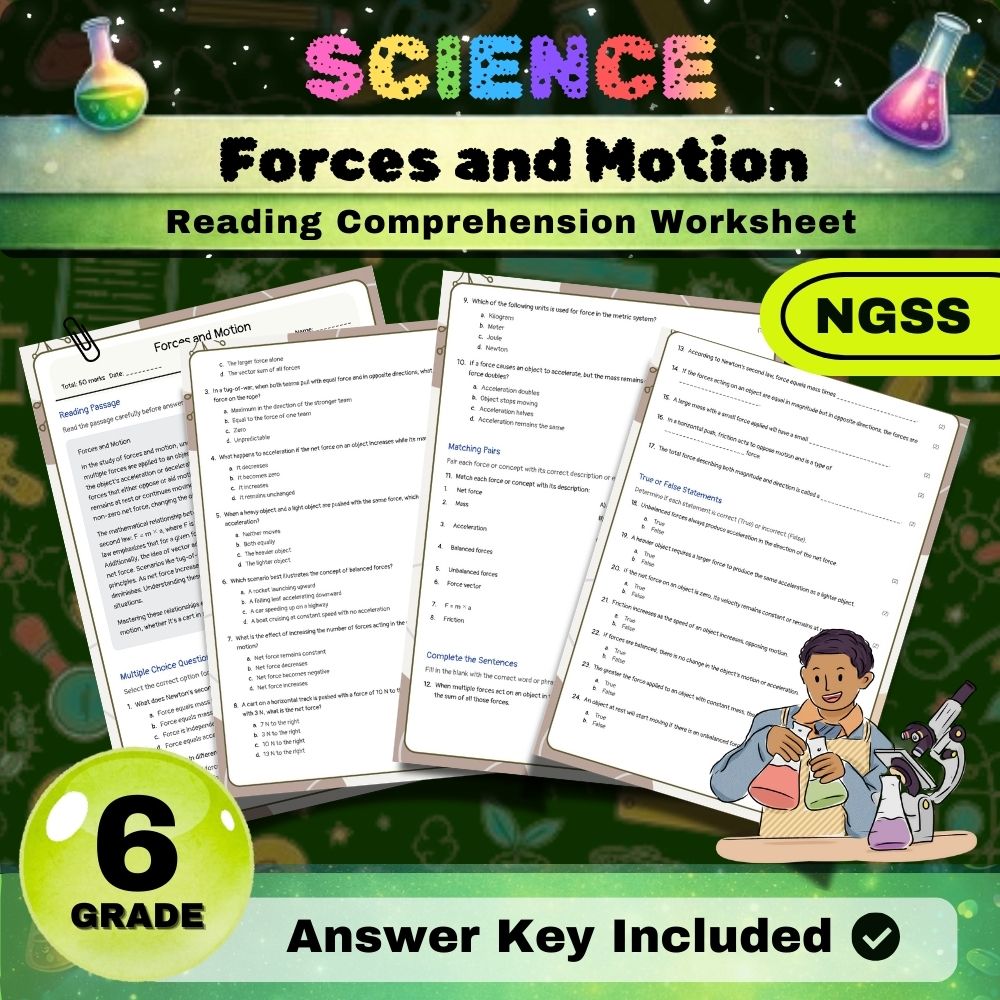
6th Grade Science | Forces and Motion NGSS Worksheet (PDF)
 Created byMaple Path Learning
Learning Objectives
- Explain how net force affects the motion of objects based on mass and force vectors.
- Use the equation net force equals mass times acceleration to analyze different scenarios.
- Identify and describe how multiple forces combine to produce net force.
Also included in: Grade 6 Science Forces & Motion Unit Bundle (NGSS Worksheets + Answer Keys) +1 more
Instant download
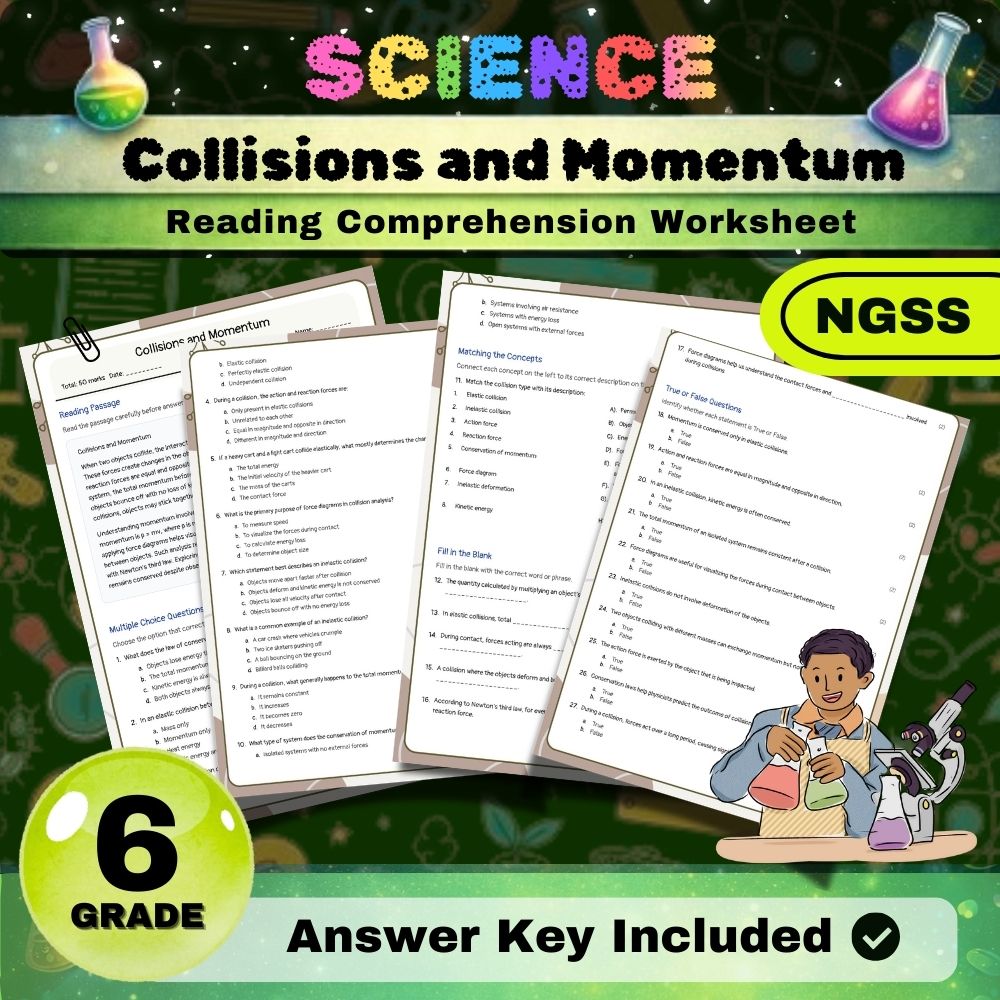
Grade 6 Science – Collisions and Momentum Worksheet + Answer Key ( NGSS )
Created byMaple Path LearningLearning Objectives
- Explain the law of conservation of momentum during two-object collisions.
- Distinguish between elastic and inelastic collisions through examples and calculations.
- Identify the forces involved during collisions using force diagrams.
Also included in: Grade 6 Science Forces & Motion Unit Bundle (NGSS Worksheets + Answer Keys) +1 more
Instant download

Atomic Structure Worksheet for Grade 8 Science | TEKS-Aligned Practice
JCreated byJ.S SheetsLearning Objectives
- Explain how atomic structure (protons, neutrons, and electrons) relates to elemental identity and bonding.
- Differentiate elements and compounds using representative examples such as hydrogen, oxygen, and sodium chloride (NaCl).
- Describe how the periodic table organizes elements in relation to electron structure and similar properties.
Instant download
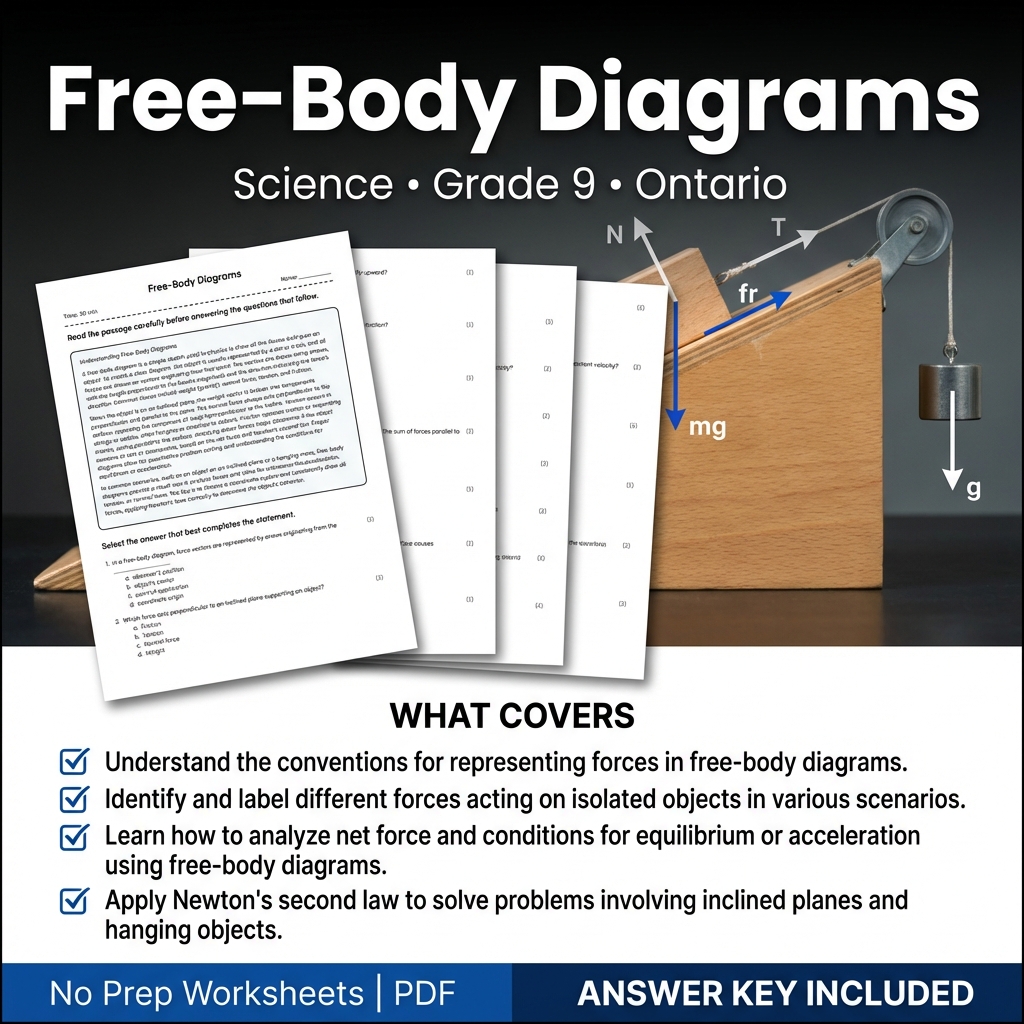
Grade 9 Science Worksheet on Free-Body Diagrams – Ontario Standards
Created byCoral Reef LearningLearning Objectives
- Understand the conventions for representing forces in free-body diagrams.
- Identify and label different forces acting on isolated objects in various scenarios.
- Learn how to analyze net force and conditions for equilibrium or acceleration using free-body diagrams.
Instant download
Browse more categories
About Science Worksheets
Find Science worksheets spanning core skills, practice, and review. All 44,295 resources are instant PDF downloads for the classroom or home.
Every worksheet on MyTeachingSheets is created by independent teacher-authors and reviewed before publication. All resources download as printable PDFs for classroom, homework, or at-home practice, and many include answer keys. Preview any worksheet free before buying.