
Science Worksheets
42,859 subject resources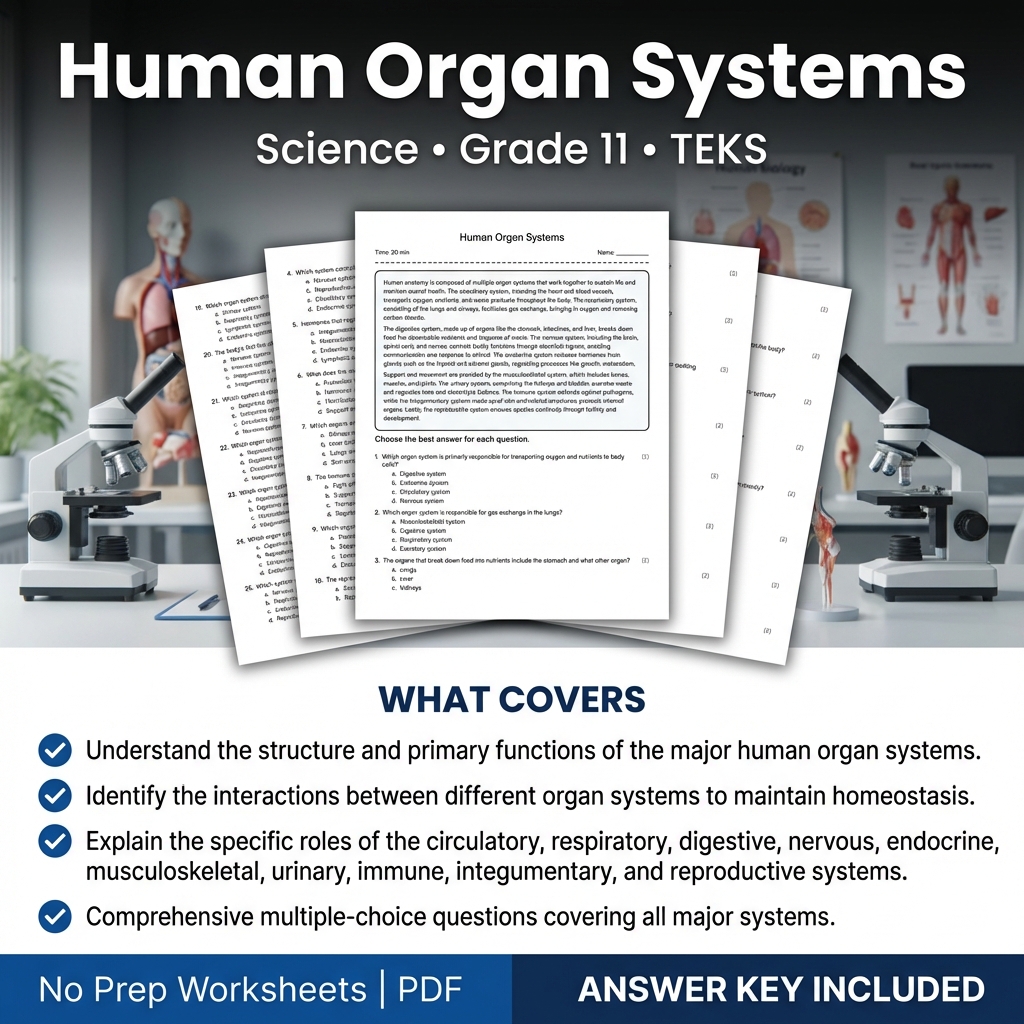
Human Organ Systems Science Worksheet for Grade 11 | TEKS Practice
 Created byCoral Reef Learning
Learning Objectives
- Understand the structure and primary functions of the major human organ systems.
- Identify the interactions between different organ systems to maintain homeostasis.
- Explain the specific roles of the circulatory, respiratory, digestive, nervous, endocrine, musculoskeletal, urinary, immune, integumentary, and reproductive systems.
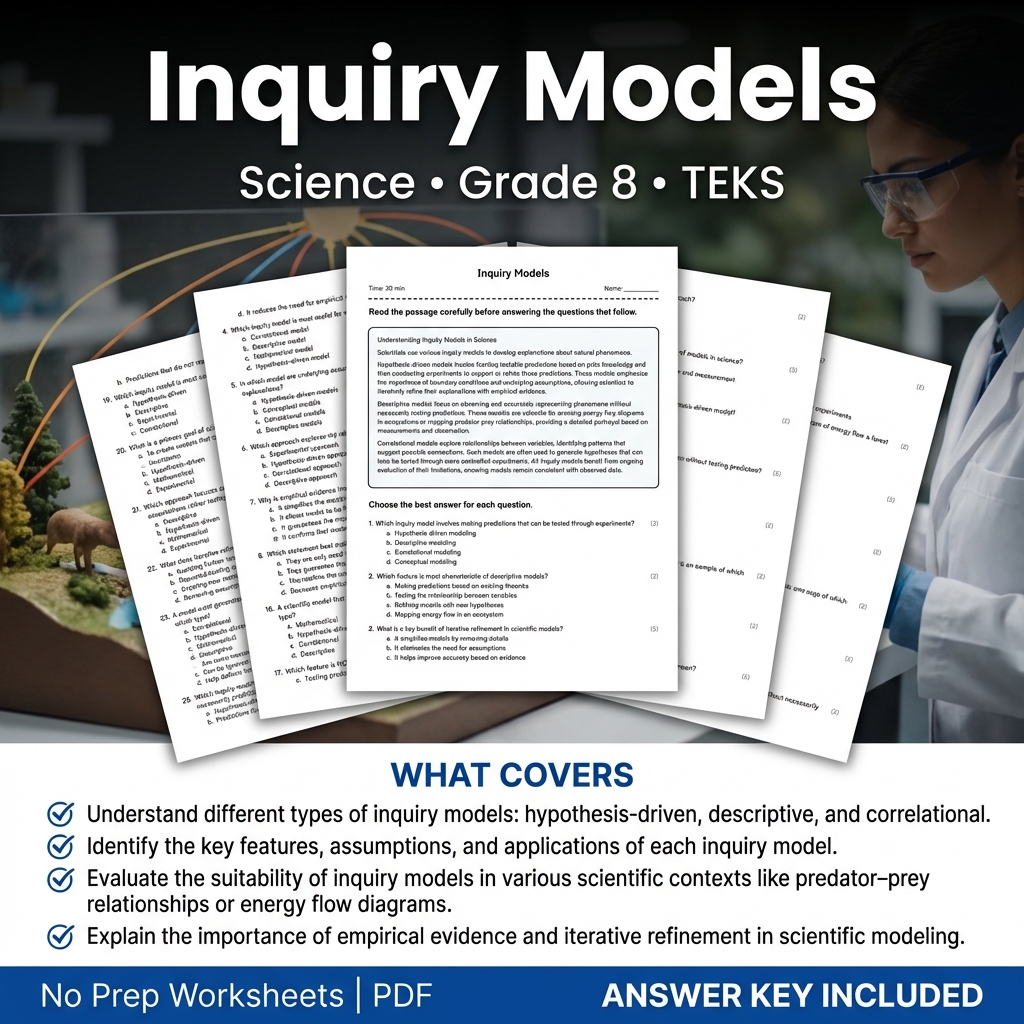
Inquiry Models Worksheet PDF with Answer Key | TEKS Grade 8 Science
Created byCoral Reef LearningLearning Objectives
- Understand different types of inquiry models: hypothesis-driven, descriptive, and correlational.
- Identify the key features, assumptions, and applications of each inquiry model.
- Evaluate the suitability of inquiry models in various scientific contexts like predator–prey relationships or energy flow diagrams.
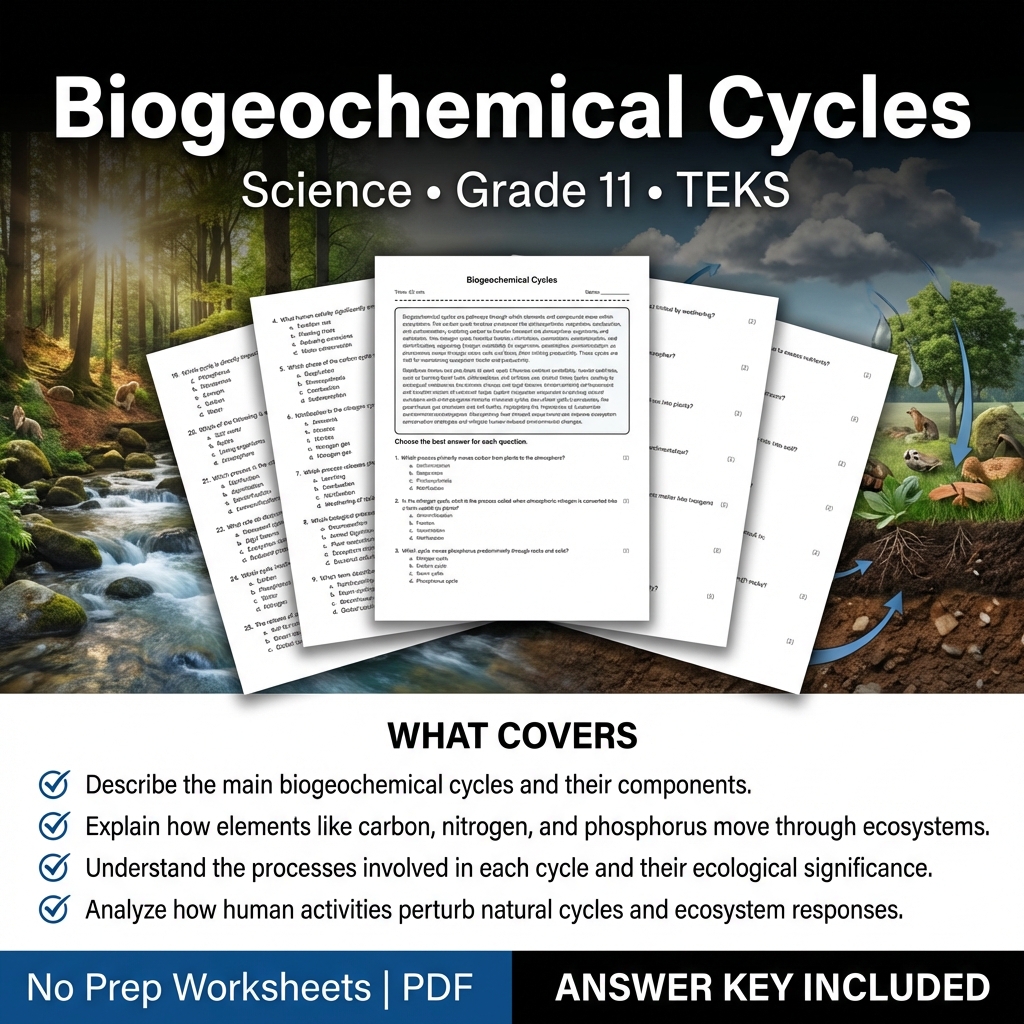
Biogeochemical Cycles Worksheet for Grade 11 Science | TEKS Standards
Created byCoral Reef LearningLearning Objectives
- Describe the main biogeochemical cycles and their components.
- Explain how elements like carbon, nitrogen, and phosphorus move through ecosystems.
- Understand the processes involved in each cycle and their ecological significance.
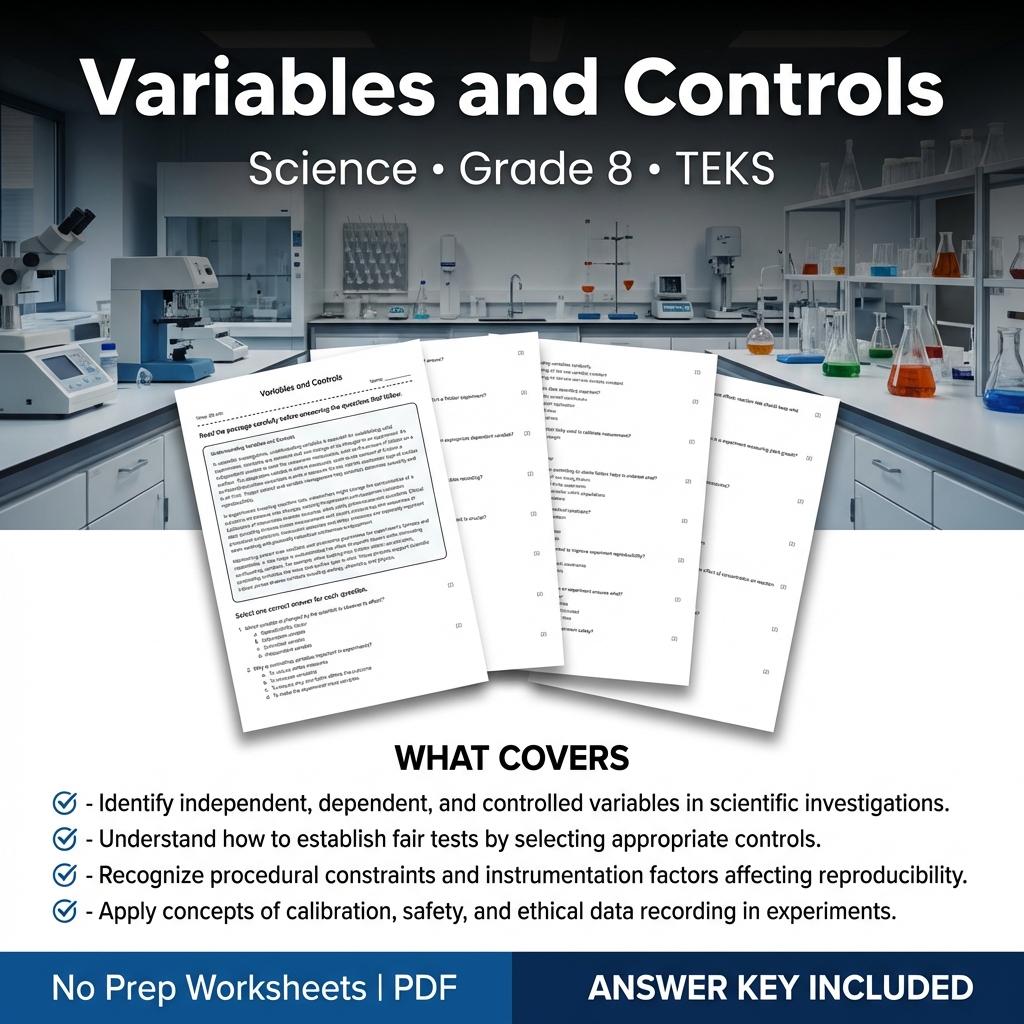
Variables and Controls Worksheet | Science Grade 8 TEKS Standards
Created byCoral Reef LearningLearning Objectives
- Identify independent, dependent, and controlled variables in scientific investigations.
- Understand how to establish fair tests by selecting appropriate controls.
- Recognize procedural constraints and instrumentation factors affecting reproducibility.
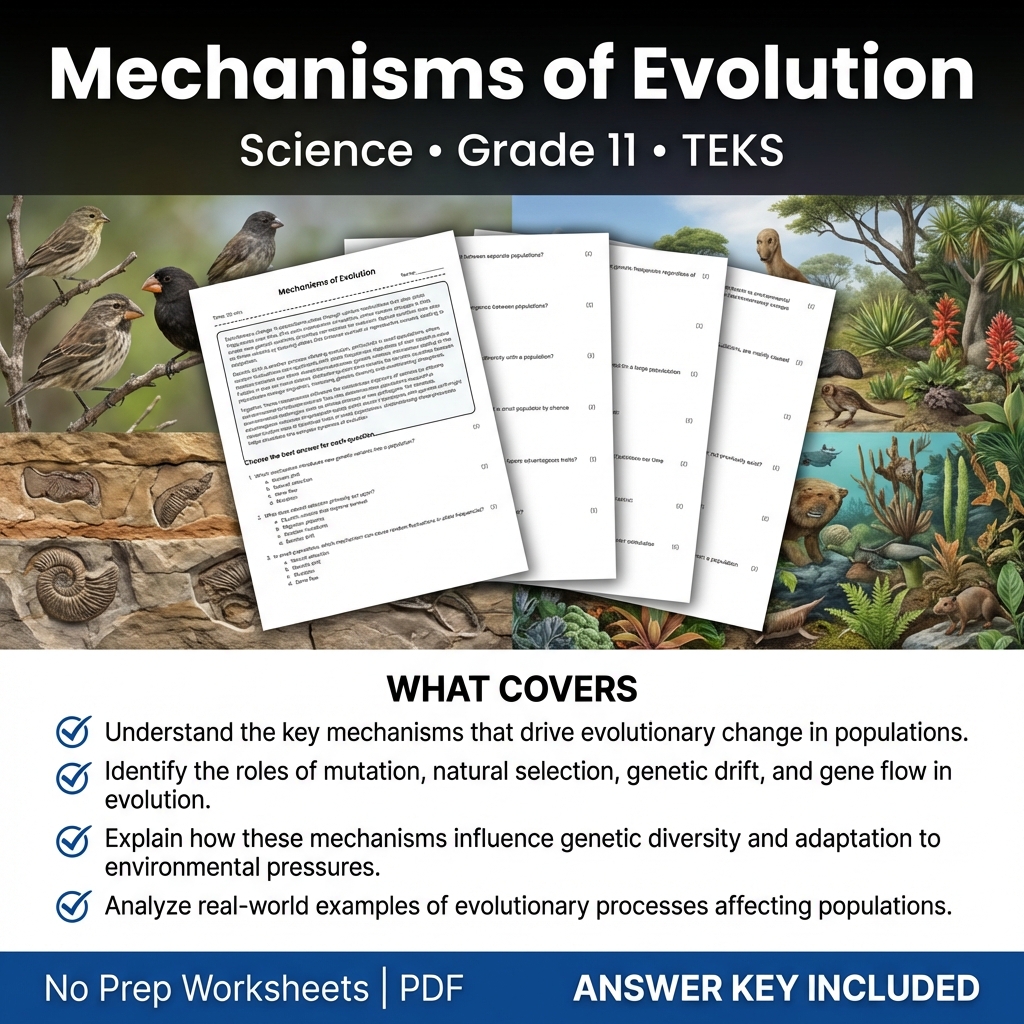
Grade 11 Science Worksheet on Mechanisms of Evolution | TEKS Aligned
Created byCoral Reef LearningLearning Objectives
- Understand the key mechanisms that drive evolutionary change in populations.
- Identify the roles of mutation, natural selection, genetic drift, and gene flow in evolution.
- Explain how these mechanisms influence genetic diversity and adaptation to environmental pressures.
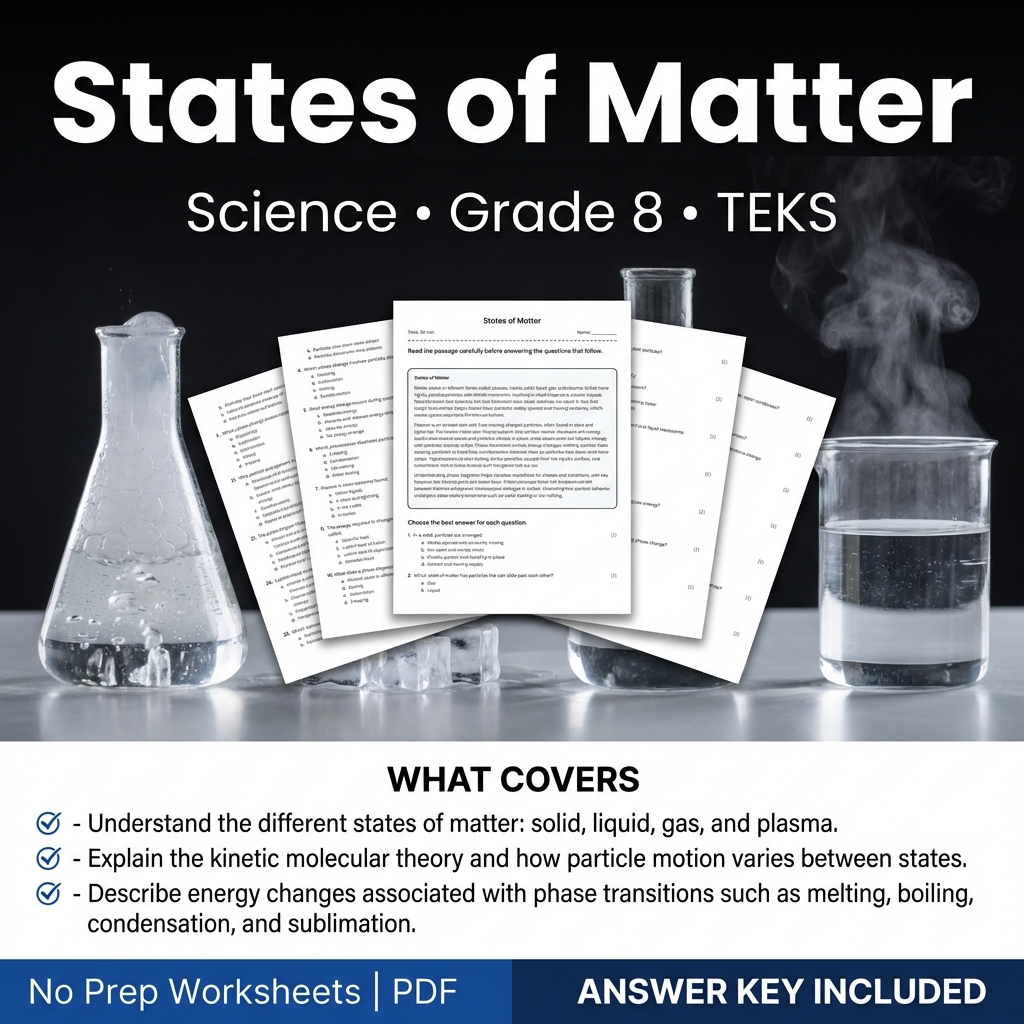
States of Matter Worksheet | 8th Grade Science Practice & Answer Key
Created byCoral Reef LearningLearning Objectives
- Understand the different states of matter: solid, liquid, gas, and plasma.
- Explain the kinetic molecular theory and how particle motion varies between states.
- Describe energy changes associated with phase transitions such as melting, boiling, condensation, and sublimation.
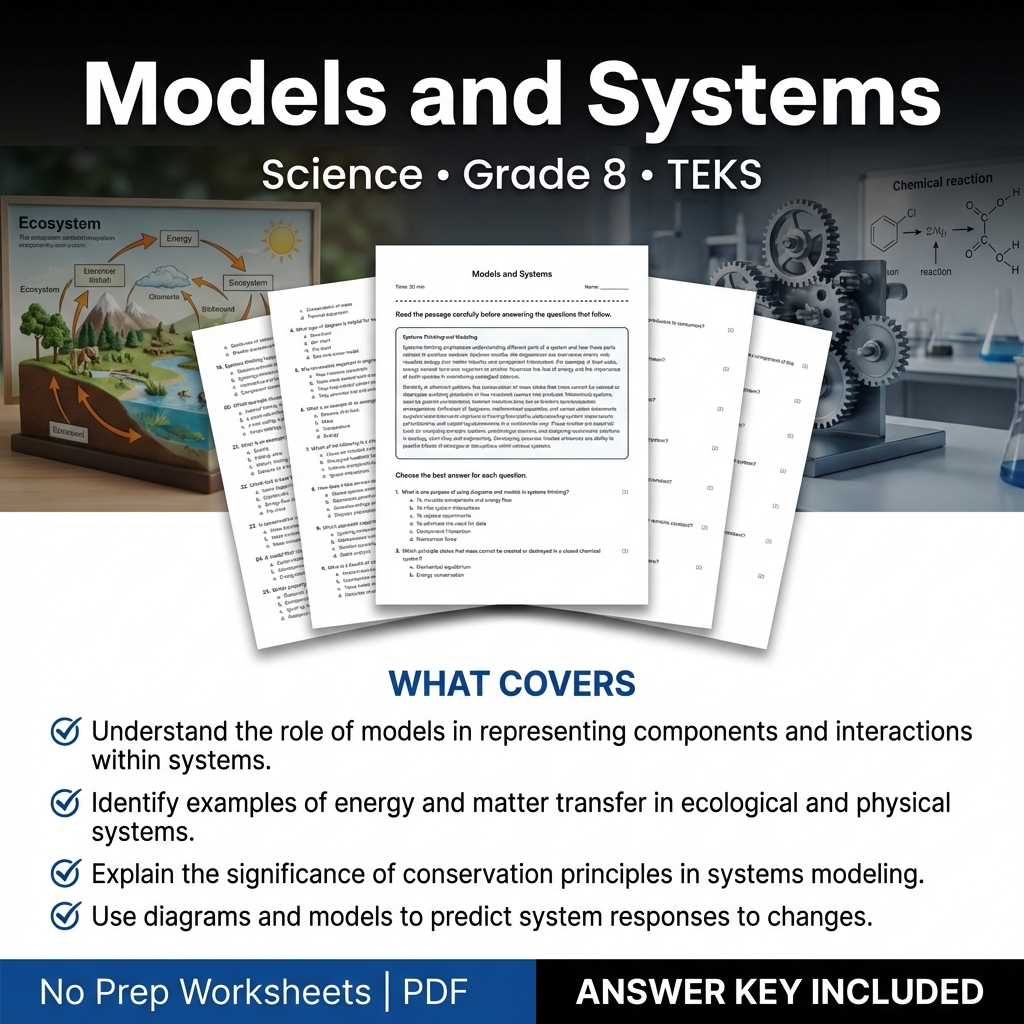
Models and Systems Worksheet for Grade 8 Science TEKS Standards
Created byCoral Reef LearningLearning Objectives
- Understand the role of models in representing components and interactions within systems.
- Identify examples of energy and matter transfer in ecological and physical systems.
- Explain the significance of conservation principles in systems modeling.
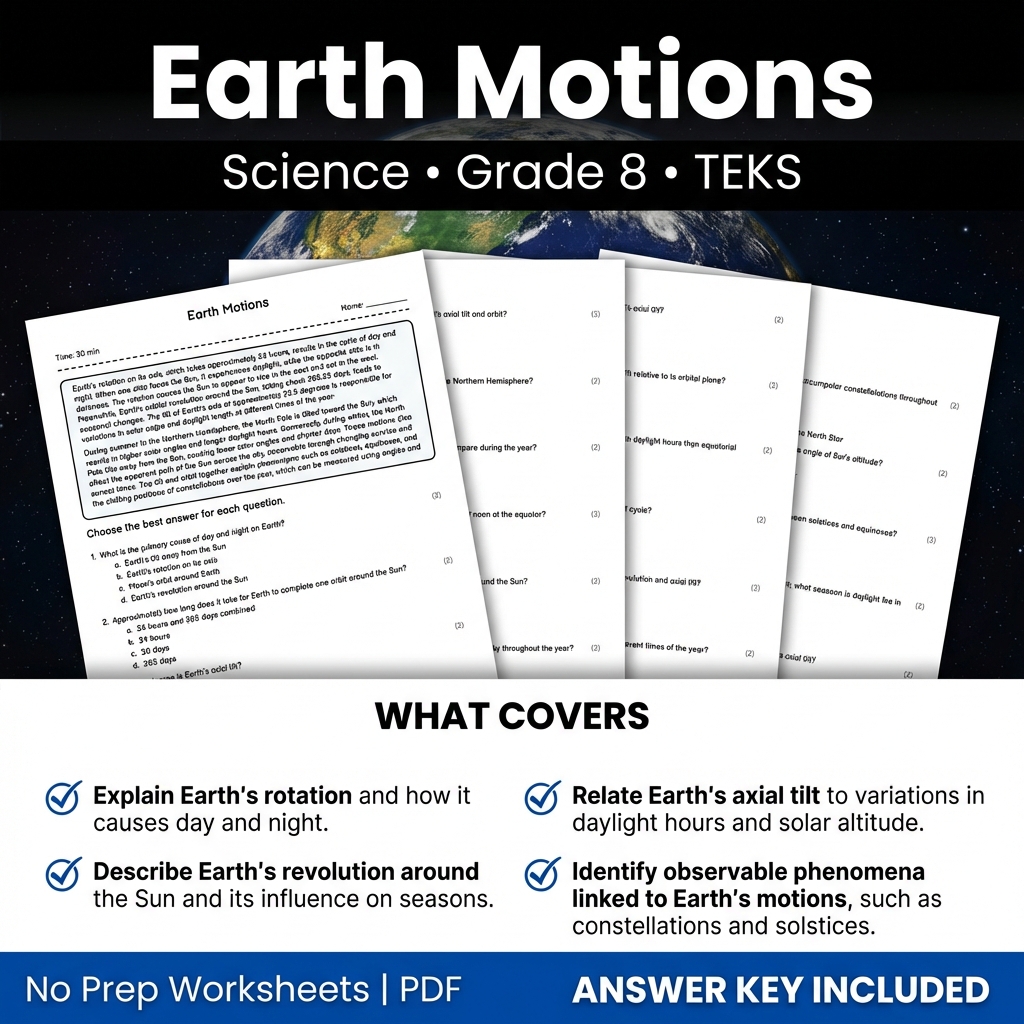
Earth Motions Worksheet for Grade 8 Science | TEKS Practice PDF
Created byCoral Reef LearningLearning Objectives
- Explain Earth's rotation and how it causes day and night.
- Describe Earth's revolution around the Sun and its influence on seasons.
- Relate Earth's axial tilt to variations in daylight hours and solar altitude.
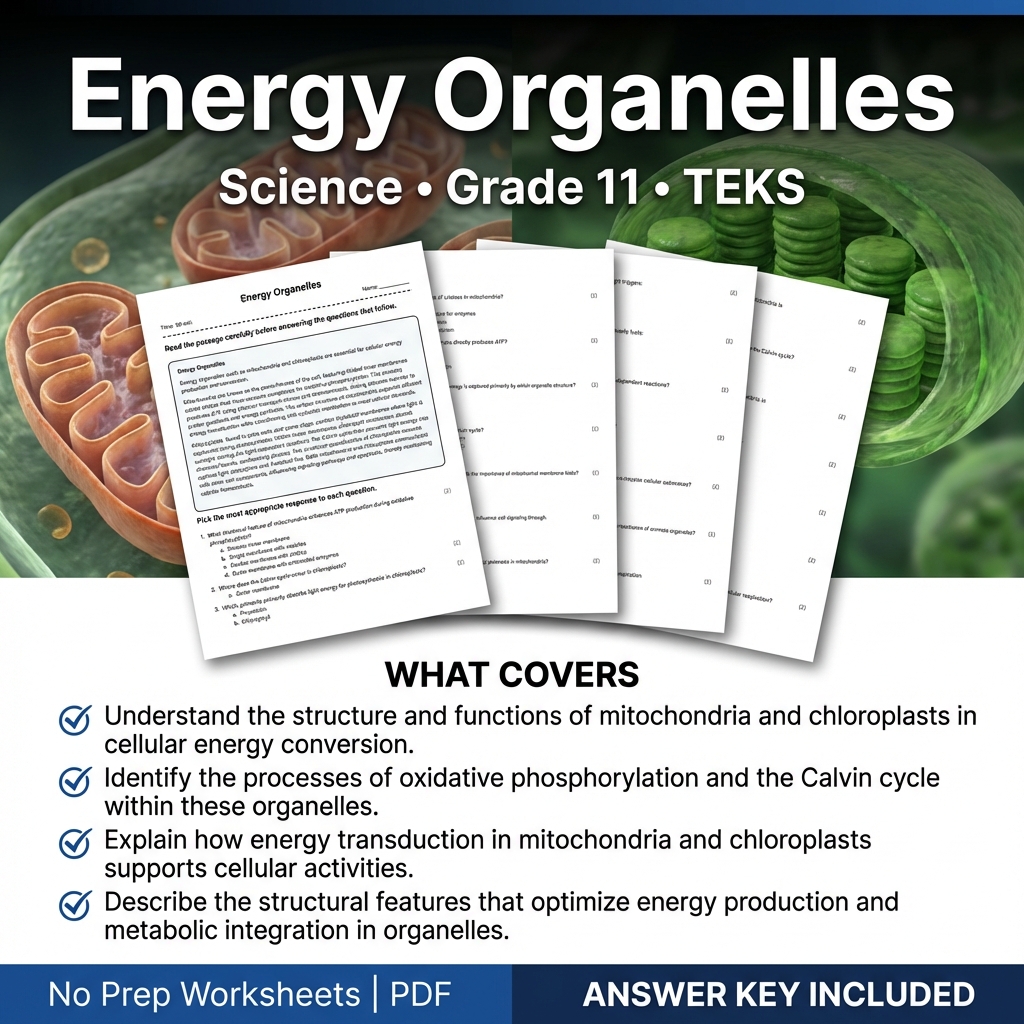
Energy Organelles Worksheet for Grade 11 Science | Standard Practice
Created byCoral Reef LearningLearning Objectives
- Understand the structure and functions of mitochondria and chloroplasts in cellular energy conversion.
- Identify the processes of oxidative phosphorylation and the Calvin cycle within these organelles.
- Explain how energy transduction in mitochondria and chloroplasts supports cellular activities.
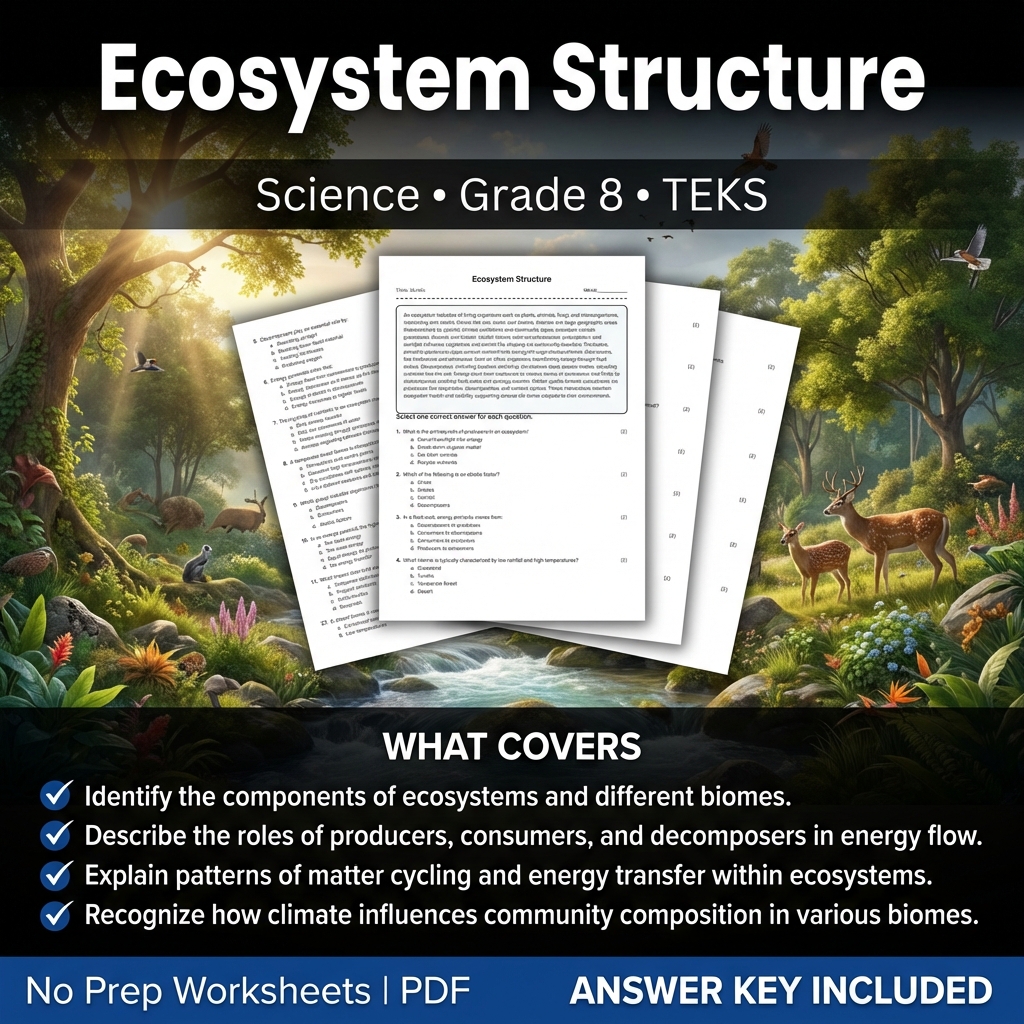
Grade 8 Science Worksheet on Ecosystem Structure | TEKS Aligned
Created byCoral Reef LearningLearning Objectives
- Identify the components of ecosystems and different biomes.
- Describe the roles of producers, consumers, and decomposers in energy flow.
- Explain patterns of matter cycling and energy transfer within ecosystems.
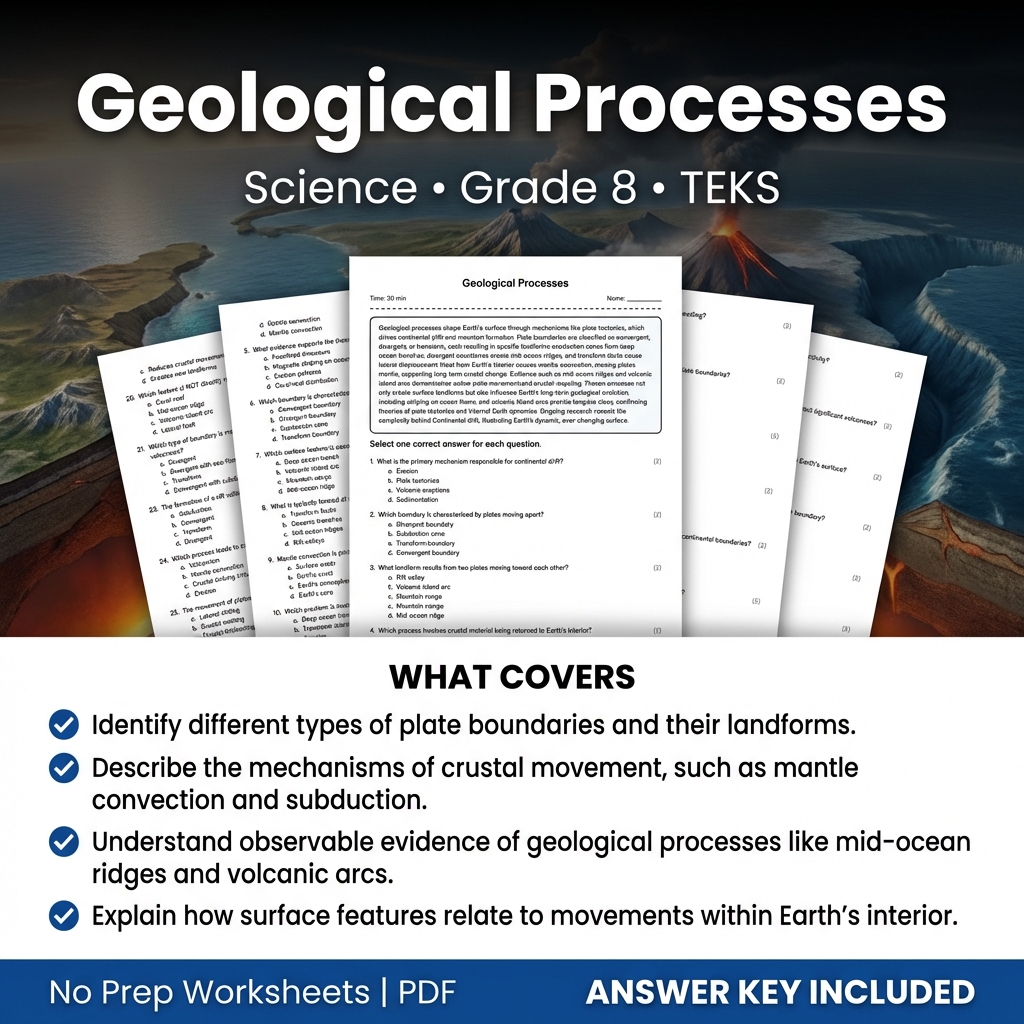
Geological Processes Worksheet for Grade 8 Science | TEKS Aligned
Created byCoral Reef LearningLearning Objectives
- Identify different types of plate boundaries and their landforms.
- Describe the mechanisms of crustal movement, such as mantle convection and subduction.
- Understand observable evidence of geological processes like mid-ocean ridges and volcanic arcs.

Speciation Mechanisms Worksheet for Grade 11 Science | TEKS
Created byCoral Reef LearningLearning Objectives
- Explain the different mechanisms of speciation, including allopatric, sympatric, and parapatric speciation.
- Identify key reproductive barriers involved in speciation, such as prezygotic and postzygotic barriers.
- Describe how geographic, ecological, and environmental factors contribute to reproductive isolation and biodiversity.
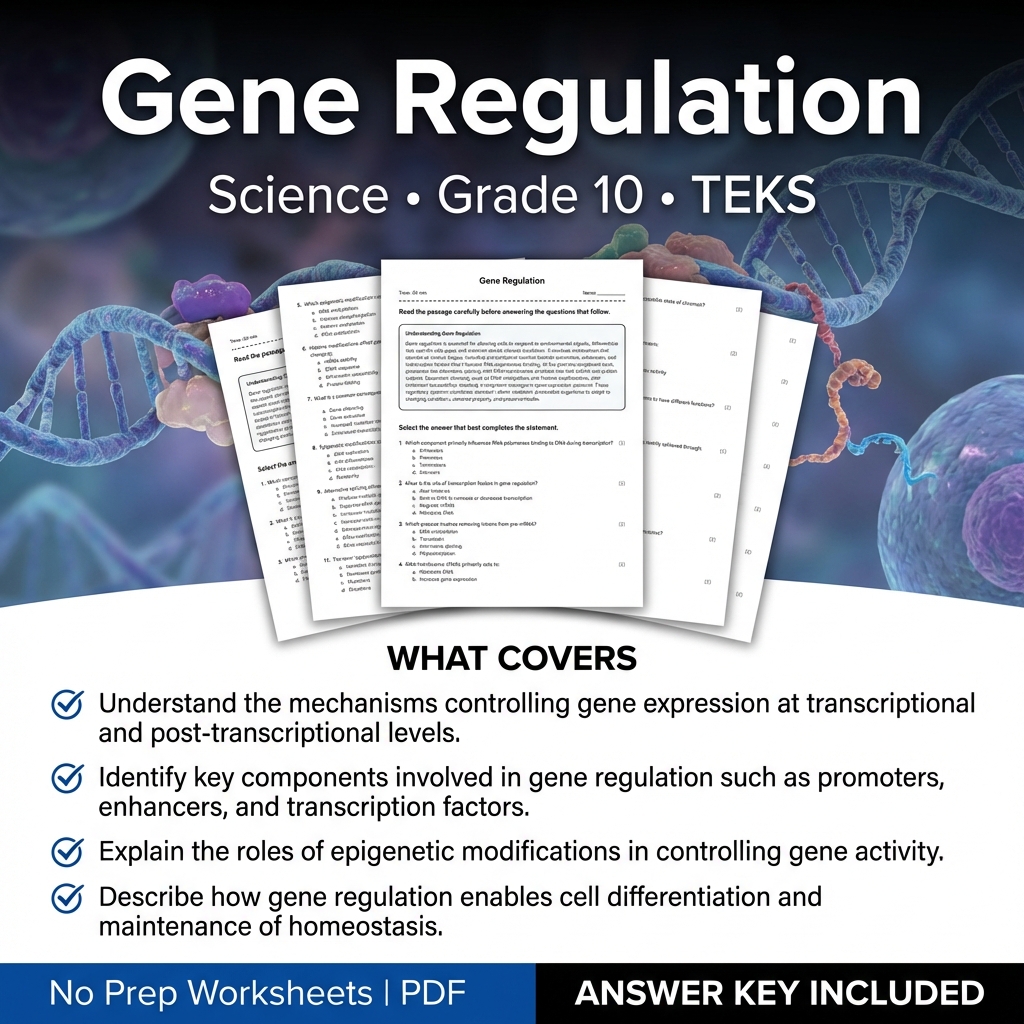
Gene Regulation Worksheet for Grade 10 Science TEKS Alignment
Created byCoral Reef LearningLearning Objectives
- Understand the mechanisms controlling gene expression at transcriptional and post-transcriptional levels.
- Identify key components involved in gene regulation such as promoters, enhancers, and transcription factors.
- Explain the roles of epigenetic modifications in controlling gene activity.
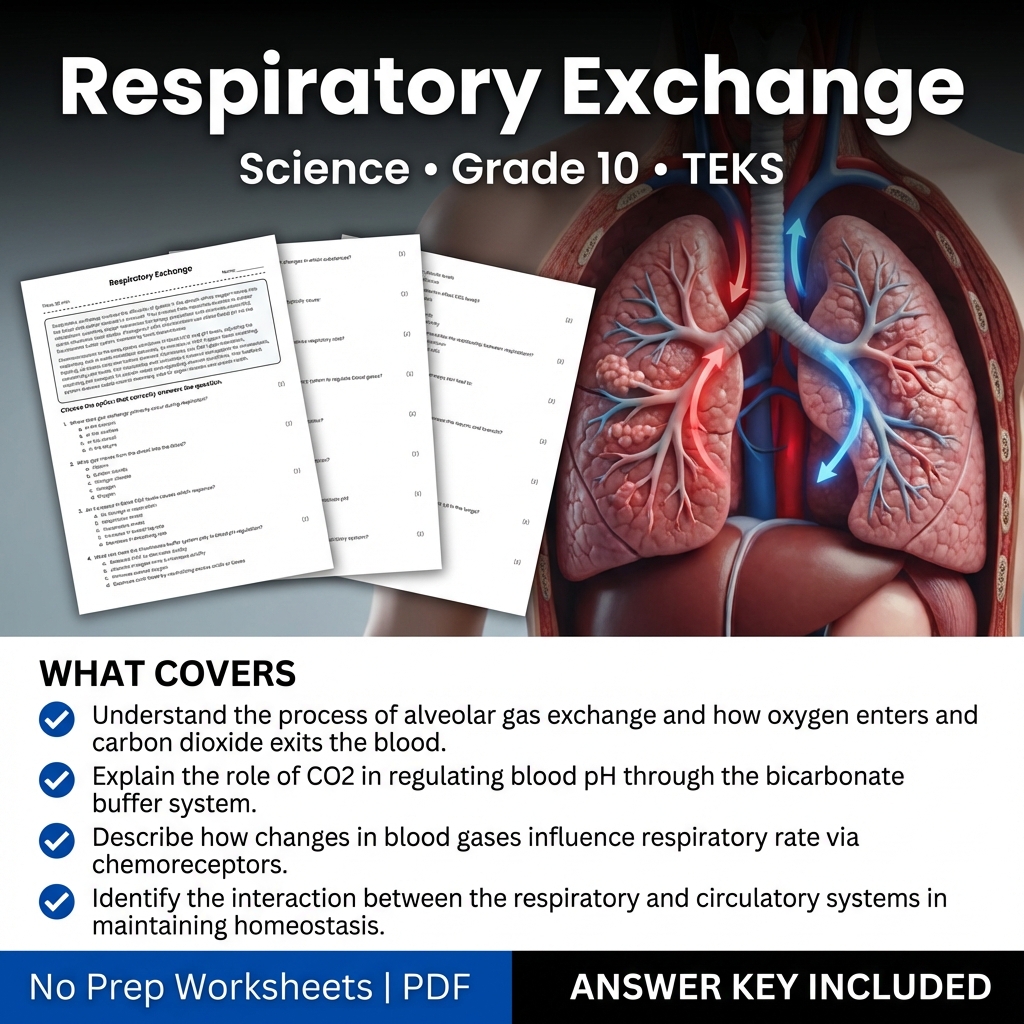
Grade 10 Science Worksheet on Respiratory Exchange | TEKS Aligned
Created byCoral Reef LearningLearning Objectives
- Understand the process of alveolar gas exchange and how oxygen enters and carbon dioxide exits the blood.
- Explain the role of CO2 in regulating blood pH through the bicarbonate buffer system.
- Describe how changes in blood gases influence respiratory rate via chemoreceptors.
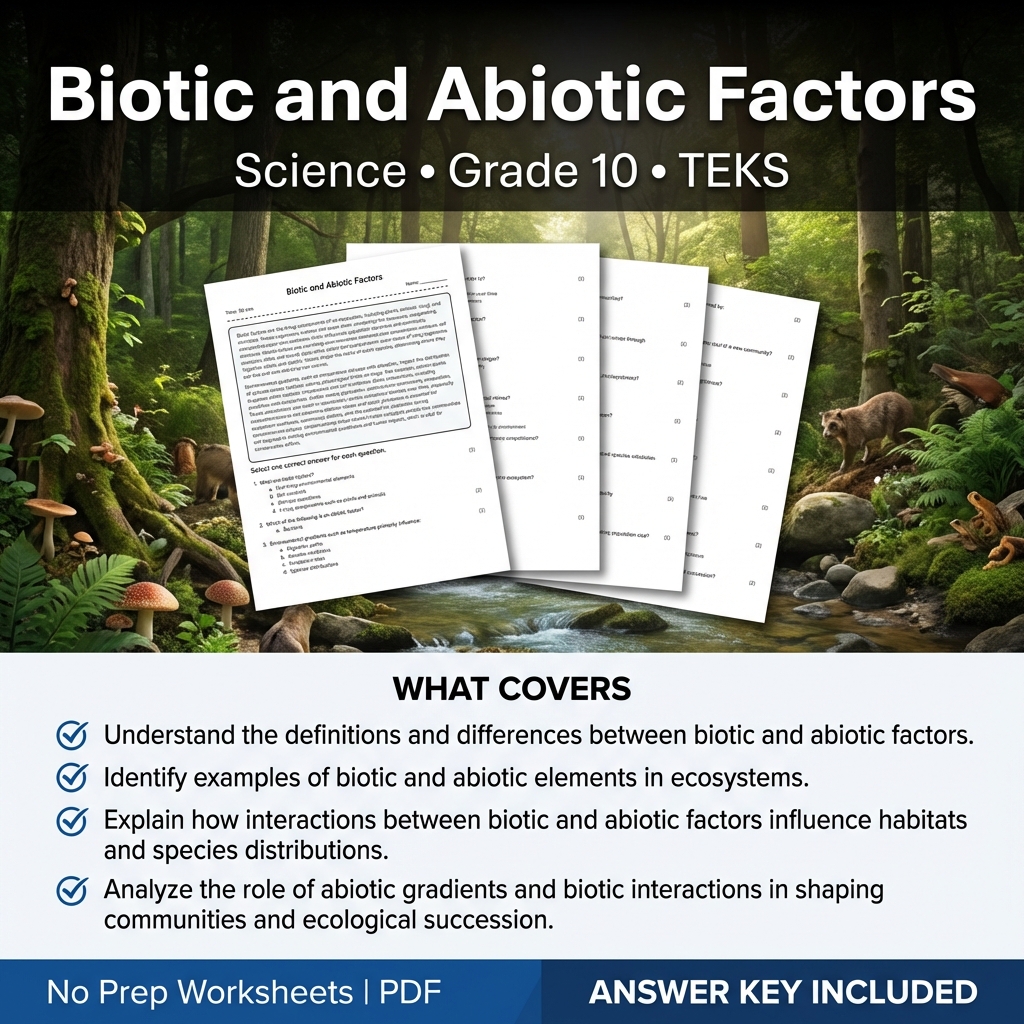
Biotic and Abiotic Factors Worksheet for Grade 10 Science TEKS
Created byCoral Reef LearningLearning Objectives
- Understand the definitions and differences between biotic and abiotic factors.
- Identify examples of biotic and abiotic elements in ecosystems.
- Explain how interactions between biotic and abiotic factors influence habitats and species distributions.
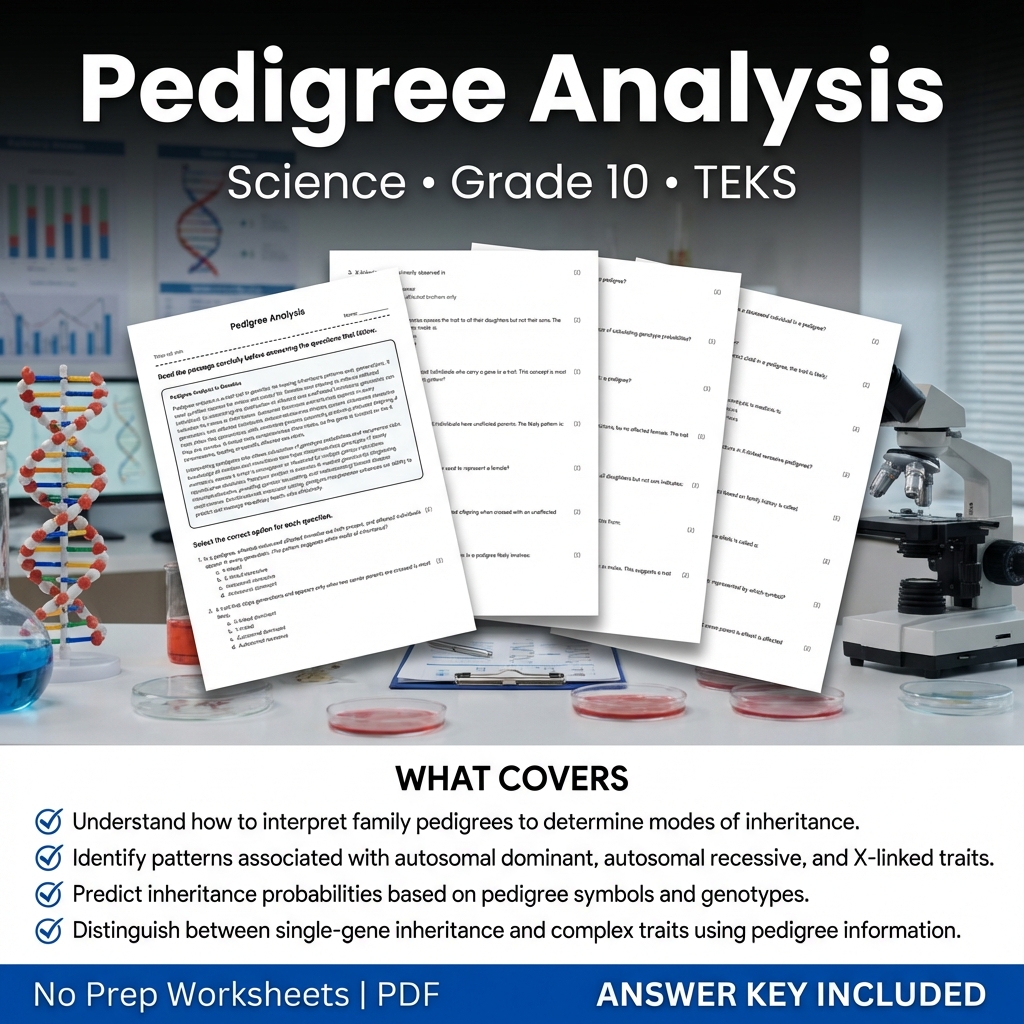
Grade 10 Science Pedigree Analysis Worksheet with Answer Key | TEKS
Created byCoral Reef LearningLearning Objectives
- Understand how to interpret family pedigrees to determine modes of inheritance.
- Identify patterns associated with autosomal dominant, autosomal recessive, and X-linked traits.
- Predict inheritance probabilities based on pedigree symbols and genotypes.
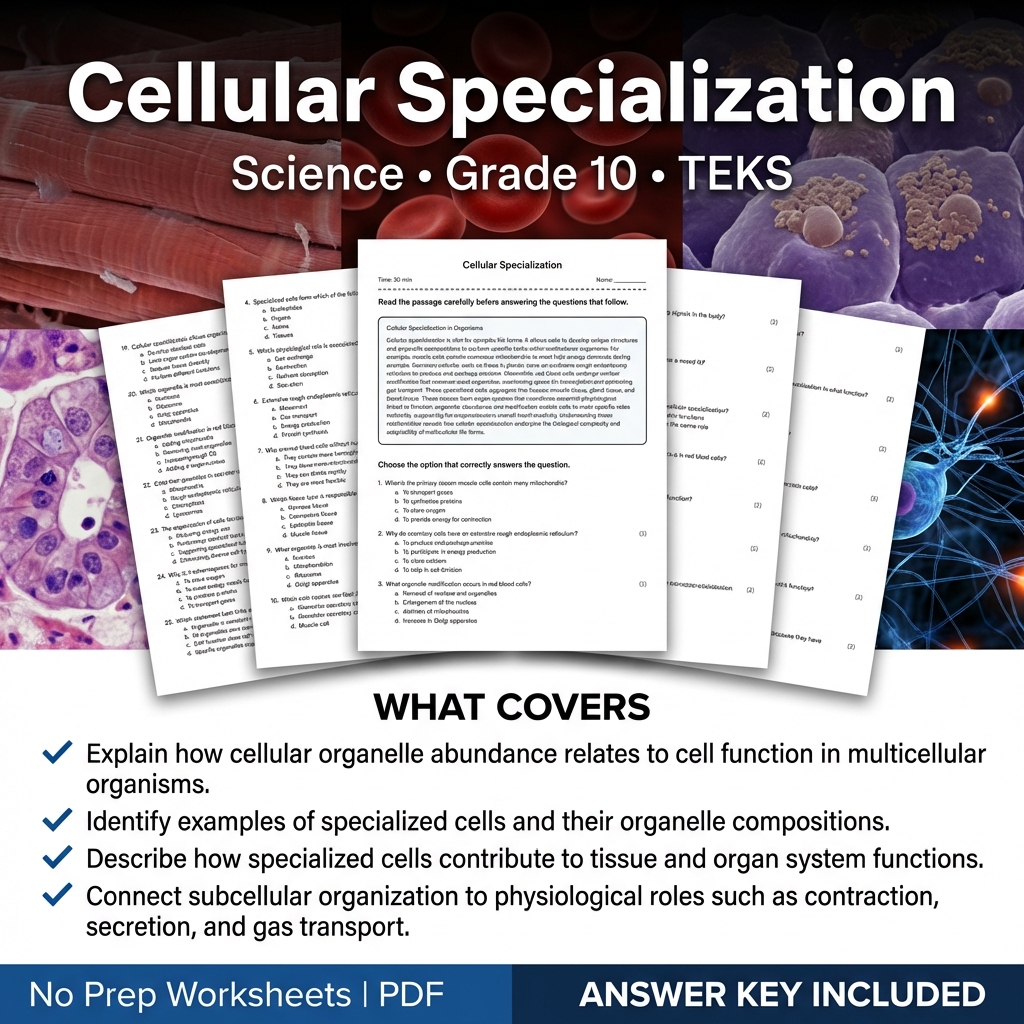
Cellular Specialization Worksheet for Grade 10 Science | TEKS Aligned
Created byCoral Reef LearningLearning Objectives
- Explain how cellular organelle abundance relates to cell function in multicellular organisms.
- Identify examples of specialized cells and their organelle compositions.
- Describe how specialized cells contribute to tissue and organ system functions.
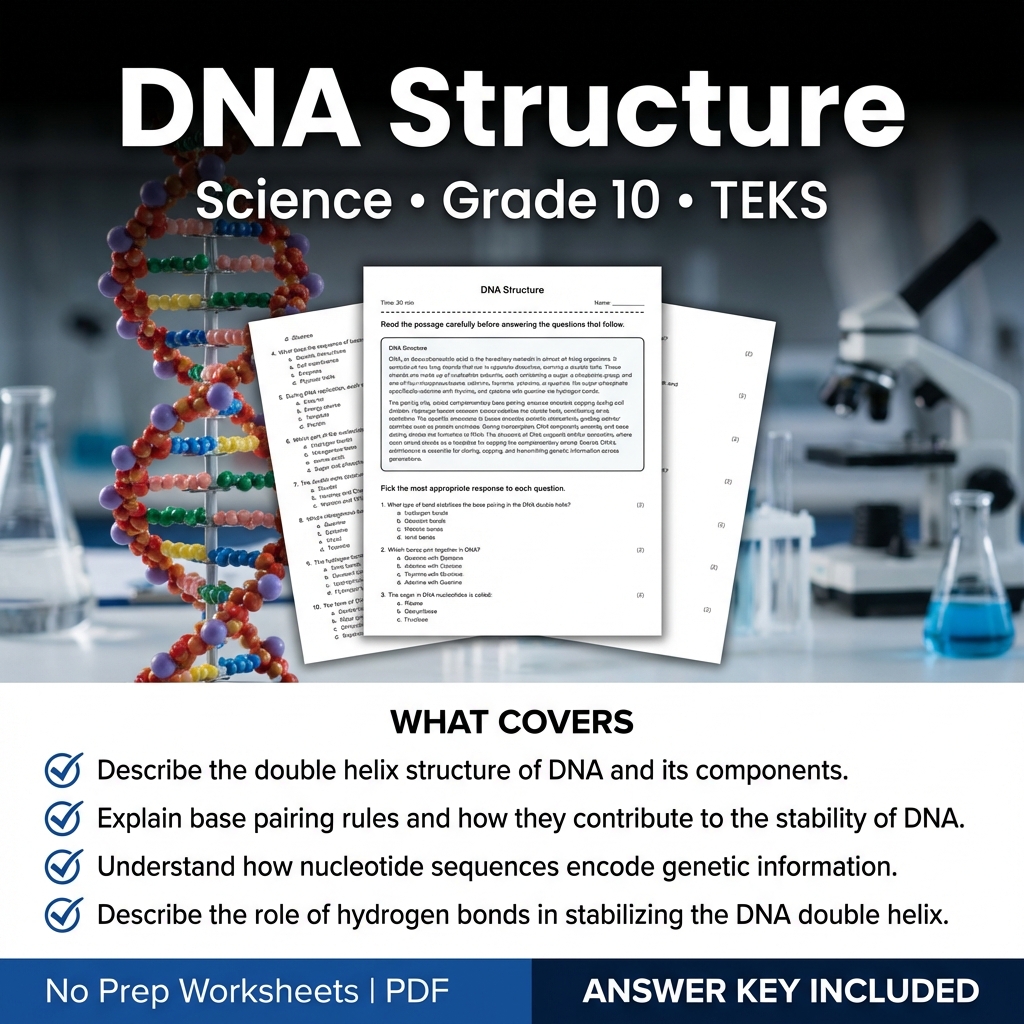
Grade 10 Science Worksheet on DNA Structure | TEKS Aligned
Created byCoral Reef LearningLearning Objectives
- Describe the double helix structure of DNA and its components.
- Explain base pairing rules and how they contribute to the stability of DNA.
- Understand how nucleotide sequences encode genetic information.
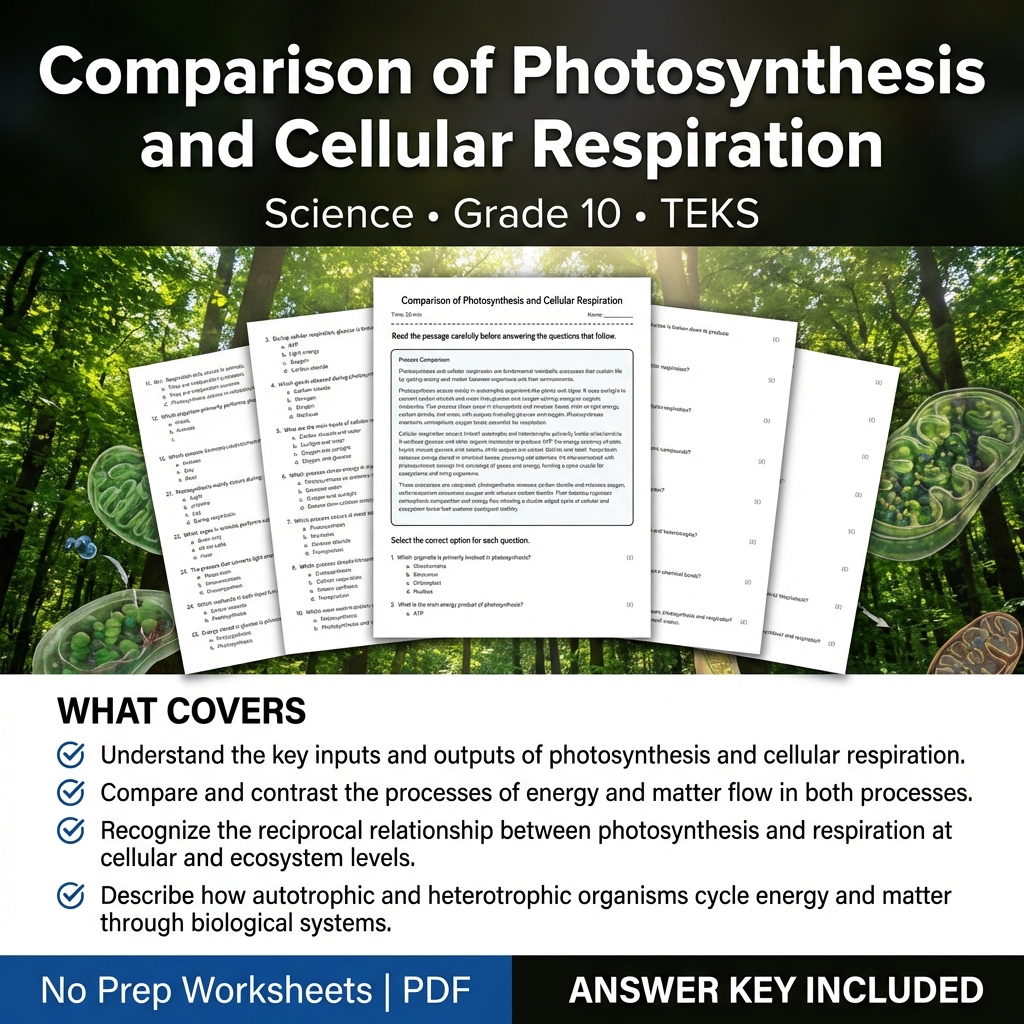
Comparison of Photosynthesis and Cellular Respiration Worksheet Grade 10 Science
Created byCoral Reef LearningLearning Objectives
- Understand the key inputs and outputs of photosynthesis and cellular respiration.
- Compare and contrast the processes of energy and matter flow in both processes.
- Recognize the reciprocal relationship between photosynthesis and respiration at cellular and ecosystem levels.
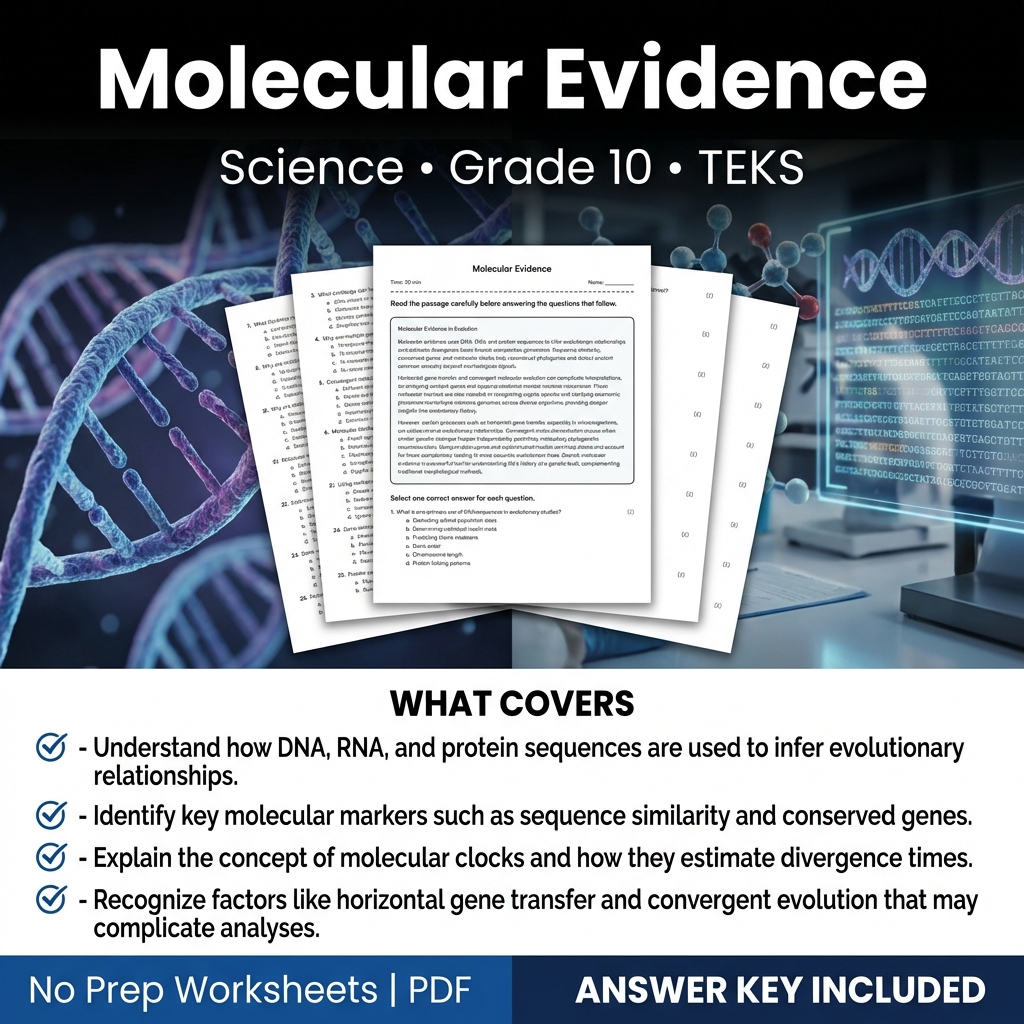
Molecular Evidence Worksheet for Grade 10 Science | TEKS
Created byCoral Reef LearningLearning Objectives
- Understand how DNA, RNA, and protein sequences are used to infer evolutionary relationships.
- Identify key molecular markers such as sequence similarity and conserved genes.
- Explain the concept of molecular clocks and how they estimate divergence times.
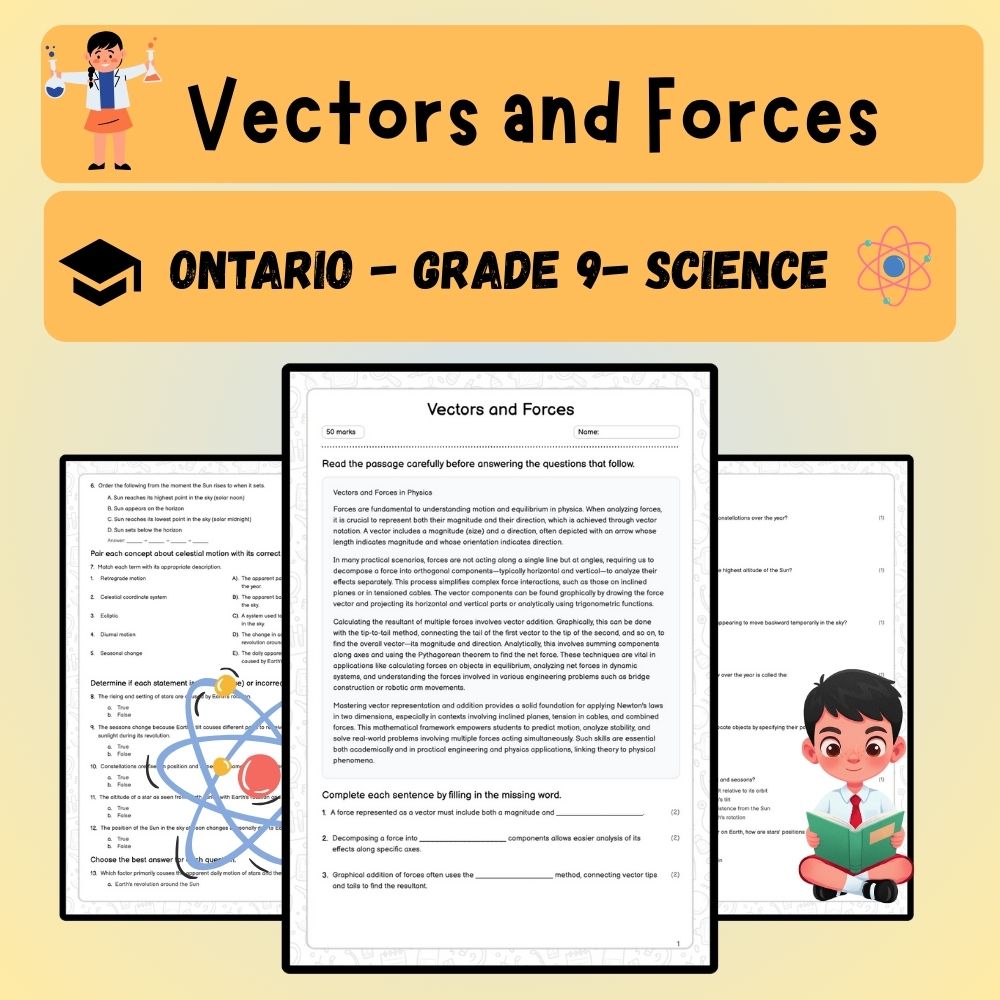
Grade 9 Science Vectors and Forces Worksheet – Ontario Standards (PDF)
 Created byPrism Point Learning
Learning Objectives
- Understand the representation of forces as vectors including magnitude and direction.
- Learn to resolve forces into components and calculate resultant vectors graphically and analytically.
- Apply the principles of vector addition to real-world force interactions such as inclined planes and cable tensions.
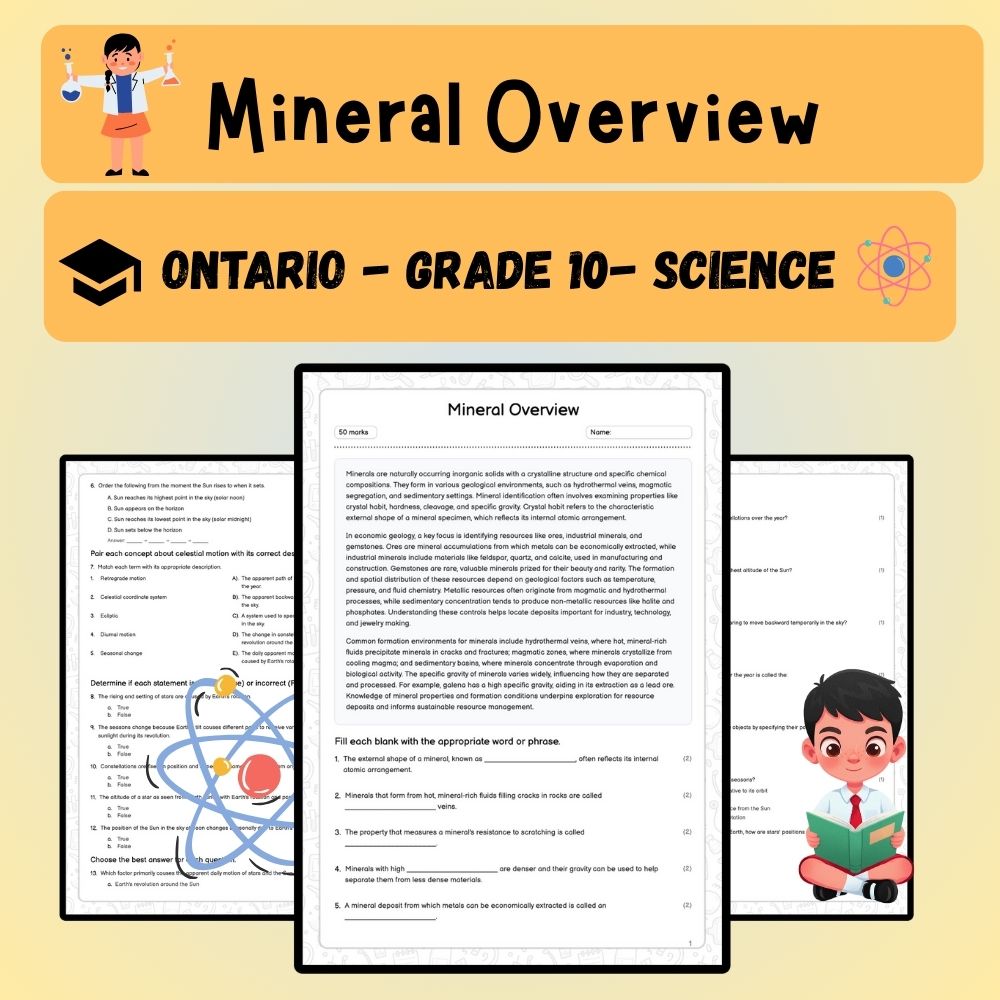
Grade 10 Science | Mineral Overview Worksheet (PDF) – Ontario Standards
Created byPrism Point LearningLearning Objectives
- Understand the classification and properties of minerals used in geology and industry.
- Identify different formation settings and their associated mineral resources.
- Differentiate between ores, industrial minerals, and gemstones based on their properties and uses.
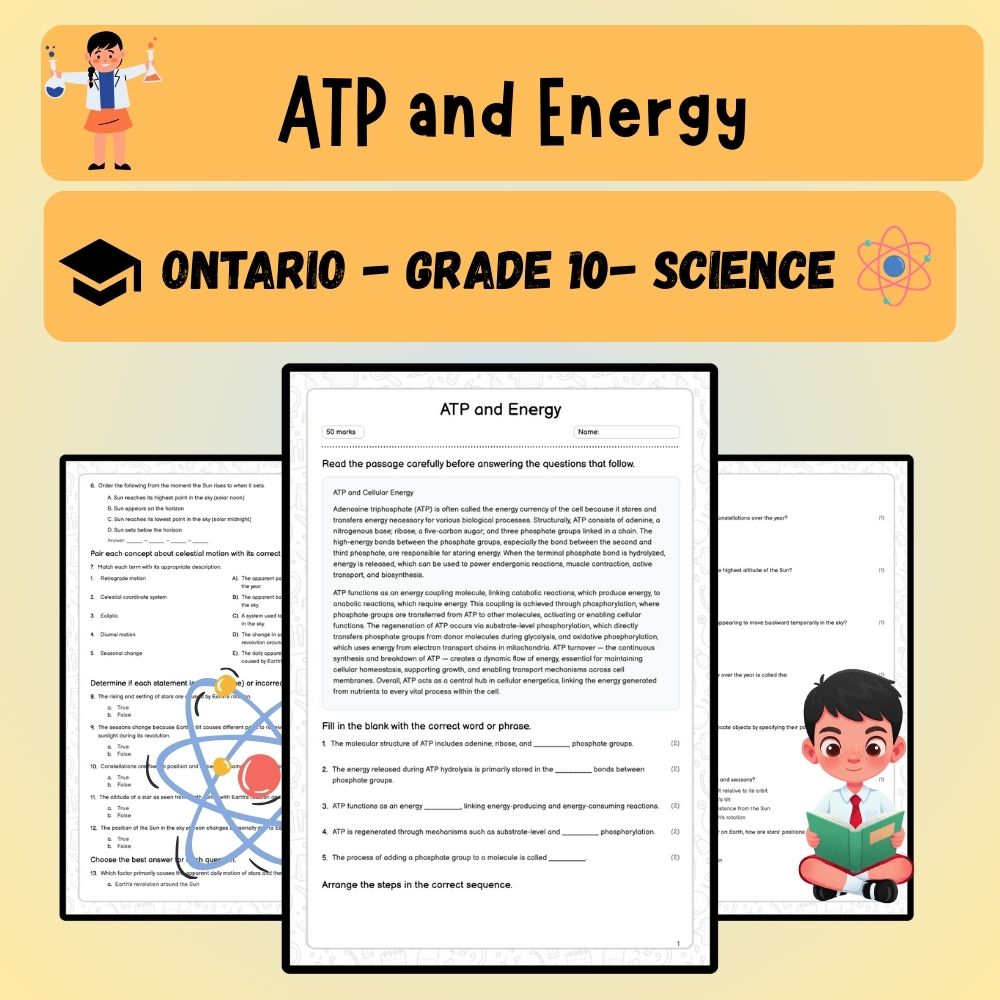
Grade 10 Science | ATP and Energy Worksheet – Ontario Standards (PDF)
Created byPrism Point LearningLearning Objectives
- Describe the molecular structure and role of ATP as an energy carrier in cells.
- Explain how ATP releases energy through phosphate bond hydrolysis and how energy is coupled to cellular work.
- Identify mechanisms of ATP regeneration, including substrate-level and oxidative phosphorylation.
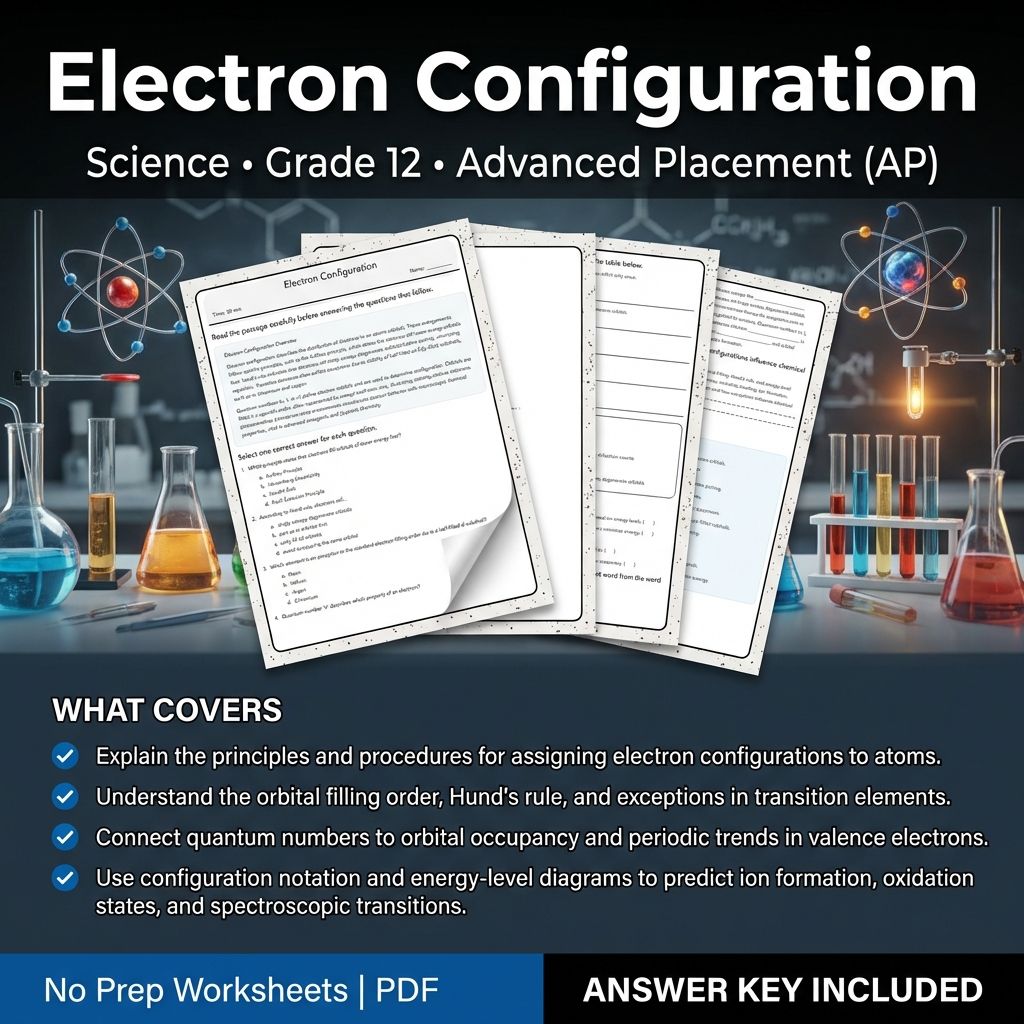
12th Grade Science | Electron Configuration Worksheet & Answers (Printable PDF)
Created byCoral Reef LearningLearning Objectives
- Explain the principles and procedures for assigning electron configurations to atoms.
- Understand the orbital filling order, Hund’s rule, and exceptions in transition elements.
- Connect quantum numbers to orbital occupancy and periodic trends in valence electrons.
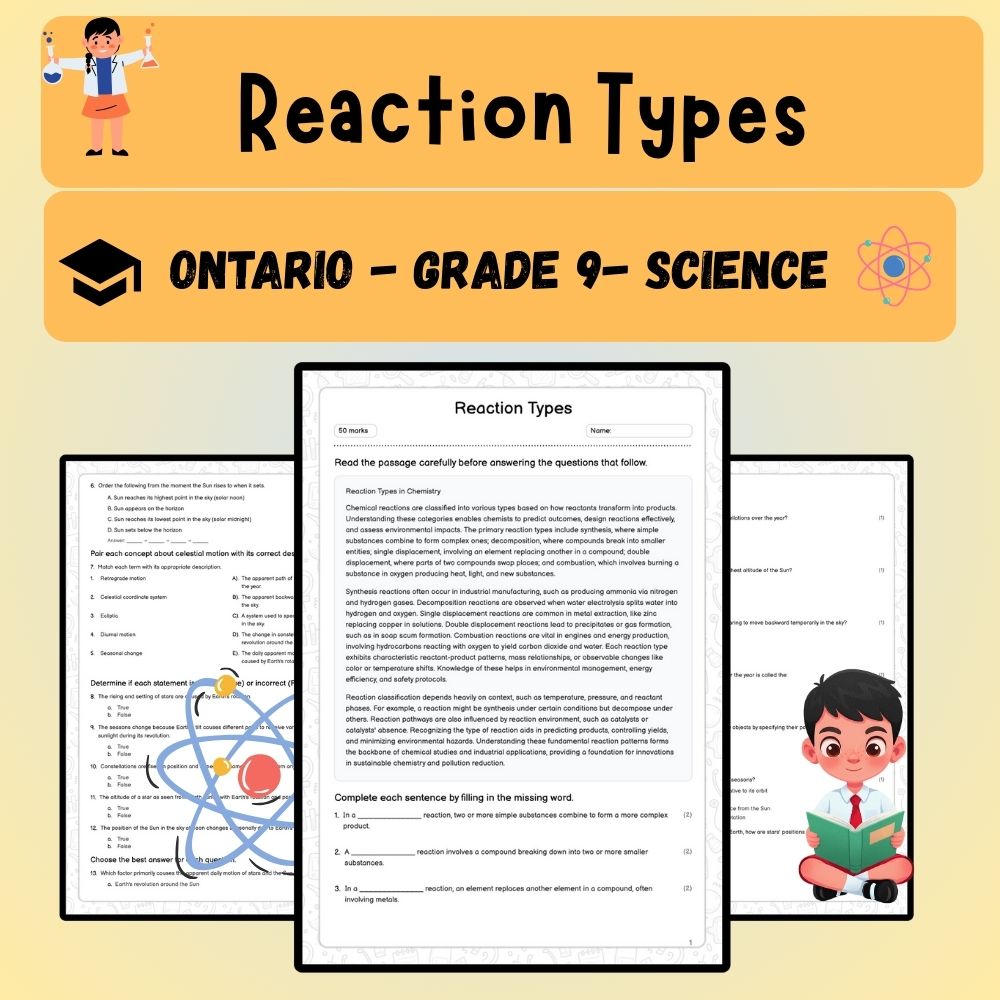
Grade 9 Science | Reaction Types Worksheet – Standard Ontario (PDF)
Created byPrism Point LearningLearning Objectives
- Identify and describe the main types of chemical reactions: synthesis, decomposition, single displacement, double displacement, and combustion.
- Recognize practical examples of each reaction type and their observable outcomes.
- Understand how reaction classifications assist in predicting products and maintaining mass conservation.
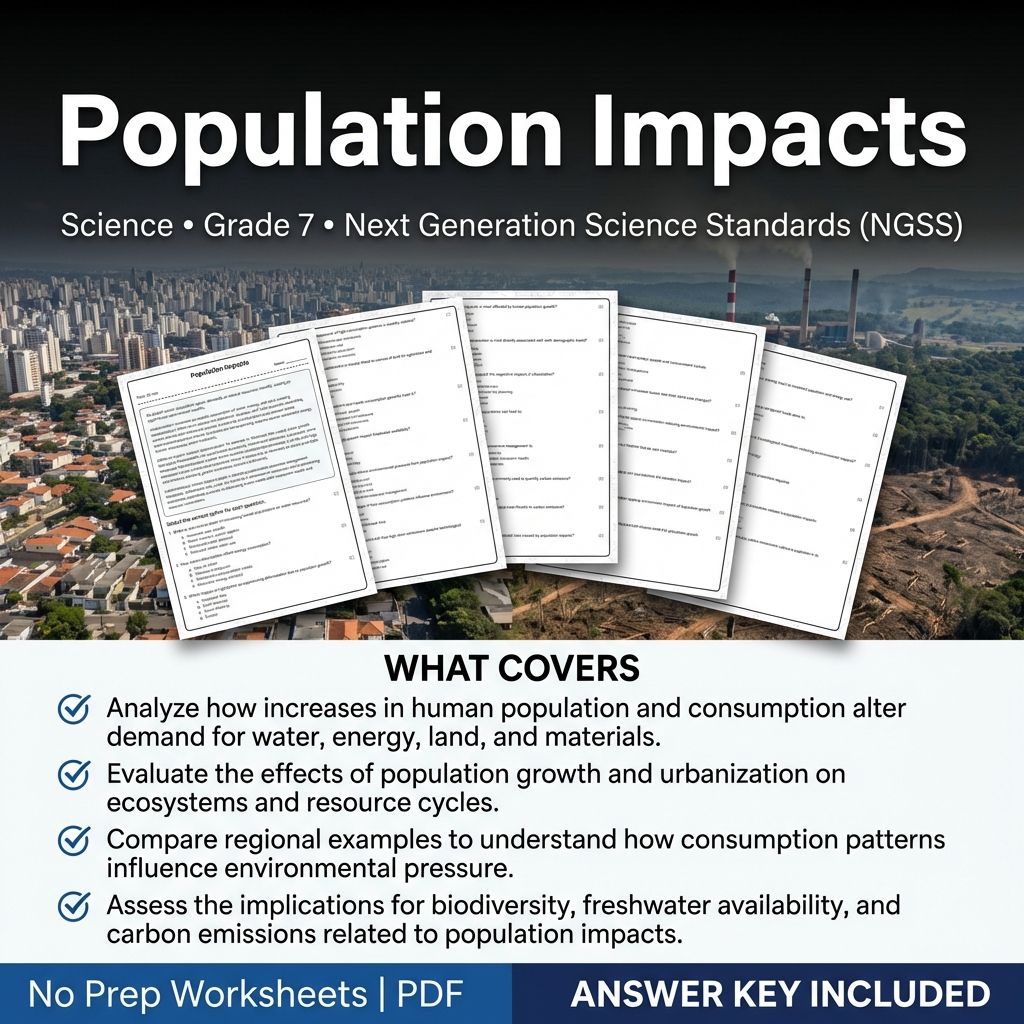
7th Grade Science Worksheet | Population Impacts & Environment (PDF & Answers)
Created byCoral Reef LearningLearning Objectives
- Analyze how increases in human population and consumption alter demand for water, energy, land, and materials.
- Evaluate the effects of population growth and urbanization on ecosystems and resource cycles.
- Compare regional examples to understand how consumption patterns influence environmental pressure.
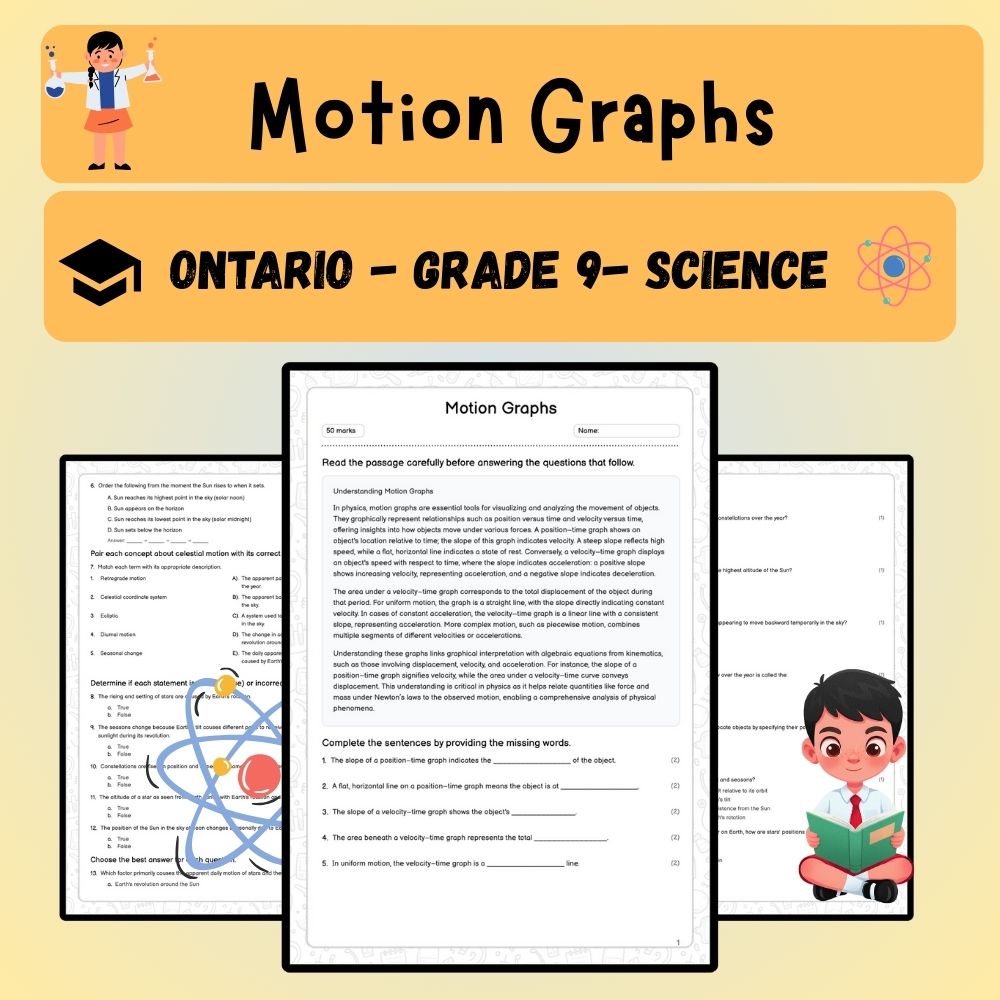
Grade 9 Science | Motion Graphs Worksheet (Answer Key) – Ontario Standards
Created byPrism Point LearningLearning Objectives
- Interpret position–time and velocity–time graphs in various motion scenarios.
- Understand how the slope of position–time graphs indicates velocity, and how the slope of velocity–time graphs indicates acceleration.
- Explain how the area under a velocity–time graph represents displacement.
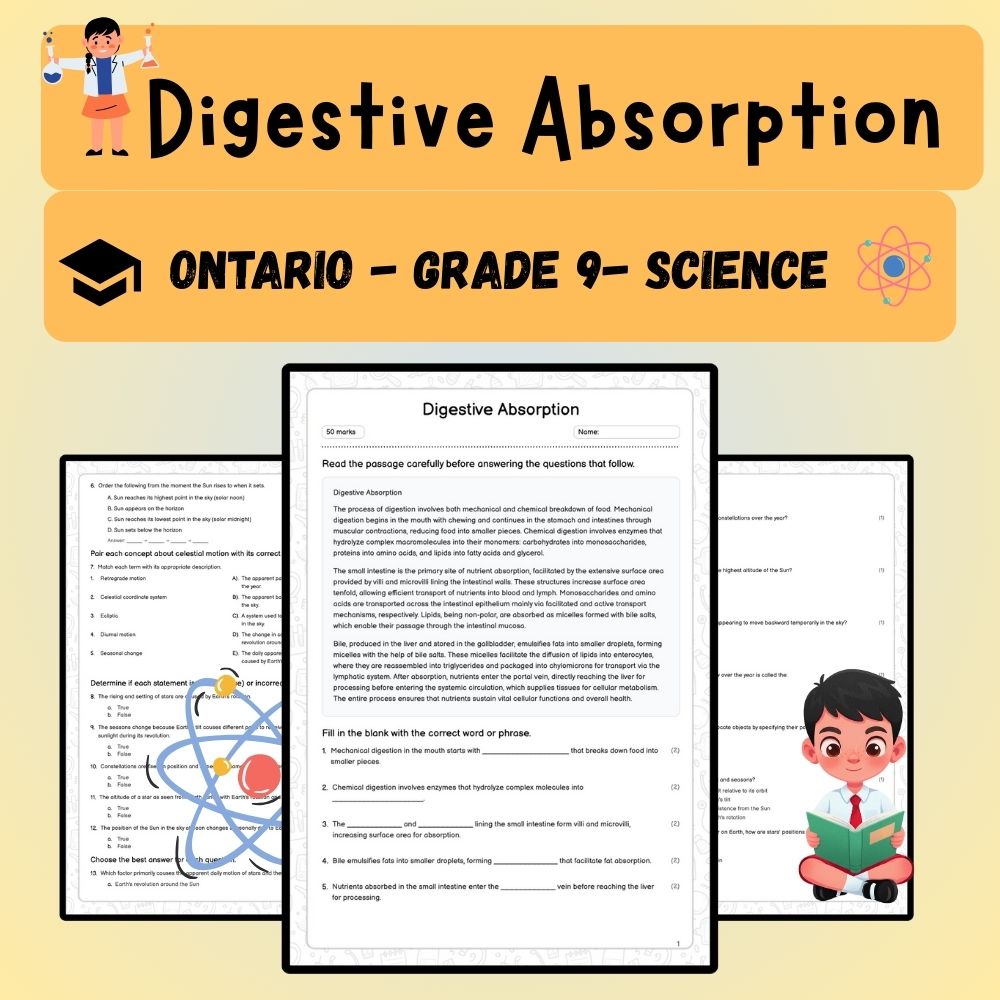
Grade 9 Science Worksheet | Digestive Absorption & Nutrient Transport (PDF)
Created byPrism Point LearningLearning Objectives
- Explain the mechanical and chemical breakdown of food in digestion.
- Describe how nutrients are absorbed across the intestinal epithelium, focusing on villi and microvilli.
- Identify the role of enzymes, bile, and micelles in nutrient digestion and absorption.
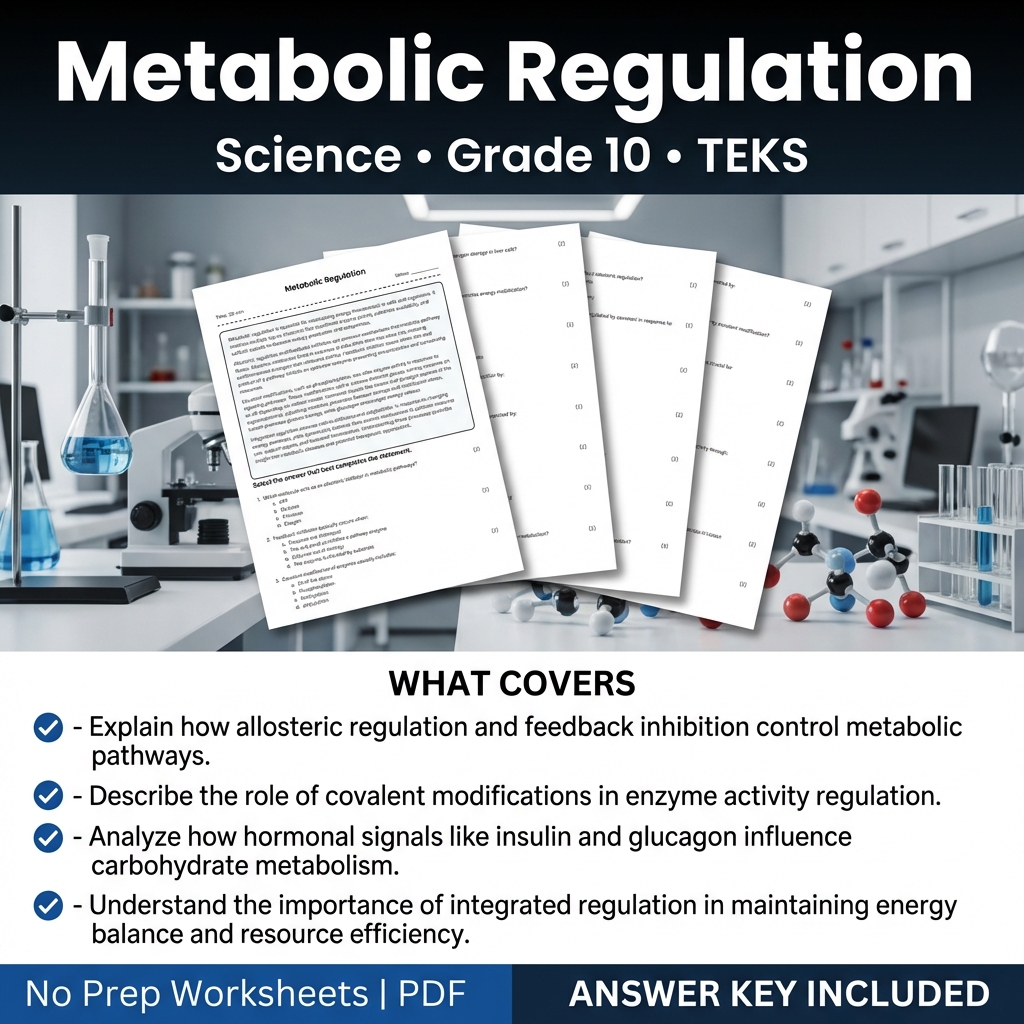
Metabolic Regulation Worksheet Grade 10 Science | TEKS Practice PDF
Created byCoral Reef LearningLearning Objectives
- Explain how allosteric regulation and feedback inhibition control metabolic pathways.
- Describe the role of covalent modifications in enzyme activity regulation.
- Analyze how hormonal signals like insulin and glucagon influence carbohydrate metabolism.
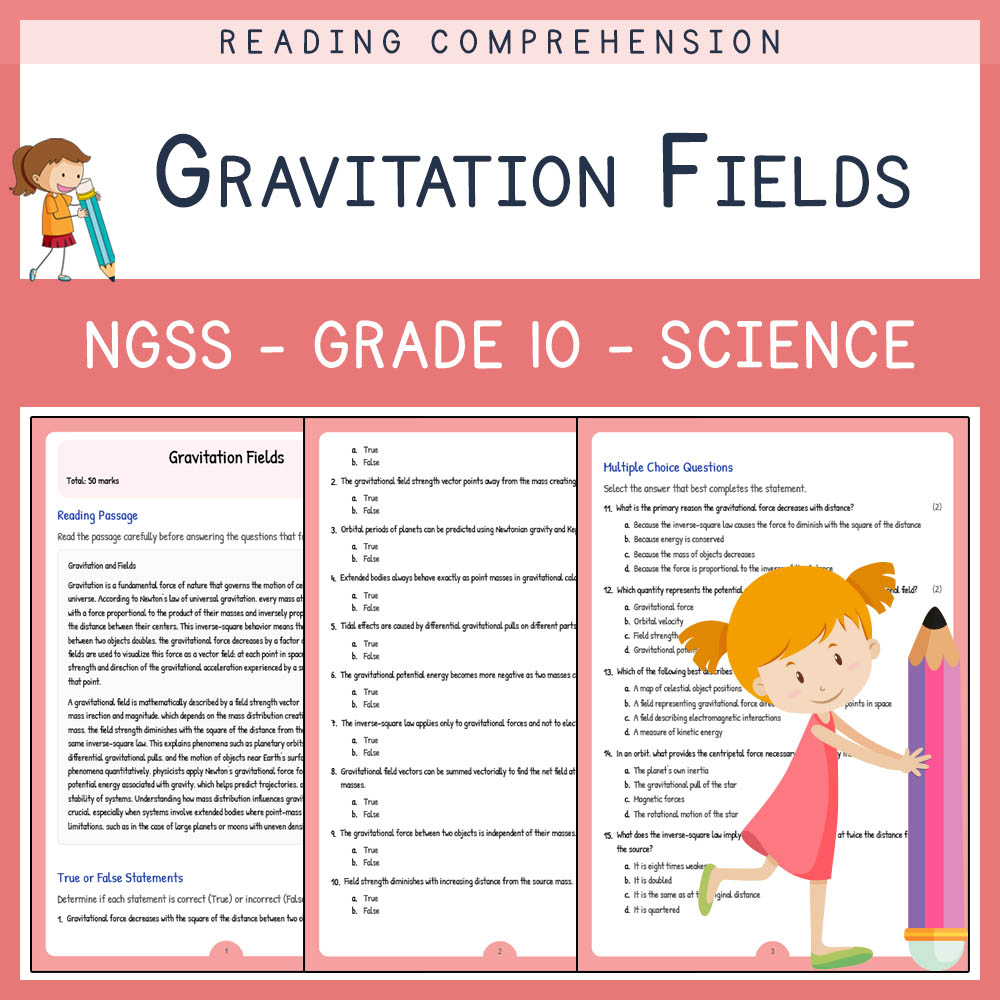
Grade 10 Science | Gravitation Fields Worksheet & Answer Key (PDF)
 Created byLumora Learning
Learning Objectives
- Understand the inverse-square law behavior of gravitational fields.
- Explain how gravitational fields are represented vectorially and with potential.
- Apply Newtonian gravity to predict planetary orbits and analyze orbital dynamics.
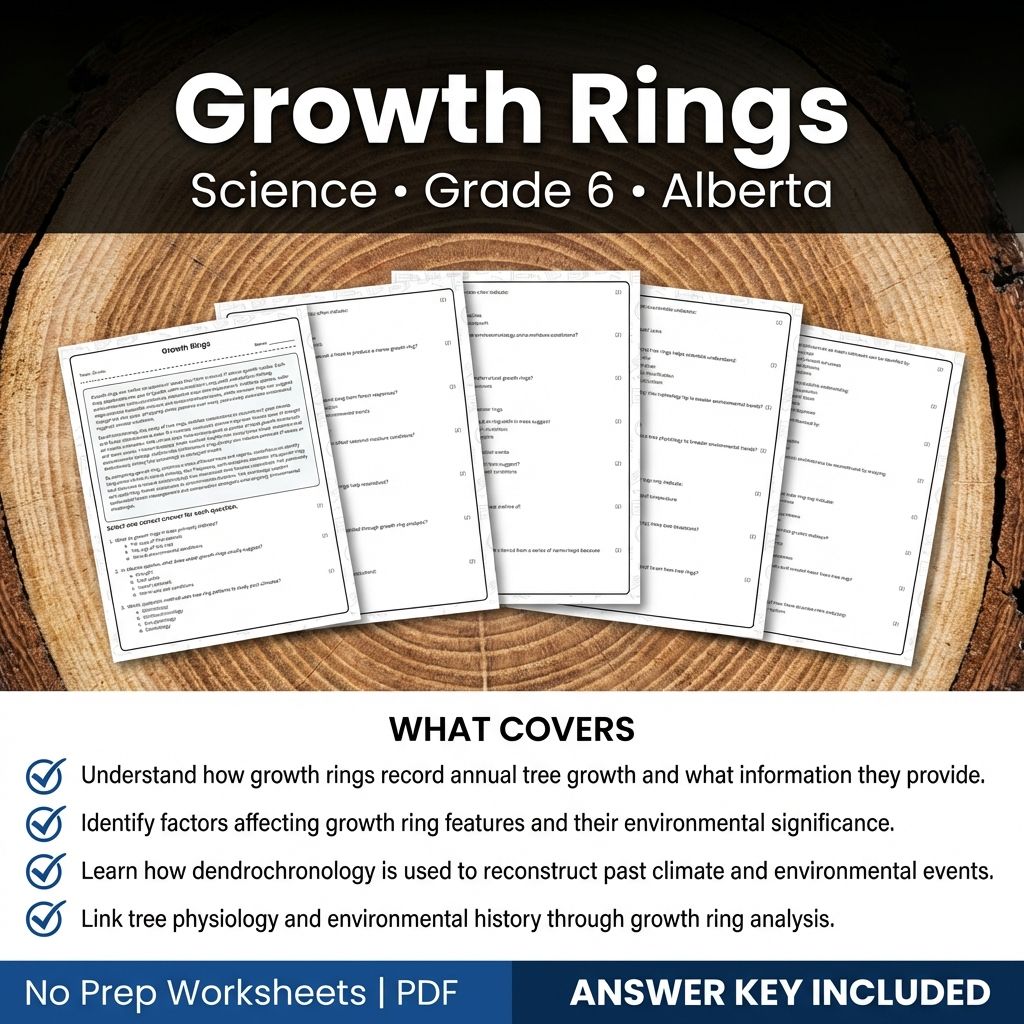
Grade 6 Science Worksheet on Growth Rings | Alberta Standards
Created byCoral Reef LearningLearning Objectives
- Understand how growth rings record annual tree growth and what information they provide.
- Identify factors affecting growth ring features and their environmental significance.
- Learn how dendrochronology is used to reconstruct past climate and environmental events.
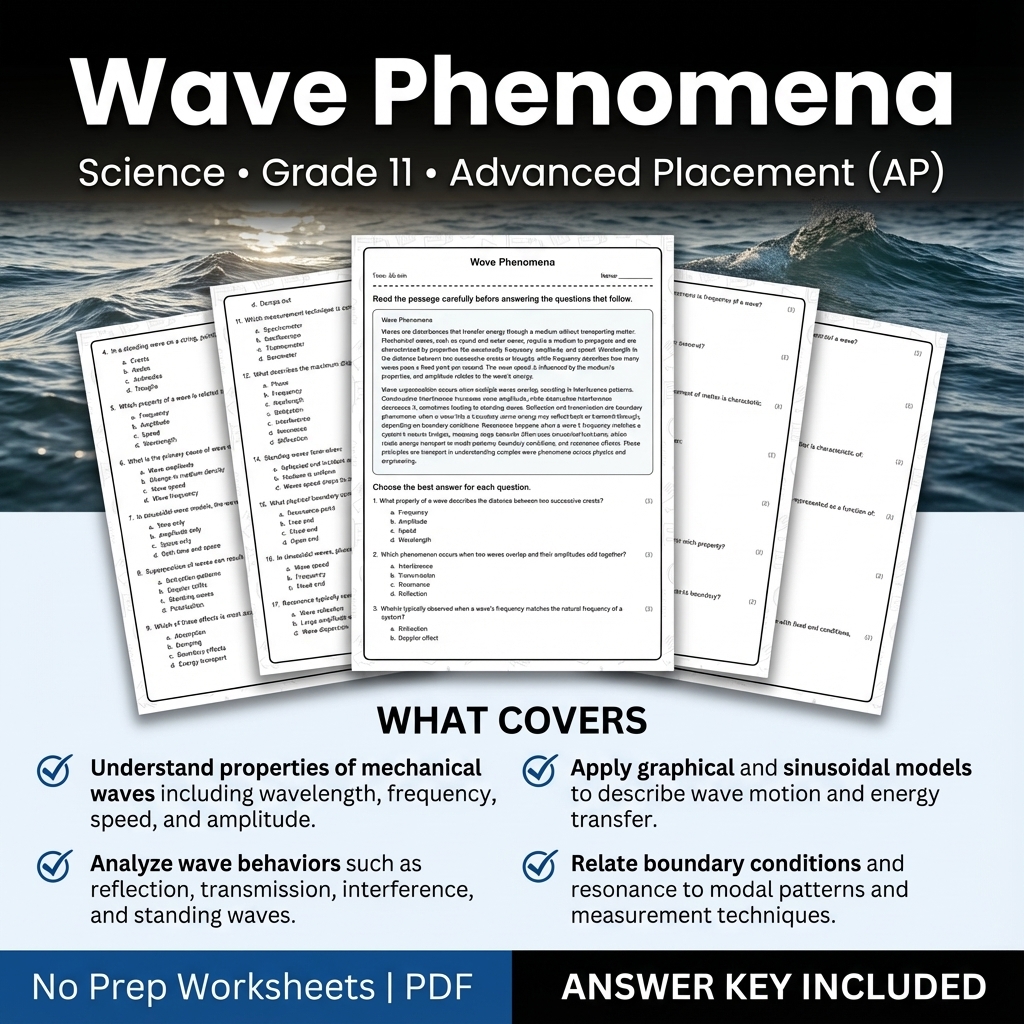
Grade 11 Science | Wave Phenomena Worksheet (Printable PDF + Answer Key)
Created byCoral Reef LearningLearning Objectives
- Understand properties of mechanical waves including wavelength, frequency, speed, and amplitude.
- Analyze wave behaviors such as reflection, transmission, interference, and standing waves.
- Apply graphical and sinusoidal models to describe wave motion and energy transfer.
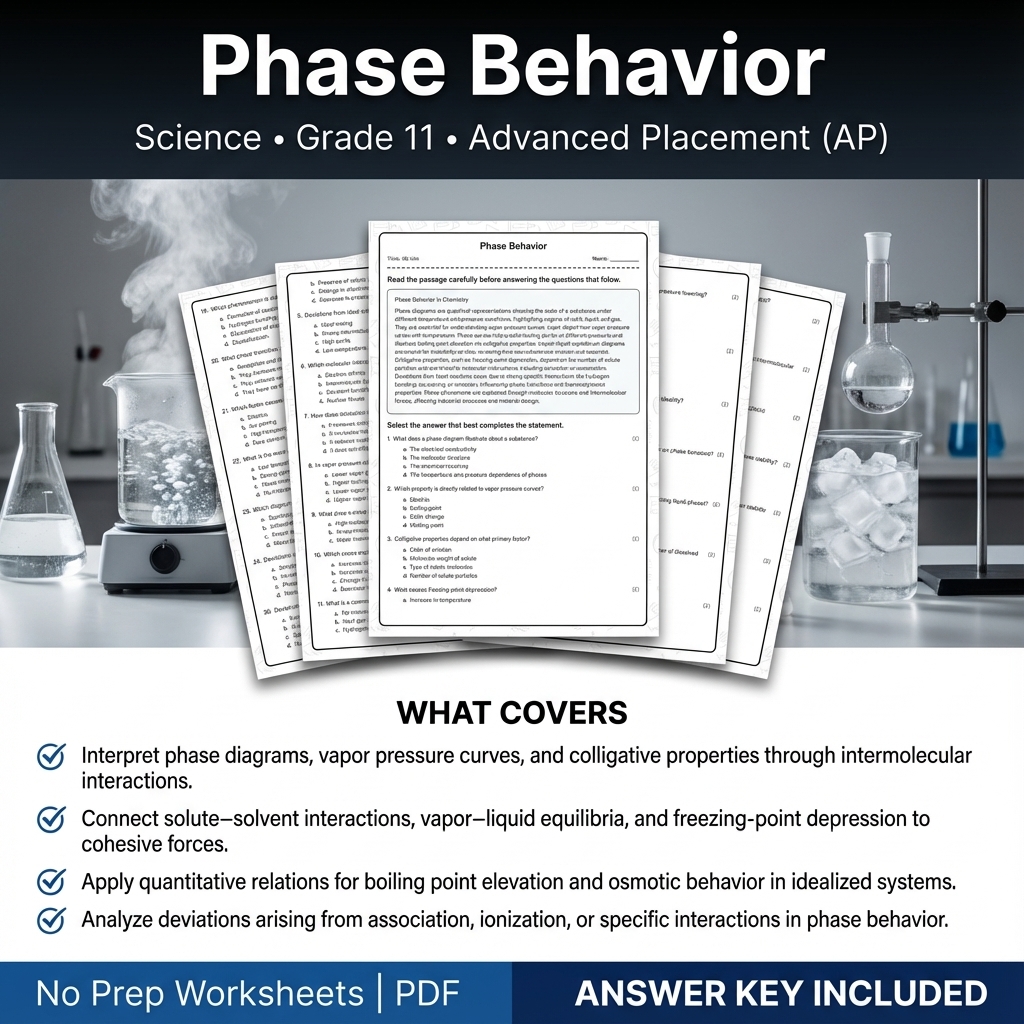
Grade 11 Science | Phase Behavior Worksheet (Printable PDF + Answer Key)
Created byCoral Reef LearningLearning Objectives
- Interpret phase diagrams, vapor pressure curves, and colligative properties through intermolecular interactions.
- Connect solute–solvent interactions, vapor–liquid equilibria, and freezing-point depression to cohesive forces.
- Apply quantitative relations for boiling point elevation and osmotic behavior in idealized systems.
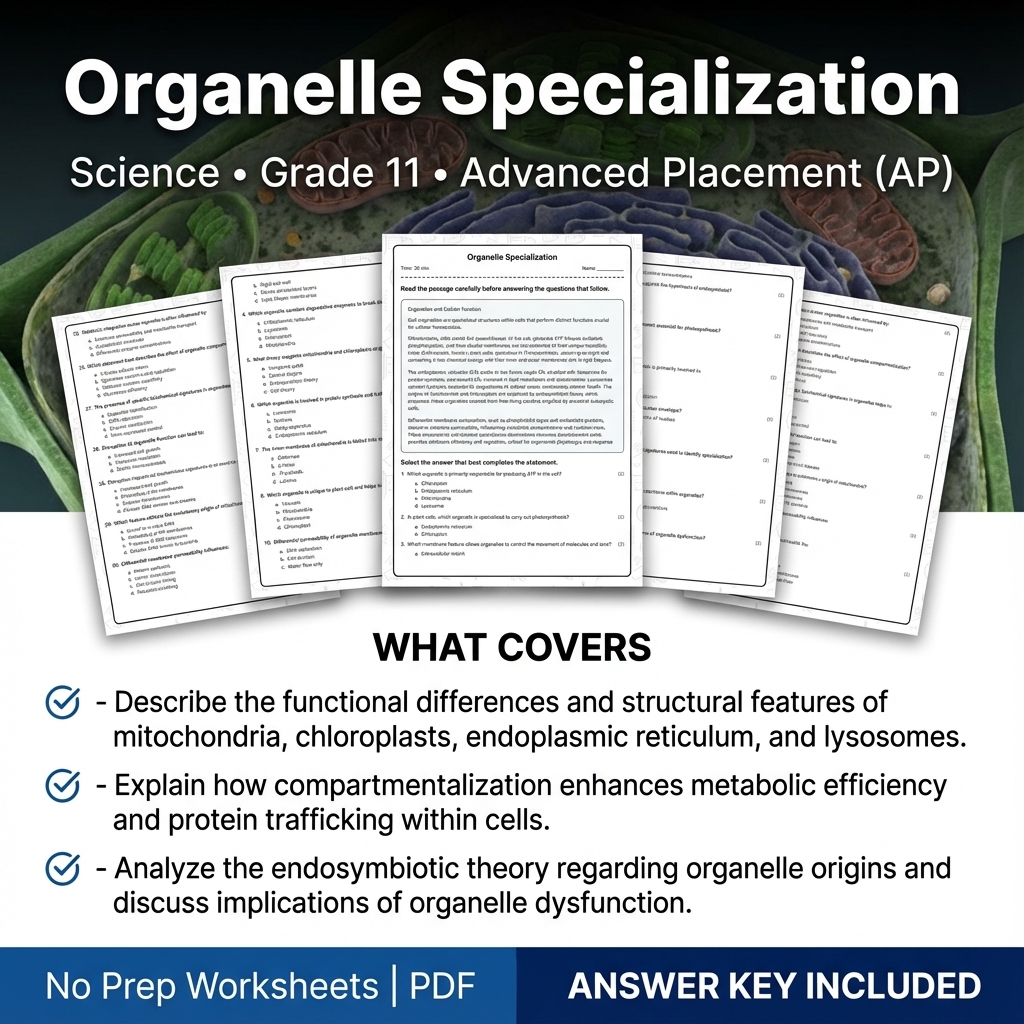
Grade 11 Science | Organelle Specialization Worksheet (Printable PDF + Answer Key)
Created byCoral Reef LearningLearning Objectives
- Describe the functional differences and structural features of mitochondria, chloroplasts, endoplasmic reticulum, and lysosomes.
- Explain how compartmentalization enhances metabolic efficiency and protein trafficking within cells.
- Analyze the endosymbiotic theory regarding organelle origins and discuss implications of organelle dysfunction.
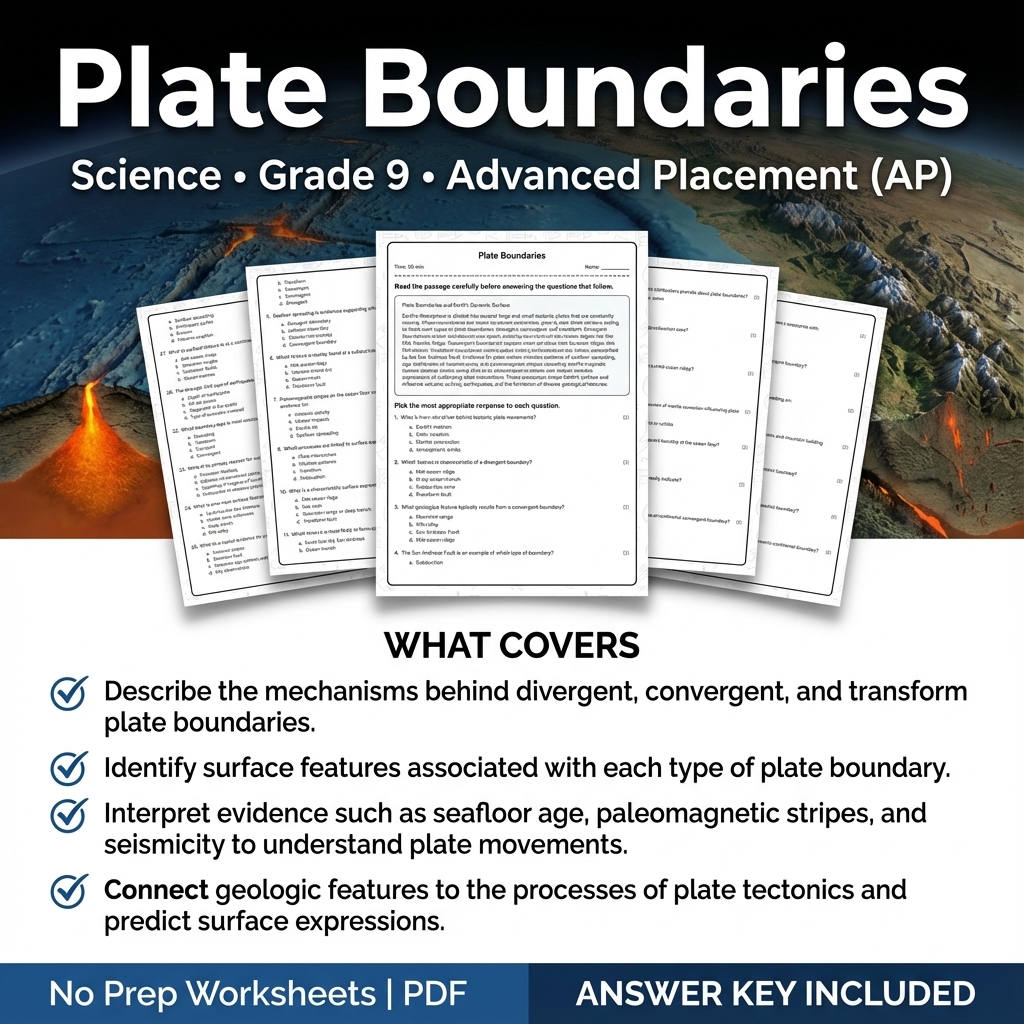
9th Grade Science | Plate Boundaries Worksheet (Printable PDF + Answer Key)
Created byCoral Reef LearningLearning Objectives
- Describe the mechanisms behind divergent, convergent, and transform plate boundaries.
- Identify surface features associated with each type of plate boundary.
- Interpret evidence such as seafloor age, paleomagnetic stripes, and seismicity to understand plate movements.
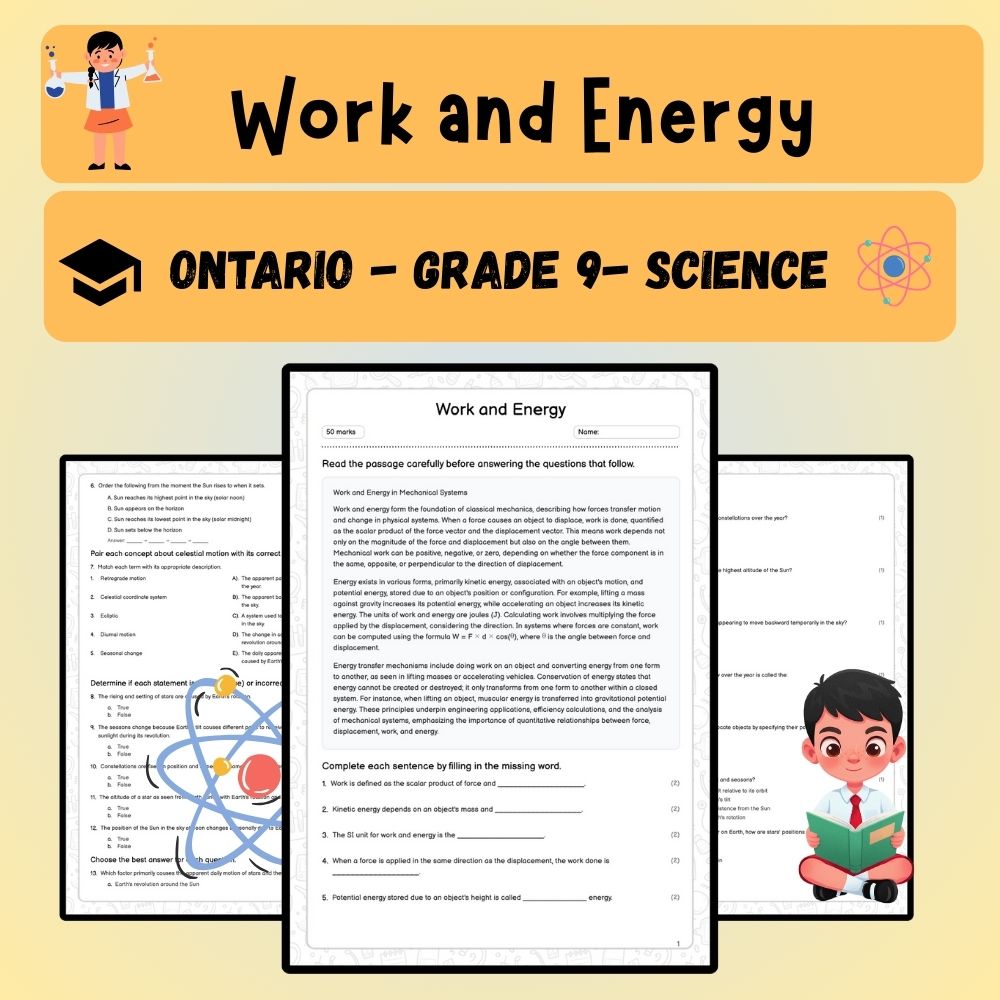
Grade 9 Science | Work and Energy Worksheet (Answer Key) – Ontario Standard
Created byPrism Point LearningLearning Objectives
- Define mechanical work as the scalar product of force and displacement.
- Identify and distinguish between kinetic and potential energy.
- Calculate work done by a constant force in different contexts.
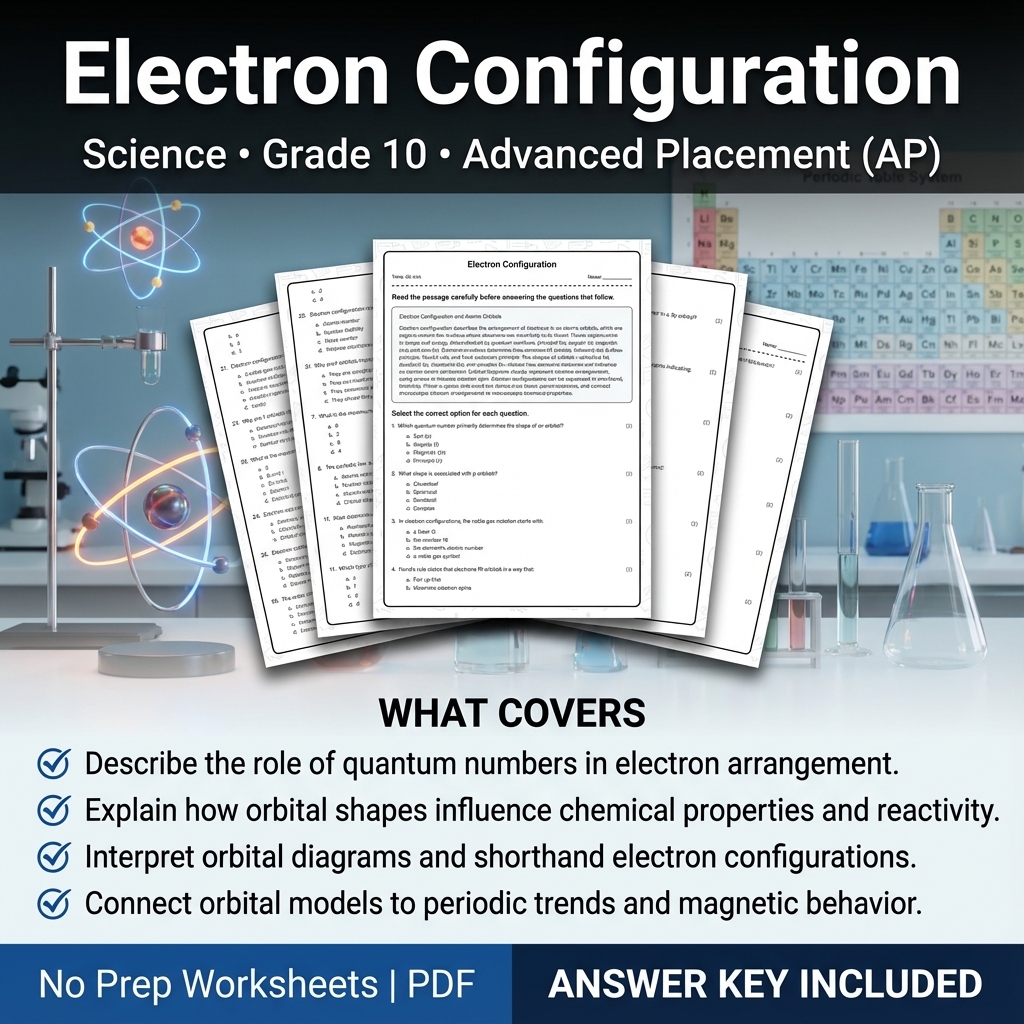
Grade 10 Science | Electron Configuration Worksheet (Printable PDF + Answer Key)
Created byCoral Reef LearningLearning Objectives
- Describe the role of quantum numbers in electron arrangement.
- Explain how orbital shapes influence chemical properties and reactivity.
- Interpret orbital diagrams and shorthand electron configurations.
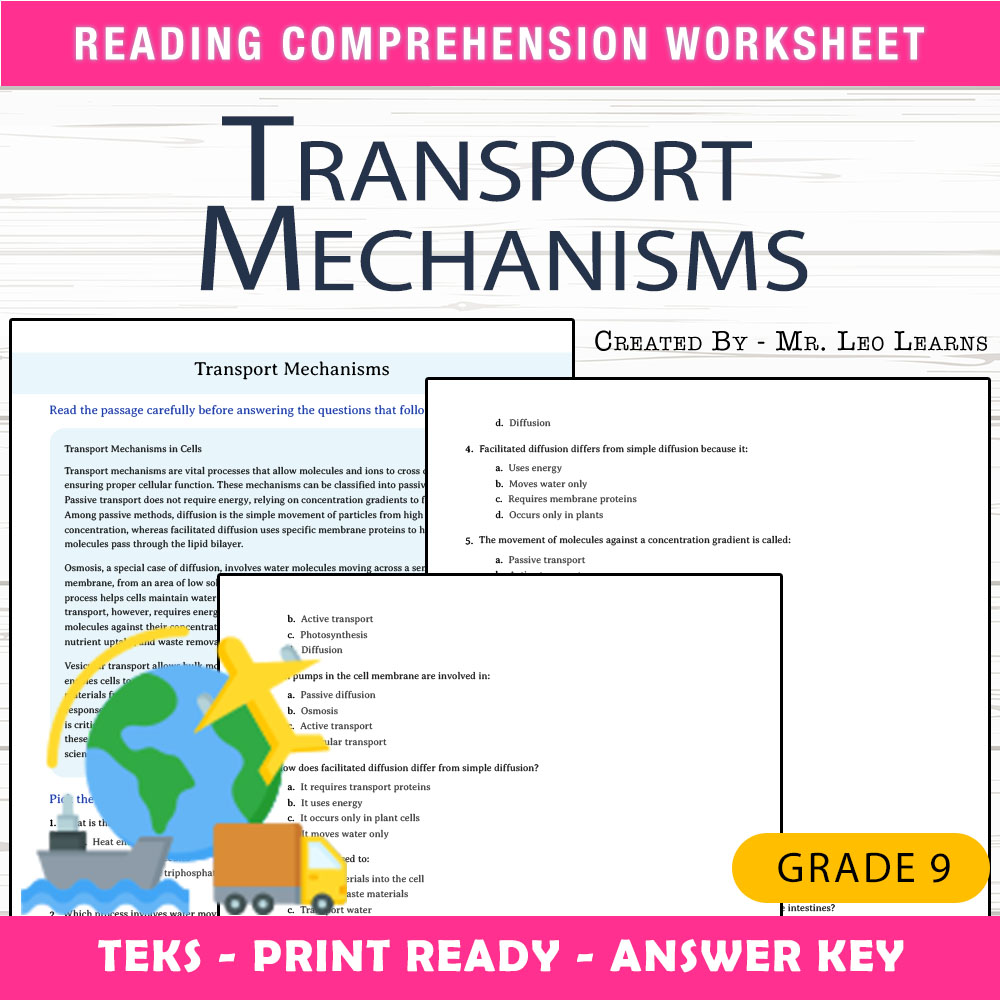
Grade 9 Science — Transport Mechanisms Worksheet for Mastery | PDF + Answer Key
 Created byThe Resource Hub
Learning Objectives
- Describe how molecules move across cell membranes through passive processes like diffusion and osmosis.
- Explain the role of membrane proteins and ATP in active transport.
- Differentiate between vesicular transport, including endocytosis and exocytosis.
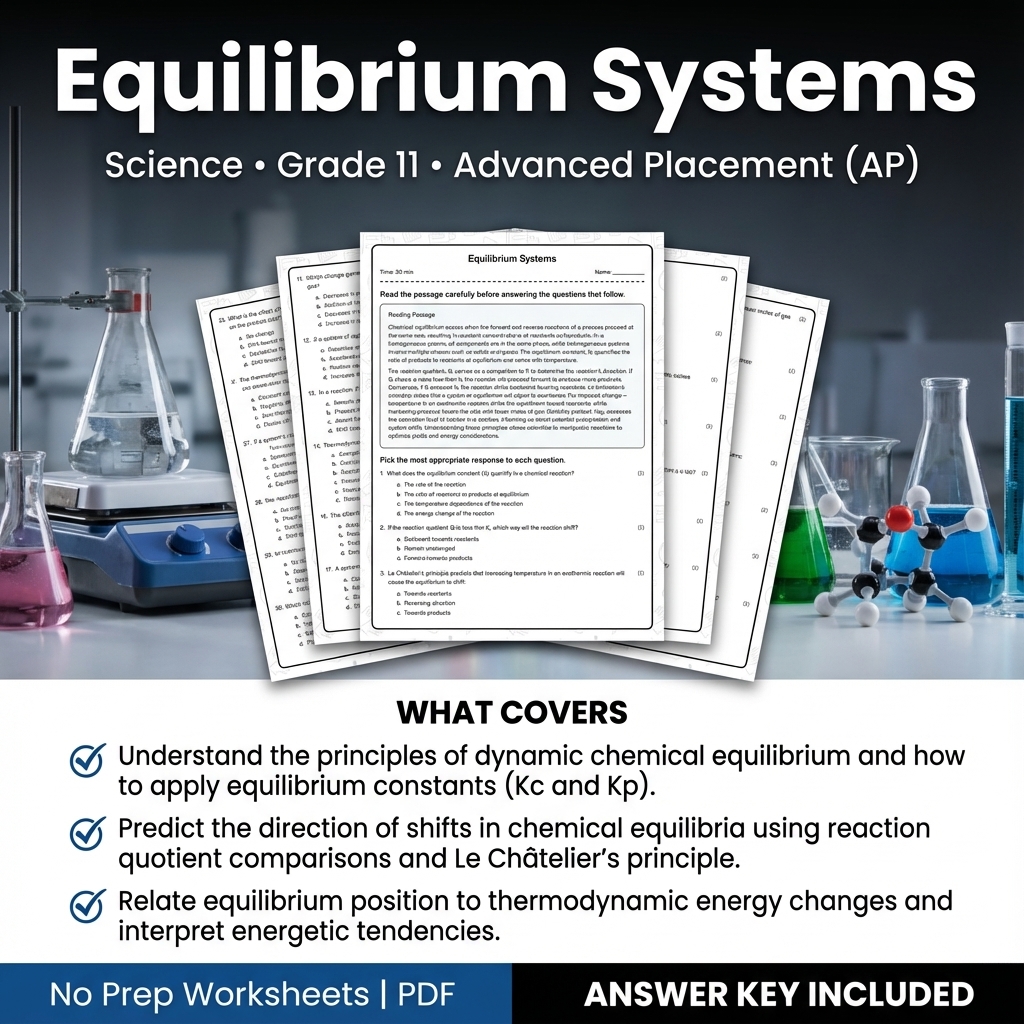
11th Grade Science | Equilibrium Systems Worksheet (Printable PDF + Answer Key)
Created byCoral Reef LearningLearning Objectives
- Understand the principles of dynamic chemical equilibrium and how to apply equilibrium constants (Kc and Kp).
- Predict the direction of shifts in chemical equilibria using reaction quotient comparisons and Le Châtelier’s principle.
- Relate equilibrium position to thermodynamic energy changes and interpret energetic tendencies.
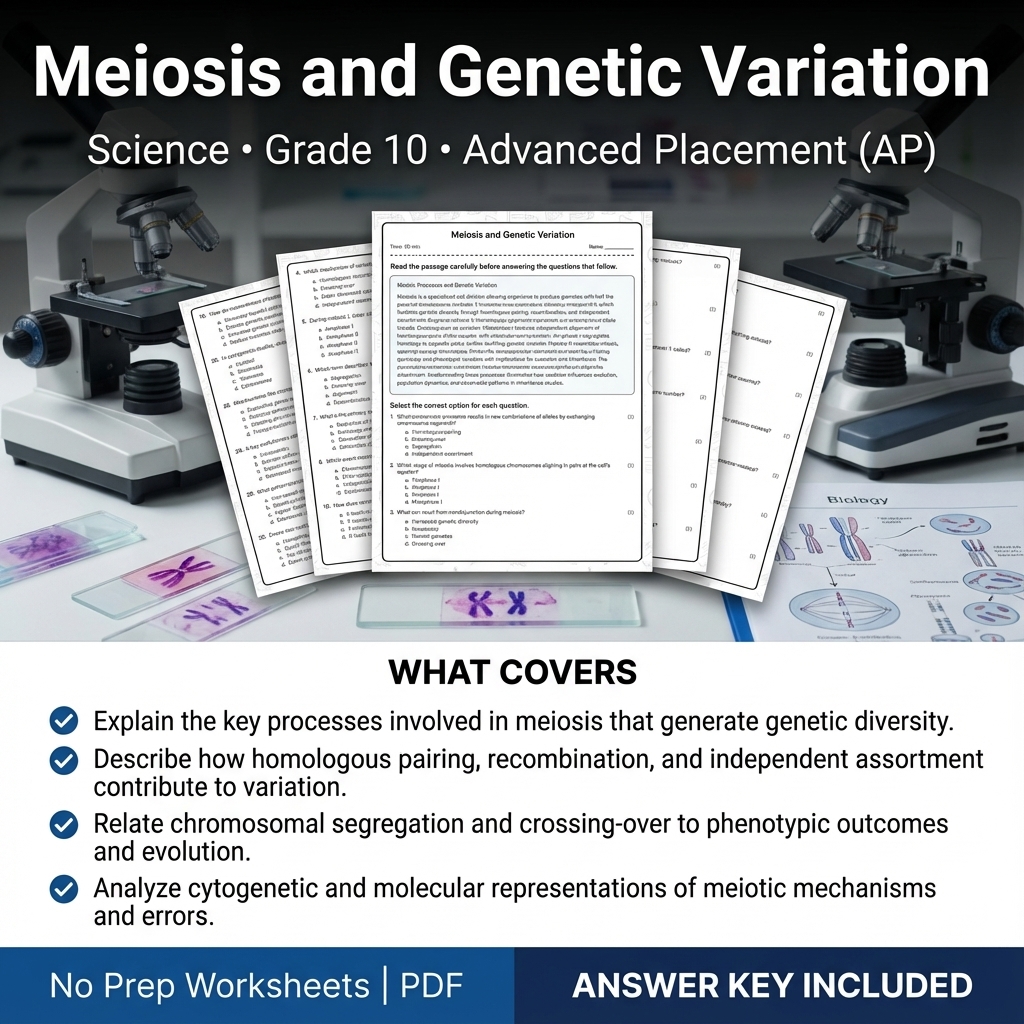
Grade 10 Science | Meiosis and Genetic Variation Worksheet (Printable PDF + Answer Key)
Created byCoral Reef LearningLearning Objectives
- Explain the key processes involved in meiosis that generate genetic diversity.
- Describe how homologous pairing, recombination, and independent assortment contribute to variation.
- Relate chromosomal segregation and crossing-over to phenotypic outcomes and evolution.
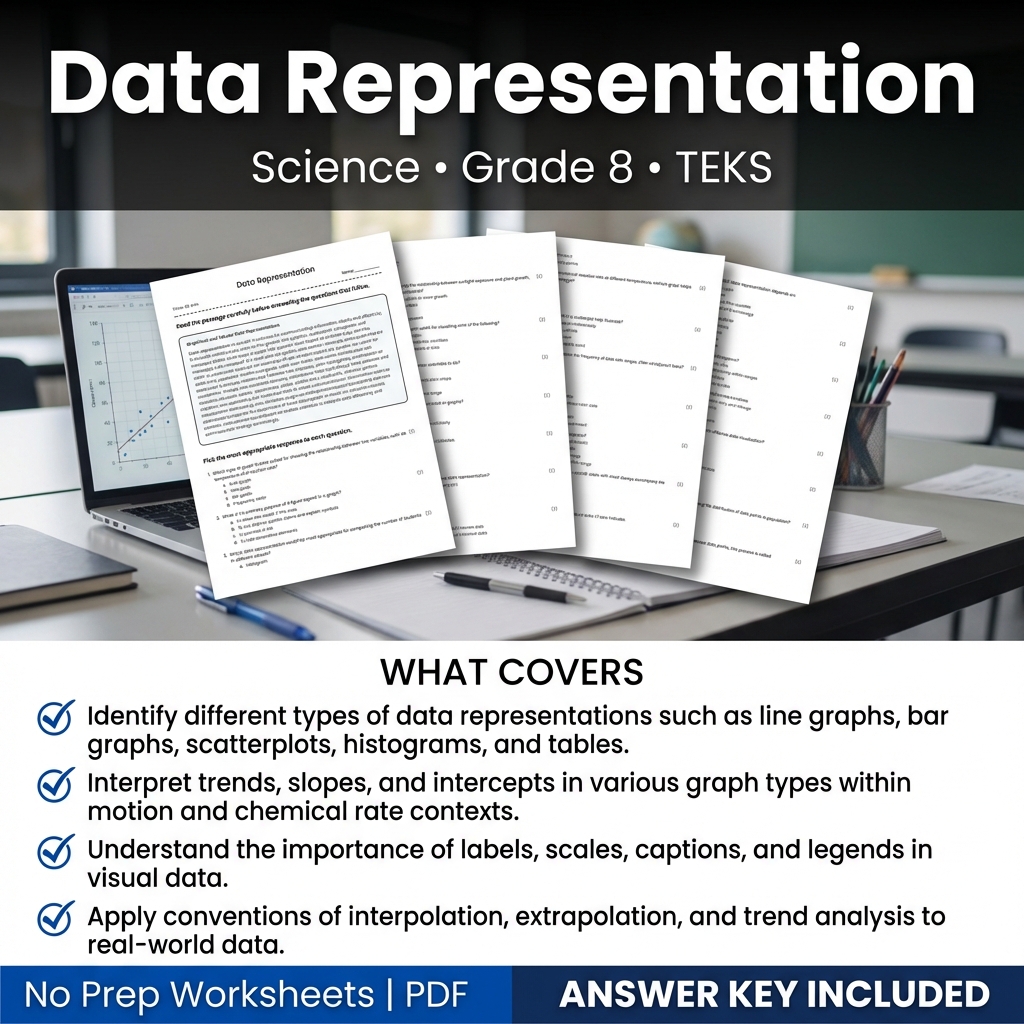
Data Representation Worksheet for Grade 8 Science TEKS Practice PDF
Created byCoral Reef LearningLearning Objectives
- Identify different types of data representations such as line graphs, bar graphs, scatterplots, histograms, and tables.
- Interpret trends, slopes, and intercepts in various graph types within motion and chemical rate contexts.
- Understand the importance of labels, scales, captions, and legends in visual data.
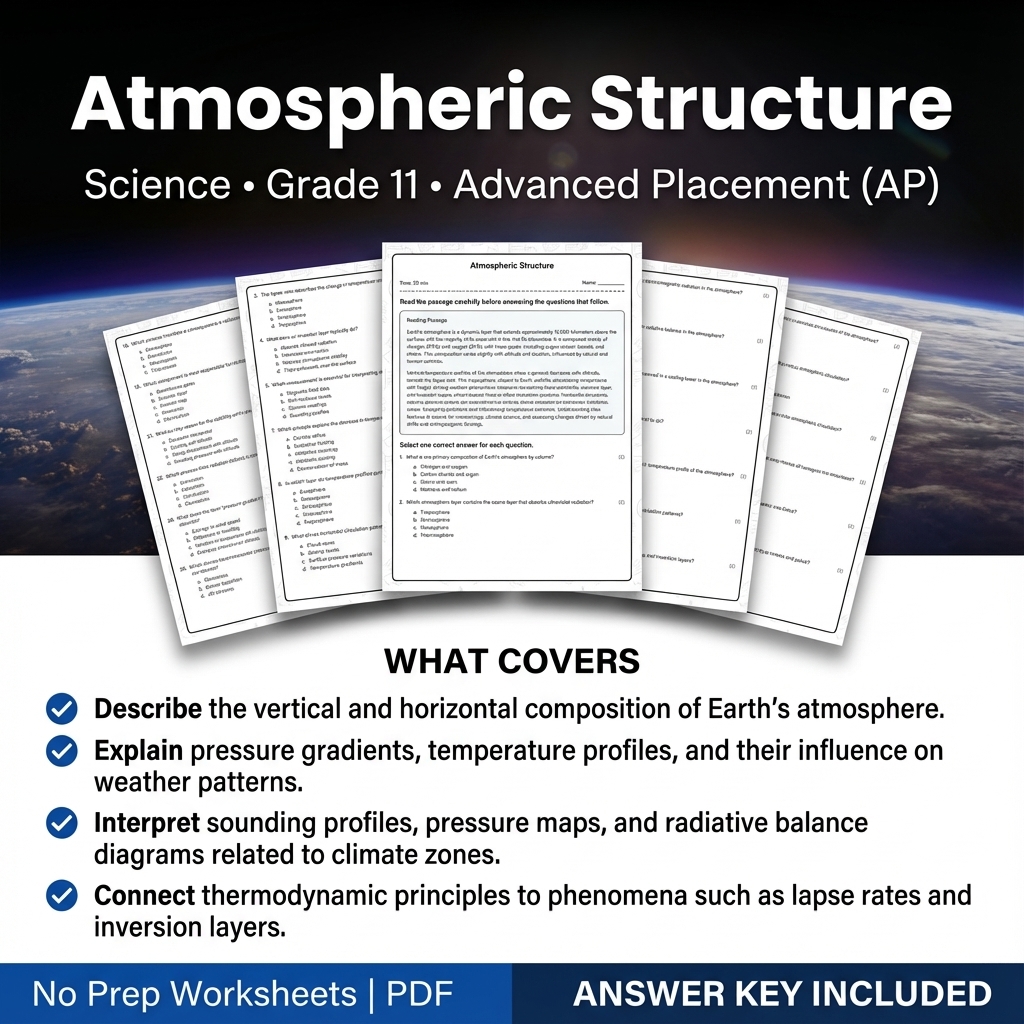
11th Grade Science | Atmospheric Structure Worksheet (Printable PDF + Answer Key)
Created byCoral Reef LearningLearning Objectives
- Describe the vertical and horizontal composition of Earth's atmosphere.
- Explain pressure gradients, temperature profiles, and their influence on weather patterns.
- Interpret sounding profiles, pressure maps, and radiative balance diagrams related to climate zones.
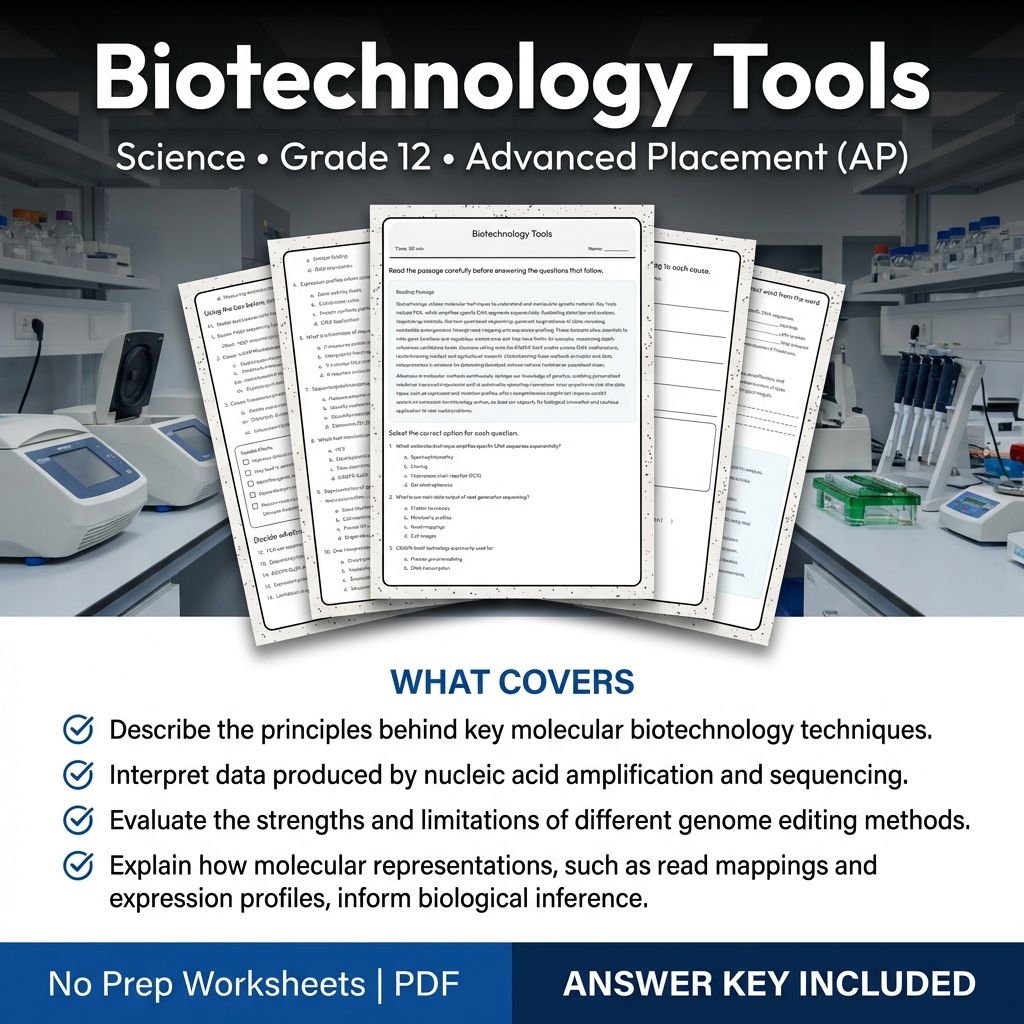
12th Grade Science | Biotechnology Tools Worksheet & Answer Key (Printable PDF)
Created byCoral Reef LearningLearning Objectives
- Describe the principles behind key molecular biotechnology techniques.
- Interpret data produced by nucleic acid amplification and sequencing.
- Evaluate the strengths and limitations of different genome editing methods.
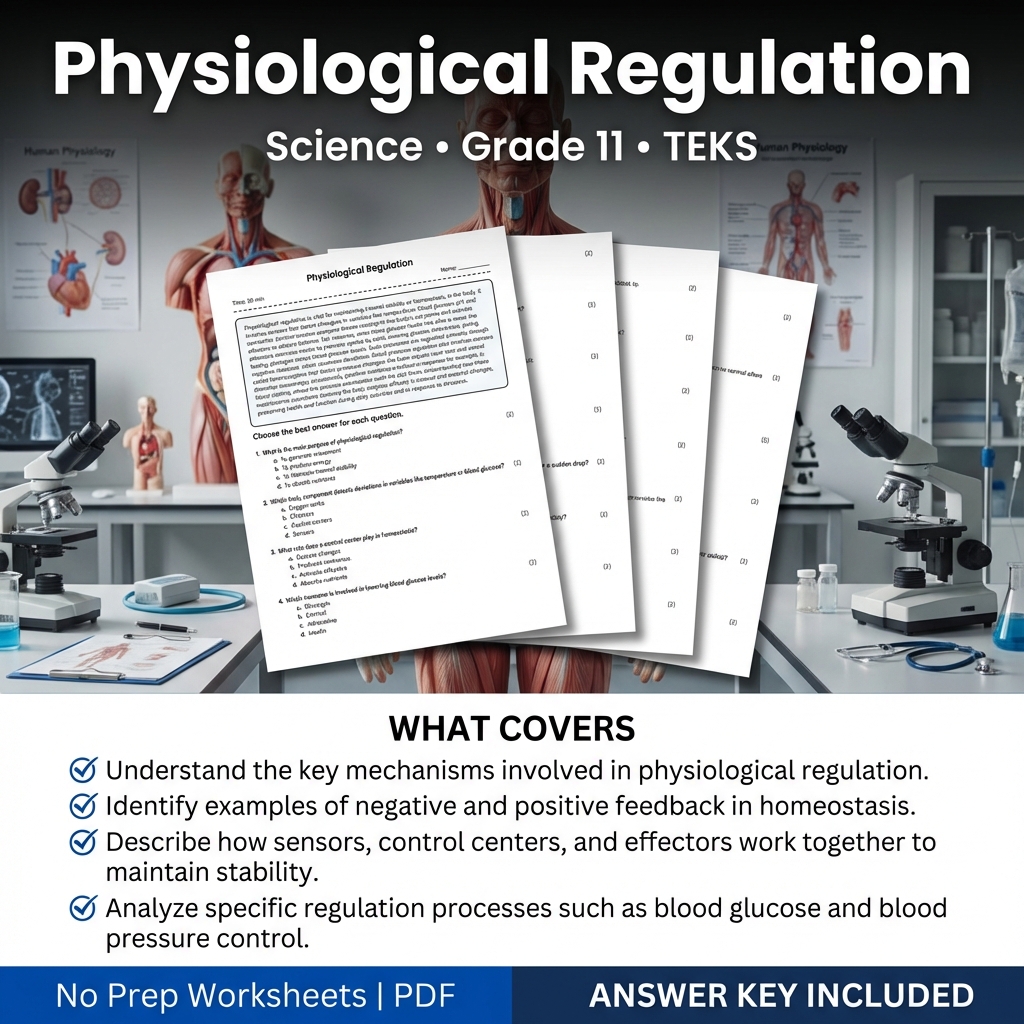
Physiological Regulation Worksheet for Grade 11 Science TEKS Standards
Created byCoral Reef LearningLearning Objectives
- Understand the key mechanisms involved in physiological regulation.
- Identify examples of negative and positive feedback in homeostasis.
- Describe how sensors, control centers, and effectors work together to maintain stability.
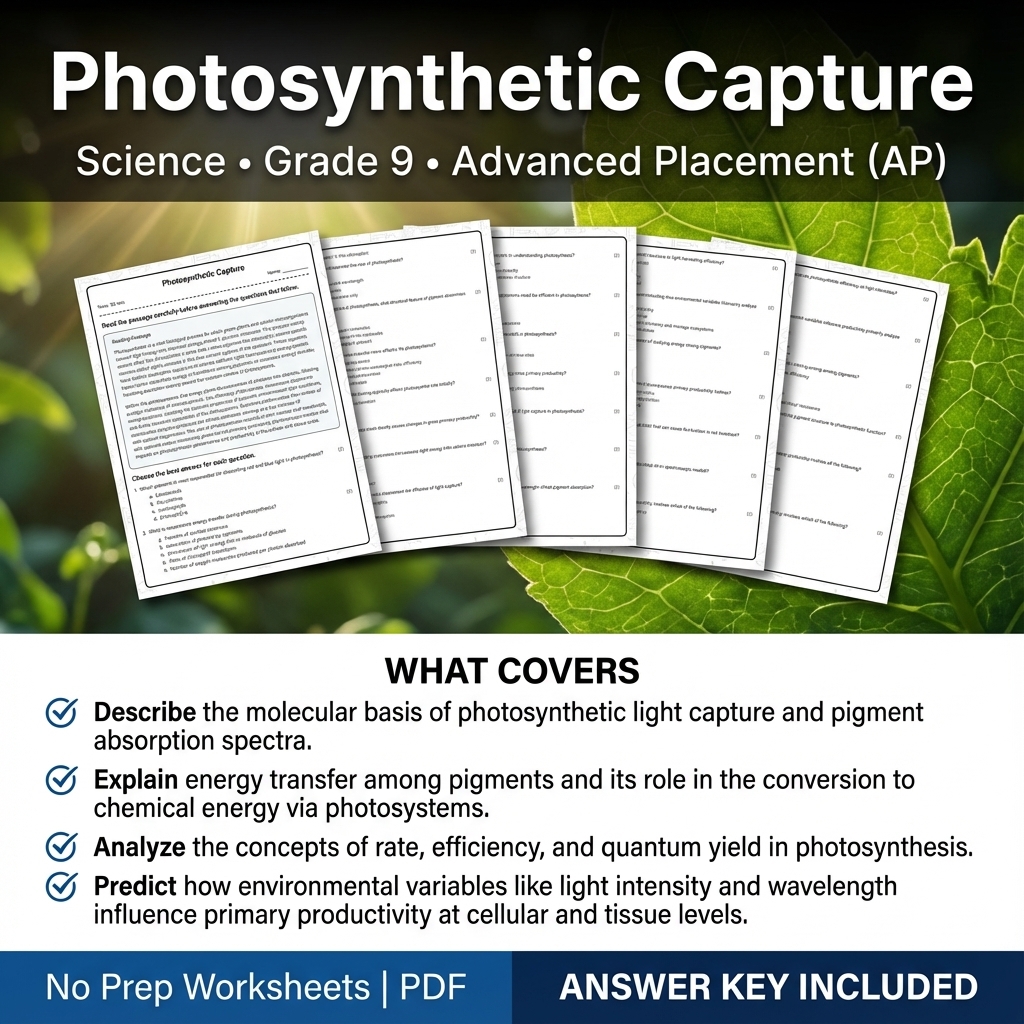
9th Grade Science | Photosynthesis Worksheet (Printable PDF + Answer Key)
Created byCoral Reef LearningLearning Objectives
- Describe the molecular basis of photosynthetic light capture and pigment absorption spectra.
- Explain energy transfer among pigments and its role in the conversion to chemical energy via photosystems.
- Analyze the concepts of rate, efficiency, and quantum yield in photosynthesis.
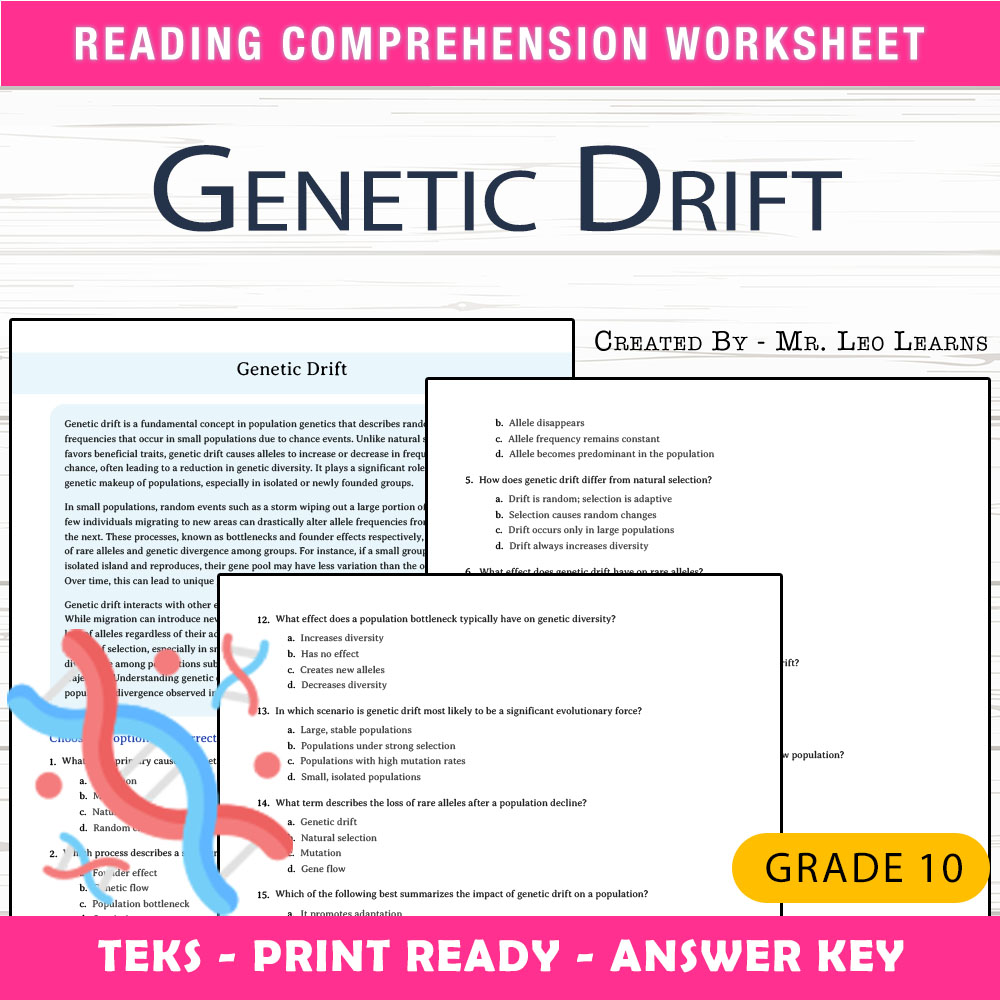
Grade 10 Science — Genetic Drift Worksheet for Mastery | PDF + Answer Key
Created byThe Resource HubLearning Objectives
- Explain the concept of genetic drift and its effects on small populations.
- Differentiate between genetic drift and natural selection.
- Describe processes such as founder effects and population bottlenecks that influence genetic variation.
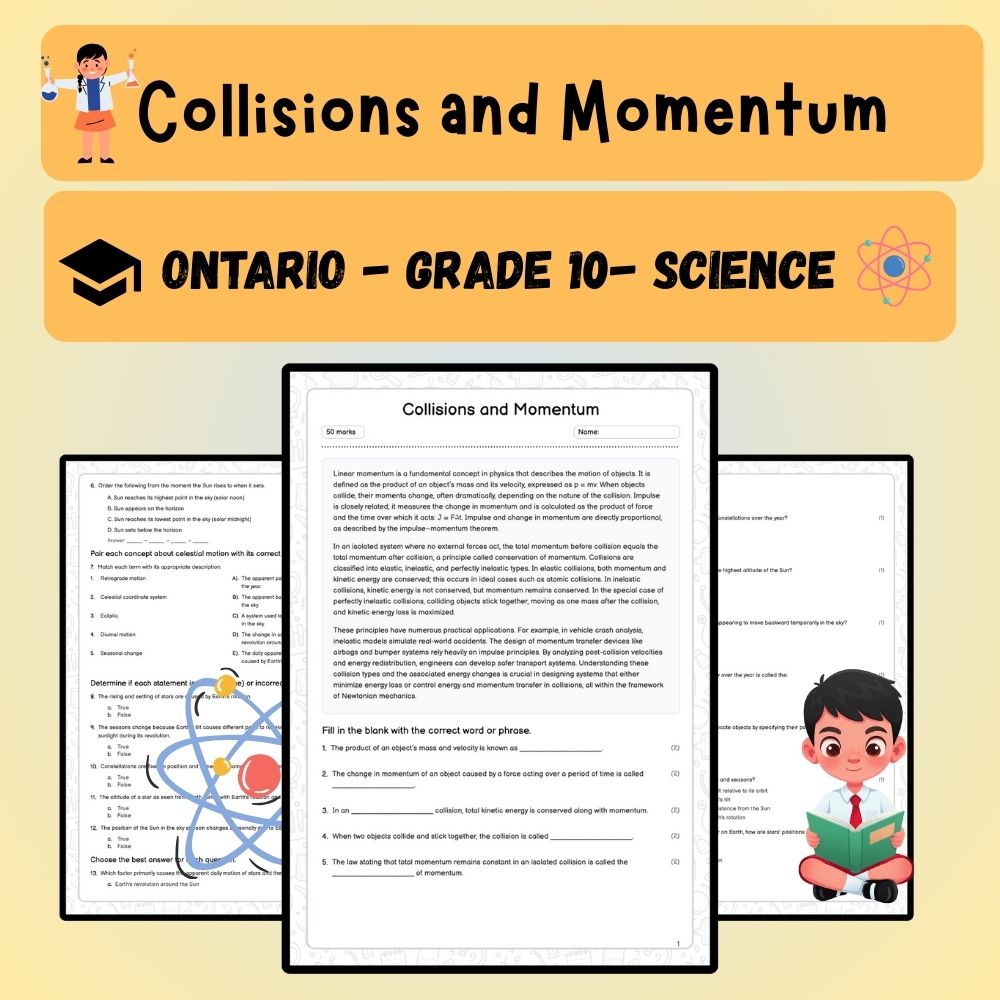
Grade 10 Science | Collisions and Momentum Worksheet (PDF) – Ontario Standards
Created byPrism Point LearningLearning Objectives
- Define and relate linear momentum and impulse to changes in motion
- Explain the conservation of momentum in various types of collisions
- Analyse energy redistribution and energy considerations in elastic, inelastic, and perfectly inelastic collisions
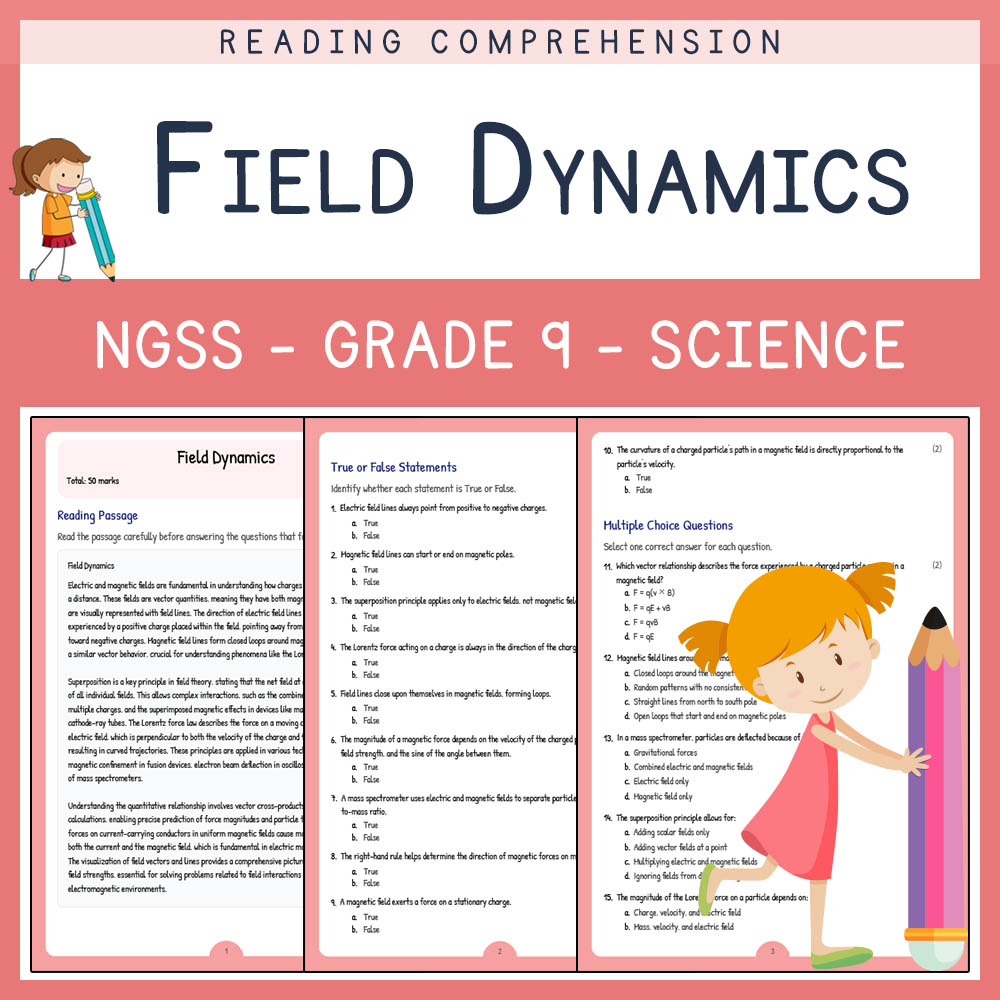
Grade 9 Science | Field Dynamics Worksheet & Answer Key (NGSS-Aligned)
Created byLumora LearningLearning Objectives
- Describe the vector nature of electric and magnetic fields and how they interact with charges.
- Explain the concept of superposition in electric and magnetic fields.
- Apply the principles of Lorentz force to predict particle motion in combined electric and magnetic fields.
Browse more categories
About Science Worksheets
Find Science worksheets spanning core skills, practice, and review. All 42,859 resources are instant PDF downloads for the classroom or home.
Every worksheet on MyTeachingSheets is created by independent teacher-authors and reviewed before publication. All resources download as printable PDFs for classroom, homework, or at-home practice, and many include answer keys. Preview any worksheet free before buying.