
Grade 11 Science Worksheets
6,616 worksheets
Grade 11 Science | Reaction Energetics Worksheet | AP Aligned
 Created byLumora Learning
Learning Objectives
- Understand enthalpy changes and calorimetric reasoning in chemical reactions.
- Explain Hess’s law and how energy steps combine to determine overall reaction heat.
- Relate bond enthalpies and formation energies to reaction enthalpy and stability.
Also included in: Grade 11 Science | Chemistry Foundations Custom Bundle | AP-Aligned
Instant download
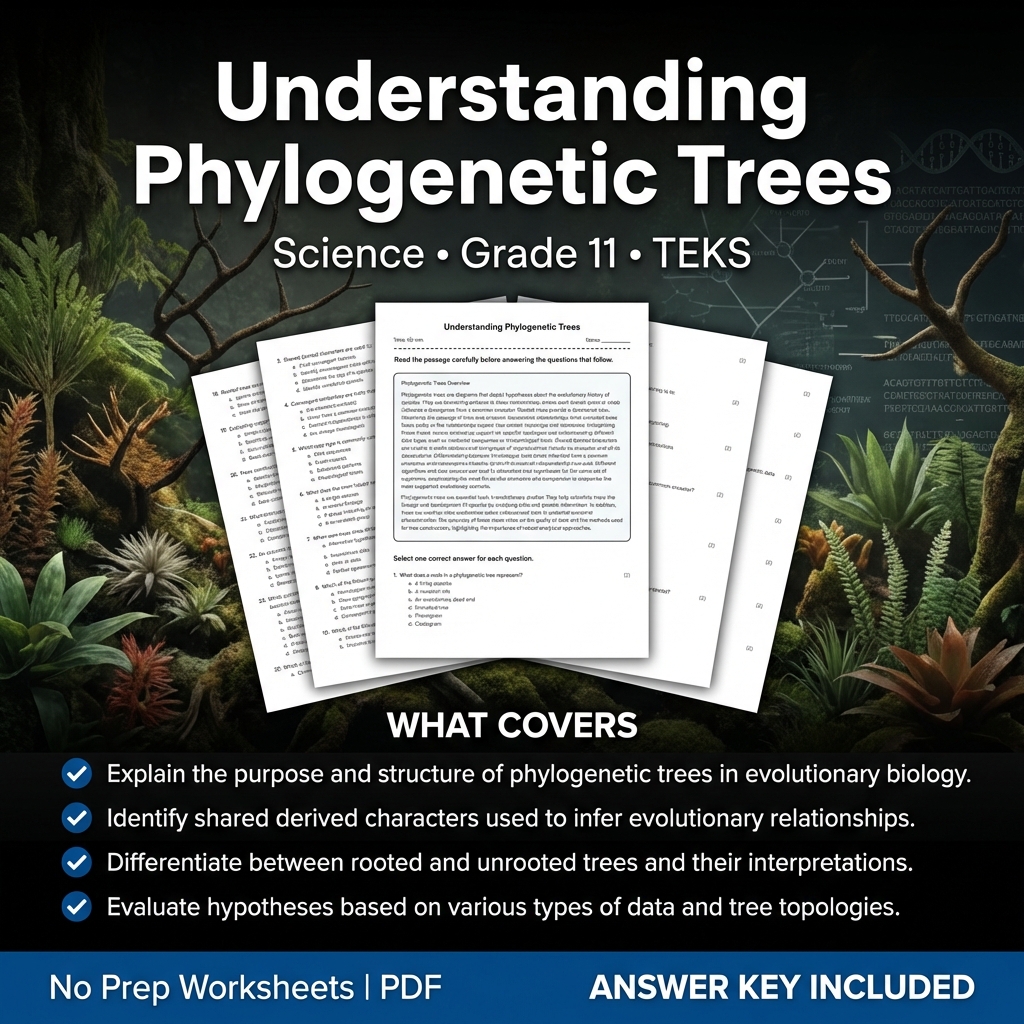
Grade 11 Science Worksheet on Phylogenetic Trees | TEKS Standards
 Created byCoral Reef Learning
Learning Objectives
- Explain the purpose and structure of phylogenetic trees in evolutionary biology.
- Identify shared derived characters used to infer evolutionary relationships.
- Differentiate between rooted and unrooted trees and their interpretations.
Instant download
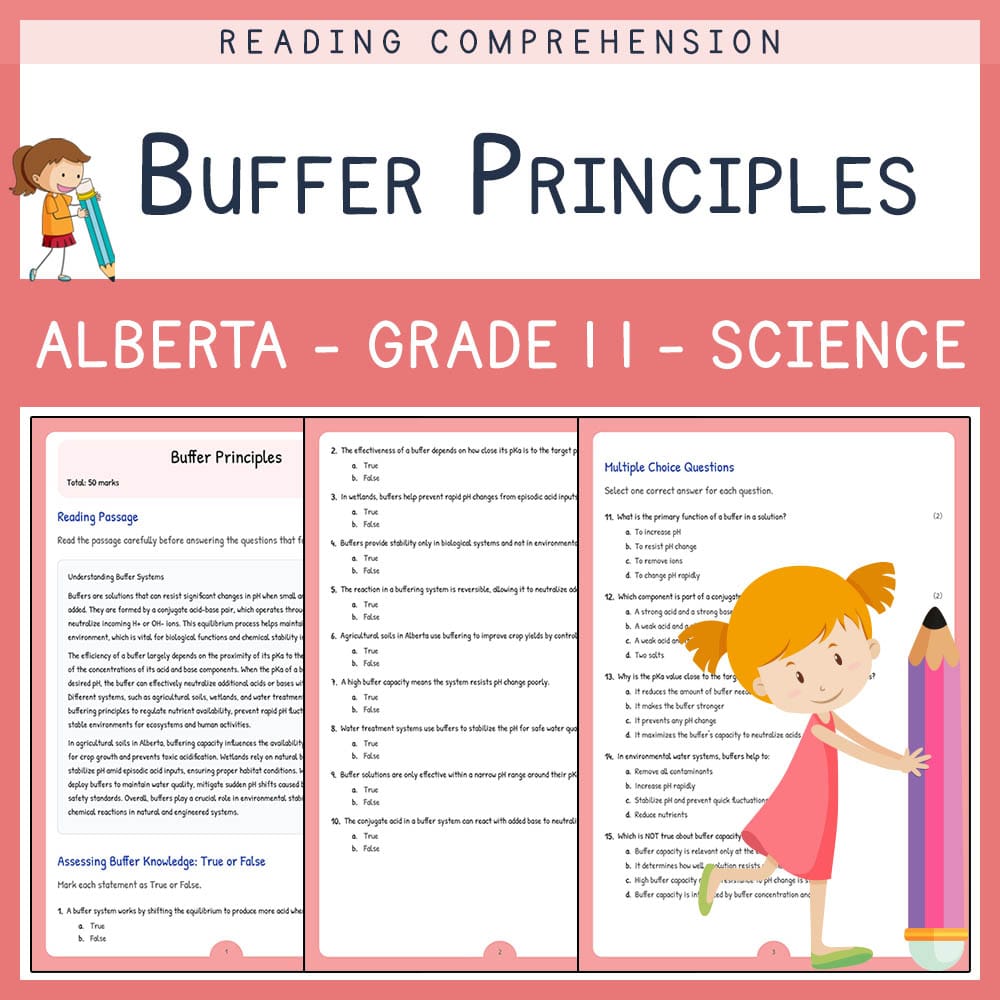
Grade 11 Science | Buffer Principles Worksheet | Alberta Standards
Created byLumora LearningLearning Objectives
- Understand the concept of buffers and their role in resisting pH changes.
- Identify how conjugate acid-base pairs function in buffering systems.
- Explain the significance of pKa proximity to target pH in buffer effectiveness.
Instant download
Grade 11 Science | Biogeochemical Cycles Worksheet (PDF) – TEKS Aligned
 Created byBright Mind Resources
Learning Objectives
- Explain the movement of key elements such as carbon, nitrogen, and phosphorus in Earth's biogeochemical cycles.
- Identify the processes involved in each biogeochemical cycle and their significance for ecosystems.
- Analyze how human activities influence these cycles and ecosystem responses.
Also included in: Grade 11 Science - Ecosystem & Biogeochemical Cycles Unit Worksheet Pack - TEKS +2 more
Instant download
Grade 11 Science | Carrying Capacity Limits Worksheet (PDF) with TEKS Alignment
Created byBright Mind ResourcesLearning Objectives
- Understand the concept of carrying capacity and factors that influence it.
- Identify environmental and human impacts that affect population sustainability.
- Analyze ecological models of density-dependent and density-independent effects.
Also included in: Grade 11 Science - Ecosystem & Biogeochemical Cycles Unit Worksheet Pack - TEKS +2 more
Instant download
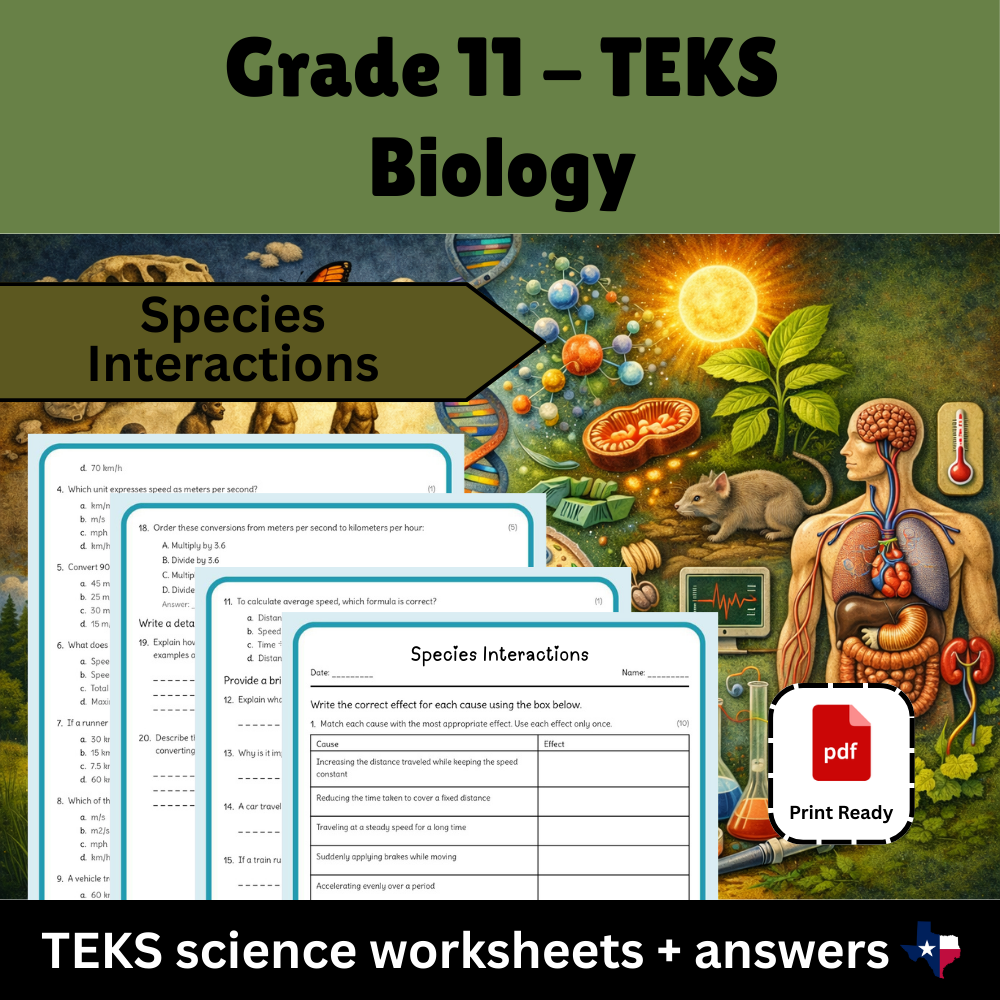
Grade 11 Science – Species Interactions Worksheet (Worksheet + Answer Key) | TEKS Aligned
Created byBright Mind ResourcesLearning Objectives
- Describe different types of species interactions, including competition, predation, mutualism, and parasitism.
- Explain how biotic and abiotic factors influence species interactions and community structure.
- Identify examples of trophic interactions and their effects on ecosystems.
Also included in: Grade 11 Science - Ecosystem & Biogeochemical Cycles Unit Worksheet Pack - TEKS +2 more
Instant download
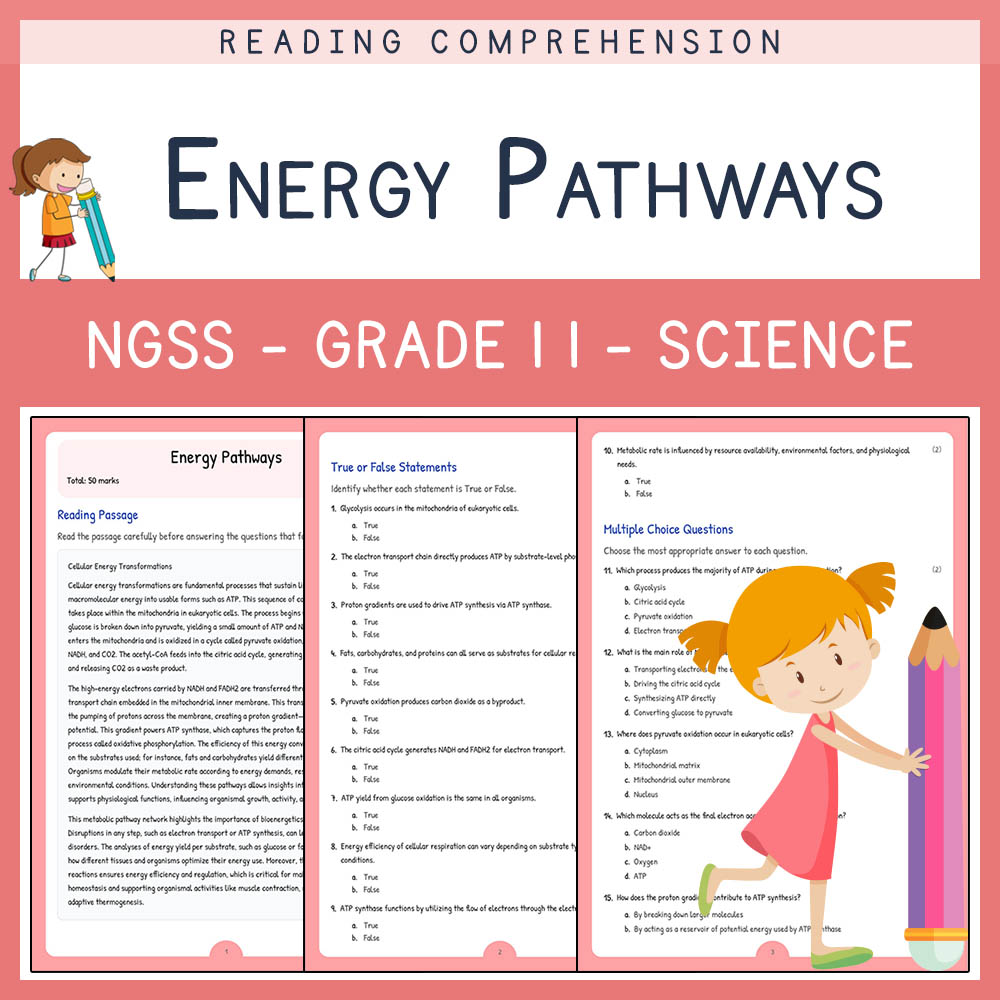
Grade 11 Science | Energy Pathways Worksheet (Answer Key) Aligned with NGSS
Created byLumora LearningLearning Objectives
- Describe the key stages of cellular energy metabolism, including glycolysis, pyruvate oxidation, the citric acid cycle, and oxidative phosphorylation.
- Explain how electron transport chains and proton gradients are involved in cellular respiration.
- Quantify energy yield from different substrates and relate this to organismal metabolic rates.
Instant download

Trophic Energy Transfer Worksheet | Grade 11 Ecology Energy Flow Activity
 Created byPrism Point Learning
Learning Objectives
- Explain how energy moves through trophic levels using the ideas of producers, consumers, and energy loss.
- Use a trophic energy model to predict why higher trophic levels typically have less available energy.
- Describe how respiration and heat loss reduce the fraction of energy available for growth and reproduction.
Instant download

Buffer Principles Worksheet Grade 11 Chemistry Alberta PDF + Answer Key
 Created byEvergreen Desk Education
Learning Objectives
- Explain how buffers resist pH change using a conjugate acid-base pair.
- Predict how pKa proximity to target pH affects a buffer’s effective range.
- Determine how the relative amounts of weak acid and conjugate base influence buffer strength and pH behavior.
Instant download

Grade 11 Science | Solution Stoichiometry - Daily Reading Comprehension
Created byCoral Reef LearningLearning Objectives
- Understand key concepts related to Science
- Apply knowledge through practice questions
- Demonstrate comprehension of the material
Also included in: Solutions and Solubility Lesson Bundle – Grade 11 Science Alberta +1 more
Instant download

Predictive Models Worksheet Grade 11 Science Activity & Critical Thinking
Created byPrism Point LearningLearning Objectives
- Explain how scientific models use simplified structures, diagrams, and equations to predict outcomes
- Translate between variables and apply assumptions to generate testable predictions
- Evaluate whether model predictions follow patterns and match real observations
Instant download

Cosmic Timescales Practice Assessment | Grade 11 Science NGSS
Created byPrism Point LearningLearning Objectives
- Explain how redshift and Hubble’s law connect observations to the expansion history of the universe.
- Describe how the cosmic microwave background and primordial element abundances constrain cosmic age and early conditions.
- Connect radiometric dating of meteorites to the age of the solar system.
Also included in: Grade 11 Orbital Mechanics & Timescales Science Lesson Bundle NGSS
Instant download
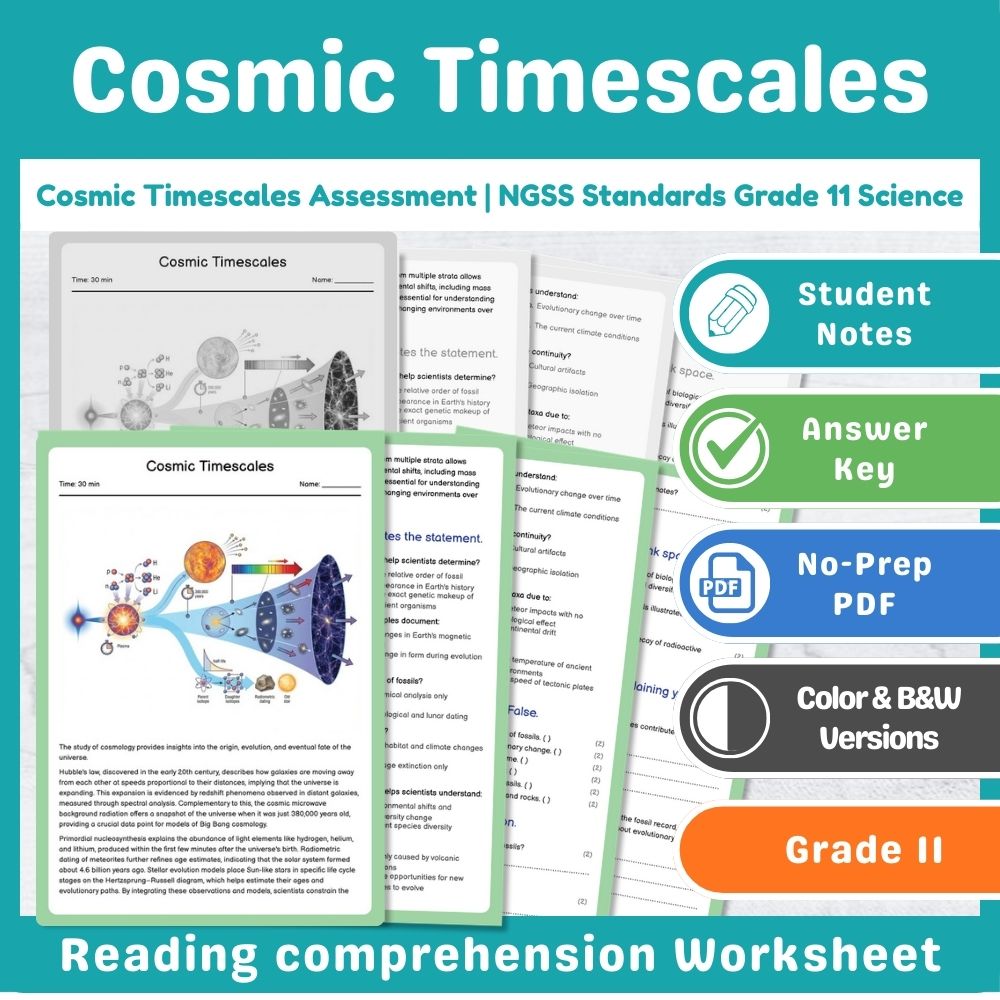
Cosmic Timescales Assessment | NGSS Standards Grade 11 Science
Created byPrism Point LearningLearning Objectives
- Understand how astronomical evidence constrains the age and evolution of the universe and solar system.
- Explain Hubble's law, galactic redshift, and cosmic microwave background measurements.
- Describe the role of primordial light elements and radiometric dating in determining cosmic ages.
Also included in: Grade 11 Science Mini Bundle | Cosmic/Orbital Mechanics Assessment NGSS
Instant download

Grade 11 NGSS Predictive Models Science Daily Reading Worksheet Activity
 Created byBRIGHT PATH RESOURCES
Learning Objectives
- Explain the purpose of a predictive model in science.
- Distinguish inputs from outputs in a model.
- Identify how validation and uncertainty affect confidence in projections.
Also included in: Earth and Human Activity Grade 11 Science Daily Reading Worksheets Bundle | NGSS +1 more
Instant download

Grade 11 Science | Balancing Reactions Worksheet | BC Aligned
Created byLumora LearningLearning Objectives
- Understand the principles of conservation of mass and atoms in chemical reactions
- Learn how to balance chemical equations correctly
- Identify and apply mole ratios in stoichiometric calculations
Also included in: Grade 11 Science | Chemistry Lesson Bundle Worksheet | BC-Aligned
Instant download
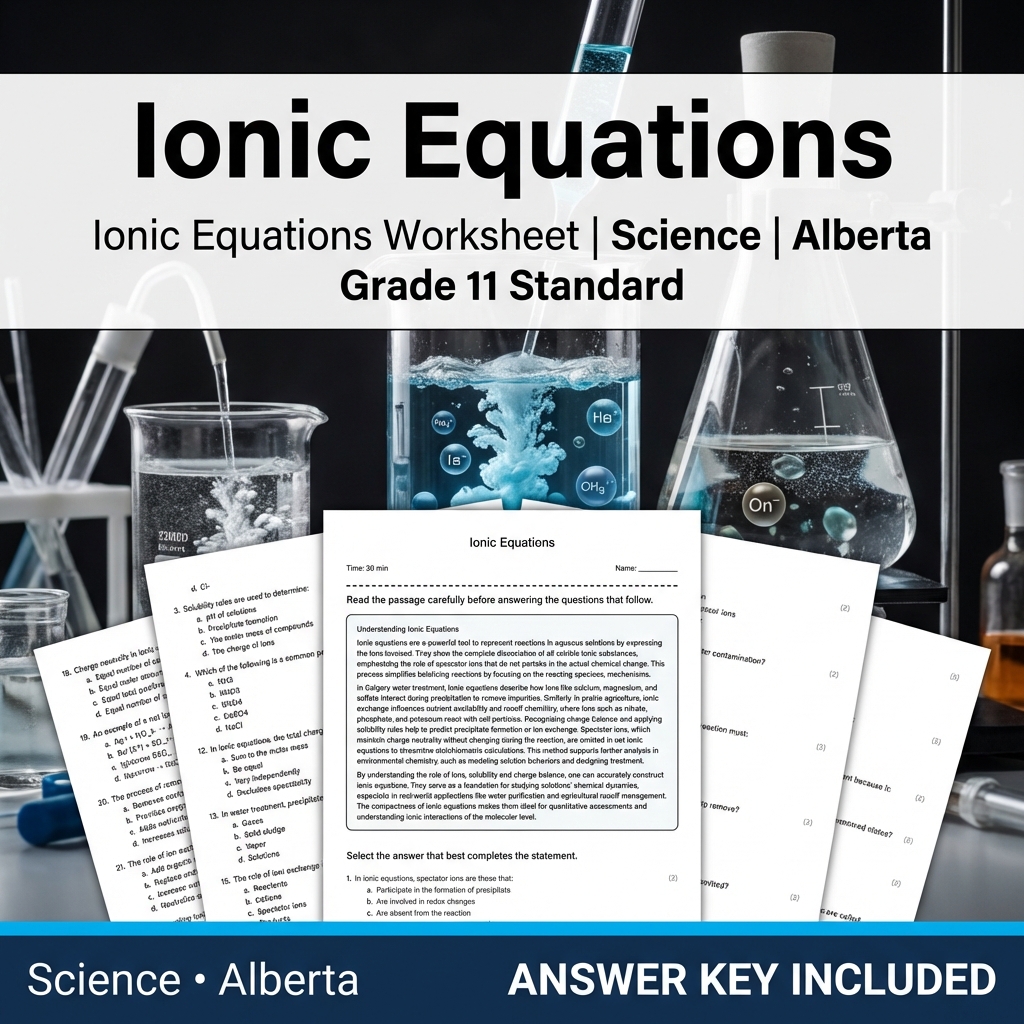
Ionic Equations Worksheet | Science | Alberta Grade 11 Standard
Created byCoral Reef LearningLearning Objectives
- Understand the purpose and process of writing complete and net ionic equations in aqueous solutions.
- Identify spectator ions and understand their role in ionic reactions.
- Apply solubility rules to determine precipitate formation in ionic reactions.
Instant download
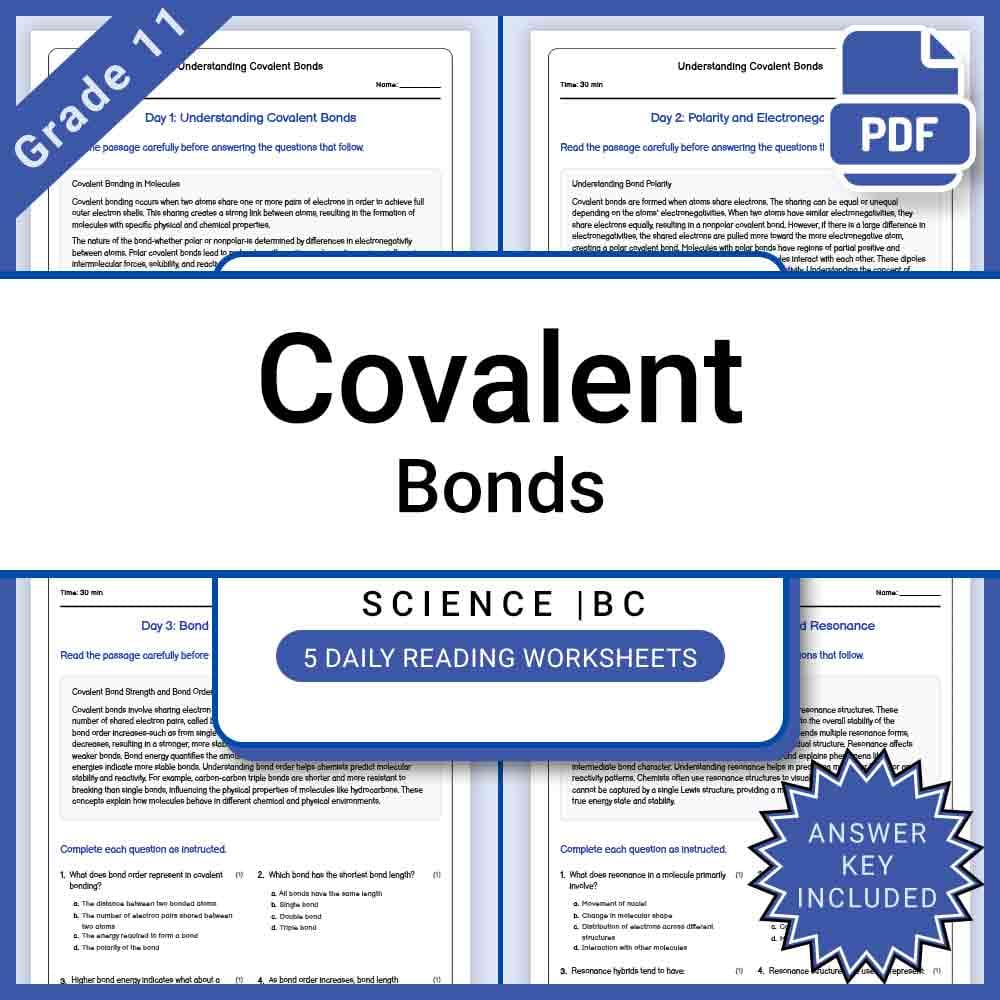
Grade 11 Science – Covalent Bonds Daily Reading Worksheet + Answer Key
JCreated byJ.S SheetsLearning Objectives
- Identify the basic principles of covalent bonding
- Explain how atoms share electron pairs to form molecules
- Describe bond polarity, bond order, bond length, and bond energy
Also included in: Grade 11 Science Lesson Group | BC Framework Daily Reading Worksheets +1 more
Instant download

Newton’s Second Law Worksheet | Grade 11 Physics Science Activity
Created byPrism Point LearningLearning Objectives
- Apply Newton’s second law to predict how net force, mass, and acceleration relate.
- Determine the direction of acceleration from the direction of the net force vector.
- Use force addition (thrust and friction) to explain changes in velocity and trajectory.
Instant download

Photoelectric Evidence Worksheet | Grade 11 Physics Science Activity
Created byPrism Point LearningLearning Objectives
- Explain how the photoelectric effect supports the idea that light energy comes in quanta (photons).
- Describe the threshold frequency and work function and how they affect electron emission.
- Compare the effects of changing light intensity versus changing light frequency on emitted electron kinetic energy.
Instant download

Momentum Conservation Worksheet | Grade 11 Physics Science Activity
Created byPrism Point LearningLearning Objectives
- Explain momentum as a vector quantity and why it is conserved in an isolated system
- Use equal and opposite forces to reason about impulse and total momentum before and after collisions
- Distinguish elastic and inelastic collisions by how they affect kinetic energy
Instant download

Grade 11 Scientific Inquiry Worksheet | Florida NGSSS Science Answer Key
Created byEvergreen Desk EducationLearning Objectives
- Explain how scientific inquiry connects observations to evidence-based explanations.
- Describe why scientific investigations often proceed in non-linear ways and use prior knowledge carefully.
- Identify what makes an explanation scientific: natural causes, testability, evidence support, and peer evaluation.
Instant download

Genetic Drift Worksheet | Grade 11 Science Activities
Created byPrism Point LearningLearning Objectives
- Explain how genetic drift causes allele frequencies to change due to chance events, especially in small populations.
- Distinguish bottleneck and founder effects and predict how each can reduce genetic variation.
- Compare genetic drift with natural selection in terms of dependence on fitness and effects on evolutionary potential.
Also included in: Evolution & Classification Lesson Bundle | Grade 11 Science | TEKS
Instant download

Grade 11 Worksheet B: Cosmic Timescales Worksheet | NGSS Practice PDF
 Created byClear Sky Classroom
Learning Objectives
- Explain how astronomical observations constrain the age and large-scale evolution of the universe and solar system.
- Interpret key evidence such as galactic redshift, Hubble’s law, the cosmic microwave background, and primordial element abundances.
- Connect radiometric ages of meteorites and stellar evolution models to the lifetimes of stars using Hertzsprung–Russell diagrams.
Also included in: Grade 11 Orbital Mechanics Space Science Lesson Bundle NGSS Worksheets +1 more
Instant download

Grade 11 Science – Wave Properties & Behavior | Daily Reading Worksheet
Created byBright Mind ResourcesLearning Objectives
- Describe key wave properties: amplitude, wavelength, frequency, and speed.
- Explain wave behaviors such as reflection, refraction, diffraction, and interference.
- Understand the concept of resonance and how natural frequency affects oscillations.
Also included in: Grade 11 Energy Science Daily Reading Lesson Bundle | California Standards +1 more
Instant download
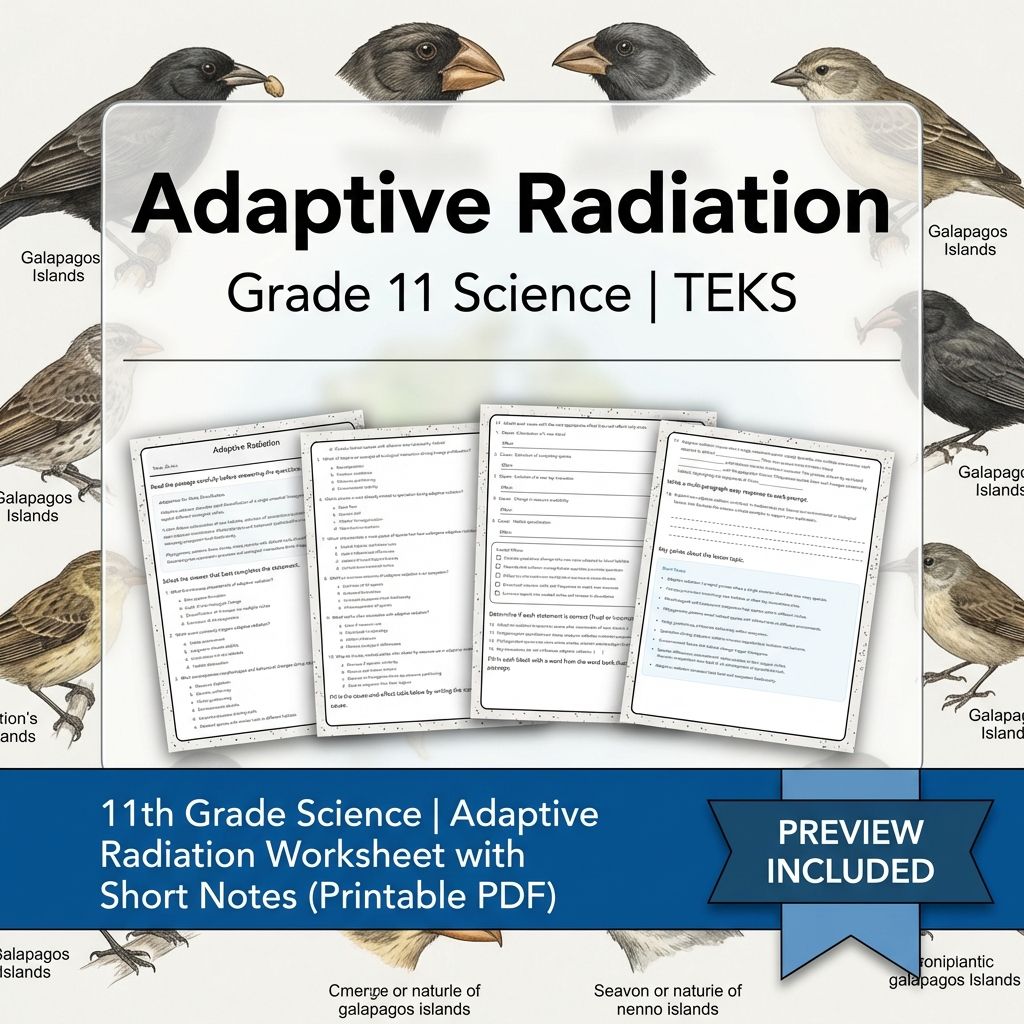
11th Grade Science | Adaptive Radiation Worksheet with Short Notes (PDF)
 Created byMeadowlark Worksheets
Learning Objectives
- Understand the concept of adaptive radiation and its role in biodiversity.
- Identify environmental and biological factors that trigger adaptive radiation.
- Analyze phylogenetic patterns illustrating adaptive divergence.
Instant download

Grade 11 Science | Chemical Energy Capture Worksheet | California Standards
Created byLumora LearningLearning Objectives
- Explain how chemical energy is stored and transferred through chemical bonds in living systems
- Compare photosynthesis and cellular respiration in terms of energy conversion and matter rearrangement
- Describe how environmental conditions can affect the rate of chemical processes and energy availability
Instant download

Grade 11 Science – Structure and Function of Organelles in Photosynthesis
JCreated byJ.S SheetsLearning Objectives
- Identify key organelles involved in photosynthesis and cellular respiration
- Explain how the structure of organelles like chloroplasts and mitochondria enhances their function
- Understand the relationship between organelle architecture and metabolic efficiency
Also included in: Grade 11 Science Lesson Group | Metabolic Regulation and Photosynthesis Bundle +1 more
Instant download

Grade 11 Simple Harmonic Motion & Wave Relationships Worksheet Ontario
 Created byChalk and Compass
Learning Objectives
- Explain how simple harmonic motion links restoring force to displacement over an oscillation cycle
- Use relationships among frequency, period, angular frequency, wavelength, and wave speed in linear media
- Distinguish transverse and longitudinal waves and describe how phase affects propagation
Also included in: Motion, Energy, Waves & DC Circuits Lesson Bundle – Grade 11 Science Ontario +1 more
Instant download
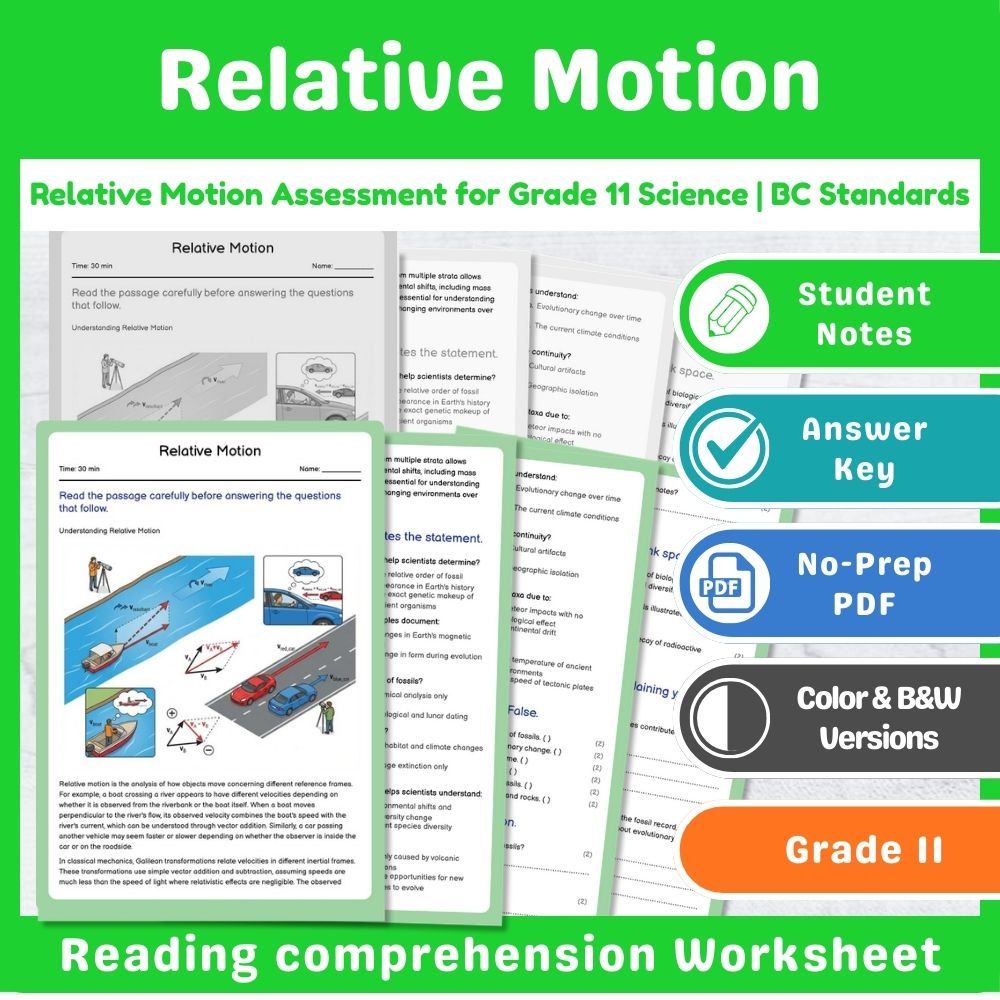
Relative Motion Assessment for Grade 11 Science | BC Standards
Created byPrism Point LearningLearning Objectives
- Explain the concept of relative motion and how velocities depend on the observer's frame of reference.
- Describe how vector addition and subtraction relate velocities observed from different frames.
- Apply Galilean velocity addition to solve real-world problems involving moving objects.
Also included in: Grade 11 Science Assessment Bundle | Classical Mechanics & Motion Topics
Instant download
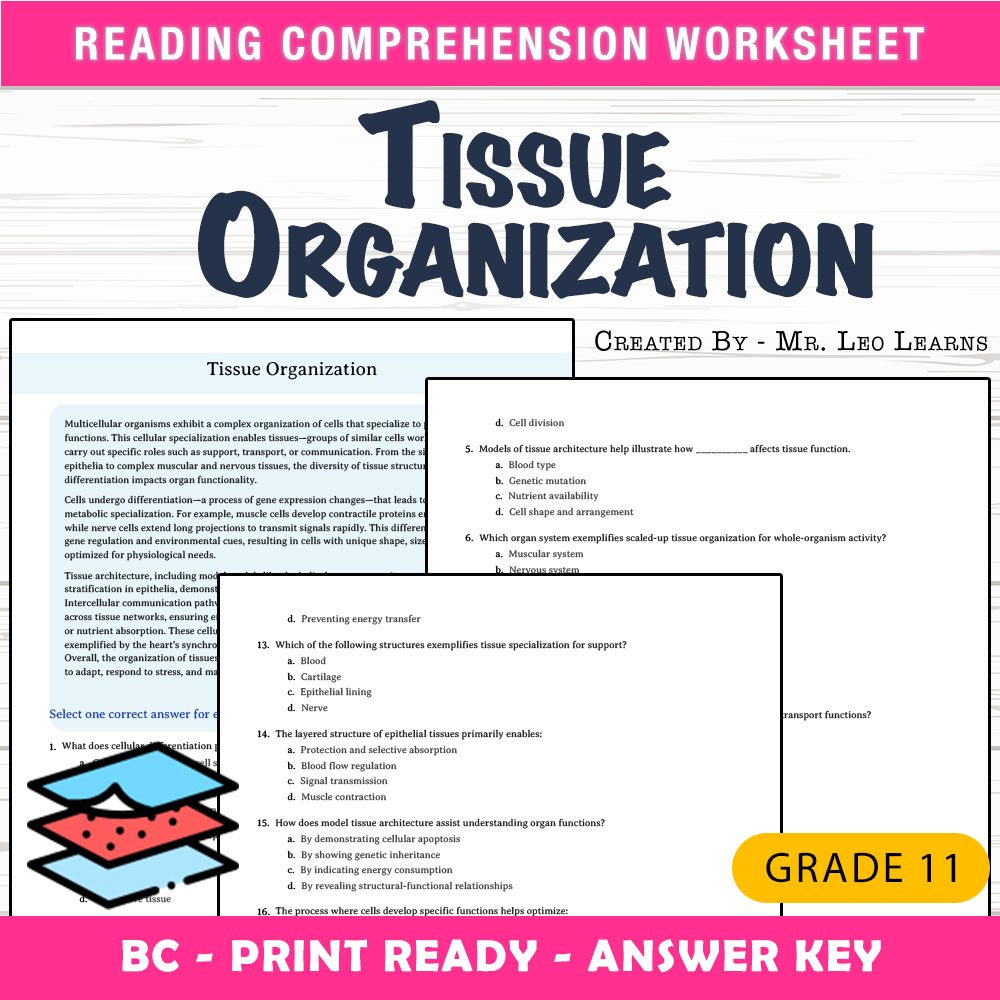
Grade 11 Science — Tissue Organization Worksheet MCQ Paper PDF + Answer Key
 Created byThe Resource Hub
Learning Objectives
- Understand the hierarchical organization of multicellular organisms from cells to organ systems.
- Identify functions of specialized tissues and how cellular differentiation contributes to tissue roles.
- Explain model structures of tissue architecture and intercellular communication in organ functions.
Also included in: Grade 11 Science Bundle | Biology Unit Worksheets for Mastery (BC Framework) +1 more
Instant download

Grade 11 Science – Electronegativity & Chemical Behavior | Reading Worksheet
Created byBright Mind ResourcesLearning Objectives
- Understand the concept of electronegativity and its importance in chemical bonding.
- Learn about the scale of electronegativity values across elements.
- Identify trends in electronegativity across periods and down groups.
Also included in: Grade 11 VSEPR & Mol. Geometry Science Daily Reading Lesson Bundle | Alberta +1 more
Instant download
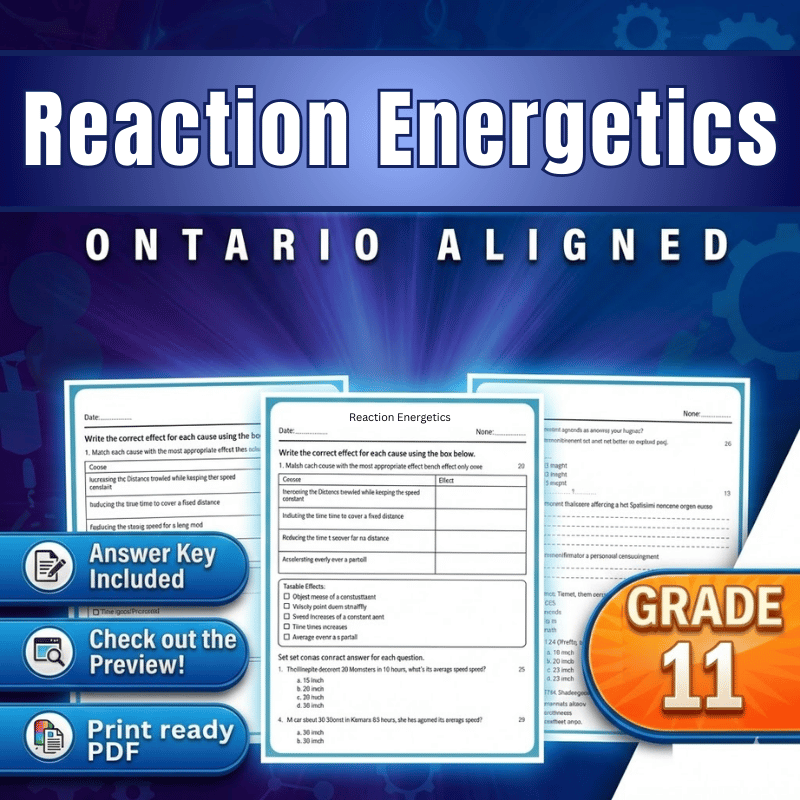
Grade 11 Science – Reaction Energetics Worksheet (Ontario Standards) (PDF)
Created byBright Mind ResourcesLearning Objectives
- Understand the relationship between bond energies, enthalpy changes, and reaction heat exchange.
- Apply Hess's law to calculate reaction enthalpies using standard enthalpies of formation.
- Estimate reaction heat changes using bond enthalpy approximations and calorimetric principles.
Instant download
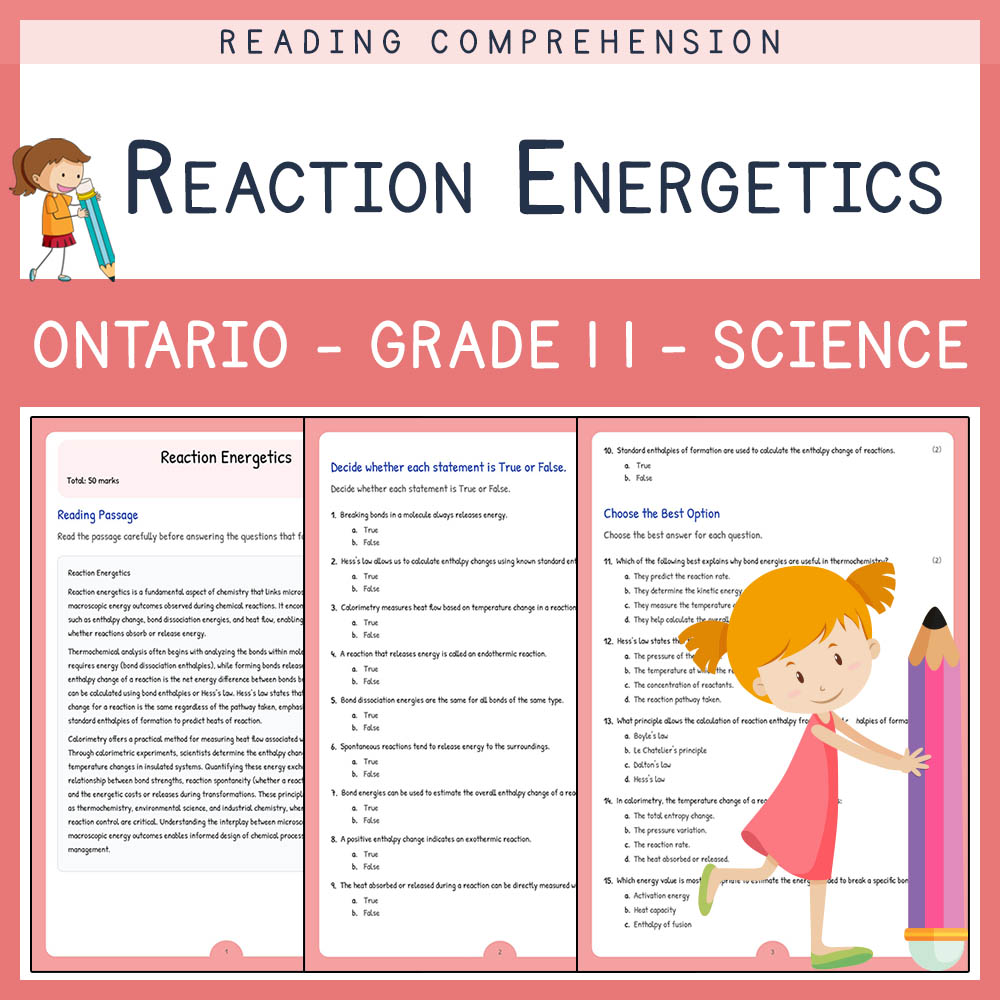
Grade 11 Science | Reaction Energetics Worksheet | Ontario Standards
Created byLumora LearningLearning Objectives
- Understand the relationship between bond energies, enthalpy changes, and reaction heat exchange.
- Apply Hess's law for calculating enthalpy changes in chemical reactions.
- Interpret standard enthalpies of formation and bond enthalpy approximations.
Also included in: Grade 11 Science | Chemistry Lesson Bundle | Ontario Framework
Instant download
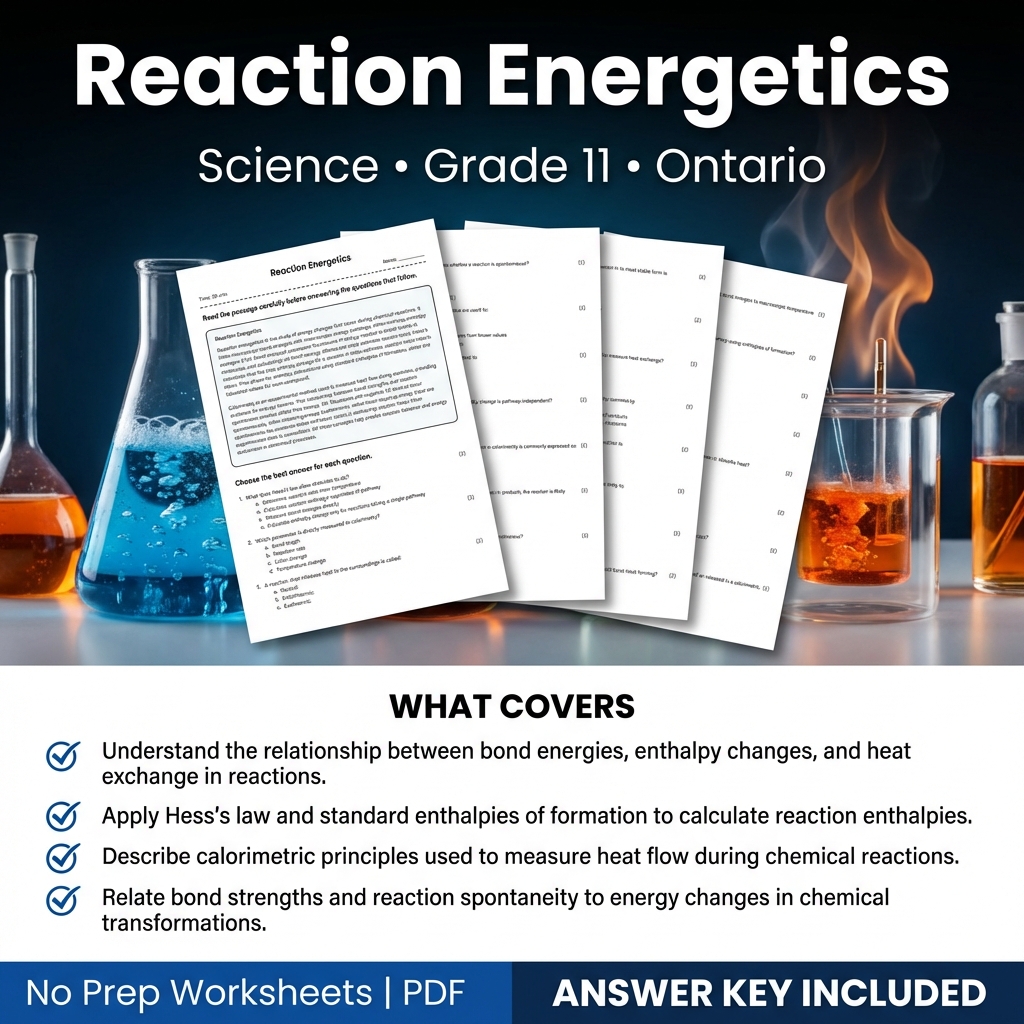
Reaction Energetics Worksheet for Grade 11 Science | Ontario Standards
Created byCoral Reef LearningLearning Objectives
- Understand the relationship between bond energies, enthalpy changes, and heat exchange in reactions.
- Apply Hess's law and standard enthalpies of formation to calculate reaction enthalpies.
- Describe calorimetric principles used to measure heat flow during chemical reactions.
Instant download

Grade 11 Science Reaction Energetics Worksheet (Ontario) (PDF)
Created byEvergreen Desk EducationLearning Objectives
- Explain how bond energies relate to reaction enthalpy change (ΔH) and whether heat is released or absorbed.
- Use Hess’s law with standard enthalpies of formation to calculate reaction enthalpy for multi-step processes.
- Interpret calorimetry data to estimate heat flow and connect measured heat exchange to energetic trends and spontaneity.
Also included in: Grade 11 Chemistry Practice Science Lesson Bundle – Ontario Worksheets +1 more
Instant download

Grade 11 Science – Titration & Concentration | Daily Reading Worksheet
Created byBright Mind ResourcesLearning Objectives
- Explain the concept of titration and its purpose in chemistry.
- Describe how molarity relates to titration calculations.
- Perform algebraic manipulations involved in titration stoichiometry.
Also included in: Grade 11 Solutions Science Daily Reading Worksheets lesson bundle | Alberta +1 more
Instant download
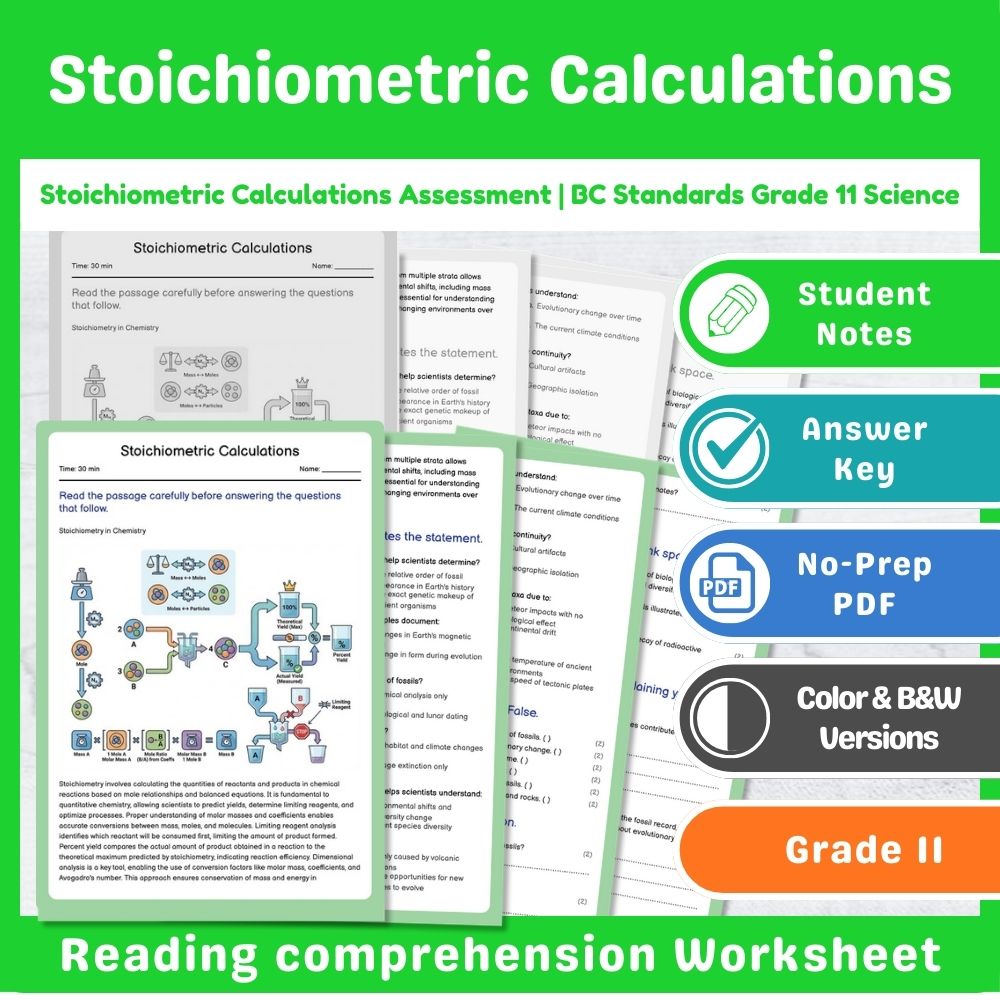
Stoichiometric Calculations Assessment | BC Standards Grade 11 Science
Created byPrism Point LearningLearning Objectives
- Apply mole relationships and balanced equations to calculate reactants and products.
- Identify limiting reagents and compute percent yields in chemical reactions.
- Perform mass-to-mass, mass-to-mole, and mole-to-mole conversions using molar masses and coefficients.
Also included in: Grade 11 Science | Thermochemistry Assessment Bundle – Standards-Aligned
Instant download

Grade 11 Science — Worksheet MCQ Paper for Mastering Population Patterns
Created byThe Resource HubLearning Objectives
- Understand principles of exponential and logistic growth models in populations.
- Identify factors influencing population fluctuations and persistence.
- Interpret graphical models and demographic data related to population dynamics.
Also included in: Grade 11 Science AP Mastery Bundle – Systems, Genetics, and Ecosystems +1 more
Instant download
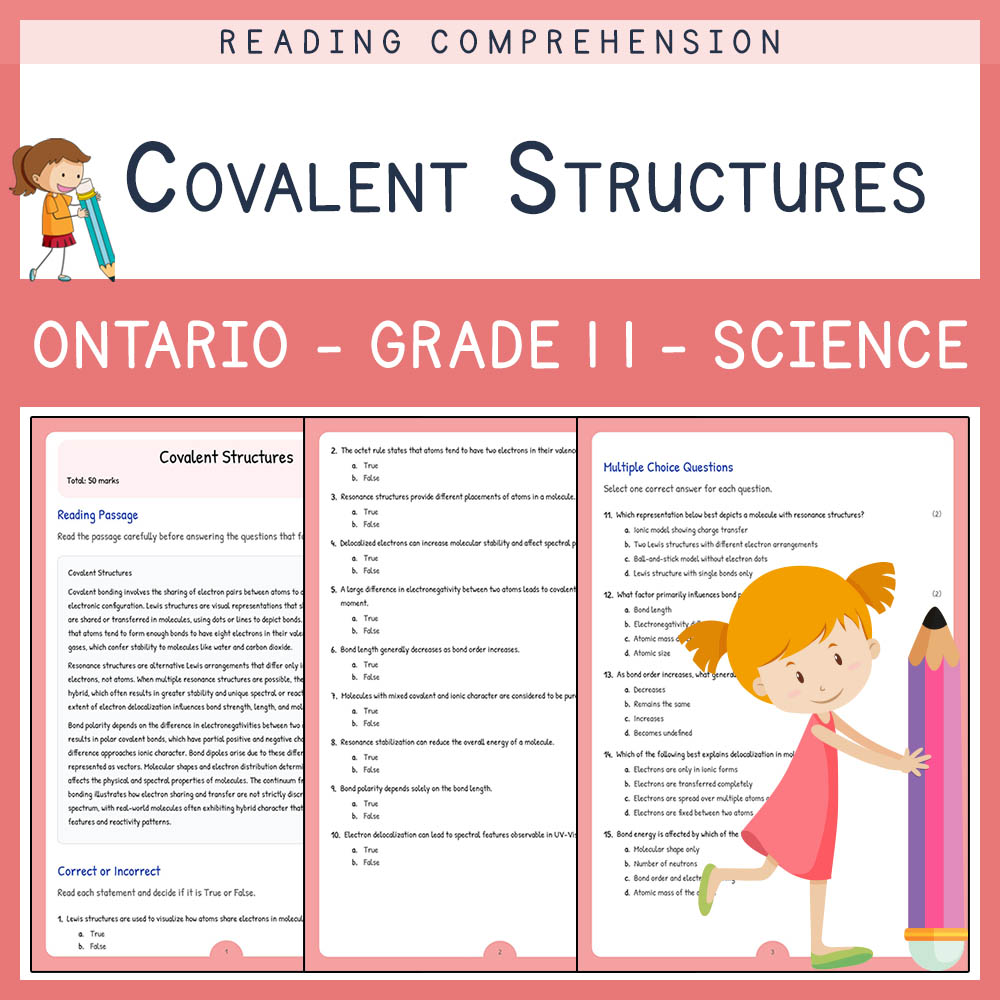
Grade 11 Science Assessment | Covalent Structures Worksheet Elena | Ontario
Created byLumora LearningLearning Objectives
- Explain shared-electron bonding through Lewis representations and octet rules.
- Assess formal charges and resonance structures to predict molecular stability.
- Understand the relationship between electronegativity differences and bond polarity.
Also included in: Grade 11 Science | Chemistry Lesson Bundle | Ontario Framework
Instant download
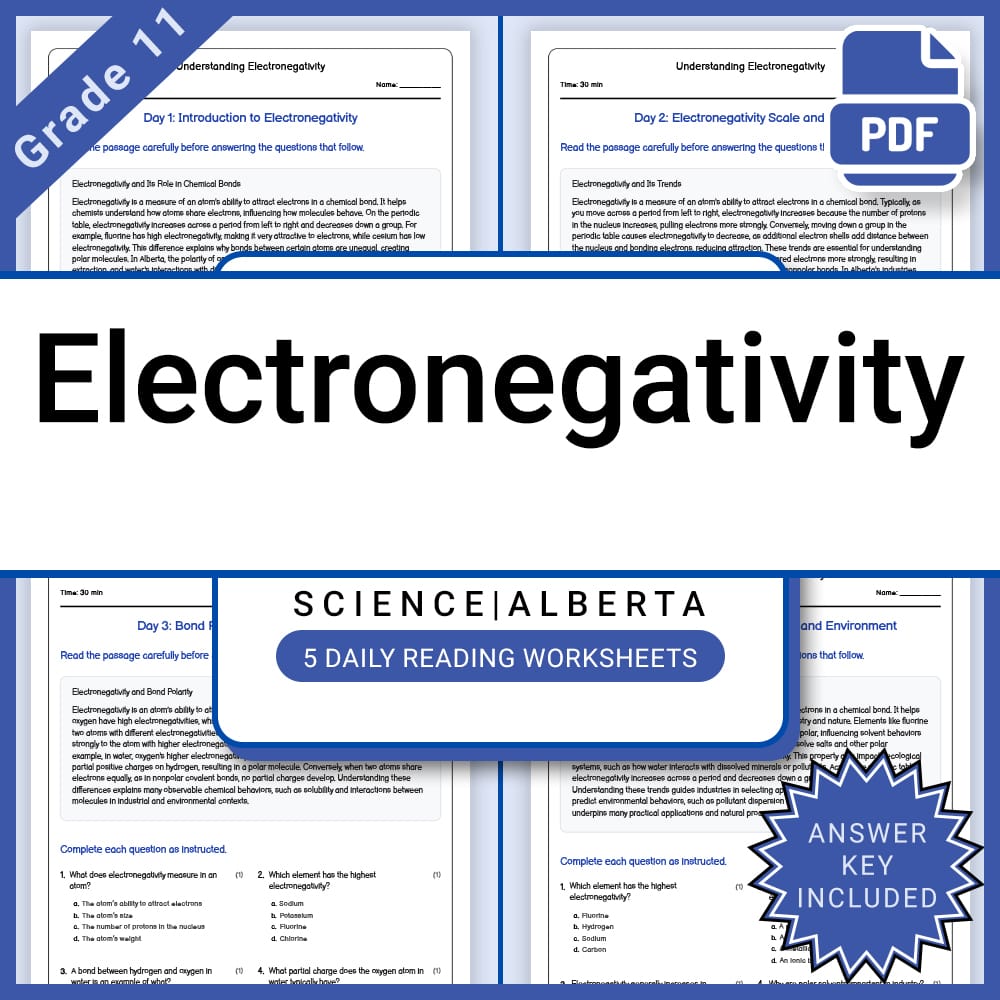
Grade 11 Science – Electronegativity Daily Reading Worksheet + Answer Key
JCreated byJ.S SheetsLearning Objectives
- Define electronegativity and explain its significance in chemical bonding.
- Identify trends in electronegativity across periods and groups in the periodic table.
- Differentiate between polar and nonpolar covalent bonds based on electronegativity differences.
Also included in: Grade 11 Science Lesson Bundle | Molecular Structure and Bonding +1 more
Instant download
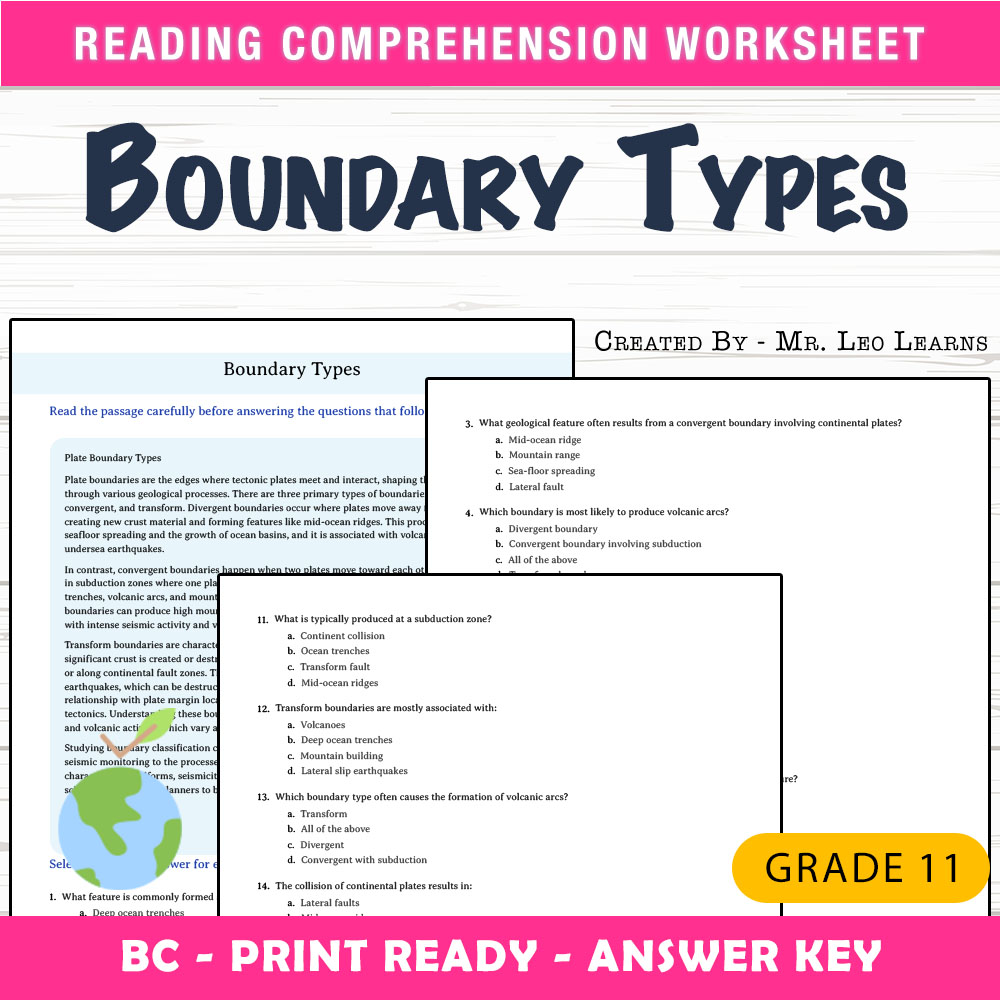
Grade 11 Science — Worksheet MCQ Paper for Boundary Types
Created byThe Resource HubLearning Objectives
- Identify and describe the three main types of tectonic plate boundaries.
- Explain the landforms and geological activity associated with each boundary type.
- Correlate seismic and volcanic patterns with boundary classifications.
Also included in: Grade 11 Science Earth Science Unit | BC Curriculum MCQ Worksheet Pack +1 more
Instant download
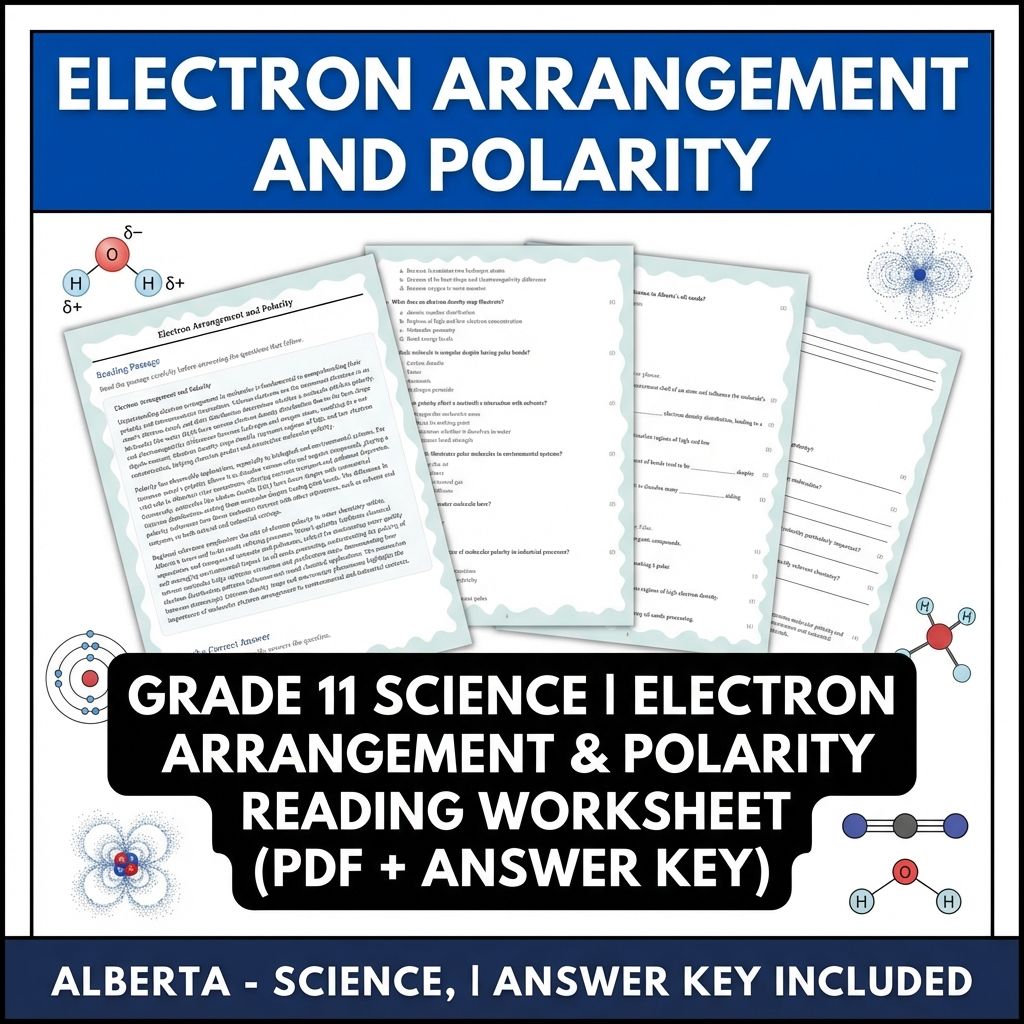
Grade 11 Science | Electron Arrangement & Polarity (PDF + Answer Key)
JCreated byJ.S SheetsLearning Objectives
- Explain how valence electron distribution influences molecular polarity.
- Describe the relationship between electron density maps and dipole moments.
- Differentiate between polar and nonpolar molecules using examples like water and carbon dioxide.
Instant download
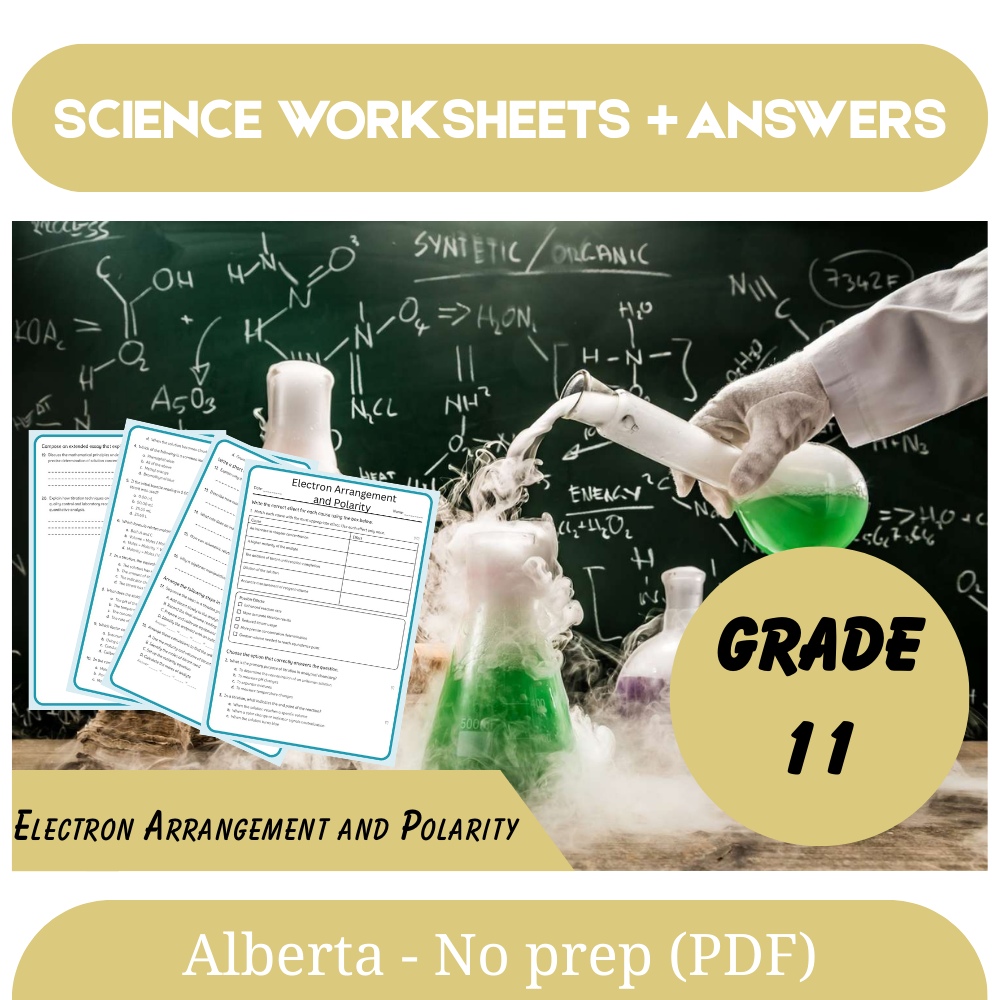
Grade 11 Science | Electron Arrangement & Polarity Worksheet (PDF)
Created byBright Mind ResourcesLearning Objectives
- Explain how valence electron distribution influences molecular polarity.
- Differentiate polar and nonpolar molecules using electron density maps.
- Analyze real-world applications of molecular polarity in water chemistry and oil sands processing.
Instant download

Grade 11 Electron Arrangement Worksheet | Practice & Alberta PDF
Created byClear Sky ClassroomLearning Objectives
- Explain how valence electrons and electronegativity differences determine molecular polarity.
- Interpret how dipole moments arise from uneven electron density and bond polarity.
- Predict and compare intermolecular interactions for polar molecules (e.g., water) versus nonpolar molecules (e.g., carbon dioxide).
Instant download

Reaction Stoichiometry Quiz | NGSS Grade 11 Science MCQ Assessment
 Created byCedar Grove Learning
Learning Objectives
- Understand how to use mole ratios from balanced chemical equations to determine reactants and products.
- Apply mass-to-mass, mass-to-mole, and mole-to-volume conversions for gases under standard conditions.
- Derive empirical and molecular formulas from compositional data.
Instant download

Grade 11 Physical vs Chemical Worksheet | NGSS Practice & PDF
Created byClear Sky ClassroomLearning Objectives
- Differentiate physical and chemical changes by comparing how matter’s composition and identity change.
- Identify evidence of chemical reactions, such as gas production, color change, temperature change, and precipitate formation.
- Predict whether a change is reversible based on whether new substances form.
Instant download

Grade 11 Balanced Chemical Equations & Reaction Types Worksheet | Ontario
Created byChalk and CompassLearning Objectives
- Represent chemical changes using balanced symbolic equations, including stoichiometric coefficients.
- Classify chemical reactions as synthesis, decomposition, combustion, and single or double displacement.
- Use the law of conservation of mass to justify balancing and interpret reaction notation with states of matter.
Also included in: Grade 11 Science Chemistry Lesson Bundle | Ontario +1 more
Instant download
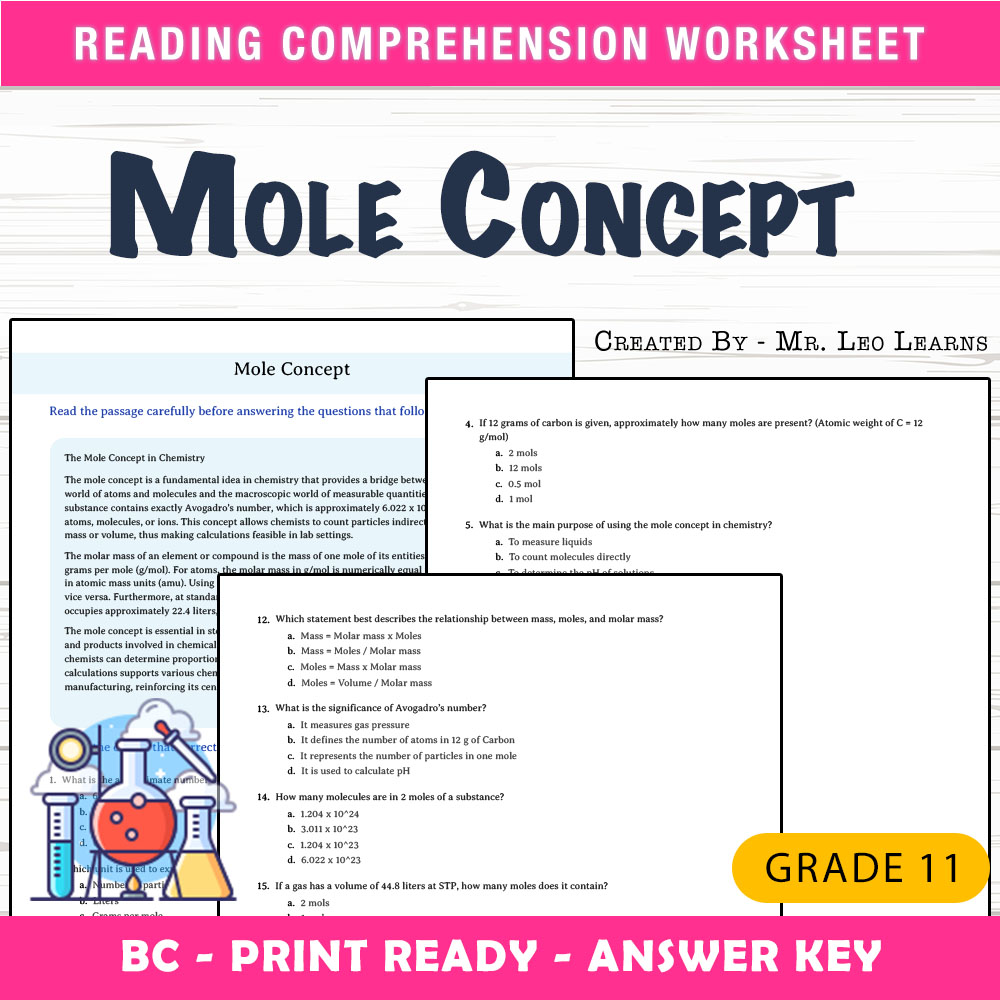
Grade 11 Science — Mole Concept Worksheet MCQ Paper for Mastery
Created byThe Resource HubLearning Objectives
- Understand the definition and significance of the mole in chemistry.
- Calculate the number of particles, molar mass, and mass relationships using the mole.
- Convert between mass, number of particles, and volume of gases under standard conditions.
Also included in: Grade 11 Science – Chemistry Unit Worksheet Bundle (BC) +1 more
Instant download
About Grade 11 Science Worksheets
Browse 6,616 printable Grade 11 Science worksheets — ready-to-print PDFs with answer keys where available.
Each resource here is built by an independent educator and reviewed for quality. Worksheets print straight from PDF and suit classroom use, homework, or extra practice; most come with answer keys, and you can preview before purchasing.