
Grade 11 Science Worksheets
6,616 worksheets
Grade 11 Science | Computational Simulation Worksheet with Short Notes (PDF)
 Created byMeadowlark Worksheets
Learning Objectives
- Understand numerical methods used for simulating dynamic systems.
- Describe the process of discretization, time-stepping, and parameter sweeps.
- Analyze the factors affecting accuracy and computational cost in simulations.
Also included in: Grade 11 Science Unit Bundle | Data Analysis & Scientific Reasoning Worksheets +1 more
Instant download

Kinematics Basics Worksheet | Grade 11 Science Activities
 Created byPrism Point Learning
Learning Objectives
- Differentiate between position, displacement, speed, and velocity in one-dimensional motion.
- Compute and interpret average speed and average velocity from distance/displacement and time.
- Describe how instantaneous velocity and acceleration relate to motion at a moment in time.
Also included in: Grade 11 Science Lesson Bundle — Work, Energy & Motion (BC)
Instant download
Grade 11 Science | Kinematic Equations Worksheet with Short Notes (PDF)
Created byMeadowlark WorksheetsLearning Objectives
- Understand the basic forms and applications of constant-acceleration kinematic equations.
- Apply kinematic equations to solve problems involving displacement, velocity, acceleration, and time.
- Derive the equations using algebraic manipulation and calculus concepts.
Also included in: Grade 11 Science Lesson Bundle | Motion, Energy, and Forces Worksheets +1 more
Instant download

Integrated Cycles Assessment | TEKS Standards Grade 11 Science
Created byPrism Point LearningLearning Objectives
- Explain how photosynthesis and cellular respiration are interconnected biochemical cycles.
- Identify the roles of carbon fixation and CO2 release in ecosystems.
- Describe how tissue specialization and transport mechanisms coordinate energy distribution in plants.
Also included in: Grade 11 Photosynthesis and Respiration Science Lesson Bundle | TEKS
Instant download

Grade 11 Science – Human Footprint & Land-Use Changes | Daily Reading Worksheet
 Created byBright Mind Resources
Learning Objectives
- Understand key concepts related to Science
- Apply knowledge through practice questions
- Demonstrate comprehension of the material
Also included in: Earth Systems Grade 11 Science Daily Reading Worksheets Lesson Bundle | AP +2 more
Instant download

Grade 11 Science – Genetic Mutations in DNA Reading Worksheet | TEKS Aligned
Created byBright Mind ResourcesLearning Objectives
- Understand the structure of DNA and how mutations can alter its sequence
- Identify different types of genetic mutations and their effects
- Analyze how mutations influence protein synthesis and phenotype
Also included in: Grade 11 DNA Replication & Genetics Science Daily Reading Lesson Bundle | TEKS +2 more
Instant download

High School Biology: Speciation and Phylogeny Worksheet (NGSS PDF)
 Created byMaple Path Learning
Learning Objectives
- Explain the mechanisms that lead to the formation of new species, including geographic isolation and reproductive barriers.
- Interpret phylogenetic trees to understand evolutionary relationships among species.
- Describe different modes of speciation such as allopatric and sympatric speciation.
Also included in: Grade 11 Biological Evolution Unity and Diversity Science Lesson Bundle (NGSS) +1 more
Instant download
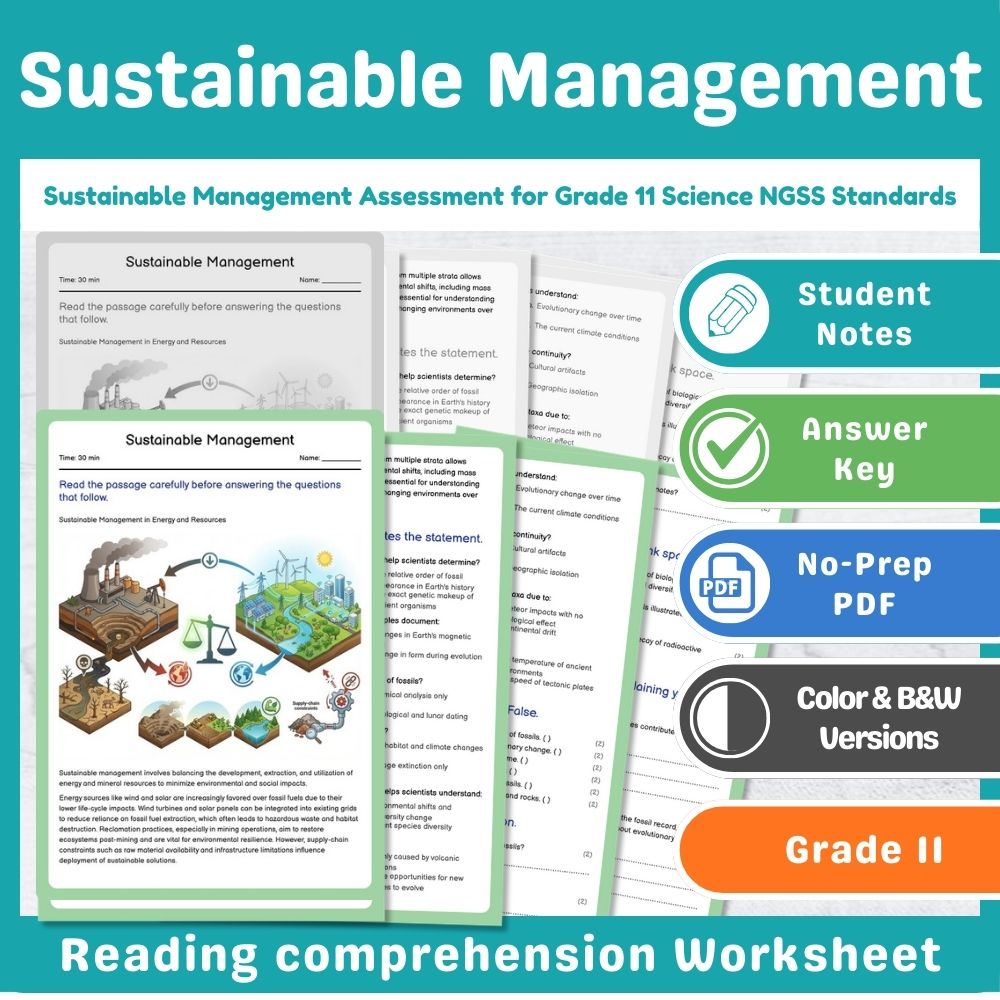
Sustainable Management Assessment for Grade 11 Science NGSS Standards
Created byPrism Point LearningLearning Objectives
- Compare technical and policy solutions for energy and mineral resource management considering life-cycle impacts.
- Evaluate reclamation practices and supply-chain constraints related to resource extraction and energy production.
- Analyze hazards and resilience metrics in ecological and social contexts for sustainable resource management.
Instant download

Grade 11 Science – Mole Concept & Stoichiometry | Daily Reading Worksheet
Created byBright Mind ResourcesLearning Objectives
- Define the mole and understand its significance in chemistry.
- Convert between mass, moles, and particle counts using molar mass and Avogadro's number.
- Solve quantitative problems involving the mole concept, including limiting reagent and percent yield calculations.
Also included in: Grade 11 Chemistry Science Daily Reading Lesson Bundle | Ontario +1 more
Instant download
Grade 11 Science | Atomic Structure Worksheet with Short Notes (Printable PDF)
Created byMeadowlark WorksheetsLearning Objectives
- Understand electron configuration, quantum shells, and isotopic variations.
- Examine atomic models and periodic trends related to chemical behavior.
- Identify bonding types including ionic, covalent, and metallic interactions.
Also included in: Grade 11 Science Lesson Bundle | Ontario Curriculum Topics and Skills +1 more
Instant download
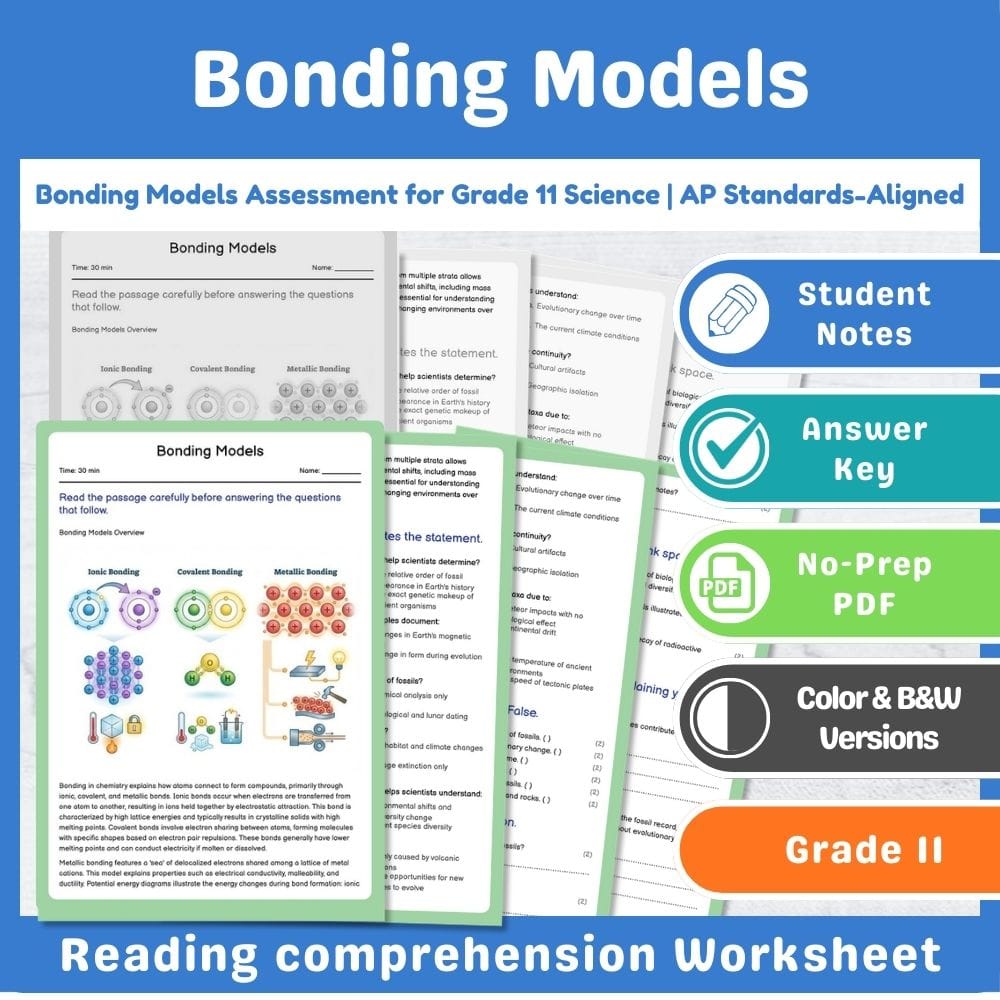
Bonding Models Assessment for Grade 11 Science | AP Standards-Aligned
Created byPrism Point LearningLearning Objectives
- Understand the differences between ionic, covalent, and metallic bonding through potential-energy diagrams and lattice considerations.
- Use electronegativity differences and formal charge concepts to distinguish bond types.
- Compare model predictions for bond strengths, lattice energies, and properties like conductivity and melting point.
Instant download

Grade 11 Science | Mendelian Patterns Worksheet (Ontario Standards)
 Created byEvergreen Desk Education
Learning Objectives
- Use Mendel’s laws to predict genotype and phenotype ratios for mono- and dihybrid crosses
- Apply dominance, recessiveness, incomplete dominance, and codominance to determine phenotypes from genotypes
- Interpret pedigree patterns to infer likely modes of inheritance
Also included in: Grade 11 Cellular Metabolism & Genetics Science Lesson Bundle: Ontario +1 more
Instant download

Grade 11 Science | pH Fundamentals in Science - Daily Reading Comprehension
 Created byCoral Reef Learning
Learning Objectives
- Understand the definition of pH and its logarithmic scale.
- Recognize how pH indicates acidity, neutrality, or alkalinity of solutions.
- Learn the relationship between hydrogen ion concentration and pH.
Also included in: Acids, Bases and pH Lesson Bundle – Grade 11 Science Alberta +1 more
Instant download

Transport Dynamics Assessment | TEKS Grade 11 Science Standards
Created byPrism Point LearningLearning Objectives
- Understand how electrochemical gradients and membrane properties facilitate ion and molecule movement across membranes.
- Explain the roles of active pumps like the sodium-potassium ATPase in establishing ion gradients.
- Describe how coupled transporters utilize existing gradients for secondary active transport.
Also included in: Grade 11 Cell Systems, Energy & Genetics Science: Lesson Bundle TEKS
Instant download

Grade 11 Systems Modeling in Earth Sciences Worksheet | NGSS Science
 Created byBRIGHT PATH RESOURCES
Learning Objectives
- Understand the components that make up the Earth's system
- Learn how different Earth system processes interact over time
- Explore the role of models in representing complex Earth processes
Also included in: Earths Systems Lesson Bundle | Grade 11 Earth Science | NGSS +1 more
Instant download
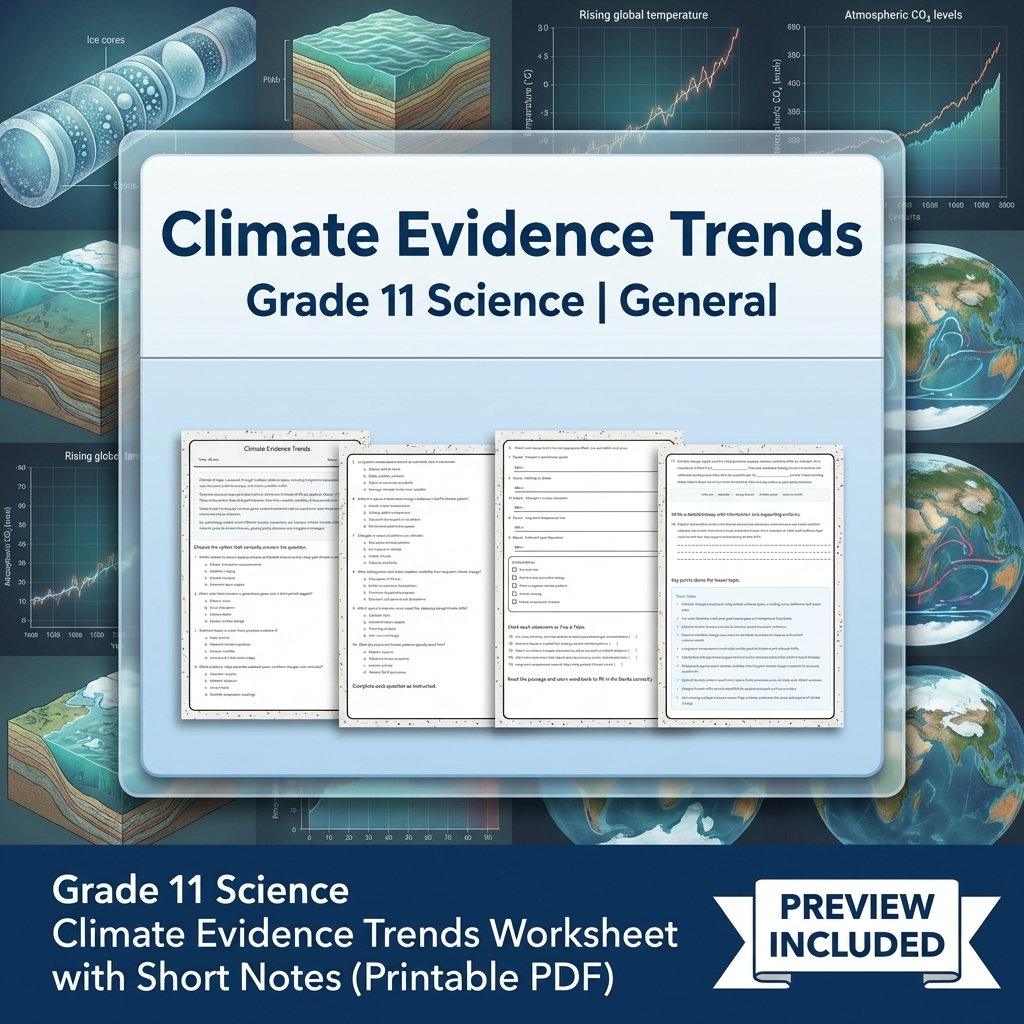
Grade 11 Science Climate Evidence Trends Worksheet with Short Notes
Created byMeadowlark WorksheetsLearning Objectives
- Identify various lines of evidence used to evaluate climate change over time.
- Differentiate between short-term weather variability and long-term climate patterns.
- Interpret signals indicating changes in Earth's energy balance and atmospheric composition.
Also included in: Grade 11 Evidence-Based Science Lesson Bundle | General Framework +1 more
Instant download

Grade 11 Science | Conceptual Modeling Worksheet | AP Aligned
 Created byLumora Learning
Learning Objectives
- Define and explain the purpose of conceptual models in scientific research.
- Identify key components and assumptions of conceptual models.
- Differentiate between discrete and continuous formulations in modeling.
Instant download

Ionic Equations Assessment for Grade 11 Science | Alberta Standards
Created byPrism Point LearningLearning Objectives
- Explain the concept of ionic equations and their importance in solution chemistry.
- Differentiate between complete ionic and net ionic equations.
- Identify spectator ions and understand their role in ionic reactions.
Also included in: Grade 11 Chemical Reactions & Stoichiometry Science Lesson Bundle – Alberta +1 more
Instant download

Energy Conversion Worksheet | NGSS-Aligned Science Practice for Grade 11
JCreated byJ.S SheetsLearning Objectives
- Understand different forms of energy and how they are converted in various devices.
- Identify key components involved in energy conversion processes.
- Analyze the efficiency and losses in energy conversion systems.
Also included in: Grade 11 Energy Transfer and Conversion Science Lesson Bundle – NGSS +1 more
Instant download

Problem Definition Worksheet | NGSS Grade 11 Science MCQ Assessment
 Created byCedar Grove Learning
Learning Objectives
- Analyze societal and environmental challenges to define measurable criteria and constraints.
- Formulate qualitative and quantitative performance metrics for solutions.
- Evaluate multiple design approaches based on defined criteria and constraints.
Instant download

Signal Encoding Worksheet | NGSS-Aligned Science Practice for Grade 11
JCreated byJ.S SheetsLearning Objectives
- Compare the advantages and disadvantages of digital versus analog transmission and storage.
- Explain principles of encoding, modulation, and decoding in communication systems.
- Analyze capacity and reliability using quantitative measures such as bit rate, signal-to-noise ratio, and spectral occupancy.
Also included in: Grade 11 Electromagnetic Spectrum and Imaging Science Lesson Bundle: NGSS +1 more
Instant download

Grade 11 Science | Statistical Reasoning - Daily Reading Comprehension
Created byCoral Reef LearningLearning Objectives
- Understand how samples can represent populations in scientific studies.
- Recognize the role of variability and noise in experimental data.
- Identify basic concepts of sampling distributions and their significance.
Also included in: Science Practices Reading Comprehension | Grade 11 Science AP Lesson Bundle +1 more
Instant download
Grade 11 Science | Ecosystem Components Worksheet (Ontario) (PDF)
Created byBright Mind ResourcesLearning Objectives
- Define biotic and abiotic components of ecosystems.
- Explain how habitat heterogeneity influences species diversity.
- Describe the role of abiotic gradients in shaping species assemblages.
Instant download

Grade 11 Science | Hazard Management Worksheet | BC-Aligned
Created byLumora LearningLearning Objectives
- Understand techniques used in hazard susceptibility mapping and risk assessment.
- Identify methods for estimating recurrence intervals of geological hazards.
- Explain the importance of land-use planning and engineering controls in hazard mitigation.
Also included in: Grade 11 Science | Earth Science Lesson Bundle Worksheets | BC-Aligned
Instant download

Grade 11 Science — Worksheet MCQ Paper for Mastering Experimental Design
 Created byThe Resource Hub
Learning Objectives
- Understand the principles of experimental design, including variable control and operational definitions.
- Evaluate the importance of replication, randomization, and trade-offs in research validity.
- Interpret flow diagrams and factorial tables to justify causal inferences and plan experiments.
Also included in: Grade 11 Science AP Bundle: Mastering Key Concepts with MCQ Practice +1 more
Instant download

Mendelian Patterns Worksheet Grade 11 Science Activities
Created byPrism Point LearningLearning Objectives
- Explain how discrete allele inheritance produces predictable genotype and phenotype ratios in simple crosses
- Differentiate dominant and recessive allele relationships in terms of observable traits
- Use pedigrees to trace inheritance patterns across generations
Also included in: Grade 11 Science Biology Cells, Genetics & Evolution Lesson Bundle | BC
Instant download

Grade 11 Science — Worksheet MCQ Paper for Mastering Energy Currency
Created byThe Resource HubLearning Objectives
- Understand the principles of energy transfer and transformation at molecular and cellular levels.
- Describe how ATP synthesis and hydrolysis drive biochemical reactions.
- Interpret reaction coordinate diagrams and enzyme kinetics in the context of energy conservation.
Also included in: Grade 11 Science AP Mastery Bundle – Systems, Genetics, and Ecosystems +1 more
Instant download
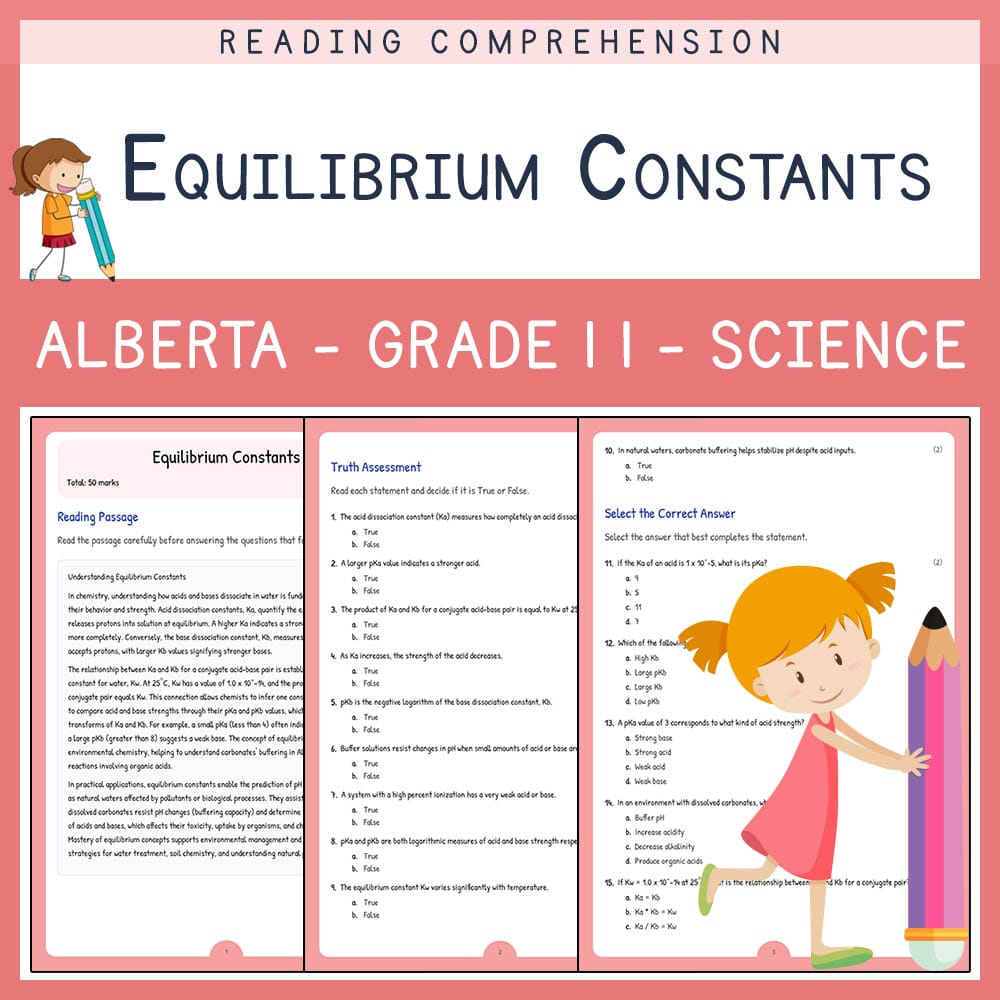
Grade 11 Science | Equilibrium Constants Worksheet Elena| Alberta Standard
Created byLumora LearningLearning Objectives
- Understand the roles of acid dissociation constant (Ka) and base dissociation constant (Kb) in equilibrium
- Connect Ka, Kb, pKa, pKb, and Kw to analyze acid-base systems
- Apply equilibrium concepts to interpret buffering, percent ionization, and pH prediction in environmental systems
Instant download

Grade 11 Science – Introduction to Coupled Models & Earth System Science | Daily Reading Worksheet
Created byBright Mind ResourcesLearning Objectives
- Understand the basic components of Earth system models including atmosphere, ocean, cryosphere, and biosphere.
- Learn how these components are integrated in coupled models to simulate environmental interactions.
- Identify typical diagnostics used to evaluate coupled model performance, such as ensemble means and uncertainty ranges.
Also included in: Earth Systems Grade 11 Science Daily Reading Worksheets Lesson Bundle | AP +2 more
Instant download

Grade 11 Science | Electron Configuration Worksheet Elena | AP Aligned
Created byLumora LearningLearning Objectives
- Understand the systematic rules governing electron occupancy in atoms, including Aufbau, Pauli exclusion, and Hund’s principles.
- Identify the shapes and nodal structures of atomic orbitals and connect these to electron configurations.
- Relate electron configurations to valence structures, oxidation states, and periodic trends.
Also included in: Grade 11 Science | Chemistry Foundations Custom Bundle | AP-Aligned
Instant download
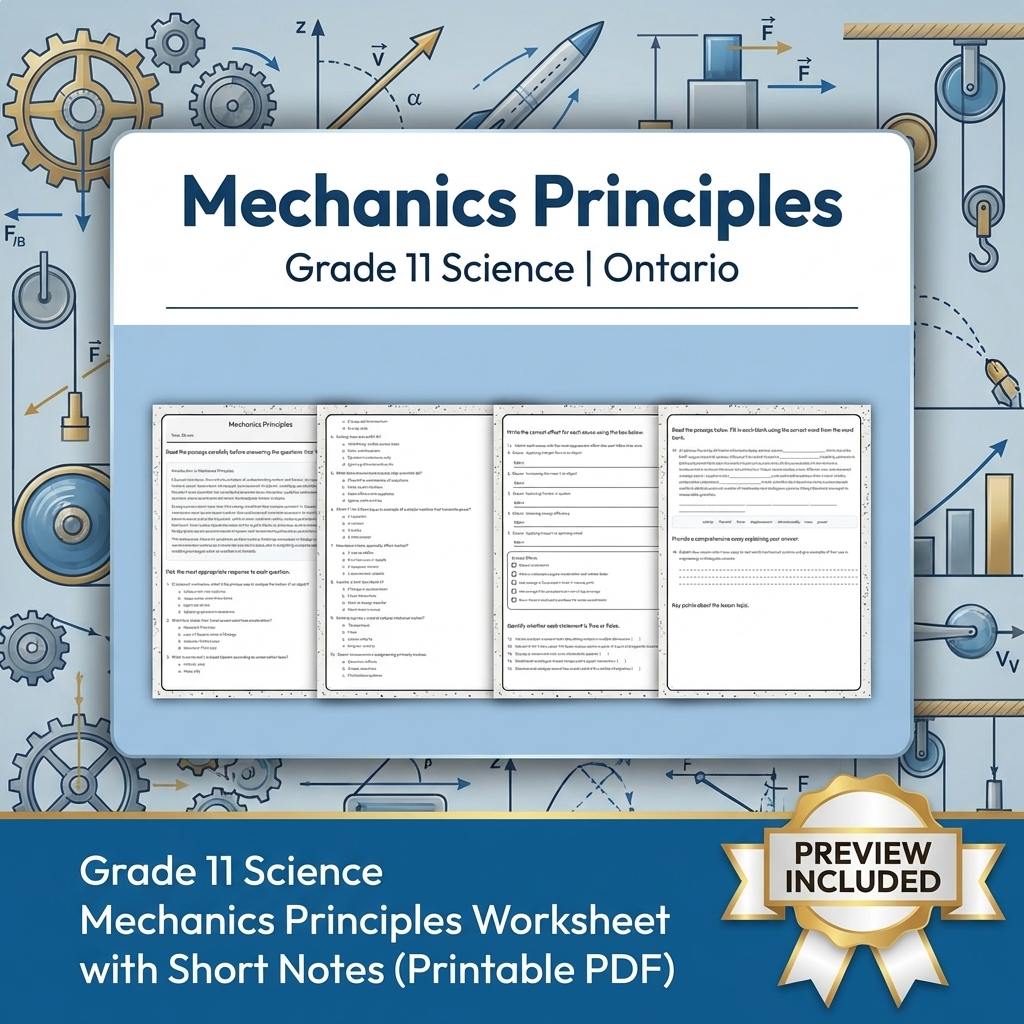
Grade 11 Science Mechanics Principles Worksheet with Short Notes (Printable PDF)
Created byMeadowlark WorksheetsLearning Objectives
- Understand fundamental concepts of classical mechanics including kinematics, dynamics, and conservation laws.
- Apply vector analysis, Newtonian forces, energy methods, and momentum conservation to different motion scenarios.
- Explain scaling laws, dimensional analysis, and modeling strategies used in physics and engineering contexts.
Also included in: Grade 11 Science Lesson Bundle | Ontario Curriculum Topics and Skills +1 more
Instant download

Motion Diagrams Practice Test | Grade 11 Science Worksheet Ontario
Created byPrism Point LearningLearning Objectives
- Interpret motion diagrams and kinematic graphs to determine instantaneous and average quantities
- Explain how slope and area on position–time and velocity–time graphs relate to velocity and displacement
- Apply uniform-acceleration relationships using correct SI units and vector direction
Also included in: Grade 11 Science Review & Test Prep Lesson Bundle for Ontario
Instant download

Atomic Structure Worksheet | Standards-Aligned Science Practice Grade 11
JCreated byJ.S SheetsLearning Objectives
- Describe the organization of protons, neutrons, and electrons within an atom.
- Explain how electron arrangements influence reactivity and bonding tendencies.
- Identify regional examples such as sodium and carbon to illustrate atomic behavior in industry and environment.
Instant download

Immune Responses Worksheet Grade 11 Science | Practice and Review
Created byPrism Point LearningLearning Objectives
- Explain how innate defenses (barriers, inflammation, phagocytosis, and complement) respond quickly to pathogens.
- Describe how adaptive immunity uses antibodies and T and B lymphocytes to target specific threats.
- Compare immediate immune responses with longer-term protection from memory cells and vaccination-like responses.
Also included in: Homeostasis & Body Systems Lesson Bundle | Grade 11 Science | Texas TEKS
Instant download

Grade 11 Science – Force & Motion | Daily Reading Worksheet
Created byBright Mind ResourcesLearning Objectives
- Understand the concept of force and how it affects motion
- Learn about Newton's Second Law, F = ma
- Identify different types of forces acting on objects
Also included in: Grade 11 Forces & Conservation Laws Science Lesson Bundle Daily Reading | NGSS +2 more
Instant download

Grade 11 Science – Measurement Uncertainty Daily Reading Worksheet| AP Standards
Created byBright Mind ResourcesLearning Objectives
- Understand the principles of precision and accuracy in measurements.
- Identify common sources of measurement uncertainty.
- Explain the significance of significant figures and calibration.
Also included in: Science Data Models Grade 11 Science Daily Reading Worksheets lesson bundle | AP +2 more
Instant download

Phylogenetic Trees Worksheet Pack | Grade 11 Science Practice
Created byPrism Point LearningLearning Objectives
- Interpret the structure of rooted and unrooted phylogenetic trees to infer relationships among organisms.
- Explain how shared derived characters support clades and how tree shape reflects hypotheses of divergence.
- Evaluate alternative phylogenetic hypotheses by considering support for branching patterns and the role of homologous traits.
Also included in: Evolution & Classification Lesson Bundle | Grade 11 Science | TEKS
Instant download

Grade 11 Science | Circulation Dynamics Worksheet | AP Standard
Created byLumora LearningLearning Objectives
- Analyze atmospheric and oceanic circulation patterns through streamfunction plots and velocity fields.
- Explain how buoyancy, momentum, and Coriolis effects influence climate phenomena.
- Interpret reanalysis data and schematic models to relate circulation changes to regional climate impacts.
Also included in: Grade 11 Science | Earth and Space Sciences Custom Bundle | AP
Instant download

Grade 11 Science – Understanding Reaction Types & Daily Reading Worksheet
Created byBright Mind ResourcesLearning Objectives
- Identify synthesis reactions in various chemical contexts.
- Describe how simple substances combine to form complex products.
- Relate real-world examples to synthesis reactions.
Also included in: Grade 11 Chemistry Science Lesson Bundle Worksheets: Daily Reading | BC +1 more
Instant download

Grade 11 Science – Periodic Trends & Atomic Radius | Daily Reading Worksheet
Created byBright Mind ResourcesLearning Objectives
- Understand how atomic radius changes across periods and groups in the periodic table.
- Identify the factors that influence atomic size, including nuclear charge, shielding, and orbital penetration.
- Explain the reason behind the decrease in atomic radius across a period and the increase down a group.
Also included in: Grade 11 Chemistry Science Lesson Bundle Worksheets: Daily Reading | BC +1 more
Instant download

Science Evidence and Data Worksheet | Standards-Aligned Grade 11 Practice
JCreated byJ.S SheetsLearning Objectives
- Explain how evidence supports or challenges scientific explanations using data from observations and measurements.
- Evaluate the reliability of evidence by considering measurement error and random variation.
- Distinguish what is known, what is uncertain, and what additional evidence is needed to improve scientific claims.
Also included in: Grade 11 Models, Evidence & Explanations Science Lesson Bundle | Florida (NGSSS) +1 more
Instant download

Grade 11 Science | Internal and External Processes Worksheet (PDF)
Created byEvergreen Desk EducationLearning Objectives
- Explain how internal Earth processes (plate tectonics, volcanism, uplift) build and reshape landforms.
- Describe how external Earth processes (weathering, erosion, deposition) transport material and smooth or rebuild surfaces.
- Analyze how the balance between uplift and erosion influences river profiles, valleys, and exposed rock layers.
Also included in: Grade 11 Earth & Space Science Lesson Bundle: Science General Framework +1 more
Instant download

Grade 11 Science | Bonding Models Worksheet | AP Aligned
Created byLumora LearningLearning Objectives
- Describe the differences between ionic, covalent, and metallic bonding using potential-energy diagrams and lattice considerations.
- Use electronegativity differences and formal charges to distinguish bond types.
- Compare model predictions for bond strengths, lattice energies, and properties such as conductivity and melting point.
Also included in: Grade 11 Science | Chemistry Foundations Custom Bundle | AP-Aligned
Instant download

Grade 11 Science – Respiratory System Daily Reading Worksheet + Answer Key
JCreated byJ.S SheetsLearning Objectives
- Identify the main structures involved in respiratory gas exchange.
- Explain how ventilation and diffusion work in the lungs.
- Describe how the body regulates breathing based on chemical signals.
Also included in: Grade 11 Science Lesson Bundle: Human Physiology and Body Systems TEKS +1 more
Instant download

Grade 11 Worksheet B: Geologic Change—Rates, Evidence, and Time | NGSS
 Created byClear Sky Classroom
Learning Objectives
- Explain how stratigraphy, sedimentary facies, erosion, metamorphism, and unconformities provide evidence of geologic change.
- Interpret temporal sequences by using relative dating and constraints from radiometric dating, fossils, and cross-cutting relationships.
- Describe how incremental processes and episodic events interact to reshape Earth’s crust over geologic time.
Also included in: Grade 11 Earth Systems Modeling Science Worksheet B Lesson Bundle NGSS +1 more
Instant download
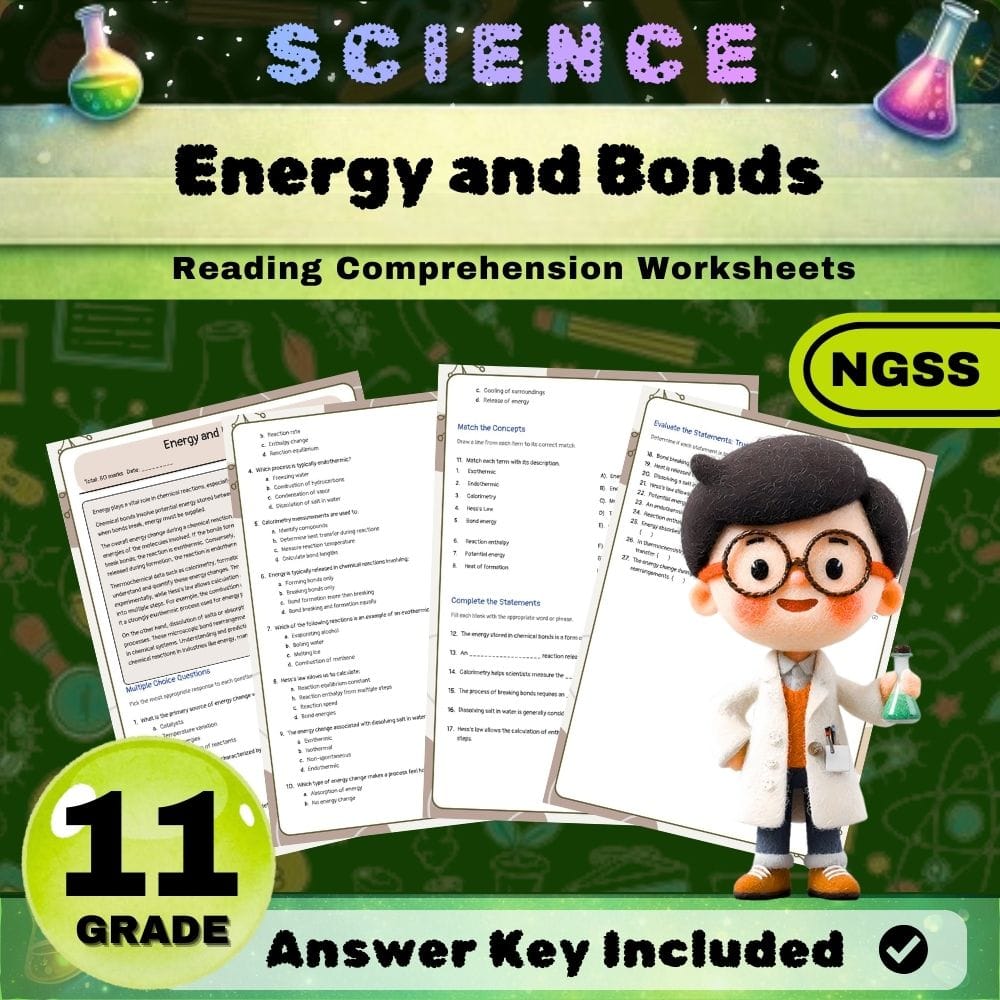
Grade 11 Science – Energy and Bonds Worksheet (NGSS) (PDF)
Created byMaple Path LearningLearning Objectives
- Explain how chemical bond formation and breaking involve changes in energy.
- Describe how thermochemical data and Hess's law relate to reaction enthalpy.
- Distinguish between exothermic and endothermic reactions with examples.
Also included in: Grade 11 Chemical Reactions & Bonding Science Lesson Bundle NGSS +1 more
Instant download
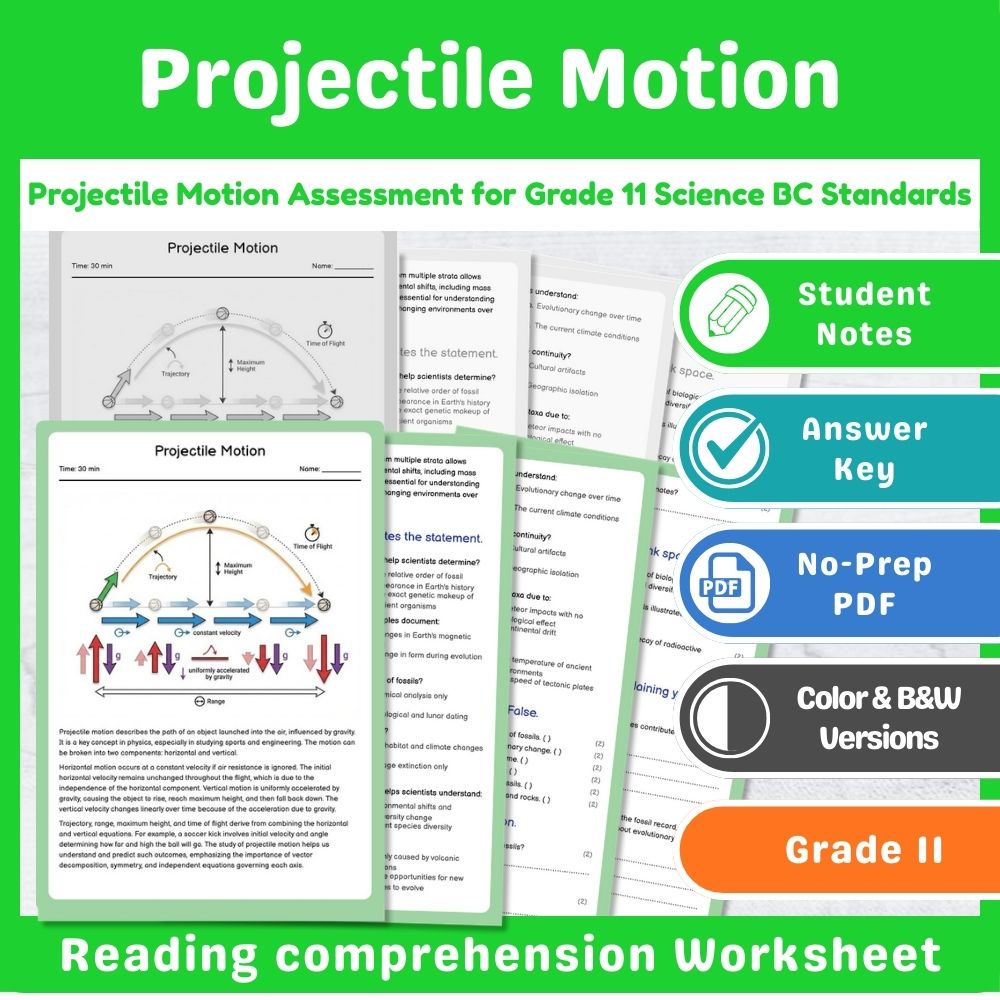
Projectile Motion Assessment for Grade 11 Science BC Standards
Created byPrism Point LearningLearning Objectives
- Understand the decomposition of projectile motion into horizontal and vertical components.
- Identify the effects of initial speed and launch angle on projectile trajectories.
- Apply equations of motion to calculate range, maximum height, and time of flight.
Also included in: Grade 11 Science Assessment Bundle | Classical Mechanics & Motion Topics
Instant download

Grade 11 Science – DNA Structure & Nucleotide Chemistry | Reading Worksheet
Created byBright Mind ResourcesLearning Objectives
- Identify the basic building blocks of DNA
- Understand the molecular structure of nucleotides
- Recognize the concept of antiparallel strands and double-helix geometry
Also included in: Grade 11 Metabolism & Genetics Science Daily Reading Lesson Bundle | Ontario +1 more
Instant download
About Grade 11 Science Worksheets
Browse 6,616 printable Grade 11 Science worksheets — ready-to-print PDFs with answer keys where available.
Each resource here is built by an independent educator and reviewed for quality. Worksheets print straight from PDF and suit classroom use, homework, or extra practice; most come with answer keys, and you can preview before purchasing.