
Grade 11 Science Worksheets
6,616 worksheets
Grade 11 Bond Polarity Worksheet | Alberta Chemistry Activity PDF
 Created byEvergreen Desk Education
Learning Objectives
- Explain how electronegativity differences create partial charges and bond dipoles.
- Predict whether a molecule is polar or nonpolar by combining bond dipoles using molecular geometry.
- Distinguish polar bonds from polar molecules and relate this to solubility and intermolecular interactions.
Instant download

Grade 11 Science | Renal Regulation Worksheet | TEKS Aligned
 Created byLumora Learning
Learning Objectives
- Describe the various mechanisms kidneys use to regulate fluid and electrolyte balance.
- Explain how hormonal control influences nephron functions and blood pressure.
- Identify renal clearance processes and their role in waste removal.
Instant download

Grade 11 Science | Disease Impacts Worksheet | TEKS Aligned
Created byLumora LearningLearning Objectives
- Understand how diseases and environmental factors affect organ system functions.
- Identify different pathways through which pathogens, toxins, and lifestyle factors cause damage.
- Analyze cascading effects of internal and external insults on homeostasis.
Instant download

Grade 11 Science | Bonding Models in Chemistry - Daily Reading Comprehension
 Created byCoral Reef Learning
Learning Objectives
- Understand the concept of ionic bonding and electron transfer.
- Identify characteristics of ionic bonds through potential-energy diagrams.
- Distinguish ionic, covalent, and metallic bonds using electronegativity differences.
Also included in: Chemistry Foundations Lesson Bundle: Grade 11 Science AP +1 more
Instant download

Grade 11 Science | Seafloor Spreading Worksheet | BC-Aligned
Created byLumora LearningLearning Objectives
- Understand the process of seafloor spreading and how it shapes ocean basins.
- Identify the evidence supporting seafloor spreading, including magnetic stripes and age of crust.
- Explain how bathymetry relates to seafloor features like mid-ocean ridges.
Also included in: Grade 11 Science | Earth Science Lesson Bundle Worksheets | BC-Aligned
Instant download
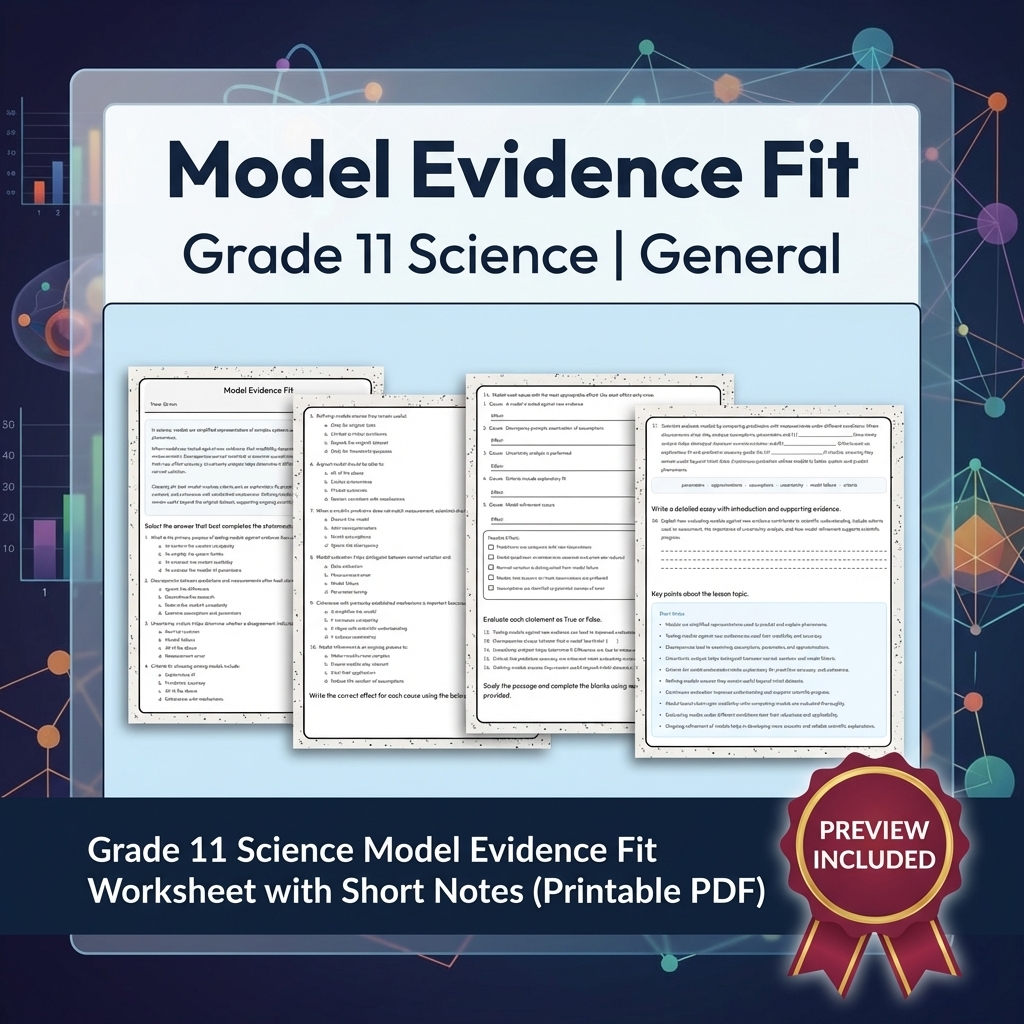
Grade 11 Science Model Evidence Fit Worksheet with Short Notes (Printable PDF)
 Created byMeadowlark Worksheets
Learning Objectives
- Understand how models are evaluated against evidence from new conditions.
- Identify criteria used to compare and refine scientific models.
- Analyze the role of uncertainty and assumptions in model testing.
Also included in: Grade 11 Uncertainty, Models & Evidence Science Lesson Bundle | General +1 more
Instant download
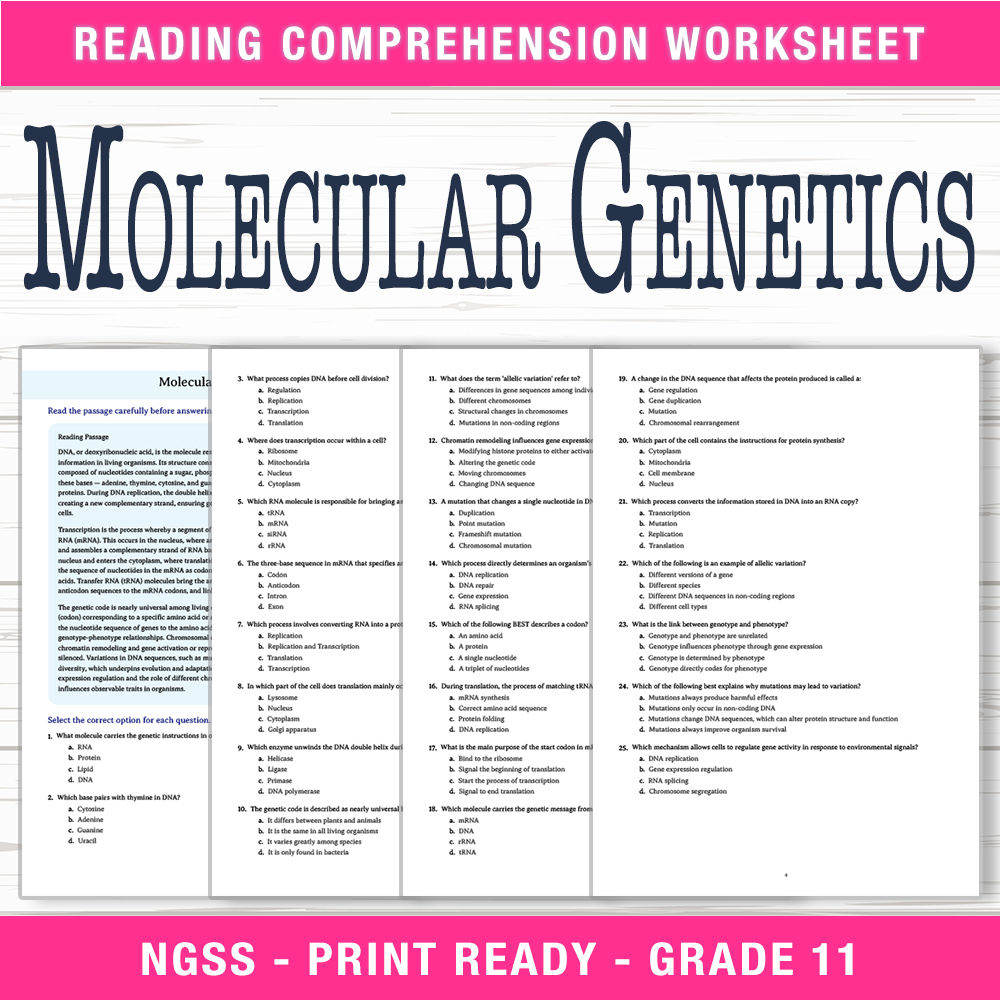
Grade 11 Science | Molecular Genetics Worksheet (PDF + Answer Key)
 Created byRiverstone Classroom
Learning Objectives
- Explain the process of DNA replication, transcription, and translation and their roles in gene expression.
- Describe the structure of DNA and how its nucleotide sequence determines amino acid sequences in proteins.
- Analyze the relationship between chromosomal organization, genetic code, and observable traits.
Instant download

Grade 11 Energy Transfer and Conservation Worksheet | Ontario Science
 Created byChalk and Compass
Learning Objectives
- Explain how energy can be transferred as work or heat and how these relate to changes in internal energy.
- Use conservation of energy to solve quantitative problems involving power, calorimetry, and work–energy.
- Describe energy budgets for closed and open systems and evaluate energy efficiency in transfers and conversions.
Also included in: Grade 11 Science Cross-Discipline Models of Energy, Matter & Force Lesson +1 more
Instant download

Grade 11 Science | Introduction to Phase Behavior - Daily Reading Comprehension
Created byCoral Reef LearningLearning Objectives
- Interpret phase diagrams to determine the state of matter under different temperature and pressure conditions.
- Understand the significance of vapor pressure curves and their relation to intermolecular forces.
- Connect concepts of colligative properties, vapor–liquid equilibrium, and molecular interactions.
Also included in: Chemistry Foundations Lesson Bundle: Grade 11 Science AP +1 more
Instant download

Grade 11 Science | Circular Motion Worksheet | AP Aligned
Created byLumora LearningLearning Objectives
- Explain the concepts of centripetal and tangential acceleration in uniform and nonuniform circular motion.
- Model the net forces involved in circular motion using radial and tangential components.
- Describe the kinematic equations in polar coordinates and relate acceleration vectors to the rate of change of velocity direction.
Also included in: Grade 11 Science | Physics Principles Science Custom Bundle | AP-Aligned
Instant download

Science Worksheet Trophic Levels Energy Flow | NGSSS Aligned Grade 11
JCreated byJ.S SheetsLearning Objectives
- Describe how energy flows through ecosystems across trophic levels.
- Explain why biomass decreases at higher trophic levels due to energy losses.
- Use energy pyramids to predict patterns in ecosystem productivity and predator populations.
Also included in: Grade 11 Living Systems Science lesson bundle worksheets | Florida (NGSSS) +1 more
Instant download

Titration Analysis Worksheet | Grade 11 Science Activities
 Created byPrism Point Learning
Learning Objectives
- Use titration data with molarity and reaction stoichiometry to calculate an unknown solution concentration
- Interpret the equivalence point to connect measured volumes with chemical change
- Apply algebraic relationships in titration calculations and evaluate reasonableness
Also included in: Grade 11 Solutions & Solubility Lesson Bundle | Alberta Science
Instant download

Grade 11 Science | Reaction Energy Pathways Worksheet | California Standards
Created byLumora LearningLearning Objectives
- Explain how conservation of energy determines energy flow during chemical reactions
- Differentiate exothermic and endothermic reactions using internal energy changes
- Connect observed thermal, light, and electrical effects to energy transfer pathways
Instant download

Momentum Conservation Worksheet for Grade 11 Science
JCreated byJ.S SheetsLearning Objectives
- Explain the concept of momentum as a vector quantity involving mass and velocity.
- Describe how momentum is conserved in isolated systems during collisions.
- Differentiate between elastic and inelastic collisions based on energy and momentum transfer.
Also included in: Energy and Particle Interactions Grade 11 Science Lesson Bundle +1 more
Instant download

Grade 11 Science – Circulation & Climate | Daily Reading Worksheet
 Created byBright Mind Resources
Learning Objectives
- Understand the concept of streamfunction plots and how they represent atmospheric circulation patterns.
- Interpret velocity fields to analyze wind flow and identify circulation cells.
- Relate atmospheric circulation features such as jet streams and trade winds to climate phenomena.
Also included in: Earth Systems Grade 11 Science Daily Reading Worksheets Lesson Bundle | AP +2 more
Instant download

Grade 11 Science | Solubility Product Concepts - Daily Reading Comprehension
Created byCoral Reef LearningLearning Objectives
- Understand the definition of the solubility product constant (Ksp).
- Interpret Ksp values qualitatively to determine solubility.
- Learn how to write the equilibrium expression for slightly soluble salts.
Also included in: Solutions and Solubility Lesson Bundle – Grade 11 Science Alberta +1 more
Instant download
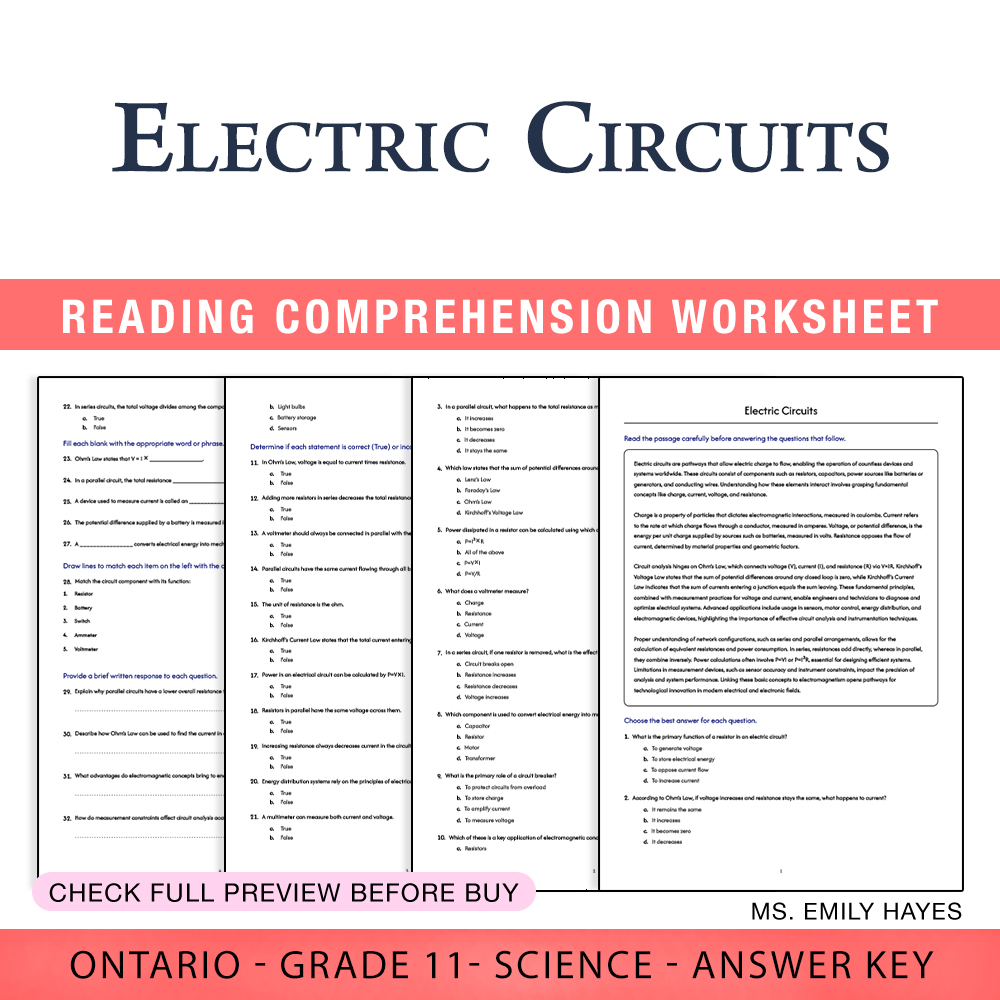
Grade 11 Science | Electric Circuits Worksheet (PDF + Answer Key)
 Created byCopper Leaf Classroom
Learning Objectives
- Understand the fundamental principles of electric charge, current, voltage, and resistance.
- Apply Ohm's law and Kirchhoff's rules to analyze simple and complex circuits.
- Differentiate between series and parallel circuit configurations and calculate total resistance and power.
Instant download

Grade 11 Energy Concepts Worksheet | Advanced Placement Practice PDF
 Created byClear Sky Classroom
Learning Objectives
- Define work, kinetic energy, potential energy, and energy conservation for a closed system
- Differentiate conservative and nonconservative forces and predict how they affect mechanical energy
- Interpret and construct energy bar charts using scalar energy concepts
Also included in: Grade 11 Physics Motion & Energy Science Lesson Bundle | Advanced Placement (AP) +1 more
Instant download

Circular Motion Worksheet | Grade 11 Science Activities
Created byPrism Point LearningLearning Objectives
- Explain how centripetal force and centripetal acceleration produce continuous changes in velocity direction during uniform circular motion
- Differentiate radial (inward) and tangential (along the motion) forces and connect them to changes in speed or direction
- Apply circular-motion ideas to real contexts such as banked turns and orbital motion approximations
Also included in: Grade 11 Science Lesson Bundle — Work, Energy & Motion (BC)
Instant download

Grade 11 Science – Understanding Acid & Base Constants | Daily Reading Worksheet
Created byBright Mind ResourcesLearning Objectives
- Define and explain the concepts of acid dissociation constant (Ka) and base dissociation constant (Kb).
- Understand the relationship between Ka, Kb, and Kw in conjugate acid-base pairs.
- Interpret how Ka and Kb influence the strength of acids and bases in everyday and environmental contexts.
Also included in: Grade 11 Acid-Base & Titration Science Daily Reading Lesson Bundle | Alberta +1 more
Instant download

Grade 11 Science Control Variables Worksheet (AP) – PDF
Created byEvergreen Desk EducationLearning Objectives
- Identify control variables and baseline conditions in comparative science studies to support causal claims.
- Select appropriate control treatments and minimize systematic bias when comparing experimental outcomes.
- Explain how control choices affect the strength of conclusions drawn from observed differences.
Also included in: Grade 11 Science Practices AP Framework Science Lesson Bundle Worksheets +1 more
Instant download

Grade 11 Science Worksheet – Light Reactions (Ontario) (PDF)
Created byEvergreen Desk EducationLearning Objectives
- Explain how photons are captured by pigment–protein complexes and how excitation energy reaches reaction centres.
- Describe the electron transport sequence in the light reactions and the roles of photosystems, plastoquinone, cytochrome b6f, and plastocyanin.
- Compare noncyclic and cyclic electron flow and relate both to ATP and NADPH production.
Also included in: Grade 11 Cellular Metabolism & Genetics Science Lesson Bundle: Ontario +1 more
Instant download

Titration Analysis Assessment | Alberta Grade 11 Science Standards
Created byPrism Point LearningLearning Objectives
- Understand the mathematical principles behind titration calculations involving molarity and reaction stoichiometry.
- Apply algebraic manipulation to determine unknown solution concentrations in titration experiments.
- Interpret equivalence point relationships and their applications in water quality control and reagent standardization.
Also included in: Grade 11 Solutions and Solubility Science Lesson Bundle | Alberta Framework +1 more
Instant download

Grade 11 Worksheet B: Microscopic Energy Practice | NGSS PDF
Created byClear Sky ClassroomLearning Objectives
- Explain how microscopic particle kinetic energy and interparticle potential energy combine to produce internal energy
- Relate temperature to average microscopic kinetic energy and predict how particle motion changes with temperature
- Describe how energy storage mechanisms differ in gases (translational/kinetic), solids (vibrational), and collisions (energy redistribution)
Also included in: Grade 11 Energy & Heat Transfer Science Lesson Bundle (Worksheet B) | NGSS +1 more
Instant download

Grade 11 Energy Accounting Daily Reading Worksheet | NGSS Science Activity
 Created byBRIGHT PATH RESOURCES
Learning Objectives
- Explain how energy accounting uses systems and boundaries to track energy transfers
- Identify when energy is transferred as heat, work, or stored as gravitational or elastic energy
- Use conservation of total energy to check whether a computational model is consistent with data
Also included in: Energy Grade 11 Science Daily Reading Worksheets Lesson Bundle | NGSS +1 more
Instant download

Grade 11 Science – Newton's Second Law & Force | Daily Reading Worksheet
Created byBright Mind ResourcesLearning Objectives
- Identify forces acting on objects
- Describe how forces affect motion
- Understand the relationship between force, mass, and acceleration
Also included in: Grade 11 Energy Science Daily Reading Lesson Bundle | California Standards +1 more
Instant download

Concentration Calculations Worksheet | Grade 11 Science Practice
Created byPrism Point LearningLearning Objectives
- Determine hydrogen ion concentration from pH and hydroxide ion concentration from pOH using logarithmic relationships
- Use Kw to interrelate [H+], [OH-], and pH/pOH in water samples
- Apply correct significant figures, units, and conversions when reporting aqueous concentration results
Instant download

Grade 11 Science | Conceptual Modeling in Science - Daily Reading Comprehension
Created byCoral Reef LearningLearning Objectives
- Understand what a conceptual model is and its purpose in science.
- Identify key components, assumptions, and scope of conceptual models.
- Differentiate between discrete and continuous formulations of models.
Also included in: Science Practices Reading Comprehension | Grade 11 Science AP Lesson Bundle +1 more
Instant download
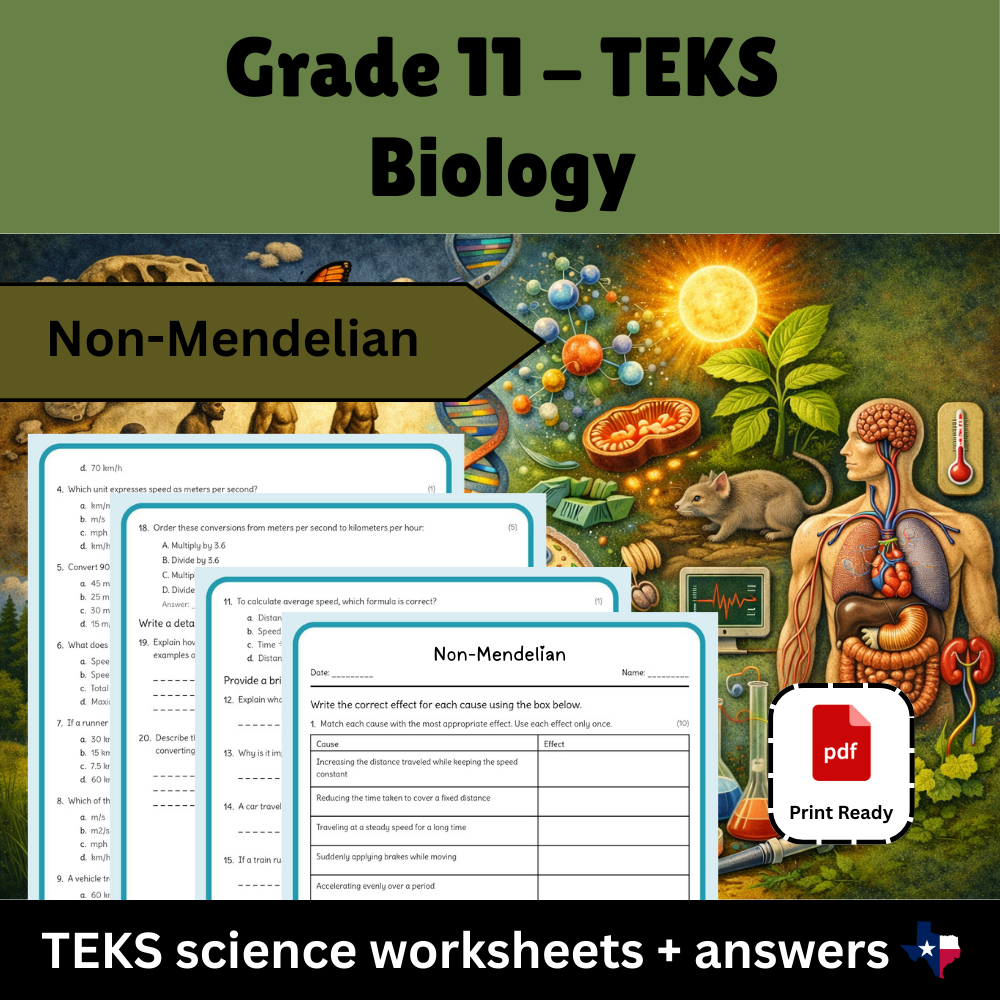
Grade 11 Science – Non-Mendelian Patterns Worksheet + Answer Key | TEKS Aligned
Created byBright Mind ResourcesLearning Objectives
- Explain different non-Mendelian inheritance patterns such as incomplete dominance and codominance.
- Describe the roles of multiple alleles, polygenic inheritance, and pleiotropy in trait variation.
- Understand how environmental factors influence phenotypic expression.
Also included in: Grade 11 Science DNA & Genetics Unit Worksheet Pack+ Answer Key (TEKS-Aligned) +2 more
Instant download

Grade 11 Science - Non-Mendelian Inheritance Daily Worksheet with Answer Key
JCreated byJ.S SheetsLearning Objectives
- Understand key concepts related to Science
- Apply knowledge through practice questions
- Demonstrate comprehension of the material
Also included in: Grade 11 Science Lesson Bundle TEKS | Molecular Genetics & Inheritance +1 more
Instant download

Solution Basics Worksheet | Grade 11 Science Activities
Created byPrism Point LearningLearning Objectives
- Define solute, solvent, and solution using homogeneous-mixture language.
- Explain how microscopic interactions drive dissolution and affect solution properties.
- Use and interpret common concentration units and identify types of solutions.
Also included in: Grade 11 Solutions & Solubility Lesson Bundle | Alberta Science
Instant download

Grade 11 Feedback Control Loops Worksheet | General Practice PDF
Created byClear Sky ClassroomLearning Objectives
- Differentiate negative feedback and positive feedback in feedback control loops
- Explain how sensors, controllers, and effectors work together to maintain or change internal conditions
- Use real-world examples to predict whether a feedback loop will stabilize or amplify a change
Instant download

Bonding and Properties Worksheet Pack | Grade 11 Science Activities
Created byPrism Point LearningLearning Objectives
- Compare ionic, covalent, and metallic bonding using particle-level ideas
- Predict physical properties such as melting point, conductivity, hardness, and solubility from bonding type
- Use real-world examples (e.g., salt for winter, steel in infrastructure, diamond/graphite materials) to justify property trends
Also included in: VSEPR & Chemical Bonding Lesson Bundle | Grade 11 Science | Alberta
Instant download

Grade 11 Science – DNA Structure & Function | Daily Reading Worksheet
Created byBright Mind ResourcesLearning Objectives
- Identify the basic components of DNA
- Understand the structure of the double helix
- Recognize base-pairing rules and their significance
Also included in: Grade 11 DNA Replication & Genetics Science Daily Reading Lesson Bundle | TEKS +2 more
Instant download

Grade 11 Science – Electromagnetic Spectrum & Radiation | Reading Worksheet
Created byBright Mind ResourcesLearning Objectives
- Identify different parts of the electromagnetic spectrum based on wavelength and energy.
- Understand the relationship between wavelength, frequency, and energy of electromagnetic radiation.
- Recognize how materials respond differently to various parts of the spectrum.
Also included in: Grade 11 Energy Science Daily Reading Lesson Bundle | California Standards +1 more
Instant download

Homeostasis Feedback Worksheet | Grade 11 Biology Regulation Activity
Created byPrism Point LearningLearning Objectives
- Explain how sensing, signaling, and effectors work together in feedback mechanisms to maintain homeostasis.
- Identify whether a change triggers negative or positive feedback and predict its overall effect on internal conditions.
- Describe how dynamic feedback loops support stable conditions for cell function.
Instant download

Grade 11 Science – Atmospheric Circulation & Weather Patterns | Daily Reading Worksheet
Created byBright Mind ResourcesLearning Objectives
- Identify the major wind belts and describe their causes
- Explain how Earth's rotation influences wind patterns
- Understand the global circulation cells and their role in heat distribution
Also included in: Earth and Space Science Grade 11 Science Lesson Bundle | Florida NGSSS +1 more
Instant download

Synthesis Reasoning Worksheet | Grade 11 AP Science Practice Skills
Created byPrism Point LearningLearning Objectives
- Integrate quantitative data, model predictions, and empirical summaries to compare competing scientific explanations.
- Use design constraints and uncertainty quantification to justify which model or explanation is more reliable.
- Evaluate model validation results and evidence hierarchies to support defensible conclusions.
Instant download

Grade 11 Science – Cell Architecture Worksheet (Ontario Standards) PDF
Created byEvergreen Desk EducationLearning Objectives
- Compare prokaryotic and eukaryotic cell architecture using major structural features.
- Explain how organelles and cytoskeletal structures support metabolism and transport.
- Analyze how scale and membrane area-to-volume constraints influence cellular specialization.
Also included in: Grade 11 Cellular Metabolism & Genetics Science Lesson Bundle: Ontario +1 more
Instant download

Erosion and Sedimentation Worksheet | Grade 11 Science Activities
Created byPrism Point LearningLearning Objectives
- Explain how weathering produces sediment and dissolved material that can be moved by Earth systems.
- Describe the processes of transport and deposition and how they contribute to landscape change.
- Connect sediment compaction and diagenesis to the formation of sedimentary rock.
Instant download

Grade 11 Science | Atomic Radius & Trends - Daily Reading Comprehension
Created byCoral Reef LearningLearning Objectives
- Understand and analyze periodic trends in atomic radius across periods and groups.
- Explain the factors influencing atomic size in elements.
- Predict trends in atomic radius based on effective nuclear charge and electron shielding.
Also included in: Chemistry Foundations Lesson Bundle: Grade 11 Science AP +1 more
Instant download

Grade 11 Science | Layers of the Atmosphere - Daily Reading Comprehension
Created byCoral Reef LearningLearning Objectives
- Identify the main layers of the Earth's atmosphere.
- Describe the composition and characteristics of each atmospheric layer.
- Understand the importance of pressure, temperature, and circulation in the atmosphere.
Also included in: Earth and Space Sciences Lesson Bundle | Grade 11 Science AP +1 more
Instant download

Molecular Phylogeny Assessment for Grade 11 Science TEKS Standards
Created byPrism Point LearningLearning Objectives
- Understand the principles of molecular phylogeny and how DNA, RNA, and protein sequences are used to infer evolutionary relationships.
- Describe the processes of sequence alignment and how models of molecular evolution account for substitution rates.
- Explain the concept of molecular clocks and how they are calibrated using fossil or biogeographic data.
Also included in: Grade 11 Evolution, Speciation & Phylogeny Science Lesson Bundle | TEKS
Instant download

Photosynthesis Worksheet | Grade 11 Science Activities
Created byPrism Point LearningLearning Objectives
- Explain how the light-dependent reactions transform light energy into chemical energy (ATP and NADPH).
- Describe how the Calvin cycle uses ATP and NADPH to fix CO2 into carbohydrates.
- Connect electron flow and proton gradients in the thylakoid membranes to energy coupling in photosynthesis.
Also included in: Grade 11 Science Biology Cells, Genetics & Evolution Lesson Bundle | BC
Instant download
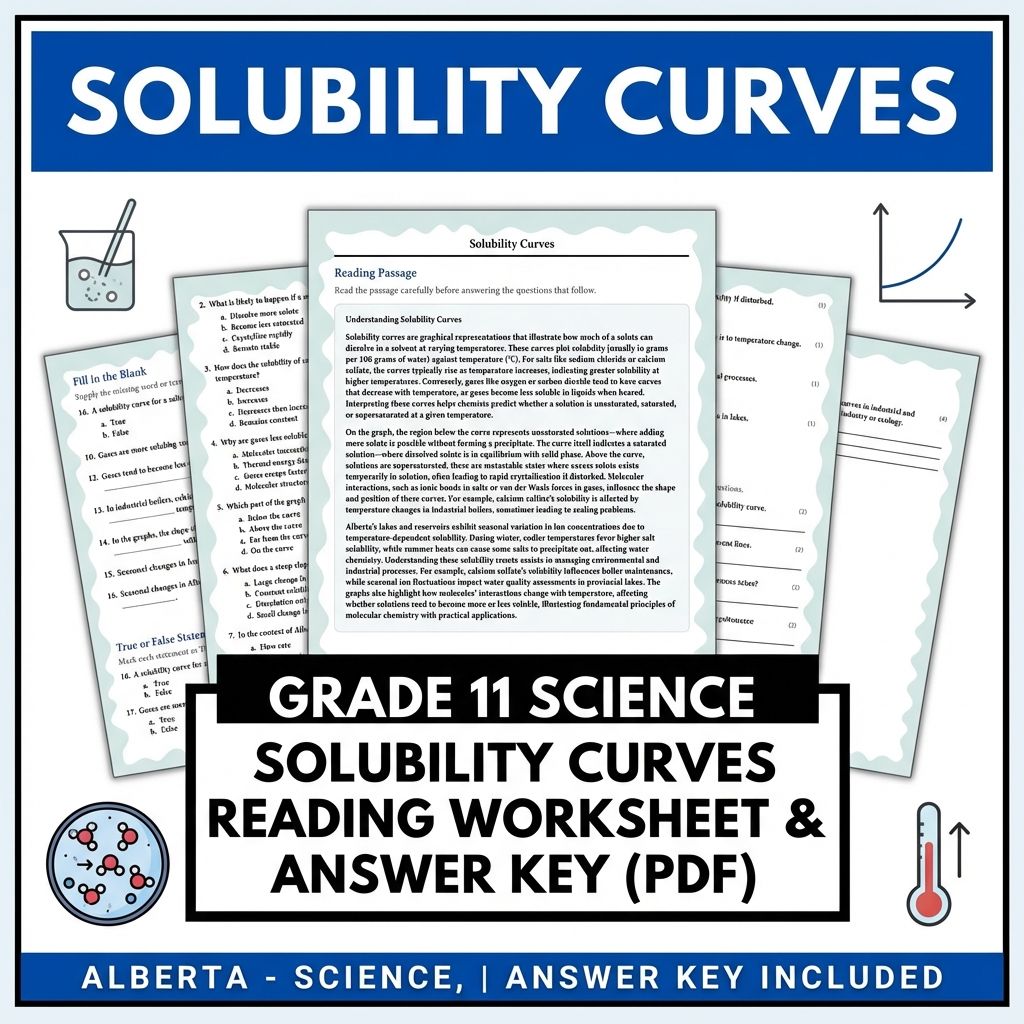
Grade 11 Science | Solubility Curves Reading Worksheet & Answer Key (PDF)
JCreated byJ.S SheetsLearning Objectives
- Understand how to interpret solubility curves for salts and gases.
- Identify regions of unsaturated, saturated, and supersaturated solutions on a graph.
- Connect graphical trends to molecular interactions affecting solubility.
Instant download

Grade 11 Science – Introduction to Mendelian Patterns | Daily Reading Worksheet
Created byBright Mind ResourcesLearning Objectives
- Understand the fundamental principles of Mendelian inheritance.
- Identify dominant and recessive traits in genetic crosses.
- Differentiate between genotype and phenotype ratios.
Also included in: Grade 11 Biology Science Daily Reading Worksheets lesson bundle | BC +1 more
Instant download
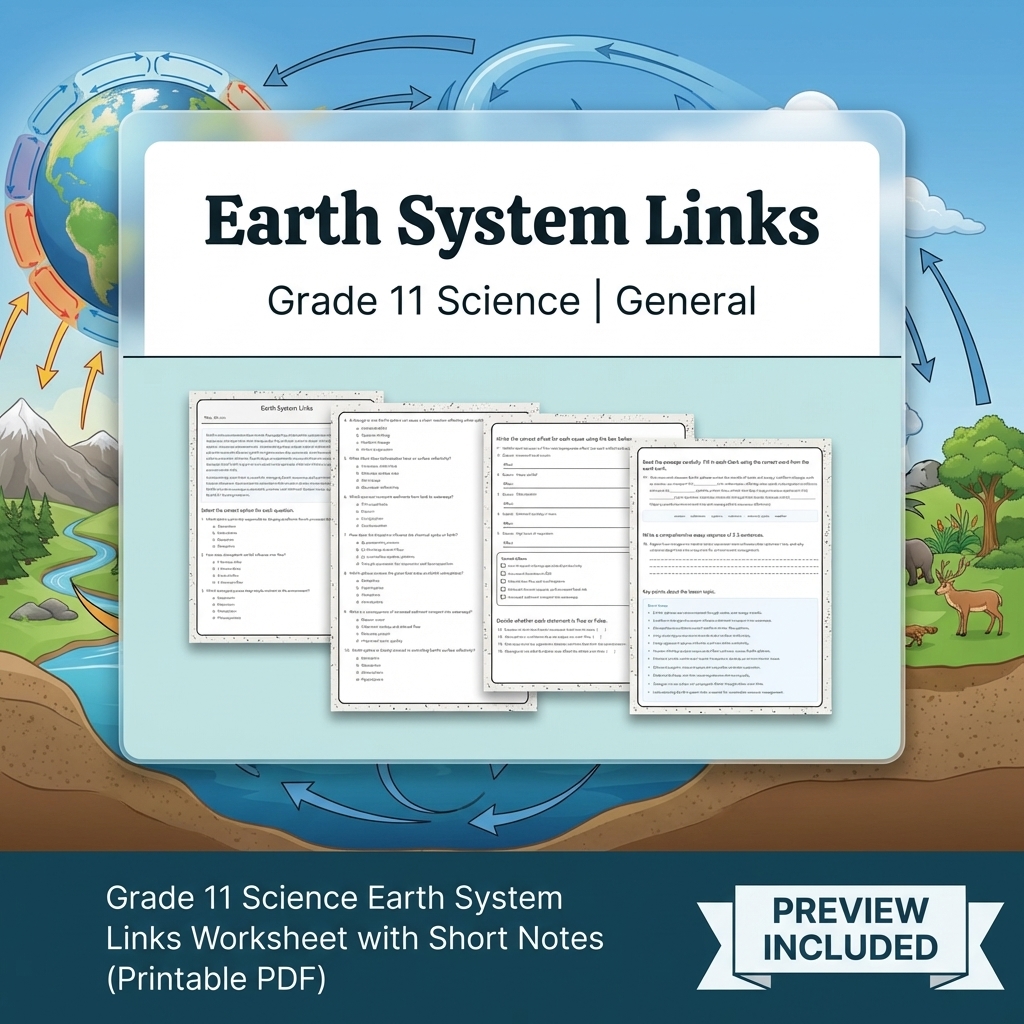
Grade 11 Science Earth System Links Worksheet with Short Notes (Printable PDF)
Created byMeadowlark WorksheetsLearning Objectives
- Understand how Earth's spheres interact through matter and energy transfer.
- Identify cause-and-effect relationships among geosphere, hydrosphere, atmosphere, and biosphere.
- Analyze how landform changes influence erosion and sediment transport.
Also included in: Grade 11 Evidence-Based Science Lesson Bundle | General Framework +1 more
Instant download

Grade 11 Science – Genetic Mutation & DNA | Daily Reading Worksheet
Created byBright Mind ResourcesLearning Objectives
- Understand the concept of genetic mutations and their types
- Identify different types of mutations based on description
- Recognize the causes and effects of mutations on DNA
Also included in: Grade 11 Biology Science Daily Reading Worksheets lesson bundle | BC +1 more
Instant download
About Grade 11 Science Worksheets
Browse 6,616 printable Grade 11 Science worksheets — ready-to-print PDFs with answer keys where available.
Each resource here is built by an independent educator and reviewed for quality. Worksheets print straight from PDF and suit classroom use, homework, or extra practice; most come with answer keys, and you can preview before purchasing.