
Grade 11 Science Worksheets
6,616 worksheets
Wave Reflection and Refraction Worksheet for Grade 11 Science
JCreated byJ.S SheetsLearning Objectives
- Explain how reflection preserves frequency while reversing wave direction at a boundary.
- Describe how refraction changes wave speed and wavelength while keeping frequency constant.
- Compare ray and wave representations to predict how light or sound paths change across media.
Also included in: Grade 11 Matter, Motion, and Energy Science Lesson Bundle: General +1 more
Instant download

Grade 11 Science | Kinematics Basics Worksheet | BC-Aligned
 Created byLumora Learning
Learning Objectives
- Define and distinguish between position, displacement, speed, and velocity.
- Explain the concepts of instantaneous velocity and acceleration.
- Calculate average speed and velocity from given data.
Also included in: Grade 11 Science | Physics Custom Bundle | BC-Aligned Worksheet Set
Instant download

Grade 11 Science – Impact Mitigation Tools Earth Systems | Reading Worksheet
 Created byBright Mind Resources
Learning Objectives
- Understand how flood barriers and management systems reduce flood risks.
- Identify different types of flood mitigation tools and their functions.
- Analyze the effectiveness and environmental impacts of mitigation strategies.
Also included in: Earth Systems Grade 11 Science Daily Reading Worksheets Bundle | CA Standards +1 more
Instant download
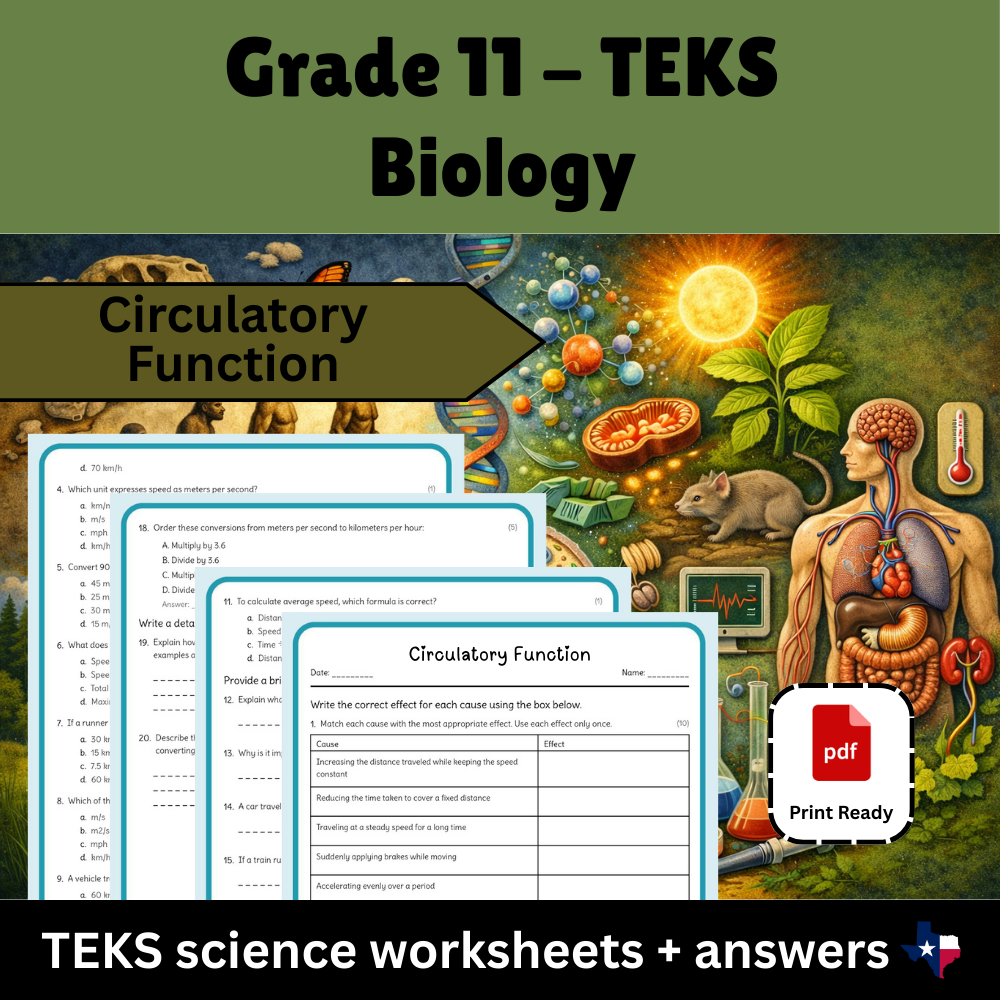
Grade 11 Science | Circulatory System Function Worksheet (PDF) - TEKS Aligned
Created byBright Mind ResourcesLearning Objectives
- Describe the main components and functions of the circulatory system.
- Explain how blood flow is regulated by pressure gradients and vessel resistance.
- Identify the roles of blood plasma proteins and cellular elements in clotting and immune defense.
Also included in: Grade 11 Science: Human Body & Homeostasis Unit Worksheet Bundle (TEKS Aligned) +2 more
Instant download

Grade 11 Science | Force Models Worksheet (AP Standards) (PDF)
 Created byEvergreen Desk Education
Learning Objectives
- Explain force as an interaction and use free-body diagrams (FBDs) to model forces on an object.
- Apply Newton’s laws to relate net force, mass, and acceleration, including correct use of sign and direction.
- Distinguish contact forces from long-range forces and select appropriate force models (friction, normal, tension, gravity).
Also included in: Grade 11 Physics Principles Science Lesson Bundle | Advanced Placement (AP) +1 more
Instant download
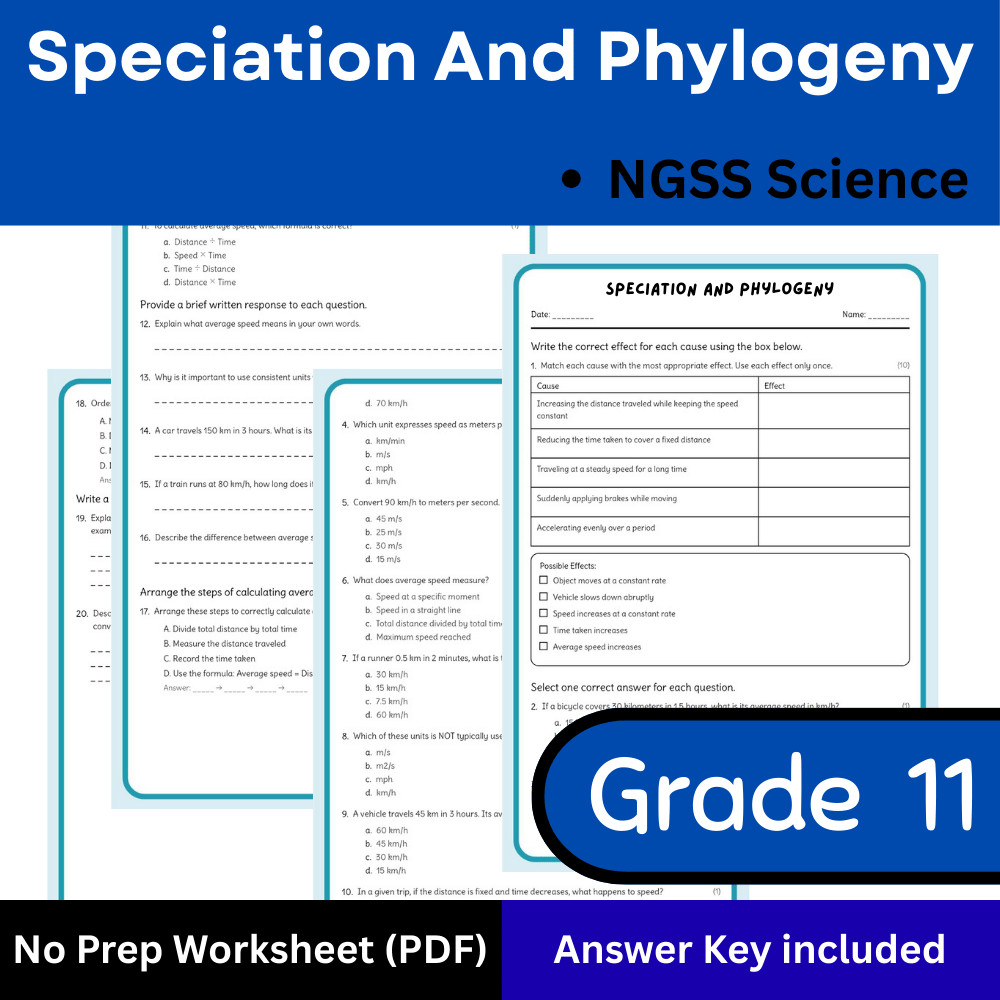
Grade 11 Science | Speciation and Phylogeny Worksheet (Answer Key) NGSS Aligned
Created byBright Mind ResourcesLearning Objectives
- Explain the mechanisms leading to the formation of new species, including geographic isolation and reproductive barriers.
- Differentiate between modes of speciation such as allopatric and sympatric.
- Interpret phylogenetic trees constructed from morphological and molecular data.
Instant download

Grade 11 Science | Inference Design Worksheet | AP Aligned
Created byLumora LearningLearning Objectives
- Understand how design decisions influence the robustness of causal inference in ecological and material testing contexts.
- Identify key techniques such as power analysis, blocking, repeated measures, and effect-size estimation.
- Evaluate trade-offs between sample size, measurement precision, and practical constraints in experimental design.
Instant download

Grade 11 Science | Community Interactions in Ecosystems - Reading Comprehension
 Created byCoral Reef Learning
Learning Objectives
- Understand the concept of mutualism and its role in ecosystems.
- Identify examples of mutualistic relationships among species.
- Analyze how mutualism benefits both species involved.
Instant download
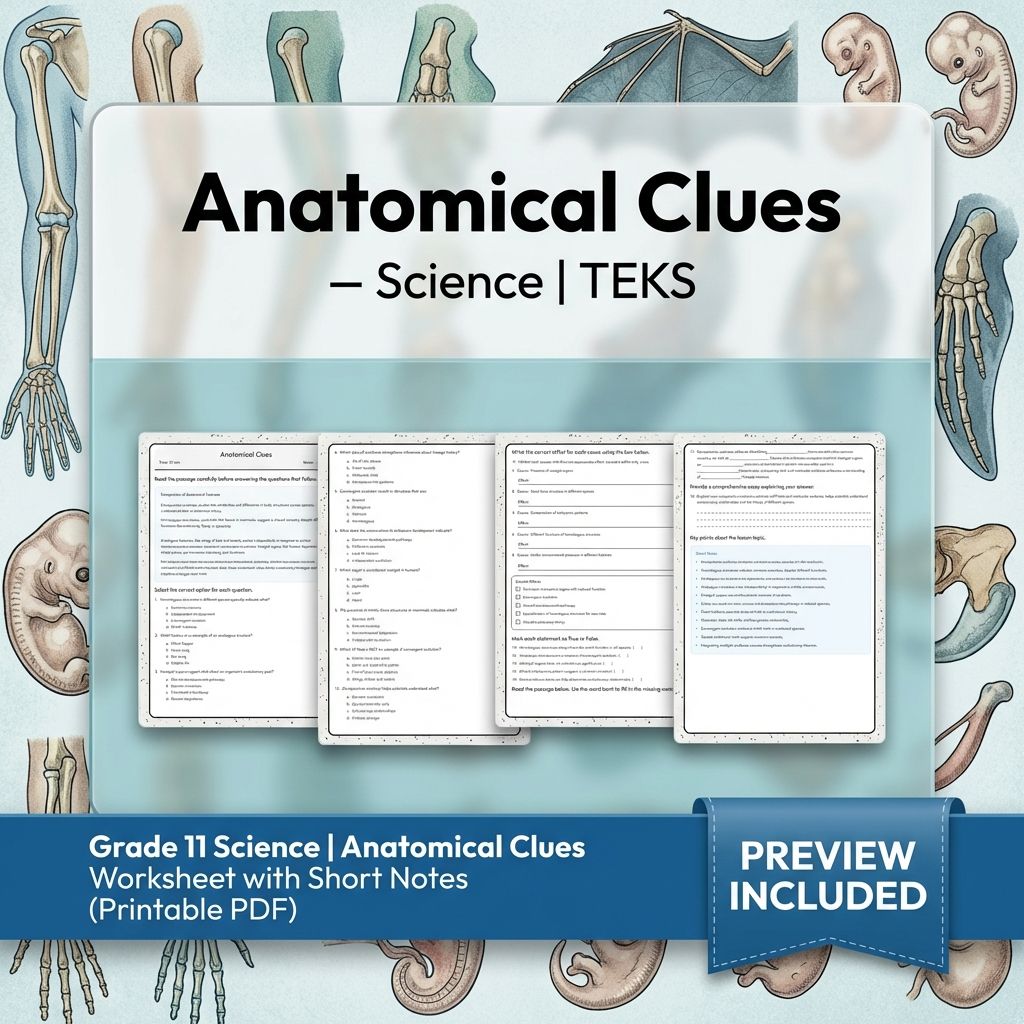
Grade 11 Science | Anatomical Clues Worksheet with Short Notes (Printable PDF)
 Created byMeadowlark Worksheets
Learning Objectives
- Understand how comparative anatomy reveals evolutionary relationships.
- Identify homologous and analogous structures in different species.
- Explain the significance of vestigial organs and embryonic patterns.
Instant download

Grade 11 Science – Energy Conservation & Mechanical Systems | Reading Worksheet
Created byBright Mind ResourcesLearning Objectives
- Understand the concept of mechanical energy conservation
- Identify potential and kinetic energy and their transformations
- Recognize factors affecting energy transfer, such as friction and air resistance
Also included in: Motion & Forces Grade 11 Science Daily Reading Worksheets Lesson Bundle | BC +1 more
Instant download

Mass Conservation in Chemical Reactions Worksheets | Grade 11 Chemistry
 Created bySunny Desk Resources
Learning Objectives
- Explain conservation of mass during chemical transformations
- Justify atom conservation using balanced symbolic equations
- Interpret mass accounting outcomes from chemical equations
Also included in: Stoichiometry & Chemical Reactions Lesson Bundle — Grade 11 Science Alberta +1 more
Instant download

Grade 11 Science | Photoelectric Evidence Worksheet Elena | California Standards
Created byLumora LearningLearning Objectives
- Explain how photon energy and the work function determine whether electrons are emitted in the photoelectric effect.
- Interpret how light intensity and light frequency affect photoelectric current and the maximum kinetic energy of emitted electrons.
- Use the relationships among Kmax, stopping potential, and cutoff frequency to connect theory with experimental observations.
Instant download

Grade 11 Evaluating Biological Evidence Worksheet | Practice & PDF
 Created byClear Sky Classroom
Learning Objectives
- Evaluate biological claims by checking whether observations and biomarkers match predictions from models and mechanisms.
- Analyze how confounding variables and alternative explanations can weaken evidence in biological studies.
- Assess model assumptions and limitations when interpreting datasets related to inheritance, selection, or homeostasis.
Instant download

Interdisciplinary Solutions Worksheet | Ontario Grade 11 Science Practice
JCreated byJ.S SheetsLearning Objectives
- Translate quantitative findings between disciplinary languages by defining variables, units, and assumptions clearly.
- Use graphical and mathematical representations to communicate scientific claims and explain uncertainty.
- Critique the quality of evidence by comparing alternative models and identifying limitations and sensitivity.
Instant download

Grade 11 Science | Community Structure Worksheet | TEKS Aligned
Created byLumora LearningLearning Objectives
- Understand the key concepts of community structure including species composition, abundance, and spatial arrangement.
- Explain the impact of biodiversity metrics like species richness, evenness, and keystone species on ecosystem stability.
- Describe how successional stages influence community development after disturbances.
Instant download

Evidence of Evolution Worksheet | NGSS Grade 11 Science MCQ Practice
 Created byCedar Grove Learning
Learning Objectives
- Understand how fossil records support common ancestry and evolution.
- Identify evidence from comparative anatomy, molecular data, and biogeography.
- Explain how multiple lines of evidence produce coherent evolutionary explanations.
Instant download

Ionic Strength Science Worksheet for Grade 11 | Alberta Standards
Created byCoral Reef LearningLearning Objectives
- Understand the concept of ionic strength and its role in solutions.
- Explain how high ionic strength affects activity coefficients and solubility.
- Discuss the implications of ionic strength in natural waters and industrial processes.
Instant download

Grade 11 Science – Atomic Structure & Elements | Daily Reading Worksheet
Created byBright Mind ResourcesLearning Objectives
- Identify protons, neutrons, and electrons in an atom
- Understand the basic structure of an atom and its parts
- Recognize the roles of electrons, shells, and valence electrons
Also included in: Grade 11 VSEPR & Mol. Geometry Science Daily Reading Lesson Bundle | Alberta +1 more
Instant download

Grade 11 Science | Earth System Links - Daily Reading Comprehension
Created byCoral Reef LearningLearning Objectives
- Identify the four main Earth spheres: geosphere, hydrosphere, atmosphere, and biosphere.
- Understand how the Earth's spheres interact through matter and energy transfer.
- Explain how landforms influence erosion and sediment transport.
Instant download

Solutions and Solubility Worksheets: Concentration & Components Grade 11
Created bySunny Desk ResourcesLearning Objectives
- Define solute and solvent within a solution
- Classify solutions by solute and solvent states
- Describe concentration using common representation units
Also included in: Grade 11 Science Alberta Solubility & Solutions Lesson Bundle: Ksp & Equilibria +1 more
Instant download
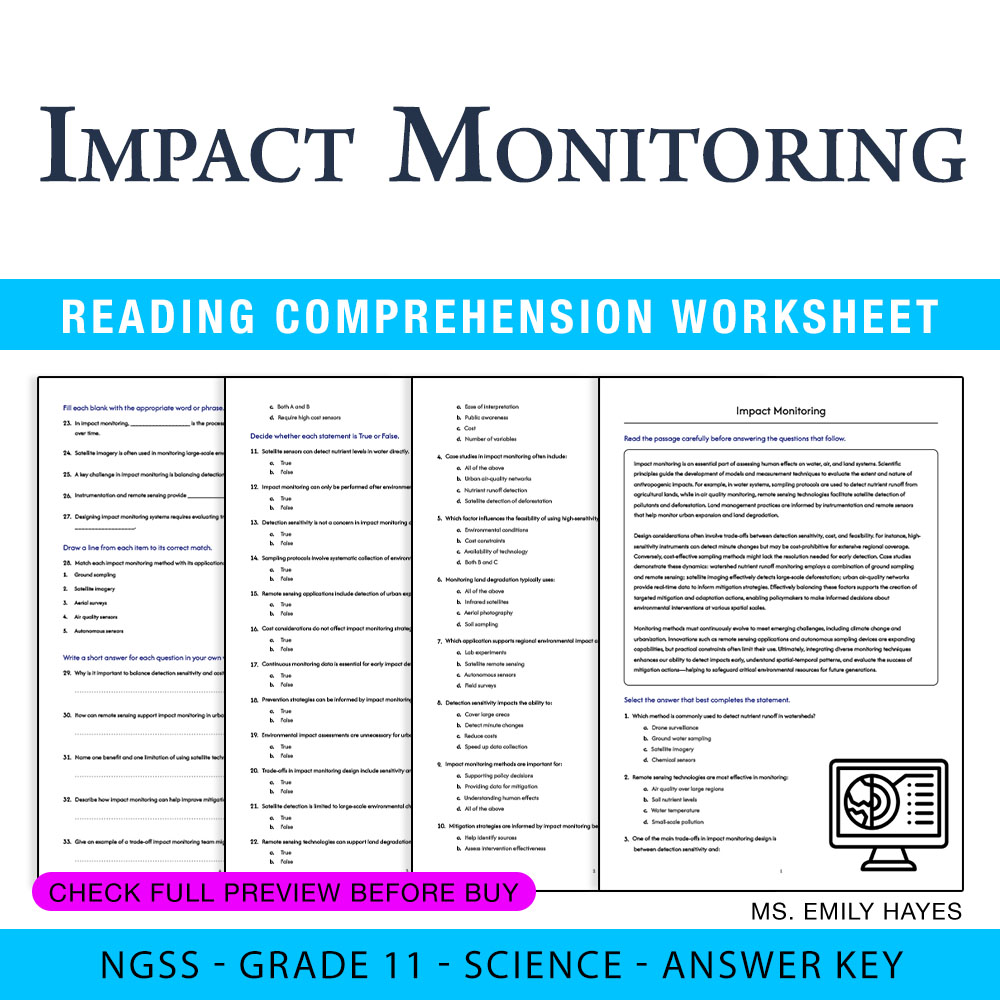
Grade 11 Science | Impact Monitoring Worksheet (PDF+ Answer Key)
 Created byCopper Leaf Classroom
Learning Objectives
- Describe scientific principles used in monitoring environmental systems affected by human activity.
- Compare methods such as instrumentation, sampling protocols, and remote sensing for impact assessment.
- Analyze case studies involving water, air, and land monitoring to evaluate effectiveness and trade-offs.
Instant download

Grade 11 Science | Hazard Management Earthquake Risks - Reading Comprehension
Created byCoral Reef LearningLearning Objectives
- Identify areas prone to earthquakes based on geological features
- Understand risk factors associated with earthquakes and hazards
- Learn techniques for assessing earthquake susceptibility and designing mitigation measures
Instant download

Grade 11 Science | Atmospheric Circulation Worksheet | NGSSS Assessment
Created byLumora LearningLearning Objectives
- Explain how uneven solar heating creates pressure gradients that drive atmospheric circulation.
- Describe how the Coriolis effect influences wind direction and large-scale wind belts.
- Compare how global circulation cells transport heat and affect humidity, precipitation, and storm-track locations.
Instant download

Grade 11 Science Worksheet | Energy Balance & Climate AP Standards (PDF)
Created byEvergreen Desk EducationLearning Objectives
- Explain Earth’s global energy balance using incoming solar radiation, outgoing longwave radiation, and the role of albedo.
- Interpret how radiative forcing changes the top-of-atmosphere energy budget and contributes to climate variability and long-term change.
- Describe feedbacks (including ice-albedo feedback and water-vapor feedback) that can amplify warming, especially near the poles.
Also included in: Grade 11 Earth and Space Science Lesson Bundle for Advanced Placement (AP) +1 more
Instant download
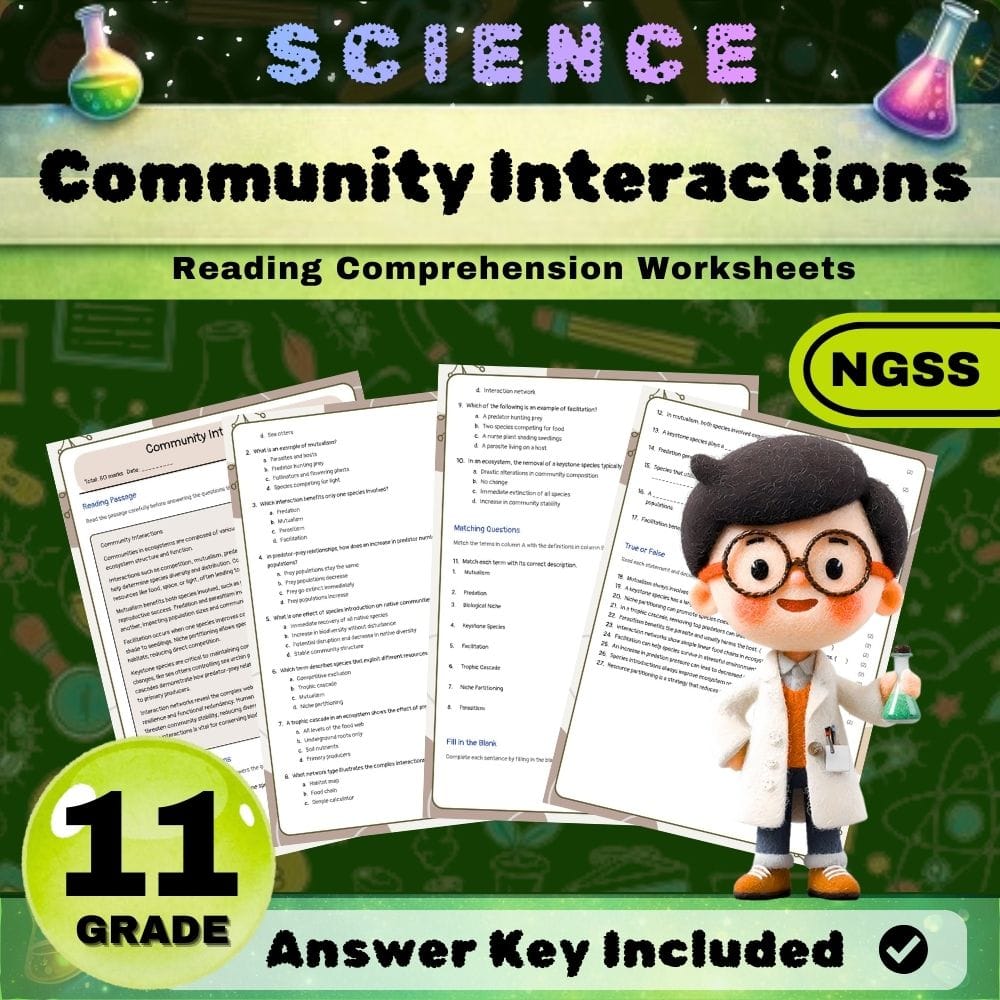
Grade 11 Science | Community Interactions Worksheet (NGSS PDF)
 Created byMaple Path Learning
Learning Objectives
- Understand different types of species interactions such as competition, mutualism, predation, parasitism, and facilitation.
- Analyze how species interactions influence community structure, diversity, and stability.
- Evaluate the roles of keystone species, trophic cascades, and interaction networks in ecosystems.
Also included in: Grade 11 Ecosystem Dynamics and Energy Flow Science Lesson Bundle | NGSS +1 more
Instant download

Grade 11 Graphical Literacy Worksheet | Practice & Assessment PDF
Created byClear Sky ClassroomLearning Objectives
- Analyze how graph design choices (axes, scales, bin widths, and labeling) influence scientific interpretation of patterns and trends.
- Compare common quantitative graphs (scatterplots, histograms, box plots, and line graphs) and match each to what it best communicates.
- Critique graphs for accuracy and completeness by checking units, scales, normalization, uncertainty, and annotation conventions.
Also included in: Grade 11 Scientific Reasoning & Modeling Bundle, Advanced Placement (AP) +1 more
Instant download

Grade 11 Science – Solubility Curves & Saturation | Daily Reading Worksheet
Created byBright Mind ResourcesLearning Objectives
- Interpret solubility graphs for salts and gases
- Identify regions of saturated, unsaturated, and supersaturated solutions
- Explain how temperature affects solubility
Also included in: Grade 11 Solutions Science Daily Reading Worksheets lesson bundle | Alberta +1 more
Instant download

Grade 11 Science | Molecular Techniques Worksheet | TEKS Aligned
Created byLumora LearningLearning Objectives
- Understand key molecular techniques used in genetics and genomics research.
- Identify the purpose and process of methods like PCR, sequencing, and gel electrophoresis.
- Explain how different techniques detect genetic variation and expression.
Instant download

Free-Body Diagrams Worksheet | Grade 11 Science Practice
 Created byPrism Point Learning
Learning Objectives
- Describe what a free-body diagram (FBD) shows and why isolating an object is useful for solving motion problems.
- Identify and label common forces (gravity, normal, tension, friction) in different scenarios and choose appropriate vector directions.
- Use net force ideas to determine whether an object is in equilibrium or accelerating.
Also included in: Grade 11 Science Lesson Bundle — Work, Energy & Motion (BC)
Instant download

Bond Polarity Worksheet | Grade 11 Science Activities
Created byPrism Point LearningLearning Objectives
- Explain how electronegativity differences create polar covalent bonds with partial charges.
- Distinguish polar bonds from polar molecules by using bond dipoles and molecular dipole vectors.
- Predict how molecular polarity affects interactions such as solubility and intermolecular forces.
Also included in: VSEPR & Chemical Bonding Lesson Bundle | Grade 11 Science | Alberta
Instant download

Ionic vs Covalent Bonding and Material Properties Worksheets Grade 11
 Created byBRIGHT PATH RESOURCES
Learning Objectives
- Explain how electron transfer creates ionic bonds in substances
- Explain how electron sharing creates covalent bonds
- Compare ionic lattices with directional covalent bonding
Also included in: Physical Science Worksheets Bundle | Grade 11 Science | Waves & Matter +4 more
Instant download

Grade 11 Science | Scientific Reasoning & Experimental Design - Daily Reading
Created byCoral Reef LearningLearning Objectives
- Understand the basic principles of causal inference in scientific research.
- Identify various design decisions that support robust causal conclusions, such as power analysis, blocking, and repeated measures.
- Recognize how trade-offs between sample size, measurement precision, and practical constraints influence experimental outcomes.
Also included in: Science Practices Reading Comprehension | Grade 11 Science AP Lesson Bundle +1 more
Instant download

Percent Yield Assessment | Alberta Standards Grade 11 Science
Created byPrism Point LearningLearning Objectives
- Understand how to calculate the theoretical yield using balanced chemical equations.
- Identify factors that affect the actual yield in a chemical reaction.
- Explain the significance of percent yield in industrial and environmental contexts.
Also included in: Grade 11 Chemical Reactions & Stoichiometry Science Lesson Bundle – Alberta +1 more
Instant download

Grade 11 Science | Understanding Mantle Convection - Daily Reading Comprehension
Created byCoral Reef LearningLearning Objectives
- Define mantle convection and explain its role in Earth's internal dynamics.
- Identify the key features and effects of mantle convection patterns.
- Describe how mantle plumes contribute to hotspot volcanism.
Instant download

Grade 11 Science – Membrane Dynamics & Cell Transport | Daily Reading Worksheet
 Created byQuiet Forest Education
Learning Objectives
- Understand the structure of biological membranes and their components.
- Identify the functions of lipid bilayers and membrane proteins.
- Explain passive and active transport mechanisms across membranes.
Also included in: Cell Biology Grade 11 Science Daily Reading Worksheets Bundle | Ontario +1 more
Instant download

Grade 11 Science – Plate Tectonics & Earth's Features | Daily Reading Worksheet
Created byBright Mind ResourcesLearning Objectives
- Identify different types of plate boundaries and their features
- Understand the processes occurring at divergent, convergent, and transform boundaries
- Recognize geological evidence for plate movements such as seafloor spreading and subduction
Also included in: Earth Systems Grade 11 Science Daily Reading Worksheets Bundle | NGSS +2 more
Instant download

Grade 11 Science | Electromagnetic Detector Imaging Worksheet (NGSS PDF)
Created byMaple Path LearningLearning Objectives
- Analyze how electromagnetic radiation across UV, visible, IR, and X-ray bands is absorbed by matter using detector measurements.
- Evaluate the calibration, uncertainty, and limitations of imaging instruments such as CCDs and photodiodes.
- Assess the validity and reliability of claims related to electromagnetic absorption based on measurement data.
Also included in: Grade 11 Electromagnetic Waves & Signal Transmission Science Lesson Bundle NGSS +1 more
Instant download
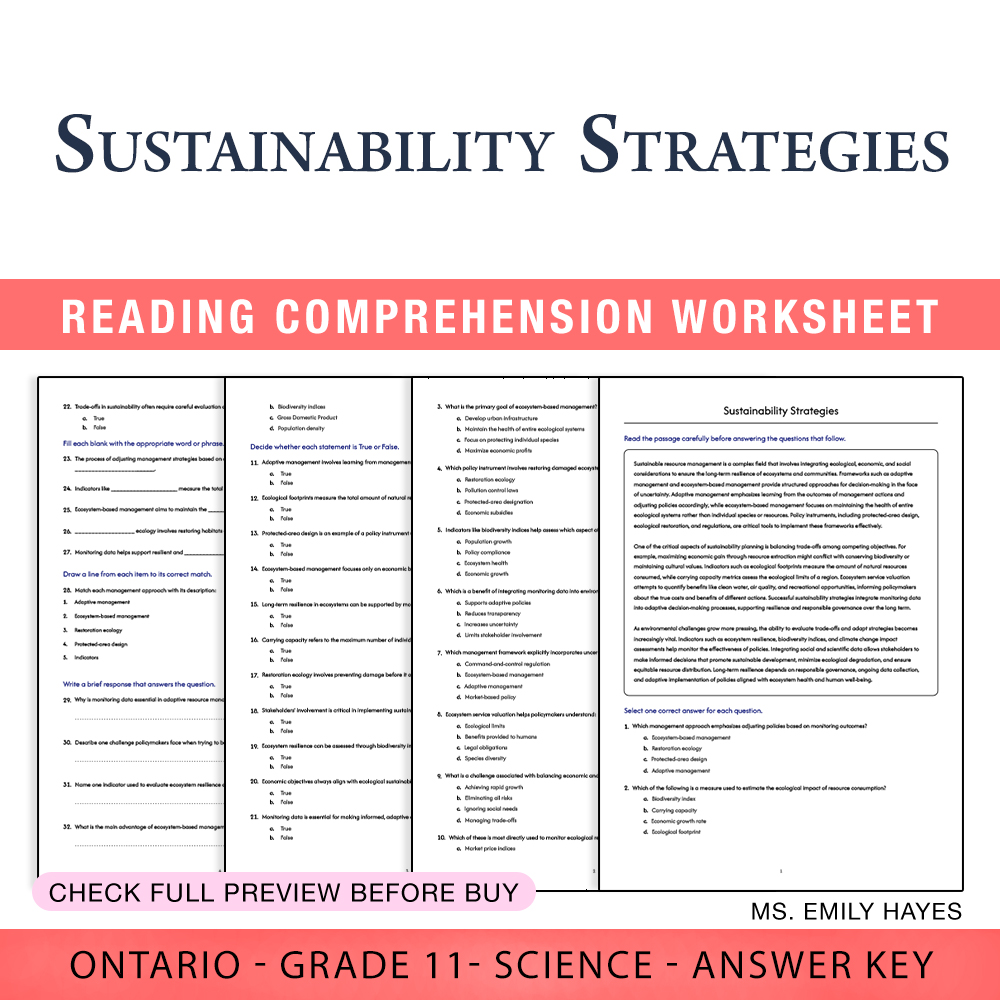
Grade 11 Science | Sustainability Strategies Worksheet (PDF + Answer Key)
Created byCopper Leaf ClassroomLearning Objectives
- Understand frameworks and policy instruments for sustainable resource use and ecosystem stewardship.
- Evaluate trade-offs among economic, social, and ecological objectives in sustainability planning.
- Identify indicators used for sustainability assessment such as ecological footprints and ecosystem service valuation.
Instant download
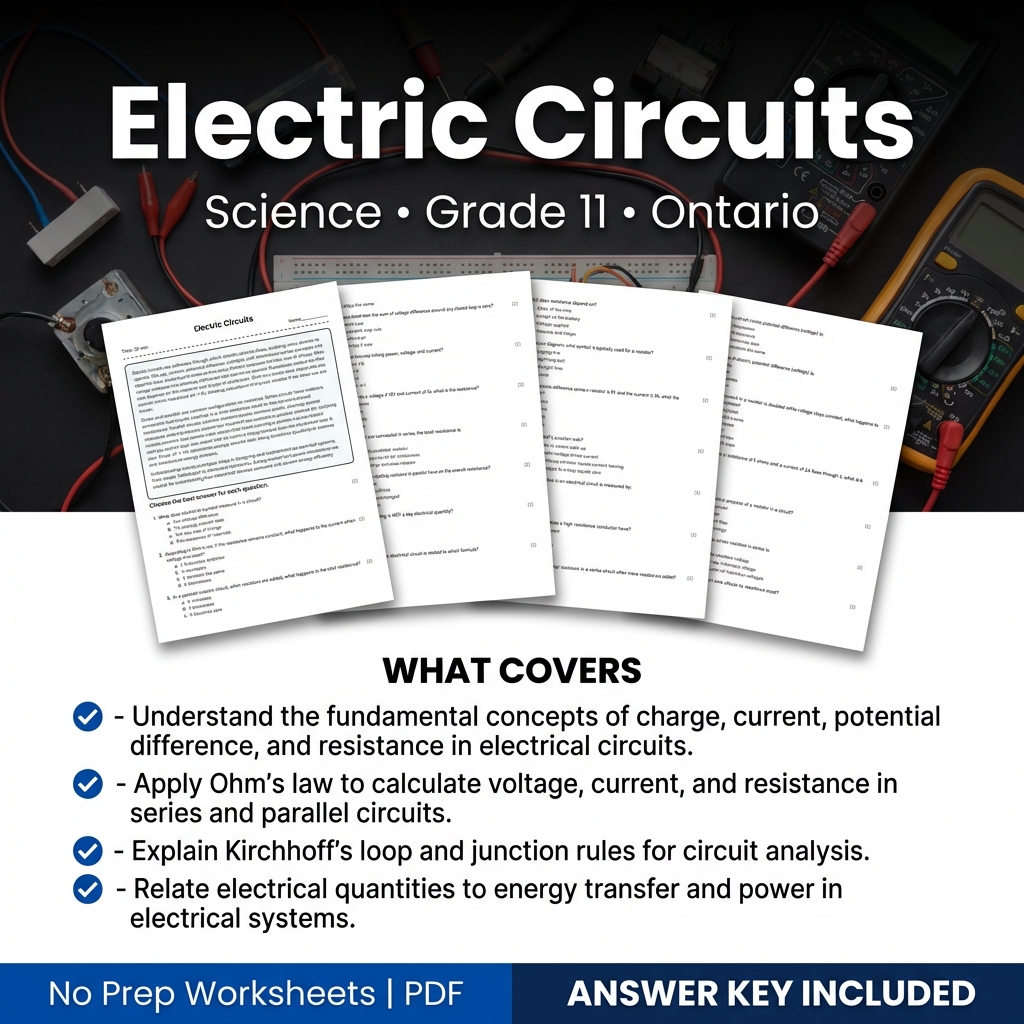
Electric Circuits Worksheet for Grade 11 Science | Ontario Standards
Created byCoral Reef LearningLearning Objectives
- Understand the fundamental concepts of charge, current, potential difference, and resistance in electrical circuits.
- Apply Ohm’s law to calculate voltage, current, and resistance in series and parallel circuits.
- Explain Kirchhoff’s loop and junction rules for circuit analysis.
Instant download

Homeostatic Failure Assessment for Grade 11 Science | TEKS Standards
Created byPrism Point LearningLearning Objectives
- Understand how chronic disorders and acute insults disrupt homeostatic regulation.
- Identify systemic consequences of homeostatic failure, such as multi-organ failure.
- Analyze pathways of failure and the importance of coordinated systemic regulation.
Also included in: Grade 11 Homeostasis & Human Body Systems Science: Lesson Bundle TEKS
Instant download

Grade 11 Science Worksheet | Petroleum Systems & Hydrocarbon Formation (PDF)
Created byEvergreen Desk EducationLearning Objectives
- Explain the main components of a petroleum system (source rock, generation, migration, reservoirs, seals, and traps).
- Describe how thermal maturation and burial history control when hydrocarbons are generated and in what amounts.
- Evaluate how reservoir and seal properties affect accumulation, leakage risk, and recoverable resources.
Instant download

Grade 11 Science – Conservation Strategies & Sustainability | Reading Worksheet
Created byBright Mind ResourcesLearning Objectives
- Understand the importance of protected areas in biodiversity conservation
- Identify different conservation strategies and their applications
- Explain the role of habitat restoration and management practices
Also included in: Grade 11 Ecosystem & Ecology Science Lesson Bundle | TEKS Daily Reading +2 more
Instant download
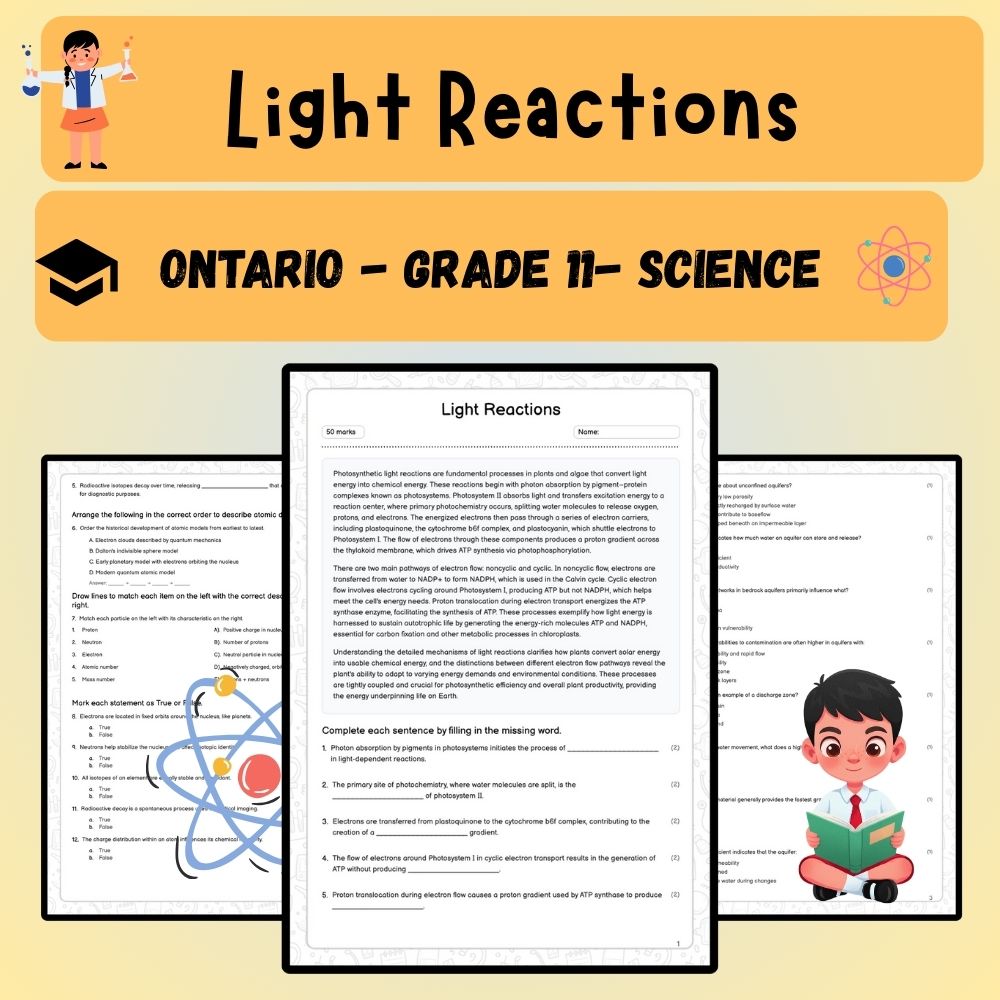
Grade 11 Science | Light Reactions Worksheet – Ontario Standard (PDF)
Created byPrism Point LearningLearning Objectives
- Describe the process of photon capture and excitation energy transfer in light-dependent reactions.
- Explain the electron transport chain involved in photosynthesis, including photosystems, plastoquinone, cytochrome b6f, and plastocyanin.
- Differentiate between noncyclic and cyclic electron flow and their roles in ATP and NADPH production.
Also included in: Grade 11 Science | Cellular Metabolism & DNA Processes Worksheet Bundle +1 more
Instant download

Grade 11 Science – Molecular Geometry & Shapes | Daily Reading Worksheet
Created byBright Mind ResourcesLearning Objectives
- Understand electron-domain considerations for molecular shape prediction
- Identify basic molecular geometries such as linear, trigonal planar, tetrahedral, trigonal bipyramidal, and octahedral
- Recognize effects of lone pairs and molecular symmetry on physical properties
Also included in: Grade 11 Chemistry Science Daily Reading Lesson Bundle | Ontario +1 more
Instant download

Ionic Bonding Test Prep Printable | Grade 11 Science
Created byPrism Point LearningLearning Objectives
- Explain how electrostatic attraction leads to ionic lattice formation between cations and anions
- Use Coulombic attraction and lattice energy ideas to describe why ionic compounds form
- Relate ion size and charge to compound stability and predicted macroscopic properties
Instant download
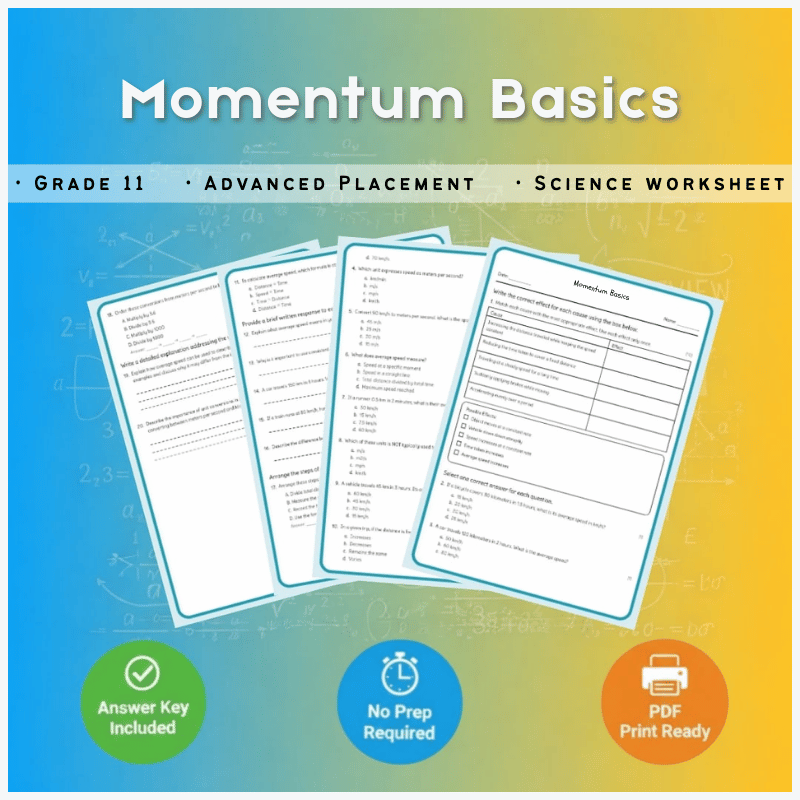
Grade 11 Science | Momentum Basics Worksheet + Answer Key (AP Standards)
Created byBright Mind ResourcesLearning Objectives
- Define and explain the concept of linear momentum as a conserved vector quantity.
- Describe the relationship between impulse and change in momentum.
- Apply algebraic conservation relations for isolated systems.
Instant download

Respiratory Exchange Assessment for Grade 11 Science TEKS Standards
Created byPrism Point LearningLearning Objectives
- Understand the structures involved in the respiratory system and their roles in gas exchange.
- Explain the processes of ventilation and diffusion in respiration.
- Describe how neural and chemical receptors regulate breathing rates.
Also included in: Grade 11 Homeostasis & Human Body Systems Science: Lesson Bundle TEKS
Instant download

Grade 11 Heat Transfer: Conduction, Convection, and Radiation Worksheet | NGSS
Created byClear Sky ClassroomLearning Objectives
- Explain how conduction, convection, and radiation transfer thermal energy and change temperature.
- Use material properties (e.g., thermal conductivity and heat capacity) to predict heat flow behavior.
- Describe phase changes using latent heat and relate them to temperature plateaus during heating/cooling.
Also included in: Grade 11 Energy & Heat Transfer Science Lesson Bundle (Worksheet B) | NGSS +1 more
Instant download
About Grade 11 Science Worksheets
Browse 6,616 printable Grade 11 Science worksheets — ready-to-print PDFs with answer keys where available.
Each resource here is built by an independent educator and reviewed for quality. Worksheets print straight from PDF and suit classroom use, homework, or extra practice; most come with answer keys, and you can preview before purchasing.