
Grade 6 Worksheets
8,578 grade resources
6th Grade Social Studies | Cultural Influences Worksheet (California Standards)
 Created bySunny Desk Resources
Learning Objectives
- Explain how classical Greek and Roman ideas influenced later Western culture in areas such as philosophy, art, and architecture.
- Use evidence from a text to identify key themes like civic virtue, rational inquiry, and beauty.
- Describe similarities and differences between classical contributions and later cultural developments.
Also included in: Grade 6 Ancient Greece and Rome Social Studies Lesson Bundle (California) +1 more
Instant download

Grade 6 Social Studies – Indigenous Perspectives Worksheet (BC Standard)
Created bySunny Desk ResourcesLearning Objectives
- Describe how Indigenous cultural practices, beliefs, and traditions support identity and resilience.
- Explain how intergenerational transmission and cultural revitalization help preserve Indigenous cultures.
- Analyze how Indigenous communities adapt while maintaining cultural continuity.
Also included in: Grade 6 Culture and Traditions Social Studies Lesson Bundle – BC Worksheets +1 more
Instant download
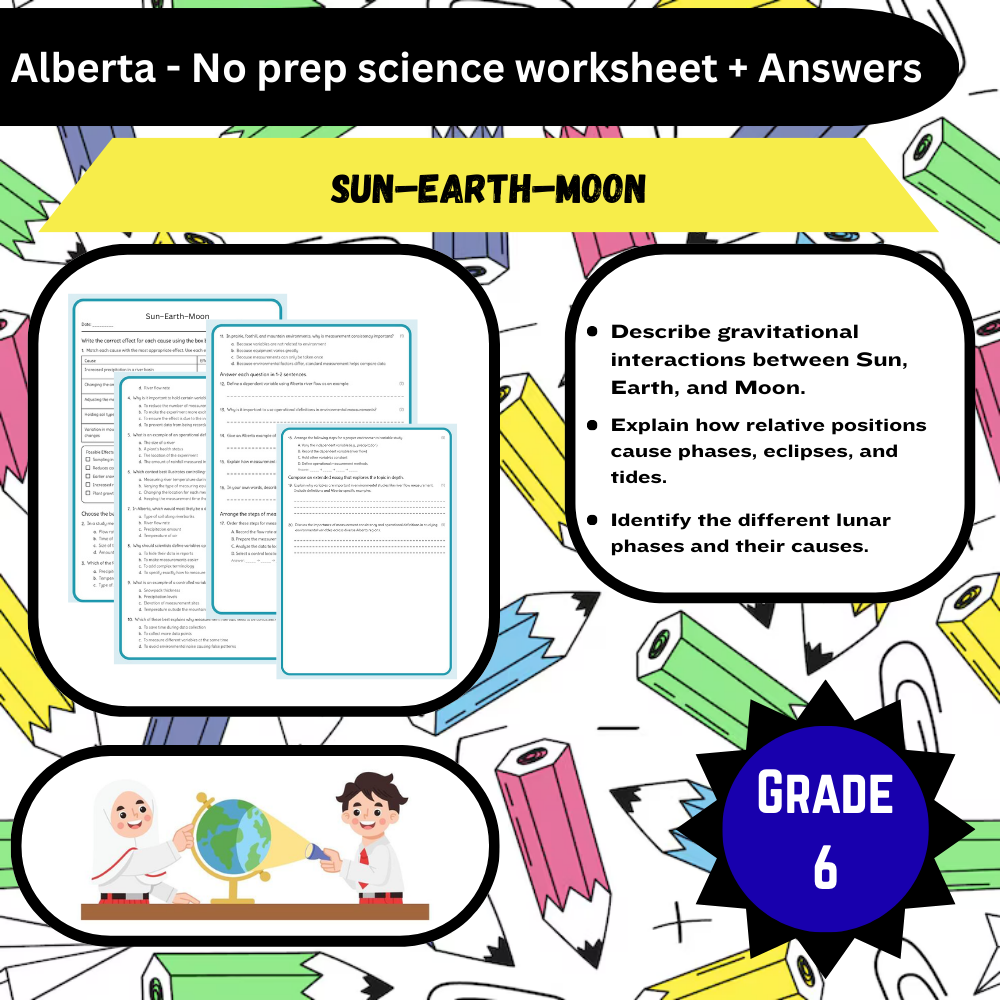
Grade 6 Science – Sun-Earth-Moon Phases & Eclipses Worksheet (PDF)
 Created byBright Mind Resources
Learning Objectives
- Describe the gravitational interactions between the Sun, Earth, and Moon.
- Explain how relative positions of the Sun, Earth, and Moon cause phases, eclipses, and tides.
- Identify the different lunar phases and their causes.
Instant download

Major Belief Systems Worksheet for Grade 6 Social Studies | Standards-Aligned
JCreated byJ.S SheetsLearning Objectives
- Explain how major belief systems (religions and philosophies) began and spread in societies.
- Describe how belief systems influence daily life, rituals, and social cohesion.
- Analyze how shared beliefs create common identity across generations.
Instant download

6th Grade Science Worksheet | Prototype Evaluation Practice (PDF)
 Created byEvergreen Desk Education
Learning Objectives
- Explain how prototype evaluation uses evidence (measurements and observations) to judge system performance.
- Identify constraints and describe how limits affect what improvements are acceptable.
- Use criteria to compare prototype results and determine next improvements.
Also included in: Grade 6 Prototype Design Science Lesson Bundle: General Systems Thinking +1 more
Instant download

Grade 6 Science | Reproductive Structures in Plants & Cones
 Created byCoral Reef Learning
Learning Objectives
- Identify different reproductive structures in flowering plants and cones.
- Understand how seed dispersal mechanisms work and their importance.
- Explain the role of specific structures like cones and root suckers in plant regeneration.
Also included in: Trees and Forests Lesson Bundle | Grade 6 Science | Alberta +1 more
Instant download

Grade 6 Health – Risks of Alcohol & Substance Use | Daily Reading Worksheet
 Created byQuiet Forest Education
Learning Objectives
- Identify the short-term and long-term health risks associated with alcohol use.
- Understand how alcohol can impair judgment and affect physical health.
- Recognize the importance of making informed decisions to prevent health problems.
Also included in: Healthy Living Grade 6 Health Daily Reading Worksheets Bundle | Ontario +2 more
Instant download

Aerodynamic Design Worksheet | Standards-Aligned Grade 6 Science Practice
JCreated byJ.S SheetsLearning Objectives
- Understand how shape, surface smoothness, and orientation affect lift, drag, and stability in flight.
- Describe how modifications to wing curvature, aspect ratio, and surface area influence flight performance.
- Apply principles of aerodynamics to practical examples like kite tuning and model glider adjustments.
Instant download

Grade 6 Reactants and Products Worksheet PDF | California Science Standards
Created byEvergreen Desk EducationLearning Objectives
- Explain the difference between reactants and products in a chemical reaction
- Use particle diagrams to describe how atoms are rearranged from reactants into products
- Identify evidence that a chemical reaction occurred by comparing properties of reactants and products
Instant download

Grade 6 ELA – Idea & Theme Progression in Literature | Daily Reading Worksheet
Created byQuiet Forest EducationLearning Objectives
- Identify how themes develop across different parts of a story
- Recognize recurring symbols and contrasting viewpoints that shape themes
- Analyze how early ideas are strengthened or challenged later in the text
Also included in: Theme & Inferences Grade 6 ELA Daily Reading Worksheets Lesson Bundle | BC +1 more
Instant download

6th Grade Math Worksheet | Money Basics (Ontario Standards) (PDF)
 Created byClear Sky Classroom
Learning Objectives
- Identify different types of currency and their values.
- Apply basic mathematical operations to solve problems involving money.
- Interpret and analyze real-world scenarios related to spending, saving, and budgeting.
Also included in: Grade 6 Math Financial Literacy Bundle | Ontario Standards Practice +1 more
Instant download

6th Grade Science | Seasonal Transition Worksheet ( May) (PDF)
 Created bySilver Birch Teaching
Learning Objectives
- Identify observable signs of seasonal change as spring transitions into summer (e.g., blooming flowers, longer daylight, warmer temperatures).
- Explain how seasonal shifts can affect ecosystems, including plants, pollinators, and other animals.
- Describe how humans adapt and how people can show resilience when conditions change.
Also included in: Grade 6 May Holiday Science full-month bundle - May framework
Instant download

Simple Media Product Practice Worksheet | Grade 6 ELA Alberta
 Created byMeadowlark Worksheets
Learning Objectives
- Explain how purpose, audience, and format shape a simple media product.
- Identify supporting details that create coherence across visuals, text, and audio.
- Use ethical media practices by choosing accurate and complete information.
Also included in: Grade 6 Media Literacy in ELA Lesson Bundle for Alberta Framework +1 more
Instant download

6th Grade Science | Quantitative Circuits Worksheet (Ontario Standards) (PDF)
Created byEvergreen Desk EducationLearning Objectives
- Explain how voltage, current, and resistance are related using proportional reasoning suitable for grade 6.
- Use given values of voltage, current, or resistance to determine an unknown circuit quantity.
- Predict how current changes when resistance changes for a fixed voltage difference, including series and parallel comparisons.
Also included in: Grade 6 Electricity Circuits Science Lesson Bundle for Ontario Worksheets +1 more
Instant download

System Integration Test Prep Worksheet | Grade 6 Science BC
 Created byPrism Point Learning
Learning Objectives
- Explain how feedback mechanisms help organisms maintain homeostasis
- Describe how different body systems (nervous, endocrine, circulatory, and muscular) work together to respond to changes
- Use examples such as temperature control and blood glucose regulation to trace cause-and-effect in body responses
Also included in: Multicellular Systems & Functions Lesson Bundle | Grade 6 Science | BC +1 more
Instant download

Heritage Sites Worksheet | Social Studies Grade 6 Practice & Assessment
JCreated byJ.S SheetsLearning Objectives
- Explain what makes a place a heritage site and how different communities may view the same site differently
- Identify reasons some heritage sites are preserved and others are neglected, including the roles of culture and tourism
- Analyze how public memory and identity can change when commemorative priorities shift
Instant download

Clarity and Precision Grade 6 ELA Worksheet | Standards-Aligned Practice
JCreated byJ.S SheetsLearning Objectives
- Revise sentences by replacing vague words with precise, specific language.
- Improve clarity by adjusting sentence structure to show clear relationships between ideas.
- Identify and remove repetitive or unnecessary wording that adds little meaning.
Instant download

Grade 6 Science Worksheet – Digestive System with Answer Key (PDF)
Created byEvergreen Desk EducationLearning Objectives
- Explain how mechanical and chemical digestion work together to break food into absorbable molecules.
- Describe the roles of the mouth, stomach, small intestine, and enzymes and acids in digestion.
- Model how nutrients move into blood or lymph and how this supports metabolism and growth.
Instant download

Grade 6 Science – Decomposers & Nutrient Recycling | Daily Reading Worksheet
Created byBright Mind ResourcesLearning Objectives
- Identify different decomposers such as fungi and bacteria
- Explain how decomposers break down dead organisms and waste
- Understand the role of decomposers in returning nutrients to ecosystems
Also included in: Life Processes Grade 6 Science Daily Reading Worksheets Lesson Bundle | General +1 more
Instant download

Grade 6 ELA – Purpose of Text Features | Daily Reading Worksheet
Created byQuiet Forest EducationLearning Objectives
- Identify the purpose of titles and subtitles in texts
- Understand how text features like captions and diagrams support comprehension
- Recognize how layout and labeling contribute to understanding informational texts
Also included in: Theme & Inferences Grade 6 ELA Daily Reading Worksheets Lesson Bundle | BC +1 more
Instant download

Informative Writing Worksheet for Grade 6 | CCSS ELA Practice and Assessment
JCreated byJ.S SheetsLearning Objectives
- Organize an informative text using a clear structure (topic introduction, headings or logical order, and supporting details).
- Use accurate information with evidence and sources to explain a concept, process, or idea.
- Write sentences that define, describe, and elaborate so readers can understand the topic clearly.
Instant download

Grade 6 Science | Habitat Fragmentation Worksheet | BC Standards
 Created byLumora Learning
Learning Objectives
- Understand the concept of habitat fragmentation and its impact on ecosystems.
- Identify causes and effects of habitat fragmentation.
- Explore methods to mitigate fragmentation effects such as creating corridors and preserving large habitats.
Instant download

Grade 6 Quantitative Relationships in Circuits Worksheet | Ontario Science
 Created byTeacher's Corner
Learning Objectives
- Explain how voltage, current, and resistance are related using proportional reasoning
- Use Ohm’s law to compute or compare circuit values from given measurements
- Predict how current changes when resistance changes in a fixed voltage circuit
Instant download

Variables and Controls Science Worksheets | Grade 6 Experiments
Created bySunny Desk ResourcesLearning Objectives
- Identify independent, dependent, and controlled variables in a science investigation.
- Choose appropriate control conditions and justify why they provide a fair comparison.
- Create a testable question and a consistent measurement plan for repeatable results.
Also included in: Evidence & Investigation Grade 6 Science Worksheets | Alberta +1 more
Instant download

Revision For Focus Worksheet | Grade 6 ELA Review and Assessment
Created byMeadowlark WorksheetsLearning Objectives
- Revise writing to strengthen a clear central message by checking sentence support for the main idea.
- Improve organization by reordering ideas for better coherence and logical flow.
- Check and correct consistency in tense, point of view, and terminology during revision.
Also included in: Grade 6 Evidence-Based Writing Skills in ELA Lesson Bundle | Alberta +1 more
Instant download

Grade 6 Science – Pressure Maps & Aerodynamics | Daily Reading Worksheet
Created byBright Mind ResourcesLearning Objectives
- Understand key concepts related to Science
- Apply knowledge through practice questions
- Demonstrate comprehension of the material
Also included in: Grade 6 Aerodynamics Science Lesson Bundle Daily Reading Worksheets | Ontario +1 more
Instant download

Optimization Tradeoffs Worksheet | Ontario Grade 6 Science Assessment
 Created byCedar Grove Learning
Learning Objectives
- Explain how designers balance competing criteria such as lift, drag, weight, and stability.
- Describe the idea of Pareto trade-offs when improving one factor can worsen another.
- Use safety margins and stall/stability buffers to support safe design choices.
Also included in: Grade 6 Aerodynamics | Flight - Science Lesson Bundle – Ontario Framework +1 more
Instant download

Ocean Currents Grade 6 | Florida NGSSS Assessment
Created byPrism Point LearningLearning Objectives
- Explain how ocean currents move water and distribute heat around Earth.
- Describe how wind patterns and Earth’s rotation help drive surface currents.
- Connect ocean currents to regional climate and weather differences near coasts.
Instant download

Grade 6 Science – Gas Pressure & Particle Model | Daily Reading Worksheet
Created byBright Mind ResourcesLearning Objectives
- Understand key concepts related to Science
- Apply knowledge through practice questions
- Demonstrate comprehension of the material
Also included in: Matter & Change Grade 6 Science Daily Reading Worksheets Lesson Bundle | BC +1 more
Instant download

6th Grade Science | Diffusion Rates Worksheet (PDF) BC Standards
Created byEvergreen Desk EducationLearning Objectives
- Explain diffusion as the net movement of particles from higher concentration to lower concentration.
- Describe how temperature, particle size, and medium viscosity affect diffusion rates.
- Connect particle-level motion to real-world examples such as scent spreading and dye dispersal.
Instant download

Forms Of Energy Worksheet | Standards-Aligned Grade 6 Science Practice
JCreated byJ.S SheetsLearning Objectives
- Identify different forms of energy such as kinetic, potential, thermal, chemical, and electrical.
- Understand how energy transforms from one form to another in natural and engineered systems.
- Recognize examples of energy transformations and describe their significance.
Instant download

Grade 6 Science | Natural Resources - Daily Reading Comprehension
Created byCoral Reef LearningLearning Objectives
- Identify different types of natural resources
- Understand how natural resources are distributed
- Recognize the ecological and economic implications of resource use
Instant download

Grade 6 Adaptation and Speciation Worksheet | NGSS Practice PDF
Created byClear Sky ClassroomLearning Objectives
- Understand the processes of adaptation and speciation in populations.
- Identify evidence and factors that contribute to reproductive isolation and lineage divergence.
- Analyze patterns of biogeography and morphology in species formation.
Also included in: Grade 6 Biological Evolution: Unity & Diversity Science lesson bundle NGSS +1 more
Instant download

Map Skills: Symbols, Scale, and Legends Worksheets Grade 6
 Created byWorld Paper Hub
Learning Objectives
- Explain how map legends and symbols help readers interpret geographic information.
- Use map scale to describe distance on a map compared to real-world distance.
- Identify spatial patterns and how they relate to settlement areas and transportation networks.
Also included in: Geography Grade 6 Worksheets Bundle | Social Studies TEKS +1 more
Instant download

Grade 6 Climate Systems Science Worksheet | NGSS Earth Science Activity
 Created byBRIGHT PATH RESOURCES
Learning Objectives
- Understand key concepts related to Science
- Apply knowledge through practice questions
- Demonstrate comprehension of the material
Also included in: Earth's Systems Grade 6 Science Daily Reading Worksheets Lesson Bundle | NGSS +2 more
Instant download

Grade 6 Carbon Cycling Worksheet with Answer Key | Florida NGSSS Science
Created byEvergreen Desk EducationLearning Objectives
- Explain how carbon moves through ecosystems using photosynthesis, respiration, feeding, and decomposition
- Describe how plants store carbon in organic molecules and how consumers release carbon dioxide
- Use evidence and key vocabulary to trace carbon cycling over time
Instant download

Grade 6 Science | Competition for Survival Worksheet | California Standards
Created byLumora LearningLearning Objectives
- Explain how limited resources can lead to competition between organisms
- Describe how competition affects survival, reproduction, and population size
- Distinguish between direct and indirect competition
Instant download

Electrical Power in Circuits Worksheet Grade 6 Ontario Science Activity
Created byTeacher's CornerLearning Objectives
- Define power as the rate of energy transfer in an electrical circuit
- Explain how voltage and current relate to power dissipation in resistive elements
- Describe how efficiency affects energy use and total energy consumption over time
Instant download

Measurement Tools Worksheet | Grade 6 Science Practice
Created byPrism Point LearningLearning Objectives
- Explain why choosing appropriate units and measurement tools improves the accuracy of collected data.
- Describe how calibration and consistent recording support reliable comparisons over time and location.
- Use measurement tools to collect, organize, and interpret observations in science investigations.
Instant download

Climate And Patterns Grade 6 Science Worksheet | Standards-Aligned Practice
JCreated byJ.S SheetsLearning Objectives
- Understand how climate factors influence regional weather patterns.
- Identify the differences between weather and climate.
- Analyze how long-term climate patterns develop and vary across regions.
Also included in: Grade 6 Climate and Atmospheric Systems Science Lesson Bundle: Florida NGSSS +1 more
Instant download
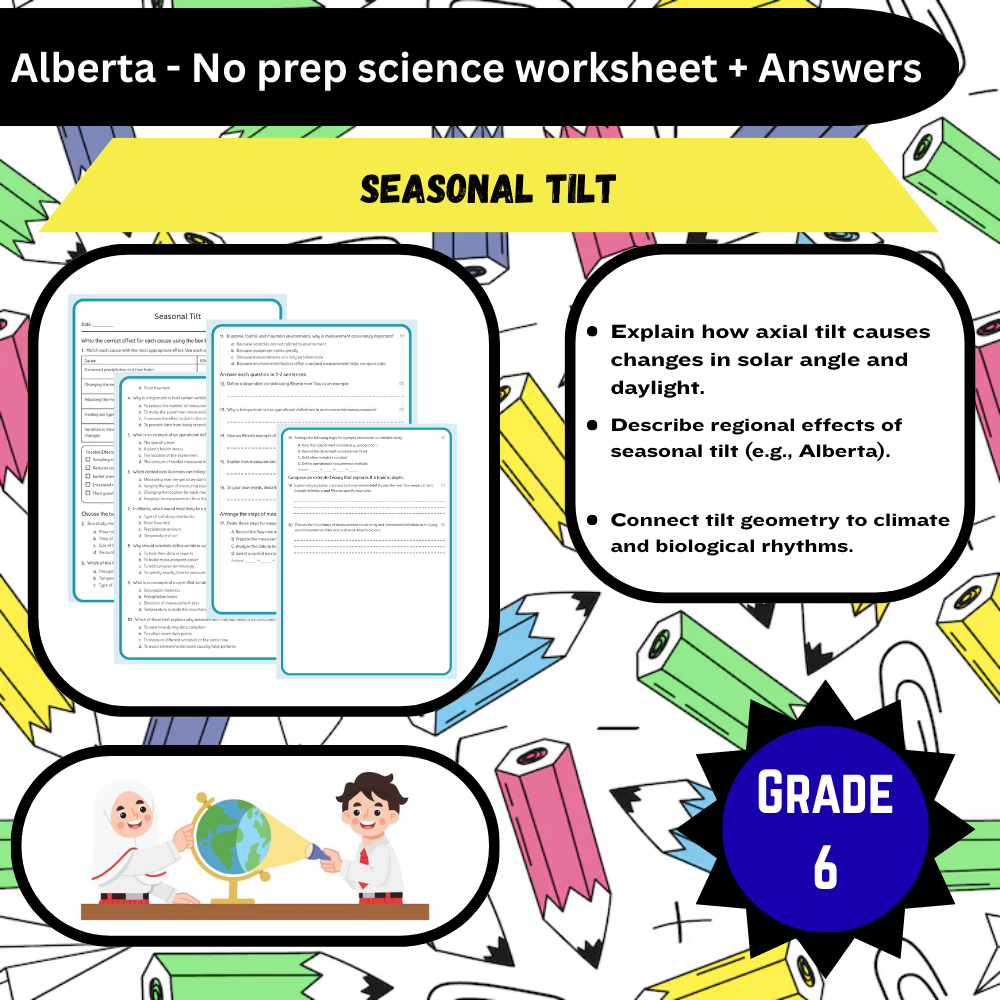
6th Grade Science – Seasonal Tilt Worksheet (PDF) — Alberta Standards
Created byBright Mind ResourcesLearning Objectives
- Explain how Earth's axial tilt causes seasonal changes in solar angle and daylight duration.
- Describe regional effects of seasonal tilt, using Alberta as an example.
- Connect the geometry of Earth's tilt to climate variations and biological rhythms.
Instant download

Predator Prey Dynamics Worksheet | Science Grade 6 Assessment PDF
JCreated byJ.S SheetsLearning Objectives
- Explain how predator and prey populations affect each other in an ecosystem
- Identify cause-and-effect relationships in predator-prey interactions
- Describe how prey adaptations can reduce predation and influence population trends
Also included in: Grade 6 Life Processes & Ecosystems Science lesson bundle: General Framework +1 more
Instant download

Trophic Interactions Worksheet for Grade 6 Science | Standards-Aligned Practice
JCreated byJ.S SheetsLearning Objectives
- Understand the different types of trophic interactions such as predation, herbivory, parasitism, competition, and mutualism.
- Explain how these interactions influence survival, reproduction, and community structure.
- Identify examples of trophic interactions in ecosystems and their ecological significance.
Instant download

Axial Rotation and Daily Sky Motion Worksheets Grade 6 Science
Created bySunny Desk ResourcesLearning Objectives
- Explain how Earth’s rotation causes alternating day and night
- Describe how Earth’s rotation relates to apparent daily motion of the Sun and stars
- Use time-order cues to connect sunrise, solar noon, and sunset to Earth’s rotation
Also included in: Sky Science Grade 6 Bundle | Alberta Science Worksheets & Activities +1 more
Instant download

Grades 6 - 8 Holiday Worksheet | Cultural Celebrations Assessment
Learning Objectives
- Compare Father’s Day traditions from different cultures and identify shared values.
- Explain how family bonds and gratitude are expressed through customs worldwide.
- Use evidence from a text to answer questions about cultural celebrations.
Also included in: Grades 6 - 8 Holiday Reflections Lesson Bundle | Common Core ELA +2 more
Instant download

Error Analysis Worksheet for Grade 6 Science | Standards-Aligned Practice
JCreated byJ.S SheetsLearning Objectives
- Identify sources of error in experimental measurements and classify them as random or systematic.
- Explain how random and systematic errors can limit the reliability of collected data.
- Describe methods for estimating uncertainty and reporting it transparently.
Instant download

Grade 6 Science Worksheet – Flight Forces with Reading & Practice (Alberta)
Created bySilver Birch TeachingLearning Objectives
- Explain how lift, weight, thrust, and drag affect motion through air
- Identify how balanced forces lead to steady flight and how unbalanced forces lead to climbing or descending
- Use key vocabulary (lift, thrust, drag, weight) to describe real-world examples of flight
Also included in: Grade 6 Aerodynamics & Flight Forces Science Lesson Bundle: Alberta +1 more
Instant download

Grade 6 Maths Worksheet – Interpreting Criteria (Ontario) (PDF)
Created byClear Sky ClassroomLearning Objectives
- Develop skills to evaluate the accuracy and clarity of mathematical solutions.
- Apply reasoning to interpret different representations of problems.
- Compare approaches against standard criteria to assess their reasonableness.
Also included in: Grade 6 Maths Social-Emotional Skills and Mathematical Processes Lesson Bundle +1 more
Instant download
Browse more categories
About Grade 6 Worksheets
Browse 8,578 printable Grade 6 worksheets across math, ELA, science, and social studies — each a ready-to-print PDF with optional answer keys.
MyTeachingSheets worksheets are made by real teacher-authors and checked before they go live. Download any as a print-ready PDF for lessons, homework, or independent practice — most include answer keys, and previews are always free.