
Grade 6 Worksheets
8,578 grade resources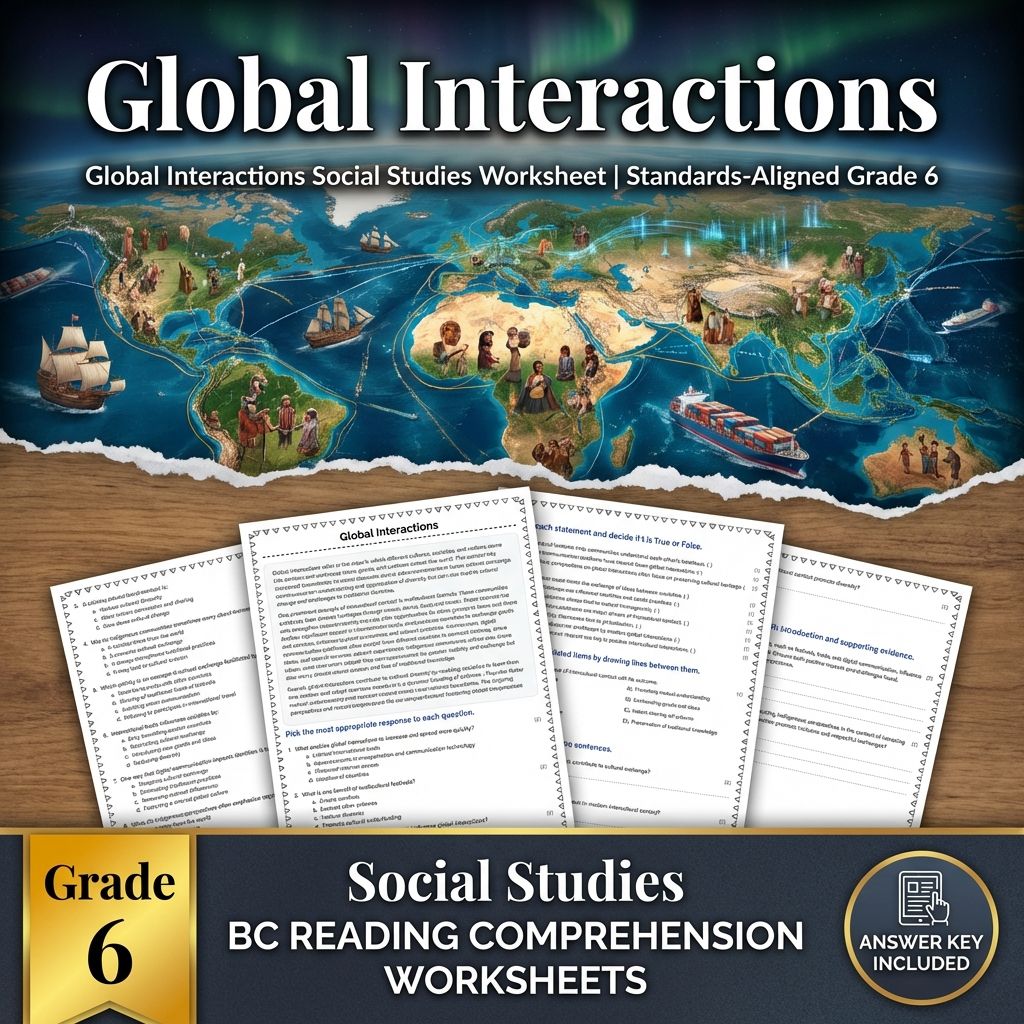
Global Interactions Social Studies Worksheet | Standards-Aligned Grade 6
JCreated byJ.S SheetsLearning Objectives
- Understand how intercultural contact influences societies and identities.
- Identify examples of multicultural festivals, international trade, and digital communication.
- Analyze the role of indigenous perspectives in global interactions.
Also included in: Grade 6 Social Studies | Cultures and Identities Unit Bundle (Standards-Aligned) +1 more
Instant download
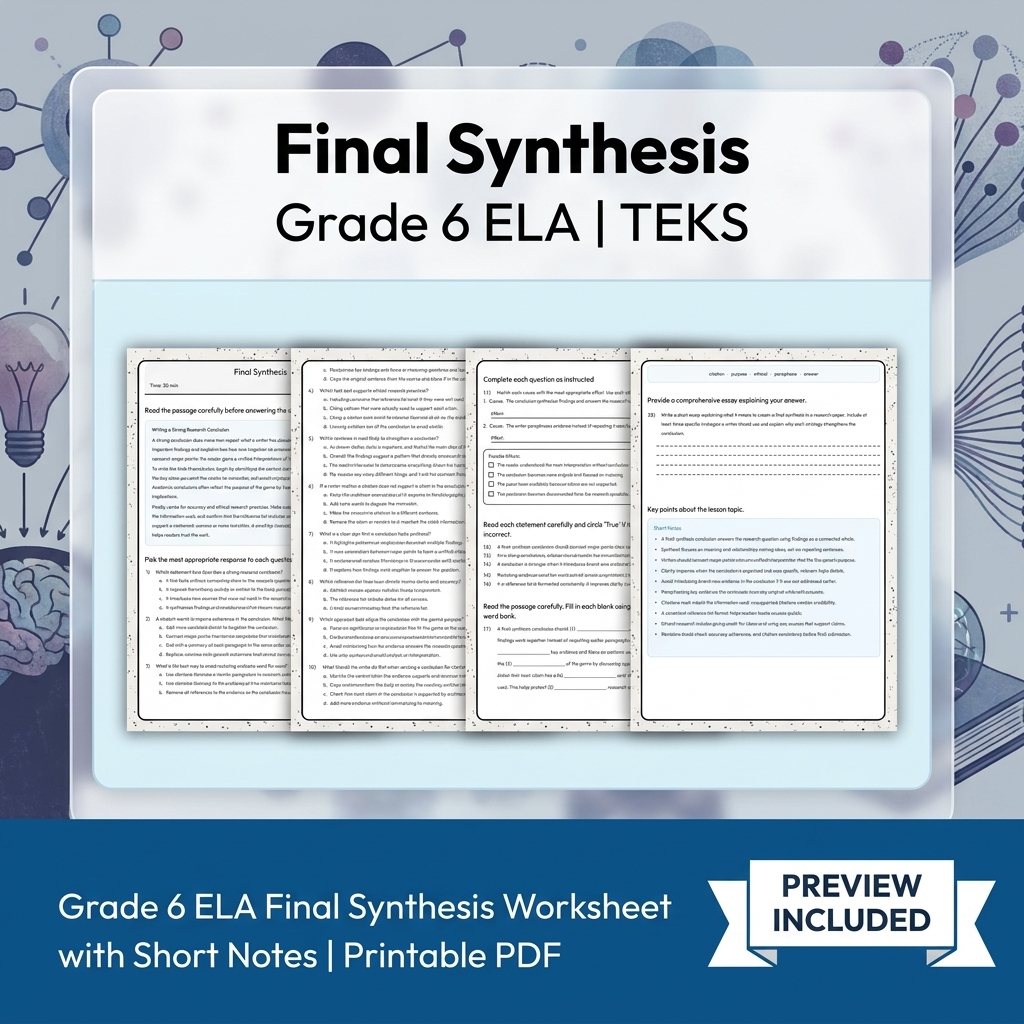
Grade 6 ELA Final Synthesis Worksheet with Short Notes | Printable PDF
 Created byMeadowlark Worksheets
Learning Objectives
- Explain how an effective research conclusion answers the research question using a unified interpretation.
- Synthesize major points instead of restating evidence word for word.
- Revise a conclusion for clarity, coherence, and accuracy, including properly matched citations in a reference list.
Also included in: Grade 6 Evidence-Based Writing & Revision Skills ELA Lesson Bundle TEKS +1 more
Instant download
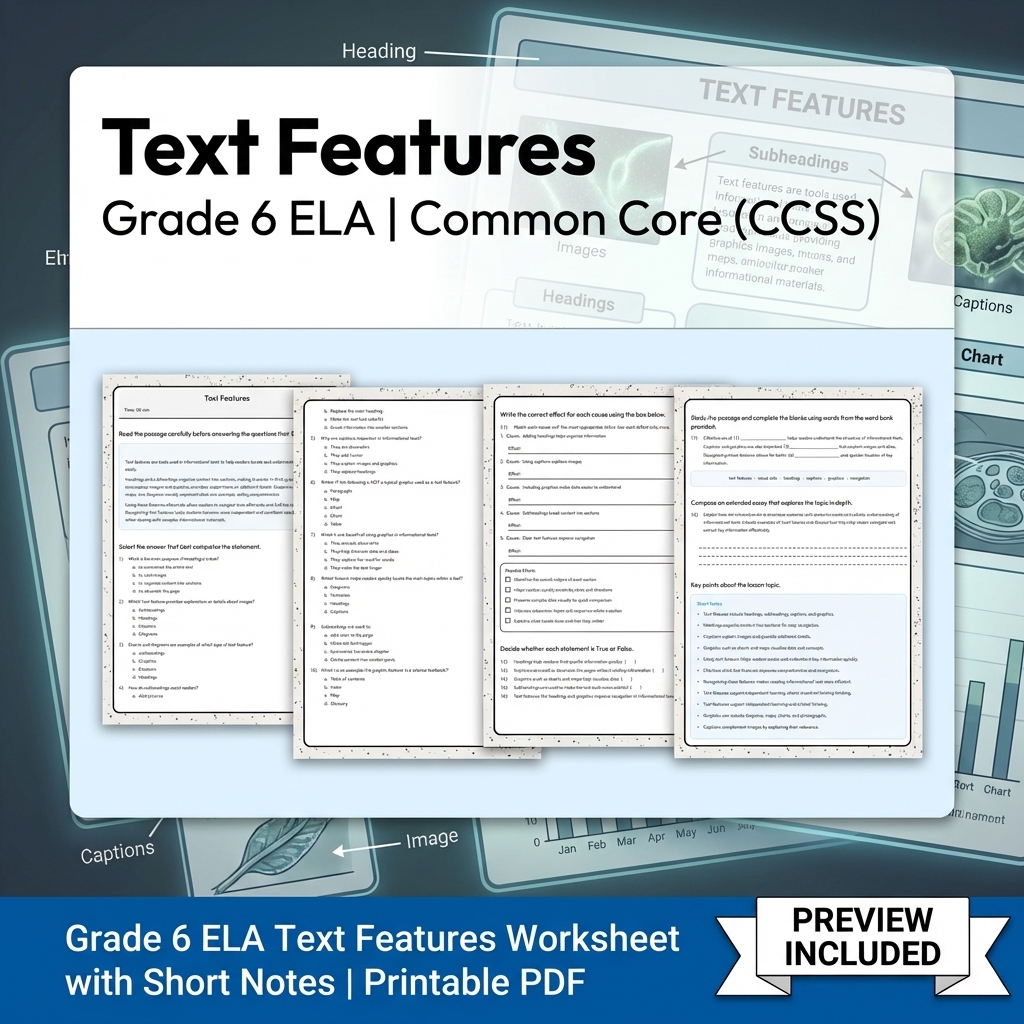
Grade 6 ELA Text Features Worksheet with Short Notes | Printable PDF
Created byMeadowlark WorksheetsLearning Objectives
- Identify different types of text features such as headings, subheadings, captions, and graphics.
- Explain how text features help in understanding informational texts.
- Analyze how text features guide navigation and highlight important information.
Also included in: Grade 6 ELA Text Evidence Comprehension Worksheets Lesson Bundle (CCSS) +1 more
Instant download
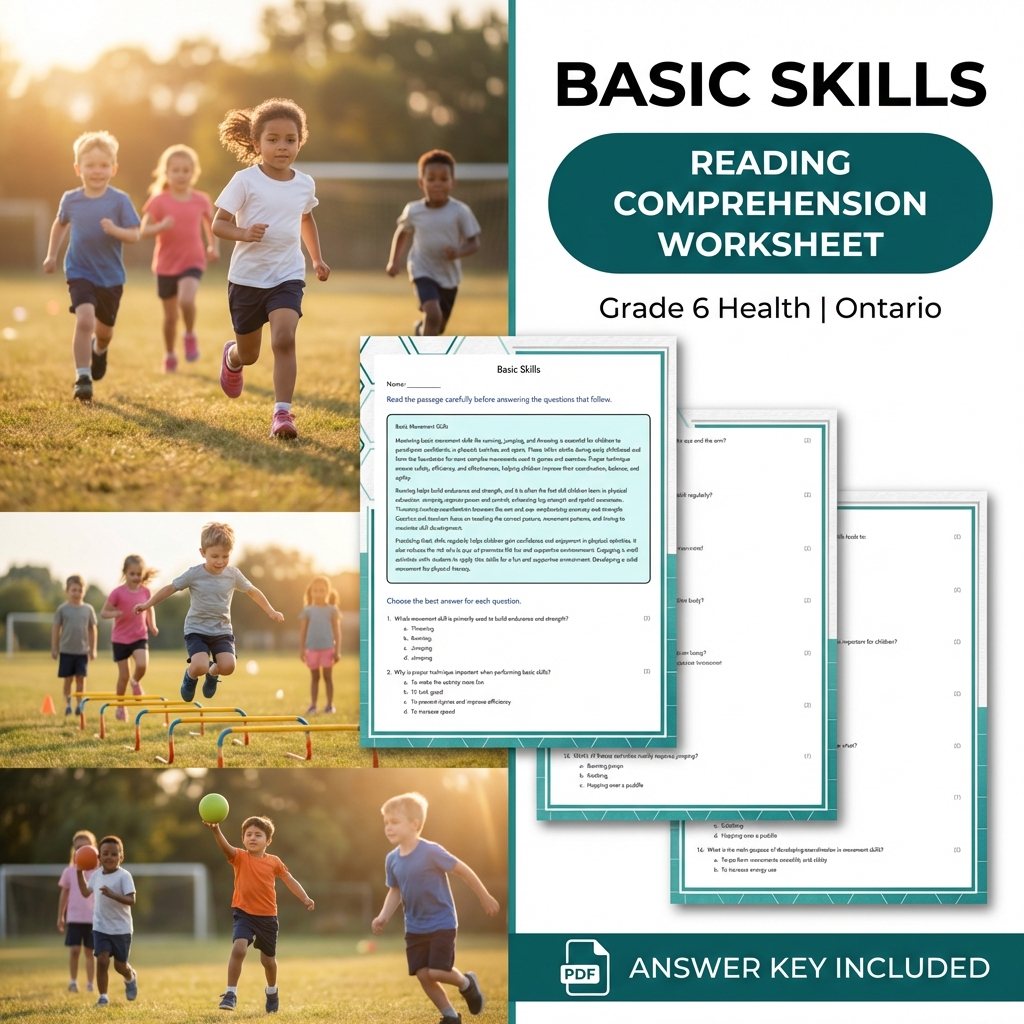
Grade 6 Health Worksheet | Basic Skills Assessment | Ontario Standards
 Created bySkylark Worksheets
Learning Objectives
- Identify and understand fundamental movement skills such as running, jumping, and throwing.
- Demonstrate proper form and technique for basic movement skills.
- Develop coordination, timing, and control in physical activities.
Also included in: Grade 6 Health Lesson Group | Ontario Standards & Worksheets
Instant download

Earth's Tilt and Seasons Worksheets | Grade 6 Space Science
 Created byPrism Point Learning
Learning Objectives
- Explain how Earth's axial tilt affects seasonal patterns
- Identify which hemisphere receives more direct sunlight near solstices
- Describe how day length changes with latitude
Also included in: Grade 6 Space Science Lesson Bundle | Ontario Science Framework
Instant download
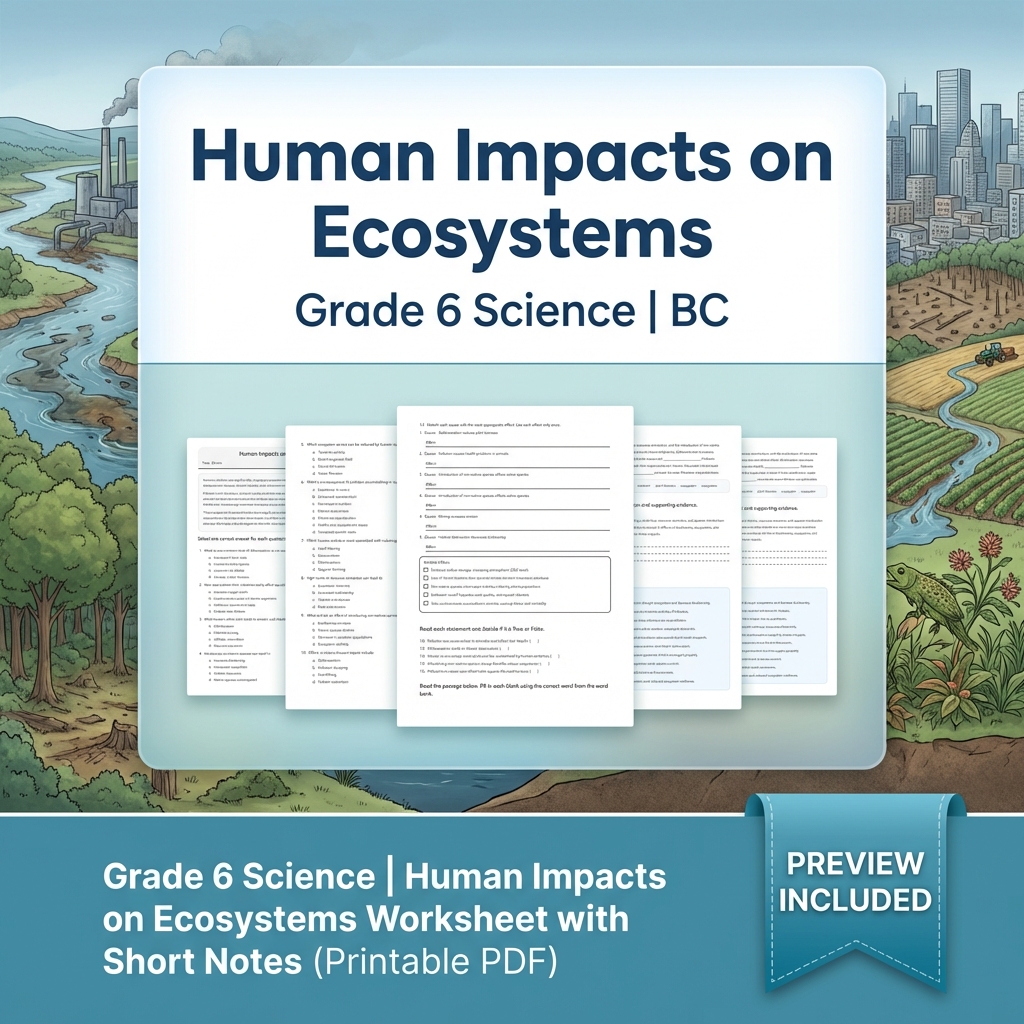
Grade 6 Science | Human Impacts on Ecosystems Worksheet with Short Notes (PDF)
Created byMeadowlark WorksheetsLearning Objectives
- Understand how human activities disrupt ecosystems and cause environmental change.
- Identify specific human actions that alter habitats and affect biodiversity.
- Evaluate the effects of pollution and resource extraction on ecosystems.
Also included in: Grade 6 Science | Ecosystems & Interdependence UNIT Worksheet Bundle +1 more
Instant download

Niche Dynamics Worksheet Assessment | Grade 6 Science Ontario
Created byPrism Point LearningLearning Objectives
- Compare fundamental and realized ecological niches using measurable environmental factors and species interactions.
- Explain how abiotic factors and interspecific competition influence where organisms can live and what resources they use.
- Use the ideas of temporal and spatial partitioning to predict how similar species can coexist.
Also included in: Grade 6 Biodiversity & Adaptation Science Lesson Bundle Ontario
Instant download

Measurement and Metric Units Worksheets Review Activity Grade 6 Science
 Created byBRIGHT PATH RESOURCES
Learning Objectives
- Identify appropriate metric units for common scientific measurements.
- Convert between common metric units accurately.
- Compare measurements using correct mathematical symbols.
Instant download

Chromatography Basics Worksheet | Standards-Aligned Grade 6 Science Practice
JCreated byJ.S SheetsLearning Objectives
- Understand the principles of paper chromatography and how it separates mixture components.
- Identify factors affecting the movement of substances in chromatography.
- Explain how solubility and affinity influence the separation process.
Instant download

Grade 6 Real-World Modelling with Equations & Graphs Worksheet
Created byBRIGHT PATH RESOURCESLearning Objectives
- Use equations to model and solve real-world situations
- Interpret and read information from coordinate grids and line plots
- Use models to make predictions, and evaluate when a model might be limited
Instant download

Science Grade 6 Adaptation Tradeoffs Worksheet | Standards-Aligned Assessment
JCreated byJ.S SheetsLearning Objectives
- Explain how adaptation tradeoffs can make specialists perform well in one environment but poorly in others
- Compare specialists and generalists using the ideas of niche, tolerance, and fitness tradeoffs
- Use examples from plants, insects, and migration to describe how fluctuating environments change which strategy is favored
Instant download

Aerodynamic Design Worksheet | Grade 6 Science Practice
Created byPrism Point LearningLearning Objectives
- Explain how shape, smoothness, and angle affect lift, drag, and stability in flight.
- Describe how design changes to wings (curvature, aspect ratio, and surface area) can improve performance.
- Connect real-world examples of model gliders and kites to aerodynamic principles.
Also included in: Aerodynamics and Flight Design Lesson Bundle – Grade 6 Science Alberta
Instant download

Grade 6 Science | Understanding Circuit Components - Daily Reading Practice
 Created byCoral Reef Learning
Learning Objectives
- Identify basic components of a simple electrical circuit.
- Understand the roles of batteries, conductors, loads, and switches.
- Describe how electrical energy is transformed within a circuit.
Instant download

Grade 6 Science | Key Construction Worksheet with Short Notes (Printable PDF)
Created byMeadowlark WorksheetsLearning Objectives
- Understand the procedures for constructing dichotomous and multi-access keys.
- Identify contrasting traits for classification in biological samples.
- Recognize limitations of morphological keys, such as cryptic species and developmental stages.
Also included in: Grade 6 Science Lesson Bundle for Ontario | Ecosystems & Genetics +1 more
Instant download

Figurative Language Meaning Worksheet Grade 6 ELA TEKS Reading Activity
 Created bySunny Desk Resources
Learning Objectives
- Identify the literal meaning of words and phrases in a passage that uses figurative language.
- Determine what a simile or metaphor suggests about a character, idea, or theme.
- Explain how repeated figurative language can reinforce an implied message in a poem or speech.
Instant download

Grade 6 Science | Plant Matter Inputs Worksheet | California Standards
 Created byLumora Learning
Learning Objectives
- Explain how plant growth depends on matter taken in from the environment
- Identify carbon dioxide, water, and gas exchange as key inputs in the plant system
- Describe how water supports cell growth and chemical processes
Instant download

Grade 6 Magnetic Separation Worksheet | Practice & Assessment PDF
 Created byClear Sky Classroom
Learning Objectives
- Explain how magnetic separation separates mixtures based on magnetic properties.
- Identify which materials in a mixture will move toward a magnet and which will stay behind.
- Describe how observations from a magnetic separation experiment support the conclusion about nonmagnetic and magnetic substances.
Instant download
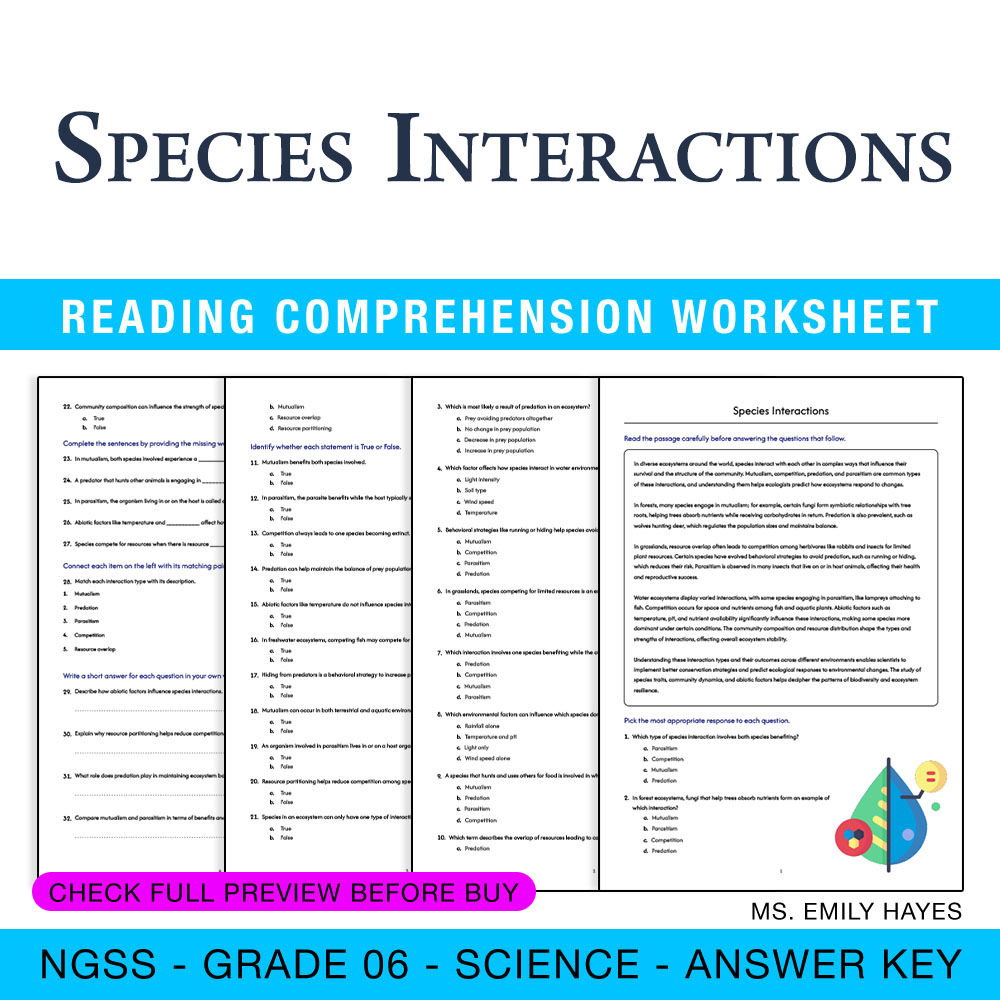
6th Grade Science | Species Interactions Worksheet (PDF +Answer Key)
 Created byCopper Leaf Classroom
Learning Objectives
- Construct explanations predicting patterns of species interactions across ecosystems
- Identify key types of species interactions such as mutualism, competition, predation, and parasitism
- Compare interaction outcomes in forest, grassland, and freshwater environments
Instant download

Grade 6 ELA – Clarity Editing & Sentence Fragments | Daily Reading Worksheet
 Created byQuiet Forest Education
Learning Objectives
- Identify sentence fragments within a paragraph.
- Understand how fragments affect clarity and readability.
- Practice revising sentences to be complete and clear.
Also included in: Research Writing & Editing Daily Reading Lesson Bundle | Grade 6 ELA | TeKS +1 more
Instant download

Science Worksheet Key Construction Grade 6 | Standards-Aligned Practice
JCreated byJ.S SheetsLearning Objectives
- Explain how dichotomous and multi-access keys help identify organisms using observable traits
- Construct simple binary branches by choosing contrasting characteristics
- Evaluate and refine a key by testing it with local taxa and spotting common identification errors
Instant download

Grade 6 Science | Prototype Evaluation - Daily Reading Comprehension
Created byCoral Reef LearningLearning Objectives
- Understand key data used in evaluating prototypes
- Identify different types of measurements and observations
- Describe how data influences improvements in models
Instant download

Complex Sentences Worksheet Grade 6 ELA Ontario Grammar Activities
Created byLumora LearningLearning Objectives
- Identify independent clauses and dependent clauses in complex sentences.
- Choose appropriate subordinating conjunctions and relative pronouns to connect ideas.
- Revise sentence fragments by attaching dependent clauses to an independent clause.
Instant download

Grade 6 Science | Atom Conservation Worksheet | California Standards
Created byLumora LearningLearning Objectives
- Explain atom conservation in chemical reactions using the particle model
- Describe how reactants’ atoms rearrange to form products without being created or destroyed
- Connect particle diagrams to the macroscopic observation of new substances
Instant download

Grade 6 Science – Mass Conservation & Principles | Daily Reading Worksheet
 Created byBright Mind Resources
Learning Objectives
- Understand key concepts related to Science
- Apply knowledge through practice questions
- Demonstrate comprehension of the material
Also included in: Matter & Change Grade 6 Science Daily Reading Worksheets Lesson Bundle | BC +1 more
Instant download

Environmental Interactions Worksheet for Grade 6 Social Studies
JCreated byJ.S SheetsLearning Objectives
- Explain how humans and natural systems interact through environmental processes
- Identify examples of how ecosystems are shaped by climate, landforms, and resources
- Analyze cause-and-effect relationships in environmental issues
Instant download
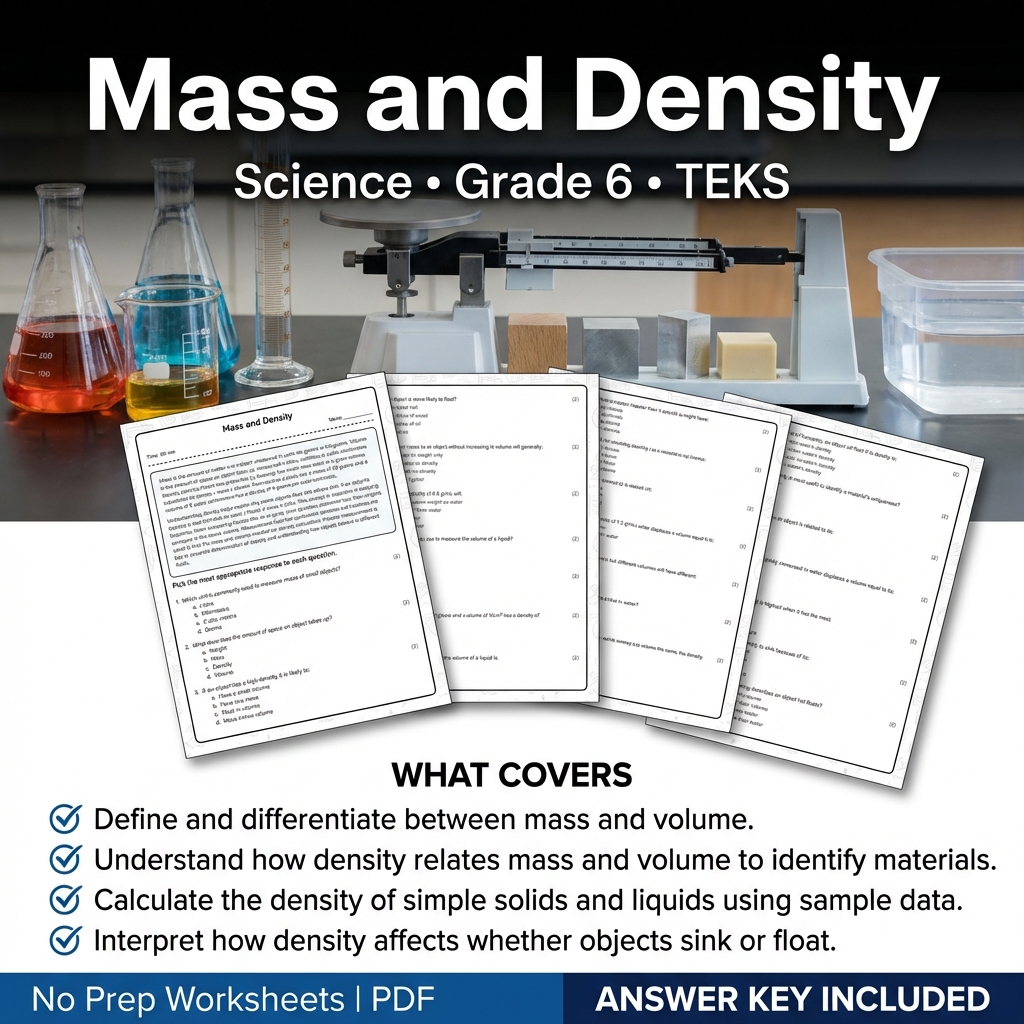
Mass and Density Grade 6 Science Worksheet | TEKS-Aligned Practice
Created byCoral Reef LearningLearning Objectives
- Define and differentiate between mass and volume.
- Understand how density relates mass and volume to identify materials.
- Calculate the density of simple solids and liquids using sample data.
Instant download

Mass and Density Worksheet | Grade 6 Science Practice
Created byPrism Point LearningLearning Objectives
- Define mass and volume and explain how they are measured
- Calculate density using density = mass ÷ volume and interpret the result
- Explain how density helps predict whether objects sink or float
Also included in: Grade 6 Matter, Energy, and Change Science Lesson Bundle TEKS Worksheets +1 more
Instant download

Inheritance Modeling Test Prep Worksheets | Grade 6 Science
Created byPrism Point LearningLearning Objectives
- Explain how genes on chromosomes can produce dominant and recessive inheritance patterns.
- Use Mendelian cross models to predict possible offspring trait ratios.
- Construct simple inheritance models and describe how model predictions can be limited.
Also included in: Grade 6 Inheritance and Variation Science Test Prep Lesson Bundle NGSS
Instant download
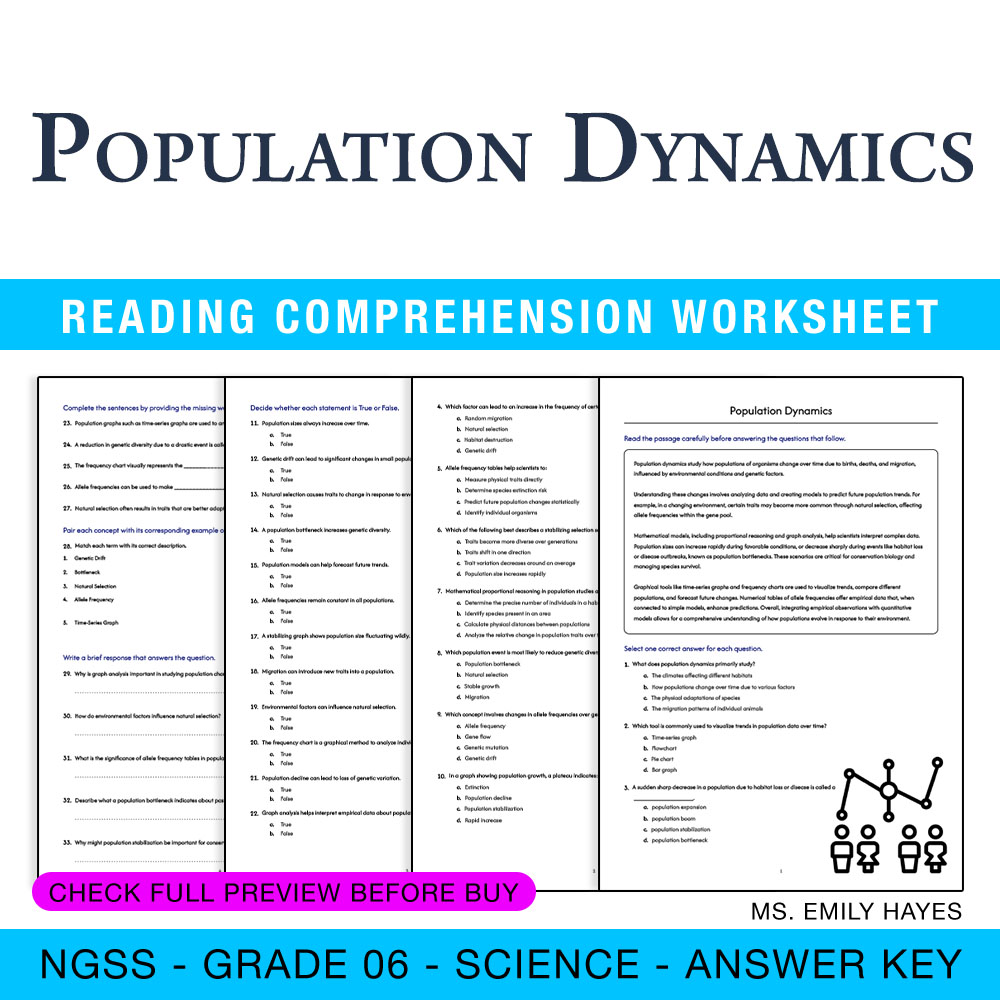
6th Grade Science | Population Dynamics Worksheet (PDF + Answer Key)
Created byCopper Leaf ClassroomLearning Objectives
- Understand how population sizes and trait frequencies change over generations due to environmental and demographic influences.
- Use mathematical models and graphical analysis to interpret changes in populations over time.
- Apply proportional reasoning to analyze data related to population change.
Instant download

Grade 6 Social Studies – Land Claims & Treaties Worksheet (PDF)
Created bySunny Desk ResourcesLearning Objectives
- Explain what treaties are and how they relate to land claims
- Describe how negotiation leads to shared responsibilities and rights
- Identify examples of treaty rights and responsibilities and explain why they matter
Also included in: Grade 6 Indigenous Governance & Land Social Studies Lesson Bundle (BC) +1 more
Instant download
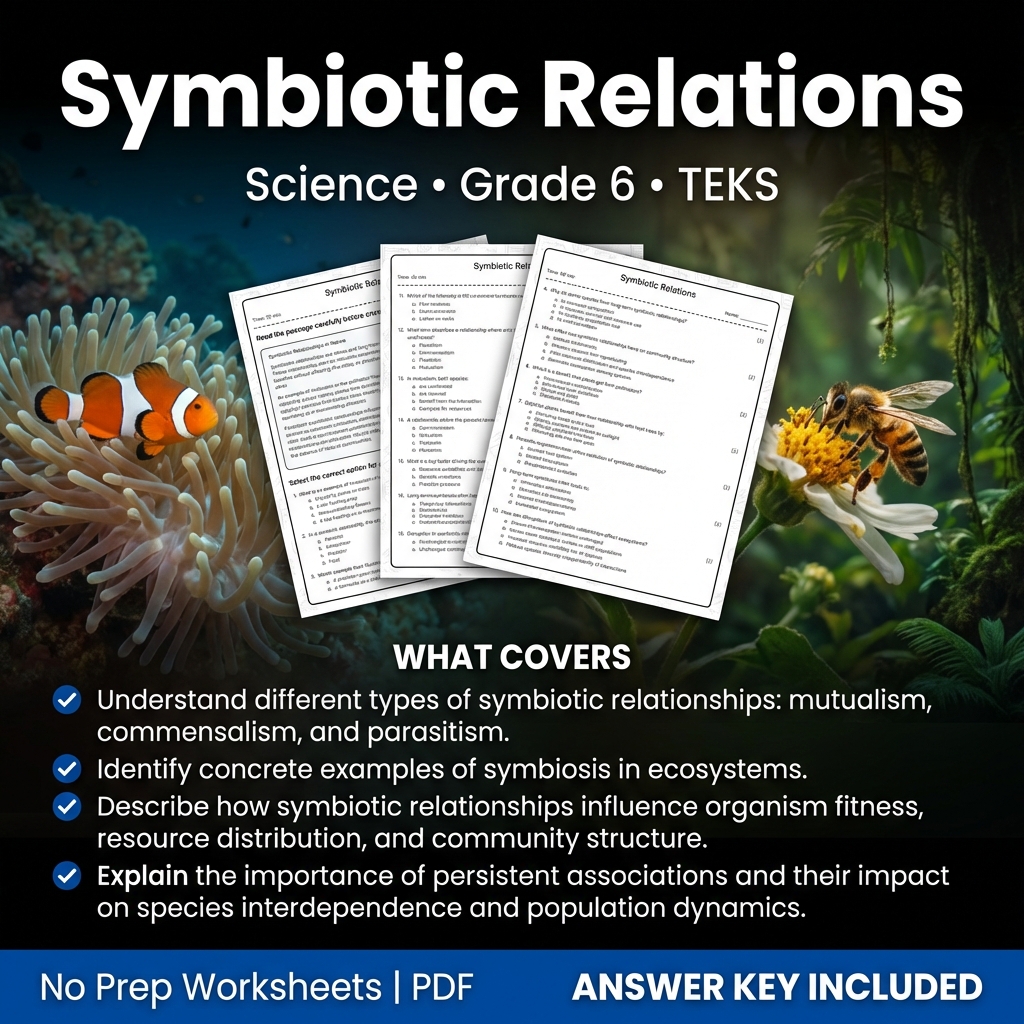
Grade 6 Science Worksheet on Symbiotic Relations – Standard TEKS Practice
Created byCoral Reef LearningLearning Objectives
- Understand different types of symbiotic relationships: mutualism, commensalism, and parasitism.
- Identify concrete examples of symbiosis in ecosystems.
- Describe how symbiotic relationships influence organism fitness, resource distribution, and community structure.
Instant download

Charge Concepts Worksheet Printables | Grade 6 Science Review & Practice
Created byPrism Point LearningLearning Objectives
- Define electric charge and explain how charge separation occurs through rubbing or contact
- Compare static electricity (charges at rest on insulators) with current electricity (charges flowing through conductors)
- Explain attractions and sparks using the idea of charge imbalance and charge transfer
Also included in: Grade 6 Circuits & Electricity Science lesson bundle: Ontario
Instant download

6th Grade Science Worksheet | Cell Specialization & Differentiation (PDF)
 Created byEvergreen Desk Education
Learning Objectives
- Explain how cell specialization helps cells perform specific roles in an organism.
- Describe how differentiation changes gene expression to produce functional proteins and specialized structures.
- Connect specialized cells to tissues and how tissues support organ functions.
Instant download

Grade 6 Developing Solutions Worksheet | NGSS Practice PDF
Created byClear Sky ClassroomLearning Objectives
- Compare multiple design solutions using matrices, rubrics, and prototypes.
- Evaluate solutions based on quantitative and qualitative metrics such as efficiency, durability, manufacturability, and cost.
- Use evidence-based justification and simple models to rank options for iterative refinement.
Also included in: Grade 6 Engineering Design Science Lesson Bundle for NGSS +1 more
Instant download

Grade 6 Forces And Motion Worksheet | Practice & Review PDF
Created byClear Sky ClassroomLearning Objectives
- Explain how net force affects changes in speed and/or direction
- Distinguish between balanced forces and unbalanced forces using real-world examples
- Use key science terms (force, net force, balanced, unbalanced, friction, constant velocity)
Instant download

Grade 6 Sampling Methods & Representative Data Worksheet | Alberta Science
Created byBRIGHT PATH RESOURCESLearning Objectives
- Identify the main idea of a science passage about sampling methods.
- Explain key vocabulary: random sampling, stratified sampling, and systematic sampling.
- Describe how sample size and spatial distribution affect how confidently we can interpret results.
Also included in: Inquiry Data Grade 6 Science Daily Reading Worksheets Lesson Bundle | Alberta +1 more
Instant download

Grade 6 Science – Limiting Resources & Ecosystem Balance | Reading Worksheet
Created byBright Mind ResourcesLearning Objectives
- Understand how water availability impacts animal populations.
- Identify the effects of scarce resources on ecosystems.
- Explain the relationship between resources and population size.
Also included in: Grade 6 Ecosystems and Energy Science Lesson Bundle | California Standards +1 more
Instant download

Measurement Precision Assessment | NGSSS Grade 6 Science Standards
Created byPrism Point LearningLearning Objectives
- Differentiate accuracy and precision in scientific measurements
- Select appropriate measurement tools and units for data collection
- Explain how systematic and random errors affect measurement results
Also included in: Grade 6 Scientific Assessment Science Lesson Bundle – Florida NGSSS
Instant download
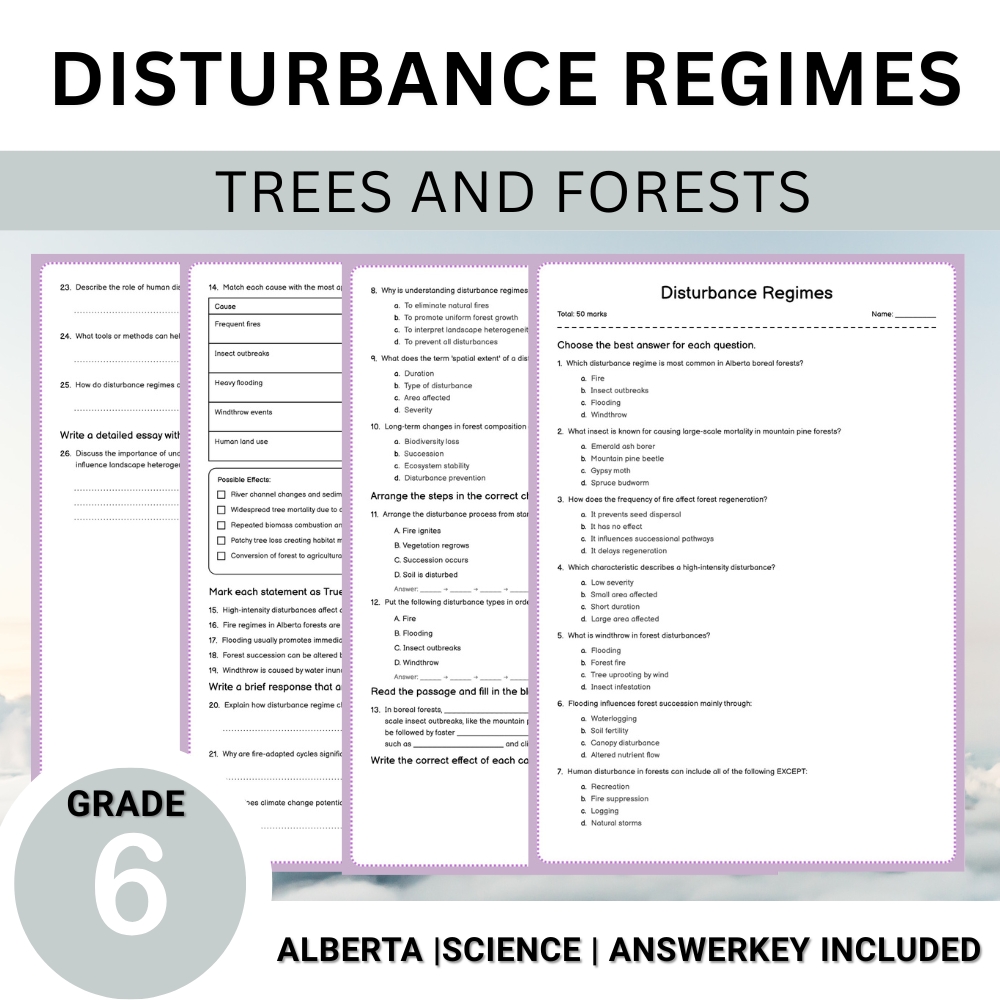
Grade 6 Science | Disturbance Regimes Worksheet (Printable PDF & Assessment)
Learning Objectives
- Identify different types of disturbance regimes in forest ecosystems.
- Understand how disturbance characteristics influence landscape patterns.
- Explain the role of disturbances like fire and insect outbreaks in succession.
Also included in: Grade 6 Science | Tree Anatomy, Ecology & Conservation Unit Worksheet Bundle +1 more
Instant download

6th Grade Social Studies | Trade Networks Worksheet (PDF) - Ontario Standards
Created bySunny Desk ResourcesLearning Objectives
- Explain how geography and available resources influenced the development of historical trade networks.
- Describe how trade partnerships affected wealth, alliances, and cultural exchange in communities.
- Analyze continuity and change by comparing older trade routes with later commercial links.
Also included in: Grade 6 Communities Through Time Social Studies Lesson Bundle for Ontario +1 more
Instant download

Grade 6 ELA – Daily Reading Worksheet | Understanding Audience & Speech
Created byQuiet Forest EducationLearning Objectives
- Identify differences between formal and informal language
- Understand how speech adapts to purpose, context, and audience
- Recognize appropriate situations for formal and informal communication
Also included in: Grade 6 Speaking and Listening ELA Daily Reading Lesson Bundle | General ELA +2 more
Instant download

Science Assessment: El Niño Effects Grade 6 | NGSSS Assessment
Created byPrism Point LearningLearning Objectives
- Explain how El Niño and La Niña relate to changes in sea surface temperatures in the tropical Pacific Ocean.
- Describe how ocean-atmosphere changes can influence evaporation, cloud formation, and wind circulation.
- Predict how precipitation and temperature patterns may shift in some regions during El Niño or La Niña.
Instant download

Grade 6 Science – Population Dynamics & Growth Models | Daily Reading Worksheet
Created byBright Mind ResourcesLearning Objectives
- Understand the basic concepts of population growth and change
- Identify factors that influence population increase or decrease
- Differentiate between growth models like exponential and logistic
Also included in: Grade 6 Ecosystem Relationships Science Daily Reading Lesson Bundle | BC +1 more
Instant download

Grade 6 Health Worksheet | Understanding Health Services & NHES Standards (PDF)
Created bySunny Desk ResourcesLearning Objectives
- Identify common types of health services (clinics, counseling, and emergency care) and what they are used for
- Explain how to choose an appropriate health service for different needs and urgency levels
- Use local and national resources to contact health services efficiently
Also included in: 6th Grade Access Valid Health Information in Health Lesson Bundle NHES +1 more
Instant download
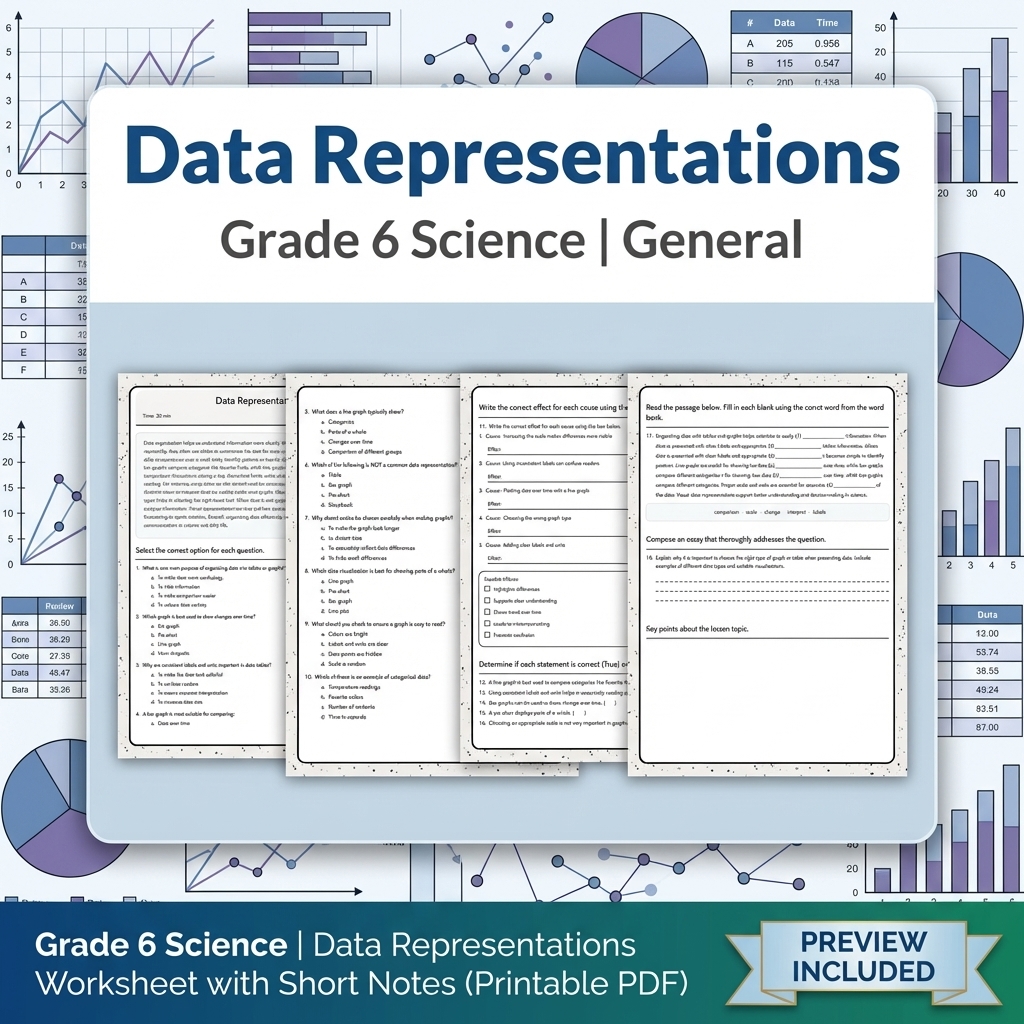
Grade 6 Science | Data Representations Worksheet with Short Notes
Created byMeadowlark WorksheetsLearning Objectives
- Understand how data can be organized into tables, graphs, and simple representations.
- Identify appropriate labels, units, and scales for clear data reading.
- Compare different types of data visualizations such as tables, bar graphs, and line graphs.
Also included in: Grade 6 Science Lesson Group | Comprehensive Worksheets & Activities +1 more
Instant download

Before After Properties Assessment | California Standards Grade 6 Science
Created byPrism Point LearningLearning Objectives
- Compare the properties of substances before and after an interaction to determine what evidence is present
- Distinguish between changes that do not form new substances and interactions that produce new substances
- Use observable evidence (color change, gas release, new solid, and new material) to support chemical reasoning
Also included in: Grade 6 Atoms and Chemical Change Science lesson bundle | California Standards +1 more
Instant download

Grade 6 Source Synthesis Worksheet | ELA Reading & Research Skills
Created bySunny Desk ResourcesLearning Objectives
- Define source synthesis and explain how it goes beyond summarizing one text
- Use evidence from multiple sources to build a coherent explanation
- Identify overlaps and decide what to do with differences between sources
Also included in: Reading Informational Grade 6 ELA Lesson Bundle | General ELA +1 more
Instant download

Source Credibility Practice Worksheet | Grade 6 ELA Assessment
Created byMeadowlark WorksheetsLearning Objectives
- Explain how to evaluate the credibility of a source using reliability signals and quality of evidence.
- Distinguish fact from opinion by checking support such as data, examples, and referenced material.
- Analyze how missing context or unclear sourcing can make information misleading.
Also included in: Grade 6 Media Literacy in ELA Lesson Bundle for Alberta Framework +1 more
Instant download
Browse more categories
About Grade 6 Worksheets
Browse 8,578 printable Grade 6 worksheets across math, ELA, science, and social studies — each a ready-to-print PDF with optional answer keys.
MyTeachingSheets worksheets are made by real teacher-authors and checked before they go live. Download any as a print-ready PDF for lessons, homework, or independent practice — most include answer keys, and previews are always free.