
Grade 6 Worksheets
8,578 grade resources
Measuring Electricity Worksheet | Standards-Aligned Grade 6 Science Practice
JCreated byJ.S SheetsLearning Objectives
- Understand the key electrical quantities: current, voltage, and power.
- Learn how to measure electrical quantities in circuits.
- Explain the relationship between power, energy, and time.
Instant download

Grade 6 Social Studies — Settlement Patterns MCQ Worksheet for Mastery
 Created byThe Resource Hub
Learning Objectives
- Understand how geographic features influence settlement locations.
- Identify different types of settlement patterns across regions.
- Interpret spatial relationships and analyze the significance of resource availability.
Also included in: Grade 6 Human Systems and Resources Social Studies Lesson Bundle +1 more
Instant download

Grade 6 Science | Understanding Gravity & Orbits - Daily Reading Comprehension
 Created byCoral Reef Learning
Learning Objectives
- Explain gravitational attraction as the primary force that governs planetary motion within the solar system.
- Describe how mutual gravity between the Sun and planets produces elliptical orbits.
- Understand the role of gravitational forces in determining orbital periods and speeds.
Instant download

Grade 6 Fair Tests Variables & Controls Science Worksheet | Alberta
 Created byBRIGHT PATH RESOURCES
Learning Objectives
- Explain why fair tests require comparisons.
- Identify independent, dependent, and controlled variables in an investigation.
- Describe a control condition and how it supports fair comparisons.
Also included in: Inquiry Data Grade 6 Science Daily Reading Worksheets Lesson Bundle | Alberta +1 more
Instant download

6th Grade Social Studies Worksheet | Trade and Resources (PDF) – California Standards
 Created bySunny Desk Resources
Learning Objectives
- Explain how Egyptian and Kushite trade networks were supported by access to valuable resources.
- Describe how regional connections through trade affected political influence and stability in both civilizations.
- Identify examples of cultural exchange that could result from trading relationships.
Also included in: Grade 6 Ancient Egypt Trade Social Studies Lesson Bundle (California) +1 more
Instant download

Patriot Day 9/11 Remembrance Worksheets and Reading Review Grade 6
 Created byShaNova Worksheets
Learning Objectives
- Explain why Patriot Day is a day of remembrance and reflection
- Describe how communities and individuals show civic resilience after tragedy
- Use evidence from the text to answer questions about heroism, loss, and unity
Also included in: Patriot Day 9/11 Remembrance Lesson Bundle | Grade 6 Holiday | September
Instant download

6th Grade Science Worksheet – Measurement Uncertainty (Alberta Standards PDF)
 Created bySilver Birch Teaching
Learning Objectives
- Explain what measurement uncertainty means and identify common sources of uncertainty.
- Use repeated measures and ranges to estimate uncertainty in data.
- Distinguish between precision and accuracy and describe how uncertainty affects confidence in conclusions.
Also included in: Grade 6 Scientific Inquiry & Data Analysis Science Lesson Bundle: Alberta +1 more
Instant download

Grade 6 Health – Training Principles for Fitness Daily Reading Worksheet
 Created byQuiet Forest Education
Learning Objectives
- Understand key concepts related to Health
- Apply knowledge through practice questions
- Demonstrate comprehension of the material
Also included in: Active Living Grade 6 Health Daily Reading Worksheets Bundle | Ontario +2 more
Instant download

6th Grade ELA | Narrator Point of View Worksheet (Worksheet + Answer Key)
 Created byGolden Apple Studio
Learning Objectives
- Explain how a narrator’s point of view influences what information a reader notices and trusts.
- Identify how word choice and description style reveal a narrator’s attitude toward events and characters.
- Use evidence from a text to describe how the narrator reveals or withholds information.
Instant download

Drag Components Worksheet & Doodle Notes | Grade 6 Ontario Science
 Created byChalk and Compass
Learning Objectives
- Categorize drag into parasitic drag and induced drag and explain how each relates to flight and airflow.
- Identify components of parasitic drag (form drag, skin-friction drag, and interference drag) and relate them to factors like speed and shape.
- Explain why induced drag is an unavoidable by-product of lift generation and how wing span and lift distribution affect it.
Also included in: Grade 6 Science Aviation Unit Aerodynamics & Flight Testing Lesson Bundle +1 more
Instant download

Grade 6 ELA Comparison Across Forms Worksheet – Analyzing Stories and Drama
Created byGolden Apple StudioLearning Objectives
- Compare how theme and conflict develop across texts in different forms (such as poetry, drama, and prose).
- Identify how genre conventions (dialogue, stage-like moments, or compressed language) shape meaning.
- Use specific evidence from each text to support similarities and differences.
Also included in: 6th Grade ELA Theme, Point of View & Evidence Lesson Bundle - General ELA +1 more
Instant download

6th Grade Science | Weather vs Climate Worksheet (PDF) - Standard Aligned
 Created byEvergreen Desk Education
Learning Objectives
- Distinguish weather from climate using everyday examples and correct scientific meanings
- Explain why weather changes quickly while climate changes over long time periods
- Identify variables (temperature, precipitation, wind, cloud cover) and describe how they can be observed
Also included in: 6th Grade Earth & Climate Science Lesson Bundle – General Framework +1 more
Instant download

Population Dynamics Worksheet | Standards-Aligned Science Practice for Grade 6
JCreated byJ.S SheetsLearning Objectives
- Understand the factors that influence population change over time.
- Identify different growth models such as exponential and logistic growth.
- Explain how density-dependent and density-independent factors affect populations.
Instant download

Science Grade 6 Particle Models of Matter Worksheet | NGSS Aligned Assessment
 Created bySkylark Worksheets
Learning Objectives
- Explain how the particle model describes matter as particles in constant motion
- Use particle spacing and motion to describe phases and changes of state (melting, freezing, boiling, condensation)
- Relate temperature and thermal energy to particle kinetic energy and gas pressure in a qualitative way
Also included in: Grade 6 Matter and Chemical Reactions Science Lesson Bundle NGSS Worksheets +1 more
Instant download

Safety and Ethics Worksheet | Grade 6 Science Review & Practice
 Created byPrism Point Learning
Learning Objectives
- Explain why risk assessment and hazard prevention matter during science investigations.
- Demonstrate safe tool and material handling and proper disposal of substances.
- Apply ethical principles such as humane treatment, informed consent, confidentiality, and environmental stewardship.
Instant download

Grade 6 Science – Moon's Phases & Lunar Cycle | Daily Reading Worksheet
 Created byBright Mind Resources
Learning Objectives
- Identify the different phases of the Moon
- Describe how the relative positions of the Sun, Earth, and Moon create lunar phases
- Use a model to predict the Moon's appearance and phases over time
Also included in: Grade 6 Solar System & Seasons Science Daily Reading Lesson Bundle | Alberta +2 more
Instant download
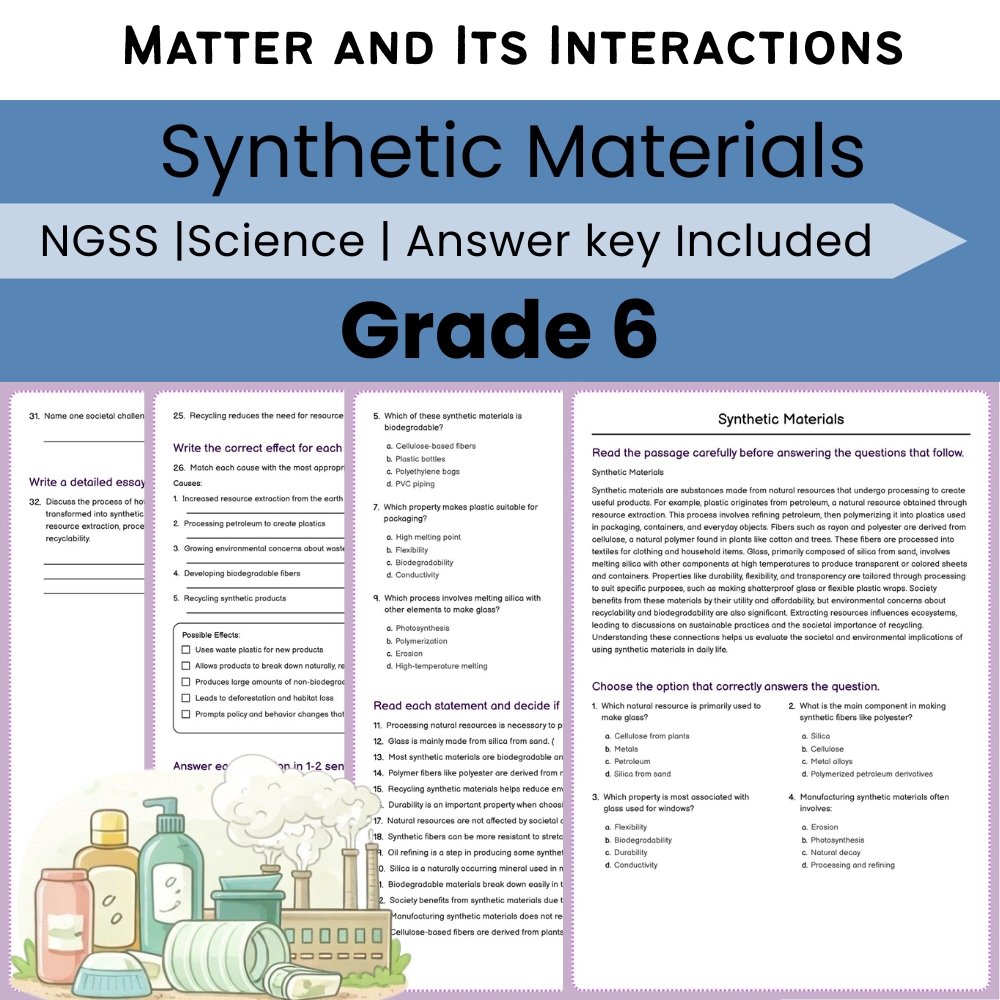
6th Grade Science | Synthetic Materials Worksheet (Printable PDF & Assessment)
Learning Objectives
- Understand the origins and sources of synthetic materials derived from natural resources.
- Compare properties of substances such as plastic, fiber, and glass and relate them to their uses.
- Explain the processes involved in extracting and processing resources for manufacturing.
Also included in: Grade 6 Science | Matter and Its Interactions NGSS Unit Bundle - Assessments & Worksheets +1 more
Instant download
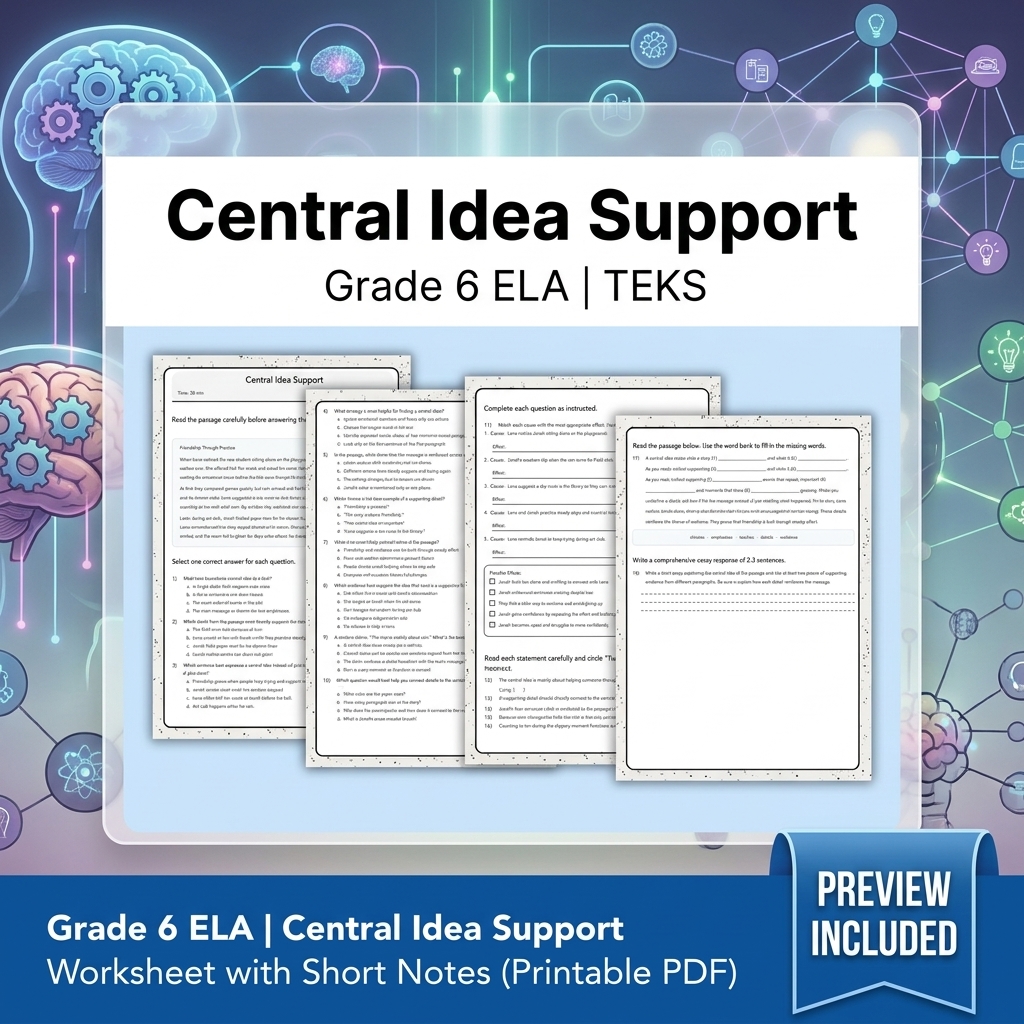
Grade 6 ELA | Central Idea Support Worksheet with Short Notes (Printable PDF)
 Created byMeadowlark Worksheets
Learning Objectives
- Identify the central idea or theme of a realistic fiction text
- Use supporting details (recurring events, repeated ideas, and key moments) to explain how they reinforce the central idea
- Distinguish between a central idea and details that only add information
Also included in: Grade 6 Tone, Theme, and Evidence ELA Skills Lesson Bundle (TEKS) +1 more
Instant download

Grade 6 Science – States of Matter & Visuals | Daily Reading Worksheet
Created byBright Mind ResourcesLearning Objectives
- Understand key concepts related to Science
- Apply knowledge through practice questions
- Demonstrate comprehension of the material
Also included in: Matter & Energy Grade 6 Science Daily Reading Worksheets Bundle | TEKS +2 more
Instant download
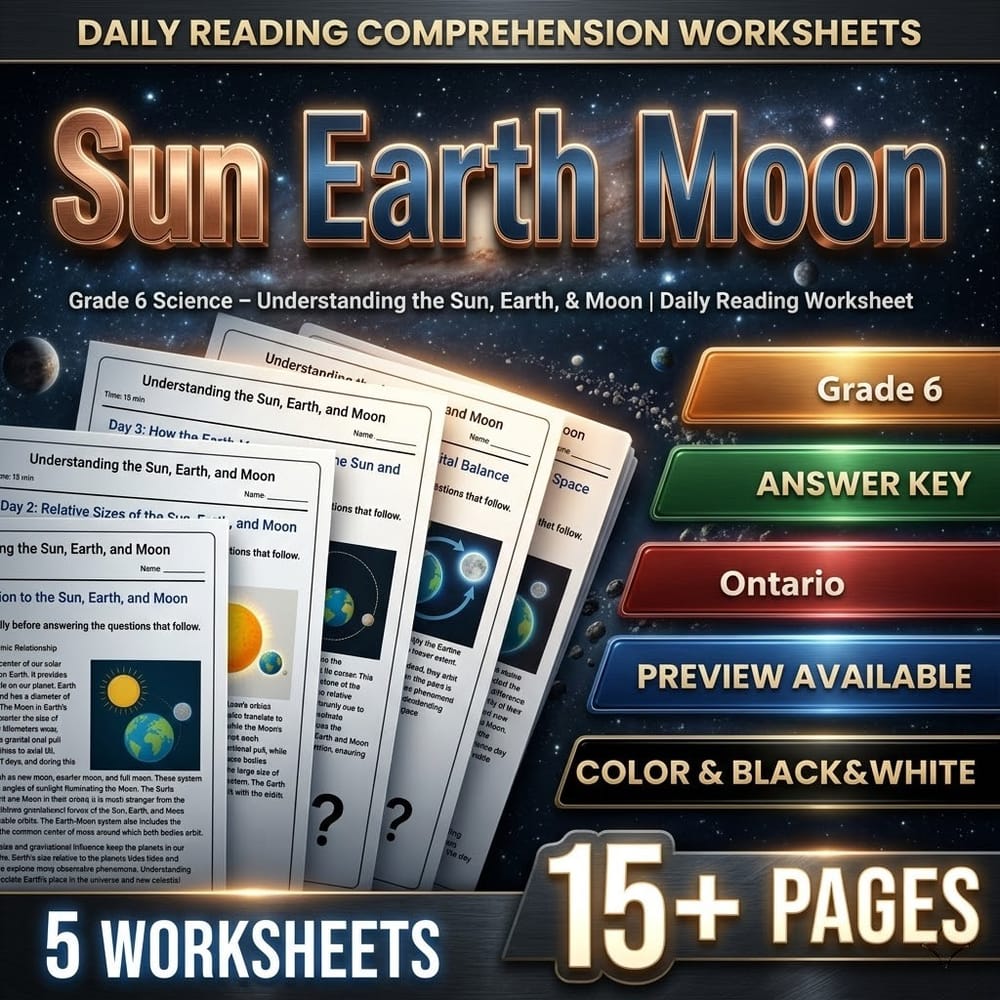
Grade 6 Science – Understanding the Sun, Earth, & Moon | Daily Reading Worksheet
Created byQuiet Forest EducationLearning Objectives
- Learn about the relative sizes and positions of the Sun, Earth, and Moon.
- Understand how gravity influences their orbital relationships.
- Identify key concepts such as the Earth–Moon barycenter and the Sun's gravitational role.
Also included in: Space Science Grade 6 Daily Reading Worksheets Bundle | Ontario +1 more
Instant download
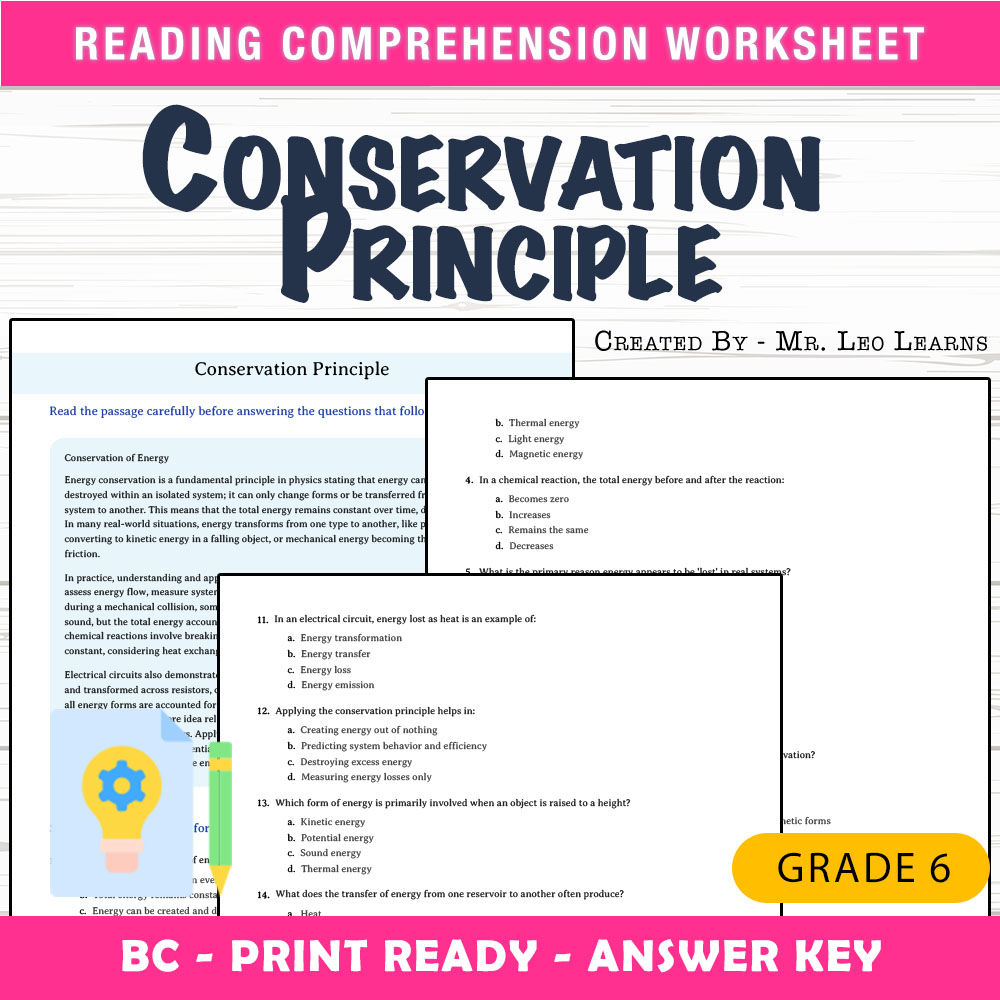
Grade 6 Science — Worksheet MCQ Paper for Mastering Conservation Principle
Created byThe Resource HubLearning Objectives
- Explain the law of conservation of energy and its significance in physical systems.
- Identify examples of energy transfer and transformation in everyday scenarios.
- Describe how conservation of energy applies in collisions, chemical reactions, and circuits.
Also included in: Grade 6 Science Energy, Waves & Circuits UNIT Bundle | BC Standards +1 more
Instant download

Land Claims & Treaties Worksheet | Standard-Aligned Grade 6 Social Studies
JCreated byJ.S SheetsLearning Objectives
- Explain what treaties and land claims are and why they matter to governance and responsibilities
- Describe the main steps involved in treaty negotiation and the types of rights and duties exchanged
- Identify Indigenous perspectives on treaties as ongoing relationships and explain the idea of reciprocal obligations
Instant download

Grade 6 ELA – Exploring Narrator Point of View Daily Reading Worksheet
Created byQuiet Forest EducationLearning Objectives
- Identify first-person point of view in a story
- Understand how narrator’s perspective influences storytelling
- Recognize narrative techniques related to narrator’s stance
Also included in: Reading Literature Grade 6 ELA Daily Reading Worksheets Lesson Bundle | Gen. ELA +2 more
Instant download

Climate Systems Practice Worksheet | Grade 6 Science | NGSS Review
Created byPrism Point LearningLearning Objectives
- Explain how unequal solar heating and Earth’s rotation create global atmospheric circulation patterns.
- Describe how ocean currents and circulation help move heat and moisture around the planet.
- Use climate-cell models and current patterns to predict regional climate zones and related events.
Also included in: Grade 6 Weather & Climate Systems Science Lesson Bundle NGSS
Instant download

Erosion and Deposition Assessment for Grade 6 Science | California Standards
Created byPrism Point LearningLearning Objectives
- Explain how moving water erodes Earth materials and transports sediment
- Describe how decreasing water energy leads to deposition
- Connect erosion and deposition to landform features such as river terraces and deltas
Also included in: Grade 6 Water in Earth Systems Science Lesson Bundle: California Standards +1 more
Instant download

Grade 6 Science | Understanding Moon Phases & Shadows - Daily Reading Practice
Created byCoral Reef LearningLearning Objectives
- Understand key concepts related to Science
- Apply knowledge through practice questions
- Demonstrate comprehension of the material
Instant download

Grade 6 Health | Benefits and Planning Worksheet (PDF) – Ontario Standards
Created bySunny Desk ResourcesLearning Objectives
- Explain at least three benefits of regular physical activity for physical health, mental well-being, and social connection
- Identify key planning ideas (frequency, intensity, time, and safety) that help make a fitness plan realistic and sustainable
- Use inclusive and individualized strategies to make physical activities safe, enjoyable, and suited to different needs
Also included in: Grade 6 Active Living Health Lesson Bundle: Ontario Health Skills Framework +1 more
Instant download

Grade 6 Inherited Adaptations Worksheet | Practice & Assessment PDF
 Created byClear Sky Classroom
Learning Objectives
- Explain how inherited traits can improve survival and reproduction in specific environments
- Identify examples of adaptations that help organisms feed, protect themselves, or tolerate temperature and moisture
- Distinguish between inherited adaptations and learned behaviors
Instant download
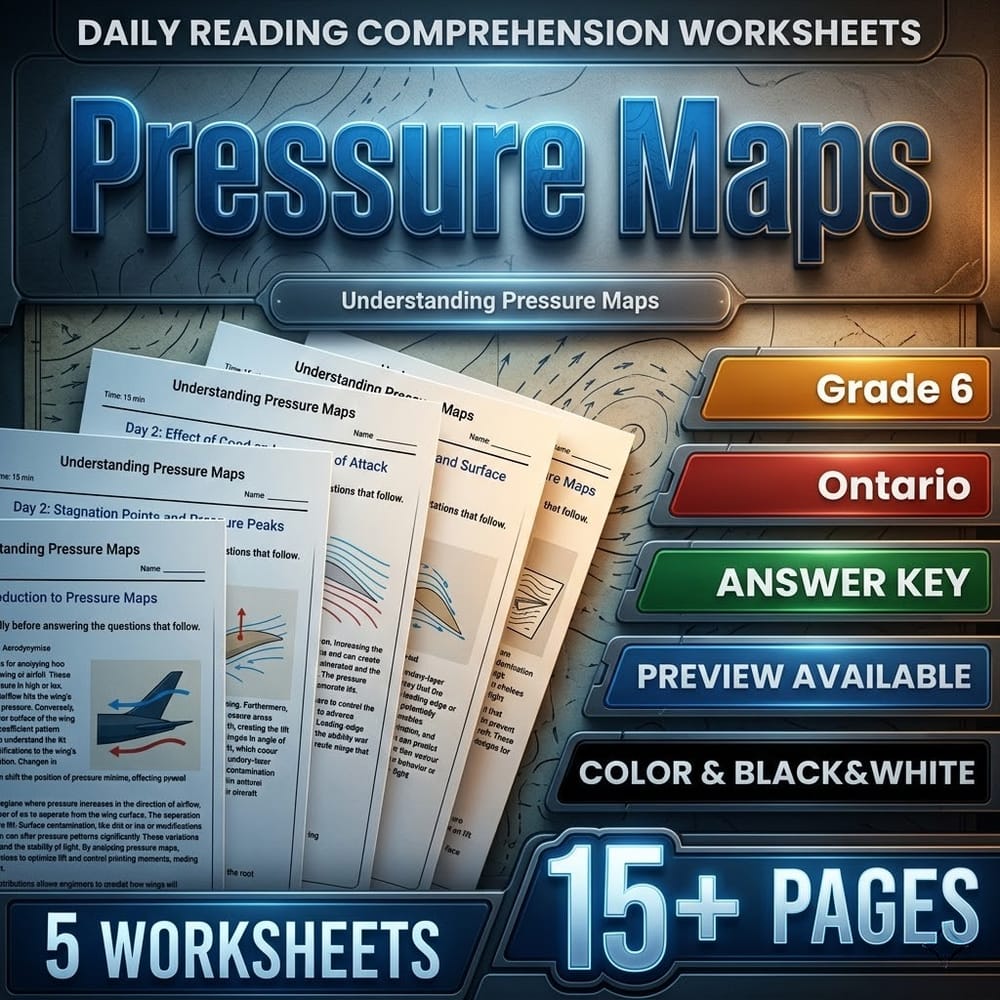
Grade 6 Science – Understanding Pressure Maps & Analysis | Daily Worksheet
Created byQuiet Forest EducationLearning Objectives
- Explain what pressure maps are and how they relate to wing surfaces.
- Identify different pressure zones such as stagnation points, suction peaks, and pressure minima.
- Understand how changes in camber and angle of attack influence pressure distributions.
Also included in: Flight Science Grade 6 Daily Reading Worksheets Bundle | Ontario +1 more
Instant download

Science Worksheet: Digital Instrumentation Sensors Data Loggers Grade 6
JCreated byJ.S SheetsLearning Objectives
- Explain how electronic sensors convert physical changes into electrical signals for digital measurement
- Identify how sampling rate, resolution, and correct units affect the quality of recorded data
- Describe why calibration and metadata documentation are necessary for accurate and trustworthy measurements
Instant download

Flight Forces Practice Worksheet | Grade 6 Science Assessment Ontario
Created byPrism Point LearningLearning Objectives
- Identify the four aerodynamic forces (lift, drag, thrust, and weight) and describe how each affects motion.
- Explain how vector addition and equilibrium relate to steady level flight, using directions and magnitudes of forces.
- Compare how changes in forces can cause climb, cruise, or descent in propeller and glider examples.
Also included in: Grade 6 Aerodynamics Flight Design Science lesson bundle - Ontario
Instant download

Decomposition of Complex Problems Worksheet | Grade 6 Computer Science
Created byBright Mind ResourcesLearning Objectives
- Define decomposition, subproblem, strategy, and solution in the context of problem solving
- Identify how a complex task can be broken into smaller subproblems
- Choose an appropriate strategy for solving a decomposed set of steps
Instant download

Particle Model Worksheet | Standardized Science Practice for Grade 6
JCreated byJ.S SheetsLearning Objectives
- Describe the particle model as a way to understand the states of matter.
- Explain how particles behave differently in solids, liquids, and gases.
- Connect microscopic particle arrangements to macroscopic properties like shape and volume.
Instant download

6th Grade Holiday Writing | Thank-You Notes Worksheet PDF
Created bySilver Birch TeachingLearning Objectives
- Identify the purpose and key components of a thank-you note (greeting, specific gratitude, and closing).
- Use an appropriate tone and grade-level vocabulary to show gratitude clearly and respectfully.
- Apply conventions of writing by organizing ideas and choosing effective sentence structure.
Also included in: 6th Grade Holiday Lesson Bundle: May Framework +1 more
Instant download

Food Chains Worksheet for Grade 6 Science | Standards-Aligned Practice
JCreated byJ.S SheetsLearning Objectives
- Define producers, consumers, and decomposers and describe how they connect in food chains and food webs
- Identify trophic levels (primary, secondary, and tertiary) and explain how energy transfers between them
- Explain why energy decreases at higher trophic levels while matter cycles through decomposers
Instant download

6th Grade Science Worksheet – Classifying Matter TEKS (PDF)
Created byEvergreen Desk EducationLearning Objectives
- Classify matter as an element, a compound, or a mixture using composition and observable characteristics
- Distinguish homogeneous mixtures from heterogeneous mixtures based on how uniform the parts appear
- Describe how separation techniques (filtration and distillation) relate to a substance’s homogeneity
Instant download
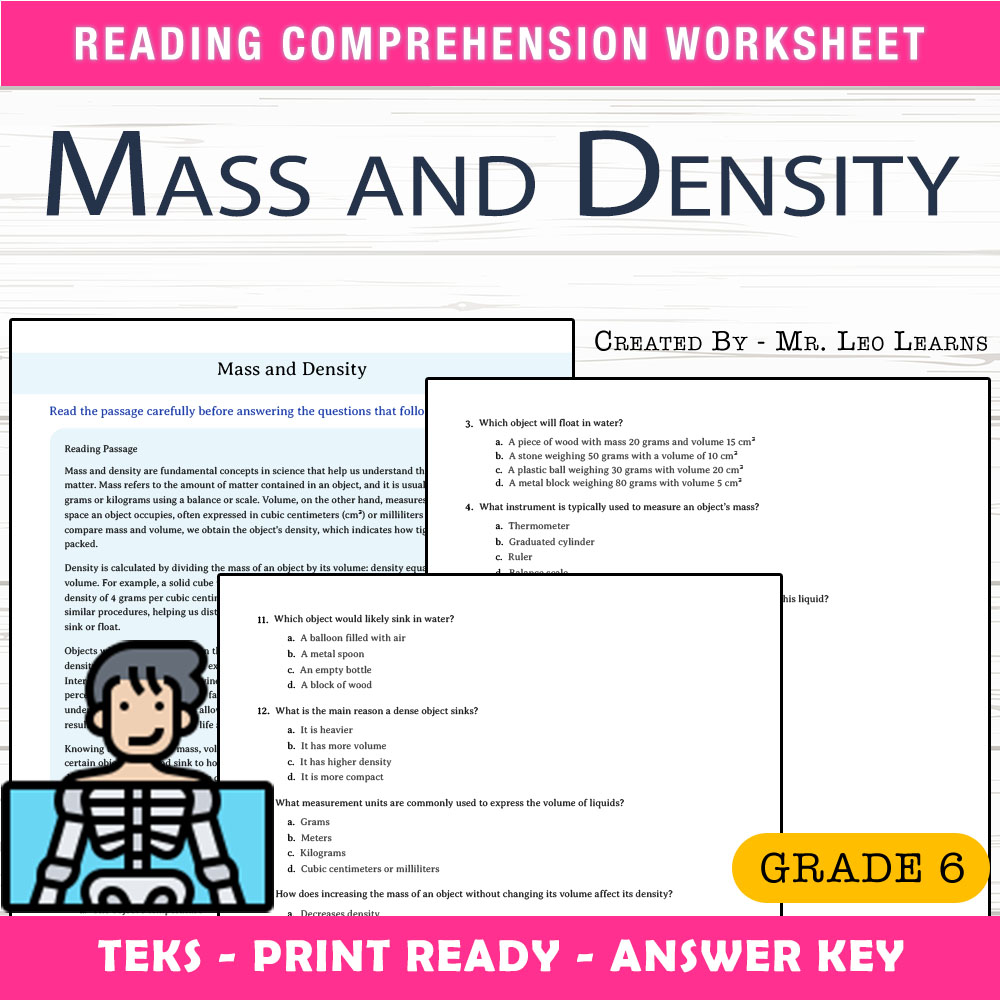
Grade 6 Science – Mass and Density Worksheet for Mastery
Created byThe Resource HubLearning Objectives
- Define and explain the concepts of mass and volume
- Understand how density relates mass and volume
- Calculate the density of simple solids and liquids
Also included in: Grade 6 Science Unit Bundle | States, Matter, Forces & Energy Mastery
Instant download

Grade 6 Science Daily Reading States of Matter Overview TEKS Worksheet
Created byBRIGHT PATH RESOURCESLearning Objectives
- Identify key traits of solids, including shape retention and particle spacing.
- Match everyday examples to the state of matter based on observable properties.
Also included in: Energy, Matter & Change Grade 6 Science Lesson Bundle | TEKS Daily Reading +1 more
Instant download

6th Grade Science | Data Representation Worksheet (PDF) TEKS Aligned
Created byEvergreen Desk EducationLearning Objectives
- Use proper conventions to label axes and choose scales when creating tables and graphs.
- Interpret data displays (tables, line graphs, bar graphs, scatter plots) to identify trends and relationships.
- Recognize outliers and patterns in data representations and use them to compare results across conditions.
Instant download

Grade 6 Complex Sentences Worksheet | Ontario ELA Grammar & Writing Skills
Created bySunny Desk ResourcesLearning Objectives
- Combine an independent clause and a dependent clause to write a complex sentence.
- Use subordinating conjunctions and relative pronouns to show relationships such as cause, contrast, and time.
- Revise sentence fragments so the dependent clause correctly attaches to an independent clause.
Instant download

Tone and Mood Worksheet Grade 6 ELA TEKS Reading Analysis Activity
Created byGolden Apple StudioLearning Objectives
- Distinguish tone from mood by identifying the author’s attitude and the text’s emotional atmosphere.
- Analyze how word choice, imagery, and sentence style (diction and syntax) contribute to tone and shape mood.
- Explain how shifts in events can cause changes in tone and mood.
Also included in: Grade 6 ELA Text Analysis & Author Craft Lesson Bundle | TEKS +1 more
Instant download

6th Grade ELA Character Analysis Worksheet (CCSS) | Reading & Writing Practice (PDF)
Created byGolden Apple StudioLearning Objectives
- Identify character traits and motivations in a narrative by analyzing what characters say and do.
- Infer how a character’s actions and decisions influence the plot and the story’s themes.
- Use textual evidence to support interpretations about a character’s personality and growth.
Also included in: Theme, Evidence & Character Analysis Lesson Bundle | Grade 6 ELA | CCSS +1 more
Instant download

Grade 6 Health – Influences Worksheet (Ontario Standards) PDF
Created bySunny Desk ResourcesLearning Objectives
- Explain how social, environmental, and psychological influences affect health behaviors.
- Identify how media messages and peer pressure can shape nutrition, activity, and safety choices.
- Use evidence and personal beliefs to justify healthy decisions over time.
Also included in: Grade 6 Healthy Living Health Lesson Bundle Unit: Ontario Framework +1 more
Instant download

Grade 6 Science – Circuit Faults & Troubleshooting | Daily Reading Worksheet
Created byBright Mind ResourcesLearning Objectives
- Identify common symptoms indicating faults in electrical circuits
- Interpret measurement patterns to diagnose circuit issues
- Apply conceptual reasoning based on circuit topology and behavior
Also included in: Grade 6 Electricity Science Daily Reading Lesson Bundle | Ontario +1 more
Instant download

Climate Factors and Weather Patterns Worksheets Grade 6 Science
 Created byElena Brooks
Learning Objectives
- Explain how climate differs from weather using long-term patterns and averages
- Identify major climate factors such as latitude, altitude, ocean distance, ocean currents, and prevailing winds
- Use evidence from climate comparisons to describe why different ecosystems occur in different regions
Instant download

Grade 6 Science | Matter Properties - Daily Reading Comprehension
Created byCoral Reef LearningLearning Objectives
- Identify and describe observable properties of solids such as color, hardness, and texture.
- Understand how to classify matter based on its physical properties.
- Recognize the characteristics that distinguish different solids like copper, wood, and glass.
Instant download

Grade 6 Science | Understanding Crystal Structures - Daily Reading Comprehension
Created byCoral Reef LearningLearning Objectives
- Define crystalline and amorphous solids.
- Identify properties that distinguish crystalline solids from amorphous solids.
- Explain how particle arrangements affect the physical properties of solids.
Instant download

Pronoun Reference Worksheets | Grade 6 ELA Grammar Practice
Created byGolden Apple StudioLearning Objectives
- Identify antecedents for pronouns in informational text
- Choose pronoun case based on grammatical role
- Revise sentences to reduce ambiguous pronoun references
Also included in: Grade 6 ELA Grammar, Vocabulary & Punctuation Worksheets | Ontario +1 more
Instant download
Browse more categories
About Grade 6 Worksheets
Browse 8,578 printable Grade 6 worksheets across math, ELA, science, and social studies — each a ready-to-print PDF with optional answer keys.
MyTeachingSheets worksheets are made by real teacher-authors and checked before they go live. Download any as a print-ready PDF for lessons, homework, or independent practice — most include answer keys, and previews are always free.