
Grade 6 Worksheets
8,578 grade resources
6th Grade ELA | Narrative Context Worksheet (PDF) – General ELA Standards
 Created byGolden Apple Studio
Learning Objectives
- Identify how a narrative introduces time, setting, and background information to frame the events.
- Explain how point of view and tense support clarity in a narrative.
- Analyze how purposeful details in the opening create mood and lead toward a central conflict or goal.
Also included in: Grade 6 Explanatory Writing Skills ELA Lesson Bundle: General ELA +1 more
Instant download
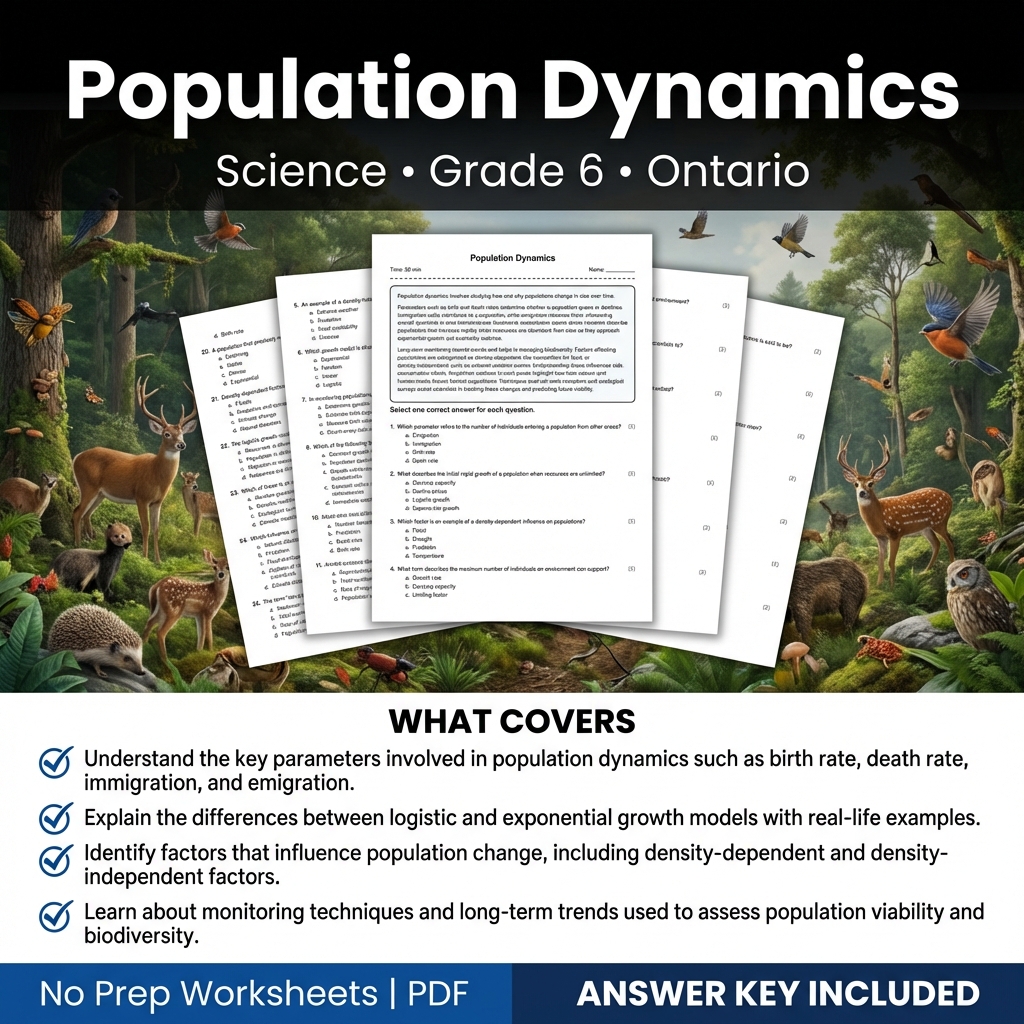
Population Dynamics Worksheet for Grade 6 Science | Ontario Standards
 Created byCoral Reef Learning
Learning Objectives
- Understand the key parameters involved in population dynamics such as birth rate, death rate, immigration, and emigration.
- Explain the differences between logistic and exponential growth models with real-life examples.
- Identify factors that influence population change, including density-dependent and density-independent factors.
Instant download

Criteria And Constraints Worksheet Pack | Grade 6 Science Activities
 Created byPrism Point Learning
Learning Objectives
- Explain the difference between criteria and constraints in the design process.
- Identify examples of criteria and constraints in a real-world design task.
- Use evidence to justify whether a proposed solution meets criteria while respecting constraints.
Instant download

Grade 6 Science Eclipses and Spring Neap Tides Worksheet Ontario
 Created byTeacher's Corner
Learning Objectives
- Explain how alignment in the Earth–Moon–Sun system produces solar and lunar eclipses.
- Distinguish umbra and penumbra and describe their effects on what people see.
- Model tidal ranges using the differential gravitational pull of the Moon and Sun.
Instant download

Grade 6 Revising for Clarity Worksheet | ELA Editing & Writing Skills
 Created bySunny Desk Resources
Learning Objectives
- Revise a draft by improving content, organization, and style to make meaning clearer
- Identify sentence-level changes that reduce redundancy and increase precision
- Use revision questions to strengthen how ideas connect for a specific audience and purpose
Also included in: Grade 6 Writing Lesson Bundle | General ELA | Editing, Narrative, Argument +1 more
Instant download

Cellular Respiration Worksheet | Standards-Aligned Grade 6 Science Practice
JCreated byJ.S SheetsLearning Objectives
- Explain the process of cellular respiration and its role in energy production.
- Identify the gases involved in cellular respiration and their exchange.
- Describe how matter from food molecules is transformed and transported in the body.
Also included in: Grade 6 Life Science Science Lesson Bundle – California Standards +1 more
Instant download

Measurement Uncertainty and Confidence in Data Worksheet Grade 6
Created bySunny Desk ResourcesLearning Objectives
- Explain how instrument resolution, environmental variation, and human observation can create measurement uncertainty
- Estimate uncertainty using repeated measurements and a range
- Interpret simple percent error and use it to judge whether results are reasonable
Also included in: Evidence & Investigation Grade 6 Science Worksheets | Alberta +1 more
Instant download

Fair Scientific Investigations Worksheets & Answer Key for Grade 6 Science
 Created byEmma Carter Resources
Learning Objectives
- Identify independent, dependent, and controlled variables in scientific investigations.
- Explain why a controlled investigation is a fair test.
- Construct hypotheses using a clear if-then-because format.
Instant download

Science Design Criteria and Constraints Worksheet | Grade 6 Science Assessment
JCreated byJ.S SheetsLearning Objectives
- Explain the difference between goals, criteria, and constraints in the design process
- Use criteria and constraints to interpret evidence from tests and observations
- Identify examples of constraints from real-world limitations like safety rules, available materials, size requirements, and environmental conditions
Also included in: Grade 6 Engineering Design Process Science Lesson Bundle – General Framework +1 more
Instant download

Grade 6 Social Studies — Spatial Relationships Worksheet for Mastery
 Created byThe Resource Hub
Learning Objectives
- Describe spatial relationships using distance, direction, and location
- Use map features (scale, legend, compass directions) to interpret geographic information
- Explain how natural features and political features influence trade, settlement, and regional development
Also included in: Maps & Physical/Political Features Lesson Bundle | Grade 6 Social Studies | TEKS +1 more
Instant download

Context Clues Worksheets | Grade 6 ELA Informational Text
Created byGolden Apple StudioLearning Objectives
- Identify types of context clues used to define unfamiliar words
- Infer word meaning from surrounding sentences and grammar
- Distinguish restatement, example, contrast, and cause-and-effect clues
Also included in: Grade 6 ELA Grammar, Vocabulary & Punctuation Worksheets | Ontario +1 more
Instant download
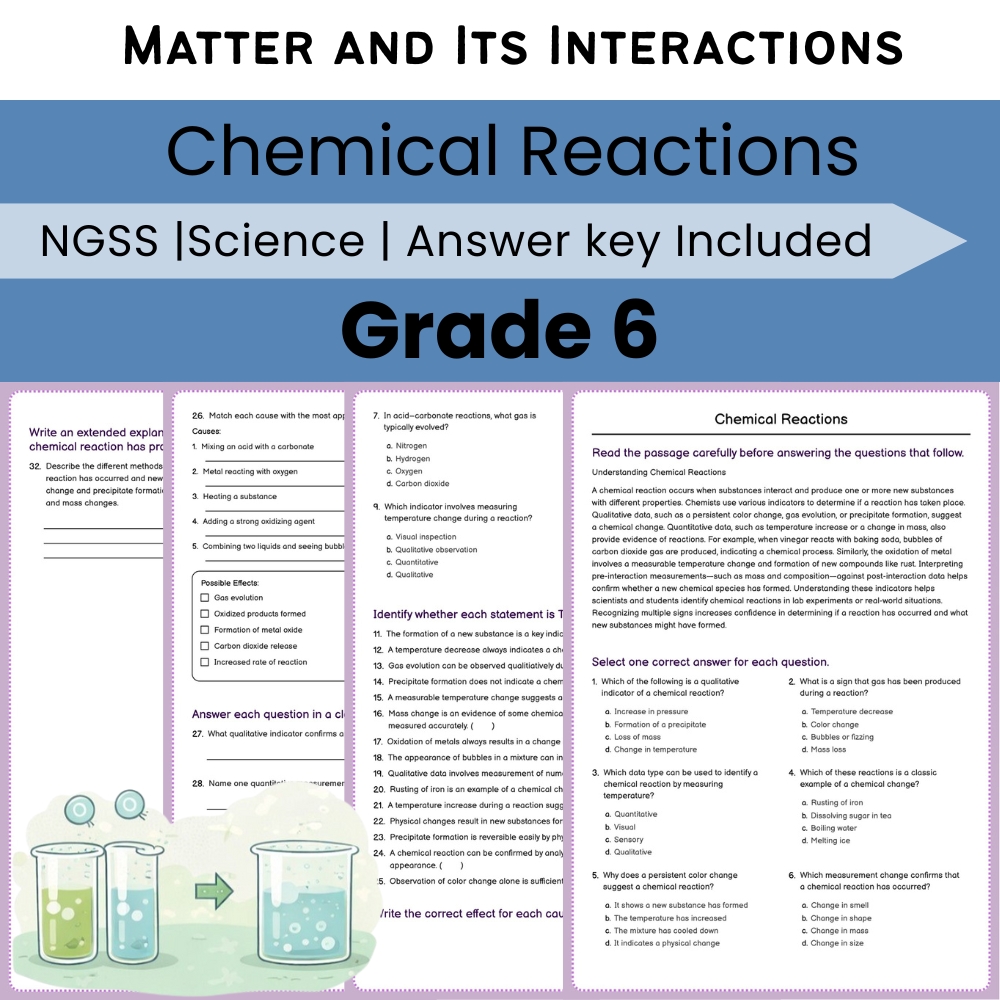
Grade 6 Science | Chemical Reactions Worksheet | Assessment & Student Practice (Printable PDF)
Learning Objectives
- Identify criteria that indicate a chemical reaction has occurred.
- Analyze quantitative and qualitative data to determine if new substances are formed.
- Recognize indicators of chemical reactions such as color change, gas evolution, precipitate formation, and temperature change.
Also included in: Grade 6 Science | Matter and Its Interactions NGSS Unit Bundle - Assessments & Worksheets +1 more
Instant download

Protecting Devices and Data Worksheet Grade 6 Computer Science
Created byPrism Point LearningLearning Objectives
- Explain how software updates help protect devices and data
- Use secure account habits to reduce the risk of problems
- Describe why backups are important for keeping data safe
Also included in: Digital Safety & Security Lesson Bundle | Grade 6 Computer Science | General +1 more
Instant download
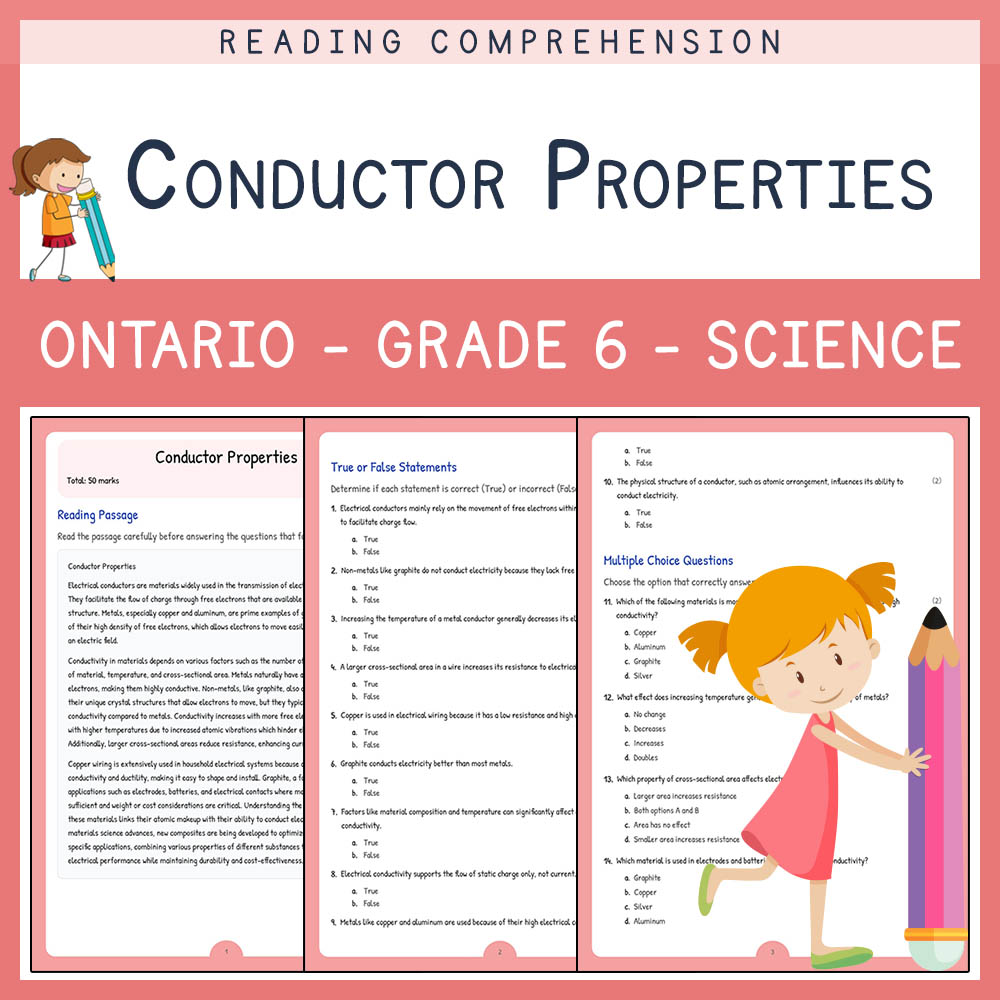
Grade 6 Science | Conductors Properties Worksheet & Answer Key (PDF)
 Created byLumora Learning
Learning Objectives
- Explain the concept of electrical conductivity and how free electrons facilitate charge flow in conductors.
- Identify common metallic and non-metallic materials that act as conductors.
- Describe factors affecting conductivity, including material composition, temperature, and cross-sectional area.
Also included in: Grade 6 Science | Electricity Unit Custom Bundle | Ontario Framework
Instant download

Celestial Patterns Worksheet Grade 6 Science | Assessment and Practice
Created byPrism Point LearningLearning Objectives
- Describe how the Sun, Moon, planets, and constellations appear to move in predictable patterns from a fixed location
- Explain how seasonal star patterns can be used to recognize characteristic times of year
- Compare how planets change position more slowly than constellations against the background stars
Also included in: Celestial Patterns & Seasons Lesson Bundle | Grade 6 Science | Alberta
Instant download

Grade 6 Social Studies — Dynastic Authority in Ancient Egypt Worksheet
Created byThe Resource HubLearning Objectives
- Understand the concept of divine kingship and its role in Egyptian civilization.
- Identify how religious beliefs reinforced political stability and authority.
- Analyze the relationship between religious and political power in ancient Egypt.
Also included in: Grade 6 Ancient Egypt Trade Resources Social Studies Lesson Bundle California +1 more
Instant download

6th Grade Science – Energy Transfer Worksheet (TEKS Standard) (PDF)
 Created byEvergreen Desk Education
Learning Objectives
- Explain how thermal energy transfers by conduction, convection, and radiation.
- Use observable temperature changes and material properties (like thermal conductivity) to predict heat flow.
- Identify heat transfer behavior in simple open and closed systems.
Instant download

Matter Cycling Carbon Assessment Grade 6 | Science Standards-Aligned
Created byPrism Point LearningLearning Objectives
- Explain how carbon atoms cycle through air, water, and living organisms in an ecosystem
- Distinguish between matter cycling (conservation of atoms) and energy flow (one-way transformation)
- Describe how carbon moves from plants to animals and returns to the environment through respiration and decomposition
Also included in: Grade 6 Energy and Matter Cycles Science Lesson Bundle | California Standards +1 more
Instant download
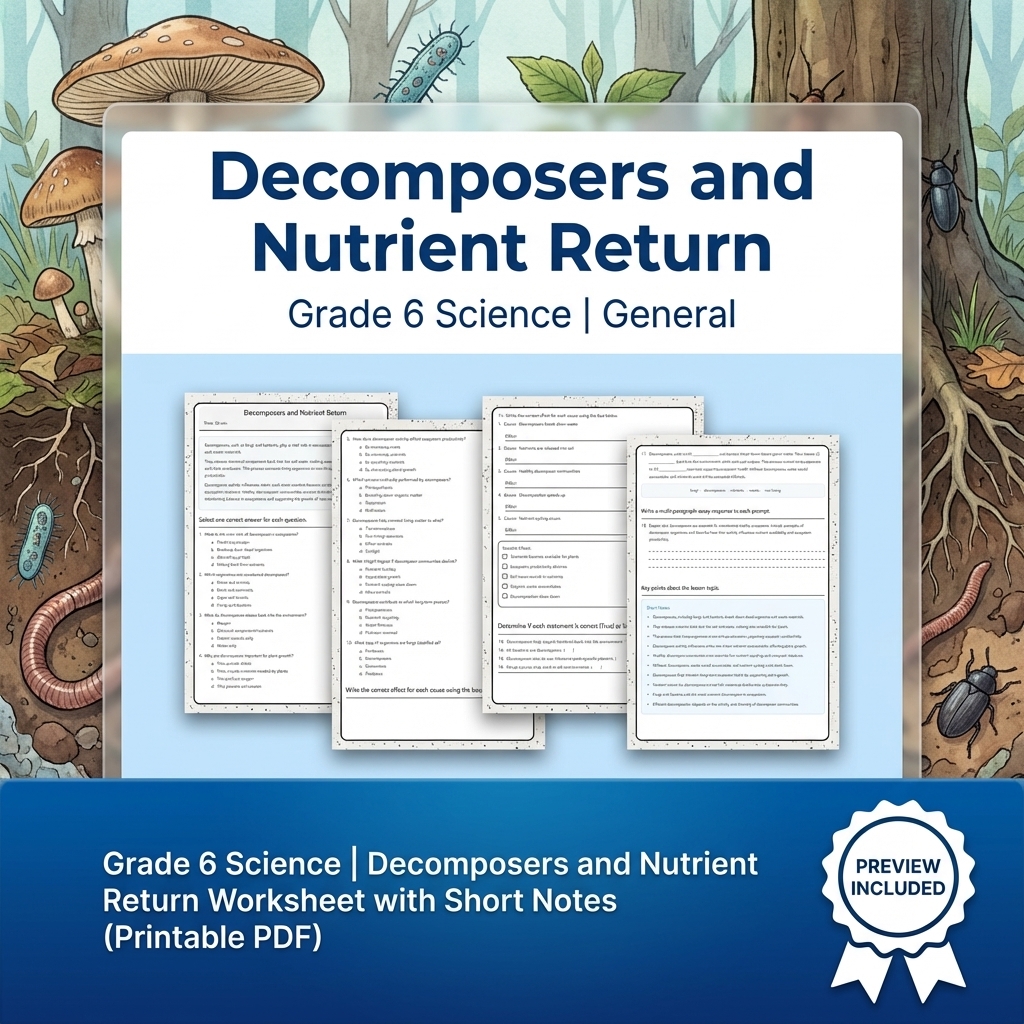
Grade 6 Science | Decomposers and Nutrient Return Worksheet with Short Notes
 Created byMeadowlark Worksheets
Learning Objectives
- Understand the role of decomposers in ecosystems.
- Identify different types of decomposers like fungi and bacteria.
- Explain how decomposers help recycle nutrients back into the environment.
Also included in: Grade 6 Science Lesson Group | Body Systems and Life Processes Worksheet Bundle +1 more
Instant download

Grade 6 Science | Particle Models in Science - Daily Reading Comprehension
Created byCoral Reef LearningLearning Objectives
- Understand that matter is made up of tiny particles that we cannot see.
- Describe how particles move, collide, and are spaced in different phases of matter.
- Explain how temperature and thermal energy affect particle behavior.
Instant download

Grade 6 Science | Water Reservoirs Water Storage & Movement - Reading Practice
Created byCoral Reef LearningLearning Objectives
- Identify different types of water reservoirs on Earth.
- Understand how water moves between reservoirs.
- Explain the conditions that affect water storage in various reservoirs.
Instant download
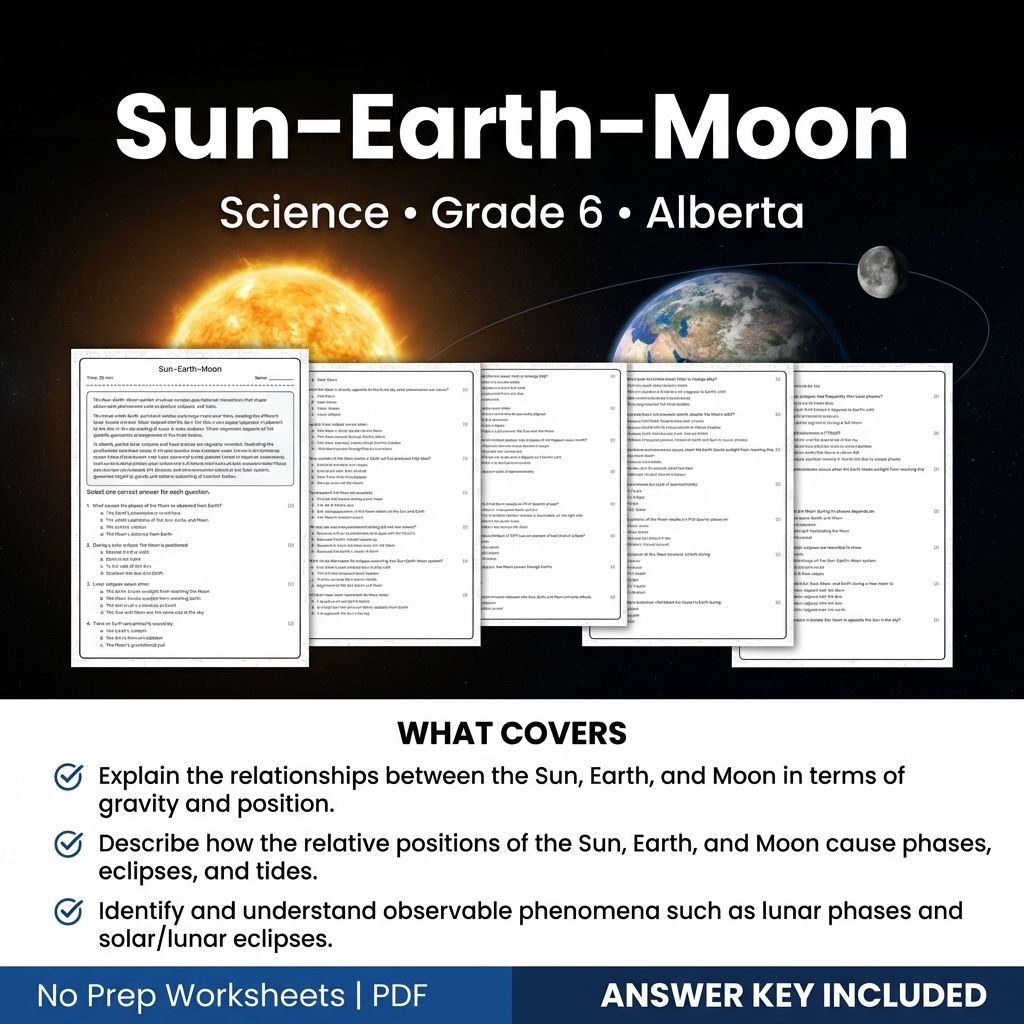
Grade 6 Science Sun–Earth–Moon Worksheet | Alberta Standards
Created byCoral Reef LearningLearning Objectives
- Explain the relationships between the Sun, Earth, and Moon in terms of gravity and position.
- Describe how the relative positions of the Sun, Earth, and Moon cause phases, eclipses, and tides.
- Identify and understand observable phenomena such as lunar phases and solar/lunar eclipses.
Instant download

Root Adaptations Worksheets Grade 6 Water Uptake and Tree Survival Review
Created bySunny Desk ResourcesLearning Objectives
- Describe how root systems anchor plants and help them absorb water and nutrients
- Compare lateral root systems and deep taproots and how soil conditions influence which form is common
- Explain how mycorrhizal associations can improve absorption and drought resilience
Also included in: Trees and Forests Grade 6 Alberta Science Worksheets Bundle +1 more
Instant download

6th Grade Science Chemical Evidence Worksheet | Reactions & Clues (PDF)
Created byEvergreen Desk EducationLearning Objectives
- Identify observable indicators that a chemical reaction has formed a new substance.
- Explain how chemical evidence suggests changes in composition rather than temporary mixing.
- Use examples (such as rusting and burning) to connect evidence to particle-level rearrangements.
Instant download

Grade 6 ELA – Expanding Vocabulary with Prefixes Daily Reading Worksheet
 Created byQuiet Forest Education
Learning Objectives
- Understand key concepts related to ELA
- Apply knowledge through practice questions
- Demonstrate comprehension of the material
Also included in: Language Grammar Grade 6 Daily Reading Worksheets Bundle | CCSS +1 more
Instant download

Evidence for Inferences Worksheet | BC Standards | Grade 6 ELA Practice
JCreated byJ.S SheetsLearning Objectives
- Support an inference using specific evidence from a text, including exact wording or precise details.
- Explain how a clue connects to an inferred meaning (not just naming the evidence).
- Revise an inference when the text includes information that seems contradictory.
Instant download

Grade 6 Science | Erosion and Deposition Worksheet | California Standards
Created byLumora LearningLearning Objectives
- Explain how moving water causes erosion by detaching and transporting sediment
- Describe how decreased water energy leads to deposition and the formation of landforms
- Identify factors that affect erosion and deposition, including water volume, flow speed, and surface materials
Instant download

6th Grade Science | Community Stewardship Worksheet (PDF) Ontario Standards
Created byEvergreen Desk EducationLearning Objectives
- Apply the steps of the scientific method to a local stewardship issue using respectful community engagement.
- Explain how consent and cultural sensitivity protect community members when collecting observations.
- Describe how to validate community-contributed records and communicate findings to non-specialist audiences.
Also included in: Grade 6 Science Inquiry and Data Collection Lesson Bundle | Ontario +1 more
Instant download

Grade 6 Social Studies — Technological Change Worksheet MCQ Paper
Created byThe Resource HubLearning Objectives
- Describe early technological innovations and explain how they met the needs of early societies.
- Analyze how technological change affected economic activity and the organization of societies.
- Explain how inventions such as irrigation, metallurgy, and writing supported cultural diffusion and empire-building.
Also included in: Grade 6 Ancient Civilizations & Cultural Change Lesson Bundle | TEKS +1 more
Instant download

Defense Interactions Worksheet Practice | Grade 6 Science
Created byPrism Point LearningLearning Objectives
- Explain how barrier defenses, innate inflammation, and adaptive immune responses work together to protect the body
- Describe how lymphatic and circulatory systems help immune cells find pathogens and communicate with other cells
- Summarize how antibodies and immune memory provide long-term protection against specific pathogens
Also included in: Multicellular Systems & Functions Lesson Bundle | Grade 6 Science | BC +1 more
Instant download

Grade 6 ELA Worksheet on Complex Sentences | Standards-Aligned Practice & Assessment
JCreated byJ.S SheetsLearning Objectives
- Identify independent clauses and dependent clauses in complex sentences.
- Use subordinating conjunctions and relative pronouns to connect ideas with precise relationships (time, cause, contrast).
- Revise sentence fragments by attaching dependent clauses to an independent clause.
Instant download
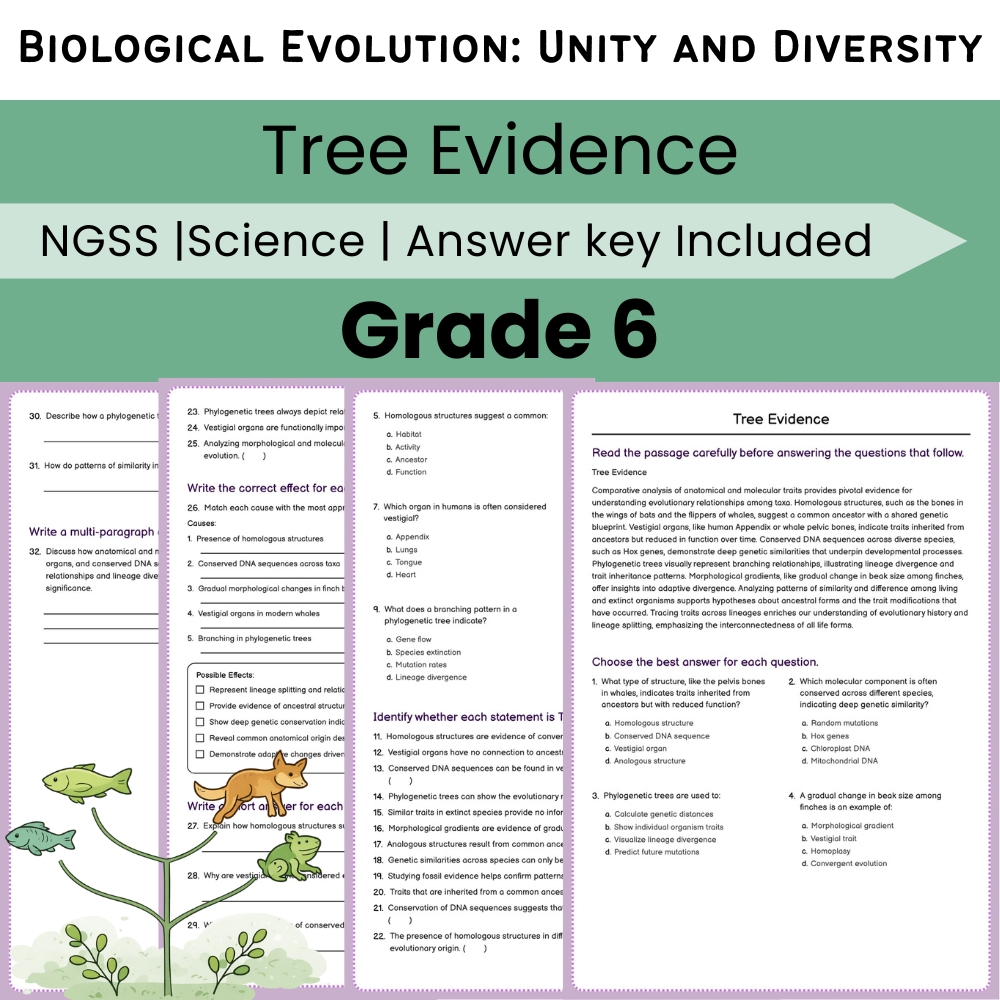
Grade 6 Science | Tree Evidence Worksheet – NGSS Assessment & Student Practice (Printable PDF)
Learning Objectives
- Understand how anatomical and molecular traits provide evidence for common ancestry among taxa.
- Identify homologous structures, vestigial organs, and conserved DNA sequences in different organisms.
- Interpret phylogenetic trees and related evidence to explain lineage splitting and trait inheritance.
Also included in: Grade 6 Science | Biological Evolution: Unity and Diversity Unit Bundle (NGSS-aligned Worksheets) +1 more
Instant download
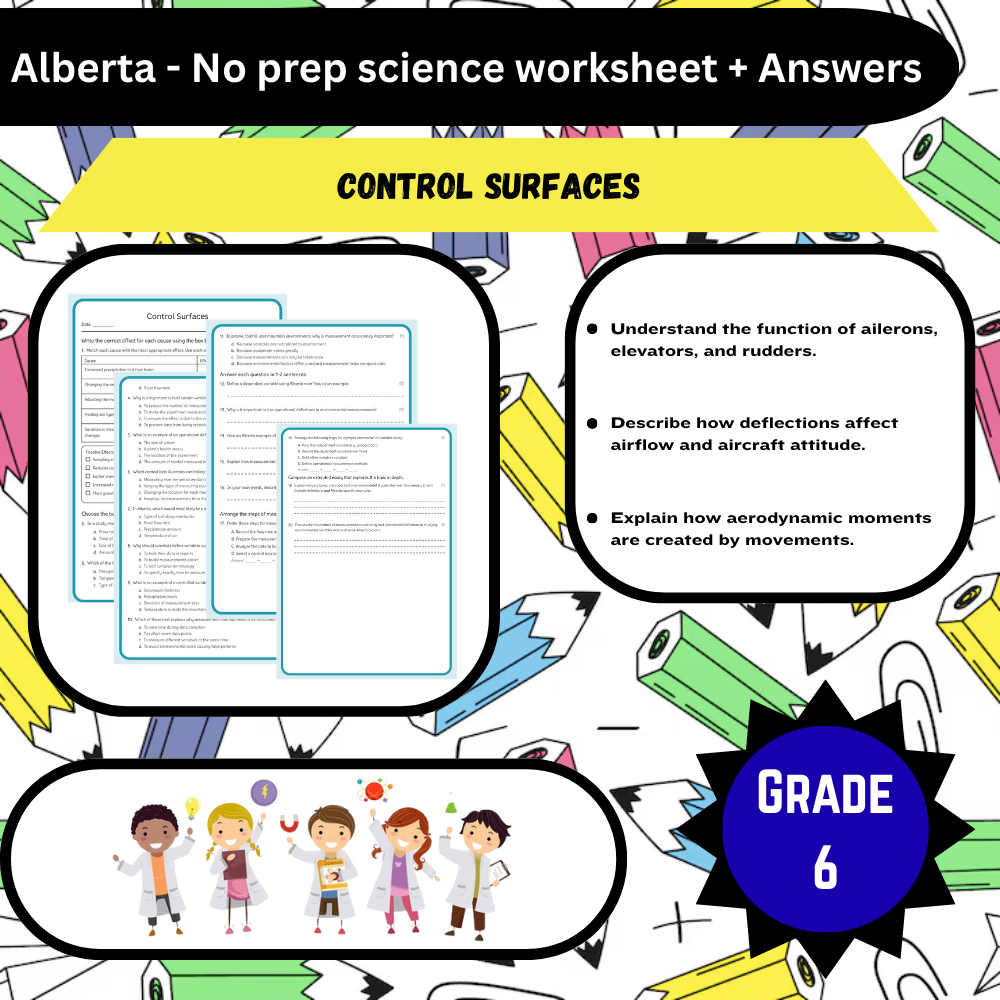
Grade 6 Science | Control Surfaces Worksheet (PDF) – Alberta Standards
 Created byBright Mind Resources
Learning Objectives
- Understand the function of ailerons, elevators, and rudders in controlling aircraft movement.
- Describe how deflections of control surfaces affect airflow and aircraft attitude.
- Explain how aerodynamic moments are created by control surface movements.
Instant download

Narrative Context Worksheet | Standards-Aligned Grade 6 ELA Practice PDF
JCreated byJ.S SheetsLearning Objectives
- Identify how narratives establish context by including time, setting, and background information.
- Explain how characters, situation, point of view, and tense help readers understand a story’s events.
- Use purposeful details to build mood and set up a central conflict or goal.
Instant download

Grade 6 Social Studies — Resource Management Worksheet MCQ Paper
Created byThe Resource HubLearning Objectives
- Understand how early communities organized resources and labor to address environmental challenges.
- Identify key infrastructure developed by early societies for resource management.
- Explain how resource management strategies supported population growth and sustainability.
Also included in: Grade 6 Resource Management & Migration Patterns Social Studies +1 more
Instant download

Grade 6 Traditions and Practices in Cultures Worksheet | BC Social Studies
Created byQuiet Forest EducationLearning Objectives
- Understand the role of traditions in different societies.
- Analyze how rituals and customs reinforce community identity.
- Compare cultural practices from diverse communities.
Also included in: Cultures: Traditions, Contact & Change Lesson Bundle | Grade 6 Social Studies BC +1 more
Instant download

Grade 6 Science – Habitats & Niches | Daily Reading Worksheet
Created byBright Mind ResourcesLearning Objectives
- Understand what habitats and niches are
- Identify different types of habitats
- Explain how niches influence species interactions
Also included in: Grade 6 Ecosystem Relationships Science Daily Reading Lesson Bundle | BC +1 more
Instant download

Trade Networks Worksheet | Standards-Aligned Social Studies Practice Grade 6
JCreated byJ.S SheetsLearning Objectives
- Explain how trade networks move goods and ideas between regions
- Describe how natural resources influence trade routes and specialization
- Analyze how trade networks can affect economic growth and cultural exchange
Instant download

Grade 6 Social Studies — Trade Networks Worksheet MCQ Paper for Mastery
Created byThe Resource HubLearning Objectives
- Explain how trade networks connect regions to exchange goods and ideas
- Describe how resources and geography influence trade routes
- Analyze how trade affects economic specialization and cultural interaction
Also included in: Grade 6 Social Studies Economic Decision-Making & Trade Networks Lesson Bundle +1 more
Instant download

Global Celebrations Worksheet Grade 6 | Holidays Around the World
 Created byShaNova Worksheets
Learning Objectives
- Identify examples of global cultural festivals and describe what people celebrate and why.
- Explain how traditions such as music, dance, food, and rituals help communities express identity.
- Practice respectful communication by comparing cultural customs without judging unfamiliar practices.
Instant download
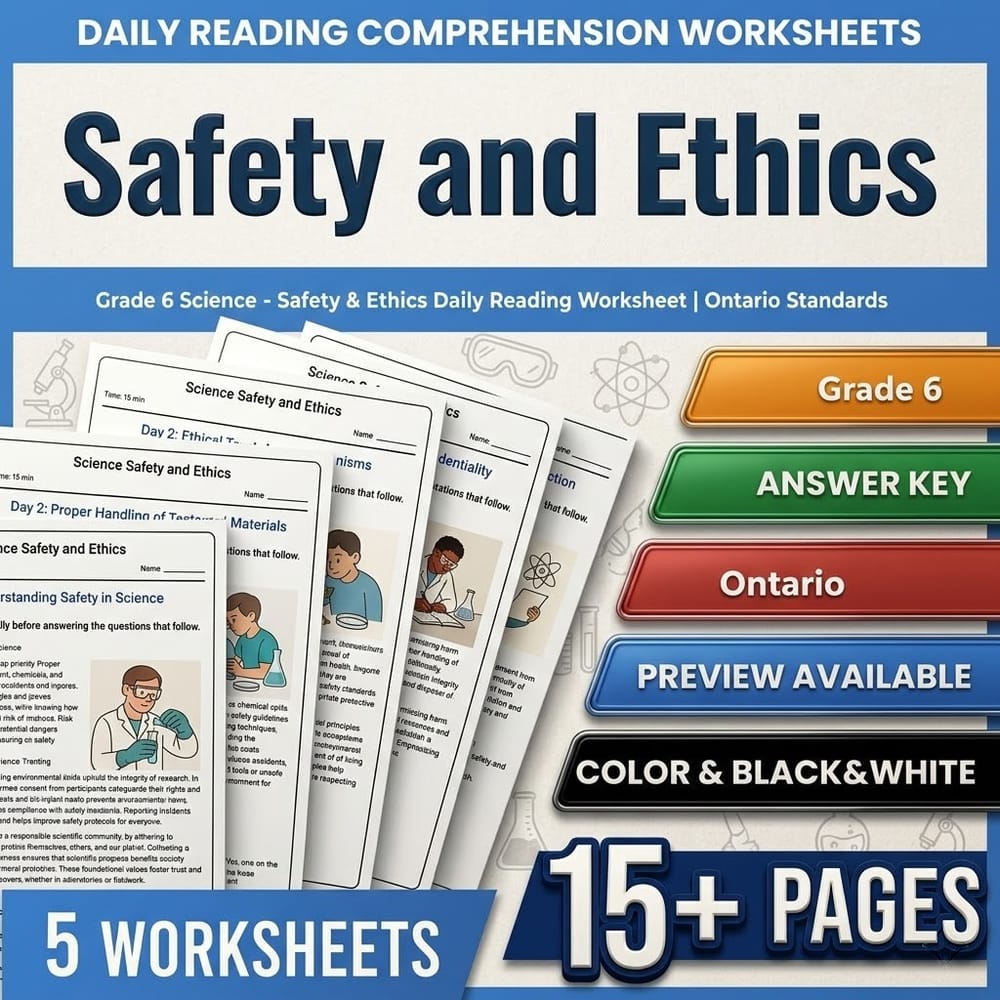
Grade 6 Science – Safety & Ethics Daily Reading Worksheet | Ontario Standards
Created byQuiet Forest EducationLearning Objectives
- Understand core safety principles in scientific practices
- Recognize ethical considerations in research involving organisms and data
- Identify proper safety protocols for handling tools and materials
Also included in: Science Grade 6 Daily Reading Worksheets Bundle | Ontario Framework +1 more
Instant download

Population Change Worksheet | NGSS Grade 6 Ecology Activity & Notes
 Created byAmber Owl Education
Learning Objectives
- Use data such as birth rate, death rate, and age structure to explain how populations change over time.
- Construct evidence-based claims linking ecosystem component changes (predators, invasive species, habitat, disease) to population increases or declines.
- Describe how trophic cascades and recovery or collapse patterns can occur in both terrestrial and aquatic systems.
Also included in: Grade 6 Science Ecology & Ecosystems Lesson Bundle | NGSS +1 more
Instant download

6th Grade Science Worksheet | Habitats and Niches (PDF) – BC Standards
Created byEvergreen Desk EducationLearning Objectives
- Explain the difference between a habitat and a niche using examples
- Describe how overlapping niches can cause competition and limit population growth
- Analyze how resource partitioning can support species coexistence
Instant download

Matter & Particle Model Worksheets and Review Activity for Grade 6 Science
Created byEmma Carter ResourcesLearning Objectives
- Identify matter, particles, and the three states of matter.
- Compare particle arrangement and movement in solids, liquids, and gases.
- Explain changes of state using the particle model.
Instant download

Science Grade 6 Worksheet on Apparent Motion of the Sun, Moon, and Stars
JCreated byJ.S SheetsLearning Objectives
- Explain apparent daily motion of the Sun, Moon, and stars as a result of Earth’s rotation.
- Describe diurnal rising and setting and how Earth’s rotation creates apparent paths across the sky.
- Use the ideas of the celestial sphere and the horizon to explain how sky objects appear to move.
Instant download

Character Trait Tracking Worksheet Pack Grade 6 ELA Practice
Created bySunny Desk ResourcesLearning Objectives
- Analyze how a character’s traits develop across a text by connecting actions, decisions, and relationships to evidence
- Track changes in behavior or reactions over time to identify growth, conflict, or changing beliefs
- Use character dialogue and descriptive details to support claims with specific textual evidence
Also included in: Reading and Viewing Lesson Bundle – Grade 6 ELA (BC Framework) +1 more
Instant download

6th Grade ELA Argument Development Worksheet (PDF) | CCSS Standards
Created byGolden Apple StudioLearning Objectives
- Write a clear claim for a persuasive argument supported by relevant evidence
- Use logical reasoning to explain how evidence supports a position
- Address counterarguments fairly and maintain focus on the main topic
Also included in: Grade 6 ELA Claim, Evidence & Argument Writing Lesson Bundle | CCSS +1 more
Instant download
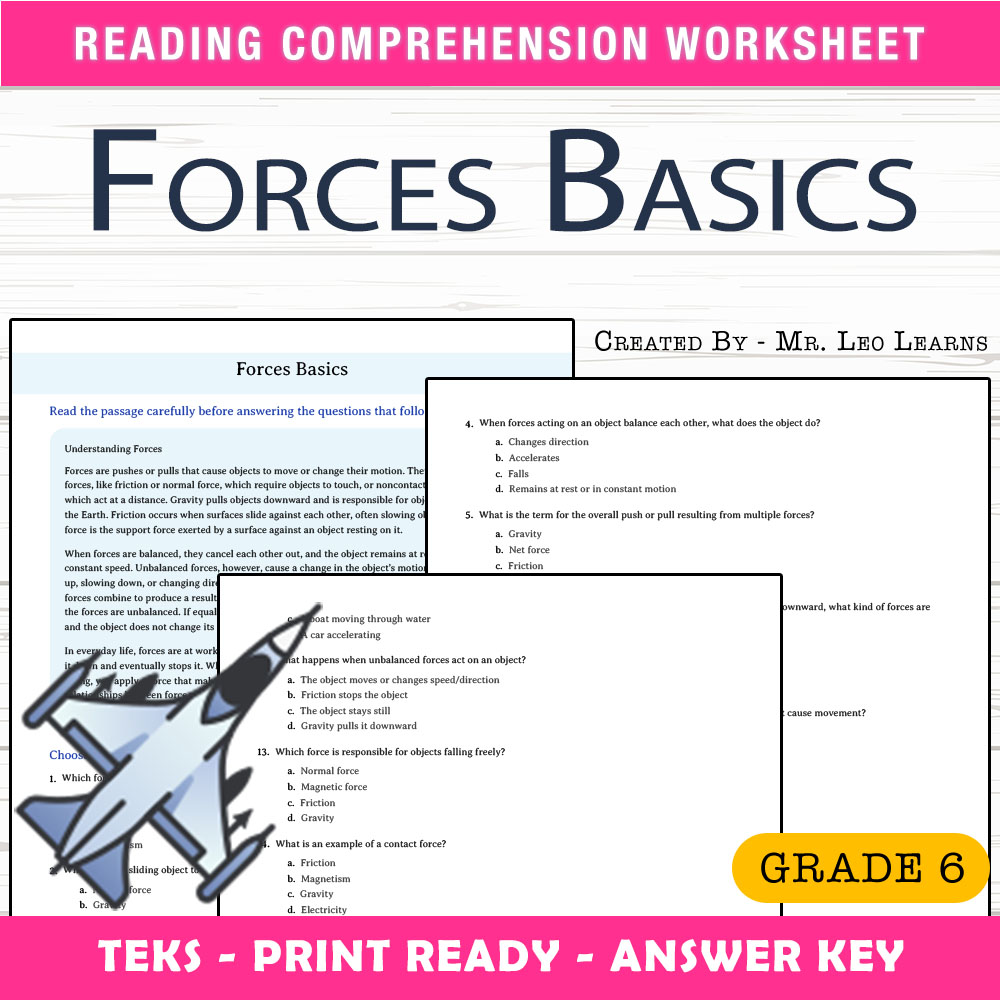
Grade 6 Science – Forces Basics Worksheet for Mastering Forces & Motion
Created byThe Resource HubLearning Objectives
- Identify and describe contact and noncontact forces, including gravity, friction, and normal force.
- Understand the differences between balanced and unbalanced forces and their effects on motion.
- Explain the concept of net force and apply simple real-world examples to illustrate force interactions.
Also included in: Grade 6 Science Unit Bundle | States, Matter, Forces & Energy Mastery
Instant download
Browse more categories
About Grade 6 Worksheets
Browse 8,578 printable Grade 6 worksheets across math, ELA, science, and social studies — each a ready-to-print PDF with optional answer keys.
MyTeachingSheets worksheets are made by real teacher-authors and checked before they go live. Download any as a print-ready PDF for lessons, homework, or independent practice — most include answer keys, and previews are always free.