
Grade 6 Worksheets
8,578 grade resources
Grade 6 Holiday Youth Day for Mastering Global Voices | PDF + Answer Key
 Created byShaNova Worksheets
Learning Objectives
- Identify ways youth celebrations around the world reflect inclusion and cultural awareness
- Explain how young people’s voices can connect celebrations to global issues such as climate change, education, and human rights
- Use evidence from the text to make accurate judgments and choose correct answers
Instant download

Grade 6 Mixtures and Compounds Worksheet | Practice & Assessment PDF
 Created byClear Sky Classroom
Learning Objectives
- Distinguish mixtures from compounds using particle models and descriptions of atomic arrangement
- Explain how physical separation methods relate to mixture composition
- Identify properties of compounds that result from consistent atomic bonding
Instant download

Ocean Currents Science Worksheet Grade 6 | Florida NGSSS Earth Science
 Created byEvergreen Desk Education
Learning Objectives
- Explain how wind patterns and Earth’s rotation help drive ocean currents.
- Describe how ocean currents move water and heat and influence regional climate.
- Use evidence from a text to identify causes and effects related to coastal weather.
Instant download

Urban Growth Worksheet | Standards-Aligned Grade 6 Social Studies Practice
JCreated byJ.S SheetsLearning Objectives
- Explain how industrialization, transportation, and migration contributed to urban growth.
- Analyze how rapid city expansion affected housing, labor, and public services.
- Evaluate how municipal governance and economic policy can shape different outcomes for cities.
Instant download

Coordinate Distance Worksheet | Grade 6 Maths | Common Core CCSS
 Created byElena Brooks
Learning Objectives
- Find the coordinate distance between two points that are horizontally or vertically aligned on a coordinate plane.
- Use the absolute difference of the changing coordinate values to calculate distance.
- Read point coordinates from a grid and apply the coordinate distance rule correctly.
Also included in: 6th Grade Geometry & Coordinates Maths Lesson Bundle, Common Core (CCSS) +1 more
Instant download

Grade 6 Math Worksheet – Financial Tracking | Ontario Standards (PDF)
Created byClear Sky ClassroomLearning Objectives
- Apply basic mathematical operations to interpret financial data.
- Understand and calculate percentages related to budgeting and savings.
- Interpret charts and lists to make informed financial decisions.
Also included in: Grade 6 Math Financial Literacy Bundle | Ontario Standards Practice +1 more
Instant download
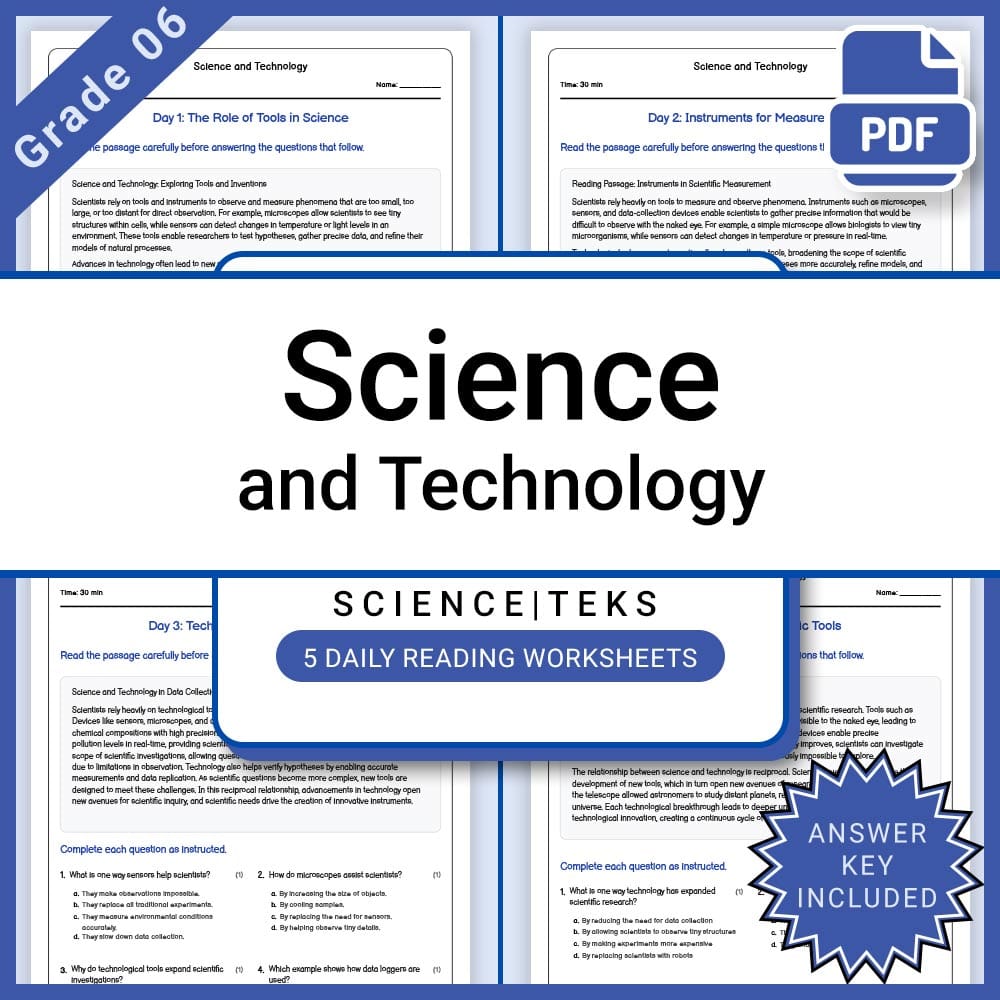
Grade 6 Science – Science and Technology Daily Reading Worksheet + Answer Key
JCreated byJ.S SheetsLearning Objectives
- Understand how scientific tools extend observation and measurement.
- Identify different instruments used in scientific investigations.
- Recognize how technological improvements influence scientific inquiry.
Also included in: Grade 6 Science Lesson Bundle | TEKS-Aligned Activities and Worksheets +1 more
Instant download
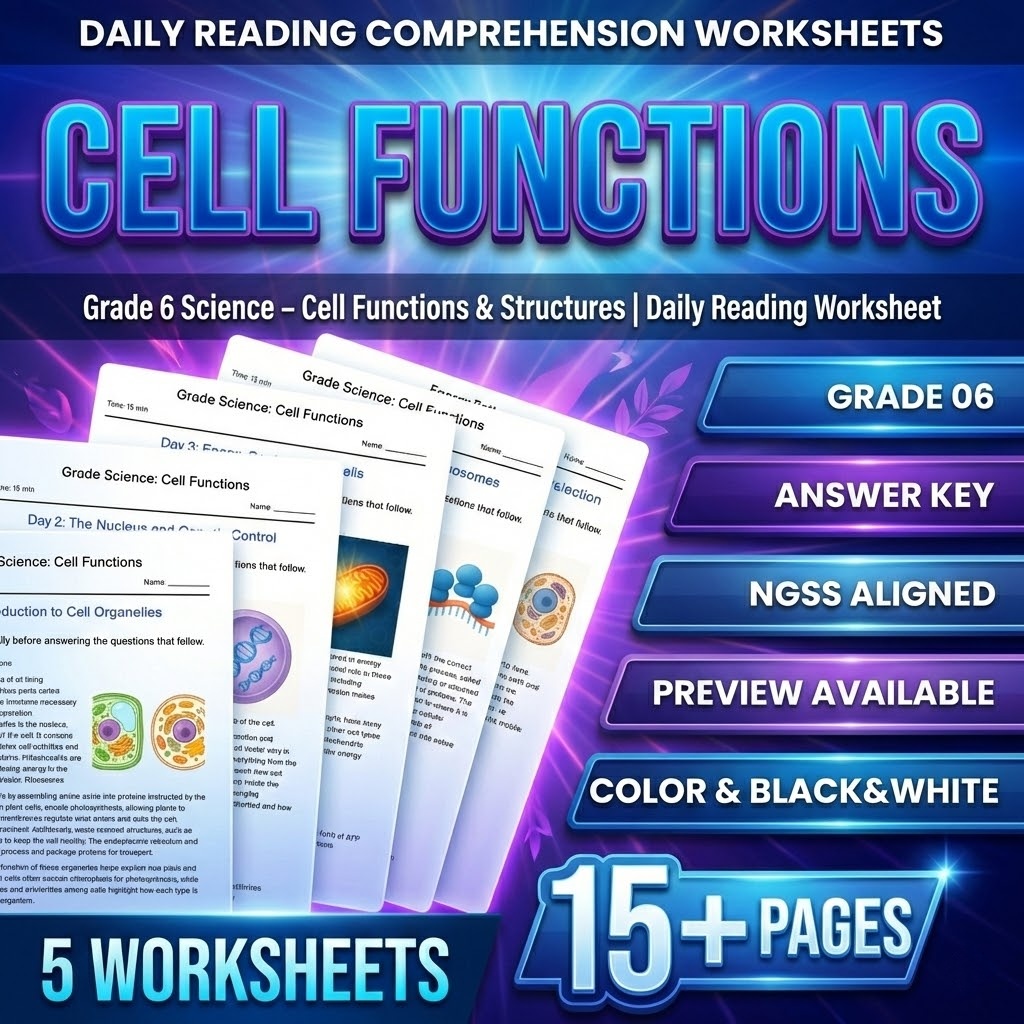
Grade 6 Science – Cell Functions & Structures | Daily Reading Worksheet
Created byElena BrooksLearning Objectives
- Identify the main organelles in plant and animal cells.
- Describe the functions of key cell organelles.
- Understand how cell structure relates to organelle function.
Also included in: Grade 6 Science From Molecules to Organisms Worksheet Bundle | NGSS +1 more
Instant download

Grade 6 Science | Electric and Magnetic Forces - Daily Reading Comprehension
 Created byCoral Reef Learning
Learning Objectives
- Understand the basic differences between electric and magnetic forces.
- Recognize how force depends on source strength and separation.
- Identify examples of electrostatic attraction and repulsion.
Instant download

Grade 6 Science | Leaf Functions - Daily Reading Comprehension
Created byCoral Reef LearningLearning Objectives
- Identify different parts of a leaf and understand their functions.
- Explain how leaves contribute to photosynthesis, transpiration, and gas exchange.
- Recognize variations in leaf structures between conifers and deciduous trees.
Also included in: Trees and Forests Lesson Bundle | Grade 6 Science | Alberta +1 more
Instant download

Optimization Tradeoffs Worksheet | Grade 6 Science Review & Practice
 Created byPrism Point Learning
Learning Objectives
- Explain how optimizing multiple design criteria requires tradeoffs and constraints.
- Use Pareto trade-off ideas to compare design options with different performance goals.
- Describe how safety margins, buffers, and manufacturability affect viable engineering configurations.
Also included in: Grade 6 Aerodynamics Flight Design Science lesson bundle - Ontario
Instant download

6th Grade ELA Worksheet | Analyzing Messages & Purposes – Alberta Standards
 Created byGolden Apple Studio
Learning Objectives
- Identify the main claim and intended audience in a media message
- Explain how key details and visual choices support a message’s purpose
- Distinguish between informational and persuasive purposes in real-world media
Also included in: Grade 6 Media Literacy ELA Lesson Bundle: Alberta Standards Worksheets +1 more
Instant download

Climate Data Patterns and Extremes Worksheets Grade 6 Science
 Created byBRIGHT PATH RESOURCES
Learning Objectives
- Explain how long-term climate records are summarized using averages and variability
- Interpret graphs to identify patterns in temperature and precipitation over time
- Describe how comparing current data to historical baselines shows climate change or stability
Also included in: Grade 6 Earth Science Worksheets | Weather, Water & Climate Bundle +2 more
Instant download

6th Grade Science Worksheet – States of Matter TEKS (PDF)
Created byEvergreen Desk EducationLearning Objectives
- Compare solids, liquids, and gases using particle arrangement and relative motion.
- Describe macroscopic traits such as shape retention and compressibility for each state of matter.
- Use everyday examples (ice, liquid water, water vapor) to connect state changes with density and molecular spacing.
Instant download

6th Grade Science Worksheet – Measuring Circuits (PDF) (Ontario Standards)
Created byEvergreen Desk EducationLearning Objectives
- Explain how current and voltage measurements relate to circuit performance.
- Describe conceptually where instruments are placed to measure current versus voltage.
- Interpret typical meter readings and uncertainty in simple circuit scenarios.
Also included in: Grade 6 Electricity Circuits Science Lesson Bundle for Ontario Worksheets +1 more
Instant download
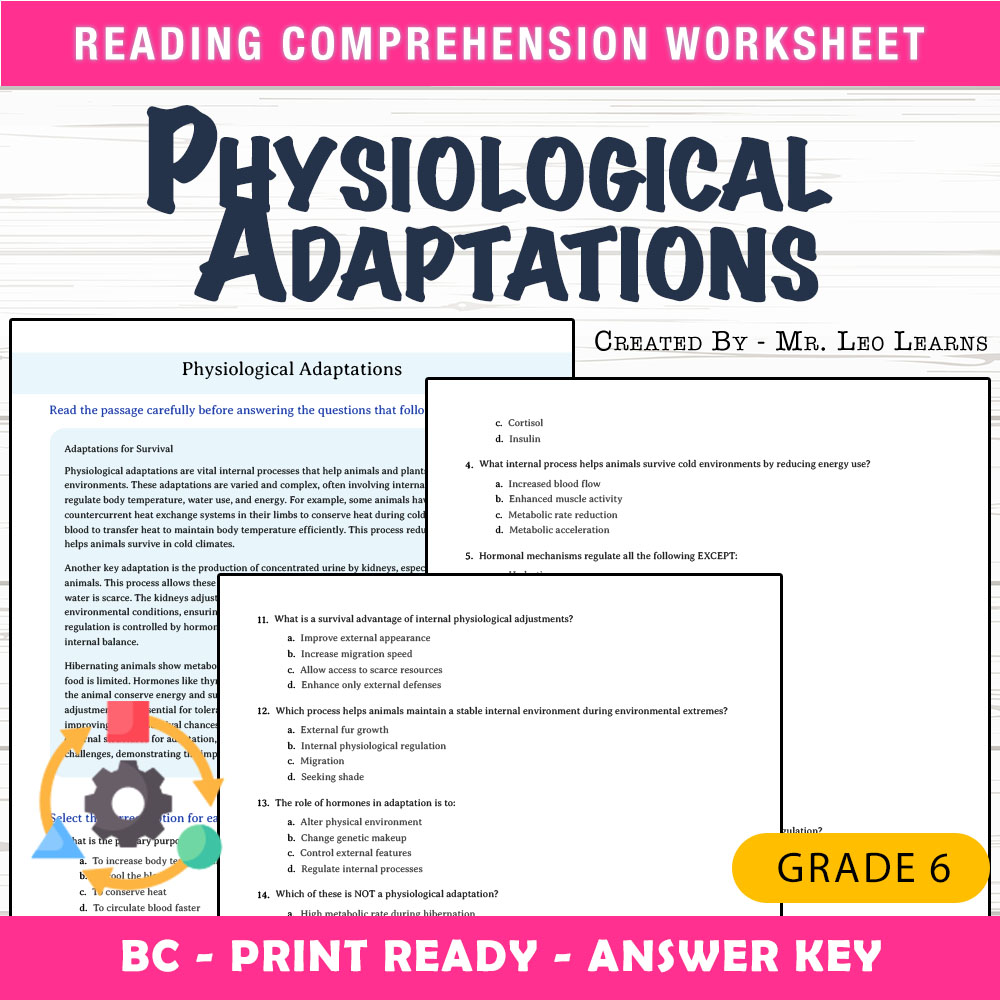
Grade 6 Science – Physiological Adaptations Worksheet MCQ Paper
 Created byThe Resource Hub
Learning Objectives
- Understand internal physiological processes that support survival in different environments.
- Identify examples of physiological adaptations such as heat exchange, water conservation, and metabolic regulation.
- Link physiological mechanisms to their roles in helping organisms adapt to environmental extremes.
Also included in: Grade 6 Science Unit | Multicellular Systems & Functions Worksheet Bundle +1 more
Instant download

Cloud Storage and Syncing Worksheet | Grade 6 Computer Science Practice
 Created byBright Mind Resources
Learning Objectives
- Define cloud storage and explain how it helps users access files from different devices.
- Describe what syncing does and how it reduces version confusion.
- Use vocabulary (cloud storage, sync, file, access) to explain saving, opening, and organizing digital files.
Instant download

Grade 6 | Read Across America Day Worksheet for Social Themes | PDF + Answer Key
Created byShaNova WorksheetsLearning Objectives
- Explore how Dr. Seuss’s stories have influenced cultural attitudes and social values.
- Analyze themes of diversity, inclusion, and acceptance in children's literature.
- Reflect on the societal messages embedded in Seuss’s works and their impact on communities.
Instant download

Space Tools Assessment | TEKS Grade 6 Science Standards-Aligned Assessment
Created byPrism Point LearningLearning Objectives
- Understand various observational techniques and instruments used in space science.
- Identify the functions of ground-based and orbital telescopes, space probes, and satellites.
- Describe spectral imaging, remote sensing, and data interpretation methods in space exploration.
Instant download

Grade 6 Science | Claim Evaluation Daily Reading Practice - Alberta Standards
Created byCoral Reef LearningLearning Objectives
- Understand the importance of relevance in scientific evidence.
- Identify criteria for evaluating the strength of scientific claims.
- Learn to assess the consistency and uncertainty of evidence.
Also included in: Evidence and Investigation Lesson Bundle | Grade 6 Science | Alberta +1 more
Instant download

6th Grade Social Studies – Key Civilizations Worksheet (TEKS)
 Created bySunny Desk Resources
Learning Objectives
- Identify major characteristics and achievements of Mesopotamia, the Indus Valley, and Chinese dynasties.
- Explain how writing systems and technology helped these civilizations govern, trade, and record information.
- Describe how governance practices and cultural legacies influenced later societies in Asia and the Middle East.
Instant download

6th Grade Science | Lunar Phases Model Worksheet (Alberta Standard) (PDF)
 Created bySilver Birch Teaching
Learning Objectives
- Explain how the relative positions of the Sun, Earth, and Moon determine lunar phases
- Use a simple geometric model to predict which phase will be visible from Earth
- Describe the sequence of lunar phases and relate it to the synodic period
Also included in: Grade 6 Celestial Motion & Seasons Science Lesson Bundle | Alberta +1 more
Instant download

Grade 6 Science Worksheet on Orbital Motion: Gravity, Orbits, and Periods
 Created bySkylark Worksheets
Learning Objectives
- Explain how gravitational attraction between a planet (or moon) and the Sun produces orbital motion
- Describe how orbital shape can be elliptical and how distance affects orbital speed and orbital period
- Use comparative examples (Earth–Moon and Jupiter–satellites) to reason about how mass and distance influence orbits
Also included in: Grade 6 Solar System Relationships Science Lesson Bundle NGSS +1 more
Instant download
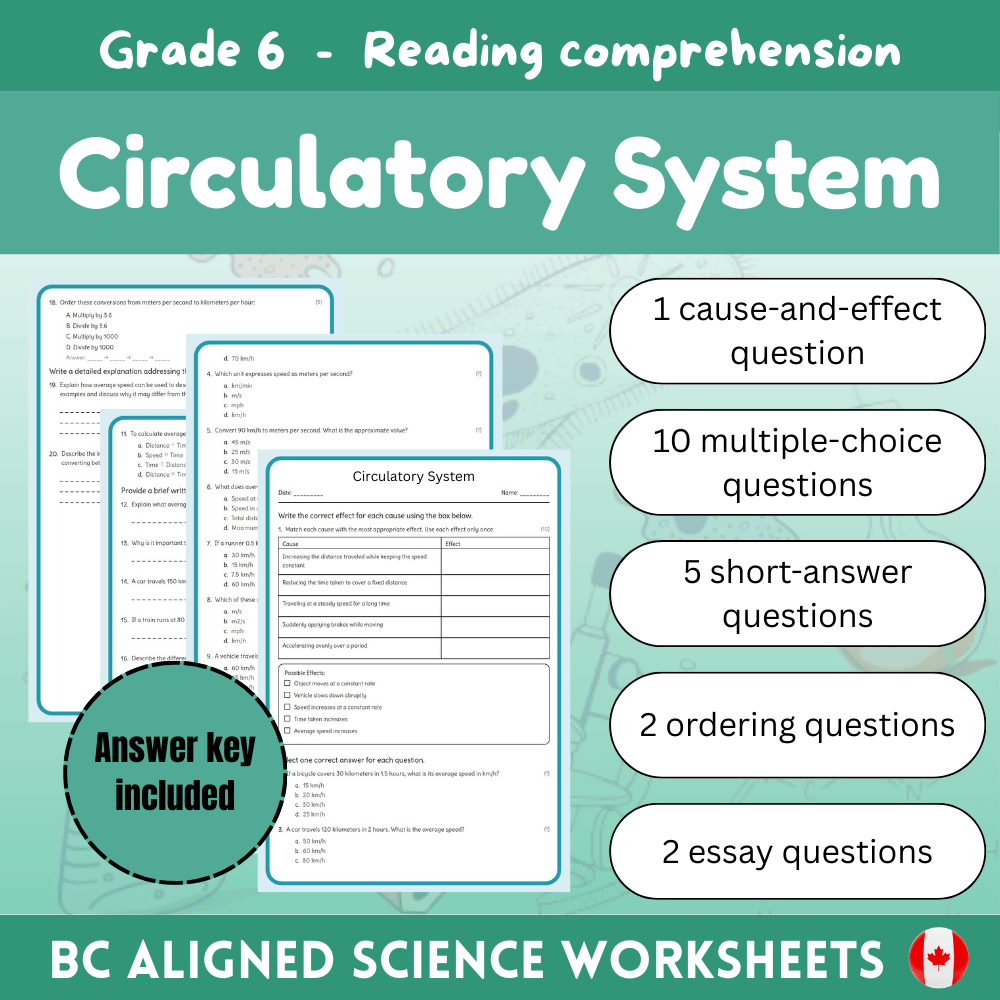
Grade 6 Science | Circulatory System Worksheet (Worksheet + Answer Key) PDF
Created byBright Mind ResourcesLearning Objectives
- Understand the main functions of the circulatory system.
- Identify the components of the heart and blood vessels.
- Explain how blood transports gases, nutrients, and wastes.
Instant download

Grade 6 ELA – Connections & Distinctions | Daily Reading Worksheet
 Created byQuiet Forest Education
Learning Objectives
- Understand key concepts related to ELA
- Apply knowledge through practice questions
- Demonstrate comprehension of the material
Also included in: Grade 6 Informational Reading ELA Lesson Bundle | General ELA Framework +2 more
Instant download
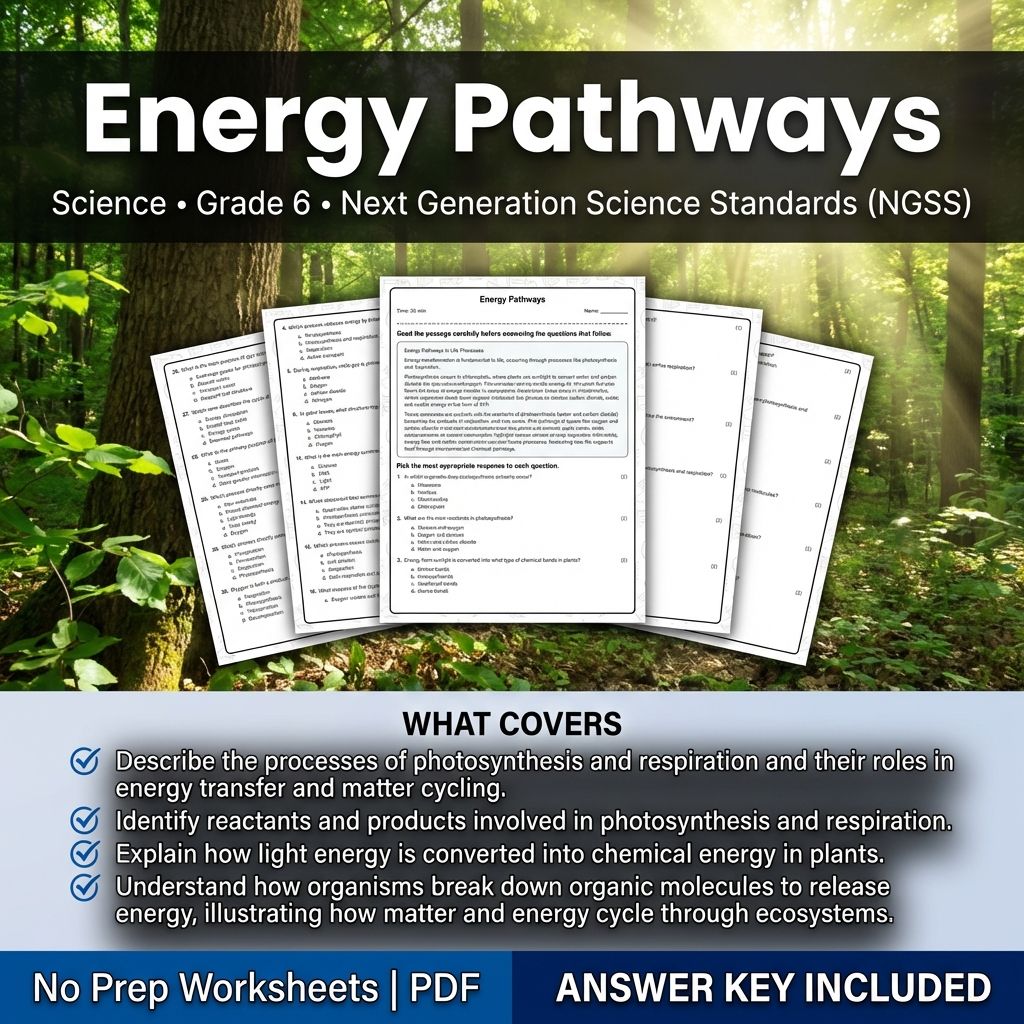
Grade 6 Science | Energy Pathways Worksheet & Answer Key (Printable PDF)
Created byCoral Reef LearningLearning Objectives
- Describe the processes of photosynthesis and respiration and their roles in energy transfer and matter cycling.
- Identify reactants and products involved in photosynthesis and respiration.
- Explain how light energy is converted into chemical energy in plants.
Instant download

Grade 6 Science – Oceans & Climate Regulation Daily Reading Worksheet
Created byBright Mind ResourcesLearning Objectives
- Understand how oceans influence climate stability
- Learn about the process of heat absorption and release by oceans
- Identify how ocean conditions affect weather patterns
Also included in: Climate Grade 6 Science Daily Reading Worksheets Lesson Bundle | Florida NGSSS +1 more
Instant download

Grade 6 Pride Day Worksheet for Symbols of Pride | PDF + Answer Key
Created byShaNova WorksheetsLearning Objectives
- Identify common Pride symbols (such as the rainbow flag and equal sign) and explain what they represent
- Describe how symbols can communicate welcome, belonging, and support within communities
- Practice respectful language and actions when discussing LGBTQ+ identities and symbols
Also included in: Grade 6 Pride Day Holiday Lesson Bundle for CCSS ELA Reading & Writing
Instant download

Data Graphing and Trends Science Worksheets Grade 6
Created bySunny Desk ResourcesLearning Objectives
- Match a data set to an appropriate graph type (line, bar, or scatter)
- Label axes clearly and choose scales that do not mislead readers
- Use annotations to highlight key patterns or comparisons in a graph
Also included in: Evidence & Investigation Grade 6 Science Worksheets | Alberta +1 more
Instant download

Parallel Characteristics Worksheet Grade 6 Science | Ontario Standards
 Created byCedar Grove Learning
Learning Objectives
- Explain how parallel circuits provide the same potential difference across each branch.
- Describe how total current in a parallel circuit relates to the sum of branch currents.
- Compare fault tolerance of parallel circuits with the vulnerability of series circuits.
Also included in: Grade 6 Electricity and Circuits Science lesson bundle: Ontario framework +1 more
Instant download

Atom Conservation Worksheet Grade 6 Science Matter Conservation Practice
Created byPrism Point LearningLearning Objectives
- Explain how atoms are conserved during chemical reactions using particle diagrams.
- Describe reactants and products as rearrangements of atoms rather than creation or destruction.
- Use particle-level evidence to connect conservation of atoms to observable changes.
Instant download

Grade 6 Social Studies — Technological Innovations Worksheet MCQ Paper
Created byThe Resource HubLearning Objectives
- Identify major technological innovations and describe how they worked
- Explain how technological changes influenced economic growth and social structures
- Analyze how innovations affected daily life, mobility, and access to information
Also included in: Innovations & Infrastructure Lesson Bundle: Grade 6 Social Studies TEKS +1 more
Instant download

Variation Effects Practice Worksheet | Grade 6 Science NGSS Review
Created byPrism Point LearningLearning Objectives
- Explain how genetic variation and environmental factors can produce phenotypic variation in organisms.
- Use examples (inheritance, nutrition, and temperature-dependent expression) to describe how traits change across development and populations.
- Connect DNA sequence changes and environmental/epigenetic influences to differences in structure and function.
Also included in: Grade 6 Cellular Systems Science Lesson Bundle NGSS Worksheets
Instant download

Techniques and Framing Worksheet Grade 6 ELA Media Literacy + Answer Key
 Created byLumora Learning
Learning Objectives
- Identify how visual and audio techniques guide attention and shape interpretation in media.
- Explain how editing choices (pacing, cuts, transitions) affect mood, clarity, and meaning.
- Analyze how typography, captions, and graphic overlays contribute to framing and audience understanding.
Instant download

Air Density Worksheet | Grade 6 Science | Standards-Aligned Practice
JCreated byJ.S SheetsLearning Objectives
- Understand what air density is and how it affects buoyancy and aerodynamic forces.
- Identify the effects of temperature, humidity, and altitude on air density.
- Explain how local atmospheric conditions influence lift generation on wings.
Instant download

Particle Model Worksheet | Grade 6 Science Practice
Created byPrism Point LearningLearning Objectives
- Explain how the particle model describes solids, liquids, and gases using particle motion and spacing.
- Connect microscopic particle behavior to macroscopic properties such as shape, volume, flow, and compressibility.
- Use particle model vocabulary (solid, liquid, gas, particles, motion, spacing, arrangement) to describe everyday examples.
Also included in: Matter, Properties & Change Lesson Bundle — Grade 6 Science BC Framework +1 more
Instant download

Science Grade 6 Classification Basics Worksheet | Ontario Standards Practice
JCreated byJ.S SheetsLearning Objectives
- Identify observable traits and use them to classify organisms at familiar habitats
- Explain how a hierarchy of categories (kingdom to species) helps scientists group living things
- Use a dichotomous key to classify an organism by choosing between paired traits
Instant download
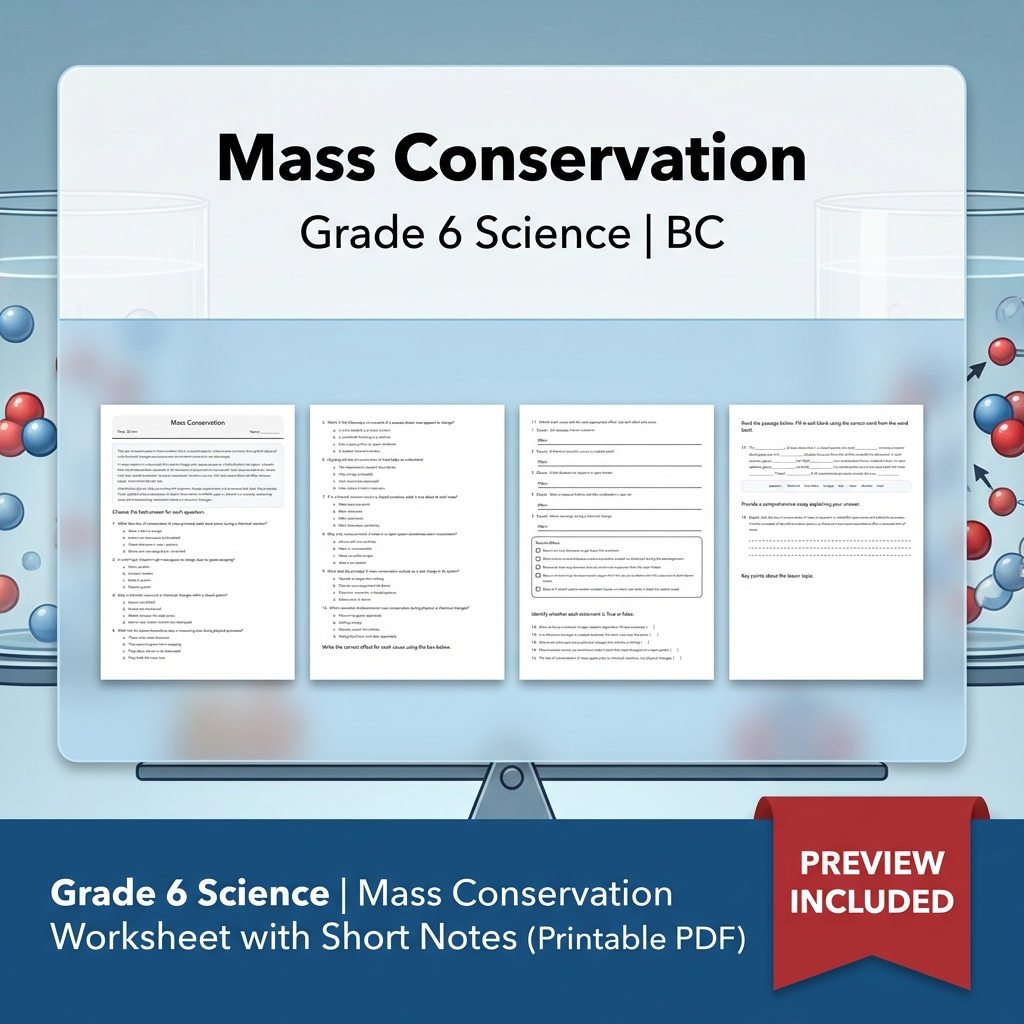
Grade 6 Science | Mass Conservation Worksheet with Short Notes (Printable PDF)
 Created byMeadowlark Worksheets
Learning Objectives
- Understand the law of conservation of mass and how it applies to closed and open systems.
- Identify differences between physical and chemical processes in terms of mass.
- Apply principles of mass conservation to real-world experiments and observations.
Also included in: Grade 6 Science | Matter, Properties & Change UNIT Worksheet Bundle +1 more
Instant download

Belief Systems Worksheets | Grade 6 Social Studies Culture & Religion
 Created byWorld Paper Hub
Learning Objectives
- Identify major belief systems and describe how they originated and spread within societies.
- Explain how belief systems shape daily life, rituals, and social values in a culture.
- Compare how different beliefs can create shared identity across generations.
Also included in: Culture Grade 6 Worksheets Bundle | Social Studies TEKS +1 more
Instant download

Paragraph Organization Worksheet for Grade 6 ELA | Standards-Aligned Practice
JCreated byJ.S SheetsLearning Objectives
- Identify the key parts of an effective paragraph: topic sentence, supporting details, and concluding statement.
- Use paragraph unity by keeping most sentences relevant to the paragraph’s main idea.
- Evaluate how evidence or quotations can be integrated smoothly to support meaning.
Instant download

Grade 6 Pollution Effects Worksheet | BC Use Practice PDF
Created byClear Sky ClassroomLearning Objectives
- Explain how different types of pollution enter ecosystems and affect living things
- Describe processes such as bioaccumulation, biomagnification, and eutrophication
- Identify evidence of ecosystem damage caused by pollutants, including dead zones
Instant download

Human Influences Worksheet | TEKS-Aligned Grade 6 Science Practice
JCreated byJ.S SheetsLearning Objectives
- Explain how human activities can change natural systems and affect community composition and population viability.
- Describe the effects of habitat fragmentation, pollution, land-use change, nonnative species, and resource extraction on ecosystems.
- Use examples (like altered waterways and urban expansion) to predict how species distributions and genetic diversity may shift.
Instant download

Grade 6 Social Studies — Using Maps Worksheet MCQ Paper for Mastery
Created byThe Resource HubLearning Objectives
- Explain how maps, globes, and aerial imagery help us understand spatial patterns on Earth
- Interpret map legends, symbols, directions, and scales to make geographic meaning
- Use map information to describe how transportation networks and settlement patterns are related to geographic features
Also included in: Maps & Physical/Political Features Lesson Bundle | Grade 6 Social Studies | TEKS +1 more
Instant download

6th Grade Social Studies | Ancient Africa Worksheet (PDF) – TEKS Aligned
Created bySunny Desk ResourcesLearning Objectives
- Identify major ancient African civilizations, including Egypt and the Nok culture, and describe key features of their societies.
- Explain how innovations such as writing, architecture, and metalworking supported community life and long-distance trade.
- Analyze how geography and resources influenced where civilizations developed and what they created.
Instant download

Grade 6 | Nelson Mandela International Day for Comprehension | PDF + Answer Key
Created byShaNova WorksheetsLearning Objectives
- Explain how Nelson Mandela International Day encourages community service and civic responsibility
- Identify ways different communities remember Mandela and honor human rights
- Use grade-level reading strategies to answer questions about traditions and initiatives
Instant download

Understanding Citizenship Worksheet Grade 6 | Constitution Day Activity
Created byShaNova WorksheetsLearning Objectives
- Explain what citizenship means in a democracy
- Identify key rights and responsibilities of citizens
- Describe how the Constitution protects freedoms
Instant download

Grade 6 Science | Rearrangement Explanation Worksheet | California Standards
Created byLumora LearningLearning Objectives
- Explain the rearrangement idea using atomic models (atoms break apart from reactants and recombine in products).
- Connect rearranged atomic combinations to observable properties of products (such as gas release or solid formation).
- Distinguish mixing from chemical reactions by focusing on new arrangements and new combinations.
Instant download

Grade 6 ELA – Evidence Clarity in Writing | Daily Reading Worksheet
Created byQuiet Forest EducationLearning Objectives
- Understand key concepts related to ELA
- Apply knowledge through practice questions
- Demonstrate comprehension of the material
Also included in: Research Writing & Editing Daily Reading Lesson Bundle | Grade 6 ELA | TeKS +1 more
Instant download
Browse more categories
About Grade 6 Worksheets
Browse 8,578 printable Grade 6 worksheets across math, ELA, science, and social studies — each a ready-to-print PDF with optional answer keys.
MyTeachingSheets worksheets are made by real teacher-authors and checked before they go live. Download any as a print-ready PDF for lessons, homework, or independent practice — most include answer keys, and previews are always free.