
Grade 6 Worksheets
8,578 grade resources
Grade 6 Scale of Space Worksheet | NGSS Practice PDF
 Created byClear Sky Classroom
Learning Objectives
- Understand the relative sizes, distances, and orbital periods of planets in the solar system.
- Use astronomical units, planetary radii, and orbital data to compare celestial bodies.
- Interpret data tables and charts to analyze spatial relationships within the solar system.
Also included in: Grade 6 Earth's Place in the Universe Science Lesson Bundle: NGSS +1 more
Instant download

Grade 6 Science | Cell Functions - Daily Reading Comprehension Practice
 Created byCoral Reef Learning
Learning Objectives
- Understand the structure and function of the cell nucleus.
- Identify other organelles involved in cell energy processing and protein synthesis.
- Compare plant and animal cells to see how organelles contribute to cell specialization.
Instant download

Dialogue Punctuation Worksheets | Grade 6 ELA Narrative Writing
 Created byGolden Apple Studio
Learning Objectives
- Use quotation marks to show spoken dialogue correctly
- Place punctuation correctly relative to quotation marks
- Apply dialogue tags to identify changes in speaker
Also included in: Grade 6 ELA Grammar, Vocabulary & Punctuation Worksheets | Ontario +1 more
Instant download

Water Reservoirs Assessment for Grade 6 Science | California Standards
 Created byPrism Point Learning
Learning Objectives
- Explain how Earth’s water is stored in major reservoirs such as oceans, lakes, rivers, groundwater, glaciers, and the atmosphere.
- Describe how changes in state and processes like precipitation, runoff, and infiltration move water between reservoirs.
- Compare whether water transfer between reservoirs is usually gradual or fast and provide examples.
Also included in: Grade 6 Water in Earth Systems Science Lesson Bundle: California Standards +1 more
Instant download

Grade 6 Science – Design Refinement & Aerodynamics Daily Reading Worksheet
 Created byBright Mind Resources
Learning Objectives
- Understand how adjustments to shape and control surfaces affect flight performance.
- Identify criteria for evaluating modifications to aerodynamic designs.
- Recognize common trade-offs between speed, stability, and payload in flight design.
Also included in: Aerodynamics Grade 6 Science Daily Reading Worksheets Lesson Bundle | Alberta +2 more
Instant download

Adaptation Patterns Worksheet for Grade 6 Science | TEKS-Aligned PDF
JCreated byJ.S SheetsLearning Objectives
- Explain how morphological, physiological, and behavioral adaptations help organisms survive in different environments
- Use examples (desert plants, birds, and mammals) to describe how trait–environment matches improve survival and reproduction
- Differentiate adaptation from ideas about origin by focusing on how a trait functions in a given environment
Instant download

Topic Sentences Worksheet Pack | Grade 6 ELA Practice
 Created bySunny Desk Resources
Learning Objectives
- Identify the main idea of a paragraph and explain how a topic sentence supports it
- Write and revise topic sentences that connect clearly to supporting details
- Use consistent point of view and tense to improve paragraph coherence
Also included in: Grade 6 Writing Workshop Lesson Bundle | ELA Alberta Framework +1 more
Instant download

Grade 6 Science | Photosynthesis & Energy Conversion - Daily Reading Practice
Created byCoral Reef LearningLearning Objectives
- Understand the process of photosynthesis and its relation to energy conversion
- Identify the role of light in photosynthesis
- Recognize the byproducts of photosynthesis
Instant download

Grade 6 Science | Flight Forces - Daily Reading Comprehension Practice
Created byCoral Reef LearningLearning Objectives
- Understand the four primary forces of flight: lift, thrust, drag, and weight.
- Explain how these forces interact to allow objects to fly or descend.
- Identify examples of flight forces in real-life scenarios such as kites, airplanes, and parachutes.
Also included in: Air and Aerodynamics Lesson Bundle – Grade 6 Science Alberta Reading Comp. +1 more
Instant download

Circuit Diagrams Worksheet for Grade 6 Science | Standards-Aligned Practice
JCreated byJ.S SheetsLearning Objectives
- Understand the standard symbols used in circuit diagrams to represent sources, conductors, and loads.
- Learn to interpret and translate physical electrical systems into schematic diagrams.
- Identify components such as batteries, resistors, switches, and meters in circuit diagrams.
Instant download

Physical vs Chemical Changes Worksheet | Grade 6 Science NGSSS Cloze
Created byPrism Point LearningLearning Objectives
- Distinguish physical changes from chemical changes by identifying evidence of new substances.
- Use examples to explain how matter changes can involve rearranging or forming new materials.
- Identify and describe signs of chemical change, such as gas production, color change, and permanent texture changes.
Also included in: Grade 6 Energy, Matter & Motion Lesson Bundle | Florida NGSSS
Instant download

Grade 6 | National Aviation Day for Mastering Flight History | PDF + Answer Key
 Created byShaNova Worksheets
Learning Objectives
- Explain how early aviation milestones helped people travel and share information more quickly.
- Describe how aircraft technology supports humanitarian and disaster-relief missions.
- Identify key features of modern aircraft that improve safety, navigation, and coordination.
Instant download
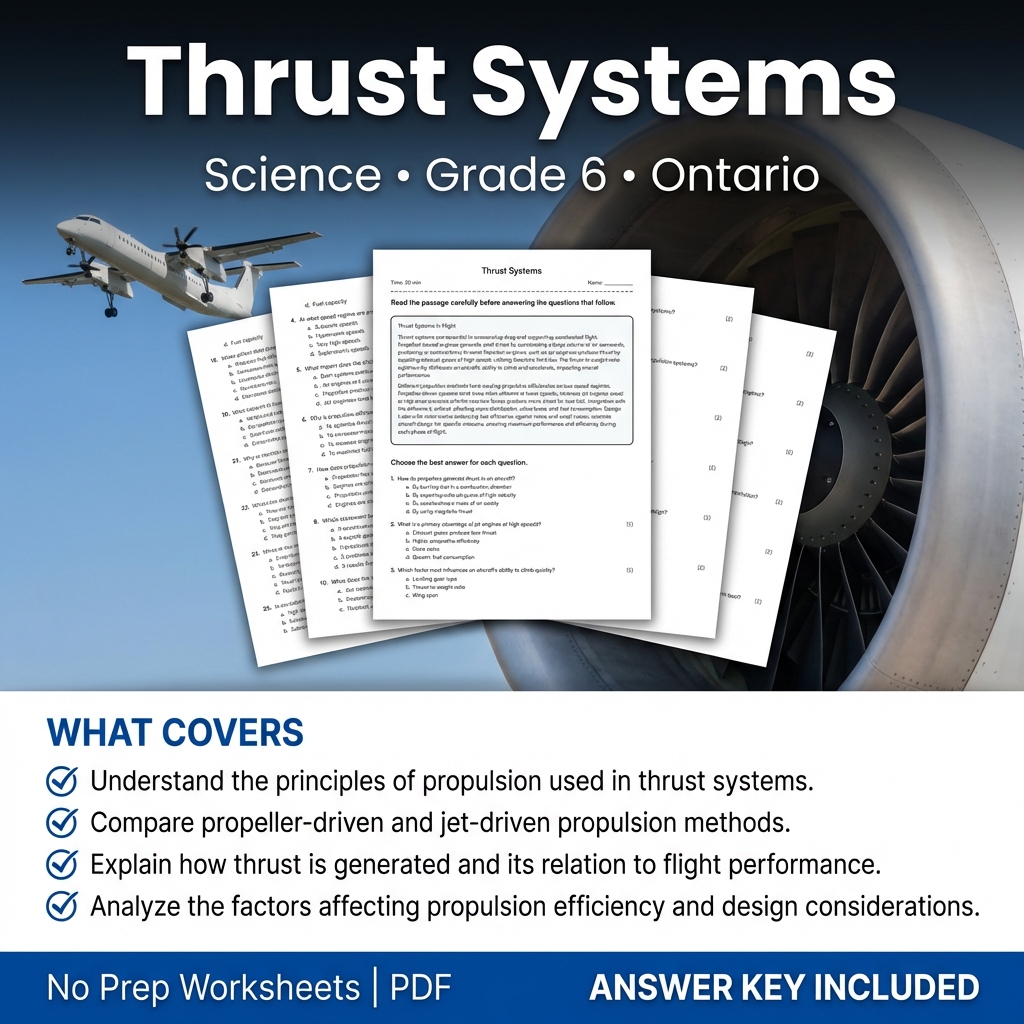
Grade 6 Science Worksheet | Thrust Systems Practice & Assessment
Created byCoral Reef LearningLearning Objectives
- Understand the principles of propulsion used in thrust systems.
- Compare propeller-driven and jet-driven propulsion methods.
- Explain how thrust is generated and its relation to flight performance.
Instant download
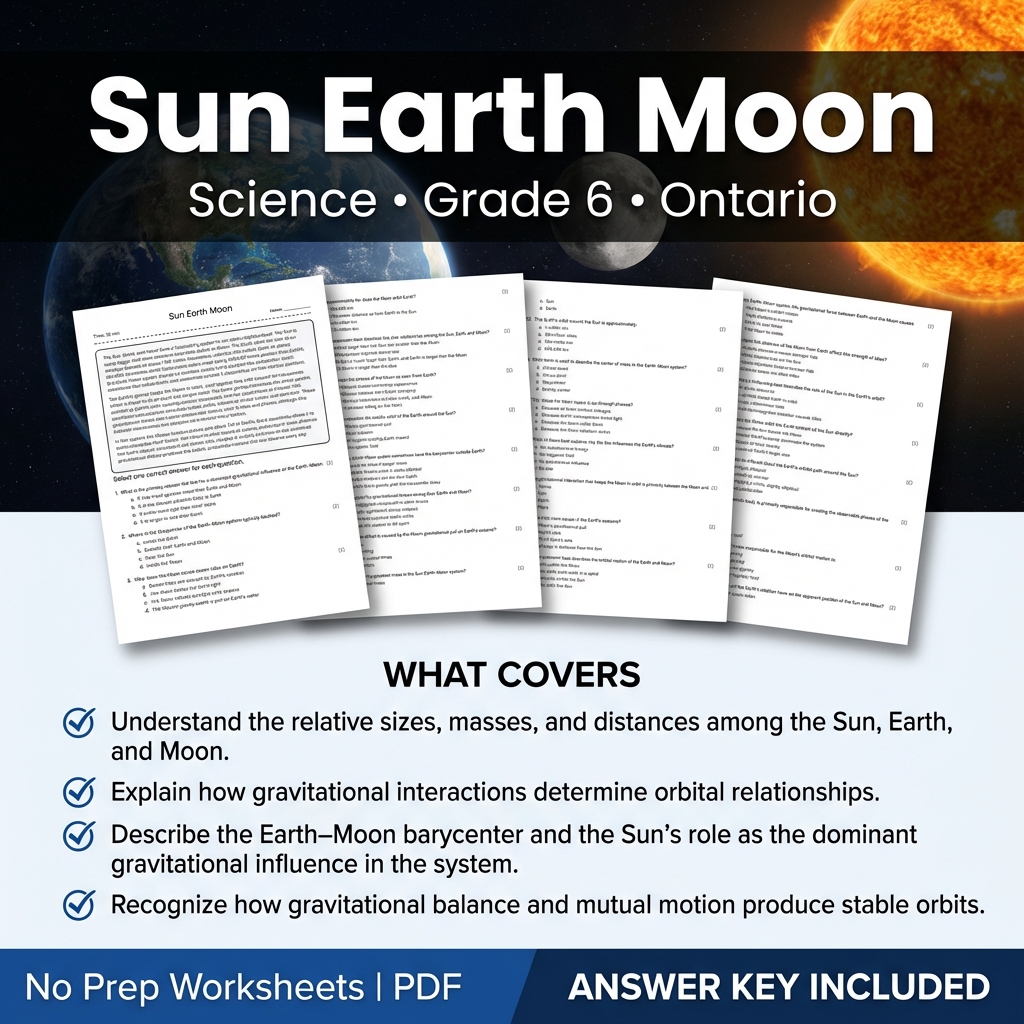
Sun Earth Moon Grade 6 Science Worksheet | Ontario Standard
Created byCoral Reef LearningLearning Objectives
- Understand the relative sizes, masses, and distances among the Sun, Earth, and Moon.
- Explain how gravitational interactions determine orbital relationships.
- Describe the Earth–Moon barycenter and the Sun's role as the dominant gravitational influence in the system.
Instant download
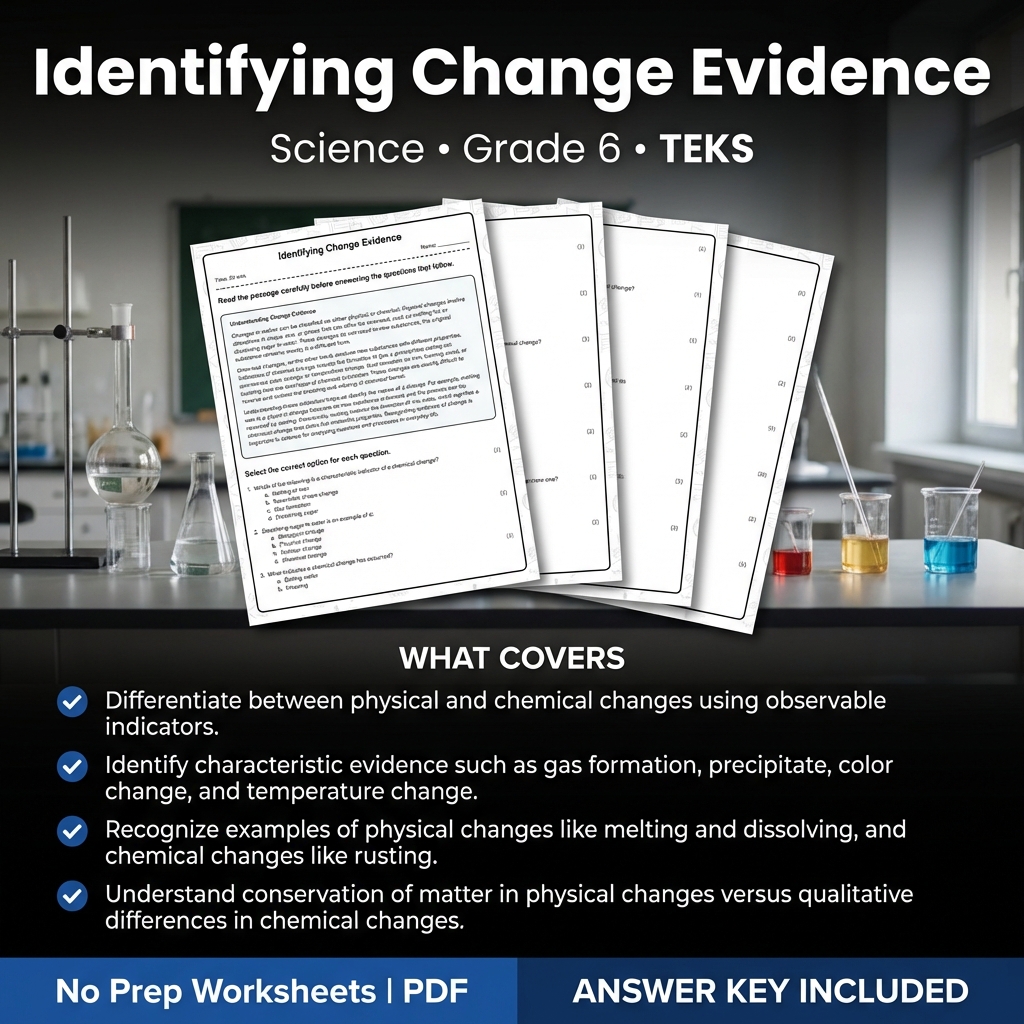
Grade 6 Science Worksheet on Identifying Change Evidence | TEKS Practice
Created byCoral Reef LearningLearning Objectives
- Differentiate between physical and chemical changes using observable indicators.
- Identify characteristic evidence such as gas formation, precipitate, color change, and temperature change.
- Recognize examples of physical changes like melting and dissolving, and chemical changes like rusting.
Instant download

Orbital Motion & Stable Orbits Worksheets Grade 6 Science
Created byPrism Point LearningLearning Objectives
- Explain how gravity and inertia combine to create an orbital path
- Compare elliptical and near-circular orbits using distance and speed
- Describe how orbital speed changes in an elliptical orbit
Also included in: Grade 6 Space Science Lesson Bundle | Ontario Science Framework
Instant download

Grade 6 Electric and Magnetic Worksheet | NGSS Physical Science Activity
 Created byNorthstar Worksheets
Learning Objectives
- Explain how electric and magnetic forces depend on source strength and distance
- Use qualitative ideas of electric and magnetic fields to describe interactions
- Distinguish between balanced and unbalanced forces using examples with charges and magnets or currents
Also included in: Grade 6 Physical Science Forces, Gravity, Electricity & Momentum Lesson Bundle | NGSS +1 more
Instant download

Solar Timekeeping Worksheet | Standards-Aligned Grade 6 Science Practice
JCreated byJ.S SheetsLearning Objectives
- Understand the principles of solar time and how it relates to apparent solar motion.
- Identify factors that cause differences between solar time and clock time.
- Describe the historical and modern uses of solar time in communities.
Instant download

Grade 6 Science – Phase Energy & Changes | Daily Reading Worksheet
Created byBright Mind ResourcesLearning Objectives
- To understand how phase changes involve energy transfer without altering chemical identity
- To explain how melting and boiling require energy, while freezing and condensation release energy
- To relate latent heat to particle motion and bonding during phase changes
Also included in: Matter & Change Grade 6 Science Daily Reading Worksheets Lesson Bundle | BC +1 more
Instant download

Event Driven Programs Triggers and Responses Worksheet Grade 6 CS
Created byPrism Point LearningLearning Objectives
- Explain how events trigger actions in an event-driven program.
- Use key vocabulary (event, trigger, response, interaction) to describe program behavior.
- Identify event types such as clicks, key presses, touches, and timed actions.
Also included in: Interactive Coding Foundations Lesson Bundle | Grade 6 Computer Science | General +1 more
Instant download

Particle Models Worksheet | NGSS Science Practice for Grade 6
JCreated byJ.S SheetsLearning Objectives
- Describe matter as composed of tiny particles that are too small to see.
- Explain how particle motion, collisions, and spacing relate to phases and changes of state.
- Relate temperature and thermal energy to particle kinetic energy and pressure in gases.
Also included in: Particle Models and Chemical Reactions Grade 6 Science Lesson Bundle | NGSS +1 more
Instant download
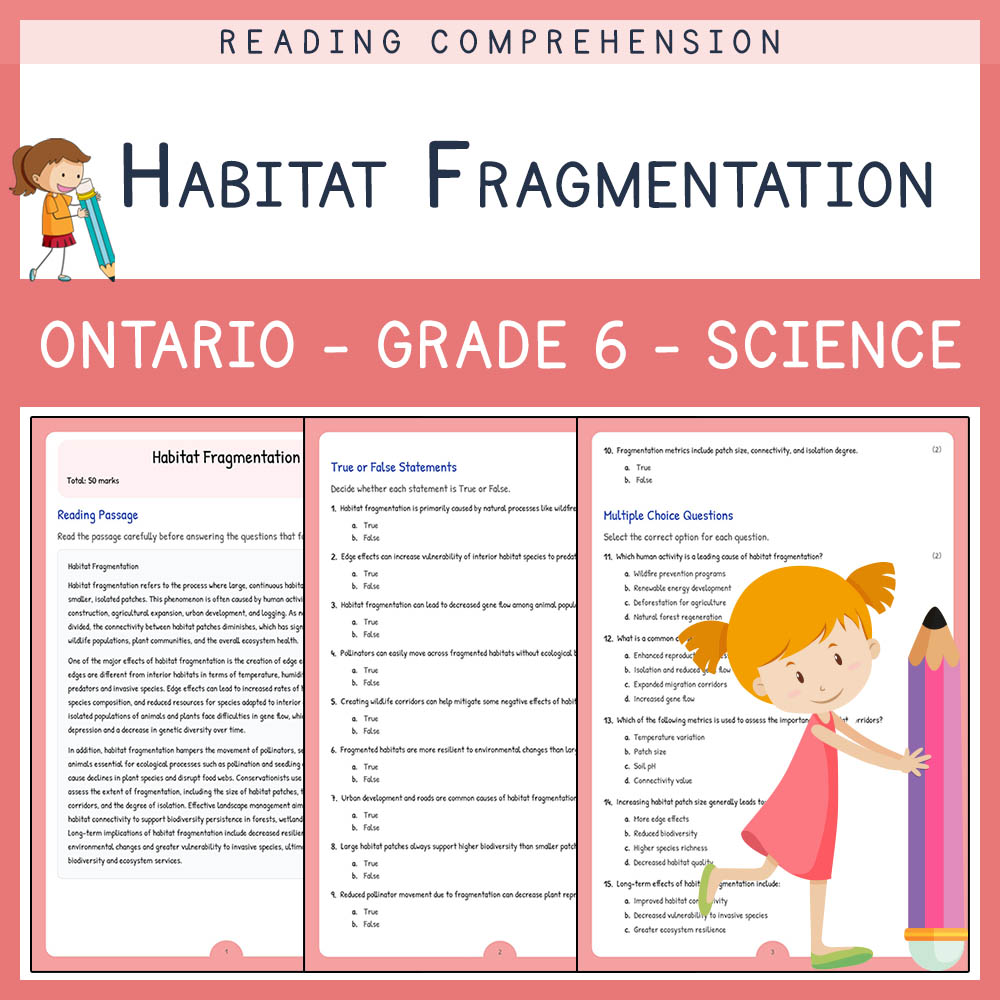
Grade 6 Science | Habitat Fragmentation Worksheet (Answer Key) – Ontario Standard
 Created byLumora Learning
Learning Objectives
- Understand how habitat fragmentation affects species and ecosystems.
- Identify human activities that cause habitat fragmentation and their consequences.
- Evaluate the ecological impacts of habitat fragmentation on biodiversity and ecosystem health.
Also included in: Grade 6 Science | Biodiversity Custom Unit Resource | Ontario Framework
Instant download

Creator Choices Worksheet for Grade 6 ELA | Standards-Aligned Practice
JCreated byJ.S SheetsLearning Objectives
- Identify observable media choices (wording, visuals, camera angles, editing pace, music, and layout) in a message
- Explain inferred meaning by connecting multiple media choices rather than treating details separately
- Use evidence from wording and visuals to support interpretations about author/creator purpose
Instant download

6th Grade Science – Optimization Tradeoffs Worksheet (Ontario PDF)
 Created byEvergreen Desk Education
Learning Objectives
- Explain how multi-criteria design balances lift, drag, weight, stability, and manufacturability.
- Describe Pareto trade-offs and how a performance envelope guides selection of viable designs.
- Use parameter tuning and structural constraints to predict how design changes affect performance and safety margins.
Also included in: Grade 6 Flight & Aerodynamics Science Lesson Bundle Worksheets (Ontario) +1 more
Instant download
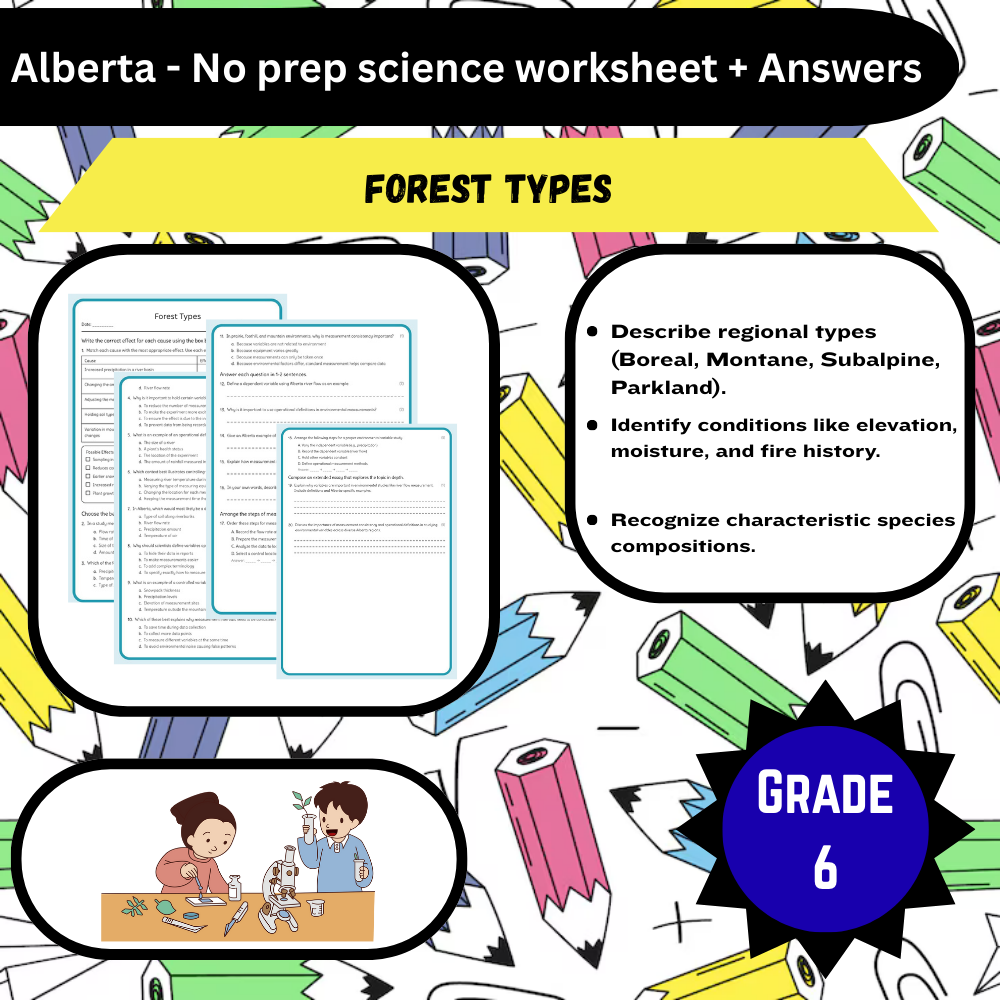
6th Grade Science | Forest Types Exploration Worksheet (PDF)
Created byBright Mind ResourcesLearning Objectives
- Describe major regional forest types such as boreal mixedwood, montane, subalpine, and aspen parkland.
- Identify environmental conditions that influence forest distribution, including elevation, soil moisture, and fire history.
- Recognize characteristic species compositions of different forest types.
Instant download

Grade 6 Science Worksheet | Tissue Types Practice and Assessment
JCreated byJ.S SheetsLearning Objectives
- Identify the four main tissue types in multicellular animals.
- Describe the functions and structures of epithelial, connective, muscle, and nervous tissues.
- Explain how different tissues contribute to organ properties and animal functions.
Instant download

Writing Purpose and Planning Worksheets for Grade 6 ELA
Created byGolden Apple StudioLearning Objectives
- Identify a writer’s main purpose
- Select supporting points for an intended audience
- Match writing choices to a specific goal
Also included in: Grade 6 ELA Writing Worksheets | Audience, Tone & Purpose | Ontario +1 more
Instant download

Science Worksheet Control Surfaces (Roll, Pitch, Yaw) | Grade 6
JCreated byJ.S SheetsLearning Objectives
- Identify primary and secondary control surfaces and match them to roll, pitch, and yaw control.
- Explain how deflection of a control surface changes local lift or side force and produces a turning moment.
- Describe control authority and how factors like hinge moments and surface sizing affect responsiveness and trade-offs such as drag.
Instant download

Science Density Evidence Worksheet Grade 6 | Standards-Aligned Practice
JCreated byJ.S SheetsLearning Objectives
- Explain how density connects mass and volume and predict whether objects will float or sink in water.
- Use density evidence to compare substances and interpret why mixtures form layers.
- Estimate or measure density to support claims about which material is present in a mixture.
Also included in: Grade 6 Matter, Motion, and Heat Science Lesson Bundle – General Framework +1 more
Instant download

6th Grade ELA Vocabulary Development Worksheet (CCSS) | PDF
Created byGolden Apple StudioLearning Objectives
- Use context clues to infer the meaning of unfamiliar words in Grade 6 reading and listening tasks.
- Identify meanings of common word roots and affixes to decode the meaning of new vocabulary.
- Use dictionaries to confirm definitions and select the definition that best fits a sentence.
Also included in: Grade 6 ELA Grammar, Vocabulary & Sentence Variety Lesson Bundle | CCSS +1 more
Instant download

Grade 6 Surface Change Worksheet | NGSS Practice PDF
Created byClear Sky ClassroomLearning Objectives
- Describe geologic processes that modify Earth's surface over different time scales.
- Identify evidence such as rock strata, fossils, and landforms used to interpret landscape evolution.
- Differentiate between rapid events like volcanic eruptions and slow processes like weathering.
Also included in: Grade 6 Earth's Systems Science Lesson Bundle (NGSS-Aligned) Worksheets +1 more
Instant download

Developed Responses Worksheet for Grade 6 ELA | Ontario Standards Practice
JCreated byJ.S SheetsLearning Objectives
- Identify a central viewpoint or reaction in a text-based response.
- Use evidence from the text and connect it to interpretation with clear reasoning.
- Check consistency between claims and text references to create a coherent argument.
Instant download

Grade 6 Holiday Mothers Day Worksheet for Persuasive Messages | PDF + Answer Key
Created byShaNova WorksheetsLearning Objectives
- Identify features of persuasive writing (purpose, reasons, and a call to action) in Mother’s Day messages
- Use gratitude- and emotion-related vocabulary to express appreciation clearly and respectfully
- Draft and revise a heartfelt, persuasive message that fits diverse family caregiving backgrounds
Also included in: Grade 6 Mother's Day Holiday Custom Bundle (CCSS) Worksheet Set
Instant download

Engineering Design Trade-Offs Worksheets Grade 6 Science
 Created byBRIGHT PATH RESOURCES
Learning Objectives
- Explain how trade-offs affect design choices in terms of properties and user needs.
- Match design constraints to likely material or feature changes.
- Use evidence from a passage to complete statements about strength, flexibility, and insulation.
Also included in: Grade 6 Engineering Design Worksheets | Criteria & Constraints Bundle +2 more
Instant download

Revising for Clarity Worksheet | BC Standards Grade 6 ELA Practice
JCreated byJ.S SheetsLearning Objectives
- Identify vague or confusing wording and replace it with more precise language during revision.
- Revise drafts so key points and relevant details appear early enough for readers to follow the main idea.
- Use consistent references (names, pronouns, and topic terms) to reduce confusion.
Instant download

Grade 6 Matter Cycling Carbon Worksheet | Practice & Assessment PDF
Created byClear Sky ClassroomLearning Objectives
- Explain how carbon atoms cycle through an ecosystem, including photosynthesis, feeding, respiration, and decomposition.
- Distinguish between the flow of energy through trophic pathways and the conservation of matter.
- Identify reservoirs and processes that move matter between air, water, and living organisms.
Instant download

Earth Structure Worksheet for Grade 6 Science | Standards-Aligned Practice
JCreated byJ.S SheetsLearning Objectives
- Describe Earth’s internal layers (crust, mantle, outer core, inner core) and explain how each layer relates to geological activity.
- Compare divergent, convergent, and transform plate boundaries and predict the types of surface features they form.
- Explain how plate motion and mantle convection contribute to earthquakes, volcanic eruptions, and mountain building.
Instant download

6th Grade Science | Operational Definitions Worksheet (PDF) – Alberta Standards
 Created bySilver Birch Teaching
Learning Objectives
- Explain what operational definitions are and why they improve clarity in science investigations.
- Convert qualitative observations into quantitative measurements by selecting units, tools, and procedures.
- Use consistent measurement locations and timing to enable reliable comparisons across data sets.
Also included in: Grade 6 Scientific Inquiry & Data Analysis Science Lesson Bundle: Alberta +1 more
Instant download

Grade 6 Science – Safety & Reporting | Daily Reading Worksheet
Created byBright Mind ResourcesLearning Objectives
- Understand and identify proper safety practices in a laboratory setting
- Learn how to communicate scientific results safely and ethically
- Recognize the importance of reporting data accurately and responsibly
Also included in: Variables & Experiments Data Grade 6 Science Worksheets Lesson Bundle | General +1 more
Instant download

Grade 6 Science – Particle Model & Matter | Daily Reading Worksheet
Created byBright Mind ResourcesLearning Objectives
- Describe how matter is made up of tiny particles.
- Identify the different arrangements and movements of particles in solids, liquids, and gases.
- Explain how microscopic particle behavior relates to macroscopic properties such as shape, volume, and flow.
Also included in: Matter & Change Grade 6 Science Daily Reading Worksheets Lesson Bundle | BC +1 more
Instant download
6th Grade Social Studies | Trade Networks Practice Worksheet & Answer Key (PDF)
JCreated byJ.S SheetsLearning Objectives
- Understand the concept and importance of trade networks in historical and modern societies.
- Identify key factors influencing the development of trade routes.
- Recognize examples of ancient and contemporary trade networks and their impact on cultural exchange.
Also included in: Grade 6 Social Studies Unit Bundle | Trade, Scarcity & Economic Institutions +1 more
Instant download

Summary From Evidence Worksheet Grade 6 ELA TEKS Reading Practice
Created byGolden Apple StudioLearning Objectives
- Identify the central idea of an informational text and distinguish it from supporting details.
- Write a concise summary using evidence that covers the whole text without repeating unnecessary details.
- Maintain the author’s meaning by using accurate key terms and summarizing the author’s structure (such as definitions and cause/effect).
Also included in: Grade 6 ELA Text Analysis & Author Craft Lesson Bundle | TEKS +1 more
Instant download

Artificial Satellite Orbits & Roles Worksheets Grade 6 Science
Created byPrism Point LearningLearning Objectives
- Describe satellite roles in Earth observation, communication, and monitoring
- Compare geostationary and polar orbits for different satellite tasks
- Match satellite payloads with the data they are designed to collect
Also included in: Grade 6 Space Science Lesson Bundle | Ontario Science Framework
Instant download

Grade 6 Conservation Strategies Worksheet | Practice & PDF
Created byClear Sky ClassroomLearning Objectives
- Identify key conservation strategies that support forest biodiversity and ecosystem services
- Explain how habitat protection, restoration, and species-at-risk recovery contribute to long-term forest viability
- Use conservation vocabulary accurately in sentence-level and short-response questions
Also included in: Grade 6 Biodiversity & Plant Ecosystems Science Lesson Bundle | Alberta +1 more
Instant download

Grade 6 Flight Forces Worksheet | Alberta NGSS Practice PDF
Created byClear Sky ClassroomLearning Objectives
- Identify the four main forces involved in flight: lift, thrust, drag, and weight
- Explain how lift, thrust, drag, and weight interact to produce steady flight or descent
- Use scientific terms to describe real-world examples such as kites, aircraft, and parachutes
Also included in: Grade 6 Air and Aerodynamics Science Lesson Bundle (Alberta Framework) +1 more
Instant download

Parts of Speech Worksheets | Grade 6 ELA Grammar Practice
Created byGolden Apple StudioLearning Objectives
- Identify nouns, verbs, adjectives, and adverbs in sentences
- Identify pronouns, prepositions, conjunctions, and interjections
- Choose parts of speech that improve descriptive tone
Also included in: Grade 6 ELA Grammar, Vocabulary & Punctuation Worksheets | Ontario +1 more
Instant download

Grade 6 Science | Matter Cycling Carbon in Ecosystems | Standards Aligned
Created byLumora LearningLearning Objectives
- Explain how carbon atoms cycle through air, water, plants, and animals in an ecosystem
- Distinguish matter cycling from energy flow in food webs and trophic pathways
- Describe how photosynthesis, respiration, and decomposition return carbon to the environment
Instant download

Grade 6 ELA – Main Ideas & Supporting Details | Daily Reading Worksheet
 Created byQuiet Forest Education
Learning Objectives
- Identify the main idea of an informational paragraph
- Recognize supporting details that elaborate on the main idea
- Understand how headings and examples clarify information
Also included in: Theme, Evidence & Author’s Purpose Daily Lesson Bundle | Grade 6 ELA | TEKS +1 more
Instant download
Browse more categories
About Grade 6 Worksheets
Browse 8,578 printable Grade 6 worksheets across math, ELA, science, and social studies — each a ready-to-print PDF with optional answer keys.
MyTeachingSheets worksheets are made by real teacher-authors and checked before they go live. Download any as a print-ready PDF for lessons, homework, or independent practice — most include answer keys, and previews are always free.