
Grade 6 Worksheets
8,578 grade resources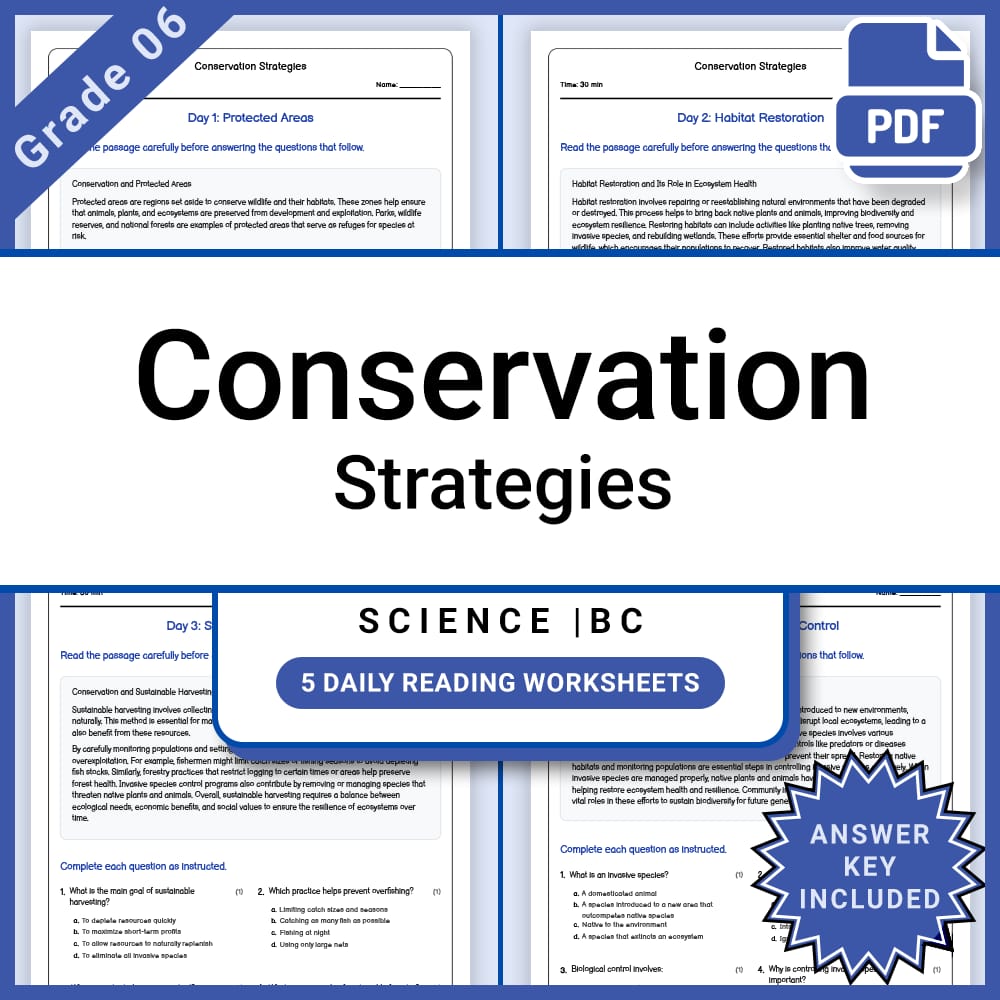
Grade 6 Science – Conservation Strategies Daily Reading Worksheet + Answer Key
JCreated byJ.S SheetsLearning Objectives
- Understand the importance of protected areas in conservation.
- Learn different conservation strategies and their roles.
- Recognize how protected areas contribute to ecosystems.
Also included in: Grade 6 Science Lesson Group Bundle on Ecosystems and Ecology +1 more
Instant download
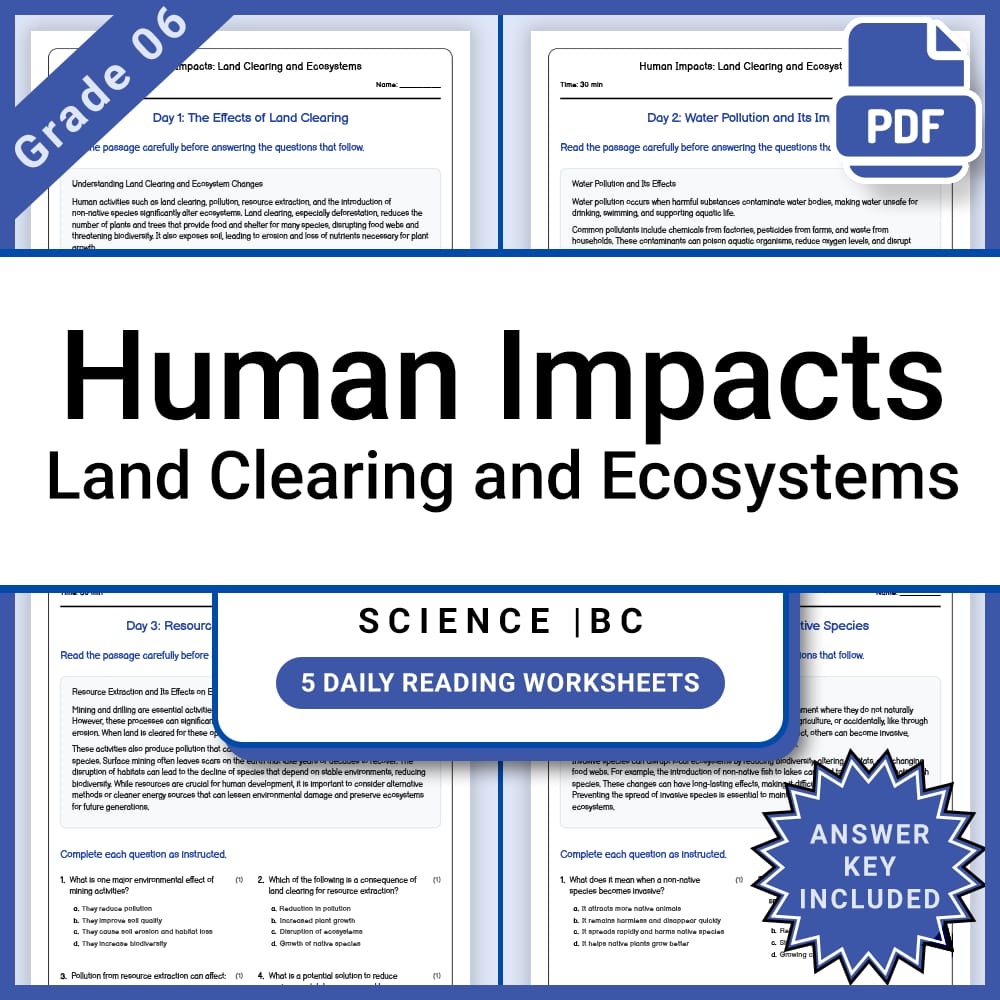
Grade 6 Science – Human Land Impacts | Daily Reading Worksheet + Answer Key
JCreated byJ.S SheetsLearning Objectives
- Understand how land clearing affects habitats and biodiversity
- Identify the consequences of deforestation on ecosystems
- Recognize ways to reduce the negative impacts of land clearing
Also included in: Grade 6 Science Lesson Group Bundle on Ecosystems and Ecology +1 more
Instant download
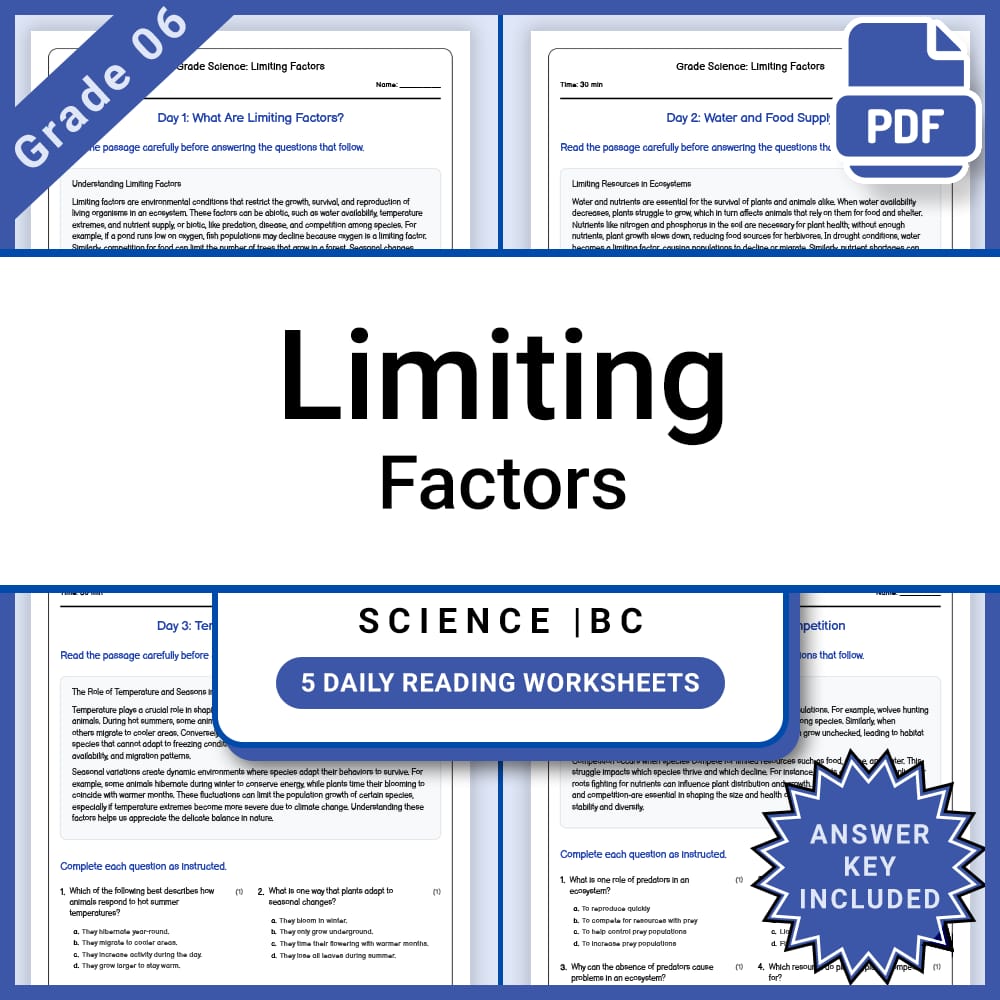
Grade 6 Science – Limiting Factors Daily Reading Worksheet + Answer Key
JCreated byJ.S SheetsLearning Objectives
- Understand what limiting factors are and how they affect populations
- Identify different abiotic and biotic limiting factors in ecosystems
- Explain how limiting factors influence the survival and reproduction of species
Also included in: Grade 6 Science Lesson Group Bundle on Ecosystems and Ecology +1 more
Instant download
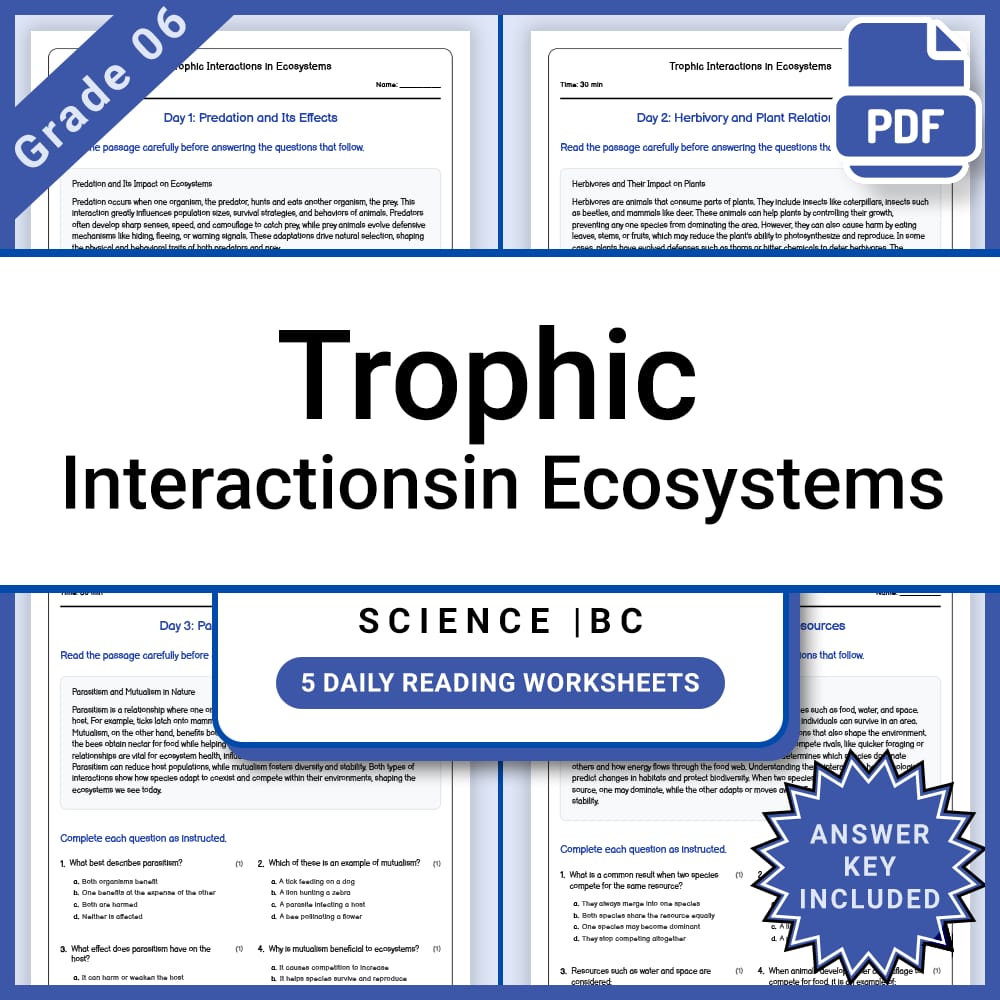
Grade 6 – Trophic Interactions in Ecosystems Daily Worksheet + Answer Key
JCreated byJ.S SheetsLearning Objectives
- Define predation and explain its role in ecosystems.
- Identify examples of predation and its effects on prey species.
- Understand how predation influences predator and prey adaptations.
Also included in: Grade 6 Science Lesson Group Bundle on Ecosystems and Ecology +1 more
Instant download
Grade 6 Science – Decomposers and Nutrients Daily Reading Worksheet + Answer Key
JCreated byJ.S SheetsLearning Objectives
- Understand key concepts related to Science
- Apply knowledge through practice questions
- Demonstrate comprehension of the material
Also included in: Grade 6 Science Lesson Group Bundle on Ecosystems and Ecology +1 more
Instant download
Grade 6 Science – Food Webs Daily Reading Worksheet with Answer Key
JCreated byJ.S SheetsLearning Objectives
- Define what a food web is and explain its components.
- Describe the importance of food webs in ecosystems.
- Identify how species interactions affect ecosystem stability.
Also included in: Grade 6 Science Lesson Group Bundle on Ecosystems and Ecology +1 more
Instant download
Grade 6 Science – Invasive Species Daily Reading Worksheet with Answer Key
JCreated byJ.S SheetsLearning Objectives
- Define invasive species and give examples.
- Explain how invasive species impact native ecosystems.
- Identify characteristics of invasive plants and animals.
Also included in: Grade 6 Science Lesson Group Bundle on Ecosystems and Ecology +1 more
Instant download
Grade 6 Science – Minerals and Rocks Daily Reading Worksheet + Answer Key
JCreated byJ.S SheetsLearning Objectives
- Understand the basic properties used to identify minerals
- Learn how rocks are classified into igneous, sedimentary, and metamorphic types
- Explore how mineral resources relate to the rock cycle
Also included in: Grade 6 Science Lesson Bundle: Space, Water, Earth, and Resources TEKS +1 more
Instant download

6th Grade Science | Phases Mechanics Worksheet (Ontario Standards) (PDF)
 Created byEvergreen Desk Education
Learning Objectives
- Explain how the changing relative positions of the Sun, Earth, and Moon create the visible fractions of the Moon during its phases.
- Describe the typical sequence of lunar phases and relate it to the Moon’s repeating cycle over time.
- Distinguish lunar phase appearance from eclipse circumstances using observational patterns.
Also included in: Grade 6 Solar System Space Science Lesson Bundle – Ontario Worksheets +1 more
Instant download
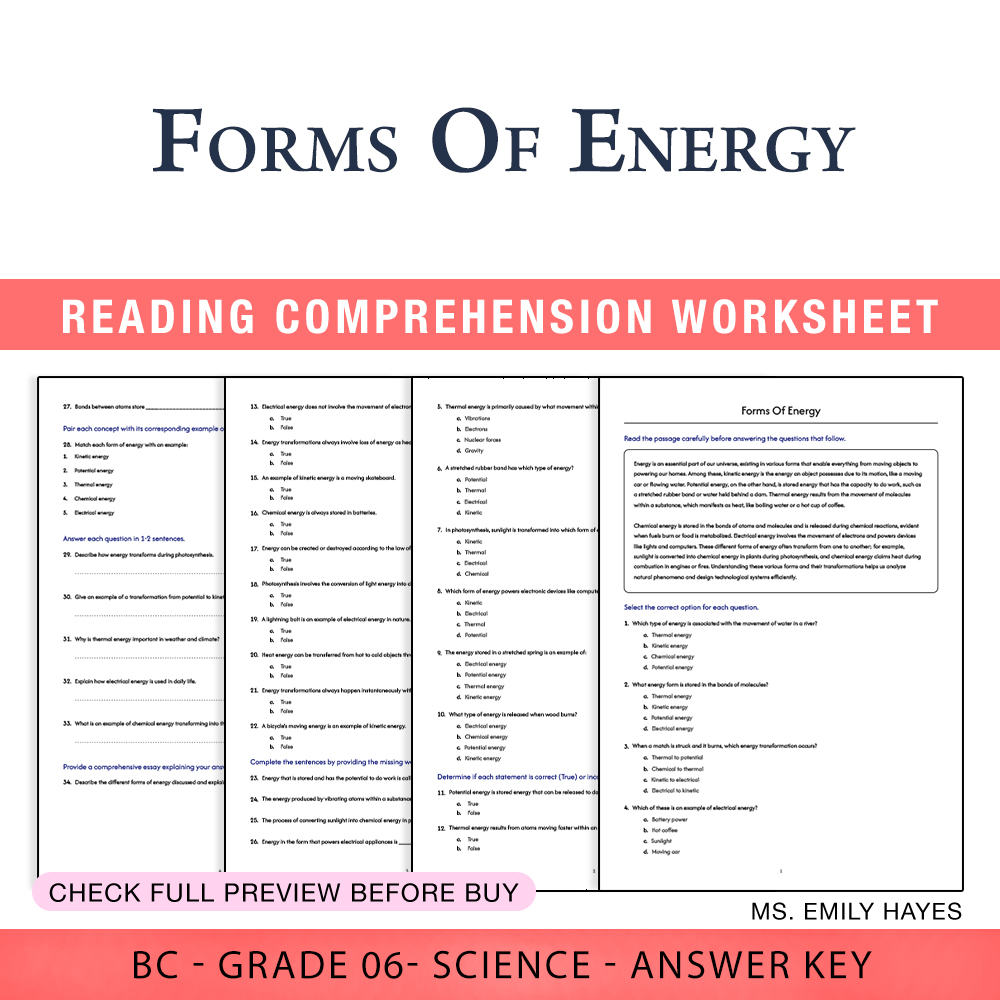
6th Grade Science | Forms of Energy Worksheet (PDF+ Answer Key)
 Created byCopper Leaf Classroom
Learning Objectives
- Identify and describe different forms of energy such as kinetic, potential, thermal, chemical, and electrical.
- Explain the process of energy transformations between different forms.
- Recognize common examples of energy forms and their typical transformations in real-world systems.
Also included in: Grade 6 Science BC | Waves, Sound, Light & Energy Worksheets (PDF + Answer Key) +1 more
Instant download

Grade 6 World Refugees Day Worksheet for Mastering Resilience | PDF + Answer Key
 Created byShaNova Worksheets
Learning Objectives
- Explain what it means to be a refugee and why people may be forced to leave their homes
- Identify key human-rights ideas connected to safety, shelter, and access to services
- Demonstrate empathy by describing respectful ways to support people who have been displaced
Instant download

6th Grade ELA Worksheet on Logical Transitions | Alberta Standards (PDF)
 Created byGolden Apple Studio
Learning Objectives
- Use transition words and phrases to clarify relationships between ideas (addition, contrast, cause and effect, sequence, emphasis).
- Revise sentences and paragraph links so the writing stays coherent and easy to follow.
- Identify where a missing or misplaced transition word changes the meaning of a draft.
Also included in: Grade 6 ELA Sentence, Evidence & Revision Lesson Bundle – Alberta +1 more
Instant download

Grade 6 Holiday | Creating Inspired Art Worksheet | January Standards
 Created byLumora Learning
Learning Objectives
- Explain how personal feelings and cultural traditions can inspire visual art choices.
- Use art vocabulary to describe techniques, themes, and the emotional impact of an artwork.
- Plan and present an inspired artwork with a clear connection to a story or tradition.
Instant download

Grade 6 | Cinco de Mayo Day for Mastering Mexican History | PDF + Answer Key
Created byShaNova WorksheetsLearning Objectives
- Explain the historical context of Cinco de Mayo and the Battle of Puebla (1862).
- Identify key ideas about resilience and unity during times of adversity.
- Analyze how historical events can shape cultural identity and traditions.
Also included in: Grade 6 Cinco de Mayo Holiday Custom Bundle: Common Core Arts & History
Instant download

Grade 6 World Earth Day Worksheet for Environmental Awareness | PDF + Answer Key
Created byShaNova WorksheetsLearning Objectives
- Develop research skills by investigating environmental challenges.
- Analyze data and propose innovative solutions for sustainability.
- Understand the importance of scientific inquiry in creating systemic change.
Also included in: Grade 6 Holiday Earth Day Worksheets | Environmental Science Bundle
Instant download

Grade 6 Holiday | World Earth Day for Mastering Biodiversity | PDF + Answer Key
Created byShaNova WorksheetsLearning Objectives
- Understand the variety of life forms inhabiting Earth and their habitats.
- Recognize the importance of biodiversity for ecosystems and human life.
- Identify different species and habitats, and learn about endangered plants and animals.
Also included in: Grade 6 Holiday Earth Day Worksheets | Environmental Science Bundle
Instant download

Grade 6 Holiday |Sustainable Living World Earth Day Worksheet | PDF + Answer Key
Created byShaNova WorksheetsLearning Objectives
- Understand the concept of sustainability and its importance for future generations.
- Identify renewable energy sources and conservation techniques.
- Recognize eco-friendly practices at home and school.
Also included in: Grade 6 Holiday Earth Day Worksheets | Environmental Science Bundle
Instant download

Species Classification Worksheets for Grade 6 Science: Forest Ecosystems
 Created bythe curious pencil
Learning Objectives
- Classify organisms as producers, consumers, or decomposers.
- Distinguish native species from introduced and invasive species.
- Explain how species interactions influence ecosystem balance.
Instant download

Scientific Data Interpretation and Evidence Communication Worksheets Grade 6
Created bythe curious pencilLearning Objectives
- Summarize environmental measurements using descriptive statistics.
- Compare bar graphs, line graphs, and scatter plots.
- Interpret scientific observations without overstating conclusions.
Instant download

Human Impacts on Forests and Ecosystems | Grade 6 Science
Created bythe curious pencilLearning Objectives
- Identify human activities that change forest habitats and landscapes.
- Explain how habitat fragmentation affects wildlife movement and connectivity.
- Describe how pollution and invasive species affect forest ecosystems.
Instant download

Flight Forces Worksheets: Lift, Thrust, Drag & Weight Grade 6
Created bythe curious pencilLearning Objectives
- Identify lift, thrust, drag, and weight in flight examples.
- Explain how balanced forces support steady flight.
- Compare how unbalanced forces affect speed and descent.
Instant download
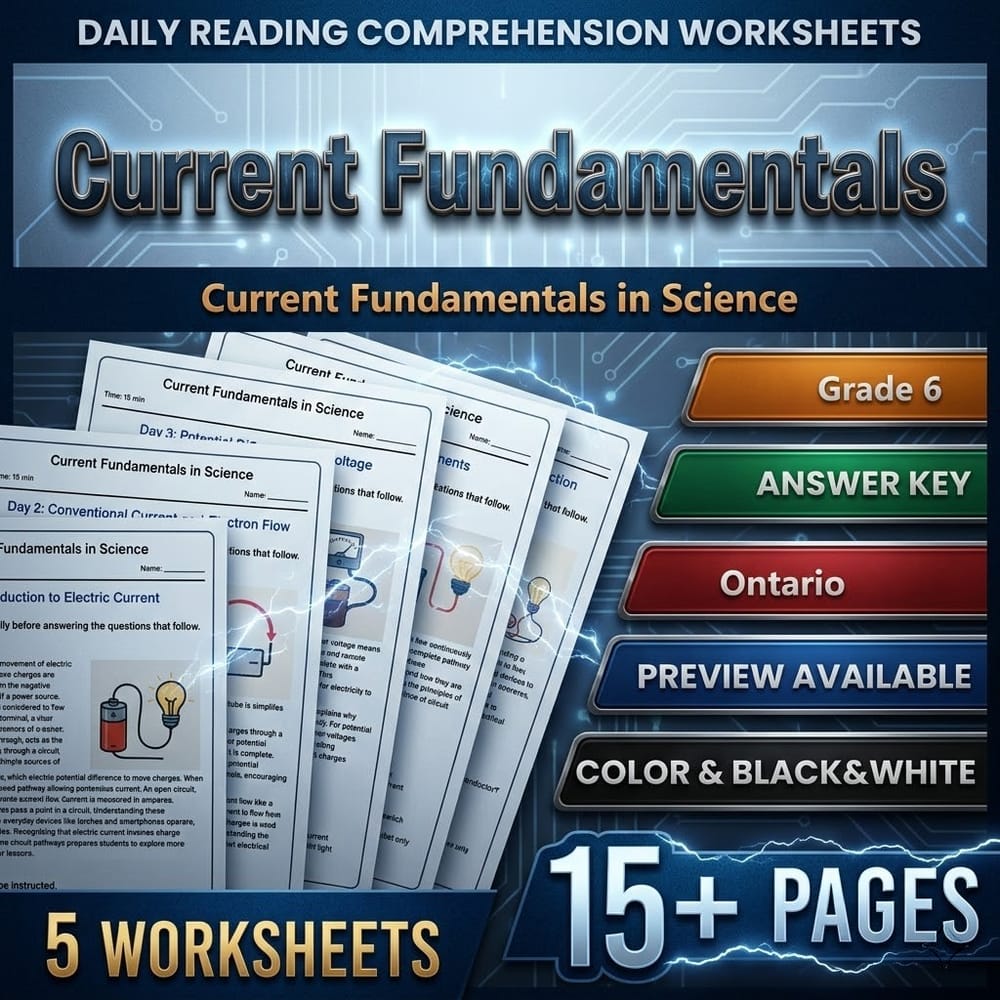
Grade 6 Science – Current Fundamentals & Circuits | Daily Reading Worksheet
 Created byQuiet Forest Education
Learning Objectives
- Understand the concept of electric current as organized movement of charges
- Differentiate between conventional current direction and electron flow
- Explain potential difference as the driving force of current
Also included in: Electricity Grade 6 Science Daily Reading Worksheets Bundle | Ontario +1 more
Instant download

6th Grade Holiday Awareness | Celebrating AAPI Contributions Worksheet
 Created bySilver Birch Teaching
Learning Objectives
- Identify ways AAPI individuals have contributed to science, arts, politics, and social justice.
- Use evidence from a text to explain how perseverance and innovation can create positive change.
- Evaluate statements about cultural pride, activism, and community impact using logical reasoning.
Also included in: Grade 6 Holiday Awareness Subject Lesson Bundle: May Framework +1 more
Instant download

Grade 6 Pride Day Worksheet for Celebrating Diversity | PDF + Answer Key
Created byShaNova WorksheetsLearning Objectives
- Explain how Pride celebrations promote visibility, acceptance, and equality in communities.
- Identify key elements of Pride events such as parades, cultural activities, and advocacy.
- Describe ways individuals can show respect and empathy during Pride celebrations.
Also included in: Grade 6 Pride Day Holiday Lesson Bundle for CCSS ELA Reading & Writing
Instant download

6th Grade Science Worksheet | Iterative Improvement & Prototype Testing (PDF)
Created byEvergreen Desk EducationLearning Objectives
- Explain how evaluation data can guide design changes in iterative improvement.
- Describe how function and constraints can be refined while maintaining safe trade-offs.
- Use evidence from testing to justify a next prototype modification.
Also included in: Grade 6 Prototype Design Science Lesson Bundle: General Systems Thinking +1 more
Instant download
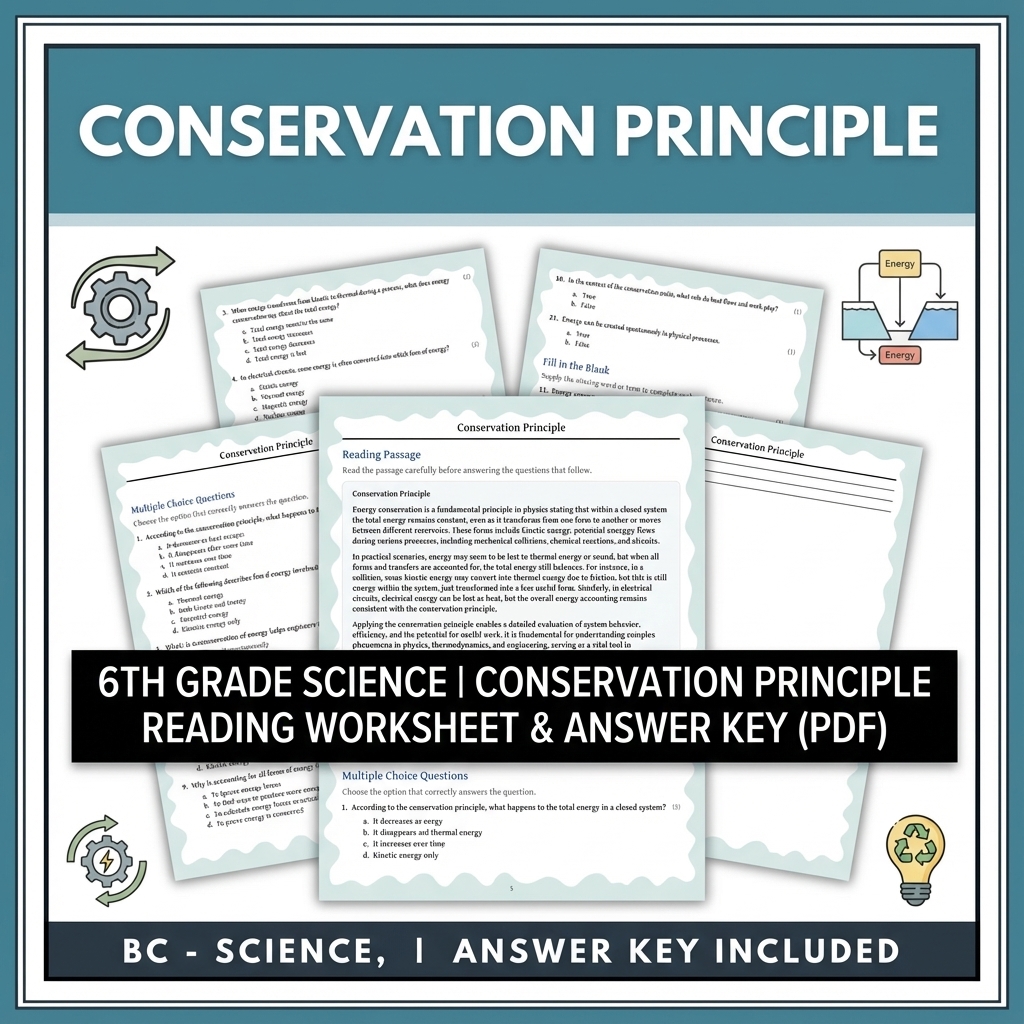
6th Grade Science | Conservation Principle Reading Worksheet & Answer Key (PDF)
JCreated byJ.S SheetsLearning Objectives
- Understand the concept of energy conservation within closed systems.
- Identify different forms of energy and how they transform and transfer.
- Explain how energy balance is maintained despite apparent losses.
Instant download
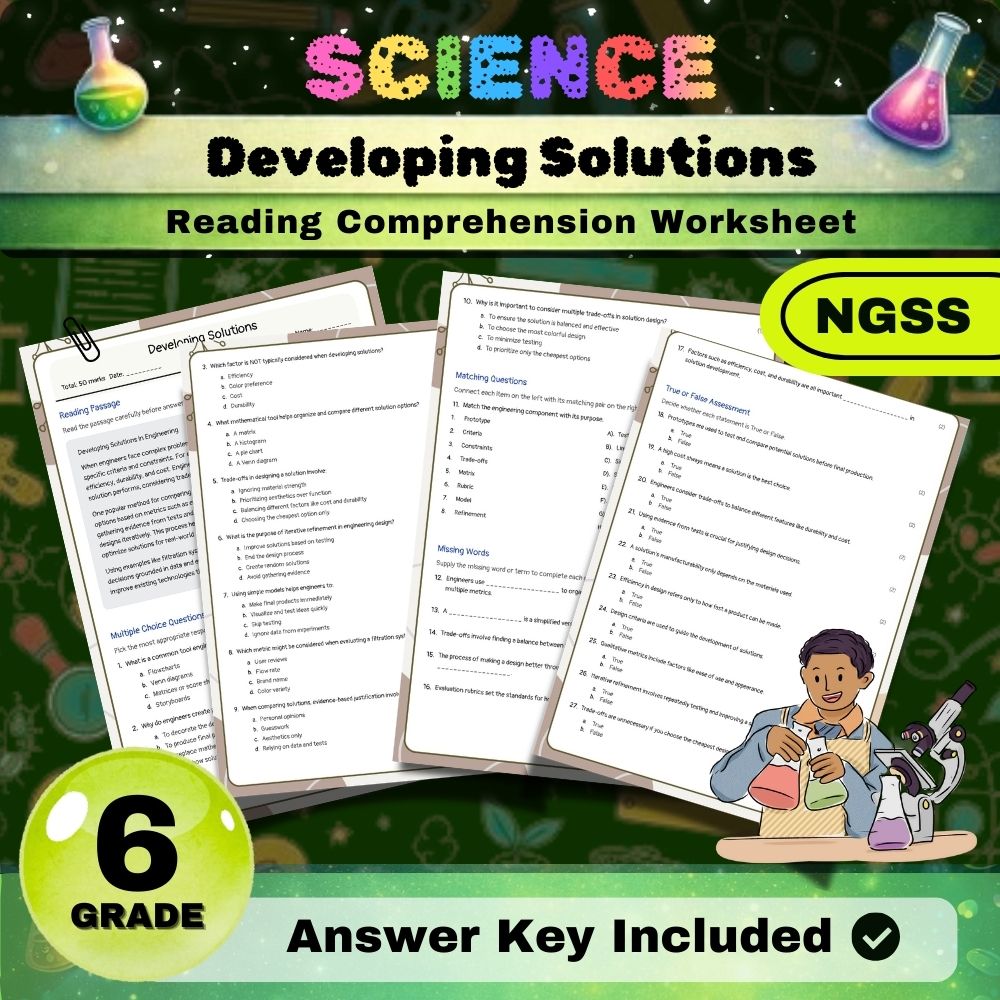
6th Grade Science | Developing Solutions Worksheet (PDF) — NGSS Aligned
 Created byMaple Path Learning
Learning Objectives
- Understand how to compare different design solutions using criteria and constraints.
- Use matrices, rubrics, and prototypes to evaluate solutions systematically.
- Analyze trade-offs among efficiency, durability, manufacturability, and cost.
Also included in: Grade 6 Science Engineering Design Unit | NGSS Worksheets Pack +1 more
Instant download

World Teachers’ Day Honoring Educators Worksheet Grade 6 | PDF + Answer Key
Created byShaNova WorksheetsLearning Objectives
- Describe the purpose and significance of World Teachers’ Day.
- Identify qualities of effective teachers and explain how teachers support learning.
- Use information from a reading passage to answer questions about educators and communities.
Instant download
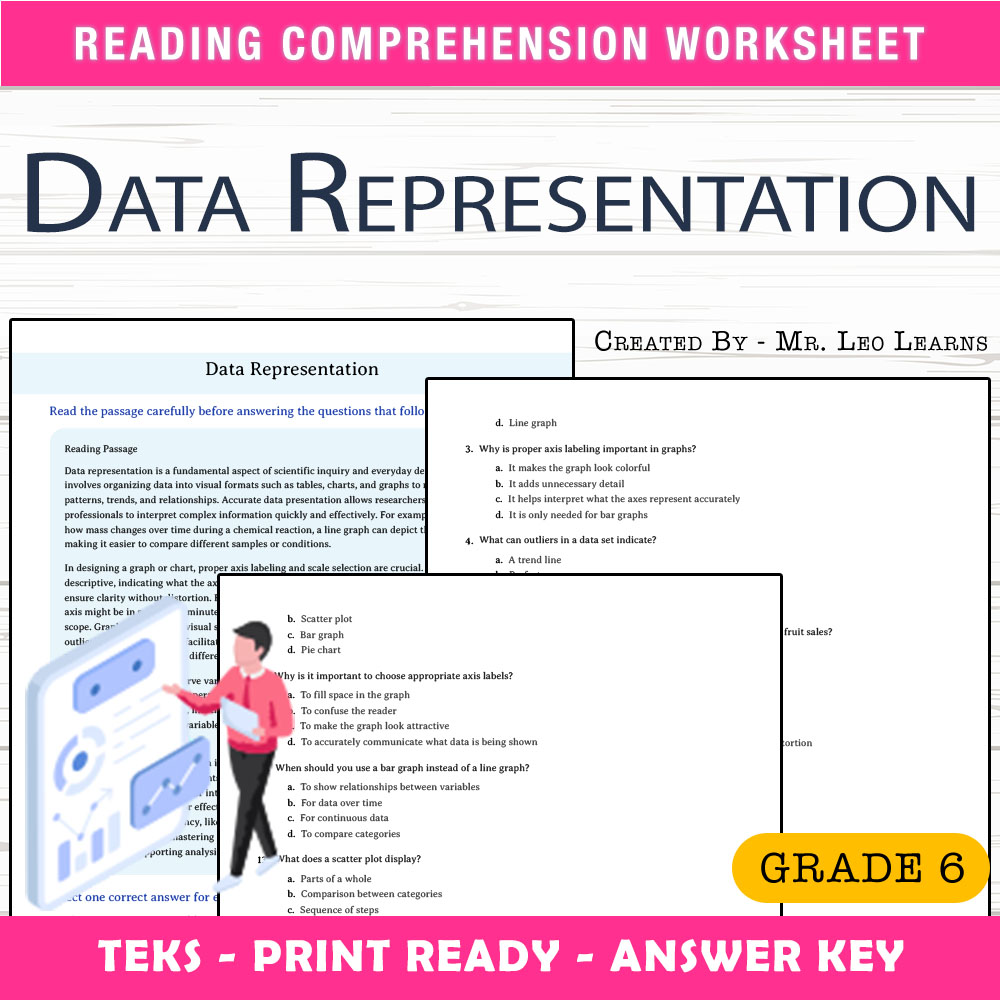
Grade 6 Science – Data Representation Worksheet for Mastering Scientific Graphs
 Created byThe Resource Hub
Learning Objectives
- Understand conventions for organizing and presenting data using different graphical methods.
- Interpret trends, patterns, outliers, and relationships in data visualizations.
- Apply proper axis labeling, scale selection, and graphical summaries to data sets.
Instant download

Grade 6 India Independence Day Symbols Worksheet for Content | PDF + Answer Key
Created byShaNova WorksheetsLearning Objectives
- Explain how national symbols (like the Indian flag and Ashoka Chakra) can represent values such as pride and responsibility.
- Describe how religious and cultural icons should be treated with respect in a diverse society.
- Connect symbols to civic identity by using respectful language and understanding shared meanings.
Instant download

Grade 6 Holiday| World Earth Day for Mastering Renewable Energy|PDF + Answer Key
Created byShaNova WorksheetsLearning Objectives
- Understand different forms of renewable energy such as solar, wind, and hydro power.
- Describe the benefits of renewable energy over fossil fuels.
- Explain how renewable energy reduces greenhouse gas emissions and fights climate change.
Also included in: Grade 6 Holiday Earth Day Worksheets | Environmental Science Bundle
Instant download

National Read a Book Day Reading Reflections Worksheets Grade 6
Created byShaNova WorksheetsLearning Objectives
- Determine the theme and support it with story details
- Explain how Lila changes from the beginning to the end
- Identify the author’s purpose using evidence from the passage
Also included in: National Read a Book Day Lesson Bundle | Grade 6 Holiday | September
Instant download

Grade 6 Holiday | Juneteenth Day for Mastering Celebrations | PDF + Answer Key
Created byShaNova WorksheetsLearning Objectives
- Explain key events and meanings associated with Juneteenth Day, including freedom and remembrance.
- Identify how Juneteenth celebrations (parades, readings, and gatherings) promote unity and cultural pride.
- Use vocabulary related to community, celebration, and heritage to describe traditions respectfully.
Also included in: Grade 6 Juneteenth Day Holiday Lesson Bundle Worksheets for C3 Framework
Instant download

Grade 6 | Juneteenth Day Worksheet for Mastering Origins | PDF + Answer Key
Created byShaNova WorksheetsLearning Objectives
- Explain what happened on June 19, 1865, and why it matters in Juneteenth history
- Use key vocabulary (freedom, emancipation, liberty, justice) to describe historical events
- Describe how Juneteenth celebrations connect the past to cultural identity and ongoing efforts for justice
Also included in: Grade 6 Juneteenth Day Holiday Lesson Bundle Worksheets for C3 Framework
Instant download
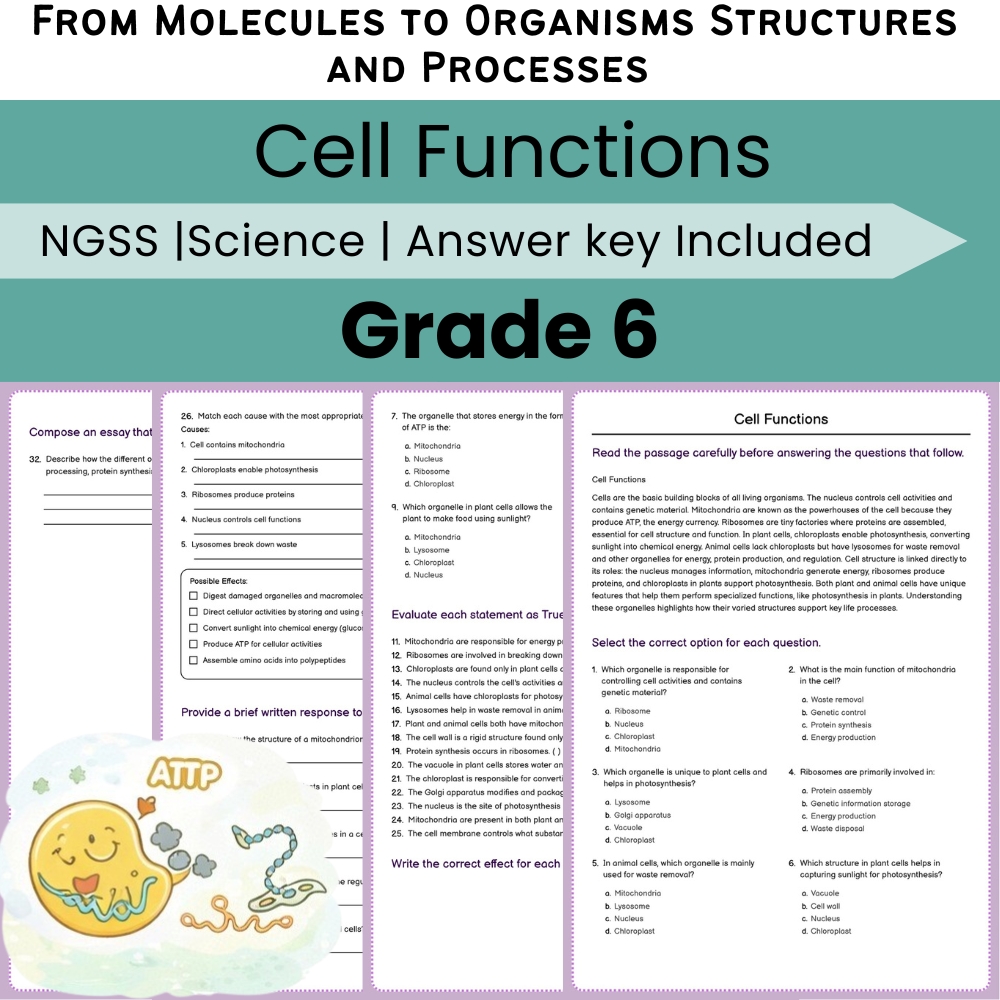
Cell Functions Worksheet | Grade 6 Science printable PDF | assessment
Learning Objectives
- Identify the main organelles of a cell and their functions.
- Understand how cell structure relates to its role in energy production, protein synthesis, and waste removal.
- Compare plant and animal cells to understand specialization of organelles.
Also included in: Grade 6 Science UNIT | Cells, Structures & Processes NGSS Worksheet Bundle +1 more
Instant download
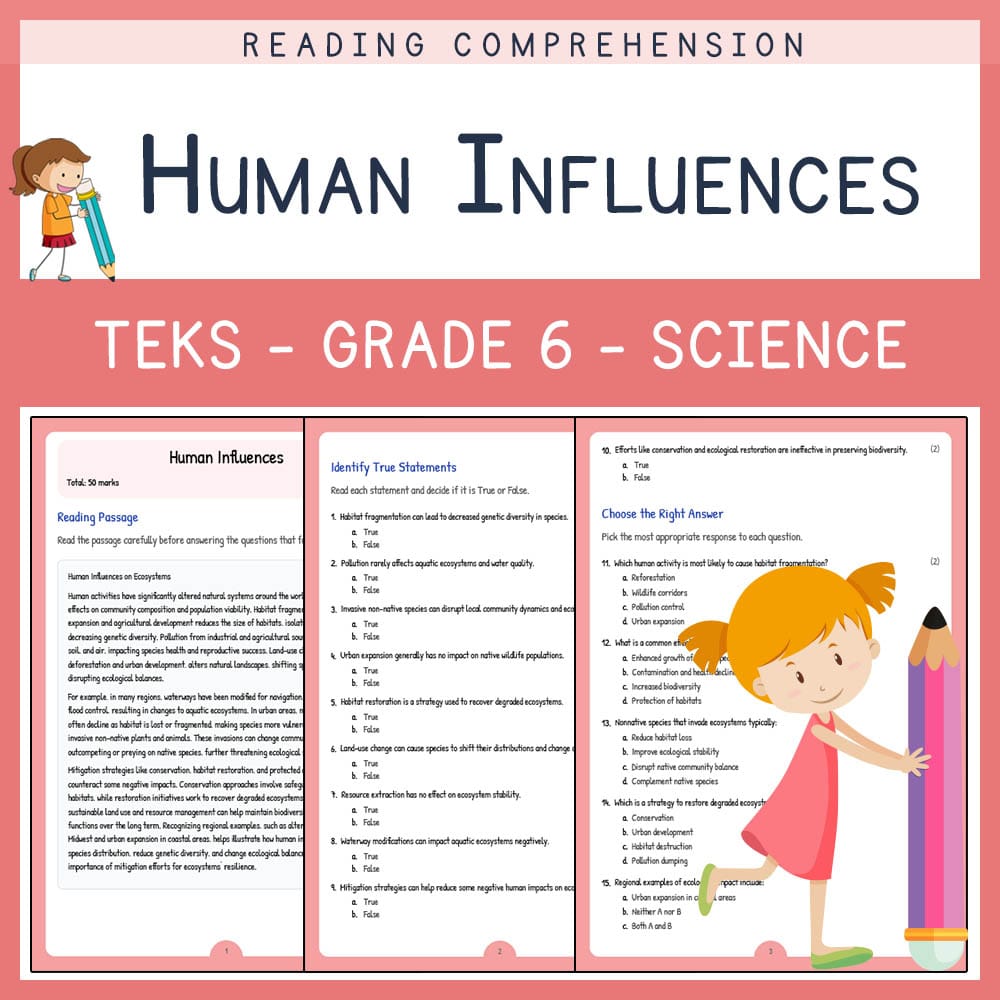
Grade 6 Science | Human Influences Worksheet | TEKS Alligned
Created byLumora LearningLearning Objectives
- Understand how human activities impact natural ecosystems and species diversity.
- Identify examples of habitat fragmentation, pollution, and other human-induced environmental changes.
- Explain mitigation strategies like conservation and restoration to reduce negative effects on communities.
Instant download
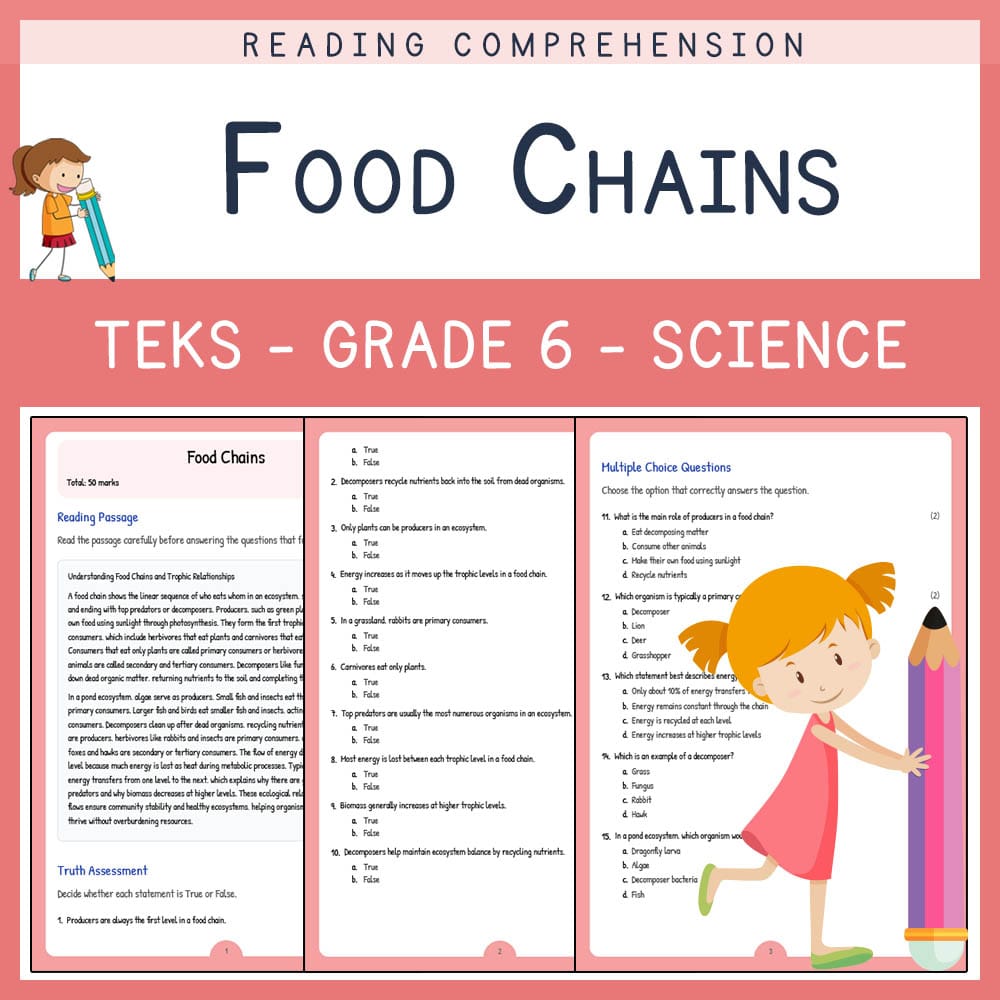
Grade 6 Science | Food Chains Worksheet Elena | TEKS-Aligned
Created byLumora LearningLearning Objectives
- Define and identify producers, consumers, and decomposers in food chains.
- Describe trophic levels and energy transfer among organisms.
- Illustrate simple pond and grassland food sequences to explain ecological relationships.
Instant download
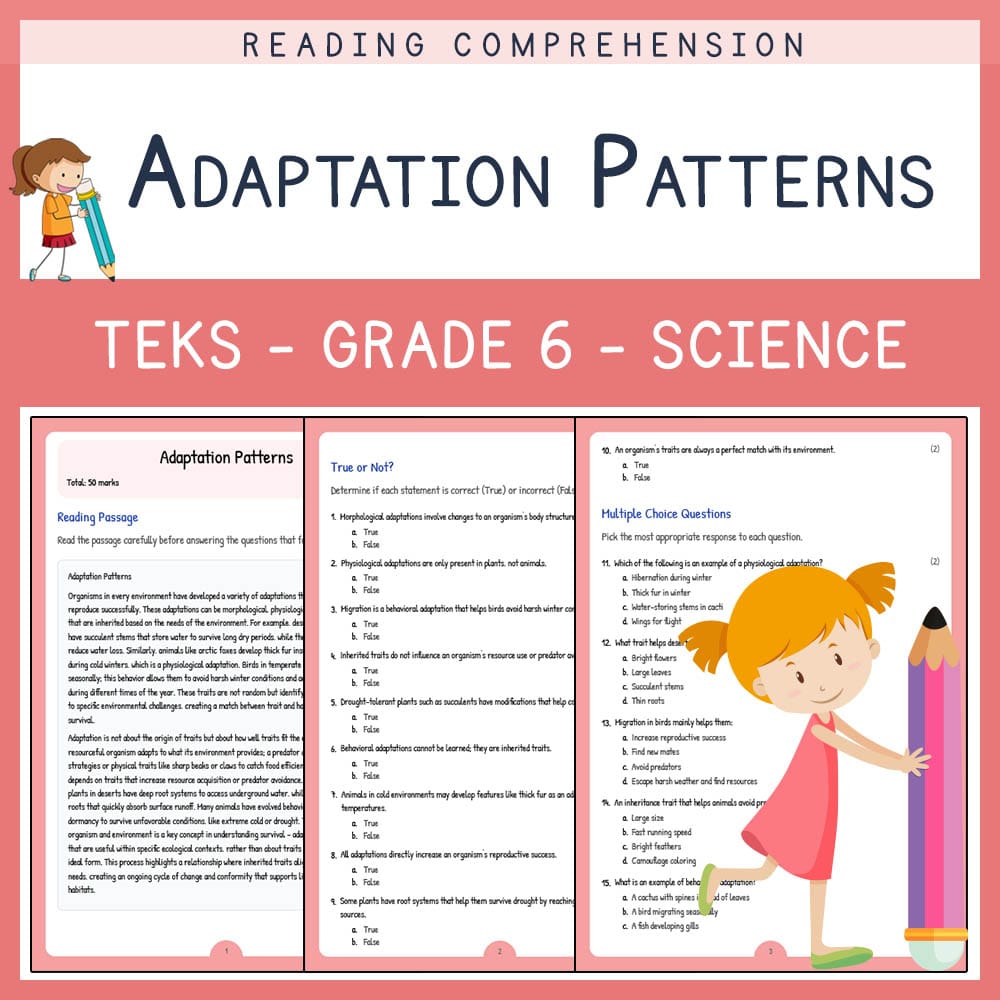
Grade 6 Science | Adaptation Patterns Worksheet | TEKS Standards
Created byLumora LearningLearning Objectives
- Understand the different types of adaptation patterns such as morphological, physiological, and behavioral traits.
- Identify examples of adaptations that enhance survival in various environments.
- Explain how inherited traits influence resource use, predator avoidance, and reproductive success.
Instant download
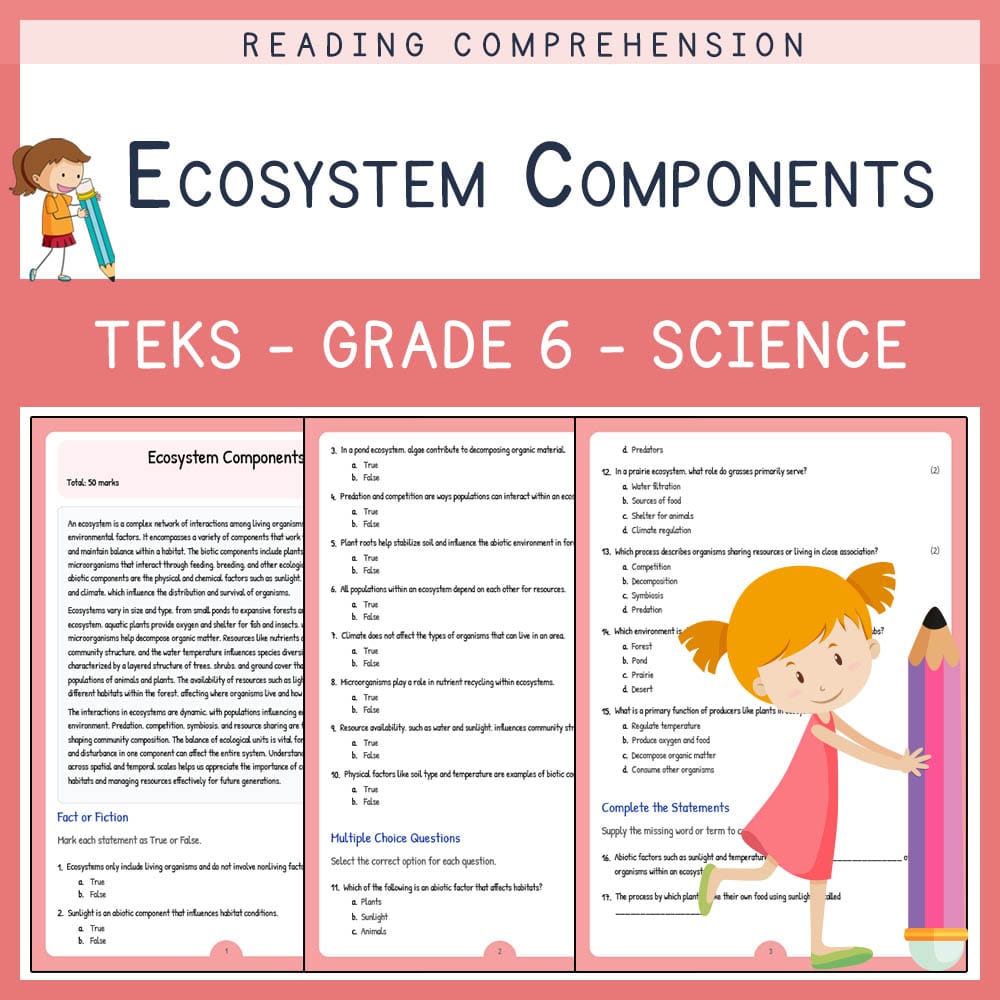
Grade 6 Science | Ecosystem Components Worksheet | TEKS-Aligned
Created byLumora LearningLearning Objectives
- Define ecosystems as interacting systems of populations, communities, and physical factors.
- Identify biotic and abiotic components and their roles in habitats.
- Describe examples such as ponds, prairies, and forests to illustrate resource distribution and community interdependence.
Instant download
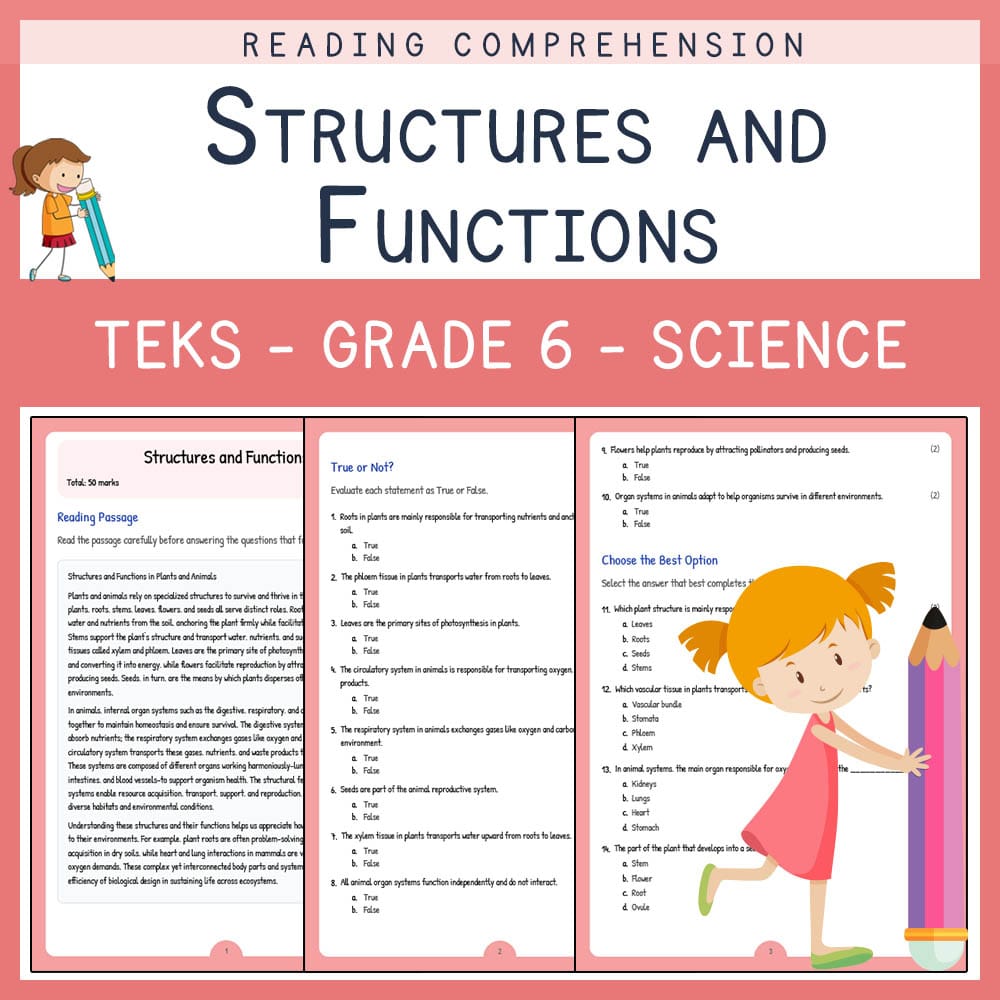
Grade 6 Science | Structures and Functions Worksheet | TEKS Standards
Created byLumora LearningLearning Objectives
- Describe major plant structures such as roots, stems, leaves, and flowers and explain their functions in resource acquisition and reproduction.
- Identify the roles of vascular tissues like xylem and phloem in transporting water and nutrients within plants.
- Explain basic animal organ systems such as digestive, respiratory, and circulatory systems and how they contribute to organism survival.
Instant download
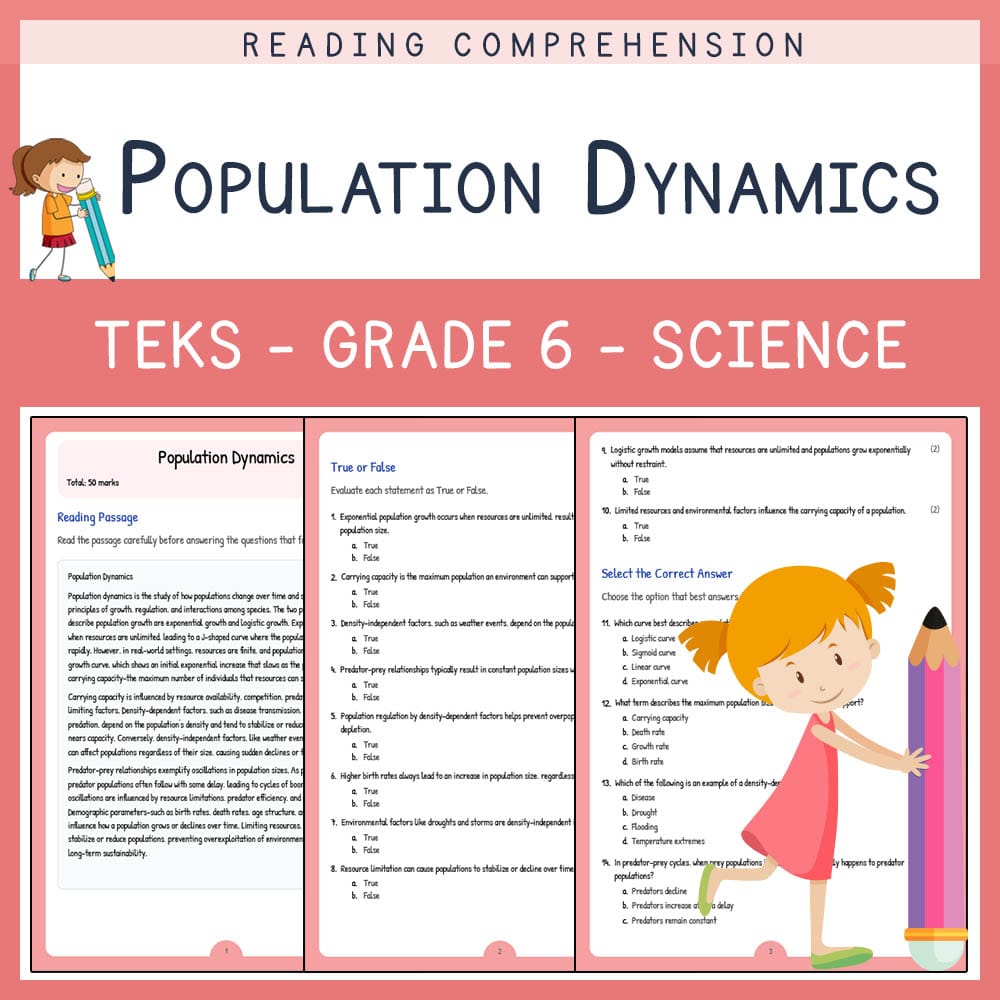
Grade 6 Science | Population Dynamics Worksheet | TEKS Aligned
Created byLumora LearningLearning Objectives
- Understand the principles of population size and how it changes over time.
- Differentiate between exponential and logistic growth curves in populations.
- Define carrying capacity and identify factors influencing population size.
Instant download
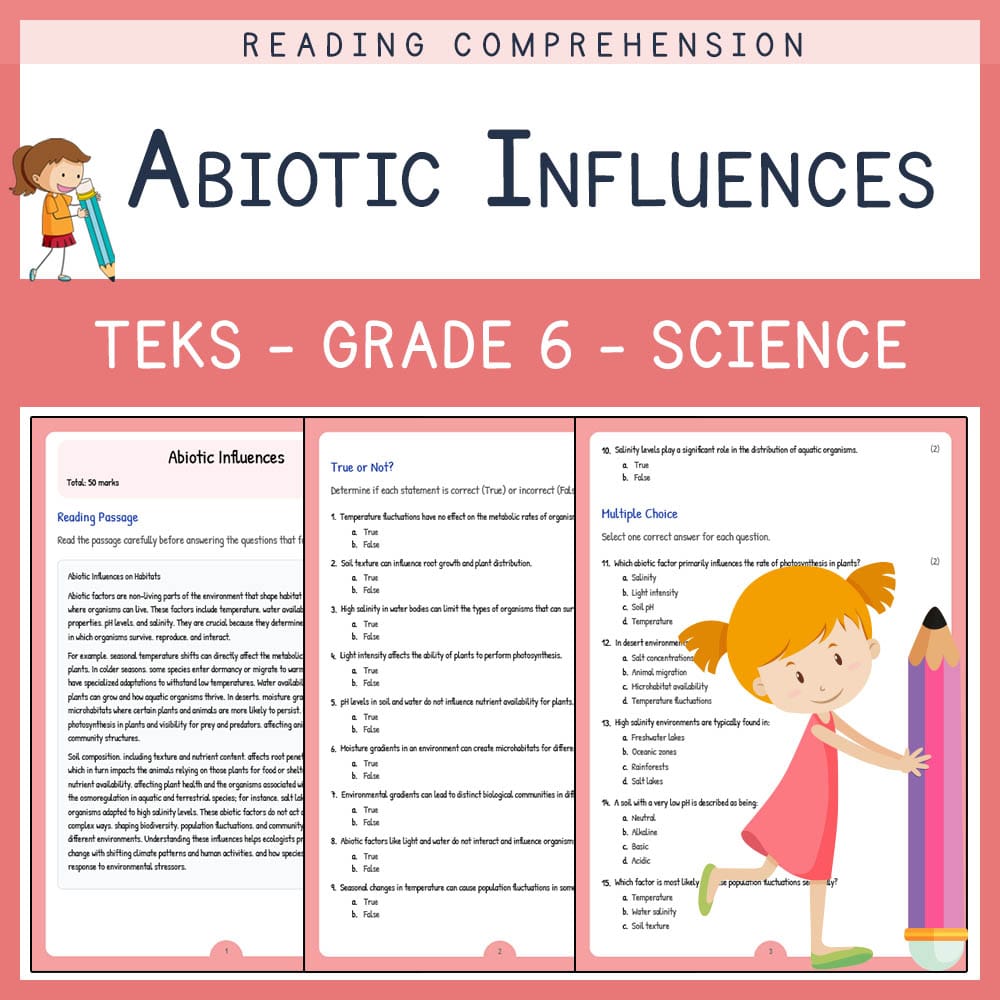
Grade 6 Science | Abiotic Influences Worksheet | TEKS Aligned
Created byLumora LearningLearning Objectives
- Understand how abiotic factors like temperature, water, light, soil, pH, and salinity influence habitats.
- Describe how environmental gradients affect organism distribution and community composition.
- Analyze examples of abiotic factors affecting biological processes and population dynamics.
Instant download
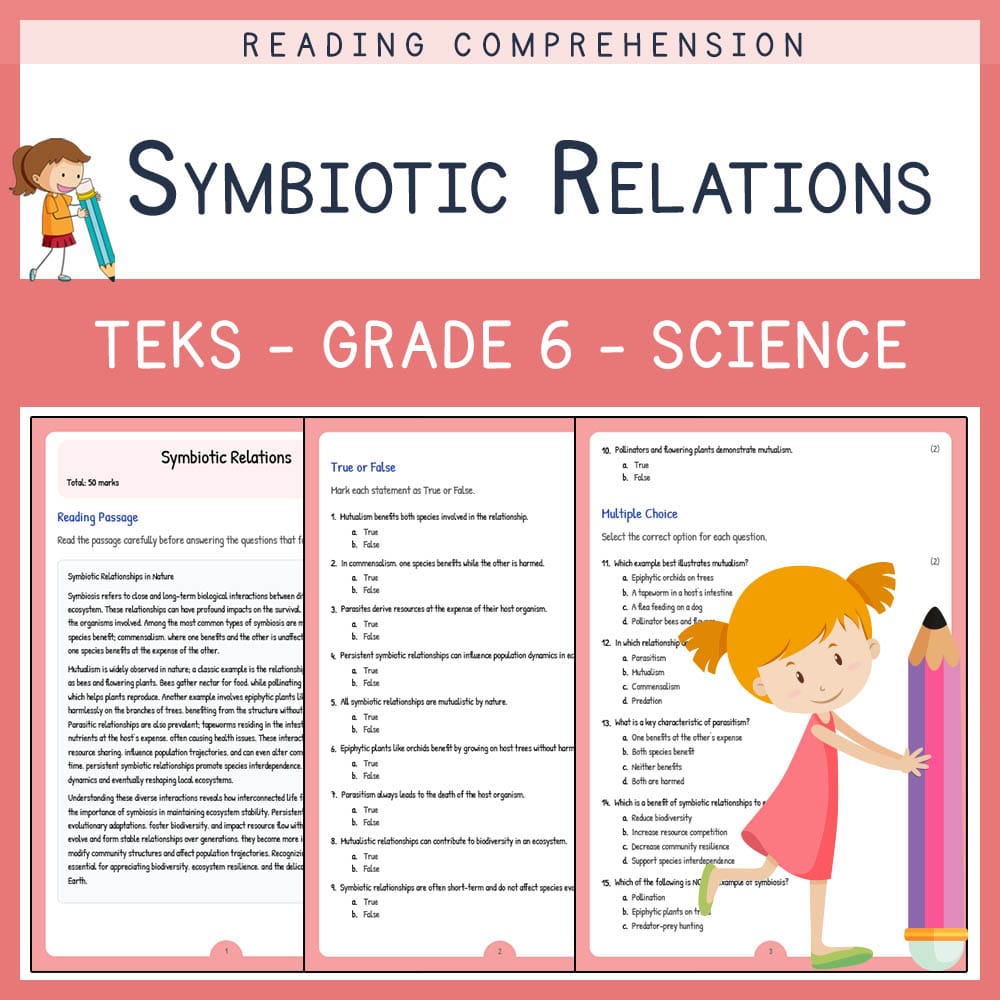
Grade 6 Science | Symbiotic Relations Worksheet | TEKS Alligned
Created byLumora LearningLearning Objectives
- Define and describe symbiotic relationships including mutualism, commensalism, and parasitism.
- Identify concrete examples of each type of symbiosis in real ecosystems.
- Analyze how symbiotic relationships influence organism fitness, resource distribution, and community structure.
Instant download
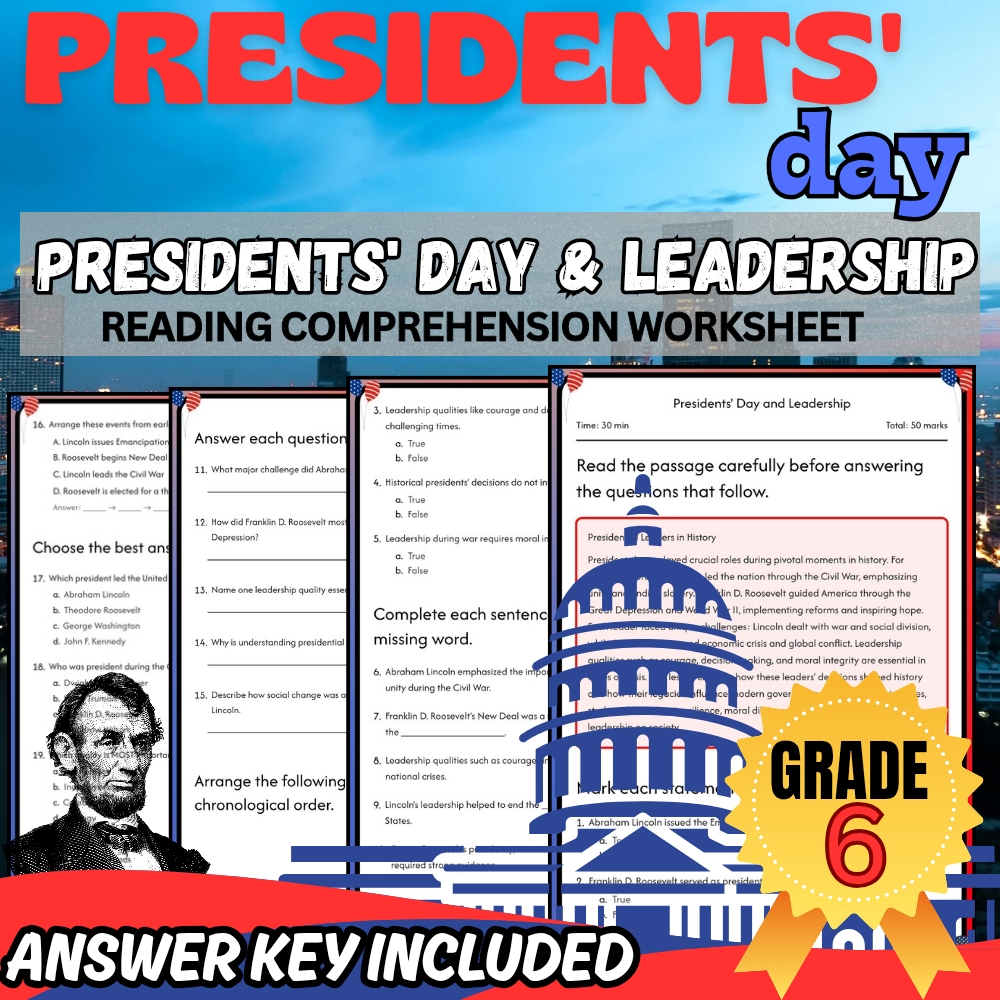
Grade 6 Holiday | Presidents' day for Mastering Leadership | PDF + Answer Key
Created byShaNova WorksheetsLearning Objectives
- Analyze the achievements and leadership styles of different presidents.
- Understand the historical context during their presidencies.
- Compare how presidents addressed challenges like war and social change.
Instant download

Grade 6 Health – Building Resilience Daily Worksheet | Ontario Standard
Created byQuiet Forest EducationLearning Objectives
- Understand the concept of positive self-talk and how it influences mental strength.
- Recognize the impact of resilience on recovering from setbacks.
- Learn strategies to improve self-esteem and emotional well-being.
Also included in: Social-Emotional Skills Grade 6 Health Daily Reading Worksheets Bundle | Ontario +2 more
Instant download
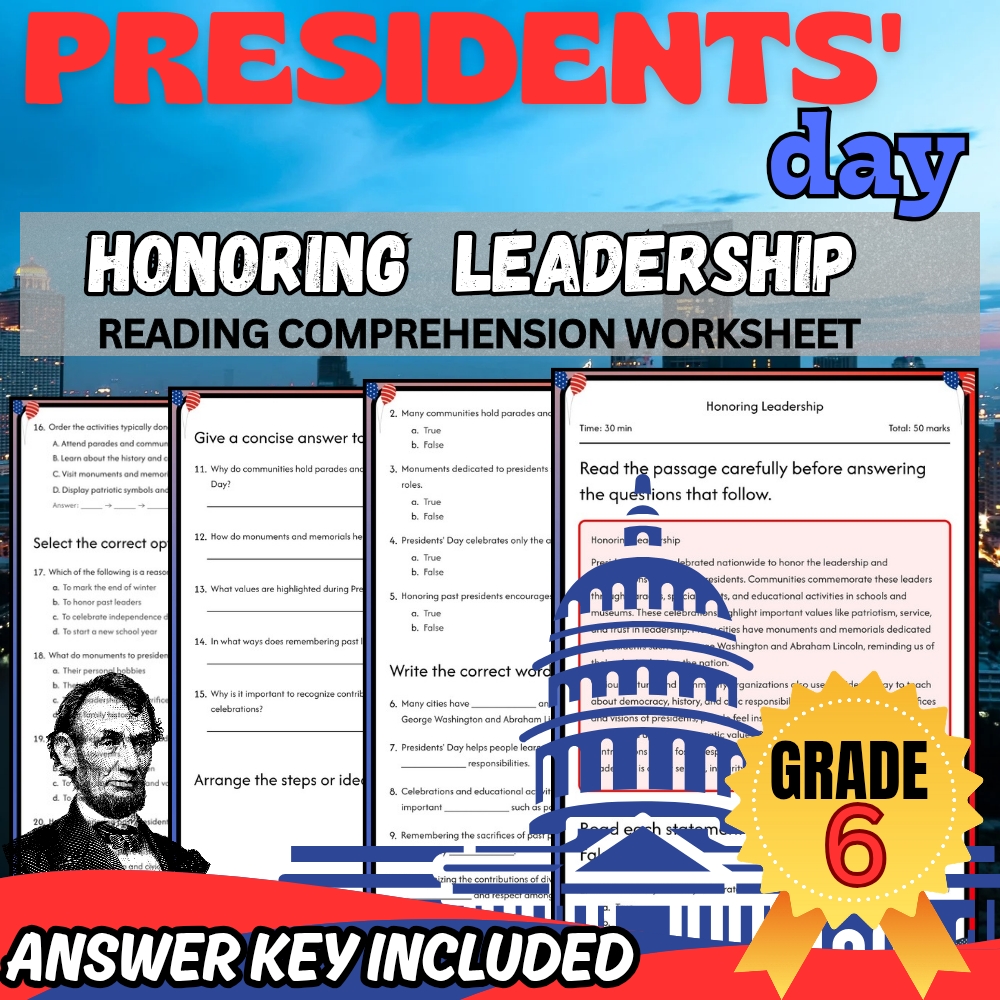
Grade 6 | Presidents' day Worksheet for Mastering Leadership | PDF + Answer Key
Created byShaNova WorksheetsLearning Objectives
- Understand how communities commemorate presidents through monuments, holidays, and events.
- Recognize the importance of leadership and service in American history.
- Reflect on the values and lessons associated with Presidents' Day.
Instant download
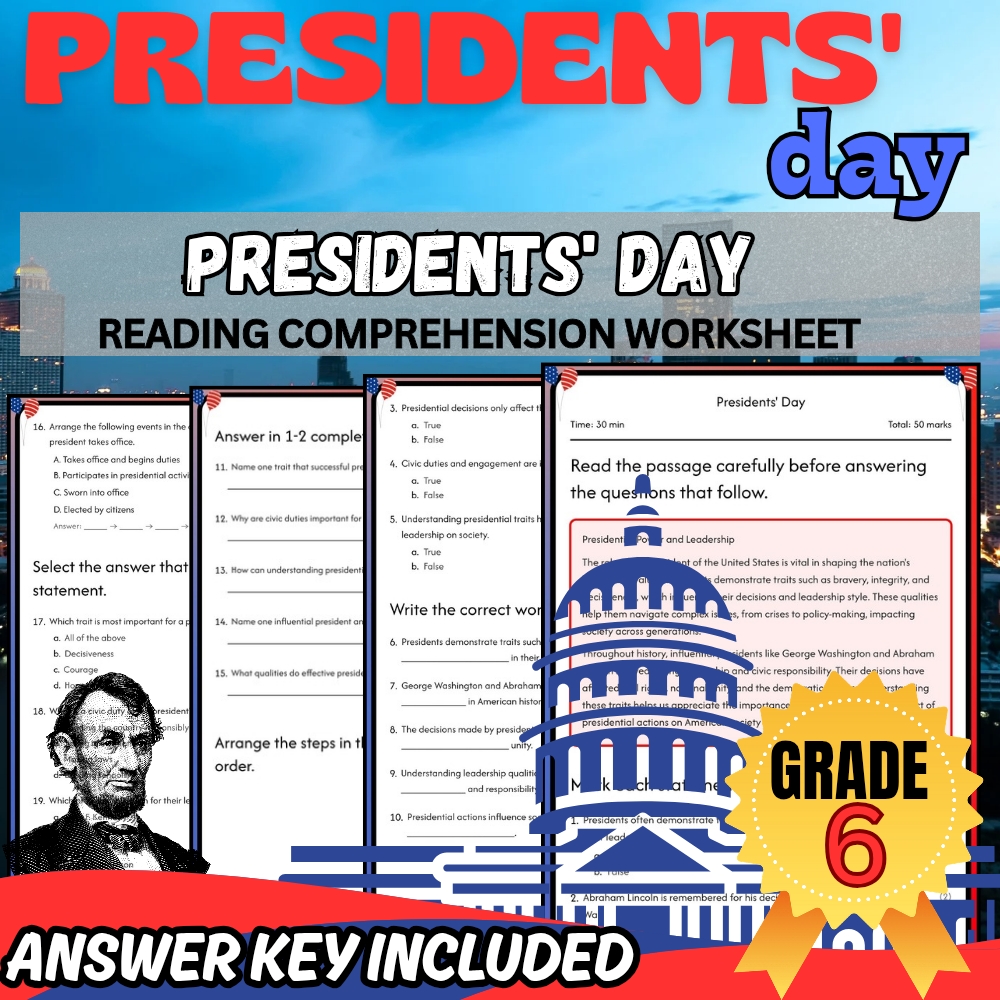
Grade 6 Presidents' Day Worksheet for Mastering Civic Traits | PDF + Answer Key
Created byShaNova WorksheetsLearning Objectives
- Understand the roles and responsibilities of the US president.
- Identify key traits of influential presidents and their impact on history and society.
- Learn about leadership qualities and civic duties of presidents.
Instant download

Grade 6| Mothers Day for Understanding Origins & Appreciation | PDF + Answer Key
Created byShaNova WorksheetsLearning Objectives
- Explain how Mother’s Day developed from earlier cultural and religious traditions to the modern holiday
- Identify key people and dates connected to the modern celebration of Mother’s Day in the United States
- Describe how different cultures honor mothers and other maternal caregivers
Also included in: Grade 6 Mother's Day Holiday Custom Bundle (CCSS) Worksheet Set
Instant download
Browse more categories
About Grade 6 Worksheets
Browse 8,578 printable Grade 6 worksheets across math, ELA, science, and social studies — each a ready-to-print PDF with optional answer keys.
MyTeachingSheets worksheets are made by real teacher-authors and checked before they go live. Download any as a print-ready PDF for lessons, homework, or independent practice — most include answer keys, and previews are always free.