
Grade 6 Worksheets
8,578 grade resources
Grade 6 Science Worksheet – Classification Basics (Ontario) (PDF)
 Created byEvergreen Desk Education
Learning Objectives
- Identify how observable characteristics are used to group organisms.
- Use a dichotomous key to classify organisms step-by-step.
- Explain hierarchical classification from kingdom to species and why species is the most specific category.
Also included in: Grade 6 Biodiversity, Adaptation & Ecology Science Lesson Bundle | Ontario +1 more
Instant download

Purposeful Presenting Worksheet for Grade 6 ELA | Standards-Aligned Practice
JCreated byJ.S SheetsLearning Objectives
- Explain how a speaker’s purpose affects the selection of main ideas, supporting details, and evidence in an informational presentation.
- Identify main ideas and supporting details and use logical sequencing to understand presented information.
- Use signposting language and clear topic sentences to improve clarity and organization in a spoken or written presentation.
Instant download

Grade 6 TEKS Minerals and Rocks Daily Science Reading Worksheet
 Created byBRIGHT PATH RESOURCES
Learning Objectives
- Identify the main idea and key details about minerals and rocks.
- Distinguish minerals from rocks using physical properties.
- Recognize how properties like hardness, cleavage, and grain size help identify rock types.
Also included in: Earth & Space Grade 6 Science Daily Reading Worksheets Lesson Bundle | TEKS +1 more
Instant download
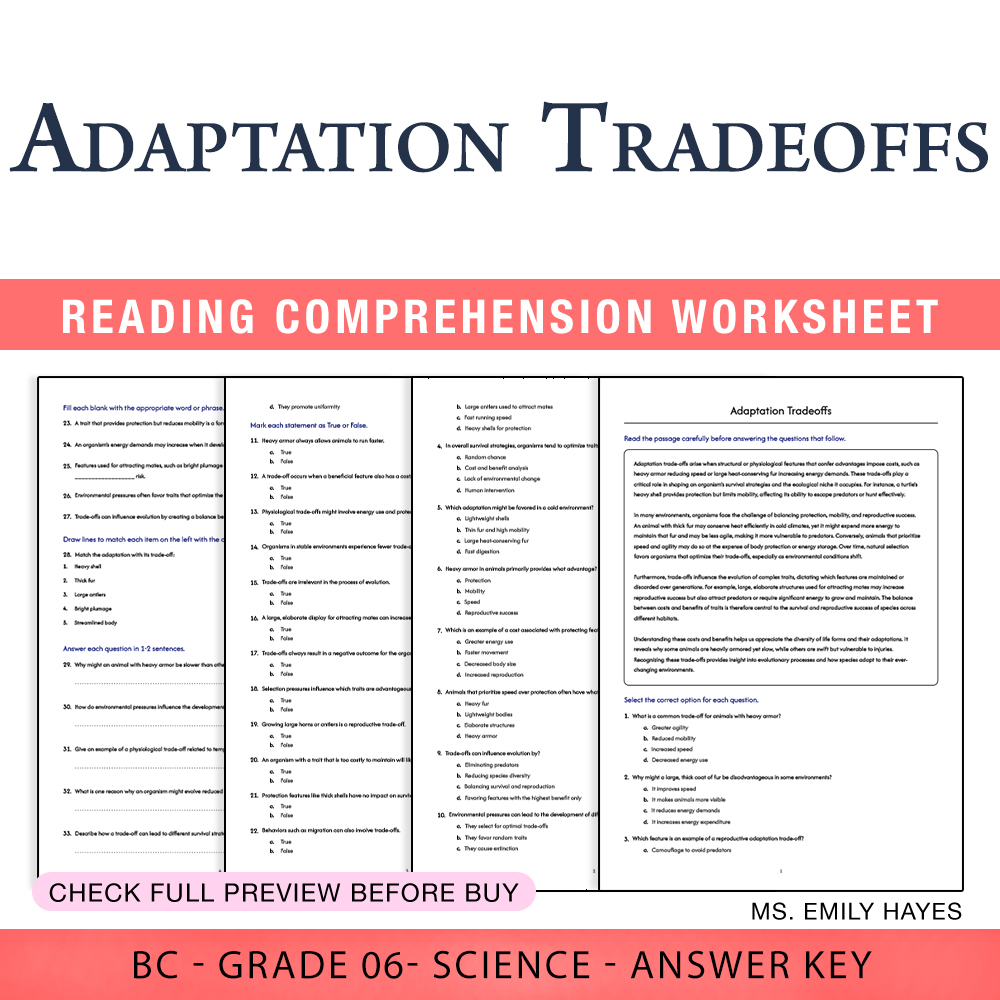
6th Grade Science | Adaptation Tradeoffs Worksheet (PDF+ Answer Key)
 Created byCopper Leaf Classroom
Learning Objectives
- Understand the concept of adaptation trade-offs and how they affect organism survival
- Describe different types of trade-offs in structural and physiological features
- Evaluate the costs and benefits associated with specific adaptations
Also included in: Grade 6 Science BC | Human Body Systems & Adaptations (PDF+ Answer Keys) +1 more
Instant download
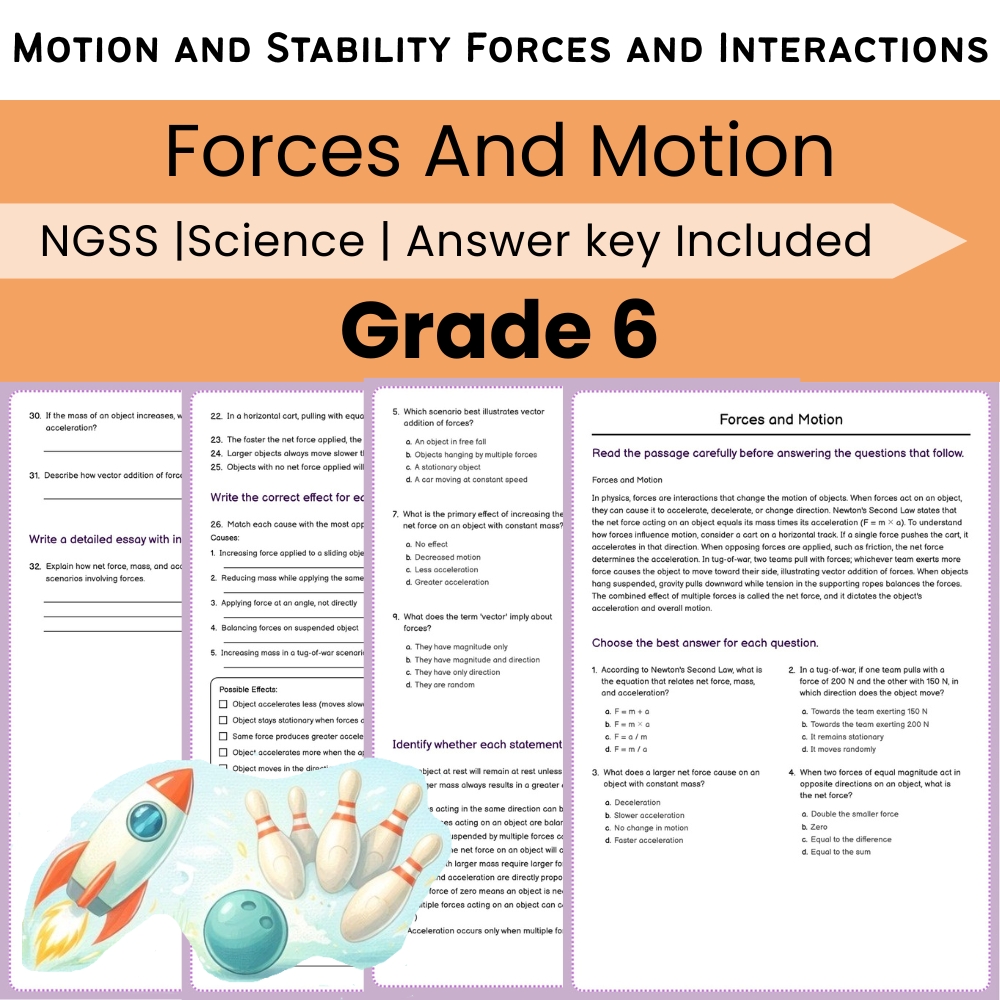
Forces and Motion Worksheet | NGSS Grade 6 Science printable PDF
Learning Objectives
- Understand the relationship between net force, mass, and acceleration.
- Explain how vector addition affects motion in different scenarios.
- Apply the formula net force equals mass times acceleration to solve problems.
Also included in: Grade 6 Science | Forces and Motion NGSS Unit Bundle (4 Worksheets Included) +1 more
Instant download
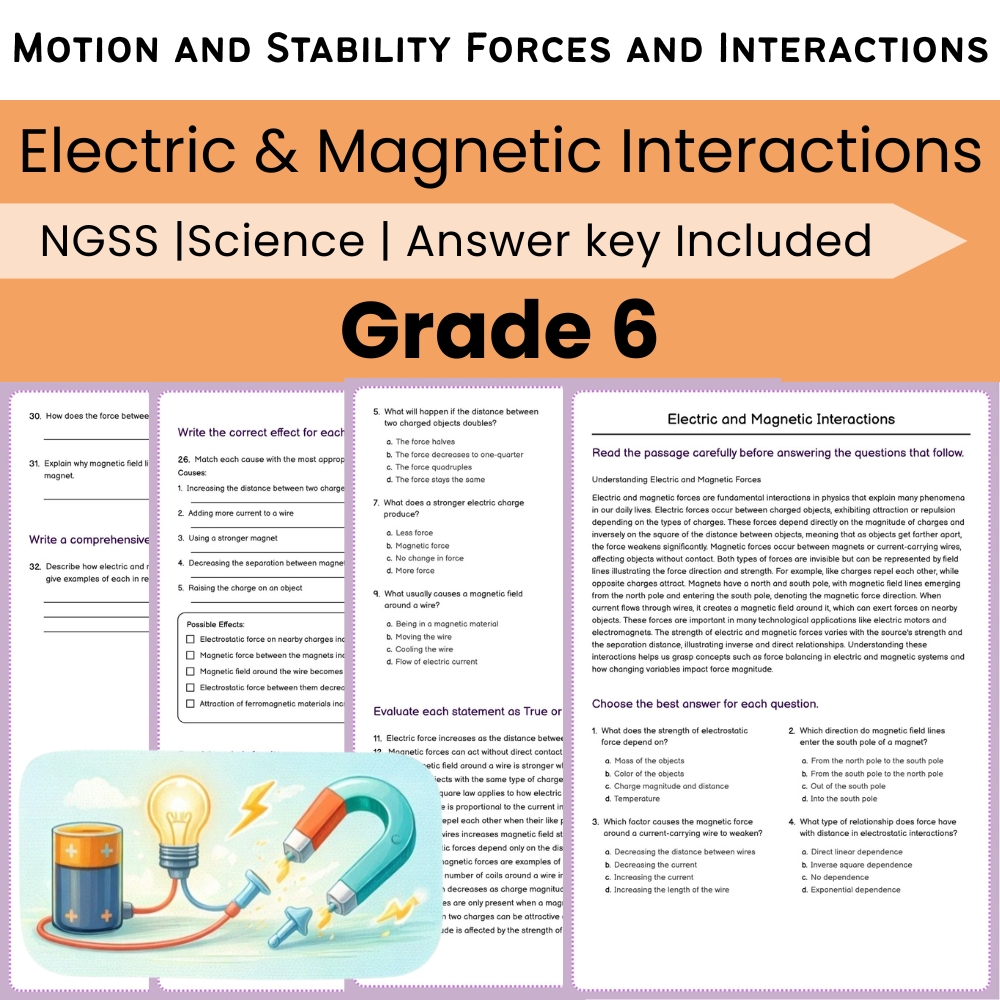
Electric and Magnetic Interactions Worksheet | Grade 6 Science PDF
Learning Objectives
- Understand how electric and magnetic forces depend on source strength and separation.
- Identify examples of electrostatic and magnetic forces in real-world situations.
- Explain how factors like distance, charge, and current influence force strength.
Also included in: Grade 6 Science | Forces and Motion NGSS Unit Bundle (4 Worksheets Included) +1 more
Instant download
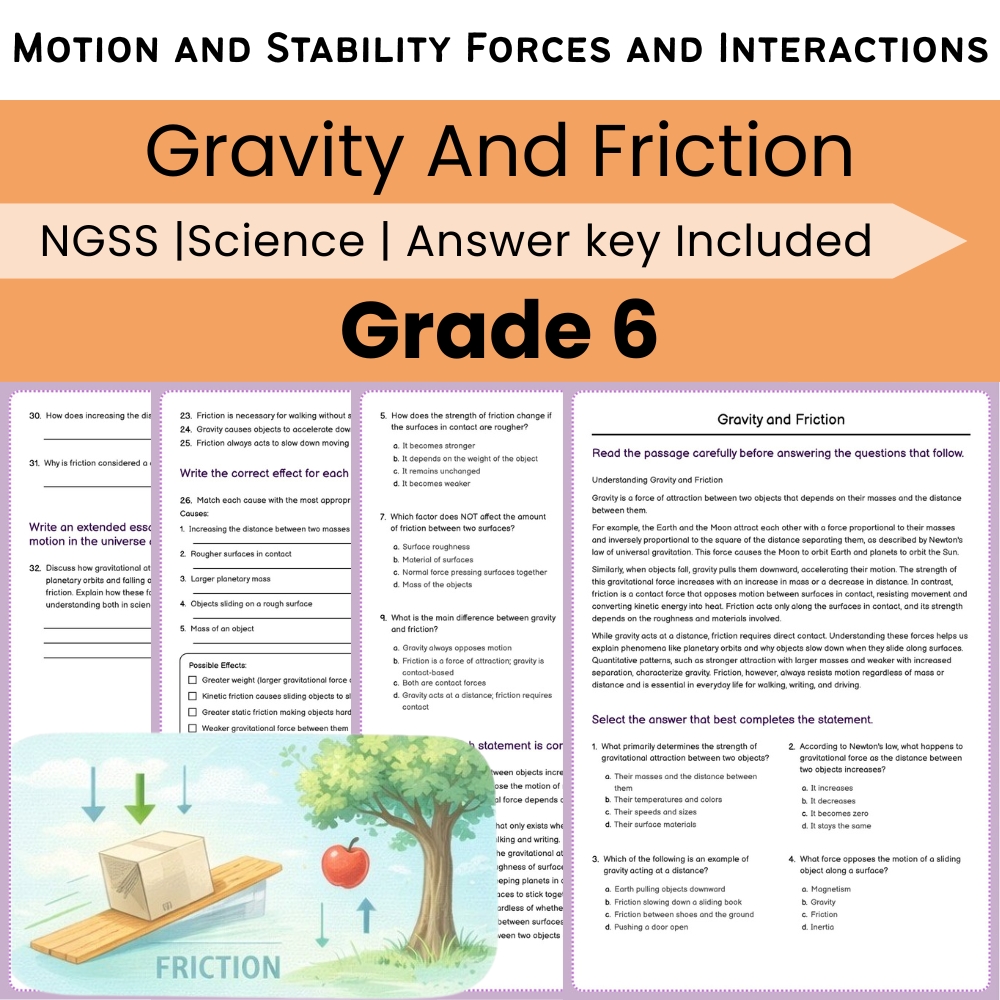
Gravity and Friction Science Worksheet | Grade 6 NGSS Printable PDF
Learning Objectives
- Explain how gravitational attraction depends on mass and distance between objects.
- Differentiate between gravitational forces and contact forces like friction.
- Use examples such as planetary orbits, Earth-Moon interactions, and falling objects to illustrate gravity.
Also included in: Grade 6 Science | Forces and Motion NGSS Unit Bundle (4 Worksheets Included) +1 more
Instant download
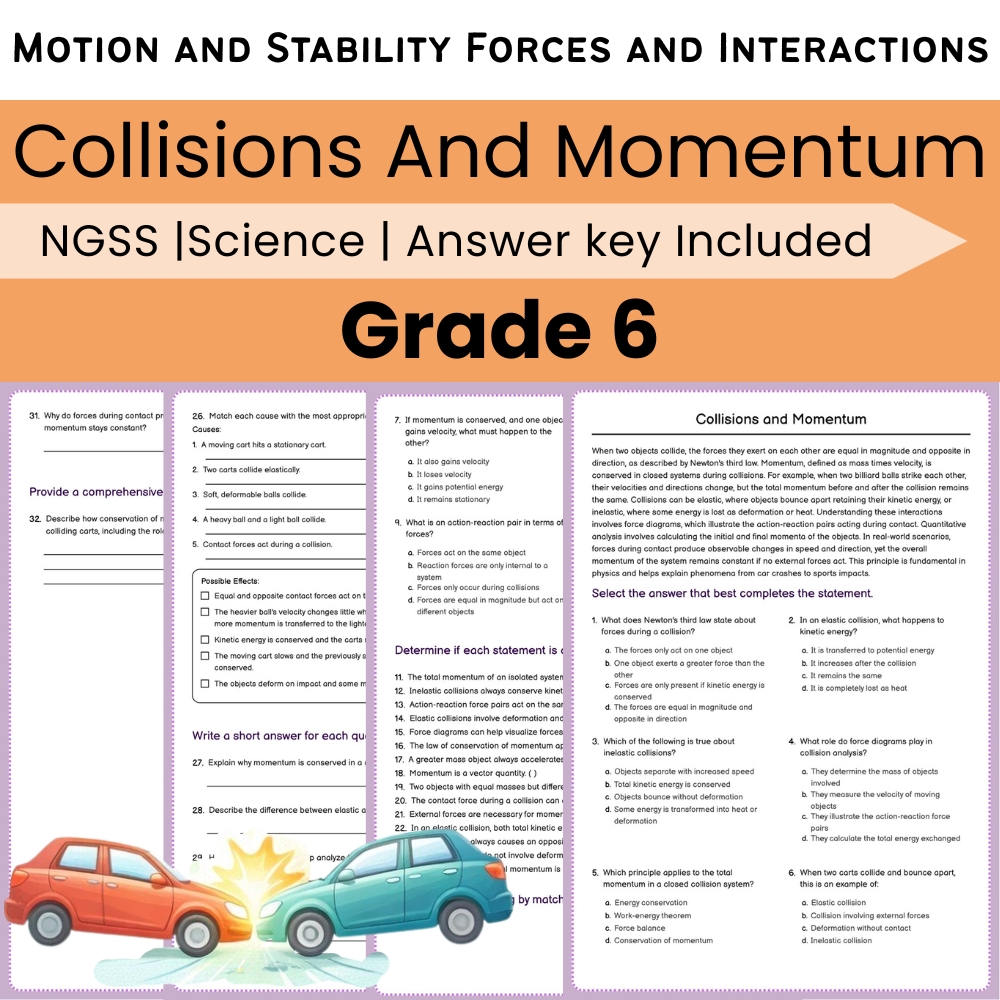
Collisions and Momentum Worksheet | Grade 6 Science NGSS Printable PDF
Learning Objectives
- Understand the law of conservation of momentum during two-body collisions.
- Identify the differences between elastic and inelastic collisions.
- Apply force diagrams to analyze action-reaction pairs during contact.
Also included in: Grade 6 Science | Forces and Motion NGSS Unit Bundle (4 Worksheets Included) +1 more
Instant download
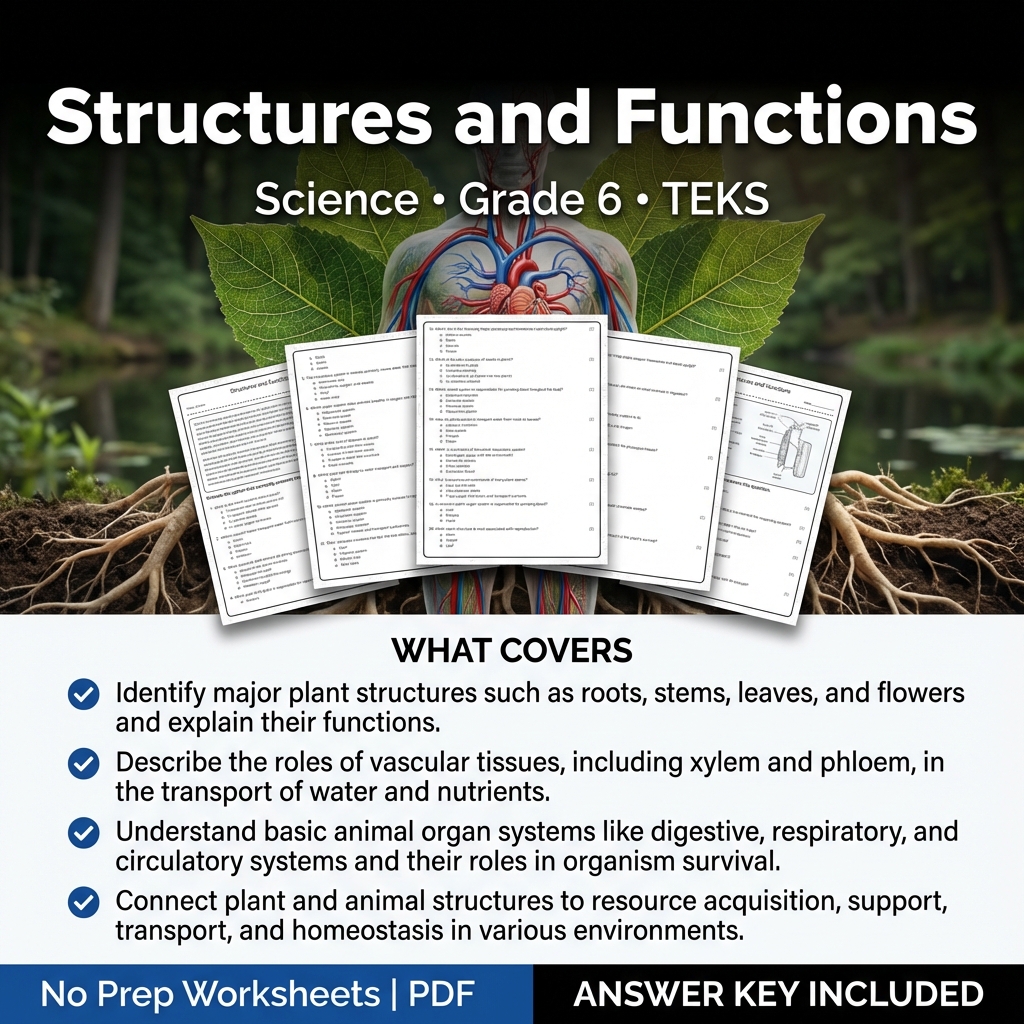
Grade 6 Science Worksheet on Structures and Functions | TEKS Aligned
 Created byCoral Reef Learning
Learning Objectives
- Identify major plant structures such as roots, stems, leaves, and flowers and explain their functions.
- Describe the roles of vascular tissues, including xylem and phloem, in the transport of water and nutrients.
- Understand basic animal organ systems like digestive, respiratory, and circulatory systems and their roles in organism survival.
Instant download
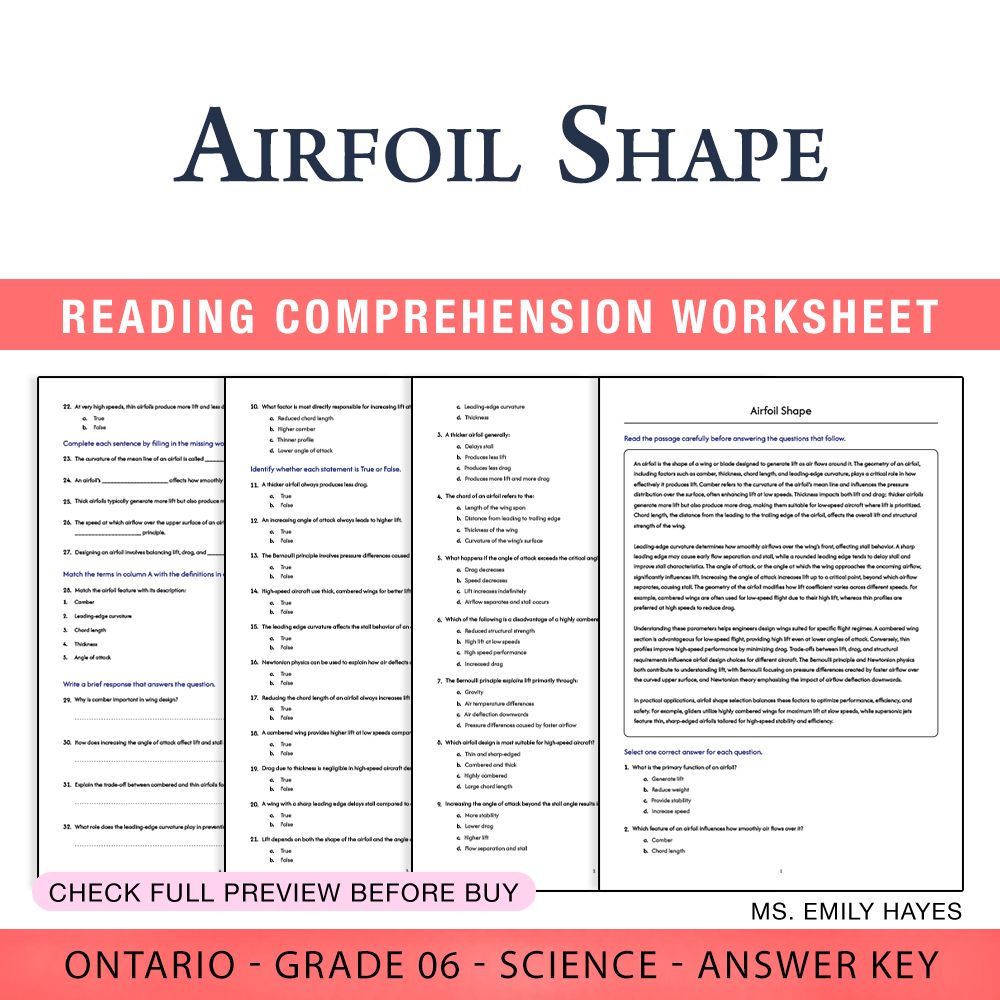
6th Grade Science | Airfoil Shape Worksheet (PDF + Answer Key)
Created byCopper Leaf ClassroomLearning Objectives
- Explain how camber, thickness, chord length, and leading-edge curvature influence pressure distribution and lift.
- Describe the differences between Bernoulli and Newtonian approaches to understanding lift.
- Identify the effects of angle of attack and critical angles for stall on lift production.
Instant download

Narrative Crafting Worksheet Pack | Grade 6 ELA Practice
 Created bySunny Desk Resources
Learning Objectives
- Identify the key parts of a narrative (character, setting, plot, and point of view)
- Use clear sequencing to make events in a story easy to follow
- Write with vivid details and craft choices that strengthen a personal or imagined narrative
Also included in: Grade 6 ELA Writing Lesson Bundle: Argument, Narrative & Informative CCSS +1 more
Instant download

Health Goals Worksheet Grade 6 Wellness Planning and Goal Setting
 Created byPrism Point Learning
Learning Objectives
- Explain why setting health goals helps people make better daily choices.
- Create a specific, measurable, realistic, and time-bound health goal.
- Identify steps to plan for a goal and track progress over time.
Instant download

Health Planning Strategies Worksheet | Grade 6 Goal Setting Activities
Created byPrism Point LearningLearning Objectives
- Identify steps for planning health goals using clear timelines.
- Break a health goal into smaller tasks and track progress.
- Adjust a plan when obstacles or results show changes are needed.
Instant download

Mixtures and Compounds Worksheet Pack Grade 6 Science Chemistry
Created byPrism Point LearningLearning Objectives
- Explain how mixtures and compounds differ in particle arrangement and atomic composition
- Identify examples of mixtures and compounds using particle model ideas
- Describe how physical separation often works for mixtures but not for compounds
Instant download
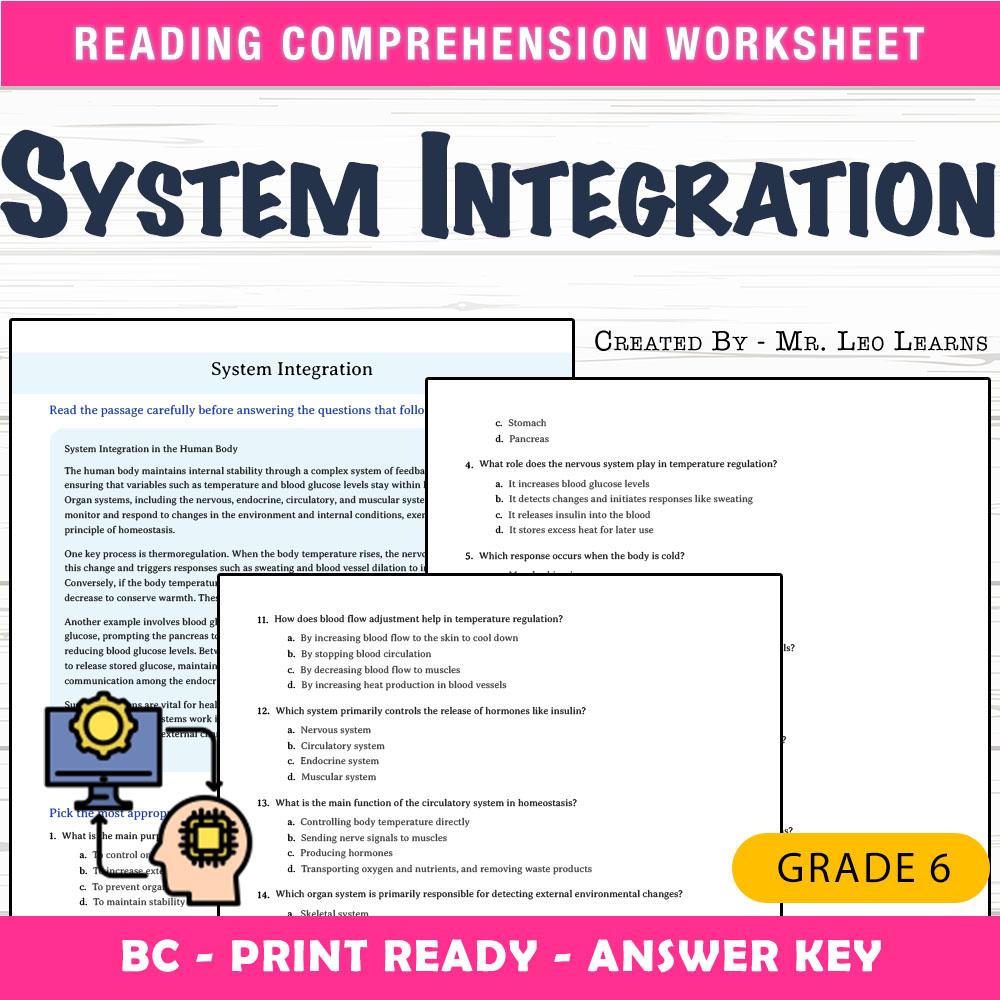
Grade 6 Science — System Integration MCQ Worksheet for Mastery
 Created byThe Resource Hub
Learning Objectives
- Understand how organ systems interact to maintain homeostasis.
- Identify feedback mechanisms involved in regulating internal conditions.
- Explore examples of system responses like temperature regulation and blood glucose control.
Also included in: Grade 6 Science Unit | Multicellular Systems & Functions Worksheet Bundle +1 more
Instant download
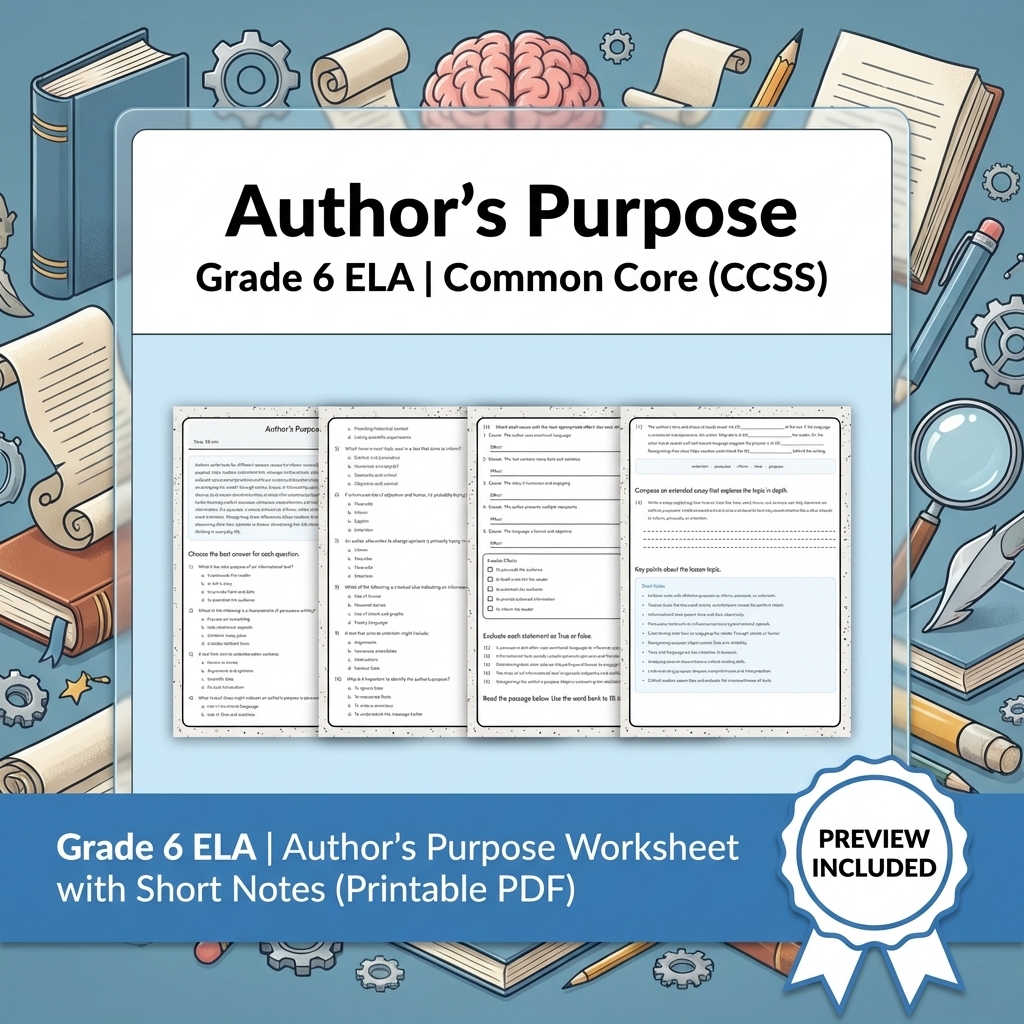
Grade 6 ELA | Author's Purpose Worksheet with Short Notes (Printable PDF)
 Created byMeadowlark Worksheets
Learning Objectives
- Identify the different purposes an author might have when writing a text.
- Analyze textual clues and tone to determine whether the author aims to inform, persuade, or entertain.
- Distinguish between informational, persuasive, and entertainment texts through critical reading skills.
Also included in: Grade 6 ELA Text Evidence Comprehension Worksheets Lesson Bundle (CCSS) +1 more
Instant download

Grade 6 Social Studies Worksheet | Stewardship in Action (PDF)
Created bySunny Desk ResourcesLearning Objectives
- Explain what stewardship means in Indigenous worldviews and how it connects to land health.
- Identify stewardship practices that support ecological responsibility, conservation, and sustainable resource management.
- Analyze a case study to describe how reciprocal relationships guide ethical community involvement.
Also included in: Grade 6 Indigenous Governance & Land Social Studies Lesson Bundle (BC) +1 more
Instant download

Grade 6 Science Natural Selection Worksheet | NGSS Assessment
 Created bySkylark Worksheets
Learning Objectives
- Explain how heritable variation and environmental pressures lead to natural selection.
- Describe how differential reproductive success changes trait frequencies over generations.
- Connect examples (finches, pollution, antibiotic resistance) to selection-driven shifts in populations.
Also included in: Grade 6 Evolution Evidence and Natural Selection Science Lesson Bundle NGSS +1 more
Instant download

Science Worksheet Biodiversity Patterns | Worksheet | NGSS Grade 6 Science
Created bySkylark WorksheetsLearning Objectives
- Interpret how species occurrence and richness can reveal spatial and temporal biodiversity patterns
- Compare biodiversity patterns across islands, along latitudes, and among habitats with different heterogeneity
- Explain how historical records and present-day surveys help estimate turnover and community composition
Also included in: Grade 6 Evolution Evidence and Natural Selection Science Lesson Bundle NGSS +1 more
Instant download

Science Worksheet: Fossil Patterns Assessment | NGSS Grade 6 Science
Created bySkylark WorksheetsLearning Objectives
- Analyze how fossil occurrences and stratigraphic sequences reveal patterns of origin, diversification, and extinction over geologic time.
- Explain how relative dating and radiometric dating help place fossils in a temporal sequence.
- Interpret how fossil morphology and geographic distribution support ideas about lineage continuity and turnover.
Also included in: Grade 6 Evolution Evidence and Natural Selection Science Lesson Bundle NGSS +1 more
Instant download
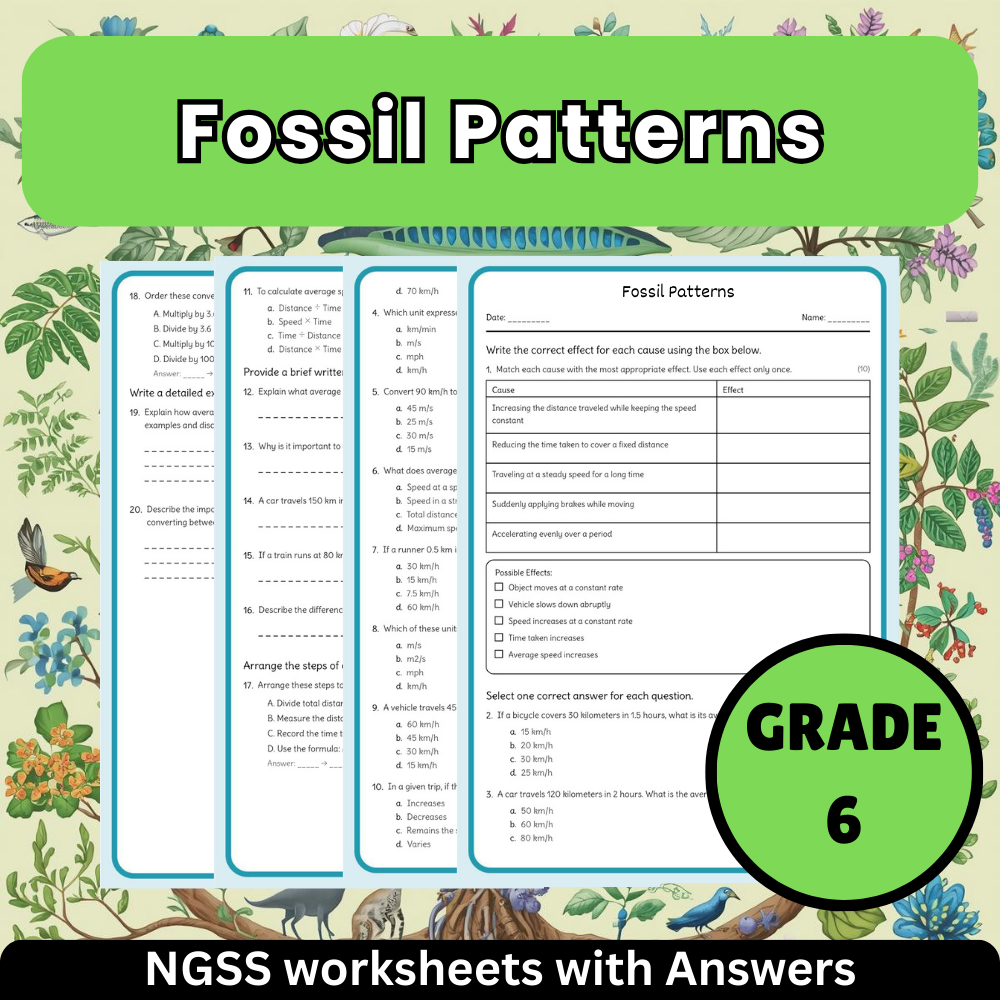
6th Grade Science | Fossil Patterns & Evolution NGSS Worksheet (PDF)
 Created byBright Mind Resources
Learning Objectives
- Understand how fossil occurrences and stratigraphy reveal patterns of origin, diversification, and extinction over geologic time.
- Analyze morphological transitions in the fossil record, such as fish-to-tetrapod examples.
- Interpret stratigraphic sequences, relative and radiometric dating methods, and geographic distribution to infer lineage continuity and turnover.
Also included in: Grade 6 Science Unit Bundle | Evolution, Genetics & Biodiversity NGSS Worksheets +2 more
Instant download
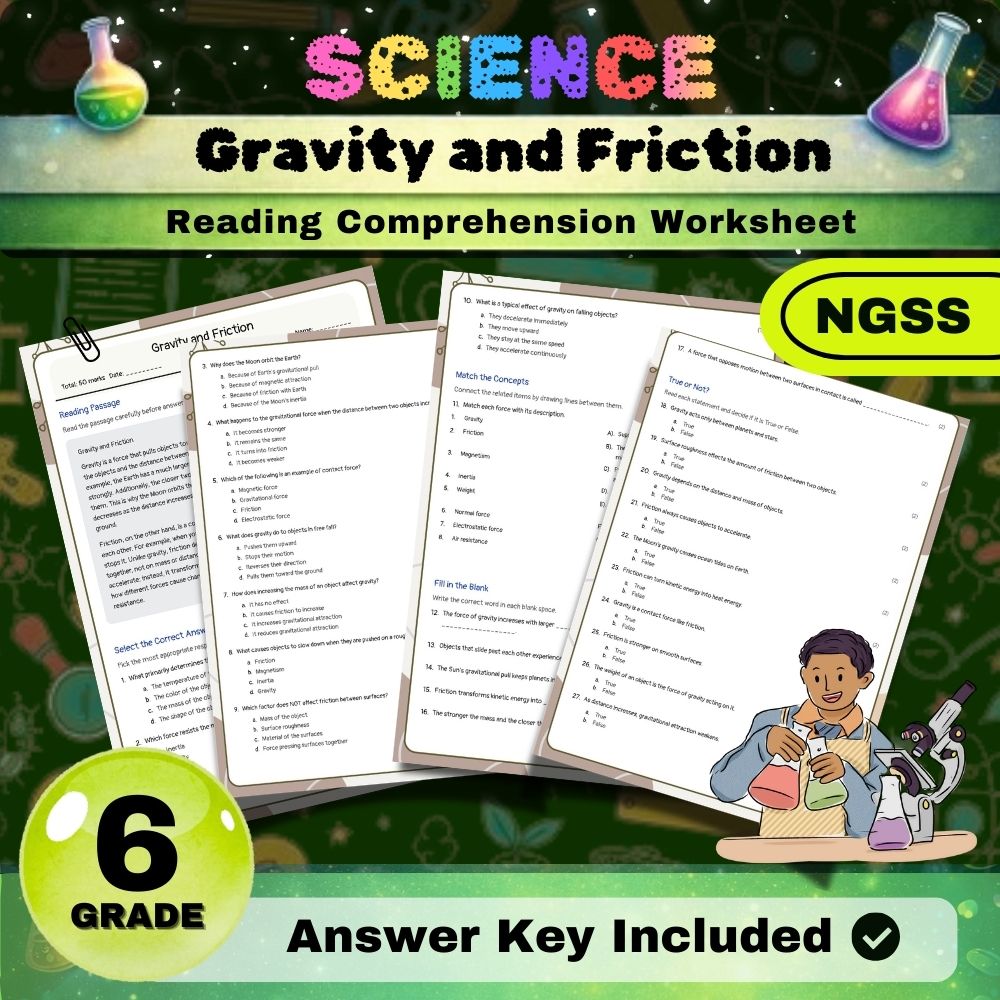
6th Grade Science | Gravity and Friction NGSS Worksheet (PDF + Answer Key)
 Created byMaple Path Learning
Learning Objectives
- Understand that gravitational attraction depends on mass and distance between objects.
- Differentiate between gravitational and contact forces, such as friction.
- Explain how gravity influences planetary orbits and falling objects.
Also included in: Grade 6 Science Forces & Motion Unit Bundle (NGSS Worksheets + Answer Keys) +1 more
Instant download

Solar System Components & Planet Classification Worksheets Grade 6
Created byPrism Point LearningLearning Objectives
- Identify major solar system objects by composition and size
- Compare terrestrial and gas giant planets by key characteristics
- Explain how distance from the Sun affects planetary temperature
Also included in: Grade 6 Space Science Lesson Bundle | Ontario Science Framework
Instant download

Formation of Society Worksheet | Standards-Aligned Grade 6 Social Studies
JCreated byJ.S SheetsLearning Objectives
- Explain how early Israelite society developed from tribes to more centralized governance under kings
- Identify how social organization and political authority changed in response to challenges and needs
- Use a timeline perspective to describe relationships between conflict, governance, and community identity
Instant download

Earth System Interactions and Feedbacks Worksheets Grade 6 Science
 Created byTeachers Club
Learning Objectives
- Explain how matter and energy move among the geosphere, hydrosphere, atmosphere, and biosphere.
- Describe feedback mechanisms that change Earth systems, such as ice-albedo effects.
- Use a model sequence to predict observable patterns from short-term to geologic timescales.
Also included in: Earth's Systems Grade 6 Science Worksheets | NGSS Unit Bundle +2 more
Instant download

Collisions and Momentum Worksheet | NGSS Grade 6 Physics Activity
 Created byAmber Owl Education
Learning Objectives
- Explain how conservation of momentum applies to an isolated two-object system during a collision
- Identify action-reaction force pairs and describe how they relate to changes in motion
- Differentiate elastic and inelastic collisions using momentum and kinetic energy behavior
Also included in: Grade 6 Science Forces and Motion Unit Lesson Bundle | NGSS +1 more
Instant download

Grade 6 ELA | Infographic Details Worksheet | Alberta Standards
 Created byLumora Learning
Learning Objectives
- Interpret key infographic features such as titles, legends, axes, scales, labels, and icons to understand claims.
- Connect information from visuals to accompanying text to draw accurate conclusions.
- Evaluate how numbers and comparisons in infographics should be read using units and scale marks.
Instant download

Conditionals and Branching Worksheet | Grade 6 Computer Science
Created byPrism Point LearningLearning Objectives
- Explain how conditionals help programs make decisions based on rules
- Identify the parts of if-then-else logic and how branching changes program behavior
- Use conditional vocabulary (conditional, branch, rule, decision) correctly in explanations
Also included in: Interactive Coding Foundations Lesson Bundle | Grade 6 Computer Science | General +1 more
Instant download

Variables and Data Values Worksheet | Grade 6 Computer Science
Created byPrism Point LearningLearning Objectives
- Explain what variables are and how they store changing information in a program.
- Identify the difference between a variable name and the value a variable holds.
- Use variables and values to make predictions about program behavior.
Also included in: Interactive Coding Foundations Lesson Bundle | Grade 6 Computer Science | General +1 more
Instant download
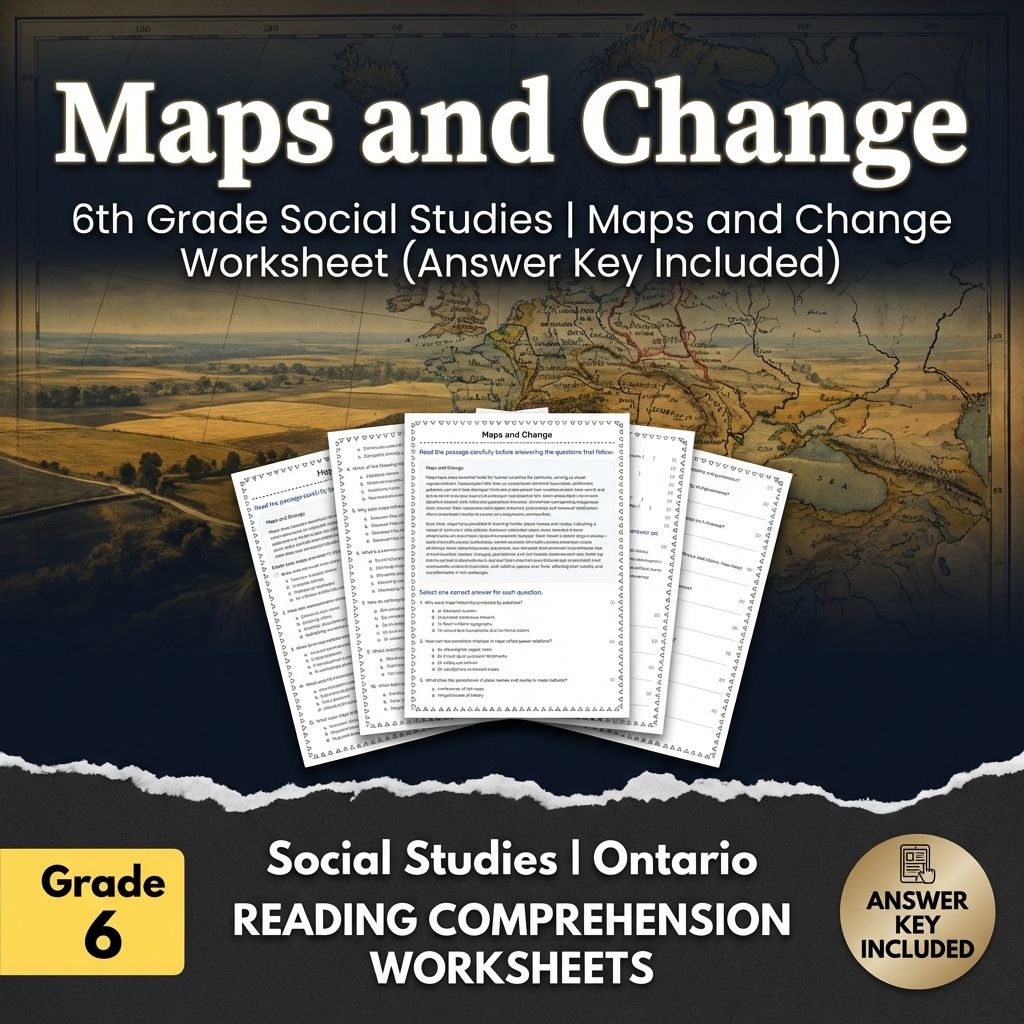
Grade 6 Social Studies | Maps and Change Practice Worksheet (PDF + Answer Key)
JCreated byJ.S SheetsLearning Objectives
- Understand how maps are produced to reflect territorial change, settlement, and land use.
- Identify how representation choices reflect social and political power.
- Analyze the consequences of mapped boundaries and land claims.
Also included in: Grade 6 Social Studies UNIT Bundle – Communities, History, & Culture (PDF) +1 more
Instant download

Celebrating Diversity Worksheet Elena | Holiday Standards Grade 6
Created byLumora LearningLearning Objectives
- Explain how different cultures and religions celebrate beliefs and traditions through specific examples
- Identify respectful ways to respond to differences in faith and holiday practices
- Describe how tolerance and understanding support harmony in diverse communities
Instant download

Social and Economic Structures Worksheet | Standards-Based Grade 6
JCreated byJ.S SheetsLearning Objectives
- Compare how social hierarchies in ancient India and China shaped daily life and governance
- Identify economic roles (agriculture, craftsmanship, and trade) and explain how they supported civilization stability
- Use evidence from maps and timelines to make claims about why social and economic systems mattered
Instant download

Galaxy Origins Worksheet - Grade 6 Holiday Printable PDF for Assessment
Learning Objectives
- Explain how Star Wars uses themes like hope and bravery to show heroism in challenging situations.
- Describe how storytelling and imagination can shape pop culture and bring people together across backgrounds.
- Use grade-appropriate vocabulary related to space, mythology, and cultural impact.
Also included in: Grade 6 - 8 Holiday Science STEM in Space Unit Bundle - NGSS: 7 Worksheets +2 more
Instant download

Grade 6 | The Future Begins Worksheet Elena | Holiday Assessment January
Created byLumora LearningLearning Objectives
- Explain how daily choices shape the future in a meaningful way.
- Identify key goal-setting steps (such as SMART goals) and apply them to a personal situation.
- Analyze examples of renewal and change and connect them to responsible action.
Instant download

Dynasties and Governance Worksheet for Grade 6 Social Studies
JCreated byJ.S SheetsLearning Objectives
- Explain how ancient Chinese dynasties used bureaucratic systems to govern large territories.
- Compare dynastic rule and local governance methods used in India to manage diverse populations.
- Identify how laws and administrative strategies helped promote stability and unity over time.
Instant download
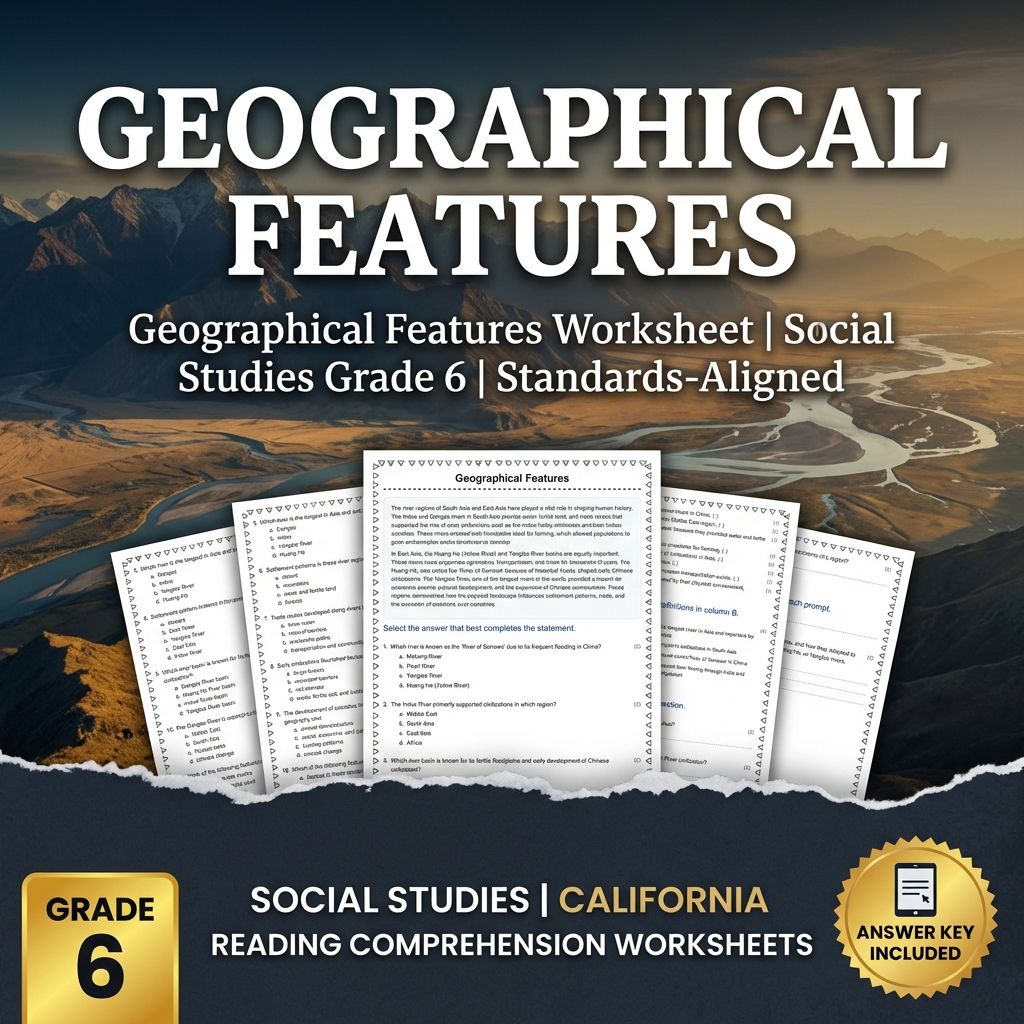
Geographical Features Worksheet | Social Studies Grade 6 | Standards-Aligned
JCreated byJ.S SheetsLearning Objectives
- Understand the significance of major river regions in South Asia and East Asia.
- Identify how rivers influenced early settlement and civilization development.
- Analyze the relationship between geography and social, economic, and political life.
Also included in: Grade 6 Social Studies Unit | Ancient India & China Worksheet Bundle +1 more
Instant download

Forest Food Webs and Energy Flow Worksheets Grade 6 Science Activity
Created bySunny Desk ResourcesLearning Objectives
- Describe how energy moves through a forest food web among producers, consumers, and decomposers.
- Identify trophic relationships and how changes in one species can affect others over time.
- Explain the role of decomposers in recycling organic matter in forest ecosystems.
Also included in: Trees and Forests Grade 6 Alberta Science Worksheets Bundle +1 more
Instant download

Ecosystem Classification Worksheets Grade 6 Producers Consumers Review
Created bySunny Desk ResourcesLearning Objectives
- Explain how species classification can group organisms as producers, consumers, and decomposers.
- Identify native versus invasive (or pest) species and predict how they can affect ecosystem balance.
- Use classification to make simple predictions about energy flow and competition in ecosystems.
Also included in: Trees and Forests Grade 6 Alberta Science Worksheets Bundle +1 more
Instant download

Section Summaries Worksheet for Grade 6 ELA | Standards-Aligned Practice
JCreated byJ.S SheetsLearning Objectives
- Identify a section’s main idea and choose the most relevant supporting details for a summary.
- Write concise summaries that preserve the author’s purpose without repeating every sentence.
- Organize a summary in the same logical order as the text (claim first, then evidence).
Instant download

Grade 6 Science | Disturbance Regimes in Forests - Reading Comprehension
Created byCoral Reef LearningLearning Objectives
- Identify different types of disturbance in forest ecosystems.
- Understand how fire impacts forest structure and succession.
- Recognize other disturbance agents such as insects and wind.
Also included in: Trees and Forests Lesson Bundle | Grade 6 Science | Alberta +1 more
Instant download

Grade 6 Science | Forest Types - Daily Reading Comprehension
Created byCoral Reef LearningLearning Objectives
- Identify key characteristics of boreal forests
- Understand how environmental factors influence forest distribution
- Recognize different forest regions and ecosystems
Also included in: Trees and Forests Lesson Bundle | Grade 6 Science | Alberta +1 more
Instant download

Grade 6 Science | Stewardship Practices in Land Care - Reading Comprehension
Created byCoral Reef LearningLearning Objectives
- Understand the concept of stewardship practices and their importance.
- Identify different community-based planting initiatives.
- Recognize how stewardship efforts benefit local and regional landscapes.
Also included in: Trees and Forests Lesson Bundle | Grade 6 Science | Alberta +1 more
Instant download

Grade 6 Science | Growth Rings - Daily Reading Comprehension
Created byCoral Reef LearningLearning Objectives
- Understand key concepts related to Science
- Apply knowledge through practice questions
- Demonstrate comprehension of the material
Also included in: Trees and Forests Lesson Bundle | Grade 6 Science | Alberta +1 more
Instant download

Grade 6 Science | Integrated Management Daily Reading Practice
Created byCoral Reef LearningLearning Objectives
- Understand the concept of ecosystem-based management
- Identify the ecological, economic, and social objectives in forest management
- Learn about tools used in integrated forest management, such as monitoring and stakeholder collaboration
Also included in: Trees and Forests Lesson Bundle | Grade 6 Science | Alberta +1 more
Instant download

Grade 6 Science | Stem Transport - Daily Reading Comprehension
Created byCoral Reef LearningLearning Objectives
- Understand how water and nutrients are transported within trees through stems.
- Identify the roles of xylem and phloem in resource movement.
- Explain how environmental factors like freeze-thaw cycles, drought, and pests affect sap flow.
Also included in: Trees and Forests Lesson Bundle | Grade 6 Science | Alberta +1 more
Instant download

Clarifying Questions Worksheet Pack | Grade 6 ELA Practice
Created bySunny Desk ResourcesLearning Objectives
- I can ask clarifying questions that target specific details, definitions, or steps in reasoning.
- I can use question stems to request examples, evidence, or rewording when something is unclear.
- I can revise my questions to stay relevant to the topic being discussed.
Also included in: Speaking and Listening Lesson Bundle | Grade 6 ELA | BC +1 more
Instant download

Vocabulary Refinement Worksheet for Grade 6 | ELA Standard Practice
JCreated byJ.S SheetsLearning Objectives
- Refine word choice by selecting synonyms that match meaning and connotation in context
- Use surrounding context clues to determine the precise meaning of unfamiliar words
- Improve coherence by using thematic vocabulary consistently across related ideas
Instant download

Grade 6 Linear Relationships Worksheet | Ontario Math Patterns & Algebra
Created byBRIGHT PATH RESOURCESLearning Objectives
- Interpret linear relationships using tables, graphs, and equations
- Identify the constant rate of change and link it to the slope of a graph
- Use an equation to model a real-world situation and make predictions
Instant download
Browse more categories
About Grade 6 Worksheets
Browse 8,578 printable Grade 6 worksheets across math, ELA, science, and social studies — each a ready-to-print PDF with optional answer keys.
MyTeachingSheets worksheets are made by real teacher-authors and checked before they go live. Download any as a print-ready PDF for lessons, homework, or independent practice — most include answer keys, and previews are always free.