
Grade 6 Worksheets
8,582 grade resources
Molecular Building Blocks Worksheets: Grade 6 Science Molecules to Organisms
 Created bythe curious pencil
Learning Objectives
- Identify building blocks of proteins, nucleic acids, carbohydrates, and lipids
- Explain how condensation reactions build larger molecules from smaller units
- Explain how hydrolysis breaks larger molecules into smaller units using water
Also included in: Grade 6 Science Cells & Organisms Worksheets Bundle | NGSS +2 more
Instant download

Fossil Patterns and Changes Through Time Worksheets Grade 6 Science
Created bythe curious pencilLearning Objectives
- Identify patterns of change in the fossil record
- Interpret stratigraphic sequences to place fossils in relative time
- Explain how morphology provides evidence of change
Also included in: Biological Evolution Worksheets Bundle | Grade 6 Science NGSS +2 more
Instant download

Cell Evidence and Biological Organization
Created bythe curious pencilLearning Objectives
- Identify cells as the basic units of life using observational evidence.
- Distinguish single-celled organisms from multicellular organisms.
- Explain how cells relate to tissues, organs, and whole organisms.
Also included in: Grade 6 Science Cells & Organisms Worksheets Bundle | NGSS +2 more
Instant download

Gravity and Friction: Forces and Motion Science Worksheets Grade 6
Created bythe curious pencilLearning Objectives
- Explain how mass affects gravitational attraction between objects.
- Describe how distance changes gravitational attraction.
- Explain how gravity and motion work together in an orbit.
Also included in: Grade 6 Science Forces and Motion Worksheets Bundle | NGSS +2 more
Instant download

Climate Systems and Global Circulation Grade 6 Science Worksheets
Created bythe curious pencilLearning Objectives
- Explain how unequal solar heating drives atmospheric circulation.
- Identify the roles of Hadley, Ferrel, and polar cells.
- Describe how winds and ocean currents transport heat and moisture.
Also included in: Earth's Systems Grade 6 Science Worksheets Bundle | NGSS +2 more
Instant download

Natural Hazards Worksheets: Patterns, Records & Risk Grade 6 Science
Created bythe curious pencilLearning Objectives
- Identify patterns in observational and instrumental natural hazard data.
- Explain how recurrence intervals describe hazard patterns and risk.
- Interpret hazard records for locations, frequencies, and linked conditions.
Also included in: Earth's Systems Grade 6 Science Worksheets Bundle | NGSS +2 more
Instant download

Synthetic Materials Worksheets: Properties & Resources Grade 6 Science
Created bythe curious pencilLearning Objectives
- Identify natural resources used to make synthetic materials
- Explain how processing changes raw materials into manufactured products
- Compare material properties for different product purposes
Also included in: Matter and Its Interactions Grade 6 Science Worksheets NGSS Bundle +2 more
Instant download

Photosynthesis & Respiration Worksheets: Energy Pathways Grade 6
Created bythe curious pencilLearning Objectives
- Explain how photosynthesis transfers light energy into chemical energy
- Identify reactants and products in photosynthesis and respiration
- Describe how stomata support gas exchange in leaves
Also included in: Grade 6 Science Cells & Organisms Worksheets Bundle | NGSS +2 more
Instant download

Engineering Design Data & Trade-Offs Worksheets Grade 6 Science
Created bythe curious pencilLearning Objectives
- Explain how engineers compare prototype test data
- Identify trade-offs among strength, weight, cost, and durability
- Calculate averages from repeated design test results
Also included in: Grade 6 Engineering Design Worksheets Bundle | NGSS Science +2 more
Instant download

Water Cycle Worksheets: Earth's Systems Science Grade 6 NGSS
Created bythe curious pencilLearning Objectives
- Explain how evaporation and condensation move water through the hydrosphere
- Describe how solar energy and gravity drive water cycle processes
- Trace water movement among ocean, ice, surface water, and groundwater
Also included in: Earth's Systems Grade 6 Science Worksheets Bundle | NGSS +2 more
Instant download

Orbital Motion Worksheets | Grade 6 Earth and Space Science
Created bythe curious pencilLearning Objectives
- Explain how gravity keeps planets and satellites in orbit
- Describe how orbital distance relates to orbital period
- Identify how orbital speed changes along an elliptical path
Also included in: Grade 6 Space Science Worksheets Bundle | Earth's Place in Universe +2 more
Instant download

Forces, Net Force and Motion Grade 6 Science Practice Worksheets
Created bythe curious pencilLearning Objectives
- Explain how multiple forces combine to produce net force
- Calculate acceleration using net force and mass
- Predict acceleration changes when force or mass changes
Also included in: Grade 6 Science Forces and Motion Worksheets Bundle | NGSS +2 more
Instant download

Natural Selection Worksheets | Grade 6 Science Evolution Practice
Created bythe curious pencilLearning Objectives
- Explain variation in inherited traits within populations
- Describe how environmental pressures affect survival and reproduction
- Explain how natural selection changes trait frequencies
Also included in: Biological Evolution Worksheets Bundle | Grade 6 Science NGSS +2 more
Instant download

Particle Models of Matter Worksheets: Changes of State Grade 6
Created bythe curious pencilLearning Objectives
- Describe particle spacing and motion in solids, liquids, and gases
- Explain how heating and cooling change particle kinetic energy
- Use particle collisions to explain gas pressure
Also included in: Matter and Its Interactions Grade 6 Science Worksheets NGSS Bundle +2 more
Instant download

Electric and Magnetic Interactions: Science Worksheets Grade 6
Created bythe curious pencilLearning Objectives
- Describe how source strength affects electric and magnetic interactions.
- Compare interaction strength using patterns in force data.
- Distinguish attraction and repulsion between charges and magnets.
Also included in: Grade 6 Science Forces and Motion Worksheets Bundle | NGSS +2 more
Instant download

Organ Systems and Their Interactions Grade 6 Science Worksheets
Created bythe curious pencilLearning Objectives
- Identify the roles of major organs in four organ systems
- Explain how organs work together within organ systems
- Connect oxygen and nutrients with cellular needs
Also included in: Grade 6 Science Cells & Organisms Worksheets Bundle | NGSS +2 more
Instant download

Cell Functions and Organelles Worksheets Grade 6 Science
Created bythe curious pencilLearning Objectives
- Identify major organelles and describe their functions.
- Explain how organelle structure supports specific cell functions.
- Compare specialized structures in plant and animal cells.
Also included in: Grade 6 Science Cells & Organisms Worksheets Bundle | NGSS +2 more
Instant download

Human Impacts on Earth Systems Worksheets | Grade 6 Science
Created bythe curious pencilLearning Objectives
- Explain how human activities alter land, air, water, and ecosystems
- Describe causal links between human activities and environmental changes
- Identify environmental effects of deforestation, agriculture, and urbanization
Also included in: Grade 6 Earth Science Worksheets Bundle | Earth & Human Activity NGSS +2 more
Instant download

Phenotypic Variation and Traits Science Worksheets for Grade 6
Created bythe curious pencilLearning Objectives
- Identify genetic and environmental contributors to phenotypic variation.
- Explain how DNA sequence differences can influence proteins and traits.
- Describe how nutrition and temperature can affect traits during development.
Also included in: Grade 6 Science Cells & Organisms Worksheets Bundle | NGSS +2 more
Instant download

Lunar Phases & Earth-Moon-Sun Relationships Grade 6 Science Worksheet
Created bythe curious pencilLearning Objectives
- Explain how Earth, Moon, and Sun positions produce lunar phases
- Distinguish solar and lunar eclipses using their alignment patterns
- Sequence the primary lunar phases in their repeating pattern
Also included in: Grade 6 Space Science Worksheets Bundle | Earth's Place in Universe +2 more
Instant download

Natural Hazards: Causes, Patterns & Effects Science Worksheets Grade 6
Created bythe curious pencilLearning Objectives
- Explain how tectonic, atmospheric, and water processes produce natural hazards.
- Interpret historical records, seismic data, satellite images, and hazard maps.
- Describe how hazard frequency, intensity, and location affect communities.
Also included in: Grade 6 Earth Science Worksheets Bundle | Earth & Human Activity NGSS +2 more
Instant download

Population Change Worksheets: Ecosystem Effects | Grade 6 Science
Created bythe curious pencilLearning Objectives
- Identify environmental factors that cause populations to increase or decline.
- Describe population change patterns using data collected over time.
- Explain how predators, invasive species, and disease affect populations.
Also included in: Ecosystems Worksheets Grade 6 Science | NGSS Unit Bundle +2 more
Instant download

Species Interactions Ecosystems Worksheets Grade 6 Science
Created bythe curious pencilLearning Objectives
- Identify mutualism, competition, predation, and parasitism
- Explain how niche partitioning can reduce competition
- Compare species interactions across different ecosystems
Also included in: Ecosystems Worksheets Grade 6 Science | NGSS Unit Bundle +2 more
Instant download

Biodiversity and Ecosystem Services Worksheets Grade 6 Science
Created bythe curious pencilLearning Objectives
- Compare conservation strategies for maintaining biodiversity and ecosystem services
- Explain how habitat restoration and protected areas support species persistence
- Evaluate conservation trade-offs involving effectiveness, feasibility, and economic constraints
Also included in: Ecosystems Worksheets Grade 6 Science | NGSS Unit Bundle +2 more
Instant download

Human Impacts on Earth Systems Worksheets | Grade 6 Science
Created bythe curious pencilLearning Objectives
- Explain how human activities alter land, air, water, and ecosystems
- Describe causal links between human activities and environmental changes
- Identify environmental effects of deforestation, agriculture, and urbanization
Also included in: Grade 6 Science Forces and Motion Worksheets Bundle | NGSS +2 more
Instant download

Population Size and Resource Limits Science Worksheets Grade 6
Created bythe curious pencilLearning Objectives
- Explain how limited resources affect organism populations.
- Identify patterns between resource availability and population size.
- Describe carrying capacity and population fluctuations.
Also included in: Ecosystems Worksheets Grade 6 Science | NGSS Unit Bundle +2 more
Instant download

Solar System Scale Worksheets: Space & Planet Data Grade 6
Created bythe curious pencilLearning Objectives
- Compare planetary sizes and distances using proportional relationships
- Interpret astronomical units, planetary radii, and orbital periods
- Explain how scale models represent large spatial relationships
Also included in: Grade 6 Space Science Worksheets Bundle | Earth's Place in Universe +2 more
Instant download

Geoscience Processes and Resource Distribution Worksheets Grade 6
Created bythe curious pencilLearning Objectives
- Explain how plate tectonics influences mineral resource distribution
- Describe how sedimentation affects where resources are found
- Explain how groundwater moves through aquifers
Also included in: Grade 6 Earth Science Worksheets Bundle | Earth & Human Activity NGSS +2 more
Instant download

Conservation of Mass Worksheets Grade 6 Science Matter Changes
Created bythe curious pencilLearning Objectives
- Explain how atoms are conserved during physical and chemical changes.
- Use particle models to trace atoms before and after changes.
- Compare mass measurements in closed systems.
Also included in: Matter and Its Interactions Grade 6 Science Worksheets NGSS Bundle +2 more
Instant download

Earth's Surface Change and Landscape Evolution Worksheets Grade 6
Created bythe curious pencilLearning Objectives
- Explain how plate motion and volcanic activity change Earth's surface.
- Describe how rivers and glaciers transport sediment.
- Use rock and landform evidence to explain landscape change.
Also included in: Earth's Systems Grade 6 Science Worksheets Bundle | NGSS +2 more
Instant download

Homeostasis Worksheets: Feedback Control Science Grade 6 NGSS
Created bythe curious pencilLearning Objectives
- Explain how feedback control maintains internal stability
- Compare negative and positive feedback using physiological examples
- Describe how sensors and effectors coordinate body responses
Also included in: Grade 6 Science Cells & Organisms Worksheets Bundle | NGSS +2 more
Instant download

Heredity Inheritance and Trait Prediction Worksheets Grade 6
Created bythe curious pencilLearning Objectives
- Explain how genes, alleles, and chromosomes relate to inheritance.
- Use simple inheritance models to predict possible offspring traits.
- Interpret probability and predicted ratios in inheritance models.
Also included in: Grade 6 Heredity & Traits Worksheets Bundle | NGSS Science +2 more
Instant download

Earth Systems Worksheets: Interactions & Energy Transfers Grade 6
Created bythe curious pencilLearning Objectives
- Identify interactions among the geosphere, hydrosphere, atmosphere, and biosphere
- Explain how matter moves between connected Earth systems
- Describe how energy transfers affect Earth system patterns
Also included in: Earth's Systems Grade 6 Science Worksheets Bundle | NGSS +2 more
Instant download

Genetic and Environmental Variation Worksheets | Grade 6 Science
Created bythe curious pencilLearning Objectives
- Explain how genetic differences contribute to variation among individuals
- Describe how environmental factors affect observable traits
- Identify how inherited alleles and conditions interact to produce phenotypes
Also included in: Grade 6 Heredity & Traits Worksheets Bundle | NGSS Science +2 more
Instant download

Engineering Design Solutions: Comparing Design Solutions Grade 6 Worksheets
Created bythe curious pencilLearning Objectives
- Identify criteria and constraints used to evaluate design solutions
- Compare design options using quantitative and qualitative evidence
- Explain how trade-offs affect engineering design decisions
Also included in: Grade 6 Engineering Design Worksheets Bundle | NGSS Science +2 more
Instant download

Design Problem: Engineering Design Worksheets for Grade 6 Science
Created bythe curious pencilLearning Objectives
- Identify criteria that describe what a design solution must accomplish.
- Identify constraints involving materials, cost, size, time, and safety.
- Explain how simple models can predict possible cause-and-effect relationships.
Also included in: Grade 6 Engineering Design Worksheets Bundle | NGSS Science +2 more
Instant download

Renewable Transformations Worksheet | Science Assessment Grade 6 BC Standards
JCreated byJ.S SheetsLearning Objectives
- Understand how different renewable energy systems convert environmental sources into usable electrical energy.
- Identify the stages in photovoltaic, wind, and hydro energy transformations.
- Explain the energy losses involved at each stage of renewable energy conversion.
Instant download

Thermal Energy Transfer Worksheet Grade 6 Science | Heat Transfer
 Created byPrism Point Learning
Learning Objectives
- Explain how thermal energy transfers through conduction, convection, and radiation.
- Identify the medium and movement involved in each thermal energy mechanism.
- Use evidence from everyday examples to determine which transfer mechanism is happening.
Also included in: Grade 6 Energy, Matter & Motion Lesson Bundle | Florida NGSSS
Instant download

Grade 6 Science Worksheet | Competition and Resource Use (PDF)
 Created byEvergreen Desk Education
Learning Objectives
- Explain why organisms compete for limited resources such as space, light, water, and nutrients
- Describe how traits and behaviors affect access to resources during competition
- Predict how competition can change population sizes and influence which species persist in a community
Also included in: Grade 6 Life Processes & Ecosystem Interactions Science Lesson Bundle: General +1 more
Instant download

Grade 6 Social Studies — Resource Management Strategies Worksheet MCQ
 Created byThe Resource Hub
Learning Objectives
- Understand various strategies used for managing natural resources.
- Evaluate the effectiveness of conservation methods and policies.
- Analyze case studies related to fisheries and forest conservation in Canada.
Also included in: Grade 6 Human Systems and Resources Social Studies Lesson Bundle +1 more
Instant download

Grade 6 Science Pollution Effects Worksheet with Short Notes (Printable PDF)
 Created byMeadowlark Worksheets
Learning Objectives
- Understand the ecological impacts of pollution such as eutrophication, endocrine disruption, and biomagnification.
- Identify measurable environmental indicators affected by pollution.
- Analyze cause-and-effect relationships related to pollution impacts on ecosystems.
Also included in: Grade 6 Science Lesson Bundle for Ontario | Ecosystems & Genetics +1 more
Instant download

Grade 6 — Worksheet MCQ Paper for Mastering Economic Decision-Making
Created byThe Resource HubLearning Objectives
- Explain how limited resources create trade-offs in economic decision-making
- Describe how supply and demand influence prices and market outcomes
- Identify factors such as resource availability, societal needs, and technology that affect economic choices
Also included in: Grade 6 Social Studies Economic Decision-Making & Trade Networks Lesson Bundle +1 more
Instant download

Personal Information Privacy Worksheet | Digital Citizenship Grade 6
 Created byBright Mind Resources
Learning Objectives
- Identify examples of personal information and explain why it can be risky to share online
- Classify information as private or public and choose safer options for profiles, forms, and messages
- Use privacy vocabulary (personal information, private, public, secure) to describe safe online behavior
Instant download

Plate Tectonics Worksheets | Grade 6 Earth Science Practice
LCreated byLearnora ResourcesLearning Objectives
- Define plate tectonics using accurate Earth science vocabulary.
- Identify tectonic plates as large, moving pieces of Earth’s lithosphere.
- Distinguish continental crust from oceanic crust.
Instant download
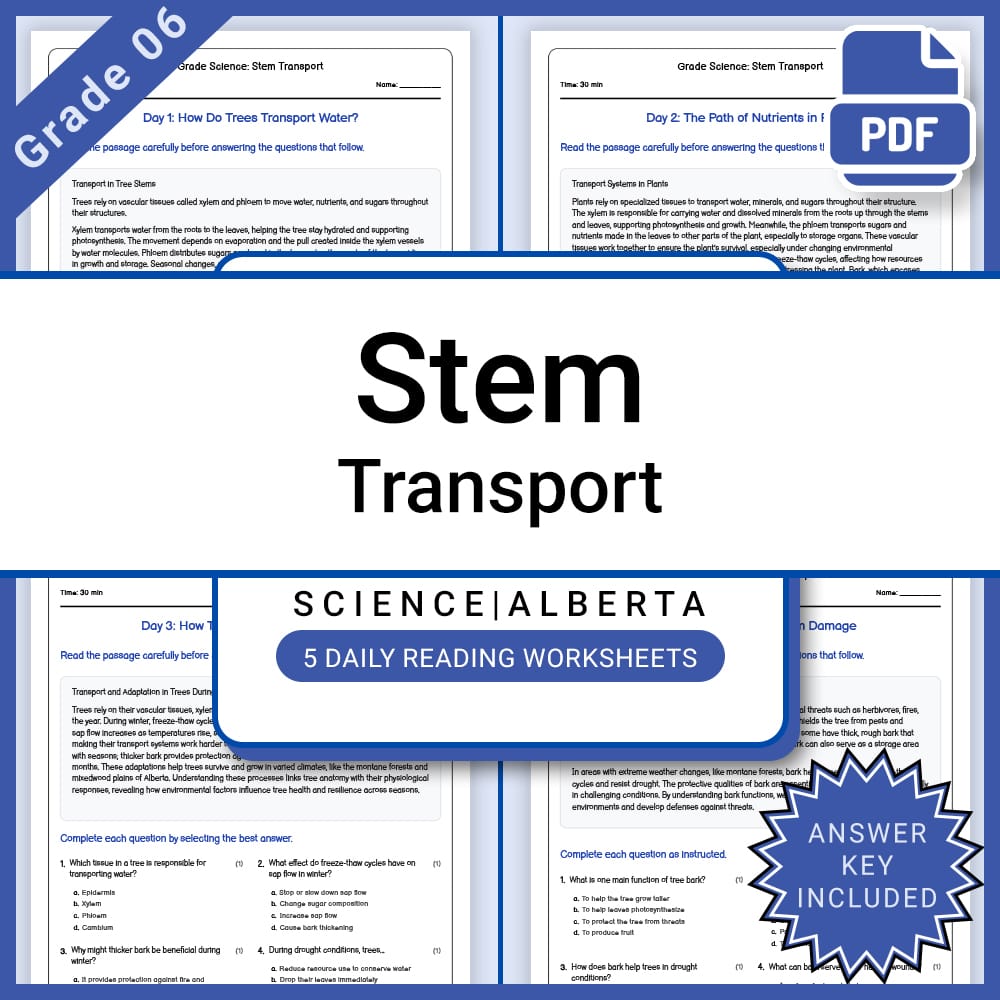
Grade 6 Science – Stem Transport Daily Reading Worksheet with Answer Key
JCreated byJ.S SheetsLearning Objectives
- Understand how xylem and phloem transport water, minerals, and sugars in trees.
- Identify how environmental conditions affect sap flow in trees.
- Explain the protective features of bark against herbivory and fire.
Also included in: Grade 6 Science Lesson Bundle – Ecosystems, Trees, and Land Management +1 more
Instant download

Grade 6 — Worksheet MCQ Paper for Mastering Physical and Political Features
Created byThe Resource HubLearning Objectives
- Identify physical features (mountain ranges, rivers, plains) and explain how they affect human activity.
- Recognize political features (countries, states, cities) and describe how borders may follow physical landmarks.
- Compare how geography and political decisions shape transportation routes and regional organization.
Also included in: Maps & Physical/Political Features Lesson Bundle | Grade 6 Social Studies | TEKS +1 more
Instant download

6th Grade Math – Representing Expressions Worksheet (Ontario Standards) (PDF)
 Created byClear Sky Classroom
Learning Objectives
- Understand methods for representing algebraic expressions and equations.
- Interpret and write expressions involving operations like addition, subtraction, multiplication, and division.
- Evaluate the equivalence of different expressions using properties of operations.
Also included in: Grade 6 Algebra and Mathematical Modelling Lessons | Ontario Standards +1 more
Instant download
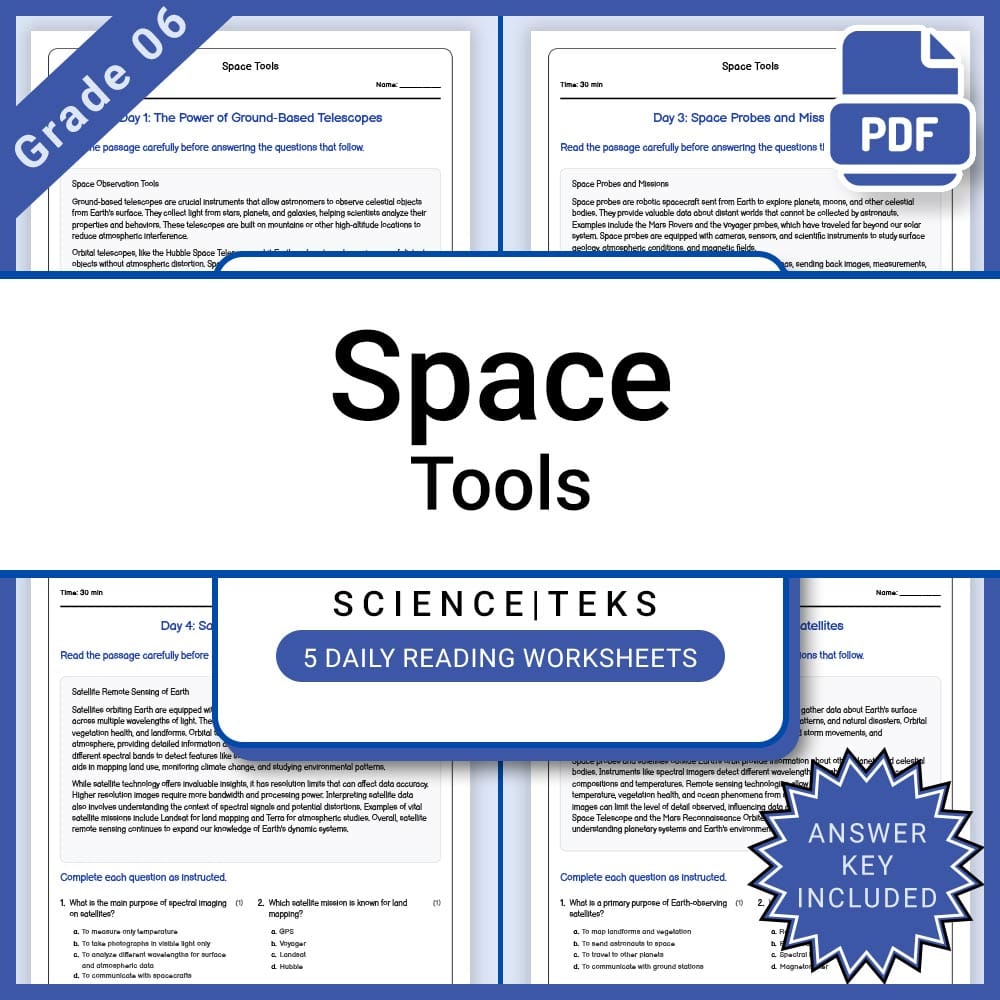
Grade 6 Science – Space Tools Daily Reading Worksheet + Answer Key
JCreated byJ.S SheetsLearning Objectives
- Understand how ground-based telescopes help astronomers observe the sky
- Identify different instruments used in space science
- Describe how satellite data is used to study Earth's surface and atmosphere
Also included in: Grade 6 Science Lesson Bundle: Space, Water, Earth, and Resources TEKS +1 more
Instant download
Browse more categories
About Grade 6 Worksheets
Browse 8,582 printable Grade 6 worksheets across math, ELA, science, and social studies — each a ready-to-print PDF with optional answer keys.
MyTeachingSheets worksheets are made by real teacher-authors and checked before they go live. Download any as a print-ready PDF for lessons, homework, or independent practice — most include answer keys, and previews are always free.