
Grade 6 Science Worksheets
5,969 worksheets
Decomposer Matter Return Assessment Grade 6 Science | California Standards
 Created byPrism Point Learning
Learning Objectives
- Explain how decomposers recycle matter in ecosystems by breaking down dead organisms and waste
- Describe how atoms and nutrients move from living things to nonliving parts of an ecosystem (soil and water) and back to producers
- Compare the roles of decomposers and producers in maintaining ecosystem functioning
Also included in: Grade 6 Energy and Matter Cycles Science Lesson Bundle | California Standards +1 more
Instant download

Condensation and Clouds Assessment | California Standards Grade 6 Science
Created byPrism Point LearningLearning Objectives
- Explain how cooling and vapor pressure changes lead to condensation or ice crystal formation in the atmosphere
- Describe how clouds form from condensed droplets or ice crystals and how this relates to the water cycle
- Compare how clouds affect Earth’s energy balance by reflecting sunlight and trapping infrared radiation
Also included in: Grade 6 Water in Earth Systems Science Lesson Bundle: California Standards +1 more
Instant download
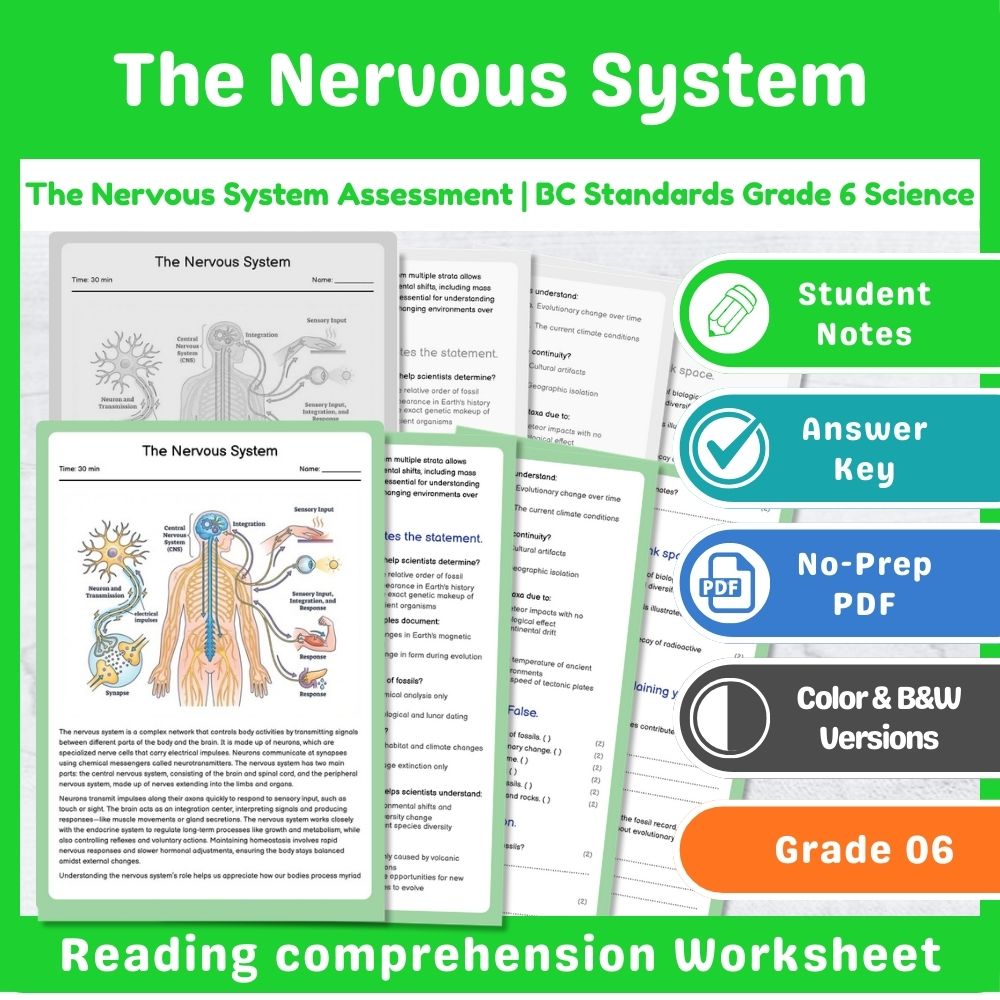
The Nervous System Assessment | BC Standards Grade 6 Science
Created byPrism Point LearningLearning Objectives
- Describe the basic structure and function of neurons.
- Explain how the nervous system collects, processes, and responds to sensory information.
- Identify the role of integration centers in coordinating responses.
Instant download
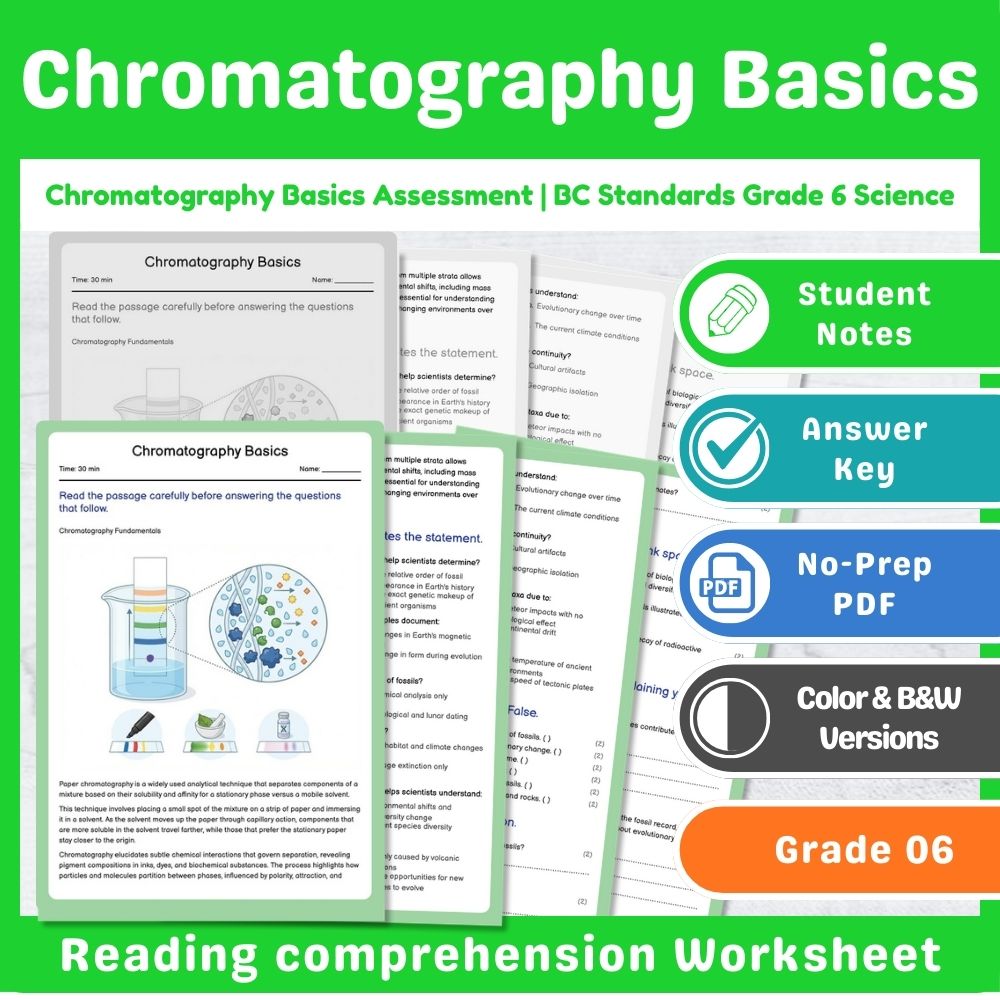
Chromatography Basics Assessment | BC Standards Grade 6 Science
Created byPrism Point LearningLearning Objectives
- Understand the fundamental principles of paper chromatography and how it separates mixture components.
- Identify factors influencing the mobility and separation of substances in chromatography.
- Describe practical applications of chromatography in analyzing complex mixtures such as ink pigments.
Instant download

Circuit Diagrams Assessment for Grade 6 | BC Standards-Aligned Science
Created byPrism Point LearningLearning Objectives
- Understand the standard symbols used in circuit diagrams for sources, conductors, and loads.
- Identify components such as batteries, resistors, switches, and meters in circuit diagrams.
- Translate physical electrical systems into simplified schematic diagrams.
Instant download

Physical Properties Assessment | BC Standards Grade 6 Science Worksheet
Created byPrism Point LearningLearning Objectives
- Define and identify various physical properties of matter.
- Differentiate between physical and chemical changes based on properties.
- Observe and measure properties like mass, volume, density, conductivity, melting point, and hardness.
Instant download

Feedback Control Assessment | NGSS Aligned Grade 6 Science
Created byPrism Point LearningLearning Objectives
- Understand the concept of feedback mechanisms in maintaining internal stability.
- Identify examples of negative and positive feedback in physiological processes.
- Describe how sensors and effectors work together in homeostasis.
Also included in: Grade 6 Science Mini Bundle | Structures and Processes NGSS Not specified +1 more
Instant download

Ecosystem Components Assessment | BC Standards Grade 6 Science
Created byPrism Point LearningLearning Objectives
- Identify the key components of an ecosystem, including biotic and abiotic factors.
- Explain how living organisms interact with nonliving elements in their habitat.
- Describe the roles of sunlight, water, soil, and temperature in supporting ecosystems.
Instant download

Lunar Phases Model Assessment for Grade 6 Science | Alberta Standards
Created byPrism Point LearningLearning Objectives
- Describe the sequence and timing of lunar phases using a geometric model of the Moon's orbit.
- Identify the relative positions of the Sun, Earth, and Moon during different lunar phases.
- Predict lunar phases and illumination changes over weeks based on the model.
Also included in: Lesson Grade 6 Science Assessment | Celestial & Earth Movements
Instant download
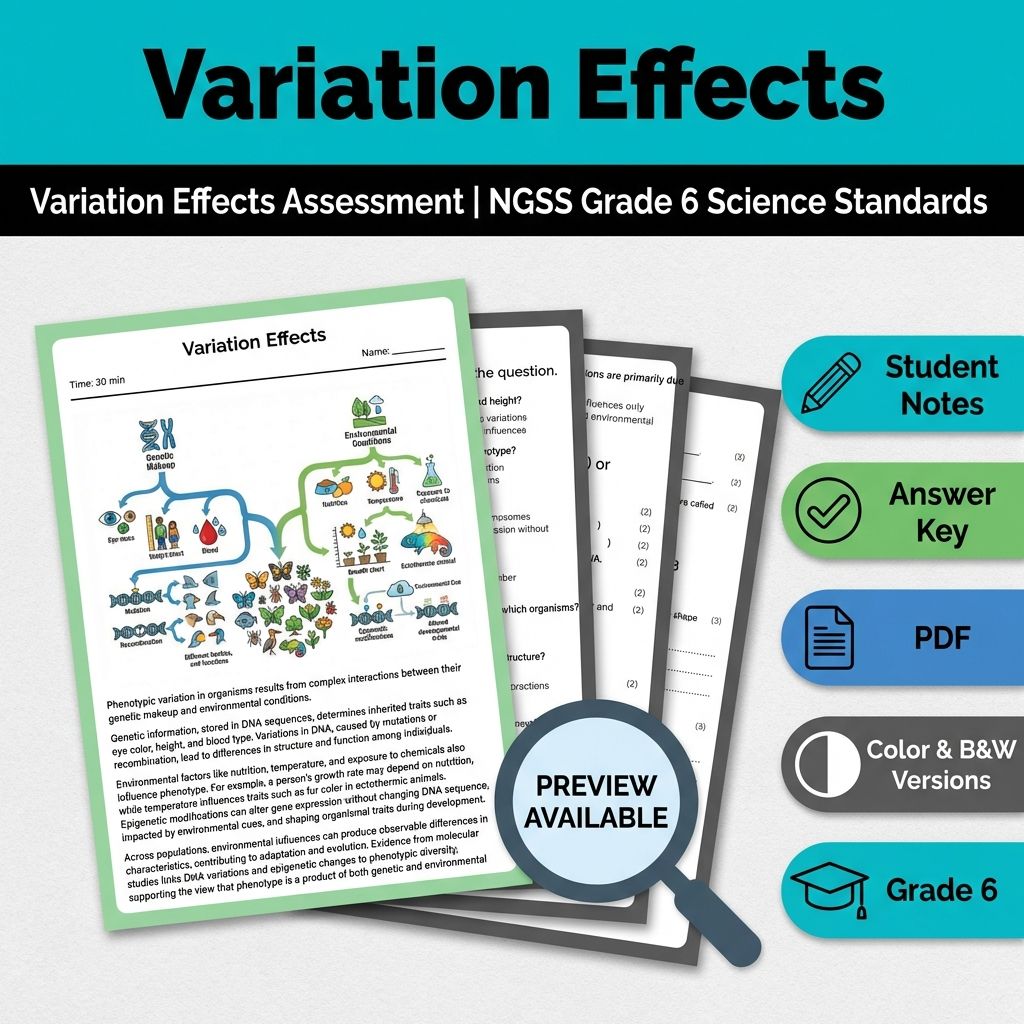
Variation Effects Assessment | NGSS Grade 6 Science Standards
Created byPrism Point LearningLearning Objectives
- Understand how phenotypic variation results from genetic and environmental interactions.
- Identify examples of inherited traits, environmental influences, and temperature-dependent gene expression.
- Explain the links between DNA sequence variation, macromolecular processes, and organismal differences.
Also included in: Grade 6 Science Mini Bundle | Structures and Processes NGSS Not specified +1 more
Instant download

Evaporation and Transpiration Assessment | California Standards Grade 6 Science
Created byPrism Point LearningLearning Objectives
- Explain how evaporation and transpiration add water vapor to the atmosphere
- Describe how temperature and available liquid water affect the amount of water vapor
- Connect phase changes to the water cycle, including condensation and precipitation
Also included in: Grade 6 Water in Earth Systems Science Lesson Bundle: California Standards +1 more
Instant download

Design Problem Assessment for Grade 6 Science | Standards-Based Worksheet
Created byPrism Point LearningLearning Objectives
- Understand the key components involved in solving a design problem.
- Identify constraints and requirements in designing protective cases.
- Apply problem-solving strategies to real-world engineering challenges.
Instant download

Testable Questions Assessment | General Grade 6 Science Standards-Aligned
Created byPrism Point LearningLearning Objectives
- Understand how to formulate scientific questions that can be tested with evidence.
- Identify measurable outcomes and observations that remain consistent in experiments.
- Differentiate between testable and non-testable questions in scientific inquiry.
Also included in: Grade 6 Data & Evidence Science Lesson Bundle | General Framework
Instant download
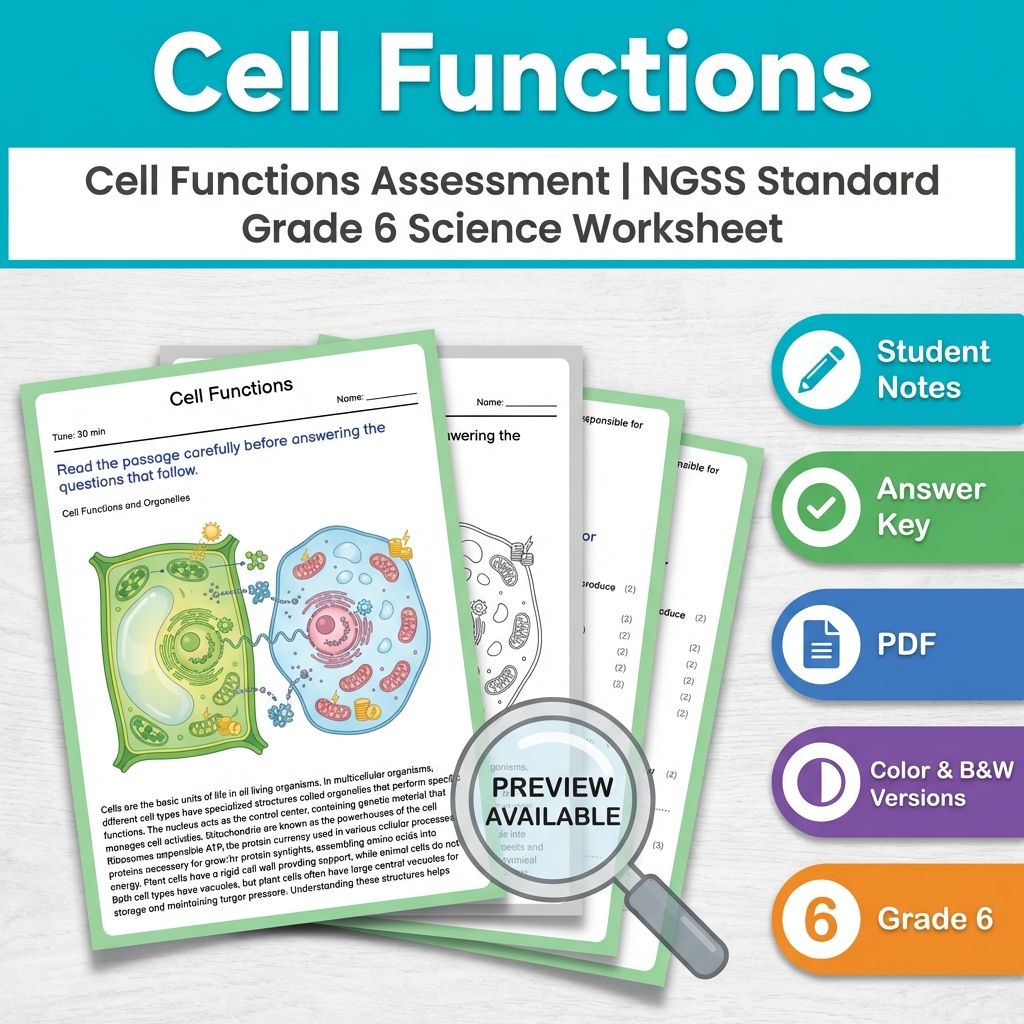
Cell Functions Assessment | NGSS Standard Grade 6 Science Worksheet
Created byPrism Point LearningLearning Objectives
- Identify the major organelles in plant and animal cells and their functions.
- Explain how cell structures relate to their specific roles in energy production, protein synthesis, waste removal, and regulation.
- Compare and contrast cell functions in plant and animal cells to understand specialization.
Also included in: Grade 6 Science Mini Bundle | Structures and Processes NGSS Not specified +1 more
Instant download
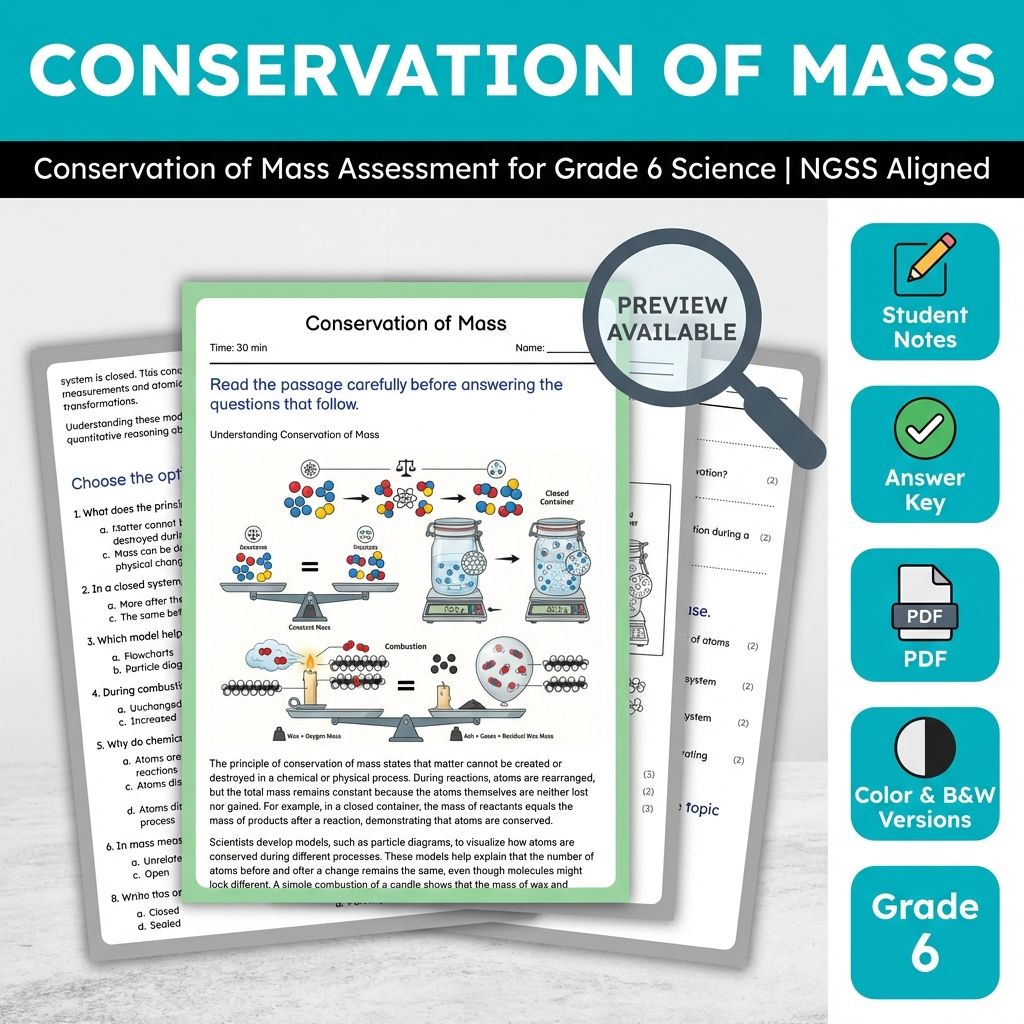
Conservation of Mass Assessment for Grade 6 Science | NGSS Aligned
Created byPrism Point LearningLearning Objectives
- Explain the principle of the conservation of mass through physical and chemical changes.
- Identify models and diagrams that demonstrate atom count constancy during reactions.
- Connect mass measurements before and after matter transformations to the concept of atom conservation.
Also included in: Grade 6 Science Mini Bundle | Matter and Its Interactions NGSS Not Specified +1 more
Instant download
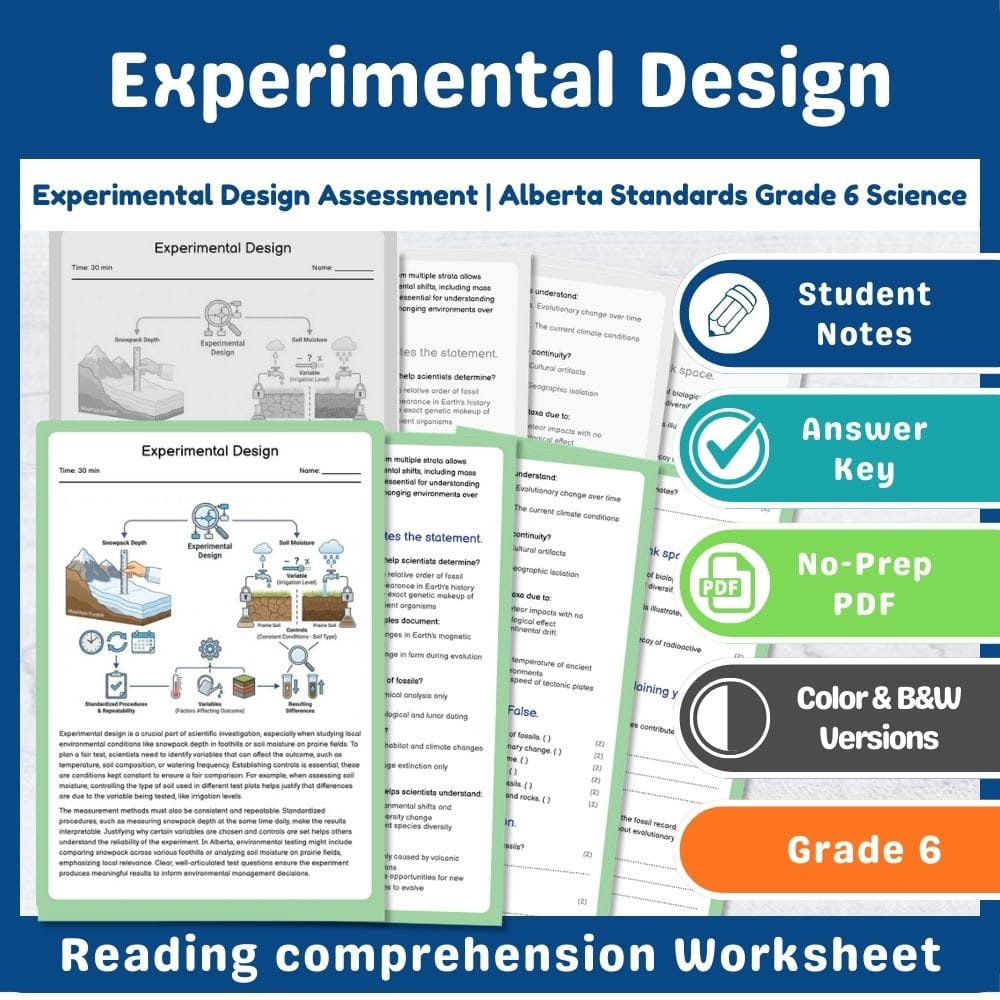
Experimental Design Assessment | Alberta Standards Grade 6 Science
Created byPrism Point LearningLearning Objectives
- Understand the importance of variables, controls, and measurement procedures in experimental design.
- Identify and justify appropriate control conditions in fair tests.
- Describe how to formulate testable questions that yield interpretable results in local environmental studies.
Also included in: Lesson Grade 6 Science Mini Bundle | Evidence and Investigation
Instant download

Seasonal Tilt Assessment | Alberta Standards Grade 6 Science
Created byPrism Point LearningLearning Objectives
- Understand how Earth's axial tilt affects seasons and climate.
- Identify the differences in solar angle and daylight duration during seasons.
- Explain regional examples such as Alberta's temperature variations.
Also included in: Lesson Grade 6 Science Assessment | Celestial & Earth Movements
Instant download
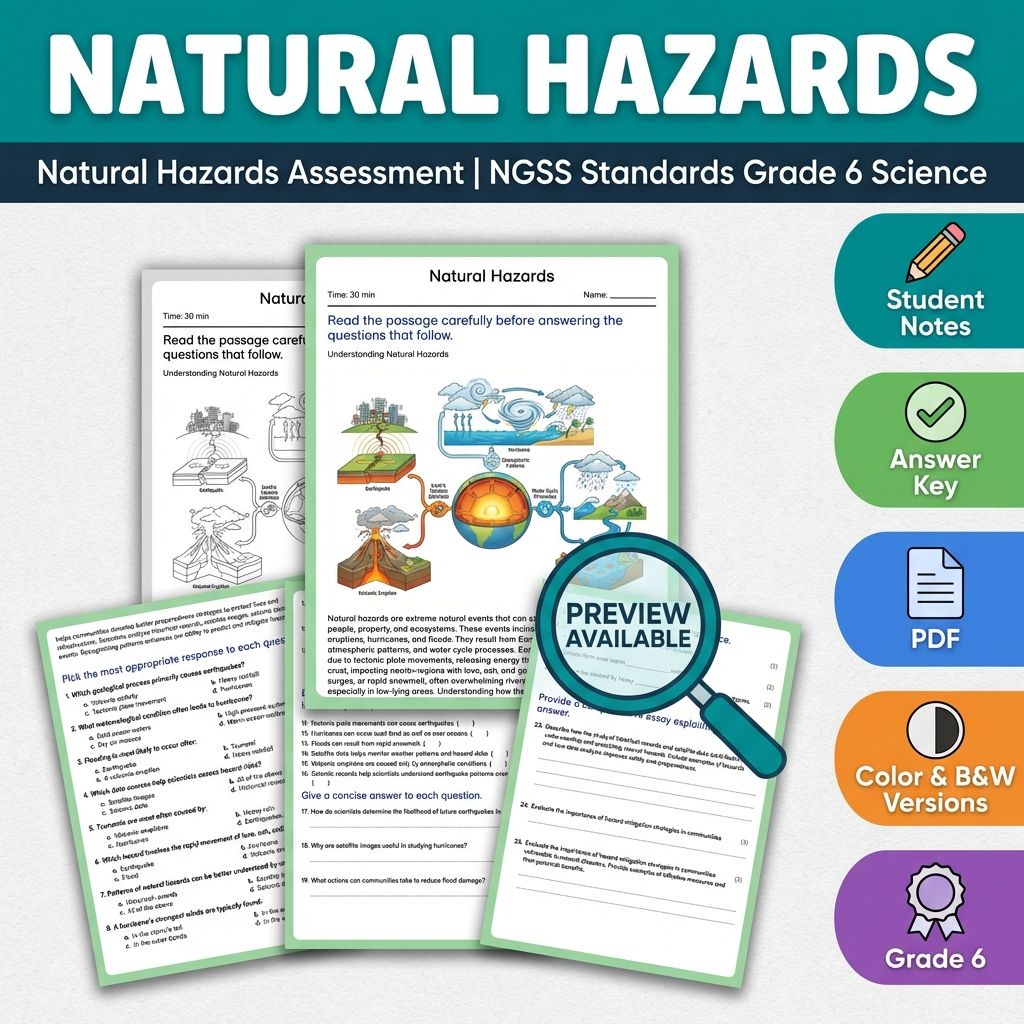
Natural Hazards Assessment | NGSS Standards Grade 6 Science
Created byPrism Point LearningLearning Objectives
- Analyze the origins, patterns, and effects of natural hazards such as earthquakes, volcanic eruptions, hurricanes, and floods.
- Understand the relationships among tectonic processes, atmospheric dynamics, and hydrologic cycles in hazard occurrence.
- Evaluate historical records, seismic data, satellite images, and hazard maps to interpret cause-effect links and impacts on communities.
Also included in: Grade 6 Science Mini Bundle | Earth and Human Activity NGSS Not Specified +1 more
Instant download
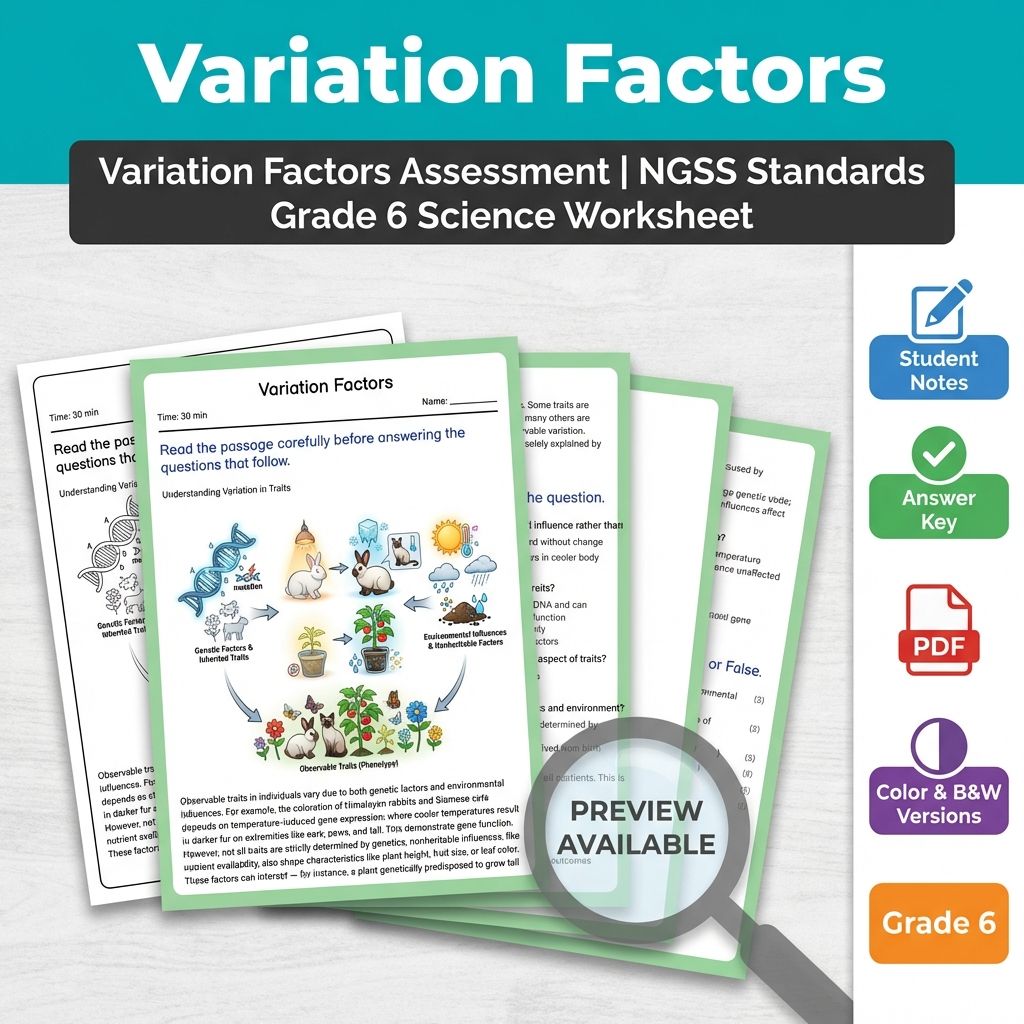
Variation Factors Assessment | NGSS Standards Grade 6 Science Worksheet
Created byPrism Point LearningLearning Objectives
- Understand how genetic differences and environmental factors contribute to observable traits.
- Explain models of allele combinations, mutations, and environmental influences on phenotype.
- Identify the limits of genetic explanations for traits affected by environmental conditions.
Also included in: Grade 6 Science Mini Bundle | Heredity, Inheritance & Traits NGSS +1 more
Instant download

Safety and Reporting Assessment for Grade 6 Science | Standards-Aligned
Created byPrism Point LearningLearning Objectives
- Understand the importance of safety practices in scientific experiments.
- Identify proper reporting methods for data and safety concerns.
- Recognize ethical standards in scientific communication.
Also included in: Grade 6 Data & Evidence Science Lesson Bundle | General Framework
Instant download
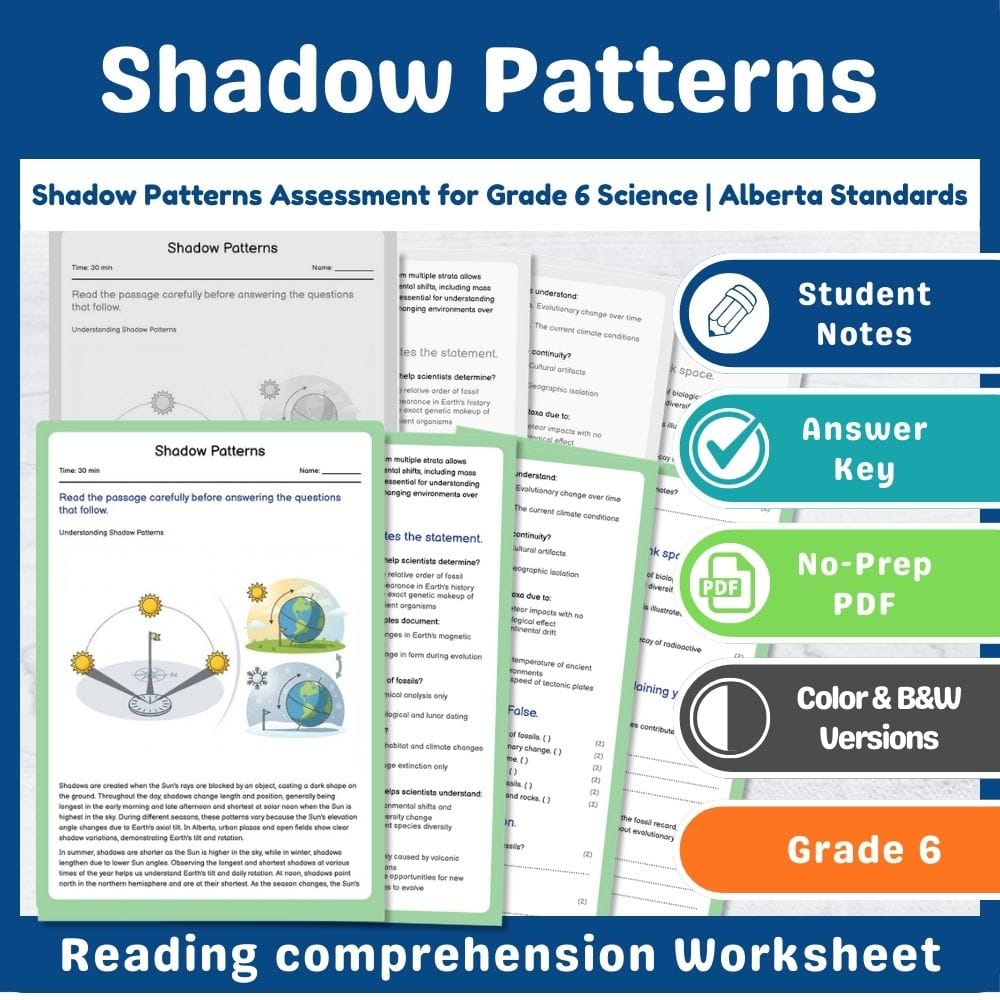
Shadow Patterns Assessment for Grade 6 Science | Alberta Standards
Created byPrism Point LearningLearning Objectives
- Describe how daily and seasonal changes in Sun angle affect shadow length and direction.
- Identify different shadow patterns such as noon shadows, longest shadows, and shortest shadows.
- Explain how Earth's motion and axial tilt influence shadow characteristics across seasons.
Also included in: Lesson Grade 6 Science Assessment | Celestial & Earth Movements
Instant download
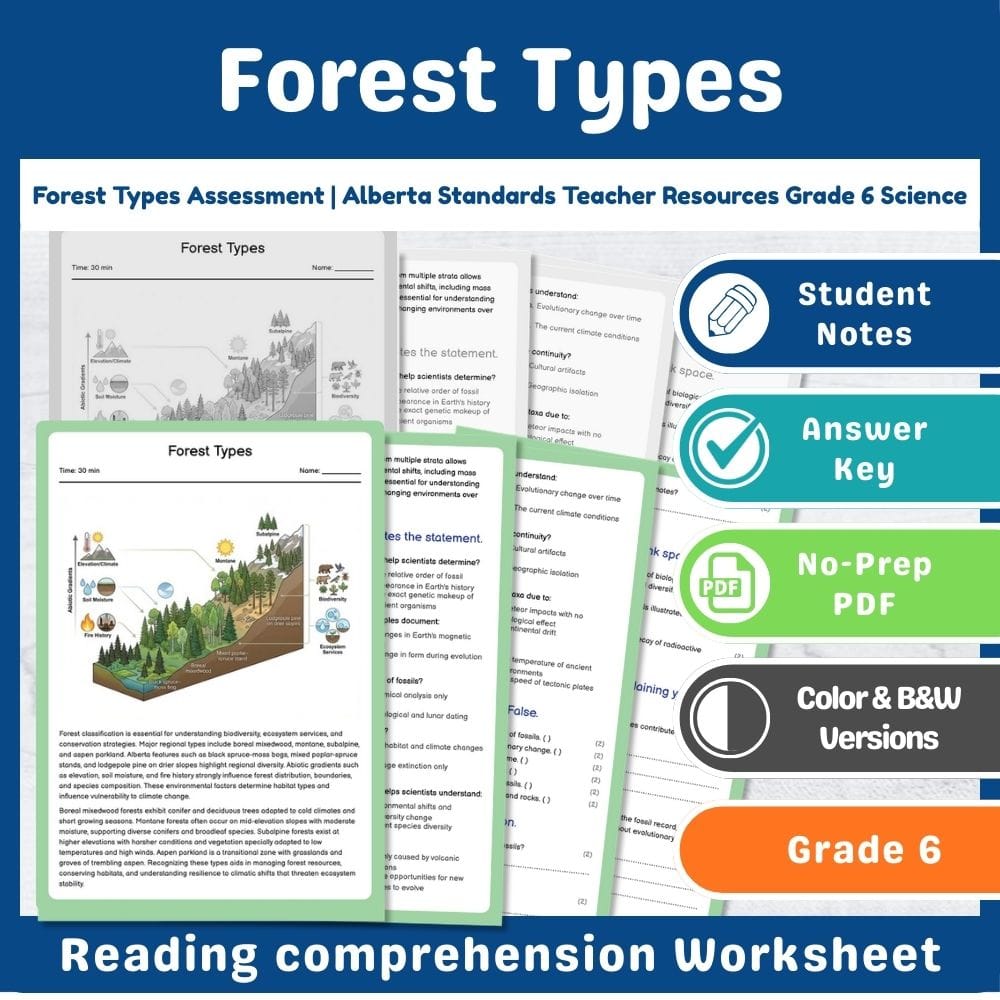
Forest Types Assessment | Alberta Standards Teacher Resources Grade 6 Science
Created byPrism Point LearningLearning Objectives
- Identify major regional forest types and their characteristic species
- Understand environmental factors shaping forest distribution
- Recognize different forest ecosystems and their ecological importance
Also included in: Lesson Grade 6 Science Mini Bundle Trees and Forests Alberta Standards
Instant download

Leaf Functions Assessment | Alberta Grade 6 Science Standards
Created byPrism Point LearningLearning Objectives
- Understand key concepts related to Science
- Apply knowledge through practice questions
- Demonstrate comprehension of the material
Also included in: Lesson Grade 6 Science Mini Bundle Trees and Forests Alberta Standards
Instant download

Crystal Structures Assessment | BC Grade 6 Science Standards-Aligned
Created byPrism Point LearningLearning Objectives
- Understand the differences between crystalline and amorphous solids based on particle arrangement.
- Identify observable behaviors associated with crystalline and amorphous structures.
- Explain how particle bonding strength influences solid properties.
Instant download

Interdependence Roles Assessment | Florida NGSSS Grade 6 Science
Created byPrism Point LearningLearning Objectives
- Explain how predators and prey are interdependent in an ecosystem
- Describe how competition and mutualism affect population changes
- Predict how changes in one population can ripple through a community
Also included in: Grade 6 Ecosystems Science Lesson Bundle | Florida NGSSS Assessment
Instant download

Habitats and Niches Assessment | BC Standard Grade 6 Science Worksheet
Created byPrism Point LearningLearning Objectives
- Understand the difference between habitats and niches in ecosystems.
- Identify how species interact within shared habitats and niches.
- Explain how resource partitioning reduces competition among species.
Instant download

Conservation Strategies Assessment | BC Standards Grade 6 Science
Created byPrism Point LearningLearning Objectives
- Understand various conservation strategies including protected areas, habitat restoration, sustainable harvesting, and invasive species control.
- Evaluate the ecological, economic, and social trade-offs involved in different conservation methods.
- Describe how monitoring and long-term resilience are essential for assessing conservation effectiveness.
Instant download

Phase Energy Assessment | BC Grade 6 Science Standards-Aligned Assessment
Created byPrism Point LearningLearning Objectives
- Understand that phase changes involve energy transfer without altering chemical identity.
- Explain how melting and boiling require added energy to overcome particle attractions.
- Describe how freezing and condensation release energy as particles bond more tightly.
Instant download
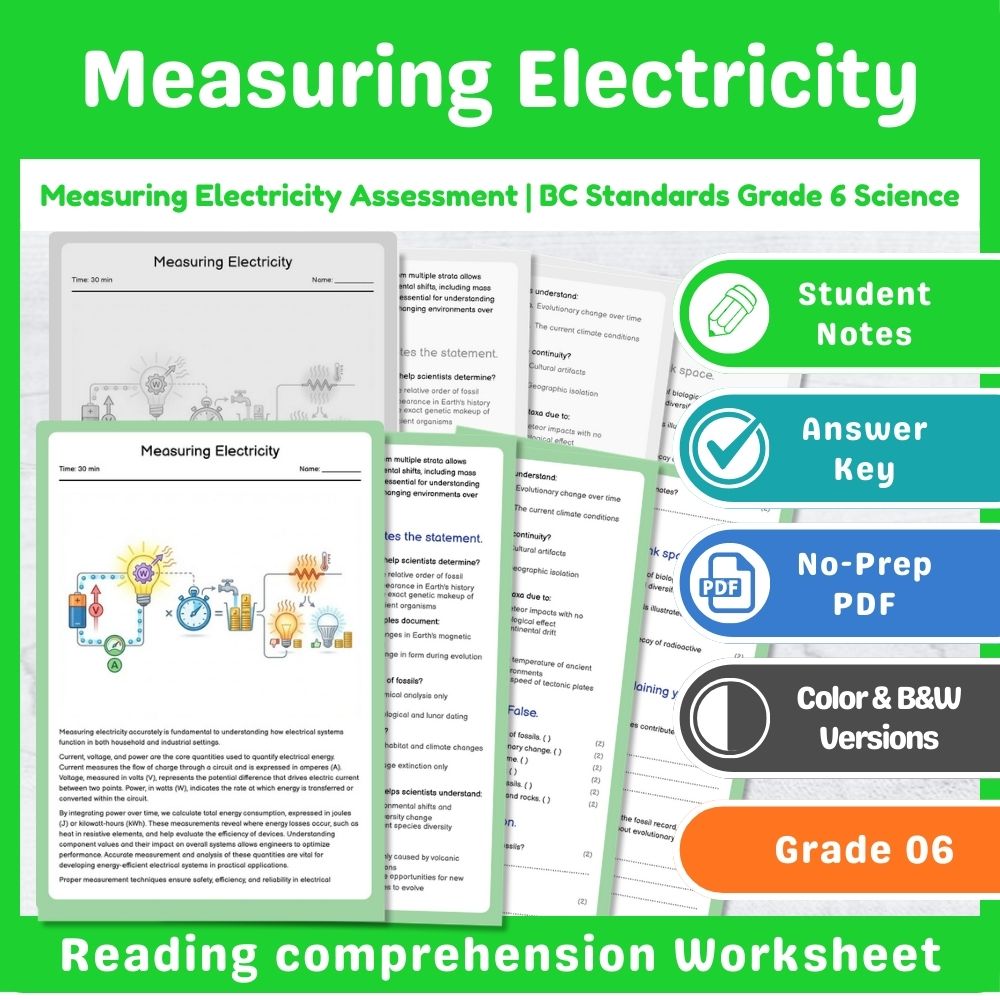
Measuring Electricity Assessment | BC Standards Grade 6 Science
Created byPrism Point LearningLearning Objectives
- Understand key electrical quantities such as current, voltage, and power.
- Identify how measurements of electricity determine energy transfer and system efficiency.
- Learn the relationship between instantaneous electrical quantities and cumulative energy consumption.
Instant download

Decomposers and Nutrient Return Assessment | General Grade 6 Science
Created byPrism Point LearningLearning Objectives
- Understand the role of decomposers in nutrient cycling within ecosystems.
- Identify different types of decomposers such as fungi and bacteria.
- Explain how decomposers contribute to soil and water health.
Instant download

Density Evidence Assessment | General Grade 6 Science Standards
Created byPrism Point LearningLearning Objectives
- Understand how density relates mass to volume and its role in classifying substances.
- Identify how objects with different densities behave in water, such as floating or sinking.
- Explain that density depends on how tightly matter is packed and does not change the substance's identity.
Also included in: Grade 6 Physical Science Science Lesson Bundle: General Framework
Instant download

Magnetic Separation Assessment for Grade 6 Science – Standards Aligned
Created byPrism Point LearningLearning Objectives
- Understand the principle of magnetic separation and its applications.
- Identify materials that respond to magnetic forces versus those that do not.
- Describe how magnetic separation can be used in everyday technology and recycling.
Also included in: Grade 6 Physical Science Science Lesson Bundle: General Framework
Instant download

Diffusion Rates Assessment | BC Grade 6 Science Standards
Created byPrism Point LearningLearning Objectives
- Explain the process of diffusion and the factors that influence its rate.
- Connect microscopic particle movement to observable phenomena like scent dispersion and gas mixing.
- Identify how temperature, particle size, and medium viscosity affect diffusion speed.
Instant download

Light Properties Assessment | BC Standards Grade 6 Science
Created byPrism Point LearningLearning Objectives
- Describe the wave and particle nature of light and their properties such as wavelength, frequency, and energy.
- Explain how visible, ultraviolet, and infrared light differ in wavelength and energy.
- Understand how different materials transmit, absorb, or reflect specific colours based on light properties.
Instant download

Precipitation and Infiltration Assessment | California Standards Grade 6 Science
Created byPrism Point LearningLearning Objectives
- Explain how precipitation returns water to Earth and describe examples of precipitation types.
- Describe infiltration and runoff and how they affect soil moisture and groundwater recharge.
- Use gravity and landscape features to predict how water moves across or into the ground.
Also included in: Grade 6 Water in Earth Systems Science Lesson Bundle: California Standards +1 more
Instant download

Atoms and Particles Assessment | California Standards Grade 6 Science
Created byPrism Point LearningLearning Objectives
- Explain how particle models describe matter using atoms and particles too small to see
- Relate the composition of atoms in substances to observable physical and chemical properties
- Use particle-level reasoning to predict how changes in matter affect properties
Also included in: Grade 6 Atoms and Chemical Change Science lesson bundle | California Standards +1 more
Instant download

Growth and Stored Energy Assessment Grade 6 Science California Standards
Created byPrism Point LearningLearning Objectives
- Explain how photosynthesis provides energy and matter for plant growth.
- Describe why plants store chemical energy and how they use it when light is limited.
- Identify how plant structures change over time through ongoing energy transformations and matter use.
Also included in: Grade 6 Energy and Matter Cycles Science Lesson Bundle | California Standards +1 more
Instant download

Heat and Temperature Assessment | NGSSS Standards Grade 6 Science
Created byPrism Point LearningLearning Objectives
- Explain the difference between heat and temperature using particle motion and energy transfer.
- Use everyday examples (hot water, warm air, cooling objects) to predict how energy moves.
- Interpret warming and cooling patterns by reasoning about temperature differences.
Also included in: Grade 6 Energy and Matter Science Lesson Bundle Unit: Florida NGSSS
Instant download

Niche Relationships Assessment for Grade 6 Science | Florida NGSSS
Created byPrism Point LearningLearning Objectives
- Explain what a niche is and how it describes an organism’s role in an ecosystem.
- Identify how different niches can allow two species to coexist in the same habitat.
- Analyze how niche overlap can increase competition when resources become limited.
Also included in: Grade 6 Ecosystems Science Lesson Bundle | Florida NGSSS Assessment
Instant download

Food Chains Assessment for Grade 6 Science | Florida NGSSS Standards
Created byPrism Point LearningLearning Objectives
- Identify the roles of producers and consumers in a food chain
- Explain how energy transfers between trophic levels
- Describe why real ecosystems often form food webs instead of single pathways
Also included in: Grade 6 Ecosystems Science Lesson Bundle | Florida NGSSS Assessment
Instant download

Friction Effects Assessment for Grade 6 Science | NGSSS Standards
Created byPrism Point LearningLearning Objectives
- Explain how friction affects the motion of objects on different surfaces
- Describe how friction can convert kinetic energy into thermal energy
- Compare friction on solid surfaces with air resistance (drag) in fluids
Also included in: Grade 6 Energy and Matter Science Lesson Bundle Unit: Florida NGSSS
Instant download

Science Assessment: Atmospheric Circulation Grade 6 | Assessment NGSSS
Created byPrism Point LearningLearning Objectives
- Explain how uneven heating causes air to rise and sink, forming atmospheric circulation patterns
- Describe how warm air and cool air differ in density and how that affects pressure and wind
- Connect atmospheric circulation to moisture transport and the development of storms
Instant download

Science Assessment: Oceans Regulate Climate (Grade 6) – Assessment | NGSSS
Created byPrism Point LearningLearning Objectives
- Explain how oceans absorb, store, and release heat more slowly than land to moderate temperatures.
- Describe how ocean heat affects evaporation, atmospheric humidity, and storm or weather patterns.
- Use evidence from ocean conditions to predict how coastal climates may respond to climate shifts.
Instant download

Ecosystem Components Assessment | Florida NGSSS Standards Grade 6 Science
Created byPrism Point LearningLearning Objectives
- Identify abiotic factors and explain how they affect where organisms can live.
- Distinguish biotic factors (producers, consumers, decomposers) by their roles in an ecosystem.
- Use ecosystem component vocabulary to describe how ecosystem structure can vary by location.
Also included in: Grade 6 Ecosystems Science Lesson Bundle | Florida NGSSS Assessment
Instant download

Trophic Levels Assessment for Grade 6 Science | Florida NGSSS Standard
Created byPrism Point LearningLearning Objectives
- Explain how producers, consumers, and decomposers relate to trophic levels and energy flow
- Identify the correct trophic level for different organisms based on what they eat
- Describe how energy transfer between trophic levels affects ecosystem structure and populations
Also included in: Grade 6 Ecosystems Science Lesson Bundle | Florida NGSSS Assessment
Instant download

Behavioral Strategies Assessment | Florida NGSSS Standards Grade 6 Science
Created byPrism Point LearningLearning Objectives
- Explain how behavioral adaptations help organisms survive in changing environments
- Identify examples of behavioral adaptations such as migration, hibernation, and daily timing
- Describe how behavior works together with structural and physiological traits
Also included in: Grade 6 Ecosystems Science Lesson Bundle | Florida NGSSS Assessment
Instant download

Science Assessment: Energy From Sun (Grade 6) – Florida NGSSS Assessment
Created byPrism Point LearningLearning Objectives
- Explain how the angle of incoming solar energy affects heating on Earth
- Describe how unequal heating drives air movement and influences weather
- Connect energy transfers in the atmosphere and oceans to seasonal climate patterns
Instant download
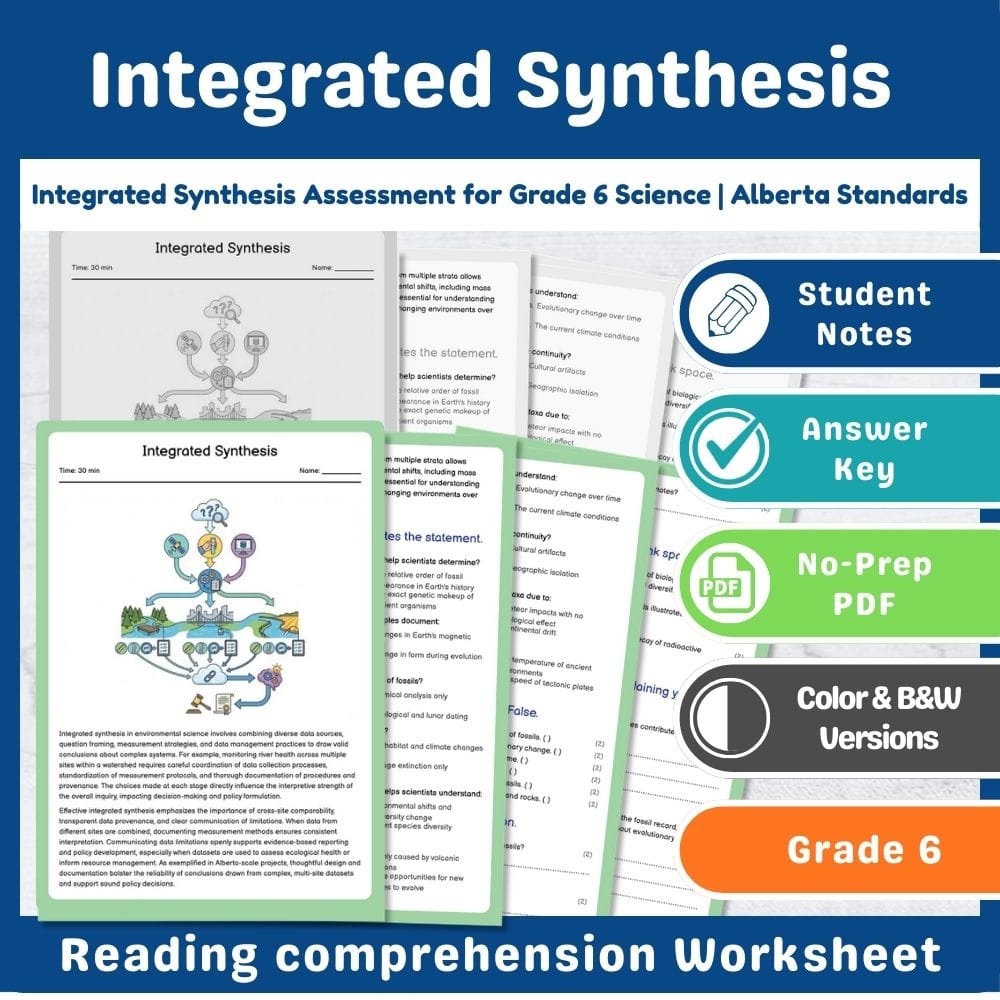
Integrated Synthesis Assessment for Grade 6 Science | Alberta Standards
Created byPrism Point LearningLearning Objectives
- Understand the key components involved in integrated synthesis within environmental monitoring.
- Evaluate the importance of documentation and data provenance in scientific inquiry.
- Analyze how measurement strategies influence the interpretation of multi-site environmental data.
Also included in: Lesson Grade 6 Science Mini Bundle | Evidence and Investigation
Instant download
About Grade 6 Science Worksheets
Explore Grade 6 Science worksheets for classwork, homework, or review. Our 5,969 printables download instantly as PDFs.
MyTeachingSheets worksheets are made by real teacher-authors and checked before they go live. Download any as a print-ready PDF for lessons, homework, or independent practice — most include answer keys, and previews are always free.