
Grade 6 Science Worksheets
5,969 worksheets
Graph Selection Worksheet | Grade 6 Science Practice
 Created byPrism Point Learning
Learning Objectives
- Match data types to the most appropriate graph (line, bar, or scatter plot).
- Choose a suitable scale and axis labels to avoid misleading graph impressions.
- Use annotations to highlight important patterns or relationships in data.
Instant download

Phase Energy Test Prep Printable | Grade 6 Science Worksheet BC
Created byPrism Point LearningLearning Objectives
- Explain how energy changes particle motion during phase changes (melting, boiling, freezing, and condensation).
- Describe why temperature can stay nearly constant during a phase change even while energy is still being added or released.
- Connect latent heat to the energy needed to overcome attractive forces or form stronger particle bonds.
Also included in: Matter, Properties & Change Lesson Bundle — Grade 6 Science BC Framework +1 more
Instant download

Invasive Species Practice & Assessment Worksheet | Grade 6 Science BC
Created byPrism Point LearningLearning Objectives
- Explain how invasive species are introduced by human transport and why they spread quickly.
- Describe how invasive species can disrupt food webs, habitats, and nutrient cycles.
- Identify real-world examples of invasive species and predict likely ecosystem impacts.
Also included in: Ecosystems & Interdependence Lesson Bundle | Grade 6 Science | BC +1 more
Instant download

Seasons Explained Worksheet | Grade 6 Science Practice & Review
Created byPrism Point LearningLearning Objectives
- Explain how Earth’s axial tilt causes different hemispheres to receive different amounts of sunlight during the year
- Describe how Earth’s orbit affects the timing of equinoxes and solstices through changes in solar elevation
- Connect sunlight angle and day length to seasonal differences in climate and biological cycles
Also included in: Grade 6 Space Systems Science Lesson Bundle for Ontario (10 Worksheets)
Instant download

Change Examples Practice Worksheet | Grade 6 Science Review
Created byPrism Point LearningLearning Objectives
- Distinguish physical changes from chemical changes using observable evidence and product identity
- Explain how phase changes and dissolving differ from reactions that form new substances
- Identify signs of chemical change such as gas production, precipitate formation, and energy changes
Also included in: Matter, Properties & Change Lesson Bundle — Grade 6 Science BC Framework +1 more
Instant download

Measuring Electricity Worksheet | Grade 6 Science Review & Practice
Created byPrism Point LearningLearning Objectives
- Explain how current, voltage, and power are measured and what each quantity describes in a circuit.
- Use units (amperes, volts, watts, joules, and kilowatt-hours) to interpret electricity data accurately.
- Describe how energy transfer over time relates to device energy use in practical situations.
Also included in: Energy, Waves & Circuits Lesson Bundle | Grade 6 Science | BC Framework +1 more
Instant download

Developing Solutions Test Prep Worksheet | Grade 6 Science NGSS
Created byPrism Point LearningLearning Objectives
- Compare design solutions using clear criteria and constraints to decide which option is most promising to improve.
- Use quantitative and qualitative metrics (such as efficiency, durability, manufacturability, and cost) to justify design trade-offs.
- Refine and rank multiple prototypes using evidence from simple models, observations, and measurements.
Also included in: Grade 6 Engineering Design Process Science Lesson Bundle for NGSS
Instant download

Atomic Composition Practice Worksheet | Grade 6 Science NGSS
Created byPrism Point LearningLearning Objectives
- Describe how chemical formulas and models show the relative number and types of atoms in simple molecules and extended structures.
- Use representations (ball-and-stick and space-filling) to explain how atoms combine to form compounds like H2O and NaCl.
- Explain how repeating units build polymer chains and how ionic lattices form from ions.
Instant download

Food Chains Worksheet Grade 6 Science NGSSS Florida Ecosystems
Created byPrism Point LearningLearning Objectives
- Explain how energy moves through a food chain from producers to consumers.
- Identify producers, primary consumers, and secondary consumers in examples.
- Use trophic level vocabulary (producer, primary consumer, secondary consumer) accurately.
Instant download

Reasoning Claims Worksheet | Grade 6 Science Activities
Created byPrism Point LearningLearning Objectives
- Explain the difference between raw observations and explanatory scientific claims.
- Connect evidence to a claim by describing how data supports reasoning.
- Evaluate whether evidence is strong enough to justify an inference.
Also included in: Grade 6 Scientific Investigation Practices Science Lesson Bundle TEKS +1 more
Instant download

Error Analysis Worksheet | Grade 6 Science Activities
Created byPrism Point LearningLearning Objectives
- Identify sources of error in experimental data and describe how they affect results.
- Distinguish random error from systematic error and explain how each changes measurements.
- Use uncertainty and examples to judge the reliability of a scientific conclusion.
Also included in: Grade 6 Scientific Investigation Practices Science Lesson Bundle TEKS +1 more
Instant download

Human Influences Worksheet | Grade 6 Science Activities
Created byPrism Point LearningLearning Objectives
- Explain how habitat fragmentation, pollution, land-use change, nonnative species, and resource extraction can affect natural systems
- Describe how human impacts can change community composition, population viability, and genetic diversity
- Evaluate mitigation strategies such as conservation and restoration to reduce negative effects
Also included in: Grade 6 Ecosystem Interactions Science Lesson Bundle Worksheets | TEKS +1 more
Instant download

Science and Technology Worksheet | Grade 6 Science Activities
Created byPrism Point LearningLearning Objectives
- Explain how scientific investigation and technological development influence each other.
- Describe how instruments and tools improve observation, measurement, and the testing of hypotheses.
- Use cause-and-effect reasoning to show how new tools change the questions scientists can ask.
Also included in: Grade 6 Science Ethics and Societal Impacts Lesson Bundle for TEKS +1 more
Instant download

Human Impacts Practice Test | Grade 6 Science Worksheet & Review
Created byPrism Point LearningLearning Objectives
- Explain how human activities can disrupt ecosystem balance by changing habitats, nutrient cycles, and energy pathways.
- Describe how deforestation can increase erosion and harm food webs and biodiversity.
- Investigate how pollution can accumulate in organisms and affect health and reproduction.
Also included in: Ecosystems & Interdependence Lesson Bundle | Grade 6 Science | BC +1 more
Instant download

Nervous System Practice Worksheet | Grade 6 Science Review & Assessment
Created byPrism Point LearningLearning Objectives
- Describe how the nervous system collects sensory information and produces responses through neural signaling.
- Explain how neurons transmit impulses along axons and communicate at synapses using chemical messengers.
- Identify the role of brain and spinal cord integration in coordinating muscle and gland activity.
Also included in: Multicellular Systems & Functions Lesson Bundle | Grade 6 Science | BC +1 more
Instant download

Reaction Rates Practice Worksheet | Grade 6 Science Review and Assessment
Created byPrism Point LearningLearning Objectives
- Explain how particle collisions influence the rate of chemical reactions.
- Describe how concentration, temperature, surface area, and catalysts affect reaction rates.
- Use observable evidence (gas release, color change, heat) to infer changes in reaction rate.
Also included in: Matter, Properties & Change Lesson Bundle — Grade 6 Science BC Framework +1 more
Instant download

Decomposers And Nutrients Test Prep Printables | Grade 6 Science
Created byPrism Point LearningLearning Objectives
- Explain how decomposers break down dead organic matter and return nutrients to the environment.
- Describe how temperature, moisture, and oxygen affect decomposition rates.
- Connect nutrient cycling to plant growth and ecosystem balance.
Also included in: Ecosystems & Interdependence Lesson Bundle | Grade 6 Science | BC +1 more
Instant download

Chemical Energy Release Worksheet Grade 6 Science Activities Pack
Created byPrism Point LearningLearning Objectives
- Explain how chemical energy stored in food is released to power life processes.
- Describe how energy changes form in organisms (including heat loss).
- Use the idea that matter/energy is not created or destroyed to interpret food-energy changes.
Also included in: Animals Matter Lesson Bundle | Grade 6 Science | California Standards
Instant download

Speed and Velocity Worksheet Grade 6 Science | Motion Practice Activity
Created byPrism Point LearningLearning Objectives
- Distinguish speed from velocity by explaining how direction affects velocity
- Calculate and interpret average speed using total distance and elapsed time
- Use consistent measurement units to describe motion accurately
Also included in: Grade 6 Energy, Matter & Motion Lesson Bundle | Florida NGSSS
Instant download

Instrumentation Principles Practice Worksheet | Grade 6 Science Ontario
Created byPrism Point LearningLearning Objectives
- Explain the roles of ammeters and voltmeters in electrical measurement
- Use the correct units for current (amperes) and voltage (volts)
- Predict how meter readings relate to circuit arrangements in series and parallel
Also included in: Grade 6 Circuits & Electricity Science lesson bundle: Ontario
Instant download

Conductor Properties Test Prep Printable | Grade 6 Science
Created byPrism Point LearningLearning Objectives
- Explain how free charge carriers in conductors allow electrical current to flow.
- Describe how metallic structure and material type affect conductivity.
- Identify how temperature and cross-sectional area influence the ease of charge flow.
Also included in: Grade 6 Circuits & Electricity Science lesson bundle: Ontario
Instant download

Modeling Systems Test Prep Worksheets | Grade 6 Science Ontario
Created byPrism Point LearningLearning Objectives
- Construct simple physical, diagrammatic, and mathematical models to represent real-world systems.
- Identify model assumptions and define model boundaries to make predictions more reasonable.
- Compare model predictions with observable outcomes to explain limitations and refine the model.
Instant download

Invasive Species Practice Assessment | Grade 6 Science Ontario
Created byPrism Point LearningLearning Objectives
- Explain how invasive species enter new ecosystems and why they can become established.
- Describe how invasive species can change food webs, nutrient cycling, and habitats.
- Identify factors that increase establishment and describe simple monitoring indicators.
Also included in: Grade 6 Biodiversity & Adaptation Science Lesson Bundle Ontario
Instant download

Quantitative Circuits Practice Assessment | Grade 6 Science
Created byPrism Point LearningLearning Objectives
- Explain how voltage, current, and resistance are related using proportional reasoning.
- Predict how changing resistance affects current when voltage stays the same.
- Compare current and resistance behaviors in series and parallel circuits using numeric relationships.
Also included in: Grade 6 Circuits & Electricity Science lesson bundle: Ontario
Instant download

Biodiversity Patterns Assessment Practice Worksheet | Grade 6 Science
Created byPrism Point LearningLearning Objectives
- Explain how species richness, abundance, and evenness describe biodiversity in different ecosystems.
- Use sampling tools like transects and quadrats to measure biodiversity patterns.
- Interpret spatial patterns and relate biodiversity metrics to ecosystem stability and conservation.
Also included in: Grade 6 Biodiversity & Adaptation Science Lesson Bundle Ontario
Instant download

Circuit Diagnosis Test Prep Printables | Grade 6 Science
Created byPrism Point LearningLearning Objectives
- Explain how observed symptoms can indicate different faults in series and parallel circuits.
- Use expected measurement patterns to compare predictions with observations during troubleshooting.
- Describe how component behavior changes diagnostic conclusions in circuit topology (series vs. parallel).
Also included in: Grade 6 Circuits & Electricity Science lesson bundle: Ontario
Instant download

Current Fundamentals Test Prep Printable | Grade 6 Science
Created byPrism Point LearningLearning Objectives
- Explain that electric current is an organized movement of charges through a conductor
- Distinguish conventional current direction from electron flow
- Describe how potential difference (voltage) drives charge to move in a circuit
Also included in: Grade 6 Circuits & Electricity Science lesson bundle: Ontario
Instant download

Design Process Test Prep Printables | Grade 6 Science
Created byPrism Point LearningLearning Objectives
- Describe the iterative design process using specifications, prototyping, measurement, and refinement.
- Explain how lift, drag, weight, and stability trade-offs affect aircraft or glider concepts.
- Interpret measurements such as lift and drag coefficients to improve aerodynamic performance.
Also included in: Grade 6 Aerodynamics Flight Design Science lesson bundle - Ontario
Instant download

Stability Modes Practice Worksheet | Grade 6 Science Assessment Ontario
Created byPrism Point LearningLearning Objectives
- Differentiate static stability from dynamic stability and describe how aircraft behave after a disturbance
- Explain how center of gravity (CG) location relative to the aerodynamic center affects longitudinal stability
- Describe how dihedral angle and tail/fin design contribute to roll, directional, and pitch stability
Also included in: Grade 6 Aerodynamics Flight Design Science lesson bundle - Ontario
Instant download

Combined Circuits Practice & Assessment Worksheet | Grade 6 Science
Created byPrism Point LearningLearning Objectives
- Explain how mixed series-parallel circuits can be broken into simpler series and parallel subcircuits
- Describe how current and voltage changes (or stays the same) in series parts versus parallel branches
- Predict how removing or failing a component affects brightness and readings in a combined circuit
Also included in: Grade 6 Circuits & Electricity Science lesson bundle: Ontario
Instant download

Weather Patterns Test Prep Printables | Grade 6 Science
Created byPrism Point LearningLearning Objectives
- Interpret surface weather maps using pressure systems, fronts, and temperature changes to predict short-term weather.
- Explain how air masses, pressure gradients, and fronts affect wind shifts and precipitation patterns.
- Use precipitation, temperature, and radar clues to describe likely storm development such as thunderstorms and squall lines.
Also included in: Grade 6 Weather & Climate Systems Science Lesson Bundle NGSS
Instant download

Sustainability Strategies Practice Worksheet | Grade 6 Science NGSS Review
Created byPrism Point LearningLearning Objectives
- Explain how population trends and per-capita resource use can increase or decrease impacts on Earth systems.
- Compare sustainability strategies such as renewable energy, conservation, circular resource use, and land-management approaches.
- Evaluate trade-offs among economic, social, and environmental priorities and suggest measurable indicators of progress.
Instant download

Particle Models Test Prep Printable Worksheet | Grade 6 Science
Created byPrism Point LearningLearning Objectives
- Use particle models to explain how particle motion, spacing, and collisions relate to the physical states of matter.
- Describe how temperature and thermal energy connect to particle kinetic energy and gas pressure in qualitative ways.
- Predict which change of state (melting, freezing, boiling, condensation) matches a given particle-level description.
Instant download

Species Interactions Practice Test Printables | Grade 6 Science
Created byPrism Point LearningLearning Objectives
- Identify and describe mutualism, competition, predation, and parasitism as recurring species interaction types.
- Use observations and species traits to predict how interaction strength changes across forest, grassland, and freshwater ecosystems.
- Explain how niche partitioning, resource overlap, and behavioral strategies affect the outcomes of species interactions.
Also included in: Grade 6 Species Interactions Science Lesson Bundle | NGSS
Instant download

Moon Relationships Practice Worksheet | Grade 6 Science NGSS
Created byPrism Point LearningLearning Objectives
- Explain how the relative positions of Earth, the Moon, and the Sun produce lunar phases and eclipses.
- Use line-of-sight and shadow geometry to distinguish phase changes from shadowing events.
- Describe the sequence and timing of primary lunar phases and predict when eclipses can occur.
Instant download

Comparative Flight Worksheet | Grade 6 Science Activities
Created byPrism Point LearningLearning Objectives
- Compare how kites, gliders, and round canopies differ in performance using lift, drag, and glide-related ideas
- Explain how design trade-offs affect endurance versus maneuverability
- Use Alberta context (prairie crosswinds and valley thermals) to predict likely flight outcomes
Also included in: Aerodynamics and Flight Design Lesson Bundle – Grade 6 Science Alberta
Instant download
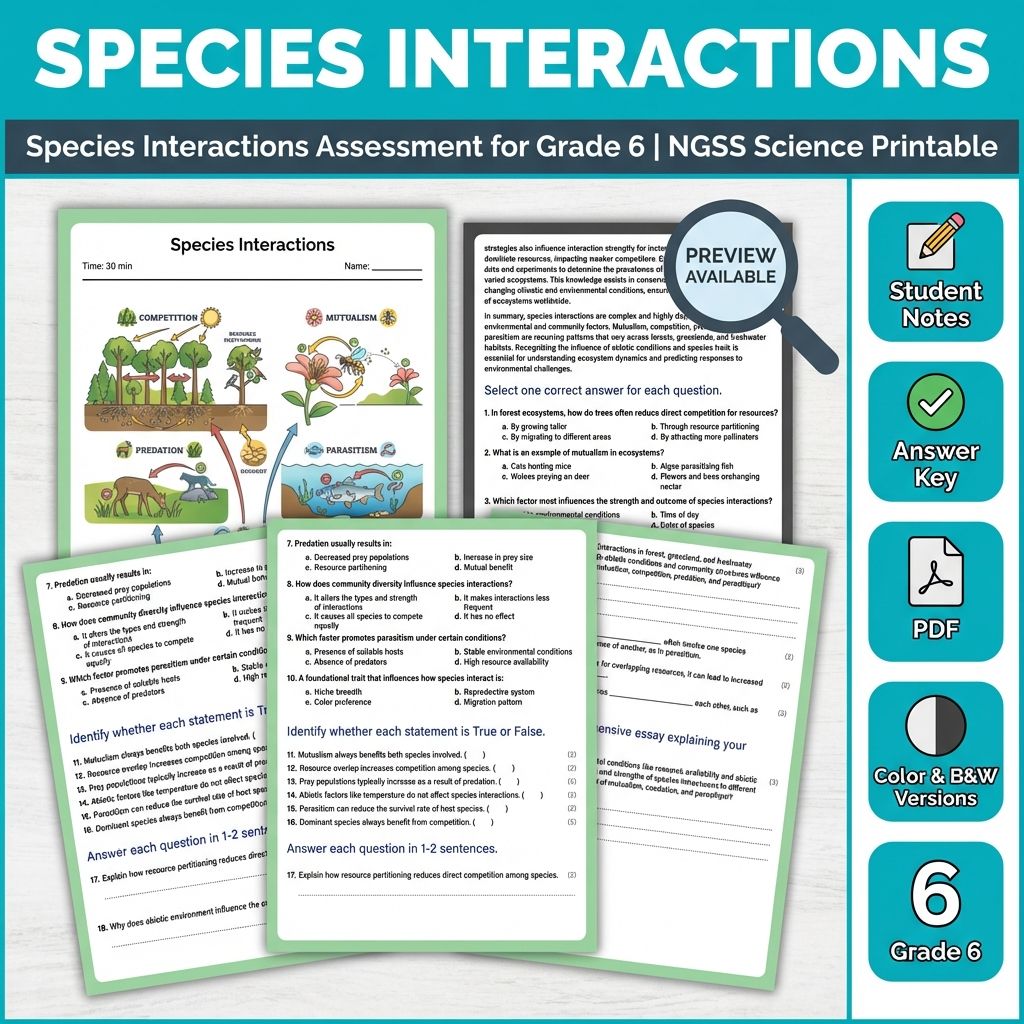
Species Interactions Assessment for Grade 6 | NGSS Science Printable
Created byPrism Point LearningLearning Objectives
- Predict patterns of species interactions across different ecosystems.
- Identify mutualism, competition, predation, and parasitism as interaction types.
- Compare interaction outcomes in forest, grassland, and freshwater environments.
Also included in: Grade 6 Science Mini Bundle | Ecosystems: Interactions, Energy, and Dynamics +1 more
Instant download
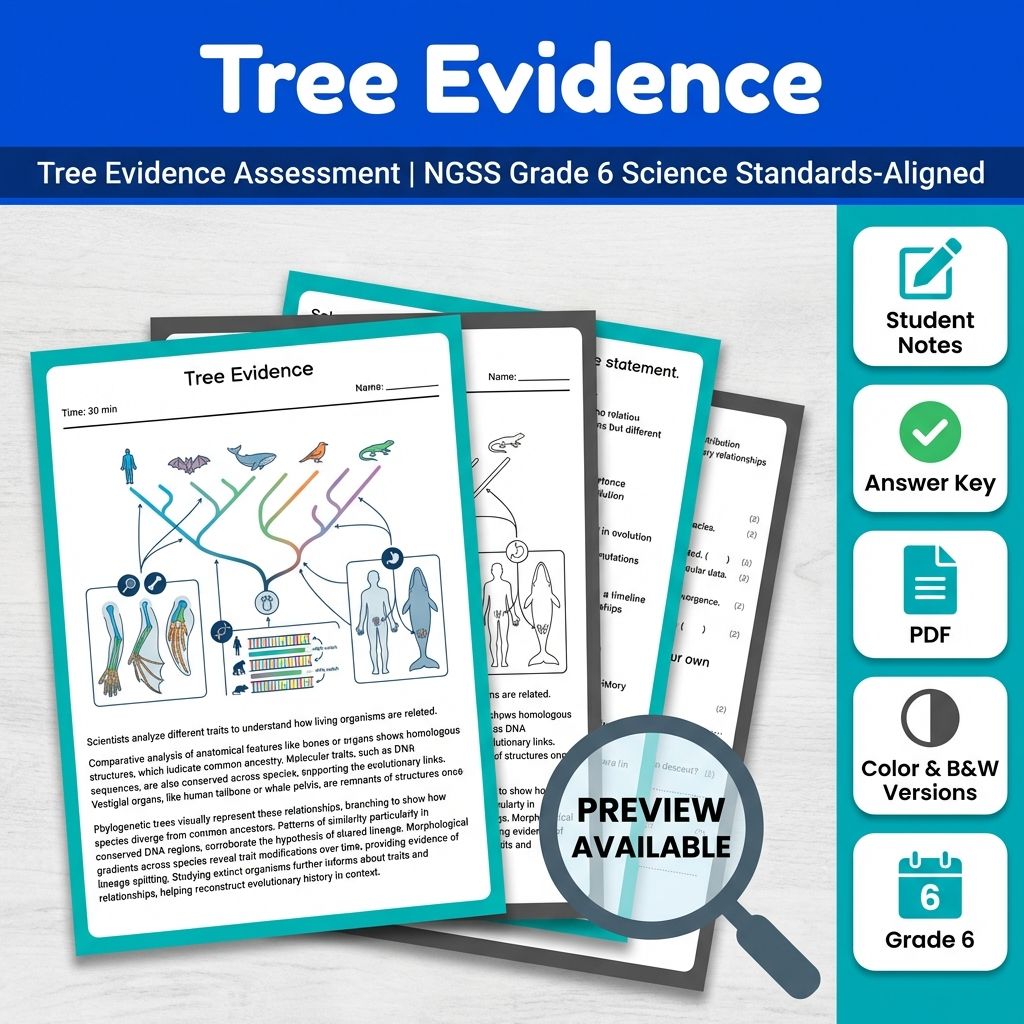
Tree Evidence Assessment | NGSS Grade 6 Science Standards-Aligned
Created byPrism Point LearningLearning Objectives
- Compare and analyze anatomical and molecular traits in taxa.
- Interpret evolutionary relationships using phylogenetic trees.
- Identify homologous and vestigial structures in organisms.
Also included in: Grade 6 Science Mini Bundle – Biological Evolution: Unity & Diversity +1 more
Instant download
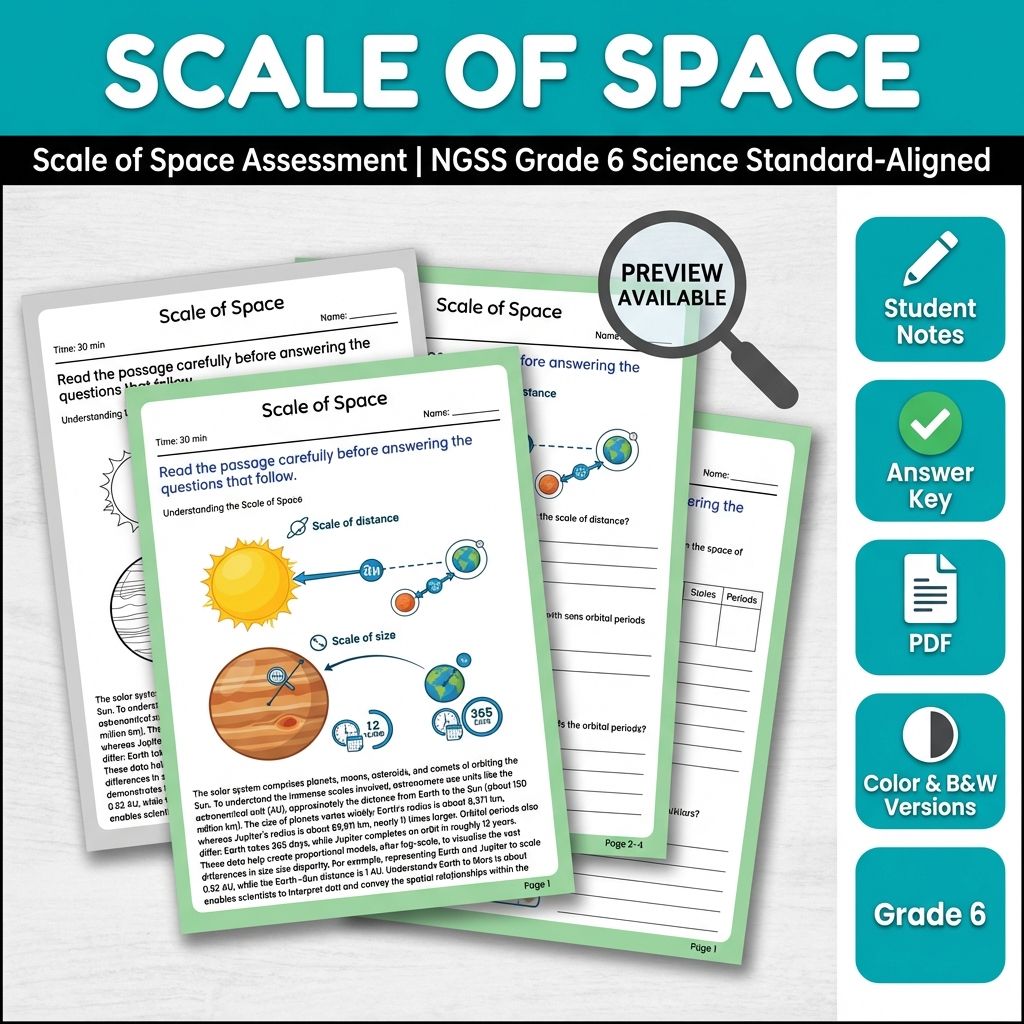
Scale of Space Assessment | NGSS Grade 6 Science Standard-Aligned
Created byPrism Point LearningLearning Objectives
- Understand the concept of astronomical units, planetary radii, and orbital periods to compare celestial bodies.
- Analyze relative sizes and distances within the solar system using scale models and data interpretation.
- Describe the differences between terrestrial planets and gas giants based on scale and orbital data.
Also included in: Grade 6 Science Mini Bundle | Earth’s Place in the Universe NGSS Standards +1 more
Instant download
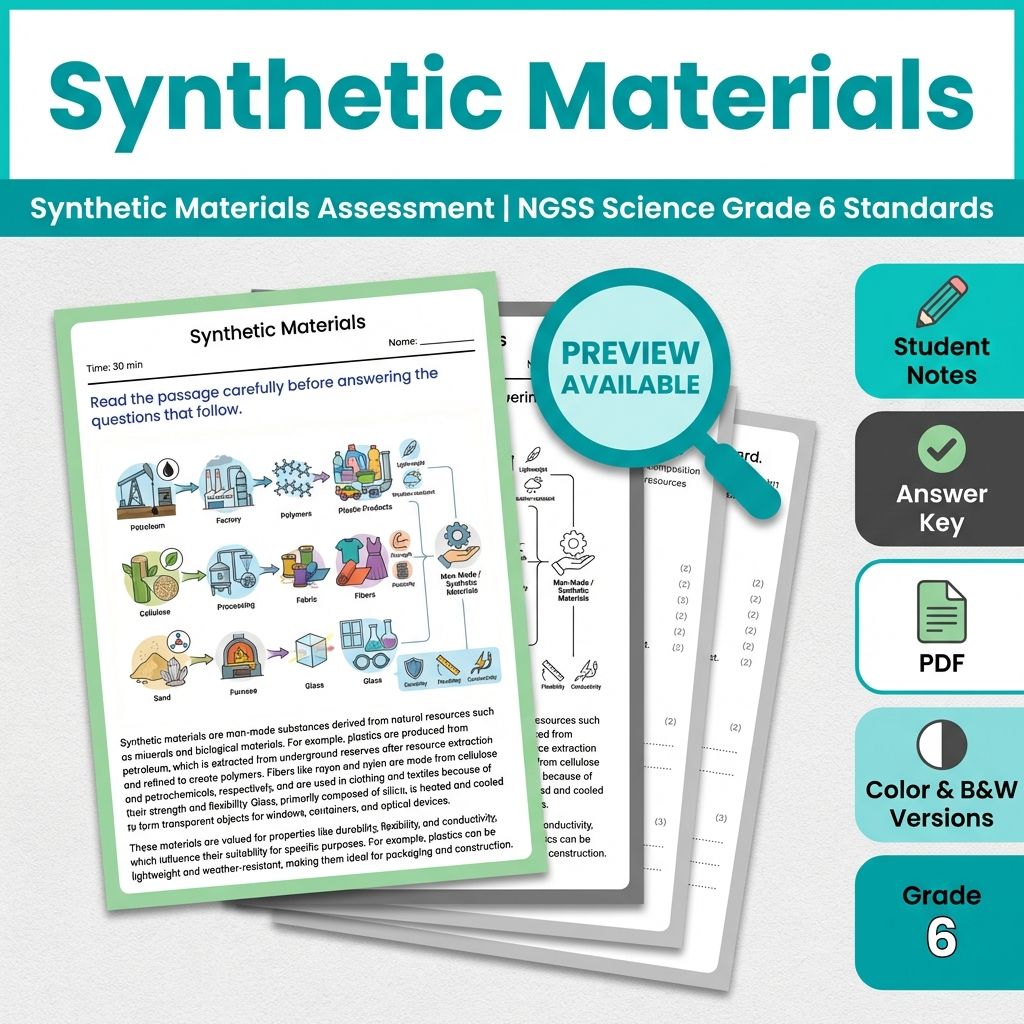
Synthetic Materials Assessment | NGSS Science Grade 6 Standards
Created byPrism Point LearningLearning Objectives
- Identify natural resources used to produce synthetic materials.
- Compare properties of natural and synthetic substances for specific applications.
- Understand processes involved in resource extraction and material manufacturing.
Also included in: Grade 6 Science Mini Bundle | Matter and Its Interactions NGSS Not Specified +1 more
Instant download
Population Dynamics Assessment for Grade 6 | NGSS Science Standards
Created byPrism Point LearningLearning Objectives
- Understand how mathematical representations and graphs illustrate changes in population over generations.
- Analyze how environmental and demographic factors influence trait frequencies and population sizes.
- Apply proportional reasoning, interpret frequency charts, and analyze time-series graphs related to population change.
Also included in: Grade 6 Science Mini Bundle – Biological Evolution: Unity & Diversity +1 more
Instant download
Organ Systems Assessment | NGSS Aligned Grade 6 Science Worksheet
Created byPrism Point LearningLearning Objectives
- Describe the structure and function of main organ systems involved in body organization.
- Explain how tissues and organs work together within the circulatory, respiratory, digestive, and nervous systems.
- Identify the interactions and interdependence among different organ systems and relate cellular functions to system-level processes.
Also included in: Grade 6 Science Mini Bundle | Structures and Processes NGSS Not specified +1 more
Instant download
Human Impacts Assessment | NGSS Standards Grade 6 Science
Created byPrism Point LearningLearning Objectives
- Describe human activities that alter land, air, and water systems.
- Analyze how land-use change, fossil fuel use, and waste management affect environmental cycles.
- Explain the causal links between human actions and environmental trends.
Also included in: Grade 6 Science Mini Bundle | Earth and Human Activity NGSS Not Specified +1 more
Instant download

System Thinking In Solutions Assessment | General Grade 6 Science
Created byPrism Point LearningLearning Objectives
- Understand the concept of systems thinking and how components interact within a system.
- Identify cause-and-effect relationships in system design and performance.
- Analyze how changes to one part of a system can influence overall behavior.
Instant download

Science Assessment: Water Cycle Pathways (Grade 6) – Florida NGSSS
Created byPrism Point LearningLearning Objectives
- Describe the major pathways of the water cycle, including evaporation, condensation, precipitation, runoff, and infiltration
- Explain how energy transfer affects water’s state changes and movement between land and the atmosphere
- Use evidence from the water cycle to predict how changes can lead to droughts or flooding
Instant download

Food Webs Assessment | Florida NGSSS Grade 6 Science
Created byPrism Point LearningLearning Objectives
- Explain what a food web is and how it shows feeding relationships in an ecosystem
- Use food web ideas to describe how energy moves between trophic levels
- Predict effects of changes to one organism on other organisms in a community
Also included in: Grade 6 Ecosystems Science Lesson Bundle | Florida NGSSS Assessment
Instant download

Physiological Traits Assessment | Standards-Aligned Assessment Grade 6 Science
Created byPrism Point LearningLearning Objectives
- Explain how physiological adaptations help organisms survive in specific environments
- Identify examples of internal traits related to water balance, metabolism, and ion regulation
- Interpret statements about physiological adaptations as true or false
Also included in: Grade 6 Ecosystems Science Lesson Bundle | Florida NGSSS Assessment
Instant download

Decomposition Recycling Assessment | Florida NGSSS Grade 6 Science
Created byPrism Point LearningLearning Objectives
- Explain how decomposers break down dead organisms and waste into simpler materials.
- Describe how decomposition returns nutrients to the environment for producers to use again.
- Connect decomposition to matter cycling and ecosystem stability over time.
Also included in: Grade 6 Ecosystems Science Lesson Bundle | Florida NGSSS Assessment
Instant download
About Grade 6 Science Worksheets
Explore Grade 6 Science worksheets for classwork, homework, or review. Our 5,969 printables download instantly as PDFs.
MyTeachingSheets worksheets are made by real teacher-authors and checked before they go live. Download any as a print-ready PDF for lessons, homework, or independent practice — most include answer keys, and previews are always free.