
Grade 6 Science Worksheets
5,735 worksheets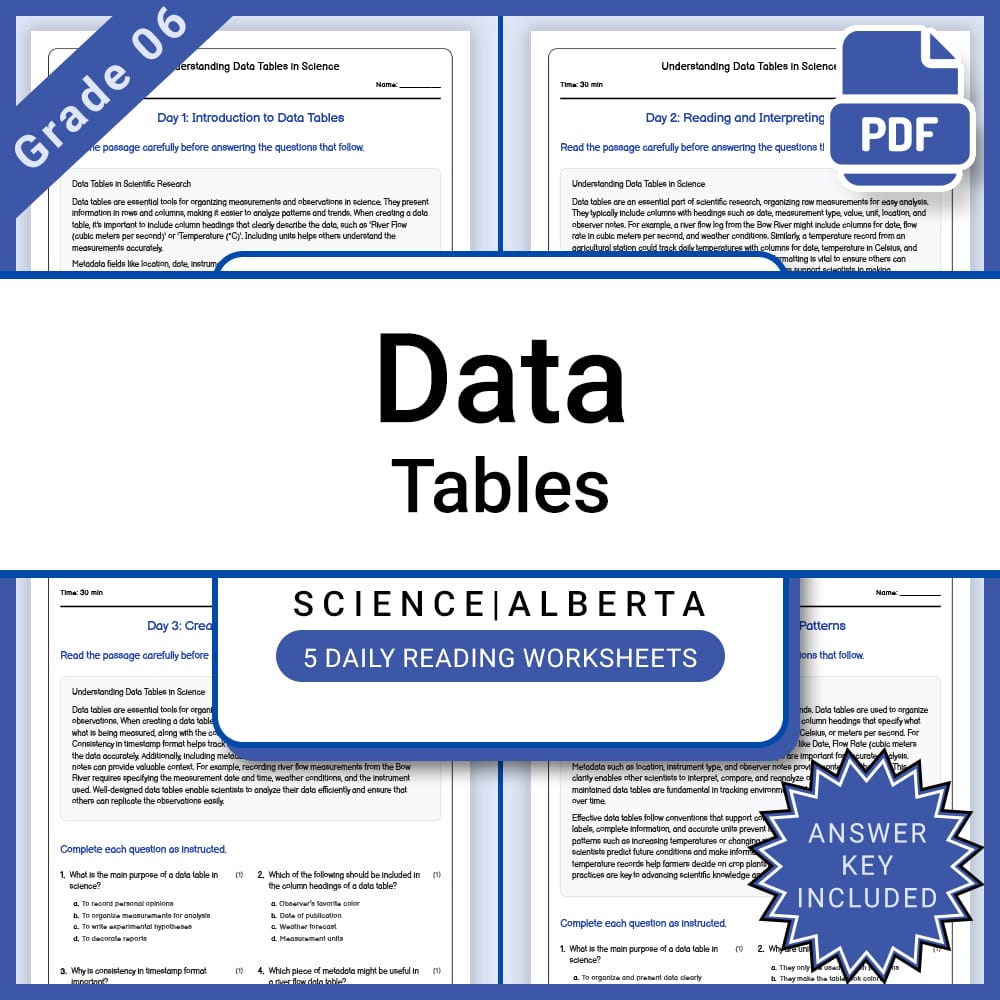
Grade 6 Science – Data Tables Daily Reading Worksheet + Answer Key
JCreated byJ.S SheetsLearning Objectives
- Identify the components of a data table, including column headings and metadata.
- Understand the importance of clear and consistent labels in data recording.
- Recognize examples of data tables used in real-world scientific observations.
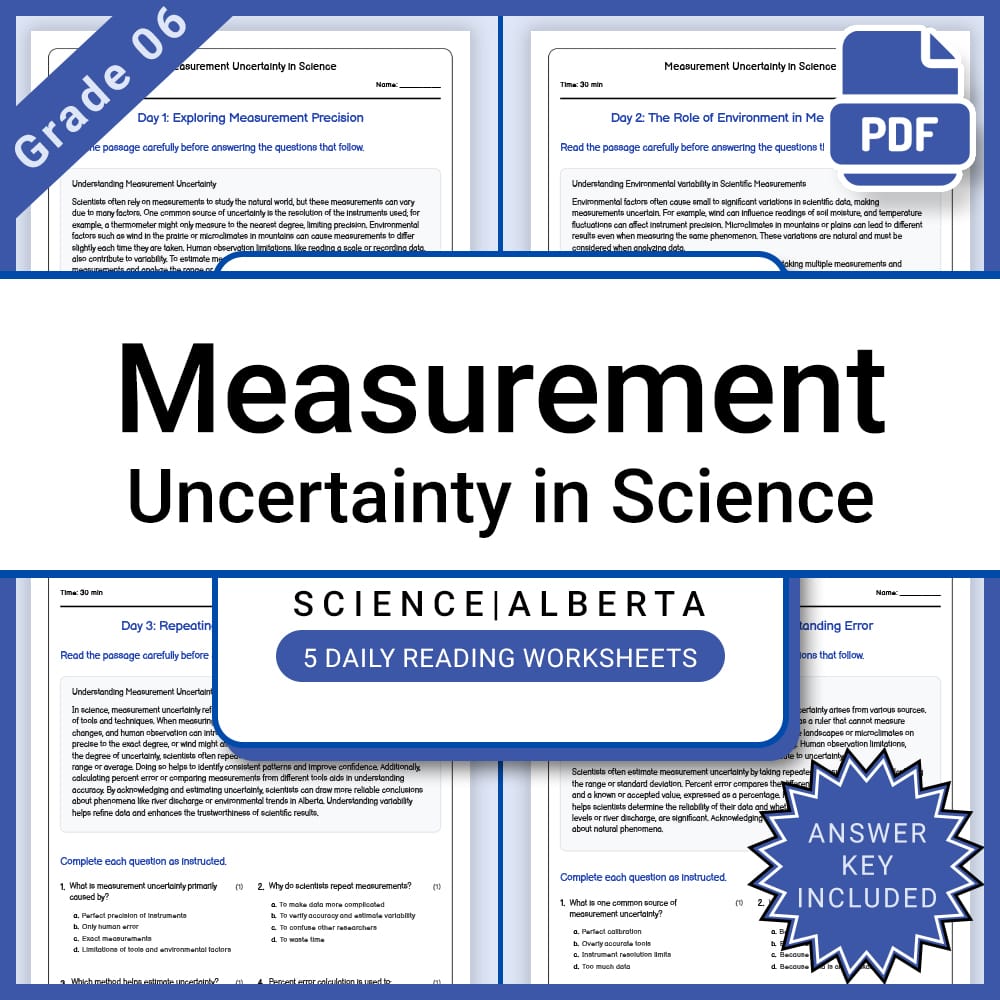
Grade 6 Science – Measurement Uncertainty Daily Reading Worksheet + Answer Key
JCreated byJ.S SheetsLearning Objectives
- Understand what measurement uncertainty is and its sources
- Learn how environmental and human factors influence data variability
- Identify methods used to estimate measurement uncertainty
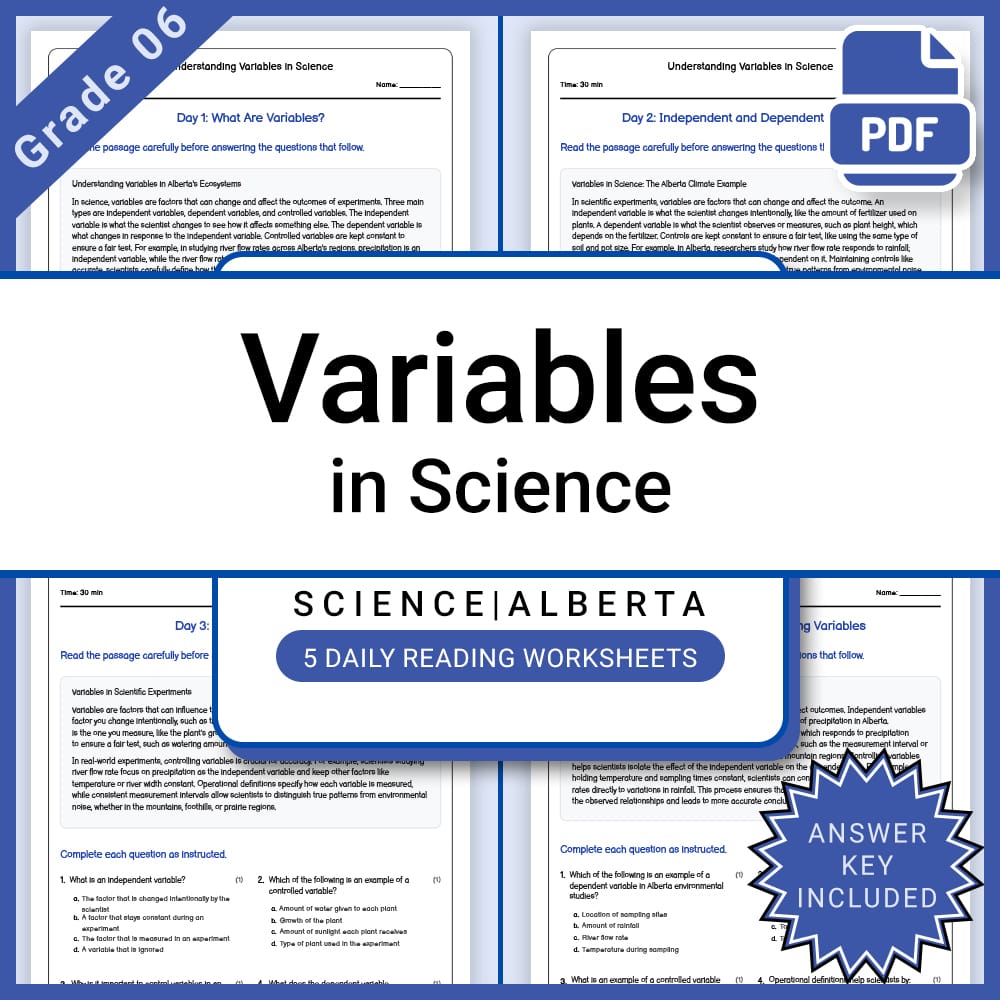
Grade 6 Science – Understanding Variables Daily Reading Worksheet + Answer Key
JCreated byJ.S SheetsLearning Objectives
- Define the different types of variables: independent, dependent, and controlled
- Identify variables in scientific experiments related to Alberta's ecology
- Understand the importance of operational definitions and measurement consistency
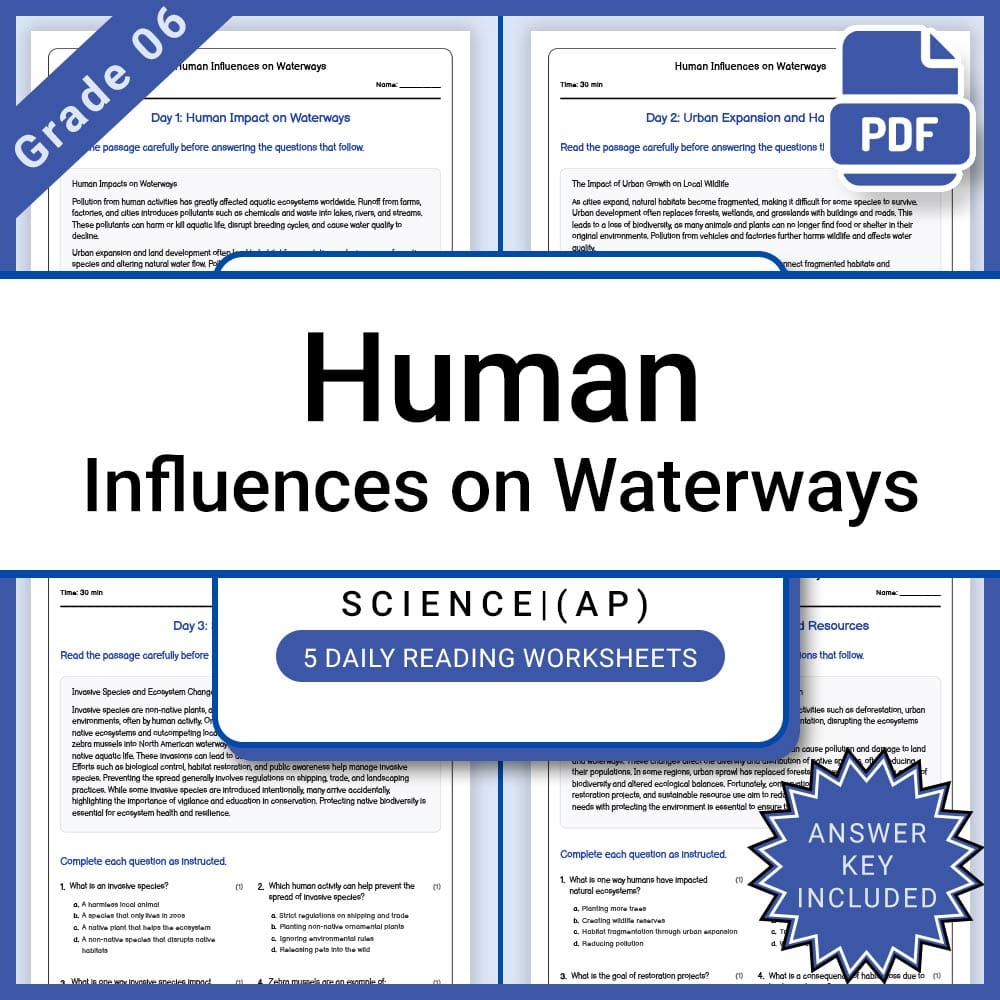
Grade 6 Science – Human Influences on Waterways Worksheet + Answer Key
JCreated byJ.S SheetsLearning Objectives
- Understand how pollution impacts aquatic ecosystems.
- Identify examples of human influence on waterways.
- Learn strategies to reduce pollution and protect water habitats.
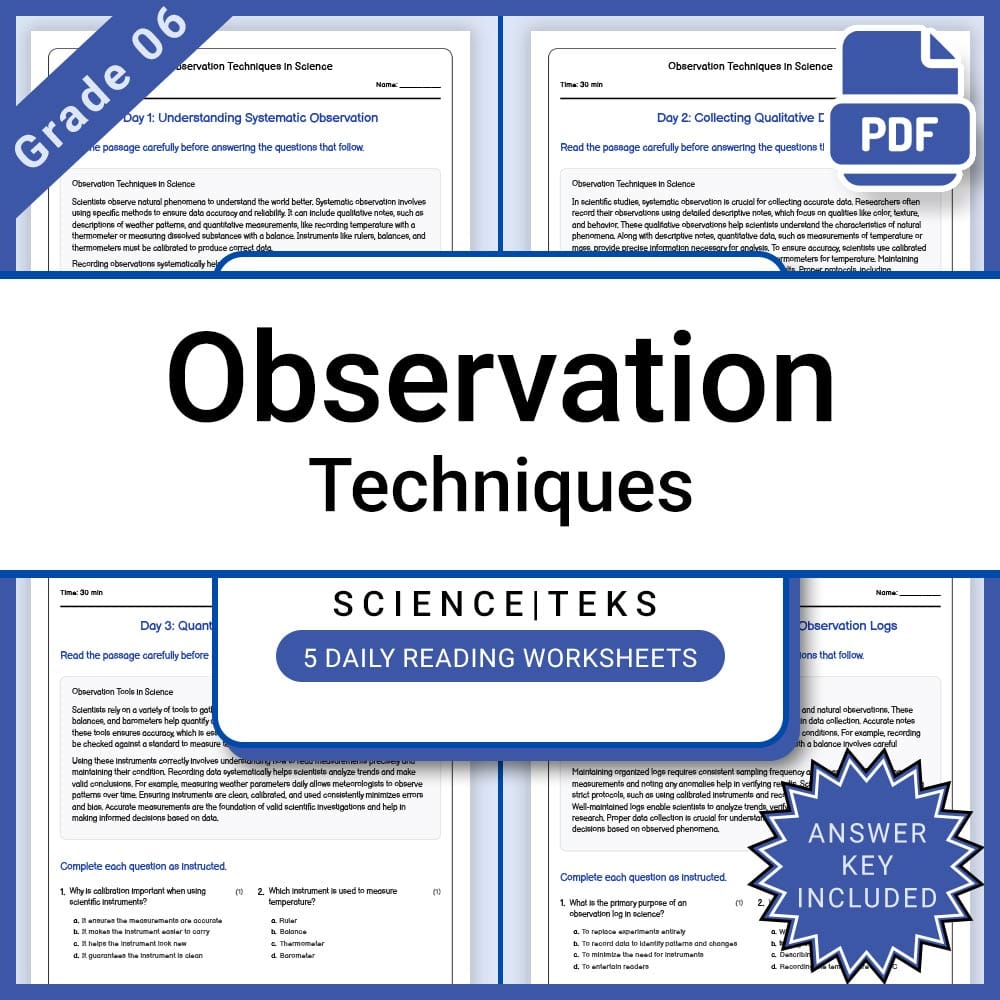
Grade 6 Science Observation Techniques Daily Reading Worksheet with Answer Key
JCreated byJ.S SheetsLearning Objectives
- Understand the concept of systematic observation in scientific studies.
- Differentiate between qualitative notes and quantitative measurements.
- Identify common instruments used in scientific observation such as rulers, balances, and thermometers.
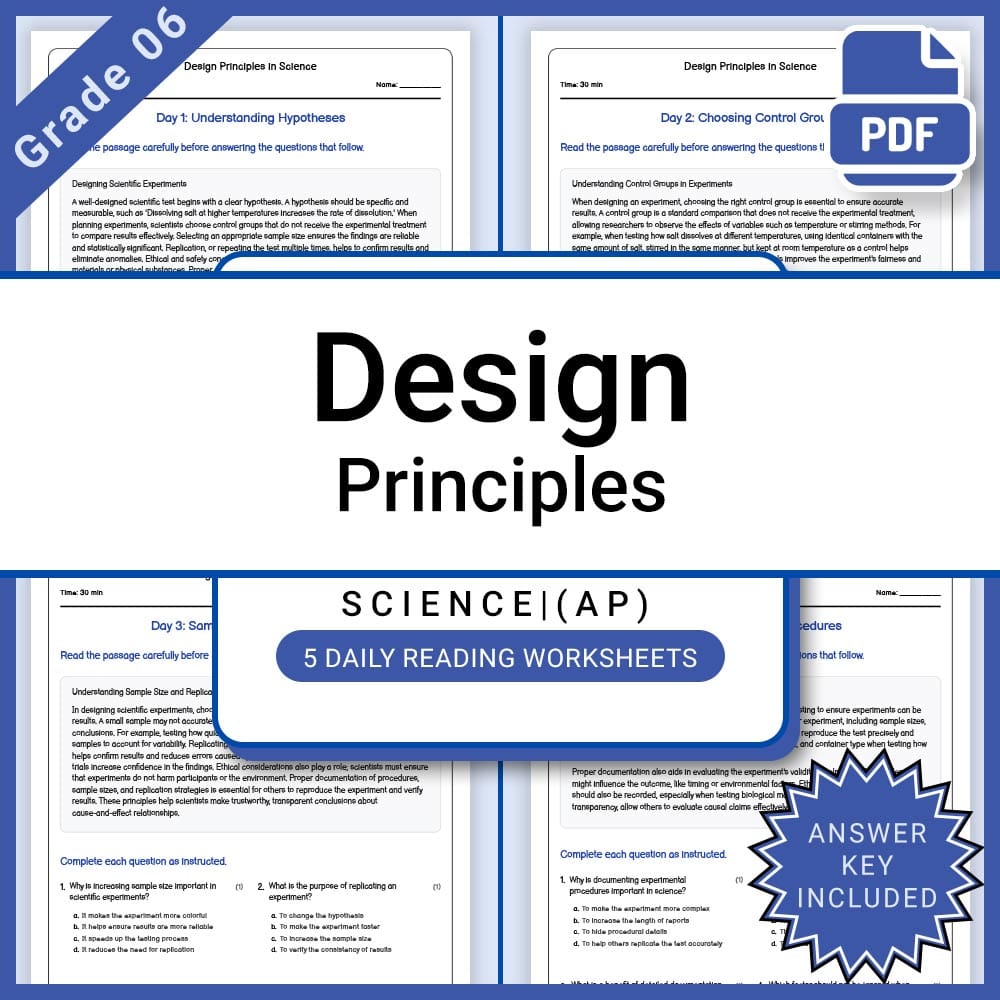
Grade 6 Science – Design Principles Daily Reading Worksheet + Answer Key
JCreated byJ.S SheetsLearning Objectives
- Understand the importance of formulating clear, measurable hypotheses.
- Identify appropriate control groups in experiments.
- Recognize how sample size and replication affect experimental validity.
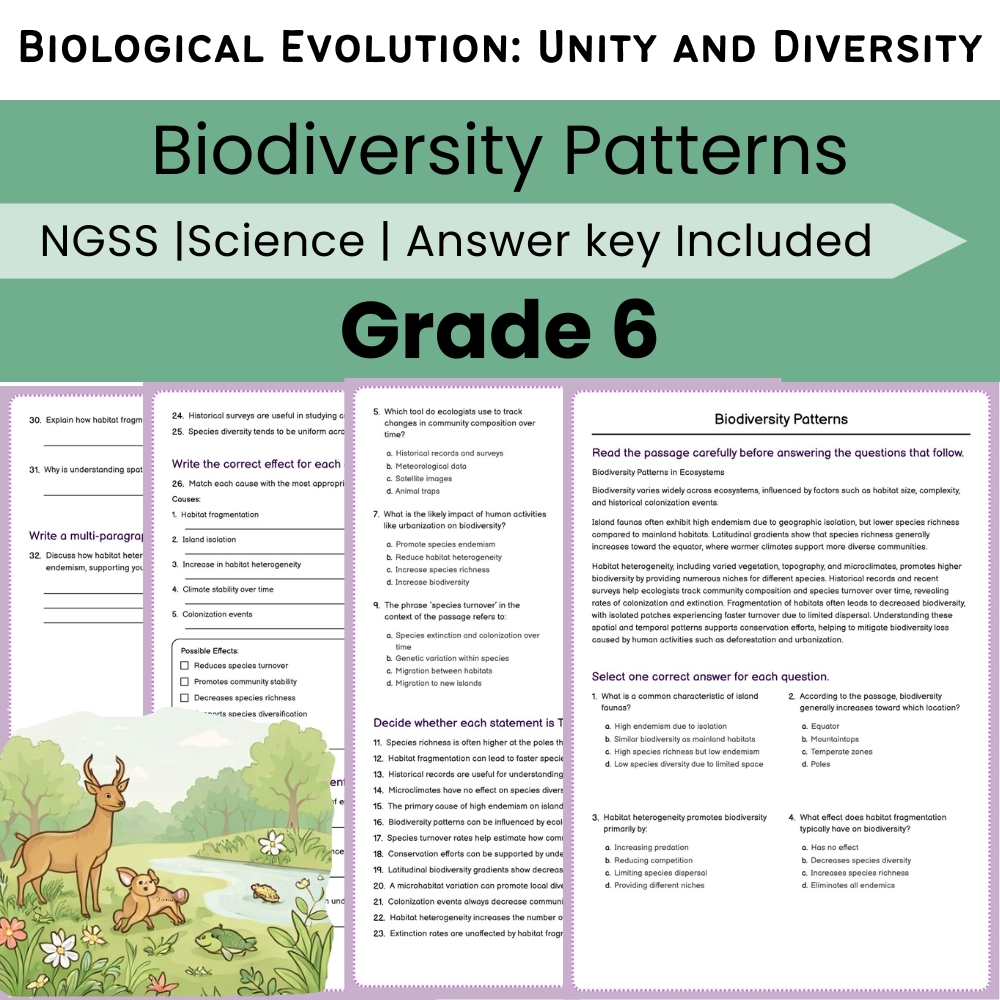
Grade 6 Science | Biodiversity Patterns Worksheet (Printable PDF & Assessment)
Learning Objectives
- Understand how species occurrence and richness reveal biodiversity patterns across ecosystems.
- Compare biodiversity variations in island, latitudinal, and habitat contexts.
- Interpret ecological and historical factors influencing biodiversity distribution.
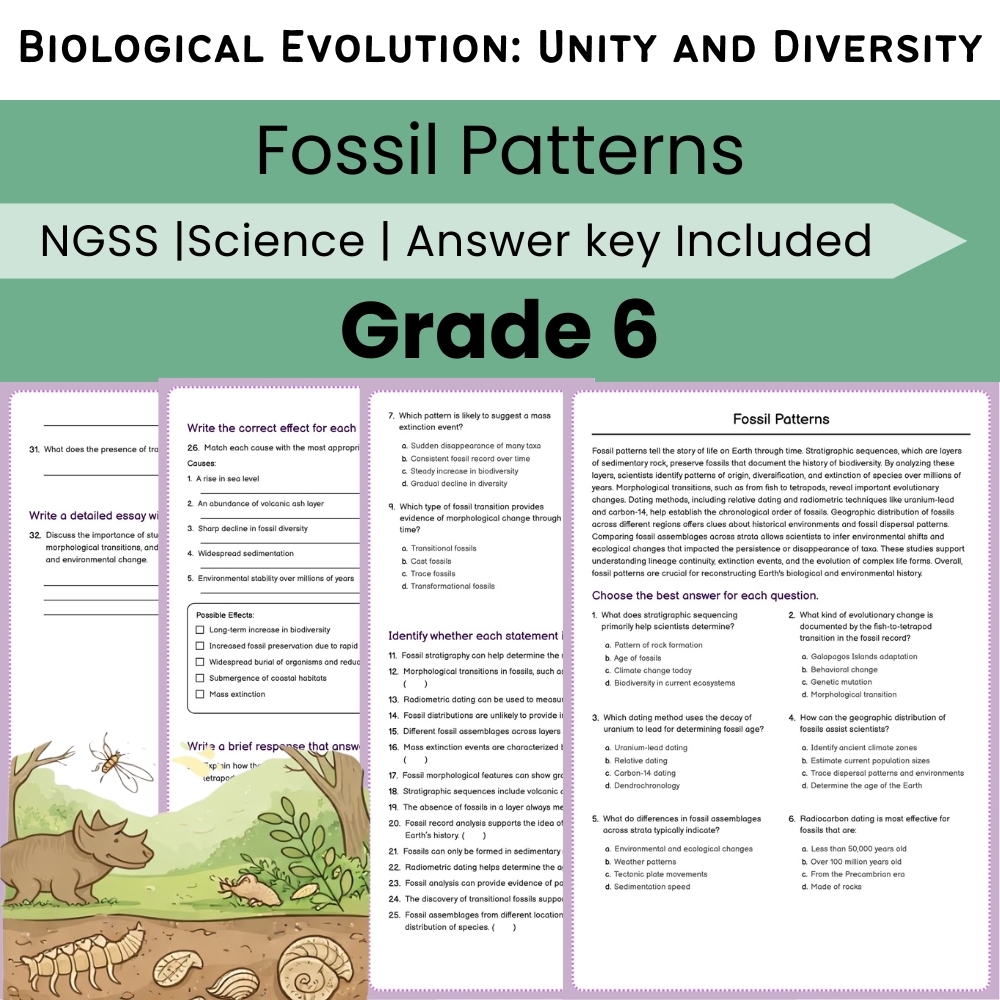
Grade 6 Science | Fossil Patterns Worksheet – NGSS Assessment & Student Practice (Printable PDF)
Learning Objectives
- Analyze fossil occurrences and stratigraphic sequences to understand patterns of origin, diversification, and extinction.
- Identify morphological transitions in the fossil record, such as fish-to-tetrapod examples.
- Use temporal, relative, and radiometric dating methods to determine lineage continuity and turnover.
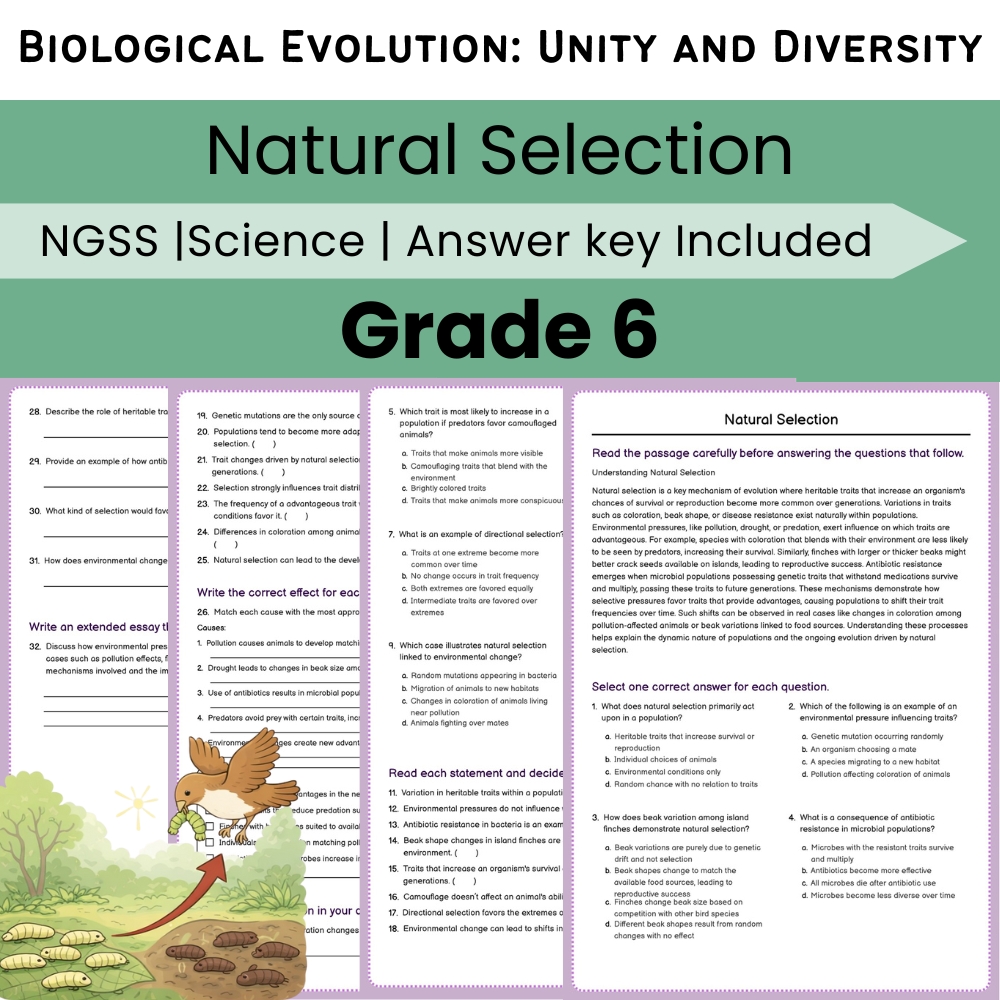
Grade 6 Science | Natural Selection Worksheet & Assessment (Printable PDF)
Learning Objectives
- Understand how heritable traits influence survival and reproduction.
- Identify examples of natural selection in environmental contexts.
- Explain how trait frequencies change over generations due to selection pressures.
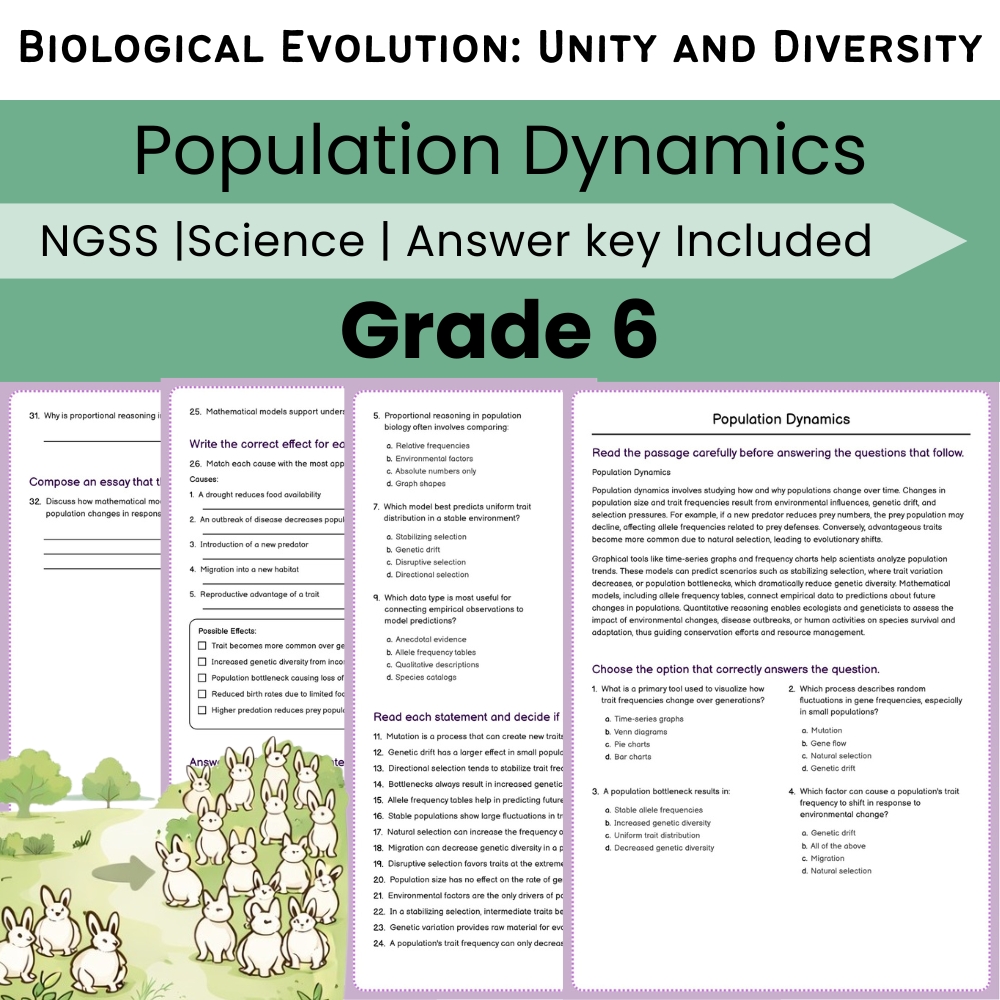
Grade 6 Science | Population Dynamics Worksheet & Assessment - Printable PDF
Learning Objectives
- Understand how trait frequencies change over generations due to environmental factors.
- Interpret proportional reasoning, frequency charts, and graphs in population studies.
- Analyze models predicting population change and the impact of demographic factors.
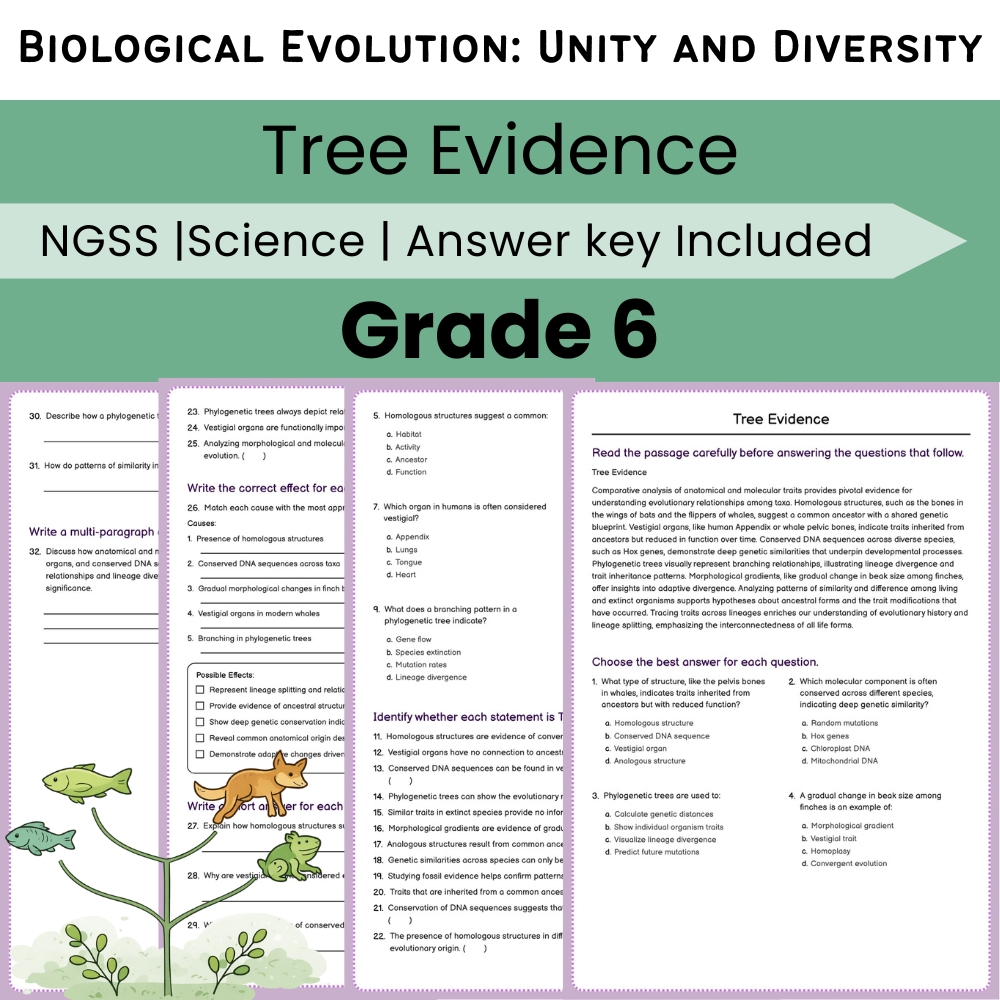
Grade 6 Science | Tree Evidence Worksheet – NGSS Assessment & Student Practice (Printable PDF)
Learning Objectives
- Understand how anatomical and molecular traits provide evidence for common ancestry among taxa.
- Identify homologous structures, vestigial organs, and conserved DNA sequences in different organisms.
- Interpret phylogenetic trees and related evidence to explain lineage splitting and trait inheritance.
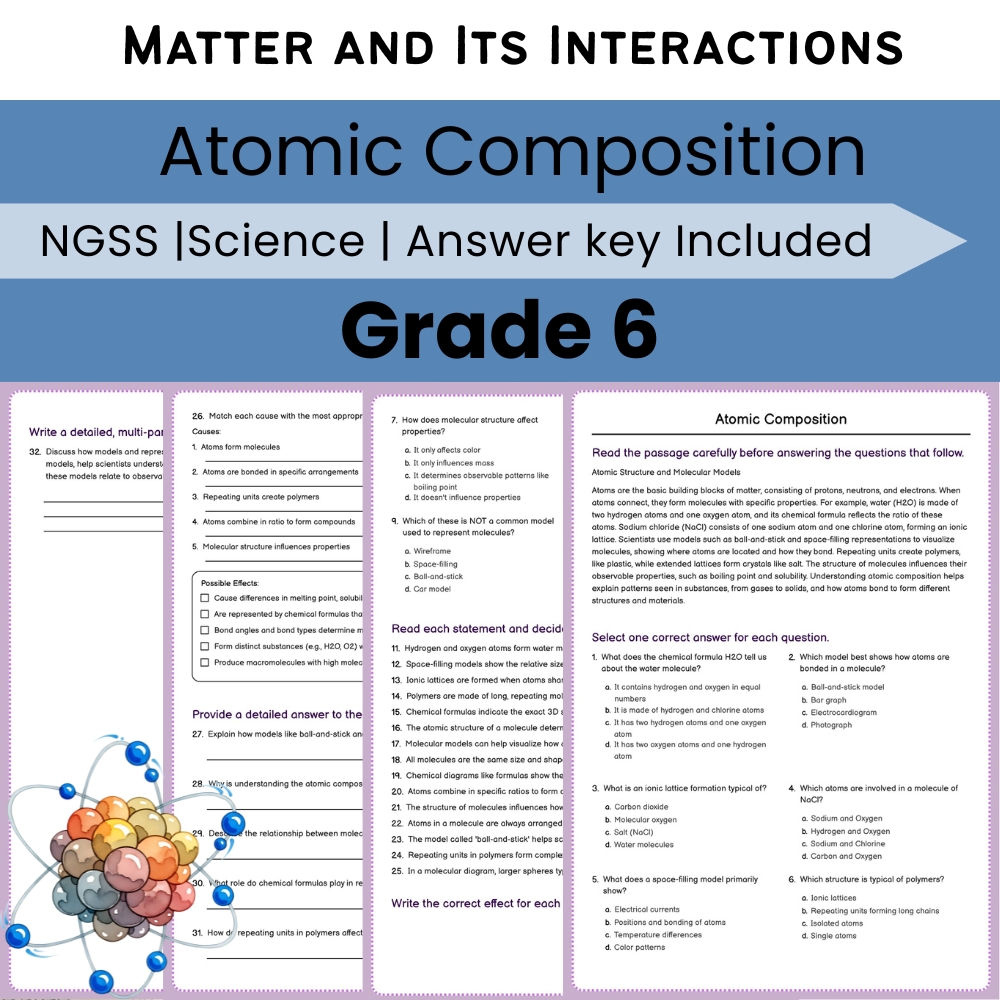
Grade 6 Science | Atomic Composition Worksheet – NGSS Assessment & Student Practice (PDF)
Learning Objectives
- Describe how atoms combine to form simple molecules like H2O and NaCl.
- Use models such as ball-and-stick and space-filling representations to visualize molecules.
- Explain the relationship between molecular structure and observable patterns of matter.
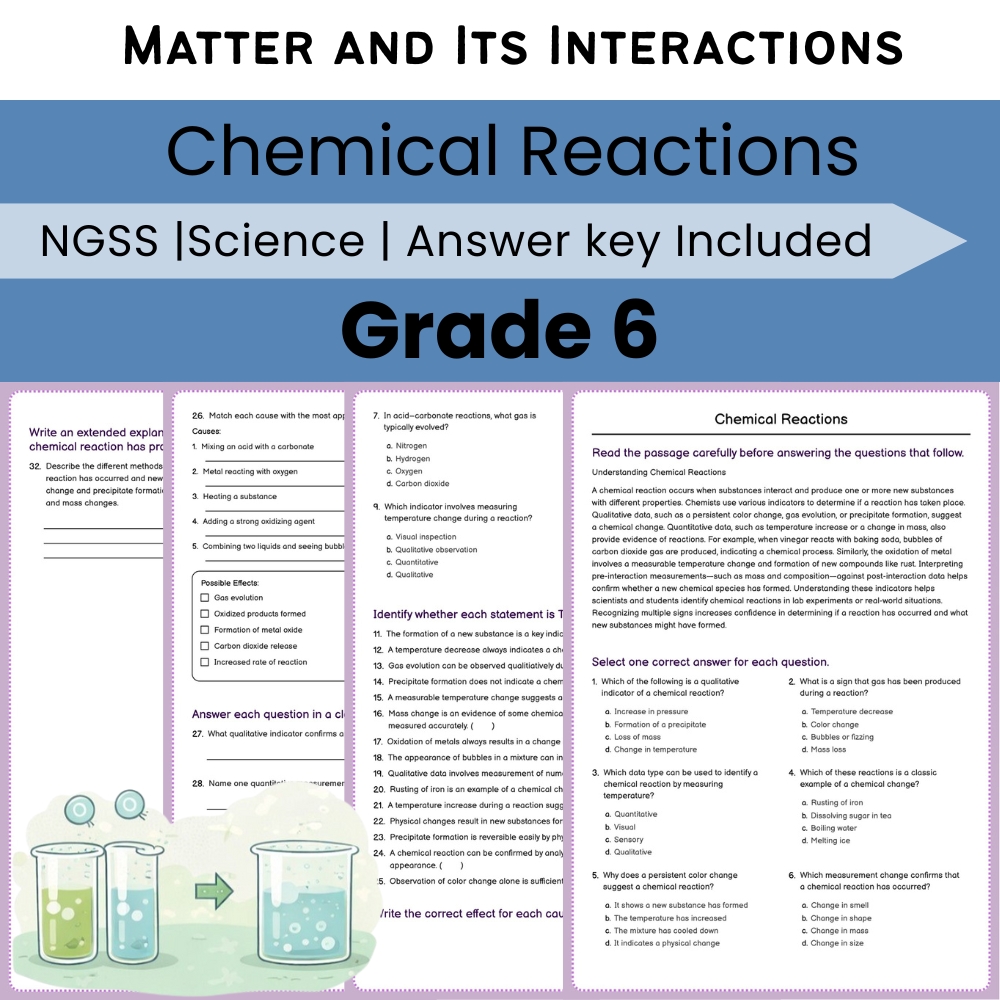
Grade 6 Science | Chemical Reactions Worksheet | Assessment & Student Practice (Printable PDF)
Learning Objectives
- Identify criteria that indicate a chemical reaction has occurred.
- Analyze quantitative and qualitative data to determine if new substances are formed.
- Recognize indicators of chemical reactions such as color change, gas evolution, precipitate formation, and temperature change.
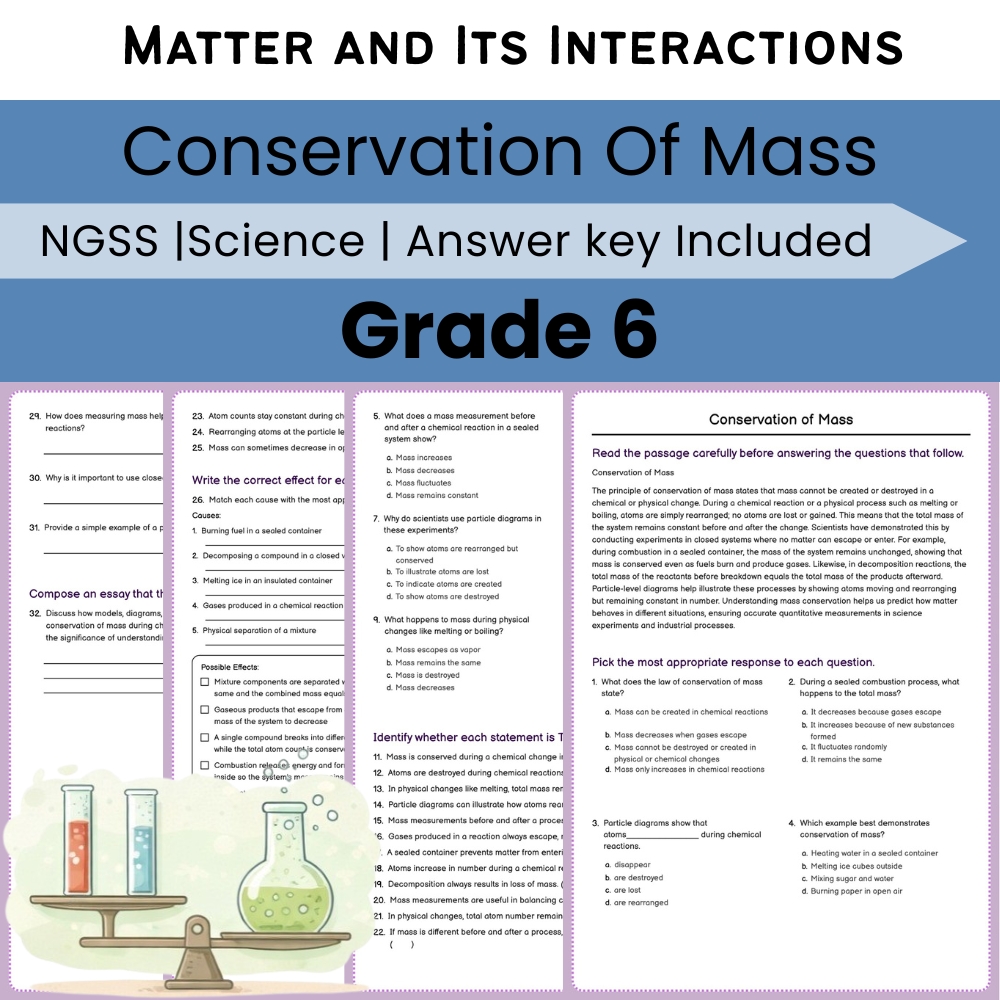
Grade 6 Science | Conservation of Mass Worksheet + Answer Key (Printable PDF)
Learning Objectives
- Understand the principle of conservation of mass in physical and chemical changes.
- Trace atoms and mass during chemical reactions and physical processes.
- Use models and diagrams to demonstrate mass conservation at the particle level.
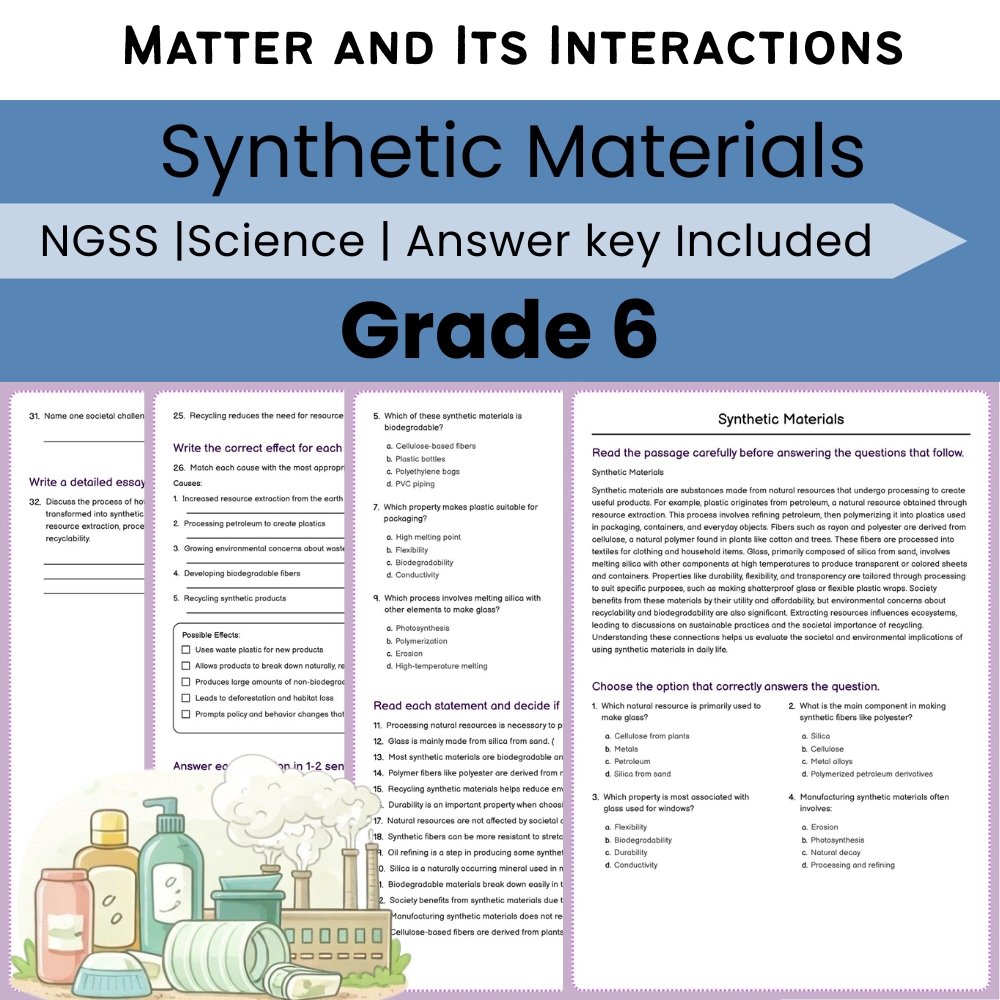
6th Grade Science | Synthetic Materials Worksheet (Printable PDF & Assessment)
Learning Objectives
- Understand the origins and sources of synthetic materials derived from natural resources.
- Compare properties of substances such as plastic, fiber, and glass and relate them to their uses.
- Explain the processes involved in extracting and processing resources for manufacturing.
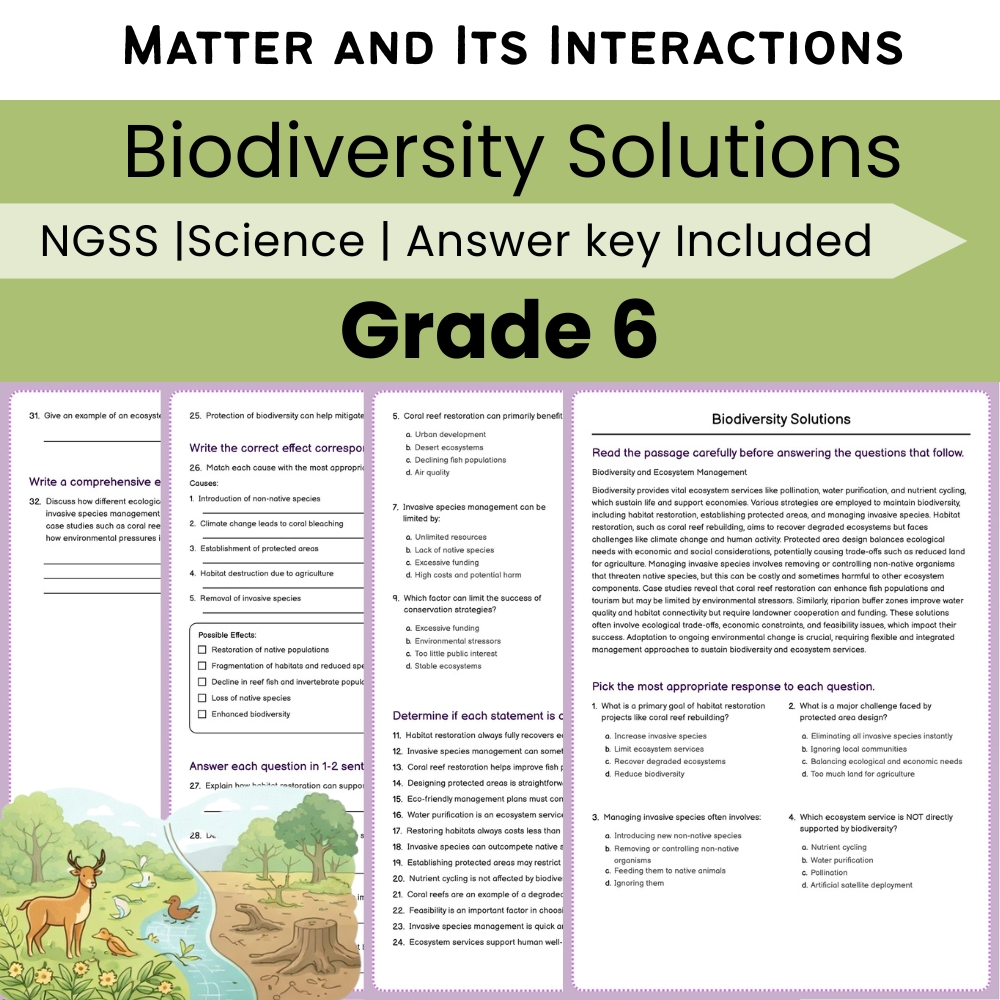
Grade 6 Science | Biodiversity Solutions Worksheet (Printable PDF & Assessment)
Learning Objectives
- Compare different conservation strategies and their ecological trade-offs.
- Analyze case studies such as coral reef restoration and riparian buffer implementation.
- Evaluate the effectiveness of various ecosystem management practices under environmental pressures.
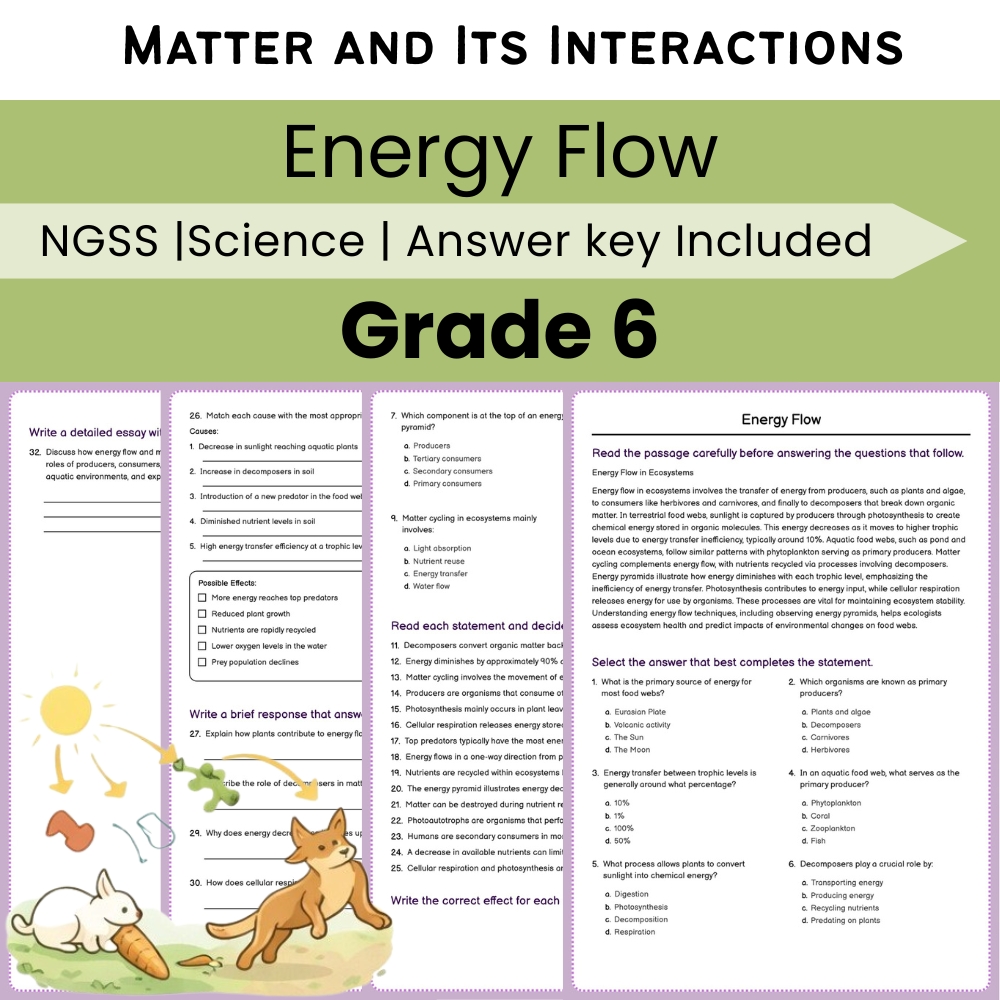
6th Grade Science | Energy Flow Worksheet (Printable PDF + Answer Key)
Learning Objectives
- Explain the components and flow of energy within terrestrial and aquatic food webs.
- Identify producers, consumers, and decomposers and their roles in ecosystems.
- Analyze energy pyramids and understand trophic transfer efficiency.
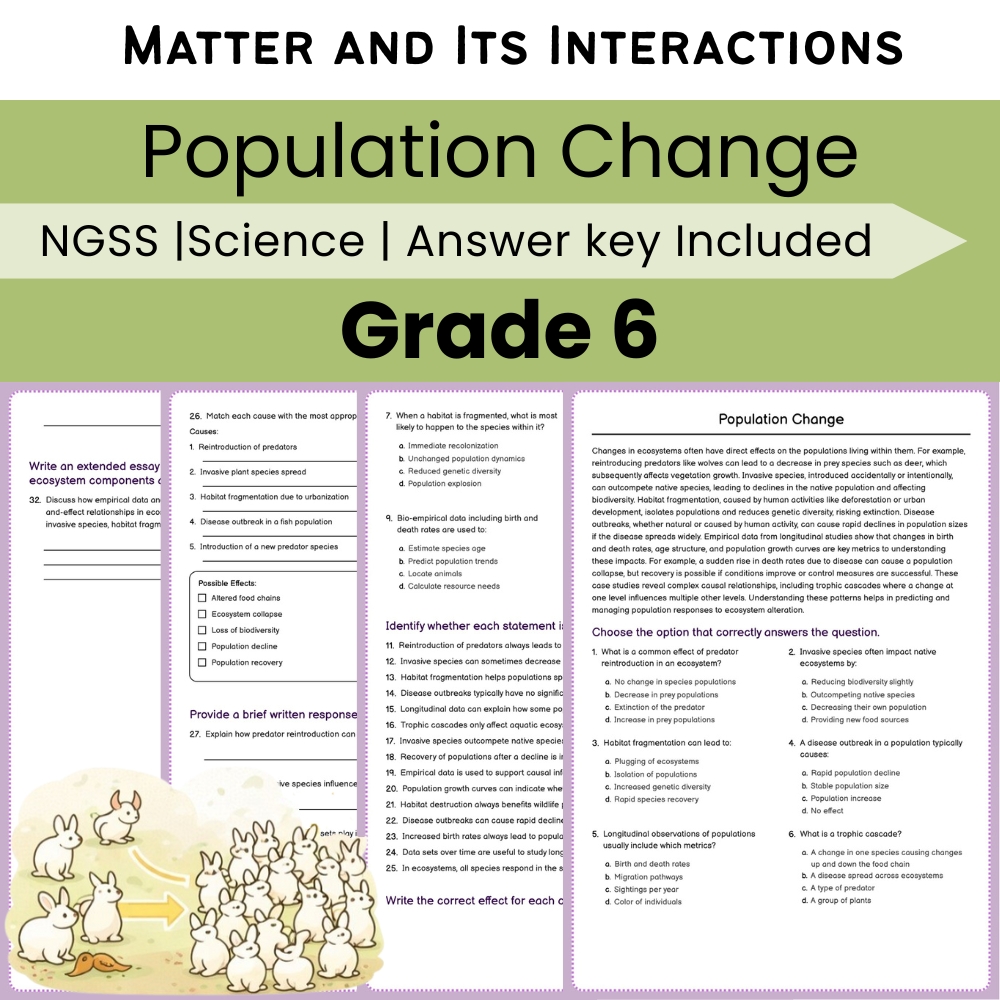
Grade 6 Science | Population Change Worksheet (Printable PDF & Assessment)
Learning Objectives
- Construct evidence-based arguments linking ecosystem component changes to population increases or decreases.
- Analyze case studies such as predator reintroduction, invasive species, habitat fragmentation, and disease outbreaks.
- Interpret empirical data sets and longitudinal observations to infer causality in population responses.
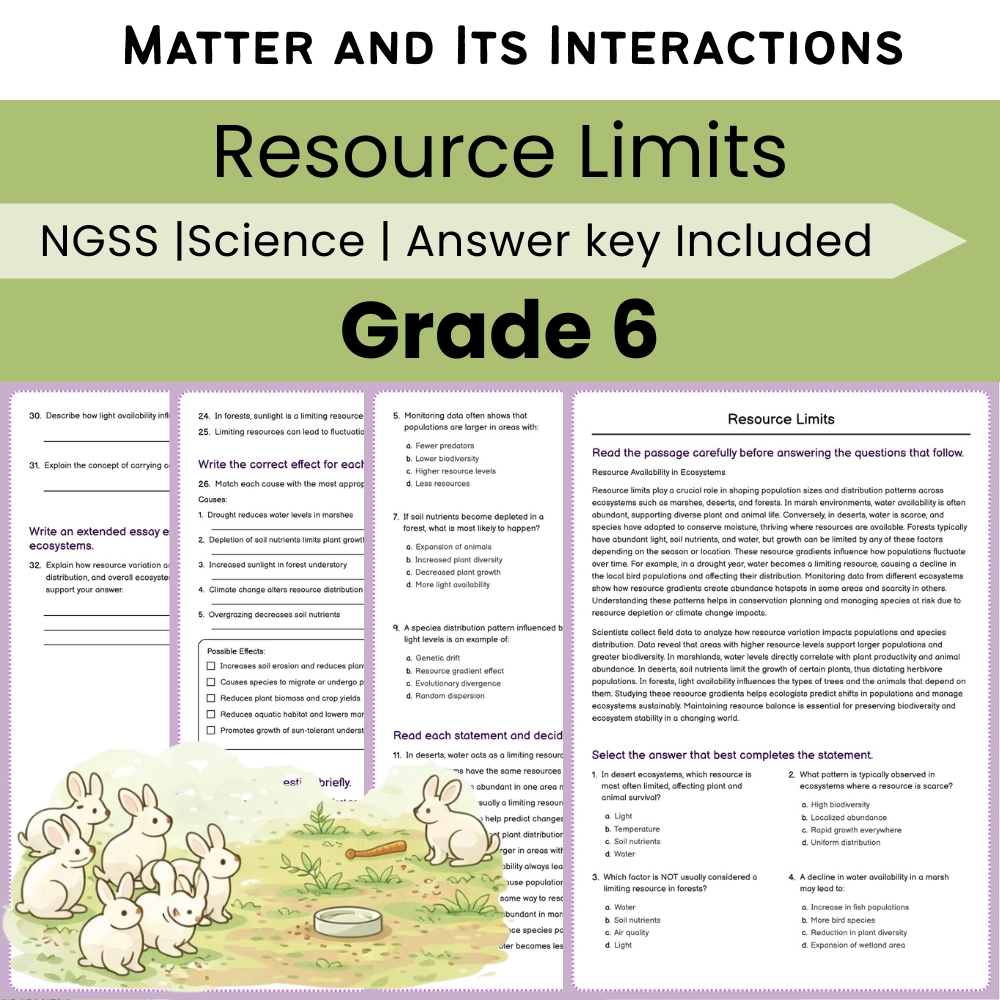
Grade 6 Science | Resource Limits Worksheet – NGSS
Learning Objectives
- Explain how resource availability affects individual organisms and populations.
- Identify limiting resources like water, nutrients, and light in different ecosystems.
- Interpret data patterns related to resource distribution and population trends.
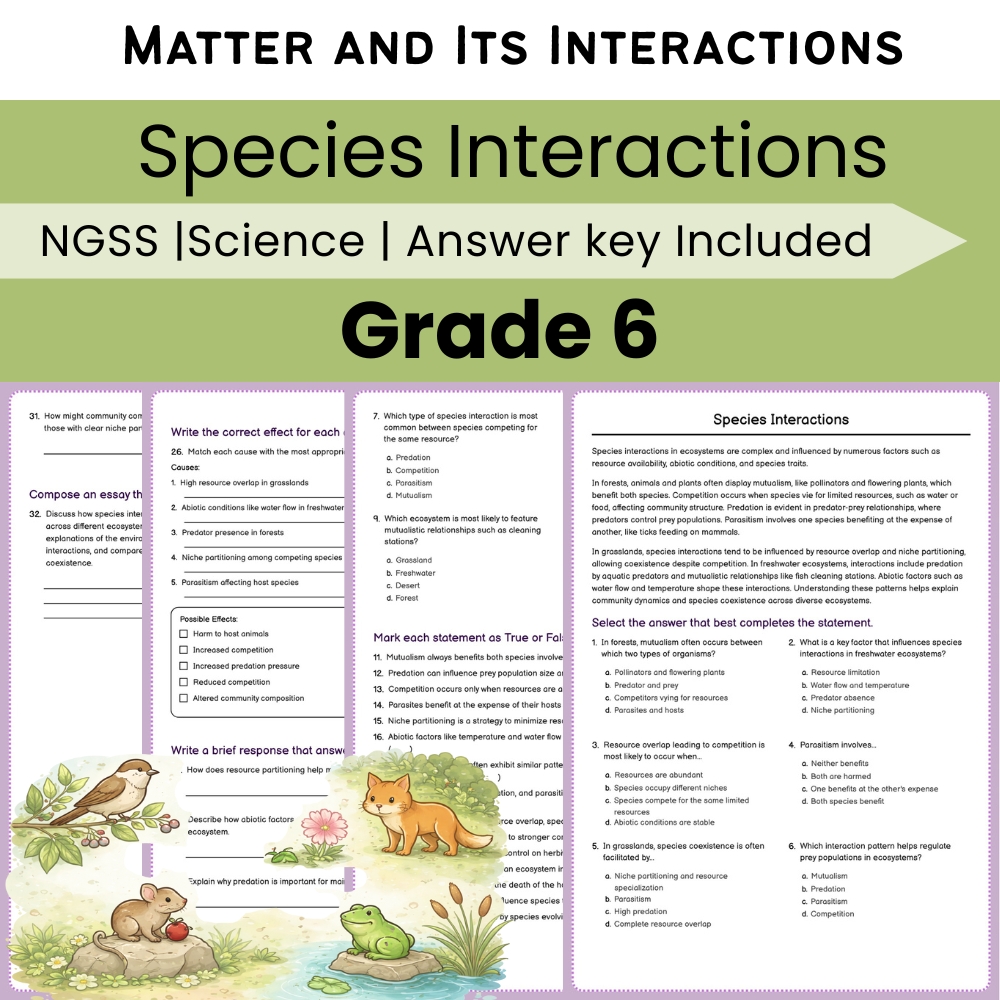
Grade 6 Science | Species Interactions Worksheet (Printable PDF & Assessment)
Learning Objectives
- Construct explanations predicting the patterns of species interactions across different ecosystems.
- Identify and describe key types of species interactions: mutualism, competition, predation, and parasitism.
- Compare interaction outcomes in forest, grassland, and freshwater environments.
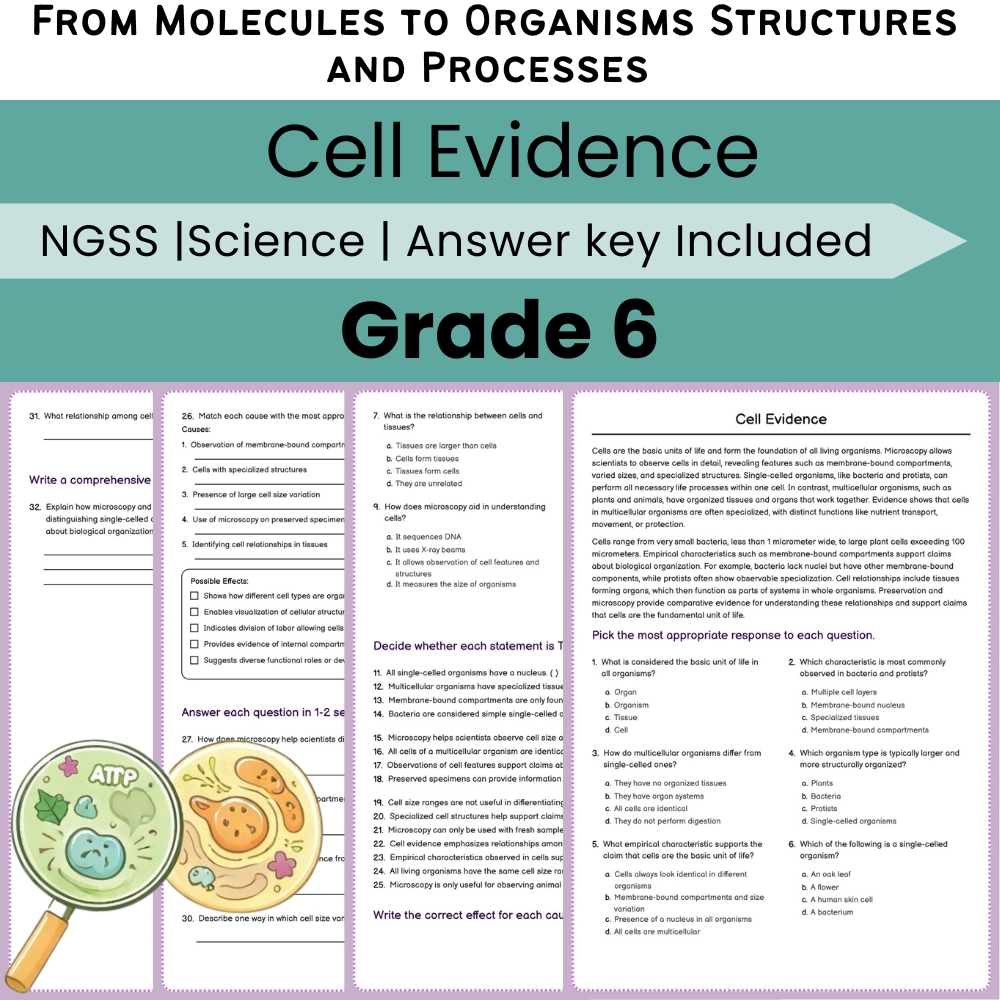
Cell Evidence Worksheet | Grade 6 Science printable PDF | NGSS aligned
Learning Objectives
- Identify observable features that distinguish single-celled and multicellular organisms.
- Understand the relationship between cells, tissues, organs, and whole organisms.
- Recognize empirical characteristics like membrane-bound compartments and cell size ranges.
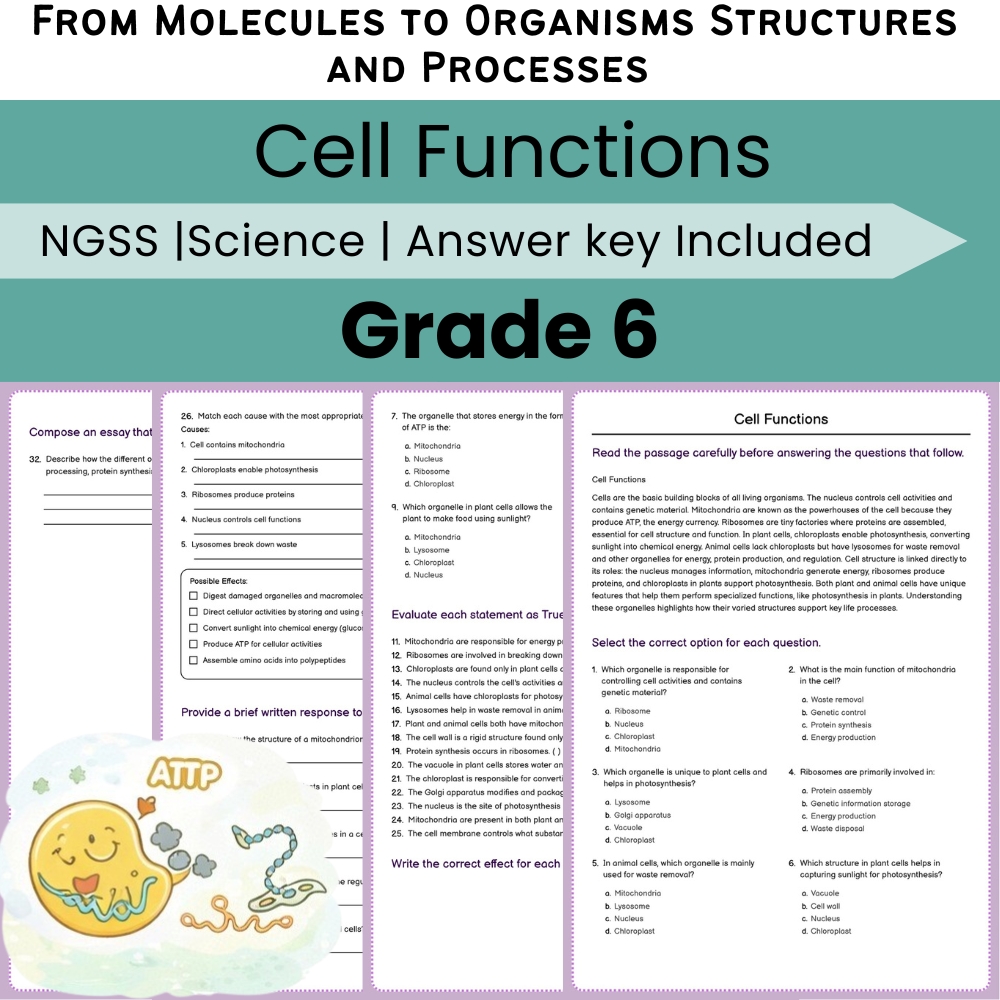
Cell Functions Worksheet | Grade 6 Science printable PDF | assessment
Learning Objectives
- Identify the main organelles of a cell and their functions.
- Understand how cell structure relates to its role in energy production, protein synthesis, and waste removal.
- Compare plant and animal cells to understand specialization of organelles.
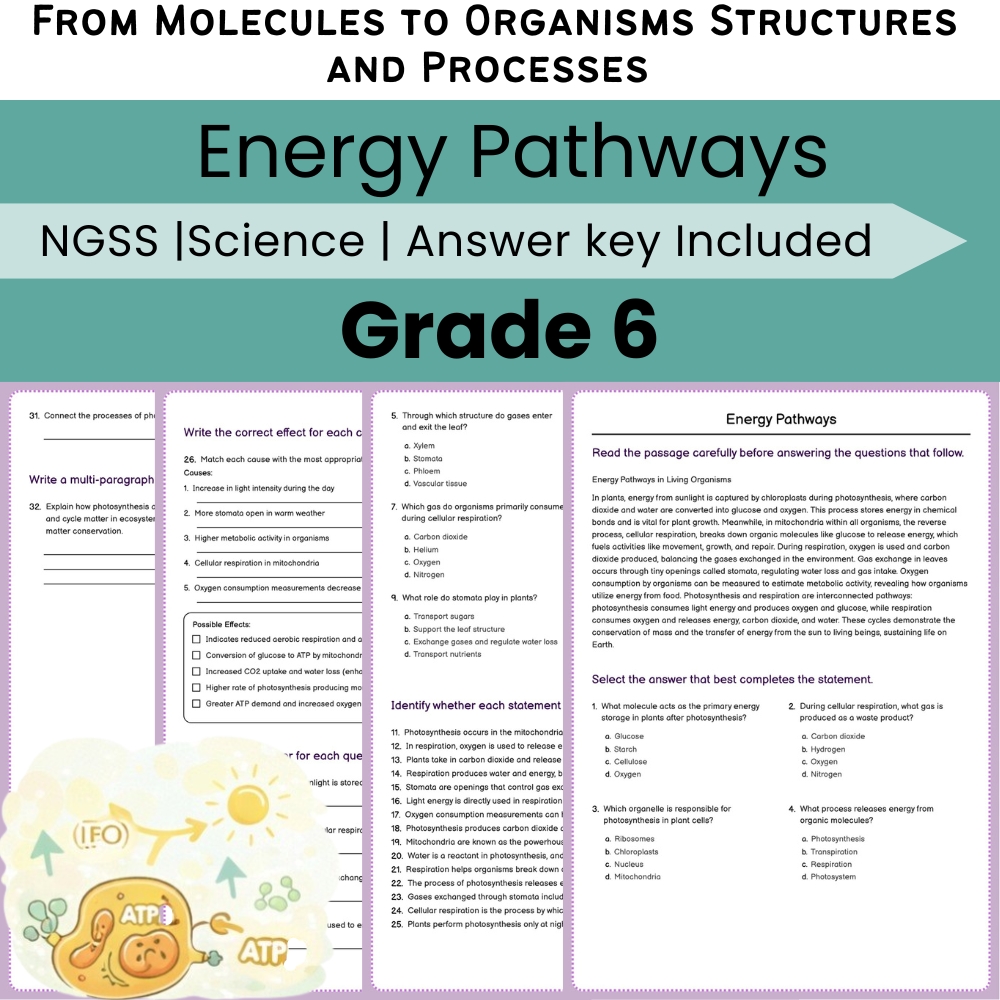
Energy Pathways Worksheet | Grade 6 Science Printable PDF | Assessment
Learning Objectives
- Describe how photosynthesis converts light energy into chemical bonds in plants.
- Explain how cellular respiration releases energy from organic molecules.
- Connect reactants and products involved in photosynthesis and respiration.
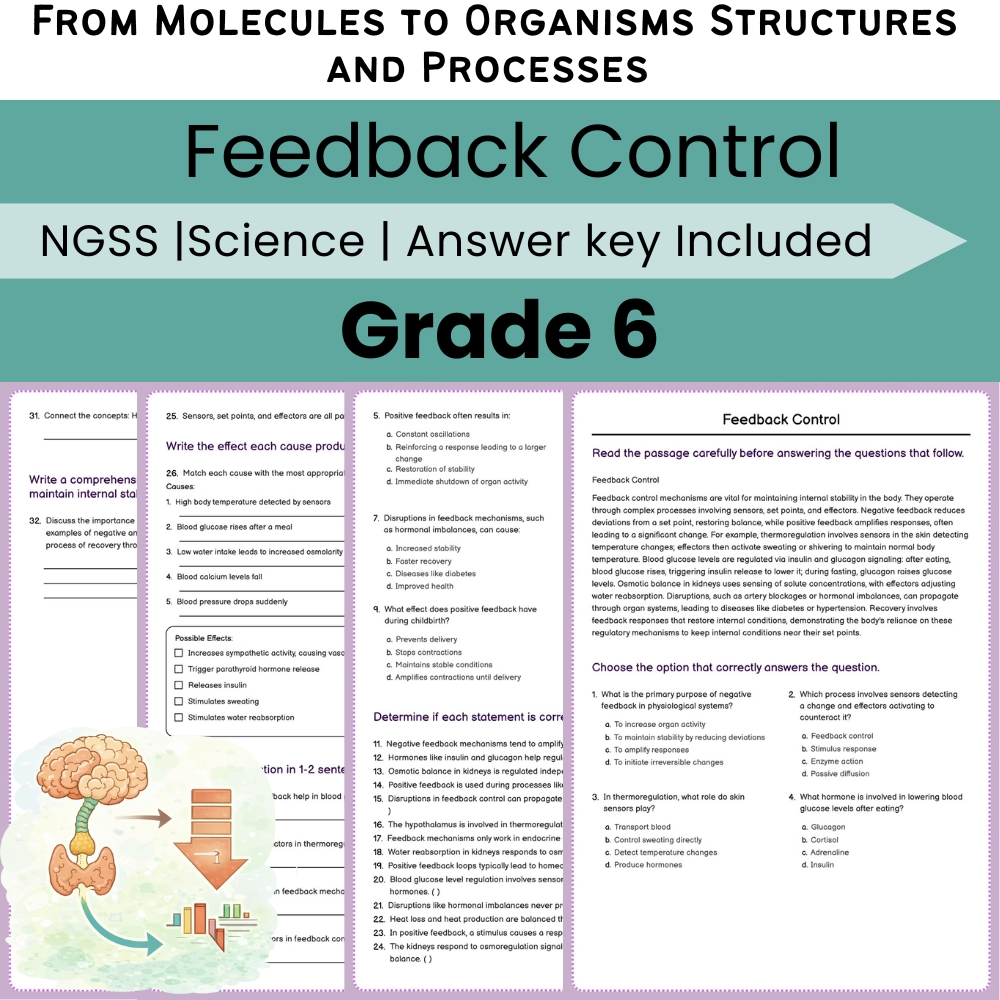
Feedback Control Worksheet | NGSS Grade 6 Science printable PDF
Learning Objectives
- Understand the role of negative and positive feedback in maintaining internal stability.
- Identify examples of feedback mechanisms such as thermoregulation, blood glucose regulation, and osmotic balance.
- Explain how disruptions propagate through organ systems and how recovery occurs.
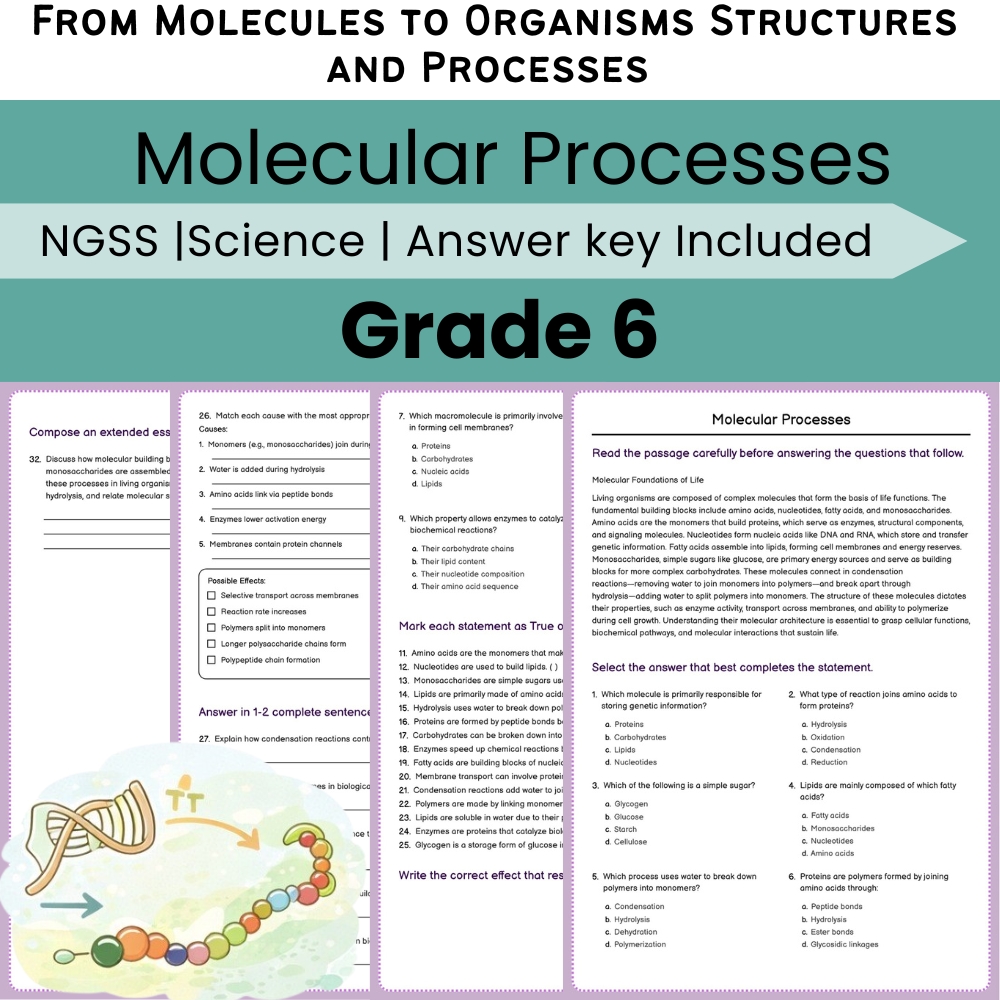
Molecular Processes Worksheet | Science Assessment Grade 6 NGSS Printable PDF
Learning Objectives
- Identify the basic molecular building blocks such as amino acids, nucleotides, fatty acids, and monosaccharides.
- Explain how monomers assemble into polymers through condensation reactions and break down by hydrolysis.
- Relate molecular structure to properties like enzymatic activity, membrane transport, and polymerization.
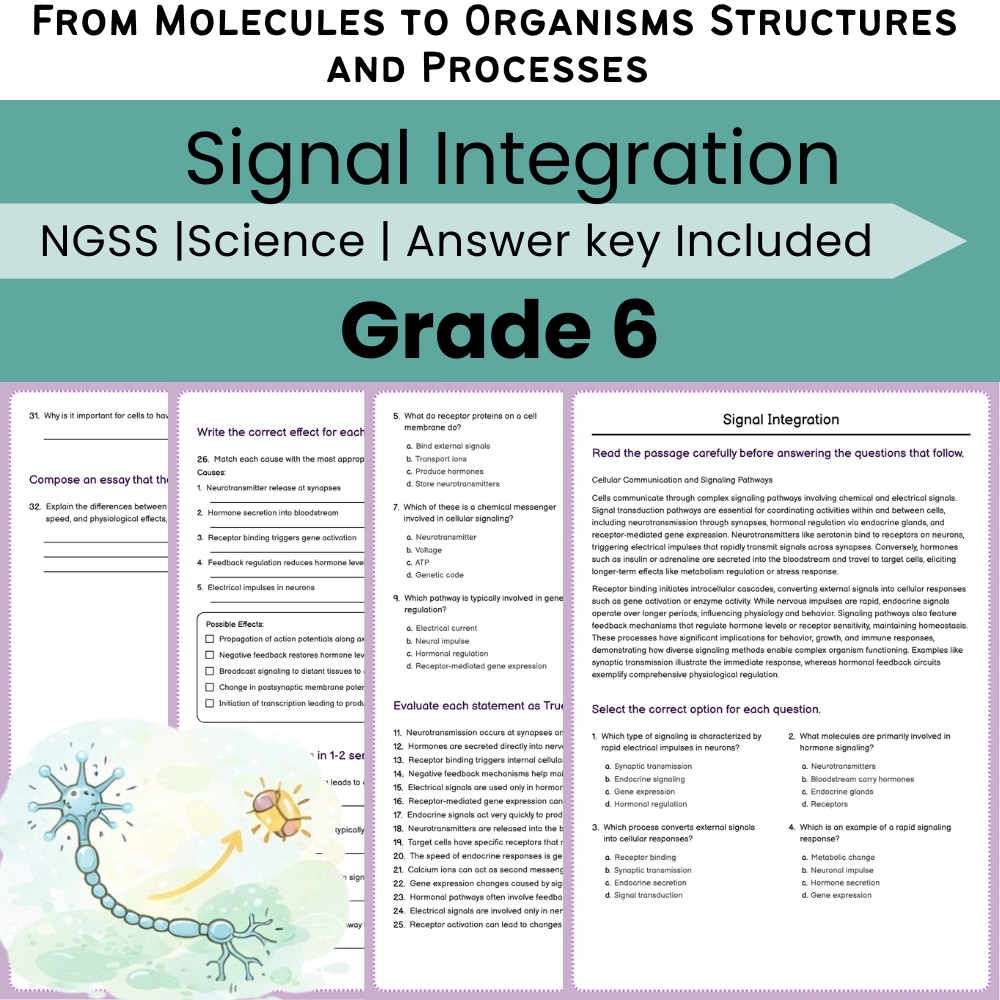
Signal Integration Worksheet | NGSS Grade 6 Science printable PDF
Learning Objectives
- Explain how cells communicate through chemical and electrical signals.
- Describe pathways such as neurotransmission, hormonal regulation, and signal transduction cascades.
- Compare rapid nerve impulses with slower endocrine responses.
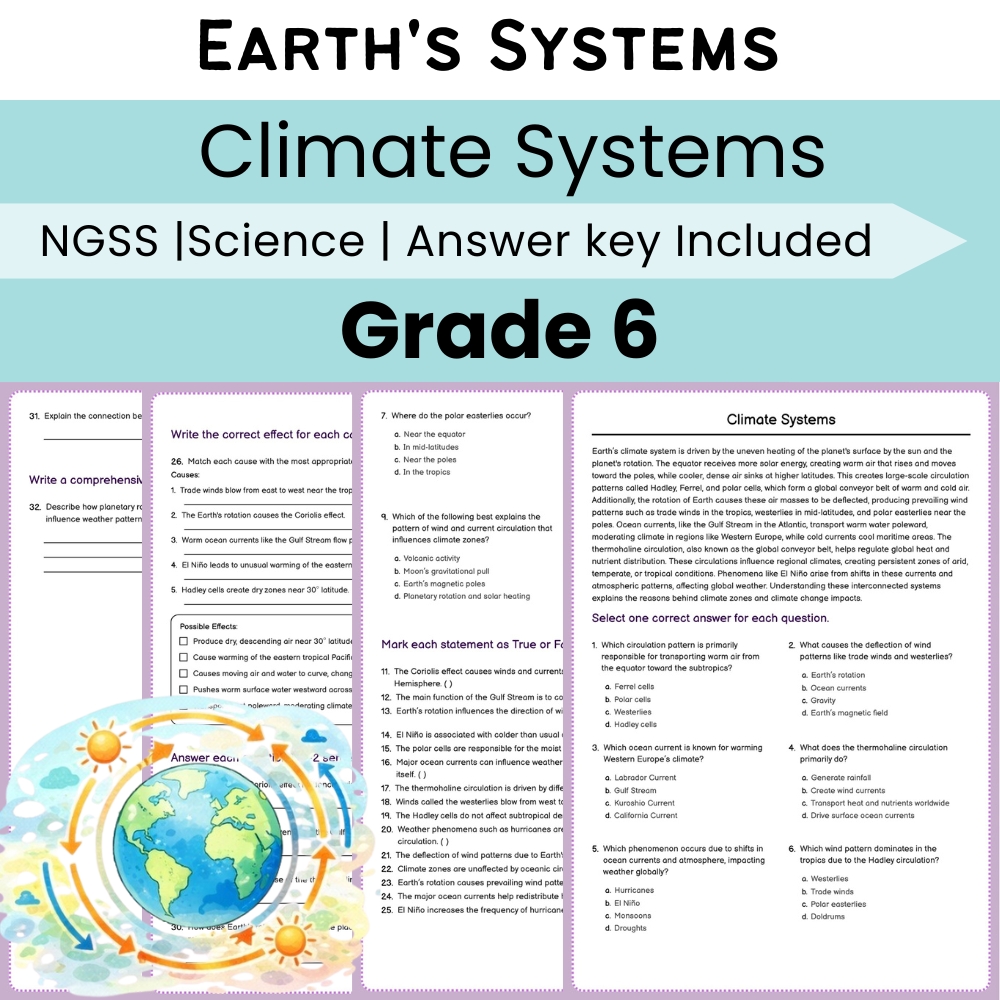
Climate Systems Worksheet | Science Assessment for Grade 6 NGSS Standards
Learning Objectives
- Explain how unequal solar heating and Earth's rotation give rise to global atmospheric and oceanic circulation patterns.
- Identify key circulation models like Hadley, Ferrel, and polar cells, and describe their effects on climate zones.
- Understand major wind patterns such as trade winds and westerlies and their influence on regional climates.
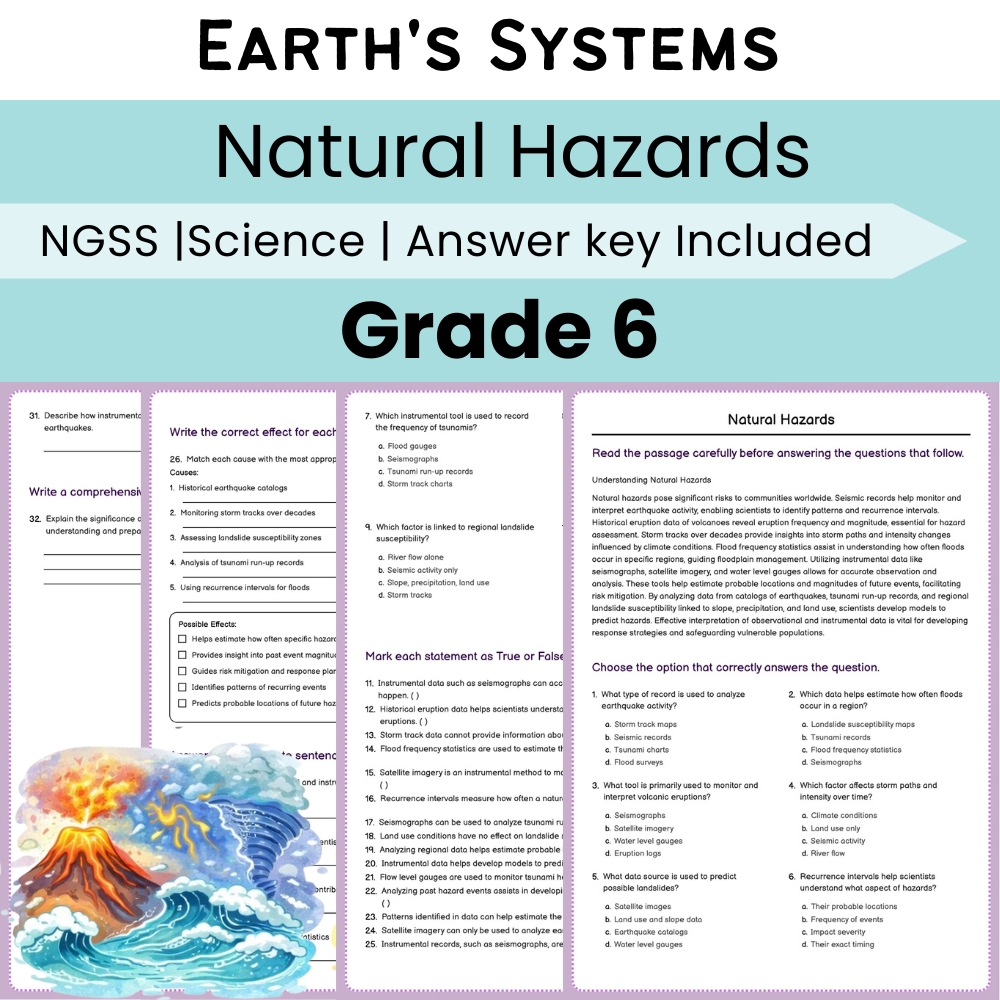
Natural Hazards Worksheet | Science Assessment for Grade 6 NGSS Printable PDF
Learning Objectives
- Understand how scientists analyze observational and instrumental data related to natural hazards.
- Identify patterns and recurrence intervals of events like earthquakes, tsunamis, and floods.
- Assess probable locations and magnitudes of natural hazards to inform risk management.
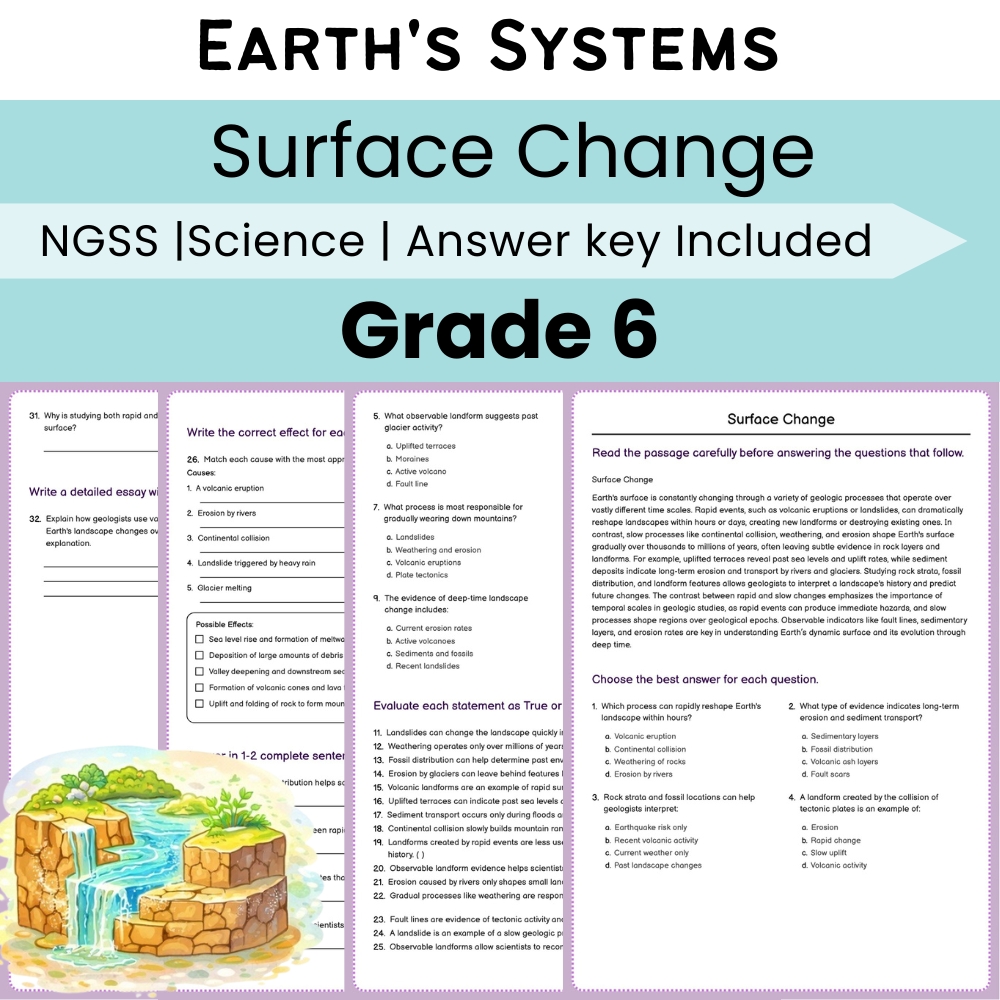
Surface Change Worksheet | NGSS Grade 6 Science printable PDF
Learning Objectives
- Understand various geological processes that alter Earth's surface over time.
- Identify observable indicators in rock and landforms that reveal landscape evolution.
- Differentiate between rapid and slow earth surface events.
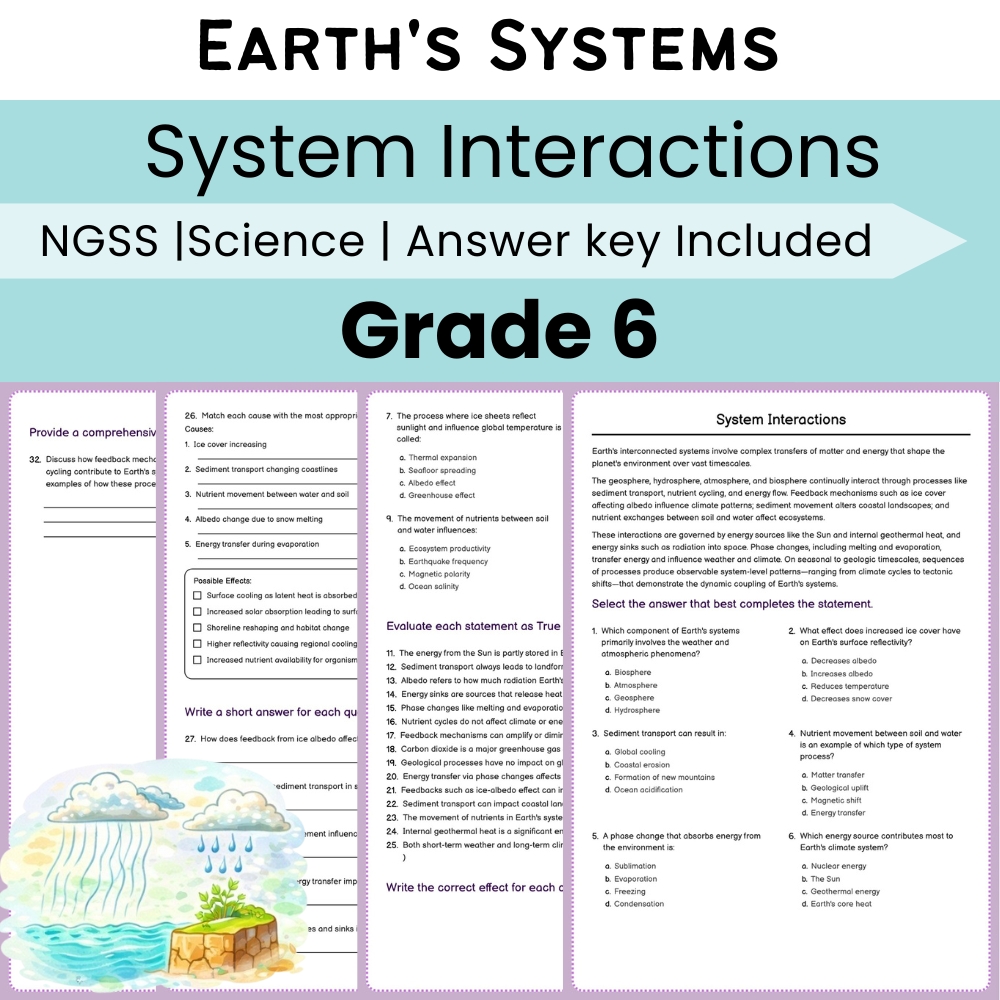
System Interactions Science Worksheet | NGSS Grade 6 Science printable PDF
Learning Objectives
- Describe how Earth's systems transfer matter and energy among the geosphere, hydrosphere, atmosphere, and biosphere.
- Identify feedback mechanisms such as albedo changes, sediment transport, and nutrient cycles.
- Explain how energy sources, sinks, and phase changes influence environmental patterns across time scales.
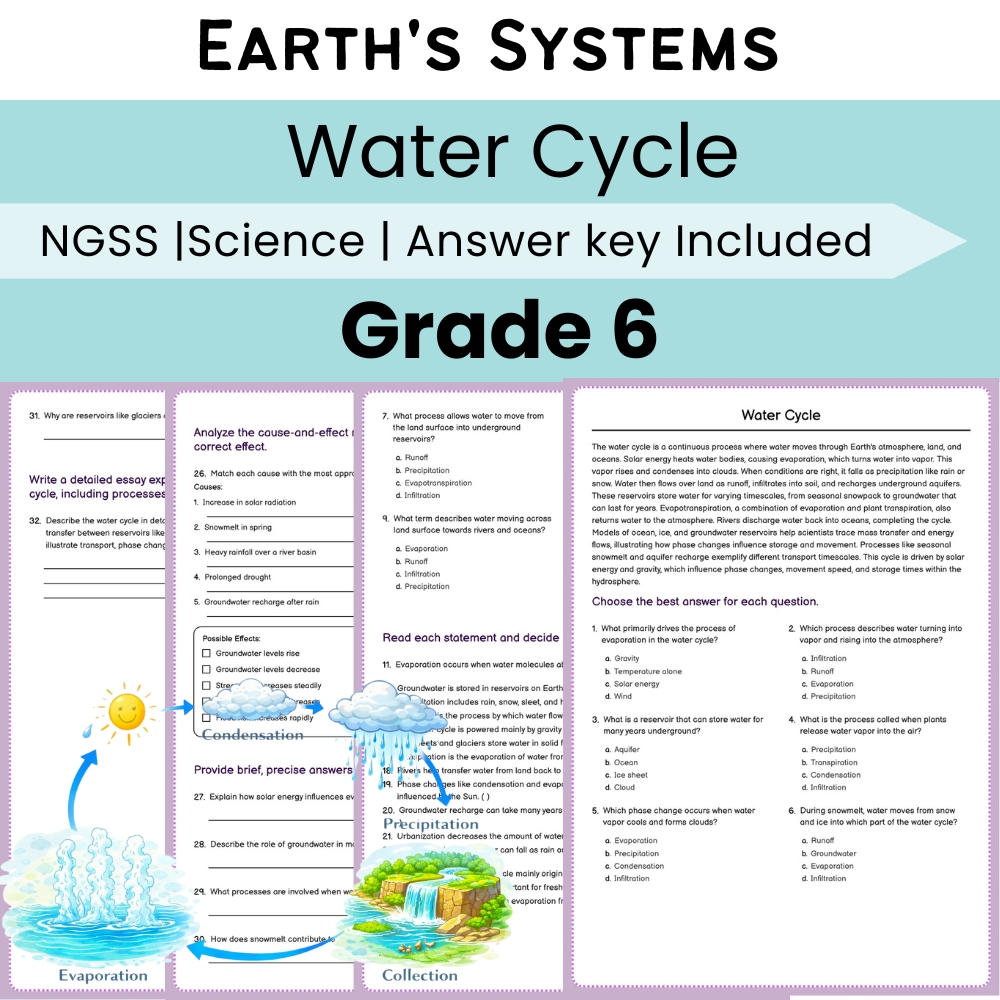
Water Cycle Worksheet | Science Assessment for Grade 6 | NGSS Standards
Learning Objectives
- Describe the processes involved in the water cycle, including evaporation, condensation, precipitation, runoff, infiltration, and groundwater storage.
- Explain how solar energy and gravity drive the water cycle processes.
- Identify and interpret models of reservoirs like oceans, ice, and groundwater in the context of water transfer and energy flow.
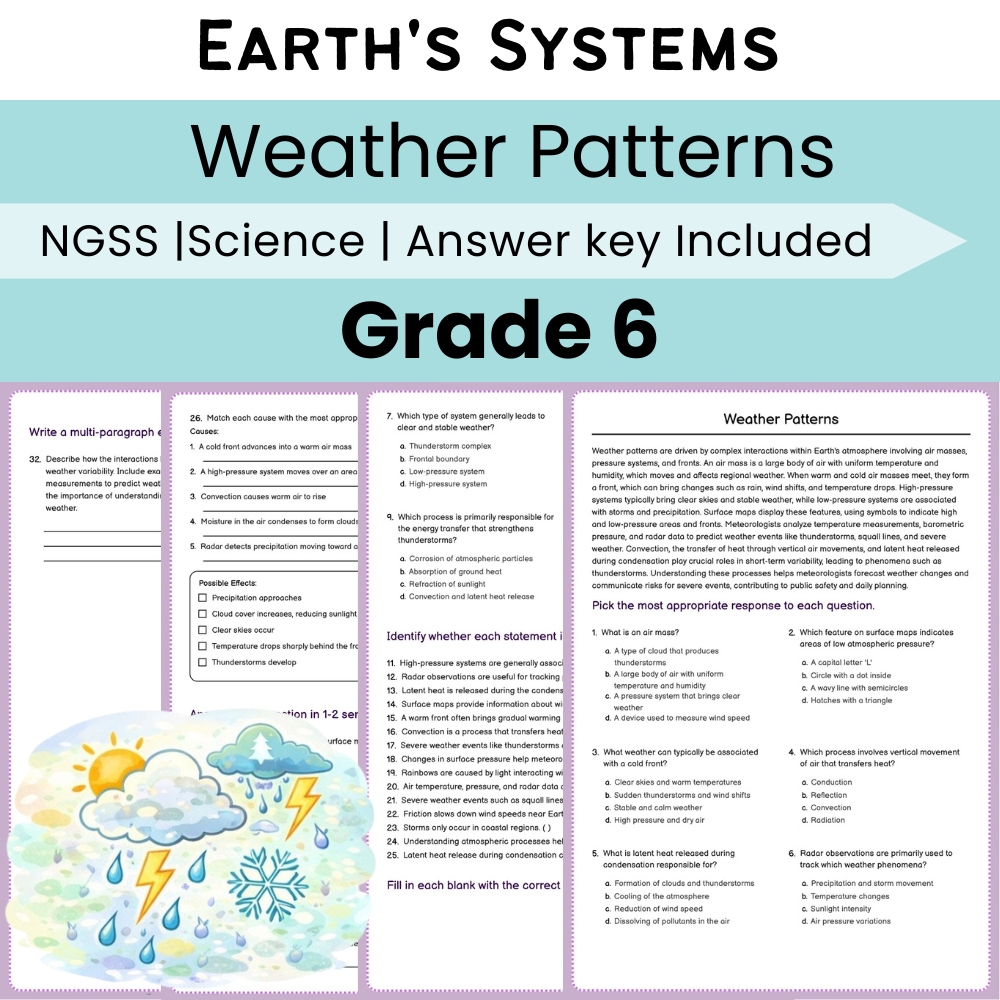
Weather Patterns Worksheet | NGSS Grade 6 Science printable PDF
Learning Objectives
- Describe atmospheric processes that produce local and regional weather.
- Interpret surface maps, temperature, and pressure measurements to analyze weather events.
- Explain how convection and latent heat release influence short-term weather variability.
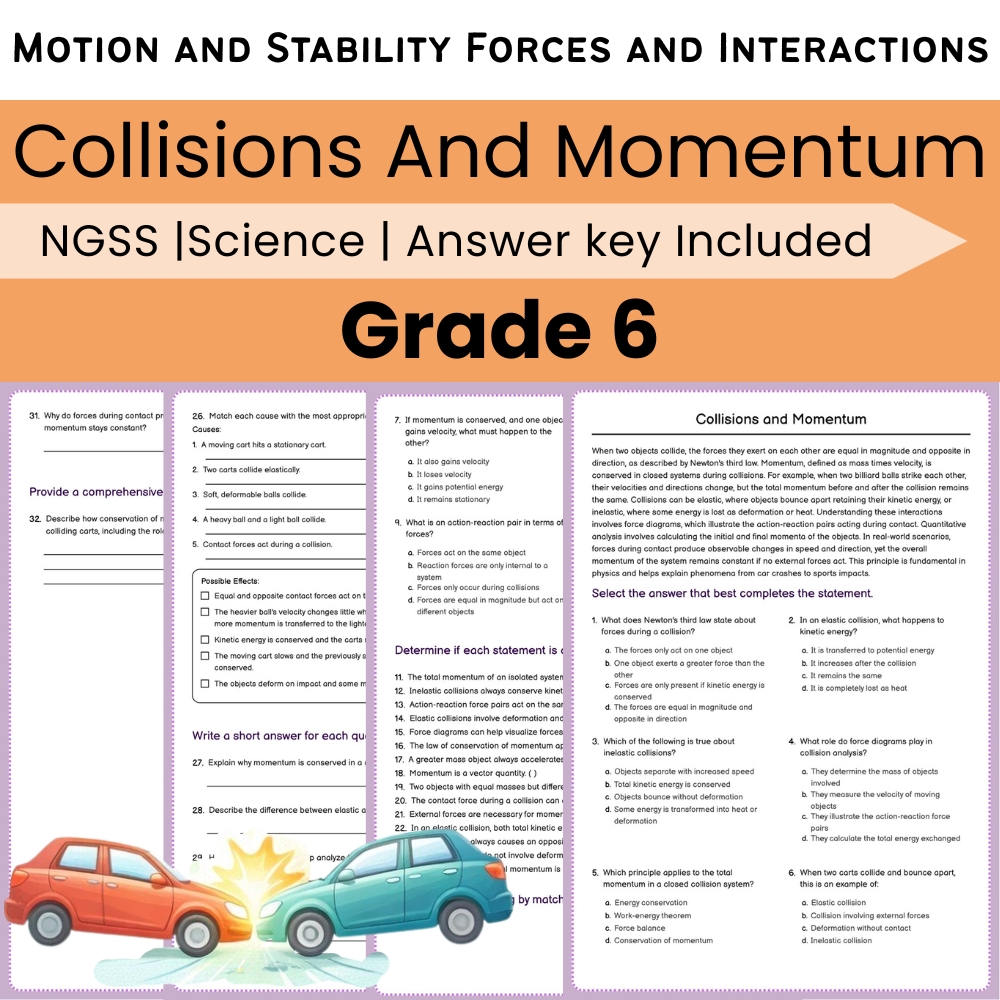
Collisions and Momentum Worksheet | Grade 6 Science NGSS Printable PDF
Learning Objectives
- Understand the law of conservation of momentum during two-body collisions.
- Identify the differences between elastic and inelastic collisions.
- Apply force diagrams to analyze action-reaction pairs during contact.
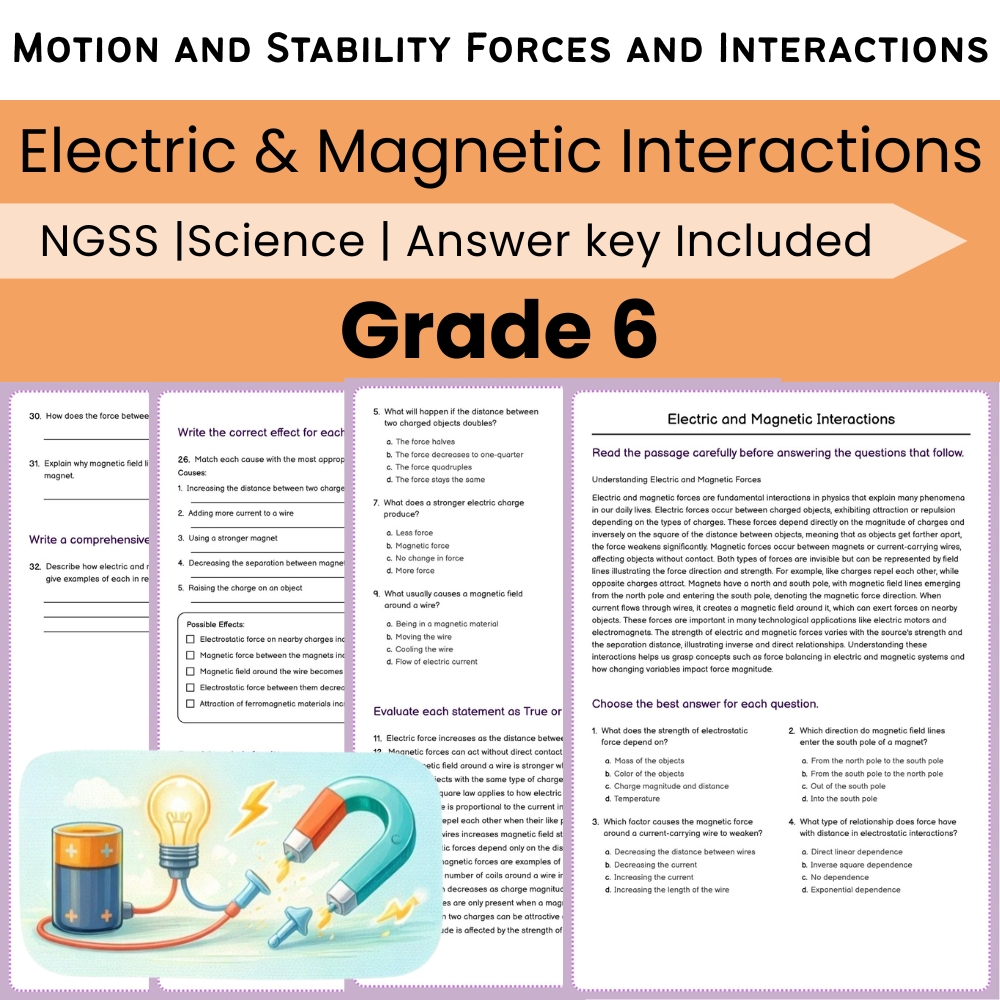
Electric and Magnetic Interactions Worksheet | Grade 6 Science PDF
Learning Objectives
- Understand how electric and magnetic forces depend on source strength and separation.
- Identify examples of electrostatic and magnetic forces in real-world situations.
- Explain how factors like distance, charge, and current influence force strength.
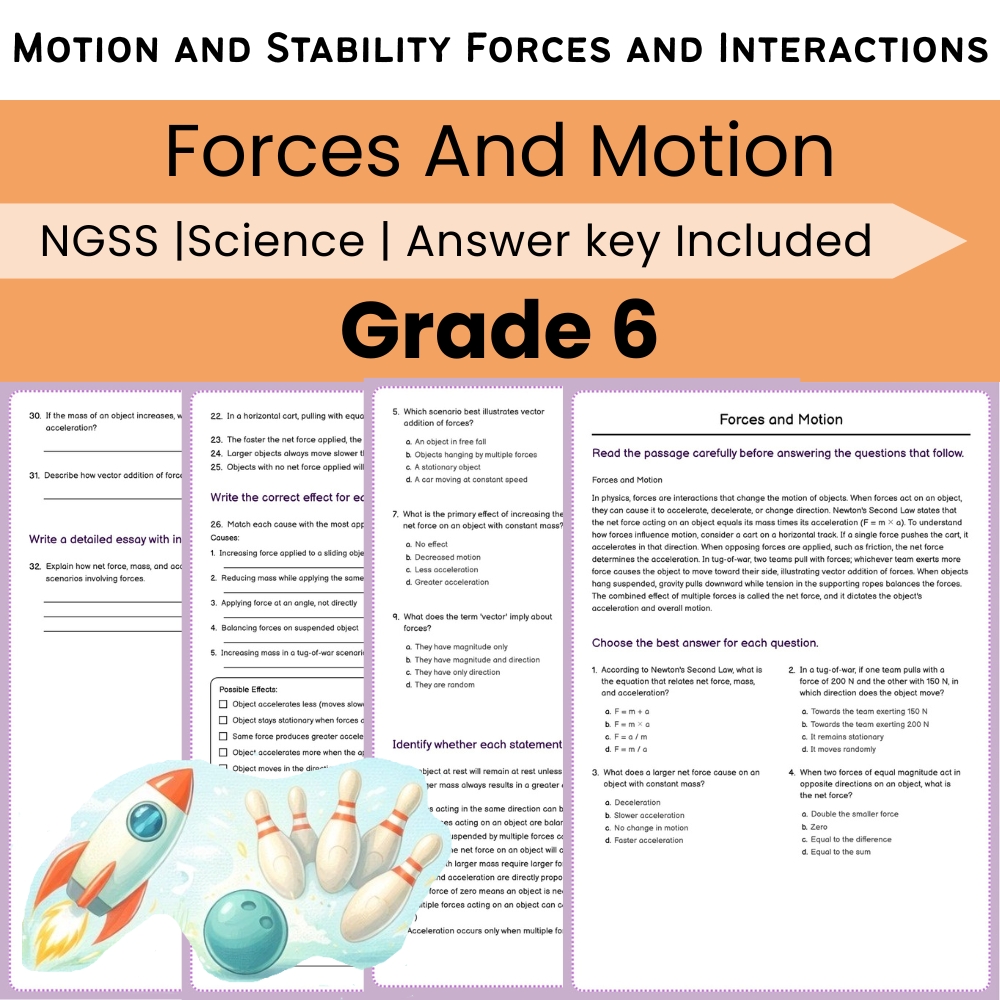
Forces and Motion Worksheet | NGSS Grade 6 Science printable PDF
Learning Objectives
- Understand the relationship between net force, mass, and acceleration.
- Explain how vector addition affects motion in different scenarios.
- Apply the formula net force equals mass times acceleration to solve problems.
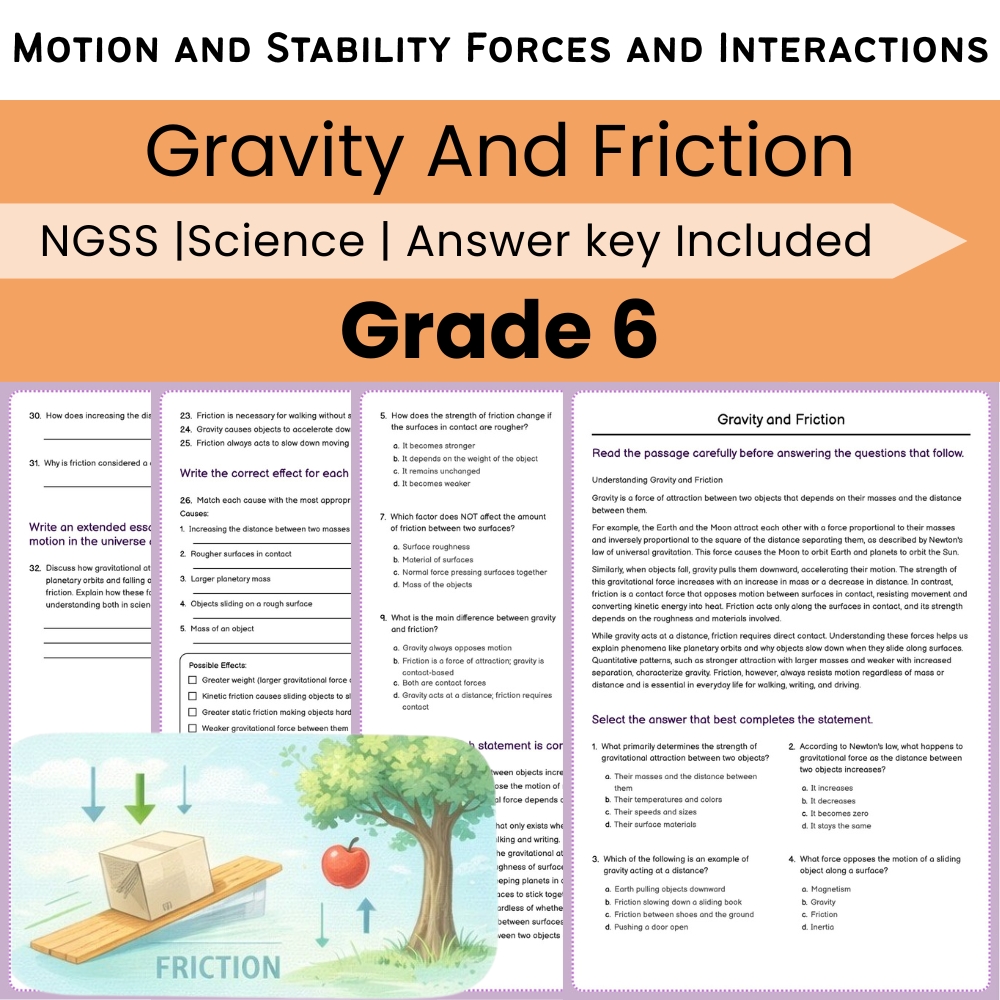
Gravity and Friction Science Worksheet | Grade 6 NGSS Printable PDF
Learning Objectives
- Explain how gravitational attraction depends on mass and distance between objects.
- Differentiate between gravitational forces and contact forces like friction.
- Use examples such as planetary orbits, Earth-Moon interactions, and falling objects to illustrate gravity.
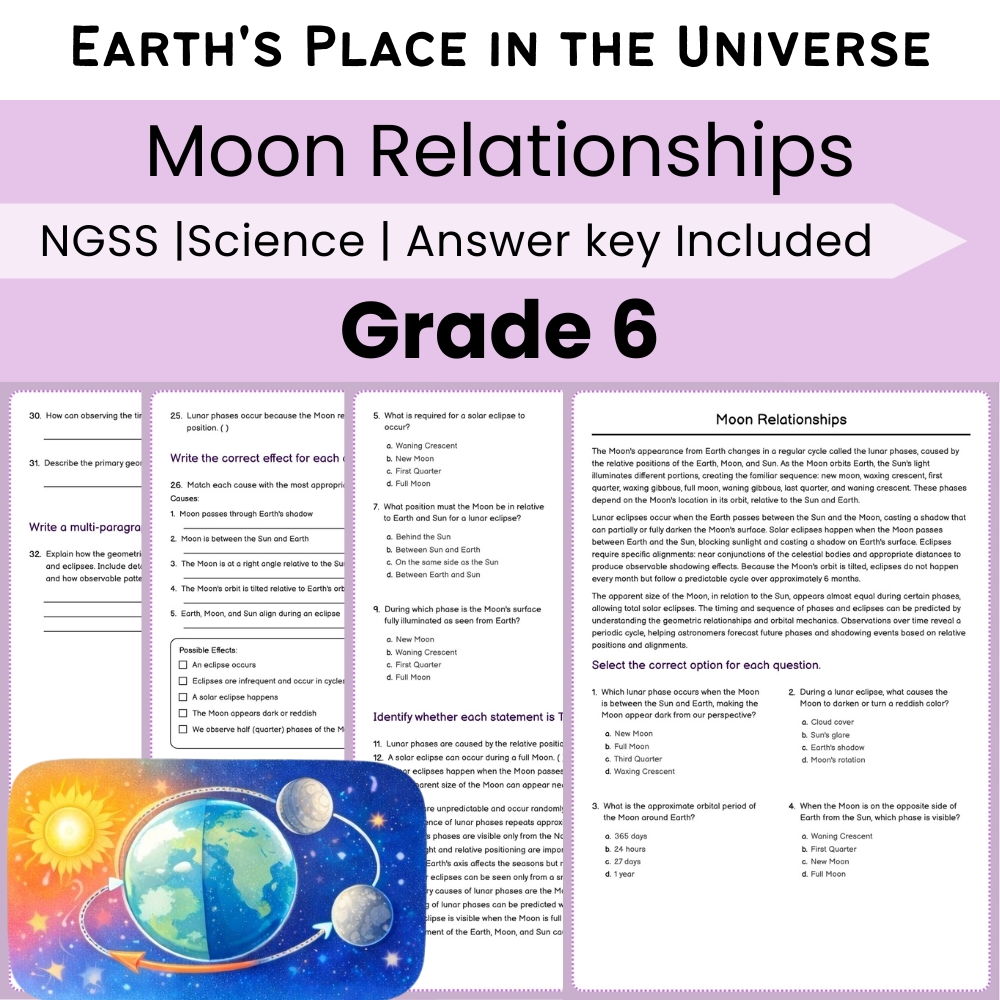
Moon Relationships Worksheet | NGSS Grade 6 Science Printable PDF
Learning Objectives
- Explain the geometric relationships among Earth, Moon, and Sun that produce lunar phases and eclipses.
- Identify the sequence of primary lunar phases and the conditions for solar and lunar eclipses.
- Describe how the apparent size and alignment of the Moon influence visibility of phases and eclipses.
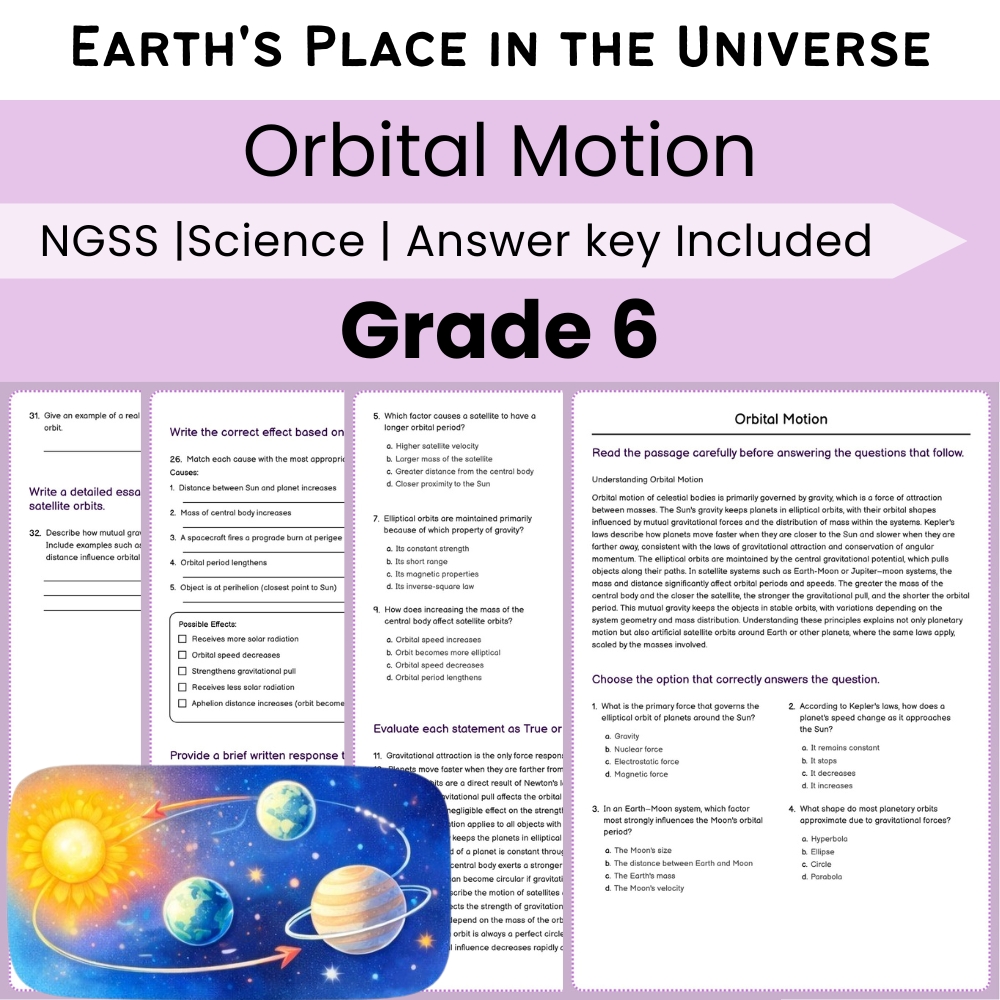
Orbital Motion Worksheet | NGSS Grade 6 Science printable PDF
Learning Objectives
- Understand gravitational attraction as the primary force governing planetary motion.
- Describe how mutual gravity produces elliptical orbits and influences orbital periods.
- Explain the role of central gravitational potential in satellite and planetary orbits.
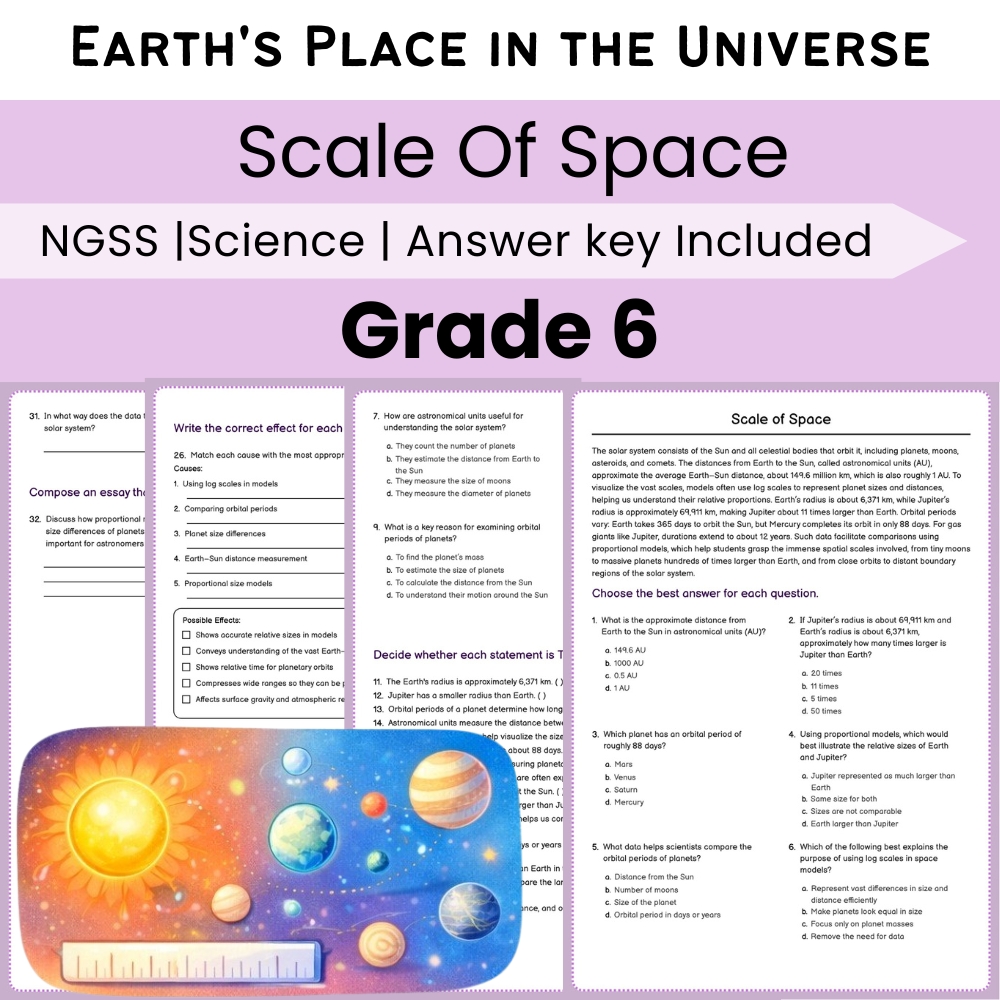
Scale of Space Worksheet | NGSS Grade 6 Science assessment & student practice
Learning Objectives
- Understand the relative sizes, distances, and periods of orbit of planets within the solar system.
- Compare planetary properties using astronomical units, radii, and orbital periods.
- Interpret data tables and charts to analyze spatial relationships within the solar system.
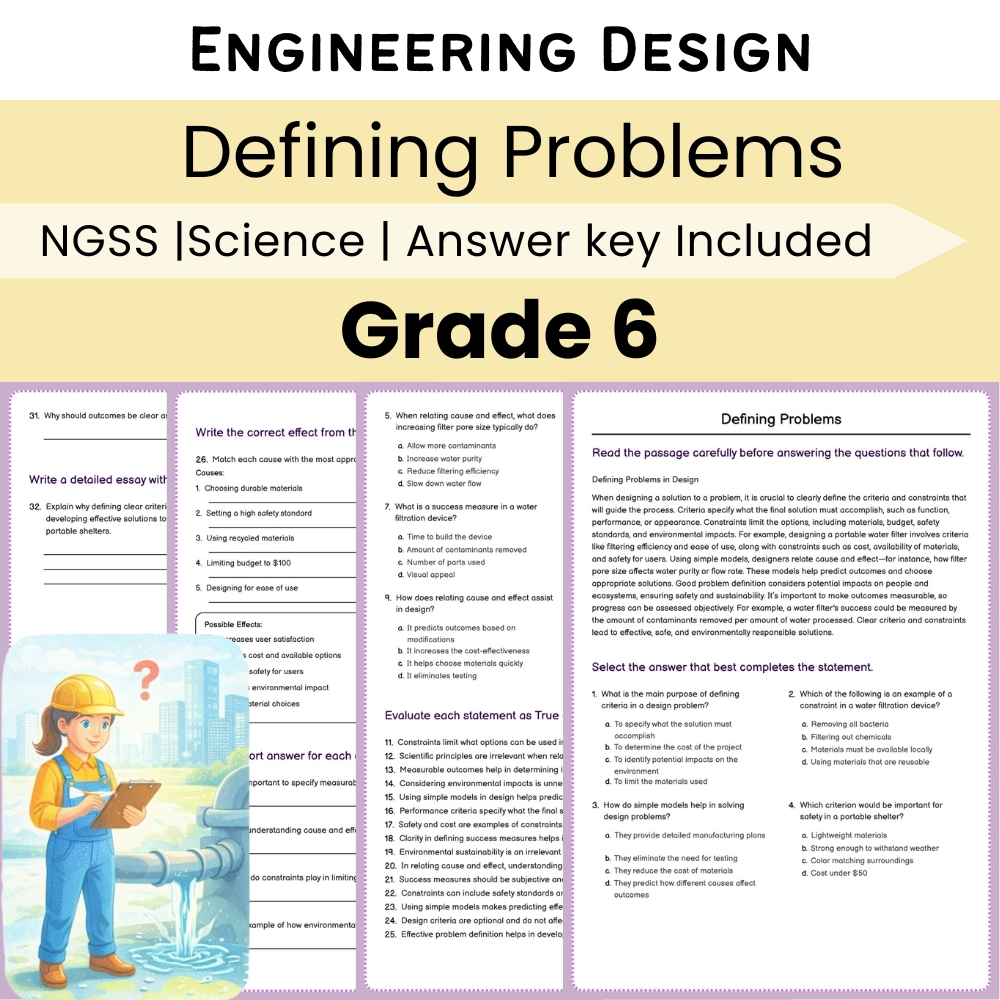
Defining Problems Worksheet | Grade 6 Science printable PDF | NGSS
Learning Objectives
- Understand how to specify criteria and constraints for a design problem.
- Learn to define success measures and limits such as materials, cost, and safety.
- Use simple models and scientific principles to relate cause and effect in problem solving.
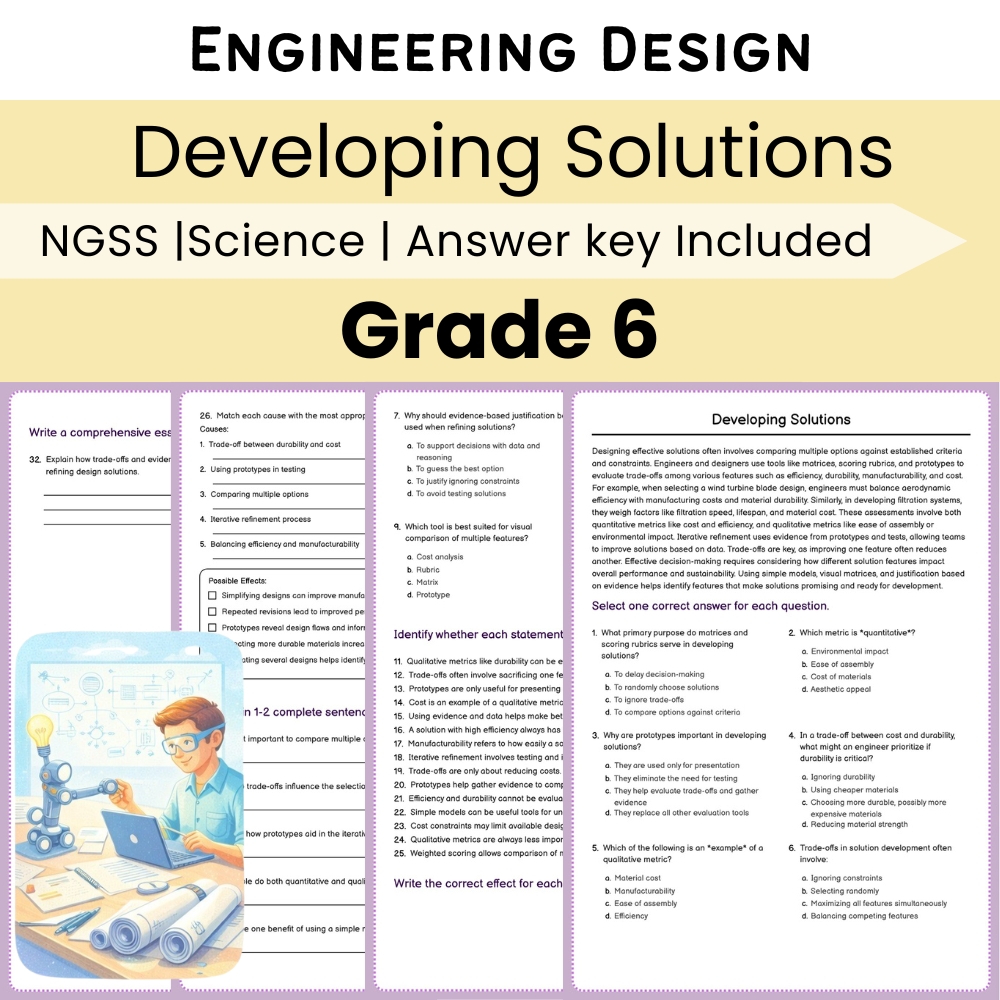
Developing Solutions Worksheet | Grade 6 Science Printable PDF NGSS Aligned
Learning Objectives
- Compare multiple design solutions using matrices, scoring rubrics, and prototypes.
- Evaluate and rank design options based on quantitative and qualitative metrics.
- Understand how trade-offs influence the selection of solutions.
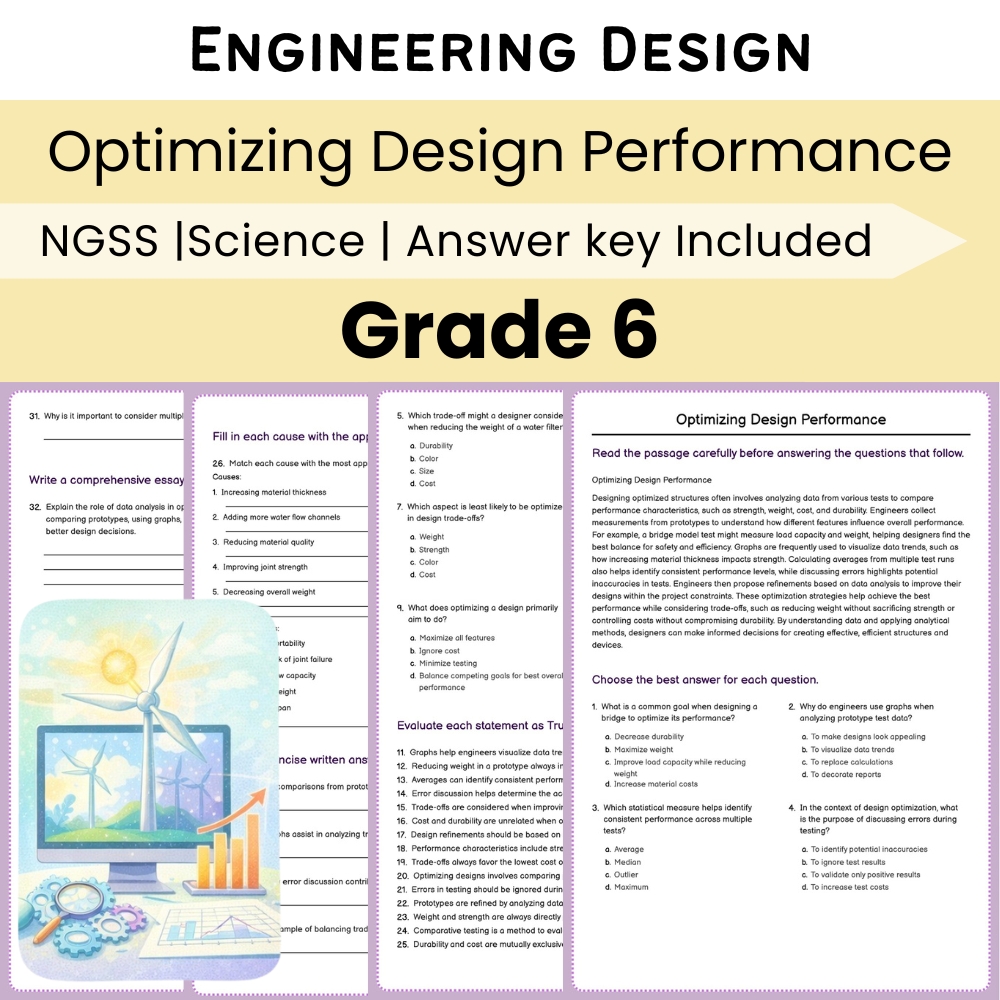
Optimizing Design Performance Science Worksheet | Grade 6 NGSS printable PDF
Learning Objectives
- Analyze data from comparative tests of different prototypes to determine performance characteristics.
- Interpret graphs, averages, and discuss errors to support design trade-offs.
- Apply optimization strategies that balance goals like strength versus weight or cost versus durability.
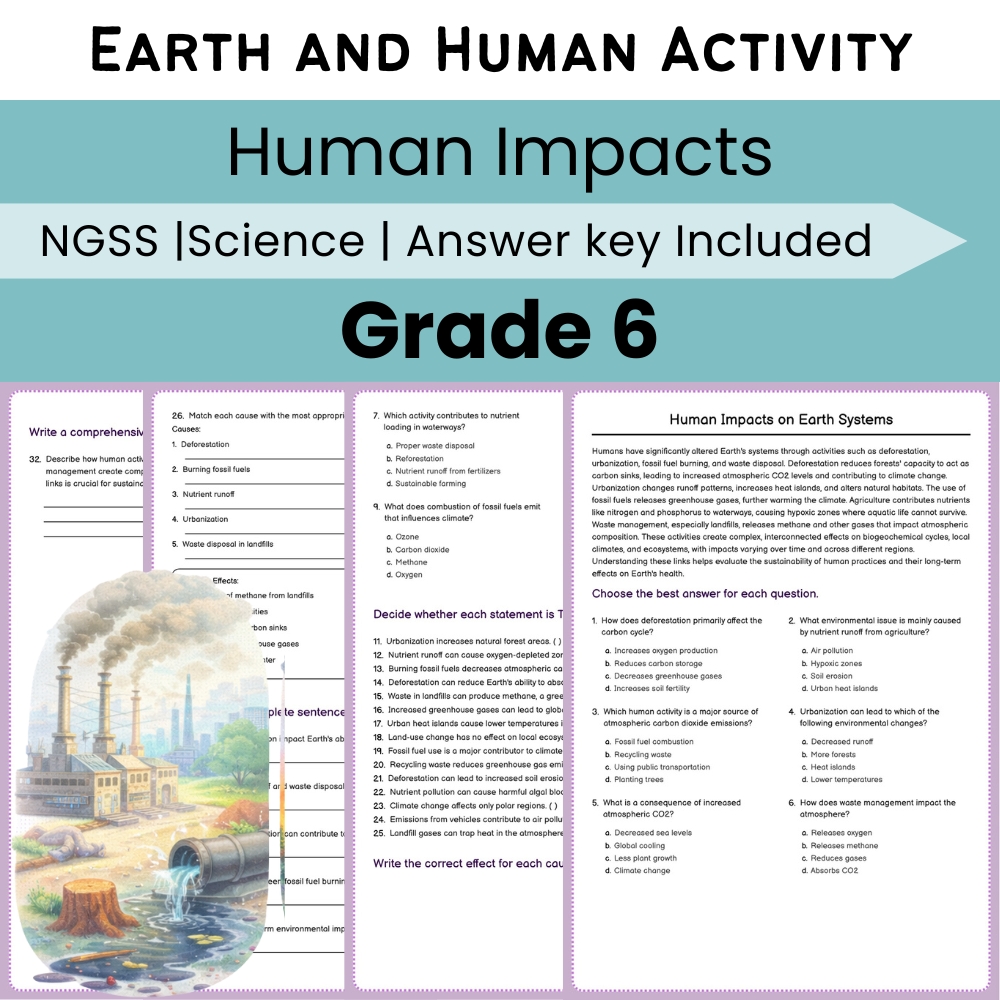
Human Impacts on Earth Systems | Grade 6 Science Worksheet & Assessment
Learning Objectives
- Identify different human activities that affect earth systems.
- Explain causal links between human actions and environmental changes.
- Analyze the effects of land-use change, pollution, and resource extraction on ecosystems.
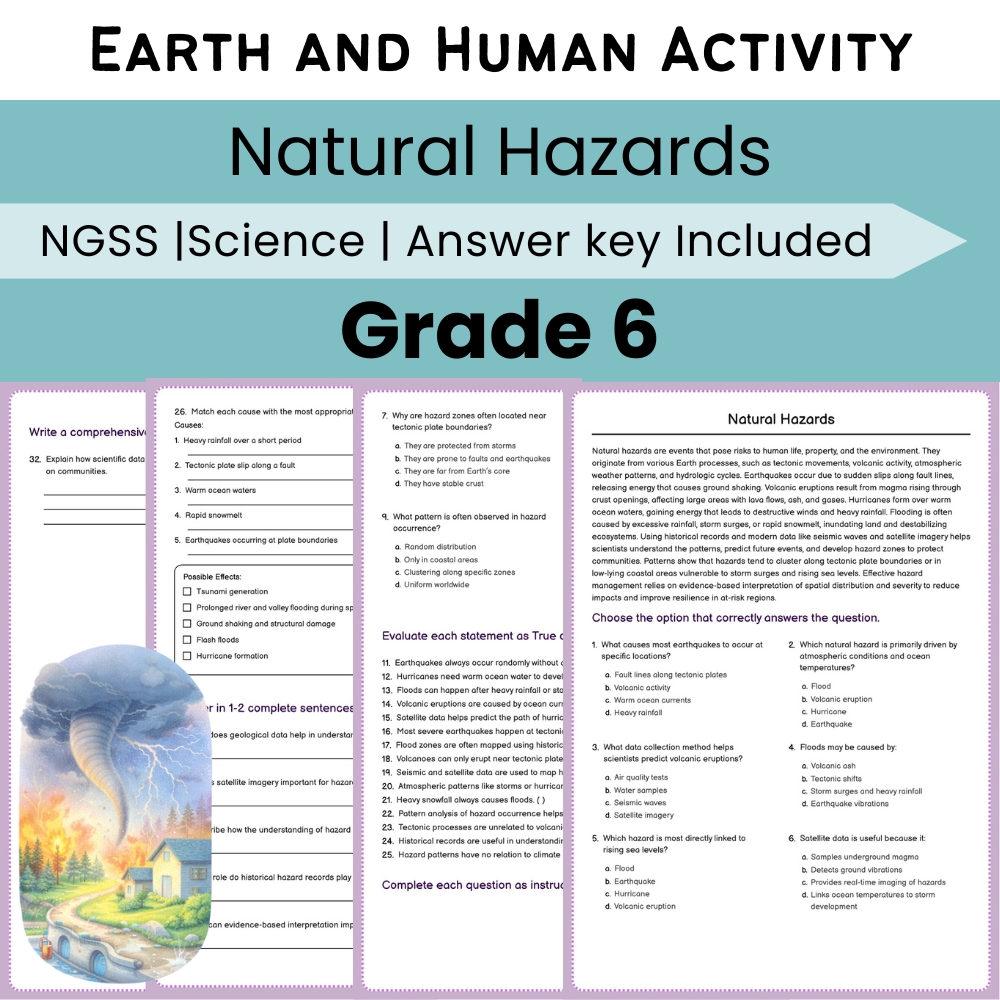
Natural Hazards Worksheet | Grade 6 Science Printable PDF & Assessment
Learning Objectives
- Understand the origins and patterns of natural hazards such as earthquakes, volcanoes, hurricanes, and floods.
- Analyze the effects of these hazards on communities and infrastructure.
- Evaluate relationships among tectonic, atmospheric, and hydrologic processes to explain hazard occurrence.
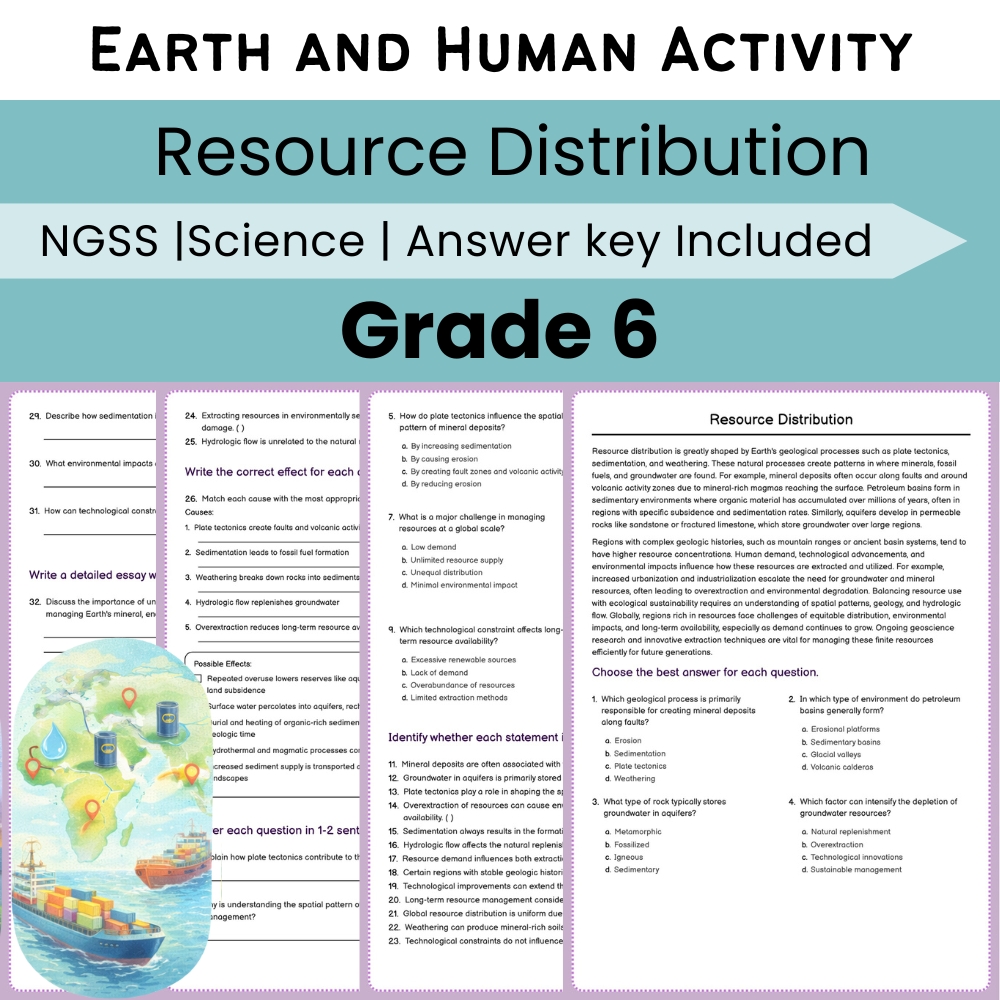
Resource Distribution Worksheet - Grade 6 Science Printable PDF | NGSS
Learning Objectives
- Understand how geological processes influence the distribution of mineral, energy, and groundwater resources.
- Identify spatial patterns in ore deposits, petroleum basins, and aquifers.
- Evaluate the impact of human activity and technology on resource availability and sustainability.
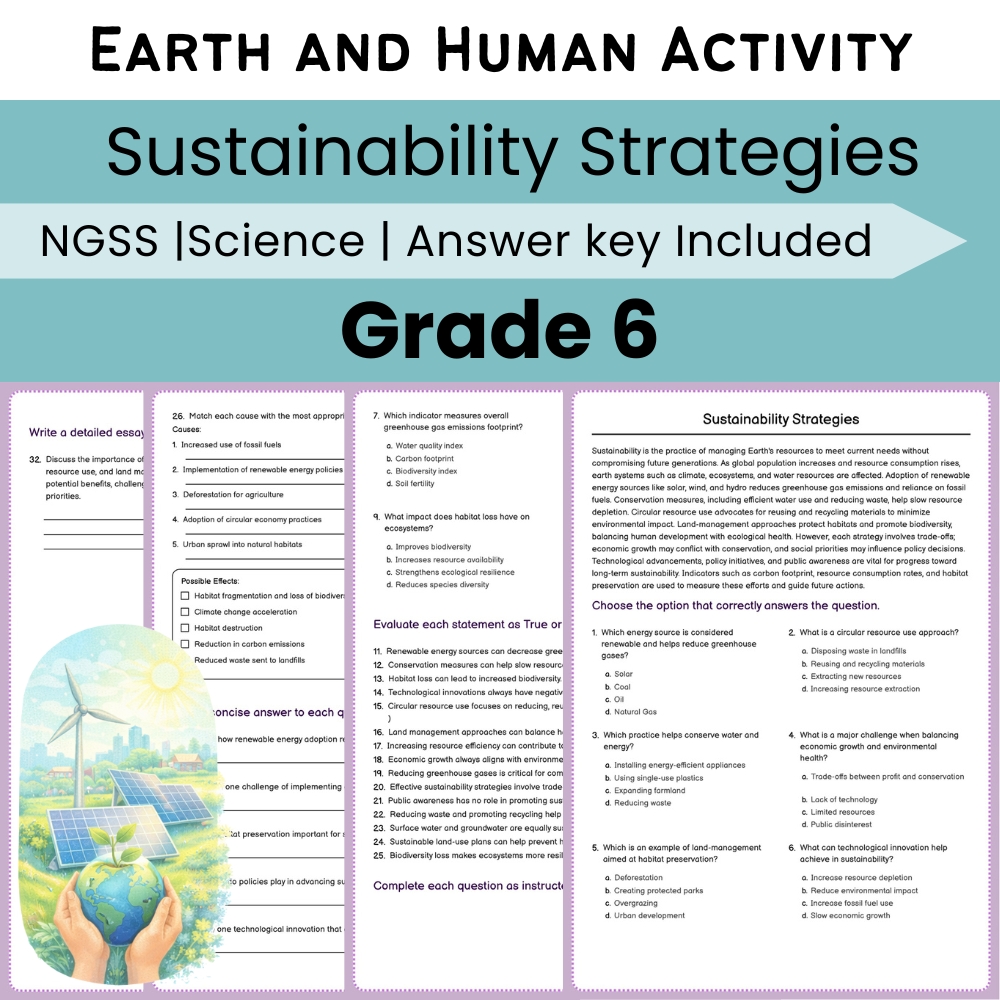
Sustainability Strategies Worksheet | NGSS Grade 6 Science Printable PDF
Learning Objectives
- Understand how population trends and resource use impact earth systems.
- Evaluate different sustainable practices such as renewable energy and conservation.
- Compare policy and technological options for sustainability.
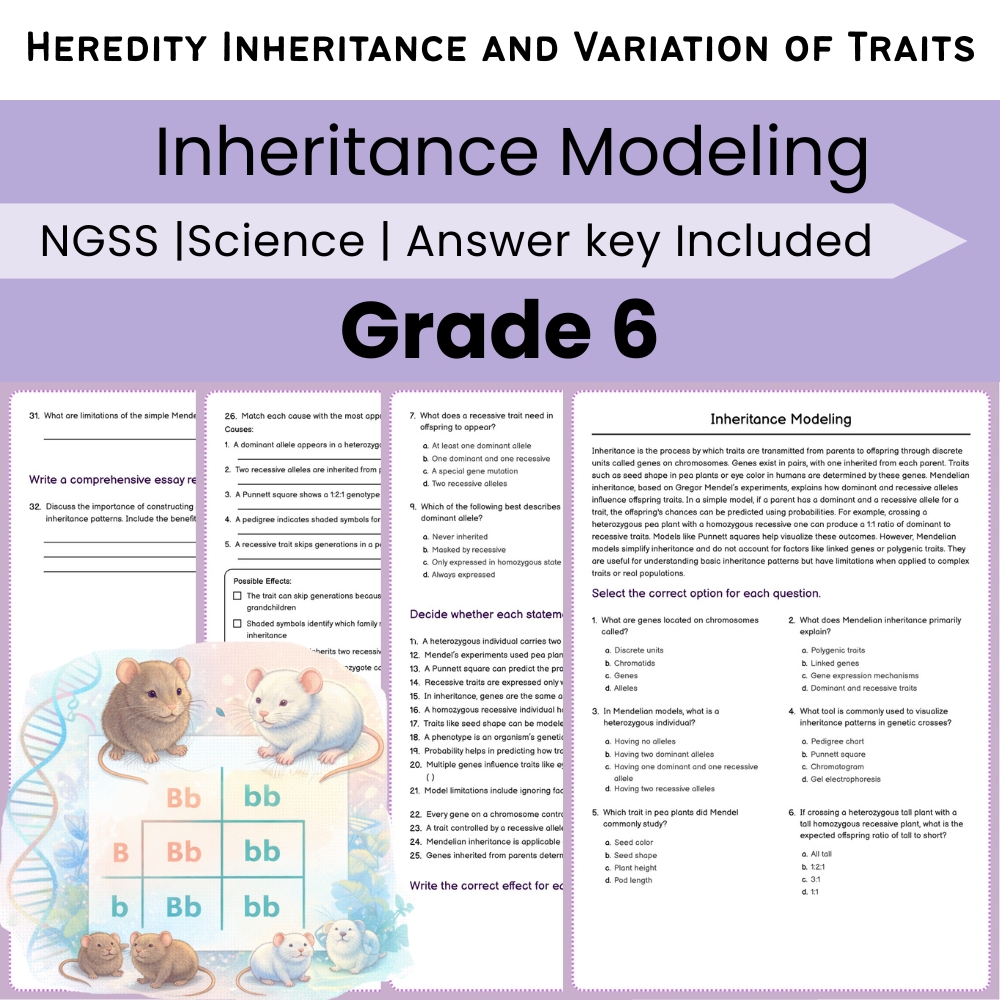
Inheritance Modeling Worksheet | Grade 6 Science Printable PDF NGSS
Learning Objectives
- Explain how traits are transmitted from parents to offspring using genes.
- Predict offspring trait ratios using Mendelian inheritance models.
- Construct and interpret simple models of dominant and recessive inheritance patterns.
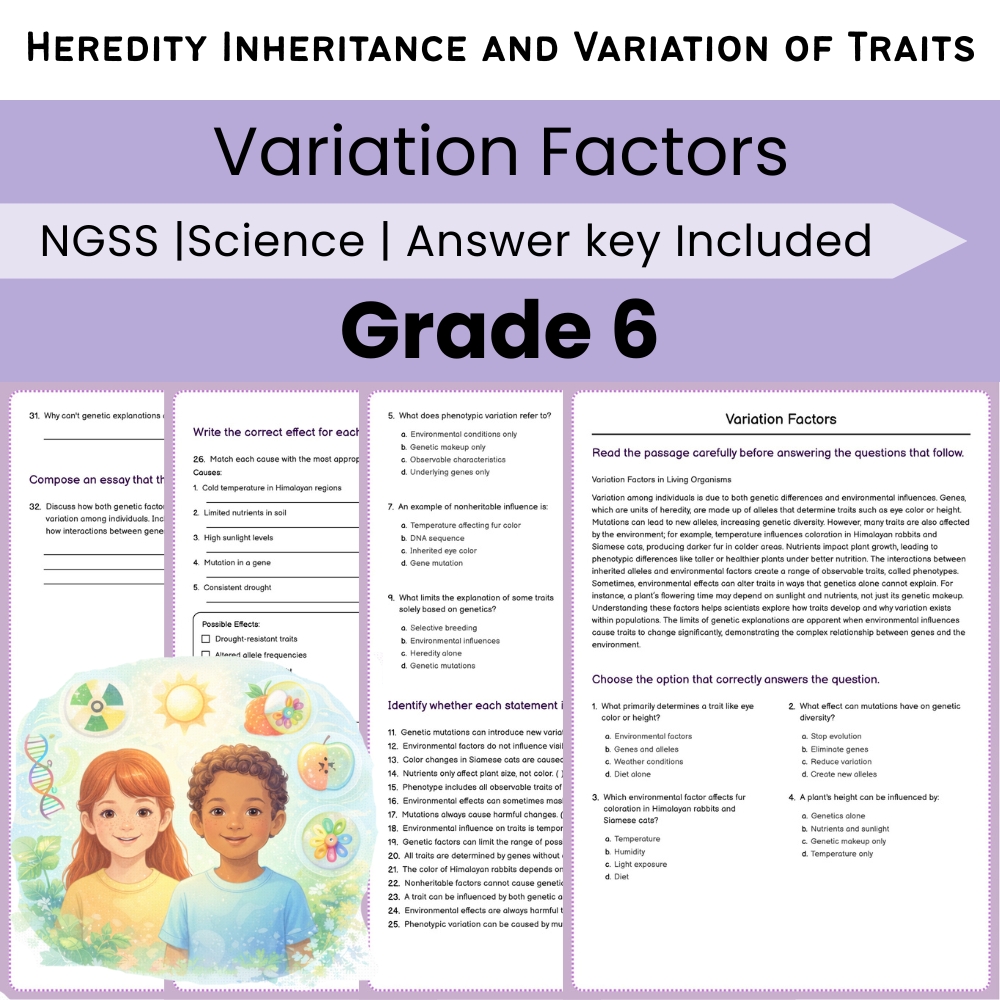
Variation Factors Worksheet | Grade 6 Science Printable PDF | NGSS
Learning Objectives
- Explain how genetic differences and environmental factors contribute to observable variations among individuals.
- Identify models of allele combinations and mutation impacts on traits.
- Describe nonheritable influences such as temperature-dependent coloration and nutrient effects on plants.
About Grade 6 Science Worksheets
Explore Grade 6 Science worksheets for classwork, homework, or review. Our 5,735 printables download instantly as PDFs.
MyTeachingSheets worksheets are made by real teacher-authors and checked before they go live. Download any as a print-ready PDF for lessons, homework, or independent practice — most include answer keys, and previews are always free.