
Grade 6 Science Worksheets
5,969 worksheets
Aerodynamic Design Worksheet | Standards-Aligned Grade 6 Science Practice
JCreated byJ.S SheetsLearning Objectives
- Understand how shape, surface smoothness, and orientation affect lift, drag, and stability in flight.
- Describe how modifications to wing curvature, aspect ratio, and surface area influence flight performance.
- Apply principles of aerodynamics to practical examples like kite tuning and model glider adjustments.
Instant download

Grade 6 Reactants and Products Worksheet PDF | California Science Standards
 Created byEvergreen Desk Education
Learning Objectives
- Explain the difference between reactants and products in a chemical reaction
- Use particle diagrams to describe how atoms are rearranged from reactants into products
- Identify evidence that a chemical reaction occurred by comparing properties of reactants and products
Instant download

6th Grade Science | Quantitative Circuits Worksheet (Ontario Standards) (PDF)
Created byEvergreen Desk EducationLearning Objectives
- Explain how voltage, current, and resistance are related using proportional reasoning suitable for grade 6.
- Use given values of voltage, current, or resistance to determine an unknown circuit quantity.
- Predict how current changes when resistance changes for a fixed voltage difference, including series and parallel comparisons.
Also included in: Grade 6 Electricity Circuits Science Lesson Bundle for Ontario Worksheets +1 more
Instant download

System Integration Test Prep Worksheet | Grade 6 Science BC
 Created byPrism Point Learning
Learning Objectives
- Explain how feedback mechanisms help organisms maintain homeostasis
- Describe how different body systems (nervous, endocrine, circulatory, and muscular) work together to respond to changes
- Use examples such as temperature control and blood glucose regulation to trace cause-and-effect in body responses
Also included in: Multicellular Systems & Functions Lesson Bundle | Grade 6 Science | BC +1 more
Instant download

Grade 6 Science Worksheet – Digestive System with Answer Key (PDF)
Created byEvergreen Desk EducationLearning Objectives
- Explain how mechanical and chemical digestion work together to break food into absorbable molecules.
- Describe the roles of the mouth, stomach, small intestine, and enzymes and acids in digestion.
- Model how nutrients move into blood or lymph and how this supports metabolism and growth.
Instant download

Grade 6 Science – Decomposers & Nutrient Recycling | Daily Reading Worksheet
 Created byBright Mind Resources
Learning Objectives
- Identify different decomposers such as fungi and bacteria
- Explain how decomposers break down dead organisms and waste
- Understand the role of decomposers in returning nutrients to ecosystems
Also included in: Life Processes Grade 6 Science Daily Reading Worksheets Lesson Bundle | General +1 more
Instant download

Grade 6 Science | Habitat Fragmentation Worksheet | BC Standards
 Created byLumora Learning
Learning Objectives
- Understand the concept of habitat fragmentation and its impact on ecosystems.
- Identify causes and effects of habitat fragmentation.
- Explore methods to mitigate fragmentation effects such as creating corridors and preserving large habitats.
Instant download

Grade 6 Quantitative Relationships in Circuits Worksheet | Ontario Science
 Created byTeacher's Corner
Learning Objectives
- Explain how voltage, current, and resistance are related using proportional reasoning
- Use Ohm’s law to compute or compare circuit values from given measurements
- Predict how current changes when resistance changes in a fixed voltage circuit
Instant download

Variables and Controls Science Worksheets | Grade 6 Experiments
 Created bySunny Desk Resources
Learning Objectives
- Identify independent, dependent, and controlled variables in a science investigation.
- Choose appropriate control conditions and justify why they provide a fair comparison.
- Create a testable question and a consistent measurement plan for repeatable results.
Also included in: Evidence & Investigation Grade 6 Science Worksheets | Alberta +1 more
Instant download

Grade 6 Science – Pressure Maps & Aerodynamics | Daily Reading Worksheet
Created byBright Mind ResourcesLearning Objectives
- Understand key concepts related to Science
- Apply knowledge through practice questions
- Demonstrate comprehension of the material
Also included in: Grade 6 Aerodynamics Science Lesson Bundle Daily Reading Worksheets | Ontario +1 more
Instant download

Optimization Tradeoffs Worksheet | Ontario Grade 6 Science Assessment
 Created byCedar Grove Learning
Learning Objectives
- Explain how designers balance competing criteria such as lift, drag, weight, and stability.
- Describe the idea of Pareto trade-offs when improving one factor can worsen another.
- Use safety margins and stall/stability buffers to support safe design choices.
Also included in: Grade 6 Aerodynamics | Flight - Science Lesson Bundle – Ontario Framework +1 more
Instant download

Ocean Currents Grade 6 | Florida NGSSS Assessment
Created byPrism Point LearningLearning Objectives
- Explain how ocean currents move water and distribute heat around Earth.
- Describe how wind patterns and Earth’s rotation help drive surface currents.
- Connect ocean currents to regional climate and weather differences near coasts.
Instant download

Grade 6 Science – Gas Pressure & Particle Model | Daily Reading Worksheet
Created byBright Mind ResourcesLearning Objectives
- Understand key concepts related to Science
- Apply knowledge through practice questions
- Demonstrate comprehension of the material
Also included in: Matter & Change Grade 6 Science Daily Reading Worksheets Lesson Bundle | BC +1 more
Instant download

6th Grade Science | Diffusion Rates Worksheet (PDF) BC Standards
Created byEvergreen Desk EducationLearning Objectives
- Explain diffusion as the net movement of particles from higher concentration to lower concentration.
- Describe how temperature, particle size, and medium viscosity affect diffusion rates.
- Connect particle-level motion to real-world examples such as scent spreading and dye dispersal.
Instant download

Forms Of Energy Worksheet | Standards-Aligned Grade 6 Science Practice
JCreated byJ.S SheetsLearning Objectives
- Identify different forms of energy such as kinetic, potential, thermal, chemical, and electrical.
- Understand how energy transforms from one form to another in natural and engineered systems.
- Recognize examples of energy transformations and describe their significance.
Instant download

Grade 6 Science | Natural Resources - Daily Reading Comprehension
 Created byCoral Reef Learning
Learning Objectives
- Identify different types of natural resources
- Understand how natural resources are distributed
- Recognize the ecological and economic implications of resource use
Instant download

Grade 6 Adaptation and Speciation Worksheet | NGSS Practice PDF
 Created byClear Sky Classroom
Learning Objectives
- Understand the processes of adaptation and speciation in populations.
- Identify evidence and factors that contribute to reproductive isolation and lineage divergence.
- Analyze patterns of biogeography and morphology in species formation.
Also included in: Grade 6 Biological Evolution: Unity & Diversity Science lesson bundle NGSS +1 more
Instant download

Grade 6 Climate Systems Science Worksheet | NGSS Earth Science Activity
 Created byBRIGHT PATH RESOURCES
Learning Objectives
- Understand key concepts related to Science
- Apply knowledge through practice questions
- Demonstrate comprehension of the material
Also included in: Earth's Systems Grade 6 Science Daily Reading Worksheets Lesson Bundle | NGSS +2 more
Instant download

Grade 6 Carbon Cycling Worksheet with Answer Key | Florida NGSSS Science
Created byEvergreen Desk EducationLearning Objectives
- Explain how carbon moves through ecosystems using photosynthesis, respiration, feeding, and decomposition
- Describe how plants store carbon in organic molecules and how consumers release carbon dioxide
- Use evidence and key vocabulary to trace carbon cycling over time
Instant download

Grade 6 Science | Competition for Survival Worksheet | California Standards
Created byLumora LearningLearning Objectives
- Explain how limited resources can lead to competition between organisms
- Describe how competition affects survival, reproduction, and population size
- Distinguish between direct and indirect competition
Instant download

Electrical Power in Circuits Worksheet Grade 6 Ontario Science Activity
Created byTeacher's CornerLearning Objectives
- Define power as the rate of energy transfer in an electrical circuit
- Explain how voltage and current relate to power dissipation in resistive elements
- Describe how efficiency affects energy use and total energy consumption over time
Instant download

Measurement Tools Worksheet | Grade 6 Science Practice
Created byPrism Point LearningLearning Objectives
- Explain why choosing appropriate units and measurement tools improves the accuracy of collected data.
- Describe how calibration and consistent recording support reliable comparisons over time and location.
- Use measurement tools to collect, organize, and interpret observations in science investigations.
Instant download

Climate And Patterns Grade 6 Science Worksheet | Standards-Aligned Practice
JCreated byJ.S SheetsLearning Objectives
- Understand how climate factors influence regional weather patterns.
- Identify the differences between weather and climate.
- Analyze how long-term climate patterns develop and vary across regions.
Also included in: Grade 6 Climate and Atmospheric Systems Science Lesson Bundle: Florida NGSSS +1 more
Instant download
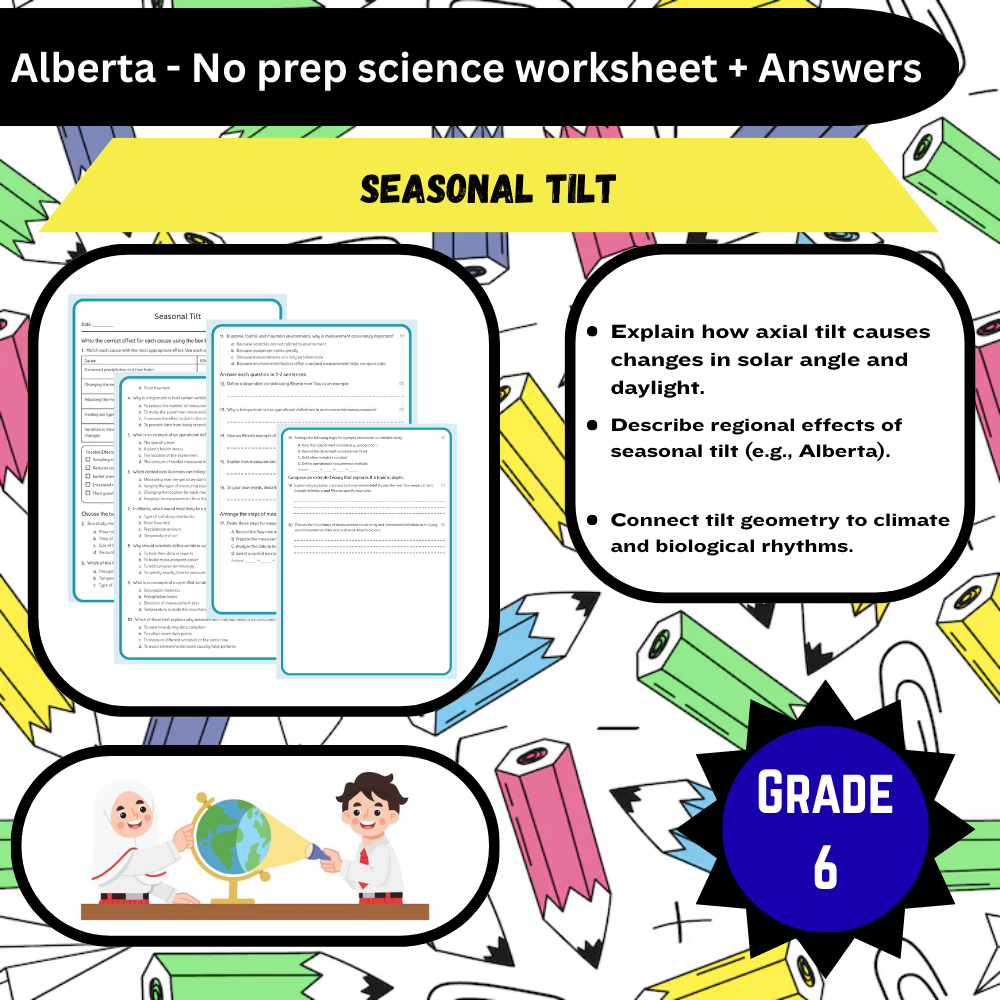
6th Grade Science – Seasonal Tilt Worksheet (PDF) — Alberta Standards
Created byBright Mind ResourcesLearning Objectives
- Explain how Earth's axial tilt causes seasonal changes in solar angle and daylight duration.
- Describe regional effects of seasonal tilt, using Alberta as an example.
- Connect the geometry of Earth's tilt to climate variations and biological rhythms.
Instant download

Predator Prey Dynamics Worksheet | Science Grade 6 Assessment PDF
JCreated byJ.S SheetsLearning Objectives
- Explain how predator and prey populations affect each other in an ecosystem
- Identify cause-and-effect relationships in predator-prey interactions
- Describe how prey adaptations can reduce predation and influence population trends
Also included in: Grade 6 Life Processes & Ecosystems Science lesson bundle: General Framework +1 more
Instant download

Trophic Interactions Worksheet for Grade 6 Science | Standards-Aligned Practice
JCreated byJ.S SheetsLearning Objectives
- Understand the different types of trophic interactions such as predation, herbivory, parasitism, competition, and mutualism.
- Explain how these interactions influence survival, reproduction, and community structure.
- Identify examples of trophic interactions in ecosystems and their ecological significance.
Instant download

Axial Rotation and Daily Sky Motion Worksheets Grade 6 Science
Created bySunny Desk ResourcesLearning Objectives
- Explain how Earth’s rotation causes alternating day and night
- Describe how Earth’s rotation relates to apparent daily motion of the Sun and stars
- Use time-order cues to connect sunrise, solar noon, and sunset to Earth’s rotation
Also included in: Sky Science Grade 6 Bundle | Alberta Science Worksheets & Activities +1 more
Instant download

Error Analysis Worksheet for Grade 6 Science | Standards-Aligned Practice
JCreated byJ.S SheetsLearning Objectives
- Identify sources of error in experimental measurements and classify them as random or systematic.
- Explain how random and systematic errors can limit the reliability of collected data.
- Describe methods for estimating uncertainty and reporting it transparently.
Instant download

Grade 6 Science Worksheet – Flight Forces with Reading & Practice (Alberta)
 Created bySilver Birch Teaching
Learning Objectives
- Explain how lift, weight, thrust, and drag affect motion through air
- Identify how balanced forces lead to steady flight and how unbalanced forces lead to climbing or descending
- Use key vocabulary (lift, thrust, drag, weight) to describe real-world examples of flight
Also included in: Grade 6 Aerodynamics & Flight Forces Science Lesson Bundle: Alberta +1 more
Instant download

Measuring Electricity Worksheet | Standards-Aligned Grade 6 Science Practice
JCreated byJ.S SheetsLearning Objectives
- Understand the key electrical quantities: current, voltage, and power.
- Learn how to measure electrical quantities in circuits.
- Explain the relationship between power, energy, and time.
Instant download

Grade 6 Science | Understanding Gravity & Orbits - Daily Reading Comprehension
Created byCoral Reef LearningLearning Objectives
- Explain gravitational attraction as the primary force that governs planetary motion within the solar system.
- Describe how mutual gravity between the Sun and planets produces elliptical orbits.
- Understand the role of gravitational forces in determining orbital periods and speeds.
Instant download

Grade 6 Fair Tests Variables & Controls Science Worksheet | Alberta
Created byBRIGHT PATH RESOURCESLearning Objectives
- Explain why fair tests require comparisons.
- Identify independent, dependent, and controlled variables in an investigation.
- Describe a control condition and how it supports fair comparisons.
Also included in: Inquiry Data Grade 6 Science Daily Reading Worksheets Lesson Bundle | Alberta +1 more
Instant download

6th Grade Science Worksheet – Measurement Uncertainty (Alberta Standards PDF)
Created bySilver Birch TeachingLearning Objectives
- Explain what measurement uncertainty means and identify common sources of uncertainty.
- Use repeated measures and ranges to estimate uncertainty in data.
- Distinguish between precision and accuracy and describe how uncertainty affects confidence in conclusions.
Also included in: Grade 6 Scientific Inquiry & Data Analysis Science Lesson Bundle: Alberta +1 more
Instant download

Drag Components Worksheet & Doodle Notes | Grade 6 Ontario Science
 Created byChalk and Compass
Learning Objectives
- Categorize drag into parasitic drag and induced drag and explain how each relates to flight and airflow.
- Identify components of parasitic drag (form drag, skin-friction drag, and interference drag) and relate them to factors like speed and shape.
- Explain why induced drag is an unavoidable by-product of lift generation and how wing span and lift distribution affect it.
Also included in: Grade 6 Science Aviation Unit Aerodynamics & Flight Testing Lesson Bundle +1 more
Instant download

6th Grade Science | Weather vs Climate Worksheet (PDF) - Standard Aligned
Created byEvergreen Desk EducationLearning Objectives
- Distinguish weather from climate using everyday examples and correct scientific meanings
- Explain why weather changes quickly while climate changes over long time periods
- Identify variables (temperature, precipitation, wind, cloud cover) and describe how they can be observed
Also included in: 6th Grade Earth & Climate Science Lesson Bundle – General Framework +1 more
Instant download

Population Dynamics Worksheet | Standards-Aligned Science Practice for Grade 6
JCreated byJ.S SheetsLearning Objectives
- Understand the factors that influence population change over time.
- Identify different growth models such as exponential and logistic growth.
- Explain how density-dependent and density-independent factors affect populations.
Instant download

Science Grade 6 Particle Models of Matter Worksheet | NGSS Aligned Assessment
 Created bySkylark Worksheets
Learning Objectives
- Explain how the particle model describes matter as particles in constant motion
- Use particle spacing and motion to describe phases and changes of state (melting, freezing, boiling, condensation)
- Relate temperature and thermal energy to particle kinetic energy and gas pressure in a qualitative way
Also included in: Grade 6 Matter and Chemical Reactions Science Lesson Bundle NGSS Worksheets +1 more
Instant download

Safety and Ethics Worksheet | Grade 6 Science Review & Practice
Created byPrism Point LearningLearning Objectives
- Explain why risk assessment and hazard prevention matter during science investigations.
- Demonstrate safe tool and material handling and proper disposal of substances.
- Apply ethical principles such as humane treatment, informed consent, confidentiality, and environmental stewardship.
Instant download

Grade 6 Science – Moon's Phases & Lunar Cycle | Daily Reading Worksheet
Created byBright Mind ResourcesLearning Objectives
- Identify the different phases of the Moon
- Describe how the relative positions of the Sun, Earth, and Moon create lunar phases
- Use a model to predict the Moon's appearance and phases over time
Also included in: Grade 6 Solar System & Seasons Science Daily Reading Lesson Bundle | Alberta +2 more
Instant download
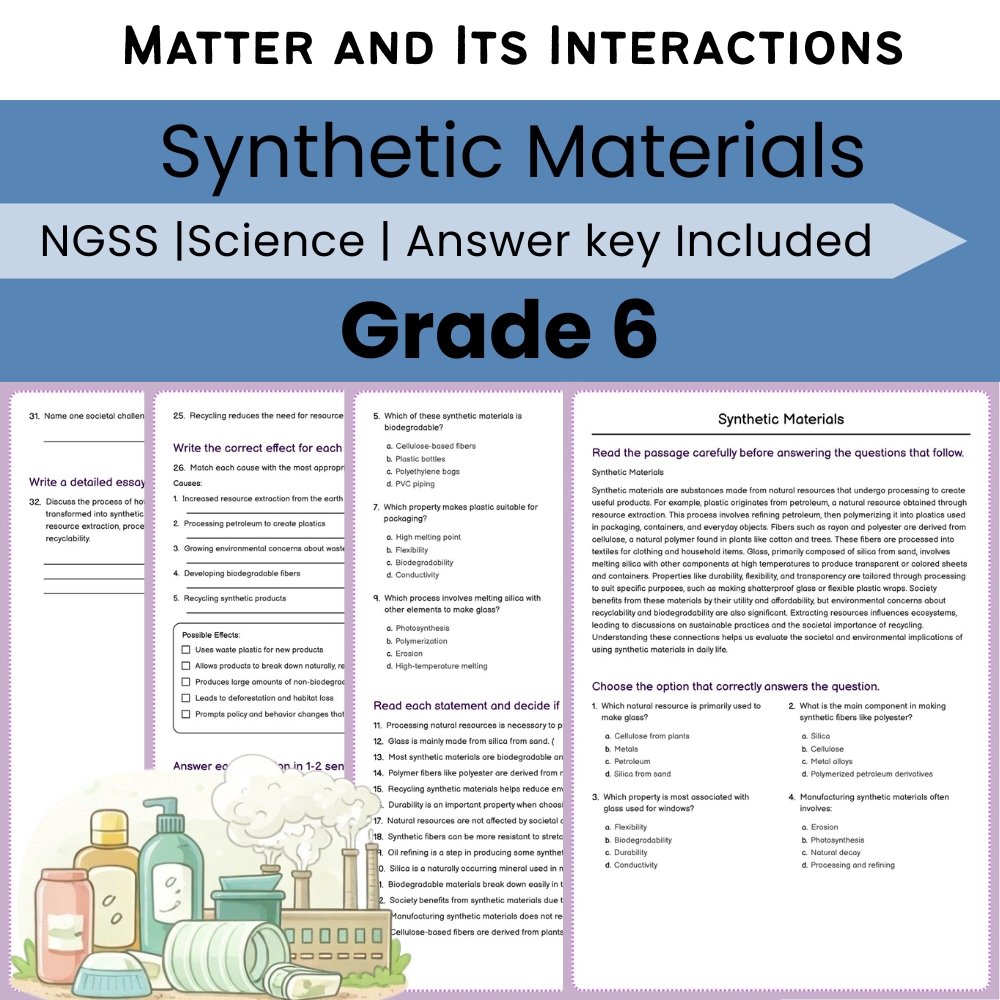
6th Grade Science | Synthetic Materials Worksheet (Printable PDF & Assessment)
Learning Objectives
- Understand the origins and sources of synthetic materials derived from natural resources.
- Compare properties of substances such as plastic, fiber, and glass and relate them to their uses.
- Explain the processes involved in extracting and processing resources for manufacturing.
Also included in: Grade 6 Science | Matter and Its Interactions NGSS Unit Bundle - Assessments & Worksheets +1 more
Instant download

Grade 6 Science – States of Matter & Visuals | Daily Reading Worksheet
Created byBright Mind ResourcesLearning Objectives
- Understand key concepts related to Science
- Apply knowledge through practice questions
- Demonstrate comprehension of the material
Also included in: Matter & Energy Grade 6 Science Daily Reading Worksheets Bundle | TEKS +2 more
Instant download
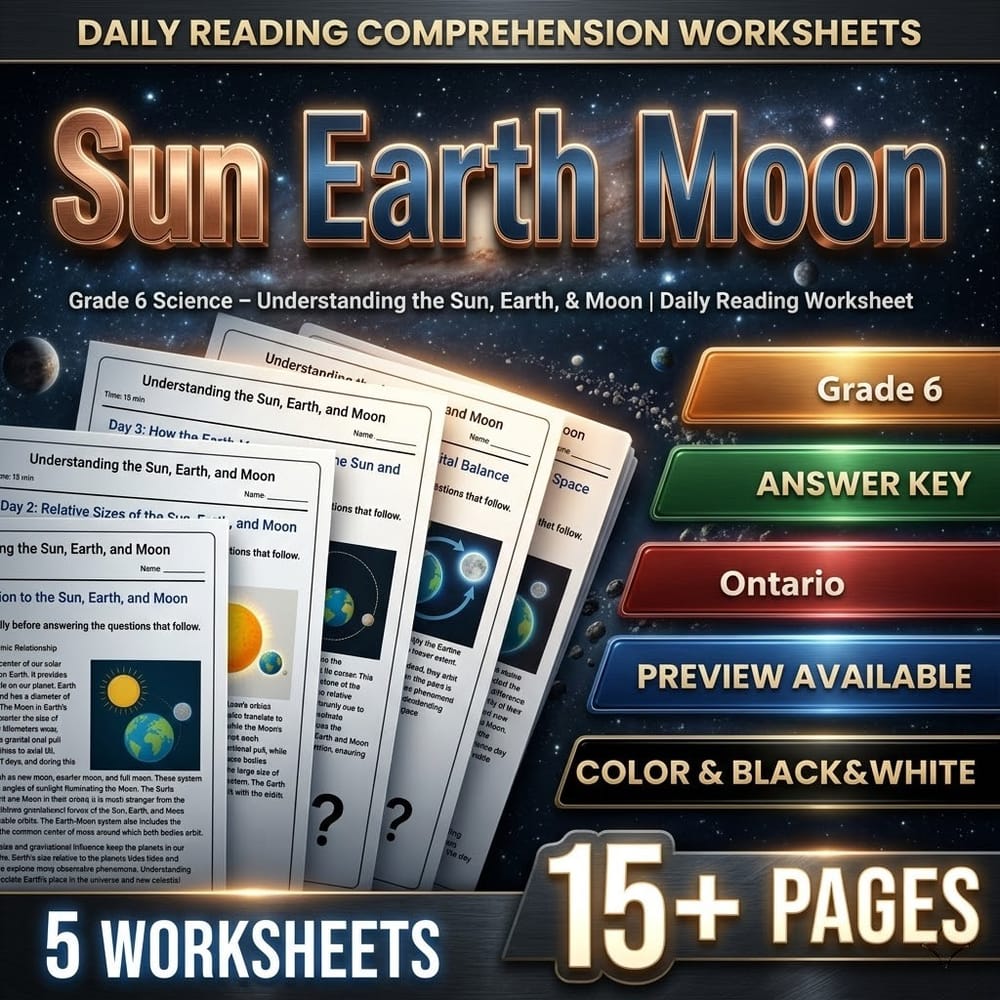
Grade 6 Science – Understanding the Sun, Earth, & Moon | Daily Reading Worksheet
 Created byQuiet Forest Education
Learning Objectives
- Learn about the relative sizes and positions of the Sun, Earth, and Moon.
- Understand how gravity influences their orbital relationships.
- Identify key concepts such as the Earth–Moon barycenter and the Sun's gravitational role.
Also included in: Space Science Grade 6 Daily Reading Worksheets Bundle | Ontario +1 more
Instant download
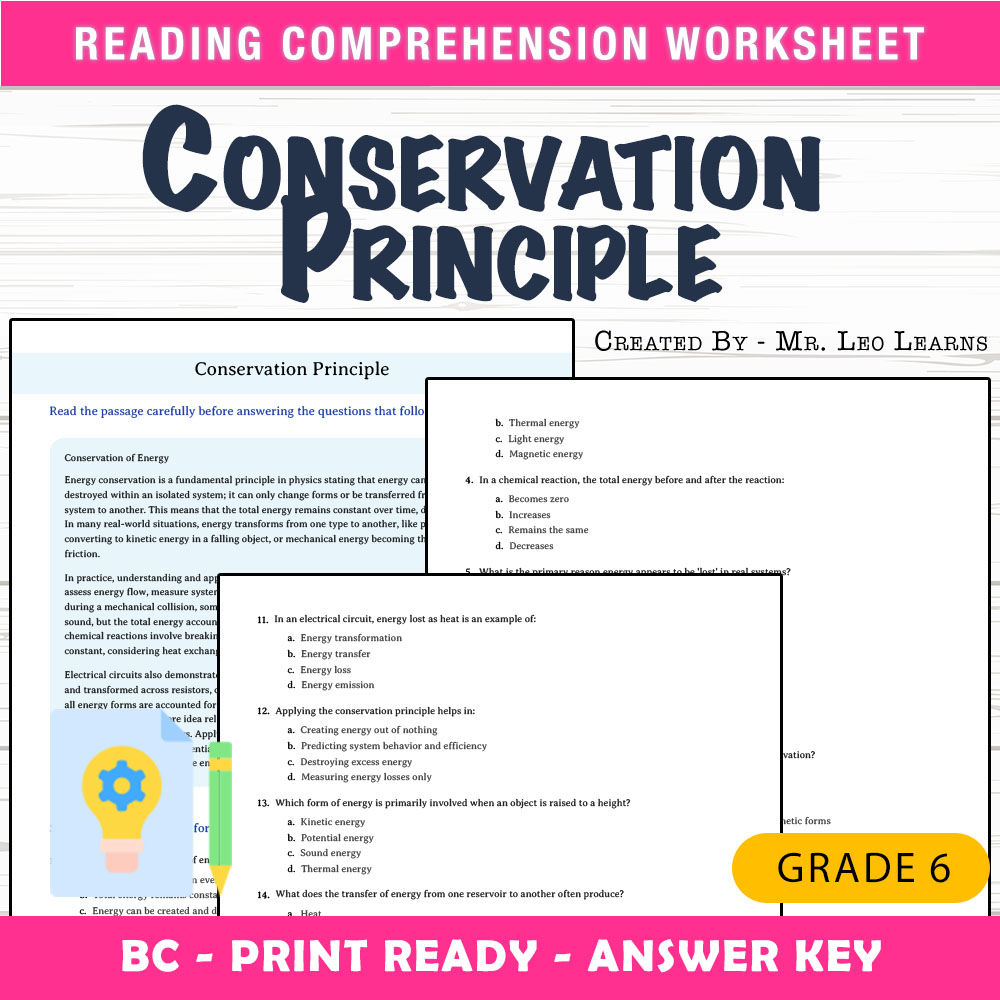
Grade 6 Science — Worksheet MCQ Paper for Mastering Conservation Principle
 Created byThe Resource Hub
Learning Objectives
- Explain the law of conservation of energy and its significance in physical systems.
- Identify examples of energy transfer and transformation in everyday scenarios.
- Describe how conservation of energy applies in collisions, chemical reactions, and circuits.
Also included in: Grade 6 Science Energy, Waves & Circuits UNIT Bundle | BC Standards +1 more
Instant download

Climate Systems Practice Worksheet | Grade 6 Science | NGSS Review
Created byPrism Point LearningLearning Objectives
- Explain how unequal solar heating and Earth’s rotation create global atmospheric circulation patterns.
- Describe how ocean currents and circulation help move heat and moisture around the planet.
- Use climate-cell models and current patterns to predict regional climate zones and related events.
Also included in: Grade 6 Weather & Climate Systems Science Lesson Bundle NGSS
Instant download

Erosion and Deposition Assessment for Grade 6 Science | California Standards
Created byPrism Point LearningLearning Objectives
- Explain how moving water erodes Earth materials and transports sediment
- Describe how decreasing water energy leads to deposition
- Connect erosion and deposition to landform features such as river terraces and deltas
Also included in: Grade 6 Water in Earth Systems Science Lesson Bundle: California Standards +1 more
Instant download

Grade 6 Science | Understanding Moon Phases & Shadows - Daily Reading Practice
Created byCoral Reef LearningLearning Objectives
- Understand key concepts related to Science
- Apply knowledge through practice questions
- Demonstrate comprehension of the material
Instant download

Grade 6 Inherited Adaptations Worksheet | Practice & Assessment PDF
Created byClear Sky ClassroomLearning Objectives
- Explain how inherited traits can improve survival and reproduction in specific environments
- Identify examples of adaptations that help organisms feed, protect themselves, or tolerate temperature and moisture
- Distinguish between inherited adaptations and learned behaviors
Instant download
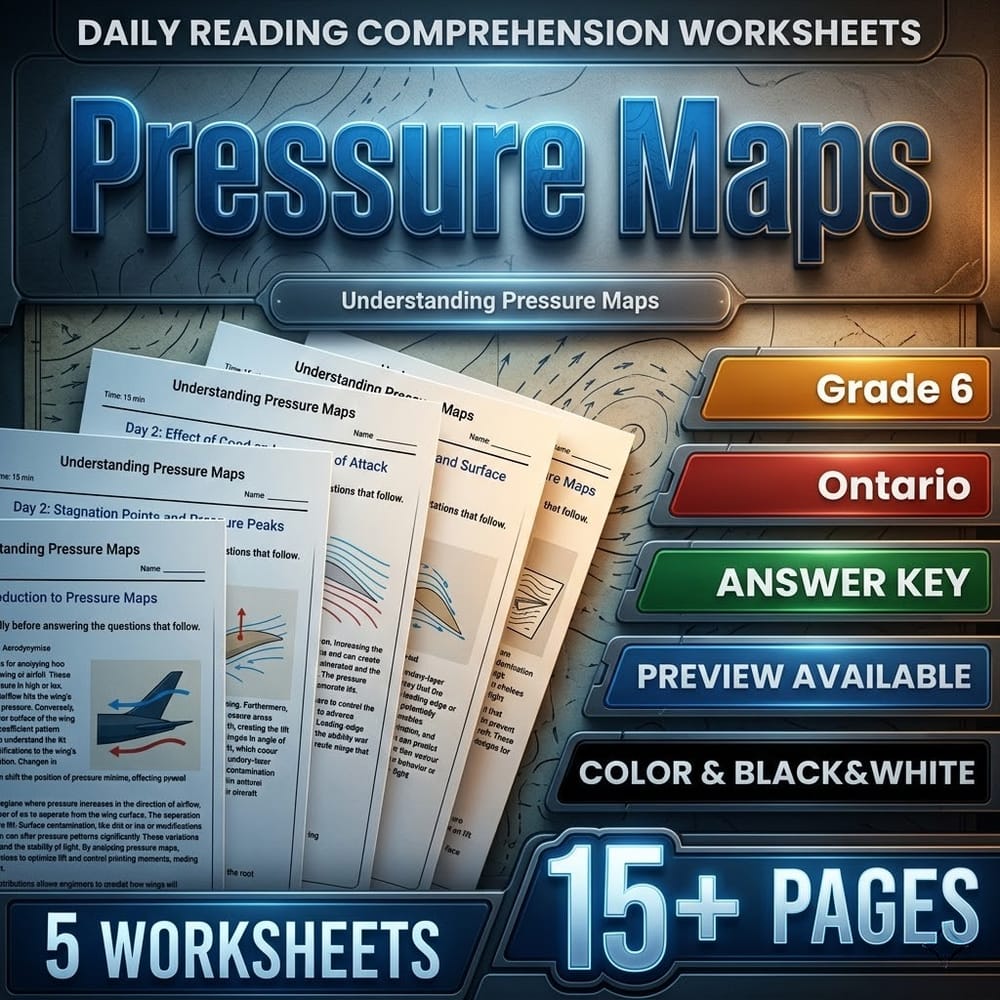
Grade 6 Science – Understanding Pressure Maps & Analysis | Daily Worksheet
Created byQuiet Forest EducationLearning Objectives
- Explain what pressure maps are and how they relate to wing surfaces.
- Identify different pressure zones such as stagnation points, suction peaks, and pressure minima.
- Understand how changes in camber and angle of attack influence pressure distributions.
Also included in: Flight Science Grade 6 Daily Reading Worksheets Bundle | Ontario +1 more
Instant download
About Grade 6 Science Worksheets
Explore Grade 6 Science worksheets for classwork, homework, or review. Our 5,969 printables download instantly as PDFs.
MyTeachingSheets worksheets are made by real teacher-authors and checked before they go live. Download any as a print-ready PDF for lessons, homework, or independent practice — most include answer keys, and previews are always free.