
Grade 6 Science Worksheets
5,969 worksheets
Grade 6 Digital Sources Worksheet | Practice & Assessment PDF
 Created byClear Sky Classroom
Learning Objectives
- Identify common types of digital sources (datasets, sensors, and remote-sensing products) used for local science inquiry
- Use metadata to verify temporal resolution and spatial coverage when interpreting digital information
- Explain how licensing and standardized formats affect reuse and comparison of digital sources
Also included in: Grade 6 Scientific Investigation Data Analysis Science Lesson Bundle | Alberta +1 more
Instant download

Energy From Sun Worksheet | Standards-Aligned Grade 6 Science Practice
JCreated byJ.S SheetsLearning Objectives
- Understand how incoming solar energy varies with angle and location.
- Explain how temperature patterns are influenced by solar energy distribution.
- Describe the processes of energy transfer through the atmosphere and oceans.
Also included in: Grade 6 Climate and Atmospheric Systems Science Lesson Bundle: Florida NGSSS +1 more
Instant download
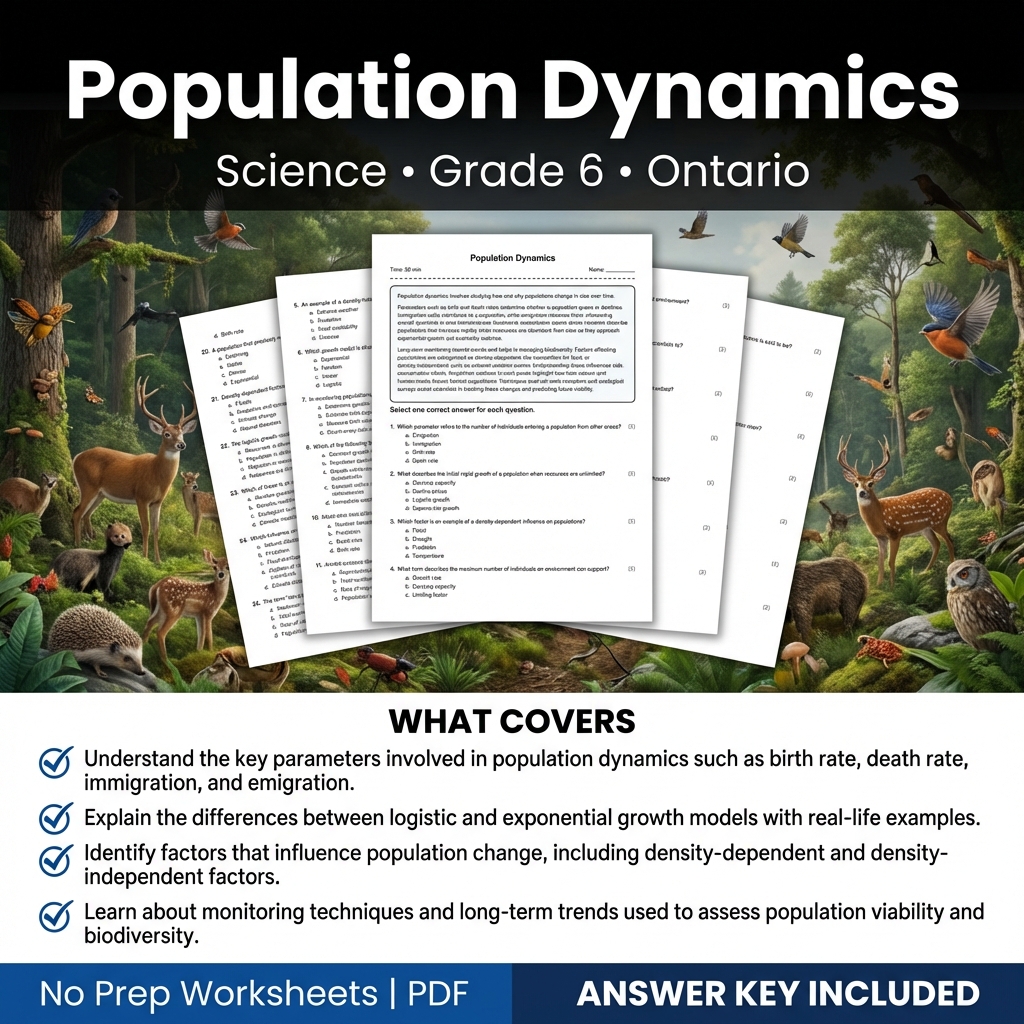
Population Dynamics Worksheet for Grade 6 Science | Ontario Standards
 Created byCoral Reef Learning
Learning Objectives
- Understand the key parameters involved in population dynamics such as birth rate, death rate, immigration, and emigration.
- Explain the differences between logistic and exponential growth models with real-life examples.
- Identify factors that influence population change, including density-dependent and density-independent factors.
Instant download

Criteria And Constraints Worksheet Pack | Grade 6 Science Activities
 Created byPrism Point Learning
Learning Objectives
- Explain the difference between criteria and constraints in the design process.
- Identify examples of criteria and constraints in a real-world design task.
- Use evidence to justify whether a proposed solution meets criteria while respecting constraints.
Instant download

Grade 6 Science Eclipses and Spring Neap Tides Worksheet Ontario
 Created byTeacher's Corner
Learning Objectives
- Explain how alignment in the Earth–Moon–Sun system produces solar and lunar eclipses.
- Distinguish umbra and penumbra and describe their effects on what people see.
- Model tidal ranges using the differential gravitational pull of the Moon and Sun.
Instant download

Cellular Respiration Worksheet | Standards-Aligned Grade 6 Science Practice
JCreated byJ.S SheetsLearning Objectives
- Explain the process of cellular respiration and its role in energy production.
- Identify the gases involved in cellular respiration and their exchange.
- Describe how matter from food molecules is transformed and transported in the body.
Also included in: Grade 6 Life Science Science Lesson Bundle – California Standards +1 more
Instant download

Measurement Uncertainty and Confidence in Data Worksheet Grade 6
 Created bySunny Desk Resources
Learning Objectives
- Explain how instrument resolution, environmental variation, and human observation can create measurement uncertainty
- Estimate uncertainty using repeated measurements and a range
- Interpret simple percent error and use it to judge whether results are reasonable
Also included in: Evidence & Investigation Grade 6 Science Worksheets | Alberta +1 more
Instant download

Fair Scientific Investigations Worksheets & Answer Key for Grade 6 Science
 Created byEmma Carter Resources
Learning Objectives
- Identify independent, dependent, and controlled variables in scientific investigations.
- Explain why a controlled investigation is a fair test.
- Construct hypotheses using a clear if-then-because format.
Instant download

Science Design Criteria and Constraints Worksheet | Grade 6 Science Assessment
JCreated byJ.S SheetsLearning Objectives
- Explain the difference between goals, criteria, and constraints in the design process
- Use criteria and constraints to interpret evidence from tests and observations
- Identify examples of constraints from real-world limitations like safety rules, available materials, size requirements, and environmental conditions
Also included in: Grade 6 Engineering Design Process Science Lesson Bundle – General Framework +1 more
Instant download
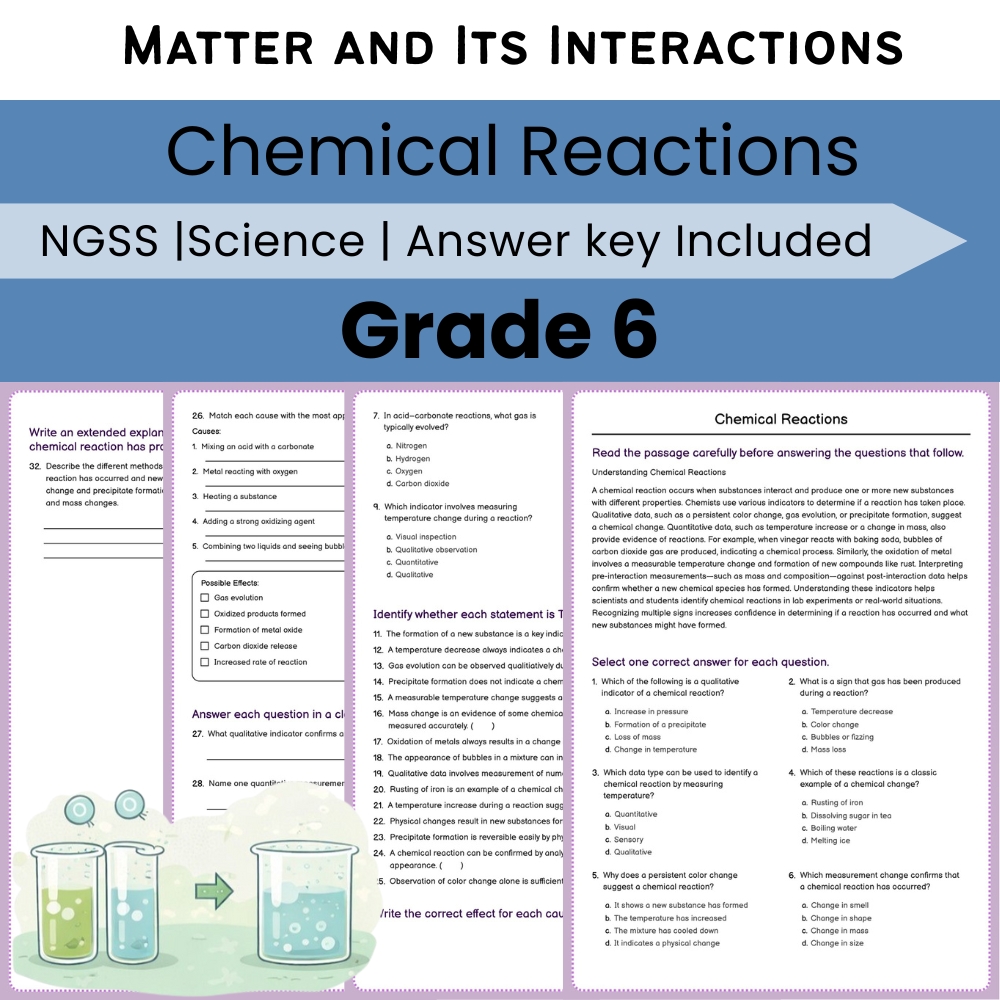
Grade 6 Science | Chemical Reactions Worksheet | Assessment & Student Practice (Printable PDF)
Learning Objectives
- Identify criteria that indicate a chemical reaction has occurred.
- Analyze quantitative and qualitative data to determine if new substances are formed.
- Recognize indicators of chemical reactions such as color change, gas evolution, precipitate formation, and temperature change.
Also included in: Grade 6 Science | Matter and Its Interactions NGSS Unit Bundle - Assessments & Worksheets +1 more
Instant download
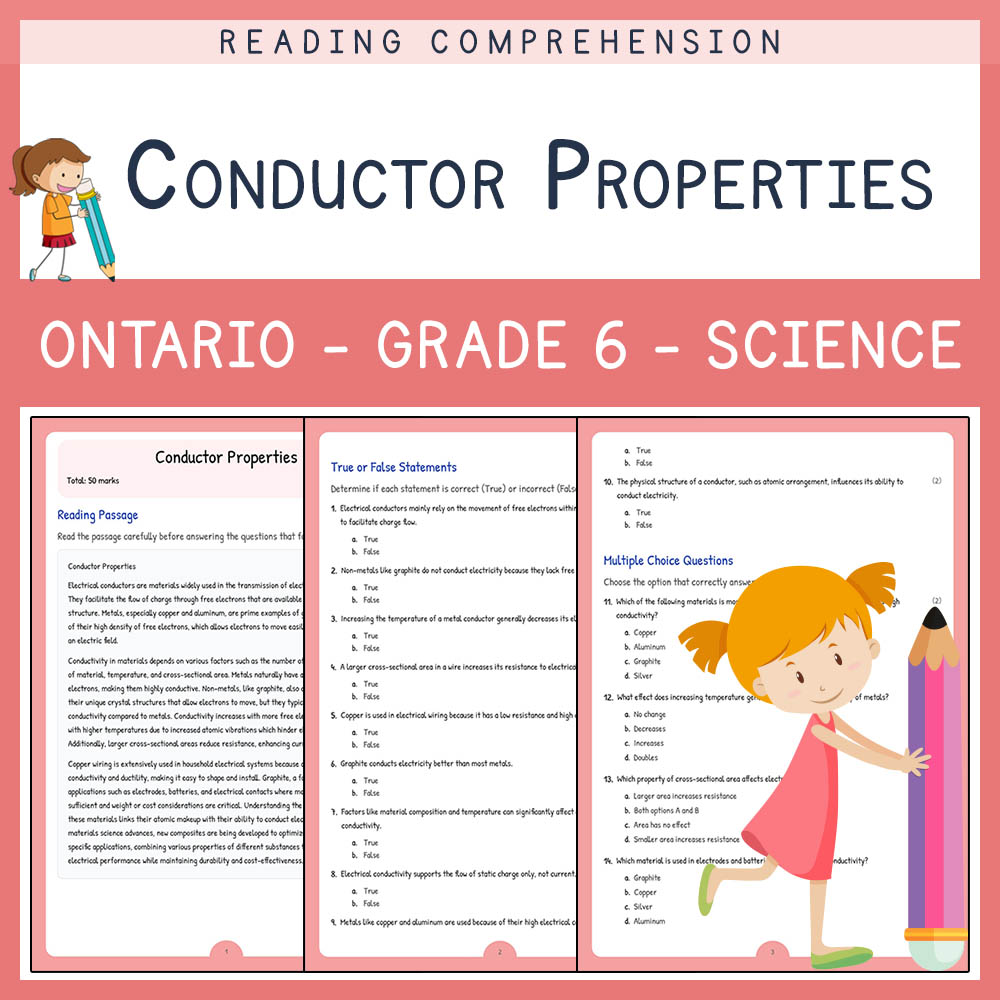
Grade 6 Science | Conductors Properties Worksheet & Answer Key (PDF)
 Created byLumora Learning
Learning Objectives
- Explain the concept of electrical conductivity and how free electrons facilitate charge flow in conductors.
- Identify common metallic and non-metallic materials that act as conductors.
- Describe factors affecting conductivity, including material composition, temperature, and cross-sectional area.
Also included in: Grade 6 Science | Electricity Unit Custom Bundle | Ontario Framework
Instant download

Celestial Patterns Worksheet Grade 6 Science | Assessment and Practice
Created byPrism Point LearningLearning Objectives
- Describe how the Sun, Moon, planets, and constellations appear to move in predictable patterns from a fixed location
- Explain how seasonal star patterns can be used to recognize characteristic times of year
- Compare how planets change position more slowly than constellations against the background stars
Also included in: Celestial Patterns & Seasons Lesson Bundle | Grade 6 Science | Alberta
Instant download

6th Grade Science – Energy Transfer Worksheet (TEKS Standard) (PDF)
 Created byEvergreen Desk Education
Learning Objectives
- Explain how thermal energy transfers by conduction, convection, and radiation.
- Use observable temperature changes and material properties (like thermal conductivity) to predict heat flow.
- Identify heat transfer behavior in simple open and closed systems.
Instant download

Matter Cycling Carbon Assessment Grade 6 | Science Standards-Aligned
Created byPrism Point LearningLearning Objectives
- Explain how carbon atoms cycle through air, water, and living organisms in an ecosystem
- Distinguish between matter cycling (conservation of atoms) and energy flow (one-way transformation)
- Describe how carbon moves from plants to animals and returns to the environment through respiration and decomposition
Also included in: Grade 6 Energy and Matter Cycles Science Lesson Bundle | California Standards +1 more
Instant download
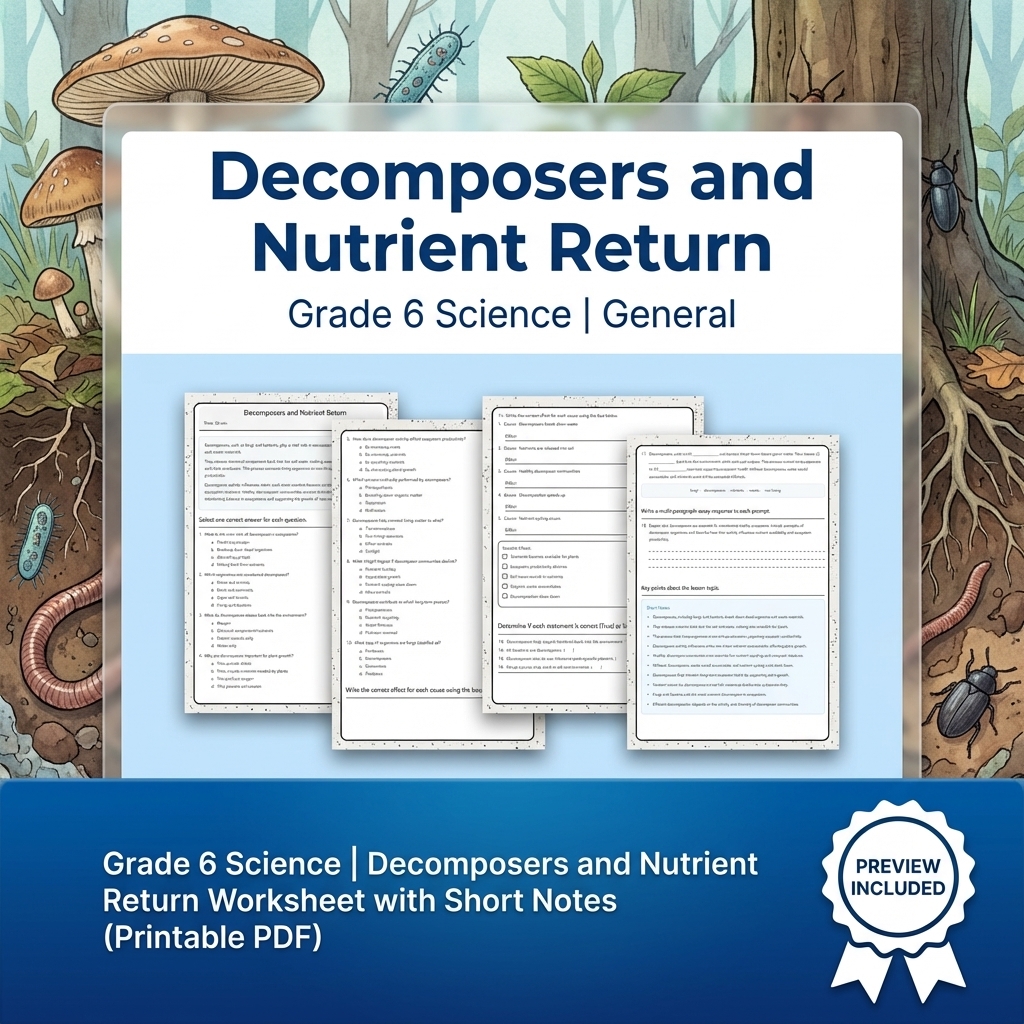
Grade 6 Science | Decomposers and Nutrient Return Worksheet with Short Notes
 Created byMeadowlark Worksheets
Learning Objectives
- Understand the role of decomposers in ecosystems.
- Identify different types of decomposers like fungi and bacteria.
- Explain how decomposers help recycle nutrients back into the environment.
Also included in: Grade 6 Science Lesson Group | Body Systems and Life Processes Worksheet Bundle +1 more
Instant download

Grade 6 Science | Particle Models in Science - Daily Reading Comprehension
Created byCoral Reef LearningLearning Objectives
- Understand that matter is made up of tiny particles that we cannot see.
- Describe how particles move, collide, and are spaced in different phases of matter.
- Explain how temperature and thermal energy affect particle behavior.
Instant download

Grade 6 Science | Water Reservoirs Water Storage & Movement - Reading Practice
Created byCoral Reef LearningLearning Objectives
- Identify different types of water reservoirs on Earth.
- Understand how water moves between reservoirs.
- Explain the conditions that affect water storage in various reservoirs.
Instant download
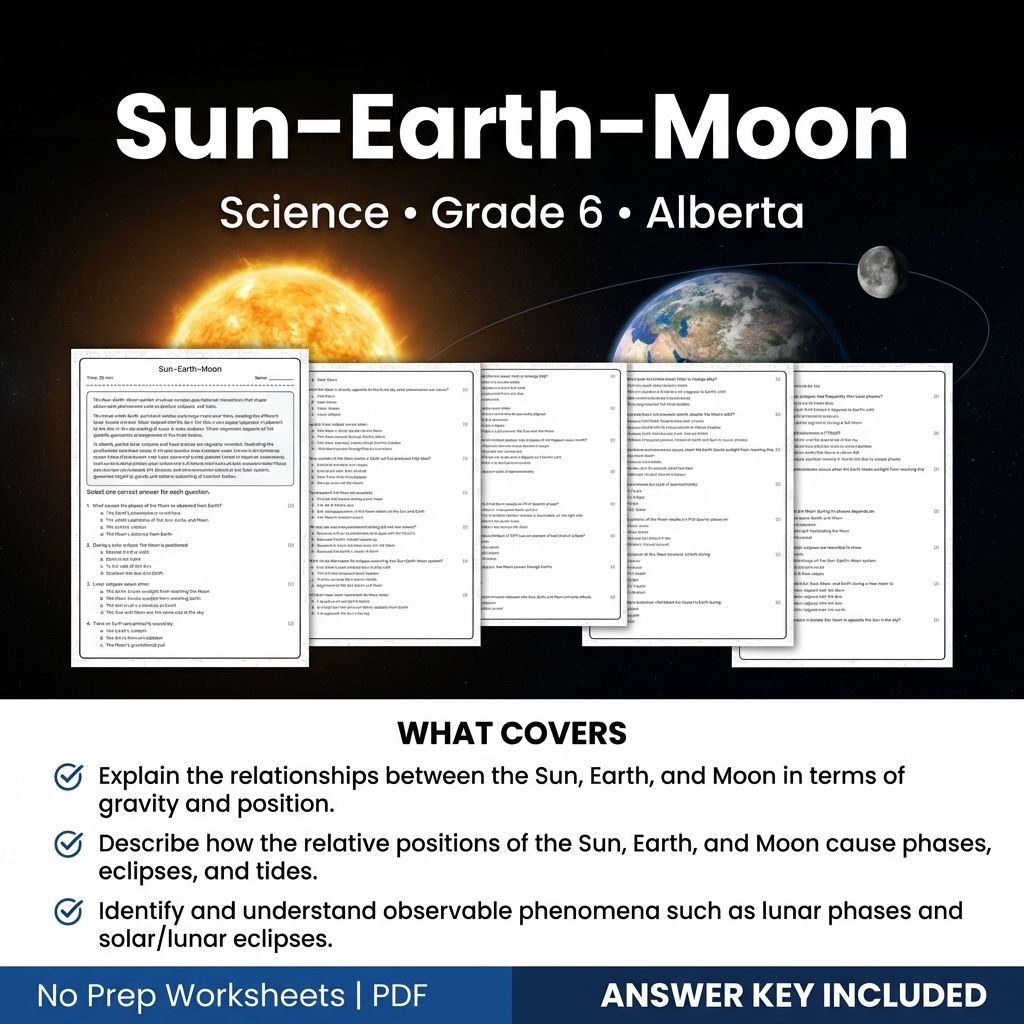
Grade 6 Science Sun–Earth–Moon Worksheet | Alberta Standards
Created byCoral Reef LearningLearning Objectives
- Explain the relationships between the Sun, Earth, and Moon in terms of gravity and position.
- Describe how the relative positions of the Sun, Earth, and Moon cause phases, eclipses, and tides.
- Identify and understand observable phenomena such as lunar phases and solar/lunar eclipses.
Instant download

Root Adaptations Worksheets Grade 6 Water Uptake and Tree Survival Review
Created bySunny Desk ResourcesLearning Objectives
- Describe how root systems anchor plants and help them absorb water and nutrients
- Compare lateral root systems and deep taproots and how soil conditions influence which form is common
- Explain how mycorrhizal associations can improve absorption and drought resilience
Also included in: Trees and Forests Grade 6 Alberta Science Worksheets Bundle +1 more
Instant download

6th Grade Science Chemical Evidence Worksheet | Reactions & Clues (PDF)
Created byEvergreen Desk EducationLearning Objectives
- Identify observable indicators that a chemical reaction has formed a new substance.
- Explain how chemical evidence suggests changes in composition rather than temporary mixing.
- Use examples (such as rusting and burning) to connect evidence to particle-level rearrangements.
Instant download

Grade 6 Science | Erosion and Deposition Worksheet | California Standards
Created byLumora LearningLearning Objectives
- Explain how moving water causes erosion by detaching and transporting sediment
- Describe how decreased water energy leads to deposition and the formation of landforms
- Identify factors that affect erosion and deposition, including water volume, flow speed, and surface materials
Instant download

6th Grade Science | Community Stewardship Worksheet (PDF) Ontario Standards
Created byEvergreen Desk EducationLearning Objectives
- Apply the steps of the scientific method to a local stewardship issue using respectful community engagement.
- Explain how consent and cultural sensitivity protect community members when collecting observations.
- Describe how to validate community-contributed records and communicate findings to non-specialist audiences.
Also included in: Grade 6 Science Inquiry and Data Collection Lesson Bundle | Ontario +1 more
Instant download

Defense Interactions Worksheet Practice | Grade 6 Science
Created byPrism Point LearningLearning Objectives
- Explain how barrier defenses, innate inflammation, and adaptive immune responses work together to protect the body
- Describe how lymphatic and circulatory systems help immune cells find pathogens and communicate with other cells
- Summarize how antibodies and immune memory provide long-term protection against specific pathogens
Also included in: Multicellular Systems & Functions Lesson Bundle | Grade 6 Science | BC +1 more
Instant download
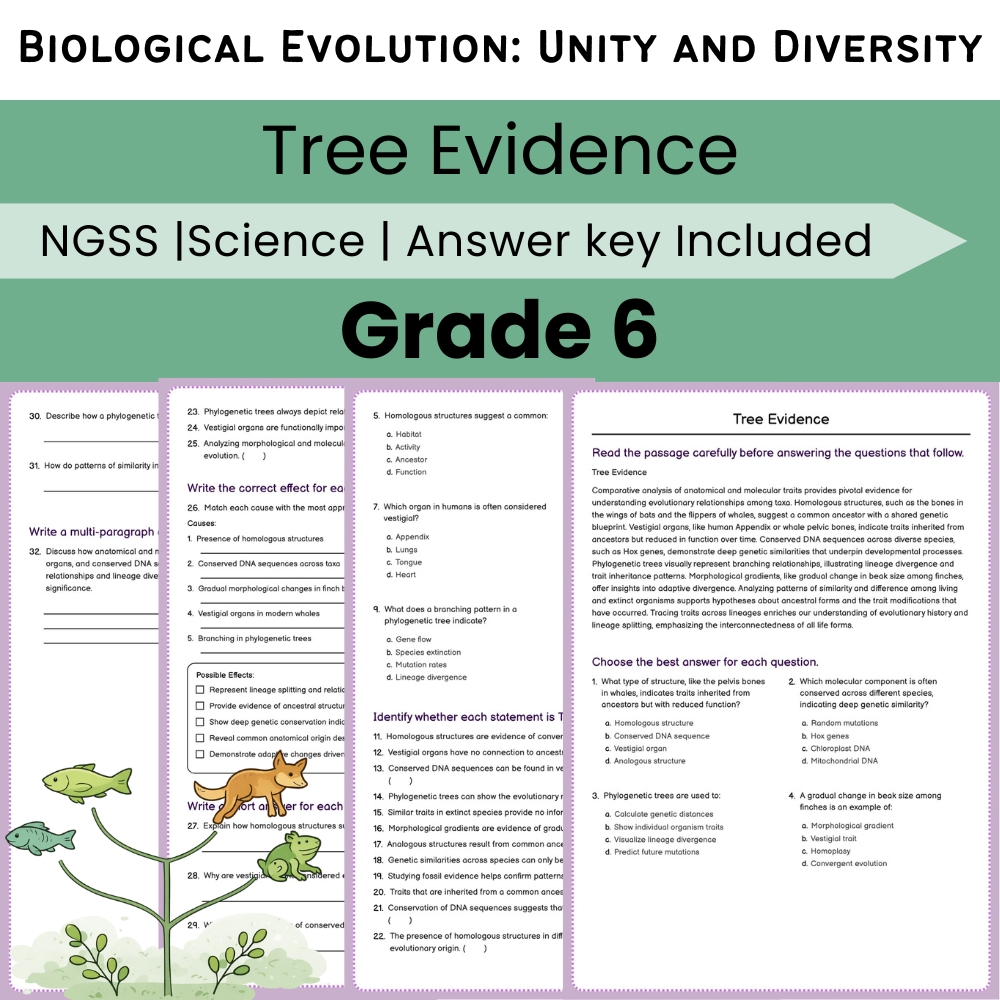
Grade 6 Science | Tree Evidence Worksheet – NGSS Assessment & Student Practice (Printable PDF)
Learning Objectives
- Understand how anatomical and molecular traits provide evidence for common ancestry among taxa.
- Identify homologous structures, vestigial organs, and conserved DNA sequences in different organisms.
- Interpret phylogenetic trees and related evidence to explain lineage splitting and trait inheritance.
Also included in: Grade 6 Science | Biological Evolution: Unity and Diversity Unit Bundle (NGSS-aligned Worksheets) +1 more
Instant download

Grade 6 Science – Habitats & Niches | Daily Reading Worksheet
 Created byBright Mind Resources
Learning Objectives
- Understand what habitats and niches are
- Identify different types of habitats
- Explain how niches influence species interactions
Also included in: Grade 6 Ecosystem Relationships Science Daily Reading Lesson Bundle | BC +1 more
Instant download
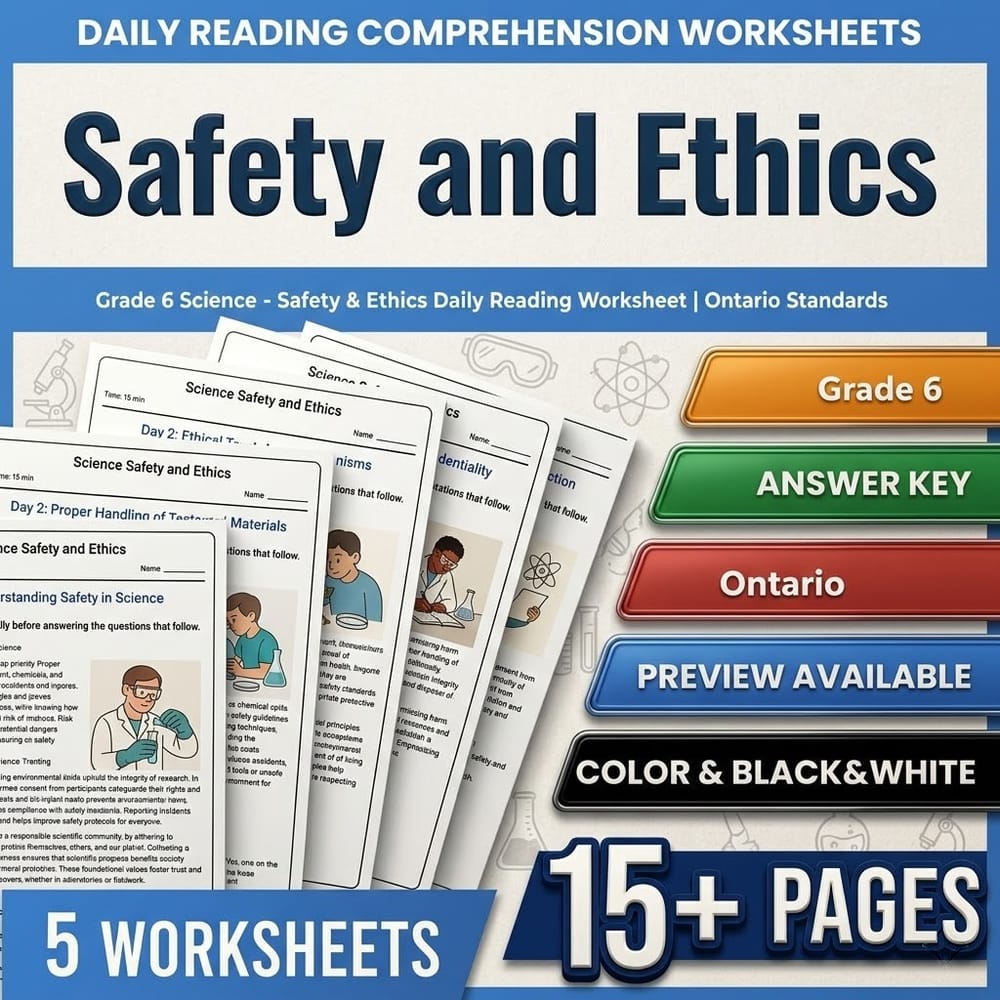
Grade 6 Science – Safety & Ethics Daily Reading Worksheet | Ontario Standards
 Created byQuiet Forest Education
Learning Objectives
- Understand core safety principles in scientific practices
- Recognize ethical considerations in research involving organisms and data
- Identify proper safety protocols for handling tools and materials
Also included in: Science Grade 6 Daily Reading Worksheets Bundle | Ontario Framework +1 more
Instant download

Population Change Worksheet | NGSS Grade 6 Ecology Activity & Notes
 Created byAmber Owl Education
Learning Objectives
- Use data such as birth rate, death rate, and age structure to explain how populations change over time.
- Construct evidence-based claims linking ecosystem component changes (predators, invasive species, habitat, disease) to population increases or declines.
- Describe how trophic cascades and recovery or collapse patterns can occur in both terrestrial and aquatic systems.
Also included in: Grade 6 Science Ecology & Ecosystems Lesson Bundle | NGSS +1 more
Instant download

6th Grade Science Worksheet | Habitats and Niches (PDF) – BC Standards
Created byEvergreen Desk EducationLearning Objectives
- Explain the difference between a habitat and a niche using examples
- Describe how overlapping niches can cause competition and limit population growth
- Analyze how resource partitioning can support species coexistence
Instant download

Matter & Particle Model Worksheets and Review Activity for Grade 6 Science
Created byEmma Carter ResourcesLearning Objectives
- Identify matter, particles, and the three states of matter.
- Compare particle arrangement and movement in solids, liquids, and gases.
- Explain changes of state using the particle model.
Instant download

Science Grade 6 Worksheet on Apparent Motion of the Sun, Moon, and Stars
JCreated byJ.S SheetsLearning Objectives
- Explain apparent daily motion of the Sun, Moon, and stars as a result of Earth’s rotation.
- Describe diurnal rising and setting and how Earth’s rotation creates apparent paths across the sky.
- Use the ideas of the celestial sphere and the horizon to explain how sky objects appear to move.
Instant download

Grade 6 Mixtures and Compounds Worksheet | Practice & Assessment PDF
Created byClear Sky ClassroomLearning Objectives
- Distinguish mixtures from compounds using particle models and descriptions of atomic arrangement
- Explain how physical separation methods relate to mixture composition
- Identify properties of compounds that result from consistent atomic bonding
Instant download

Ocean Currents Science Worksheet Grade 6 | Florida NGSSS Earth Science
Created byEvergreen Desk EducationLearning Objectives
- Explain how wind patterns and Earth’s rotation help drive ocean currents.
- Describe how ocean currents move water and heat and influence regional climate.
- Use evidence from a text to identify causes and effects related to coastal weather.
Instant download
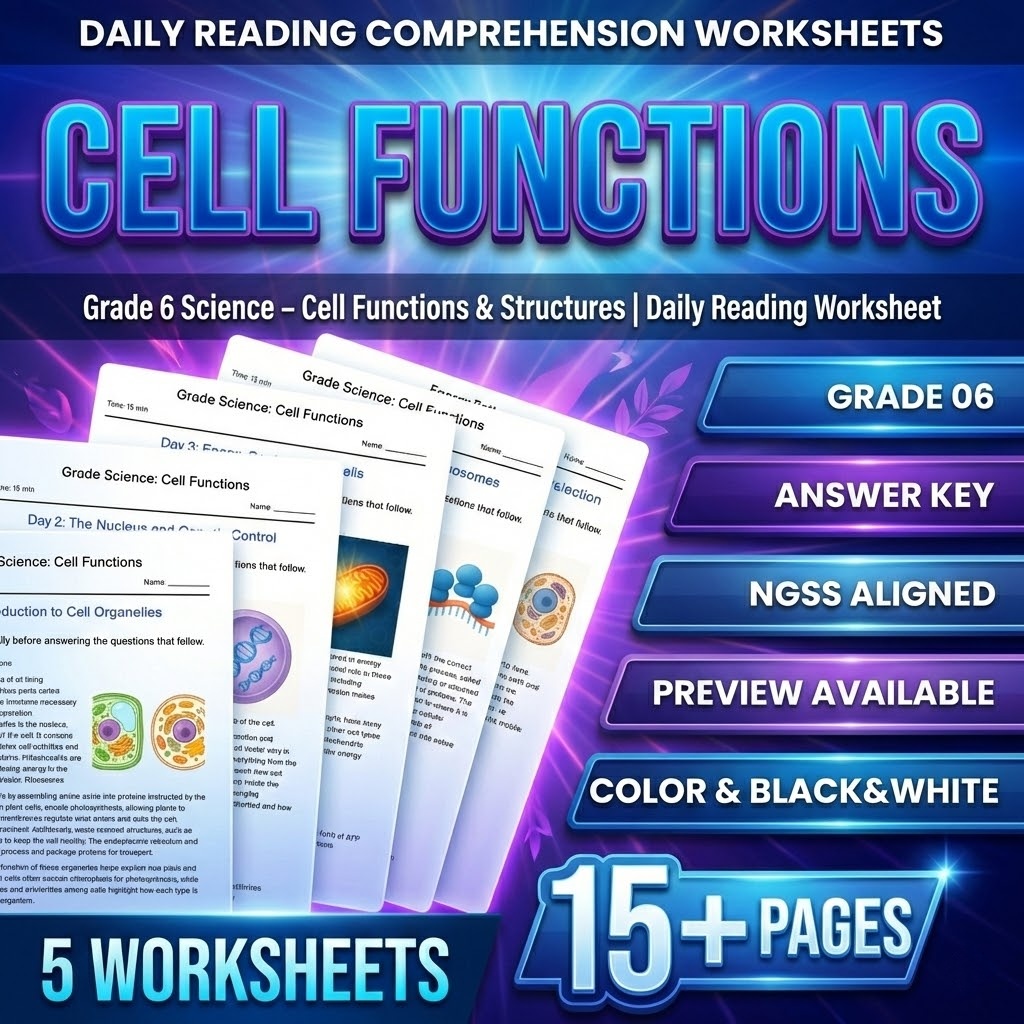
Grade 6 Science – Cell Functions & Structures | Daily Reading Worksheet
 Created byElena Brooks
Learning Objectives
- Identify the main organelles in plant and animal cells.
- Describe the functions of key cell organelles.
- Understand how cell structure relates to organelle function.
Also included in: Grade 6 Science From Molecules to Organisms Worksheet Bundle | NGSS +1 more
Instant download

Grade 6 Science | Electric and Magnetic Forces - Daily Reading Comprehension
Created byCoral Reef LearningLearning Objectives
- Understand the basic differences between electric and magnetic forces.
- Recognize how force depends on source strength and separation.
- Identify examples of electrostatic attraction and repulsion.
Instant download

Grade 6 Science | Leaf Functions - Daily Reading Comprehension
Created byCoral Reef LearningLearning Objectives
- Identify different parts of a leaf and understand their functions.
- Explain how leaves contribute to photosynthesis, transpiration, and gas exchange.
- Recognize variations in leaf structures between conifers and deciduous trees.
Also included in: Trees and Forests Lesson Bundle | Grade 6 Science | Alberta +1 more
Instant download

Optimization Tradeoffs Worksheet | Grade 6 Science Review & Practice
Created byPrism Point LearningLearning Objectives
- Explain how optimizing multiple design criteria requires tradeoffs and constraints.
- Use Pareto trade-off ideas to compare design options with different performance goals.
- Describe how safety margins, buffers, and manufacturability affect viable engineering configurations.
Also included in: Grade 6 Aerodynamics Flight Design Science lesson bundle - Ontario
Instant download

Climate Data Patterns and Extremes Worksheets Grade 6 Science
 Created byBRIGHT PATH RESOURCES
Learning Objectives
- Explain how long-term climate records are summarized using averages and variability
- Interpret graphs to identify patterns in temperature and precipitation over time
- Describe how comparing current data to historical baselines shows climate change or stability
Also included in: Grade 6 Earth Science Worksheets | Weather, Water & Climate Bundle +2 more
Instant download

6th Grade Science Worksheet – States of Matter TEKS (PDF)
Created byEvergreen Desk EducationLearning Objectives
- Compare solids, liquids, and gases using particle arrangement and relative motion.
- Describe macroscopic traits such as shape retention and compressibility for each state of matter.
- Use everyday examples (ice, liquid water, water vapor) to connect state changes with density and molecular spacing.
Instant download

6th Grade Science Worksheet – Measuring Circuits (PDF) (Ontario Standards)
Created byEvergreen Desk EducationLearning Objectives
- Explain how current and voltage measurements relate to circuit performance.
- Describe conceptually where instruments are placed to measure current versus voltage.
- Interpret typical meter readings and uncertainty in simple circuit scenarios.
Also included in: Grade 6 Electricity Circuits Science Lesson Bundle for Ontario Worksheets +1 more
Instant download

Space Tools Assessment | TEKS Grade 6 Science Standards-Aligned Assessment
Created byPrism Point LearningLearning Objectives
- Understand various observational techniques and instruments used in space science.
- Identify the functions of ground-based and orbital telescopes, space probes, and satellites.
- Describe spectral imaging, remote sensing, and data interpretation methods in space exploration.
Instant download

Grade 6 Science | Claim Evaluation Daily Reading Practice - Alberta Standards
Created byCoral Reef LearningLearning Objectives
- Understand the importance of relevance in scientific evidence.
- Identify criteria for evaluating the strength of scientific claims.
- Learn to assess the consistency and uncertainty of evidence.
Also included in: Evidence and Investigation Lesson Bundle | Grade 6 Science | Alberta +1 more
Instant download

6th Grade Science | Lunar Phases Model Worksheet (Alberta Standard) (PDF)
 Created bySilver Birch Teaching
Learning Objectives
- Explain how the relative positions of the Sun, Earth, and Moon determine lunar phases
- Use a simple geometric model to predict which phase will be visible from Earth
- Describe the sequence of lunar phases and relate it to the synodic period
Also included in: Grade 6 Celestial Motion & Seasons Science Lesson Bundle | Alberta +1 more
Instant download

Grade 6 Science Worksheet on Orbital Motion: Gravity, Orbits, and Periods
 Created bySkylark Worksheets
Learning Objectives
- Explain how gravitational attraction between a planet (or moon) and the Sun produces orbital motion
- Describe how orbital shape can be elliptical and how distance affects orbital speed and orbital period
- Use comparative examples (Earth–Moon and Jupiter–satellites) to reason about how mass and distance influence orbits
Also included in: Grade 6 Solar System Relationships Science Lesson Bundle NGSS +1 more
Instant download
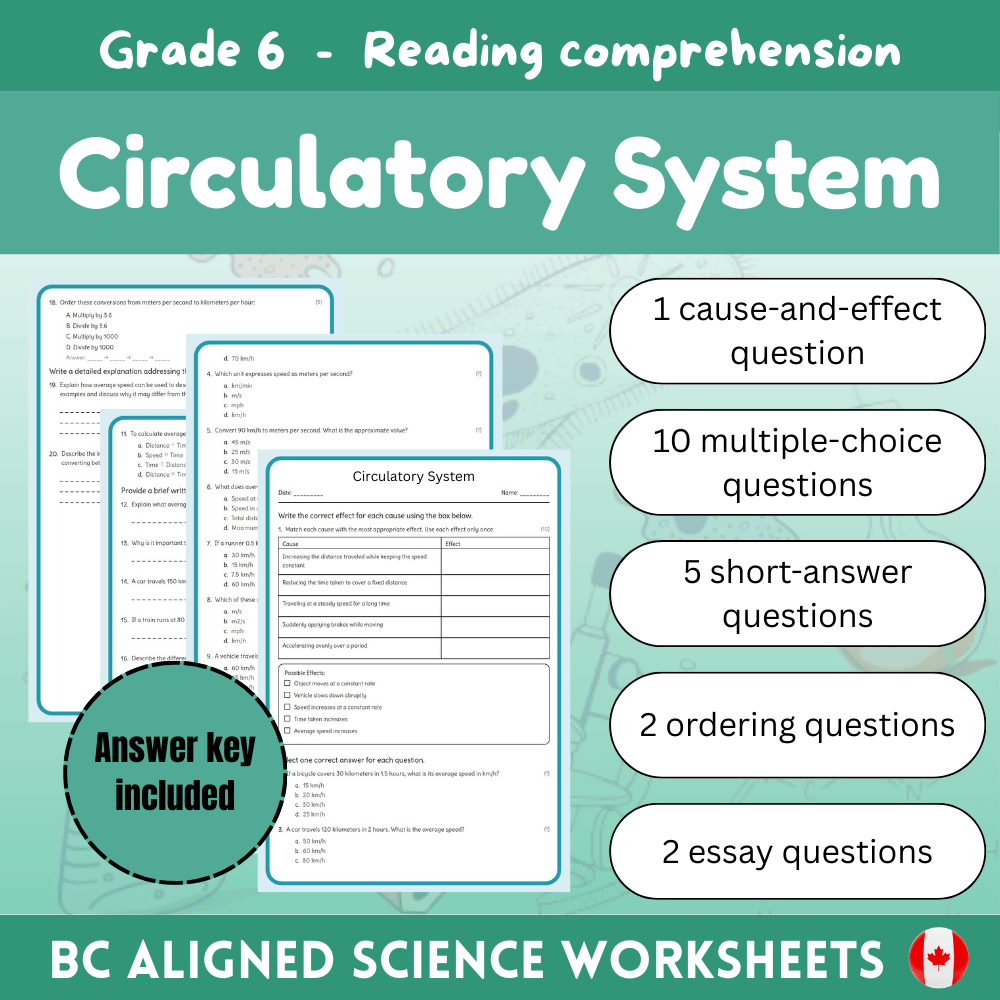
Grade 6 Science | Circulatory System Worksheet (Worksheet + Answer Key) PDF
Created byBright Mind ResourcesLearning Objectives
- Understand the main functions of the circulatory system.
- Identify the components of the heart and blood vessels.
- Explain how blood transports gases, nutrients, and wastes.
Instant download

Grade 6 Science – Oceans & Climate Regulation Daily Reading Worksheet
Created byBright Mind ResourcesLearning Objectives
- Understand how oceans influence climate stability
- Learn about the process of heat absorption and release by oceans
- Identify how ocean conditions affect weather patterns
Also included in: Climate Grade 6 Science Daily Reading Worksheets Lesson Bundle | Florida NGSSS +1 more
Instant download

Data Graphing and Trends Science Worksheets Grade 6
Created bySunny Desk ResourcesLearning Objectives
- Match a data set to an appropriate graph type (line, bar, or scatter)
- Label axes clearly and choose scales that do not mislead readers
- Use annotations to highlight key patterns or comparisons in a graph
Also included in: Evidence & Investigation Grade 6 Science Worksheets | Alberta +1 more
Instant download

Parallel Characteristics Worksheet Grade 6 Science | Ontario Standards
 Created byCedar Grove Learning
Learning Objectives
- Explain how parallel circuits provide the same potential difference across each branch.
- Describe how total current in a parallel circuit relates to the sum of branch currents.
- Compare fault tolerance of parallel circuits with the vulnerability of series circuits.
Also included in: Grade 6 Electricity and Circuits Science lesson bundle: Ontario framework +1 more
Instant download

Atom Conservation Worksheet Grade 6 Science Matter Conservation Practice
Created byPrism Point LearningLearning Objectives
- Explain how atoms are conserved during chemical reactions using particle diagrams.
- Describe reactants and products as rearrangements of atoms rather than creation or destruction.
- Use particle-level evidence to connect conservation of atoms to observable changes.
Instant download
About Grade 6 Science Worksheets
Explore Grade 6 Science worksheets for classwork, homework, or review. Our 5,969 printables download instantly as PDFs.
MyTeachingSheets worksheets are made by real teacher-authors and checked before they go live. Download any as a print-ready PDF for lessons, homework, or independent practice — most include answer keys, and previews are always free.