
Grade 6 Science Worksheets
5,969 worksheets
Variation Effects Practice Worksheet | Grade 6 Science NGSS Review
 Created byPrism Point Learning
Learning Objectives
- Explain how genetic variation and environmental factors can produce phenotypic variation in organisms.
- Use examples (inheritance, nutrition, and temperature-dependent expression) to describe how traits change across development and populations.
- Connect DNA sequence changes and environmental/epigenetic influences to differences in structure and function.
Also included in: Grade 6 Cellular Systems Science Lesson Bundle NGSS Worksheets
Instant download

Air Density Worksheet | Grade 6 Science | Standards-Aligned Practice
JCreated byJ.S SheetsLearning Objectives
- Understand what air density is and how it affects buoyancy and aerodynamic forces.
- Identify the effects of temperature, humidity, and altitude on air density.
- Explain how local atmospheric conditions influence lift generation on wings.
Instant download

Particle Model Worksheet | Grade 6 Science Practice
Created byPrism Point LearningLearning Objectives
- Explain how the particle model describes solids, liquids, and gases using particle motion and spacing.
- Connect microscopic particle behavior to macroscopic properties such as shape, volume, flow, and compressibility.
- Use particle model vocabulary (solid, liquid, gas, particles, motion, spacing, arrangement) to describe everyday examples.
Also included in: Matter, Properties & Change Lesson Bundle — Grade 6 Science BC Framework +1 more
Instant download

Science Grade 6 Classification Basics Worksheet | Ontario Standards Practice
JCreated byJ.S SheetsLearning Objectives
- Identify observable traits and use them to classify organisms at familiar habitats
- Explain how a hierarchy of categories (kingdom to species) helps scientists group living things
- Use a dichotomous key to classify an organism by choosing between paired traits
Instant download
Grade 6 Science | Mass Conservation Worksheet with Short Notes (Printable PDF)
 Created byMeadowlark Worksheets
Learning Objectives
- Understand the law of conservation of mass and how it applies to closed and open systems.
- Identify differences between physical and chemical processes in terms of mass.
- Apply principles of mass conservation to real-world experiments and observations.
Also included in: Grade 6 Science | Matter, Properties & Change UNIT Worksheet Bundle +1 more
Instant download

Grade 6 Pollution Effects Worksheet | BC Use Practice PDF
 Created byClear Sky Classroom
Learning Objectives
- Explain how different types of pollution enter ecosystems and affect living things
- Describe processes such as bioaccumulation, biomagnification, and eutrophication
- Identify evidence of ecosystem damage caused by pollutants, including dead zones
Instant download

Human Influences Worksheet | TEKS-Aligned Grade 6 Science Practice
JCreated byJ.S SheetsLearning Objectives
- Explain how human activities can change natural systems and affect community composition and population viability.
- Describe the effects of habitat fragmentation, pollution, land-use change, nonnative species, and resource extraction on ecosystems.
- Use examples (like altered waterways and urban expansion) to predict how species distributions and genetic diversity may shift.
Instant download

Grade 6 Science | Rearrangement Explanation Worksheet | California Standards
 Created byLumora Learning
Learning Objectives
- Explain the rearrangement idea using atomic models (atoms break apart from reactants and recombine in products).
- Connect rearranged atomic combinations to observable properties of products (such as gas release or solid formation).
- Distinguish mixing from chemical reactions by focusing on new arrangements and new combinations.
Instant download
Grade 6 Science – Trait Heritability Worksheet for Mastering Genetic Traits
 Created byThe Resource Hub
Learning Objectives
- Explain the concept of heritability and how genetic variation contributes to adaptive traits.
- Distinguish between heritable and environmental influences on traits.
- Describe basic mechanisms of inheritance and how traits can shift allele frequencies over generations.
Also included in: Grade 6 Science Unit Bundle | Ecosystems, Genetic Traits & Environmental Impact +1 more
Instant download

Grade 6 Science | Oceans Regulate Climate Worksheet | NGSSS Aligned
Created byLumora LearningLearning Objectives
- Explain how oceans absorb, store, and release heat more slowly than land.
- Describe how ocean heat content can influence evaporation, humidity, and weather patterns.
- Connect ocean circulation and moisture supply to milder coastal temperatures and early climate signals.
Instant download

Life Processes in Cells Assessment | Standards-Aligned Grade 6 Science
Created byPrism Point LearningLearning Objectives
- Understand the key life processes that occur within cells, including photosynthesis and cellular respiration.
- Describe how diffusion and transport mechanisms support material movement across cell membranes.
- Explain how these processes maintain conditions necessary for growth, repair, and reproduction in organisms.
Instant download

Grade 6 Science | Introduction to Geologic Time - Daily Reading Comprehension
 Created byCoral Reef Learning
Learning Objectives
- Understand the principles of relative and absolute dating
- Learn about the division of Earth's history into geologic periods
- Identify methods used to determine the age of rocks and fossils
Instant download

Grade 6 Science – Introduction to Parallel Circuits | Daily Reading Worksheet
 Created byBright Mind Resources
Learning Objectives
- Understand the basic features of parallel circuits
- Identify components and pathway structures in parallel wiring
- Explain how potential difference and current behave in parallel circuits
Also included in: Grade 6 Electricity Science Daily Reading Lesson Bundle | Ontario +1 more
Instant download

Testable Predictions Worksheet Grade 6 Science | NGSSS Inquiry Skills Practice
 Created byEvergreen Desk Education
Learning Objectives
- Explain what makes a scientific prediction testable and linked to an explanation or model
- Describe how evidence supports or challenges a prediction and how scientists refine models
- Identify criteria for evaluating results and interpret measurement uncertainty
Instant download

Change Evidence Worksheet for Grade 6 Science | TEKS-Aligned Practice
JCreated byJ.S SheetsLearning Objectives
- Differentiate physical changes from chemical changes using observable evidence such as gas formation, precipitate formation, permanent color change, and temperature change.
- Identify which evidence is more consistent with chemical change versus physical change.
- Explain how conservation of matter applies to both physical and chemical changes.
Instant download

Grade 6 Science – Electrical Measurement Instruments | Daily Reading Worksheet
Created byBright Mind ResourcesLearning Objectives
- Identify the roles of ammeters and voltmeters in electrical circuits.
- Understand measurement units: amperes and volts.
- Comprehend how instruments are connected in series and parallel circuits.
Also included in: Grade 6 Electricity Science Daily Reading Lesson Bundle | Ontario +1 more
Instant download
6th Grade Science | Sun–Earth–Moon Reading Worksheet (PDF + Answer Key)
JCreated byJ.S SheetsLearning Objectives
- Describe the gravitational relationships between the Sun, Earth, and Moon.
- Explain how the relative positions of celestial bodies cause phases, eclipses, and tides.
- Identify geometric configurations that lead to observable lunar and solar phenomena.
Also included in: Grade 6 Science | Celestial Motion & Sky Observation Worksheets Bundle +1 more
Instant download

Sun Earth Moon Worksheet | Grade 6 Science Assessment Ontario Standards
 Created byCedar Grove Learning
Learning Objectives
- Explain how the masses of the Sun, Earth, and Moon affect gravitational interactions and orbital relationships.
- Describe the role of the Earth–Moon barycenter in how Earth and Moon move around each other.
- Use gravitational ideas to connect mutual motion and stable orbital patterns.
Also included in: Grade 6 Earth and Space Systems Science Lesson Bundle: Ontario +1 more
Instant download

Science Worksheet: Control Coupling Grade 6 | Ontario Standards Alignment
JCreated byJ.S SheetsLearning Objectives
- Explain how roll, pitch, and yaw controls can influence each other through control coupling
- Describe how differential drag during roll can cause adverse yaw
- Identify ways aircraft designers reduce unwanted coupled moments (e.g., differential and Frise ailerons, trim, control mixers)
Instant download

Lunar Phases Sun Earth Moon Model Worksheet | Grade 6 Alberta Science
 Created byBRIGHT PATH RESOURCES
Learning Objectives
- Identify how the relative positions of the Sun, Earth, and Moon determine the Moon’s visible phases.
- Use a geometric model to predict which phase (crescent, quarter, gibbous, or full) matches a viewpoint.
- Explain how the Moon’s illuminated fraction appears to change over about one lunar month.
Also included in: Sun-Earth-Moon Patterns Lesson Bundle Grade 6 Science Alberta Daily Reading +1 more
Instant download

Grade 6 Science | Control Coupling in Aerodynamics - Daily Reading Comprehension
Created byCoral Reef LearningLearning Objectives
- Understand the concept of control surfaces in aircraft.
- Learn about aerodynamic interactions such as adverse yaw and control coupling.
- Identify techniques used to mitigate unwanted control effects.
Instant download

Grade 6 Science – Prototype Evaluation & Testing | Daily Reading Worksheet
Created byBright Mind ResourcesLearning Objectives
- Understand the purpose of prototype evaluation in science projects.
- Identify different types of data used to assess prototypes.
- Learn how to interpret measurements and observations to improve models.
Also included in: Engineering & Technology Grade 6 Science Worksheets Lesson Bundle | General +1 more
Instant download

Grade 6 Science | Decomposers & Nutrient Return - Daily Reading Comprehension
Created byCoral Reef LearningLearning Objectives
- Understand the role of decomposers in ecosystems
- Identify different types of decomposers such as fungi and bacteria
- Explain how decomposers return nutrients to the environment
Instant download

Feedback Control Worksheet & Doodle Notes | NGSS Grade 6 Science
 Created byAmber Owl Education
Learning Objectives
- Explain how negative feedback helps maintain internal stability (homeostasis) in the body.
- Identify the roles of sensors, control centers, and effectors in feedback control systems.
- Compare negative and positive feedback by describing how each changes the direction of change.
Also included in: Cells & Scientific Evidence Lesson Bundle – Grade 6 Science NGSS +1 more
Instant download

Grade 6 Variables Control Daily Reading Worksheet | TEKS Science Activity
Created byBRIGHT PATH RESOURCESLearning Objectives
- Identify independent, dependent, and controlled variables in a simple science test.
- Explain why keeping controlled variables the same makes a comparison fair.
- Use operational definitions to describe variables clearly.
Also included in: Scientific Methods 6th Science Daily Reading Worksheets Lesson Bundle | TeKS +1 more
Instant download
Grade 6 Science | Space Cycles Worksheet with Short Notes (Printable PDF)
Created byMeadowlark WorksheetsLearning Objectives
- Understand the causes of day and night as Earth rotates.
- Describe how Earth's orbit and tilt cause seasons.
- Explain the Moon's phases and their recurring pattern.
Also included in: Grade 6 Science Lesson Group Weather, Water, Space, Erosion & Climate +1 more
Instant download

Grade 6 Renewable Transformations Worksheet | Practice & BC Standard PDF
Created byClear Sky ClassroomLearning Objectives
- Explain how photovoltaic, wind, and hydro systems transform one form of energy into electrical energy.
- Describe how energy losses (heat and friction) limit the net usable energy from renewable sources.
- Connect storage and conversion choices to conservation of energy and practical limits.
Instant download

Grade 6 Molecular Processes Worksheet | NGSS Science Activity + Answer Key
 Created byNorthstar Worksheets
Learning Objectives
- Explain how monomers form polymers through condensation reactions and how polymers are broken down by hydrolysis.
- Identify major biological macromolecules (proteins, nucleic acids, lipids, carbohydrates) and name their monomers.
- Describe how enzymes help reactions happen and how transport across membranes relates to molecular structure.
Also included in: Cells & Human Body Systems Lesson Bundle | Grade 6 Science | NGSS +1 more
Instant download
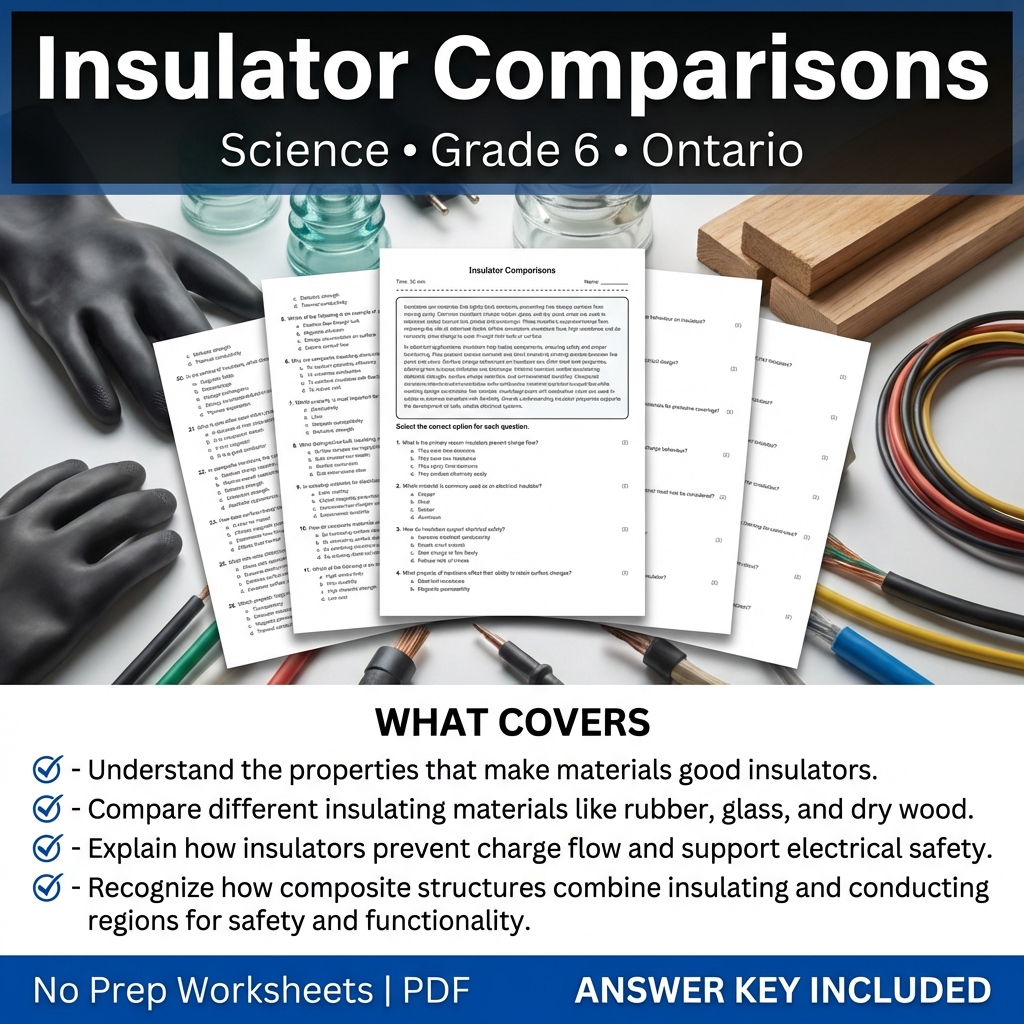
Grade 6 Science Worksheet on Insulator Comparisons | Ontario
Created byCoral Reef LearningLearning Objectives
- Understand the properties that make materials good insulators.
- Compare different insulating materials like rubber, glass, and dry wood.
- Explain how insulators prevent charge flow and support electrical safety.
Instant download

Grade 6 Science | Adaptation Overview Worksheet | BC Aligned
Created byLumora LearningLearning Objectives
- Understand the concept of adaptations and their role in survival.
- Identify different types of structural adaptations in organisms.
- Explain how adaptations provide advantages for resource acquisition, defense, and reproduction.
Instant download

Science Worksheet: Erosion Pathways | Standards-Aligned Grade 6 Assessment
JCreated byJ.S SheetsLearning Objectives
- Explain how erosion transports rock and sediment using agents like water, wind, ice, and gravity.
- Describe how deposition occurs when transporting agents lose energy.
- Connect erosion and deposition to landforms such as river valleys, deltas, dunes, and coastal beaches.
Also included in: Grade 6 Earth System Cycles Science Lesson Bundle: General Framework +1 more
Instant download

Grade 6 Science | Streamlining in Aerodynamics - Daily Reading Comprehension
Created byCoral Reef LearningLearning Objectives
- Understand the basic principles of streamlining
- Identify common features that reduce aerodynamic resistance
- Recognize practical examples of streamlined objects
Also included in: Air and Aerodynamics Lesson Bundle – Grade 6 Science Alberta Reading Comp. +1 more
Instant download

Grade 6 Science Worksheet on Gravity and Friction | NGSS Aligned Assessment
JCreated byJ.S SheetsLearning Objectives
- Explain how gravitational attraction depends on mass and distance.
- Compare and contrast gravitational forces with contact forces like friction.
- Use examples such as the Earth-Moon system and planetary orbits to illustrate gravitational interactions.
Also included in: Grade 6 Forces, Motion, and Interactions Science Lesson Bundle: NGSS +1 more
Instant download

6th Grade Science Worksheet | Observation Techniques & Data Collection (PDF)
Created byEvergreen Desk EducationLearning Objectives
- Define systematic observation and explain how to plan data collection before measuring or recording.
- Distinguish qualitative notes from quantitative measurements and choose appropriate units.
- Use observation logs to improve accuracy by reducing bias and maintaining consistent sampling over time.
Instant download

Biodiversity Solutions Keeping Ecosystems Working Worksheet NGSS Grade 6 Science
 Created bySkylark Worksheets
Learning Objectives
- Compare conservation strategies, habitat restoration, protected area design, and invasive species management using evidence from case studies.
- Evaluate ecological trade-offs and feasibility when solutions are applied to support biodiversity and ecosystem services.
- Explain how biodiversity supports pollination, water purification, and nutrient cycling under changing environmental pressures.
Also included in: Grade 6 Ecosystems Lesson Bundle: NGSS Science Worksheets & Food Webs +1 more
Instant download

Abiotic Influences Worksheet | Grade 6 Science Activities
Created byPrism Point LearningLearning Objectives
- Identify abiotic factors (nonliving physical/chemical conditions) that shape habitat conditions.
- Explain how abiotic gradients (such as moisture, light, and temperature) affect where organisms can survive and reproduce.
- Describe examples of seasonal or local changes in abiotic factors that influence organism behavior and population fluctuations.
Also included in: Grade 6 Ecosystem Interactions Science Lesson Bundle Worksheets | TEKS +1 more
Instant download

Earthquakes and Volcanoes Worksheets | Grade 6 Science Practice
LCreated byLearnora ResourcesLearning Objectives
- Identify key vocabulary related to earthquakes and volcanic activity
- Explain how tectonic plate movement can cause earthquakes
- Describe how stress builds and energy is released along faults
Instant download

Airfoil Shape and Lift Worksheets | Grade 6 Flight Science
Created byPrism Point LearningLearning Objectives
- Explain how airfoil geometry affects pressure distribution
- Compare simplified Bernoulli and Newtonian ideas about lift
- Describe how angle of attack influences lift
Also included in: Flight Lesson Bundle | Grade 6 Science | Ontario Framework
Instant download

Grade 6 Science – Ocean Currents & Climate | Daily Reading Worksheet
Created byBright Mind ResourcesLearning Objectives
- Understand key concepts related to Science
- Apply knowledge through practice questions
- Demonstrate comprehension of the material
Also included in: Climate Grade 6 Science Daily Reading Worksheets Lesson Bundle | Florida NGSSS +1 more
Instant download
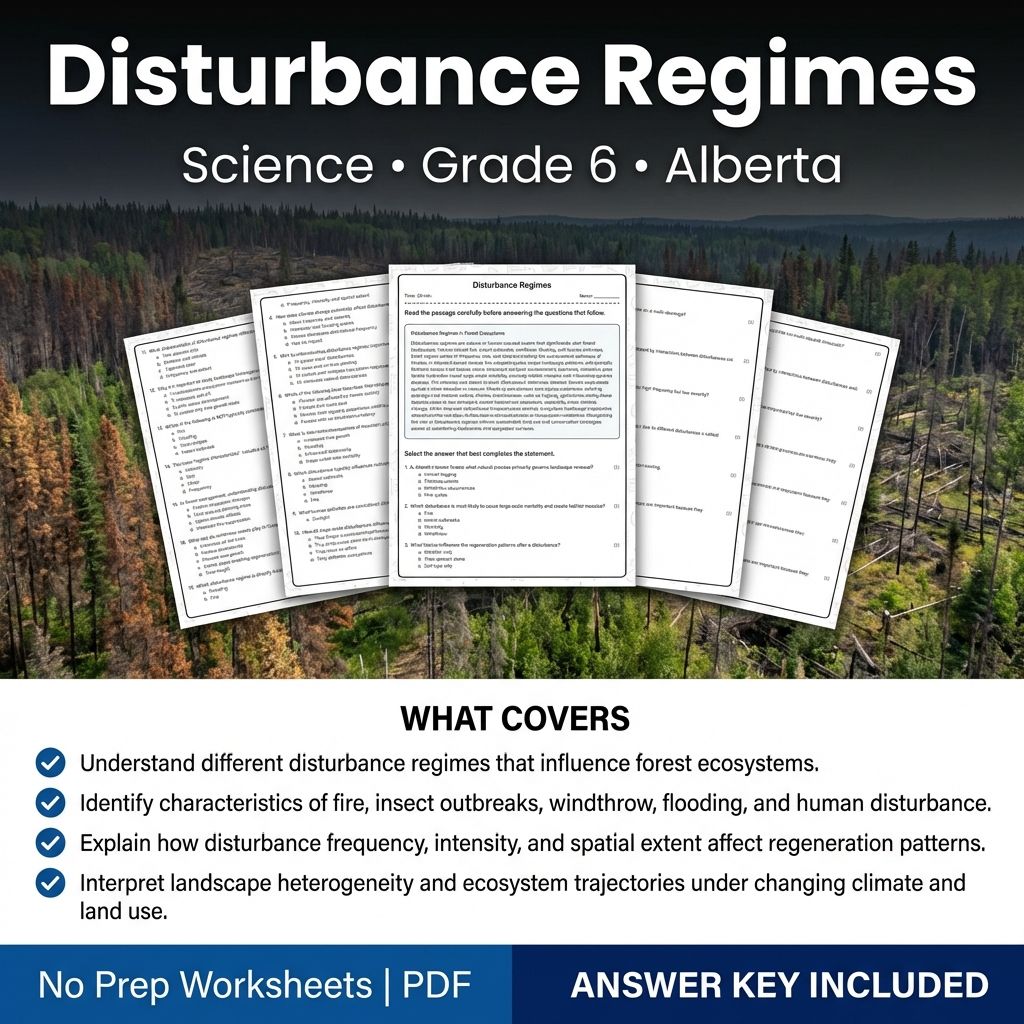
Grade 6 Science Worksheet on Disturbance Regimes – Alberta Standards
Created byCoral Reef LearningLearning Objectives
- Understand different disturbance regimes that influence forest ecosystems.
- Identify characteristics of fire, insect outbreaks, windthrow, flooding, and human disturbance.
- Explain how disturbance frequency, intensity, and spatial extent affect regeneration patterns.
Instant download

Science Grade 6 Transfer Mechanisms of Heat Worksheet
JCreated byJ.S SheetsLearning Objectives
- Explain how heat energy transfers by conduction, convection, and radiation
- Identify evidence of each heat transfer mechanism in everyday situations
- Predict temperature or state changes based on the dominant heat transfer pathway
Also included in: Grade 6 Matter, Motion, and Heat Science Lesson Bundle – General Framework +1 more
Instant download

Grade 6 Science | Carbon Cycling Worksheet | NGSSS Aligned
Created byLumora LearningLearning Objectives
- Explain how carbon moves through producers, consumers, and decomposers
- Describe the role of photosynthesis, respiration, and decomposition in the carbon cycle
- Use cause-and-effect reasoning to trace how carbon transforms in an ecosystem
Instant download

Grade 6 Science – Control Surfaces & Aviation | Daily Reading Worksheet
Created byBright Mind ResourcesLearning Objectives
- Understand the function and purpose of control surfaces such as ailerons, elevators, and rudders.
- Describe how deflection of control surfaces influences aircraft movement, including rolling, pitching, and yawing.
- Identify real-world examples of control surface use in aviation scenarios.
Also included in: Aerodynamics Grade 6 Science Daily Reading Worksheets Lesson Bundle | Alberta +2 more
Instant download
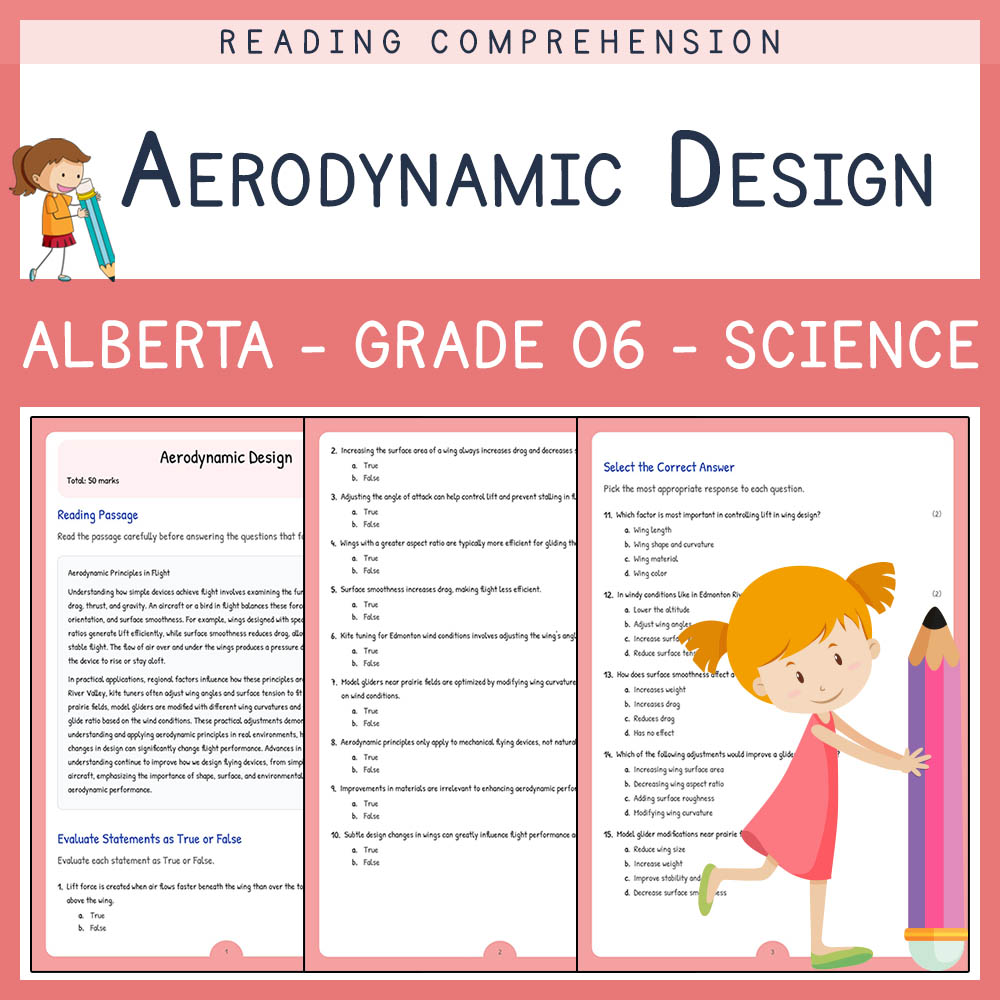
Grade 6 Science Assessment | Aerodynamic Design Worksheet Elena | Alberta
Created byLumora LearningLearning Objectives
- Understand basic principles of aerodynamics including lift, drag, and stability.
- Identify how modifications to wing shape and surface affect flight performance.
- Apply aerodynamic concepts to real-world devices like kites and model gliders.
Also included in: Grade 6 Science | Air and Aerodynamics Science Lesson Bundle | Alberta
Instant download
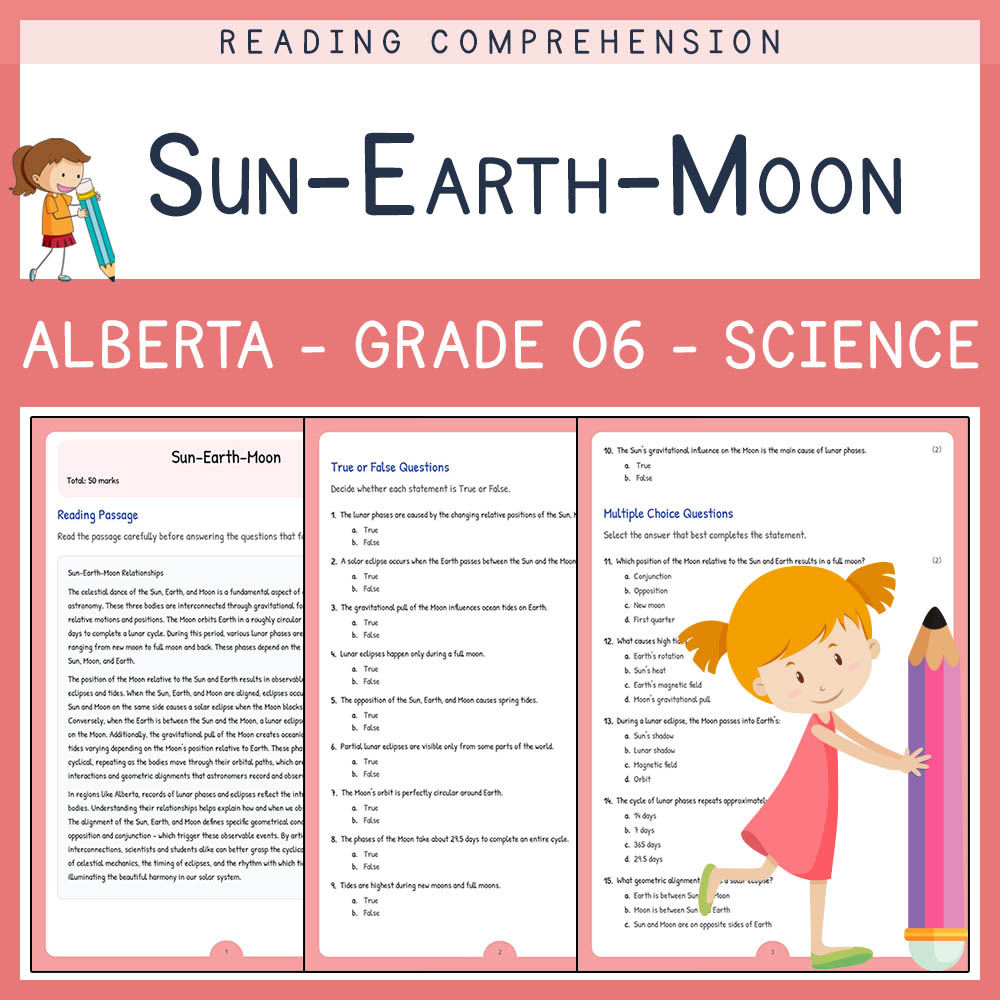
Grade 6 Science Assessment | Sun–Earth–Moon Worksheet Elena | Alberta
Created byLumora LearningLearning Objectives
- Explain the gravitational relationships between the Sun, Earth, and Moon.
- Describe how relative positions of the Sun, Earth, and Moon influence lunar phases.
- Understand the geometric conditions causing solar and lunar eclipses.
Instant download

Grade 6 Pattern Analysis Worksheet | Practice & Assessment PDF
Created byClear Sky ClassroomLearning Objectives
- Identify patterns in environmental data by describing trends, cycles, and anomalies
- Use descriptive statistics and moving averages to interpret data more clearly
- Explain how seasonal decomposition and graphs help reveal recurring patterns
Also included in: Grade 6 Scientific Investigation Data Analysis Science Lesson Bundle | Alberta +1 more
Instant download

Grade 6 Science – Food Chains & Energy Flow | Daily Reading Worksheet
Created byBright Mind ResourcesLearning Objectives
- Understand what a food chain is and how it illustrates energy transfer
- Identify different organisms at various levels in a food chain
- Recognize the importance of each organism within an ecosystem
Also included in: Grade 6 Ecosystem Relationships Science Daily Reading Lesson Bundle | BC +1 more
Instant download

Grade 6 Science | Population Dynamics Worksheet | BC Standards
Created byLumora LearningLearning Objectives
- Understand the factors that influence changes in population size over time.
- Identify differences between exponential and logistic growth models.
- Explain how density-dependent and density-independent factors affect populations.
Instant download
About Grade 6 Science Worksheets
Explore Grade 6 Science worksheets for classwork, homework, or review. Our 5,969 printables download instantly as PDFs.
MyTeachingSheets worksheets are made by real teacher-authors and checked before they go live. Download any as a print-ready PDF for lessons, homework, or independent practice — most include answer keys, and previews are always free.