
Grade 6 Science Worksheets
5,969 worksheets
Energy Transfer Worksheet for Grade 6 Science | Standards-Aligned Practice
JCreated byJ.S SheetsLearning Objectives
- Understand the three main modes of energy transfer: conduction, convection, and radiation.
- Identify examples of each energy transfer mode in everyday life.
- Explain how energy transfer affects temperature changes and energy distribution.
Instant download

Grade 6 Cycles Of Matter Model Worksheet | General Practice PDF
 Created byClear Sky Classroom
Learning Objectives
- Explain how matter cycles through living and non-living parts of an ecosystem instead of being used up
- Use a cycles of matter model to describe reservoirs (air, soil, water, organisms) and flows (feeding, respiration, decomposition, runoff)
- Describe how carbon and water move among organisms and the environment
Instant download

Balanced and Unbalanced Forces Worksheets | Net Force Practice
LCreated byLearnora ResourcesLearning Objectives
- Define force, balanced forces, unbalanced forces, and net force
- Identify whether forces cancel or produce a nonzero net force
- Determine whether a force situation is balanced or unbalanced
Instant download

Grade 6 Science | Weather Versus Climate Worksheet | General Standard
 Created byLumora Learning
Learning Objectives
- Differentiate weather and climate using time scale and recurring patterns
- Identify examples of weather variables (temperature, precipitation, wind, cloud cover) and climate variables (averages, ranges, seasonal patterns)
- Use daily and monthly observations to explain how single events differ from long-term climate tendencies
Instant download

Grade 6 Atmospheric Circulation Worksheet | NGSS Practice PDF
Created byClear Sky ClassroomLearning Objectives
- Explain how uneven heating of Earth creates rising and sinking air that drives global wind patterns
- Describe how warm air behavior differs from cool air behavior in atmospheric circulation
- Connect atmospheric circulation to moisture transport and the development of storms
Instant download
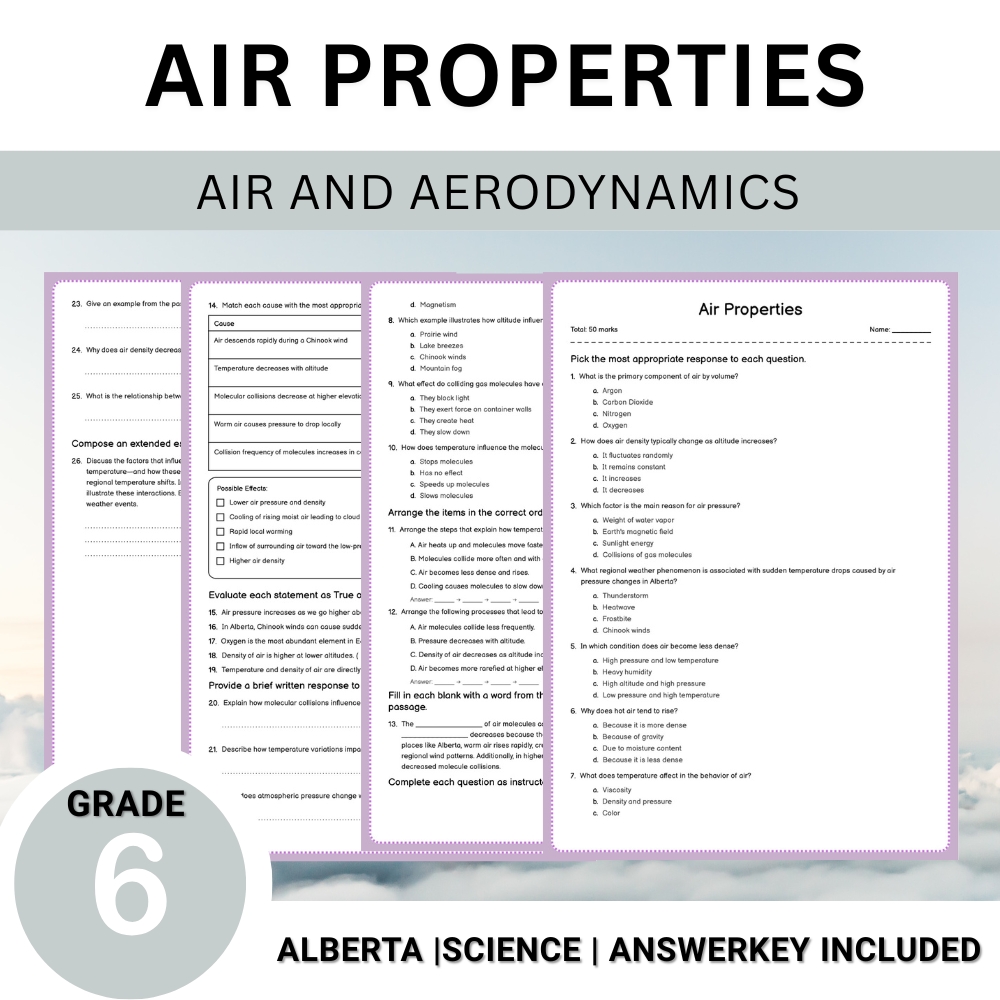
Grade 6 Science | Air Properties Worksheet (Printable PDF & Assessment)
Learning Objectives
- Understand the molecular composition of air and how it varies with altitude and temperature.
- Explain how air density and pressure are related and how they influence weather phenomena.
- Analyze regional examples such as Chinook winds and altitude differences affecting air properties.
Also included in: Grade 6 Science Unit Bundle | Flight, Air Pressure & Aerodynamics Worksheets +1 more
Instant download

Grade 6 Science | Nervous System Worksheet | BC Aligned
Created byLumora LearningLearning Objectives
- Describe the structure and function of neurons and the nervous system.
- Explain how electrical impulses are transmitted along neurons and communicated at synapses.
- Identify the roles of different parts of the nervous system, including the brain, spinal cord, and nerves.
Instant download

6th Grade Science | Waves and Technology Worksheet (PDF)
 Created byEvergreen Desk Education
Learning Objectives
- Explain how sound waves carry energy and information in devices such as speakers and microphones
- Describe how light waves are captured and converted into electrical signals in cameras
- Use wave properties (frequency and intensity) to predict how changing signals affects device performance
Instant download
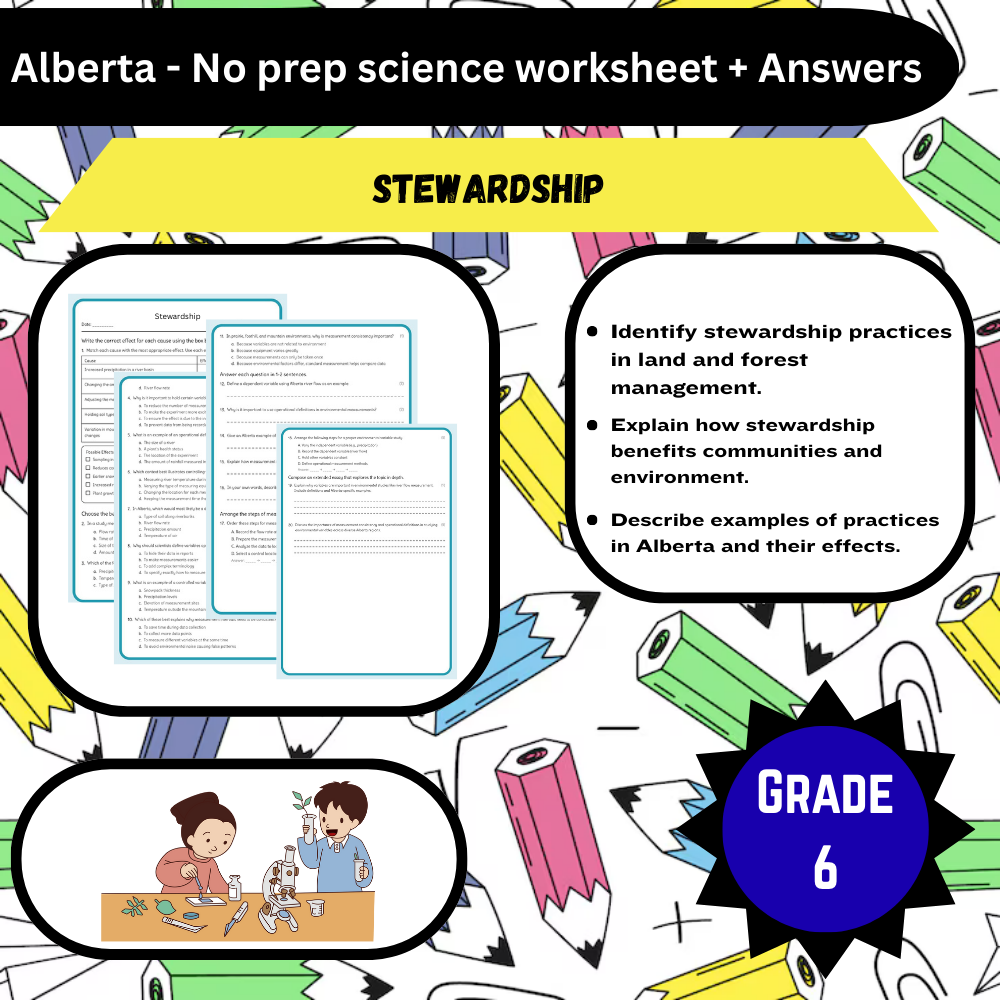
Grade 6 Science – Transport Systems in Plants Worksheet (PDF)
 Created byBright Mind Resources
Learning Objectives
- Explain how stems and vascular tissues transport water, minerals, and sugars in trees.
- Describe how trees respond to environmental factors like freeze–thaw cycles, drought, and pests.
- Identify protective features of bark and their functions in trees.
Instant download

Grade 6 Matter Properties Worksheet | Practice & Assessment PDF
Created byClear Sky ClassroomLearning Objectives
- Identify observable properties of matter, including color, hardness, texture, and conductivity.
- Classify substances as solids, liquids, or gases based on evidence.
- Use property evidence to support predictions about how materials will behave.
Instant download

Grade 6 Science | Climate Systems - Daily Reading Comprehension
 Created byCoral Reef Learning
Learning Objectives
- Understand how solar heating influences climate patterns
- Learn about planetary rotation and atmospheric circulation
- Identify major global wind patterns and ocean currents
Instant download

Lunar Motion Worksheet | Grade 6 Science Activities
 Created byPrism Point Learning
Learning Objectives
- Explain how the Sun–Earth–Moon geometry causes the Moon’s phases to change predictably
- Describe how the Moon’s position relative to the Sun changes from night to night
- Use observations to make reasonable predictions about what lunar phase and sky direction might be seen
Also included in: Celestial Patterns & Seasons Lesson Bundle | Grade 6 Science | Alberta
Instant download

Energy Conservation in Systems Worksheets | Grade 6 Physical Science
LCreated byLearnora ResourcesLearning Objectives
- Define a system and identify its boundary and surroundings
- Identify common forms of energy in everyday situations
- Explain how energy moves between objects within a system
Instant download

Cycles Of Matter Model Worksheet | Grade 6 Science Activities
Created byPrism Point LearningLearning Objectives
- Explain how matter cycles through living and non-living parts of an ecosystem instead of being used up.
- Describe how models with reservoirs and flows show movement of matter among air, water, soil, and organisms.
- Use examples involving carbon and water to trace matter transfer through plants, consumers, and wastes.
Instant download
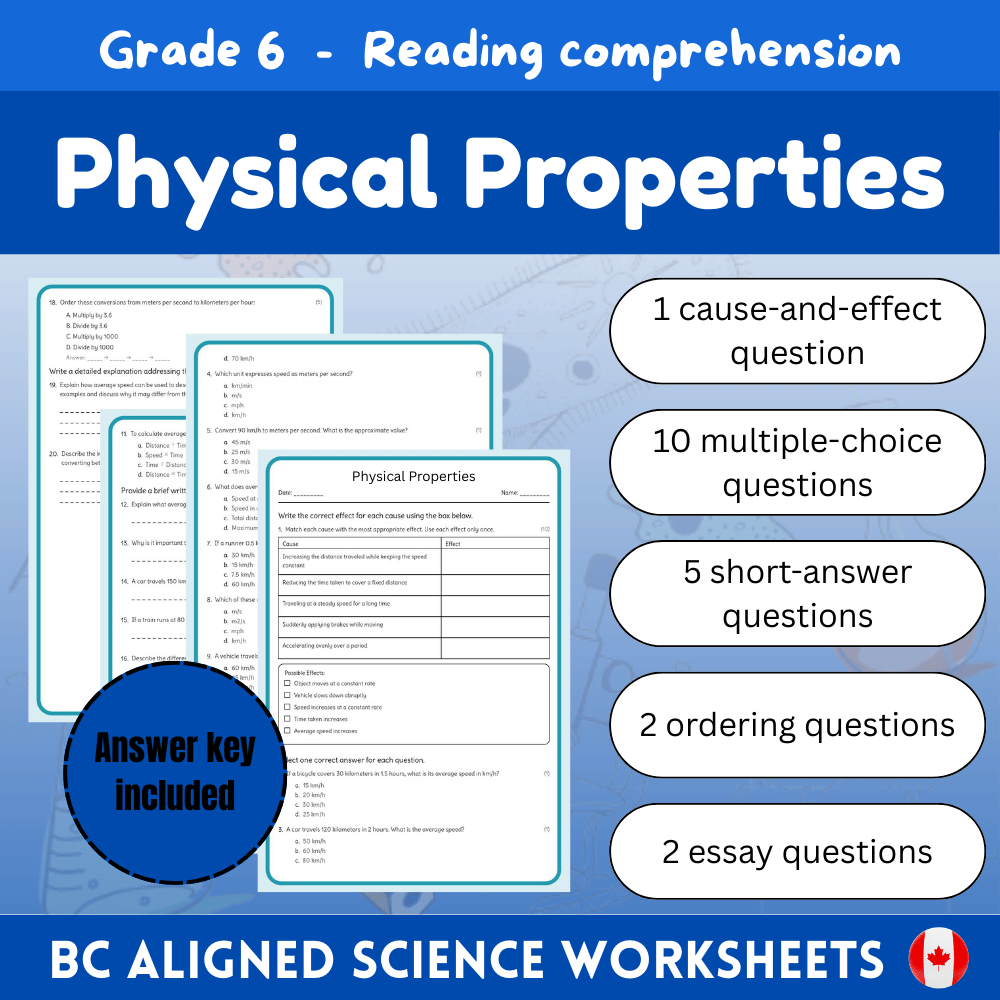
6th Grade Science | Physical Properties Worksheet (Answer Key) – BC Standard
Created byBright Mind ResourcesLearning Objectives
- Identify and describe observable physical properties of matter such as mass, volume, density, conductivity, melting point, and hardness.
- Understand how physical properties differentiate matter without changing its chemical identity.
- Explain how changes in physical properties involve rearrangement or phase change rather than formation of new substances.
Instant download

Operational Definitions for Observations Grade 6 Science Worksheet
 Created bySunny Desk Resources
Learning Objectives
- Define operational definitions and explain why they make observations clearer and comparable.
- Identify key details needed for a good measurement protocol (units, location, timing, and procedure).
- Convert qualitative ideas into quantitative measures using an appropriate unit and method.
Also included in: Evidence & Investigation Grade 6 Science Worksheets | Alberta +1 more
Instant download
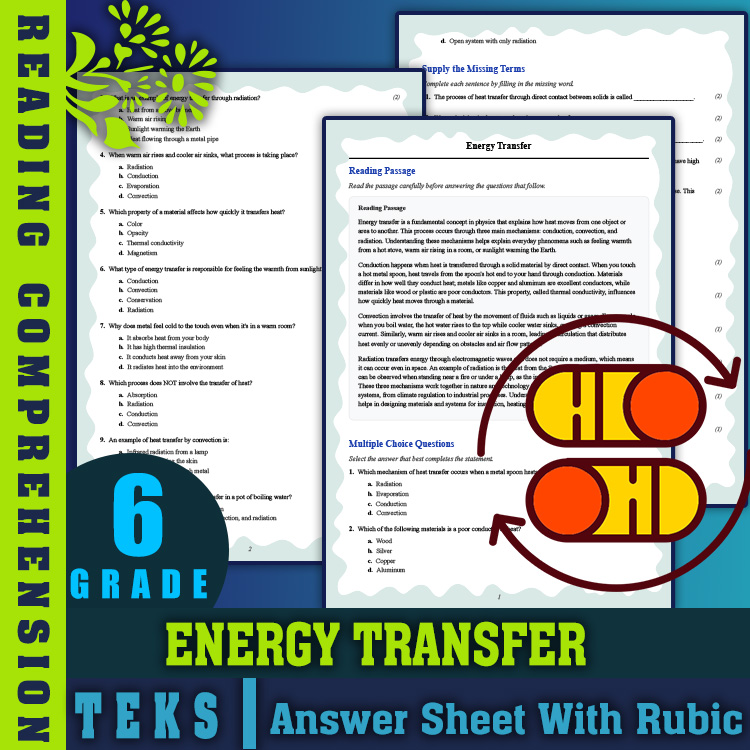
Grade 6 Science | Energy Transfer Reading Worksheet & Answer Key (PDF)
JCreated byJ.S SheetsLearning Objectives
- Explain the mechanisms of thermal energy transfer: conduction, convection, and radiation.
- Identify practical examples of each energy transfer method.
- Connect observable temperature changes to different energy transfer processes.
Instant download

Grade 6 Science CER Worksheet | Claims Evidence Reasoning | Ontario
 Created byTeacher's Corner
Learning Objectives
- Explain the difference between a claim, evidence, and reasoning when communicating scientific ideas.
- Select relevant data from a graph or source to support a conclusion.
- Construct a logical argument that links evidence to a claim.
Instant download

Grade 6 Feedback Control Worksheet | NGSS Homeostasis Science Activity
 Created byNorthstar Worksheets
Learning Objectives
- Explain how negative feedback helps maintain internal stability using sensors, control centers, and effectors.
- Describe how positive feedback can amplify change and sometimes leads to a rapid process in the body.
- Use examples such as thermoregulation, blood glucose control, and kidney osmotic balance to trace cause-and-effect in feedback systems.
Also included in: Cells & Human Body Systems Lesson Bundle | Grade 6 Science | NGSS +1 more
Instant download
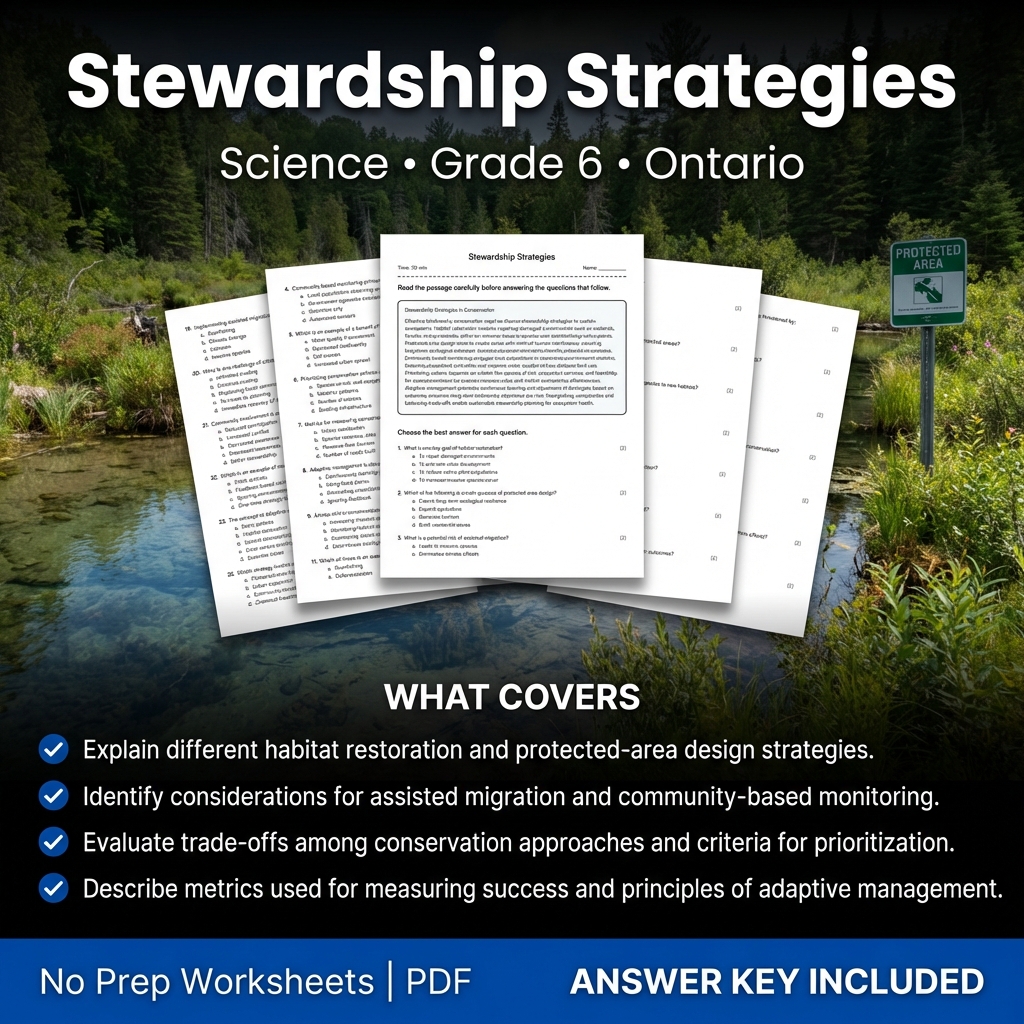
Grade 6 Science Worksheet on Stewardship Strategies for Ontario
Created byCoral Reef LearningLearning Objectives
- Explain different habitat restoration and protected-area design strategies.
- Identify considerations for assisted migration and community-based monitoring.
- Evaluate trade-offs among conservation approaches and criteria for prioritization.
Instant download

Grade 6 Science | Behavioral Strategies Worksheet | NGSSS Aligned
Created byLumora LearningLearning Objectives
- Define behavioral adaptations and explain how they help organisms survive.
- Identify examples of behavioral strategies such as migration, hibernation, daily timing, nest building, and burrowing.
- Explain how behavioral adaptations work with structural and physiological traits to respond to environmental changes.
Instant download
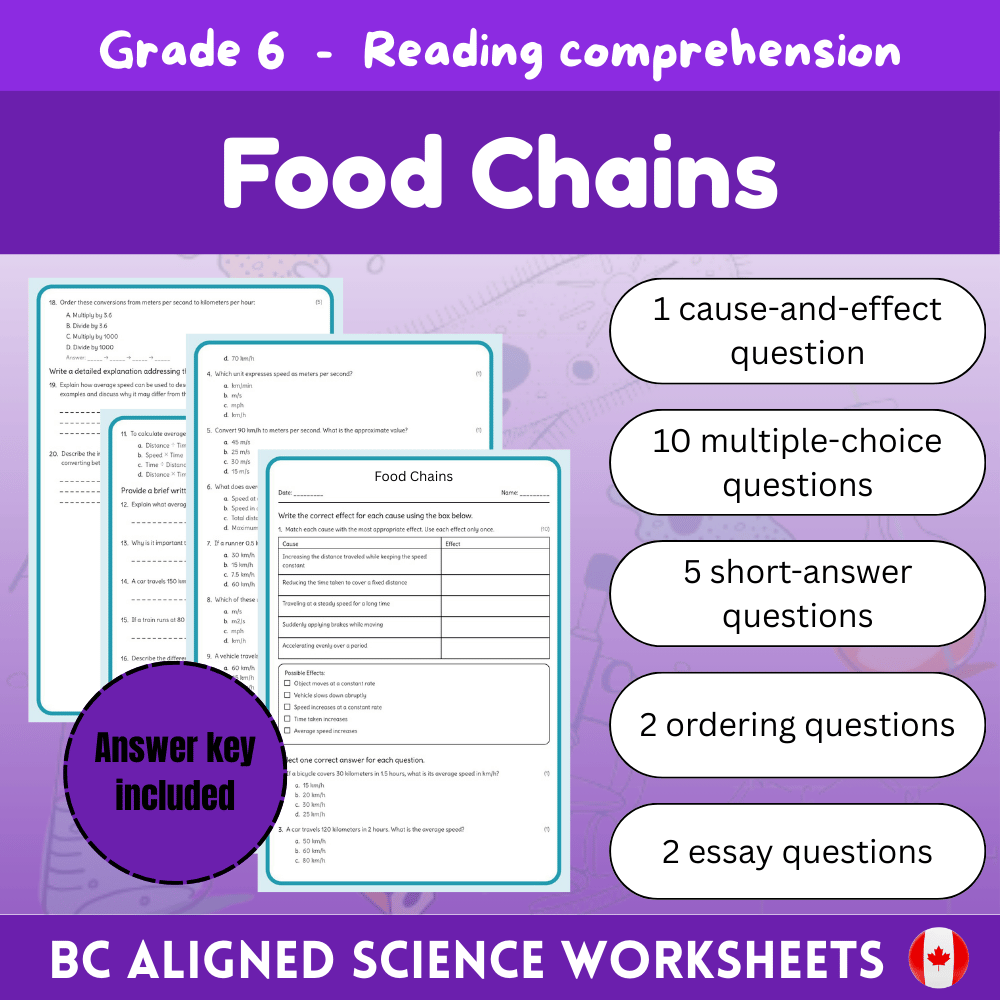
Grade 6 Science | Food Chains Worksheet (Worksheet + Answer Key) – BC Standard
Created byBright Mind ResourcesLearning Objectives
- Understand the concept of a food chain and the flow of energy through ecosystems.
- Identify producers, consumers, and their roles in a food chain.
- Recognize how changes in one population can affect others within a food chain.
Instant download

Grade 6 Science | Evidence Explanations Worksheet | General Standard
Created byLumora LearningLearning Objectives
- Explain how scientific claims are supported by evidence from observations and measurements
- Use scientific ideas (such as density) to connect evidence to an explanation
- Compare competing explanations by judging which one best matches the evidence
Instant download
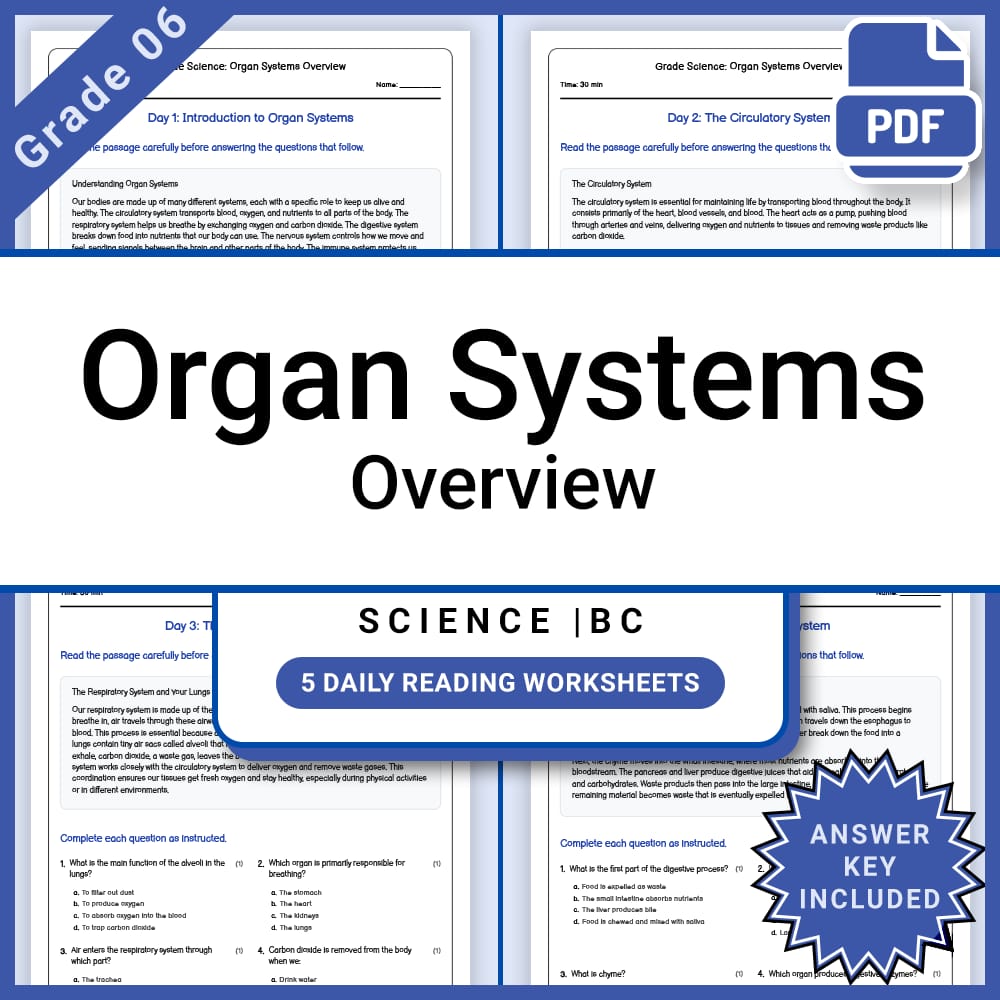
Grade 6 Science – Organ Systems Overview Daily Reading Worksheet + Answer Key
JCreated byJ.S SheetsLearning Objectives
- Identify major human organ systems
- Describe the basic functions of each system
- Understand how organ systems interact to maintain health
Also included in: Grade 6 Science Lesson Group | Body Systems and Adaptations Bundle +1 more
Instant download
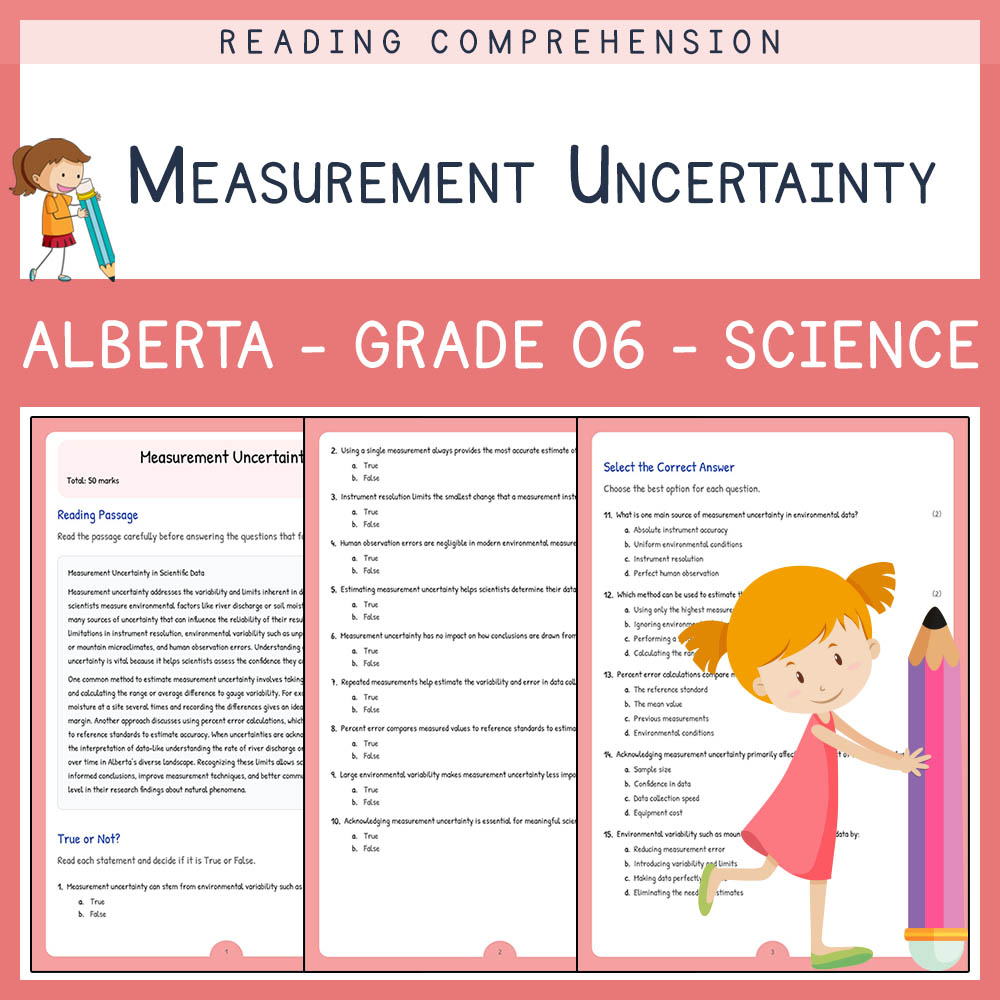
Grade 6 Science | Measurement Uncertainty Worksheet | Alberta Standards
Created byLumora LearningLearning Objectives
- Understand the concept of measurement uncertainty and its sources.
- Identify methods used to estimate uncertainty in data collection.
- Recognize how measurement variability impacts conclusions about environmental phenomena.
Also included in: Grade 6 Science | Evidence and Investigation Custom Bundle | Alberta
Instant download

Grade 6 Physical vs Chemical Changes Worksheet with Answer Key | Florida NGSSS
Created byEvergreen Desk EducationLearning Objectives
- Distinguish physical changes from chemical changes by identifying evidence of new substances.
- Describe common indicators of chemical change (gas formation, color change, temperature change, permanent texture change).
- Classify everyday examples of matter changes and justify the classification using observable evidence.
Instant download

Grade 6 Science – Ecosystem Components & Features | Daily Reading Worksheet
Created byBright Mind ResourcesLearning Objectives
- Understand the basic parts of an ecosystem
- Identify abiotic and biotic factors
- Recognize different types of organisms in ecosystems
Also included in: Ecosystems Grade 6 Science Daily Reading Worksheets Lesson Bundle |Florida NGSSS +1 more
Instant download

Grade 6 Pattern From Graphs Worksheet | Practice & Assessment PDF
Created byClear Sky ClassroomLearning Objectives
- Identify graph patterns such as increasing, decreasing, plateau, and curved change from given data.
- Describe trends using quantitative language (direction, rate/steepness, and changes in values).
- Use simple evidence from graphs to make comparisons across different conditions.
Instant download

Grade 6 Science | Science Policy & Decisions - Daily Reading Comprehension
Created byCoral Reef LearningLearning Objectives
- Understand how scientific evidence influences policy making.
- Learn about risk assessment and cost-benefit analysis in environmental decisions.
- Explore stakeholder values and how they impact policy choices.
Instant download

Grade 6 Science Niche Dynamics Worksheet with Short Notes (Printable PDF)
 Created byMeadowlark Worksheets
Learning Objectives
- Understand the differences between fundamental and realized ecological niches.
- Analyze how abiotic factors and interspecific interactions influence resource use.
- Examine examples of spatial and temporal niche partitioning in ecosystems.
Also included in: Grade 6 Science Lesson Bundle for Ontario | Ecosystems & Genetics +1 more
Instant download

Grade 6 Atomic Composition Worksheet | NGSS Science Atoms & Matter
 Created byElena Brooks
Learning Objectives
- Identify atoms and molecules in simple chemical formulas.
- Understand how atoms combine to form molecules like H2O and NaCl.
- Learn different models used to represent atomic structures.
Instant download

Grade 6 Science | Tissue Types - Daily Reading Comprehension Practice
Created byCoral Reef LearningLearning Objectives
- Understand key concepts related to Science
- Apply knowledge through practice questions
- Demonstrate comprehension of the material
Instant download

Grade 6 Science | Data Representations Worksheet | General Standard
Created byLumora LearningLearning Objectives
- Explain how numerical and categorical observations can be represented in tables and graphs
- Identify appropriate labels, units, and scales that help readers interpret data correctly
- Use bar graphs and line graphs to compare categories and describe change over time
Instant download
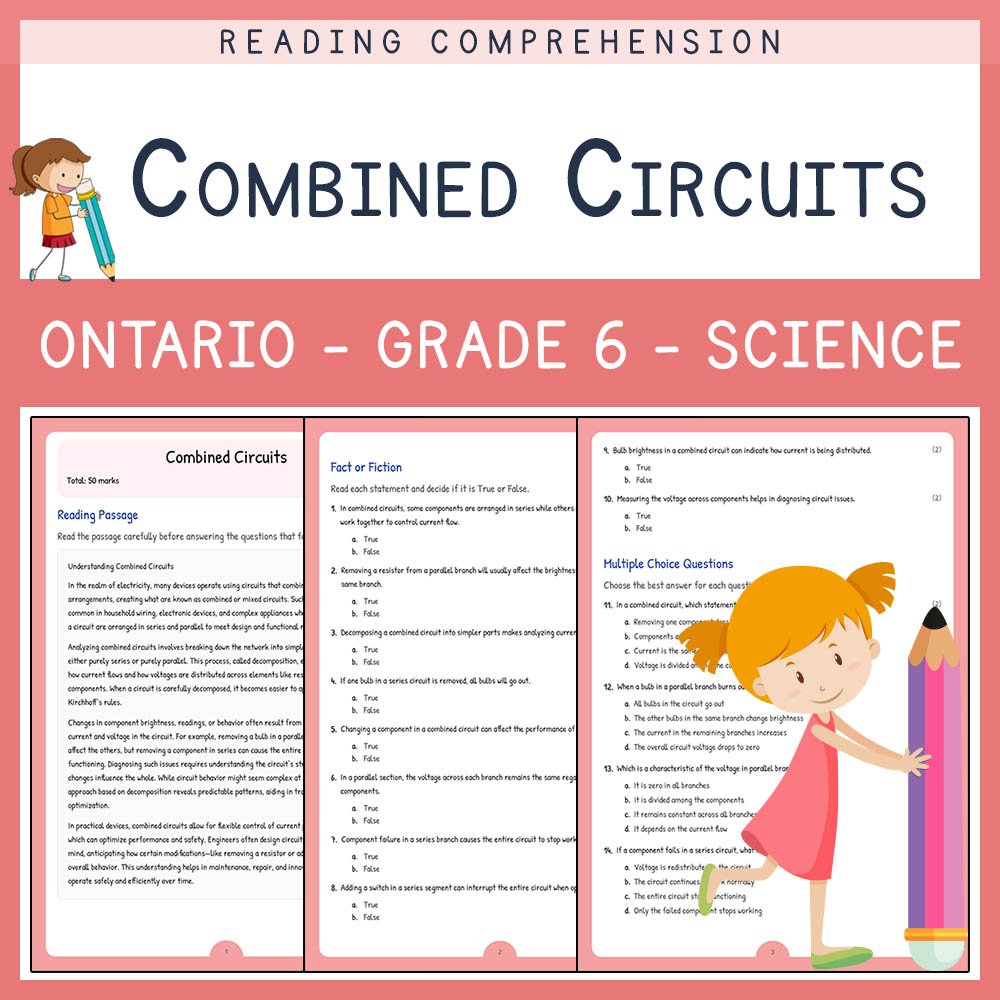
Grade 6 Science | Combined Circuits Worksheet & Answer Key (PDF) – Ontario Standards
Created byLumora LearningLearning Objectives
- Understand how to conceptualize and analyze mixed series-parallel electrical networks.
- Describe how current and voltage distribute in combined circuit configurations.
- Apply methods of decomposition into simpler series and parallel subcircuits for easier analysis.
Also included in: Grade 6 Science | Electricity Unit Custom Bundle | Ontario Framework
Instant download

Measurement Tools Worksheet | Science Grade 6 | Standards-Aligned
JCreated byJ.S SheetsLearning Objectives
- Identify common measurement instruments such as thermometers, pH probes, and tape measures.
- Understand the importance of calibration and unit selection in data collection.
- Describe procedures for accurate and consistent recording of observations.
Instant download
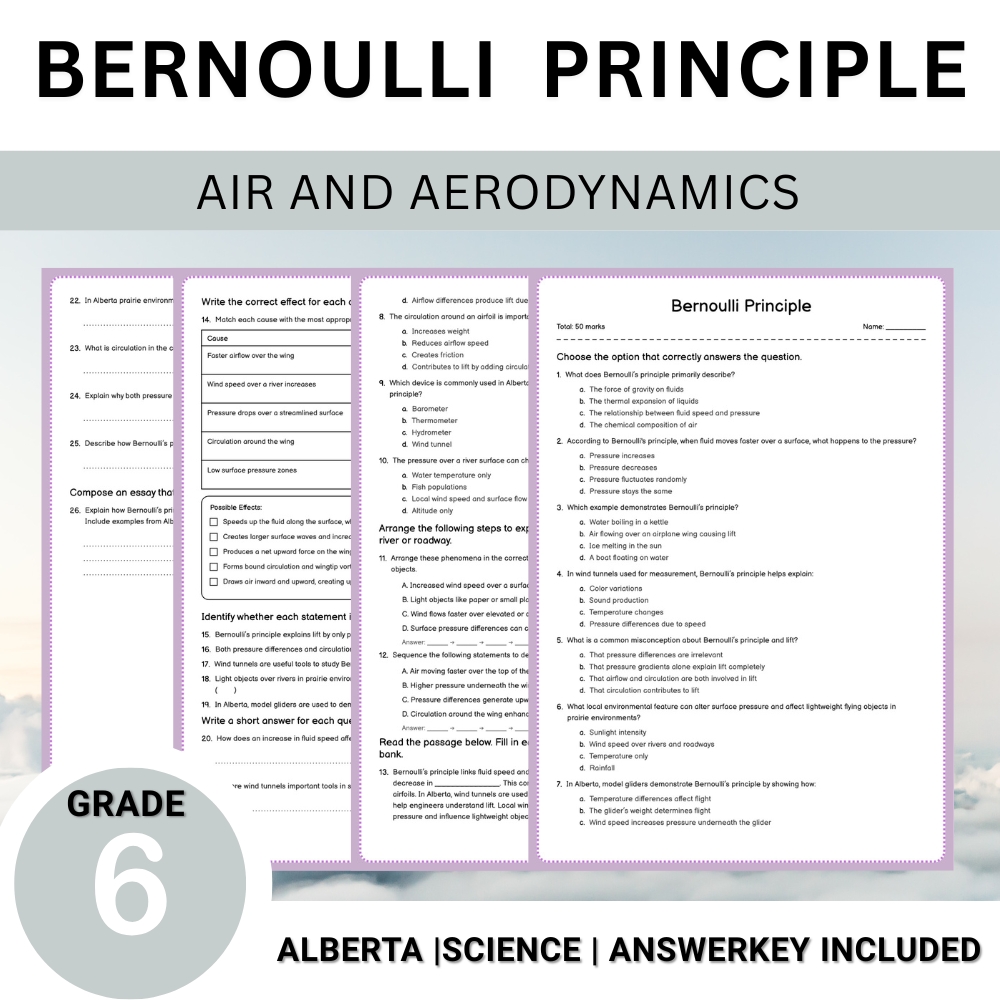
Grade 6 Science | Bernoulli Principle Worksheet (Printable PDF & Assessment)
Learning Objectives
- Explain how Bernoulli’s principle relates fluid speed to pressure.
- Describe how pressure differences contribute to lift on airfoils.
- Identify real-world applications of Bernoulli’s principle, such as wind tunnels and model gliders.
Also included in: Grade 6 Science Unit Bundle | Flight, Air Pressure & Aerodynamics Worksheets +1 more
Instant download

Grade 6 Science – Energy Transfer & Ecosystems | Daily Reading Worksheet
Created byBright Mind ResourcesLearning Objectives
- Understand how energy is transferred between organisms in a food chain.
- Identify the energy loss at each trophic level due to heat and life functions.
- Explain why higher trophic levels support fewer predators based on energy transfer.
Also included in: Ecosystems Grade 6 Science Daily Reading Worksheets Lesson Bundle |Florida NGSSS +1 more
Instant download
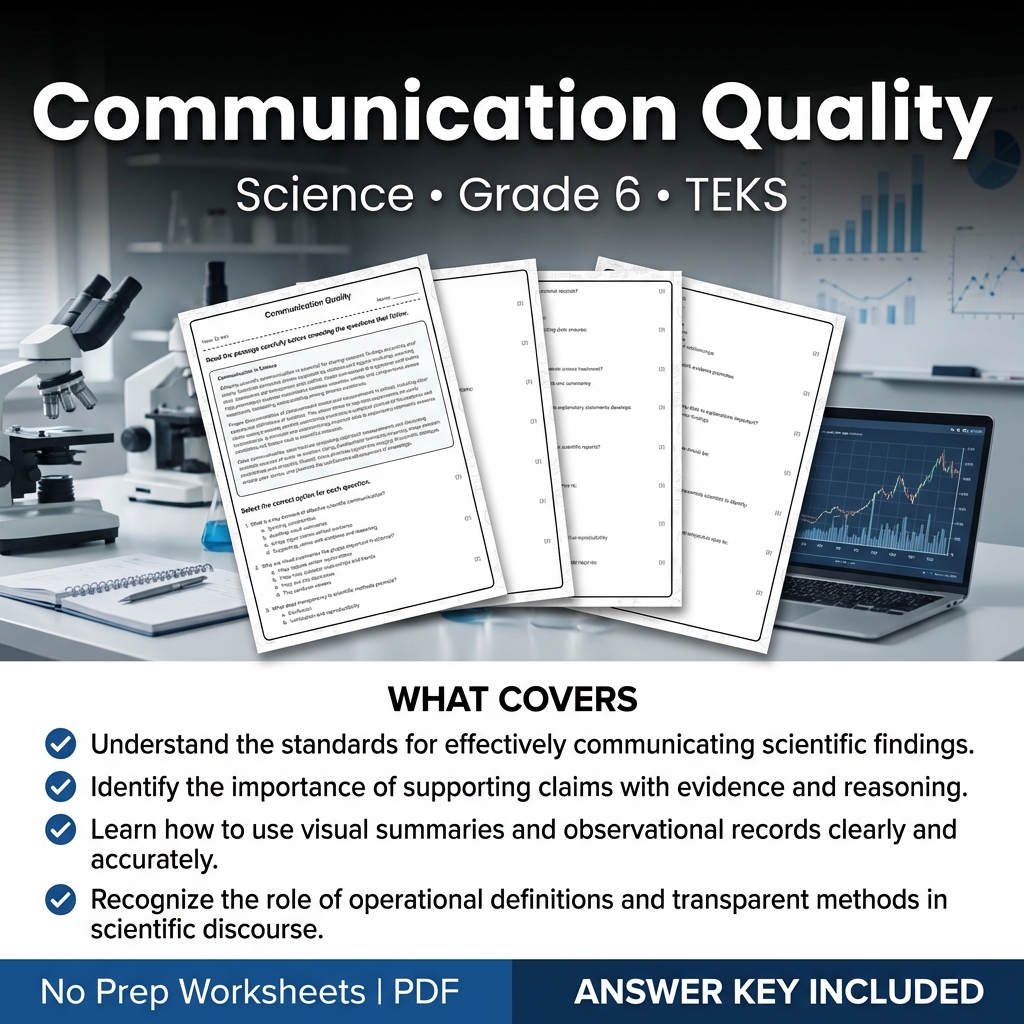
Grade 6 Science Worksheet on Communication Quality — Classroom Printable PDF
Created byCoral Reef LearningLearning Objectives
- Understand the standards for effectively communicating scientific findings.
- Identify the importance of supporting claims with evidence and reasoning.
- Learn how to use visual summaries and observational records clearly and accurately.
Instant download
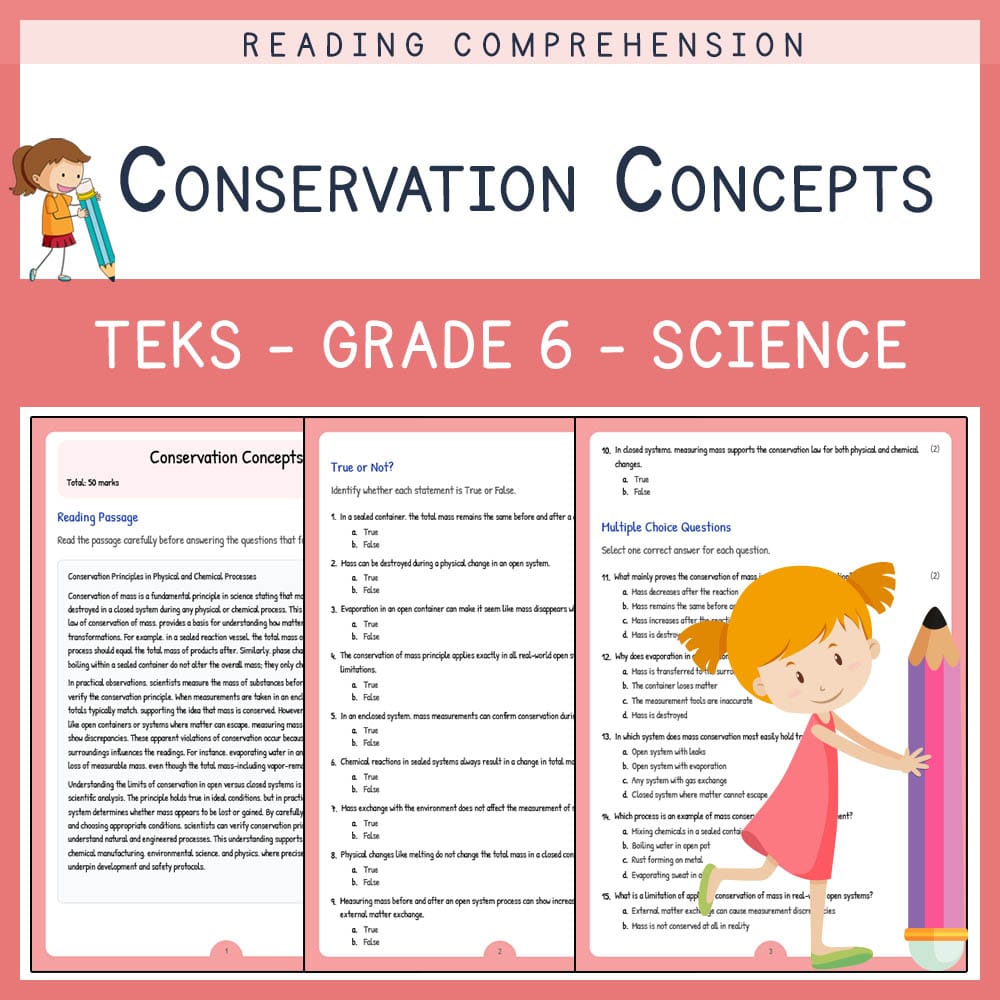
Grade 6 Science | Conservation Concepts Worksheet | TEKS Alligned
Created byLumora LearningLearning Objectives
- Understand the principle of conservation of mass in closed systems during physical and chemical changes.
- Identify real-world examples where mass conservation applies or does not apply.
- Interpret measurements before and after a process to determine if mass is conserved.
Also included in: Grade 6 Science | Matter and Energy Lesson Bundle | TEKS Aligned
Instant download

Levels Of Life Test Prep Printable | Grade 6 Science
Created byPrism Point LearningLearning Objectives
- Explain how levels of biological organization build from cells to organisms.
- Identify how tissues, organs, and organ systems work together to support survival.
- Describe how a problem at one level can affect higher levels of organization.
Also included in: Multicellular Systems & Functions Lesson Bundle | Grade 6 Science | BC +1 more
Instant download

Drag Types Worksheet for Grade 6 Science | Standards-Aligned Practice
JCreated byJ.S SheetsLearning Objectives
- Understand the different types of drag and their causes.
- Explain how design features can reduce drag in vehicles and aircraft.
- Analyze how drag affects thrust and energy requirements during flight.
Instant download

Mass Wasting Worksheet | Grade 6 Science Practice and Review
Created byPrism Point LearningLearning Objectives
- Explain how gravity and slope instability cause mass wasting to move rock and soil downhill.
- Identify common triggers of mass wasting, including heavy rainfall, freeze-thaw, earthquakes, and erosion.
- Describe how deposited debris can change drainage and affect later erosion.
Instant download

Grade 6 Science | Roots & Water - Daily Reading Comprehension
Created byCoral Reef LearningLearning Objectives
- Understand the structure and functions of roots in trees
- Identify different types of root systems and their adaptations
- Explain how roots contribute to tree survival and environmental factors
Also included in: Trees and Forests Lesson Bundle | Grade 6 Science | Alberta +1 more
Instant download

Forms Of Energy Practice Worksheets | Grade 6 Science Review
Created byPrism Point LearningLearning Objectives
- Identify major forms of energy (kinetic, potential, thermal, chemical, electrical) in real-world examples.
- Explain how energy can transform from one form into another within systems.
- Use science vocabulary to describe energy storage and energy transfer.
Also included in: Energy, Waves & Circuits Lesson Bundle | Grade 6 Science | BC Framework +1 more
Instant download

Grade 6 Eclipses and Tides Worksheet | Moon Earth Sun Activity
 Created byChalk and Compass
Learning Objectives
- Explain how the Earth–Moon–Sun alignment creates solar and lunar eclipses
- Distinguish between umbra and penumbra and predict what parts of Earth see different eclipse effects
- Describe how the Moon and Sun’s differential gravity causes tides, including spring and neap tides
Also included in: Space - Grade 6 Bundle +1 more
Instant download
Grade 6 Science — Stability Modes in Aircraft Worksheet for Mastery
 Created byThe Resource Hub
Learning Objectives
- Understand the difference between static and dynamic stability in aircraft.
- Identify how aircraft geometry affects longitudinal, lateral, and directional stability.
- Explain the roles of center of gravity, dihedral angles, and fin/tailplane design in stability.
Also included in: Grade 6 Science | Aerodynamics & Engineering Unit Workbook (Worksheet Pack) +1 more
Instant download
Food Webs Assessment | Alberta Standards – Grade 6 Science Worksheet
Created byPrism Point LearningLearning Objectives
- Understand key concepts related to Science
- Apply knowledge through practice questions
- Demonstrate comprehension of the material
Also included in: Lesson Grade 6 Science Mini Bundle Trees and Forests Alberta Standards
Instant download

Leaf Functions Worksheets Grade 6 Seasonal Adaptations Science Review
Created bySunny Desk ResourcesLearning Objectives
- Describe how stomata help leaves exchange gases and manage water loss.
- Compare needlelike and broadleaf trees by leaf structure and seasonal leaf function.
- Explain how chlorophyll, leaf area, and stomatal regulation affect growth and water use efficiency.
Also included in: Trees and Forests Grade 6 Alberta Science Worksheets Bundle +1 more
Instant download
About Grade 6 Science Worksheets
Explore Grade 6 Science worksheets for classwork, homework, or review. Our 5,969 printables download instantly as PDFs.
MyTeachingSheets worksheets are made by real teacher-authors and checked before they go live. Download any as a print-ready PDF for lessons, homework, or independent practice — most include answer keys, and previews are always free.