
Grade 6 Science Worksheets
5,969 worksheets
Science Worksheet Iterative Improvement Grade 6 | Standards-Aligned Practice
JCreated byJ.S SheetsLearning Objectives
- Explain how iterative improvement uses test results (evaluation) to guide redesigns.
- Identify how function and constraints can both change during iterative improvement while honoring safety limits.
- Describe the role of trade-offs when refining a prototype based on evidence.
Also included in: Grade 6 Engineering Design Process Science Lesson Bundle – General Framework +1 more
Instant download

Competition for Survival Worksheet | Standards-Based Grade 6 Science Practice
JCreated byJ.S SheetsLearning Objectives
- Understand how organisms compete for limited resources in their environment.
- Identify different types of competition and their effects on populations.
- Analyze how resource availability influences survival and reproduction.
Also included in: Grade 6 Life Science Science Lesson Bundle – California Standards +1 more
Instant download

Developing Solutions Worksheet | NGSS Grade 6 Science Activity Pack
 Created byAmber Owl Education
Learning Objectives
- Compare multiple design solutions using established criteria and constraints
- Use quantitative and qualitative metrics to score and rank prototype options
- Justify design choices using evidence from tests, models, and iterations
Also included in: Grade 6 Science Engineering Design Lesson Bundle | NGSS +1 more
Instant download

6th Grade Science – Circuit Diagnosis Worksheet (Ontario Standards)
 Created byEvergreen Desk Education
Learning Objectives
- Explain how observed symptoms can be used to infer likely circuit faults using series and parallel expectations.
- Use circuit topology (where components are connected) to predict measurement patterns such as current and voltage behavior.
- Justify diagnostic conclusions by comparing predicted outcomes with observed meter readings and brightness changes.
Also included in: Grade 6 Electricity Circuits Science Lesson Bundle for Ontario Worksheets +1 more
Instant download
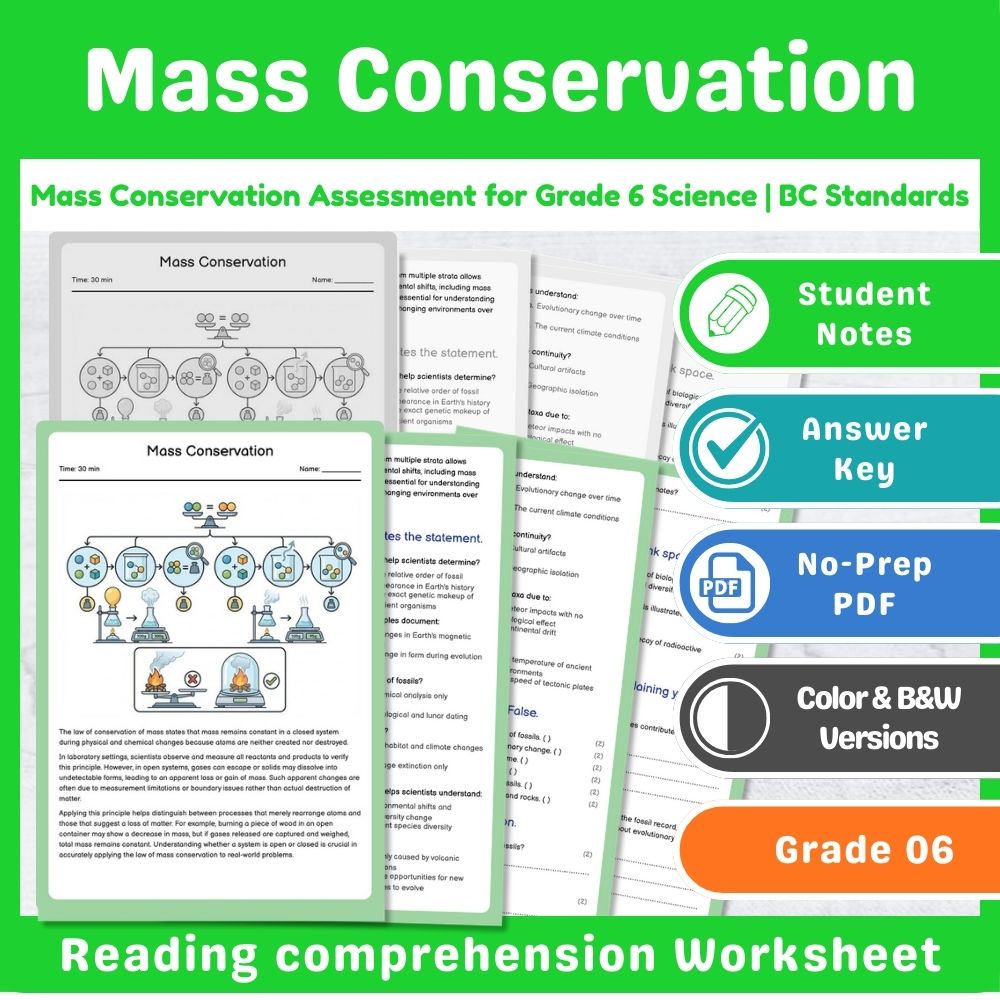
Mass Conservation Assessment for Grade 6 Science | BC Standards
 Created byPrism Point Learning
Learning Objectives
- Understand the law of conservation of mass and its application in physical and chemical changes.
- Identify situations where mass appears to change and explain why the apparent change occurs.
- Differentiate between closed and open systems in terms of mass conservation.
Instant download
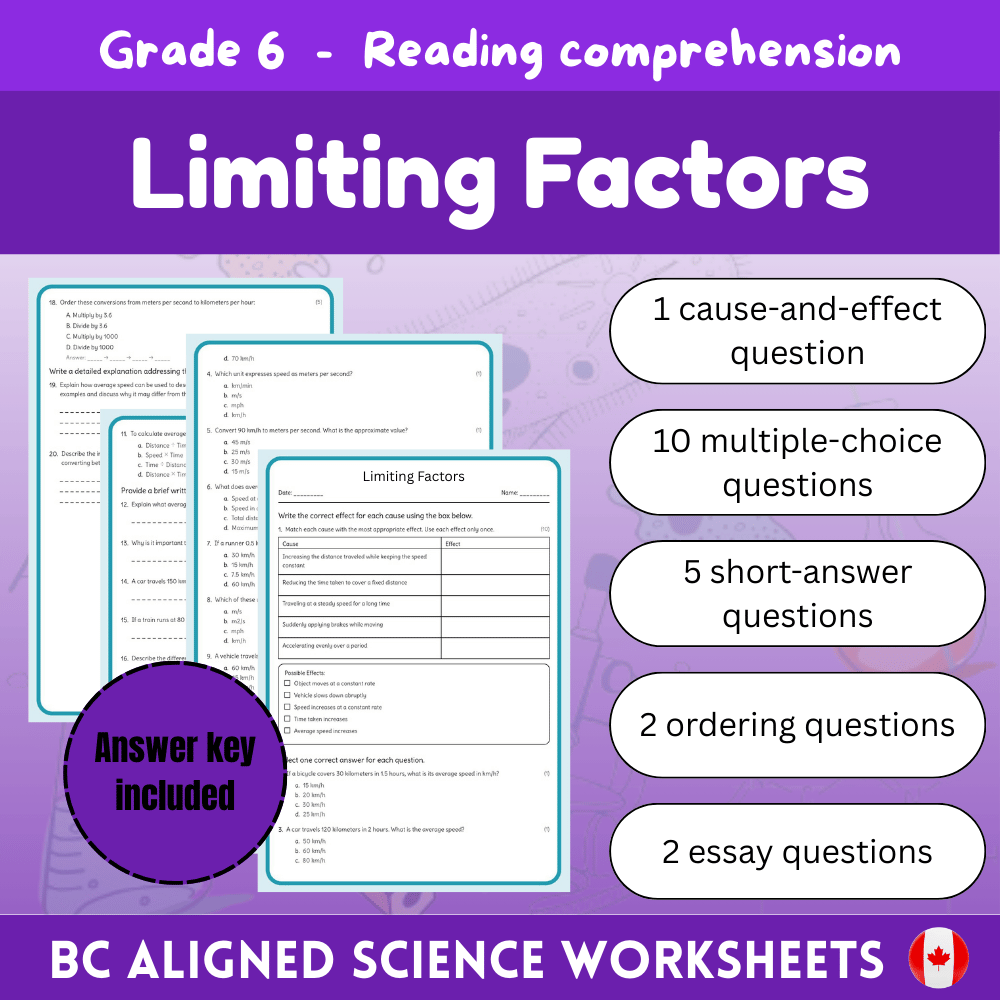
Grade 6 Science – Limiting Factors Worksheet + Answer Key | BC Standards
 Created byBright Mind Resources
Learning Objectives
- Understand what limiting factors are and how they affect populations.
- Identify environmental conditions that restrict population growth and distribution.
- Analyze the impact of abiotic and biotic factors on ecosystems.
Instant download

Classifying Matter Worksheet | TEKS Grade 6 Science Assessment PDF
JCreated byJ.S SheetsLearning Objectives
- Classify matter as elements, compounds, or mixtures using composition and observable characteristics.
- Differentiate between homogeneous and heterogeneous mixtures based on uniformity.
- Use separation techniques such as filtration and distillation to support classification decisions.
Instant download

Grade 6 Science | Defense Interactions Worksheet | BC Standards
 Created byLumora Learning
Learning Objectives
- Describe the main components and functions of the immune system in defending organisms.
- Identify and explain the roles of barrier defenses, innate inflammation, and adaptive responses.
- Understand the interaction of the immune system with circulatory and lymphatic systems in fighting pathogens.
Instant download

Grade 6 Science | Density & Its Properties - Daily Reading Practice
 Created byCoral Reef Learning
Learning Objectives
- Define what density means in the context of physical properties.
- Explain how different materials can have the same volume but different masses.
- Identify the factors that affect an object's density.
Instant download

Density Properties Assessment Grade 6 NGSSS | Science Standards
Created byPrism Point LearningLearning Objectives
- Explain how density relates mass and volume
- Identify how density helps predict whether objects float or sink
- Use comparisons of density to describe materials and their properties
Also included in: Grade 6 Energy and Matter Science Lesson Bundle Unit: Florida NGSSS
Instant download
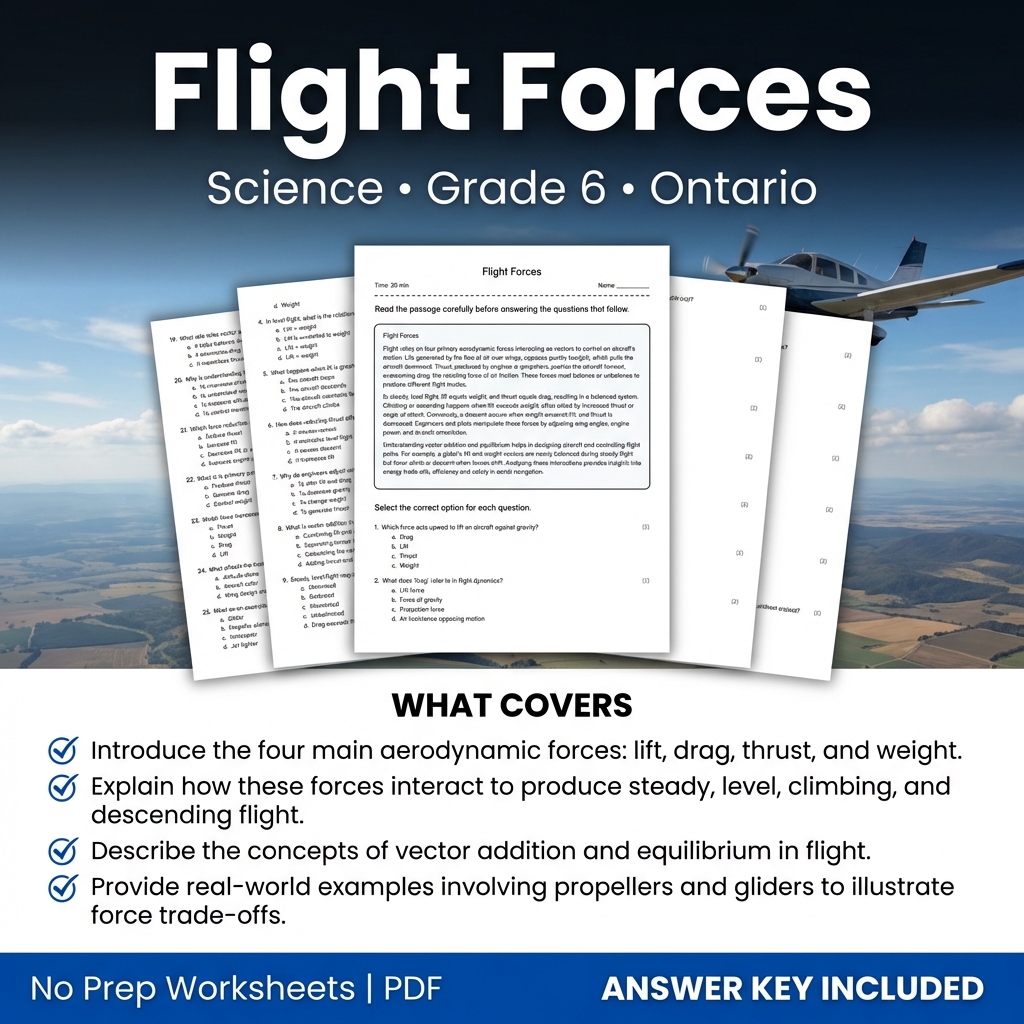
Flight Forces Science Worksheet Grade 6 | Ontario Standards
Created byCoral Reef LearningLearning Objectives
- Introduce the four main aerodynamic forces: lift, drag, thrust, and weight.
- Explain how these forces interact to produce steady, level, climbing, and descending flight.
- Describe the concepts of vector addition and equilibrium in flight.
Instant download
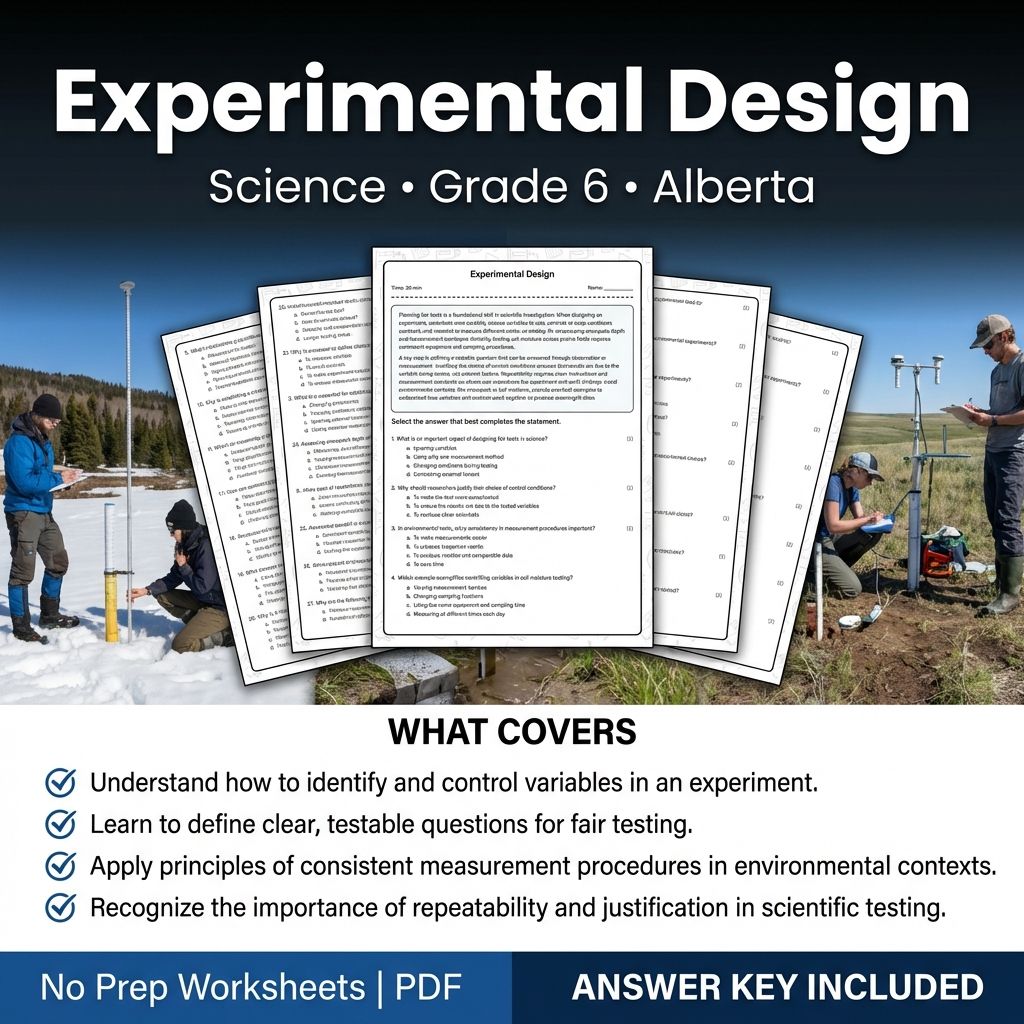
Grade 6 Science Worksheet on Experimental Design | Alberta Standard
Created byCoral Reef LearningLearning Objectives
- Understand how to identify and control variables in an experiment.
- Learn to define clear, testable questions for fair testing.
- Apply principles of consistent measurement procedures in environmental contexts.
Instant download

Circuit Symbols Worksheet Grade 6 Science | Circuits & Diagrams
 Created byChalk and Compass
Learning Objectives
- Identify common circuit symbols (cell, battery, resistor, lamp, switch, ammeter, voltmeter) and explain what each one does in a circuit.
- Interpret schematic diagrams to describe how components are connected (series, parallel, or mixed) and predict basic behavior.
- Use schematic conventions such as correct symbol orientation and meter connection placement to interpret voltage and current readings.
Also included in: Grade 6 Science Circuits & Electricity Lesson Bundle | Ontario +1 more
Instant download

Space Cycles Assessment for Grade 6 | Science Standards-Aligned
Created byPrism Point LearningLearning Objectives
- Understand the cycles in the sky caused by Earth's rotation, orbit, and tilt.
- Identify how the Moon's orbit creates phases and affects the night sky.
- Predict the effects of Earth's movement on day length, seasons, and night and day.
Also included in: Grade 6 Life Science Science Lesson Bundle – General Framework Unit
Instant download
Grade 6 Science | Water Cycle Worksheet with Answer Key (NGSS Aligned) (PDF)
Created byBright Mind ResourcesLearning Objectives
- Describe the processes involved in the water cycle, including evaporation, condensation, precipitation, runoff, infiltration, and groundwater storage.
- Explain how solar energy and gravity drive the water cycle.
- Identify different reservoirs such as oceans, ice, and groundwater, and understand the transfer of water between them.
Also included in: Grade 6 Science Unit Bundle - Weather, Water Cycle & Climate Systems - NGSS +2 more
Instant download

Grade 6 Science | Water and Resources Worksheet | General Standard
Created byLumora LearningLearning Objectives
- Explain how the water cycle moves water through Earth systems and affects where freshwater is available.
- Describe the roles of evaporation, precipitation, runoff, infiltration, and groundwater recharge.
- Identify how storage in glaciers and aquifers influences water supply over time.
Instant download

Digital Instrumentation Assessment | Grade 6 Science Worksheet Ontario
Created byPrism Point LearningLearning Objectives
- Explain how electronic sensors, digital probes, and data loggers work together to measure physical quantities
- Describe how sampling rate, resolution, and units affect the quality of digital measurements
- Use calibration and metadata documentation to improve measurement accuracy and data reliability
Instant download
6th Grade Science | Data Representation Worksheet (Ontario Standard) (PDF)
Created byBright Mind ResourcesLearning Objectives
- Understand various methods for organizing and displaying data.
- Identify appropriate graph types and interpret their information.
- Learn to analyze patterns, trends, and outliers in data sets.
Instant download
6th Grade Science | Design Process Reading Worksheets with Answer Key (PDF)
JCreated byJ.S SheetsLearning Objectives
- Understand the iterative nature of the design process in aeronautics.
- Identify key steps such as specification, prototyping, measurement, and refinement.
- Explain how trade-offs among lift, drag, weight, and stability affect aircraft design.
Also included in: Grade 6 Science | Aerodynamics & Flight Unit Worksheet Pack (PDF + Answer Keys) +1 more
Instant download

Grade 6 Science | Understanding Variables & Controls in Scientific Experiments - Daily Reading Comprehension
Created byCoral Reef LearningLearning Objectives
- Understand key concepts related to Science
- Apply knowledge through practice questions
- Demonstrate comprehension of the material
Instant download

Elements in Compounds Science Worksheet | California Standards Grade 6
JCreated byJ.S SheetsLearning Objectives
- Understand that compounds are formed from atoms of different elements joined in specific proportions.
- Identify the atomic composition patterns that determine a compound's properties.
- Explain how particle models represent the bonding arrangements within compounds.
Also included in: Grade 6 Physical Science Lesson Bundle for Science – California Standards +1 more
Instant download

6th Grade Science | Body Organization Levels Worksheet (PDF)
Created byEvergreen Desk EducationLearning Objectives
- Explain the hierarchy of body organization from cells to tissues, organs, and body systems.
- Describe how each level supports specific functions in the body.
- Predict how a change at one level can affect the performance of a body system.
Also included in: Grade 6 Life Processes & Ecosystem Interactions Science Lesson Bundle: General +1 more
Instant download

Building Scientific Knowledge Worksheet Grade 6 Science Florida NGSSS
Created byPrism Point LearningLearning Objectives
- Explain how scientific knowledge becomes more reliable through iterative refinement and new evidence
- Differentiate between scientific theories and scientific laws using examples
- Describe how communication, peer evaluation, and reproducibility strengthen claims
Also included in: Scientific Inquiry Lesson Bundle | Grade 6 Science | Florida NGSSS
Instant download

Circulatory System Practice Worksheet | Grade 6 Science Review Assessment
Created byPrism Point LearningLearning Objectives
- Explain how the heart pumps blood and creates pressure that moves materials through blood vessels.
- Describe how circulation delivers oxygen and nutrients and removes carbon dioxide and metabolic wastes.
- Connect circulatory function to thermoregulation and how the body fights infections.
Also included in: Multicellular Systems & Functions Lesson Bundle | Grade 6 Science | BC +1 more
Instant download

Grade 6 Science | Energy Drives Change - Daily Reading Comprehension
Created byCoral Reef LearningLearning Objectives
- Understand how sunlight causes water to evaporate.
- Identify the role of energy in Earth's water cycle.
- Explore how energy influences weather patterns and material movement.
Instant download

Grade 6 Evidence Explanations Worksheet | General Practice PDF
 Created byClear Sky Classroom
Learning Objectives
- Explain how evidence supports a scientific claim by describing what the evidence shows (patterns, ranges, or matches).
- Use scientific concepts to connect evidence to a cause-and-effect explanation.
- Compare competing explanations by evaluating which one is better supported by the available evidence.
Instant download

6th Grade Science Worksheet | Safety and Ethics (Ontario) (PDF)
Created byEvergreen Desk EducationLearning Objectives
- Explain why risk assessment, proper tool use, and hazard prevention are essential in science investigations.
- Apply ethical responsibilities such as humane treatment of organisms, informed consent, and confidentiality.
- Identify safe procedures for handling materials, preventing hazards, and reporting incidents accurately.
Also included in: Grade 6 Science Inquiry and Data Collection Lesson Bundle | Ontario +1 more
Instant download

Grade 6 Celestial Patterns Worksheet | Practice & Assessment PDF
Created byClear Sky ClassroomLearning Objectives
- Explain how the apparent motion of the Sun, Moon, planets, and constellations follows predictable patterns from a fixed location.
- Use observation of seasonal constellations and planetary motion to make simple predictions about what will be visible at different times.
- Interpret statements about celestial cycles as true or false based on the idea of repeating patterns.
Also included in: Grade 6 Sky Science Sun–Earth–Moon Science Lesson Bundle for Alberta +1 more
Instant download

Grade 6 Respiration And Digestion Worksheet | Practice & PDF
Created byClear Sky ClassroomLearning Objectives
- Explain how the respiratory system exchanges gases using diffusion and gas concentration differences.
- Describe how the digestive system breaks food into smaller molecules that can enter the bloodstream.
- Connect coordinated respiration and digestion to energy release in cells and proper waste removal.
Instant download

Grade 6 Science | States of Matter Overview - Daily Reading Comprehension
Created byCoral Reef LearningLearning Objectives
- Understand the three main states of matter: solid, liquid, and gas
- Describe the particle arrangement and motion in each state
- Identify the macroscopic traits such as shape and compressibility of solids, liquids, and gases
Instant download

Particle Models Worksheet | Standards-Aligned Grade 6 Science Practice
JCreated byJ.S SheetsLearning Objectives
- Understand how particle models represent matter as collections of atoms and molecules.
- Identify the different kinds of atoms and their arrangements in particle diagrams.
- Connect particle models to properties of substances and changes during reactions.
Also included in: Grade 6 Physical Science Lesson Bundle for Science – California Standards +1 more
Instant download

Grade 6 Science Worksheet Survival Changes | Standards-Aligned Practice
JCreated byJ.S SheetsLearning Objectives
- Understand how environmental changes influence the usefulness of traits in organisms.
- Describe how populations respond to shifts in resources and conditions through natural selection.
- Explain the connection between adaptation, ecosystem change, and resilience.
Also included in: Grade 6 Ecosystem Adaptations and Energy Flow Science Lesson Bundle | Florida NGSSS +1 more
Instant download

6th Grade Science Worksheet | Electrostatic Phenomena (Ontario Standard) (PDF)
Created byEvergreen Desk EducationLearning Objectives
- Explain how charge transfer during rubbing or contact can create temporary static electricity.
- Use the triboelectric series idea to predict the usual direction of charge tendency for common materials.
- Describe attraction, repulsion, and spark discharge as effects of electrostatic charge behavior.
Also included in: Grade 6 Electricity Circuits Science Lesson Bundle for Ontario Worksheets +1 more
Instant download

Grade 6 Pollution Effects on Ecosystems Worksheet | Ontario Science Activity
 Created byTeacher's Corner
Learning Objectives
- Explain how nutrient loading can reduce dissolved oxygen in aquatic ecosystems.
- Identify how chemical contaminants can affect organisms and populations through bioaccumulation and biomagnification.
- Use ecological indicators such as algal biomass and contaminant residues to describe ecosystem changes.
Instant download

Grade 6 Evidence Reasoning Worksheet | Practice & Assessment PDF
Created byClear Sky ClassroomLearning Objectives
- Explain how scientific claims must be supported by relevant evidence rather than assumptions.
- Use measurements and observations in consistent units or qualitative terms to justify conclusions.
- Distinguish correlation from causation when interpreting data patterns.
Instant download

6th Grade Science Worksheet – Structures and Functions (PDF) for TEKS Standards
Created byEvergreen Desk EducationLearning Objectives
- Explain how plant structures (roots, stems, leaves, vascular tissues, flowers, seeds) help organisms survive and reproduce.
- Describe how animal organ systems (digestive, respiratory, circulatory) support key life processes and maintain homeostasis.
- Use examples to connect structure to function, including transport of materials and responses to environmental conditions.
Instant download

Grade 6 Science | Science Observational Instruments - Reading Comprehension
Created byCoral Reef LearningLearning Objectives
- Understand the types of telescopes used in astronomy.
- Learn how different wavelengths reveal planetary and stellar features.
- Distinguish between ground-based and space-based observatories.
Instant download

Grade 6 Carbon Cycling Worksheet | Practice & Assessment PDF
Created byClear Sky ClassroomLearning Objectives
- Explain how carbon moves through ecosystems via photosynthesis, respiration, feeding, and decomposition
- Describe the roles of plants, consumers, and decomposers in the carbon cycle
- Use tracing ideas to predict how changes in one process can affect carbon storage over time
Instant download

Grade 6 Science – Chromatography Basics Daily Reading Worksheet | BC Standards
Created byBright Mind ResourcesLearning Objectives
- Understand the fundamental concept of chromatography and its purpose.
- Identify and explain the main components involved in chromatography.
- Recognize real-world applications of chromatography in science.
Also included in: Matter & Change Grade 6 Science Daily Reading Worksheets Lesson Bundle | BC +1 more
Instant download

Grade 6 Science – Classification & Biodiversity | Daily Reading Worksheet
Created byBright Mind ResourcesLearning Objectives
- Identify observable characteristics used to classify animals and plants.
- Understand hierarchical categories in biological classification from kingdom to species.
- Describe how dichotomous keys help in identifying local species.
Also included in: Grade 6 Ecology & Biodiversity Science Lesson Bundle | Ontario Daily Reading +1 more
Instant download
Surface Change Assessment | NGSS Grade 6 Science Standards
Created byPrism Point LearningLearning Objectives
- Describe geologic processes that modify Earth's surface over different time scales.
- Identify observable indicators in rock and landform records related to landscape evolution.
- Contrast rapid and slow surface change events and explain their impact on Earth's landscape.
Also included in: Grade 6 Science Mini Bundle – Earth's Systems NGSS Standards-Aligned +1 more
Instant download

6th Grade Science Worksheet | Satellite Systems Ontario Standards (PDF)
Created byEvergreen Desk EducationLearning Objectives
- Identify the main categories of artificial satellites by their purpose (operational, scientific, and reconnaissance).
- Describe how different orbits (geostationary and polar) match different mission goals.
- Explain how satellite sensors and payloads help monitor Earth systems and space phenomena.
Also included in: Grade 6 Solar System Space Science Lesson Bundle – Ontario Worksheets +1 more
Instant download

Grade 6 Science – Optimization Tradeoffs & Design Analysis | Reading Worksheet
Created byBright Mind ResourcesLearning Objectives
- Understand the concept of tradeoffs in engineering design
- Identify key factors affecting optimization, such as lift, drag, and stability
- Analyze how different design features influence overall performance
Also included in: Grade 6 Aerodynamics Science Lesson Bundle Daily Reading Worksheets | Ontario +1 more
Instant download

Grade 6 Food Web Energy Paths Worksheet | NGSS Practice PDF
Created byClear Sky ClassroomLearning Objectives
- Explain how energy moves through an ecosystem using trophic levels and feeding relationships in a food web
- Describe the roles of producers, consumers, and decomposers in transferring energy and cycling matter
- Interpret how multiple energy pathways differ from a single food chain
Instant download

Grade 6 Science | Phase Energy - Daily Reading Comprehension Practice
Created byCoral Reef LearningLearning Objectives
- Understand what happens during phase changes and how energy is involved.
- Identify different phase changes such as melting, freezing, boiling, and condensation.
- Explain the relationship between energy transfer and particle motion during phase changes.
Instant download

Mass and Density Assessment | TEKS Grade 6 Science Standards-Aligned
Created byPrism Point LearningLearning Objectives
- Define mass and volume and understand their relationship through density.
- Calculate density of simple solids and liquids using basic measurements.
- Interpret density values to determine if an object will sink or float in water.
Also included in: Lesson Bundle Grade 6 Matter and Energy Science Assessment | TEKS
Instant download

Observation Techniques Assessment | TEKS Grade 6 Science Standards
Created byPrism Point LearningLearning Objectives
- Define systematic observation and explain its purpose in scientific data collection.
- Identify differences between qualitative notes and quantitative measurements.
- Recognize common instruments used in observation, such as rulers, balances, and thermometers.
Also included in: Scientific Inquiry and Processes Grade 6 Science Lesson Bundle | TEKS
Instant download

Weather Patterns Worksheet | NGSS-Aligned 6th Grade Science Practice
JCreated byJ.S SheetsLearning Objectives
- Understand atmospheric processes that influence local and regional weather.
- Interpret surface maps, temperature, pressure measurements, and radar observations.
- Identify features such as fronts, pressure systems, and severe weather events.
Also included in: Grade 6 Earth System Interactions Climate Science Lesson Bundle – NGSS +1 more
Instant download
About Grade 6 Science Worksheets
Explore Grade 6 Science worksheets for classwork, homework, or review. Our 5,969 printables download instantly as PDFs.
MyTeachingSheets worksheets are made by real teacher-authors and checked before they go live. Download any as a print-ready PDF for lessons, homework, or independent practice — most include answer keys, and previews are always free.