
Grade 6 Science Worksheets
5,969 worksheets
Population Dynamics Worksheet | TEKS Grade 6 Science Practice PDF
JCreated byJ.S SheetsLearning Objectives
- Explain how birth rates, death rates, immigration, and emigration affect population size over time
- Distinguish exponential growth from logistic growth and identify the role of carrying capacity
- Describe density-dependent and density-independent factors that can limit population growth
Instant download

Cell Structure Assessment | General Grade 6 Science Standards
 Created byPrism Point Learning
Learning Objectives
- Identify the main parts of a cell and their functions.
- Describe the roles of the cell membrane, cytoplasm, nucleus, and organelles.
- Explain how cell parts work together to support life processes.
Instant download

Grade 6 Science | Safety and Reporting Worksheet | General Standard
 Created byLumora Learning
Learning Objectives
- Explain how to communicate experimental results clearly using accurate data, proper units, and labeled graphs or tables
- Describe safety expectations for common lab situations (heat sources, eye protection, handling and disposal of substances)
- Practice ethical reporting by using accurate measurements, citing sources, and discussing limitations honestly
Instant download

The Circulatory System Worksheet | Standards-Aligned Grade 6 Science Practice
JCreated byJ.S SheetsLearning Objectives
- Understand how the circulatory system transports blood, gases, nutrients, hormones, and wastes.
- Identify the main components of the heart and blood vessels.
- Explain how the heart's pumping action creates pressure to circulate blood.
Instant download
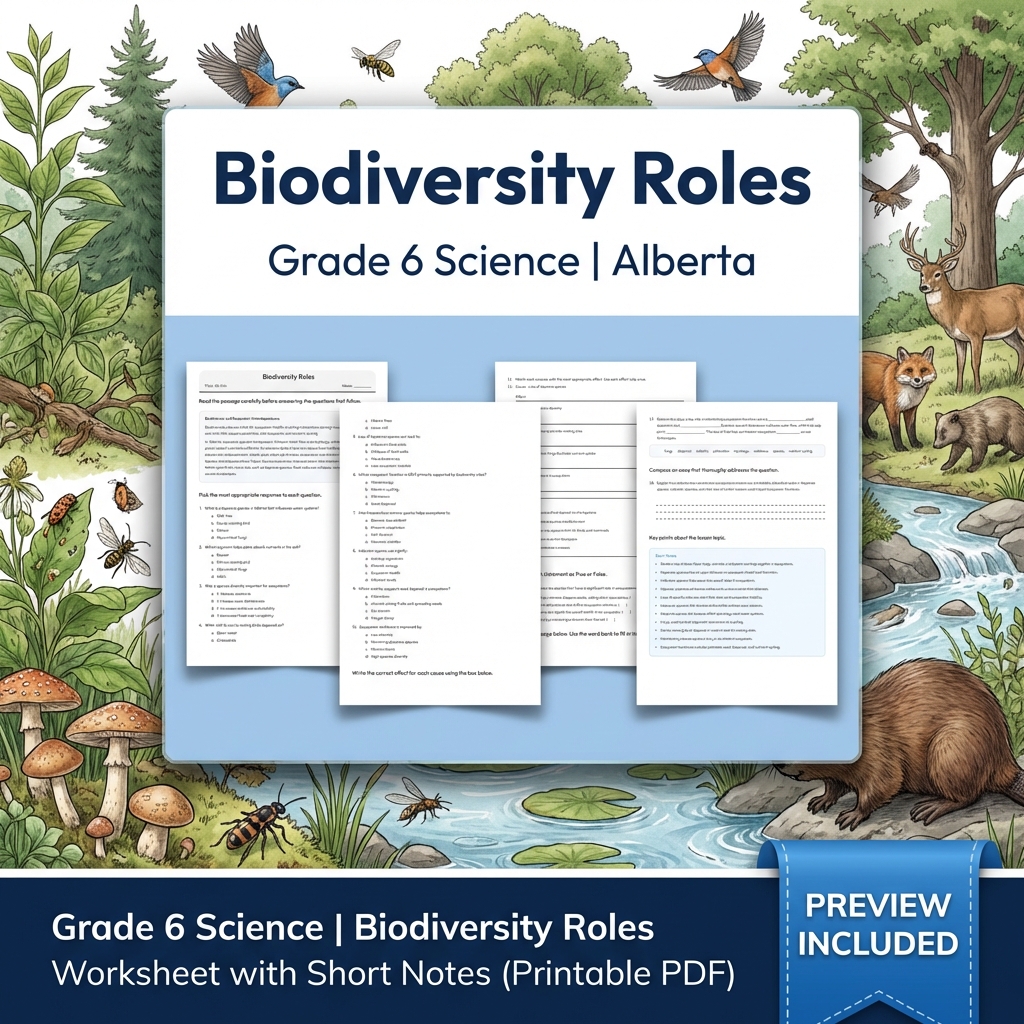
Grade 6 Science | Biodiversity Roles Worksheet with Short Notes (Printable PDF)
 Created byMeadowlark Worksheets
Learning Objectives
- Understand how different species contribute to ecosystem functions like pollination, seed dispersal, and nutrient cycling.
- Identify keystone and indicator species in Alberta and their ecological roles.
- Explain how species diversity increases resilience and ecosystem stability.
Also included in: Grade 6 Science | Trees and Forests Unit Worksheet Bundle – Alberta Curriculum +1 more
Instant download

Energy Pathways Worksheet for Grade 6 Science | NGSS-Aligned Practice
JCreated byJ.S SheetsLearning Objectives
- Describe how photosynthesis converts light energy into chemical energy in plants.
- Explain how respiration releases energy from organic molecules in cells.
- Identify reactants and products involved in photosynthesis and respiration.
Also included in: Grade 6 Cellular Processes and Feedback Science Lesson Bundle – NGSS +1 more
Instant download

Grade 6 Science – Life Processes in Cells | Daily Reading Worksheet
 Created byBright Mind Resources
Learning Objectives
- Understand the process of photosynthesis in plants.
- Identify the role of sunlight and gases in photosynthesis.
- Explain how plants produce food and energy.
Also included in: Life Processes Grade 6 Science Daily Reading Worksheets Lesson Bundle | General +1 more
Instant download
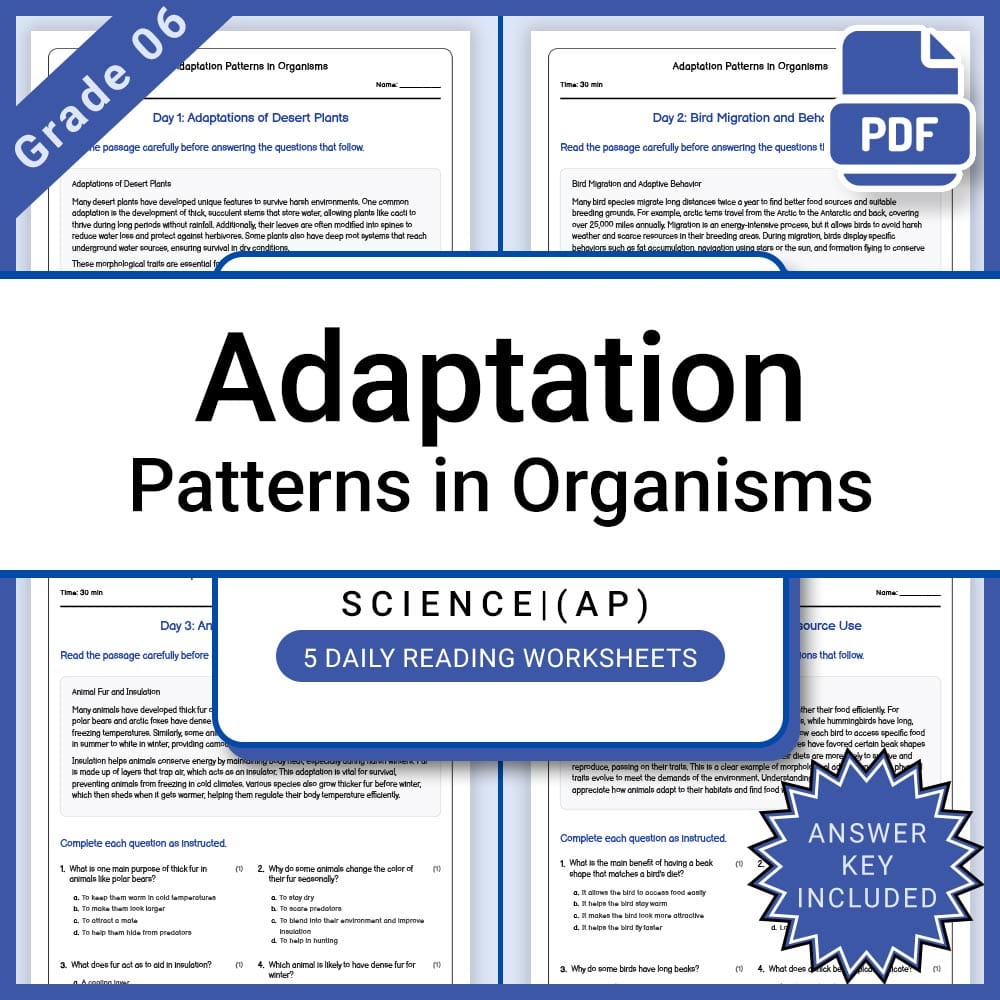
Grade 6 Science – Adaptation Patterns in Organisms Worksheet + Answer Key
JCreated byJ.S SheetsLearning Objectives
- Understand morphological adaptations in desert plants
- Identify physiological and behavioral traits that aid survival
- Analyze how traits like fur insulation and beak shape help organisms in different environments
Also included in: Grade 6 Science Lesson Bundle: Ecosystems, Food Chains & Environment +1 more
Instant download

Earth System Links Assessment | General Grade 6 Science Standards
Created byPrism Point LearningLearning Objectives
- Understand how Earth's systems are interconnected and how changes in one system can affect others.
- Identify the different Earth systems: lithosphere, hydrosphere, atmosphere, and biosphere.
- Describe how energy from the Sun drives cycles and interactions among Earth's systems.
Also included in: Grade 6 Life Science Science Lesson Bundle – General Framework Unit
Instant download

Symbiotic Relations Worksheet | Grade 6 Science Practice
Created byPrism Point LearningLearning Objectives
- Explain what symbiotic relationships are and how they affect organisms in an ecosystem.
- Categorize examples of interactions as mutualism, commensalism, or parasitism.
- Describe how symbiotic relationships can influence survival, reproduction, resource distribution, and community structure.
Also included in: Grade 6 Ecosystem Interactions Science Lesson Bundle Worksheets | TEKS +1 more
Instant download

Grade 6 Science | Evidence & Reasoning in Science - Reading Comprehension
 Created byCoral Reef Learning
Learning Objectives
- Understand the importance of relevant evidence in scientific explanations.
- Learn how to distinguish between observations, data, and assumptions.
- Develop skills to evaluate the strength of evidence in reasoning.
Instant download
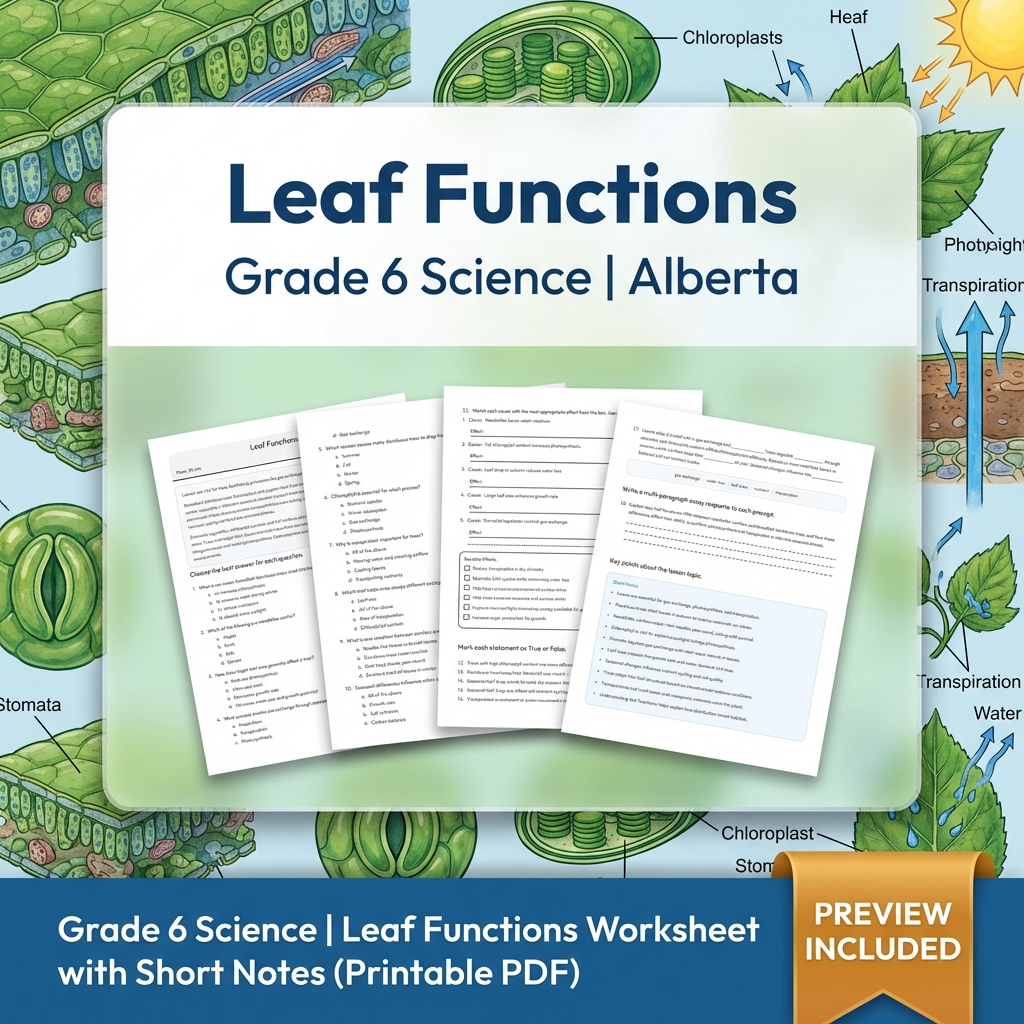
Grade 6 Science | Leaf Functions Worksheet with Short Notes (Printable PDF)
Created byMeadowlark WorksheetsLearning Objectives
- Understand the structures of leaves and their roles in gas exchange, photosynthesis, and transpiration.
- Compare the adaptations of needlelike conifers and broadleaf deciduous trees.
- Explain how seasonal changes affect leaf retention and nutrient cycles.
Also included in: Grade 6 Science | Trees and Forests Unit Worksheet Bundle – Alberta Curriculum +1 more
Instant download
Grade 6 Science – Energy Flow & Ecosystems | Daily Reading Worksheet
 Created byElena Brooks
Learning Objectives
- Understand the concept of energy transfer within food webs
- Identify the roles of producers, consumers, and decomposers
- Describe how energy diminishes across trophic levels
Also included in: Grade 6 Science Ecosystems Lesson Bundle | NGSS Interactions & Energy +1 more
Instant download

Science Careers Worksheet | Standards-Aligned Grade 6 Science Practice
JCreated byJ.S SheetsLearning Objectives
- Identify science-related careers and match them to typical tasks involving data, tools, or lab work.
- Explain how scientific reasoning and mathematical skills support measurement, analysis, and communication in science careers.
- Describe how engineers and technicians maintain equipment and use evidence to interpret results for different audiences.
Instant download

Invasive Species Impacts and Spread Worksheet Grade 6 Ontario Science
 Created byTeacher's Corner
Learning Objectives
- Explain how invasive species are introduced and establish in new habitats
- Describe how invasive species can outcompete, prey on, or otherwise harm native species
- Identify evidence of ecosystem alteration caused by invasive species
Instant download

Grade 6 Understanding Collisions Science Worksheet | NGSS Printable
 Created byBRIGHT PATH RESOURCES
Learning Objectives
- Understand key concepts related to Science
- Apply knowledge through practice questions
- Demonstrate comprehension of the material
Also included in: Motion and Stability: Forces and Interactions Grade 6 Science Bundle | NGSS +2 more
Instant download

Conservation Principle Practice Worksheet | Grade 6 Science Review
Created byPrism Point LearningLearning Objectives
- Explain the energy conservation principle for a closed system.
- Identify how energy can transform between kinetic, potential, and thermal forms.
- Use conservation ideas to analyze collisions, reactions, and electrical circuits.
Also included in: Energy, Waves & Circuits Lesson Bundle | Grade 6 Science | BC Framework +1 more
Instant download

Cell Organelles and Their Functions Worksheets | Grade 6 Science
 Created byTeachers Club
Learning Objectives
- Identify major cell structures and explain what each organelle does in the cell.
- Connect structure of an organelle to its function, including genetic control, energy processing, and protein assembly.
- Compare plant and animal cell features to determine how organelles support different cell functions.
Also included in: From Molecules to Organisms Grade 6 Science NGSS Bundle +2 more
Instant download
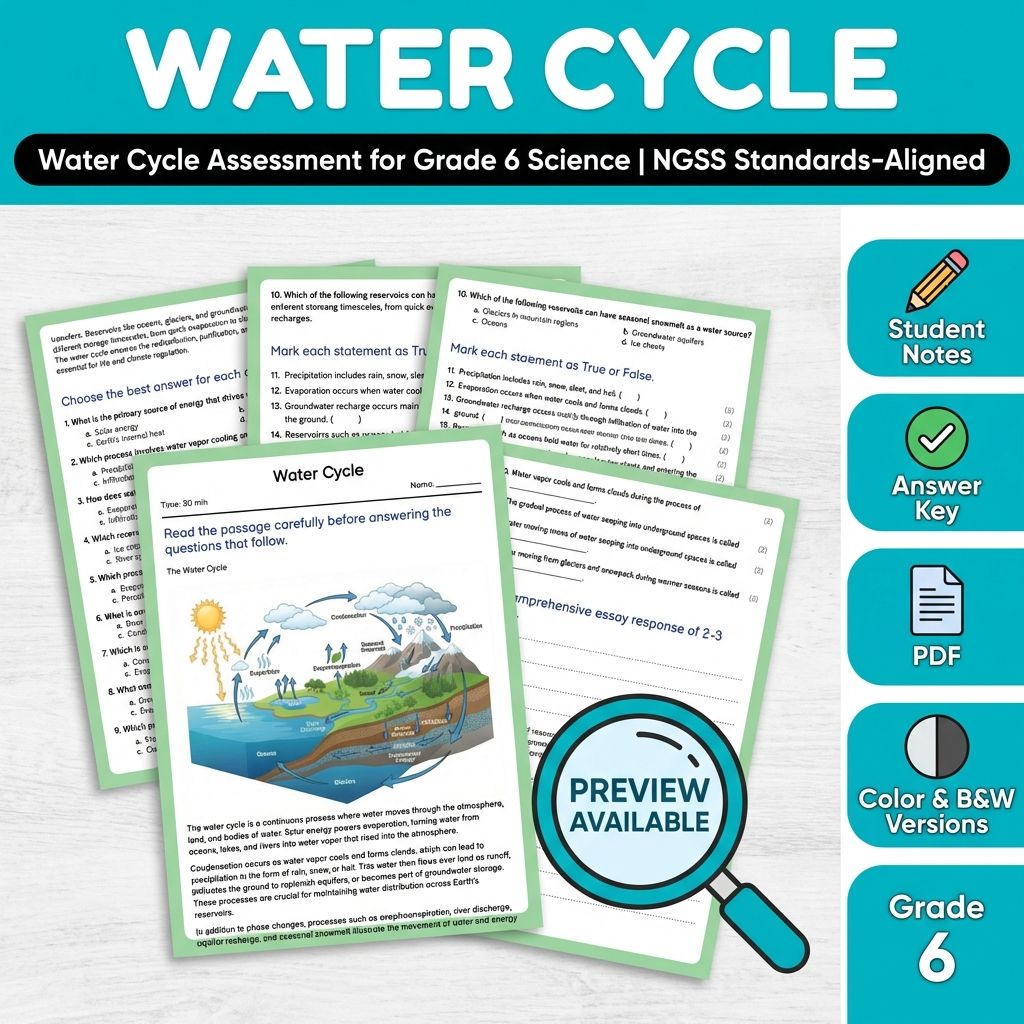
Water Cycle Assessment for Grade 6 Science | NGSS Standards-Aligned
Created byPrism Point LearningLearning Objectives
- Explain the processes involved in the water cycle, including evaporation, condensation, and precipitation.
- Identify the role of solar energy and gravity in water movement across the hydrosphere.
- Describe the cycling of water through different reservoirs such as oceans, ice, and groundwater.
Also included in: Grade 6 Science Mini Bundle – Earth's Systems NGSS Standards-Aligned +1 more
Instant download

Grade 6 Historical Perspectives Worksheet | Practice & PDF
 Created byClear Sky Classroom
Learning Objectives
- Explain how Indigenous and settler communities observed celestial patterns for seasonal planning and cultural practices
- Describe how solar and lunar cycles can be used to support navigation and timekeeping
- Compare different ways people record and predict celestial events using oral knowledge and early written observations
Also included in: Grade 6 Sky Science Sun–Earth–Moon Science Lesson Bundle for Alberta +1 more
Instant download

Grade 6 Science | Adaptation Tradeoffs Worksheet (Ontario Standards) (PDF)
 Created byEvergreen Desk Education
Learning Objectives
- Explain how adaptation tradeoffs connect to fitness in changing environments
- Compare specialists and generalists by their benefits and costs
- Use examples (plants, insects, and migration) to predict which strategy may be favored under fluctuating conditions
Also included in: Grade 6 Biodiversity, Adaptation & Ecology Science Lesson Bundle | Ontario +1 more
Instant download

Stewardship Practices Worksheet | Standards-Aligned Grade 6 Science Assessment
JCreated byJ.S SheetsLearning Objectives
- Understand community-based stewardship practices such as planting and shelterbelts.
- Identify the benefits of urban canopy programs and Indigenous land care methods.
- Explore real-world examples from Alberta that demonstrate landscape benefits.
Instant download

Grade 6 Science – Design Process & Aircraft Development | Reading Worksheet
Created byBright Mind ResourcesLearning Objectives
- Understand the stages of the design process for aircraft and gliders.
- Identify how prototypes and simulations are used to improve aerodynamics.
- Explain the importance of measurements like lift and drag in design refinement.
Also included in: Grade 6 Aerodynamics Science Lesson Bundle Daily Reading Worksheets | Ontario +1 more
Instant download

Grade 6 Science – Series Circuit Characteristics Daily Reading Worksheet
Created byBright Mind ResourcesLearning Objectives
- Understand the basic concept of series circuits
- Identify a series circuit from a schematic diagram
- Explain current flow in series circuits
Also included in: Grade 6 Electricity Science Daily Reading Lesson Bundle | Ontario +1 more
Instant download

Grade 6 Science | Respiratory System Worksheet | BC Standards
Created byLumora LearningLearning Objectives
- Understand the structure and function of the respiratory system.
- Identify how respiratory surfaces such as lungs and gills facilitate gas exchange.
- Explain how surface area adaptations improve respiratory efficiency.
Instant download

Grade 6 Science – Satellite Systems & Orbits | Daily Reading Worksheet
Created byBright Mind ResourcesLearning Objectives
- Understand different types of artificial satellites and their functions
- Identify the various orbits used by satellites and their purposes
- Explain how satellites contribute to Earth observation, communication, and scientific monitoring
Also included in: Space Systems Grade 6 Science Daily Reading Worksheets Bundle | Ontario +1 more
Instant download
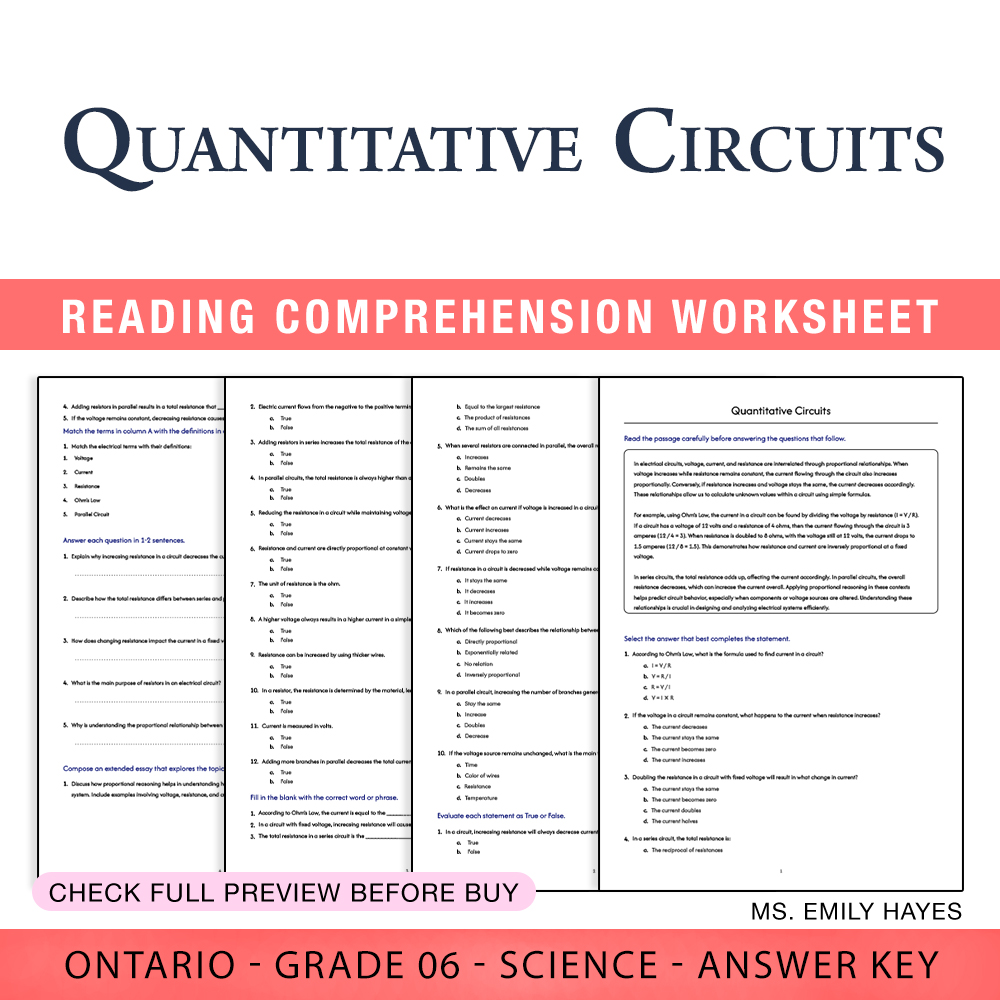
Grade 6 Science | Quantitative Circuits Worksheet (PDF + Answer Key)
 Created byCopper Leaf Classroom
Learning Objectives
- Understand the relationship between voltage, current, and resistance in electrical circuits.
- Calculate current, resistance, or voltage using proportional relationships.
- Apply mathematical reasoning to predict how changes in circuit components affect overall behavior.
Instant download
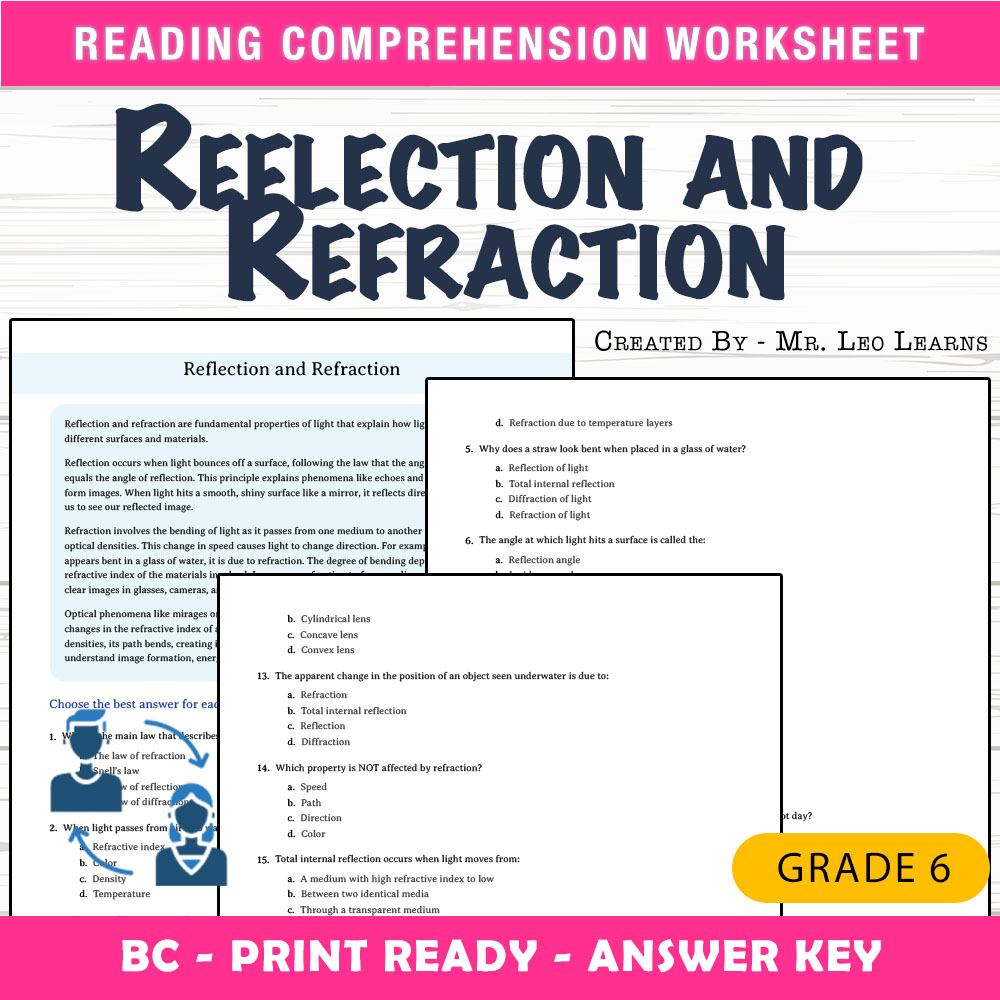
Grade 6 Science — Reflection and Refraction Worksheet MCQ Paper
 Created byThe Resource Hub
Learning Objectives
- Understand the concepts of reflection and refraction of light.
- Identify how light changes direction at surfaces and boundaries.
- Recognize the role of lenses and optical phenomena like mirages.
Also included in: Grade 6 Science Energy, Waves & Circuits UNIT Bundle | BC Standards +1 more
Instant download

Grade 6 Science – Adaptation Overview & Survival | Daily Reading Worksheet
Created byBright Mind ResourcesLearning Objectives
- Understand what adaptations are and why they are important for survival.
- Identify different types of structural adaptations in animals.
- Explain how adaptations provide advantages in specific habitats.
Also included in: Grade 6 Science: Organ Systems & Adaptations Daily Reading Lesson Bundle | BC +1 more
Instant download

Grade 6 Inherited Adaptations Worksheet with Answer Key | Florida NGSSS Science
Created byEvergreen Desk EducationLearning Objectives
- Explain how inherited adaptations help organisms survive and reproduce in a specific environment.
- Describe how living and nonliving environmental pressures can make certain traits more valuable.
- Use vocabulary such as adaptation, inherited trait, environment, and survival to answer science questions.
Instant download

6th Grade Science Worksheet on Ecosystem Components (PDF) – BC Standards
Created byEvergreen Desk EducationLearning Objectives
- Identify biotic and abiotic components of an ecosystem and describe what each includes
- Explain how abiotic factors influence biotic growth, survival, and reproduction
- Use cause-and-effect reasoning to predict how changes in ecosystem conditions affect populations
Instant download

Grade 6 Science – Earth System Spheres Reading Worksheet | Standards-Aligned
Created byBright Mind ResourcesLearning Objectives
- Identify the components of Earth's geosphere
- Understand how the geosphere interacts with other spheres
- Explore processes that change Earth's land
Also included in: Water Cycle Grade 6 Science Lesson Bundle Daily Reading | California Standards +1 more
Instant download

Natural Selection Practice Worksheets | Grade 6 Science NGSS Review
Created byPrism Point LearningLearning Objectives
- Explain how heritable trait differences and environmental pressures can change trait frequencies over time
- Describe the role of differential reproductive success in natural selection
- Use examples (e.g., pollution, island finches, antibiotic resistance) to connect trait advantages to population change
Also included in: Grade 6 Evolution and Biodiversity Science lesson bundle | NGSS
Instant download

Moon Relationships Worksheet | NGSS Grade 6 Space Science Activity
 Created byAmber Owl Education
Learning Objectives
- Explain how the relative positions of Earth, Moon, and Sun produce the sequence of lunar phases.
- Distinguish between lunar phases (illumination changes) and eclipses (shadowing events).
- Predict when solar and lunar eclipses can occur based on line-of-sight alignment.
Also included in: Grade 6 Science Moon Relationships & Day Night Seasons Lesson Bundle | NGSS +1 more
Instant download
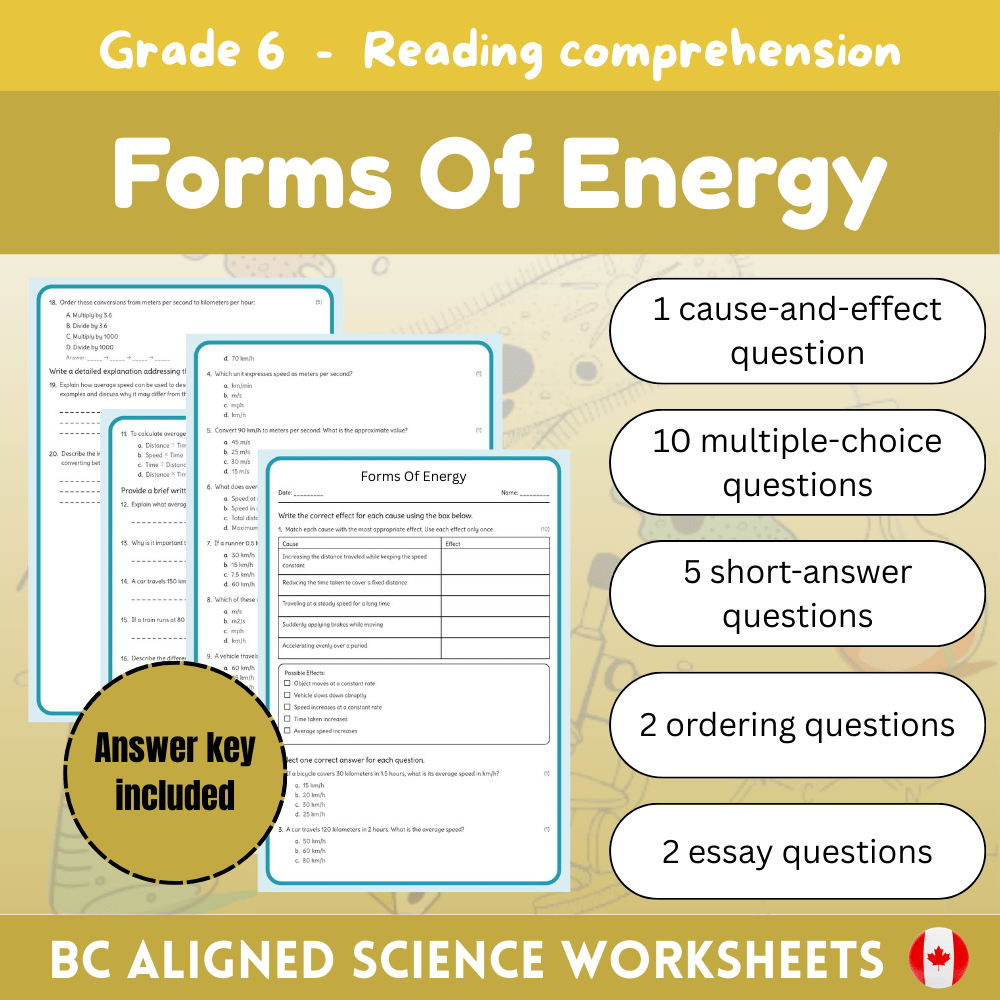
Grade 6 Science | Forms of Energy Worksheet – Standard BC (PDF)
Created byBright Mind ResourcesLearning Objectives
- Identify and describe different forms of energy such as kinetic, potential, thermal, chemical, and electrical.
- Understand how energy can transform from one form to another in natural and engineered systems.
- Explain examples of energy transformations, such as sunlight to chemical energy in plants or chemical to thermal energy during combustion.
Instant download

Science Worksheet Drag Components Parasitic vs Induced | Ontario Grade 6
JCreated byJ.S SheetsLearning Objectives
- Categorize drag into parasitic drag and induced drag based on how each is produced
- Identify the components of parasitic drag: form drag, skin-friction drag, and interference drag
- Explain how induced drag relates to lift production, wingspan, and lift distribution
Instant download

6th Grade Science | Data Tables Worksheet (PDF) Alberta Standards
Created byEvergreen Desk EducationLearning Objectives
- Identify essential parts of a science data table, including clear column headings and units
- Explain why consistent time stamps and metadata improve data quality and reusability
- Interpret and revise data tables by checking for clarity, completeness, and consistent conventions
Instant download

Trophic Levels Worksheet | Standards-Aligned Grade 6 Science Practice
JCreated byJ.S SheetsLearning Objectives
- Understand the concept of trophic levels and their role in ecosystems.
- Identify producers, consumers, and decomposers within a food chain.
- Explain how energy flows through different trophic levels.
Also included in: Grade 6 Ecosystem Adaptations and Energy Flow Science Lesson Bundle | Florida NGSSS +1 more
Instant download
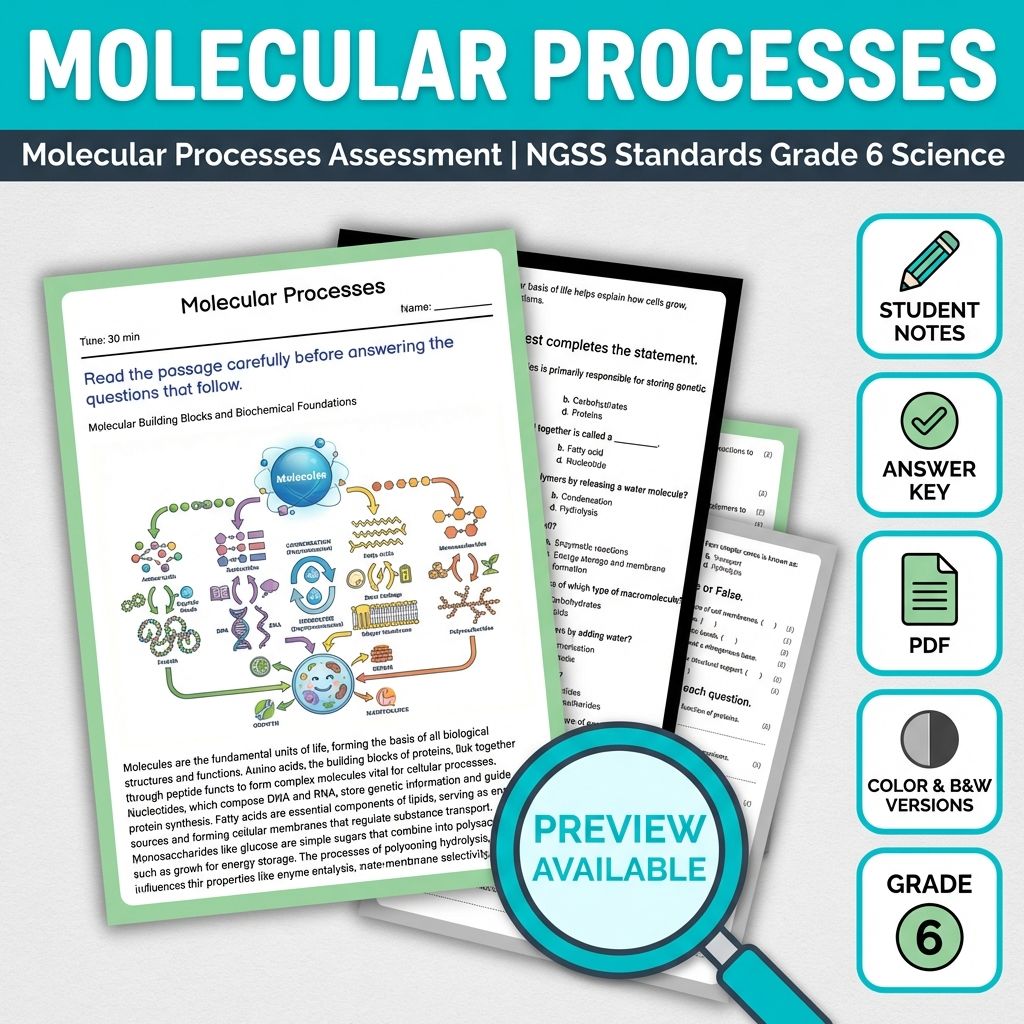
Molecular Processes Assessment | NGSS Standards Grade 6 Science
Created byPrism Point LearningLearning Objectives
- Explain the role of amino acids, nucleotides, fatty acids, and monosaccharides as molecular building blocks.
- Describe how monomers assemble into polymers via condensation reactions.
- Understand how macromolecules like proteins, nucleic acids, lipids, and carbohydrates function in biological systems.
Also included in: Grade 6 Science Mini Bundle | Structures and Processes NGSS Not specified +1 more
Instant download
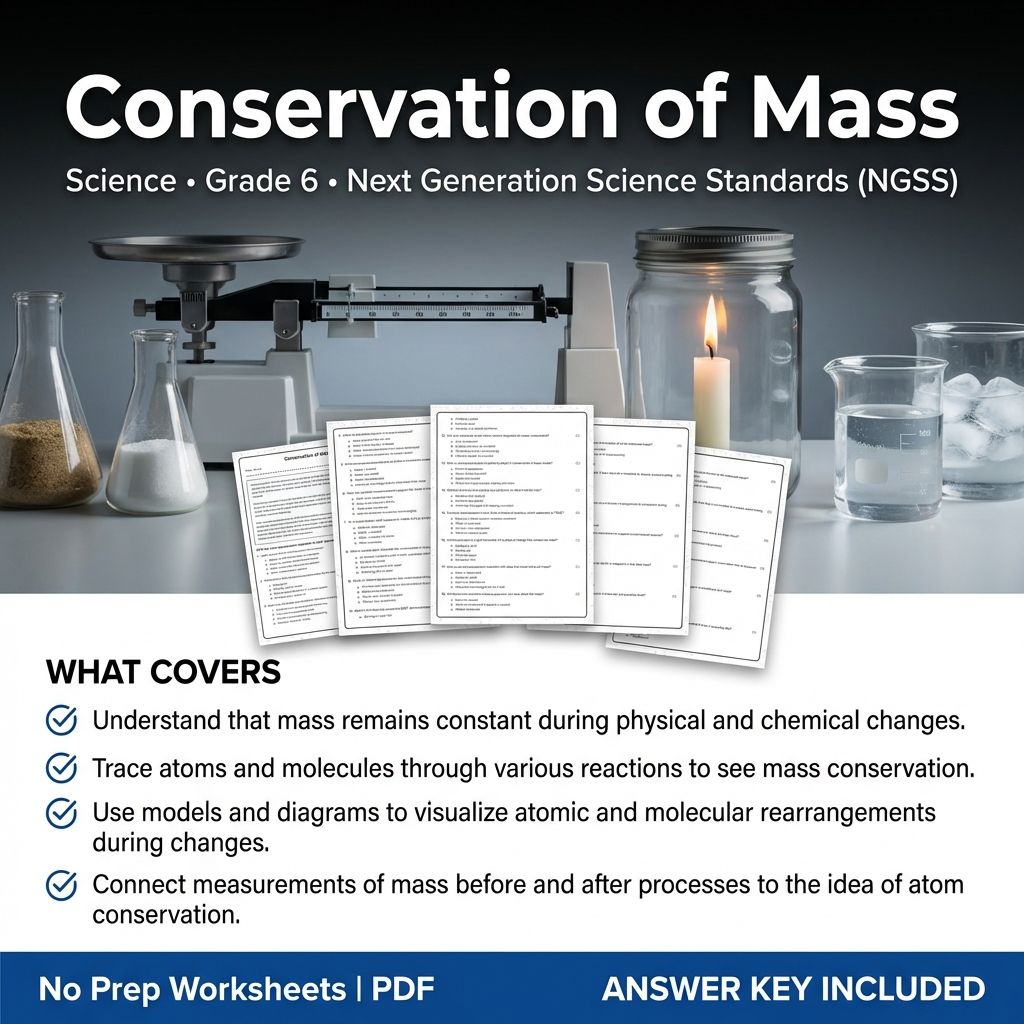
Grade 6 Science Worksheet | Conservation of Mass – Printable PDF & Answer Key
Created byCoral Reef LearningLearning Objectives
- Understand that mass remains constant during physical and chemical changes.
- Trace atoms and molecules through various reactions to see mass conservation.
- Use models and diagrams to visualize atomic and molecular rearrangements during changes.
Instant download
6th Grade Science | Atmospheric Patterns Worksheet (Worksheet + Answer Key)
Created byBright Mind ResourcesLearning Objectives
- Understand the structure and components of the atmosphere
- Identify and describe air-mass interactions and weather fronts
- Connect heat transfer mechanisms and the greenhouse effect to climate variability
Instant download

Flight Forces Worksheet | Grade 6 Science | Alberta Standards
JCreated byJ.S SheetsLearning Objectives
- Identify and describe the four primary forces involved in flight: lift, thrust, drag, and weight.
- Explain how these forces interact to produce steady flight or descent.
- Provide real-world examples of flight forces in Alberta, such as kites, aircraft, and parachutes.
Instant download

Science Worksheet Robotic Missions | Standards-Aligned Grade 6 Assessment
JCreated byJ.S SheetsLearning Objectives
- Explain how robotic missions to the solar system can be designed using mission types such as flyby, orbiter, lander, and sample-return.
- Describe major engineering constraints (distance, communication delay, and planetary environments) that affect robotic spacecraft design.
- Identify how propulsion, gravity assists, instrumentation, and data return work together to achieve mission goals.
Instant download

Grade 6 Science | Wave Interactions Worksheet | BC Aligned
Created byLumora LearningLearning Objectives
- Describe how wave interactions such as interference, superposition, and resonance influence sound and light.
- Explain the concepts of constructive and destructive interference and their effects.
- Identify how standing waves and resonance occur in musical instruments and other systems.
Also included in: Grade 6 Science | Energy, Waves & Circuits | Custom Bundle | BC Aligned
Instant download
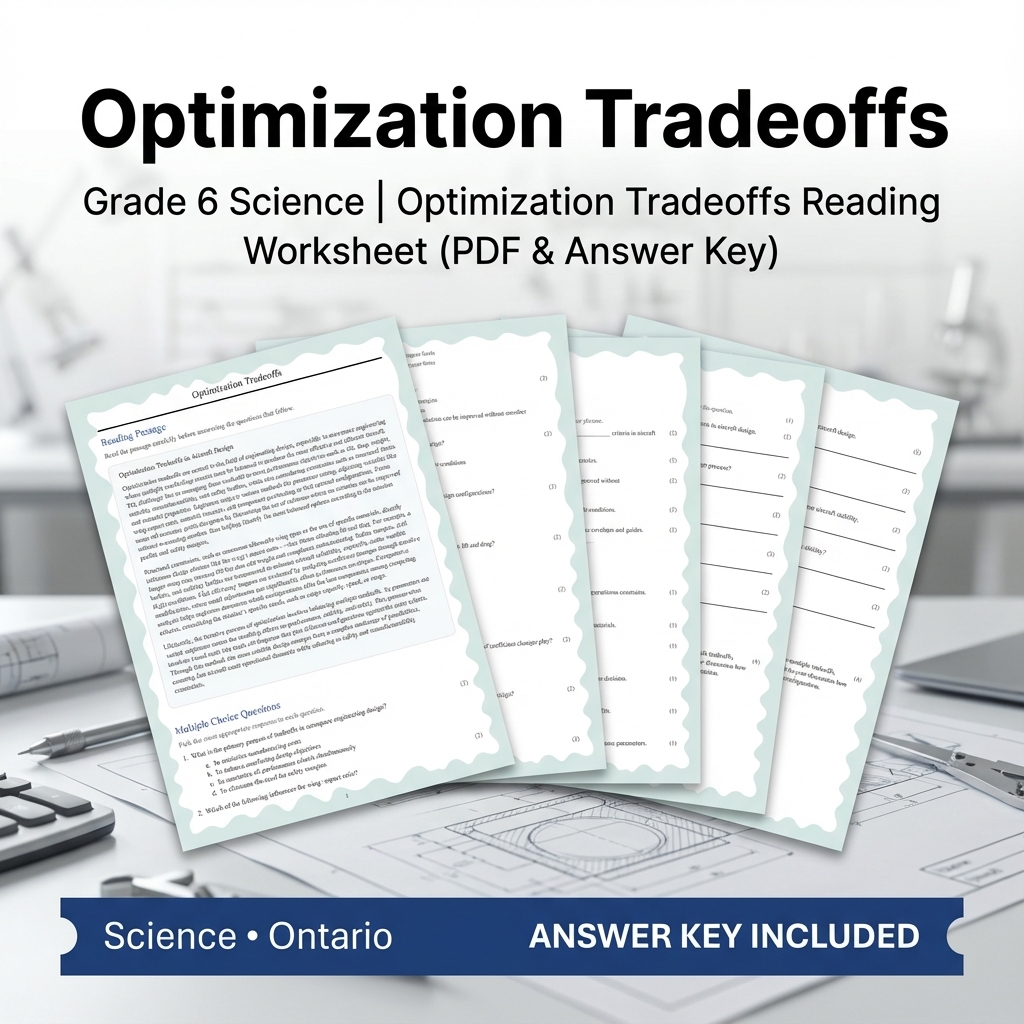
Grade 6 Science | Optimization Tradeoffs Reading Worksheet (PDF & Answer Key)
JCreated byJ.S SheetsLearning Objectives
- Understand the concept of tradeoffs in multi-criteria design processes.
- Analyze how structural constraints affect aircraft wing design choices.
- Evaluate the methods used for parameter tuning and Pareto trade-offs.
Also included in: Grade 6 Science | Aerodynamics & Flight Unit Worksheet Pack (PDF + Answer Keys) +1 more
Instant download

Weather and Climate Patterns Worksheets Grade 6 Science
Created byBRIGHT PATH RESOURCESLearning Objectives
- Explain how weather and climate differ in time scale and how they are measured.
- Identify variables used to describe weather and climate, such as temperature and precipitation.
- Use observational data to describe patterns that define local climate.
Also included in: Grade 6 Earth Science Worksheets | Weather, Water & Climate Bundle +2 more
Instant download

Grade 6 Science | Cell Structure - Daily Reading Comprehension
Created byCoral Reef LearningLearning Objectives
- Identify the basic parts of a cell from a diagram
- Understand the function of each cell part
- Recognize the importance of cell components in maintaining life processes
Instant download
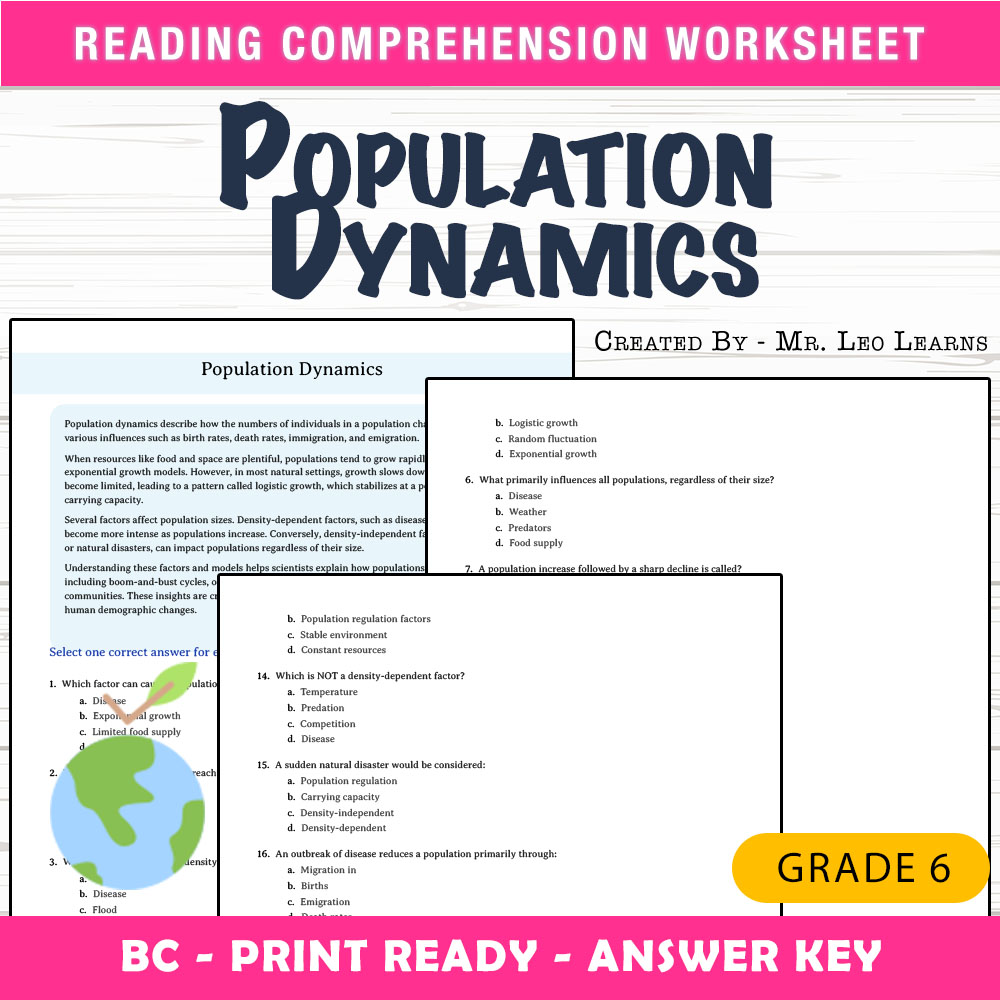
Grade 6 Science — Population Dynamics Worksheet MCQ Paper
Created byThe Resource HubLearning Objectives
- Explain how birth, death, immigration, and emigration influence population size.
- Differentiate between exponential and logistic growth models.
- Identify factors that affect populations, including density-dependent and density-independent factors.
Also included in: Grade 6 Science Ecosystems & Interdependence Worksheet Bundle – BC Curriculum +1 more
Instant download
About Grade 6 Science Worksheets
Explore Grade 6 Science worksheets for classwork, homework, or review. Our 5,969 printables download instantly as PDFs.
MyTeachingSheets worksheets are made by real teacher-authors and checked before they go live. Download any as a print-ready PDF for lessons, homework, or independent practice — most include answer keys, and previews are always free.