
Grade 6 Science Worksheets
5,969 worksheets
Grade 6 Chromatography Basics Worksheet | BC Practice & PDF
 Created byClear Sky Classroom
Learning Objectives
- Explain how paper chromatography separates mixture components using a mobile solvent and a stationary medium.
- Identify the roles of solubility, attraction, and partitioning in determining how far substances travel.
- Use Rf value ideas to compare how different components move on a chromatogram.
Instant download
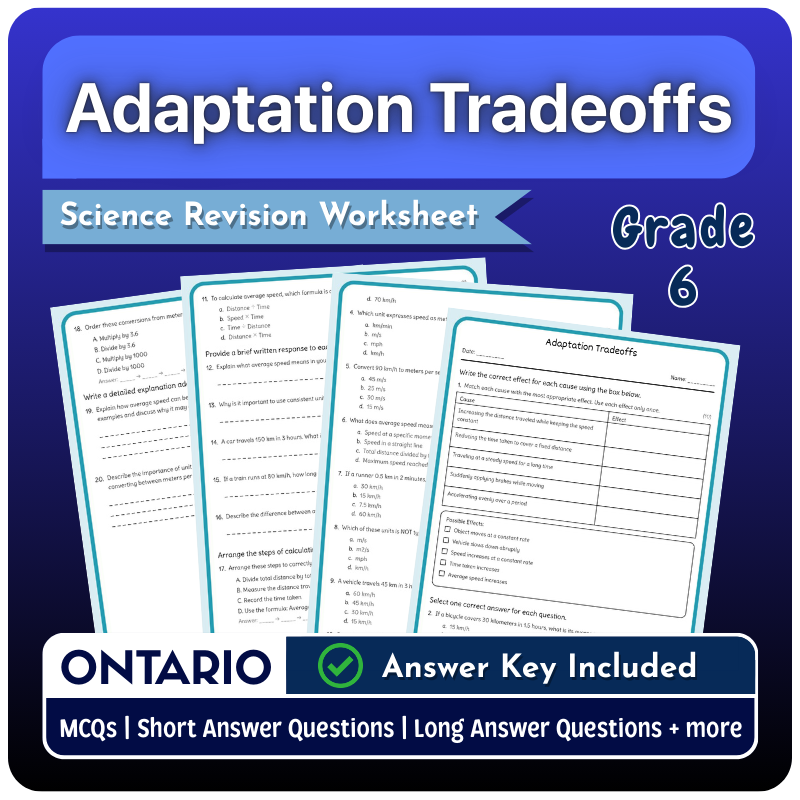
6th Grade Science | Adaptation Tradeoffs Worksheet (Ontario, Science 1) (PDF)
 Created byBright Mind Resources
Learning Objectives
- Understand the concept of fitness trade-offs in adaptation strategies.
- Compare the benefits and costs of specialist versus generalist adaptations.
- Analyze examples such as mountain versus lowland plants, nocturnal versus diurnal insects, and migratory behaviors.
Instant download

6th Grade Science | Variable Control Worksheet (General) (PDF)
 Created byEvergreen Desk Education
Learning Objectives
- Explain the difference between the independent variable and the dependent variable in an investigation.
- Identify which factors should be controlled to make evidence reliable.
- Use a plan to clearly separate the changing factor from measured outcomes.
Also included in: Grade 6 Science Inquiry Lesson Bundle: Variable Control & Models (General) +1 more
Instant download

Balanced Forces Worksheet for Grade 6 Science | Standards-Aligned Practice
JCreated byJ.S SheetsLearning Objectives
- Understand how forces affect motion and the concept of net force.
- Differentiate between balanced and unbalanced forces.
- Identify examples of balanced and unbalanced forces in real-world scenarios.
Also included in: Grade 6 Matter, Energy, and Forces Science lesson bundle – Florida (NGSSS) +1 more
Instant download

Grade 6 Population Dynamics in Science Worksheet | NGSS Ecology Activity
 Created byBRIGHT PATH RESOURCES
Learning Objectives
- Understand the factors that influence population growth and decline
- Analyze graphical representations of population changes
- Use mathematical models to predict changes in populations
Also included in: Biological Evolution: Unity & Diversity Grade 6 Science Lesson Bundle | ngss +2 more
Instant download

6th Grade Science | Energy Efficiency Worksheet (PDF) - BC Standards
Created byEvergreen Desk EducationLearning Objectives
- Explain energy efficiency as the fraction of input energy that becomes useful output energy.
- Identify common sources of energy loss in machines, lighting, and heating systems.
- Calculate or reason about efficiency using useful output energy and total input energy.
Instant download

Grade 6 Science – Human Impacts on Forests & Ecosystems | Reading Worksheet
Created byBright Mind ResourcesLearning Objectives
- Understand how human activities affect forest ecosystems
- Identify examples of human impact in Alberta forests
- Analyze the environmental consequences of land conversion and resource extraction
Also included in: Grade 6 Forest Ecology Science Daily Reading Worksheets Lesson Bundle | Alberta +2 more
Instant download

Societal Impacts of Scientific Findings Assessment | TEKS Grade 6 Science
 Created byPrism Point Learning
Learning Objectives
- Analyze how scientific data informs public health measures, environmental policies, and resource management.
- Evaluate societal changes resulting from scientific initiatives like water treatment, air quality monitoring, and vaccination campaigns.
- Interpret empirical indicators used to assess the effectiveness of societal interventions.
Instant download

Grade 6 Science – Celestial Patterns & Celestial Movements | Reading Worksheet
Created byBright Mind ResourcesLearning Objectives
- Understand the Sun's movement across the sky during the day and throughout the year
- Identify the path of the Sun and how it influences shadows and timekeeping
- Describe the pattern of the Sun's rising and setting times seasonally
Also included in: Grade 6 Solar System & Seasons Science Daily Reading Lesson Bundle | Alberta +2 more
Instant download
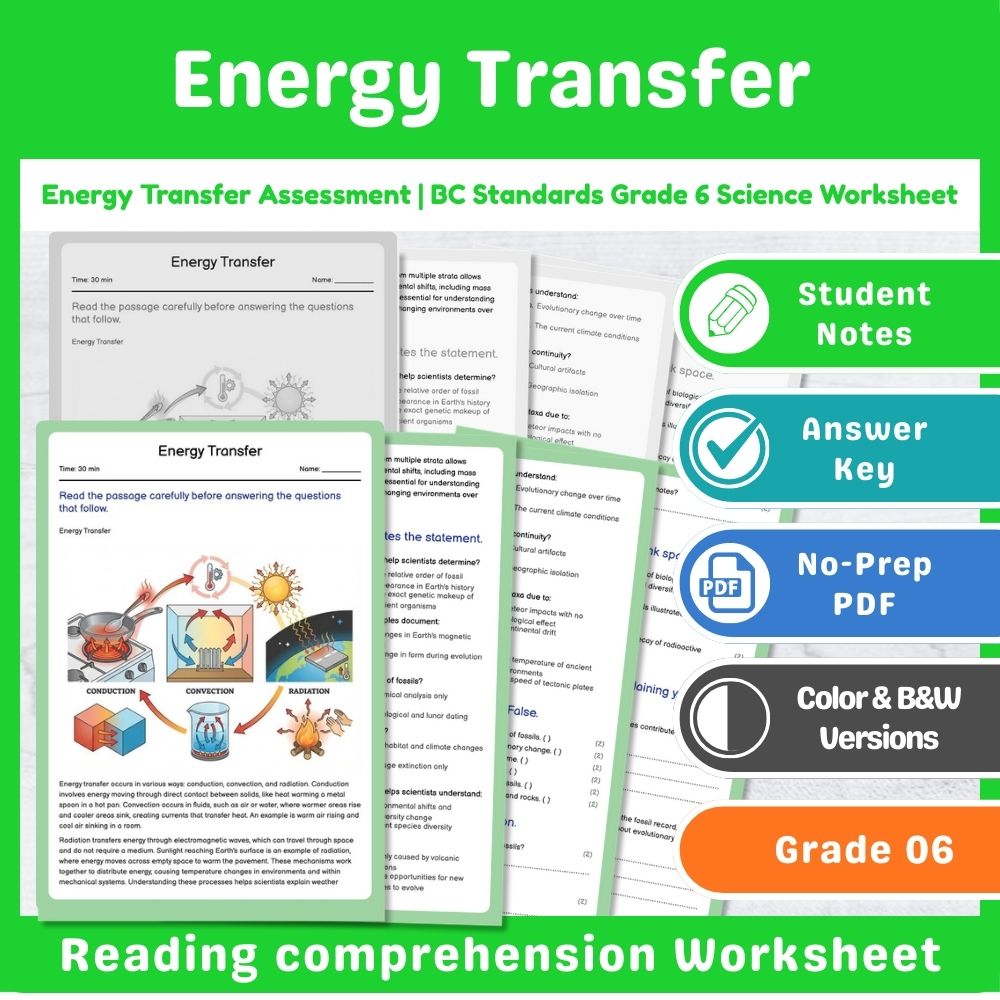
Energy Transfer Assessment | BC Standards Grade 6 Science Worksheet
Created byPrism Point LearningLearning Objectives
- Describe the three main methods of energy transfer: conduction, convection, and radiation.
- Identify real-world examples of each energy transfer mode.
- Distinguish between conduction, convection, and radiation based on how they transfer energy.
Instant download

Data Tables Worksheet | Grade 6 Science Activities
Created byPrism Point LearningLearning Objectives
- Identify key parts of a data table, including clear headings and units
- Use consistent time stamps and metadata to make measurements interpretable and reusable
- Distinguish between raw measurements and information needed for later analysis
Instant download

Grade 6 Science | Shadow Patterns in Sunlight - Daily Reading Comprehension
 Created byCoral Reef Learning
Learning Objectives
- Understand how shadows are formed by the Sun's position.
- Identify how shadow length and direction change throughout the day and year.
- Describe how Earth's tilt and motion affect shadow patterns.
Also included in: Sky Science Lesson Bundle | Grade 6 Science Daily Reading | Alberta +1 more
Instant download

Science Careers Grade 6 Assessment | TEKS Standards Printable
Created byPrism Point LearningLearning Objectives
- Identify various science-related career pathways and their typical tasks.
- Understand the skills and coursework that support careers in science and technology.
- Recognize the roles of professionals such as biomedical technicians, environmental scientists, instrumentation engineers, and laboratory analysts.
Instant download

Grade 6 Science – Physical Changes & Properties | Daily Reading Worksheet
Created byBright Mind ResourcesLearning Objectives
- Understand what physical changes are and how they differ from chemical changes.
- Identify examples of physical changes in everyday life.
- Explain the reversible nature of most physical changes.
Also included in: Grade 6 Matter Science Daily Reading Worksheets Lesson Bundle | CA Standards +1 more
Instant download

Robotic Solar System Missions & Design Constraints Worksheets Grade 6
Created byPrism Point LearningLearning Objectives
- Identify flyby, orbiter, lander, and sample-return mission types
- Explain how communication distance constrains robotic mission control
- Describe how gravity assists can reduce spacecraft fuel needs
Also included in: Grade 6 Space Science Lesson Bundle | Ontario Science Framework
Instant download

Grade 6 Science – Conservation Strategies Worksheet (PDF) – Alberta Standards
Created byEvergreen Desk EducationLearning Objectives
- Describe multiple conservation strategies used to protect forest biodiversity and ecosystem services.
- Explain how protected areas, riparian buffers, habitat restoration, and species-at-risk recovery support long-term ecosystem health.
- Connect seed-source considerations and genetic diversity to successful replanting in Alberta’s boreal and montane zones.
Instant download

Grade 6 Science | Heat And States Worksheet | General Standard
 Created byLumora Learning
Learning Objectives
- Explain how heat transfer changes energy in matter and affects particle motion
- Distinguish among melting, freezing, evaporation, and boiling as changes of state
- Describe how temperature and energy can change differently during phase changes
Instant download

Grade 6 Adaptation Tradeoffs Worksheet | Ontario Science PDF & Answer Key
Created byClear Sky ClassroomLearning Objectives
- Explain the difference between specialists and generalists in terms of adaptation tradeoffs
- Use fitness trade-off ideas to describe how an organism’s traits can help in one environment but harm in another
- Analyze examples (plants, insects, migration) to determine benefits and costs of narrow vs. broad adaptation
Instant download

Grade 6 Control Coupling in Aircraft Maneuvers Science Worksheet Ontario
 Created byTeacher's Corner
Learning Objectives
- Explain how roll, pitch, and yaw controls can influence each other through aerodynamic coupling
- Describe how differential drag during roll can cause adverse yaw
- Identify how design choices like differential and Frise ailerons and control mixers can reduce unwanted coupled moments
Instant download

Grade 6 Control Surfaces Worksheet | Ontario Science Activity PDF
Created byClear Sky ClassroomLearning Objectives
- Identify primary and secondary control surfaces and describe what they do (roll, pitch, yaw).
- Explain how deflecting a control surface changes local lift and the resulting moment about an aircraft’s center of mass.
- Describe control authority and how trim and flap deployment affect stability and performance.
Instant download

Grade 6 Adaptation Basics Worksheet PDF | Science Review & Assessment
Created byClear Sky ClassroomLearning Objectives
- Identify and distinguish structural, behavioral, and physiological adaptations
- Explain how adaptations can improve survival and reproductive success in a niche
- Compare inherited traits with acquired characteristics and describe how selection can change populations over generations
Instant download

Grade 6 Science | Scientific Models - Daily Reading Comprehension
Created byCoral Reef LearningLearning Objectives
- Understand what scientific models are and their purpose
- Identify different types of models used in science
- Recognize the importance of models in scientific investigations
Instant download

Grade 6 Science | Mass Wasting - Daily Reading Comprehension Practice
Created byCoral Reef LearningLearning Objectives
- Understand the concept of mass wasting and its role in shaping Earth's surface.
- Identify different types of mass wasting such as rockfalls, landslides, and slumps.
- Recognize natural triggers and conditions that cause mass wasting.
Instant download

Grade 6 Measurement Precision Worksheet | NGSSS Science Data Skills Practice
Created byEvergreen Desk EducationLearning Objectives
- Differentiate precision from accuracy and explain how repeated trials show precision.
- Choose appropriate measurement tools and units for common science tasks.
- Read measurements correctly from graduated scales (including the meniscus).
Instant download
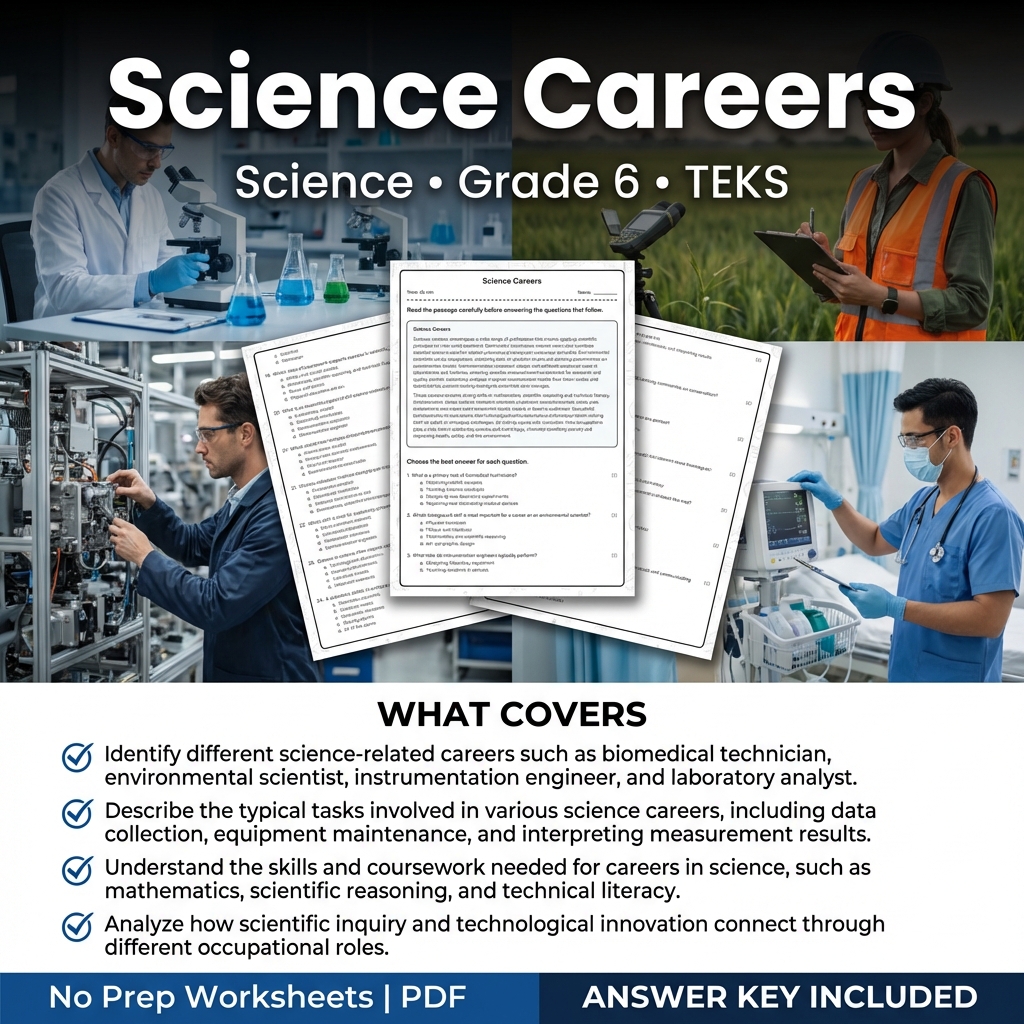
Grade 6 Science Careers Worksheet PDF | TEKS-Aligned Practice
Created byCoral Reef LearningLearning Objectives
- Identify different science-related careers such as biomedical technician, environmental scientist, instrumentation engineer, and laboratory analyst.
- Describe the typical tasks involved in various science careers, including data collection, equipment maintenance, and interpreting measurement results.
- Understand the skills and coursework needed for careers in science, such as mathematics, scientific reasoning, and technical literacy.
Instant download
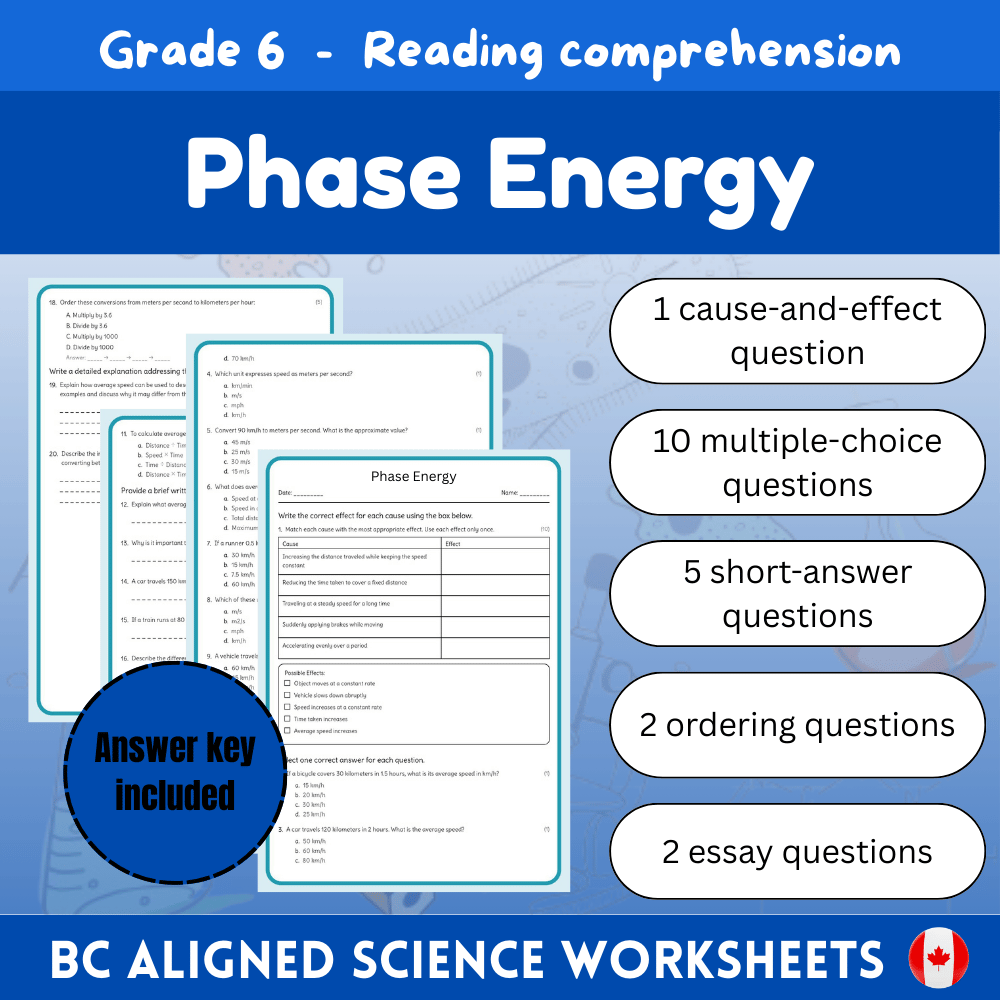
Grade 6 Science | Phase Energy Worksheets(Worksheet + Answer Key) - BC Standards
Created byBright Mind ResourcesLearning Objectives
- Understand how energy transfer occurs during phase changes such as melting, boiling, freezing, and condensation.
- Explain the connection between latent heat and particle interactions during phase changes.
- Describe why temperature can remain constant during a phase change despite energy input.
Instant download
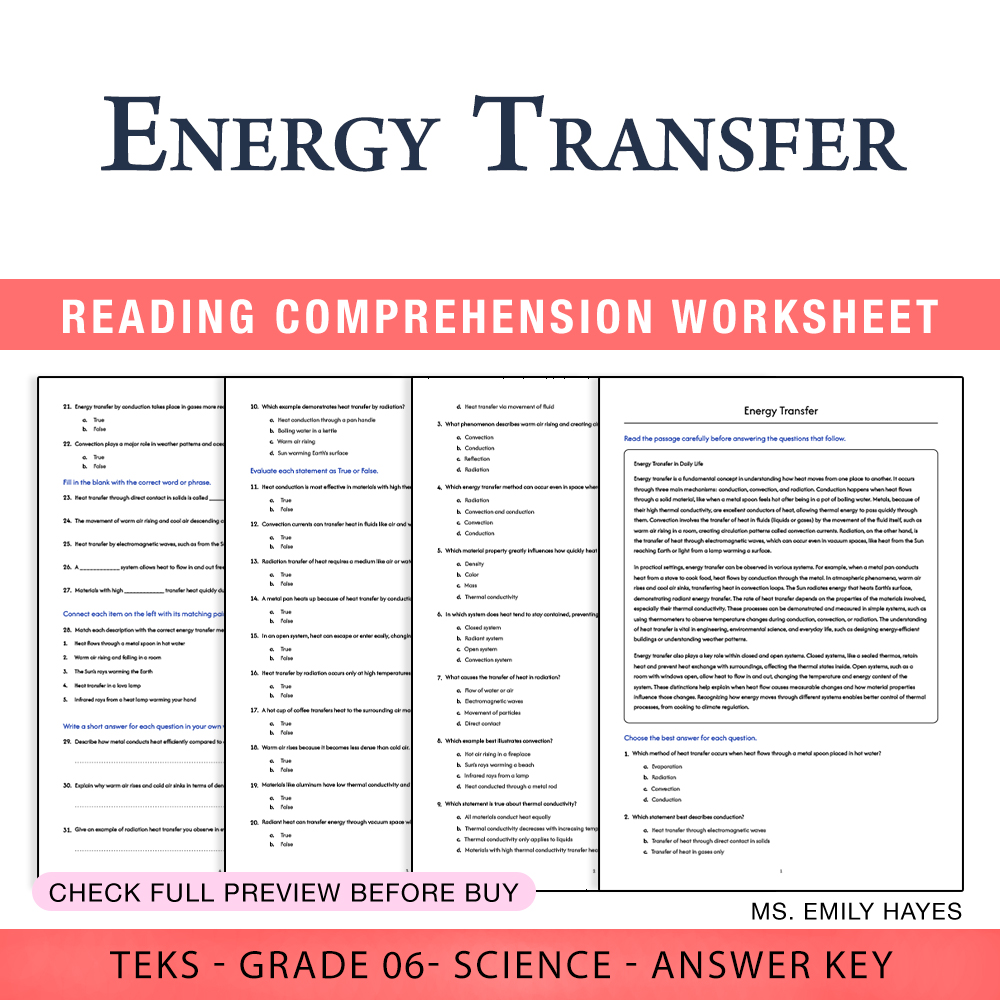
6th Grade Science | Energy Transfer Worksheet (PDF+ Answer Key)
 Created byCopper Leaf Classroom
Learning Objectives
- Understand the mechanisms of thermal energy transfer: conduction, convection, and radiation.
- Identify real-world examples of each energy transfer method, such as heat conduction through metals, convection currents in air, and radiant heat from sources like the Sun or lamps.
- Explain how energy transfer causes observable changes in temperature and material properties such as thermal conductivity.
Instant download

Variation Factors Worksheet | NGSS Grade 6 Science Practice and Assessment
JCreated byJ.S SheetsLearning Objectives
- Understand how genetic differences contribute to observable variation among individuals.
- Identify environmental factors that influence traits and their effects.
- Explain models of allele combinations, mutation impacts, and nonheritable influences.
Also included in: Grade 6 Variation and Inheritance Science Lesson Bundle | NGSS Practice +1 more
Instant download

Food Webs Worksheet | Grade 6 Science Activities
Created byPrism Point LearningLearning Objectives
- Explain how energy flows through food webs using trophic relationships (producers, consumers, decomposers).
- Identify how changes in an ecosystem (seasonal changes, migration, invasive species) can affect food web structure.
- Use food-web vocabulary (predator, herbivore, decomposer, energy transfer) to describe trophic interactions.
Also included in: Trees and Forests Lesson Bundle | Grade 6 Science | Alberta Framework
Instant download
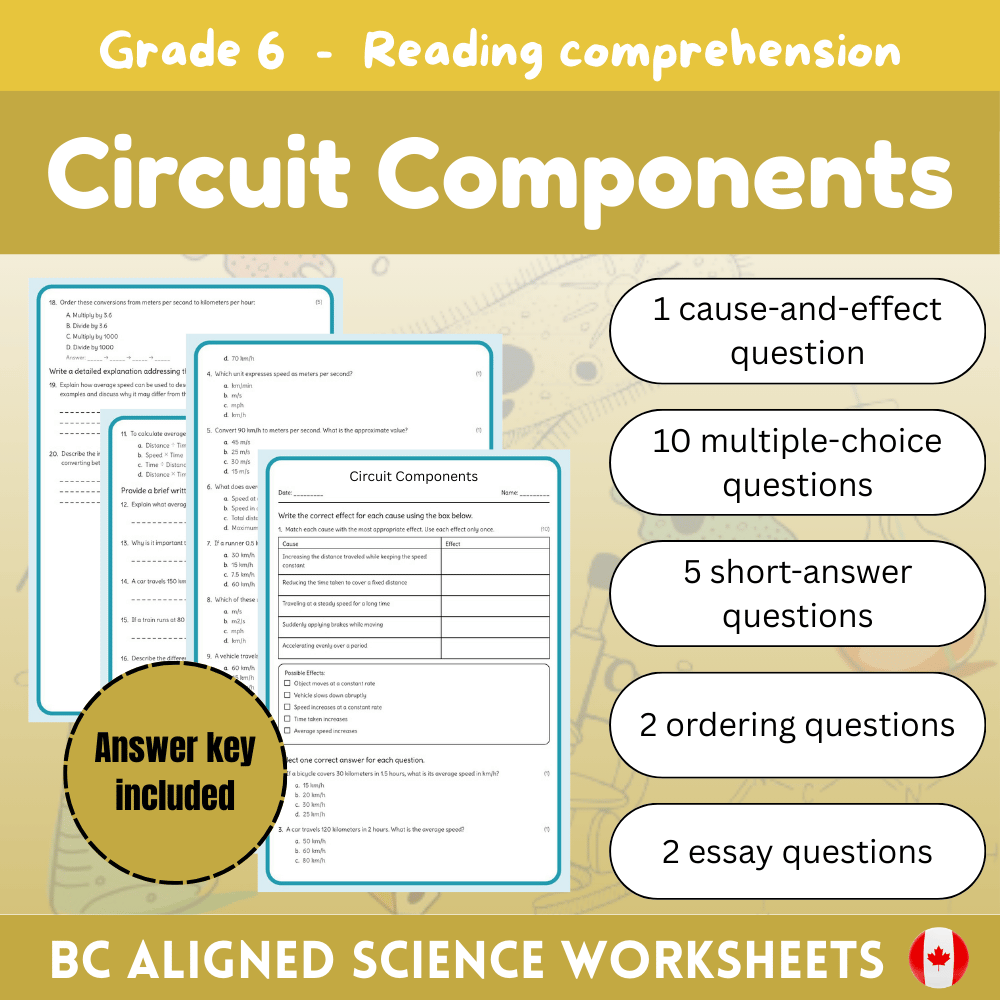
Grade 6 Science | Circuit Components Worksheet + Answer Key – BC Standards
Created byBright Mind ResourcesLearning Objectives
- Identify key components of an electrical circuit and describe their roles.
- Explain how energy is transformed within simple electrical circuits.
- Distinguish between different circuit components such as sources, conductors, loads, and switches.
Instant download
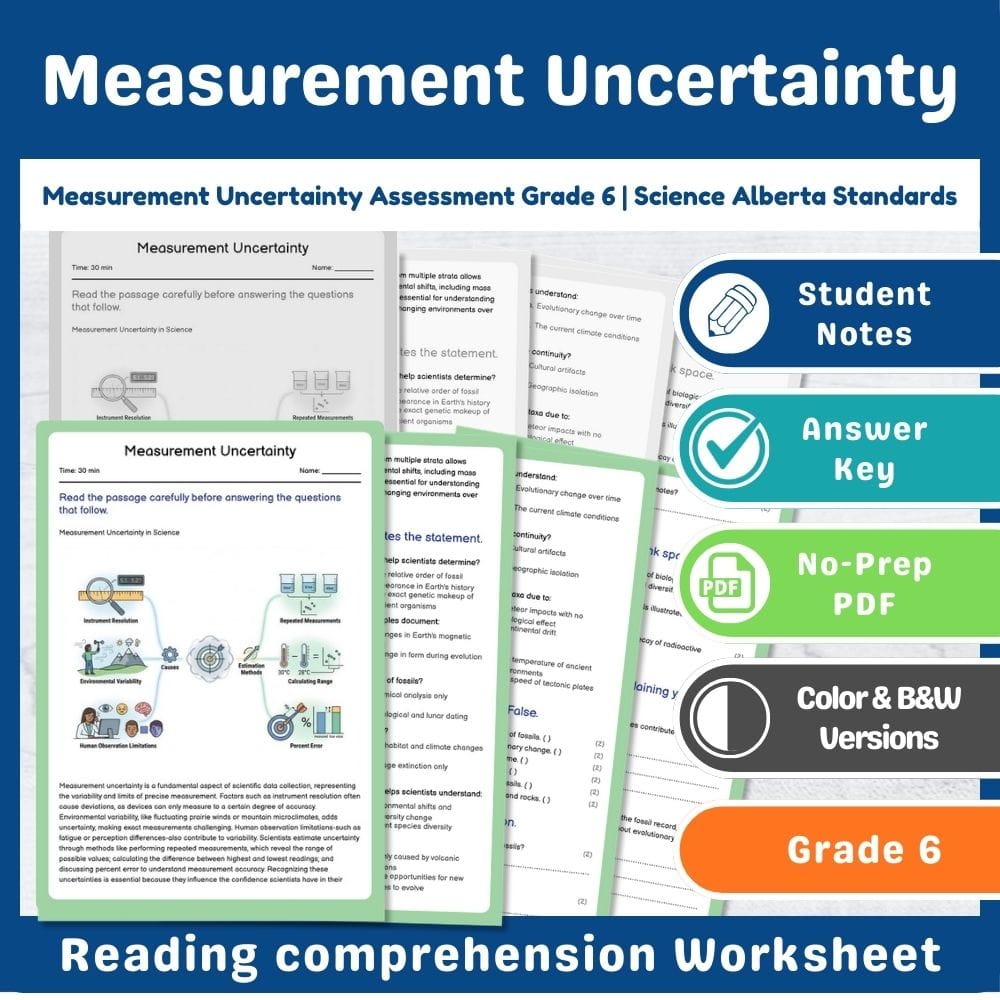
Measurement Uncertainty Assessment Grade 6 | Science Alberta Standards
Created byPrism Point LearningLearning Objectives
- Understand the concept of measurement uncertainty and its sources in scientific data.
- Identify methods used to estimate uncertainty in measurements.
- Recognize the importance of acknowledging uncertainty when interpreting data from natural phenomena.
Also included in: Lesson Grade 6 Science Mini Bundle | Evidence and Investigation
Instant download

Communication Quality Assessment for Grade 6 Science | TEKS
Created byPrism Point LearningLearning Objectives
- Understand standards for communicating scientific findings clearly and effectively.
- Learn how to formulate claims supported by empirical evidence and scientific reasoning.
- Identify the use of visual summaries, such as graphs, to present data relationships.
Also included in: Scientific Inquiry and Processes Grade 6 Science Lesson Bundle | TEKS
Instant download

Life Processes in Cells Worksheet | Grade 6 Science Practice
Created byPrism Point LearningLearning Objectives
- Explain how cells convert energy and exchange materials using linked pathways such as photosynthesis and cellular respiration.
- Describe how diffusion spreads materials across membranes and how transport mechanisms move materials when diffusion is not enough.
- Connect concentration gradients to the direction and rate of material movement into and out of cells.
Instant download

Grade 6 Science | Elements in Compounds - Daily Reading Comprehension
Created byCoral Reef LearningLearning Objectives
- Understand what compounds are and how they are formed from elements.
- Identify atoms within chemical compounds based on atomic composition.
- Learn how the atomic arrangement relates to the properties of compounds.
Instant download

Grade 6 Science – Organ Definition & Functions | Daily Reading Worksheet
Created byBright Mind ResourcesLearning Objectives
- Understand the structure and function of organs in the human body.
- Recognize how tissues interact within organs to perform specific functions.
- Learn about the roles of the heart and other organs in maintaining life.
Also included in: Grade 6 Science: Organ Systems & Adaptations Daily Reading Lesson Bundle | BC +1 more
Instant download

Grade 6 Control Coupling Worksheet | Ontario Science Practice & Answer Key
Created byClear Sky ClassroomLearning Objectives
- Explain how aileron, elevator, and rudder inputs can interact through aerodynamic forces (control coupling).
- Describe adverse yaw and why it can occur during roll maneuvers.
- Connect mass distribution and inertia to how aircraft respond to control inputs.
Instant download

Grade 6 Science | Classification Basics Worksheet with Short Notes (PDF)
 Created byMeadowlark Worksheets
Learning Objectives
- Understand the hierarchical categories used in biological classification.
- Identify observable characteristics to distinguish different species.
- Learn how to use dichotomous keys for species identification.
Also included in: Grade 6 Science Lesson Bundle for Ontario | Ecosystems & Genetics +1 more
Instant download

Eclipses and Alignments Worksheet - Grade 6 Science | Alberta Standards
JCreated byJ.S SheetsLearning Objectives
- Explain how near-linear alignments of the Sun, Earth, and Moon cause solar and lunar eclipses.
- Describe the orbital conditions that lead to partial, total, and annular eclipses.
- Understand why eclipses are relatively rare at specific locations due to orbital inclination and geometry.
Instant download

Grade 6 Science | Predictive Models of Earth–Sun Geometry
Created byCoral Reef LearningLearning Objectives
- Understand how Earth's tilt affects the position of the Sun in the sky
- Recognize the relationship between Earth's orbital position and seasonal changes
- Learn how physical and diagrammatic models predict daylight duration and solar angles
Also included in: Sky Science Lesson Bundle | Grade 6 Science Daily Reading | Alberta +1 more
Instant download
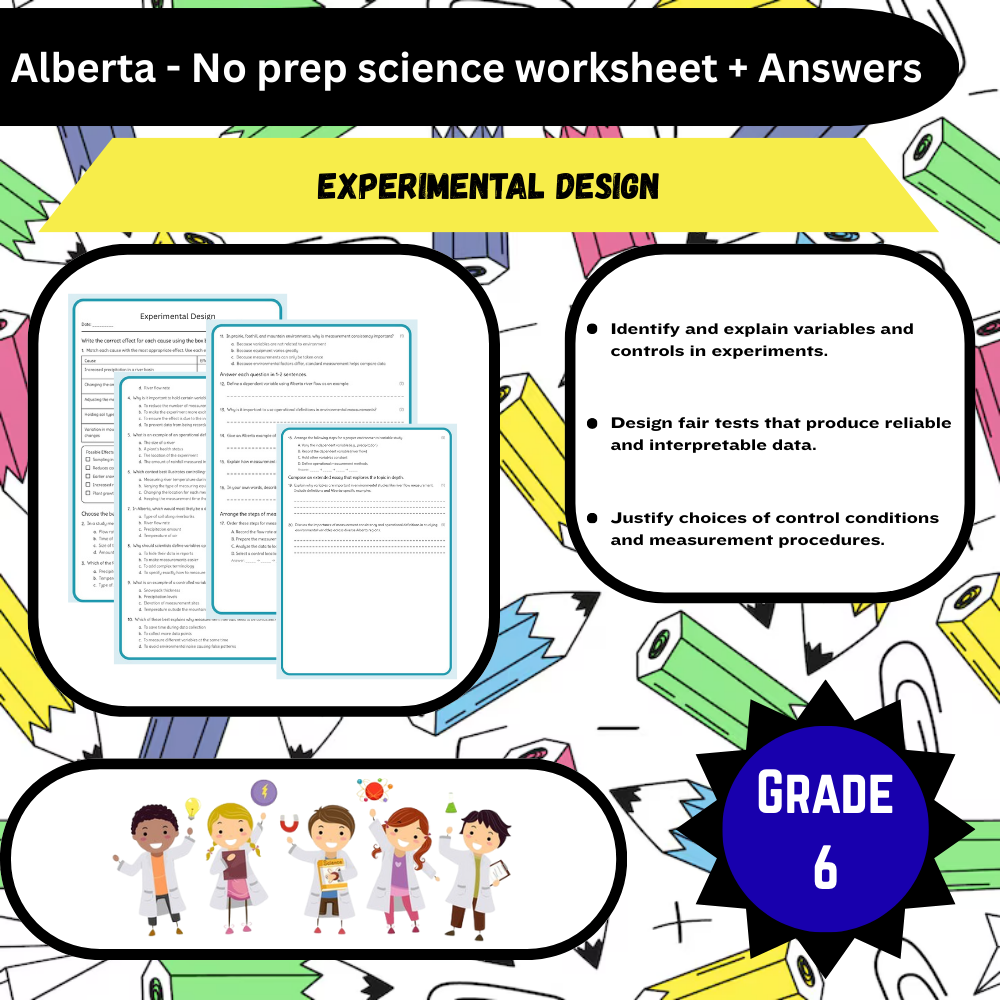
Grade 6 Science – Experimental Design Worksheet (Worksheet + Answer Key) | Alberta Standards
Created byBright Mind ResourcesLearning Objectives
- Identify and explain variables and controls in scientific experiments.
- Design fair tests that produce reliable and interpretable data.
- Justify choices of control conditions and measurement procedures.
Instant download

Body Organization Levels Learning Stations Activity | Grade 6 Science
 Created byElena Brooks
Learning Objectives
- Identify cells, tissues, organs, and body systems in examples
- Explain how cells combine to form tissues and organs
- Connect organs to the body systems they support
Instant download

Atmospheric Circulation and Global Wind Patterns Worksheets Grade 6
Created byElena BrooksLearning Objectives
- Explain how uneven heating leads to rising and sinking air in different regions.
- Describe how warm and cool air density differences drive large-scale wind patterns.
- Predict how circulation affects moisture transport and typical weather patterns over time.
Instant download

Measurement & Metric Units Worksheets and Review Practice for Grade 6 Science
 Created byEmma Carter Resources
Learning Objectives
- Identify common metric units for length, mass, volume, and temperature.
- Choose appropriate measuring tools for everyday measurement tasks.
- Compare and convert simple metric measurements accurately.
Instant download
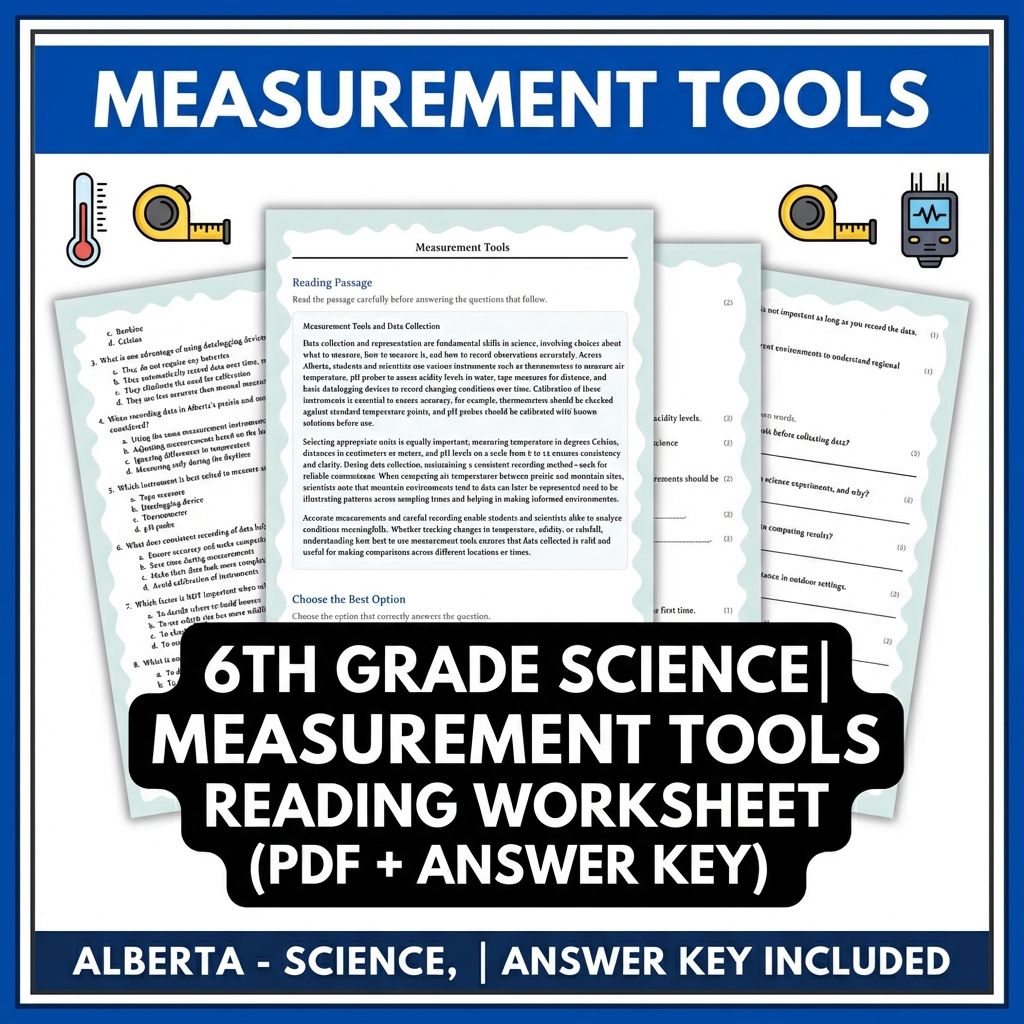
6th Grade Science | Measurement Tools Reading Worksheet (PDF + Answer Key)
JCreated byJ.S SheetsLearning Objectives
- Identify common measurement instruments such as thermometers, pH probes, and tape measures.
- Understand the importance of calibration and unit selection when collecting data.
- Learn how to record observations accurately for comparison and graphing purposes.
Also included in: Grade 6 Science Bundle – Data Analysis, Scientific Inquiry & Measurement Skills +1 more
Instant download
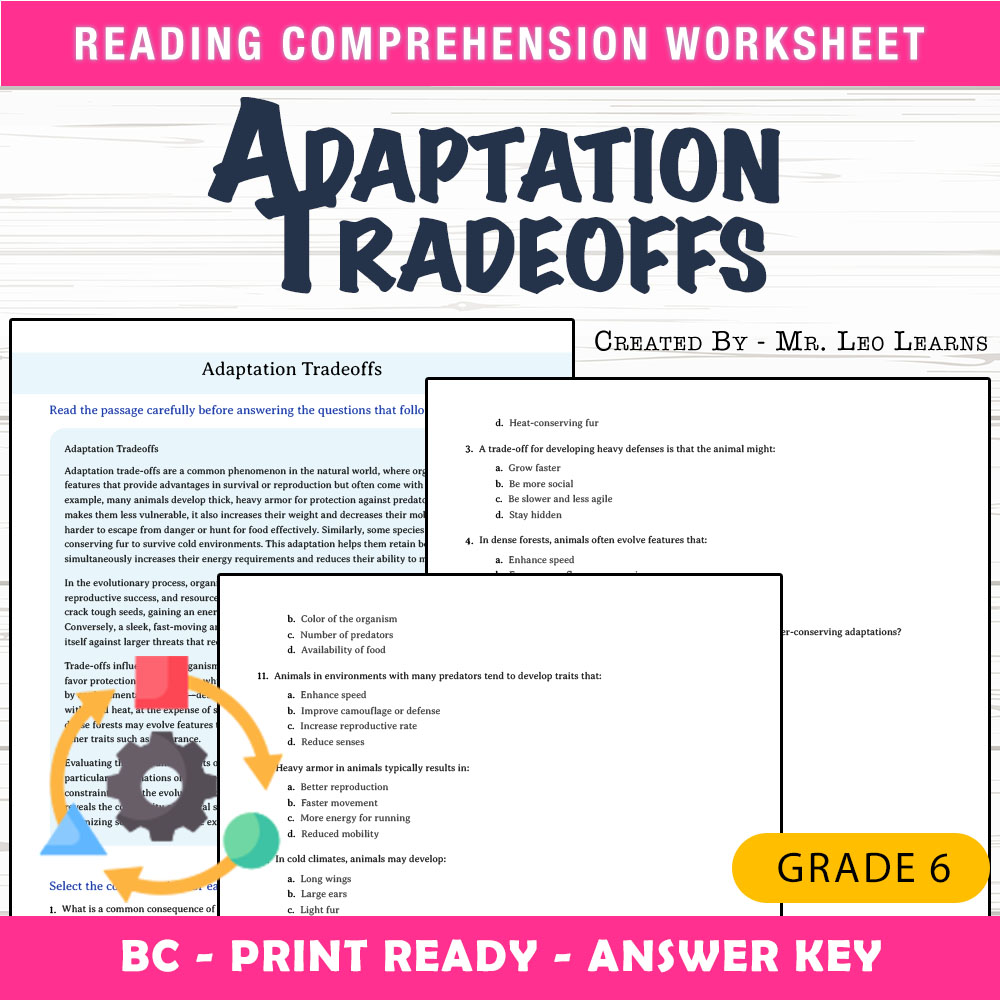
Grade 6 Science – Adaptation Tradeoffs MCQ Worksheet for Mastery
 Created byThe Resource Hub
Learning Objectives
- Understand the concept of adaptation trade-offs and how they influence survival strategies.
- Identify different examples of structural and physiological trade-offs in animals.
- Evaluate the costs and benefits associated with specific adaptations.
Also included in: Grade 6 Science Unit | Multicellular Systems & Functions Worksheet Bundle +1 more
Instant download
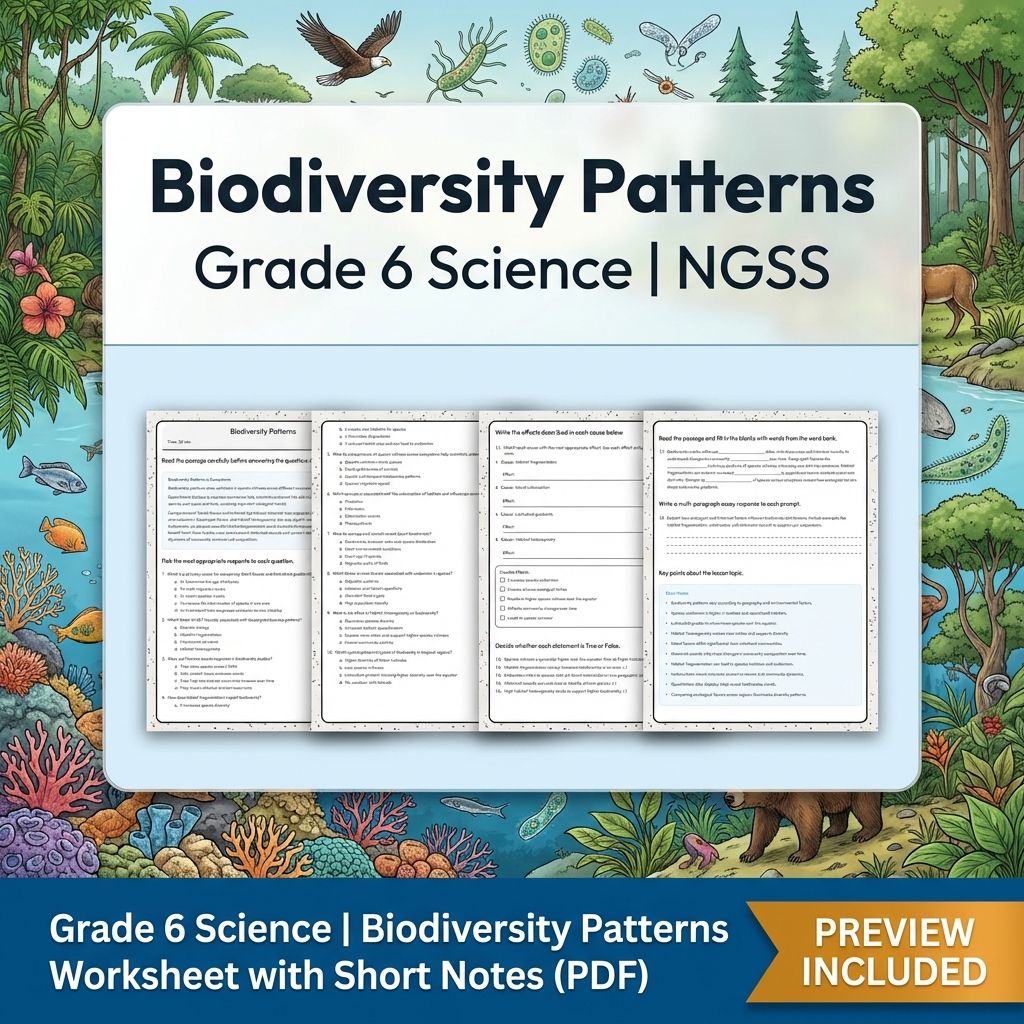
Grade 6 Science | Biodiversity Patterns Worksheet with Short Notes (PDF)
Created byMeadowlark WorksheetsLearning Objectives
- Understand how species occurrence and richness reveal biodiversity patterns across ecosystems
- Analyze spatial and temporal variations in biodiversity including island faunas and latitudinal gradients
- Interpret ecological and historical factors affecting community composition and diversity
Also included in: Grade 6 Science | Biological Evolution: Unity and Diversity Unit Bundle +1 more
Instant download

Community Stewardship Scientific Methods Worksheets Grade 6 Science
Created byPrism Point LearningLearning Objectives
- Explain respectful scientific methods for studying local environmental issues
- Identify consent and cultural sensitivity practices during community observations
- Describe methods for validating community-contributed environmental records
Instant download

Aerodynamic Forces and Steady Flight Worksheets | Grade 6 Science
Created byPrism Point LearningLearning Objectives
- Identify lift, drag, thrust, and weight as the four aerodynamic forces
- Explain how force direction and magnitude affect vehicle motion
- Describe force changes during aircraft climb, cruise, and descent
Also included in: Flight Lesson Bundle | Grade 6 Science | Ontario Framework
Instant download
About Grade 6 Science Worksheets
Explore Grade 6 Science worksheets for classwork, homework, or review. Our 5,969 printables download instantly as PDFs.
MyTeachingSheets worksheets are made by real teacher-authors and checked before they go live. Download any as a print-ready PDF for lessons, homework, or independent practice — most include answer keys, and previews are always free.