
Grade 6 Science Worksheets
5,969 worksheets
Aircraft Stability Modes and Geometry Worksheets | Grade 6 Science
 Created byPrism Point Learning
Learning Objectives
- Describe static and dynamic stability using aircraft behavior examples
- Explain how center of gravity affects pitch stability
- Relate aerodynamic centre position to aircraft pitch stability
Also included in: Flight Lesson Bundle | Grade 6 Science | Ontario Framework
Instant download

Drag Components and Lift-Induced Trade-Offs Worksheets | Grade 6
Created byPrism Point LearningLearning Objectives
- Categorize drag into parasitic and induced sources
- Explain how speed affects different components of drag
- Describe how shape influences aerodynamic drag
Also included in: Flight Lesson Bundle | Grade 6 Science | Ontario Framework
Instant download

Science Safety and Ethical Research Practices Worksheets Grade 6
Created byPrism Point LearningLearning Objectives
- Explain why scientists use risk assessment before investigations
- Identify ethical responsibilities in scientific research
- Describe how informed consent protects community data collection
Instant download

Invasive Species Impacts and Spread Worksheets | Grade 6 Science
Created byPrism Point LearningLearning Objectives
- Explain how invasive species become established in new ecosystems
- Describe how competition affects native species and food webs
- Identify indicators used to monitor invasive species ecosystem effects
Instant download

Air Composition, Density, Pressure & Temperature Worksheets Grade 6
 Created bySunny Desk Resources
Learning Objectives
- Describe how air composition, temperature, density, and pressure affect how air behaves.
- Explain why air pressure relates to collisions between gas molecules.
- Predict how temperature and altitude can change air density and pressure.
Also included in: Air and Aerodynamics Grade 6 Alberta Science Worksheets Bundle +1 more
Instant download

Angle of Attack and Stall Effects Worksheets | Grade 6 Science
Created bySunny Desk ResourcesLearning Objectives
- Explain how angle of attack affects lift and drag on a wing
- Describe what happens at the critical angle when airflow separates
- Use evidence from a text and apply it to a flight scenario
Also included in: Air and Aerodynamics Grade 6 Alberta Science Worksheets Bundle +1 more
Instant download

Solar Time and Civil Time Differences Grade 6 Science Worksheets
Created bySunny Desk ResourcesLearning Objectives
- Explain how apparent solar motion and solar noon are used in solar timekeeping
- Identify why solar time can differ from clock time using longitude, time zones, and the equation of time
- Describe how communities may adjust solar time for civil schedules
Also included in: Sky Science Grade 6 Bundle | Alberta Science Worksheets & Activities +1 more
Instant download

Measurement Tools & Data Collection Worksheets Grade 6 Science
Created bySunny Desk ResourcesLearning Objectives
- Identify common measurement tools and match them to the quantity they measure
- Explain why calibration and unit choice matter for accurate data collection
- Represent measurement observations clearly for comparison across sampling times
Also included in: Evidence & Investigation Grade 6 Science Worksheets | Alberta +1 more
Instant download

Aircraft Control Surfaces & Aerodynamic Moments Worksheets Grade 6
Created bySunny Desk ResourcesLearning Objectives
- Identify the functions of ailerons, elevators, and rudders as control surfaces.
- Explain how deflecting a control surface changes lift or airflow to create rolling, pitching, or yawing moments.
- Connect aircraft attitude changes to aerodynamic moments and airflow direction.
Also included in: Air and Aerodynamics Grade 6 Alberta Science Worksheets Bundle +1 more
Instant download

Air Density and Lift Worksheets: Factors Affecting Air Density Grade 6
Created bySunny Desk ResourcesLearning Objectives
- Explain how temperature, humidity, and altitude affect air density
- Describe how changes in air density can change buoyancy and lift
- Use vocabulary such as density, humidity, and altitude to interpret air-density situations
Also included in: Air and Aerodynamics Grade 6 Alberta Science Worksheets Bundle +1 more
Instant download
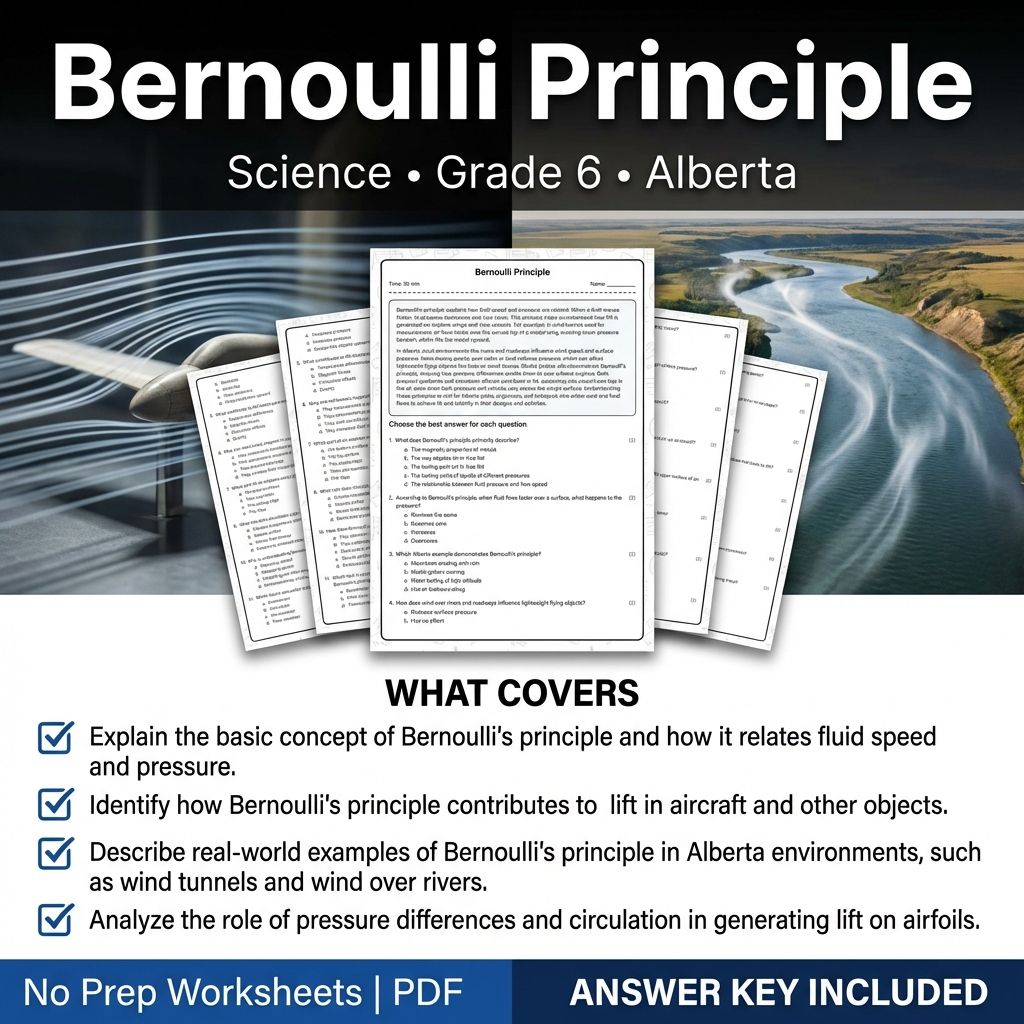
Grade 6 Science Worksheet Bernoulli Principle | Alberta Standards Practice
 Created byCoral Reef Learning
Learning Objectives
- Explain the basic concept of Bernoulli's principle and how it relates fluid speed and pressure.
- Identify how Bernoulli's principle contributes to lift in aircraft and other objects.
- Describe real-world examples of Bernoulli's principle in Alberta environments, such as wind tunnels and wind over rivers.
Instant download
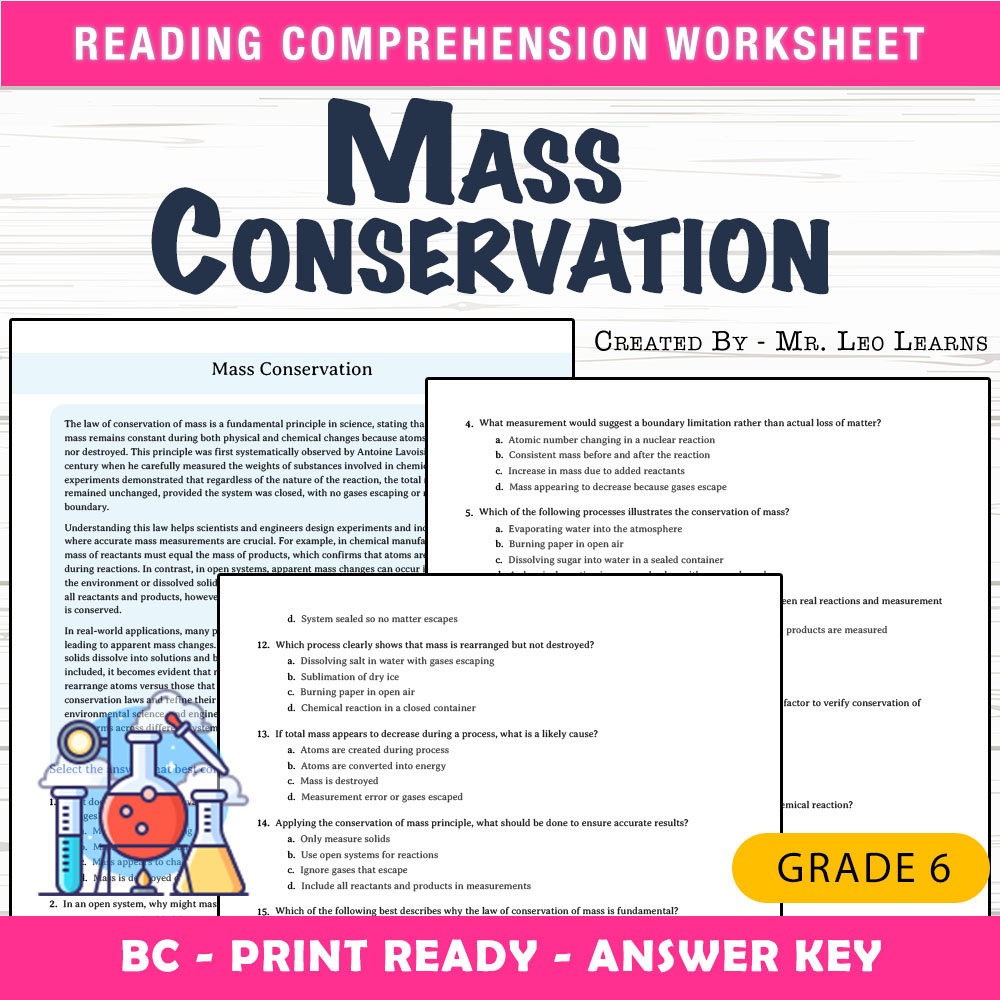
Grade 6 Science — Mass Conservation Worksheet for Mastery
 Created byThe Resource Hub
Learning Objectives
- Understand the principle of conservation of mass in closed systems.
- Identify examples of physical and chemical changes where mass is conserved or appears to change.
- Explain how boundary conditions affect measurements of mass.
Also included in: Grade 6 Science | Matter, Properties & Change Worksheet Bundle (BC Framework) +1 more
Instant download

Energy Transfer Worksheets and Review for Grade 6 Physical Science
LCreated byLearnora ResourcesLearning Objectives
- Identify energy sources and receivers in everyday systems
- Explain how energy transfers through collisions, waves, currents, and motion
- Trace energy through multi-step and branching systems
Instant download

Analyzing Patterns in Data Review Worksheets | Grade 6 Science
LCreated byLearnora ResourcesLearning Objectives
- Identify patterns and trends in numerical data tables
- Compare values and describe increases and decreases
- Complete patterns and determine rules from data
Instant download

Weather vs Climate Worksheets | Grade 6 Science Weather Patterns
LCreated byLearnora ResourcesLearning Objectives
- Classify observations as weather events or climate patterns
- Compare short-term weather observations with long-term climate patterns
- Interpret given numerical information about weather and climate
Instant download
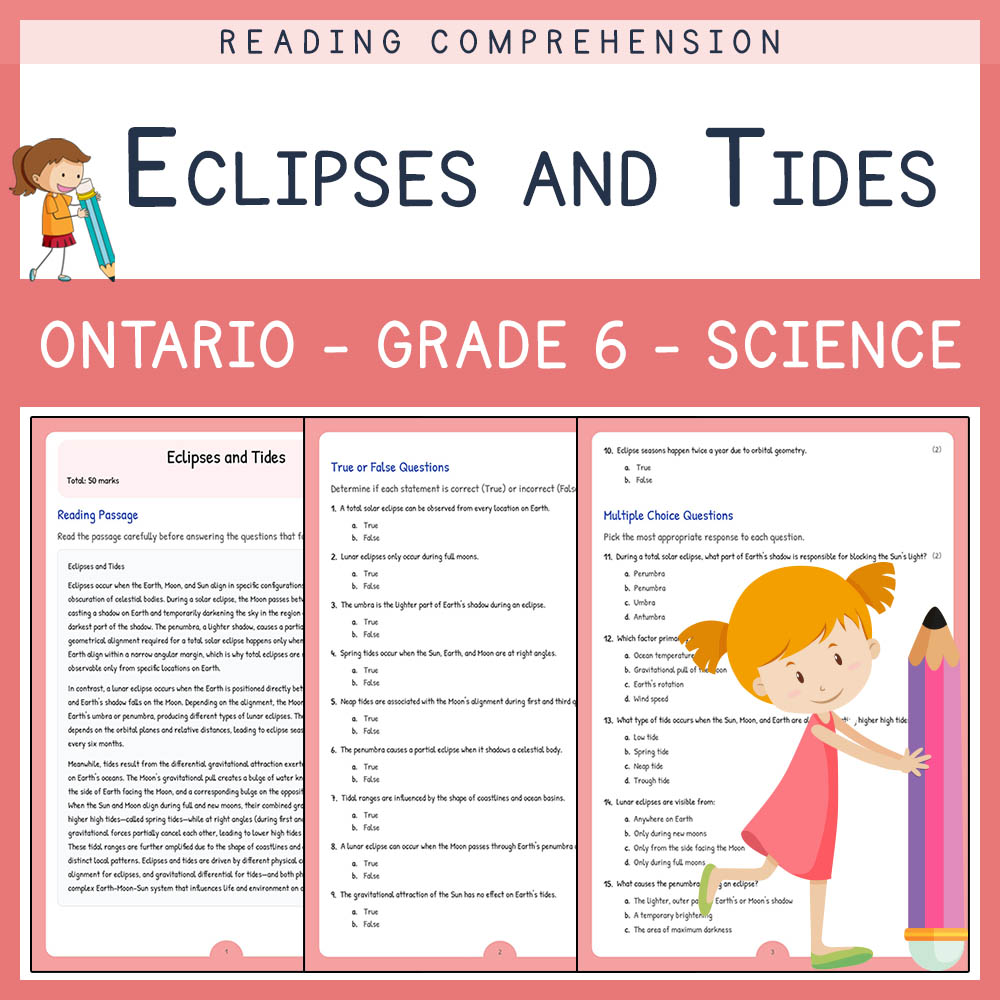
Grade 6 Science | Eclipses and Tides Worksheet (PDF + Answer Key) – Ontario Standards
 Created byLumora Learning
Learning Objectives
- Understand the geometric principles behind solar and lunar eclipses, including the concepts of umbra and penumbra.
- Explain how the alignment of the Earth, Moon, and Sun causes eclipse phenomena.
- Describe the gravitational forces of the Moon and Sun that cause oceanic tides, including spring and neap tides.
Also included in: Grade 6 | Space Science Lesson Bundle Worksheets | Ontario Framework
Instant download
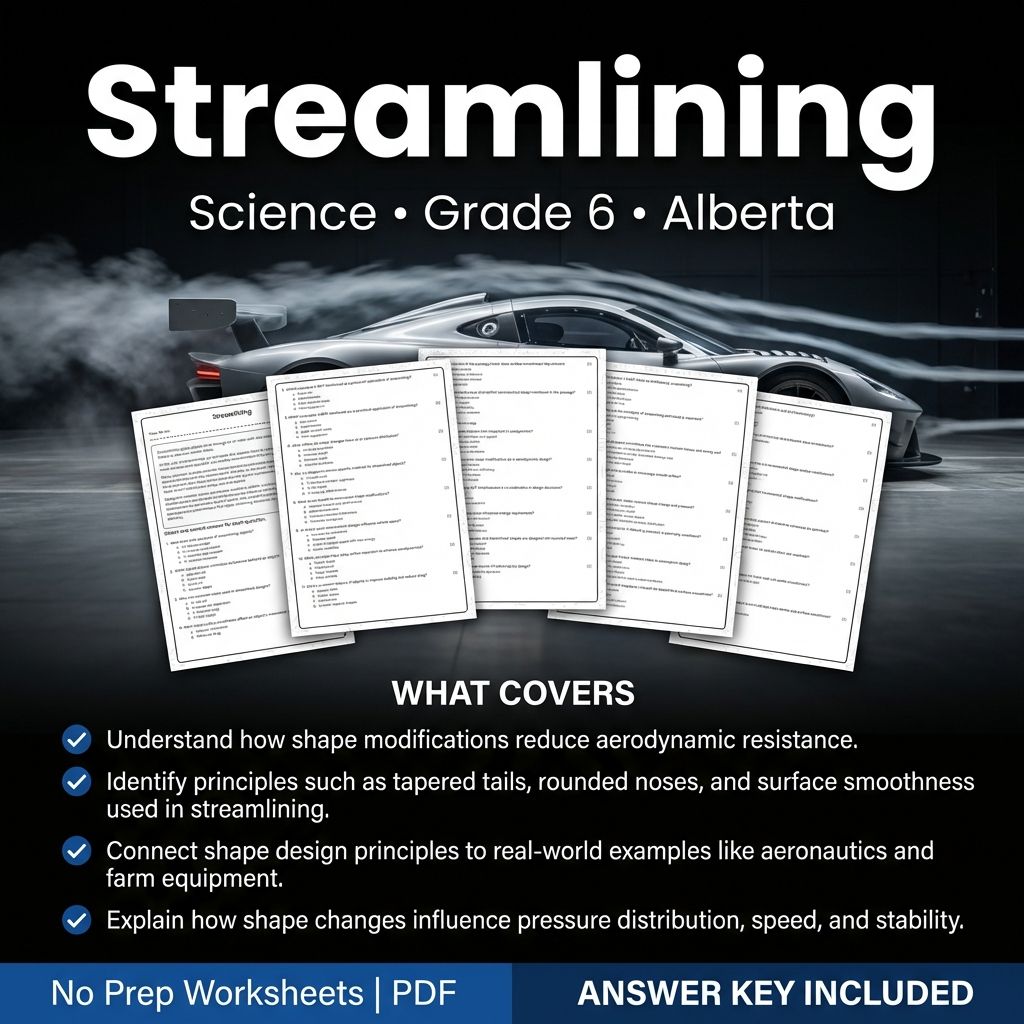
Grade 6 Science Worksheet on Streamlining | Alberta Standard Practice
Created byCoral Reef LearningLearning Objectives
- Understand how shape modifications reduce aerodynamic resistance.
- Identify principles such as tapered tails, rounded noses, and surface smoothness used in streamlining.
- Connect shape design principles to real-world examples like aeronautics and farm equipment.
Instant download

Uneven Distribution of Earth's Resources | MS-ESS3-1 Phenomenon Lesson + CER
 Created byLearn Nest
Learning Objectives
- Analyze five real U.S. resource sites and underline evidence clues.
- Infer patterns causing uneven resource distribution across the sites.
- Build a labeled cause-and-effect model linking location to processes.
Instant download

Grade 6 Natural Hazards Worksheet | NGSS Science Activity & Notes
 Created byAmber Owl Education
Learning Objectives
- Explain how tectonic, atmospheric, and hydrologic processes can produce different natural hazards.
- Analyze how evidence such as historical records, seismic/satellite data, and hazard maps helps estimate hazard intensity and impact.
- Evaluate cause-and-effect relationships to predict how and where hazards may affect communities and infrastructure.
Also included in: Grade 6 Science Sustainability and Natural Hazards Lesson Bundle | ngss +1 more
Instant download

Evidence Communication Worksheet | Standards-Aligned Grade 6 Science Practice
JCreated byJ.S SheetsLearning Objectives
- Understand how to interpret observed data and transform it into clear, evidence-supported claims.
- Learn methods for summarizing patterns using descriptive statistics and appropriate visuals.
- Identify suitable visual representations like bar, line, and scatter plots for Alberta environmental phenomena.
Instant download

Symbiotic Relations Assessment for Grade 6 Science – TEKS Standards
Created byPrism Point LearningLearning Objectives
- Understand different types of symbiotic relationships: mutualism, commensalism, and parasitism.
- Identify real-world examples of each symbiotic relationship.
- Explain how these relationships affect organism fitness and community structure.
Instant download

Grade 6 Crystal Structures Worksheet | BC Use Practice PDF
 Created byClear Sky Classroom
Learning Objectives
- Explain how particle arrangement in crystalline solids differs from amorphous solids
- Describe how bonding strength and packing affect mechanical properties and melting behavior
- Connect microscopic structure to macroscopic observations such as brittleness and cleavage
Instant download

Grade 6 Human Impacts Worksheet | NGSS Earth Science Activity & Answer Key
 Created byNorthstar Worksheets
Learning Objectives
- Explain how land-use change, fossil fuel combustion, agriculture, and waste management alter Earth systems.
- Describe how human activities can modify biogeochemical cycles and climate drivers.
- Use cause-and-effect reasoning to connect an activity to an environmental trend over time and space.
Also included in: Sustainability & Human Impacts Lesson Bundle | Grade 6 Science | NGSS +1 more
Instant download

Grade 6 Science – Series and Parallel Circuits Worksheet (PDF) | BC Standards
 Created byEvergreen Desk Education
Learning Objectives
- Explain how current and voltage behave in series circuits and in parallel circuits.
- Predict how changing connections (series vs. parallel) affects brightness of bulbs and operation of devices.
- Use circuit reasoning to identify what happens when a component breaks in a series circuit compared with a parallel circuit.
Instant download

Grade 6 Science – Energy From the Sun & Climate | Daily Reading Worksheet
 Created byBright Mind Resources
Learning Objectives
- Understand how the sun's energy reaches different parts of Earth
- Learn how solar energy influences temperature and weather patterns
- Explore the role of solar energy in atmospheric and ocean circulation
Also included in: Climate Grade 6 Science Daily Reading Worksheets Lesson Bundle | Florida NGSSS +1 more
Instant download

Grade 6 Science – Decomposition & Recycling | Daily Reading Worksheet
Created byBright Mind ResourcesLearning Objectives
- Understand the role of decomposers such as fungi and bacteria in breaking down dead organisms and waste.
- Explain how decomposition helps recycle nutrients in ecosystems.
- Recognize the process of decomposition as a vital part of ecosystem stability.
Also included in: Ecosystems Grade 6 Science Daily Reading Worksheets Lesson Bundle |Florida NGSSS +1 more
Instant download

Grade 6 Science Atom Conservation Worksheet | California Standards PDF
Created byEvergreen Desk EducationLearning Objectives
- Explain how atom conservation applies to chemical reactions as rearrangements of atoms.
- Use particle diagrams to show reactants and products and to check whether atoms are conserved.
- Predict and verify the identities of products based on which atoms are bonded together.
Instant download

Grade 6 Interdependence Roles Worksheet | NGSS Practice PDF
Created byClear Sky ClassroomLearning Objectives
- Explain how predator-prey relationships and competition affect population sizes in an ecosystem
- Describe mutualism and give examples of organisms that benefit from both sides
- Use cause-and-effect reasoning to predict how changes in one population can ripple through a community
Instant download

Stewardship Strategies Worksheet | Science Grade 6 Ontario Standard
 Created byCedar Grove Learning
Learning Objectives
- Explain how habitat restoration, protected-area design, and community monitoring support biodiversity
- Describe how trade-offs influence conservation decisions and why metrics matter
- Apply the ideas of assisted migration, invasive species removal, and adaptive management to real-world scenarios
Also included in: Grade 6 Biodiversity and Adaptations Science Lesson Bundle Ontario +1 more
Instant download

Grade 6 Science – Plant Matter Inputs & Photosynthesis | Daily Reading Worksheet
Created byBright Mind ResourcesLearning Objectives
- Understand how plants obtain matter from their environment
- Identify sources of carbon dioxide and water for plants
- Explain the process of gas exchange in leaves
Also included in: Grade 6 Ecosystems and Energy Science Lesson Bundle | California Standards +1 more
Instant download

Hydrologic Cycle Worksheet for Grade 6 Science | TEKS-Aligned Practice
JCreated byJ.S SheetsLearning Objectives
- Explain the major steps of the hydrologic cycle (evaporation, condensation, precipitation, runoff, infiltration, and groundwater discharge).
- Describe how watersheds and aquifers affect regional water availability.
- Connect hydrologic processes to water quantity, soil/landscape changes, and water quality monitoring.
Instant download

Grade 6 Combined Circuits Worksheet | Electricity Practice & Assessment
Created byClear Sky ClassroomLearning Objectives
- Explain how series and parallel behaviors combine in mixed (series-parallel) circuits.
- Predict how current and voltage distribute in combined circuit paths.
- Diagnose changes in brightness or readings when one component is removed or fails.
Instant download

Grade 6 Science | Sound Properties Worksheet | BC-Aligned
Created byLumora LearningLearning Objectives
- Understand the nature of sound as a mechanical wave and how it transmits energy.
- Identify how frequency and amplitude affect pitch and loudness of sound.
- Explain the factors influencing the speed of sound in different media and conditions.
Also included in: Grade 6 Science | Energy, Waves & Circuits | Custom Bundle | BC Aligned
Instant download

Scientific Models Assessment for Grade 6 | Florida NGSSS Science
Created byPrism Point LearningLearning Objectives
- Explain why scientists use models to represent systems that are too large, too small, or too complex to study directly.
- Describe how effective scientific models connect observable features to underlying ideas and clarify what the model can and cannot represent.
- Use evidence from measurements to compare model outputs to real data and identify limitations.
Also included in: Grade 6 Scientific Assessment Science Lesson Bundle – Florida NGSSS
Instant download

Adaptation Patterns Worksheet | Grade 6 Science Activities
Created byPrism Point LearningLearning Objectives
- Identify how morphological, physiological, and behavioral adaptations help organisms survive and reproduce in specific environments.
- Explain how inherited traits can improve resource use, predator avoidance, and successful reproduction based on environmental conditions.
- Distinguish adaptation from statements about an organism’s origin by focusing on the match between traits and the environment.
Also included in: Grade 6 Ecosystem Interactions Science Lesson Bundle Worksheets | TEKS +1 more
Instant download

Grade 6 Science – Variables & Science Concepts | Daily Reading Worksheet
Created byBright Mind ResourcesLearning Objectives
- Define and identify independent, dependent, and controlled variables.
- Explain the role of variables in scientific experiments.
- Apply knowledge of variables to real-world Alberta-focused examples.
Also included in: Grade 6 Science Data & Inquiry Daily Reading Worksheets Lesson Bundle | Alberta +2 more
Instant download

Grade 6 Science | Digestive System Worksheet | BC Standards
Created byLumora LearningLearning Objectives
- Understand the organs involved in the digestive process and their functions.
- Describe how enzymes and acids chemically digest food into absorbable nutrients.
- Explain how nutrients cross epithelial surfaces into blood and lymph for distribution.
Instant download

Drag Components Practice Worksheet | Grade 6 Science Assessment
Created byPrism Point LearningLearning Objectives
- Categorize drag into parasitic and induced sources
- Explain how speed and shape affect parasitic drag components
- Describe why induced drag is connected to lift production and wing span
Also included in: Grade 6 Aerodynamics Flight Design Science lesson bundle - Ontario
Instant download

Grade 6 Science | Conservation Principle Worksheet | BC Standard
Created byLumora LearningLearning Objectives
- Understand the concept of energy conservation within a closed system.
- Identify different energy forms involved in physical systems.
- Explain how energy transforms and transfers during phenomena like collisions, reactions, and circuits.
Also included in: Grade 6 Science | Energy, Waves & Circuits | Custom Bundle | BC Aligned
Instant download

Pressure Maps Worksheet Grade 6 Science | Airfoil Lift & Aerodynamics
 Created byChalk and Compass
Learning Objectives
- Explain how surface pressure changes around an airfoil relate to lift and pitching moments
- Identify the role of stagnation points and suction peaks in pressure maps
- Describe how pressure minima shift with camber and angle of attack
Also included in: Grade 6 Science Aviation Unit Aerodynamics & Flight Testing Lesson Bundle +1 more
Instant download

Grade 6 Science – Insulating Materials & Electrical Safety | Reading Worksheet
Created byBright Mind ResourcesLearning Objectives
- Define what insulators are and describe their basic properties.
- Identify common insulating materials such as rubber, glass, and dry wood.
- Explain how insulators prevent electrical charges from flowing.
Also included in: Grade 6 Electricity Science Daily Reading Lesson Bundle | Ontario +1 more
Instant download

Grade 6 Physical Changes Worksheet PDF | California Science Standards
Created byEvergreen Desk EducationLearning Objectives
- Explain how physical changes alter a substance’s form or state without changing the basic atomic composition.
- Identify examples of physical changes (melting, freezing, tearing, dissolving) and describe what happens to particles and properties.
- Use evidence (reversibility, state changes, and particle behavior) to distinguish physical changes from chemical changes.
Instant download

6th Grade Science | Nervous System Worksheet (PDF) BC Standards
Created byEvergreen Desk EducationLearning Objectives
- Explain how neurons transmit information as electrical impulses and communicate at synapses using neurotransmitters.
- Describe how integration centers interpret sensory input and produce motor output to control muscles and glands.
- Compare nervous regulation with endocrine signaling in coordinating short-term and long-term body responses.
Instant download

Tools Safety Worksheet | Grade 6 Science Activities
Created byPrism Point LearningLearning Objectives
- Select and handle measurement tools safely by following proper PPE, storage, and cleaning practices.
- Explain why calibration checks and battery management help prevent inaccurate data and equipment damage.
- Use contamination-prevention protocols when working near wetlands or river edges.
Instant download

Grade 6 Science – Testable Predictions & Scientific Inquiry | Reading Worksheet
Created byBright Mind ResourcesLearning Objectives
- Define what a testable prediction is in scientific research.
- Explain the relationship between evidence, models, and predictions.
- Identify elements of a testable prediction from examples.
Also included in: Scientific Inquiry Grade 6 Science Daily Reading Worksheets Bundle | FL NGSSS +1 more
Instant download

Grade 6 Forest Biodiversity & Protected Areas Worksheet | Alberta Science
 Created byBRIGHT PATH RESOURCES
Learning Objectives
- Explain what a protected area is and how it helps conserve forest biodiversity.
- Identify key details about habitat, ecosystem services, and species at risk.
- Use information from a reading passage to answer questions accurately.
Also included in: Forest Ecosystem Adaptations Grade 6 Science Worksheets Lesson Bundle | Alberta +1 more
Instant download

Grade 6 Science | Structural Traits in Animals - Daily Reading Comprehension
Created byCoral Reef LearningLearning Objectives
- Identify different structural adaptations animals have for protection
- Understand how body parts assist in survival
- Recognize examples of adaptations like shells, webbed feet, and camouflage
Instant download

Grade 6 Science | Energy Transfer in Science - Daily Reading Comprehension
Created byCoral Reef LearningLearning Objectives
- Understand the concept of thermal energy transfer
- Identify conduction as a method of heat transfer
- Recognize examples of conduction, convection, and radiation
Instant download
About Grade 6 Science Worksheets
Explore Grade 6 Science worksheets for classwork, homework, or review. Our 5,969 printables download instantly as PDFs.
MyTeachingSheets worksheets are made by real teacher-authors and checked before they go live. Download any as a print-ready PDF for lessons, homework, or independent practice — most include answer keys, and previews are always free.