
Grade 8 Science Worksheets
6,006 worksheets
Lever Mechanics Practice Worksheet | Grade 8 Science Assessment Ontario
 Created byPrism Point Learning
Learning Objectives
- Identify and distinguish first-, second-, and third-class levers based on the positions of the fulcrum, input force (effort), and output force (load).
- Calculate mechanical advantage using the distances from the fulcrum and relate it to input/output forces.
- Explain trade-offs between force amplification and range of motion, including real-world limits such as friction and structural deformation.
Also included in: Grade 8 Work, Energy & Forces Science Lesson Bundle – Ontario Test Prep
Instant download

Hydraulic Force Transmission and Pascal’s Principle Worksheets | Grade 8
Created byPrism Point LearningLearning Objectives
- Explain how Pascal’s principle transmits pressure through confined fluids
- Calculate output force changes from differences in piston areas
- Predict pressure changes when input piston area changes
Also included in: Systems in Action Lesson Bundle | Grade 8 Science | Ontario Framework +1 more
Instant download
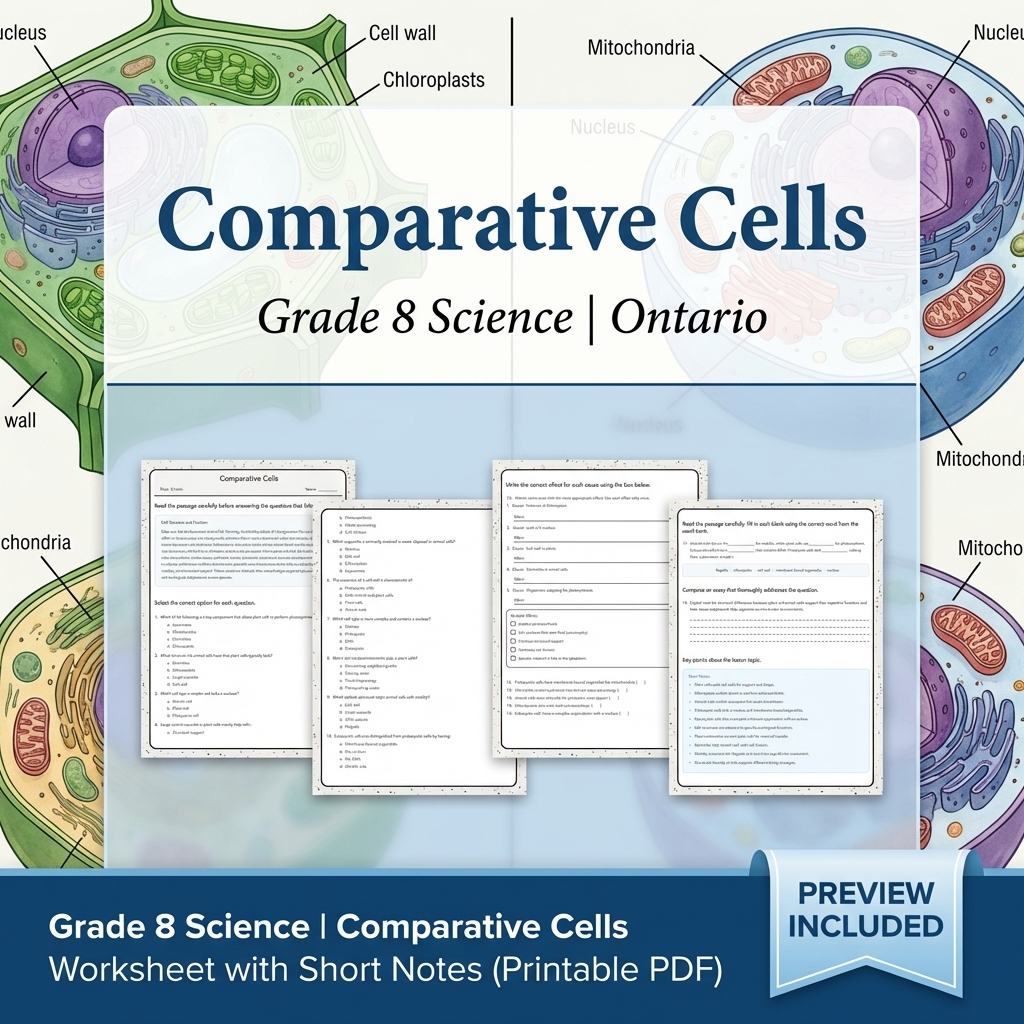
Grade 8 Science | Comparative Cells Worksheet with Short Notes (Printable PDF)
 Created byMeadowlark Worksheets
Learning Objectives
- Describe the key differences between plant and animal cells.
- Identify the functions of cellular components like cell walls, chloroplasts, and lysosomes.
- Compare prokaryotic and eukaryotic cells in terms of organization.
Also included in: Grade 8 Science Lesson Group Bundle | Ontario Curriculum Worksheets +1 more
Instant download
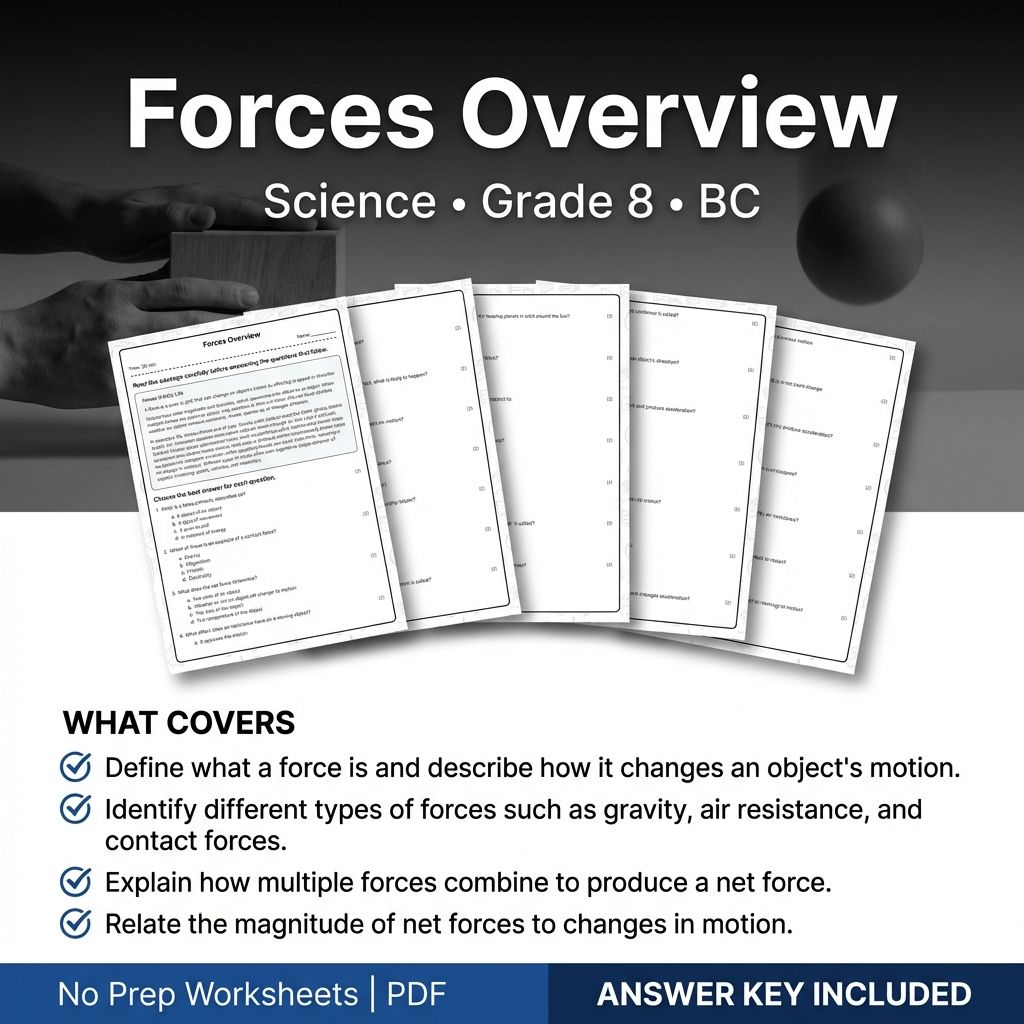
8th Grade Science | Forces Overview Worksheet & Answer Key (PDF)
 Created byCoral Reef Learning
Learning Objectives
- Define what a force is and describe how it changes an object's motion.
- Identify different types of forces such as gravity, air resistance, and contact forces.
- Explain how multiple forces combine to produce a net force.
Instant download

Grade 8 Science | Comparative Cells Worksheet (Ontario Standards) (PDF)
 Created byEvergreen Desk Education
Learning Objectives
- Compare plant and animal cell structures and explain how those structures support different functions
- Identify key differences between prokaryotic and eukaryotic cell organization and relate them to metabolism and complexity
- Explain how major organelles (cell wall, chloroplasts, vacuole, plasmodesmata, centrioles, lysosomes) affect cellular roles in living systems
Also included in: Grade 8 Cell Structure & Homeostasis Science Lesson Bundle (Ontario) +1 more
Instant download

Grade 8 Population Growth Patterns Worksheet | Alberta Science Ecology
 Created byBRIGHT PATH RESOURCES
Learning Objectives
- Explain how population growth depends on birth rates and death rates
- Identify cause-and-effect in descriptions of population change
- Describe why exponential growth cannot continue forever
Also included in: Grade 8 Alberta Science Interactions and Ecosystems Worksheet Bundle +1 more
Instant download

Molecular Structure Worksheets: Molecules & Ionic Lattices Grade 8
 Created byTeachers Club
Learning Objectives
- Represent simple molecules using element symbols and molecular formulas.
- Interpret subscripts to determine atom counts within molecular units.
- Compare discrete molecular units with extended ionic lattices.
Also included in: Grade 8 Science Worksheets | NGSS Matter & Interactions Bundle +2 more
Instant download

Grade 8 Momentum Collisions Worksheet | NGSS Practice PDF
 Created byClear Sky Classroom
Learning Objectives
- Understand the principles of momentum exchange during collisions.
- Differentiate between elastic and inelastic collisions based on energy conservation.
- Apply the concept of impulse to analyze velocity changes in colliding objects.
Also included in: Grade 8 Forces and Electric Magnetism Science Lesson Bundle NGSS Worksheet B +1 more
Instant download

Grade 8 Science – Adaptation Mechanisms & Animal Survival | Reading Worksheet
 Created byBright Mind Resources
Learning Objectives
- Understand what structural adaptations are and identify examples in animals.
- Describe how physical features help animals survive in their environments.
- Differentiate between structural, behavioral, and physiological adaptations.
Also included in: Grade 8 Ecosystems & Cells Science Daily Reading Lesson Bundle | TEKS +2 more
Instant download

Grade 8 Constant Speed Worksheet | BC Practice & PDF
Created byClear Sky ClassroomLearning Objectives
- Describe constant speed as equal distances covered in equal successive time intervals
- Interpret distance-time graphs to identify constant speed and changes in speed
- Use the relationship distance = speed × time to solve problems involving constant speed
Instant download

Grade 8 Science Worksheet – Bernoulli Principle (Ontario) (PDF)
Created byEvergreen Desk EducationLearning Objectives
- Explain Bernoulli’s principle using the relationship between fluid speed and pressure in streamlined, incompressible flow.
- Use the continuity idea and Bernoulli’s equation qualitatively to predict how pressure changes as flow speed changes.
- Apply Bernoulli’s principle to real situations such as Venturi tubes and airplane wing lift.
Also included in: Grade 8 Fluid Pressure & Forces Science Lesson Bundle: Ontario Worksheet Set +1 more
Instant download

Grade 8 Friction & Sliding Contact Worksheet | Alberta Science Forces
Created byBRIGHT PATH RESOURCESLearning Objectives
- Distinguish between static and kinetic friction
- Explain how surface texture, normal force, and material pairing affect friction
- Describe how friction opposes relative motion and leads to heat and wear
Also included in: Grade 8 Alberta Science Forces and Motion Physics Worksheet Bundle +1 more
Instant download

Phase Transitions Worksheet | Grade 8 Science – Alberta Standards
JCreated byJ.S SheetsLearning Objectives
- Explain the process of phase transitions between solid, liquid, and gas states.
- Identify examples of phase changes in natural and urban environments.
- Describe how energy exchange and pressure influence phase changes.
Also included in: Grade 8 Matter and Chemical Change Science Lesson Bundle – Alberta Framework +1 more
Instant download

Organ Systems Worksheets for Grade 8 Life Science
Created byBRIGHT PATH RESOURCESLearning Objectives
- Explain how organ systems help organisms obtain nutrients, exchange gases, balance water, and move materials
- Identify key structures in major organ systems and match them to their functions
- Use evidence from scenarios to predict how changes in organ systems affect survival
Also included in: Grade 8 Life Science Bundle | Homeostasis, Genetics & Ecosystems +2 more
Instant download

Homeostasis Through Interacting Body Systems Science Worksheets Grade 8
Created byTeachers ClubLearning Objectives
- Describe how five body systems contribute to homeostasis
- Explain how feedback mechanisms maintain stable internal conditions
- Trace insulin–glucagon signaling as a homeostatic feedback process
Also included in: Grade 8 Science Worksheets | NGSS Cells & Body Systems Bundle +2 more
Instant download

Grade 8 Measurement Practices Worksheet | NGSS Practice PDF
Created byClear Sky ClassroomLearning Objectives
- Use appropriate tools and units to measure quantities in science accurately.
- Distinguish accuracy and precision and explain how procedures affect measurement quality.
- Record measurements with consistent significant figures and methods.
Instant download

Grade 8 Science | Friction Effects & Mechanical Systems - Daily Reading Practice
Created byCoral Reef LearningLearning Objectives
- Understand the difference between static and kinetic friction.
- Identify factors that influence frictional force.
- Analyze how surface texture and normal force affect friction.
Instant download

Grade 8 Science | Atomic Structure - Daily Reading Comprehension
Created byCoral Reef LearningLearning Objectives
- Understand the basic components of an atom: protons, neutrons, and electrons.
- Distinguish between elements and compounds based on atomic structure.
- Identify the organization of the periodic table and its significance.
Instant download

Grade 8 Pressure And Temperature Worksheet | Practice & PDF
Created byClear Sky ClassroomLearning Objectives
- Explain how particle motion relates to gas temperature and pressure
- Describe how higher temperature affects collision frequency and force in a container
- Use particle ideas to interpret real-world temperature and pressure observations
Instant download

Stored Energy Worksheet NGSS G8 Science Assessment
 Created byCedar Grove Learning
Learning Objectives
- Explain energy stored by the arrangement of objects interacting at a distance, including gravitational, elastic potential energy, and magnetic interactions.
- Describe how changes in relative positions affect stored energy in systems like compressed springs, elevated masses, and magnets.
- Relate potential energy magnitude to system variables such as height, spring compression, and magnetic distance, and discuss energy conversion when configurations change.
Instant download

Grade 8 Science – Modeling Data & Scientific Models | Daily Reading Worksheet
Created byBright Mind ResourcesLearning Objectives
- Understand the purpose of physical and computational models in science.
- Identify various types of models such as scale models and simulations.
- Recognize the limitations and sources of measurement uncertainty in models.
Also included in: Grade 8 Tradeoff Analysis Science Daily Reading Worksheets Lesson Bundle | NGSS +1 more
Instant download

Grade 8 Science – Conservation Applications Mass in Closed Systems | Worksheet
Created byBright Mind ResourcesLearning Objectives
- Understand the concept of conservation of mass in closed systems.
- Identify the differences between open and closed systems in chemical reactions.
- Apply the principles of mass conservation to real-world chemical scenarios.
Also included in: Grade 8 Chemical Reactions Science Lesson Bundle: Daily Reading | BC +1 more
Instant download

Grade 8 Consumers Hierarchy Worksheet | Alberta Practice PDF
Created byClear Sky ClassroomLearning Objectives
- Explain how trophic positions (herbivores, omnivores, carnivores) determine feeding relationships in food chains and food webs.
- Describe how energy transfer patterns and feeding modes affect how organisms respond to environmental change.
- Use examples from Alberta (bison, songbirds, wolves) to classify consumers by trophic level.
Instant download

Grade 8 Science – Evolutionary Patterns Daily Reading Worksheet | TEKS Aligned
Created byBright Mind ResourcesLearning Objectives
- Identify sources of genetic variation in species
- Understand how variation influences natural selection
- Examine evidence for evolution such as fossil records and comparative anatomy
Also included in: Grade 8 Ecosystems & Cells Science Daily Reading Lesson Bundle | TEKS +2 more
Instant download

Grade 8 Conservation of Mass Worksheet | Closed Systems Alberta Science
Created byBRIGHT PATH RESOURCESLearning Objectives
- Explain the idea of a closed system and what counts as the system boundary.
- Identify key details about conservation of mass during physical and chemical changes.
- Use conservation of mass to reason about total mass before and after a change in a sealed setup.
Also included in: Grade 8 Alberta Science Matter and Chemical Change Worksheet Bundle +1 more
Instant download

Grade 8 Science | Electromagnetic Induction - Daily Reading Comprehension
Created byCoral Reef LearningLearning Objectives
- Understand the concept of magnetic fields and how they are visualized.
- Identify sources of magnetic fields and their properties.
- Describe how changing magnetic flux induces an electromotive force.
Also included in: Electricity and Magnetism Lesson Bundle – Grade 8 Science Alberta +1 more
Instant download

Particle Theory Worksheet | Grade 8 Science Activities
Created byPrism Point LearningLearning Objectives
- Explain particle theory using the ideas that matter is made of discrete particles and that particles have motion.
- Relate particle arrangement and motion to observable properties such as rigidity, flow, and compressibility.
- Use examples (like frozen rivers and prairie fog) to describe how temperature affects particle motion and state changes.
Also included in: Grade 8 Matter & Chemical Change Lesson Bundle | Alberta Science
Instant download

Natural Hazards Recurrence & Risk Analysis Worksheets Grade 8 Science
Created byTeachers ClubLearning Objectives
- Interpret earthquake and volcanic eruption history data
- Estimate recurrence intervals from natural hazard records
- Explain hazard risk using faults, tsunami records, and monitoring
Also included in: Earth's Systems - Grade 8 Bundle +2 more
Instant download

Net Force and Motion Changes Worksheet Grade 8 Science
Created byBRIGHT PATH RESOURCESLearning Objectives
- Explain how net force is determined when multiple forces act in different directions.
- Predict how balanced and unbalanced forces affect an object’s acceleration and motion.
- Use weight and friction as examples of forces that can change an object’s motion.
Also included in: Grade 8 Chemical Reactions & Conservation of Matter Bundle | Science +2 more
Instant download

Grade 8 Homogeneous Mixtures Worksheet | Alberta Practice PDF
Created byClear Sky ClassroomLearning Objectives
- Differentiate homogeneous mixtures from heterogeneous mixtures using macroscopic observations
- Explain how solubility and concentration affect the composition of a solution
- Apply the idea of uniform composition to sampling and environmental impact decisions
Instant download

Grade 8 Weathering And Erosion Worksheet | NGSS Practice PDF
Created byClear Sky ClassroomLearning Objectives
- Explain how physical and chemical weathering change rocks at Earth’s surface
- Describe how erosion transports material by wind, moving water, ice, and gravity
- Connect deposition and lithification to the formation of new sedimentary rock
Instant download
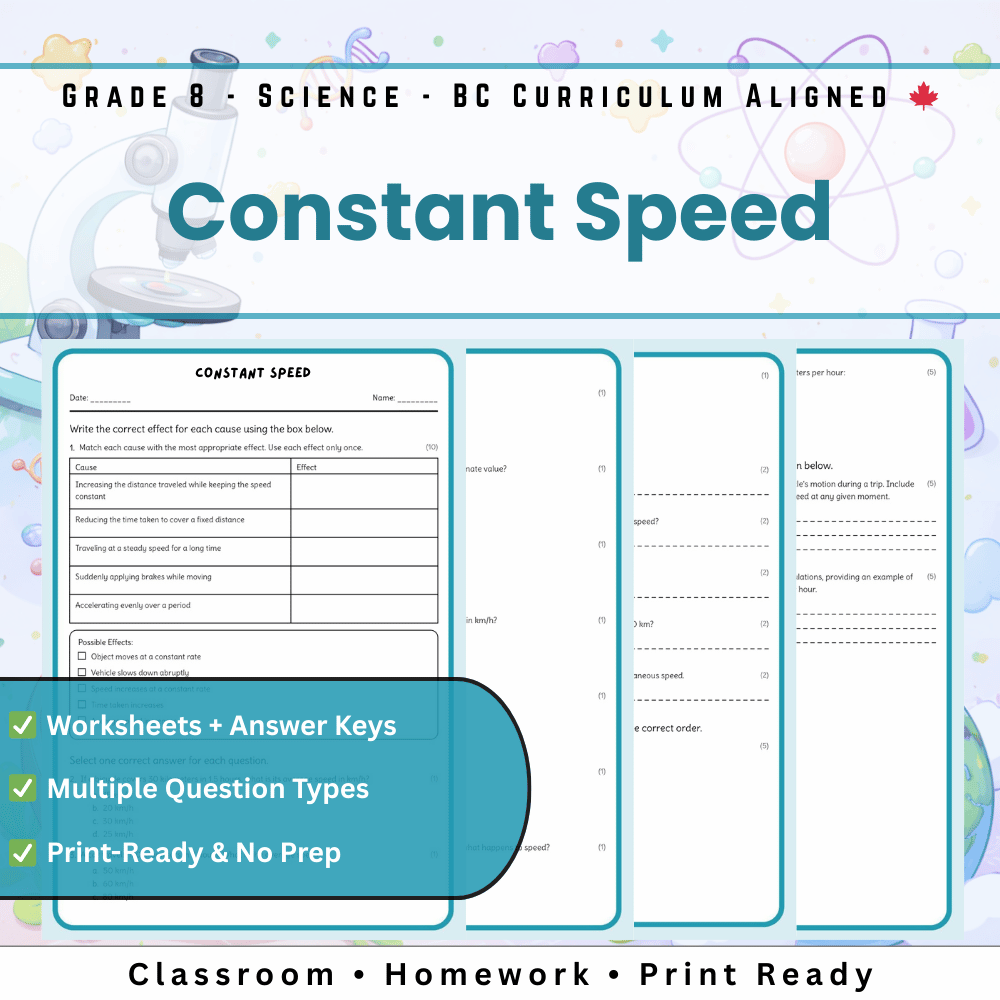
Grade 8 Science | Constant Speed Worksheet (PDF) – BC Standards & Practice
Created byBright Mind ResourcesLearning Objectives
- Define and explain constant speed and its graphical representation.
- Calculate distance, speed, and time relationships during uniform motion.
- Identify practical examples of constant speed in everyday life.
Instant download

Grade 8 Rate Factors Worksheet | BC Practice & PDF
Created byClear Sky ClassroomLearning Objectives
- Explain how temperature, concentration, and surface area affect reaction rate using the particle-collision model
- Describe the role of catalysts in changing reaction rate without being used up
- Connect macroscopic changes (what you measure) to microscopic particle behavior (collisions and rearrangements)
Instant download
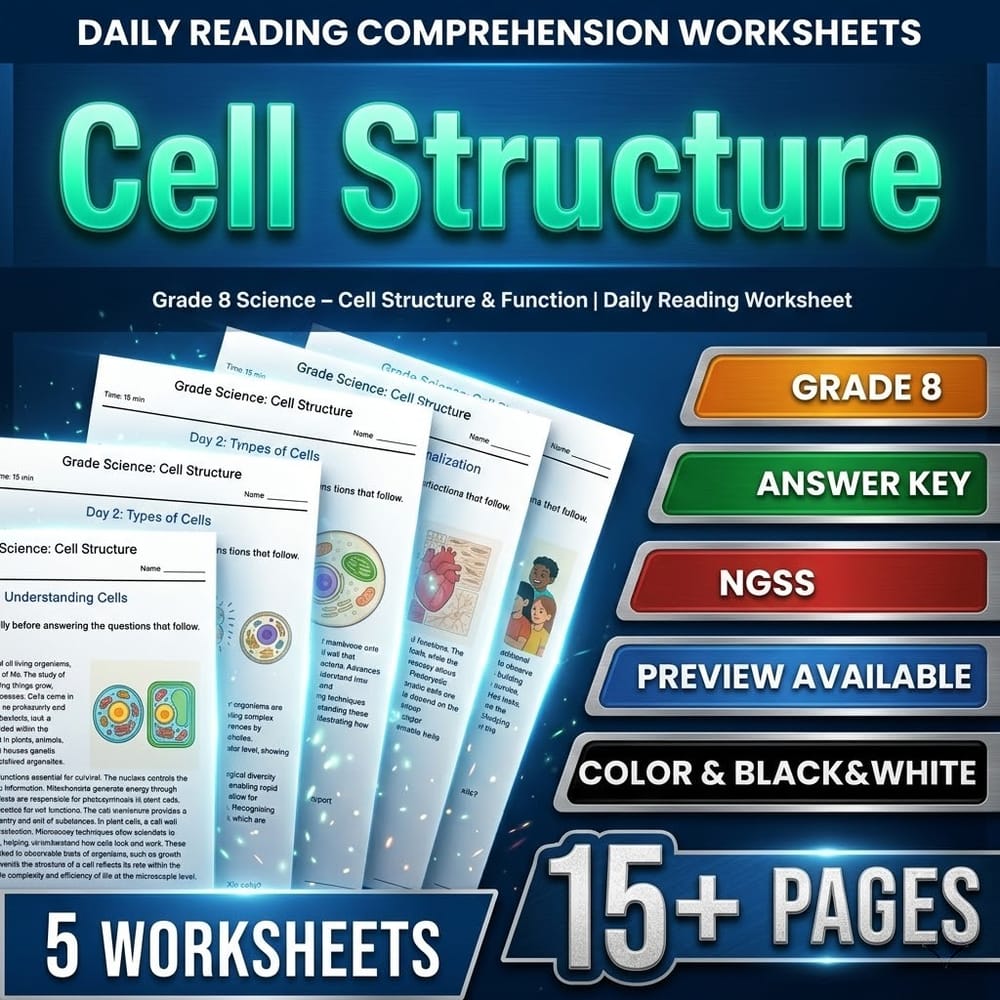
Grade 8 Science – Cell Structure & Function | Daily Reading Worksheet
 Created byElena Brooks
Learning Objectives
- Understand the basic features and functions of cell organelles
- Compare prokaryotic and eukaryotic cells
- Distinguish between single-celled and multicellular organisms
Instant download

Constant Speed Worksheet | Grade 8 Science Activities
Created byPrism Point LearningLearning Objectives
- Explain what constant speed means using distance-time graphs and proportional reasoning.
- Interpret changes in slope on a distance-time graph as changes in speed and acceleration.
- Calculate distance using speed and time, and compare average speed in non-uniform motion.
Also included in: Forces, Motion & Energy Lesson Bundle | Grade 8 Science | BC +1 more
Instant download
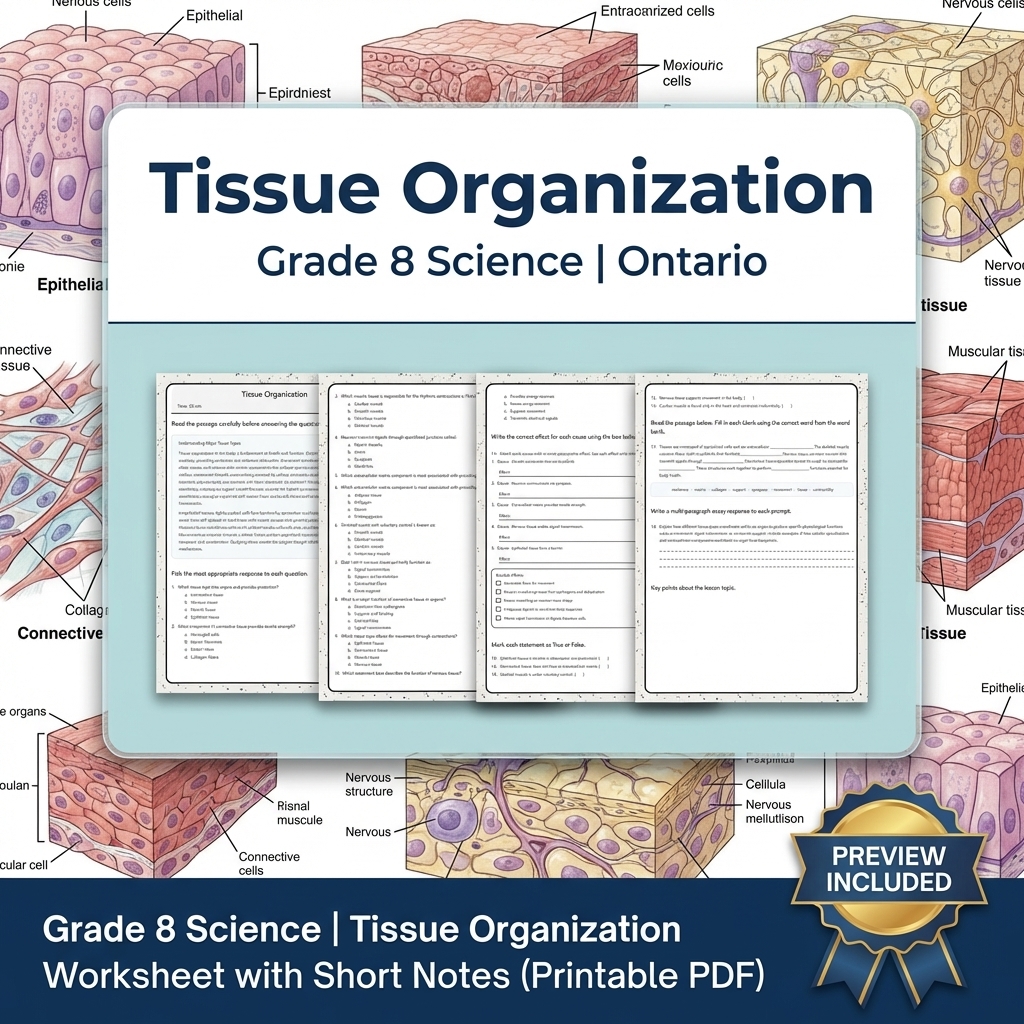
Grade 8 Science | Tissue Organization Worksheet with Short Notes (Printable PDF)
Created byMeadowlark WorksheetsLearning Objectives
- Describe the major tissue types and their cellular and extracellular components.
- Explain the structural-functional relationships in epithelial, connective, muscle, and nervous tissues.
- Understand how tissue organization contributes to organ functions such as transport, movement, and signal transmission.
Also included in: Grade 8 Science Lesson Group Bundle | Ontario Curriculum Worksheets +1 more
Instant download
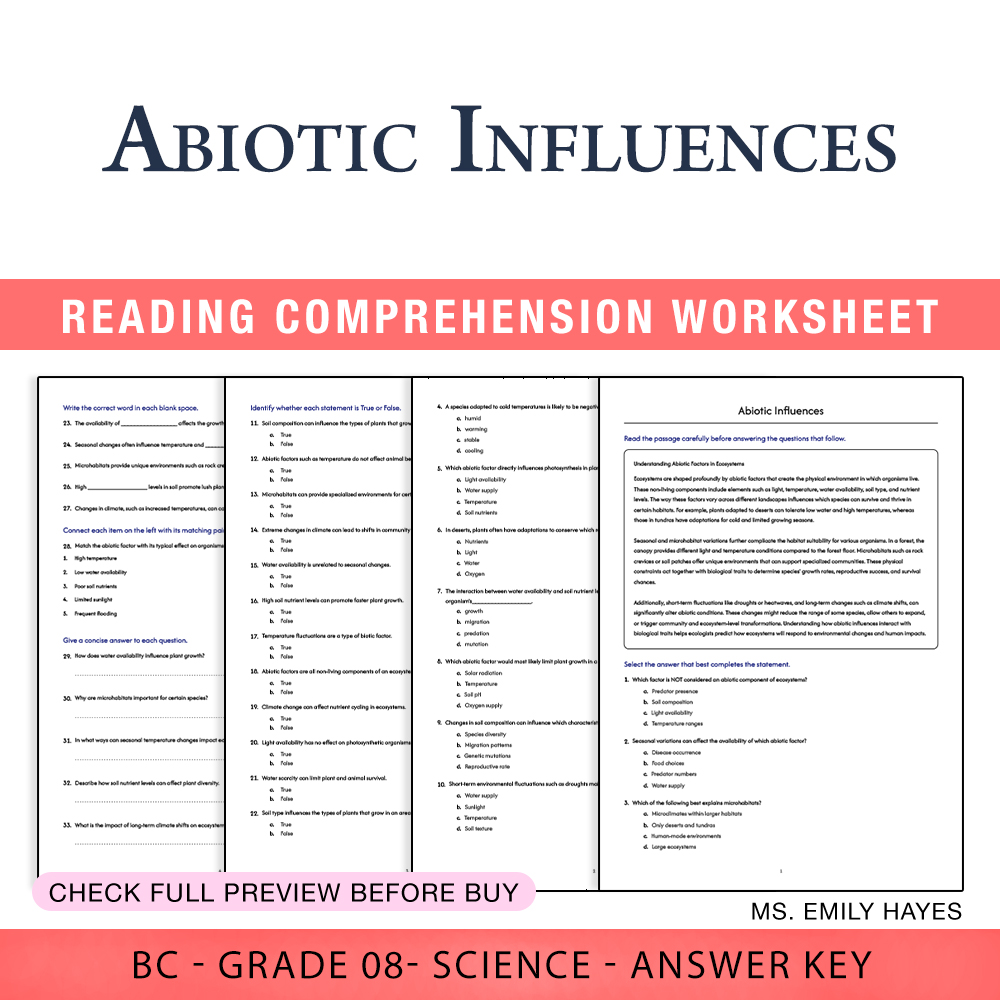
8th Grade Science | Abiotic Influences Worksheet (PDF+ Answer Key)
 Created byCopper Leaf Classroom
Learning Objectives
- Understand how abiotic factors influence the distribution and performance of species in various environments.
- Analyze the effects of abiotic variations such as temperature, water, and soil on ecosystems.
- Evaluate how changes in abiotic conditions can impact community composition and ecosystem functions.
Also included in: Grade 8 Science– Ecology, Biodiversity & Environmental Impact (PDF + Answer Key) +1 more
Instant download

Grade 8 Science – Reaction Types in Chemistry | Daily Reading Worksheet
Created byBright Mind ResourcesLearning Objectives
- Understand key concepts related to Science
- Apply knowledge through practice questions
- Demonstrate comprehension of the material
Also included in: Grade 8 Chemical Reactions Science Lesson Bundle: Daily Reading | BC +1 more
Instant download

Grade 8 Food Web Pathways Worksheet | Energy Flow & Ecosystems
Created byEvergreen Desk EducationLearning Objectives
- Explain how energy moves through a food web using multiple feeding relationships.
- Describe direct and indirect effects when one population changes in an ecosystem.
- Use food-web pathway thinking to predict possible outcomes at different trophic levels.
Instant download

Grade 8 Science – Inquiry Models Worksheet (TEKS) (PDF)
Created byEvergreen Desk EducationLearning Objectives
- Compare hypothesis-driven, descriptive, and correlational inquiry models and identify what each model is meant to explain or predict.
- Describe how boundary conditions, underlying assumptions, and limitations affect what a scientific model can claim.
- Use empirical evidence to iteratively refine a model and justify testable predictions using conceptual and mathematical representations.
Instant download

Grade 8 Science | Organ Systems Worksheet | BC Standards
 Created byLumora Learning
Learning Objectives
- Understand the structure and function of various organ systems in the human body.
- Explain how organs work together within systems to maintain internal stability.
- Identify the main organs involved in the respiratory, circulatory, and other key systems.
Also included in: Grade 8 Science | Cell Organization & Systems Custom Bundle | BC Aligned
Instant download

Grade 8 Science | Force Diagrams Worksheet (TEKS) PDF
Created byEvergreen Desk EducationLearning Objectives
- Represent forces using free-body diagrams, including normal, gravitational, frictional, and tension forces with correct vector directions.
- Decompose forces on inclined planes into components and use them to determine net force.
- Explain how static friction differs from kinetic friction and how friction affects motion outcomes.
Instant download
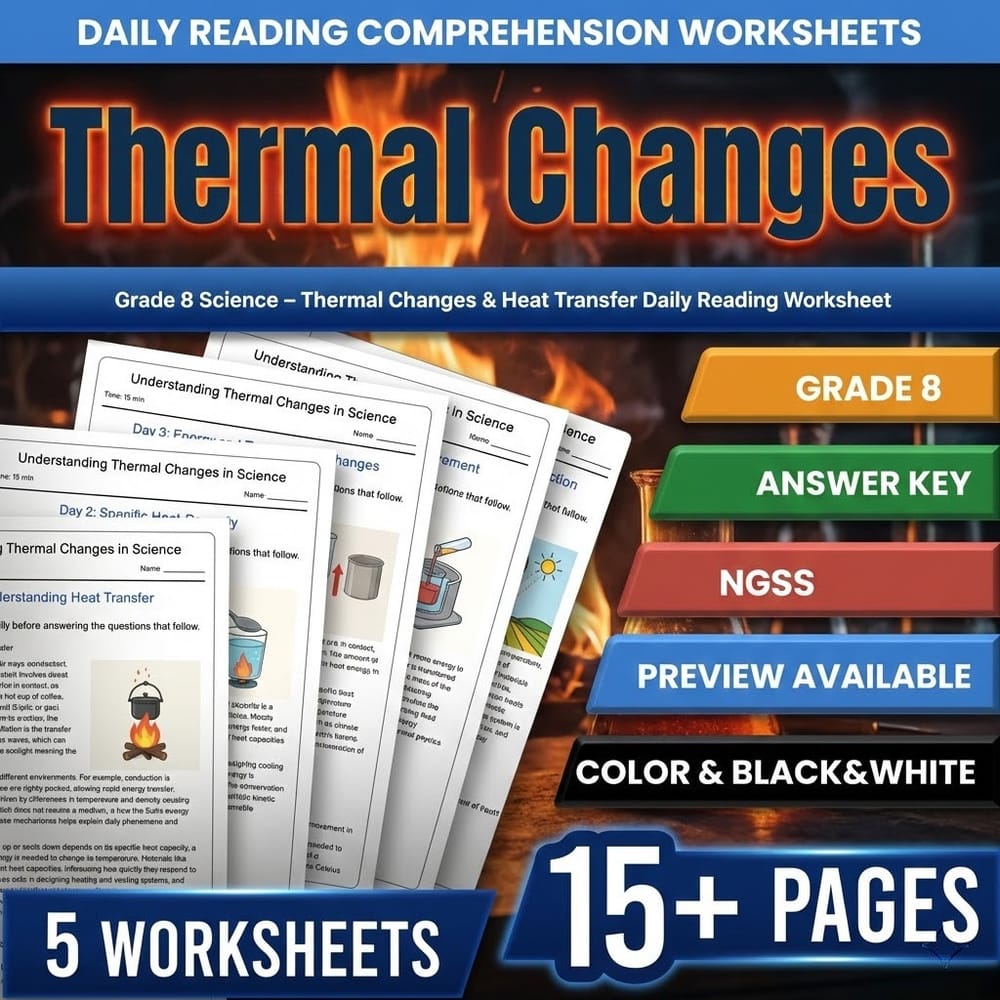
Grade 8 Science – Thermal Changes & Heat Transfer Daily Reading Worksheet
Created byElena BrooksLearning Objectives
- Explain how heat is transferred through conduction, convection, and radiation.
- Understand the concept of specific heat capacity and how it affects temperature change.
- Relate microscopic particle motion to macroscopic temperature measurements.
Instant download

Grade 8 Science | Forces & Motion - Daily Reading Comprehension
Created byCoral Reef LearningLearning Objectives
- Understand the concept of forces as push or pull interactions
- Identify different types of forces, such as push and pull
- Learn how forces affect the motion of objects
Instant download

Climate Drivers Worksheet | NGSS Grade 8 Science Climate Change Activity
 Created byAmber Owl Education
Learning Objectives
- Evaluate evidence for changes in global temperature over time using both modern observations and paleoclimate records
- Explain how greenhouse gas concentrations, volcanic aerosols, solar variability, and climate feedbacks act as climate drivers
- Distinguish natural drivers from human (anthropogenic) influences by interpreting lines of evidence and model comparisons
Also included in: Grade 8 Science Environmental Monitoring & Climate Drivers Lesson Bundle | NGSS +1 more
Instant download

Science Worksheet Ecosystem Matter Cycling - Grade 8 Practice & Assessment
JCreated byJ.S SheetsLearning Objectives
- Explain how matter cycles between living and nonliving parts of an ecosystem
- Describe how decomposition, gas exchange, and soil nutrient transformation return elements to the environment
- Trace how producers and consumers transfer the same atoms through multiple generations
Also included in: Grade 8 Biology Systems & Ecosystem Adaptations Science Lesson Bundle – General +1 more
Instant download

Grade 8 Science | Experimental Design Worksheet (PDF) aligned to TEKS
Created byEvergreen Desk EducationLearning Objectives
- Formulate a testable hypothesis and identify independent and dependent variables in an experiment.
- Write operational definitions and choose measurable criteria for collecting reliable data.
- Design controls, replication, and measurement methods to reduce confounding factors and improve reproducibility.
Instant download

Grade 8 Science – Resource Sustainability & Resources | Daily Reading Worksheet
Created byBright Mind ResourcesLearning Objectives
- Understand the differences between renewable and nonrenewable resources.
- Identify various resource types and their environmental impacts.
- Learn the importance of sustainable resource use.
Also included in: Grade 8 Earth Science Daily Reading Worksheets Lesson Bundle | Florida NGSSS +1 more
Instant download
About Grade 8 Science Worksheets
Explore Grade 8 Science worksheets for classwork, homework, or review. Our 6,006 printables download instantly as PDFs.
Each resource here is built by an independent educator and reviewed for quality. Worksheets print straight from PDF and suit classroom use, homework, or extra practice; most come with answer keys, and you can preview before purchasing.