
Grade 8 Science Worksheets
6,006 worksheets
Grade 8 Science – Pressure & Temperature in Gases | Daily Reading Worksheet
 Created byBright Mind Resources
Learning Objectives
- Understand how gas particles move and collide.
- Explain the relationship between particle motion, pressure, and temperature.
- Describe how temperature affects the speed of gas particles.
Also included in: Reaction Evidence & Matter Grade 8 Science Lesson Bundle | General Framework +1 more
Instant download

Grade 8 Inherited Traits Worksheet | Genetics, DNA & Heredity PDF
 Created byEvergreen Desk Education
Learning Objectives
- Explain how genes and alleles influence traits passed from parents to offspring
- Differentiate between dominant and recessive alleles using simple inheritance patterns
- Describe how variation in traits within a population supports the role of inherited factors
Instant download

Grade 8 Force Diagrams Worksheet | Free Body Diagrams | Ontario Science
 Created byChalk and Compass
Learning Objectives
- Draw and interpret free-body (force) diagrams for objects acted on by contact and non-contact forces.
- Identify and label forces such as normal force, friction, tension, and gravity on a diagram.
- Use net force reasoning to connect balanced forces to constant velocity and unbalanced forces to acceleration.
Also included in: Grade 8 Science Mechanical Systems Lesson Bundle | Ontario +1 more
Instant download

Grade 8 Science Worksheet | Braking Distance & Stopping Power (PDF)
Created byEvergreen Desk EducationLearning Objectives
- Explain how reaction time and braking time combine to determine stopping distance.
- Describe how tire-road friction affects decelerating force and stopping distance in different road conditions.
- Compare how unbalanced forces and brake fade can increase the distance needed to stop.
Instant download
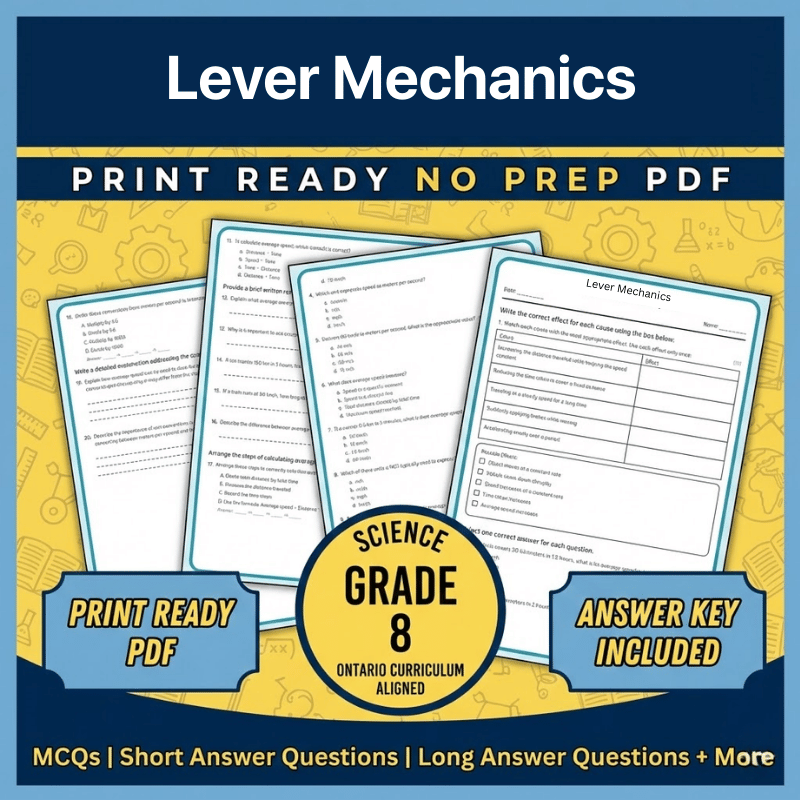
Grade 8 Science | Lever Mechanics Worksheet (Ontario) – Science 1 (PDF)
Created byBright Mind ResourcesLearning Objectives
- Identify and differentiate between the three classes of levers based on fulcrum, input, and output forces.
- Calculate the mechanical advantage for first-, second-, and third-class levers using distances from the fulcrum.
- Understand trade-offs between force amplification and range of motion in lever systems.
Instant download

Grade 8 Science – Energy Forms & Transfer | Daily Reading Worksheet
Created byBright Mind ResourcesLearning Objectives
- Identify and describe different forms of energy including kinetic and gravitational potential energy.
- Recognize everyday examples of energy transformations.
- Understand basic principles of energy conservation in simple systems.
Also included in: Grade 8 Energy & Motion Science Daily Reading Worksheets Lesson Bundle | TEKS +2 more
Instant download

Grade 8 Science | Biogeochemical Cycling Worksheet | California Standards
 Created byLumora Learning
Learning Objectives
- Explain how matter cycles within and between ecosystems through living organisms and the physical environment.
- Describe the water cycle processes of evaporation, condensation, and precipitation and how they connect to nutrient movement.
- Trace how carbon and nitrogen move through air, soil, organisms, and water using decomposition and producer uptake.
Instant download
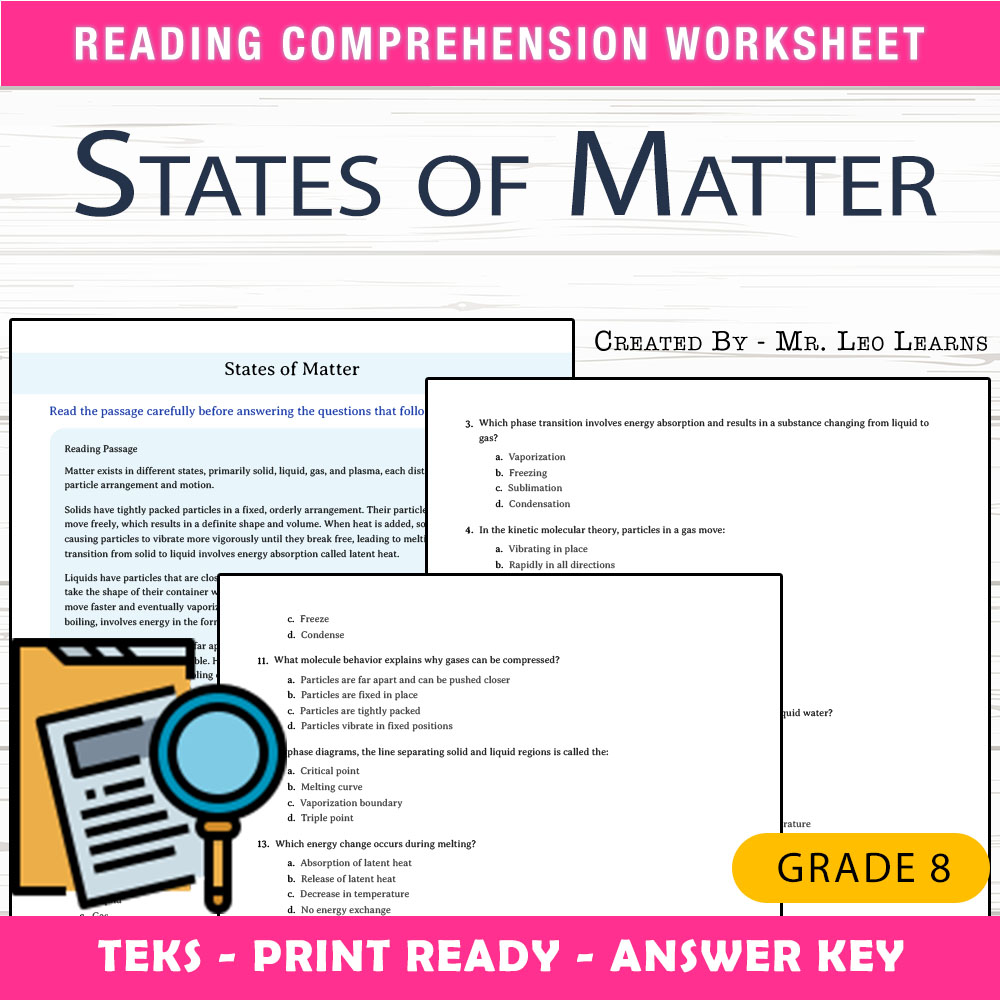
Grade 8 Science – States of Matter Worksheet for Mastering Particle Behavior
 Created byThe Resource Hub
Learning Objectives
- Describe the main characteristics of solid, liquid, gas, and plasma states of matter.
- Explain the kinetic molecular theory as it relates to phase changes.
- Identify energy changes associated with phase transitions such as melting, boiling, condensation, and sublimation.
Also included in: Grade 8 Science Unit Bundle – Matter, Reaction Rates & Energy Mastery Worksheets +1 more
Instant download

Grade 8 Science | Design Problem Framing Worksheet | California Standards
Created byLumora LearningLearning Objectives
- Explain how engineering design problem framing connects a real-world need to a measurable goal
- Identify constraints and requirements that limit solutions in an engineering challenge
- Use framed criteria to compare different solution approaches fairly
Instant download

Grade 8 Science – Pulley Systems & Mechanical Advantage | Daily Worksheet
 Created byQuiet Forest Education
Learning Objectives
- Identify different types of pulleys used in mechanical systems
- Explain the basic functions of fixed, movable, and compound pulleys
- Describe how pulleys reduce effort in lifting objects
Also included in: Energy Grade 8 Science Daily Reading Worksheets Bundle | Ontario Framework +1 more
Instant download

Grade 8 Science | Buoyant Force Worksheet (Ontario Standards) (PDF)
Created byEvergreen Desk EducationLearning Objectives
- Explain Archimedes principle and how buoyant force depends on displaced fluid.
- Compare apparent weight in air versus apparent weight when an object is submerged.
- Use density relationships to predict whether objects float, sink, or remain neutrally buoyant.
Also included in: Grade 8 Fluid Pressure & Forces Science Lesson Bundle: Ontario Worksheet Set +1 more
Instant download

Grade 8 Science | States of Matter - Daily Reading Comprehension
 Created byCoral Reef Learning
Learning Objectives
- Understand key concepts related to Science
- Apply knowledge through practice questions
- Demonstrate comprehension of the material
Instant download

Nervous Coordination Worksheet | Grade 8 Science Practice
 Created byPrism Point Learning
Learning Objectives
- Explain how neurons convert stimuli into electrical signals and transmit them through axons.
- Describe how myelination and synaptic vesicles improve the speed and reliability of neural signaling.
- Connect neuron networks to reflexes, voluntary movement, and gland secretion.
Also included in: Grade 8 Science Full-Year Bundle | BC Science Framework
Instant download

Population Growth Worksheet for Grade 8 Science | Standards-Aligned Practice
JCreated byJ.S SheetsLearning Objectives
- Understand factors influencing population change such as birth rates, death rates, immigration, and emigration.
- Identify patterns of population increase, stability, or decline.
- Explain how reproductive strategies, age structure, and resource availability affect growth rates.
Instant download

Grade 8 Science | Graphing Relationships - Daily Reading Comprehension
Created byCoral Reef LearningLearning Objectives
- Understand how to read and interpret line graphs
- Identify trends and patterns in data visualizations
- Learn the importance of proper labeling and scaling on graphs
Instant download

Population Growth & Consumption Earth System Change Worksheets Grade 8
 Created byTeachers Club
Learning Objectives
- Identify patterns in greenhouse gas emissions and land-cover change
- Interpret data related to nutrient runoff and Earth system change
- Explain how population growth can alter Earth systems over time
Also included in: Earth and Human Activity Grade 8 Science NGSS Worksheets Bundle +2 more
Instant download

Hydraulic Systems Practice Worksheet | Grade 8 Science Review Assessment
Created byPrism Point LearningLearning Objectives
- Explain how hydraulic systems transmit force through confined fluids using pressure and piston area
- Calculate or reason about mechanical advantage using force-area relationships
- Evaluate design constraints that affect hydraulic performance, including viscosity, seals, leakage, and compressibility
Instant download

Atmospheric & Ocean Circulation Worksheets | Grade 8 Science
Created byTeachers ClubLearning Objectives
- Describe how unequal solar heating drives atmospheric circulation cells
- Explain how the Coriolis effect changes global wind directions
- Compare how ocean circulation transports heat between regions
Also included in: Earth's Systems - Grade 8 Bundle +2 more
Instant download

Conservation Analysis Assessment | TEKS Grade 8 Science Worksheet
Created byPrism Point LearningLearning Objectives
- Understand the principle of mass conservation in closed chemical systems.
- Analyze the relationships between reactants and products in chemical reactions.
- Differentiate between open and closed systems in the context of matter conservation.
Also included in: Grade 8 Matter, Energy, and Reactions Science Lesson Bundle (TEKS)
Instant download
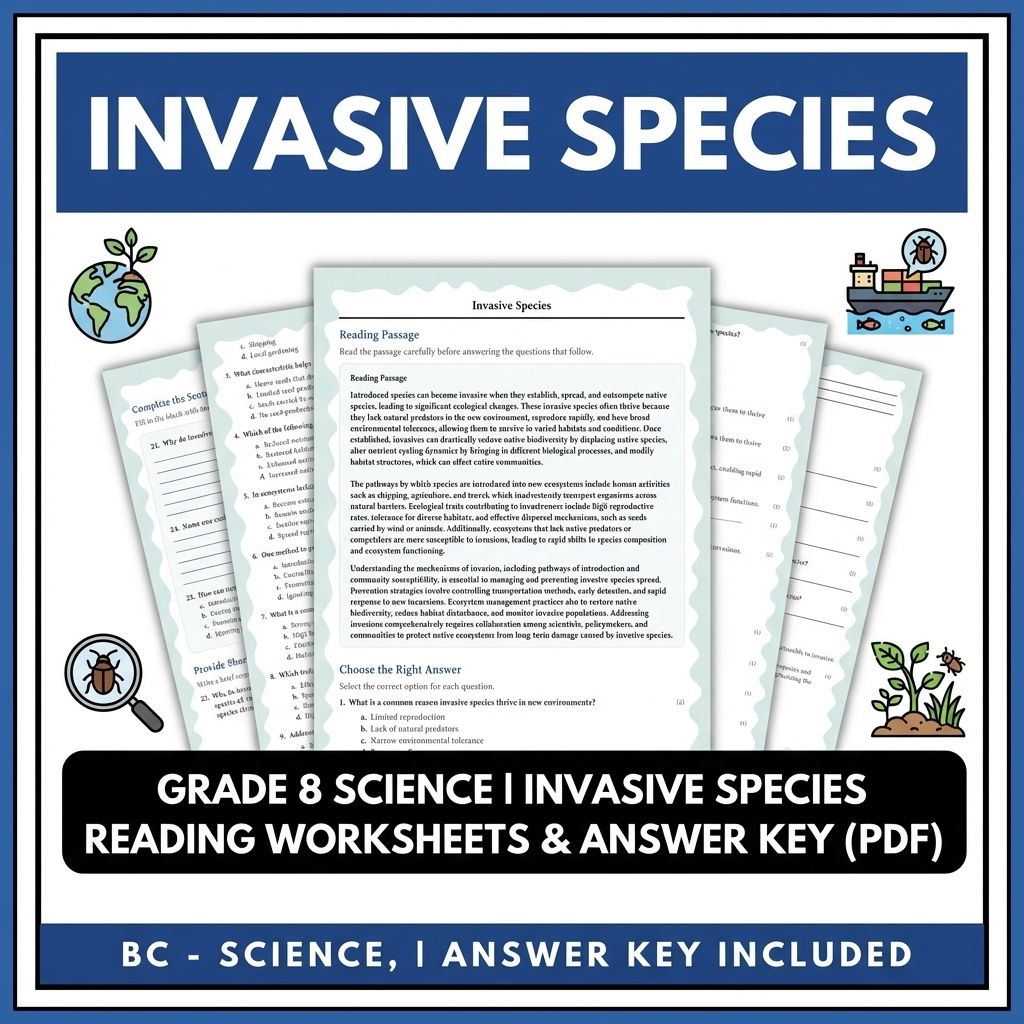
Grade 8 Science | Invasive Species Reading Worksheets & Answer Key (PDF)
JCreated byJ.S SheetsLearning Objectives
- Explain how invasive species establish and spread in new ecosystems.
- Identify ecological traits that make species invasive.
- Describe the impacts of invasive species on native biodiversity and ecosystem functions.
Instant download

Grade 8 Material Origins Worksheet | NGSS Natural & Synthetic Materials
 Created byAmber Owl Education
Learning Objectives
- Explain how natural resources can be processed and transformed into synthetic materials
- Describe how molecular structure and composition affect material properties such as strength and conductivity
- Compare natural materials and synthetic materials, including environmental and resource considerations
Also included in: Grade 8 Science Thermal Effects & Chemical Reactions Lesson Bundle | NGSS +1 more
Instant download

Chemical Reaction Models Worksheet | Grade 8 Science Practice
Created byPrism Point LearningLearning Objectives
- Explain how particle models represent chemical reactions by rearranging bonded atoms into new substances
- Use particle and energy models to predict observable evidence such as gas formation, color change, or temperature change
- Connect conservation of atoms to the idea that the total number of each type of particle is conserved during a reaction
Instant download

Grade 8 Science | Invasive Species Shifts Worksheet | California Standards
Created byLumora LearningLearning Objectives
- Explain how invasive species can disrupt predator-prey and competitive relationships in an ecosystem.
- Describe how invasive species can change niches, energy flow, and nutrient cycling over time.
- Apply vocabulary (invasive species, niche, competition, disease, ecosystem stability) to real-world examples.
Instant download

Grade 8 Science | Measurement & Precision in Science - Reading Comprehension
Created byCoral Reef LearningLearning Objectives
- Understand the importance of calibration in measurement tools
- Identify how measurement uncertainty affects results
- Recognize the significance of units and significant figures
Also included in: Forces and Motion Lesson Bundle | Grade 8 Science Alberta +1 more
Instant download
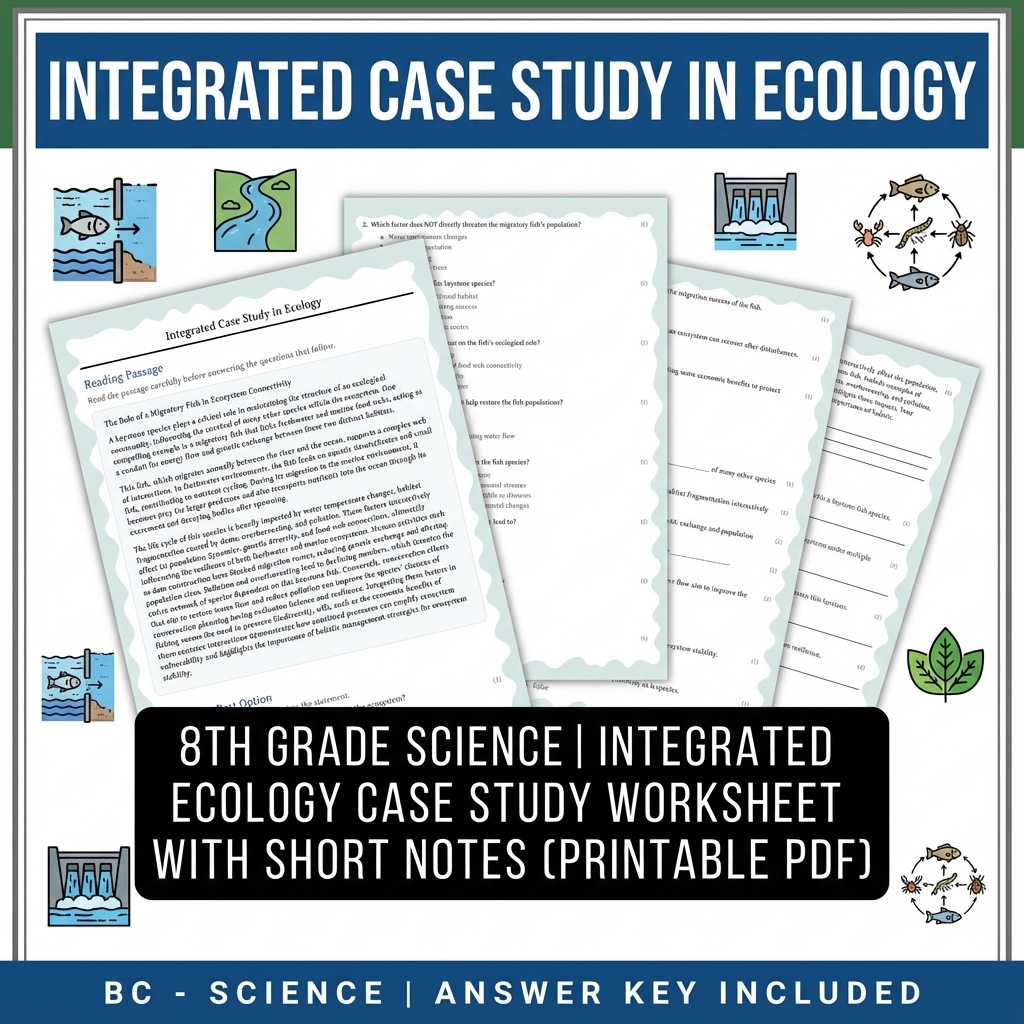
Grade 8 Science | Integrated Ecology Case Study Worksheet (PDF + Answer Key)
JCreated byJ.S SheetsLearning Objectives
- Understand how keystone species influence food webs and ecosystem stability.
- Analyze the interactions among organisms, abiotic factors, and human activities affecting populations.
- Evaluate the impact of environmental changes and human actions on biodiversity and ecosystem health.
Instant download

Environmental Monitoring Worksheets: Earth & Human Activity Grade 8
Created byTeachers ClubLearning Objectives
- Explain how scientists monitor ecosystems using measurable indicators
- Identify sampling, remote sensing, and water-quality testing methods
- Describe how thresholds help evaluate mitigation effectiveness
Also included in: Earth and Human Activity Grade 8 Science NGSS Worksheets Bundle +2 more
Instant download

Natural Selection Worksheets: Heritable Variation | Grade 8 Science
Created byTeachers ClubLearning Objectives
- Explain how heritable variation changes trait frequency over generations
- Identify selective agents that influence differential survival and reproduction
- Describe how environmental pressures affect survival and reproductive success
Also included in: Grade 8 Science Evolution Worksheets | NGSS Unit Bundle +2 more
Instant download

Hydrostatic Variation Worksheet Grade 8 Science Ontario | Fluid Pressure
 Created byClear Sky Classroom
Learning Objectives
- Explain how hydrostatic pressure changes with depth using p = ρgh
- Connect fluid density and vertical position to pressure differences in everyday systems
- Use hydrostatic ideas to interpret communicating vessels and the hydrostatic paradox
Instant download

Grade 8 Science | Aquifer Dynamics - Daily Reading Comprehension
Created byCoral Reef LearningLearning Objectives
- Identify different types of aquifers (confined and unconfined).
- Understand the structure and function of aquifers.
- Describe groundwater flow systems and related concepts such as porosity and permeability.
Instant download
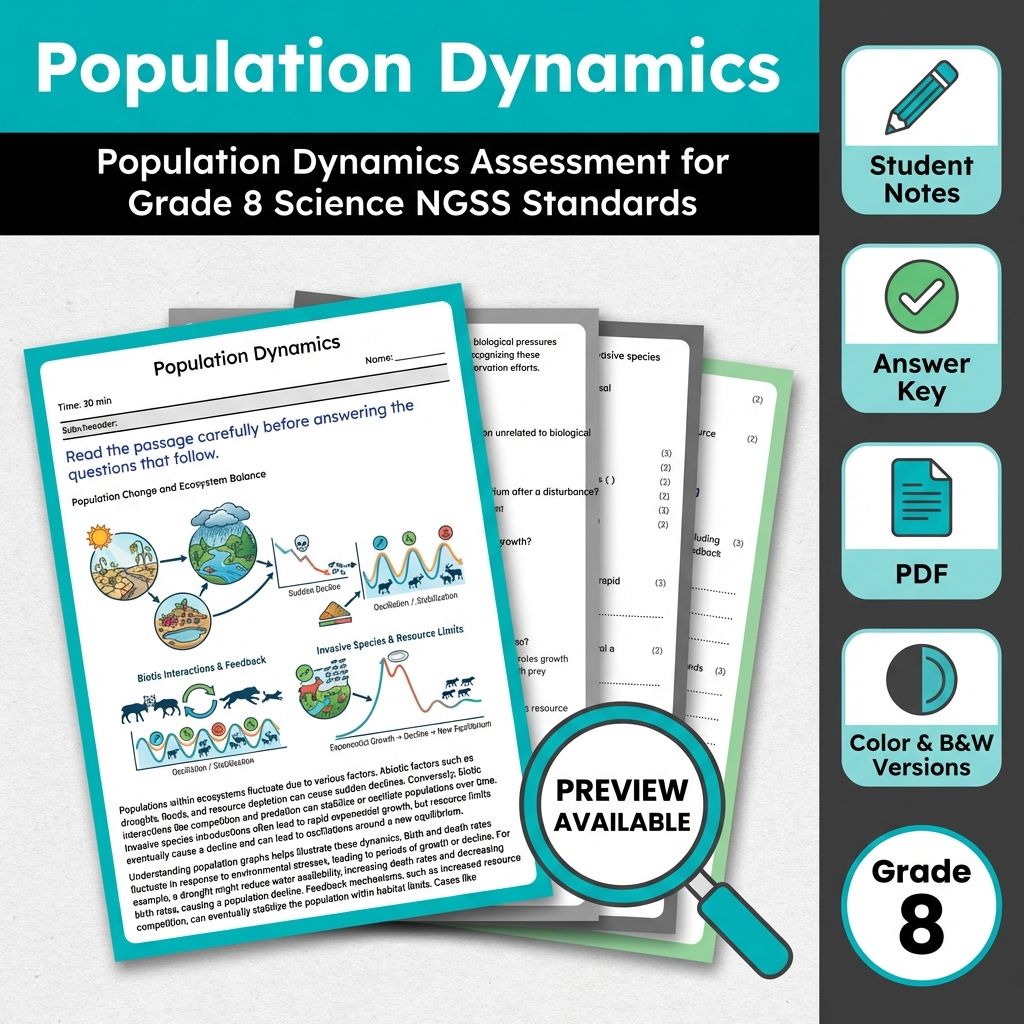
Population Dynamics Assessment for Grade 8 Science NGSS Standards
Created byPrism Point LearningLearning Objectives
- Analyze factors influencing population change including carrying capacity, density-dependent, and density-independent factors.
- Understand how biotic and abiotic changes impact population oscillations, growth limits, and stabilization.
- Interpret population graphs, birth and death rate trends, and resource limitations to explain long-term population equilibrium.
Also included in: Grade 8 Science Mini Bundle | Ecosystems: Interactions, Energy, and Dynamics – NGSS +1 more
Instant download

Sources of Error Worksheet for Grade 8 Science | TEKS-Aligned Practice
JCreated byJ.S SheetsLearning Objectives
- Identify common sources of systematic and random error in measurements and investigations.
- Explain how uncertainty can be represented using significant figures and error margins.
- Apply basic uncertainty reasoning (including error propagation ideas) to simple measurement situations.
Instant download

Grade 8 Science – Seismic Activity and Plate Boundaries Worksheet + Answer Key
JCreated byJ.S SheetsLearning Objectives
- Understand the different types of tectonic plate boundaries
- Explain how plate movements influence seismic activity
- Identify seismic wave types and their effects
Also included in: Grade 8 Science Lesson Bundle | TEKS Standards Worksheets for Earth & Space +1 more
Instant download

Grade 8 Inclined Planes Worksheet | Simple Machines Science Activity
Created byClear Sky ClassroomLearning Objectives
- Explain how inclined planes reduce required input force by trading force for distance
- Calculate ideal mechanical advantage (IMA) using length and height, and relate it to ramp steepness
- Describe how friction and surface roughness change the input force compared with ideal cases
Instant download

Grade 8 Climate Drivers Worksheet | NGSS Practice & PDF
Created byClear Sky ClassroomLearning Objectives
- Explain how latitude affects incoming solar energy and climate patterns.
- Describe how atmospheric circulation, ocean currents, and greenhouse gases influence climate.
- Analyze how multiple climate drivers work together to create regional and long-term climate differences.
Instant download

Grade 8 Thermal Effects Worksheet | NGSS Practice PDF
Created byClear Sky ClassroomLearning Objectives
- Explain how particle motion relates to the states of matter and phase changes.
- Describe the transfer of energy during melting, boiling, and condensation.
- Relate macroscopic temperature changes to microscopic particle behavior.
Also included in: Grade 8 Conservation of Matter Science Lesson Bundle | NGSS +1 more
Instant download
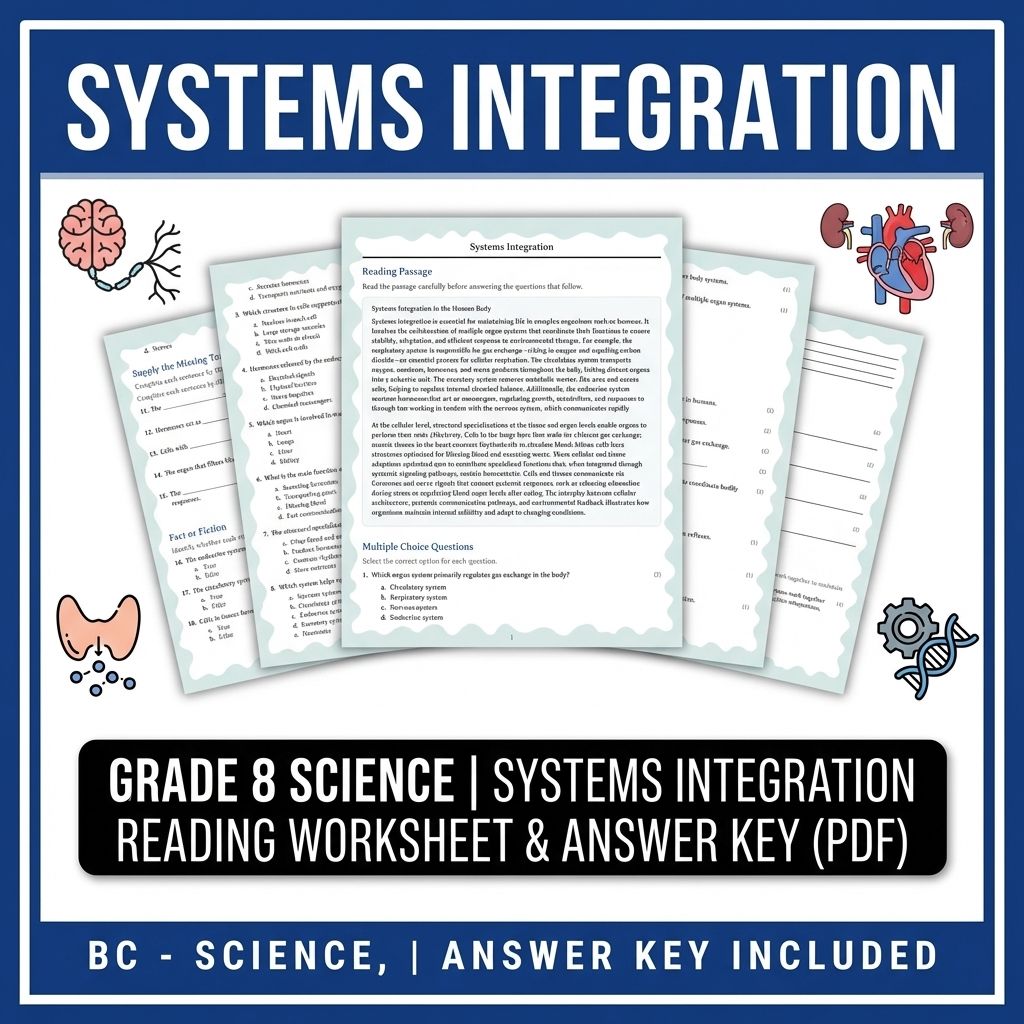
Grade 8 Science | Systems Integration Reading Worksheet & Answer Key (PDF)
JCreated byJ.S SheetsLearning Objectives
- Understand how multiple organ systems coordinate to maintain homeostasis.
- Identify the roles of respiratory, circulatory, excretory, and endocrine systems in systemic regulation.
- Explain how cellular structures support organ functions and system integration.
Instant download

Grade 8 Energy Forms Worksheet | Ontario Science Energy Systems PDF
Created byClear Sky ClassroomLearning Objectives
- Identify and describe forms of energy involved in mechanical systems, including kinetic and potential energy
- Explain how energy can convert between potential and kinetic forms during motion
- Recognize thermal and acoustic energy as common sinks that reduce usable energy
Instant download

Earth Material Cycles and Energy Flow Models Worksheets | Grade 8
Created byTeachers ClubLearning Objectives
- Explain how processes move materials through the rock cycle
- Describe how mantle convection and internal heat drive surface changes
- Compare geosphere, hydrosphere, and atmosphere interactions during surface processes
Also included in: Earth's Systems - Grade 8 Bundle +2 more
Instant download

Water Cycle and Weathering Worksheets | Grade 8 Science
Created byTeachers ClubLearning Objectives
- Describe evaporation, condensation, and precipitation in water cycling
- Explain how infiltration contributes to groundwater flow and streamflow
- Connect water cycling to weathering and landscape changes
Also included in: Earth's Systems - Grade 8 Bundle +2 more
Instant download

Invasive Species Shifts Worksheet | Grade 8 Ecosystems Science Practice
Created byPrism Point LearningLearning Objectives
- Explain how invasive species can disrupt an ecosystem by outcompeting native species, changing food webs, or spreading disease.
- Describe how shifts in community composition can alter energy transfer and nutrient use in ecosystems over time.
Instant download

Grade 8 Climate Impacts Worksheet | Ontario Science Environmental Activity
Created byClear Sky ClassroomLearning Objectives
- Explain how climate variability and change affect precipitation patterns, snowpack, runoff timing, and evapotranspiration
- Describe how these hydrologic changes influence drought, flooding, groundwater recharge, and reservoir storage
- Analyze how land-use change can interact with climate impacts to affect regional water availability and ecosystems
Instant download

Grade 8 Science | Understanding Constant Speed - Daily Reading Comprehension
Created byCoral Reef LearningLearning Objectives
- Define constant speed and explain its significance in motion.
- Identify constant speed on distance-time graphs.
- Describe real-life examples of constant speed.
Instant download

Energy Forms Worksheet Grade 8 Science Activities | Energy Transfer Review
Created byPrism Point LearningLearning Objectives
- Explain how kinetic energy depends on mass and speed, and how gravitational potential energy depends on height.
- Use graphs and data relationships to describe how changes in speed or elevation affect stored energy.
- Connect energy forms to observable motion using examples such as roller coaster crests and dips.
Instant download

Intermolecular Forces and Physical Properties Worksheet | Grade 8 Science
 Created byBRIGHT PATH RESOURCES
Learning Objectives
- Explain how intermolecular attractions affect melting point, boiling point, and solubility
- Use the ideas of stronger versus weaker intermolecular forces to predict changes in physical properties
- Connect molecular interactions to real Alberta examples such as freeze–thaw cycles and evaporation
Also included in: Grade 8 Alberta Science Matter and Chemical Change Worksheet Bundle +1 more
Instant download

Graphing Relationships Worksheet | Grade 8 Science Activities
Created byPrism Point LearningLearning Objectives
- Identify the correct axes, units, and numerical scale for graphs that show relationships between variables.
- Compare scatter plots, line graphs, and bar graphs to determine which graph best matches a data pattern.
- Interpret graphs by describing trends and models without introducing new variables.
Instant download

Engineering Problem Definition Worksheets | Grade 8 Science
Created byTeachers ClubLearning Objectives
- Define engineering problems using measurable performance goals
- Identify constraints affecting engineering design solutions
- Explain how stakeholder needs shape problem statements
Also included in: Grade 8 Science Engineering Design Worksheets | NGSS Bundle +2 more
Instant download

Grade 8 Science | Consumers Hierarchy in Ecosystems - Reading Comprehension
Created byCoral Reef LearningLearning Objectives
- Identify the different types of consumers in an ecosystem
- Understand the feeding habits of herbivores, omnivores, and carnivores
- Describe how feeding relationships influence energy flow within communities
Also included in: Interactions and Ecosystems Lesson Bundle Grade 8 Science – Alberta +1 more
Instant download

Plate Motions & Mountain Building Worksheets | Grade 8 Science
Created byTeachers ClubLearning Objectives
- Explain how seafloor spreading provides evidence for plate motions
- Interpret magnetic striping and paleomagnetic records as evidence
- Describe how rifting and subduction create distinctive landforms
Also included in: Earth's Systems - Grade 8 Bundle +2 more
Instant download
About Grade 8 Science Worksheets
Explore Grade 8 Science worksheets for classwork, homework, or review. Our 6,006 printables download instantly as PDFs.
Each resource here is built by an independent educator and reviewed for quality. Worksheets print straight from PDF and suit classroom use, homework, or extra practice; most come with answer keys, and you can preview before purchasing.