
Grade 8 Science Worksheets
6,006 worksheets
Energy in Motion Worksheet | Standards-Aligned Practice for Grade 8 Science
JCreated byJ.S SheetsLearning Objectives
- Describe how energy shifts between potential and kinetic energy during motion.
- Explain the conservation of energy in a system involving motion.
- Analyze how forces act on objects in motion and how energy exchanges occur.
Also included in: Grade 8 Forces, Energy & Matter Science Lesson Bundle | California Standards +1 more
Instant download

Grade 8 Science – Constant Speed Worksheet (BC) PDF
 Created byEvergreen Desk Education
Learning Objectives
- Interpret constant speed using distance–time graphs and the idea of equal distances in equal time intervals
- Calculate distance or time using the proportional relationship distance = speed × time
- Distinguish constant speed from changing speed by analyzing slope and identifying average vs. instantaneous speed
Instant download

Adaptation Mechanisms Assessment for Grade 8 Science | TEKS-Aligned
 Created byPrism Point Learning
Learning Objectives
- Describe different types of adaptation—structural, behavioral, and physiological—in various species.
- Explain how adaptations enhance survival and reproductive success in diverse environments.
- Differentiate between adaptation and acclimation, and understand the role of natural selection in evolution.
Instant download

Grade 8 Science – Tradeoff Analysis & Decision-Making | Daily Reading Worksheet
 Created byBright Mind Resources
Learning Objectives
- Understand how to evaluate tradeoffs between cost and performance in scientific projects
- Learn to analyze competing constraints using multi-criteria decision methods
- Apply tools such as weighted scoring and Pareto comparisons to project decision-making
Also included in: Grade 8 Tradeoff Analysis Science Daily Reading Worksheets Lesson Bundle | NGSS +1 more
Instant download
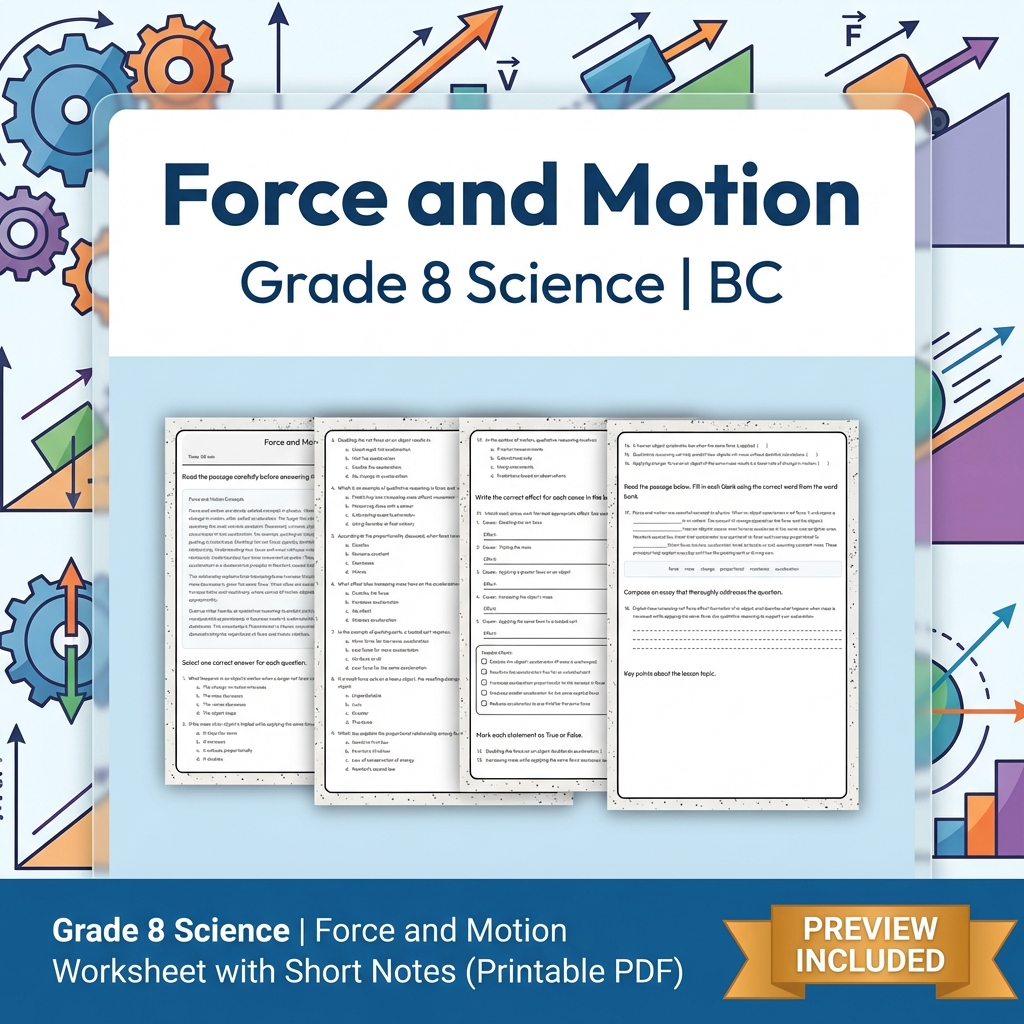
Grade 8 Science | Force and Motion Worksheet with Short Notes (Printable PDF)
 Created byMeadowlark Worksheets
Learning Objectives
- Understand the relationship between net force, mass, and acceleration.
- Predict how changes in force and mass affect motion.
- Analyze qualitative reasoning about force, mass, and their effects on objects.
Also included in: Grade 8 Science Lesson Bundle | BC Framework & Key Concepts Worksheet Pack +1 more
Instant download
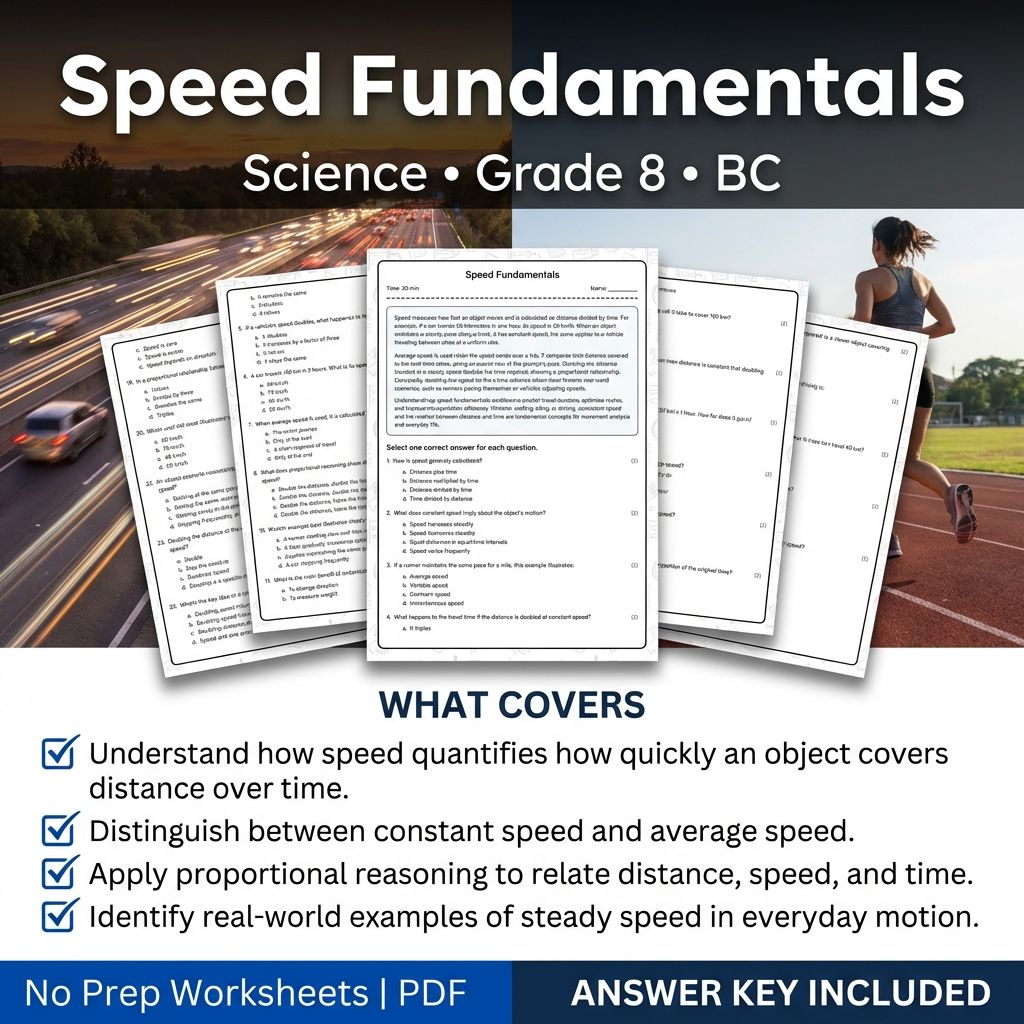
Grade 8 Science | Speed Fundamentals Worksheet with Answer Key (Printable PDF)
 Created byCoral Reef Learning
Learning Objectives
- Understand how speed quantifies how quickly an object covers distance over time.
- Distinguish between constant speed and average speed.
- Apply proportional reasoning to relate distance, speed, and time.
Instant download

Grade 8 Science | Decomposer Recycling & Nutrient Cycling | California Standards
 Created byLumora Learning
Learning Objectives
- Explain how decomposers such as fungi and bacteria break down dead matter and waste.
- Describe how decomposition supports biogeochemical cycling of key elements like nitrogen and phosphorus.
- Connect decomposition to energy flow and ecosystem productivity over time.
Instant download

Grade 8 Homeostatic Control Worksheet | Body Systems & Balance PDF
Created byEvergreen Desk EducationLearning Objectives
- Explain how homeostasis helps maintain stable internal conditions for cell function
- Describe how negative feedback systems respond to changes using a set range
- Connect homeostatic control to regulation of body temperature, blood chemistry, water balance, and oxygen levels
Instant download
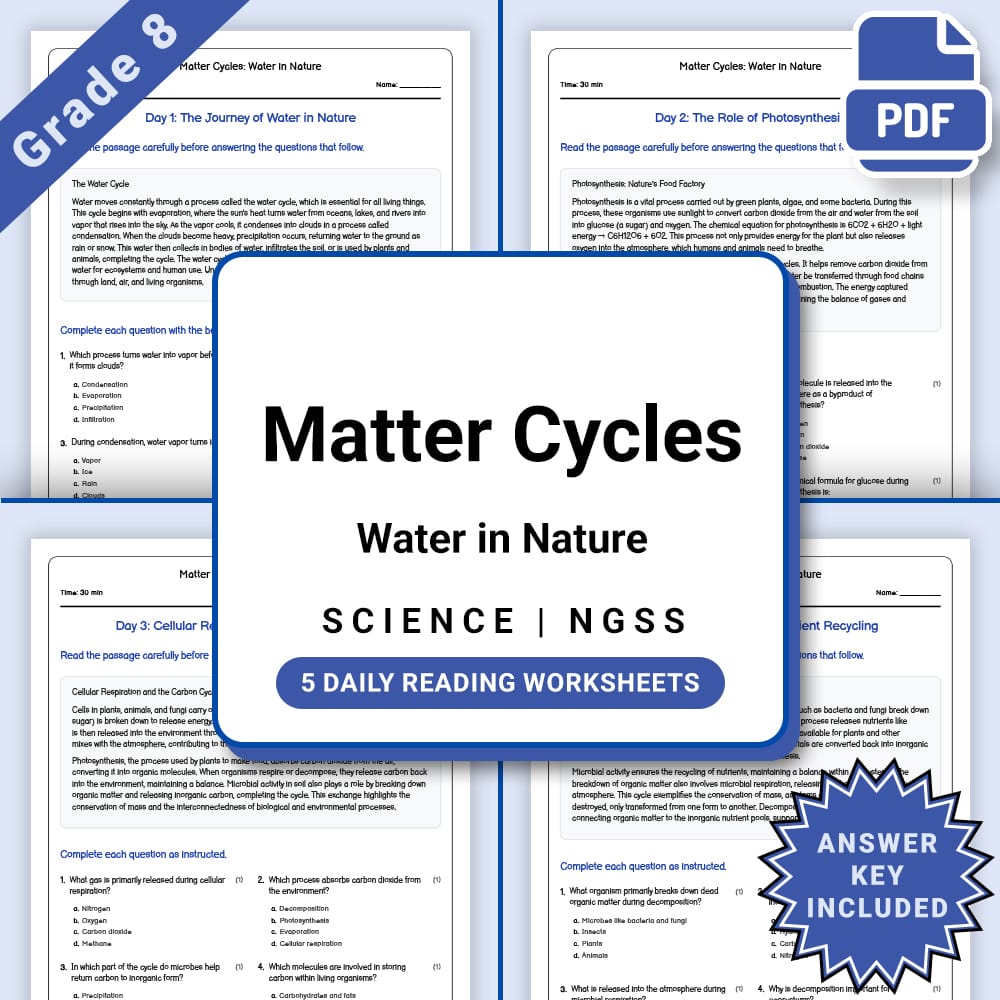
Grade 8 Science Water Cycles Daily Reading Worksheet(PDF + Answer Key)
 Created byCopper Leaf Classroom
Learning Objectives
- Understand the water cycle and its processes.
- Identify the roles of evaporation, condensation, precipitation, and collection.
- Explain how water moves through different parts of the environment.
Instant download
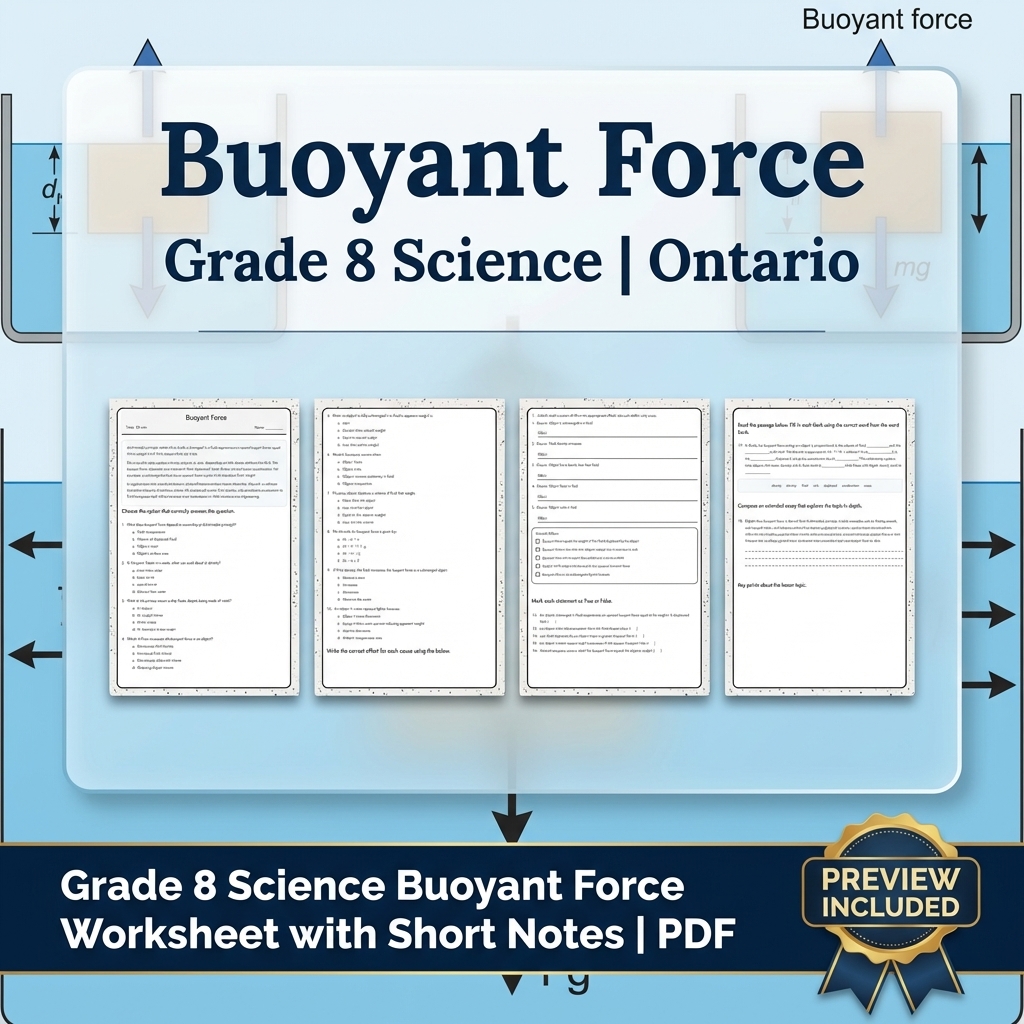
Grade 8 Science Buoyant Force Worksheet with Short Notes | PDF
Created byMeadowlark WorksheetsLearning Objectives
- Understand Archimedes' principle and how buoyant force relates to displaced fluid weight.
- Calculate buoyant force using fluid density, displaced volume, and gravitational acceleration.
- Explain the differences in apparent weight when objects are in air versus submerged in fluid.
Also included in: Grade 8 Science Lesson Group Bundle | Hydrostatics & Fluid Mechanics +1 more
Instant download

Electric Charge Worksheet | Grade 8 Science Activities
Created byPrism Point LearningLearning Objectives
- Differentiate static electricity and current electricity by origin, mobility of charges, and typical effects
- Use the terms conductor, charge imbalance, and current to explain real-world electric phenomena
- Identify safe and unsafe ways to handle electrostatic discharge and electrical devices
Also included in: Grade 8 Science Electricity & Electromagnetism Lesson Bundle | Alberta
Instant download

Grade 8 Science | Force and Motion Worksheet | NGSSS-Aligned
Created byLumora LearningLearning Objectives
- Explain how forces can change an object’s motion (starting, stopping, speeding up, slowing down, or changing direction)
- Describe how the net force (direction and magnitude) affects acceleration and changes in velocity
- Use Newton’s second law and the idea of balanced vs. unbalanced forces to predict motion in real situations
Instant download
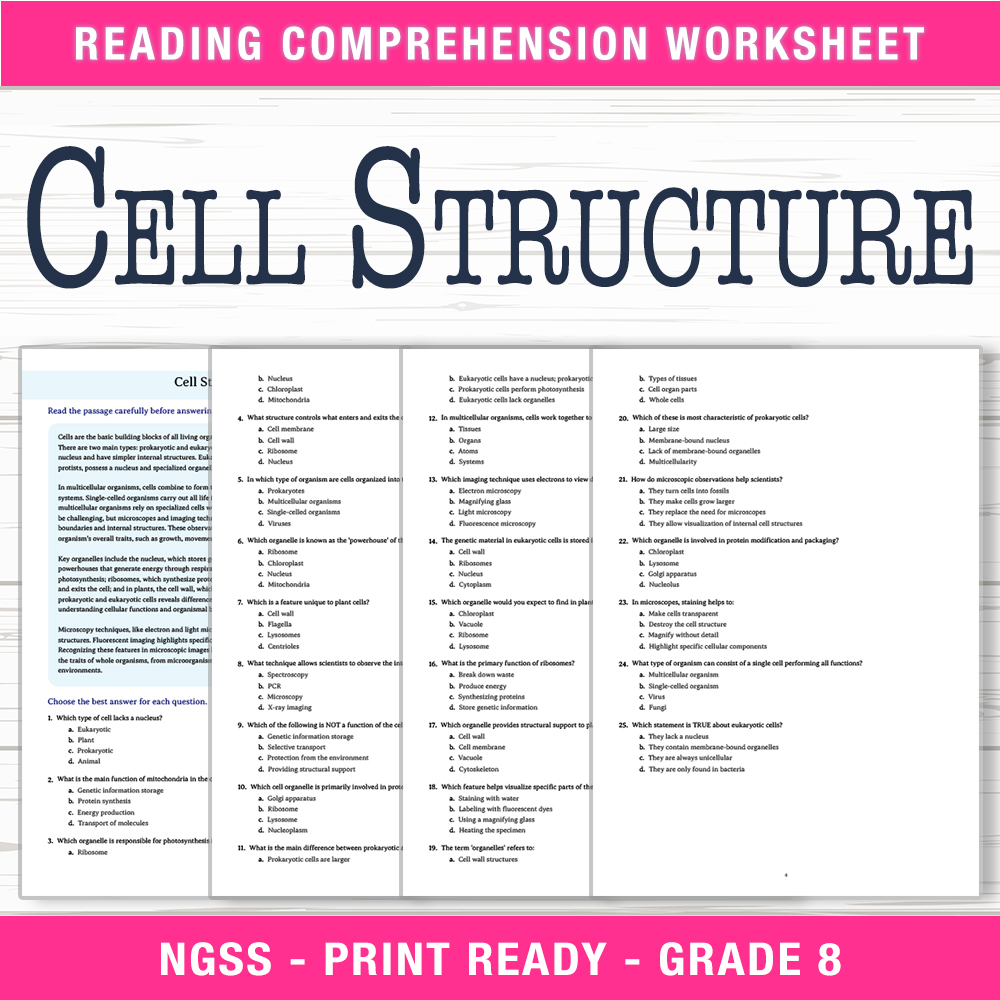
Grade 8 Science | Cell Structure Worksheet (PDF + Answer Key)
 Created byRiverstone Classroom
Learning Objectives
- Identify and describe the main organelles of cells and their functions.
- Compare the features of prokaryotic and eukaryotic cells.
- Differentiate between single-celled and multicellular organisms based on cellular organization.
Instant download

Grade 8 Membrane Transport Worksheet | Practice & Assessment PDF
 Created byClear Sky Classroom
Learning Objectives
- Explain how concentration gradients and random molecular motion influence diffusion across cell membranes.
- Compare diffusion, facilitated diffusion, and active transport in terms of energy use and movement direction.
- Describe how transport proteins and vesicles help cells maintain homeostasis by regulating what enters and leaves.
Instant download

Grade 8 Buoyant Force Worksheet | Ontario Science Activity & Answer Key
Created byClear Sky ClassroomLearning Objectives
- Explain Archimedes’ principle and relate buoyant force to the weight of displaced fluid.
- Use density and displaced volume relationships to compare buoyant force in different fluids.
- Predict whether an object floats, sinks, or is neutrally buoyant by comparing forces.
Instant download

Grade 8 Predator Prey Population Dynamics Worksheet | Alberta Science
 Created byBRIGHT PATH RESOURCES
Learning Objectives
- Identify the main idea and key details about predator–prey balance
- Explain how predation affects prey populations and predator populations
- Describe how refuges and compensatory mechanisms influence population outcomes
Also included in: Grade 8 Alberta Science Interactions and Ecosystems Worksheet Bundle +1 more
Instant download

Grade 8 Science | Resource Sustainability Worksheet | NGSSS Aligned
Created byLumora LearningLearning Objectives
- Differentiate between renewable and nonrenewable resources in terms of replenishment time scales.
- Explain how human extraction and consumption of resources can create environmental impacts.
- Describe how long-term sustainability balances human demand with regeneration capacity and mitigation of harmful byproducts.
Instant download

Grade 8 Net Force Effects Worksheet | California Standards Practice PDF
Created byClear Sky ClassroomLearning Objectives
- Explain how net force affects an object’s acceleration, including changes in speed and/or direction.
- Distinguish between balanced and unbalanced forces using the idea of net force being zero or not zero.
- Use force magnitude and direction to predict the direction of acceleration.
Instant download

Grade 8 Reversible vs Chemical Changes Worksheet | California Science PDF
Created byEvergreen Desk EducationLearning Objectives
- Differentiate reversible physical changes from generally irreversible chemical changes using evidence from observations.
- Explain how changes in temperature and state (melting/freezing, boiling/condensation) relate to reversibility.
- Identify signs of chemical change such as new substances, permanent color change, or gas production.
Instant download

Grade 8 Science | Reaction Quantities Worksheet (PDF) | Alberta Standards
 Created bySilver Birch Teaching
Learning Objectives
- Use mass conservation to relate masses of reactants and products in closed systems
- Apply proportional reasoning from balanced chemical equations to predict relative product amounts
- Interpret observed residues by comparing expected and measured mass changes in reaction systems
Also included in: Grade 8 Matter & Chemical Change Science Lesson Bundle | Alberta Framework +1 more
Instant download

Grade 8 Power Rates Worksheet | Ontario Science Energy & Power PDF
Created byClear Sky ClassroomLearning Objectives
- Explain power as the rate of doing work or transferring energy and use the SI unit watt (W).
- Use relationships between torque, rotational speed, and mechanical power to interpret motor performance.
- Describe how efficiency and transmission losses affect the difference between input electrical power and useful output power.
Instant download

Grade 8 Science – Signs of Chemical Change & Reactions | Daily Reading Worksheet
Created byBright Mind ResourcesLearning Objectives
- Identify observable signs indicating a chemical reaction
- Differentiate between physical and chemical changes
- Understand real-world examples of chemical signatures
Also included in: Matter Change Grade 8 Science Daily Reading Worksheets Lesson Bundle | Alberta +2 more
Instant download

Grade 8 Science | Graphing Relationships Worksheet | General Standard
Created byLumora LearningLearning Objectives
- Identify which variables belong on the x-axis and y-axis when creating graphs from data
- Select an appropriate graph type (scatter plot, line graph, or bar graph) for a given data situation
- Interpret graphs using correct axis labels, units, and consistent numerical scales
Instant download
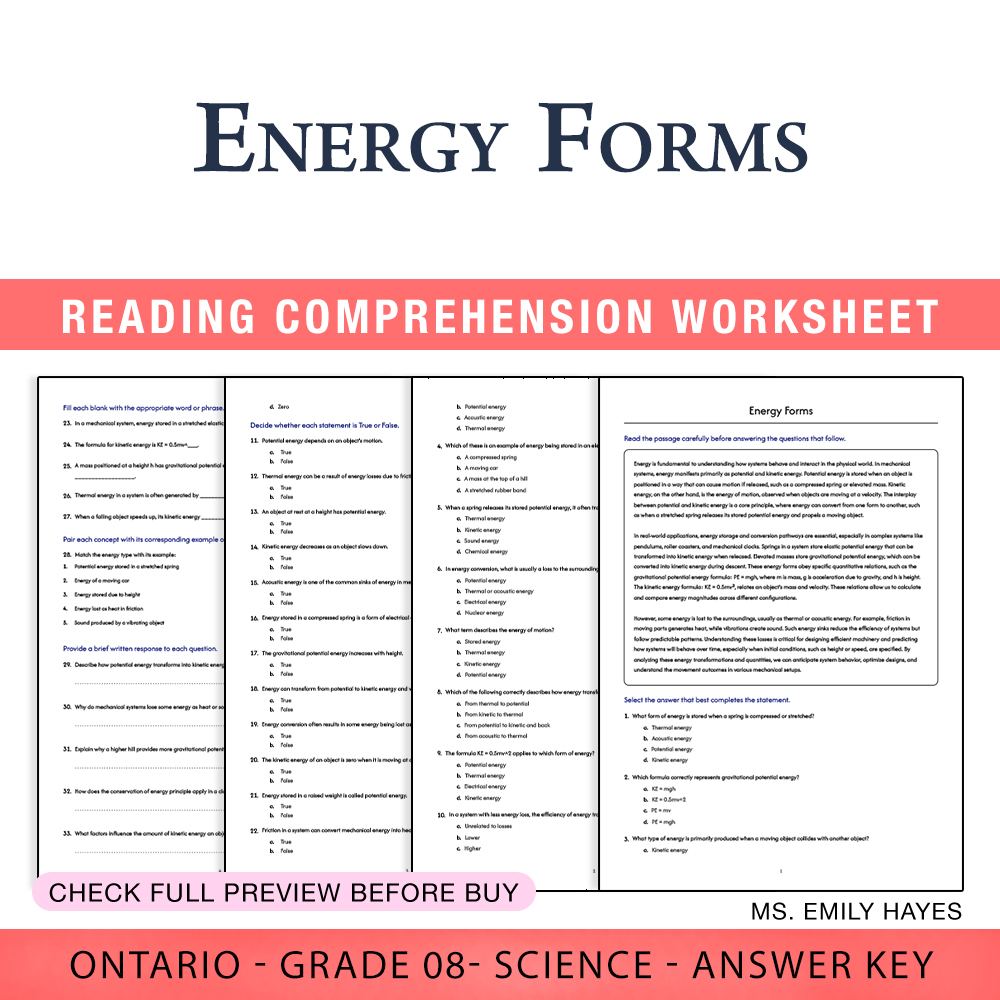
8th Grade Science | Energy Forms Worksheet (PDF+ Answer Key)
Created byCopper Leaf ClassroomLearning Objectives
- Identify and describe different types of energy present in mechanical systems.
- Explain the conversion processes between potential and kinetic energy.
- Recognize common forms of energy sinks such as thermal and acoustic energy.
Instant download

Grade 8 Science | Plate Motion and Surfaces Worksheet | General Standard
Created byLumora LearningLearning Objectives
- Explain how divergent, convergent, and transform plate boundaries shape Earth’s surface
- Describe how plate interactions relate to earthquakes, volcanic activity, and mountain building
- Interpret how uplift, faulting, and erosion contribute to long-term changes in topography
Instant download

Grade 8 Science – Reaction Quantities & Conservation of Mass | Reading Worksheet
Created byBright Mind ResourcesLearning Objectives
- Understand the concepts of reactants and products in chemical reactions.
- Learn how to identify and interpret reaction quantities.
- Apply measurable data to predict and analyze chemical reactions.
Also included in: Matter Change Grade 8 Science Daily Reading Worksheets Lesson Bundle | Alberta +2 more
Instant download

Grade 8 Science – Magnetic Fields & Magnetic Materials | Daily Reading Worksheet
Created byBright Mind ResourcesLearning Objectives
- Understand what magnetic fields are and how they are produced.
- Identify sources of magnetic fields in everyday objects.
- Describe the pattern and direction of magnetic field lines.
Also included in: Grade 8 Electricity Science Daily Reading Worksheets Lesson Bundle | Alberta +2 more
Instant download

Grade 8 Science | Pendulum Energy Worksheet | BC Aligned
Created byLumora LearningLearning Objectives
- Explain the energy transformation process in a pendulum between potential and kinetic energy.
- Identify factors such as amplitude, mass, and length that influence pendulum motion and energy transfer.
- Describe how energy conservation is observed in an ideal pendulum system without dissipation.
Also included in: Grade 8 Science | Forces and Motion Custom Bundle | BC Standards
Instant download

Grade 8 Science – Design Problem Framing & Standards-Based Reading Worksheet
Created byBright Mind ResourcesLearning Objectives
- Understand the importance of clearly defining design goals in engineering
- Identify specific objectives within a problem statement
- Recognize how clear objectives guide the development of solutions
Also included in: Design Grade 8 Science Daily Reading Worksheets Bundle | CA Standards +1 more
Instant download
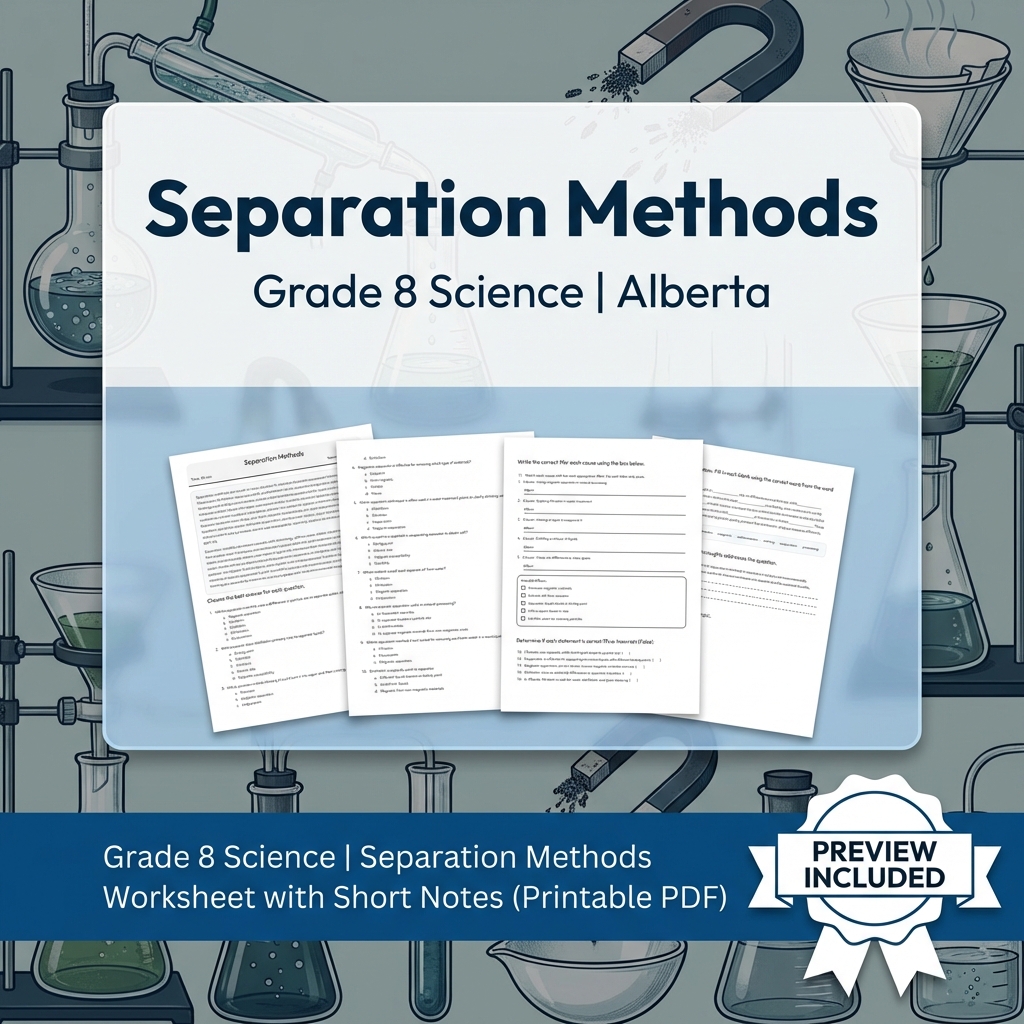
Grade 8 Science | Separation Methods Worksheet with Short Notes (Printable PDF)
Created byMeadowlark WorksheetsLearning Objectives
- Understand various separation techniques based on physical properties.
- Identify applications of filtration, evaporation, and distillation in real-world scenarios.
- Explain how separation methods are used in industries like water treatment, oil refining, and mineral processing.
Also included in: Grade 8 Science Unit | Matter & Chemical Change Worksheets Pack +1 more
Instant download
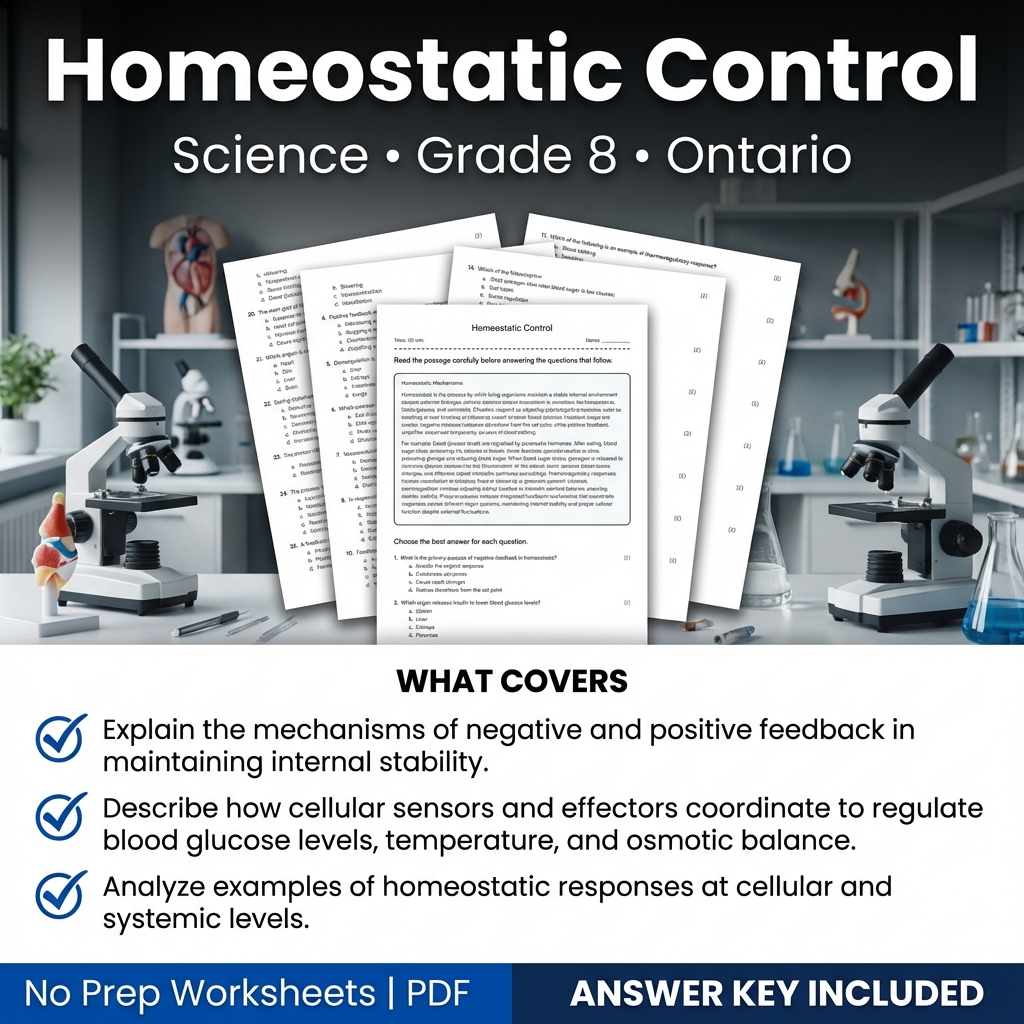
Homeostatic Control Worksheet | Grade 8 Science | Ontario Framework
Created byCoral Reef LearningLearning Objectives
- Explain the mechanisms of negative and positive feedback in maintaining internal stability.
- Describe how cellular sensors and effectors coordinate to regulate blood glucose levels, temperature, and osmotic balance.
- Analyze examples of homeostatic responses at cellular and systemic levels.
Instant download
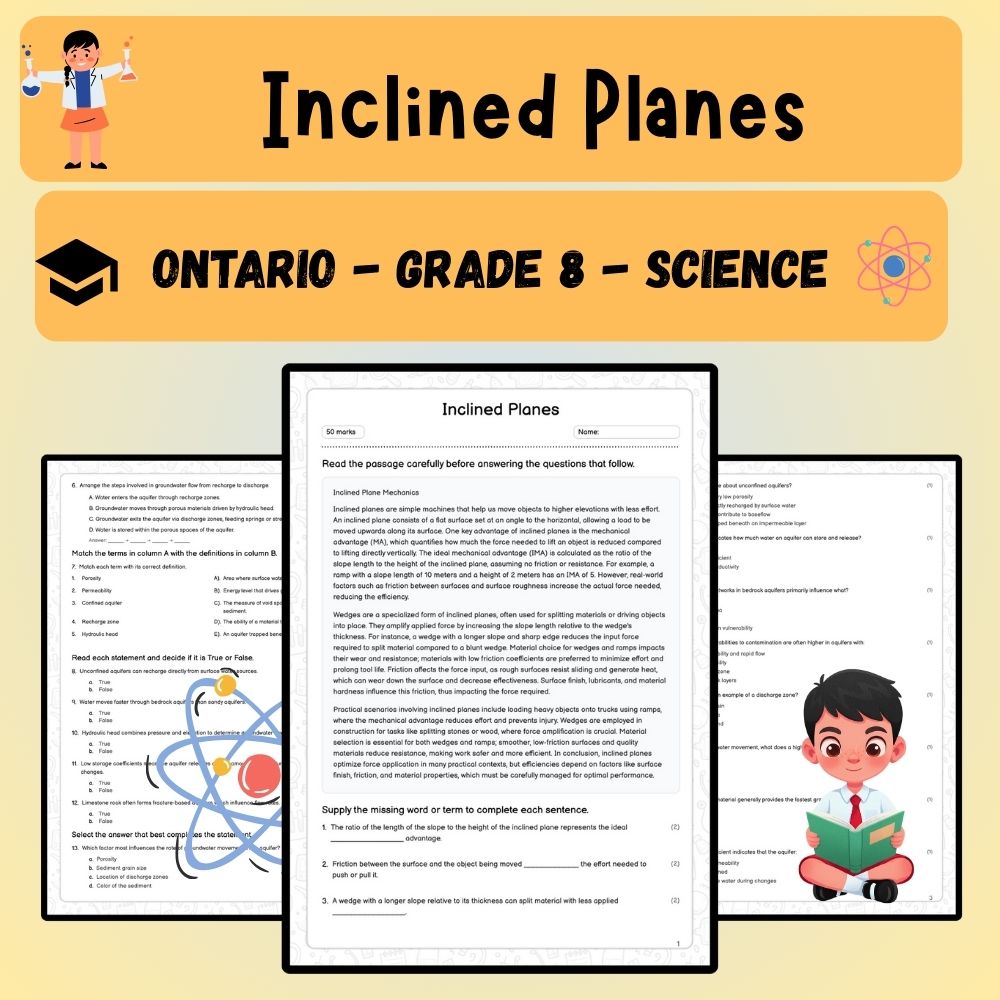
Grade 8 Science – Inclined Planes Worksheet (PDF) | Ontario Standards
Created byPrism Point LearningLearning Objectives
- Describe how inclined planes reduce input force using mechanical advantage.
- Calculate ideal and actual mechanical advantage for ramps and wedges.
- Explain how surface finish and friction influence force requirements during inclined plane use.
Also included in: Grade 8 Science Unit Bundle | Forces, Energy & Motion Worksheets +1 more
Instant download

Homogeneous Mixtures Worksheet | Grade 8 Science Activities
Created byPrism Point LearningLearning Objectives
- Identify homogeneous mixtures and distinguish them from heterogeneous mixtures using particle-level reasoning and macroscopic observations.
- Explain how solubility and concentration affect the behavior of solutions and alloys.
- Interpret examples of homogeneous mixtures in environmental and transportation contexts.
Also included in: Grade 8 Matter & Chemical Change Lesson Bundle | Alberta Science
Instant download

Phase Changes Worksheet Grade 8 Science Assessment | States of Matter
Created byPrism Point LearningLearning Objectives
- Explain how phase changes involve energy transfer even when temperature does not change immediately.
- Differentiate between melting, freezing, evaporation, and condensation using particle behavior.
- Describe real-life examples of phase changes and connect them to particle arrangement and motion.
Instant download

Population Models Worksheet Practice Assessment | Grade 8 Science NGSS
Created byPrism Point LearningLearning Objectives
- Explain how exponential and logistic population growth models describe changes in population size over time
- Interpret population curves to identify growth phases, fluctuations, and steady states (including carrying capacity)
- Use reasoning with proportional changes and limiting factors to predict how carrying capacity can shift
Also included in: Grade 8 Speciation & Natural Selection Science Lesson Bundle (NGSS)
Instant download

Grade 8 Science | Momentum & Collisions - Daily Reading Comprehension
Created byCoral Reef LearningLearning Objectives
- Understand the concept of momentum as the product of mass and velocity.
- Recognize how momentum is conserved in isolated systems during collisions.
- Differentiate between elastic and inelastic collisions.
Instant download

Grade 8 Gas Laws Pressure Temperature and Diffusion Worksheet | Alberta
Created byBRIGHT PATH RESOURCESLearning Objectives
- Explain how particle motion relates to gas pressure and temperature.
- Describe how gases expand or compress in response to temperature changes.
- Use diffusion to predict how gases spread through air over time.
Also included in: Grade 8 Alberta Science Matter and Chemical Change Worksheet Bundle +1 more
Instant download

Electric Current & Resistance in Circuits Worksheets Grade 8 Science
 Created bySunny Desk Resources
Learning Objectives
- Explain the relationship between voltage, current, and resistance in simple circuits.
- Describe how material type, temperature, and geometry affect resistance.
- Use the idea of resistance to predict how components heat under load.
Also included in: Electricity and Magnetism Grade 8 Alberta Unit Lesson Bundle +1 more
Instant download

Molecular Properties Worksheet Grade 8 Science Activities | Matter Review
Created byPrism Point LearningLearning Objectives
- Explain how particle models connect molecular structure to observable properties like states of matter and solubility.
- Compare polar and nonpolar molecules and predict how each interacts with water.
- Describe how extended structures (polymers and crystalline solids) lead to different properties based on particle arrangement.
Instant download

Natural Selection Assessment | Florida NGSSS Grade 8 Science
Created byPrism Point LearningLearning Objectives
- Explain how variation, inheritance, and environmental pressures affect survival and reproduction
- Describe how trait frequencies change over successive generations through natural selection
- Use an example (such as antibiotic resistance) to support claims about adaptation
Also included in: Grade 8 Evolution and Genetics Science Lesson Bundle | Florida NGSSS
Instant download

Grade 8 Osmotic Balance Worksheet | Ontario Science + Doodle Notes
 Created byChalk and Compass
Learning Objectives
- Explain how water potential and tonicity determine the direction of water movement across cell membranes.
- Compare how plant and animal cells respond to hypotonic, isotonic, and hypertonic environments.
- Describe how osmoregulatory mechanisms help maintain cellular survival in changing environments.
Also included in: Grade 8 Science Cell Organization, Transport & Homeostasis Lesson Bundle – Ontario +1 more
Instant download

Trip Analysis Worksheet | Grade 8 Science Activities
Created byPrism Point LearningLearning Objectives
- Calculate average speed for trips with multiple legs using total distance and total time.
- Explain how slower segments affect overall average speed in nonuniform motion.
- Use segmental thinking (distance-time pairs) to justify an average-speed result.
Also included in: Forces, Motion & Energy Lesson Bundle | Grade 8 Science | BC +1 more
Instant download

Grade 8 Ecosystem Components Worksheet | BC Use Practice PDF
Created byClear Sky ClassroomLearning Objectives
- Identify biotic and abiotic components of an ecosystem and describe how they interact
- Explain the roles of producers, consumers, and decomposers in cycling energy and matter
- Use evidence from ecosystem conditions (sunlight, water, soil, temperature) to predict where organisms can live
Instant download

Population Change Worksheet | NGSS Grade 8 Science Assessment
 Created bySkylark Worksheets
Learning Objectives
- Explain how carrying capacity affects population growth over time
- Differentiate between density-dependent and density-independent factors in population changes
- Analyze how birth/death rates and resource limits can lead to population equilibrium or oscillations
Also included in: Grade 8 Ecosystems Interactions Energy Dynamics Science Lesson Bundle NGSS +1 more
Instant download

Rock and Mineral Formation Worksheet | Grade 8 Science Practice
Created byPrism Point LearningLearning Objectives
- Explain how igneous, sedimentary, and metamorphic rocks form based on Earth processes.
- Describe how mineral properties relate to chemical composition and how minerals appear in different rock types.
- Use evidence from the rock record to connect tectonic activity with long-term Earth change.
Instant download

Predator–Prey Balance Worksheet | Alberta Grade 8 Science Practice and Mastery
JCreated byJ.S SheetsLearning Objectives
- Understand the role of predation in shaping population dynamics and community structure.
- Identify behavioral adaptations and refuges that influence predator–prey interactions.
- Describe cascading effects resulting from the absence or recolonization of top predators.
Instant download
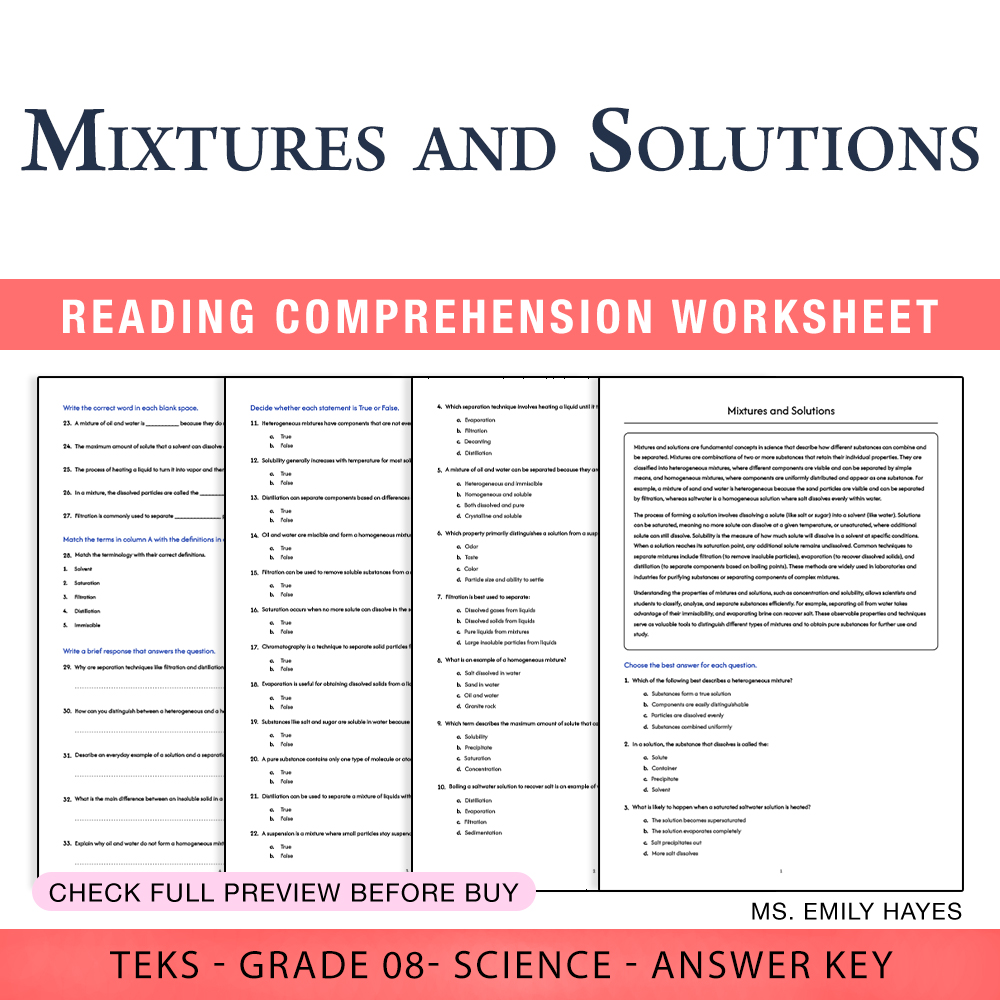
8th Grade Science | Mixtures and Solutions Worksheet & Answer Key (PDF)
Created byCopper Leaf ClassroomLearning Objectives
- Distinguish between heterogeneous and homogeneous mixtures based on observable properties.
- Explain how solutes and solvents form solutions and understand concepts of saturation and solubility.
- Identify and describe common separation techniques such as filtration, evaporation, and distillation.
Instant download

Hydrologic Measurement Worksheet | Ontario Grade 8 Science Assessment
JCreated byJ.S SheetsLearning Objectives
- Explain how stage, discharge, and rating curves are used to estimate streamflow from gauge readings
- Identify common instruments for monitoring groundwater and water quality and describe what each one measures
- Interpret basic hydrograph and water-quality time-series ideas, including baseflow separation and trends
Instant download
About Grade 8 Science Worksheets
Explore Grade 8 Science worksheets for classwork, homework, or review. Our 6,006 printables download instantly as PDFs.
Each resource here is built by an independent educator and reviewed for quality. Worksheets print straight from PDF and suit classroom use, homework, or extra practice; most come with answer keys, and you can preview before purchasing.