
Grade 8 Science Worksheets
6,006 worksheets
Problem Definition Worksheet | NGSS Grade 8 Science Assessment
 Created bySkylark Worksheets
Learning Objectives
- Identify measurable performance goals and list constraints (material, cost, safety, and environment) when defining an engineering problem.
- Explain how stakeholders’ needs and acceptable failure modes shape a clear, testable problem statement.
- Use trade-offs among time, cost, and durability to revise a problem statement for a real-world scenario.
Also included in: Grade 8 Engineering Design Science Lesson Bundle for NGSS Assessment +1 more
Instant download

Grade 8 Science | Population Effects on Earth - Daily Reading Comprehension
 Created byCoral Reef Learning
Learning Objectives
- Understand how increasing human populations influence environmental changes.
- Identify connections between population growth, resource consumption, and ecological impacts.
- Analyze evidence related to resource use, land changes, and biogeochemical fluxes.
Instant download

Grade 8 Science | Measurement Practices in Science - Daily Reading Comprehension
Created byCoral Reef LearningLearning Objectives
- Understand different measurement tools used in science.
- Identify appropriate instruments for various measurements.
- Recognize the importance of calibration in measurement accuracy.
Instant download

Grade 8 Science | Understanding Reaction Rates - Daily Reading Comprehension
Created byCoral Reef LearningLearning Objectives
- Identify factors that influence how quickly a reaction occurs
- Explain the role of temperature, concentration, surface area, and catalysts in reaction rates
- Connect microscopic particle behavior with macroscopic changes in reaction speed
Instant download

Water Cycle Practice Worksheet | Grade 8 Science NGSS Review
 Created byPrism Point Learning
Learning Objectives
- Explain the main stages of the water cycle, including phase changes and water movement.
- Describe how sunlight and gravity drive hydrologic processes like evaporation, infiltration, runoff, and groundwater flow.
- Connect water-cycle processes to mechanical and chemical weathering and resulting landforms and sediment delivery.
Instant download

Grade 8 Science | CER Argumentation Daily Reading Practice
Created byCoral Reef LearningLearning Objectives
- Understand the structure of scientific arguments involving claims, evidence, and reasoning
- Identify claims and supporting evidence within scientific texts
- Differentiate between evidence types such as measurements, trends, and comparisons
Instant download

Science Worksheet Climate Data Trends Grade 8 | Standards-Aligned Practice
JCreated byJ.S SheetsLearning Objectives
- Interpret climate graphs and tables by comparing averages and extremes over many years
- Use evidence from multiple climate indicators (temperature, precipitation, and storm frequency) to describe trends
- Explain how phenomena like El Niño and La Niña can change rainfall patterns and ocean temperatures
Also included in: Grade 8 Earth Systems and Climate Science Lesson Bundle – Florida NGSSS +1 more
Instant download

Grade 8 Science Worksheet on Aerodynamic Drag | Standards-Aligned Practice
JCreated byJ.S SheetsLearning Objectives
- Understand the concept of aerodynamic drag and its dependence on shape, area, and flow conditions.
- Identify real-world applications where drag influences design and efficiency.
- Explain how shape modifications can reduce drag and improve performance in vehicles and turbines.
Also included in: Grade 8 Forces & Motion Science Lesson Bundle – Alberta framework worksheets +1 more
Instant download

Cell Structure Worksheet | Grade 8 Science Activities
Created byPrism Point LearningLearning Objectives
- Explain how eukaryotic cells are organized into compartments and how organelles support specific functions.
- Describe the roles of the nucleus, mitochondria, and chloroplasts in maintaining homeostasis.
- Connect membrane transport and compartmentalization to the overall activity of the cell.
Also included in: Grade 8 Ecosystems & Cellular Processes Science Lesson Bundle TEKS +1 more
Instant download

Science Worksheet Evidence-Based Explanations Grade 8
JCreated byJ.S SheetsLearning Objectives
- Explain how to connect a claim to evidence and a mechanism using scientific reasoning.
- Identify reasoning that supports evidence without replacing it with opinions.
- Compare alternative explanations using what evidence supports, rules out, and what new evidence would discriminate between ideas.
Also included in: Grade 8 Scientific Reasoning and CER Science Lesson Bundle | General +1 more
Instant download

Grade 8 Science | Climate Effects - Daily Reading Comprehension
Created byCoral Reef LearningLearning Objectives
- Understand how climate change influences temperature patterns
- Identify the impacts of temperature variations on ecosystems
- Describe the relationship between climate drivers and biodiversity
Instant download

Material Origins Practice Worksheet | Grade 8 Science NGSS Review
Created byPrism Point LearningLearning Objectives
- Explain how natural resources are processed into synthetic or engineered materials.
- Describe how molecular or atomic structure and composition affect material properties such as strength, conductivity, and durability.
- Compare natural and synthetic materials using real-world examples and environmental trade-offs.
Also included in: Grade 8 Matter & Chemical Reactions Science Lesson Bundle (NGSS)
Instant download
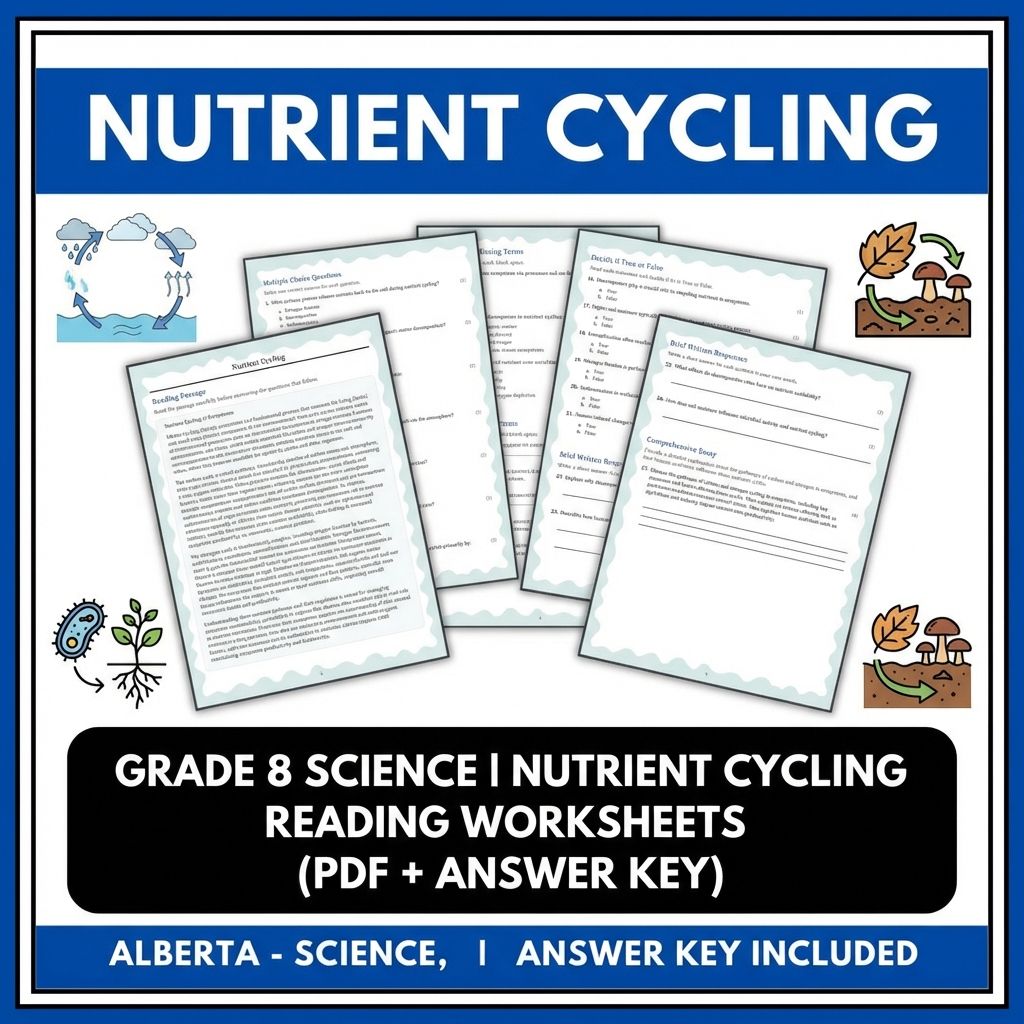
Grade 8 Science | Nutrient Cycling Reading Worksheets (PDF + Answer Key)
JCreated byJ.S SheetsLearning Objectives
- Describe the processes involved in nutrient cycling within ecosystems.
- Explain how carbon and nitrogen pathways influence ecosystem productivity.
- Analyze the roles of decomposers and the impact of environmental factors on nutrient cycling.
Also included in: Grade 8 Science Bundle | Ecosystem Dynamics & Environmental Impact Worksheets +1 more
Instant download

Simple Machines Worksheet | Grade 8 Science Practice
Created byPrism Point LearningLearning Objectives
- Identify common simple machines (lever, pulley, inclined plane, wheel and axle, wedge, screw) and explain how each helps modify force direction or magnitude.
- Compare how machine arrangement affects the input force needed to complete a task using concepts of mechanical advantage, force, distance, and motion.
- Use everyday examples (seesaws, flagpoles, ramps) to describe practical trade-offs among force, distance moved, and work done.
Also included in: Grade 8 Force, Motion & Energy Science Lesson Bundle for TEKS Practice +1 more
Instant download

Metacentric Height and Upright Stability Worksheets Grade 8 Science
Created byPrism Point LearningLearning Objectives
- Explain how CG and CB affect the stability of a floating object
- Describe how metacentric height relates to righting moments
- Calculate simple stability margins from given loading conditions
Also included in: Fluids, Pressure & Buoyancy Lesson Bundle | Grade 8 Science | Ontario +1 more
Instant download

Environmental Balances Worksheet | Grade 8 Science Activities
Created byPrism Point LearningLearning Objectives
- Explain how mass conservation helps interpret chemical and physical changes in environmental systems.
- Apply particle theory to describe how contamination and remediation can change over time.
- Classify environmental substances and processes (e.g., sources, sinks, mixtures, and phases) using system-level evidence.
Also included in: Grade 8 Matter & Chemical Change Lesson Bundle | Alberta Science
Instant download

Measurement Practices Worksheet Grade 8 Science | Data & Lab Skills
Created byPrism Point LearningLearning Objectives
- Explain how accuracy and precision affect the credibility of experimental measurements.
- Identify appropriate tools and units for measuring different physical quantities.
- Use significant figures and consistent recording procedures to improve data quality.
Also included in: Grade 8 Scientific Inquiry & CER Lesson Bundle – Florida NGSSS Science
Instant download

Grade 8 Science | Digestive System Worksheet | BC Standards
 Created byLumora Learning
Learning Objectives
- Explain how mechanical and chemical processes work together in digestion.
- Identify the roles of tissue specialization such as epithelial cells and glandular tissue.
- Describe how the circulatory system transports nutrients to body cells.
Also included in: Grade 8 Science | Cell Organization & Systems Custom Bundle | BC Aligned
Instant download

Molecules And States Worksheet | Grade 8 Science Practice
Created byPrism Point LearningLearning Objectives
- Explain how particle spacing and motion differ in solids, liquids, and gases.
- Use the particle model to predict how temperature affects particle motion.
- Describe how state changes involve changes in particle motion and spacing.
Instant download

Grade 8 Science Worksheet | Conservation Approaches (PDF) BC Standards
 Created byEvergreen Desk Education
Learning Objectives
- Explain how different conservation approaches (protected areas, restoration, and habitat corridors) help maintain biodiversity.
- Analyze how sustainable resource management and threat reduction support ecosystem resilience.
- Describe how monitoring and adaptive management improve conservation effectiveness over time.
Instant download

Particle Model of Matter Worksheet | Grade 8 Science Activities & Practice
Created byPrism Point LearningLearning Objectives
- Explain how constant particle motion and forces help describe the properties of solids, liquids, and gases.
- Use the particle model to predict how temperature affects motion, diffusion, and compressibility.
- Connect particle spacing and interactions to everyday observations such as diffusion and expansion.
Instant download

Thermal Effects Worksheet | NGSS Grade 8 Science Assessment
Created bySkylark WorksheetsLearning Objectives
- Explain how temperature relates to particles’ average kinetic energy and how particle motion changes with heating and cooling.
- Use temperature-phase behavior (heating/boiling/freezing plateaus) to predict what phase change is occurring and why temperature may stay constant during those changes.
- Distinguish reversible physical state changes from changes involving chemical composition during thermal processes.
Also included in: Matter and Its Interactions Lesson Bundle | Grade 8 Science | NGSS +1 more
Instant download
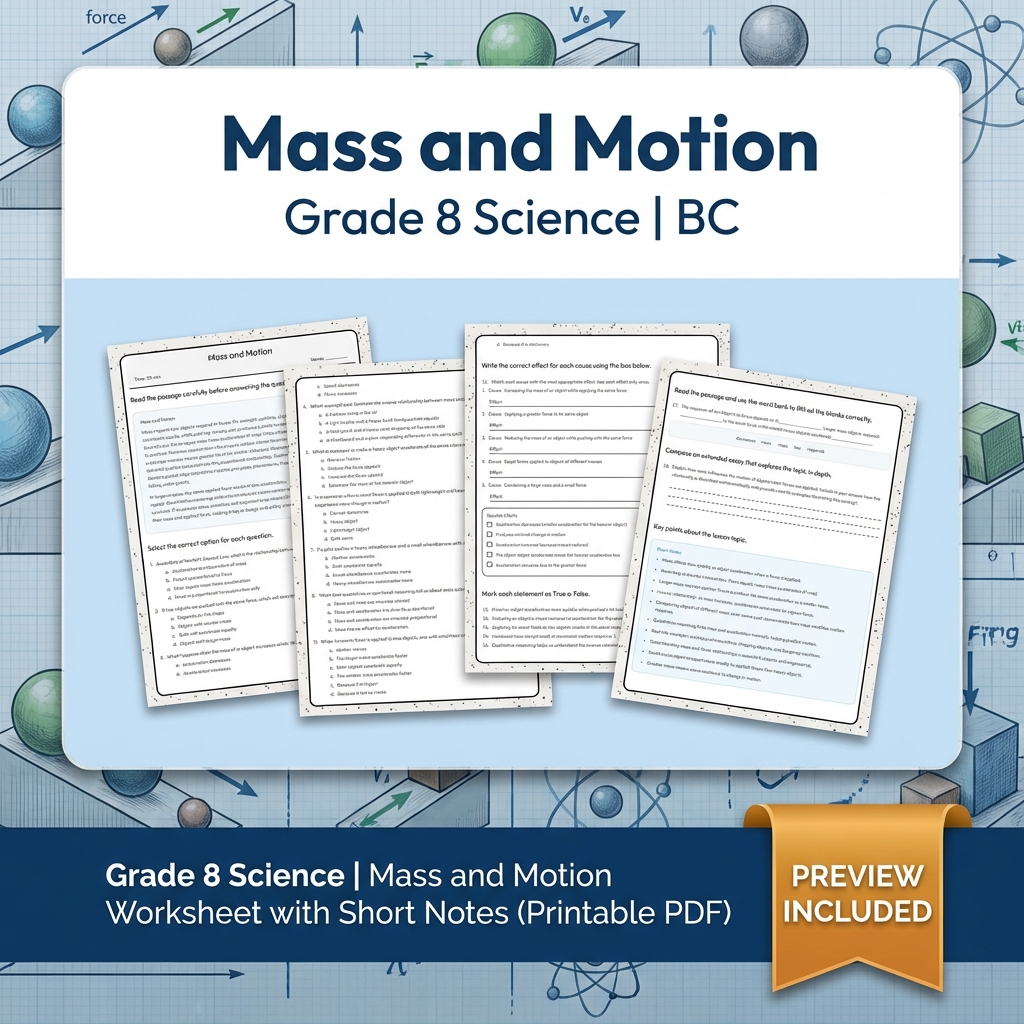
Grade 8 Science | Mass and Motion Worksheet with Short Notes (Printable PDF)
 Created byMeadowlark Worksheets
Learning Objectives
- Understand how mass influences an object's acceleration when a net force is applied.
- Describe the inverse relationship between mass and acceleration for a constant force.
- Compare the effects of different masses on motion through qualitative reasoning.
Also included in: Grade 8 Science Lesson Bundle | BC Framework & Key Concepts Worksheet Pack +1 more
Instant download

Measurement Practices Worksheet | Grade 8 Science NGSSS Skills + Key
Created byEvergreen Desk EducationLearning Objectives
- Use appropriate units and tools to make and record scientific measurements accurately.
- Distinguish between accuracy and precision and explain how calibration reduces systematic errors.
- Apply significant-figure rules and consistent recording procedures to improve data quality.
Instant download

Measuring Density Worksheets: Mass, Volume & Uncertainty Grade 8
Created byPrism Point LearningLearning Objectives
- Calculate density from measured mass and volume values
- Describe displacement and overflow methods for irregular object volume
- Explain how uncertainty affects measured density results
Also included in: Fluids, Pressure & Buoyancy Lesson Bundle | Grade 8 Science | Ontario +1 more
Instant download

Comparative Cells Practice Worksheet | Grade 8 Science Assessment
Created byPrism Point LearningLearning Objectives
- Compare plant and animal cells by identifying key structures and what they do.
- Explain how chloroplasts, cell walls, central vacuoles, plasmodesmata, centrioles, and lysosomes affect cell functions.
- Contrast prokaryotic and eukaryotic cell organization and predict how these differences influence survival and metabolism.
Also included in: Grade 8 Cell Organization & Homeostasis Science lesson bundle: Ontario
Instant download

Hydrostatic Forces Worksheets: Submerged Surfaces and Pressure Grade 8
Created byPrism Point LearningLearning Objectives
- Explain how fluid pressure changes with depth on submerged surfaces
- Determine the center of pressure for simple submerged surface shapes
- Interpret pressure distributions on planar vertical surfaces
Also included in: Fluids, Pressure & Buoyancy Lesson Bundle | Grade 8 Science | Ontario +1 more
Instant download

Mass Conservation Worksheets | Chemical Change Grade 8 Science
 Created bySunny Desk Resources
Learning Objectives
- Explain the law of mass conservation in terms of a closed system and accounting for reactants and products.
- Use balanced chemical ideas to predict how mass measurements change (or do not change) during physical and chemical changes.
- Interpret simple mass data from sealed processes, including emissions and contained waste.
Also included in: Matter & Chemical Change Grade 8 Science Bundle | Alberta Worksheets +1 more
Instant download

Science Grade 8 Solar System Feature Evidence Worksheet | Standards-Aligned
JCreated byJ.S SheetsLearning Objectives
- Explain major solar system features using multiple lines of evidence such as composition, density, and surface characteristics
- Connect planetary differentiation and heat history to observed differences across planets and smaller bodies
- Use observations of craters, volcanic landforms, rings, and moons to make evidence-based claims about geologic activity and impacts
Also included in: Grade 8 Earth and Space Systems Science Lesson Bundle – General Framework +1 more
Instant download
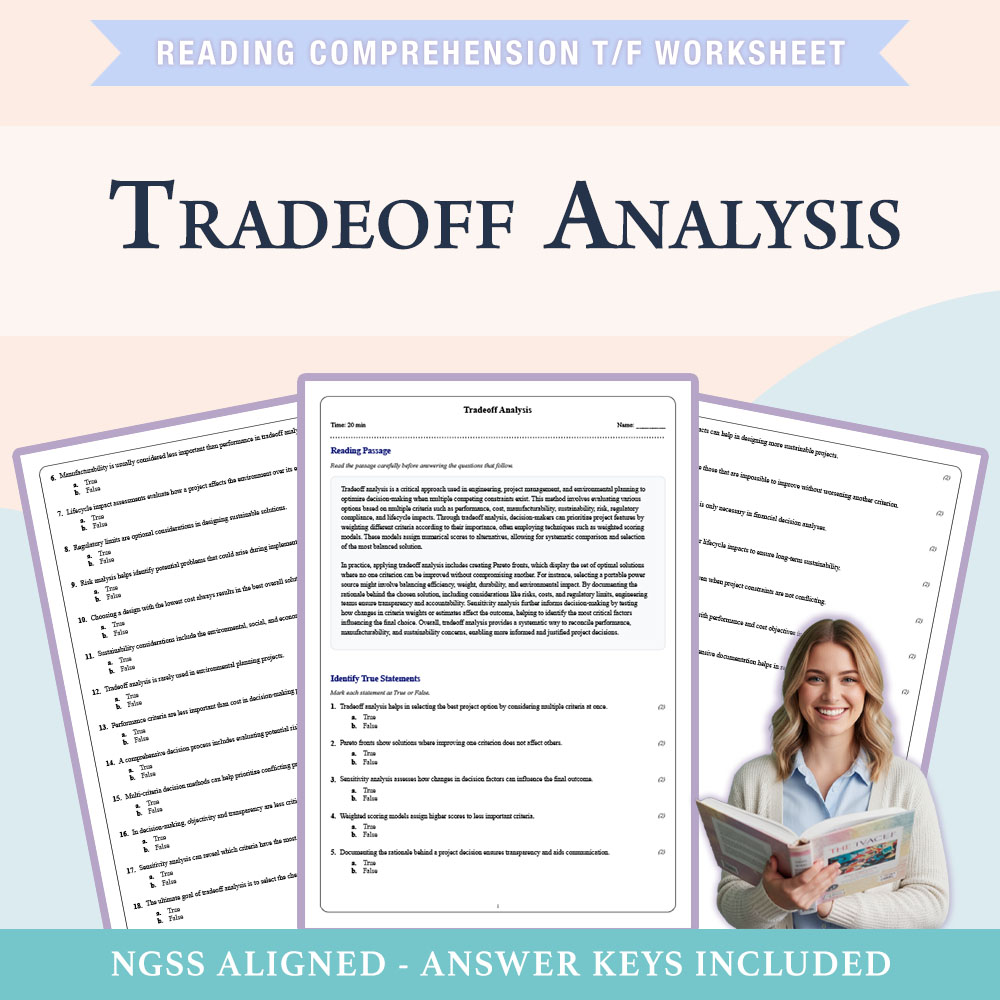
8th Grade Science | Tradeoff Analysis Worksheet (PDF + Answer Key)
 Created byCopper Leaf Classroom
Learning Objectives
- Understand the concept of tradeoff analysis in decision-making
- Identify factors influencing project constraints and choices
- Apply multi-criteria decision methods such as weighted scoring and pareto comparisons
Also included in: Grade 8 Science Unit | Engineering Problem-Solving Worksheets (PDF + Answer Key) +1 more
Instant download
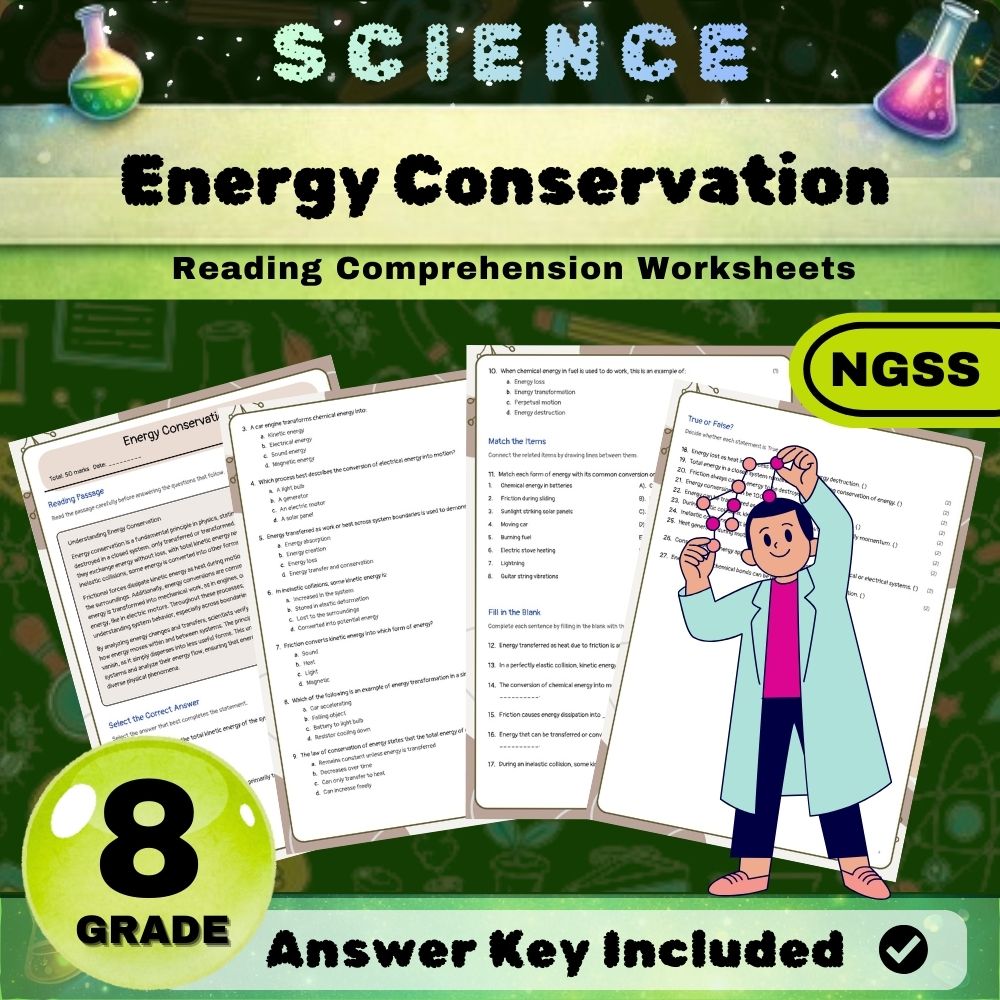
Grade 8 Science Energy Conservation Worksheet (NGSS) – PDF
 Created byMaple Path Learning
Learning Objectives
- Explain how changes in an object's kinetic energy relate to energy transfer, illustrating the conservation of energy in closed systems.
- Describe examples of energy transformations during collisions, friction, and chemical to mechanical conversions.
- Quantify energy transfers through work and heat to support energy conservation explanations.
Also included in: Grade 8 Science NGSS Energy Unit Bundle for Classroom or Distance Learning +1 more
Instant download

Reaction Evidence Test Prep Printable | Grade 8 Science
Created byPrism Point LearningLearning Objectives
- Identify observable indicators of chemical change such as gas production, precipitate formation, color change, and temperature change.
- Interpret qualitative and quantitative evidence from reactions to distinguish chemical change from physical mixing.
- Explain how macroscopic evidence connects to particle rearrangement and formation of new substances.
Also included in: Grade 8 Matter & Chemical Reactions Science Lesson Bundle (NGSS)
Instant download

Grade 8 Science | Reaction Quantities - Daily Reading Comprehension
Created byCoral Reef LearningLearning Objectives
- Understand the concept of chemical reactions and identify reactants and products
- Apply proportional reasoning to predict amounts of substances involved in reactions
- Explain the principle of mass conservation in chemical processes
Also included in: Matter and Chemical Change Lesson Bundle – Alberta Grade 8 Science +1 more
Instant download

Grade 8 Reaction Evidence Worksheet | NGSS Practice PDF
 Created byClear Sky Classroom
Learning Objectives
- Identify observable indicators of chemical reactions such as color change, gas production, precipitate formation, and temperature change.
- Interpret qualitative and quantitative data to distinguish chemical changes from physical processes.
- Link macroscopic evidence to particle rearrangements and formation of new substances.
Also included in: Grade 8 Conservation of Matter Science Lesson Bundle | NGSS +1 more
Instant download

Density, Floating and Specific Gravity Worksheets Grade 8 Science
Created byPrism Point LearningLearning Objectives
- Define density as mass per unit volume
- Calculate density using mass and volume measurements
- Compare material density with the density of water
Also included in: Fluids, Pressure & Buoyancy Lesson Bundle | Grade 8 Science | Ontario +1 more
Instant download

Grade 8 Science – Scientific Inquiry & Observing Nature | Reading Worksheet
 Created byBright Mind Resources
Learning Objectives
- Understand the importance of making observations in scientific inquiry
- Learn how to ask relevant questions about natural phenomena
- Develop skills for recording observations carefully
Also included in: Scientific Inquiry Grade 8 Science Daily Reading Worksheets | Lesson | FL NGSSS +1 more
Instant download

Grade 8 Science Worksheet | Mixtures Versus Compounds (PDF) – BC Standards
Created byEvergreen Desk EducationLearning Objectives
- Differentiate mixtures and compounds using the ideas of physical combination versus chemical bonding.
- Explain how properties of components in mixtures compare to properties of compounds.
- Use evidence from separation methods (physical vs chemical) to classify an unknown sample.
Instant download

Grade 8 Internal Structures Worksheet | Body Systems & Functions
Created byPrism Point LearningLearning Objectives
- Explain how internal body structures help organisms survive, grow, and reproduce.
- Describe how structure and function are connected in circulatory, digestive, and respiratory systems.
- Compare external features with internal needs related to feeding and protection.
Instant download

Critical Evaluation Worksheet | Grade 8 Science Activities
Created byPrism Point LearningLearning Objectives
- Evaluate scientific claims by judging evidence quality and methodological sufficiency.
- Distinguish correlation from causation and identify possible confounding variables.
- Recognize common logical fallacies and explain why alternative explanations matter in science.
Also included in: Grade 8 Scientific Inquiry and Data Analysis Science Lesson Bundle – TEKS +1 more
Instant download

Grade 8 TEKS Mixtures vs. Pure Substances Science Reading Worksheet
 Created byBRIGHT PATH RESOURCES
Learning Objectives
- Distinguish between pure substances and mixtures using observable properties
- Identify whether a mixture is heterogeneous or homogeneous based on its appearance and uniformity
- Explain why solutions are mixtures and relate concentration to saturation
Also included in: Grade 8 Matter and Energy Science Reading Worksheets Bundle | TEKS +1 more
Instant download
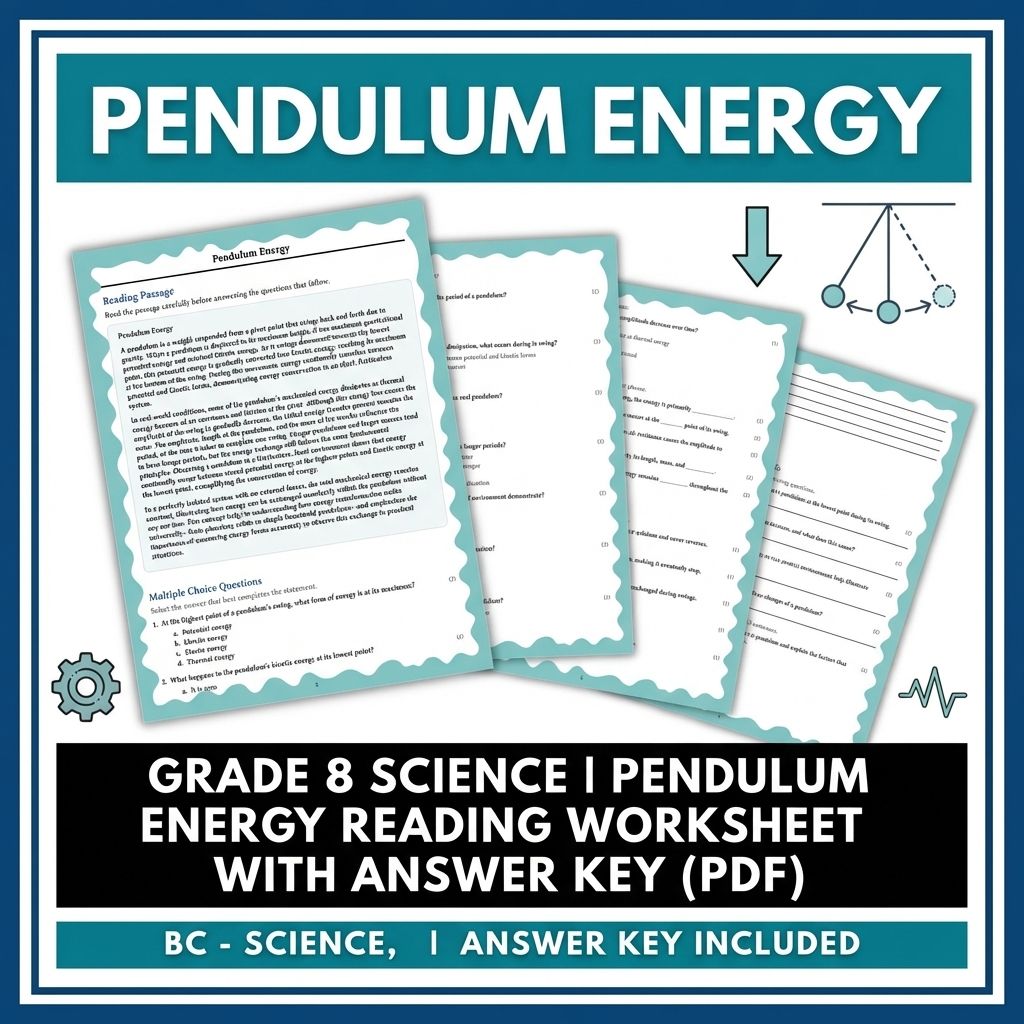
Grade 8 Science | Pendulum Energy Reading Worksheet with Answer Key (PDF)
JCreated byJ.S SheetsLearning Objectives
- Understand the energy transformation between potential and kinetic energy in a pendulum.
- Identify factors influencing the energy distribution and period of a pendulum.
- Explain how energy conservation occurs in ideal pendulum systems without dissipation.
Instant download

Layered Fluids Worksheet Practice | Grade 8 Science Assessment
Created byPrism Point LearningLearning Objectives
- Explain how temperature and salinity affect fluid density and create stratified layers.
- Describe buoyant exchange across interfaces and why mixing can be suppressed in pycnoclines.
- Interpret how density profiles relate to stability and pollutant or thermal dispersion.
Instant download

Water Routing and Landforms Worksheet | Grade 8 Science Standards-Aligned
JCreated byJ.S SheetsLearning Objectives
- Explain how runoff, erosion, transport, and deposition shape valleys and deltas.
- Describe how groundwater influences springs and affects weathering of rocks.
- Connect tectonic uplift and changing drainage patterns to where sediment accumulates.
Also included in: Grade 8 Earth and Space Systems Science Lesson Bundle – General Framework +1 more
Instant download

Comparative Cells Worksheet | Ontario Grade 8 Science Assessment
 Created byCedar Grove Learning
Learning Objectives
- Compare plant and animal cell structures (cell wall, chloroplasts, central vacuole, plasmodesmata, centrioles, lysosomes) and relate them to functions.
- Distinguish prokaryotic from eukaryotic cell organization and explain how differences affect metabolic capabilities.
- Use cell structure–function relationships to interpret how morphology supports ecological roles such as photosynthesis and motility.
Instant download
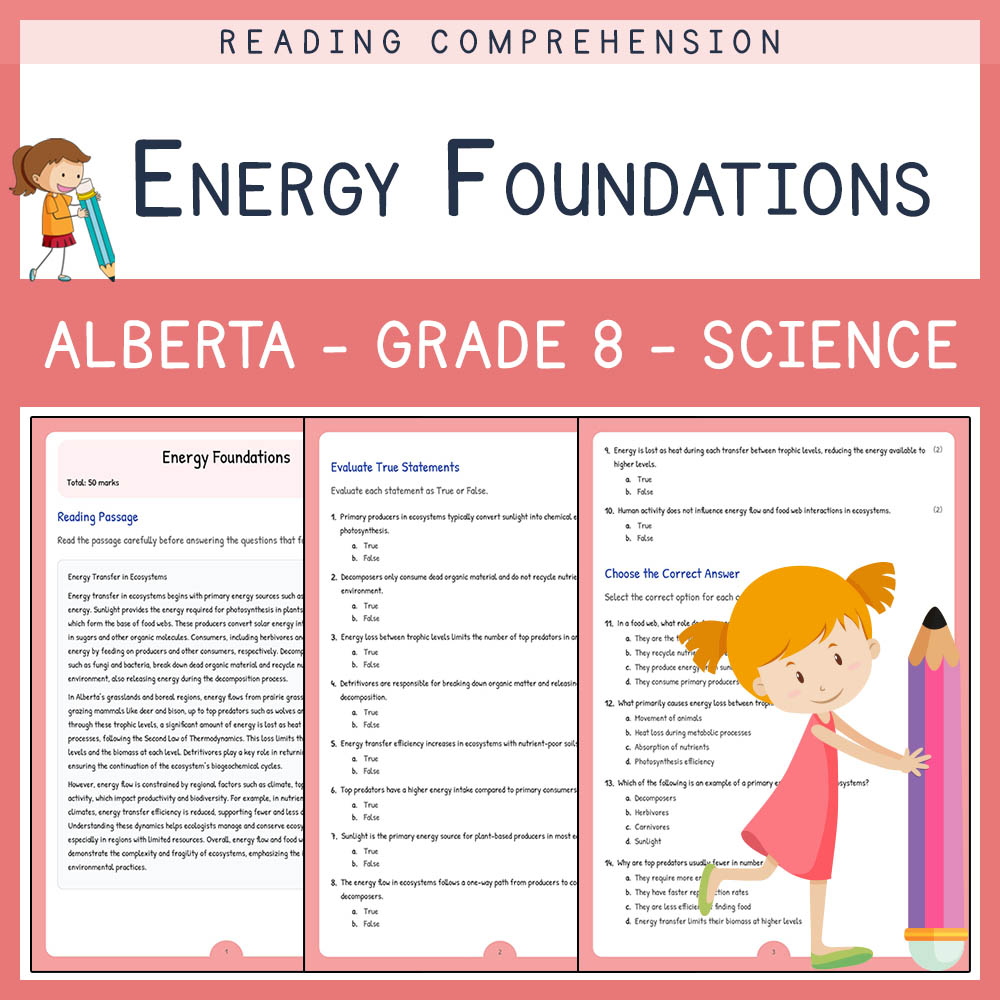
Grade 8 Science | Energy Foundations Worksheet | Alberta Standard
Created byLumora LearningLearning Objectives
- Understand how energy transfers within ecosystems starting from primary sources such as sunlight and chemical energy.
- Explain the roles of producers, consumers, decomposers, and detritivores in energy flow and matter recycling.
- Describe how energy loss occurs between trophic levels and the limitations that affect energy support in regional communities.
Instant download

Experimental Design Worksheet | Grade 8 Science Practice
Created byPrism Point LearningLearning Objectives
- Write a testable hypothesis and identify the independent and dependent variables in an experiment.
- Use operational definitions and choose reliable control conditions and replication to reduce bias.
- Select appropriate measurement criteria and recognize confounding factors in real-world investigations.
Also included in: Grade 8 Scientific Inquiry and Data Analysis Science Lesson Bundle – TEKS +1 more
Instant download

Grade 8 Atmospheric Effects Worksheet | Ontario Science + Doodle Notes
 Created byChalk and Compass
Learning Objectives
- Explain how atmospheric pressure affects boiling point and why sealed instruments rely on pressure differences.
- Describe how barometers work and how pressure gradients drive wind.
- Use kPa and altitude relationships to predict real-world atmospheric effects.
Also included in: Fluids, Pressure & Flow Lesson Bundle — Grade 8 Science Ontario +1 more
Instant download

Rock Cycle Worksheet Grade 8 Science Activities | Earth Science NGSSS
Created byPrism Point LearningLearning Objectives
- Explain how the rock cycle connects igneous, sedimentary, and metamorphic rocks
- Describe how weathering, erosion, deposition, heat, and pressure transform rocks over time
- Relate lithospheric recycling to tectonic plate motion and Earth’s energy transfer
Also included in: Earth Systems & Climate Lesson Bundle | Grade 8 Science | Florida NGSSS
Instant download
About Grade 8 Science Worksheets
Explore Grade 8 Science worksheets for classwork, homework, or review. Our 6,006 printables download instantly as PDFs.
Each resource here is built by an independent educator and reviewed for quality. Worksheets print straight from PDF and suit classroom use, homework, or extra practice; most come with answer keys, and you can preview before purchasing.