
Grade 8 Science Worksheets
6,006 worksheets
Grade 8 Science | Genetic Diversity Worksheet | BC Standards
 Created byLumora Learning
Learning Objectives
- Understand the concept of genetic diversity and its importance for populations.
- Identify factors that influence genetic variation within species.
- Explain the consequences of low genetic diversity on species survival.
Instant download

Water Cycle Systems Reading Comprehension Worksheet | Grade 8 Science
 Created byEvergreen Desk Education
Learning Objectives
- Explain how the water cycle moves water through Earth systems (atmosphere, land, oceans, and organisms).
- Use cause-and-effect reasoning to describe how temperature and energy influence evaporation and precipitation.
- Compare natural water pathways (runoff and infiltration) with human impacts on local water availability.
Instant download

Grade 8 Science – Reaction Evidence & Chemical Changes | Daily Reading Worksheet
 Created byBright Mind Resources
Learning Objectives
- Identify observable indicators of chemical reactions such as color change, gas evolution, precipitate formation, temperature change, and irreversibility.
- Differentiate between physical and chemical changes based on reaction signs.
- Understand real-life examples of chemical reactions like rusting, combustion, and effervescence.
Also included in: Grade 8 Energy Transfer & Heat Transfer Science Lesson Bundle | TEKS Daily +2 more
Instant download

Work And Energy Worksheet | Ontario Grade 8 Science Practice PDF
 Created byCedar Grove Learning
Learning Objectives
- Explain how work depends on the force component along displacement and how the sign of work relates to the direction of motion
- Use the work–energy theorem to connect net work to changes in kinetic energy
- Calculate work for constant forces and describe how to find work for variable forces
Instant download
Grade 8 Science | Cell Structure Worksheet (Worksheet + Answer Key) – TEKS aligned
Created byBright Mind ResourcesLearning Objectives
- Describe the organization of cells from membranes to organelles and their functions.
- Explain the roles of the nucleus, mitochondria, and chloroplasts in maintaining cellular activity.
- Compare prokaryotic and eukaryotic cells to understand their structure and function differences.
Also included in: Grade 8 Science Unit Bundle | Ecosystems,Evolution & Cell Processes TEKS Aligned +1 more
Instant download
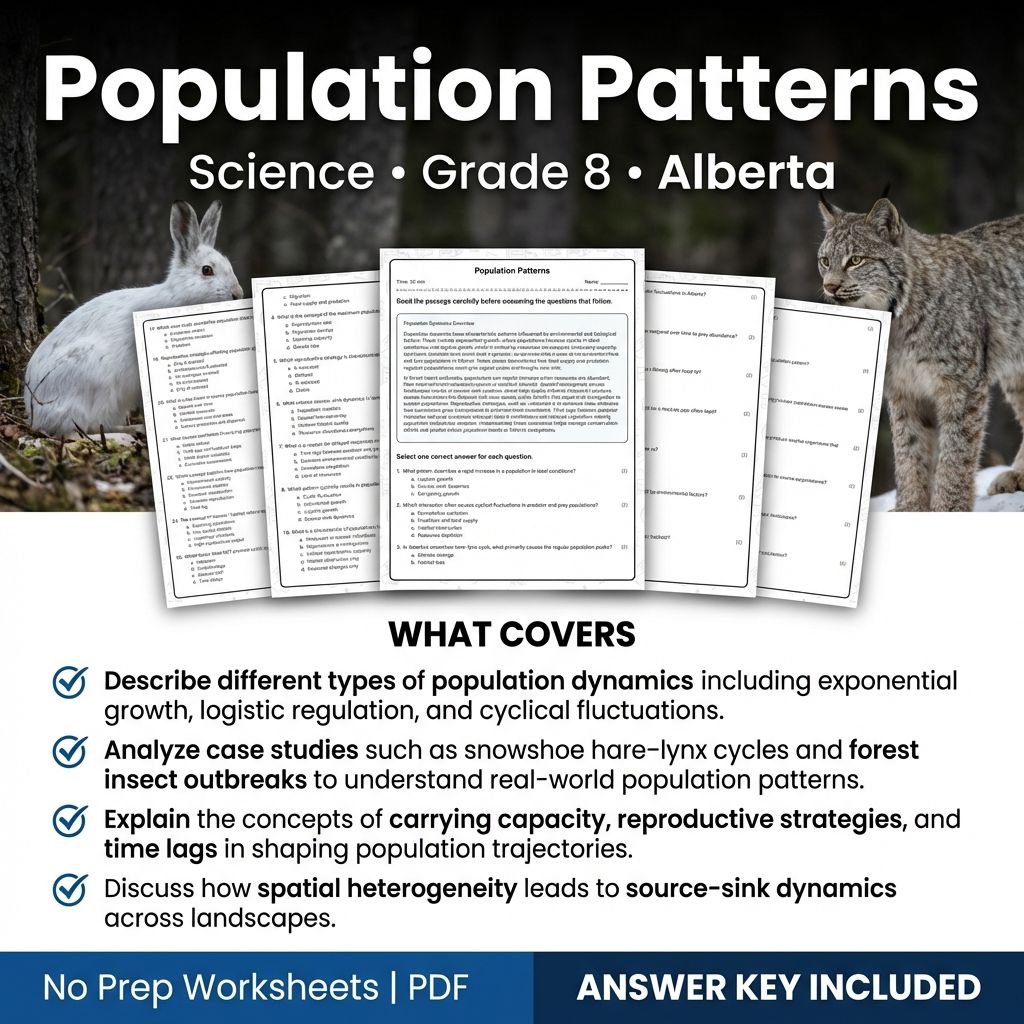
Population Patterns Worksheet for Grade 8 Science | Alberta Standards
 Created byCoral Reef Learning
Learning Objectives
- Describe different types of population dynamics including exponential growth, logistic regulation, and cyclical fluctuations.
- Analyze case studies such as snowshoe hare–lynx cycles and forest insect outbreaks to understand real-world population patterns.
- Explain the concepts of carrying capacity, reproductive strategies, and time lags in shaping population trajectories.
Instant download

Grade 8 Particle Theory of Matter Worksheet | Alberta Science Activity
 Created byBRIGHT PATH RESOURCES
Learning Objectives
- Describe particle theory: matter is made of tiny particles.
- Explain how particle motion and spacing relate to the properties of solids, liquids, and gases.
- Use Alberta examples to connect temperature to particle motion and state changes.
Also included in: Grade 8 Alberta Science Matter and Chemical Change Worksheet Bundle +1 more
Instant download

Grade 8 Science | Atmospheric Structure - Daily Reading Comprehension
Created byCoral Reef LearningLearning Objectives
- Identify and describe the layers of the Earth's atmosphere.
- Understand the characteristics and functions of each atmospheric layer.
- Explain the role of ozone, greenhouse gases, and atmospheric pressure in weather and climate.
Instant download

Grade 8 Modeling Data in Science Worksheet | NGSS Data Analysis Activity
Created byBRIGHT PATH RESOURCESLearning Objectives
- Understand what physical models are and how they are used in science
- Learn about the different types of models such as scale models, force sensors, and simulations
- Recognize the limitations and sources of measurement uncertainty in models
Also included in: Design Tradeoffs Grade 8 Science Daily Reading Worksheets Lesson Bundle | NGSS +2 more
Instant download

Grade 8 Population & Stability Worksheet | Ecosystem Interactions & Resilience
Created byEvergreen Desk EducationLearning Objectives
- Explain how interactions among organisms (predation, competition, disease, and mutualism) influence population size.
- Describe how changes in populations can affect ecosystem stability over time.
- Connect population interactions to changes in energy flow and matter cycling.
Instant download

Net Force & Acceleration Worksheet | Grade 8 Science NGSSS + Key + Notes
Created byEvergreen Desk EducationLearning Objectives
- Explain how net force is found by combining forces, including forces acting in opposite directions.
- Predict how net force affects acceleration, including changes in speed and direction.
- Use a real-world example (a cart on a smooth track) to justify the direction of motion and acceleration.
Instant download

Grade 8 Science – Tissue Organization & Function | Daily Reading Worksheet
 Created byQuiet Forest Education
Learning Objectives
- Understand the structure and functions of epithelial tissue
- Identify major tissue types: epithelial, connective, muscle, nervous
- Describe cellular components and extracellular matrix in tissues
Also included in: Cell Biology Grade 8 Science Daily Reading Worksheets Bundle | Ontario +1 more
Instant download
8th Grade Science | The Scientific Method Worksheet (PDF+ Answer Key)
 Created byCopper Leaf Classroom
Learning Objectives
- Understand the steps involved in the scientific method and inquiry process.
- Identify key components such as hypotheses, operational definitions, and evidence-based claims.
- Describe how controlled experiments support causal reasoning.
Instant download

Evidence From Testing Worksheet | Grade 8 Science Activities
 Created byPrism Point Learning
Learning Objectives
- Explain how observations and measurements become evidence for a design or claim.
- Compare data from testing to stated criteria to judge whether a solution works.
- Use both quantitative and qualitative evidence to strengthen confidence in results.
Instant download

Collision Forces and Impulse Worksheets | Grade 8 Science
 Created bySunny Desk Resources
Learning Objectives
- Explain how contact time and force magnitude during a collision affect changes in motion
- Describe how deformation can absorb energy during short collisions
- Identify observable effects that relate to the peak force during contact
Also included in: Forces and Motion Grade 8 Alberta Science Worksheets Bundle +1 more
Instant download
Grade 8 Science – Earth–Sun–Moon System | Daily Reading Worksheet
 Created byElena Brooks
Learning Objectives
- Describe the relative positions of the Earth, Sun, and Moon during different phases.
- Explain how axial tilt and orbital motion cause seasonal changes.
- Identify the causes of lunar phases, solar eclipses, and lunar eclipses.
Instant download

Energy Basics Worksheet | Grade 8 Science Practice Assessments
Created byPrism Point LearningLearning Objectives
- Explain mechanical energy as the sum of kinetic and potential energy
- Describe how energy transfers occur when forces do work
- Identify how friction and air resistance can convert mechanical energy into thermal energy
Also included in: Forces, Motion & Energy Lesson Bundle | Grade 8 Science | BC +1 more
Instant download
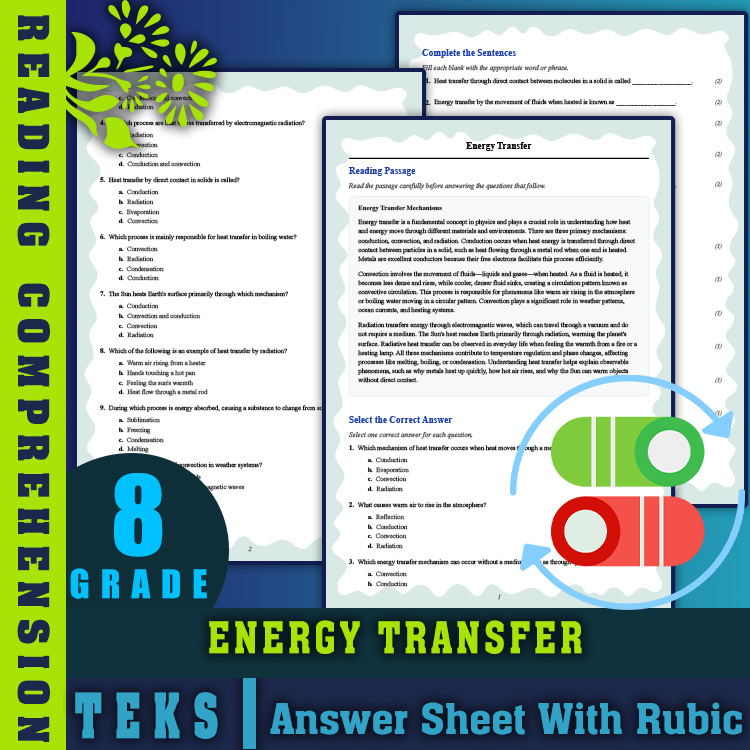
Grade 8 Science | Energy Transfer Reading Worksheet with Answer Key (PDF)
JCreated byJ.S SheetsLearning Objectives
- Understand the mechanisms of conduction, convection, and radiation in thermal processes
- Identify examples of energy transfer in real-world scenarios
- Explain how energy transfer influences phase changes and temperature changes
Instant download

Inclined Forces Worksheet for Grade 8 Science | Standards-Aligned Practice
JCreated byJ.S SheetsLearning Objectives
- Analyze the components of forces acting on slopes by resolving gravity into perpendicular and parallel components.
- Understand how slope steepness affects unbalanced forces and potential acceleration.
- Apply vector decomposition concepts to real-world inclined scenarios.
Also included in: Grade 8 Forces & Motion Science Lesson Bundle – Alberta framework worksheets +1 more
Instant download

Measurement Precision for Motion and Force Worksheets | Grade 8
Created bySunny Desk ResourcesLearning Objectives
- Explain why calibration and instrument accuracy affect motion and force measurements.
- Estimate uncertainty and interpret results using significant figures.
- Compare repeatability and reliability when measurements change across trials.
Also included in: Forces and Motion Grade 8 Alberta Science Worksheets Bundle +1 more
Instant download

Grade 8 Science | Chemical Indicators and Evidence | California Standards
Created byLumora LearningLearning Objectives
- Differentiate physical and chemical changes using particle-level reasoning.
- Identify observable chemical indicators such as gas production, color change, and precipitate formation.
- Use evidence-based claims to decide whether a new substance formed.
Instant download

Grade 8 Cell Theory Worksheet | Ontario Science Activity + Doodle Notes
 Created byChalk and Compass
Learning Objectives
- Explain the three core statements of cell theory and how they apply to living things
- Describe how microscopy and imaging evidence helped scientists develop cell theory
- Use key cell theory vocabulary (cell, nucleus, organelle, pre-existing cells) to answer science questions
Also included in: Grade 8 Science Cell Organization, Transport & Homeostasis Lesson Bundle – Ontario +1 more
Instant download

Rock Cycle Worksheet for Grade 8 Science | Standards-Aligned Practice
JCreated byJ.S SheetsLearning Objectives
- Understand the processes involved in Earth's rock cycle.
- Identify different types of rocks and how they transform from one form to another.
- Explain how Earth's materials cycle through various Earth systems over time.
Also included in: Grade 8 Earth & Space Science Lesson Bundle | California Standards +1 more
Instant download

Grade 8 Science – Solution Comparison Daily Reading Worksheet | NGSS
Created byBright Mind ResourcesLearning Objectives
- Understand the different design concepts for solutions such as helmets and lighting systems.
- Learn to evaluate and compare solutions using measurable performance indicators.
- Develop skills to create concept sketches, trade-off matrices, and assess solutions qualitatively and quantitatively.
Also included in: Grade 8 Tradeoff Analysis Science Daily Reading Worksheets Lesson Bundle | NGSS +1 more
Instant download

Measurement Basics Worksheet | Grade 8 Science Practice
Created byPrism Point LearningLearning Objectives
- Identify and use SI units for mass, length, volume, and temperature.
- Convert between common metric units and report measured values with appropriate significant figures.
- Distinguish accuracy from precision and explain how measurement uncertainty affects results.
Also included in: Grade 8 Scientific Inquiry and Data Analysis Science Lesson Bundle – TEKS +1 more
Instant download

Grade 8 Science | Density Concept - Daily Reading Comprehension
Created byCoral Reef LearningLearning Objectives
- Understand the definition of density as mass per unit volume.
- Learn how to calculate density using SI units.
- Identify the relationship between density, buoyancy, and object sinking or floating.
Instant download

Grade 8 Science | Understanding Power in Science - Daily Reading Comprehension
Created byCoral Reef LearningLearning Objectives
- Define power as the rate of doing work.
- Explain units of power, specifically watts.
- Relate mechanical systems' performance to power output.
Instant download

Grade 8 Atmospheric Structure Daily Science Reading Worksheet | TEKS
Created byBRIGHT PATH RESOURCESLearning Objectives
- Identify the main idea and key details about atmospheric layers.
- Describe how pressure and temperature change with altitude.
- Explain why ozone and greenhouse gases matter in different layers.
Also included in: Grade 8 Earth and Space Science Daily Reading Worksheets Bundle | TEKS +1 more
Instant download

Grade 8 Forces And Motion Worksheet | Practice & Review PDF
 Created byClear Sky Classroom
Learning Objectives
- Explain how forces (pushes and pulls) change an object’s motion, including speed and direction
- Determine how balanced and unbalanced forces relate to stable motion or changes in velocity
- Use the idea of net force to predict the direction and effect of forces acting on an object
Instant download

Grade 8 Force Diagrams Science Daily Reading Worksheet | TEKS Activity
Created byBRIGHT PATH RESOURCESLearning Objectives
- Identify common forces in a free-body diagram and choose their correct vector directions.
- Explain how normal, gravitational, friction, and tension forces act in everyday motion.
- Describe how net force and friction affect acceleration on ramps and in hanging-mass situations.
Also included in: Grade 8 Force Motion and Energy Science Reading Worksheets Bundle | TEKS +1 more
Instant download

Density-Dependent & Independent Population Change Worksheets Grade 8
Created bySunny Desk ResourcesLearning Objectives
- Explain how density-dependent factors affect population size through changes in competition, disease, and social behavior.
- Compare density-dependent and density-independent factors and predict how each can influence population change.
- Use examples from Alberta habitats to describe how weather and habitat conditions regulate populations.
Also included in: Interactions & Ecosystems Grade 8 Science Worksheets Alberta Bundle +1 more
Instant download

Applied Investigations Worksheet Pack | Grade 8 Science Activities
Created byPrism Point LearningLearning Objectives
- Select appropriate variables and controls for a fair investigation in applied science contexts.
- Design a comparative procedure and collect reliable data while following safety and ethics guidelines.
- Use graphs and simple statistical summaries to support a conclusion based on evidence.
Also included in: Grade 8 Scientific Inquiry and Data Analysis Science Lesson Bundle – TEKS +1 more
Instant download

Grade 8 Reaction Signatures Worksheet | Alberta Use Practice PDF
Created byClear Sky ClassroomLearning Objectives
- Identify observable reaction signatures of chemical change (temperature change, precipitate, colour change, gas release).
- Explain how combining multiple indicators increases confidence that a chemical change occurred.
- Apply reaction-signature ideas to environmental and industrial examples.
Instant download

Grade 8 Science | Free Body Worksheet (Alberta Standards) (PDF)
 Created bySilver Birch Teaching
Learning Objectives
- Represent forces acting on an object using a free-body diagram with correct directions and relative sizes
- Identify and interpret the gravitational, normal, frictional, and applied forces in real-world scenarios
- Determine the direction of net force by reasoning with vector arrows (without focusing on calculations)
Also included in: Grade 8 Forces, Motion, and Energy Science Lesson Bundle for Alberta +1 more
Instant download

Pressure Basics Test Prep Printables | Grade 8 Science
Created byPrism Point LearningLearning Objectives
- Define fluid pressure as force per unit area and identify its SI unit
- Explain how contact area affects surface pressure and how pressure acts within fluids
- Use the relationship between newtons per square metre and kilopascals
Instant download

DNA and Traits Worksheet | Grade 8 NGSS Genetics Activity with Doodle Note
 Created byAmber Owl Education
Learning Objectives
- Explain how DNA sequence information is used to produce proteins and how proteins help determine observable traits.
- Describe the roles of genes, coding sequences, transcription, and translation in the inheritance of traits.
- Model how mutations (point mutations and frameshifts) can change amino acid sequences and affect protein function.
Also included in: Grade 8 Science Genetics Lesson Bundle – Next Generation Science Standards +1 more
Instant download
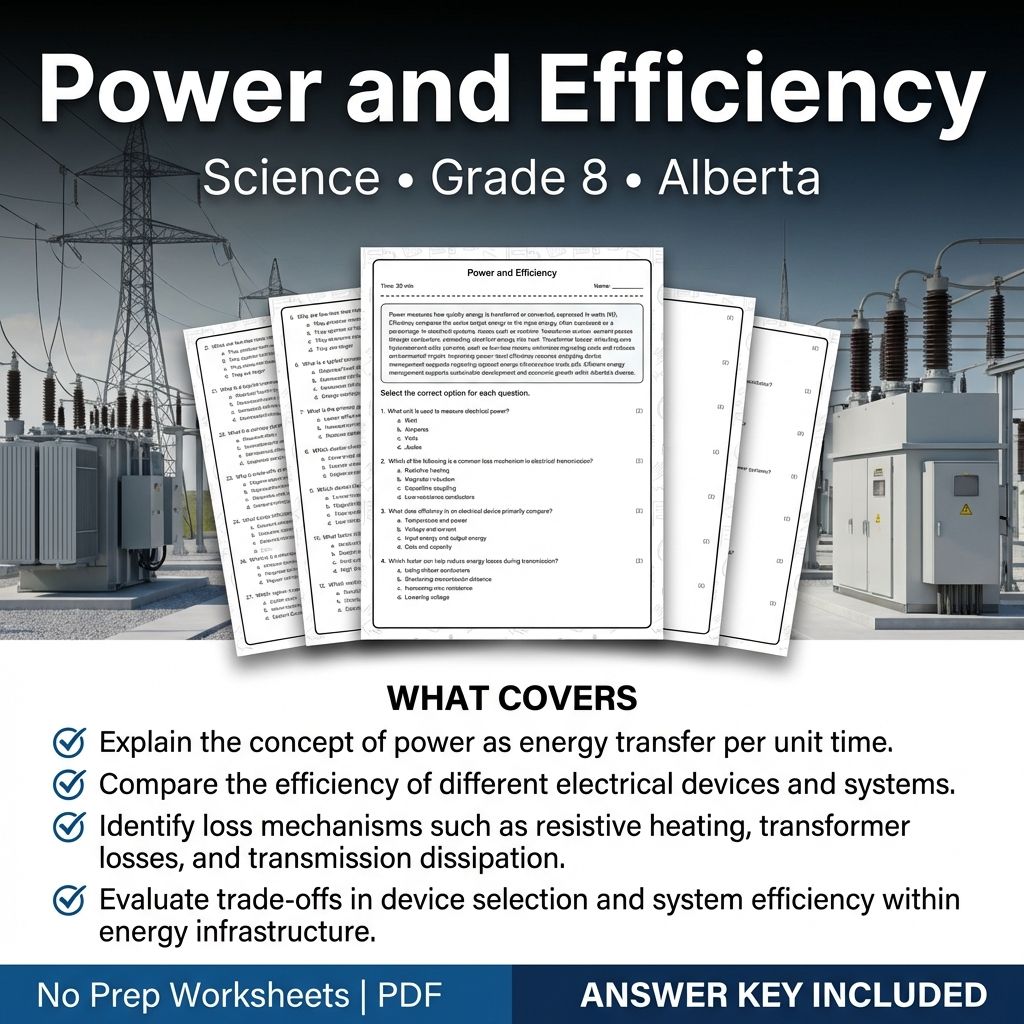
Power and Efficiency Worksheet for Grade 8 Science | Alberta Standards
Created byCoral Reef LearningLearning Objectives
- Explain the concept of power as energy transfer per unit time.
- Compare the efficiency of different electrical devices and systems.
- Identify loss mechanisms such as resistive heating, transformer losses, and transmission dissipation.
Instant download
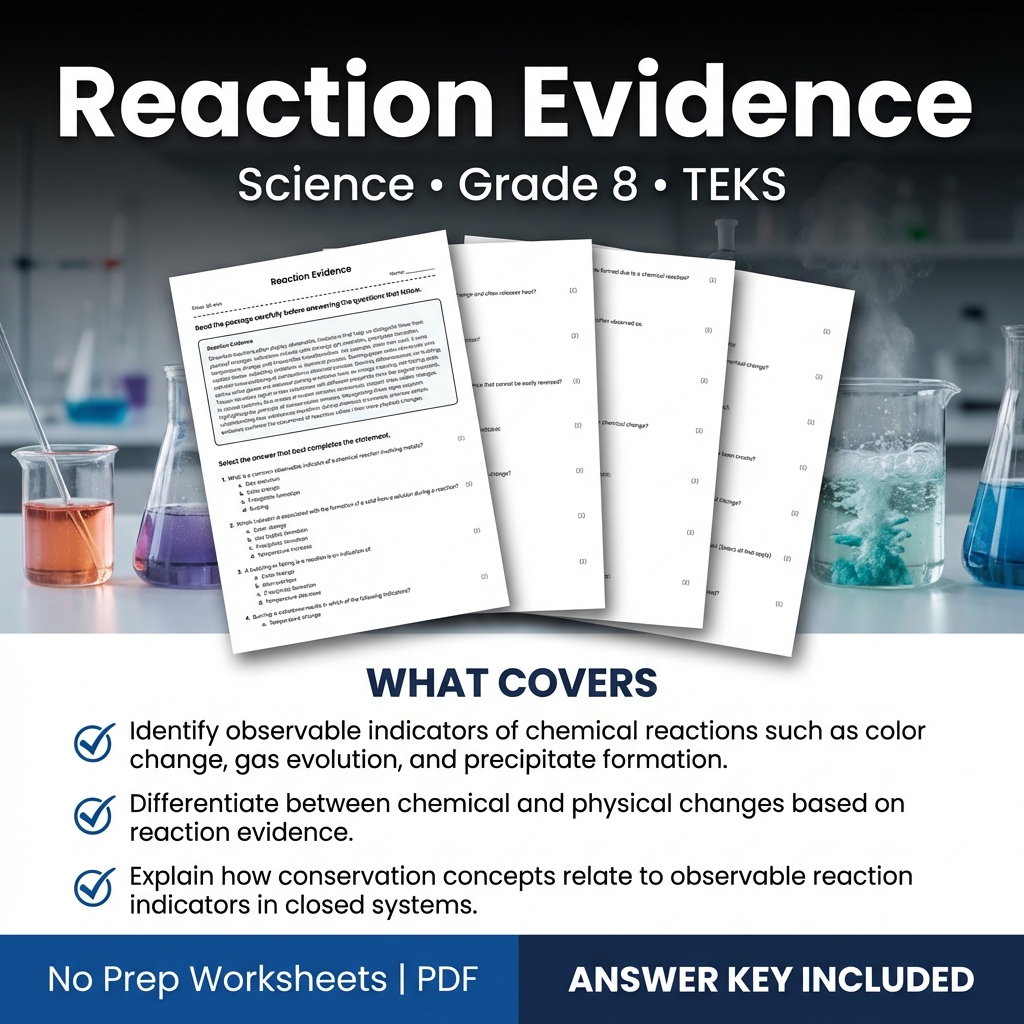
Reaction Evidence Worksheet | TEKS Grade 8 Science Assessment
Created byCoral Reef LearningLearning Objectives
- Identify observable indicators of chemical reactions such as color change, gas evolution, and precipitate formation.
- Differentiate between chemical and physical changes based on reaction evidence.
- Explain how conservation concepts relate to observable reaction indicators in closed systems.
Instant download
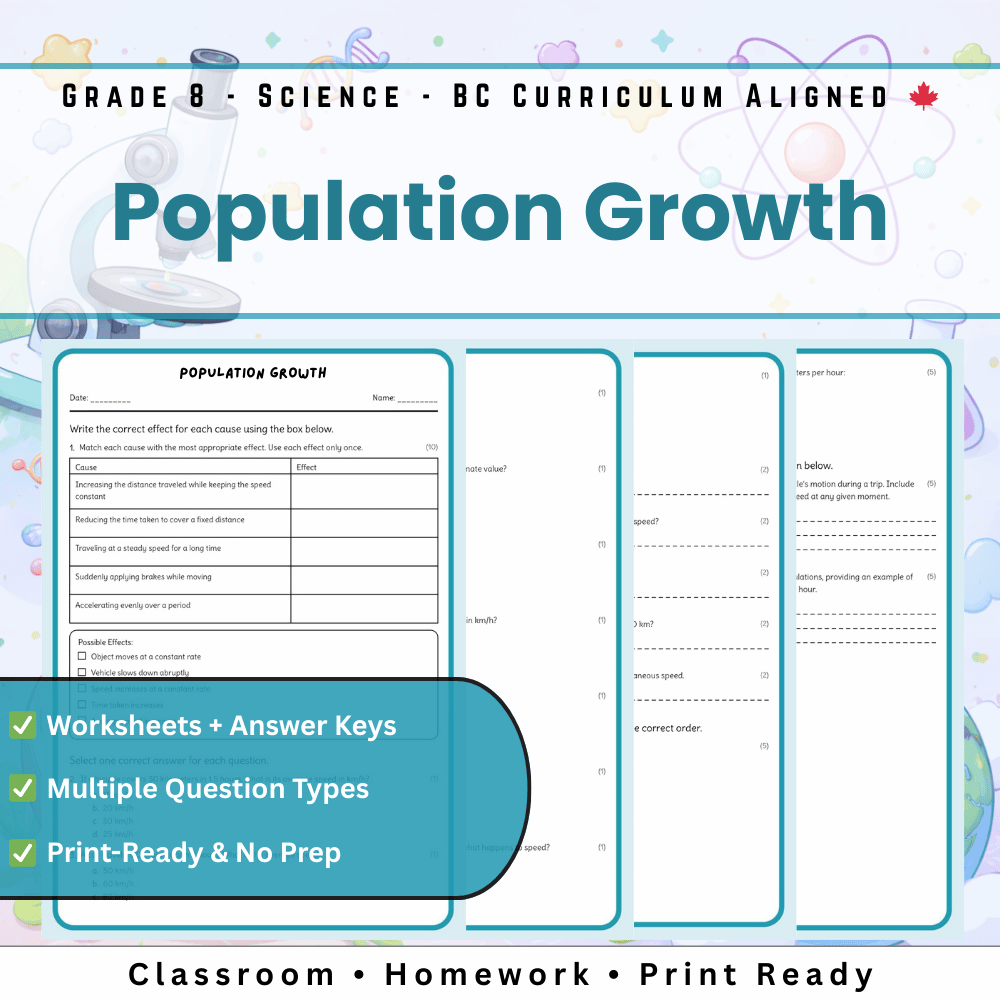
Grade 8 Science | Population Growth Worksheet + Answer Key (PDF) – BC Standards
Created byBright Mind ResourcesLearning Objectives
- Understand how birth rates, death rates, immigration, and emigration influence population change.
- Identify and analyze factors that contribute to population increase, stability, or decline.
- Interpret demographic models and measures used to assess population dynamics.
Instant download

Grade 8 Science | Atoms & Molecules - Daily Reading Comprehension
Created byCoral Reef LearningLearning Objectives
- Identify the basic units of matter: atoms and molecules.
- Recognize symbols and formulas used to represent atoms and molecules.
- Understand the role of atomic structure and bonding in chemical reactions.
Instant download

Endothermic And Exothermic Worksheet | Grade 8 Science Practice
Created byPrism Point LearningLearning Objectives
- Differentiate endothermic and exothermic reactions using evidence from the surroundings’ temperature changes.
- Explain energy changes using a particle and bonding model (breaking bonds vs. forming bonds) rather than an external energy “source.”
- Use correct vocabulary (thermal energy, surroundings, bonds, reactants, products) to describe energy flow in reactions.
Instant download

Science Grade 8 Worksheet | Water Systems & Governance | Ontario Standards
JCreated byJ.S SheetsLearning Objectives
- Explain how the hydrologic cycle links precipitation, surface water, and groundwater in a large basin
- Describe watershed connectivity and how nutrients, contaminants, and invasive species can move through water systems
- Analyze groundwater–surface water exchange and how monitoring supports adaptive management
Instant download

Grade 8 Science | Technology and Impacts Worksheet | General Standard
Created byLumora LearningLearning Objectives
- Explain how technology choices can affect people and the environment across a product’s life cycle.
- Identify trade-offs between benefits and harms when evaluating technological solutions.
- Use evidence to justify whether a technology decision is responsible and sustainable.
Instant download
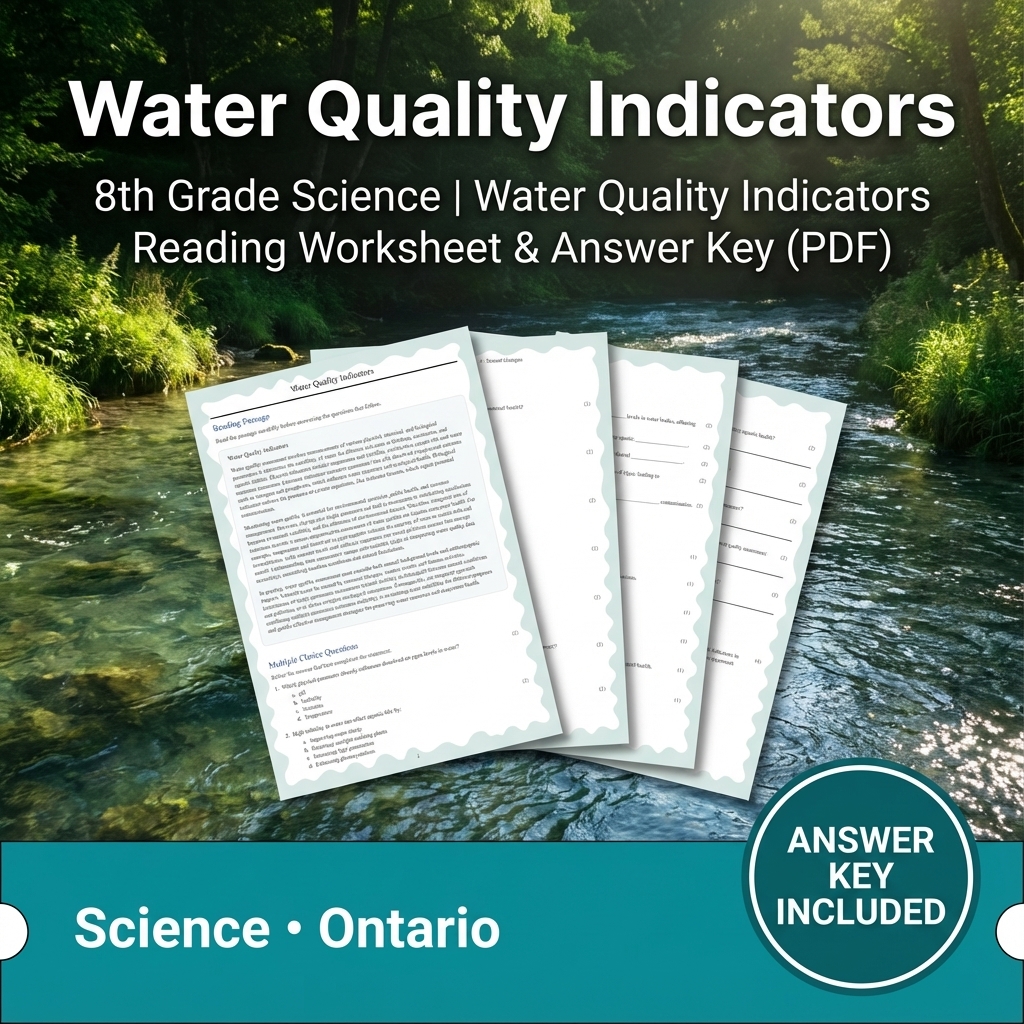
8th Grade Science | Water Quality Indicators Reading Worksheet & Answer Key
JCreated byJ.S SheetsLearning Objectives
- Identify physical, chemical, and biological water quality indicators.
- Interpret ranges of indicator parameters for aquatic health and water uses.
- Understand sources of variability and the importance of integrated assessments.
Also included in: Grade 8 Science Bundle | Water Systems Hydrology Concepts (Answer Key Included) +1 more
Instant download

Grade 8 Measurement Uncertainty Science Daily Reading Worksheet | TEKS
Created byBRIGHT PATH RESOURCESLearning Objectives
- Explain what measurement uncertainty means and why it happens
- Identify how instrument resolution affects readings
- Describe how to report uncertainty using correct significant figures
Also included in: Grade 8 Science Skills Daily Reading Worksheets Bundle | TEKS +1 more
Instant download

Grade 8 Physical and Chemical Changes Worksheet | Alberta Science
Created byBRIGHT PATH RESOURCESLearning Objectives
- Identify clues that show whether a change is physical or chemical.
- Classify described evidence from a text using the properties of matter.
- Explain how physical and chemical changes differ using evidence such as state, new substances, and observable energy or gas effects.
Also included in: Grade 8 Alberta Science Matter and Chemical Change Worksheet Bundle +1 more
Instant download

Grade 8 Kinetic and Potential Worksheet | NGSS Practice PDF
Created byClear Sky ClassroomLearning Objectives
- Distinguish kinetic energy from potential energy and identify which one changes with motion or position.
- Explain how gravitational potential energy and kinetic energy shift during roller-coaster-like motion.
- Apply the idea of energy conservation (or near conservation) to predict what happens to total mechanical energy.
Instant download

Grade 8 Science – Organelles Roles | Daily Reading Worksheet
Created byBright Mind ResourcesLearning Objectives
- Identify major organelles within a cell
- Describe the primary functions of the nucleus, mitochondria, ribosomes, endoplasmic reticulum, Golgi apparatus, lysosomes, and vacuoles
- Understand how these organelles work together in energy conversion, protein synthesis, and intracellular transport
Also included in: Grade 8 Life Systems Science Daily Reading Worksheets Lesson Bundle | Ontario +1 more
Instant download
About Grade 8 Science Worksheets
Explore Grade 8 Science worksheets for classwork, homework, or review. Our 6,006 printables download instantly as PDFs.
Each resource here is built by an independent educator and reviewed for quality. Worksheets print straight from PDF and suit classroom use, homework, or extra practice; most come with answer keys, and you can preview before purchasing.