
Grade 9 Science Worksheets
6,926 worksheets
Grade 9 Science | Integrated Physiology Worksheet with Short Notes (PDF)
 Created byMeadowlark Worksheets
Learning Objectives
- Understand the major systems involved in human physiology and how they work together.
- Identify key organs and their functions within the circulatory, respiratory, and digestive systems.
- Analyze how different physiological processes interact to maintain homeostasis.
Also included in: Grade 9 Science NGSS From Molecules to Organisms Structures & Processes Bundle +1 more
Instant download
Grade 9 Science – Force Fundamentals Daily Reading Worksheet + Answer Key
JCreated byJ.S SheetsLearning Objectives
- Define what a force is and describe how it affects objects.
- Identify different types of forces, including contact and non-contact forces.
- Explain real-world examples of forces acting on objects.
Also included in: Grade 9 Science Lesson Bundle | Physics and Motion Worksheets +1 more
Instant download
Grade 9 Science | Reaction Quantities Worksheet (PDF) - Alberta Standards
 Created byBright Mind Resources
Learning Objectives
- Understand how to interpret coefficients in balanced chemical equations to determine reaction proportions.
- Apply mass conservation principles to real-world chemical scenarios involving reactants and products.
- Calculate predicted masses of products formed or reactants consumed based on given quantities and coefficients.
Instant download
9th Grade Science | Feedback Principles Reading Worksheet (PDF + Answer Key)
JCreated byJ.S SheetsLearning Objectives
- Understand the components and functions of homeostatic feedback loops
- Differentiate between negative and positive feedback mechanisms
- Describe how signaling pathways and transport processes transmit information in feedback systems
Instant download
Grade 9 – Introduction to Predictions and Simulations Worksheet + Answer Key
JCreated byJ.S SheetsLearning Objectives
- Understand the purpose of simple computational simulations in science.
- Recognize how models generate predictions based on hypotheses.
- Learn about the role of parameter sensitivity in simulations.
Also included in: Grade 9 Science Lesson Group - AP Framework Daily Reading Worksheets +1 more
Instant download

Molecular Signaling Gene Expression Worksheets | Grade 9 Science
 Created byTeachers Club
Learning Objectives
- Explain how molecular signaling regulates gene expression and protein activity.
- Describe receptor-ligand binding and signal transduction cascades.
- Interpret how mutations alter molecular regulation and systemic outcomes.
Also included in: Grade 9 Science Worksheets: From Molecules to Organisms NGSS Bundle +1 more
Instant download
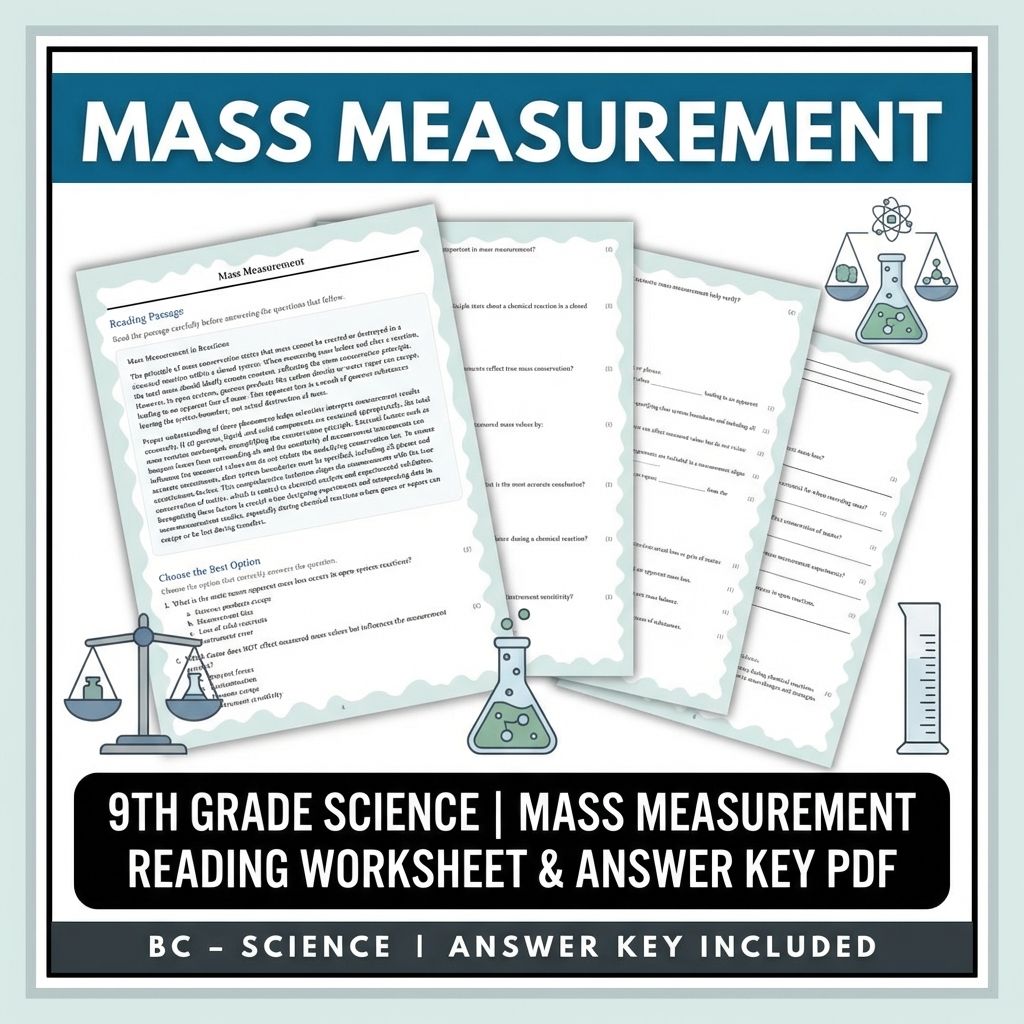
9th Grade Science | Mass Measurement Reading Worksheet & Answer Key PDF
JCreated byJ.S SheetsLearning Objectives
- Understand how measured mass reflects the conservation of atoms during reactions.
- Identify factors affecting the accuracy of mass measurements, such as gaseous escape and external influences.
- Explain the importance of defining system boundaries for mass conservation analysis.
Instant download

Grade 9 Science | Energy Transfer in Mechanical Systems - Reading Comprehension
 Created byCoral Reef Learning
Learning Objectives
- Identify different types of energy transfer in mechanical systems
- Understand how work, collisions, and friction transfer energy
- Explain how energy changes form during movement
Instant download

Grade 9 Science | Design Communication Worksheet (PDF) | General Standards
 Created byEvergreen Desk Education
Learning Objectives
- Explain how labeled diagrams help communicate relationships between components in a design.
- Use data summaries to compare test results to requirements, including noting uncertainty or variation.
- Justify design decisions by connecting observed outcomes to specific design trade-offs.
Also included in: Grade 9 Engineering Design & Prototype Evidence Science Lesson Bundle: General +1 more
Instant download

Cardiopulmonary Interaction Worksheet | Grade 9 Science Practice
 Created byPrism Point Learning
Learning Objectives
- Explain how the respiratory and cardiovascular systems work together to deliver gases and support cellular respiration.
- Describe how changes in ventilation and blood chemistry can influence heart rate, stroke volume, and vascular resistance.
- Use examples to connect chemoreceptor feedback to regulation of oxygen delivery and acid–base balance.
Instant download

Cell Signaling Worksheet | Grade 9 Science Activities
Created byPrism Point LearningLearning Objectives
- Explain how receptor proteins detect chemical signals and start intracellular signaling cascades
- Describe how signal transduction can change gene expression, metabolism, or ion channel activity
- Compare autocrine, paracrine, endocrine, and synaptic signaling by distance and timing
Instant download
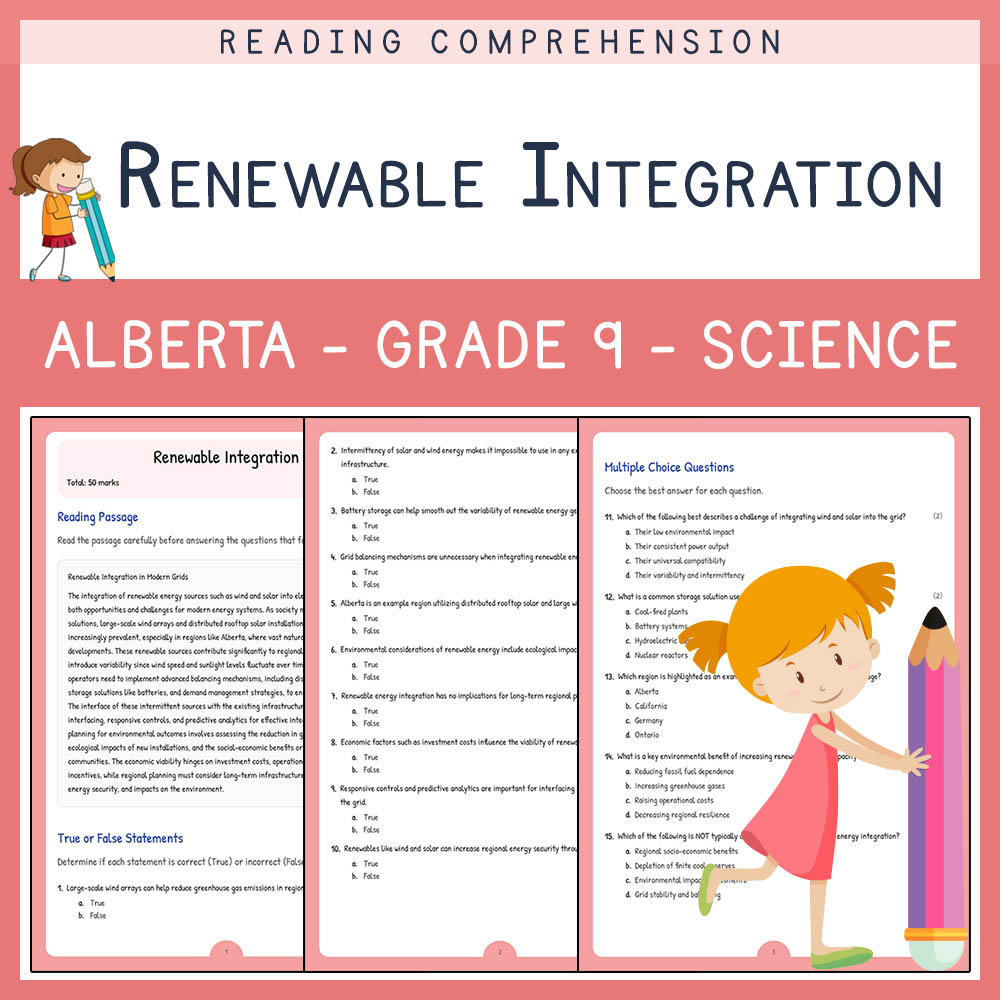
Grade 9 Science | Renewable Integration Worksheet | Alberta Standards
 Created byLumora Learning
Learning Objectives
- Explain the challenges and solutions associated with integrating renewable energy sources into electrical grids.
- Describe how wind and solar resources interface with existing infrastructure and address variability.
- Analyze environmental, economic, and regional planning considerations of renewable energy integration.
Instant download
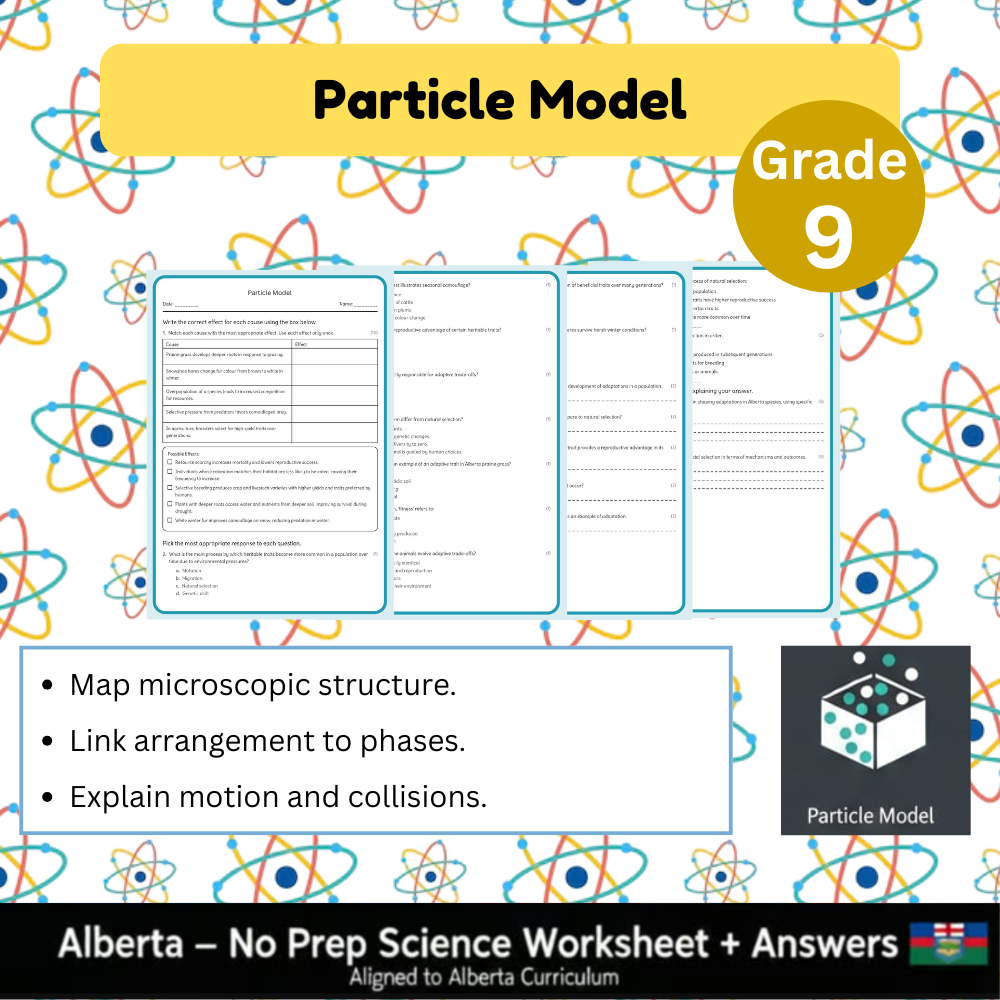
Grade 9 Science | Particle Model Worksheet (PDF) – Alberta Standards
Created byBright Mind ResourcesLearning Objectives
- Understand the particle model as a representation of matter's microscopic structure.
- Explain how particle arrangements relate to solids, liquids, and gases.
- Describe the effects of particle motion, spacing, and collisions on observable phenomena.
Instant download

Cosmic Timescales Worksheet | NGSS Grade 9 Science Assessment
 Created bySkylark Worksheets
Learning Objectives
- Explain how redshift and Hubble’s law link galaxy observations to the expansion history of the universe.
- Describe how cosmic microwave background (CMB) anisotropies constrain the universe’s early conditions and timescales.
- Connect primordial abundances of hydrogen, helium, and lithium to Big Bang nucleosynthesis and early-universe timing.
Also included in: Grade 9 Science Full-Year Bundle | NGSS Worksheets & Assessments
Instant download

Limiting Reactants Worksheet | Grade 9 Science Standards-Aligned Practice
JCreated byJ.S SheetsLearning Objectives
- Understand the concept of limiting reactants and how they determine product yield.
- Calculate theoretical yield using balanced chemical equations and molar masses.
- Differentiate between actual yield and theoretical yield, and compute percent yield.
Instant download
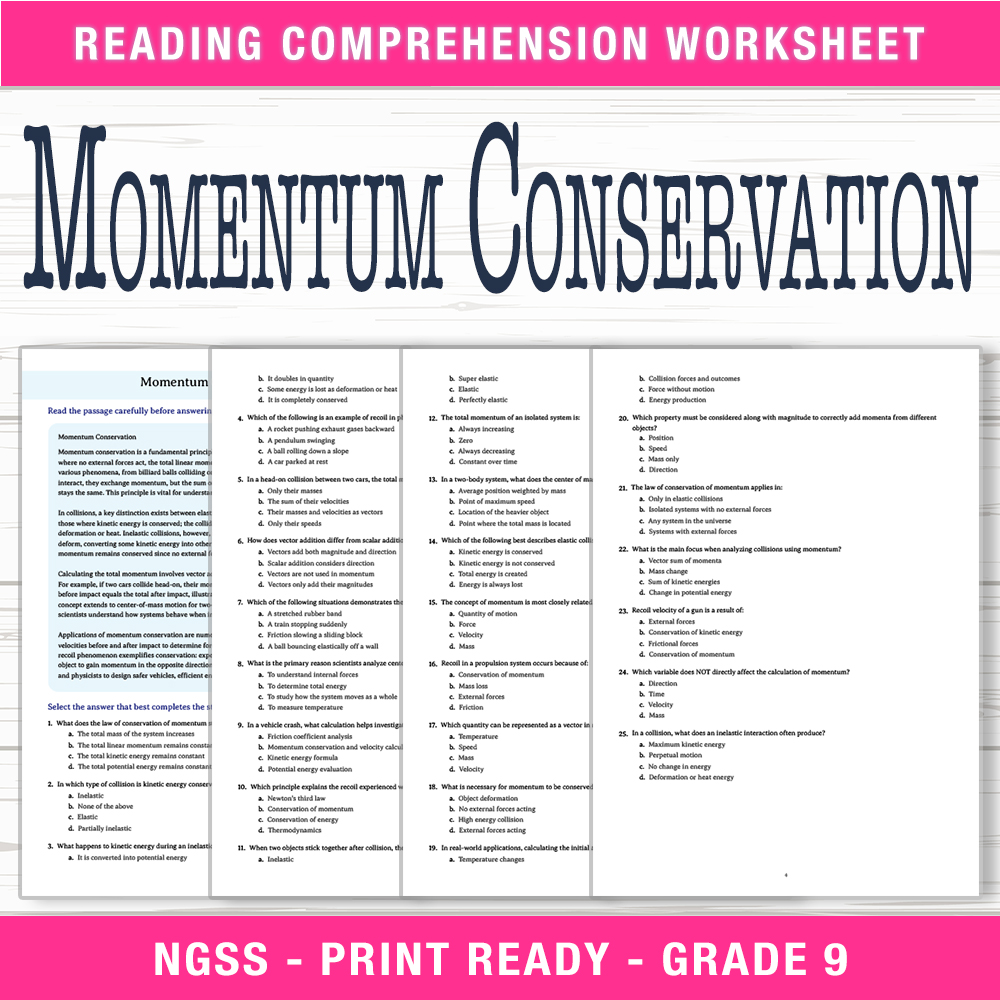
Grade 9 Science – Momentum Conservation Worksheet (PDF + Answer Key)
 Created byRiverstone Classroom
Learning Objectives
- Explain the principle of conservation of linear momentum in isolated systems.
- Calculate total momentum before and after collisions using vector addition.
- Differentiate between elastic and inelastic collisions through quantitative analysis.
Instant download

Grade 9 Science | Mutations & Their Sources - Daily Reading Comprehension
Created byCoral Reef LearningLearning Objectives
- Understand the concept of mutations in DNA
- Identify different sources of mutations
- Recognize the effects mutations can have on genes and traits
Instant download

Momentum Conservation Worksheet | Collisions & Physics Grade 9 Science
Created byPrism Point LearningLearning Objectives
- Explain how momentum depends on mass and velocity and use the momentum formula in reasoning.
- Apply the law of conservation of momentum to collisions and explosions when only internal forces act.
- Compare elastic and inelastic collisions by tracking momentum and kinetic energy outcomes.
Instant download

Conserved Energy Worksheet | Energy Conservation Grade 9 Science
Created byPrism Point LearningLearning Objectives
- Explain energy conservation in a closed system using a quantitative energy-accounting approach.
- Identify how energy transfers and converts among kinetic, potential, internal, and radiation-related forms.
- Use energy diagrams to track changes while applying the rule that total energy stays constant in an isolated/closed system.
Instant download

Energy Conversion Systems Worksheet | Grade 9 Science Energy Transformations
Created byPrism Point LearningLearning Objectives
- Explain how energy conversion systems follow the law of conservation of energy while producing waste energy
- Describe efficiency as a measure of how much input energy becomes useful output energy
- Identify common energy conversions in electrical devices, motors, and generators
Instant download

Grade 9 Science – Molecular Inheritance & DNA Structure | Reading Worksheet
Created byBright Mind ResourcesLearning Objectives
- Identify the main components of DNA and their roles
- Understand how DNA structure supports its function as the genetic material
- Explore the process of DNA replication and transcription
Also included in: Grade 9 Daily Reading Science Worksheets Lesson Bundle | AP +2 more
Instant download

Grade 9 Spheres Connectivity Worksheet | Practice & Assessment PDF
 Created byClear Sky Classroom
Learning Objectives
- Explain how the geosphere, hydrosphere, atmosphere, and biosphere are connected through matter and energy exchanges
- Use cause-and-effect reasoning and mass-balance thinking to interpret cross-domain environmental processes
- Describe how coupled sphere processes can produce observable patterns in time and space
Also included in: Grade 9 Earth and Space Sciences Science lesson bundle (AP framework) +1 more
Instant download

Grade 9 Forces Overview Worksheet | NGSS Practice PDF
Created byClear Sky ClassroomLearning Objectives
- Explain how forces can change an object’s state of motion through acceleration and changes in velocity.
- Differentiate between contact forces and field forces and give real-world examples of each.
- Use vector ideas (magnitude and direction) to describe forces and predict how multiple forces combine as a net force.
Instant download
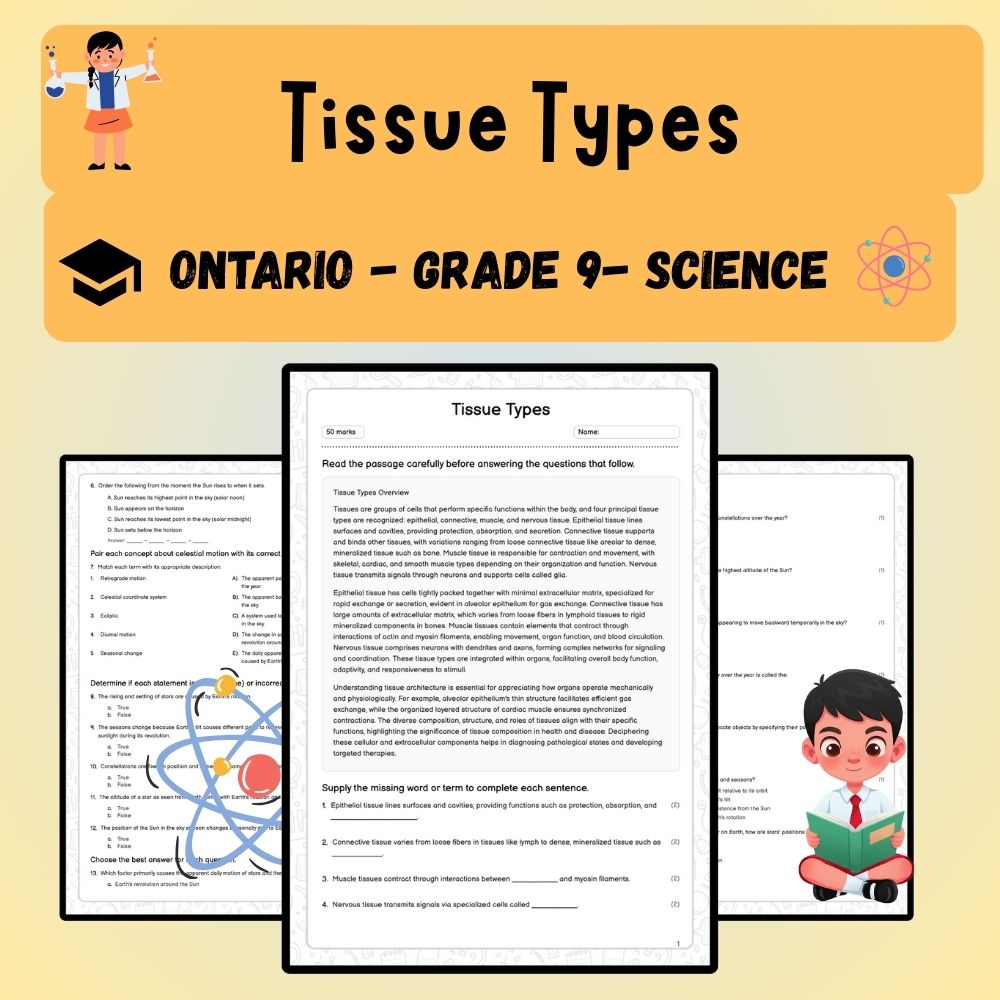
Grade 9 Science | Tissue Types Worksheet (PDF) Aligned with Ontario Standards
Created byPrism Point LearningLearning Objectives
- Describe the principal tissue classes: epithelial, connective, muscle, and nervous.
- Explain the cellular composition and extracellular matrix properties of each tissue type.
- Identify specialized epithelia for absorption and secretion and relate tissue architecture to organ functions.
Also included in: Grade 9 Science Unit Bundle | Human Body Systems & Cell Functions +1 more
Instant download
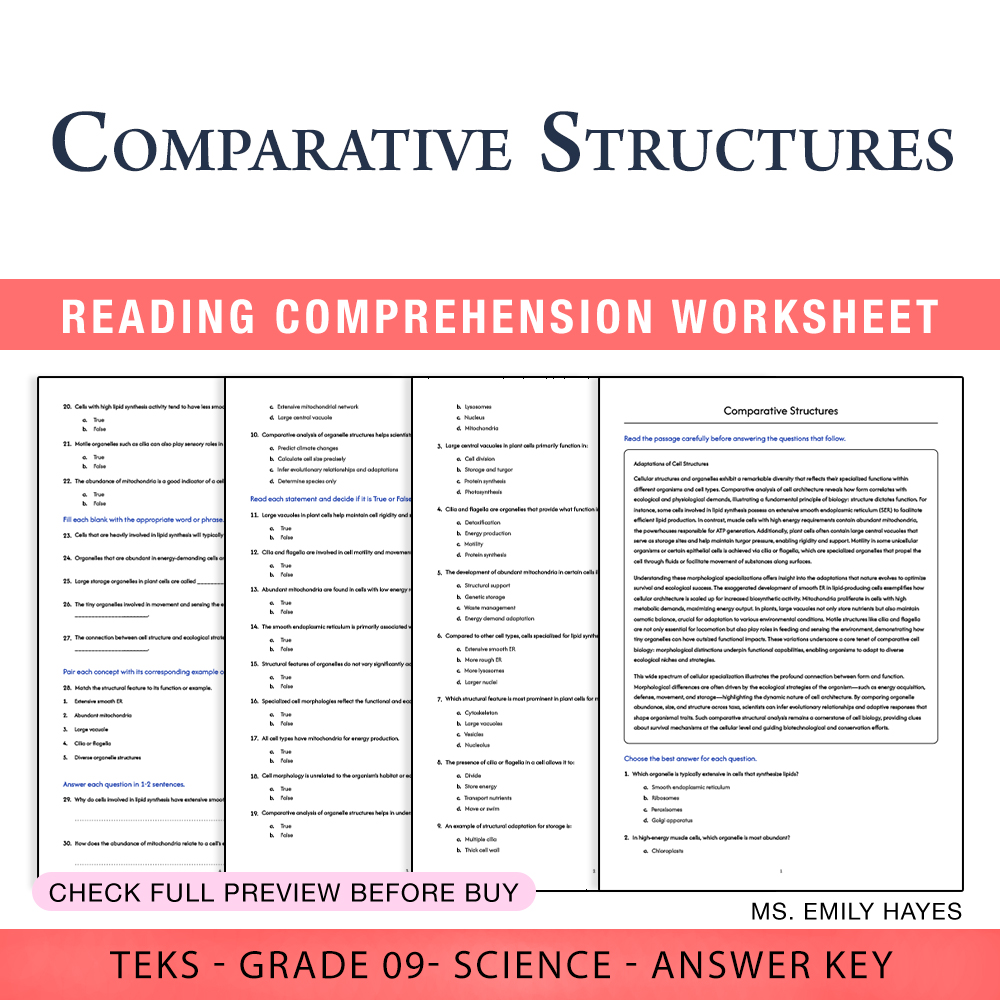
9th Grade Science | Comparative Structures Worksheet (PDF+ Answer Key)
 Created byCopper Leaf Classroom
Learning Objectives
- Examine variations in organelle form and abundance across different cell types and taxa.
- Relate cellular morphology to specific physiological functions and ecological strategies.
- Identify examples of structural adaptations at organelle and membrane levels.
Instant download

Watershed Change Assessment Worksheet | Grade 9 Science
Created byPrism Point LearningLearning Objectives
- Explain how urbanization, deforestation, agriculture, and infrastructure change watershed processes.
- Connect watershed changes to effects on runoff, sediment load, nutrient flux, groundwater recharge, and channel form.
- Use measurement indicators such as discharge and turbidity to infer watershed impacts and support integrated water management.
Also included in: Grade 9 Earth and Space Science Lesson Bundle Worksheets | Ontario
Instant download
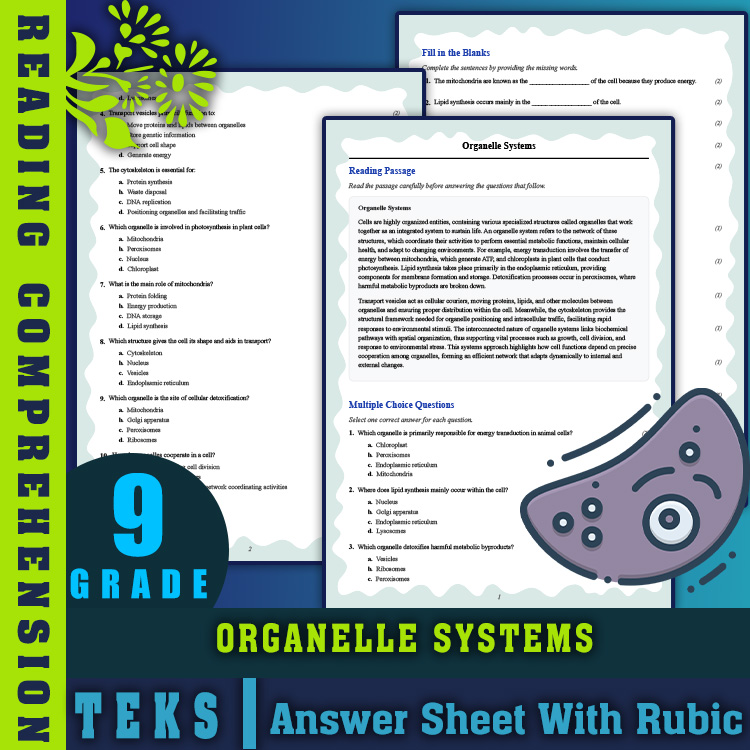
9th Grade Science Worksheets | Organelle Systems Mastery (PDF & Answer Key)
JCreated byJ.S SheetsLearning Objectives
- Understand the concept of organelle systems and their roles within cells.
- Explain how different organelles coordinate to support cell functions.
- Identify the functions of key organelles such as chloroplasts, mitochondria, endoplasmic reticulum, peroxisomes, and transport vesicles.
Instant download

Science Grade 9 Data Representation Tools Worksheet
JCreated byJ.S SheetsLearning Objectives
- Interpret graphs and tables by identifying variables, trends, and outliers.
- Evaluate how axis choices, scales, and labels affect the meaning readers can draw from data.
- Use evidence from numerical representations to support justified conclusions.
Also included in: Grade 9 Claims & Uncertainty Science – lesson bundle: General framework +1 more
Instant download
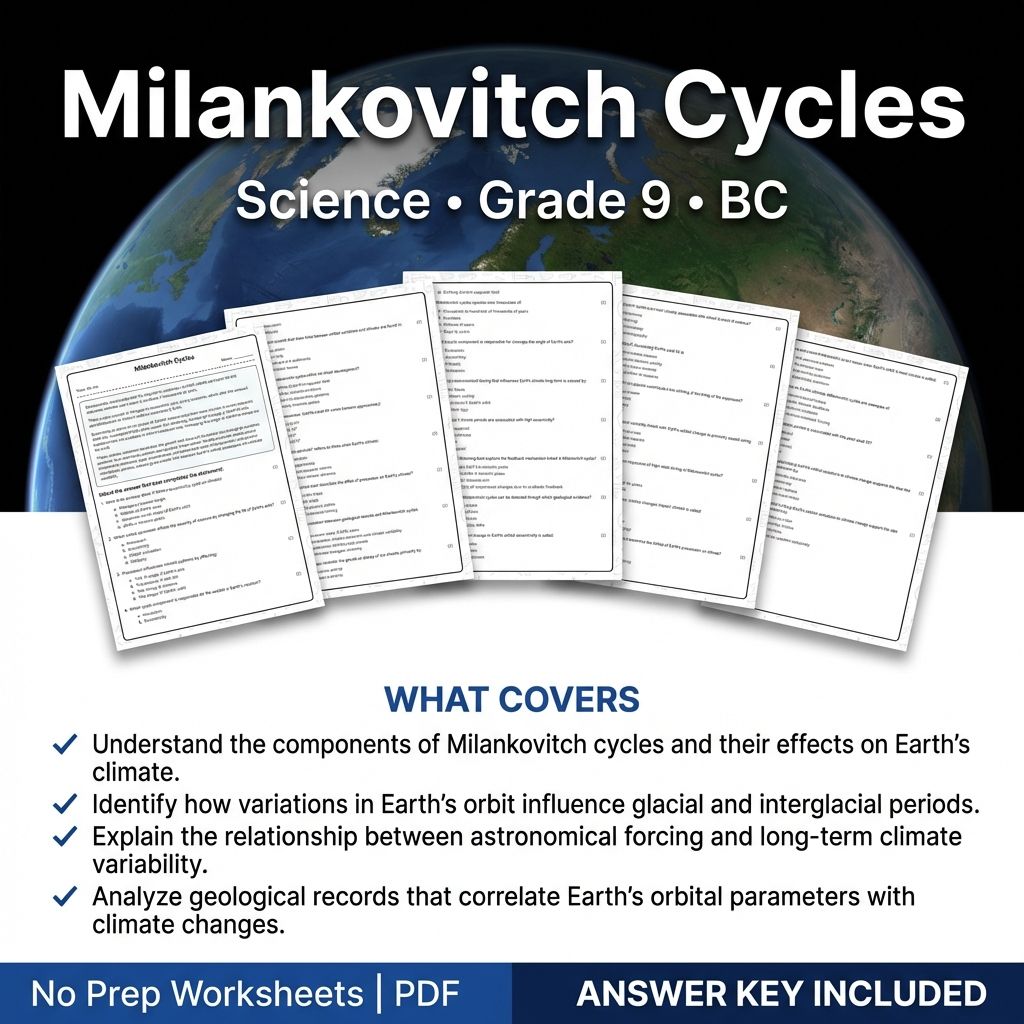
9th Grade Science | Milankovitch Cycles Worksheet & Answer Key PDF
Created byCoral Reef LearningLearning Objectives
- Understand the components of Milankovitch cycles and their effects on Earth's climate.
- Identify how variations in Earth's orbit influence glacial and interglacial periods.
- Explain the relationship between astronomical forcing and long-term climate variability.
Instant download
Grade 9 Science – Ocean–Atmosphere Coupling Daily Reading Worksheet + Answer Key
JCreated byJ.S SheetsLearning Objectives
- Understand the mechanisms of sea surface temperature anomalies.
- Identify how oceanic variability influences atmospheric patterns.
- Examine teleconnections and their role in regional climate.
Also included in: Grade 9 Science Lesson Bundle – AP Framework Daily Reading Worksheets +1 more
Instant download

Grade 9 Science | Friction and Drag Worksheet (Alberta Standards) (PDF)
Created byEvergreen Desk EducationLearning Objectives
- Explain how friction and aerodynamic drag oppose motion and convert mechanical energy into thermal energy
- Use qualitative relationships (surface texture, normal force, speed, air density, and shape) to predict changes in friction and drag
- Apply coefficients of friction and drag coefficients conceptually to estimate resistance forces
Instant download

Grade 9 Science – Population Regulation & Ecology | Daily Reading Worksheet
Created byBright Mind ResourcesLearning Objectives
- Understand basic concepts of population control mechanisms
- Identify factors affecting population sizes and dynamics
- Familiarize with mathematical models of population growth
Also included in: Ecosystem Food Webs Grade 9 Science Daily Reading Worksheets Bundle | NGSS +2 more
Instant download
9th Grade Science | Reaction Stoichiometry Reading Worksheet & Answer Key (PDF)
JCreated byJ.S SheetsLearning Objectives
- Understand how conservation of mass applies in balanced chemical equations.
- Relate moles, mass, and particle counts using molar mass conversions.
- Identify limiting reagents and calculate reaction yields.
Instant download

Grade 9 Science – Energy in Earth Systems & Daily Reading Worksheet
Created byBright Mind ResourcesLearning Objectives
- Understand how sunlight interacts with Earth's surface
- Identify the different ways energy is transferred within Earth systems
- Explain the importance of energy balance in maintaining Earth's temperature
Also included in: Earth Systems Grade 9 Science Daily Reading Worksheets Bundle | Florida NGSSS +1 more
Instant download
Grade 9 Science – Circulatory System Daily Reading Worksheet with Answer Key
JCreated byJ.S SheetsLearning Objectives
- Describe the basic structure and functions of the heart and blood vessels.
- Explain the processes of blood flow, including oxygen and nutrient transport.
- Identify the components of blood and their roles in circulation.
Also included in: Grade 9 Science Lesson Group | Human Body Systems, Environment & Energy +1 more
Instant download

Bond Types Worksheet | Grade 9 Science Practice
Created byPrism Point LearningLearning Objectives
- Distinguish ionic, covalent, and metallic bonds based on electron behavior.
- Predict how bond type affects properties such as melting point, conductivity, volatility, and solubility.
- Use particle models (ions, shared electrons, electron sea) to explain observable material behaviors.
Also included in: Grade 9 Matter and Chemical Change Lesson Bundle | Science | BC +1 more
Instant download
Grade 9 Science – Force Basics Daily Reading Worksheet + Answer Key
JCreated byJ.S SheetsLearning Objectives
- Identify different types of contact forces such as friction, tension, and normal force.
- Distinguish between contact and non-contact forces like gravity and electromagnetic interactions.
- Describe qualitatively the magnitude, direction, and point of application of forces.
Also included in: Grade 9 Science Lesson Group: Physics and Motion Worksheets Bundle +1 more
Instant download
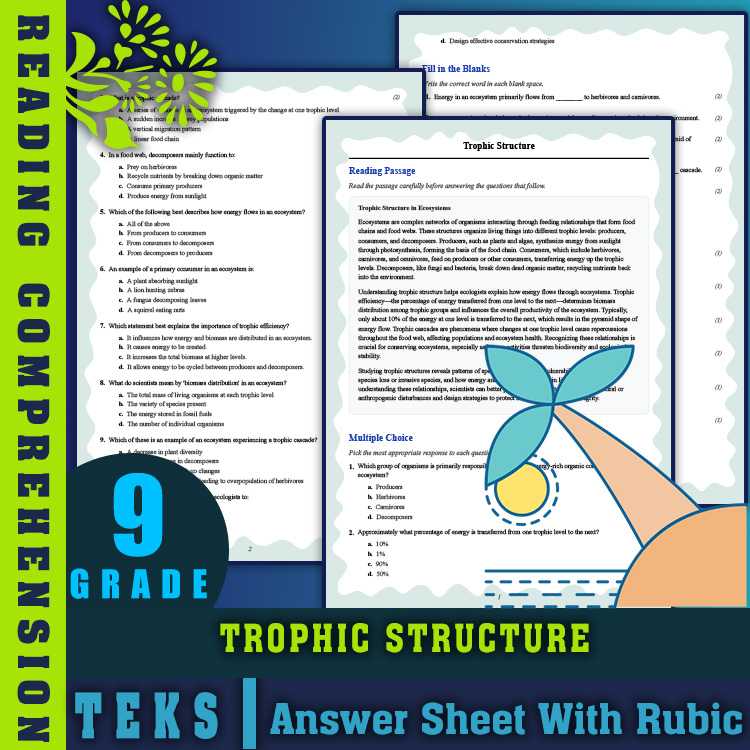
9th Grade Science | Trophic Structure Reading Worksheet & Answer Key (PDF)
JCreated byJ.S SheetsLearning Objectives
- Understand the concepts of producers, consumers, and decomposers within trophic levels.
- Explain how energy flows through food chains and webs, and how trophic efficiency affects ecosystem productivity.
- Analyze the impact of changes at one trophic level on the entire ecosystem, including trophic cascades.
Instant download
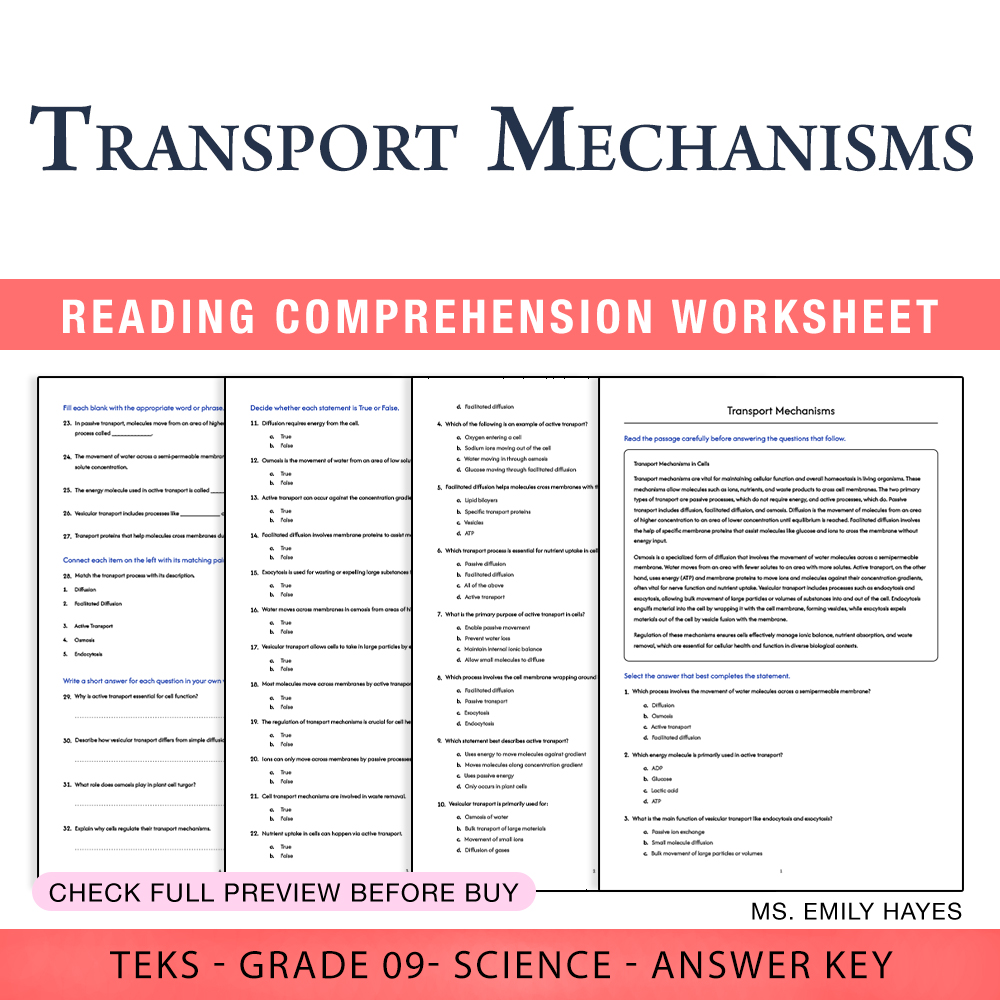
Grade 9 Science | Transport Mechanisms Worksheet (PDF+ Answer Key)
Created byCopper Leaf ClassroomLearning Objectives
- Explain how molecules move across cell membranes through passive and active transport mechanisms.
- Differentiate between diffusion, facilitated diffusion, and osmosis with examples.
- Describe the processes of active transport and vesicular transport such as endocytosis and exocytosis.
Instant download
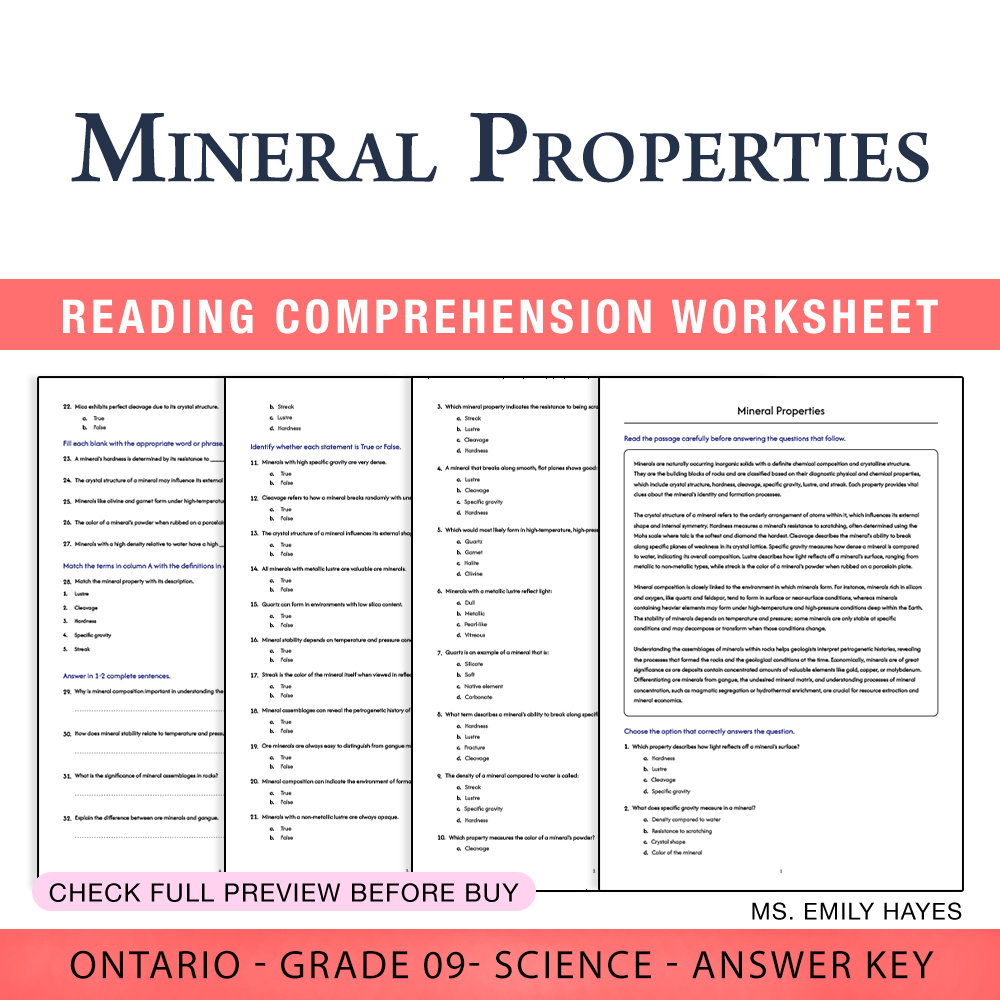
9th Grade Science | Mineral Properties Worksheet (PDF + Answer Key)
Created byCopper Leaf ClassroomLearning Objectives
- Describe the physical and chemical diagnostic properties of common rock-forming minerals.
- Explain how mineral composition relates to their formation environments and stability under varying conditions.
- Connect mineral assemblages to petrogenetic histories and distinguish between ore minerals and gangue.
Instant download
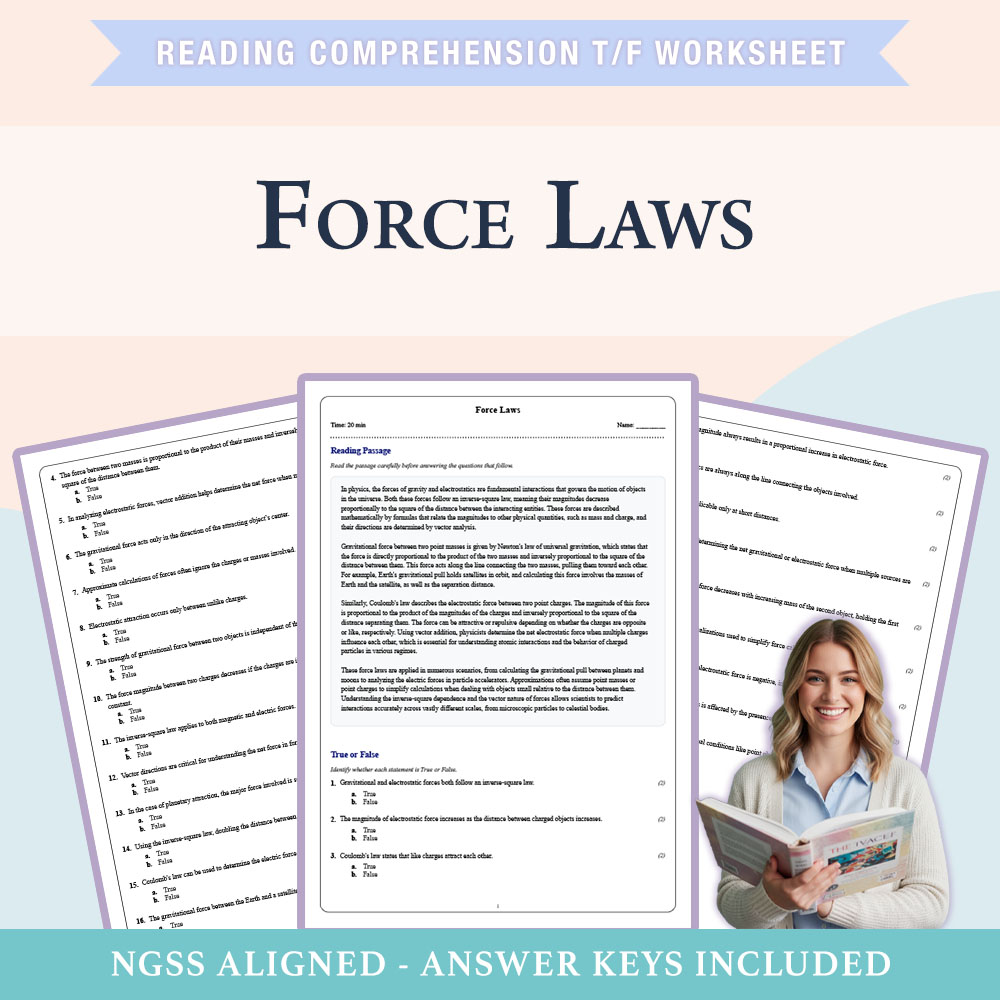
Grade 9 Science | Force Laws Worksheet (PDF + Answer Key)
Created byCopper Leaf ClassroomLearning Objectives
- Understand the inverse-square dependence of gravitational and electrostatic forces on separation distance.
- Apply mathematical formulas to predict the magnitudes and directions of forces between masses and charged objects.
- Analyze scenarios involving planetary attraction and charged particle interactions using force vectors.
Also included in: Grade 9 Science Bundle | Motion, Forces & Magnetism Worksheets (PDF +Answer Key) +1 more
Instant download

Grade 9 Science – Genetic Transmission & Mendelian Patterns | Reading Worksheet
Created byBright Mind ResourcesLearning Objectives
- Understand the process of chromosome separation during meiosis.
- Relate chromosomal behavior to inheritance patterns and Mendelian laws.
- Identify deviations such as incomplete dominance, codominance, and linkage.
Also included in: Grade 9 Daily Reading Science Worksheets Lesson Bundle | AP +2 more
Instant download

Grade 9 Heat Quantification Worksheet | NGSS Science Thermal Energy Activity
 Created byBRIGHT PATH RESOURCES
Learning Objectives
- Understand the different methods of heat transfer: conduction, convection, and radiation.
- Identify examples of heat transfer in everyday scenarios.
- Calculate thermal energy transfer using specific heat capacity, mass, and temperature change.
Also included in: Energy Conservation Grade 9 Science Daily Reading Lesson Bundle | NGSS +1 more
Instant download

Grade 9 Science | Climate Trends Worksheet (AP Standards & Data Analysis)
Created byBright Mind ResourcesLearning Objectives
- Analyze spatial and temporal climate datasets to identify trends and anomalies.
- Apply statistical methods such as trend analysis, composite mapping, and signal-to-noise reasoning.
- Interpret potential climate change drivers by comparing datasets with forcings like greenhouse gases and volcanic aerosols.
Instant download
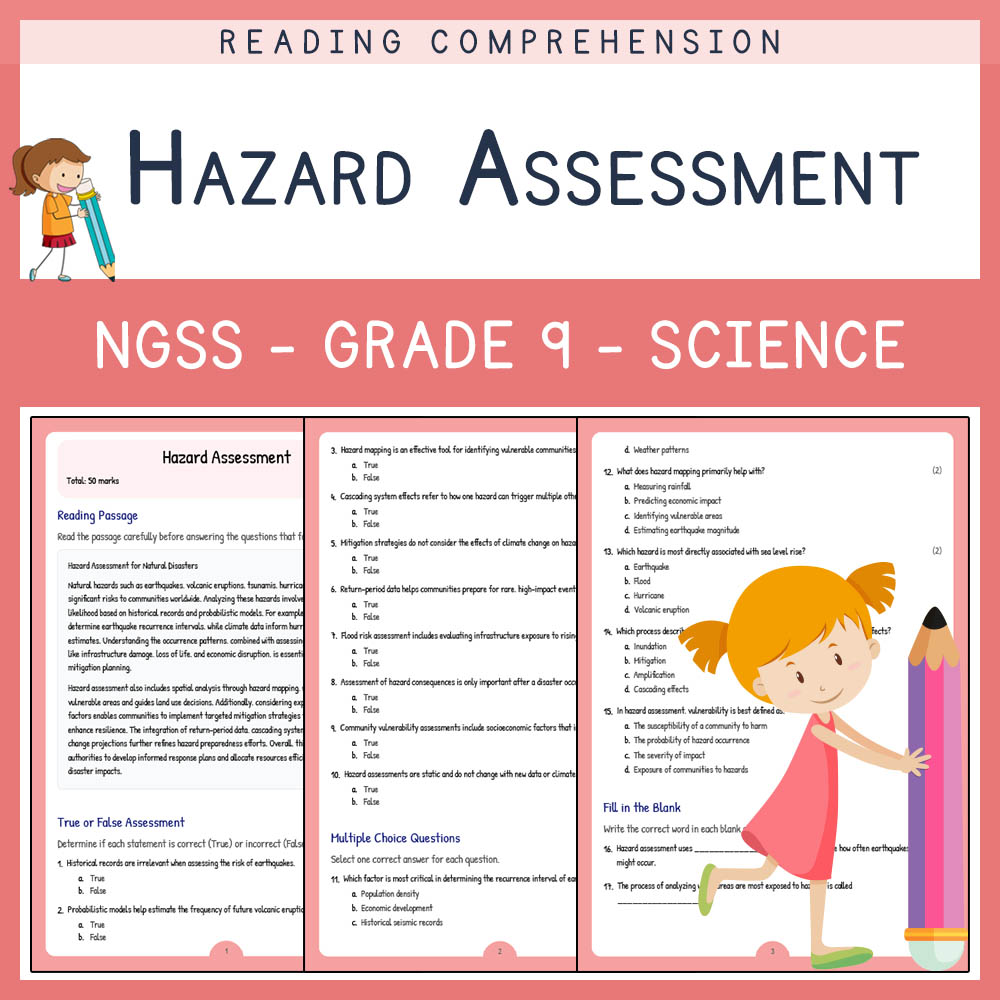
Grade 9 Science | Hazard Assessment Worksheet & Answer Key (NGSS Aligned)
Created byLumora LearningLearning Objectives
- Understand how to evaluate hazard risks using historical data and models.
- Identify key factors such as occurrence, frequency, and consequences of natural hazards.
- Analyze case studies related to earthquakes, volcanic eruptions, and other natural disasters.
Instant download

Grade 9 Science – Gene Expression Worksheet (Worksheet + Answer Key) | TEKS Aligned
Created byBright Mind ResourcesLearning Objectives
- Describe the process of gene transcription and translation.
- Identify the roles of DNA, mRNA, tRNA, and ribosomes in gene expression.
- Explain how gene regulation influences gene expression at different stages.
Also included in: Grade 9 Science Genetics & Biotechnology Unit - TEKS - Aligned (Answer Keys) +3 more
Instant download

Grade 9 Science – Energy Transformations Daily Reading Worksheet | NGSSS
Created byBright Mind ResourcesLearning Objectives
- Understand key concepts related to Science
- Apply knowledge through practice questions
- Demonstrate comprehension of the material
Also included in: Grade 9 Forces, Energy & Matter Science lesson bundle Florida NGSSS +1 more
Instant download
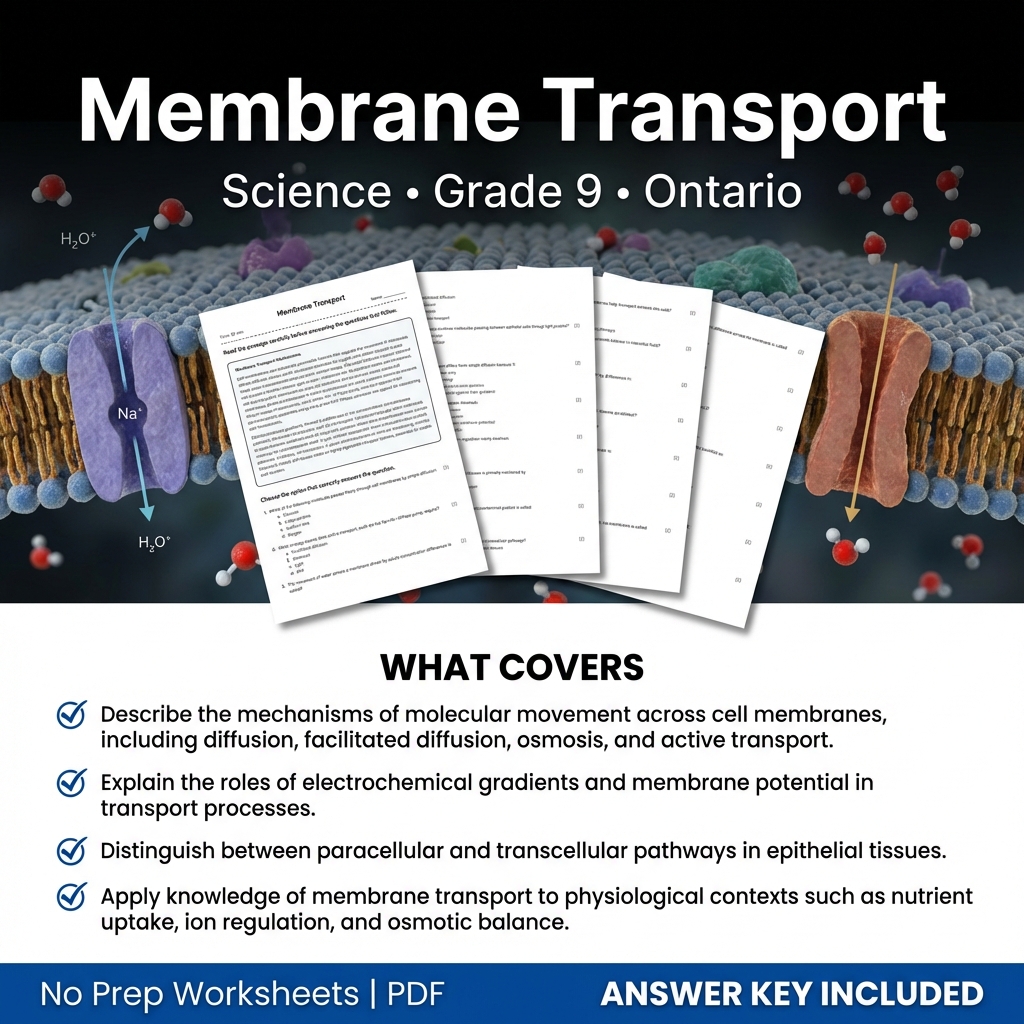
Membrane Transport Worksheet for Grade 9 Science – Ontario Standards
Created byCoral Reef LearningLearning Objectives
- Describe the mechanisms of molecular movement across cell membranes, including diffusion, facilitated diffusion, osmosis, and active transport.
- Explain the roles of electrochemical gradients and membrane potential in transport processes.
- Distinguish between paracellular and transcellular pathways in epithelial tissues.
Instant download
About Grade 9 Science Worksheets
Find Science worksheets built for Grade 9. All 6,926 cover core skills, practice, and review, each an instant PDF download.
Every worksheet on MyTeachingSheets is created by independent teacher-authors and reviewed before publication. All resources download as printable PDFs for classroom, homework, or at-home practice, and many include answer keys. Preview any worksheet free before buying.