
Grade 9 Science Worksheets
6,986 worksheets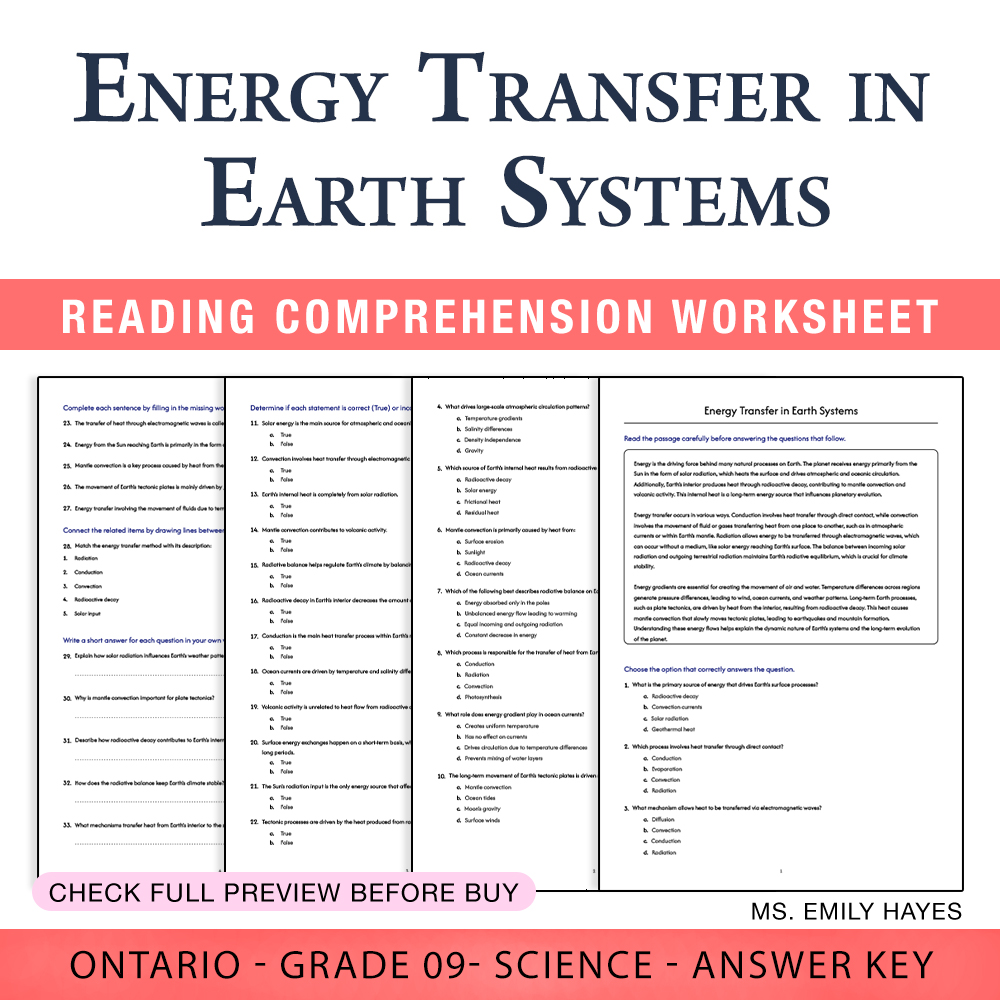
Grade 9 Science | Energy Transfer in Earth Systems Worksheet (PDF + Answer Key)
 Created byCopper Leaf Classroom
Learning Objectives
- Describe the different sources of energy within Earth systems, including solar radiation and geothermal heat.
- Explain the mechanisms of energy transfer such as conduction, convection, and radiation.
- Analyze how energy gradients influence atmospheric, oceanic, and geological processes.
Instant download

Resilience & Resistance Worksheet for Grade 9 Science | TEKS Aligned Practice
JCreated byJ.S SheetsLearning Objectives
- Explain how resistance and resilience differ in ecosystems facing disturbance.
- Describe how feedback loops, variability, and connectivity influence ecosystem recovery.
- Identify how crossing ecological thresholds can trigger regime shifts to new community states.
Instant download

Grade 9 Science – Transport Mechanisms in Cells | Daily Reading Worksheet
 Created byBright Mind Resources
Learning Objectives
- Understand the process of diffusion and how molecules move from high to low concentration.
- Describe the role of facilitated diffusion and osmosis in cellular transport.
- Identify active transport and distinguish it from passive processes.
Also included in: Grade 9 Cell Structure Science Daily Reading Lesson Bundle | TEKS +2 more
Instant download
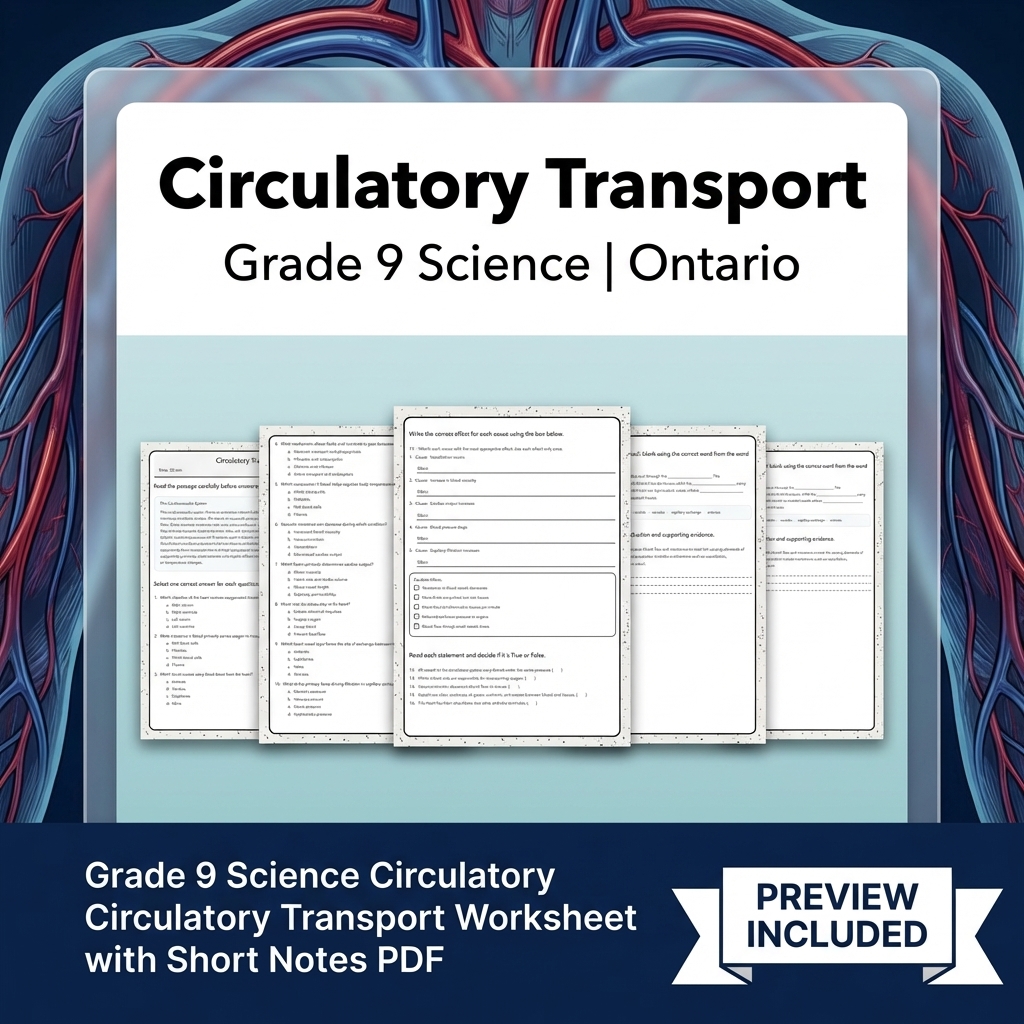
Grade 9 Science Circulatory Transport Worksheet with Short Notes PDF
 Created byMeadowlark Worksheets
Learning Objectives
- Describe the structure and function of the heart and blood vessels in the circulatory system.
- Explain the mechanisms of capillary exchange, including filtration and reabsorption.
- Identify the components of blood and their roles in transport capacity.
Instant download
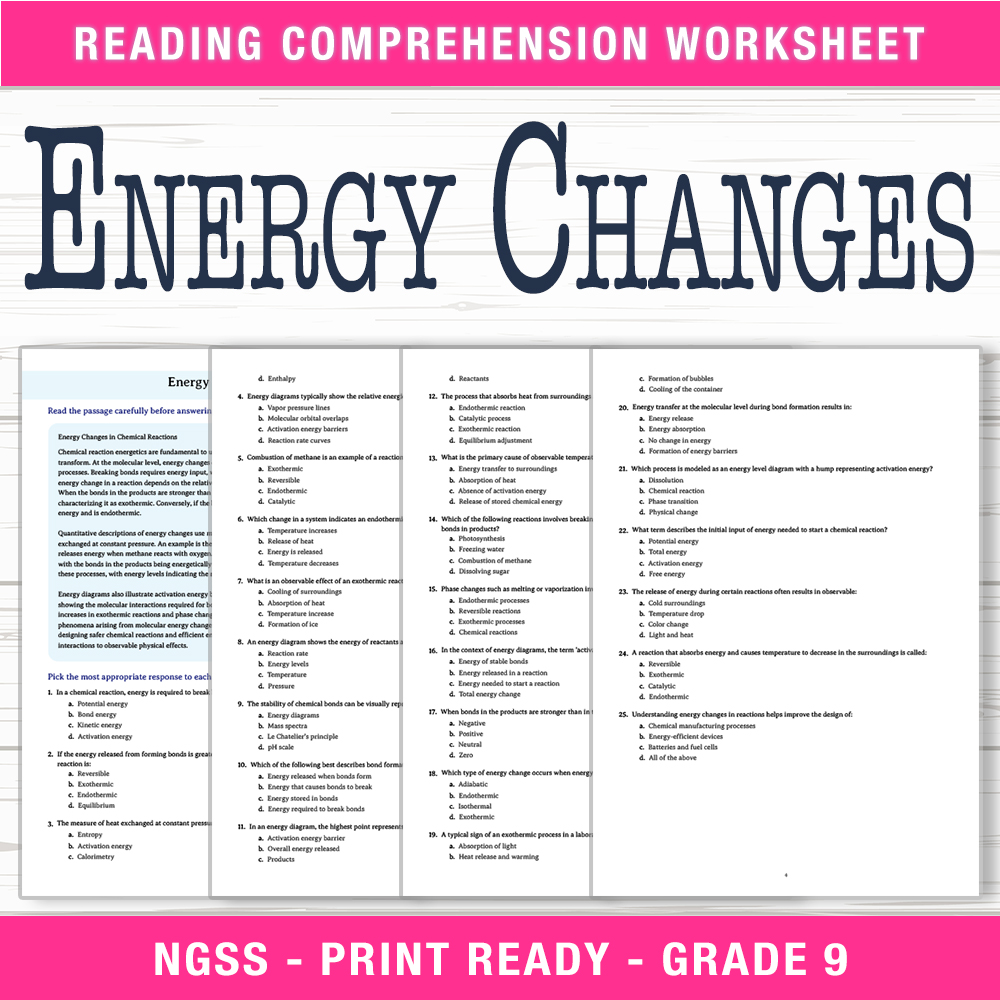
Grade 9 Science | Energy Changes Worksheet (PDF + Answer Key)
 Created byRiverstone Classroom
Learning Objectives
- Explain how chemical reactions involve energy transfer through bond breaking and formation.
- Differentiate between endothermic and exothermic reactions based on energy diagrams.
- Describe quantitative measures of energy change, such as enthalpy, in chemical processes.
Instant download
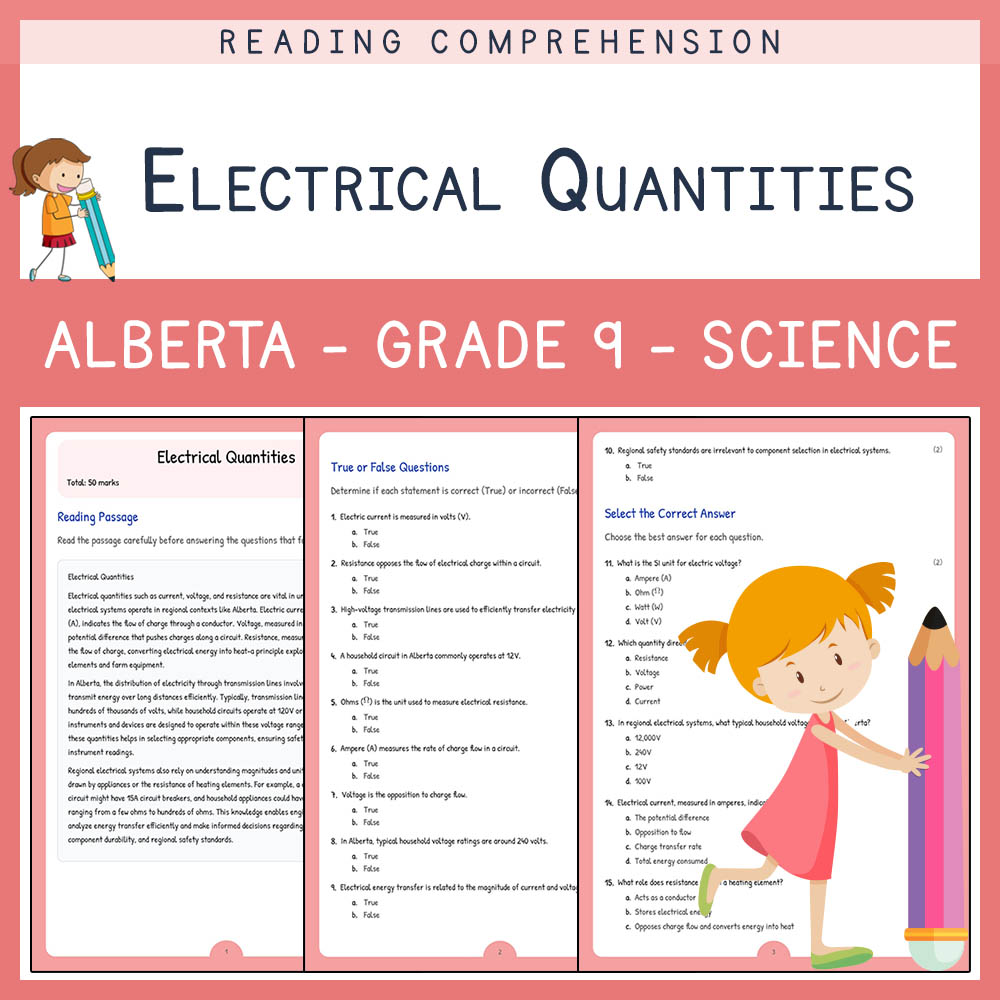
Grade 9 Science | Electrical Quantities Worksheet | Alberta Aligned
 Created byLumora Learning
Learning Objectives
- Understand the definitions of electric current, voltage, and resistance as fundamental electrical quantities.
- Interpret units, symbols, and typical magnitudes related to electrical measurements in regional contexts.
- Apply quantitative reasoning to analyze energy transfer, component selection, and instrument readings in electrical systems.
Instant download

Reaction Stoichiometry Worksheet | Grade 9 Science Printable PDF for Assessment
Learning Objectives
- Understand the principles of conservation of mass in chemical reactions.
- Relate moles, mass, and particle counts using molar mass conversions.
- Perform limiting reagent analysis and calculate theoretical yields.
Also included in: Grade 9 Science Lesson Bundle on Matter and Its Interactions +1 more
Instant download

Reaction Design Worksheet | Grade 9 Science Printable PDF | Assessment
Learning Objectives
- Understand how temperature, pressure, concentration, and catalysts influence chemical reactions.
- Explain the principles of equilibrium and kinetics in reaction systems.
- Analyze how reaction conditions affect product yield and selectivity.
Also included in: Grade 9 Science Lesson Bundle on Matter and Its Interactions +1 more
Instant download
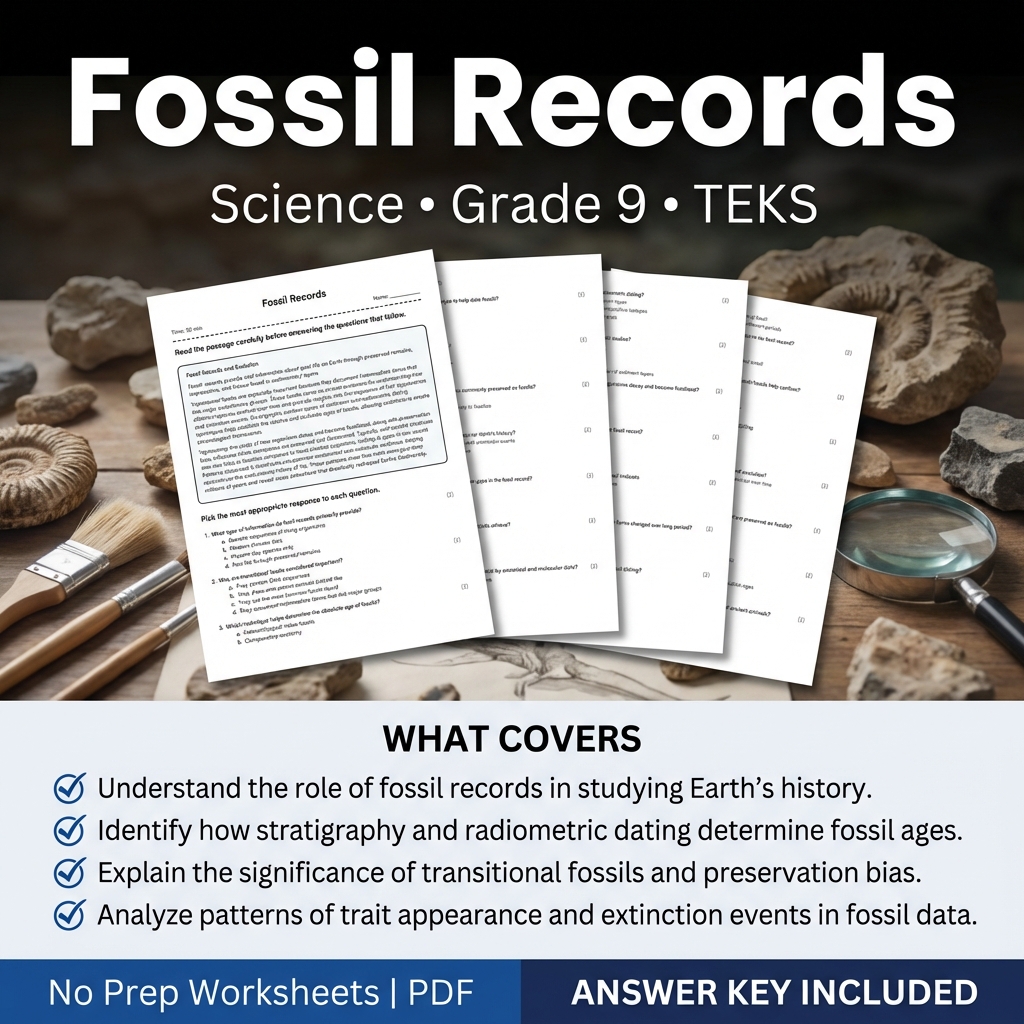
Grade 9 Science Worksheet on Fossil Records TEKS Alignment
 Created byCoral Reef Learning
Learning Objectives
- Understand the role of fossil records in studying Earth's history.
- Identify how stratigraphy and radiometric dating determine fossil ages.
- Explain the significance of transitional fossils and preservation bias.
Instant download

Constraints Trade-Offs Worksheet | Grade 9 Science Practice
 Created byPrism Point Learning
Learning Objectives
- Explain how constraints limit possible designs and how criteria define what success looks like.
- Analyze trade-offs among cost, time, materials, safety, and reliability in engineering decisions.
- Use evidence to justify a design choice when multiple criteria conflict.
Instant download
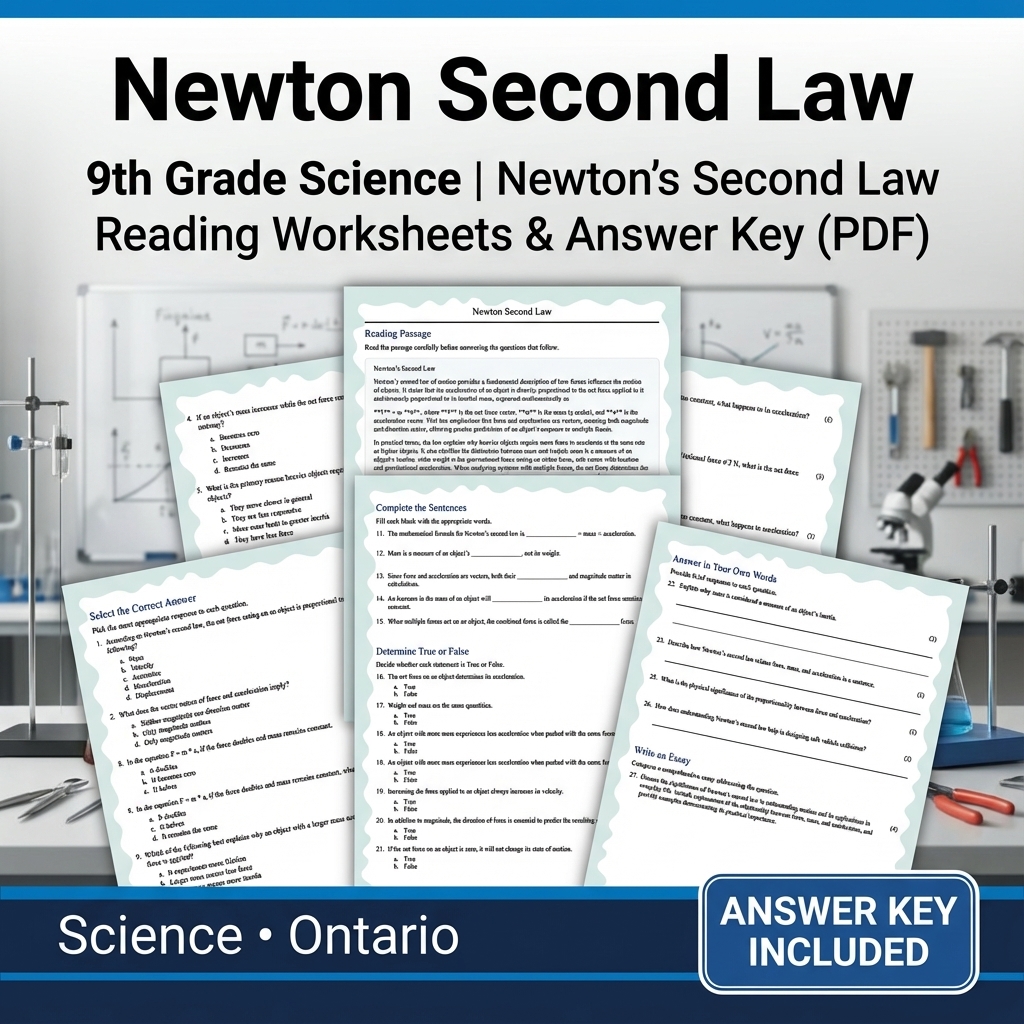
9th Grade Science | Newton's Second Law Reading Worksheets & Answer Key (PDF)
JCreated byJ.S SheetsLearning Objectives
- Understand the mathematical formulation of Newton's second law in vector form.
- Differentiate between mass and weight and their roles in dynamics.
- Analyze how net force relates to acceleration and inertia in physical systems.
Also included in: Grade 9 Science Unit | Force, Motion & Energy Worksheets & Answer Keys Bundle +1 more
Instant download
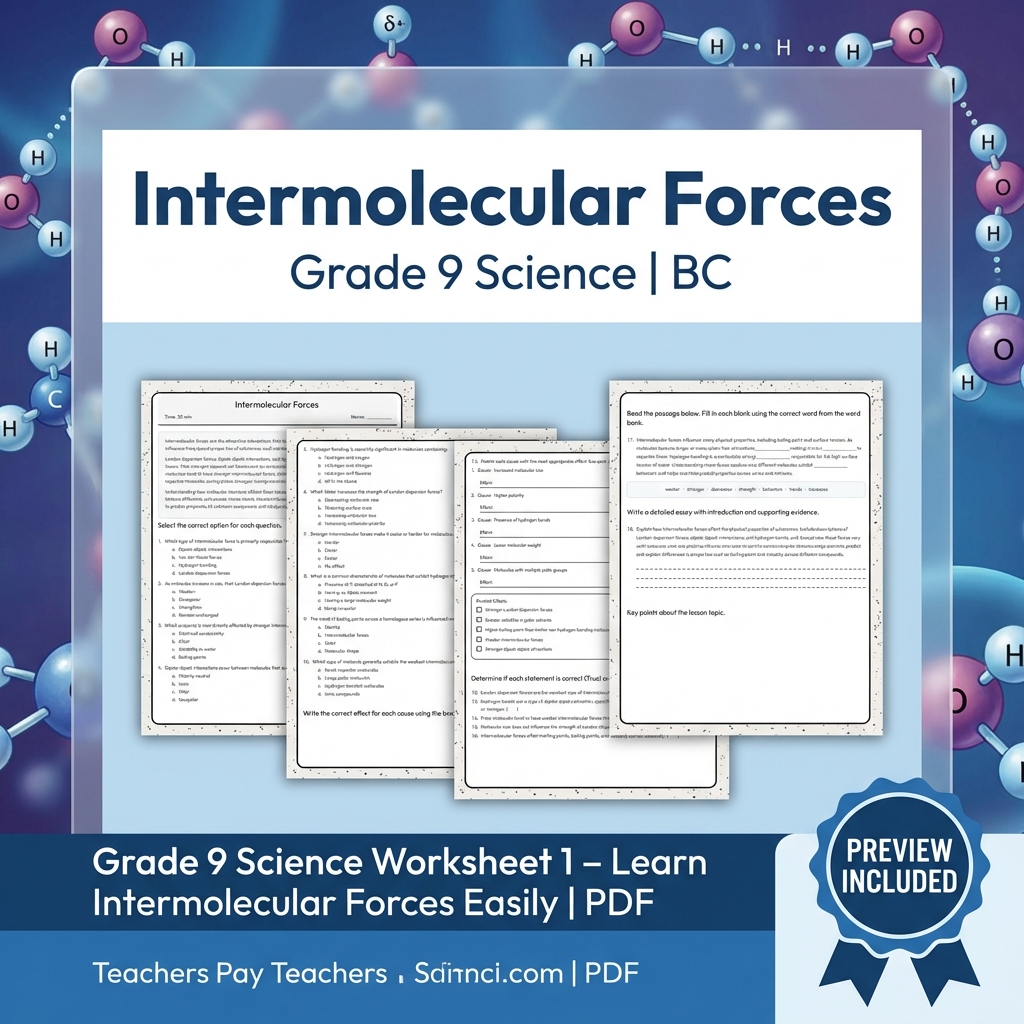
Grade 9 Science Worksheet Learn Intermolecular Forces Easily | PDF
Created byMeadowlark WorksheetsLearning Objectives
- Understand the types of intermolecular forces and their effects on physical properties of substances.
- Identify how molecular structure influences intermolecular interactions such as London dispersion forces, dipole–dipole interactions, and hydrogen bonding.
- Relate the strength of intermolecular forces to properties like boiling point, viscosity, and surface tension.
Also included in: Grade 9 Science Lesson Bundle | BC Framework Focused Worksheets +1 more
Instant download

Grade 9 Science | Variability Metrics Worksheet | AP Practice
Created byLumora LearningLearning Objectives
- Understand different measures of dispersion and distribution shape, including variance, interquartile range, range, and coefficient of variation.
- Interpret how each variability metric informs confidence in statistical estimates and comparisons.
- Relate measures of variability to sampling design, heterogeneity across groups, and theoretical models.
Also included in: Grade 9 Science | Practices in Science Custom Bundle | AP Standards
Instant download

Grade 9 Science | Representation Models Worksheet | AP Assessment
Created byLumora LearningLearning Objectives
- Describe different types of scientific models including mathematical formulae, graphs, schematics, and computational approximations.
- Explain the criteria for selecting appropriate models based on fidelity, simplicity, and predictive ability.
- Understand how mapping model components to measurable observables aids interpretation.
Also included in: Grade 9 Science | Practices in Science Custom Bundle | AP Standards
Instant download
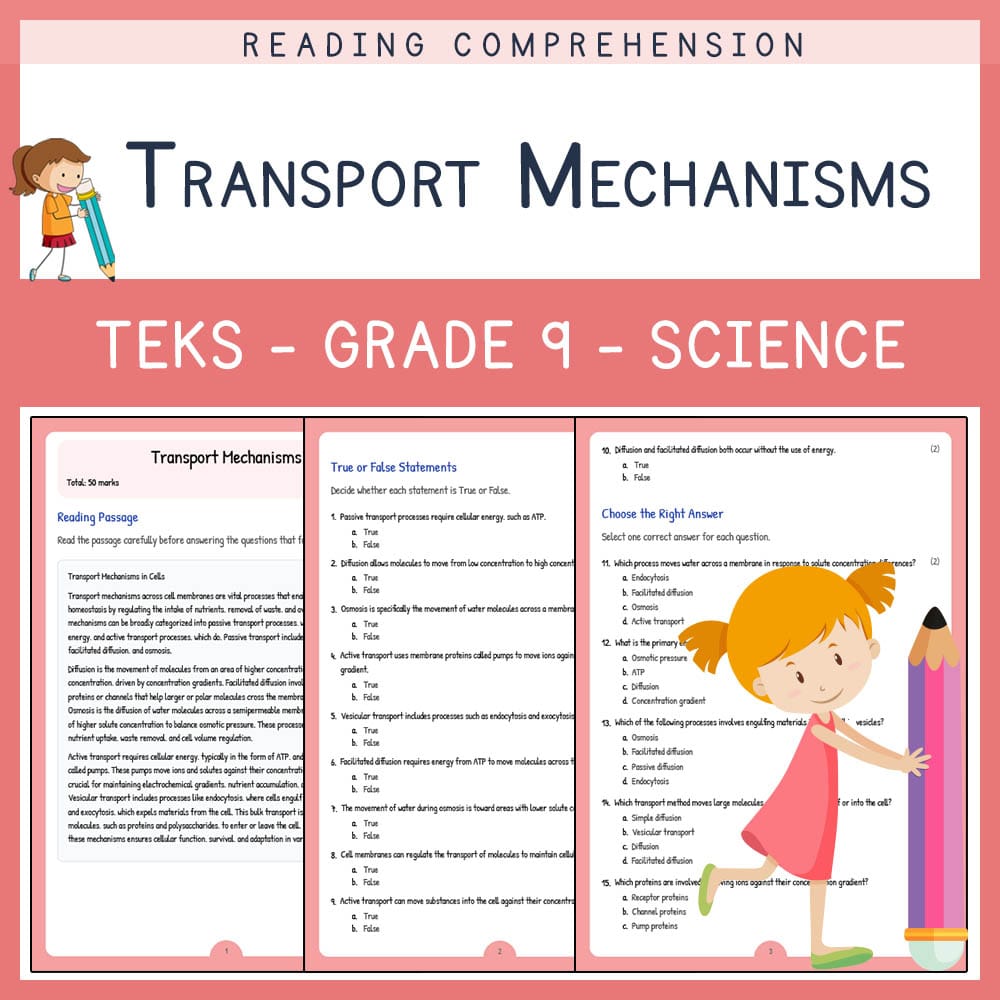
Grade 9 Science | Transport Mechanisms Worksheet | TEKS Aligned
Created byLumora LearningLearning Objectives
- Explain how molecules move across cell membranes through passive and active processes.
- Differentiate between diffusion, facilitated diffusion, osmosis, and active transport.
- Describe vesicular transport mechanisms such as endocytosis and exocytosis.
Also included in: Grade 9 Science | Cell Structure & Function Lesson Bundle | TEKS Aligned
Instant download
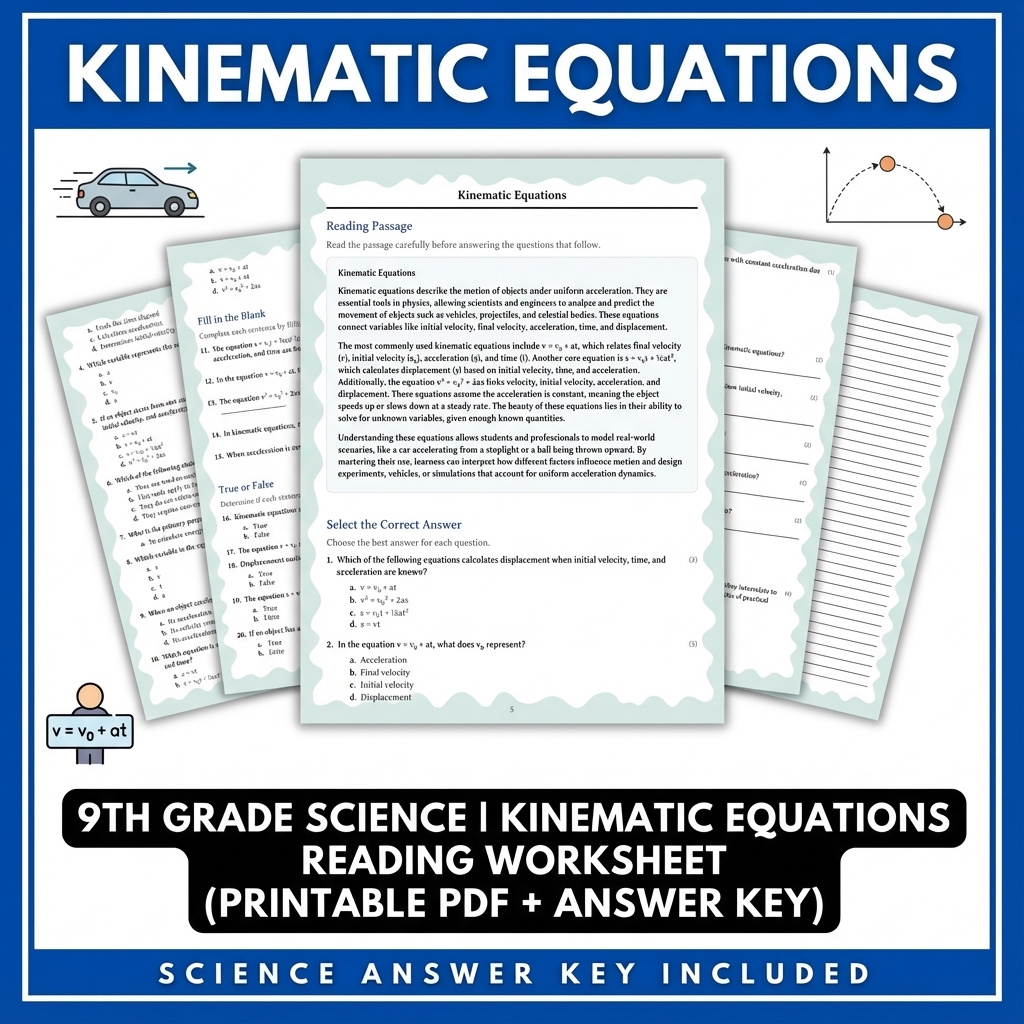
9th Grade Science | Kinematic Equations Reading Worksheet (PDF + Answer Key)
JCreated byJ.S SheetsLearning Objectives
- Understand the basic form and components of kinematic equations.
- Apply kinematic equations to solve for distance, velocity, and acceleration.
- Interpret real-world problems involving motion using the equations.
Also included in: Grade 9 Science Unit | Force, Motion & Energy Worksheets & Answer Keys Bundle +1 more
Instant download
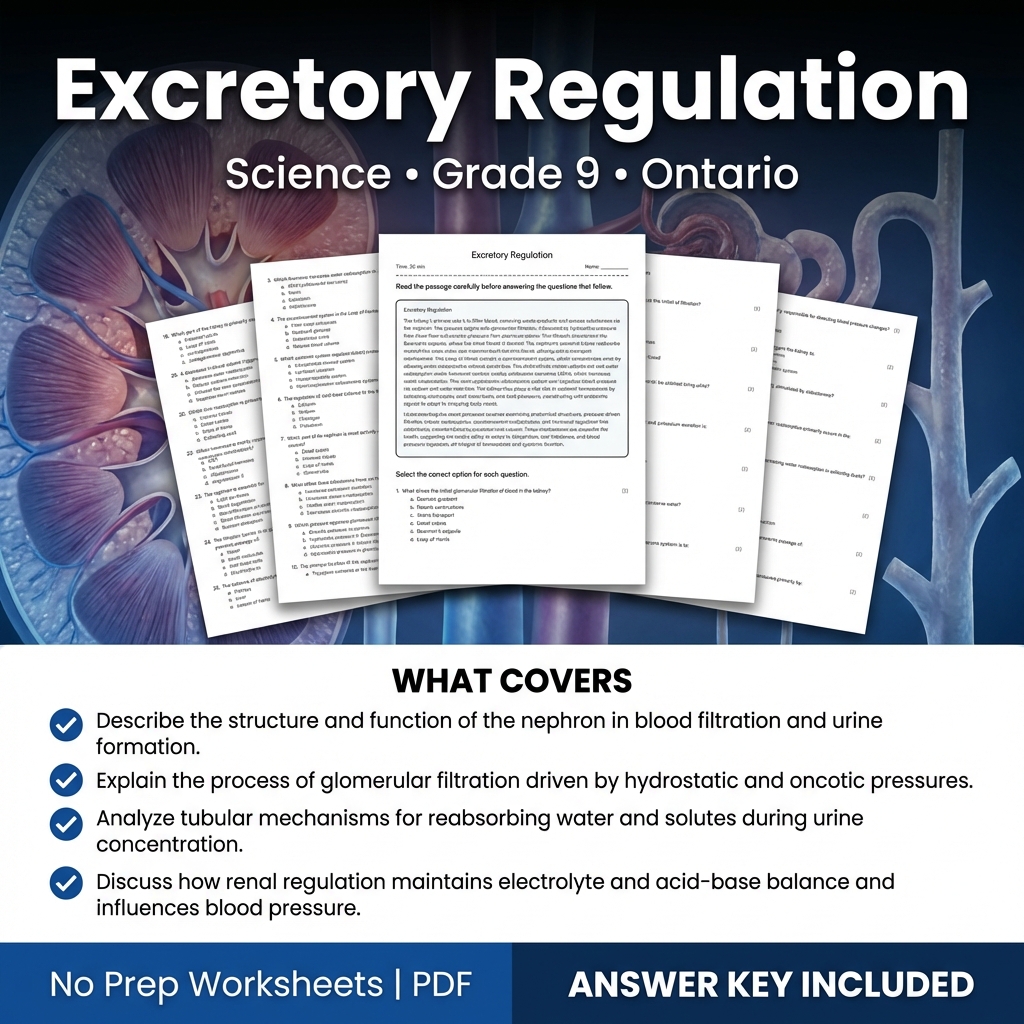
Grade 9 Science Worksheet on Excretory Regulation | Ontario Standards
Created byCoral Reef LearningLearning Objectives
- Describe the structure and function of the nephron in blood filtration and urine formation.
- Explain the process of glomerular filtration driven by hydrostatic and oncotic pressures.
- Analyze tubular mechanisms for reabsorbing water and solutes during urine concentration.
Instant download
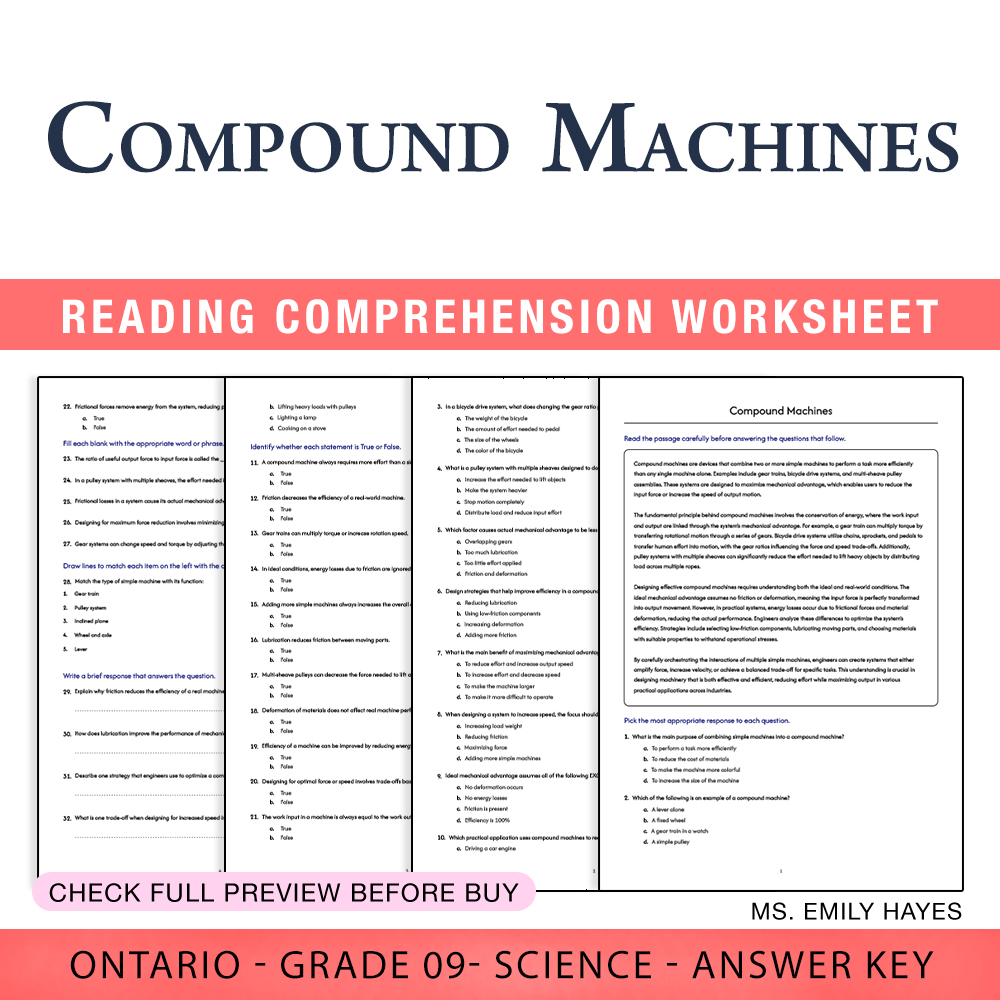
9th Grade Science | Compound Machines Worksheet (PDF + Answer Key)
Created byCopper Leaf ClassroomLearning Objectives
- Explain how multiple simple machines combine to form compound machines and analyze their mechanical advantage.
- Calculate overall mechanical advantage using force and displacement relationships in compound systems.
- Differentiate between ideal and actual mechanical advantage, and understand the effects of friction and deformation.
Instant download

Grade 9 Science – Work and Machines Worksheet (Alberta Standards) (PDF)
 Created byEvergreen Desk Education
Learning Objectives
- Explain how work depends on force and distance and how units connect to energy transfer
- Describe how simple machines change force magnitude and/or direction
- Use mechanical advantage and trade-offs (force vs distance) to predict machine performance
Instant download
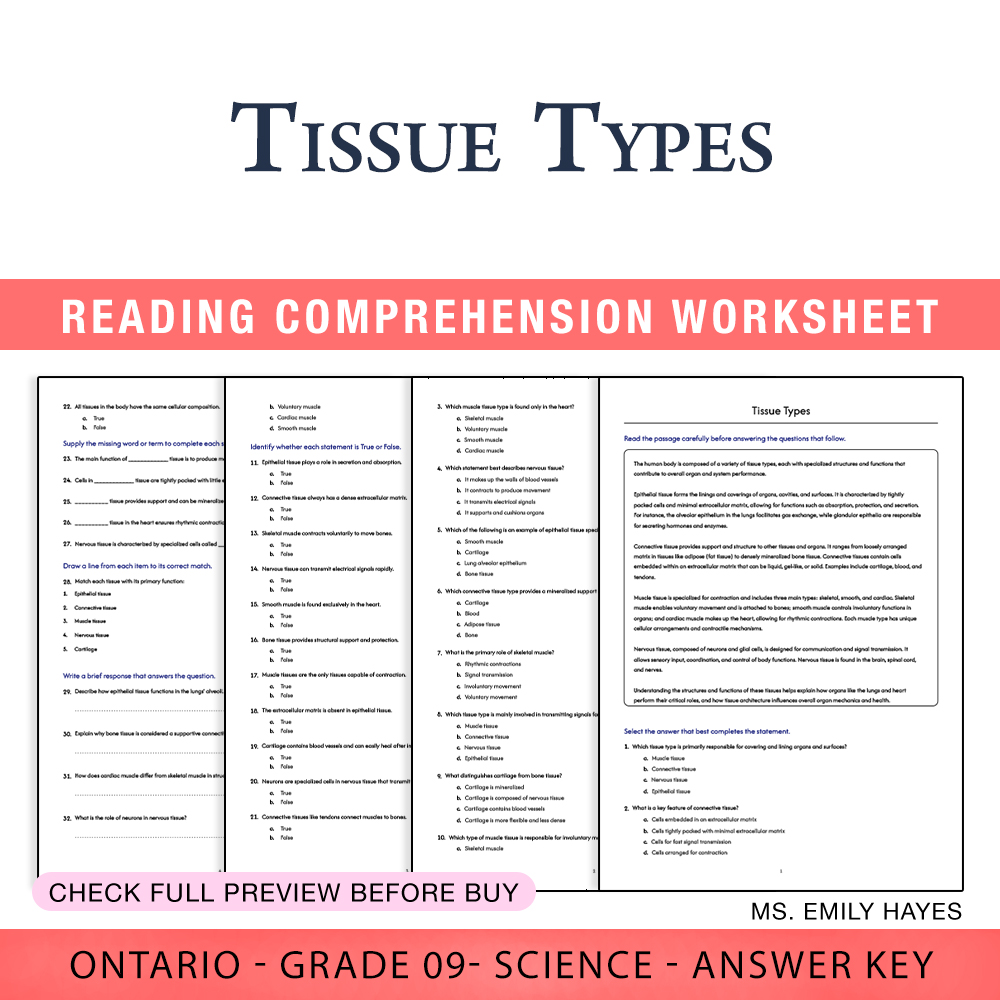
9th Grade Science | Tissue Types Worksheet (PDF + Answer Key)
Created byCopper Leaf ClassroomLearning Objectives
- Identify the four principal tissue classes and their key features.
- Describe examples of specialized epithelial, connective, and muscle tissues.
- Explain how tissue architecture relates to organ function.
Instant download
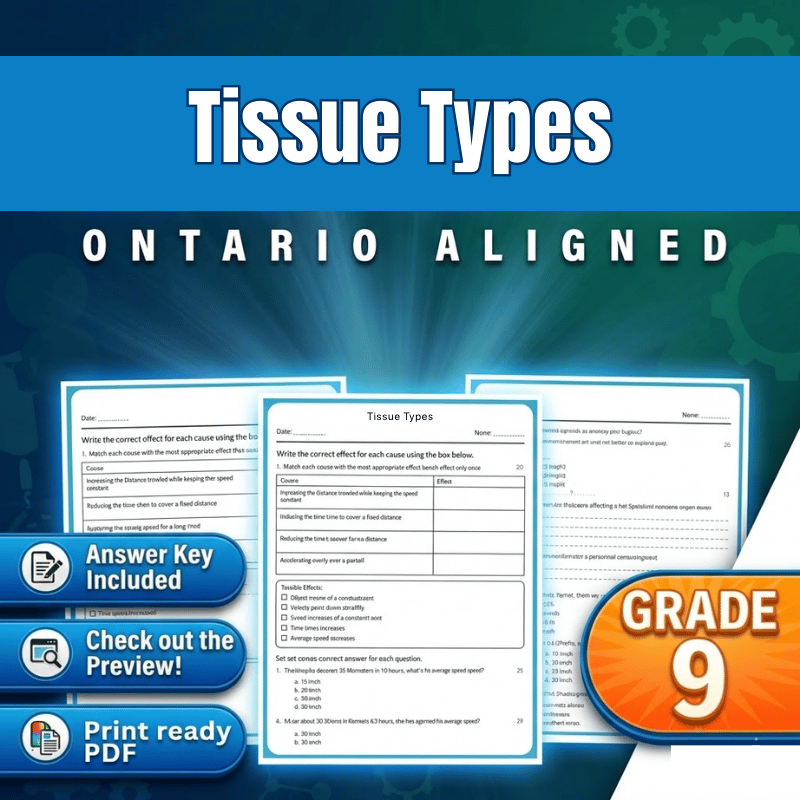
Grade 9 Science | Tissue Types Worksheet (Ontario) – Science PDF
Created byBright Mind ResourcesLearning Objectives
- Identify and describe the four principal tissue classes: epithelial, connective, muscle, and nervous.
- Explain the cellular composition and extracellular matrix roles of each tissue type.
- Differentiate specialized epithelial tissues for absorption and secretion.
Instant download

Grade 9 Science | Motion Relationships Worksheet | General Standards
Created byLumora LearningLearning Objectives
- Explain how distance and time relate to speed using data and graphs
- Describe how changing speed over time indicates acceleration
- Distinguish constant speed (linear distance–time pattern) from changing speed (nonlinear pattern)
Instant download

Grade 9 Mass Measurement Worksheet | BC Practice PDF
 Created byClear Sky Classroom
Learning Objectives
- Explain how conservation of atoms applies to mass measurements during chemical reactions within a defined system boundary.
- Distinguish between open and closed systems and predict how gas escape affects observed (measured) mass.
- Evaluate how instrument sensitivity and external influences can change measured values while conserving total atomic mass in the system.
Instant download

Grade 9 Science Apparent Motion of the Sky Worksheet | Ontario Standards
JCreated byJ.S SheetsLearning Objectives
- Explain how Earth’s rotation produces apparent diurnal motion of celestial objects across the sky.
- Describe how Earth’s revolution around the Sun leads to apparent annual changes in which stars are visible at night.
- Use celestial coordinate ideas (altitude and azimuth) to reason about rising and setting from an Earth observer’s viewpoint.
Instant download

Grade 9 Science – Succession Daily Reading Worksheet + Answer Key
JCreated byJ.S SheetsLearning Objectives
- Identify the differences between primary and secondary succession
- Explain key processes and species changes during succession
- Understand factors influencing ecosystem recovery and stability
Also included in: Grade 9 Science Lesson Bundle: Ecosystems and Ecology Worksheets +1 more
Instant download

Grade 9 Science – Trophic Levels Daily Reading Worksheet with Answer Key
JCreated byJ.S SheetsLearning Objectives
- Define and identify different trophic levels within an ecosystem.
- Describe how food chains and food webs illustrate energy flow.
- Explain the concepts of trophic efficiency and trophic cascades.
Also included in: Grade 9 Science Lesson Bundle: Ecosystems and Ecology Worksheets +1 more
Instant download

Grade 9 Science – Levels of Biological Organization | Daily Reading Worksheet
Created byBright Mind ResourcesLearning Objectives
- Understand the hierarchy from molecules to organisms
- Identify the properties of each level of biological organization
- Explain how emergent properties develop at higher levels
Also included in: Grade 9 Cell and Human Body Systems Science Daily Reading Lesson Bundle | BC +1 more
Instant download

Grade 9 Chemical Changes Worksheet | Ontario Science | Reactions & Answer Key
Created byClear Sky ClassroomLearning Objectives
- Distinguish chemical changes from physical changes by using evidence that new substances form.
- Identify observable indicators of chemical change such as temperature change, gas production, precipitate formation, and persistent color change.
- Explain reactant-to-product transformation using the idea of particles at the microscopic level.
Instant download

Using Models as Evidence Worksheets | Grade 9 Physical Science
 Created byBRIGHT PATH RESOURCES
Learning Objectives
- Explain how quantitative measurements constrain scientific claims about motion, forces, energy transfer, and waves.
- Use models to describe patterns and connect variables in a claim, then judge how well the model matches evidence.
- Compare competing explanations by using accuracy, expected relationships, and stated assumptions.
Also included in: Grade 9 Science Waves, Forces & Energy Transfer Worksheets Bundle +1 more
Instant download

Organ Systems Worksheet | TEKS Grade 9 Science Assessment Practice
JCreated byJ.S SheetsLearning Objectives
- Explain how circulatory, respiratory, digestive, and renal systems contribute to maintaining internal balance
- Describe how nervous and endocrine signaling help coordinate organ systems during changing conditions
- Use cause-and-effect reasoning to connect changes in one system to responses in other systems
Instant download
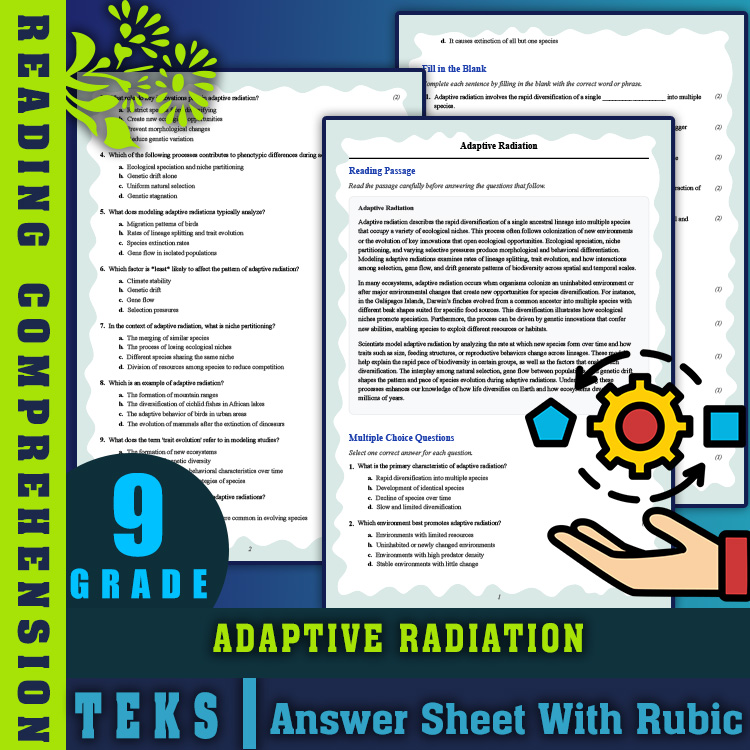
9th Grade Science | Adaptive Radiation Reading Worksheet & Answer Key (PDF)
JCreated byJ.S SheetsLearning Objectives
- Understand the concept of adaptive radiation and its significance in evolution.
- Identify key factors that drive diversification of species in new environments.
- Analyze the processes of ecological speciation and niche partitioning.
Instant download
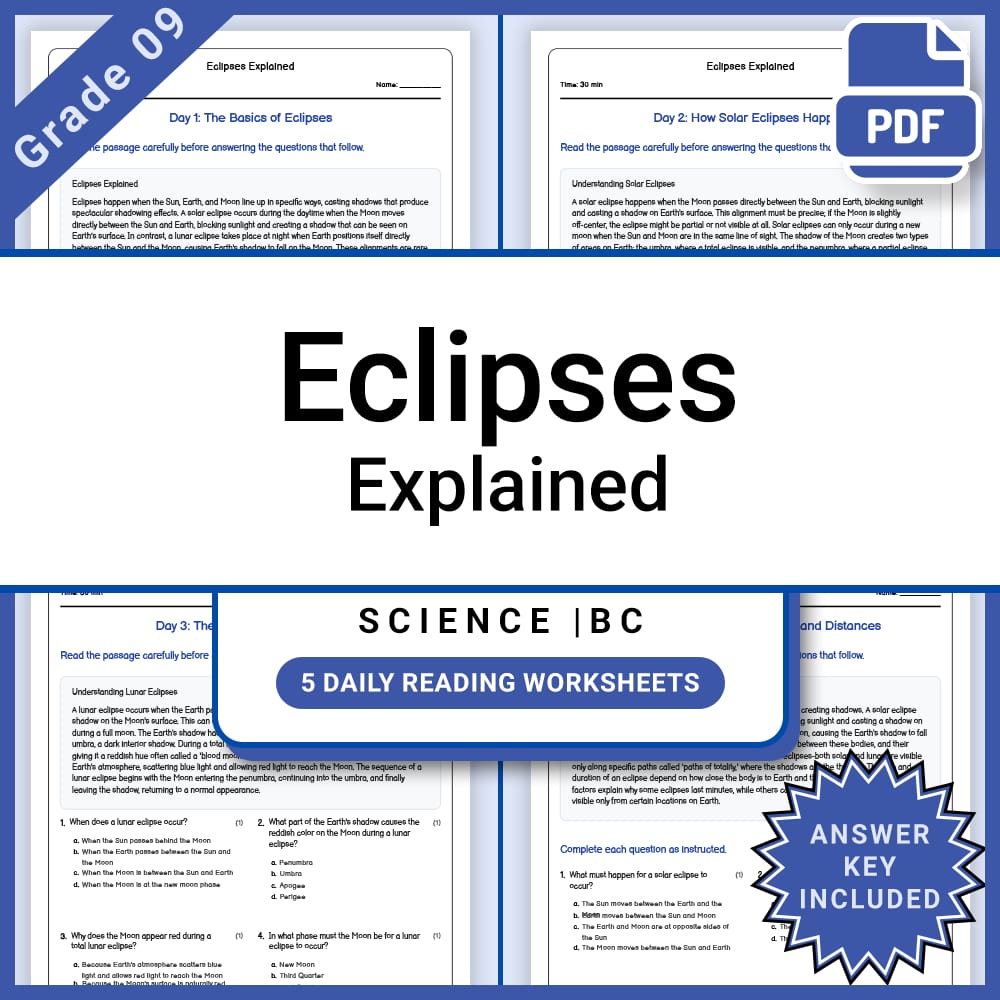
Grade 9 Science – Eclipses Explained Daily Reading Worksheet + Answer Key
JCreated byJ.S SheetsLearning Objectives
- Understand the differences between solar and lunar eclipses
- Learn how the Sun, Earth, and Moon align to produce eclipses
- Identify the conditions necessary for each type of eclipse
Also included in: Grade 9 Science Lesson Bundle: Tidal Forces, Tectonic Plates & Climate Physics +1 more
Instant download

Grade 9 Selective Breeding & Hybridization Alberta Science Worksheet
Created byBRIGHT PATH RESOURCESLearning Objectives
- Identify the main idea of a biotechnology text and use details to support it.
- Explain how selective breeding and hybridization can change traits in crops or livestock over generations.
- Connect genetic technology choices to potential benefits and limitations.
Instant download
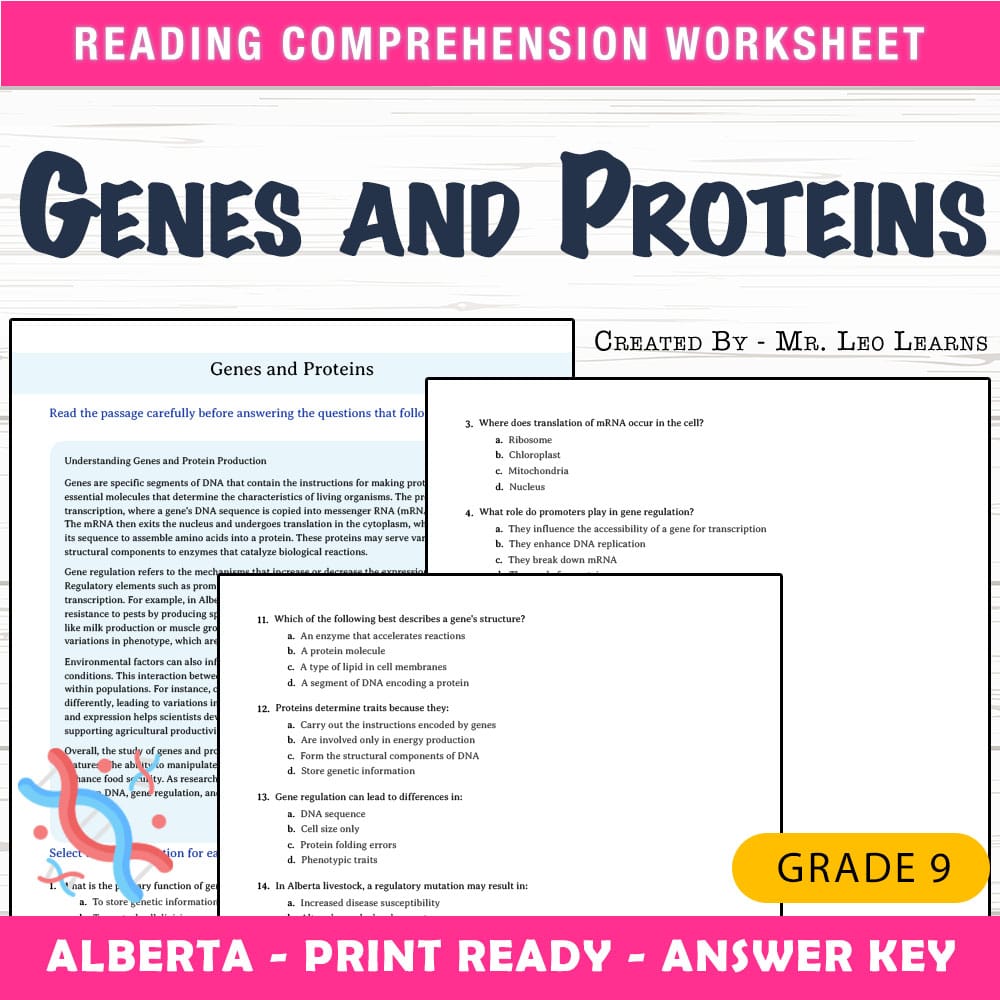
Grade 9 Science — Worksheet MCQ Paper for Mastering Genes and Proteins
 Created byThe Resource Hub
Learning Objectives
- Understand the role of genes as DNA segments coding for proteins.
- Explain the processes of transcription and translation in protein synthesis.
- Identify how gene regulation influences phenotypic traits in crops and livestock.
Also included in: Grade 9 Science Lesson Bundle | Reproduction and Heredity Worksheets +1 more
Instant download
Grade 9 Science — Worksheet MCQ Paper for Mastering Cell Type Differences
Created byThe Resource HubLearning Objectives
- Understand the key differences between prokaryotic and eukaryotic cells.
- Identify structural components unique to each cell type.
- Explain how cellular organization influences biological functions.
Also included in: Grade 9 Science Cells & Body Systems Worksheet Bundle | BC Curriculum Resources +1 more
Instant download
Circulatory Transport Worksheet Grade 9 Science | Ontario Standards
Created byCoral Reef LearningLearning Objectives
- Describe the structure and function of the cardiovascular system.
- Explain how blood flow is regulated to meet tissue demands.
- Identify components of blood and their roles in transport.
Instant download

Integrated Analysis Worksheet Pack | Grade 9 Science Activities
Created byPrism Point LearningLearning Objectives
- Explain how kinematics, net-force reasoning, and energy considerations work together to predict complex motion.
- Use force balance and energy ideas to determine acceleration and changes in speed during braking.
- Interpret how graphs and equations combine to estimate stopping distance under varying conditions.
Also included in: Forces, Motion & Energy Lesson Bundle | Grade 9 Science (Alberta)
Instant download

Power and Efficiency Worksheet | Grade 9 Science Activities
Created byPrism Point LearningLearning Objectives
- Explain how power relates to the rate of energy transfer in everyday and engineering systems
- Calculate and interpret efficiency as the fraction of input energy converted to useful output
- Identify major sources of energy loss and describe how they affect operational limits and design trade-offs
Also included in: Forces, Motion & Energy Lesson Bundle | Grade 9 Science (Alberta)
Instant download

Kinematic Concepts Worksheet | Grade 9 Science Practice Activity
Created byPrism Point LearningLearning Objectives
- Differentiate speed, velocity, and acceleration using scalar vs. vector ideas and direction conventions.
- Use basic kinematics relationships and unit conversions to compare motion in real contexts.
- Interpret sign conventions for motion and determine whether acceleration is increasing or decreasing velocity.
Also included in: Forces, Motion & Energy Lesson Bundle | Grade 9 Science (Alberta)
Instant download

Grade 9 Gene Expression Daily Reading Worksheet | TEKS Biology Science
Created byBRIGHT PATH RESOURCESLearning Objectives
- Identify the sequence of events in gene expression
- Explain how transcription and translation convert genetic information into a polypeptide
- Recognize the roles of mRNA, codons, and tRNA in building proteins
Also included in: Grade 9 Genetics Molecular Biology Science Reading Worksheets Bundle | TEKS +1 more
Instant download
Grade 9 Science — Work and Machines Worksheet MCQ for Mastery
Created byThe Resource HubLearning Objectives
- Understand the concept of work as energy transfer by force and displacement.
- Identify how simple machines change the magnitude or direction of applied forces.
- Explain the relationships among force, distance, work, and mechanical advantage in practical contexts.
Also included in: Grade 9 Science Forces and Motion Worksheet Pack | Alberta Curriculum +1 more
Instant download
Grade 9 Science — Worksheet MCQ Paper for Mastering System Coordination
Created byThe Resource HubLearning Objectives
- Describe how feedback loops contribute to multi-system coordination in the body.
- Explain the roles of neural, hormonal, and local signals in mediating organism responses.
- Analyze how disruptions in one component of system coordination can cascade to affect overall homeostasis.
Also included in: Grade 9 Science Cells & Body Systems Worksheet Bundle | BC Curriculum Resources +1 more
Instant download
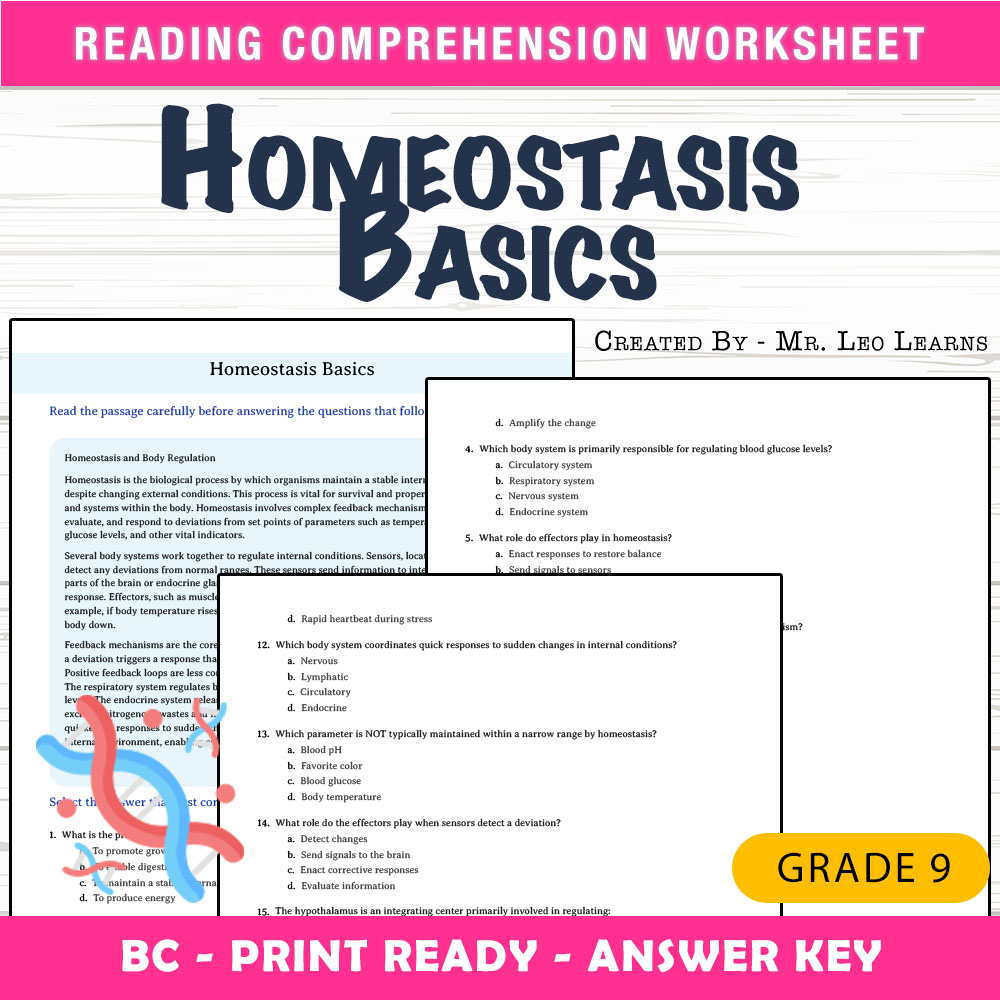
Grade 9 Science — Worksheet MCQ Paper for Mastering Homeostasis
Created byThe Resource HubLearning Objectives
- Define homeostasis and understand its significance in maintaining internal body conditions.
- Identify the roles of sensors, integrating centers, and effectors in feedback mechanisms.
- Describe how various body systems contribute to homeostasis, including respiratory, circulatory, endocrine, renal, and nervous systems.
Also included in: Grade 9 Science Cells & Body Systems Worksheet Bundle | BC Curriculum Resources +1 more
Instant download

Organelle Roles Worksheet | Grade 9 Science Activities
Created byPrism Point LearningLearning Objectives
- Identify major eukaryotic organelles and describe their specific functions
- Explain how organelle structure and molecular composition support cellular tasks
- Connect organelle roles to how different tissues carry out specialized activities
Instant download

Membrane Structure Worksheet | Grade 9 Science Activities
Created byPrism Point LearningLearning Objectives
- Explain how the phospholipid bilayer creates a selective barrier using hydrophobic and hydrophilic regions.
- Describe how integral and peripheral proteins support transport, signaling, and structure in membranes.
- Connect membrane fluidity and selective permeability to cholesterol and the fluid mosaic model.
Instant download
Grade 9 Science – Regulatory Mechanisms Worksheet (Answer Key) | TEKS Aligned
Created byBright Mind ResourcesLearning Objectives
- Explain how genes are regulated through promoter, enhancer, silencers, and transcription factors.
- Describe epigenetic modifications such as DNA methylation and histone acetylation and their effects on gene expression.
- Analyze how regulatory networks and feedback loops respond to developmental and environmental signals.
Also included in: Grade 9 Science Genetics & Biotechnology Unit - TEKS - Aligned (Answer Keys) +3 more
Instant download
Grade 9 Science – Genetic Data Analysis Worksheet (PDF) | TEKS-Aligned Practice
Created byBright Mind ResourcesLearning Objectives
- Interpret molecular and phenotypic data to infer inheritance patterns.
- Compare observed genotype and phenotype frequencies with expected ratios.
- Identify variants through PCR-based markers, single nucleotide variants, and sequencing reads.
Also included in: Grade 9 Science Genetics & Biotechnology Unit - TEKS - Aligned (Answer Keys) +3 more
Instant download
Grade 9 Science | DNA Replication Worksheet (Answer Key) – TEKS-Aligned
Created byBright Mind ResourcesLearning Objectives
- Describe the semi-conservative nature of DNA replication.
- Identify key enzymes involved in DNA replication and their functions.
- Explain the differences between leading and lagging strand synthesis.
Also included in: Grade 9 Science Genetics & Biotechnology Unit - TEKS - Aligned (Answer Keys) +3 more
Instant download
About Grade 9 Science Worksheets
Find Science worksheets built for Grade 9. All 6,986 cover core skills, practice, and review, each an instant PDF download.
Every worksheet on MyTeachingSheets is created by independent teacher-authors and reviewed before publication. All resources download as printable PDFs for classroom, homework, or at-home practice, and many include answer keys. Preview any worksheet free before buying.