
Grade 9 Science Worksheets
6,986 worksheets
Grade 9 – Element Symbols and Chemical Formulas Daily Worksheet with Answer Key
JCreated byJ.S SheetsLearning Objectives
- Identify common chemical element symbols.
- Recognize and interpret basic chemical formulas.
- Understand how symbols and formulas communicate chemical composition.
Also included in: Grade 9 Science Lesson Bundle | Alberta Framework +1 more
Instant download

Grade 9 Science | Power & Efficiency in Mechanical Systems - Reading Practice
 Created byCoral Reef Learning
Learning Objectives
- Understand the concept of power as the rate of energy transfer
- Explain how efficiency compares useful output energy to input energy
- Recognize the factors that lead to energy loss in systems
Instant download
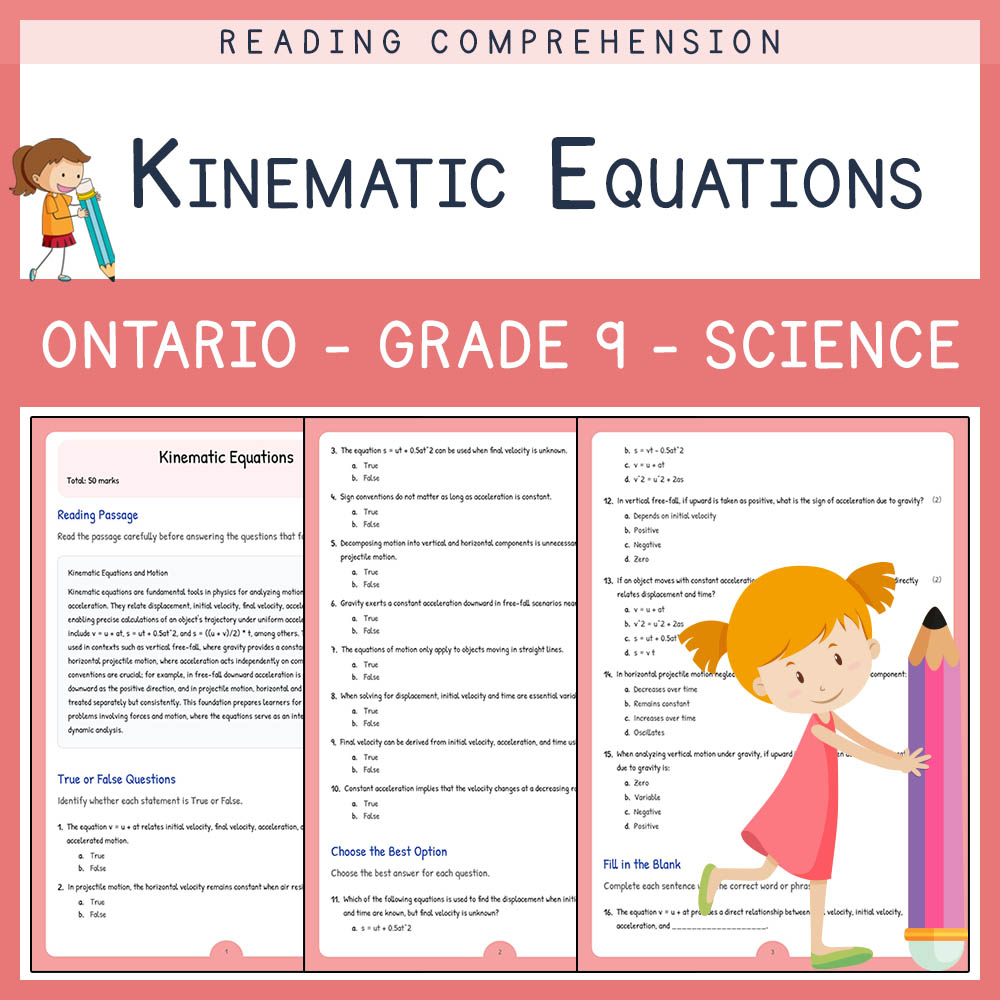
rade 9 Science Physics | Kinematic Equations Worksheet | Ontario Standard
 Created byLumora Learning
Learning Objectives
- Understand the derivation and form of constant-acceleration kinematic equations.
- Apply kinematic equations to solve problems involving vertical free-fall and projectile motion.
- Interpret sign conventions and component-wise treatment in motion analysis.
Instant download
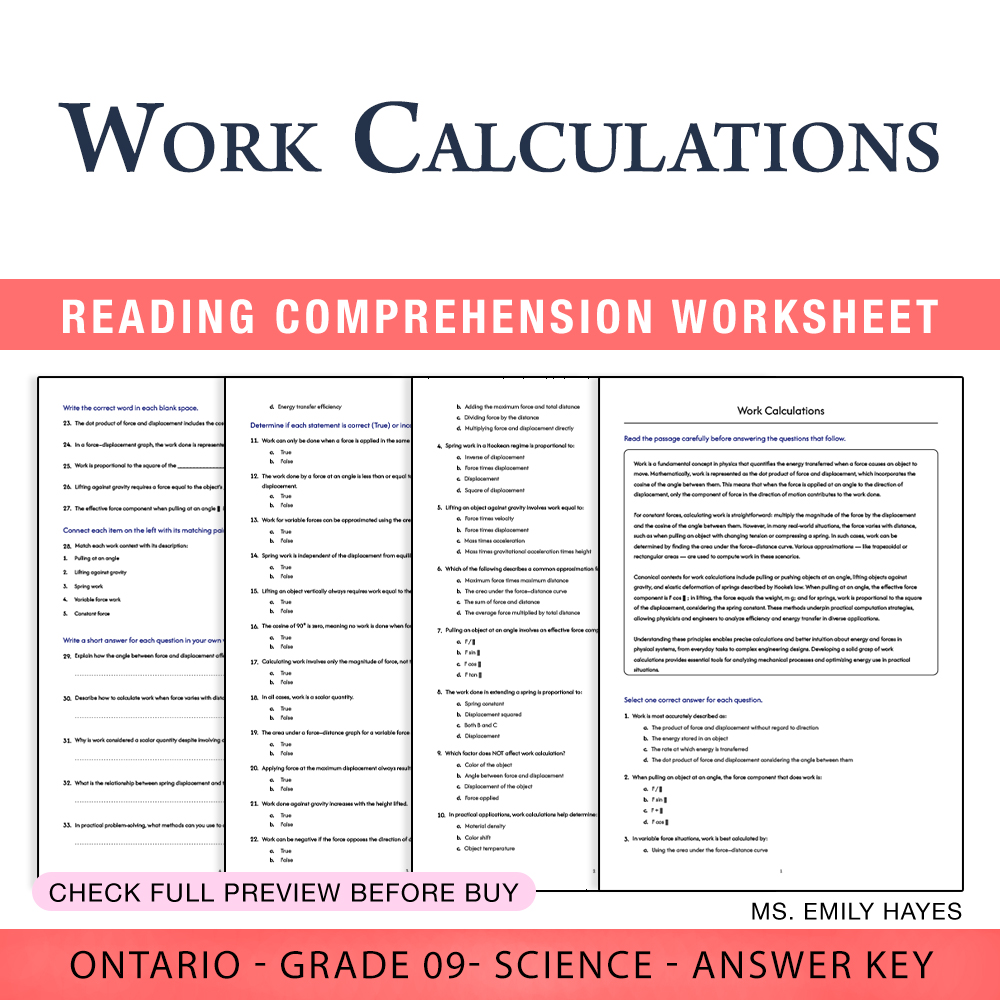
9th Grade Science | Work Calculations Worksheet (PDF + Answer Key)
 Created byCopper Leaf Classroom
Learning Objectives
- Understand the concept of work as the dot product of force and displacement, considering the angle between them.
- Calculate work done in various contexts including pulling at an angle, lifting against gravity, and spring work.
- Differentiate methods for calculating work with constant and variable forces, including the area under force–distance curves.
Instant download
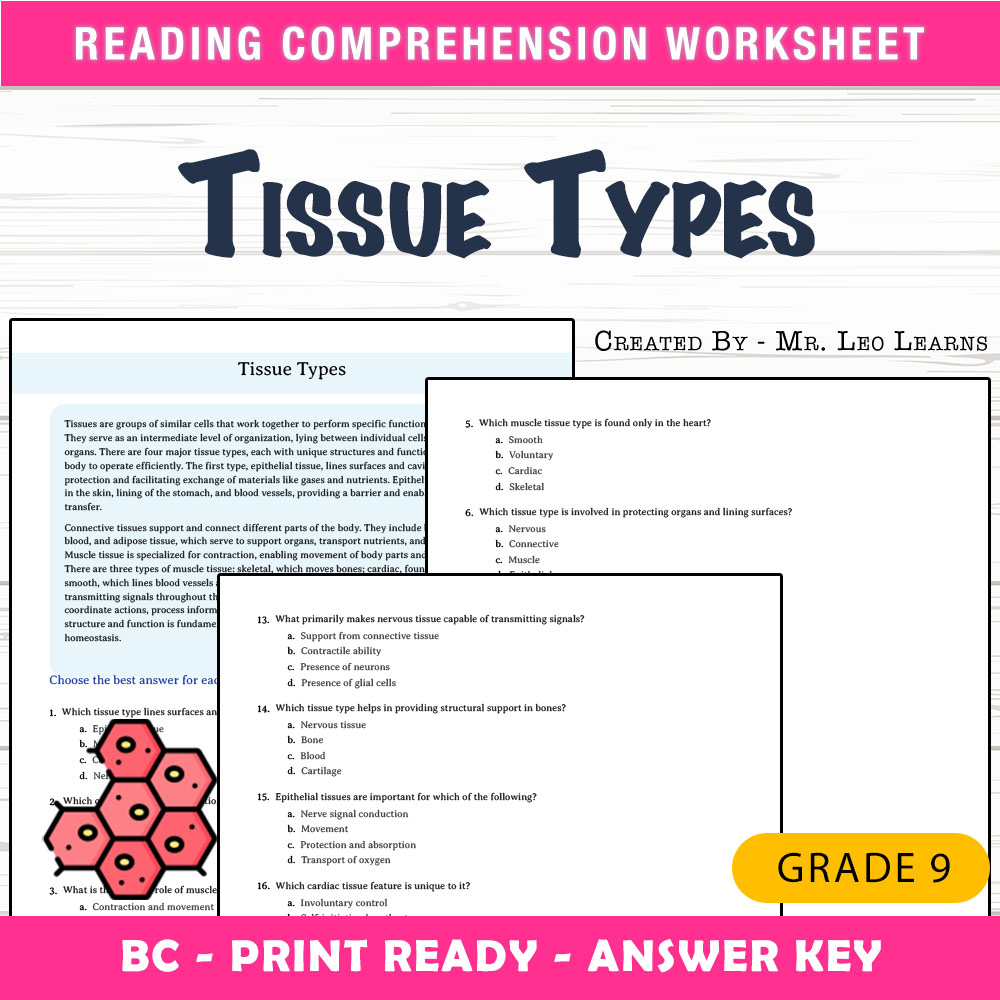
Grade 9 Science — Tissue Types Worksheet MCQ Paper for Master
 Created byThe Resource Hub
Learning Objectives
- Identify and describe the four main tissue types in the human body.
- Understand the functions of epithelial, connective, muscle, and nervous tissues.
- Recognize how tissue structure relates to their specific functions.
Also included in: Grade 9 Science Cells & Body Systems Worksheet Bundle | BC Curriculum Resources +1 more
Instant download
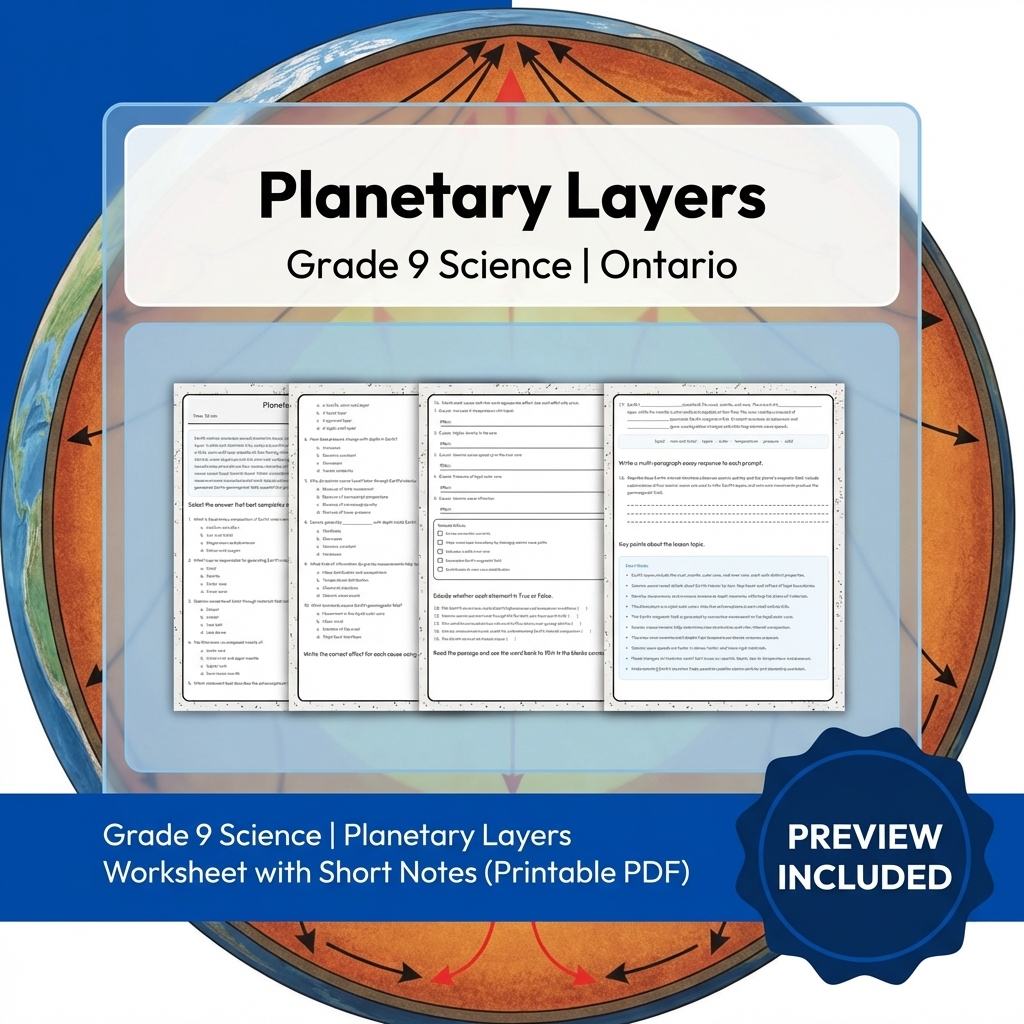
Grade 9 Science | Planetary Layers Worksheet with Short Notes (Printable PDF)
 Created byMeadowlark Worksheets
Learning Objectives
- Describe Earth's concentric layers including crust, mantle, and core.
- Compare the mechanical behavior of lithosphere and asthenosphere.
- Explain how density, temperature, and pressure vary with depth and influence material states.
Also included in: Grade 9 Science Lesson Group Bundle | Ontario Curriculum Worksheets
Instant download
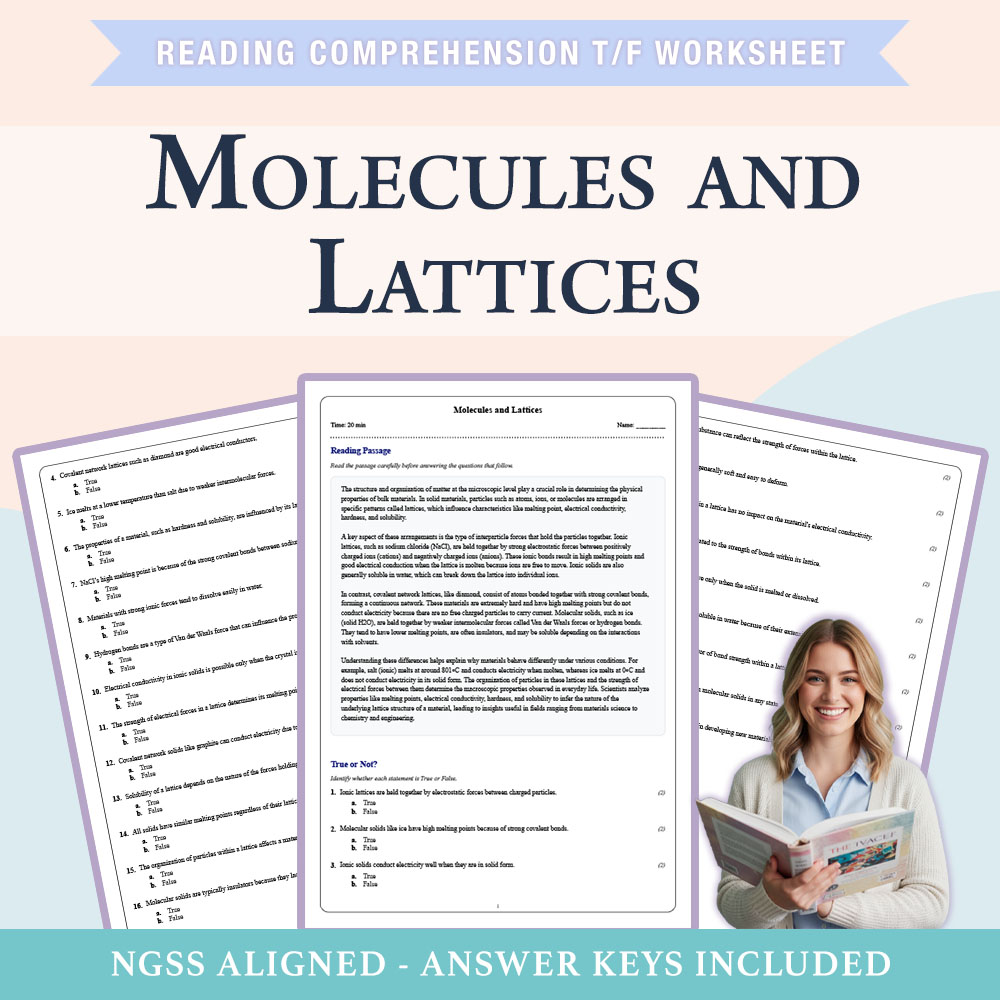
Grade 9 Science | Molecules and Lattices Worksheet (PDF + Answer Key)
Created byCopper Leaf ClassroomLearning Objectives
- Understand the differences between ionic lattices, covalent networks, and molecular solids.
- Identify properties such as melting point, electrical conductivity, hardness, and solubility as indicators of lattice organization.
- Explain how interparticle electrical interactions influence the physical properties of different solid materials.
Also included in: Grade 9 Science | Reaction & Atomic Structure Unit Bundle (PDF + Answer Key) +1 more
Instant download
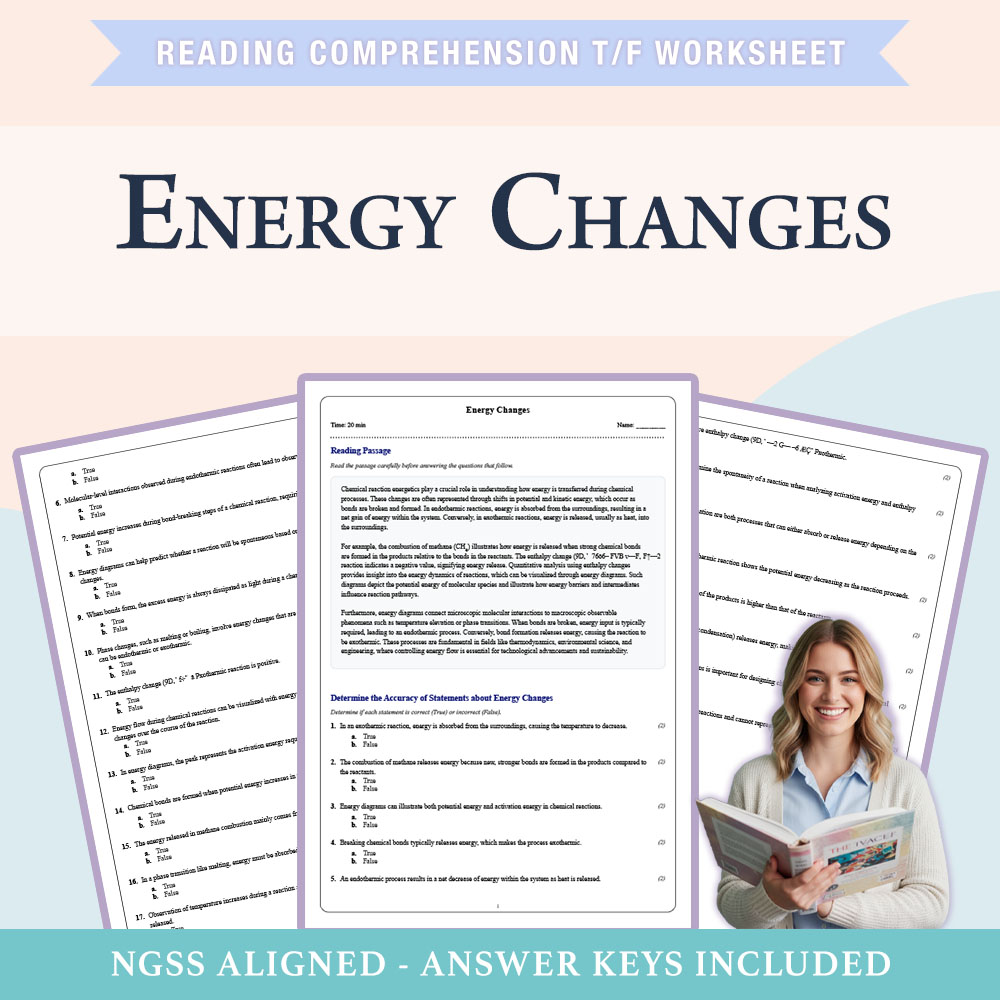
Grade 9 Science | Energy Changes Worksheet (PDF + Answer Key)
Created byCopper Leaf ClassroomLearning Objectives
- Understand how potential and kinetic energy change during chemical reactions.
- Identify processes as endothermic or exothermic based on energy diagrams.
- Relate molecular interactions to observable temperature and phase changes.
Also included in: Grade 9 Science | Reaction & Atomic Structure Unit Bundle (PDF + Answer Key) +1 more
Instant download
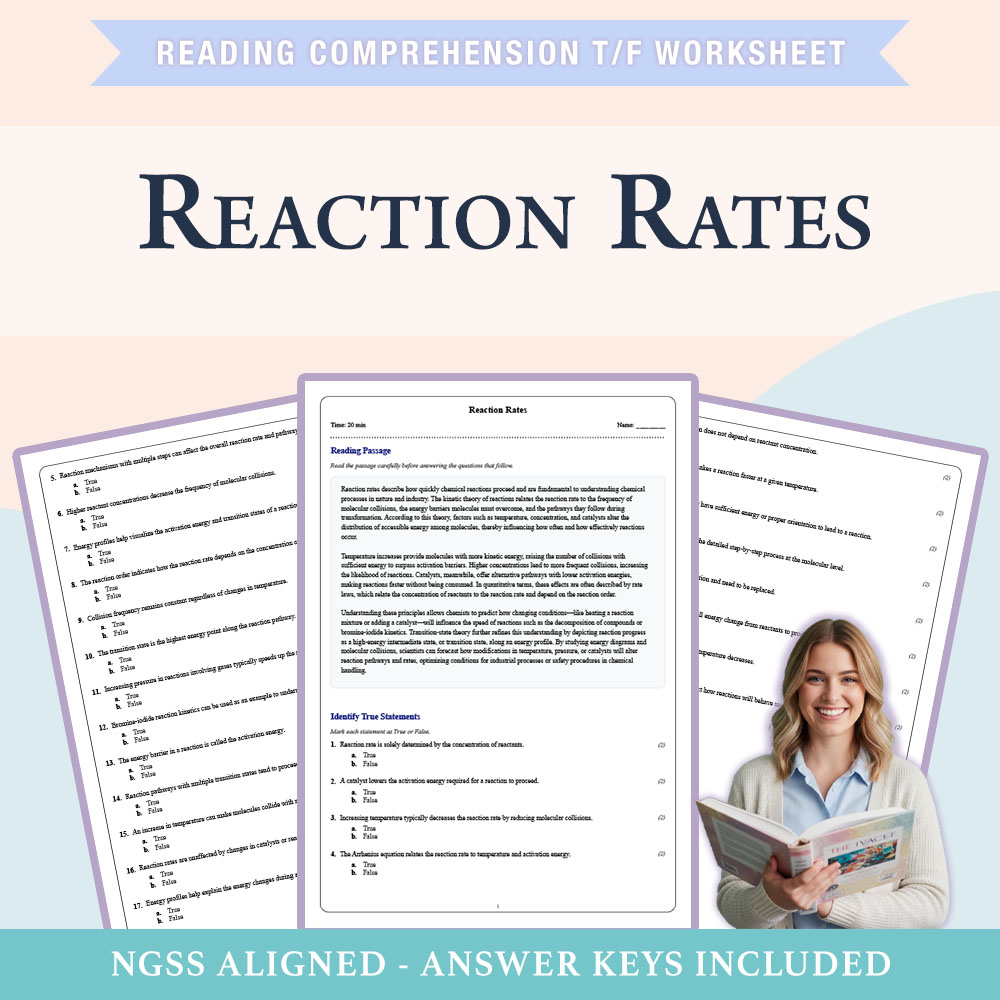
9th Grade Science | Reaction Rates Worksheet (PDF + Answer Key)
Created byCopper Leaf ClassroomLearning Objectives
- Understand how collision frequency, activation energy, and reaction pathways influence reaction rates.
- Explain how temperature, concentration, and catalysts modify energy distributions and affect reaction speed.
- Describe the concepts of rate laws, reaction order, and transition-state theory in relation to reaction kinetics.
Also included in: Grade 9 Science | Reaction & Atomic Structure Unit Bundle (PDF + Answer Key) +1 more
Instant download
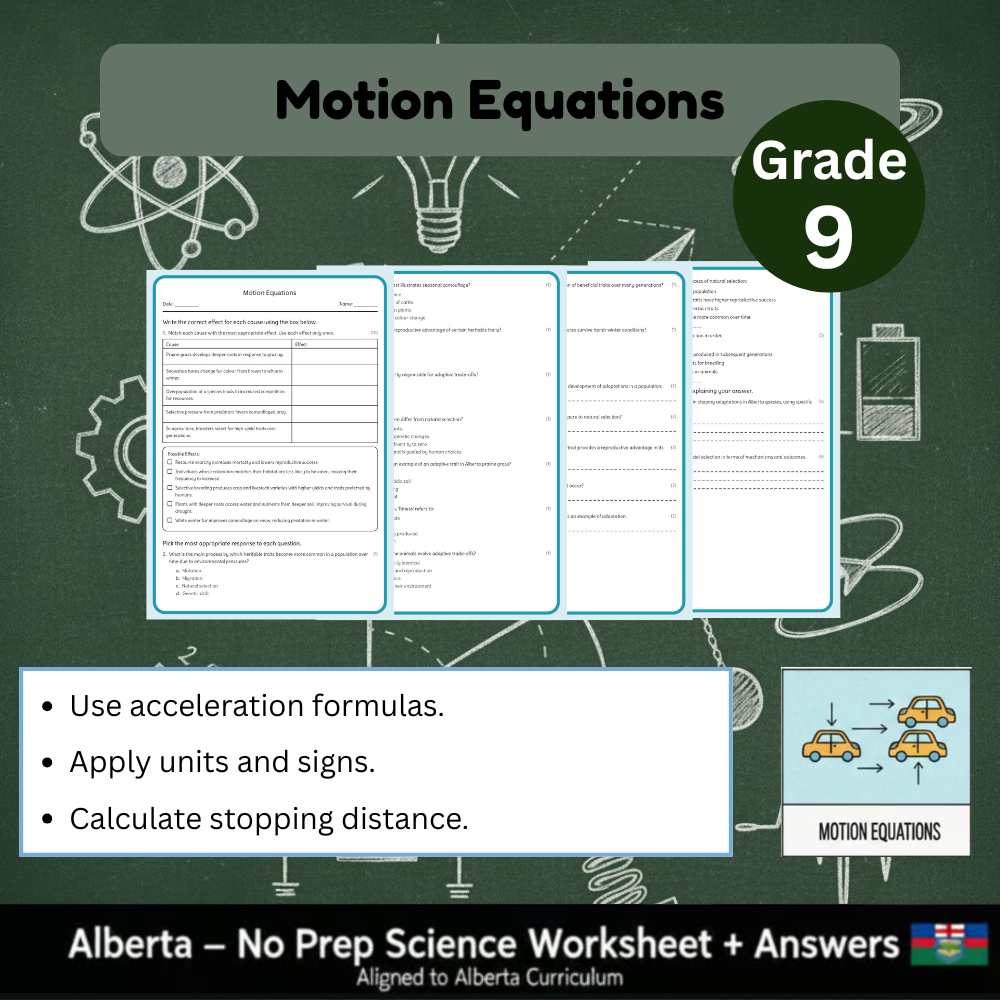
Grade 9 Science | Motion Equations Worksheet (PDF) – Alberta Standards
 Created byBright Mind Resources
Learning Objectives
- Understand how to use constant-acceleration equations to predict object displacement and velocity.
- Apply appropriate units, sign conventions, and algebraic substitution to solve motion problems.
- Interpret real-world scenarios involving vehicle stopping distances, ski slopes, and free fall.
Instant download

Grade 9 Science – Microscopy Basics Daily Reading Worksheet with Answer Key
JCreated byJ.S SheetsLearning Objectives
- Understand the principles of light microscopy.
- Recognize the components and functions of a light microscope.
- Describe the differences between magnification, resolution, and contrast.
Also included in: Grade 9 Science Lesson Group Bundle TEKS Daily Reading Worksheets +1 more
Instant download

Grade 9 Science – Introduction to Cell Membranes Daily Worksheet + Answer Key
JCreated byJ.S SheetsLearning Objectives
- Identify the main components of the cell membrane
- Understand the functions of phospholipids and proteins
- Explain the fluid mosaic model of the membrane
Also included in: Grade 9 Science Lesson Group Bundle TEKS Daily Reading Worksheets +1 more
Instant download
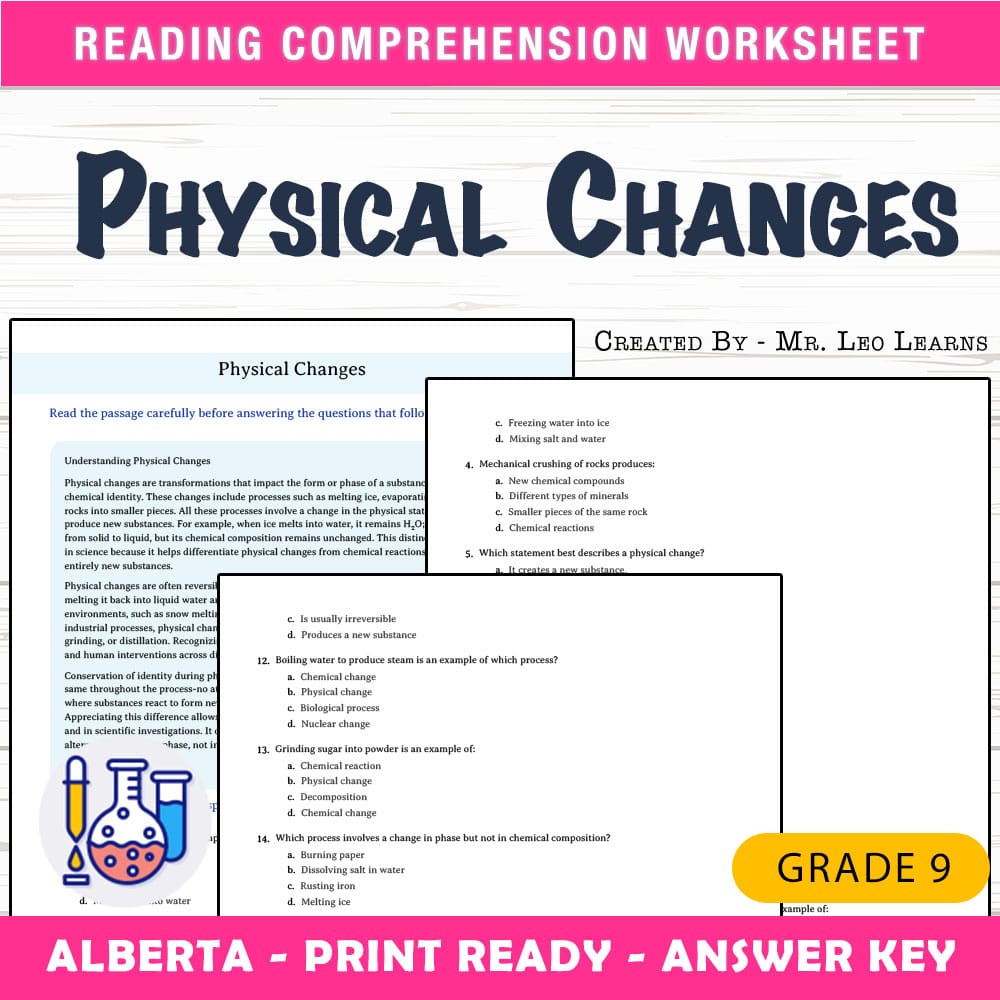
Grade 9 Science — Worksheet MCQ Paper for Mastering Physical Changes
Created byThe Resource HubLearning Objectives
- Understand the concept of physical changes and how they differ from chemical changes.
- Identify examples of physical changes in everyday life and the environment.
- Explain the processes involved in phase changes like melting, freezing, and mechanical alteration.
Also included in: Grade 9 Science Bundle | Matter and Chemical Change Worksheets Pack +1 more
Instant download

Organelle Systems Worksheet | Grade 9 Science Activities
 Created byPrism Point Learning
Learning Objectives
- Explain how multiple organelles work together as an integrated system rather than in isolation.
- Describe how transport and cell structure help move materials between organelles.
- Connect organelle cooperation to metabolism, cell maintenance, and cellular responses.
Instant download
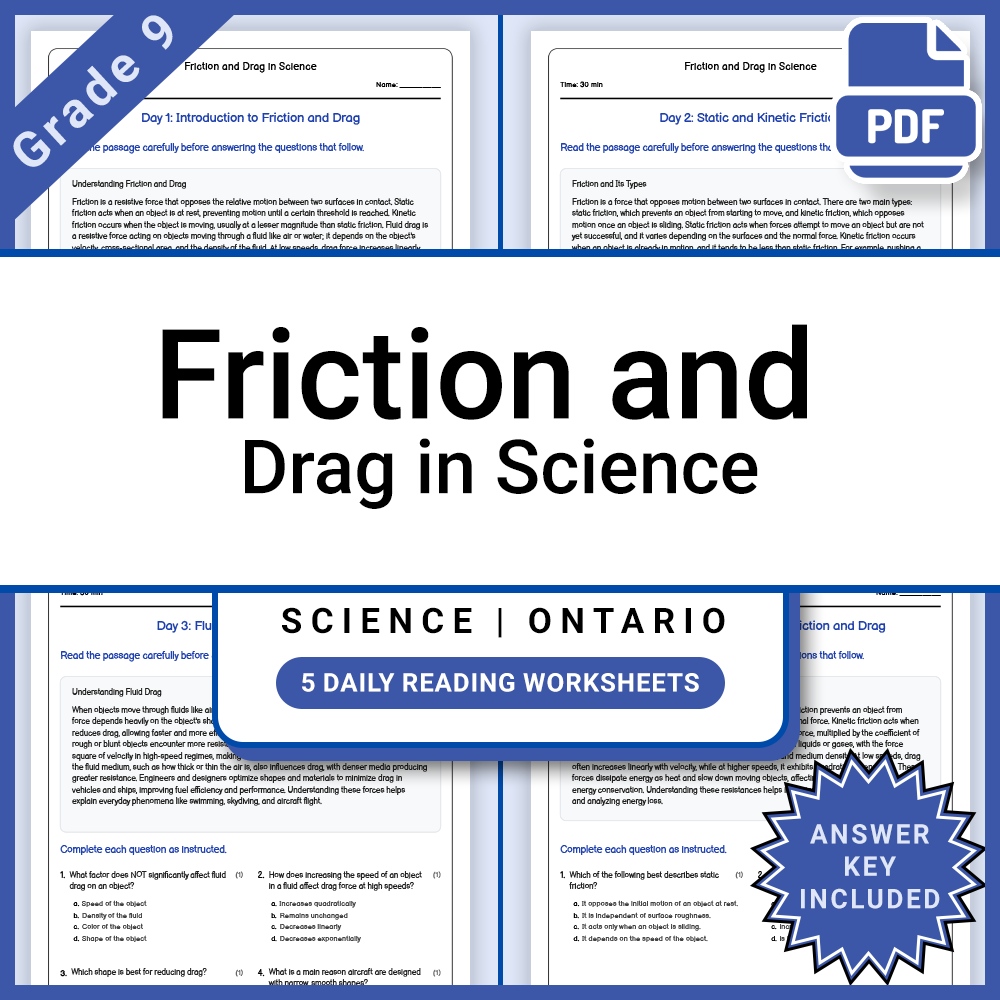
Grade 9 Science – Friction and Drag Daily Reading Worksheet + Answer Key
JCreated byJ.S SheetsLearning Objectives
- Define static and kinetic friction and explain their differences.
- Describe fluid drag and how it depends on velocity, surface area, and medium density.
- Understand the coefficients of friction and their role in force calculations.
Also included in: Grade 9 Science Lesson Group: Physics and Motion Worksheets Bundle +1 more
Instant download

Integrated Metabolism Worksheet | Grade 9 Science Activities
Created byPrism Point LearningLearning Objectives
- Explain how catabolic and anabolic pathways coordinate to meet cellular energy demands across tissues
- Describe how hormones and nutrient availability shift metabolic priorities and redistribute intermediates
- Compare short-term (post-translational) and long-term (gene expression/organelles) regulation of metabolism
Instant download
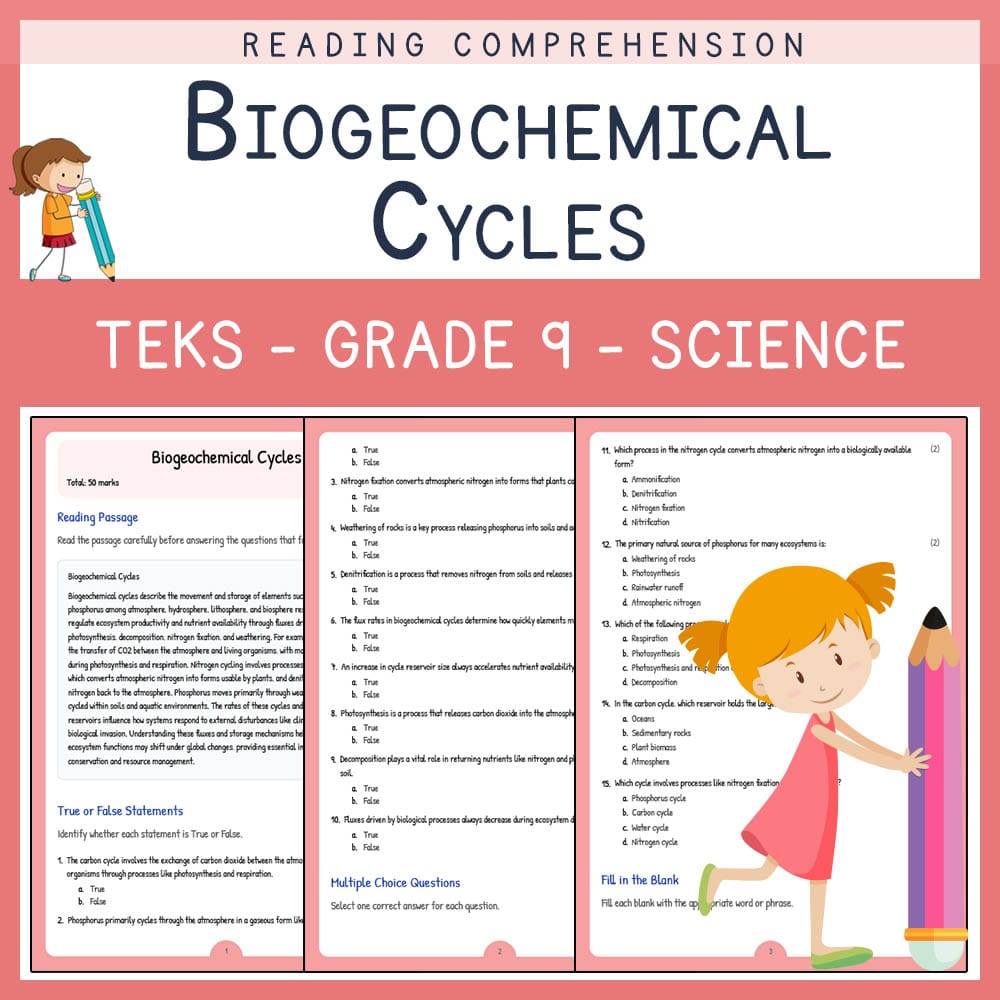
Grade 9 Science | Biogeochemical Cycles Worksheet | TEKS Aligned
Created byLumora LearningLearning Objectives
- Describe the major biogeochemical cycles and their role in ecosystems.
- Identify the key processes driving movement of elements like carbon, nitrogen, and phosphorus.
- Explain the impact of fluxes and reservoir sizes on ecosystem responses and climate change.
Instant download

Grade 9 Science Worksheet on Reservoirs and Feedback – General Standards (PDF)
 Created byEvergreen Desk Education
Learning Objectives
- Explain how storage reservoirs and time scales control how fast Earth systems exchange carbon and water.
- Describe how feedbacks can amplify or dampen changes in atmospheric carbon, ocean carbon, and living systems.
- Connect energy flow to evaporation, winds, temperature, and climate-related feedbacks.
Also included in: Grade 9 Earth and Space Science Lesson Bundle (General) Science Worksheets +1 more
Instant download
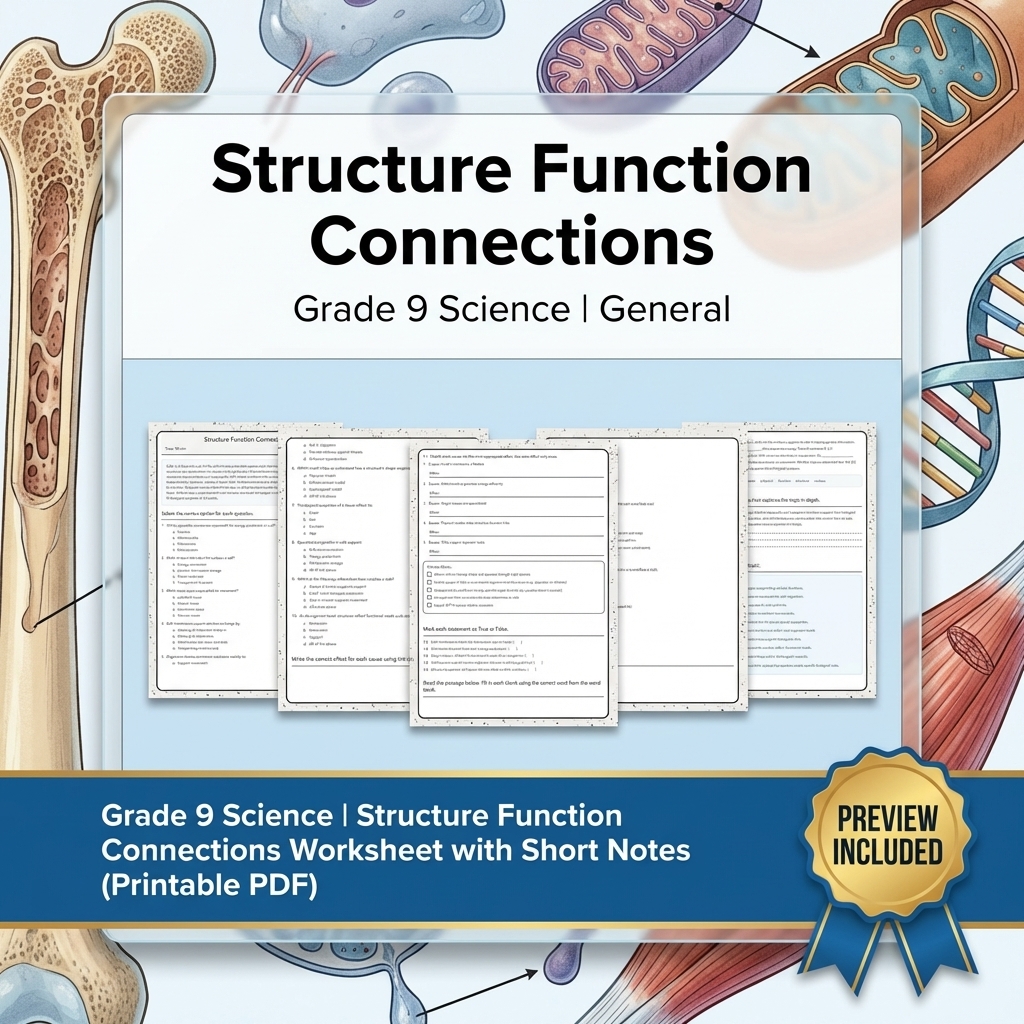
Grade 9 Science | Structure Function Connections Worksheet with Short Notes
Created byMeadowlark WorksheetsLearning Objectives
- Understand how cellular structures relate to their functions within cells.
- Identify examples of organism structures that reflect specific functional needs.
- Explain how models connect physical features to biological roles at cellular and organism levels.
Also included in: Grade 9 Ecology, Genetics & Cells Science Lesson Bundle | General Framework +1 more
Instant download

Motion Graphs Practice Worksheet | Grade 9 Science Assessment
Created byPrism Point LearningLearning Objectives
- Interpret position–time and velocity–time graphs by connecting slopes and areas to physical quantities
- Explain how slope on a position–time graph represents velocity and how slope on a velocity–time graph represents acceleration
- Use graph regions to determine displacement and connect the results to Newtonian ideas about forces
Also included in: Grade 9 Work, Energy & Forces Science Lesson Bundle Ontario Curriculum
Instant download

Microscopy Analysis Worksheet | Grade 9 Science Activities
Created byPrism Point LearningLearning Objectives
- Interpret microscopy images using resolution limits, scale bars, and contrast features
- Use staining and fluorescence patterns to infer specific cellular structures or molecules
- Evaluate image sets over time while accounting for artifacts and measurement errors
Instant download
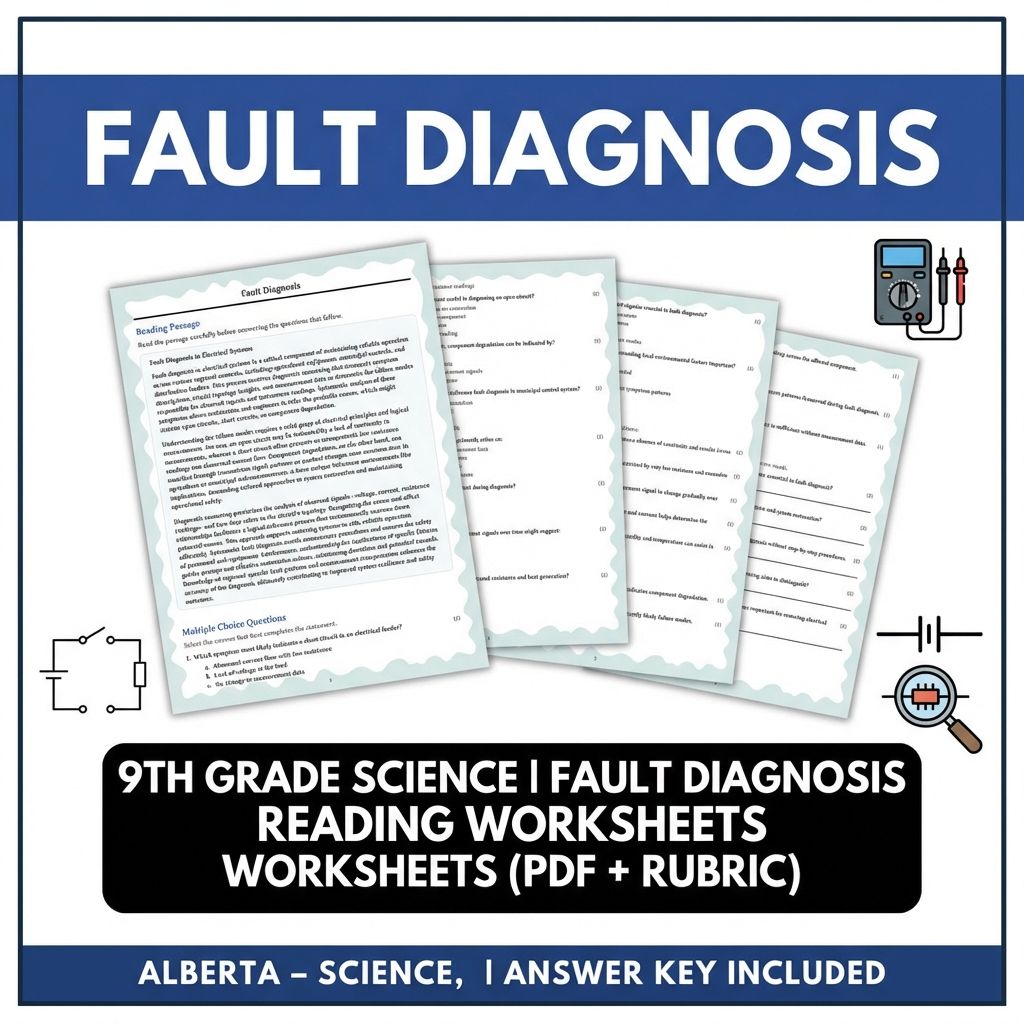
9th Grade Science | Fault Diagnosis Reading Worksheets (PDF + Rubric)
JCreated byJ.S SheetsLearning Objectives
- Understand the principles of diagnostic reasoning in electrical faults.
- Identify symptoms and interpret measurement data to infer failure modes.
- Apply logical inference to diagnoses involving open circuits, short circuits, or component degradation.
Also included in: Grade 9 Science Bundle | Electricity, Energy & Magnetism (PDF + Answer Keys) +1 more
Instant download
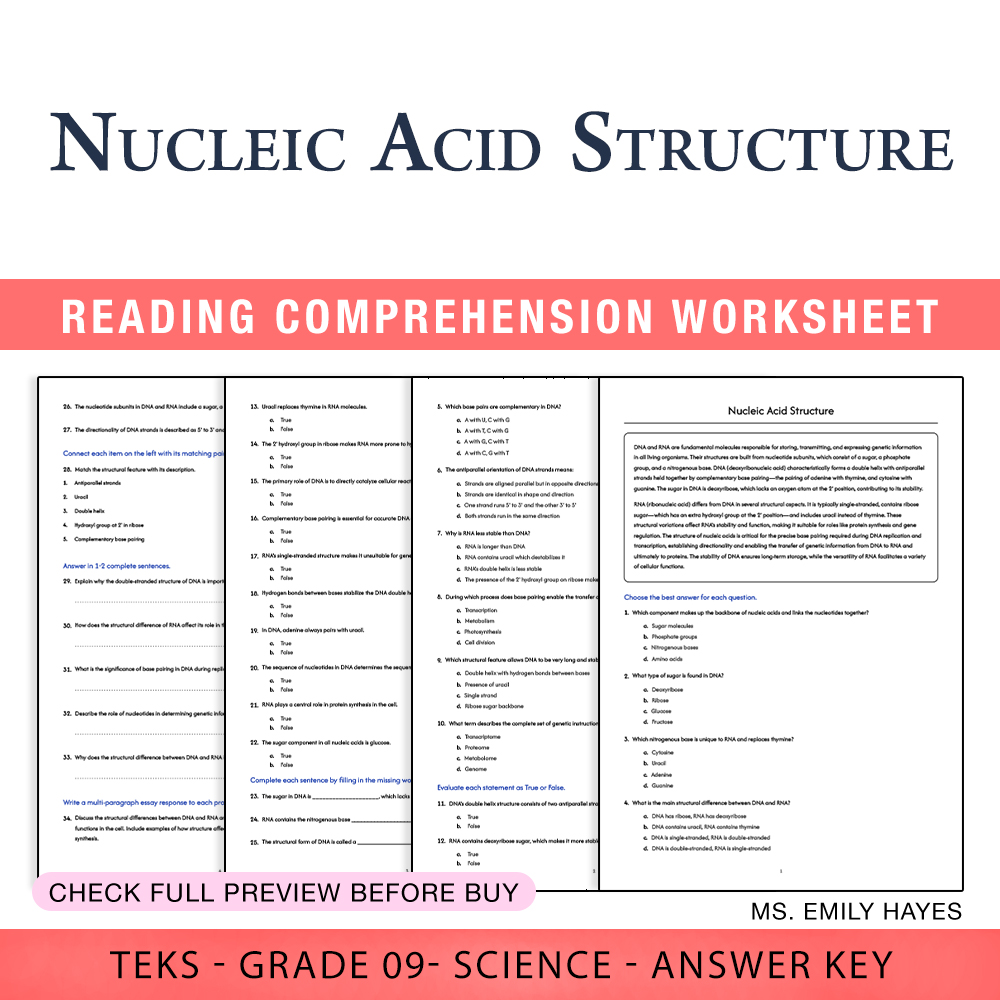
9th Grade Science | Nucleic Acid Structure Printable Worksheet (PDF+ Answer Key)
Created byCopper Leaf ClassroomLearning Objectives
- Describe the chemical structures of DNA and RNA and their nucleotide components.
- Compare the structural features of DNA and RNA, including strand orientation and sugar content.
- Explain how nucleic acid structures enable specific base pairing during processes like replication and transcription.
Instant download

Newton's Laws Worksheet | Grade 9 Science Practice and Review
Created byPrism Point LearningLearning Objectives
- Explain Newton’s three laws and connect each law to observable motion and forces.
- Use the ideas of net force, acceleration, inertia, and action–reaction pairs to predict outcomes.
- Identify common real-world examples (sports and vehicles) that illustrate Newton’s laws.
Also included in: Forces and Motion Lesson Bundle – Grade 9 Science Framework BC +1 more
Instant download

Stoichiometry Basics Worksheet | Grade 9 Science Practice
Created byPrism Point LearningLearning Objectives
- Explain how balanced chemical equations and conservation of mass connect atoms to measurable amounts.
- Use molar mass to convert between grams and moles of a substance.
- Apply mole ratios from balanced equations to predict relative amounts of reactants and products.
Also included in: Grade 9 Matter and Chemical Change Lesson Bundle | Science | BC +1 more
Instant download

Reaction Essentials Worksheet | Grade 9 Science Activities
Created byPrism Point LearningLearning Objectives
- Explain how chemical reactions transform reactants into products by making and breaking chemical bonds.
- Interpret chemical formulas and symbolic equations, including state symbols and stoichiometric coefficients.
- Connect bond energies to whether a reaction releases or absorbs energy.
Also included in: Grade 9 Matter and Chemical Change Lesson Bundle | Science | BC +1 more
Instant download

Classification Foundations Worksheet | Grade 9 Science Activities
Created byPrism Point LearningLearning Objectives
- Explain how hierarchical biological classification helps organize biodiversity.
- Describe traditional taxonomic ranks and how binomial nomenclature supports clear communication.
- Compare how evolutionary relationships and clades are used in modern classification.
Also included in: Grade 9 Evolution & Speciation Lesson Bundle | TEKS Science
Instant download
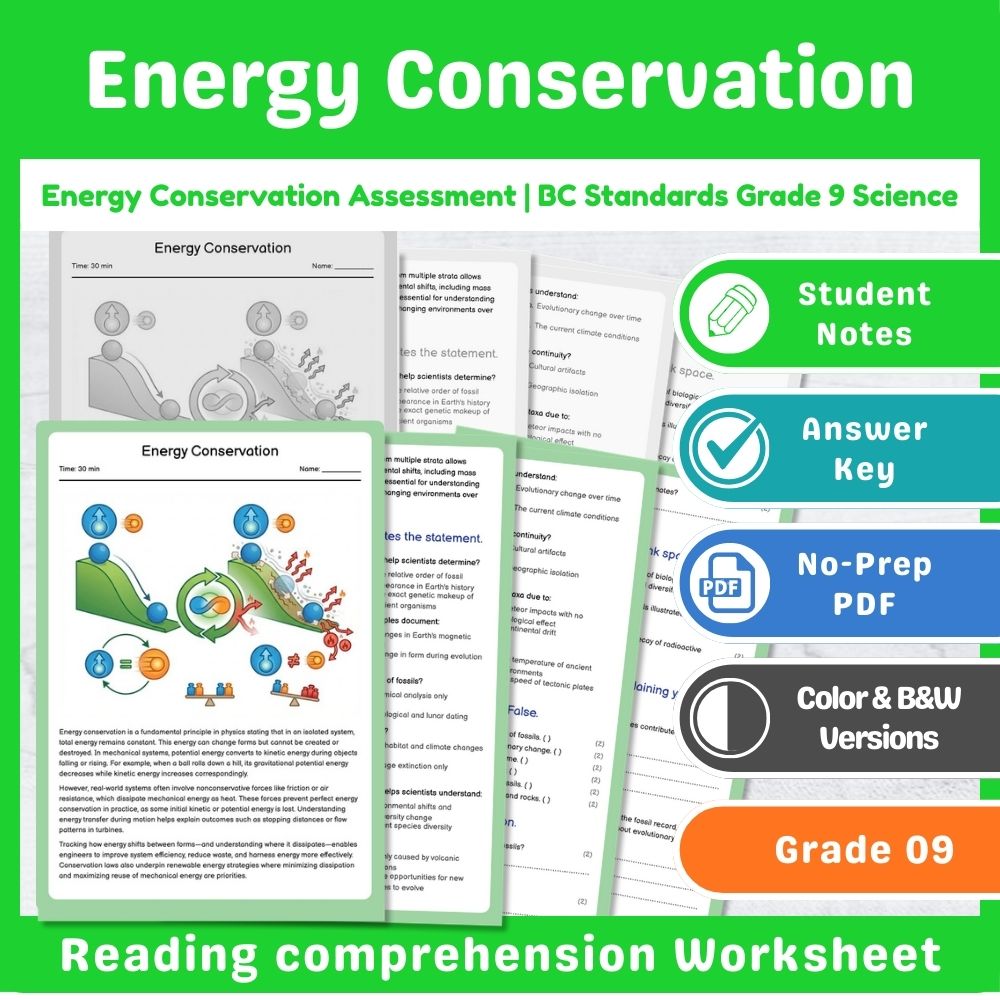
Energy Conservation Assessment | BC Standards Grade 9 Science
Created byPrism Point LearningLearning Objectives
- Explain the principle of conservation of energy in isolated systems.
- Identify different forms of energy and how they interconvert.
- Describe how nonconservative forces like friction dissipate mechanical energy into heat.
Instant download

Transport Mechanisms Worksheet | Grade 9 Science Practice
Created byPrism Point LearningLearning Objectives
- Explain how passive transport, facilitated diffusion, and osmosis move substances across cell membranes using concentration gradients.
- Describe how active transport uses membrane proteins and ATP to move substances against gradients.
- Compare vesicular transport (endocytosis and exocytosis) with transport through membrane proteins.
Instant download
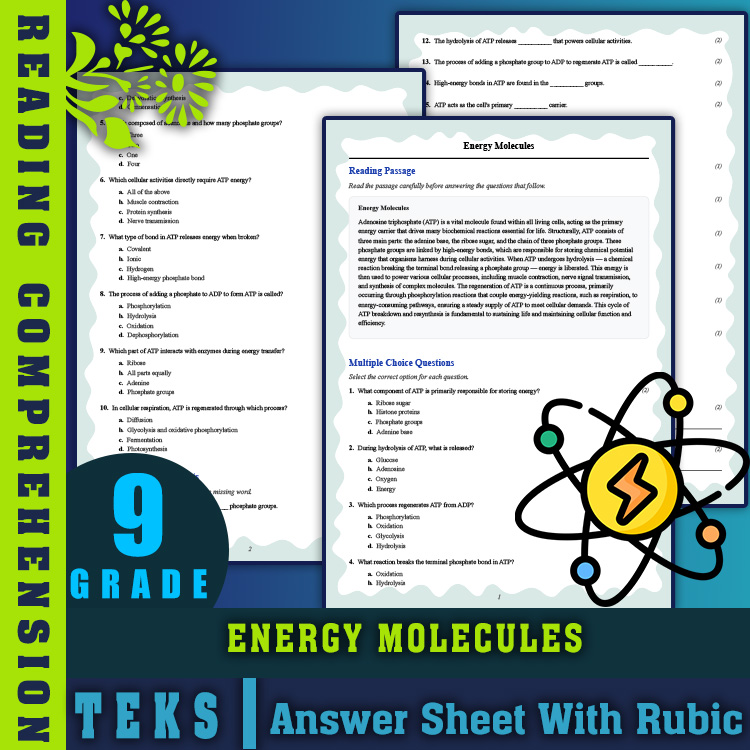
9th Grade Science | Energy Molecules Reading Worksheet & Answer Key (PDF)
JCreated byJ.S SheetsLearning Objectives
- Understand the structure and function of ATP as the cell's primary energy currency.
- Explain how ATP hydrolysis releases energy for cellular processes.
- Describe the process of ATP regeneration through phosphorylation.
Instant download

Circular Motion Worksheet | Grade 9 Science Activities
Created byPrism Point LearningLearning Objectives
- Explain how centripetal net force produces acceleration toward the center in circular motion
- Use the relationship between speed, radius, and centripetal acceleration to predict changes in motion
- Identify common inward forces (tension, friction, normal force) that maintain curved trajectories
Also included in: Forces and Motion Lesson Bundle – Grade 9 Science Framework BC +1 more
Instant download

Energy Conservation Worksheet | Grade 9 Science Practice
Created byPrism Point LearningLearning Objectives
- Explain conservation of energy in an isolated system and describe how energy can change forms.
- Differentiate between mechanical energy (kinetic and potential) and nonconservative transfers (such as heat from friction).
- Use energy-conversion reasoning to predict motion outcomes for real-world situations.
Also included in: Forces and Motion Lesson Bundle – Grade 9 Science Framework BC +1 more
Instant download

Power and Efficiency Review Worksheet | Grade 9 Science Ontario
Created byPrism Point LearningLearning Objectives
- Explain power as the rate of energy transfer (or work per unit time) using average and instantaneous ideas
- Use appropriate SI units (joule, watt) to describe energy/work and power
- Calculate mechanical efficiency and interpret how losses like friction reduce useful output
Also included in: Grade 9 Work, Energy & Forces Science Lesson Bundle Ontario Curriculum
Instant download

Nutrient Cycling Worksheet | Grade 9 Science Activities
Created byPrism Point LearningLearning Objectives
- Explain how nitrogen and phosphorus move through organisms, soils, water, and the atmosphere.
- Describe how biological processes (nitrogen fixation, assimilation, mineralization, and denitrification) affect nutrient availability.
- Analyze how human activities can increase nutrient loading and lead to eutrophication and oxygen loss.
Instant download

Friction and Drag Worksheet | Grade 9 Science Activities
Created byPrism Point LearningLearning Objectives
- Explain how friction and aerodynamic drag oppose motion and convert mechanical energy into thermal energy.
- Identify the variables that affect friction on surfaces and drag in air for real-world objects.
- Use coefficients and basic models to estimate resistance forces qualitatively.
Also included in: Forces, Motion & Energy Lesson Bundle | Grade 9 Science (Alberta)
Instant download

Grade 9 Science | Metabolic Pathways Worksheet (TEKS)
Created byEvergreen Desk EducationLearning Objectives
- Explain how catabolic and anabolic metabolic pathways differ in energy use and products.
- Describe how enzyme regulation (feedback, compartmentalization, and substrate availability) controls metabolic flux.
- Use pathway concepts to predict how changes in substrates or enzymes affect ATP production and biosynthesis.
Instant download
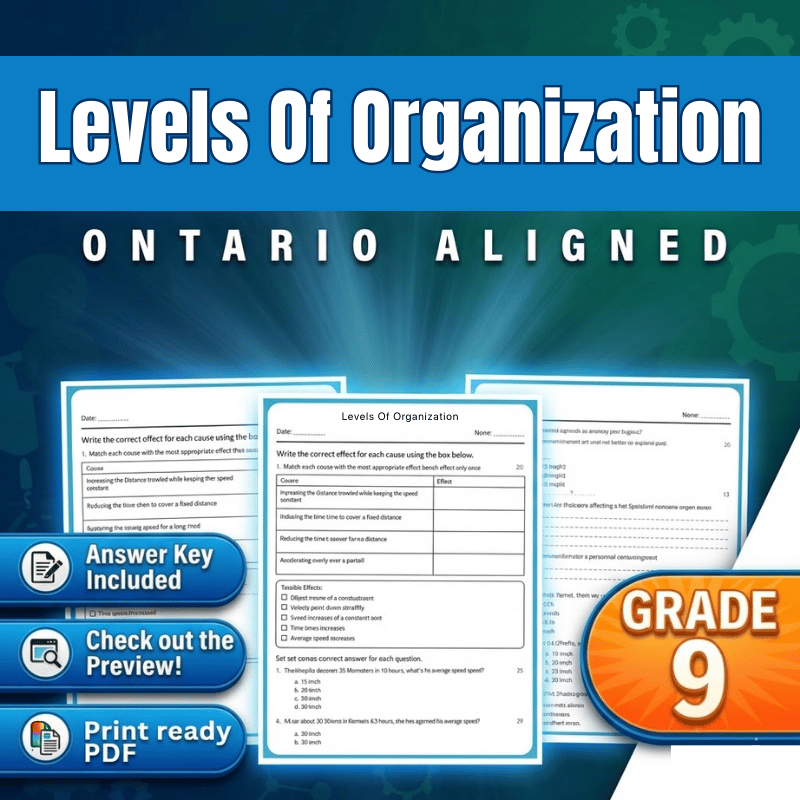
Grade 9 Science | Levels Of Organization Worksheet (Ontario, PDF)
Created byBright Mind ResourcesLearning Objectives
- Explain the hierarchical relationships among cells, tissues, organs, and systems.
- Describe how cell specialization and extracellular matrices contribute to organ functions.
- Understand the scaling principles from cellular interfaces to organ systems and their impact on physiological capacity.
Instant download
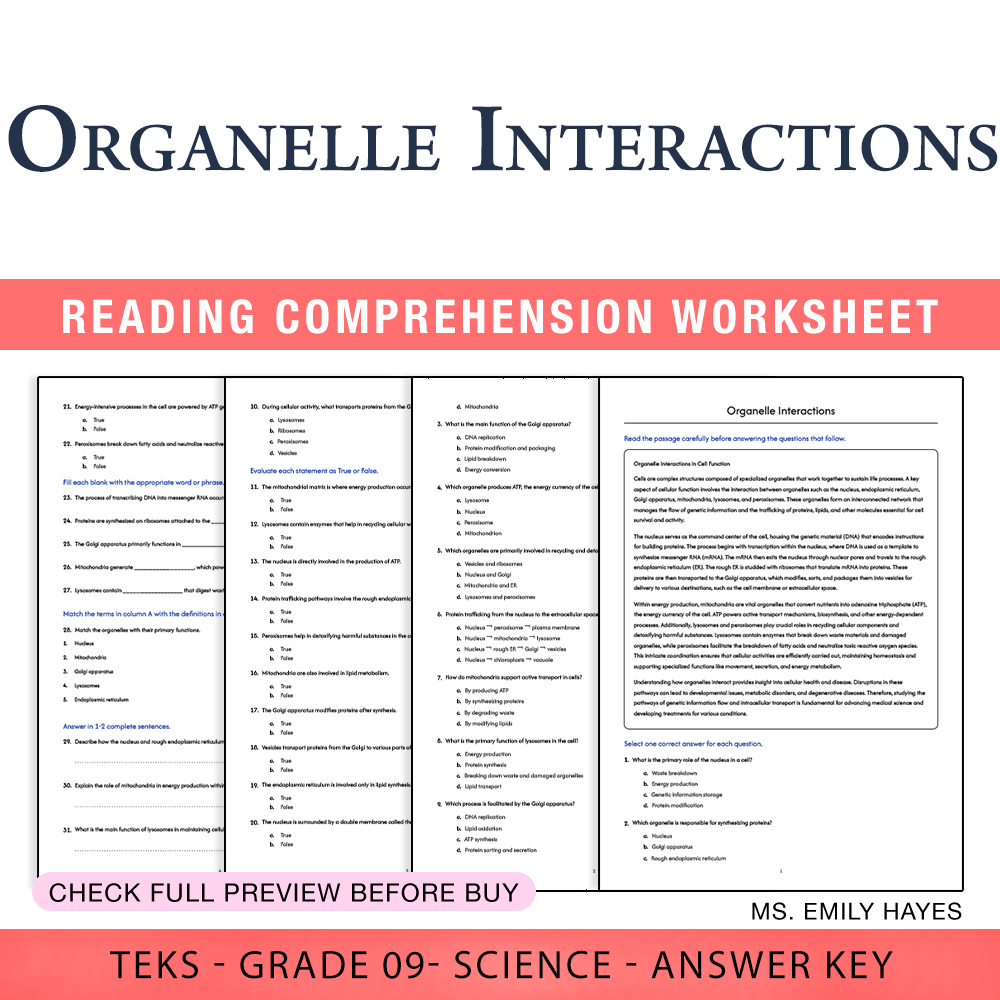
9th Grade Science | Organelle Interactions Worksheet (PDF+ Answer Key)
Created byCopper Leaf ClassroomLearning Objectives
- Describe how different organelles coordinate to support cellular functions.
- Explain the pathways of genetic information flow within a cell.
- Identify the roles of mitochondria, lysosomes, and the Golgi apparatus in maintaining homeostasis.
Instant download

Grade 9 TEKS Organelle Pathways Worksheet | Nucleus to Rough ER Activity
 Created byBRIGHT PATH RESOURCES
Learning Objectives
- Identify the main idea of a passage about protein trafficking.
- Describe how the nucleus and rough endoplasmic reticulum work together to start protein production.
- Use vocabulary related to organelles and protein synthesis accurately.
Also included in: Grade 9 Cell Structure and Function Biology Worksheets Bundle | TEKS +1 more
Instant download

Grade 9 TEKS Passive Membrane Transport Worksheet | Diffusion Activity
Created byBRIGHT PATH RESOURCESLearning Objectives
- Identify the direction of movement using concentration gradients
- Explain how diffusion and facilitated diffusion move substances across membranes
- Distinguish between simple diffusion and carrier-based facilitated diffusion
Also included in: Grade 9 Cell Structure and Function Biology Worksheets Bundle | TEKS +1 more
Instant download

Grade 9 Science – Friction & Forces | Daily Reading Worksheet
Created byBright Mind ResourcesLearning Objectives
- Define static and kinetic friction and distinguish their functions.
- Explain how surface properties and normal force affect the magnitude of friction.
- Describe real-world examples of static and kinetic friction.
Also included in: Grade 9 Forces, Motion & Energy Science Lesson Bundle for Daily Reading | BC +1 more
Instant download
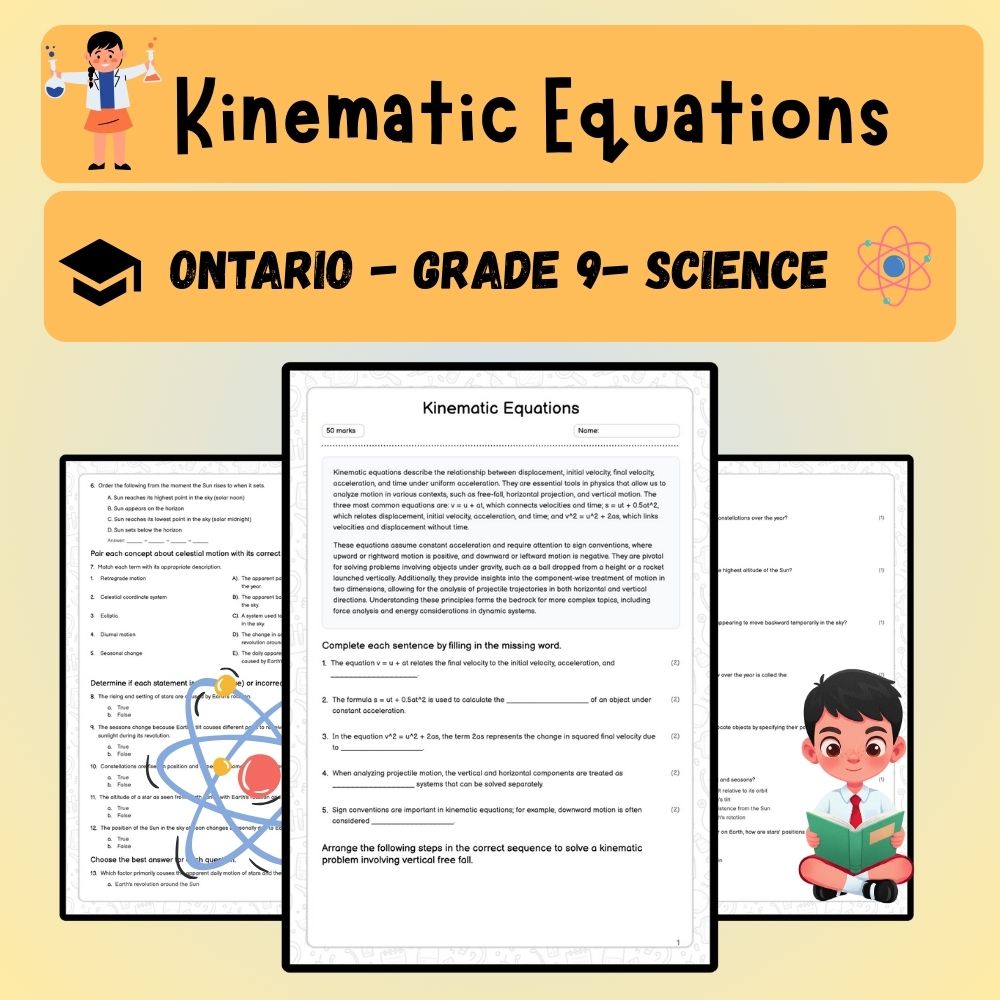
Grade 9 Science | Kinematic Equations Worksheet (PDF) | Ontario Standards
Created byPrism Point LearningLearning Objectives
- Understand and explain the fundamental kinematic equations for constant acceleration.
- Apply the equations to problems involving free-fall and projectile motion.
- Analyze motion components in horizontal and vertical directions under gravity.
Also included in: Grade 9 Science Unit | Forces, Motion & Energy Worksheets (Ontario Standards) +1 more
Instant download

Energy Molecules Worksheet Pack | Grade 9 Science Activities
Created byPrism Point LearningLearning Objectives
- Describe ATP as an energy molecule and identify its main structural parts
- Explain how ATP hydrolysis releases usable energy for cellular work
- Model how phosphorylation helps regenerate ATP by coupling energy-releasing and energy-consuming processes
Instant download
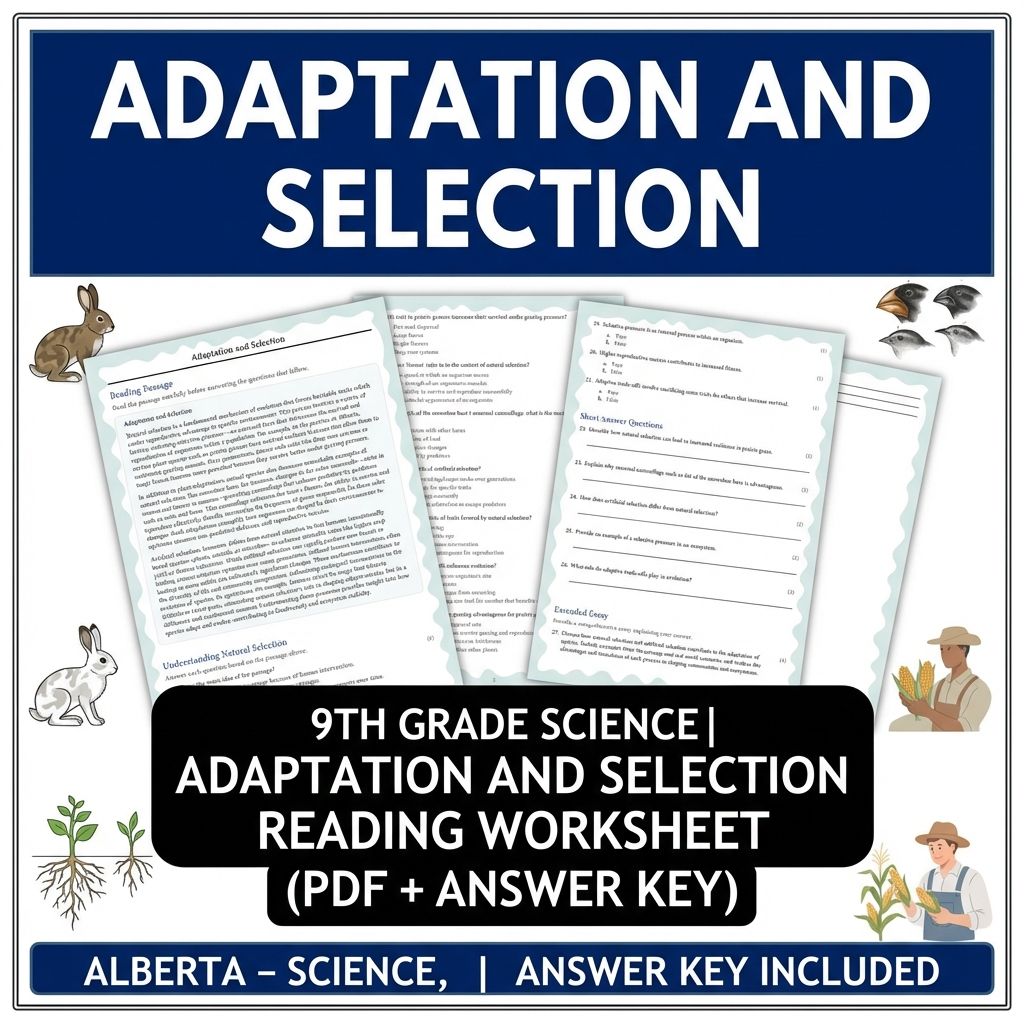
9th Grade Science | Adaptation and Selection Worksheet (PDF + Answer Key)
JCreated byJ.S SheetsLearning Objectives
- Explain the process of natural selection and how it leads to adaptation in populations.
- Identify examples of selective pressure and describe their effects on species.
- Differentiate between natural selection and artificial selection in shaping traits.
Also included in: Grade 9 Science Unit Bundle | Genetics, Cell Biology & Biotechnology Worksheets +1 more
Instant download
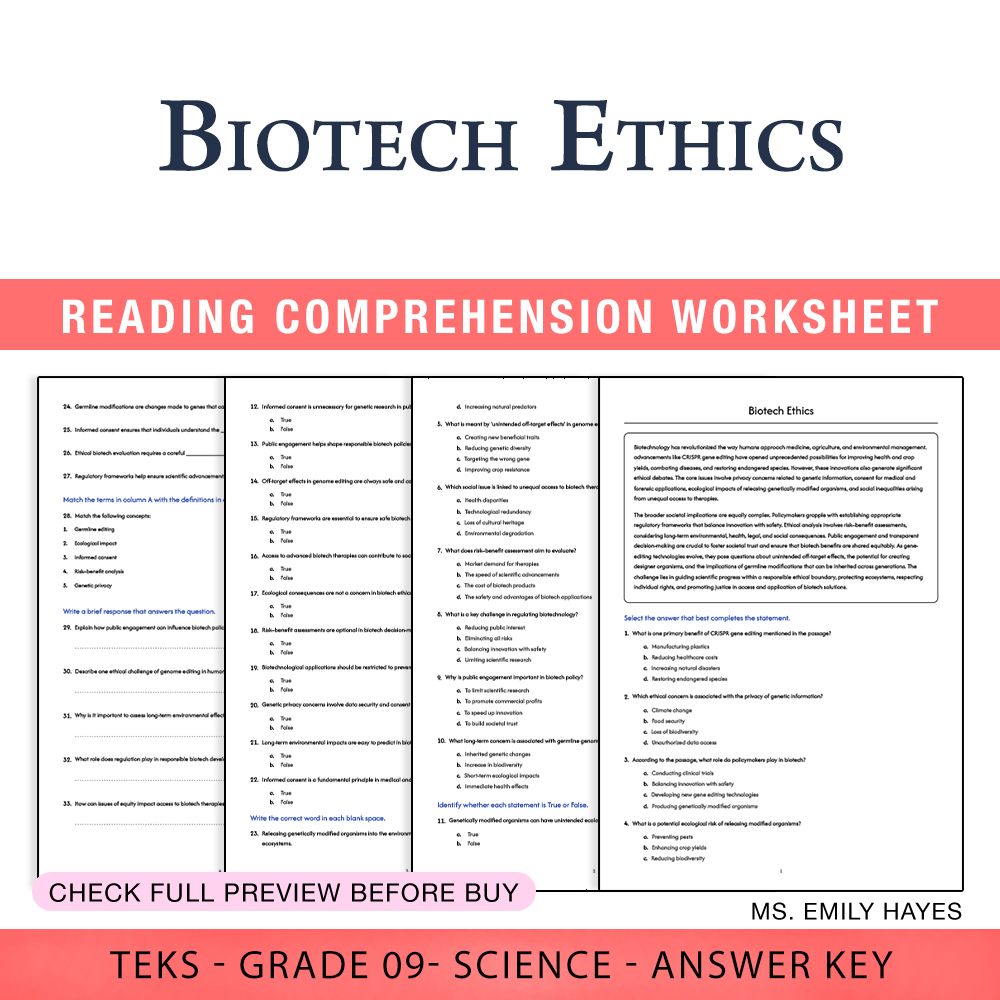
Grade 9 Science | Biotech Ethics Worksheet (PDF+ Answer Key)
Created byCopper Leaf ClassroomLearning Objectives
- Analyze the societal implications of biotechnology advancements.
- Evaluate ethical considerations related to genetic modification.
- Discuss regulatory frameworks and their roles in biotech ethics.
Instant download
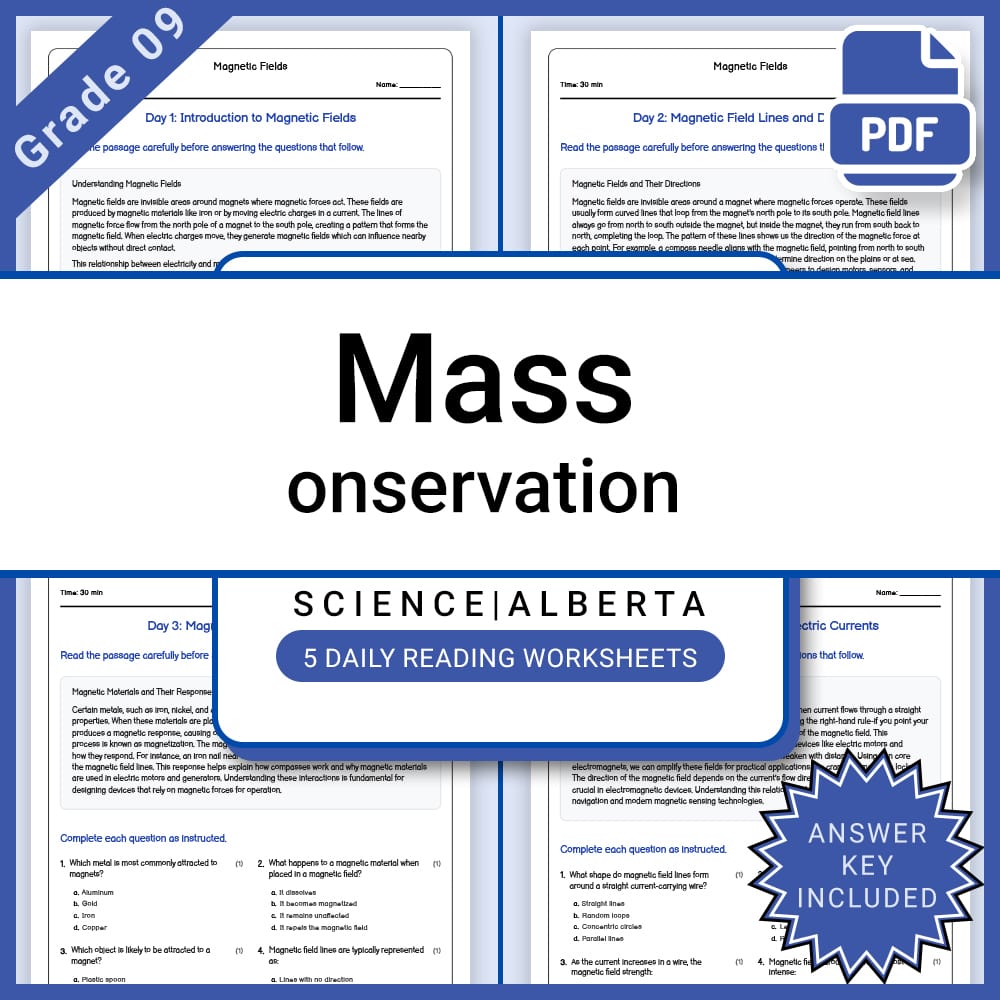
Grade 9 Science – Mass Conservation Daily Reading Worksheet + Answer Key
JCreated byJ.S SheetsLearning Objectives
- Define the principle of mass conservation in chemical reactions.
- Explain how atoms are conserved during a chemical change.
- Identify real-world examples of mass conservation in sealed systems and natural processes.
Also included in: Grade 9 Science Lesson Bundle | Alberta Framework +1 more
Instant download

Grade 9 Science – Mountain Building Daily Reading Worksheet + Answer Key
JCreated byJ.S SheetsLearning Objectives
- Explain the process of mountain building through plate convergence and collision.
- Identify key geological processes involved in fold-and-thrust belt formation.
- Describe how weathering and erosion shape mountain landscapes.
Also included in: Grade 9 Science Lesson Bundle: Tidal Forces, Tectonic Plates & Climate Physics +1 more
Instant download

Community Interactions Worksheet | Grade 9 Science Practice
Created byPrism Point LearningLearning Objectives
- Explain how different species interactions (competition, predation, herbivory, parasitism, and mutualism) affect community structure.
- Describe how keystone species and ecosystem engineers can strongly change habitat and ecosystem processes.
- Use examples to connect pairwise species interactions to indirect effects and overall ecosystem stability.
Instant download
About Grade 9 Science Worksheets
Find Science worksheets built for Grade 9. All 6,986 cover core skills, practice, and review, each an instant PDF download.
Every worksheet on MyTeachingSheets is created by independent teacher-authors and reviewed before publication. All resources download as printable PDFs for classroom, homework, or at-home practice, and many include answer keys. Preview any worksheet free before buying.