
Grade 9 Science Worksheets
6,986 worksheets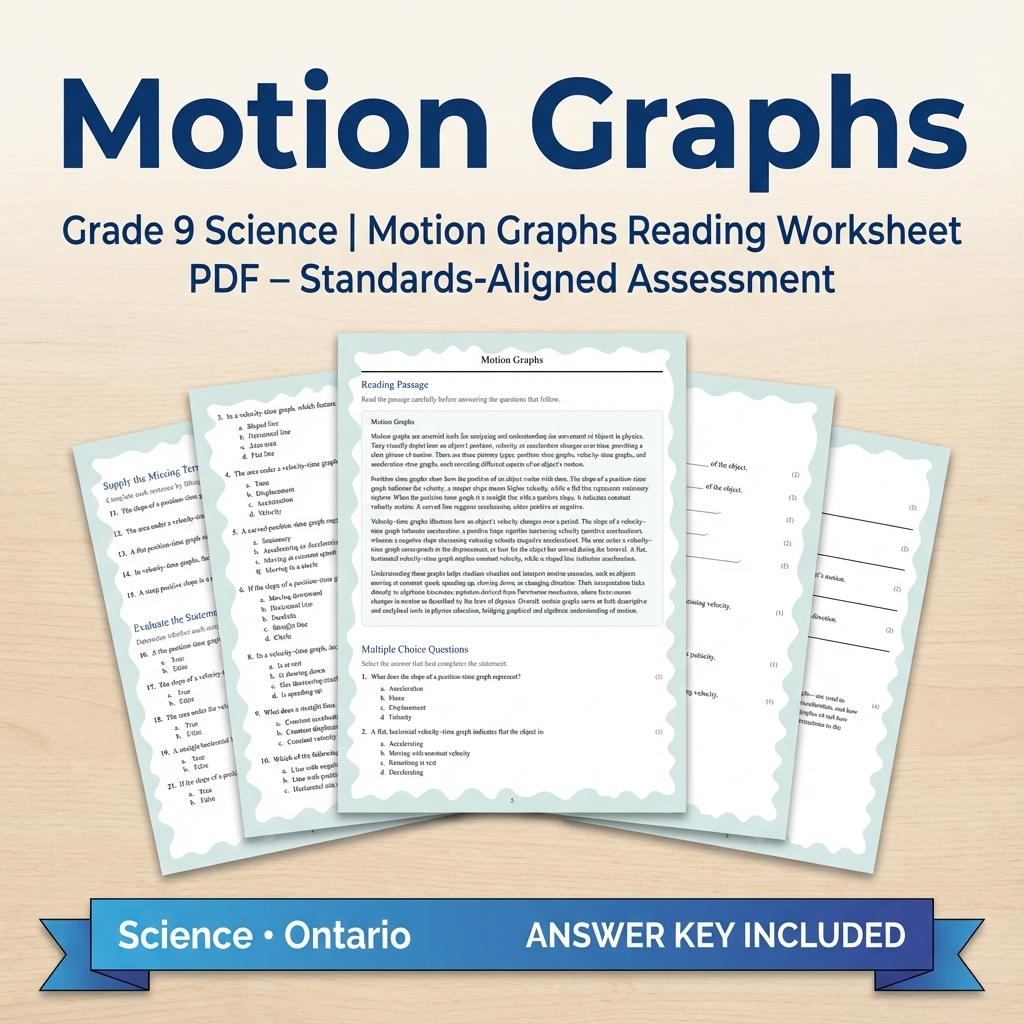
Grade 9 Science | Motion Graphs Reading Worksheet PDF
JCreated byJ.S SheetsLearning Objectives
- Interpret position–time and velocity–time graphs in the context of motion.
- Understand how the slope of a position–time graph indicates velocity and how the slope of a velocity–time graph indicates acceleration.
- Recognize that the area under a velocity–time graph corresponds to displacement.
Also included in: Grade 9 Science Unit | Force, Motion & Energy Worksheets & Answer Keys Bundle +1 more
Instant download
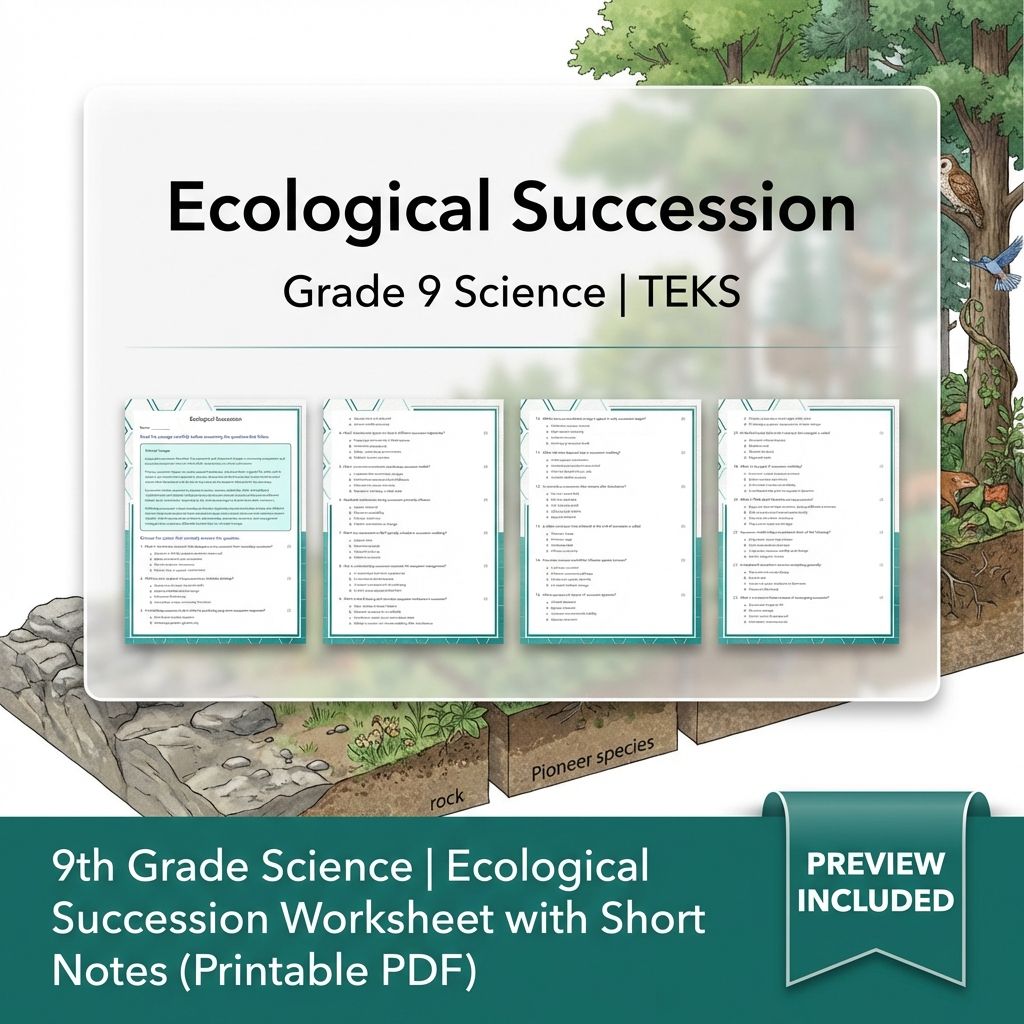
9th Grade Science | Ecological Succession Worksheet with Short Notes (PDF)
 Created byMeadowlark Worksheets
Learning Objectives
- Understand the concept and stages of ecological succession.
- Differentiate between primary and secondary succession.
- Identify factors that influence succession trajectories and ecosystem stability.
Instant download

Fossil Records Worksheet | TEKS Science Assessment Grade 9
JCreated byJ.S SheetsLearning Objectives
- Explain how fossil records provide evidence of past life through preserved remains, impressions, and traces.
- Describe how stratigraphy and radiometric dating contribute to determining fossil ages.
- Evaluate how taphonomy and preservation bias affect which organisms appear in the fossil record.
Instant download

Grade 9 Science | Cell Theory - Daily Reading Comprehension Practice
 Created byCoral Reef Learning
Learning Objectives
- Identify the basic parts of a cell and describe their functions.
- Understand the principles of cell theory and its significance in biology.
- Differentiate between unicellular and multicellular organisms.
Instant download
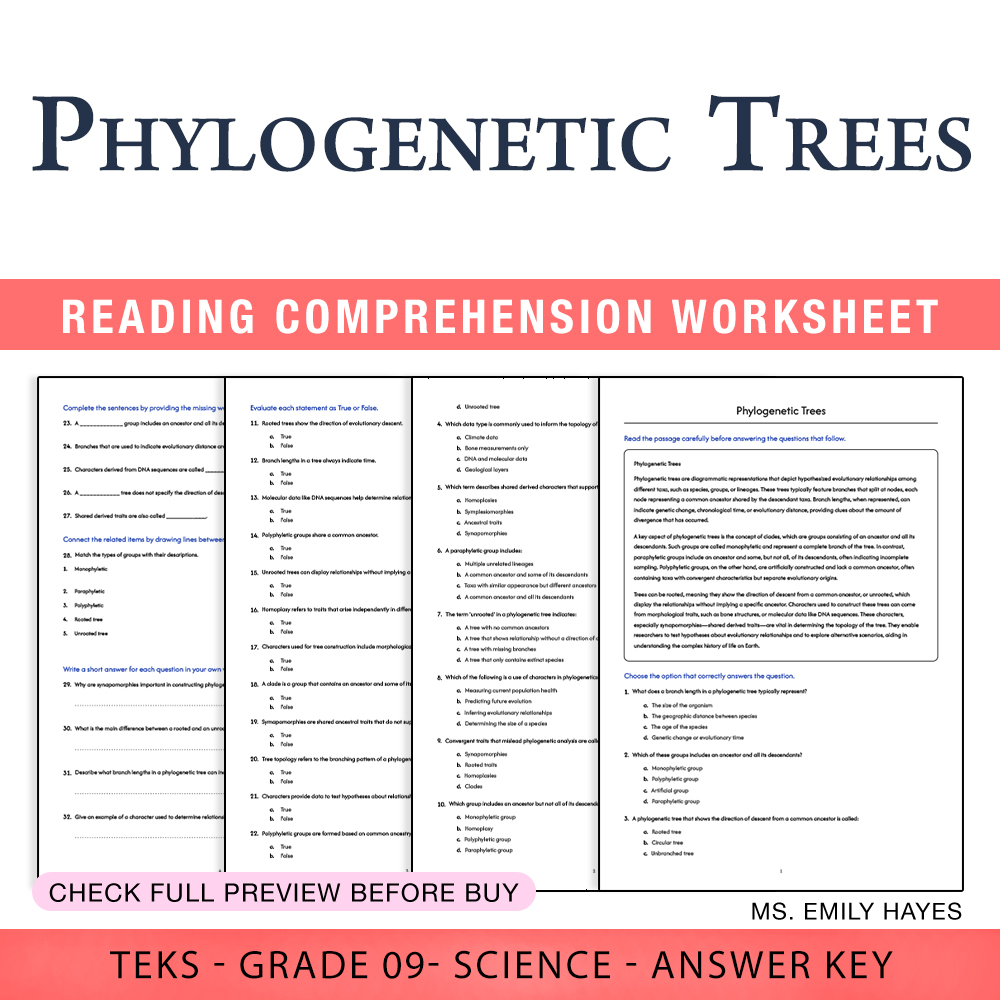
9th Grade Science | Phylogenetic Trees Worksheet (PDF+ Answer Key)
 Created byCopper Leaf Classroom
Learning Objectives
- Understand the concept of phylogenetic trees and their components.
- Identify the differences between monophyletic, paraphyletic, and polyphyletic groups.
- Interpret branch lengths and rooted versus unrooted trees.
Instant download
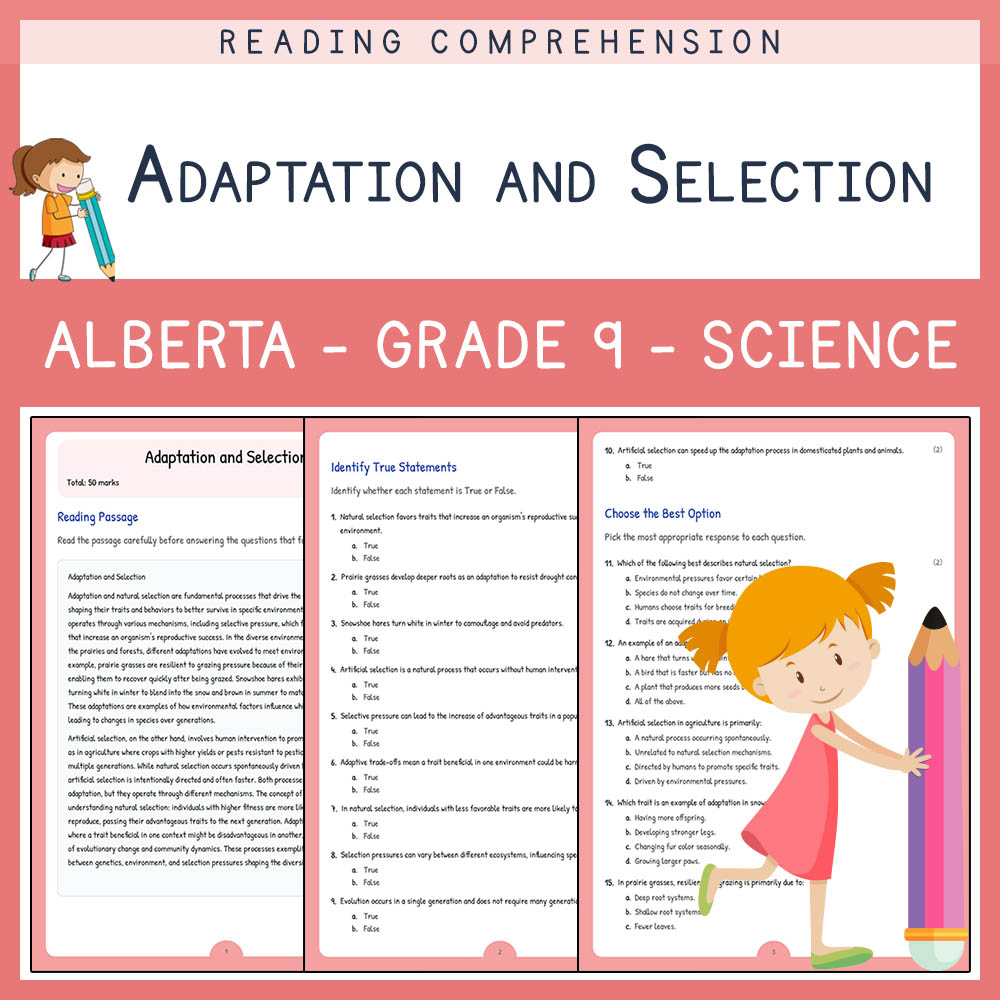
Grade 9 Science | Adaptation and Selection Worksheet | Alberta Standards
 Created byLumora Learning
Learning Objectives
- Explain the process of natural selection and its role in evolution.
- Identify examples of adaptation in Alberta's ecosystems such as prairie grass and snowshoe hares.
- Distinguish between natural and artificial selection and their effects on populations.
Instant download

Grade 9 Science | Newtonian Concepts - Daily Reading Comprehension
Created byCoral Reef LearningLearning Objectives
- Understand key concepts related to Science
- Apply knowledge through practice questions
- Demonstrate comprehension of the material
Also included in: Forces and Motion Mechanical Systems Lesson Bundle | Grade 9 Science Alberta +1 more
Instant download

Grade 9 Science | Evidence With Models - Daily Reading Comprehension
Created byCoral Reef LearningLearning Objectives
- Understand the role of models in scientific explanations
- Identify different types of scientific models
- Evaluate how models are used to interpret measurement data
Instant download
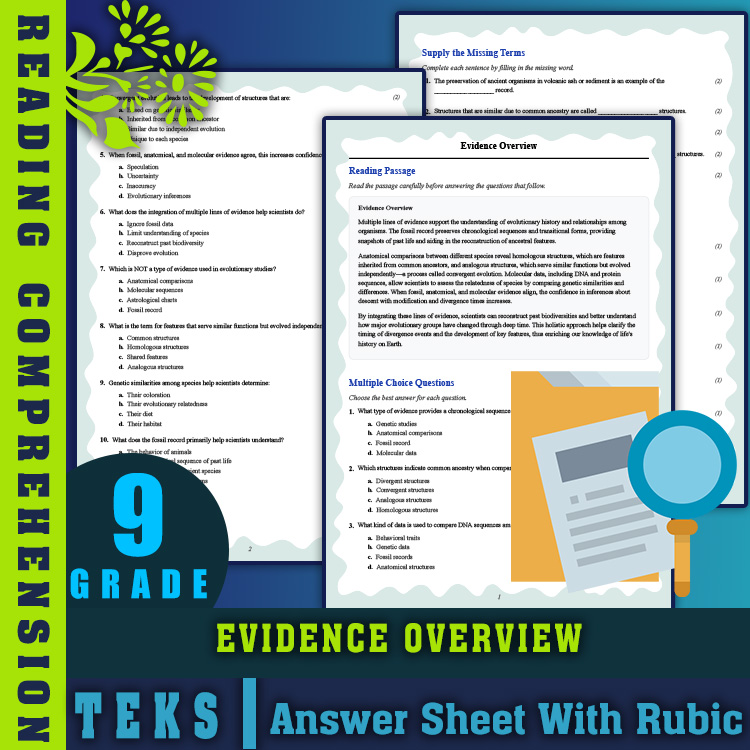
Grade 9 Science | Evidence of Evolution & Relationships (PDF + Answer Key)
JCreated byJ.S SheetsLearning Objectives
- Understand the different lines of evidence used to infer evolutionary relationships.
- Identify how fossil, anatomical, and molecular data support evolutionary history.
- Explain the importance of integrating multiple evidence types to reconstruct biodiversity over time.
Instant download
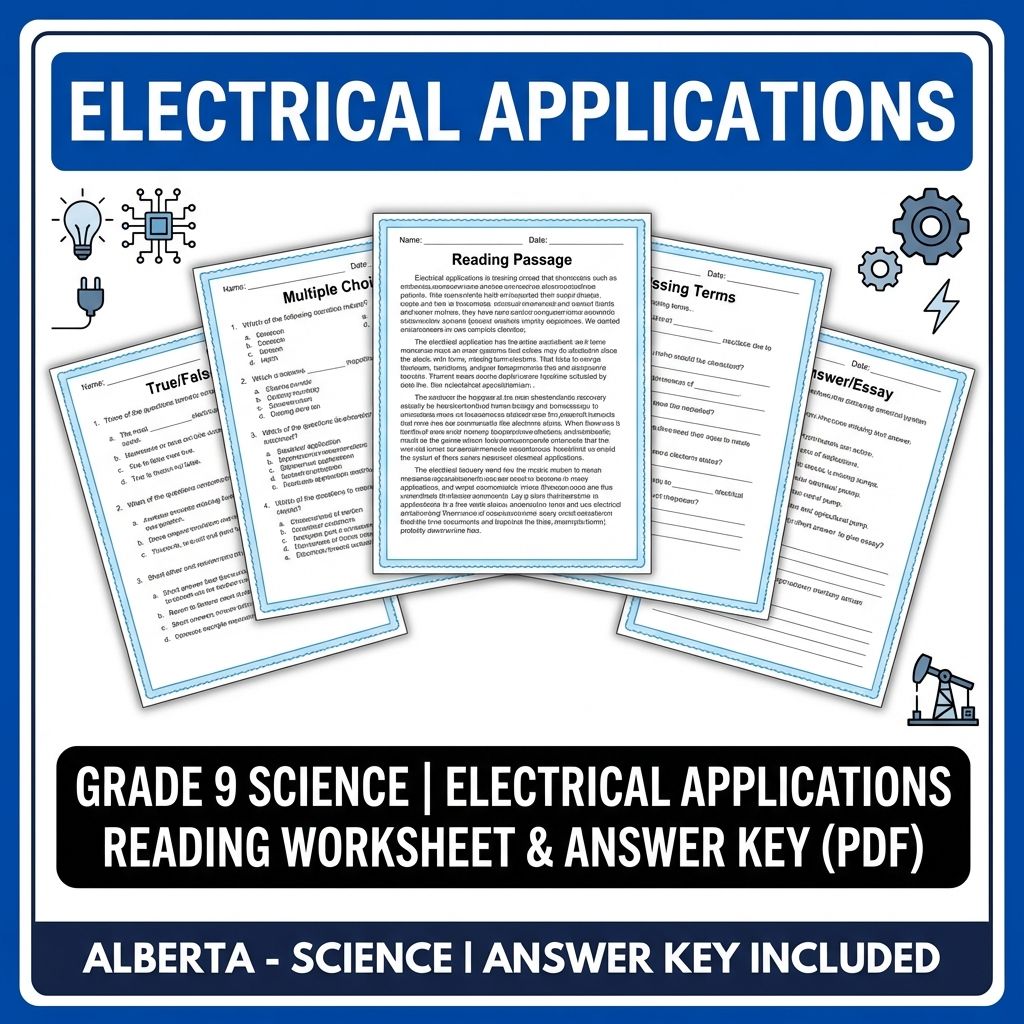
Grade 9 Science | Electrical Applications Reading Worksheet & Answer Key (PDF)
JCreated byJ.S SheetsLearning Objectives
- Understand the principles of safe and effective electrical system use in various applications.
- Learn to match device ratings and functions with appropriate power sources and environmental conditions.
- Identify protective measures essential for safety and efficiency in electrical systems.
Also included in: Grade 9 Science Bundle | Electricity, Energy & Magnetism (PDF + Answer Keys) +1 more
Instant download
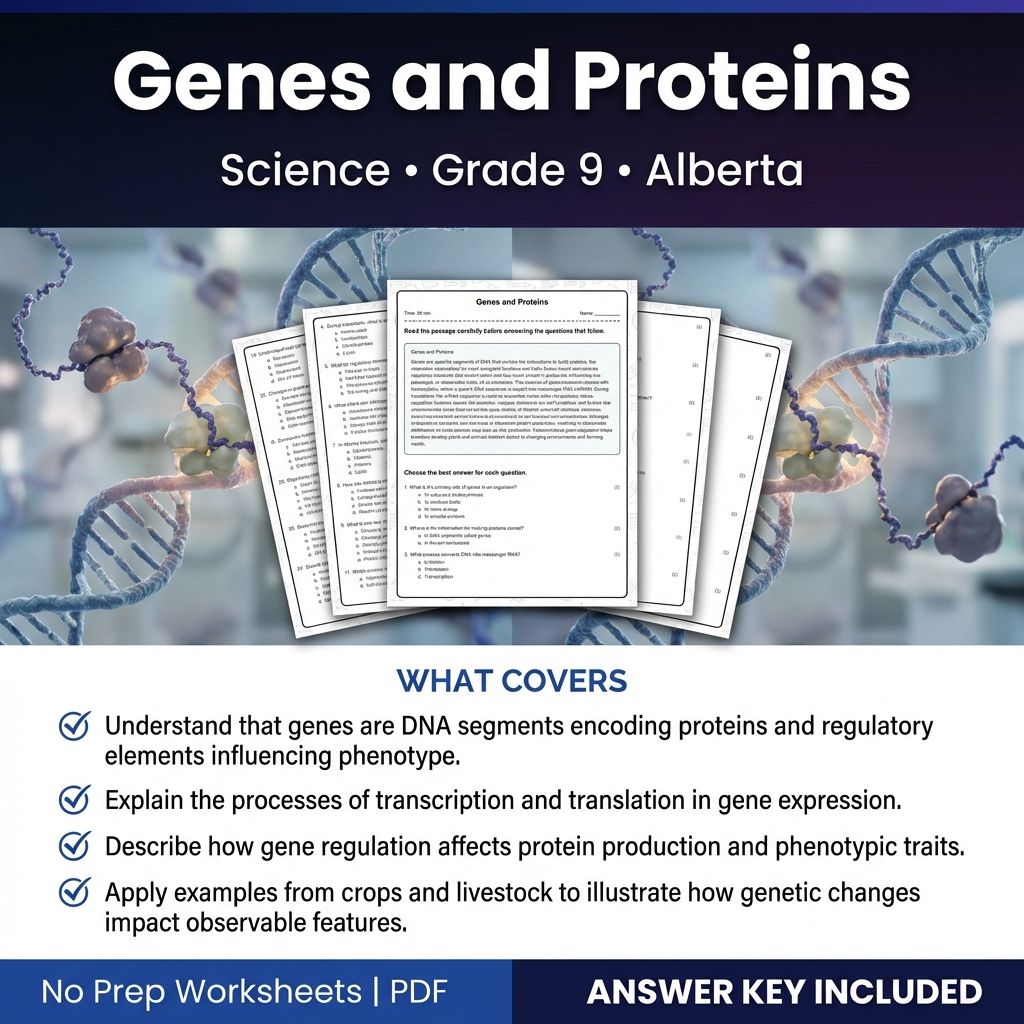
Genes and Proteins Worksheet for Grade 9 Science | Alberta Standards
Created byCoral Reef LearningLearning Objectives
- Understand that genes are DNA segments encoding proteins and regulatory elements influencing phenotype.
- Explain the processes of transcription and translation in gene expression.
- Describe how gene regulation affects protein production and phenotypic traits.
Instant download
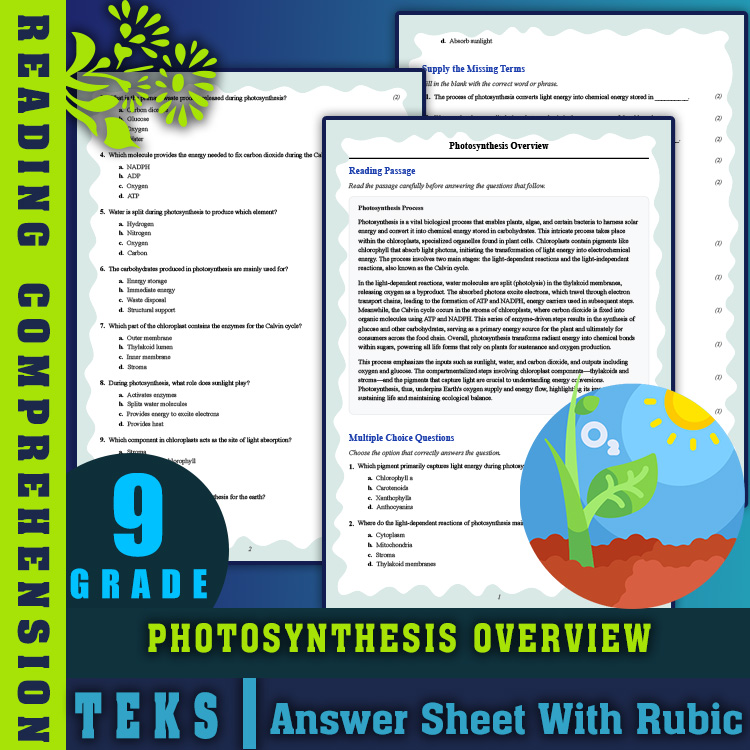
9th Grade Science | Photosynthesis Overview Reading Worksheet (PDF + Answer Key)
JCreated byJ.S SheetsLearning Objectives
- Explain the process of photosynthesis and its significance in converting solar energy to chemical energy.
- Identify the inputs and outputs involved in photosynthesis.
- Describe the role of pigments and the compartments within chloroplasts during photosynthesis.
Instant download

Milankovitch Cycles Worksheet | Grade 9 Science Lesson & Assessment
JCreated byJ.S SheetsLearning Objectives
- Describe the components of Milankovitch cycles and their influence on Earth's climate.
- Explain how variations in Earth's orbit affect glacial and interglacial periods.
- Identify the three main orbital parameters involved in Milankovitch cycles and their effects on insolation.
Instant download
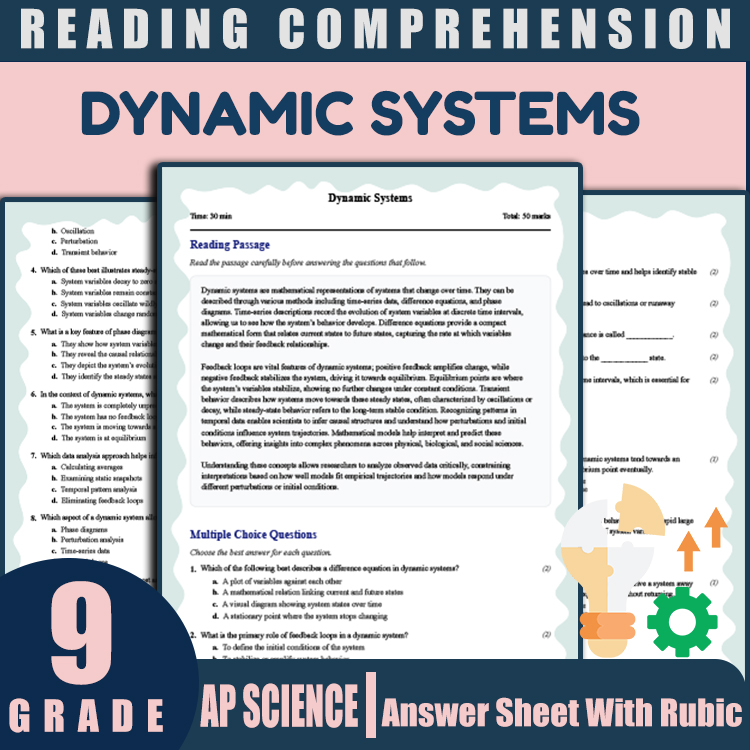
9th Grade Science | Dynamic Systems Reading Worksheet & Answer Key (PDF)
JCreated byJ.S SheetsLearning Objectives
- Understand how to represent temporally changing systems using time-series descriptions.
- Analyze the behavior of dynamic systems through difference equations and phase diagrams.
- Identify feedback loops, equilibrium states, and transient versus steady-state behavior from data.
Instant download

Grade 9 Science | Energy in Changes - Daily Reading Comprehension
Created byCoral Reef LearningLearning Objectives
- Identify and distinguish between physical and chemical changes.
- Explain energy transfer in endothermic and exothermic reactions.
- Describe how particle motion and arrangement change during physical and chemical processes.
Instant download
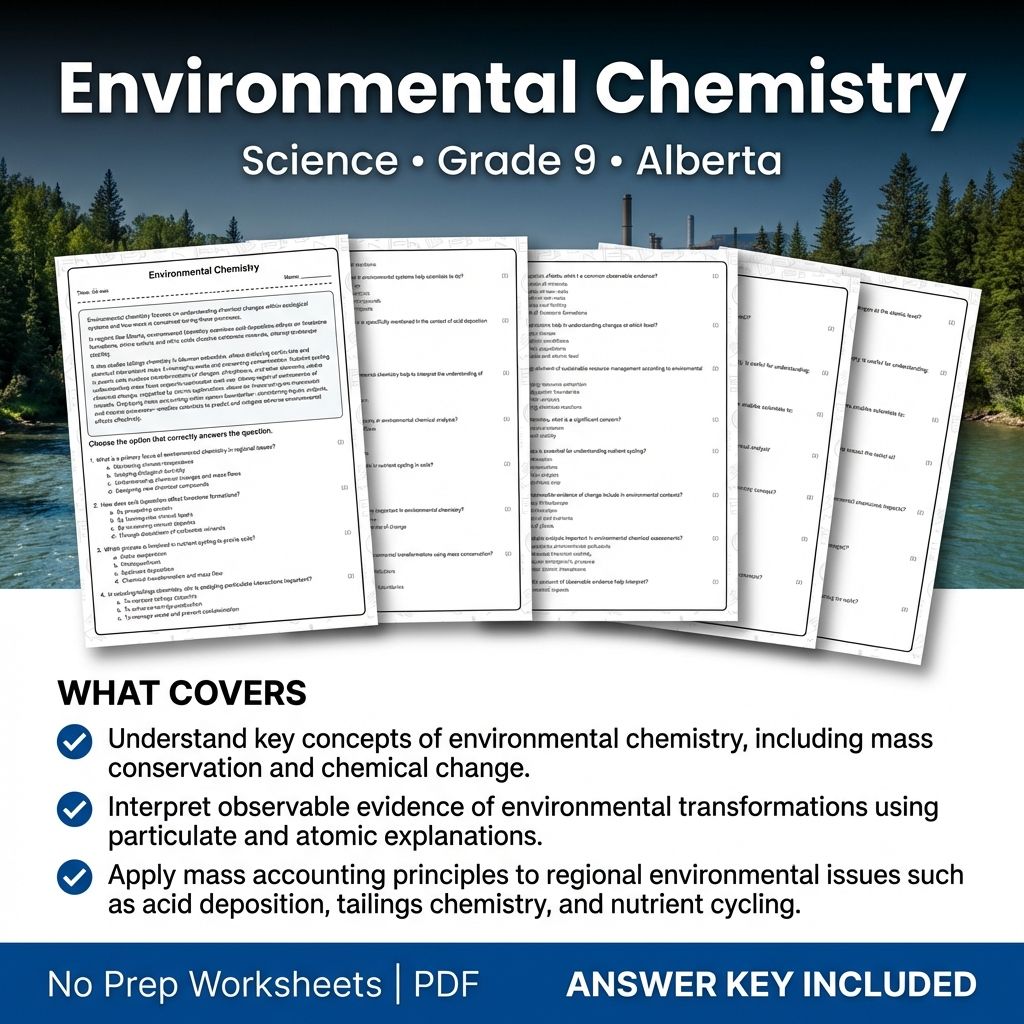
Environmental Chemistry Worksheet Grade 9 Science | Alberta Standards
Created byCoral Reef LearningLearning Objectives
- Understand key concepts of environmental chemistry, including mass conservation and chemical change.
- Interpret observable evidence of environmental transformations using particulate and atomic explanations.
- Apply mass accounting principles to regional environmental issues such as acid deposition, tailings chemistry, and nutrient cycling.
Instant download

Feedback Principles Assessment | TEKS Grade 9 Science Standards-Aligned
 Created byPrism Point Learning
Learning Objectives
- Understand the components involved in homeostatic feedback loops.
- Distinguish between negative and positive feedback mechanisms.
- Explain how signaling pathways and transport processes facilitate feedback responses.
Also included in: Grade 9 Regulation & Communication Science Assessment Lesson Bundle TEKS
Instant download
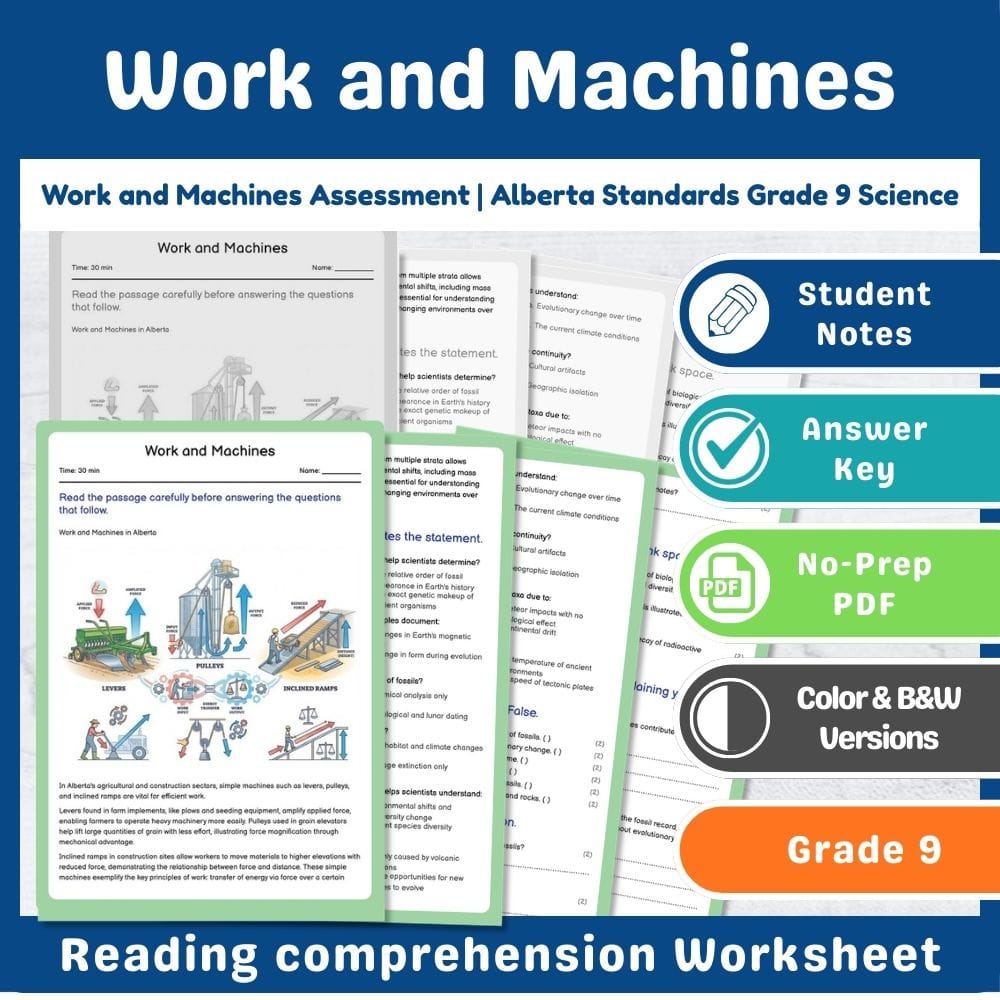
Work and Machines Assessment | Alberta Standards Grade 9 Science
Created byPrism Point LearningLearning Objectives
- Explain the concept of work as energy transfer caused by a force acting through a distance.
- Describe how simple machines alter force, distance, and mechanical advantage in real-world Alberta contexts.
- Analyze the trade-offs between force reduction and distance increase in machine design and performance.
Also included in: Grade 9 Forces and Motion Science Lesson Bundle Alberta Framework +1 more
Instant download

Thermoregulation Assessment | TEKS Grade 9 Science Evaluation
Created byPrism Point LearningLearning Objectives
- Understand the mechanisms involved in body temperature regulation.
- Identify physiological responses that maintain thermoregulation.
- Explain the roles of skin, vasculature, and nervous pathways in heat balance.
Also included in: Grade 9 Regulation & Communication Science Assessment Lesson Bundle TEKS
Instant download
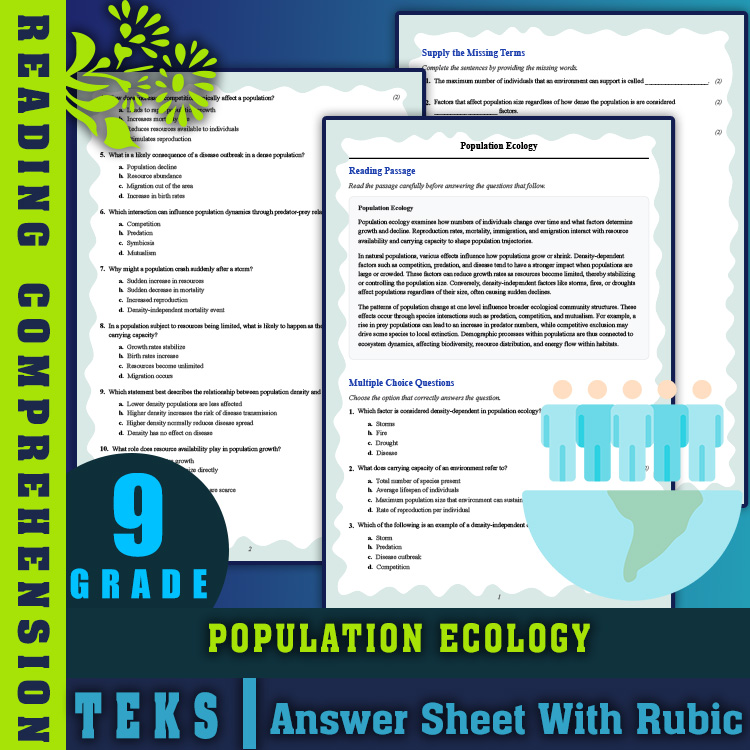
Grade 9 Science | Population Ecology Reading Worksheet (PDF + Answer Key)
JCreated byJ.S SheetsLearning Objectives
- Understand the key factors influencing population growth and decline.
- Explain the difference between density-dependent and density-independent factors.
- Describe how population patterns affect community interactions and ecosystem dynamics.
Instant download
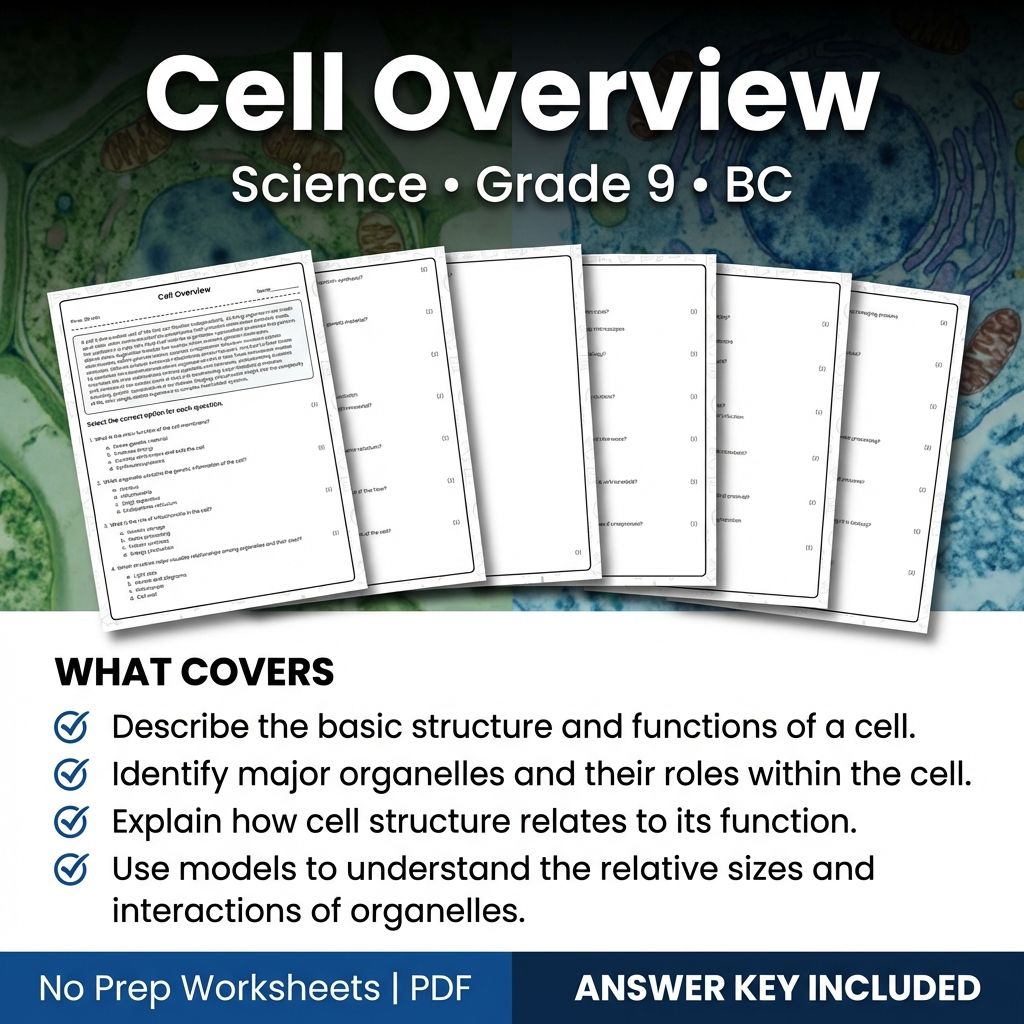
Cell Overview Worksheet for Grade 9 Science | PDF with Answer Key
Created byCoral Reef LearningLearning Objectives
- Describe the basic structure and functions of a cell.
- Identify major organelles and their roles within the cell.
- Explain how cell structure relates to its function.
Instant download
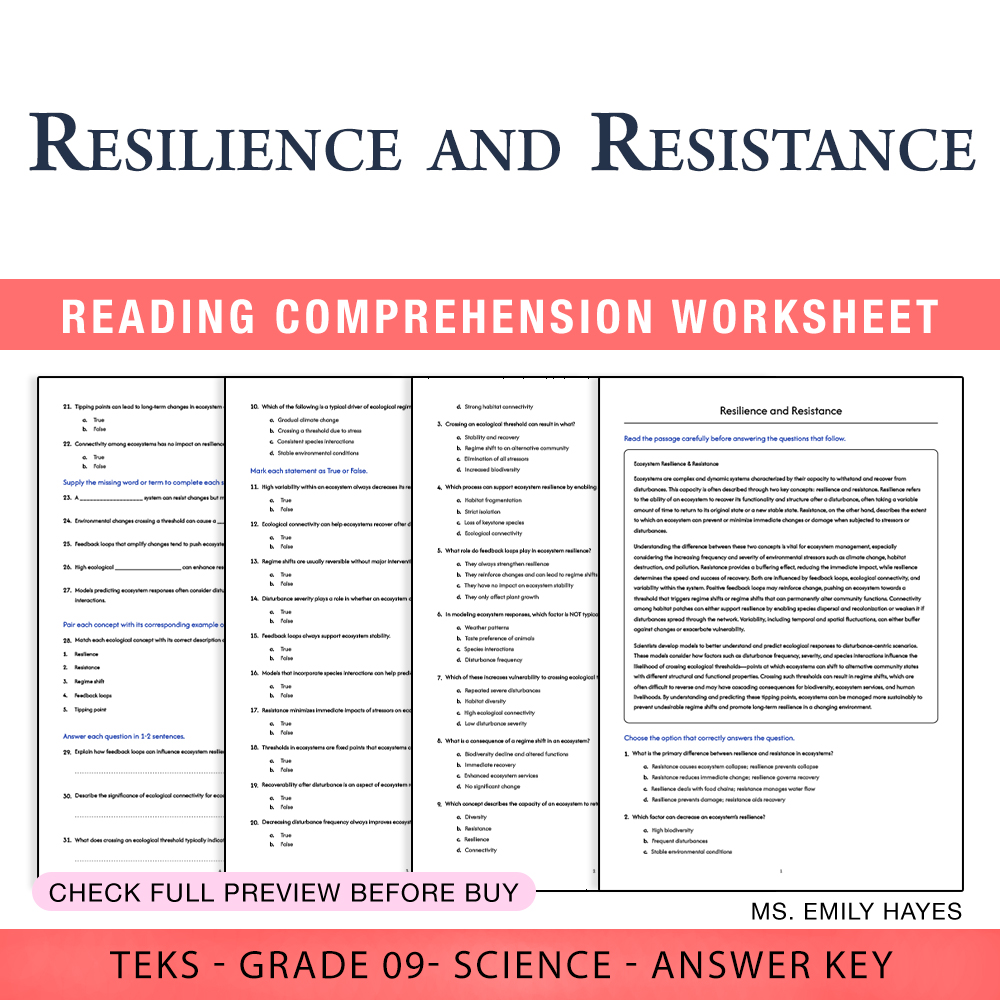
9th Grade Science | Resilience and Resistance Worksheet (PDF+ Answer Key)
Created byCopper Leaf ClassroomLearning Objectives
- Define and distinguish between resilience and resistance in ecological systems.
- Explain how feedback loops, variability, and connectivity influence ecosystem resilience.
- Identify factors that can trigger regime shifts in ecosystems requiring long-term management strategies.
Instant download
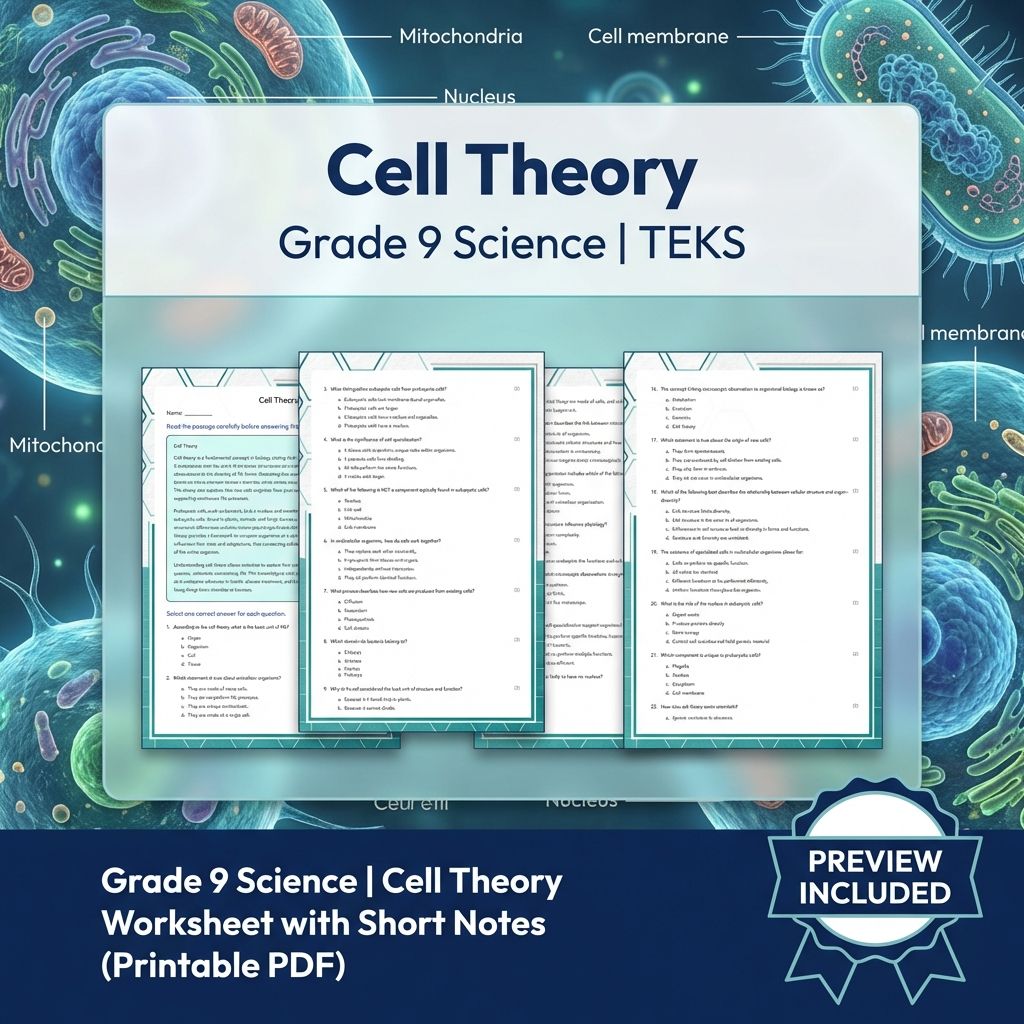
Grade 9 Science | Cell Theory Worksheet with Short Notes (Printable PDF)
Created byMeadowlark WorksheetsLearning Objectives
- Explain the fundamental principles of the cell theory.
- Differentiate between unicellular and multicellular organisms.
- Identify the differences between prokaryotic and eukaryotic cells.
Instant download
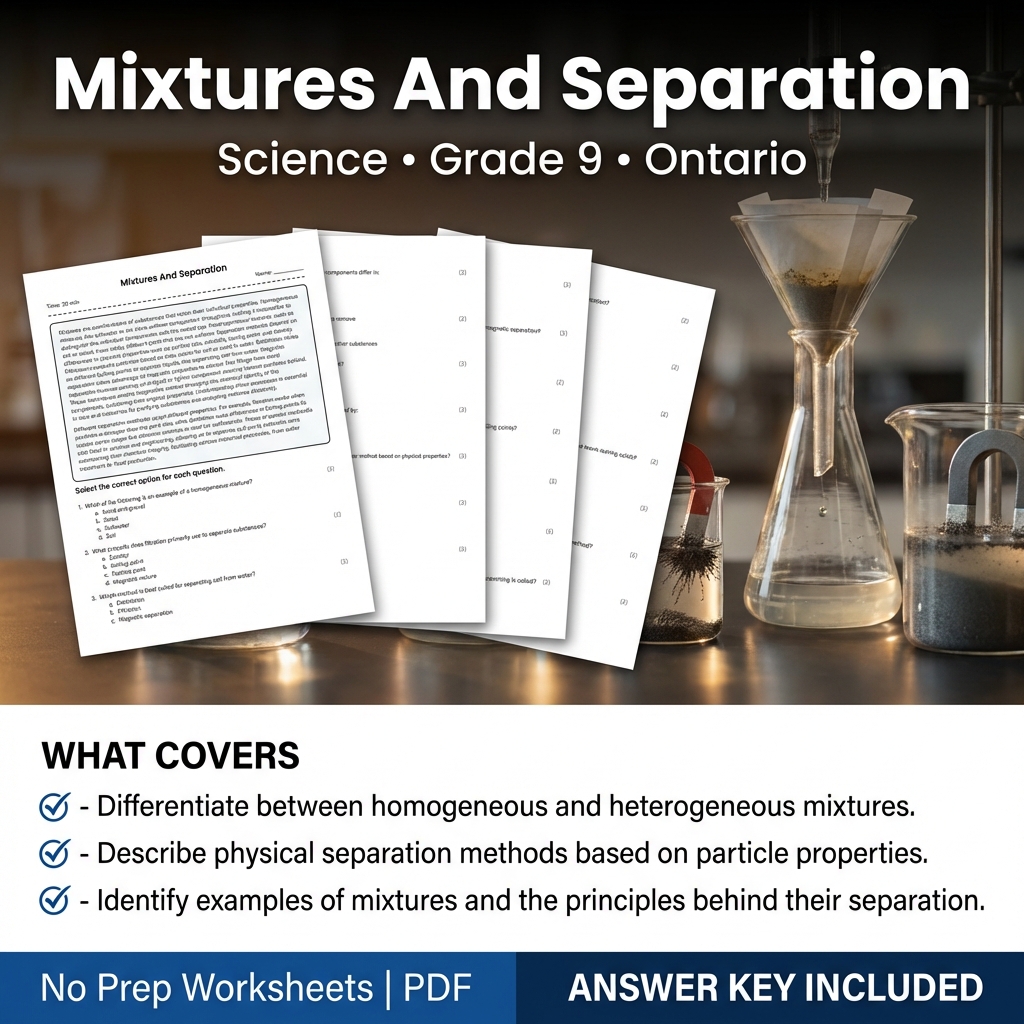
Grade 9 Science Worksheet on Mixtures and Separation – Ontario
Created byCoral Reef LearningLearning Objectives
- Differentiate between homogeneous and heterogeneous mixtures.
- Describe physical separation methods based on particle properties.
- Identify examples of mixtures and the principles behind their separation.
Instant download

Planetary Layers Inside Earth: Grade 9 Science Worksheet for Standards Alignment
JCreated byJ.S SheetsLearning Objectives
- Describe Earth’s concentric layers and explain how density, temperature, and pressure change with depth.
- Contrast lithosphere and asthenosphere based on their mechanical behavior and ability to flow.
- Explain how seismic waves and gravity data help infer Earth’s internal composition and structure.
Instant download
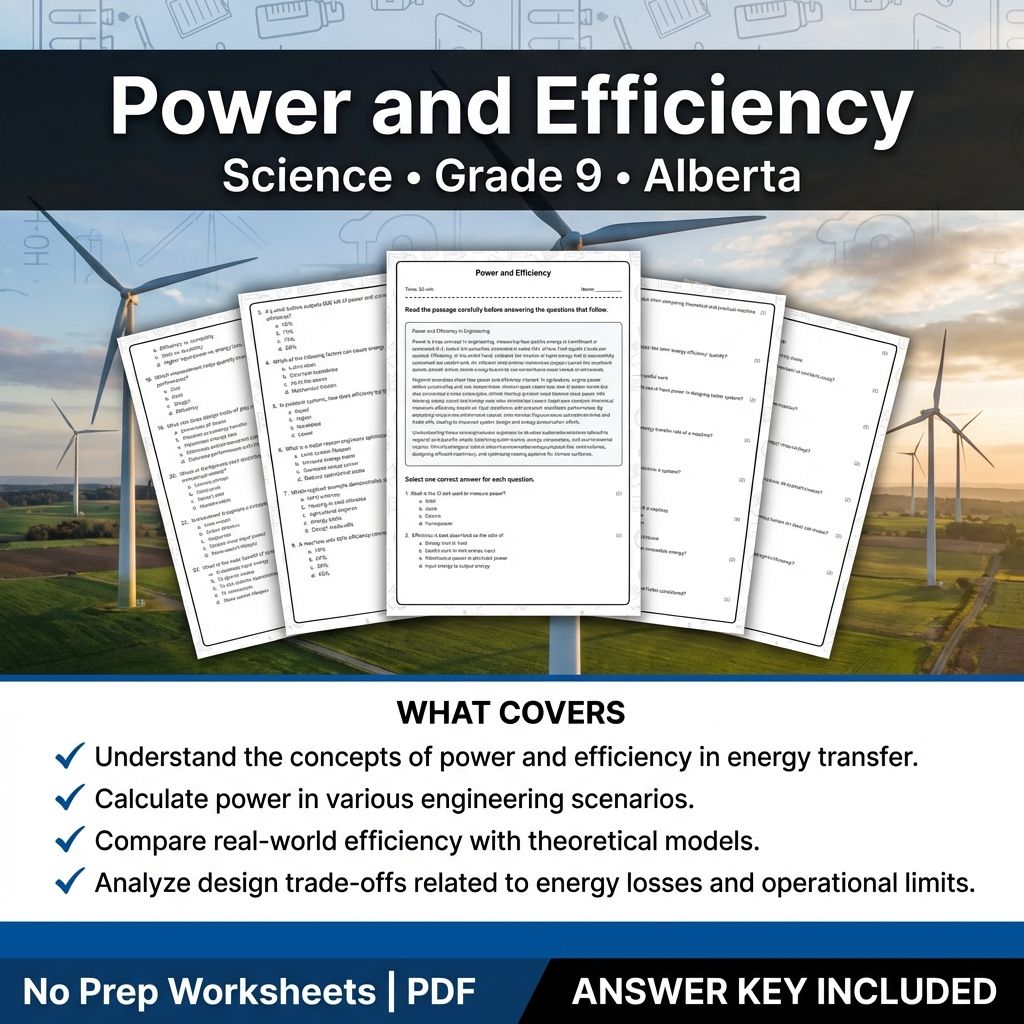
Power and Efficiency Worksheet for Grade 9 Science | Alberta Standards
Created byCoral Reef LearningLearning Objectives
- Understand the concepts of power and efficiency in energy transfer.
- Calculate power in various engineering scenarios.
- Compare real-world efficiency with theoretical models.
Instant download
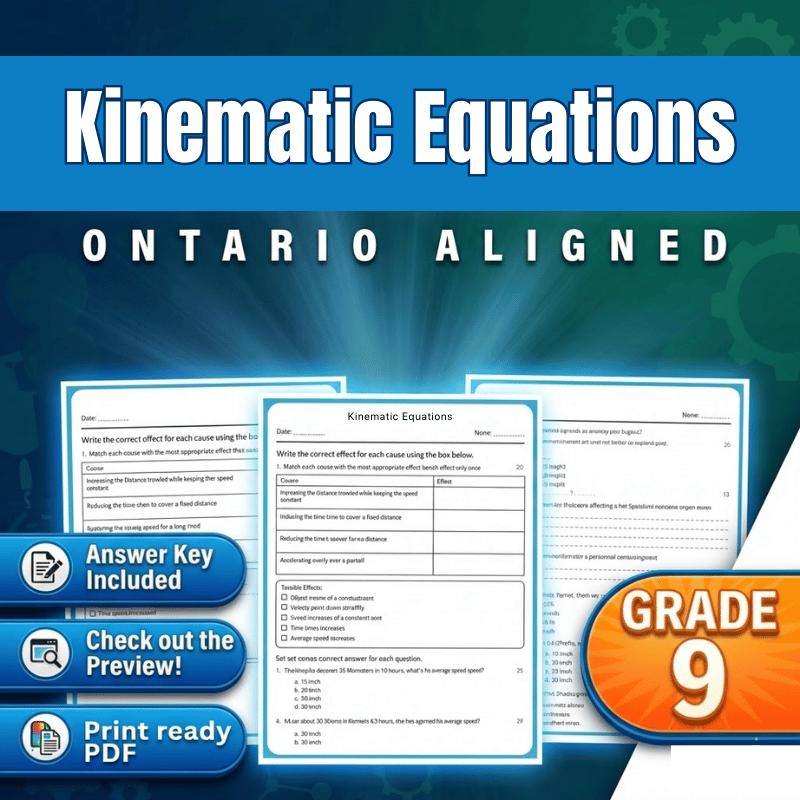
Grade 9 Science | Kinematic Equations Worksheet (Ontario) (PDF)
 Created byBright Mind Resources
Learning Objectives
- Understand the basic kinematic equations relating displacement, velocity, acceleration, and time.
- Apply the equations to scenarios involving free-fall and projectile motion.
- Interpret sign conventions and component-wise treatment in uniform acceleration problems.
Instant download

DNA Replication Worksheet | Grade 9 Science TEKS Practice PDF
JCreated byJ.S SheetsLearning Objectives
- Explain the semi-conservative model of DNA replication and how daughter DNA molecules are formed
- Describe the main roles of helicase, primase, DNA polymerase, and ligase during replication
- Differentiate leading-strand and lagging-strand synthesis, including Okazaki fragments
Instant download

Grade 9 Seasons And Day Length Worksheet | General Practice PDF
 Created byClear Sky Classroom
Learning Objectives
- Explain how Earth’s axial tilt and its orbit around the Sun change the angle of sunlight
- Describe how these changes affect day length and solar heating at different latitudes
- Analyze how repeating Earth–Sun motions help determine seasonal timing
Instant download
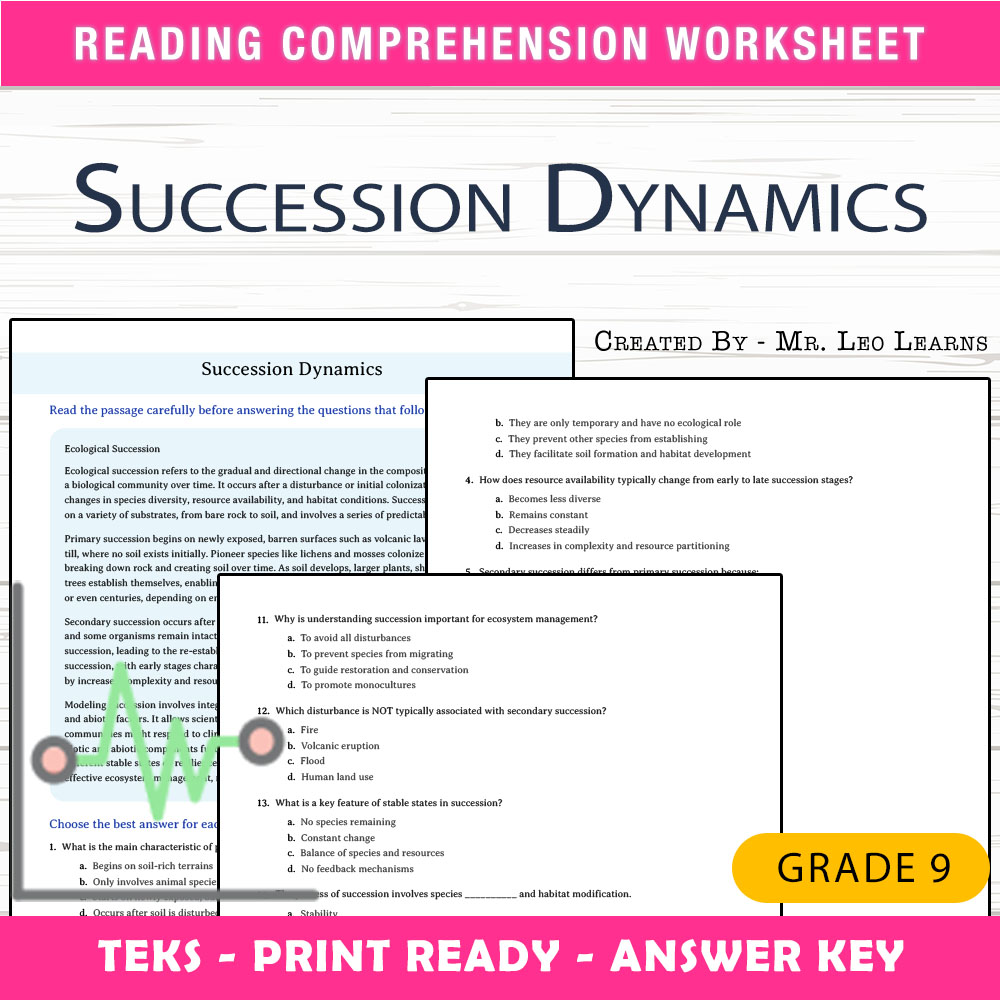
Grade 9 Science – Succession Dynamics Worksheet for Mastery
 Created byThe Resource Hub
Learning Objectives
- Understand the stages and types of ecological succession, including primary and secondary succession.
- Identify key species traits and environmental factors influencing succession trajectories.
- Explain how modeling succession helps predict ecosystem responses to disturbances and environmental change.
Also included in: Grade 9 Science Ecosystems & Biogeochemical Cycles Unit Bundle (Worksheet Pack) +1 more
Instant download
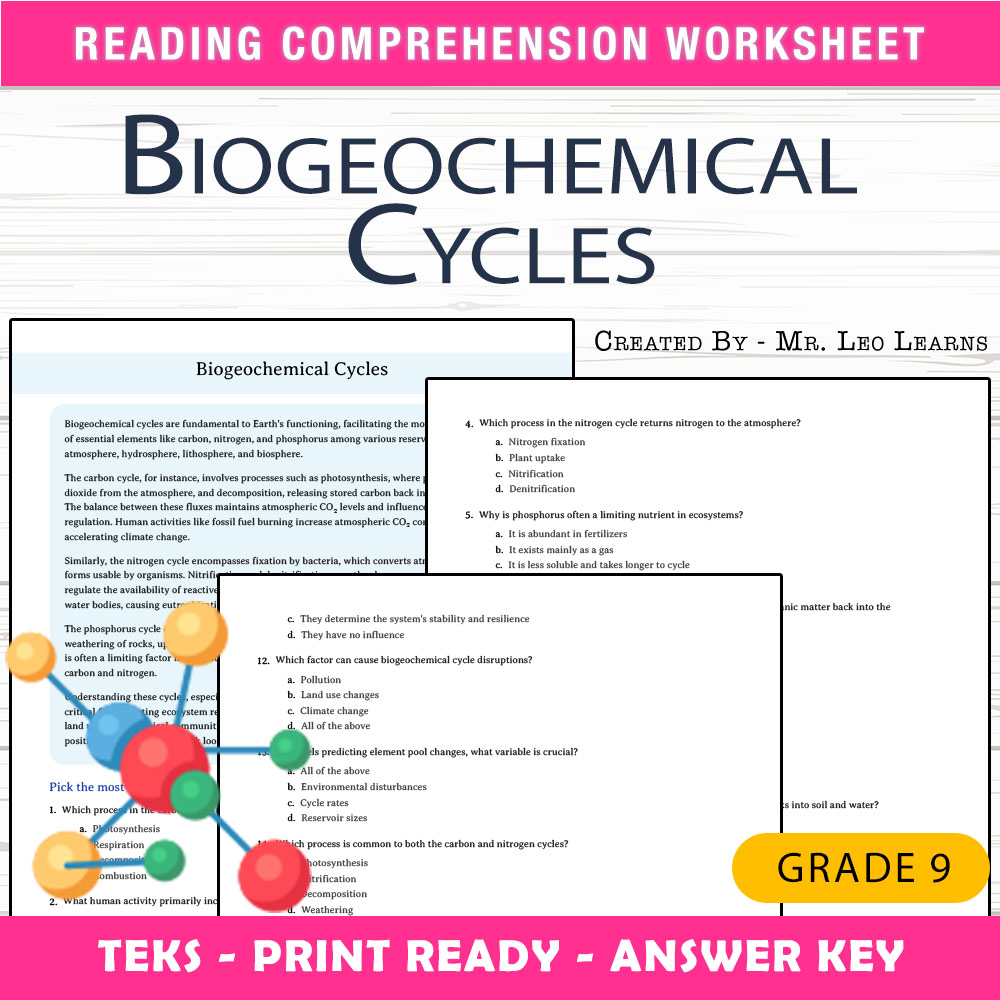
Grade 9 Science | Biogeochemical Cycles Worksheet for Mastery
Created byThe Resource HubLearning Objectives
- Understand the main processes involved in biogeochemical cycles such as carbon, nitrogen, and phosphorus.
- Identify the reservoirs and fluxes of key elements within Earth's systems.
- Explain how factors like climate change and land use impact biogeochemical cycle dynamics.
Also included in: Grade 9 Science Ecosystems & Biogeochemical Cycles Unit Bundle (Worksheet Pack) +1 more
Instant download
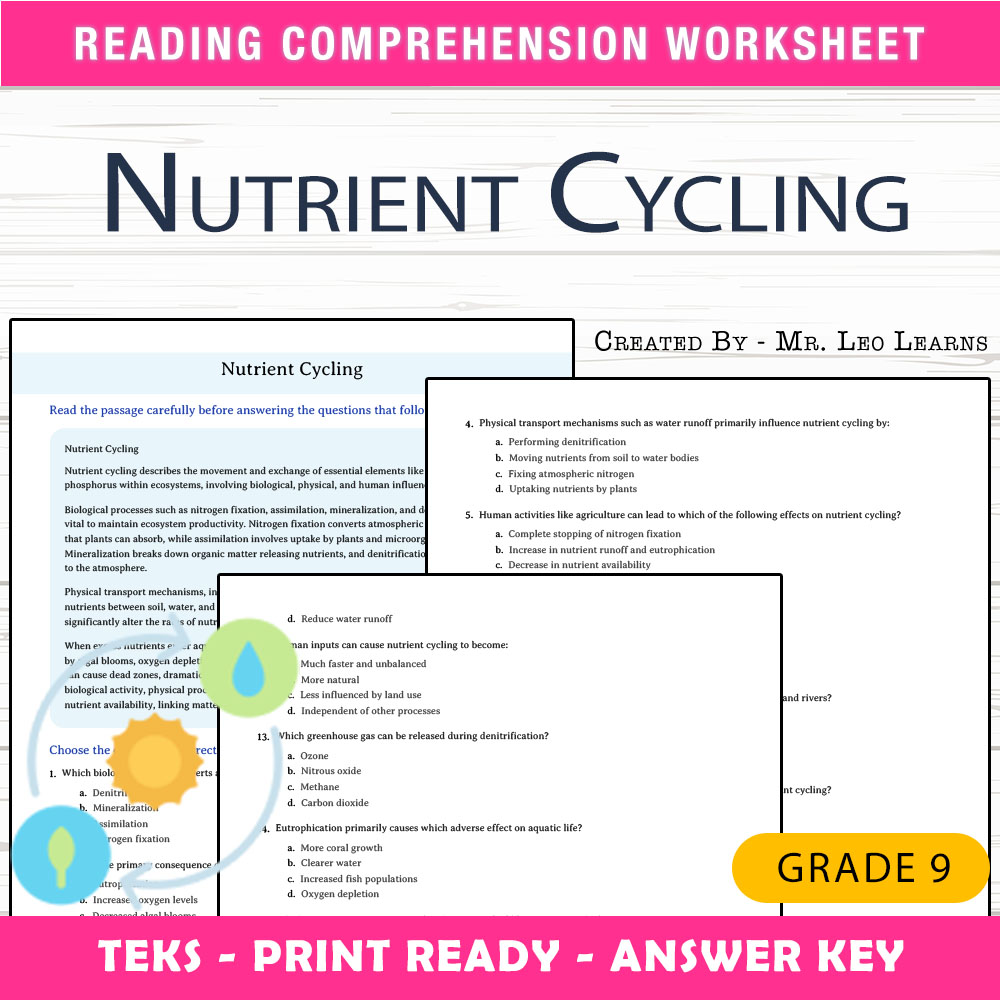
Grade 9 Science – Nutrient Cycling Worksheet for Mastery
Created byThe Resource HubLearning Objectives
- Understand the processes involved in nutrient cycling such as nitrogen fixation, assimilation, mineralization, and denitrification.
- Explain how physical transport and human activities influence nutrient availability and cycling rates.
- Assess the impact of excess nutrient loading on aquatic ecosystems, including eutrophication and species composition changes.
Also included in: Grade 9 Science Ecosystems & Biogeochemical Cycles Unit Bundle (Worksheet Pack) +1 more
Instant download
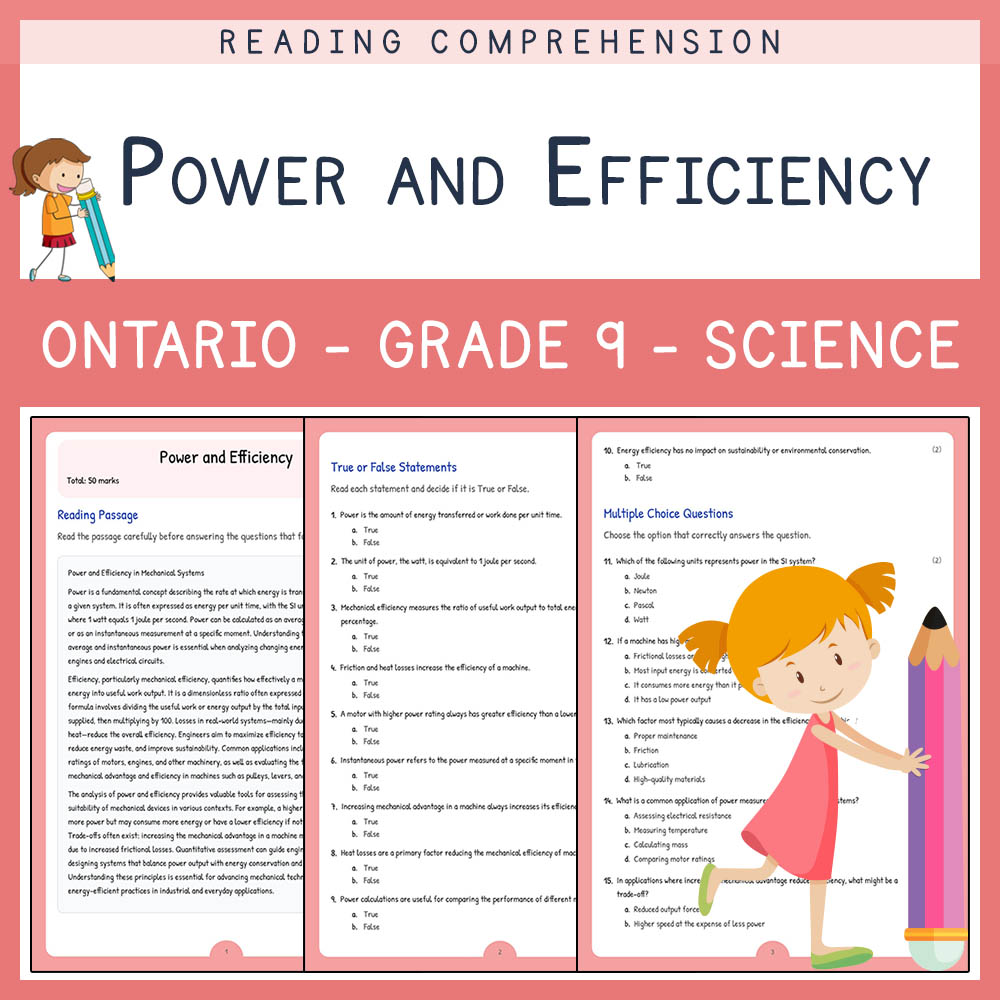
Grade 9 Science | Power and Efficiency Worksheet Elena | Ontario Standards
Created byLumora LearningLearning Objectives
- Understand the concepts of power as energy transfer rate and work per unit time.
- Differentiate between average and instantaneous power and their units.
- Explain mechanical efficiency as useful output energy relative to input energy.
Instant download
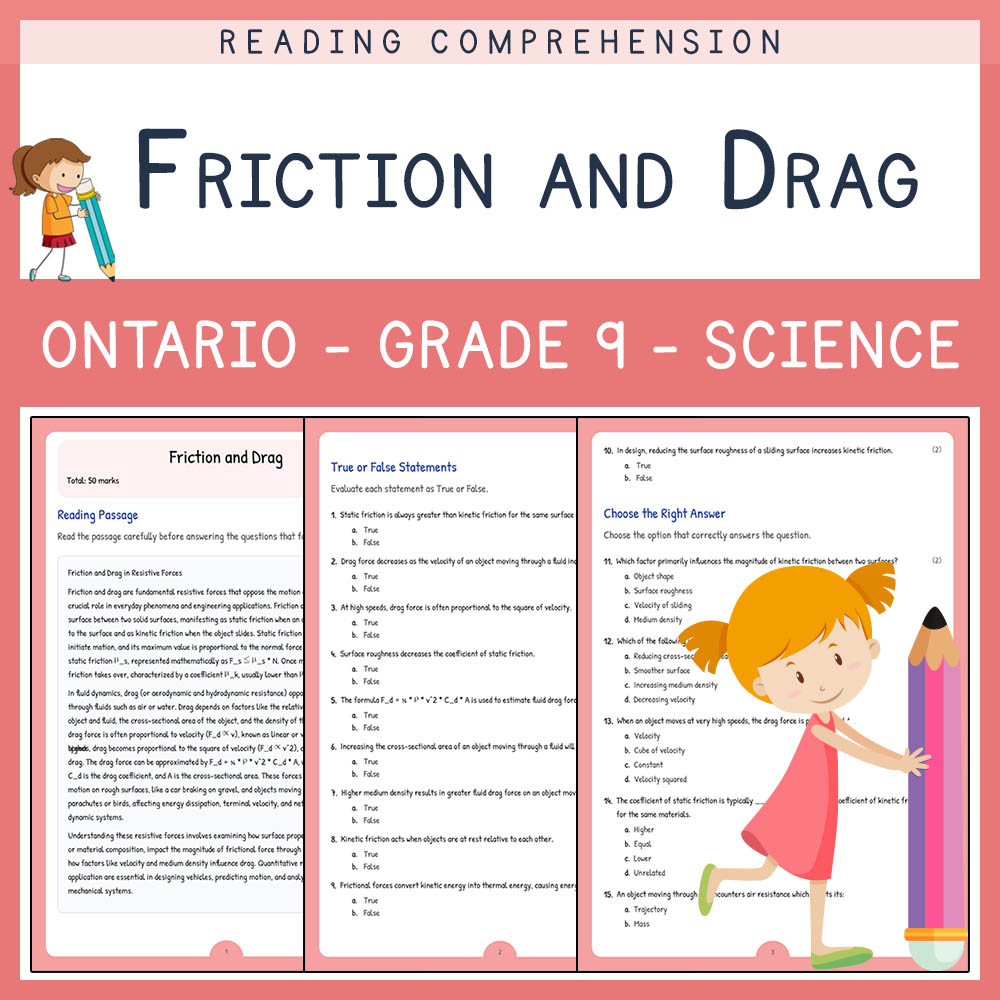
Grade 9 Science | Friction and Drag Worksheet Elena | Ontario Standard
Created byLumora LearningLearning Objectives
- Explain the differences between static and kinetic friction and how surface properties affect them.
- Describe the role of fluid drag and how it depends on velocity, surface area, and medium density.
- Apply quantitative relations involving μ coefficients and drag dependencies to real-world motion scenarios.
Instant download
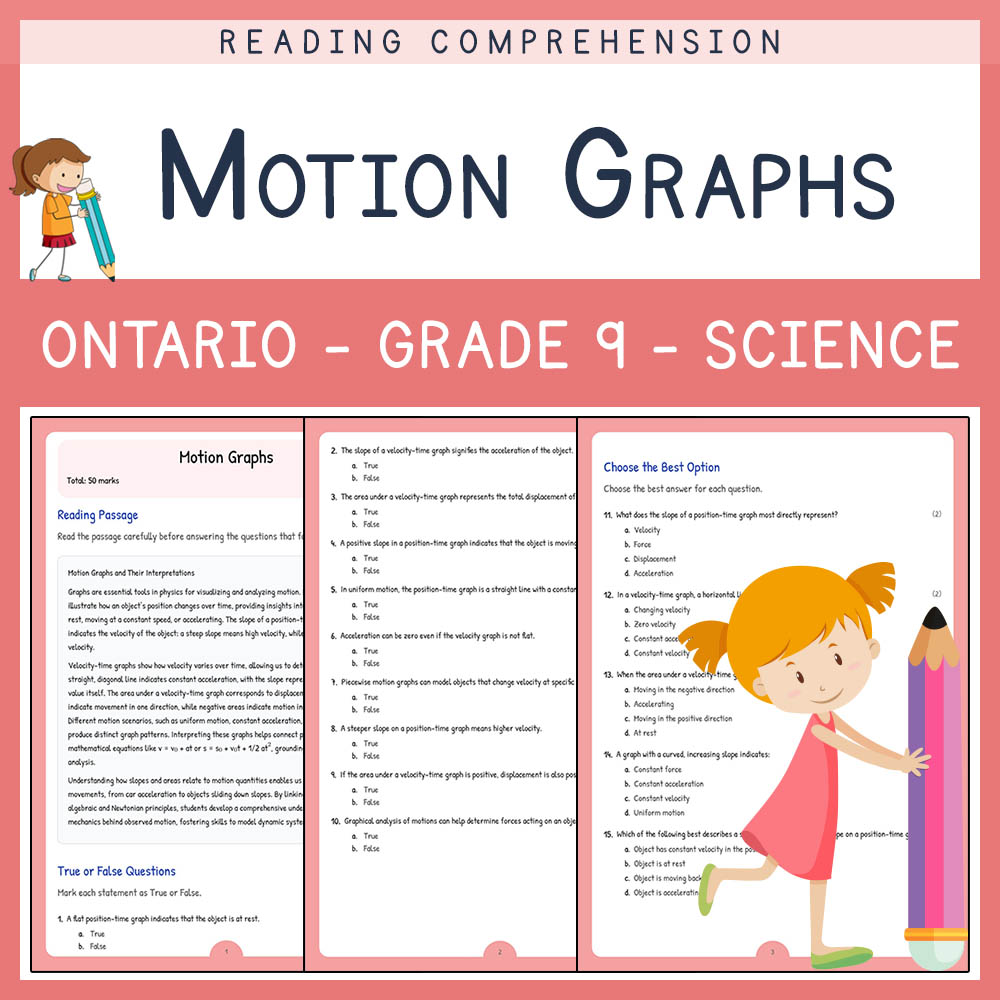
Grade 9 Science Assessment | Motion Graphs Worksheet Elena | Ontario Standard
Created byLumora LearningLearning Objectives
- Interpret position–time and velocity–time graphs in various motion scenarios.
- Understand how slopes of graphs relate to physical quantities like velocity and acceleration.
- Calculate displacement from areas under velocity–time graphs.
Instant download
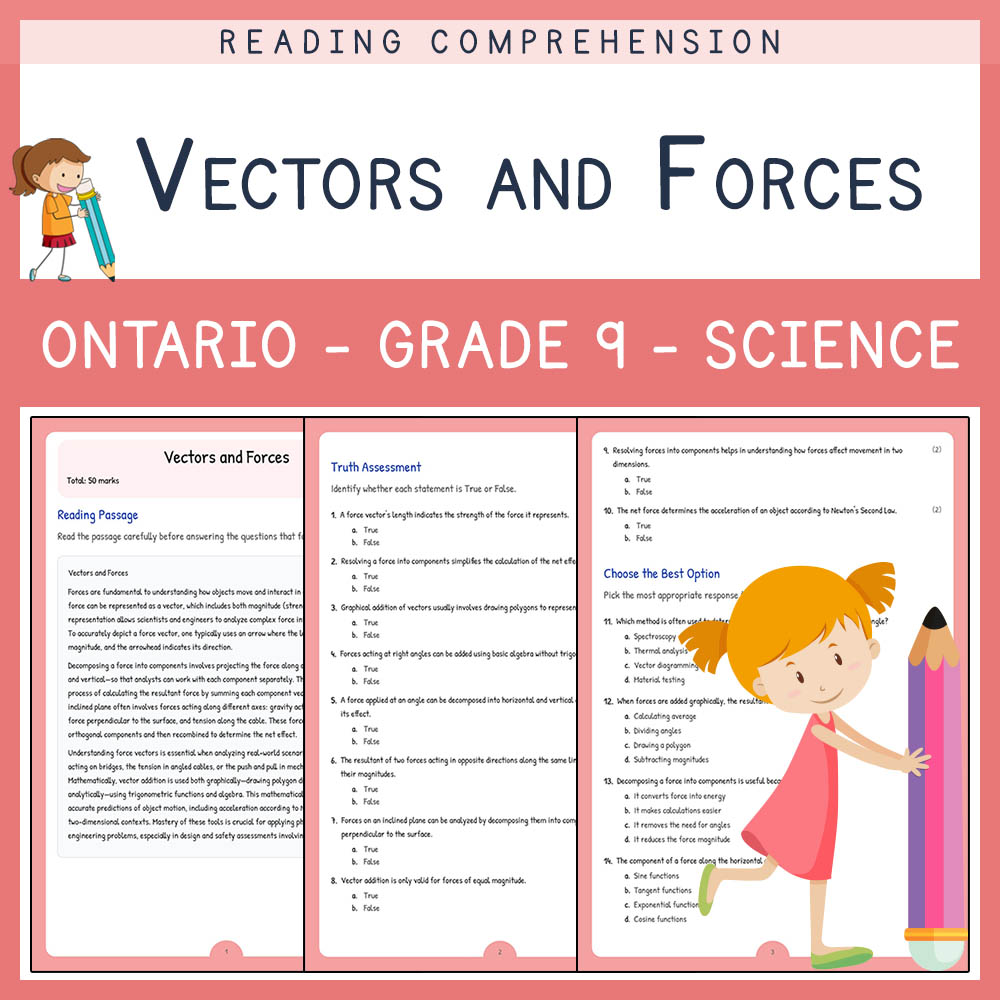
Grade 9 Science | Vectors and Forces Worksheet Elena | Ontario Standard
Created byLumora LearningLearning Objectives
- Understand the representation of forces as vectors including magnitude and direction.
- Learn to decompose forces into components and compute resultant forces graphically and analytically.
- Apply vector addition to force interactions in two-dimensional contexts such as inclined planes and angled cables.
Instant download
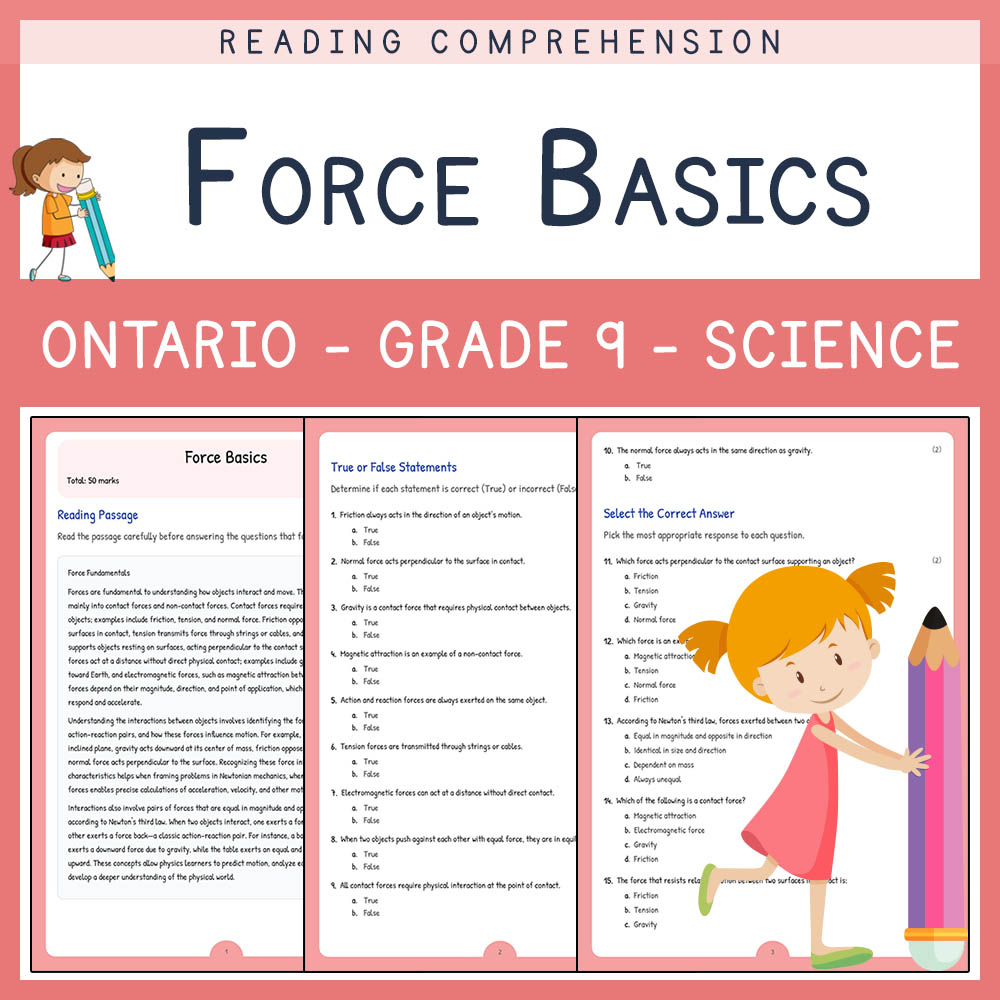
Grade 9 Science | Force Basics Worksheet Elena | Ontario Standard
Created byLumora LearningLearning Objectives
- Distinguish between contact and non-contact forces with examples.
- Identify the magnitude, direction, and point of application in force interactions.
- Understand action-reaction force pairs and their roles in physical interactions.
Instant download
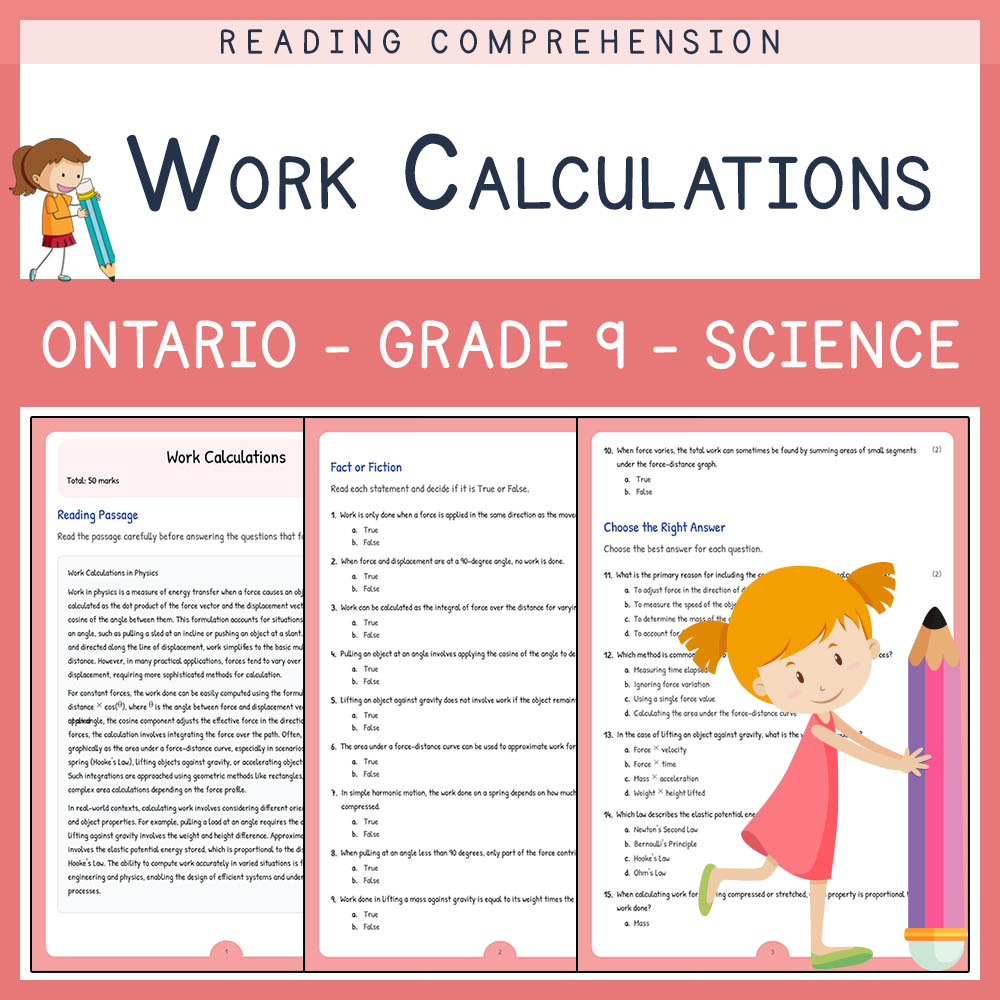
Grade 9 Science Assessment | Work Calculations Worksheet | Ontario Standard
Created byLumora LearningLearning Objectives
- Understand the concept of work as the dot product of force and displacement, including the role of the cosine of the angle between them.
- Calculate work done by constant forces at an angle, including lifting against gravity and pulling objects.
- Compare methods for calculating work when forces vary, including using the area under force–distance curves in common approximations.
Instant download

Grade 9 Science – Mineral Properties & Identification | Daily Reading Worksheet
Created byBright Mind ResourcesLearning Objectives
- Identify and describe physical and chemical properties of common rock-forming minerals.
- Understand how mineral properties relate to their formation environment and stability.
- Recognize economic significance of minerals and distinguish ore minerals from gangue.
Also included in: Grade 9 Earth & Space Science Daily Reading Worksheets Lesson Bundle | Ontario +1 more
Instant download
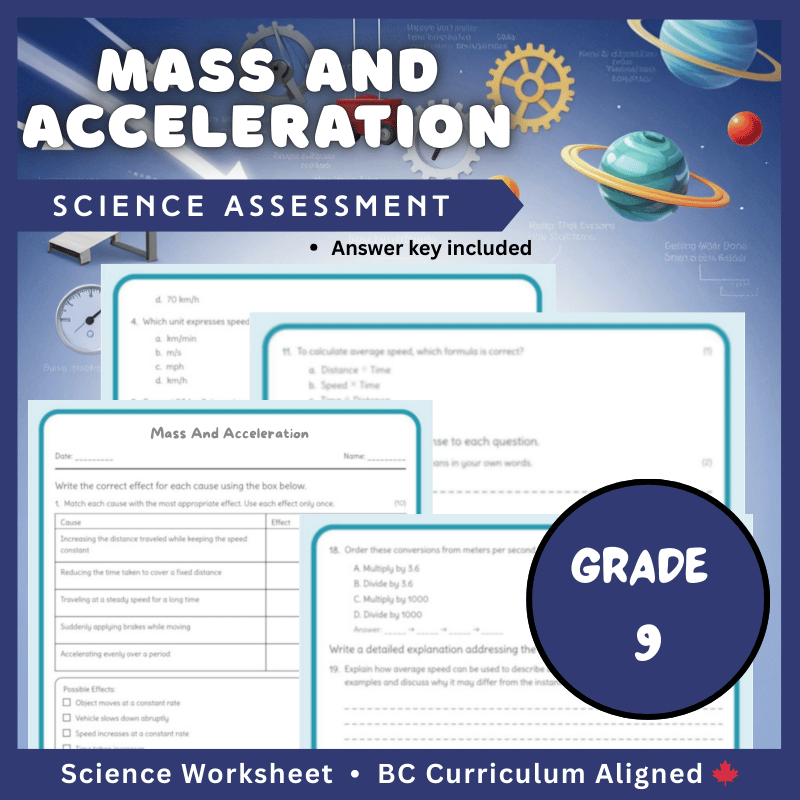
Grade 9 Science – Mass & Acceleration Worksheet + Answer Key | BC Standards
Created byBright Mind ResourcesLearning Objectives
- Understand the relationship between mass and acceleration under a given net force.
- Distinguish between inertial mass and gravitational effects in responses to forces.
- Analyze how changes in mass affect acceleration in practical scenarios.
Instant download

Cell Overview Worksheet | Grade 9 Science Practice
Created byPrism Point LearningLearning Objectives
- Explain how the cell membrane controls exchange between a cell and its environment
- Identify major organelles and describe how their structures relate to their functions
- Use models to compare cell structures and understand relative sizes and interactions
Also included in: Cells and Body Systems Lesson Bundle | Grade 9 Science | BC +1 more
Instant download

Organelles Specialization Worksheet | Grade 9 Science Practice
Created byPrism Point LearningLearning Objectives
- Explain how membrane-bound organelles specialize to carry out distinct cellular functions in eukaryotic cells.
- Describe the roles of mitochondria, ribosomes, rough endoplasmic reticulum, Golgi apparatus, lysosomes, and peroxisomes in metabolism and transport.
- Connect organelle specialization to efficiency and coordination of energy transfer and macromolecule processing.
Also included in: Cells and Body Systems Lesson Bundle | Grade 9 Science | BC +1 more
Instant download

Temperature Control Worksheet | Grade 9 Science Activities
Created byPrism Point LearningLearning Objectives
- Explain how thermoregulation maintains internal temperature within functional limits through coordinated body responses
- Describe the roles of the hypothalamus, skin blood flow, sweating, shivering, and metabolic adjustments in homeostasis
- Analyze how temperature changes affect enzyme activity, membrane stability, and overall cellular function
Also included in: Cells and Body Systems Lesson Bundle | Grade 9 Science | BC +1 more
Instant download
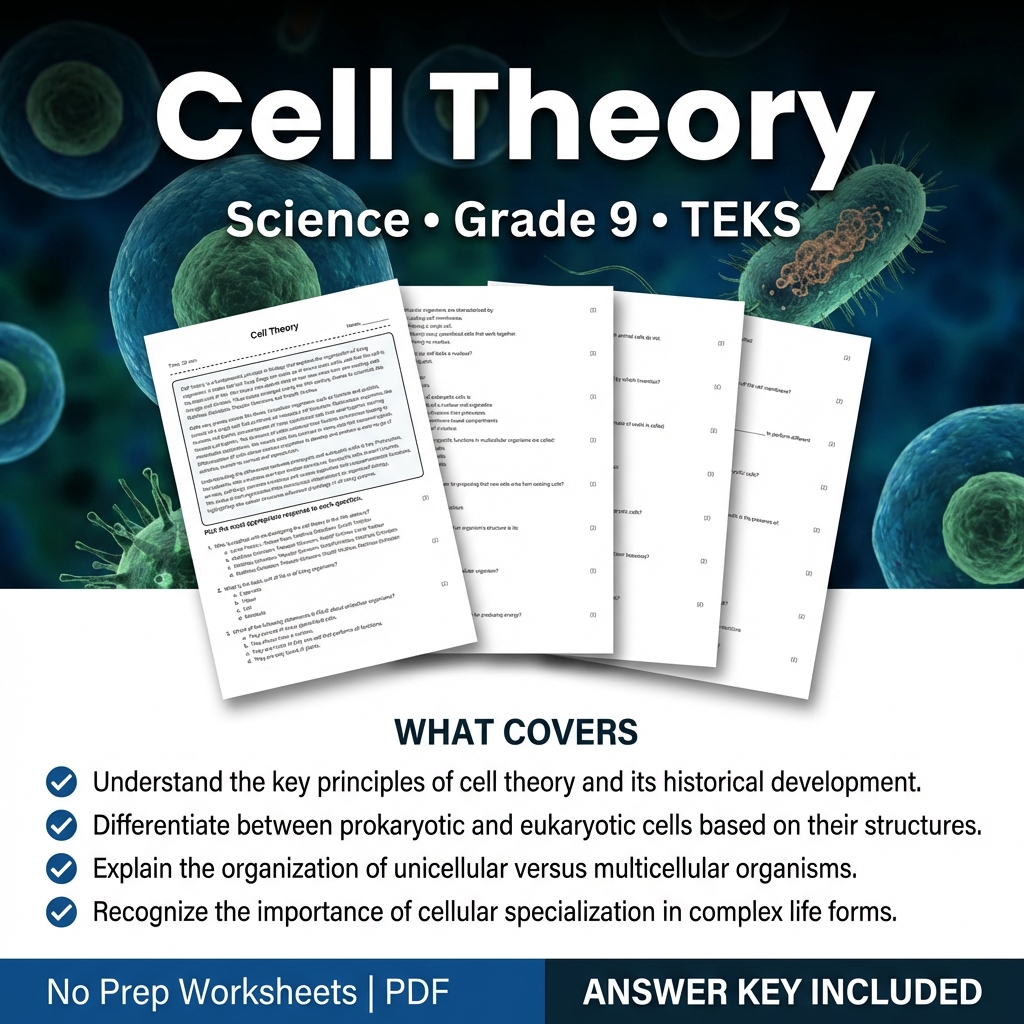
Cell Theory Worksheet for Grade 9 Science | Printable PDF & Answer Key
Created byCoral Reef LearningLearning Objectives
- Understand the key principles of cell theory and its historical development.
- Differentiate between prokaryotic and eukaryotic cells based on their structures.
- Explain the organization of unicellular versus multicellular organisms.
Instant download
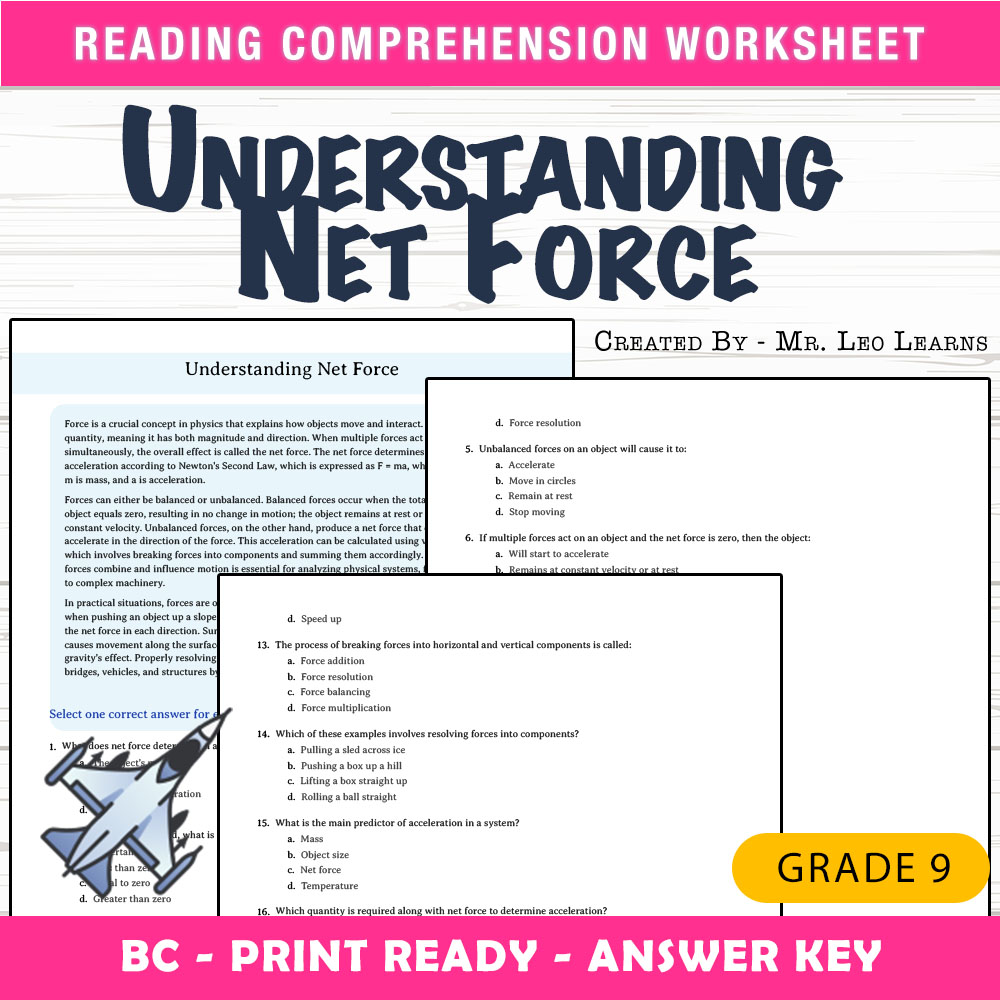
Grade 9 Science — Worksheet MCQ on Understanding Net Force
Created byThe Resource HubLearning Objectives
- Explain the concept of net force and how it affects motion.
- Identify when forces are balanced versus unbalanced.
- Resolve forces into components and compute net force.
Also included in: Grade 9 Science Forces & Motion Worksheet Bundle – BC Curriculum (15 Worksheets) +1 more
Instant download
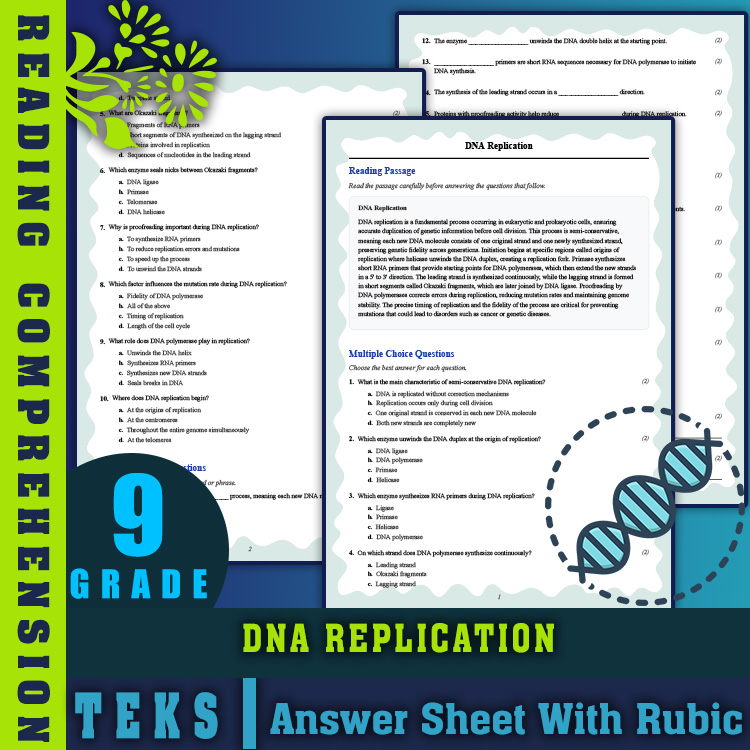
9th Grade Science | DNA Replication Reading Worksheet (PDF + Answer Key)
JCreated byJ.S SheetsLearning Objectives
- Describe the semi-conservative nature of DNA replication.
- Identify the roles of different enzymes involved in DNA replication.
- Explain the importance of replication fidelity and its impact on genome stability.
Instant download
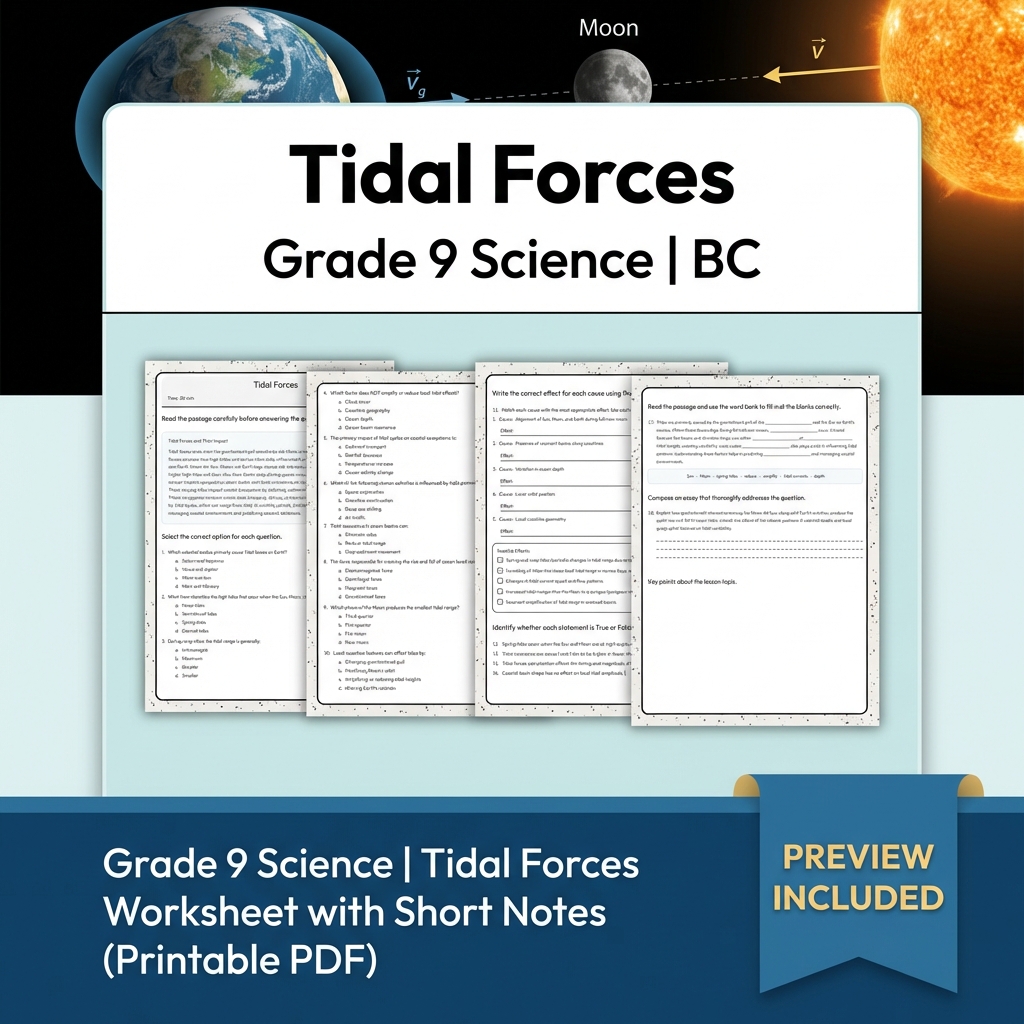
Grade 9 Science | Tidal Forces Worksheet with Short Notes (Printable PDF)
Created byMeadowlark WorksheetsLearning Objectives
- Understand the gravitational interactions among the Moon, Sun, and Earth that cause tidal forces.
- Explain the formation of spring and neap tides based on alignment of celestial bodies.
- Analyze how local coastline features and ocean basins influence tidal amplitudes.
Also included in: Grade 9 Science | BC Framework Lesson Bundle on Earth Systems & Climate +1 more
Instant download
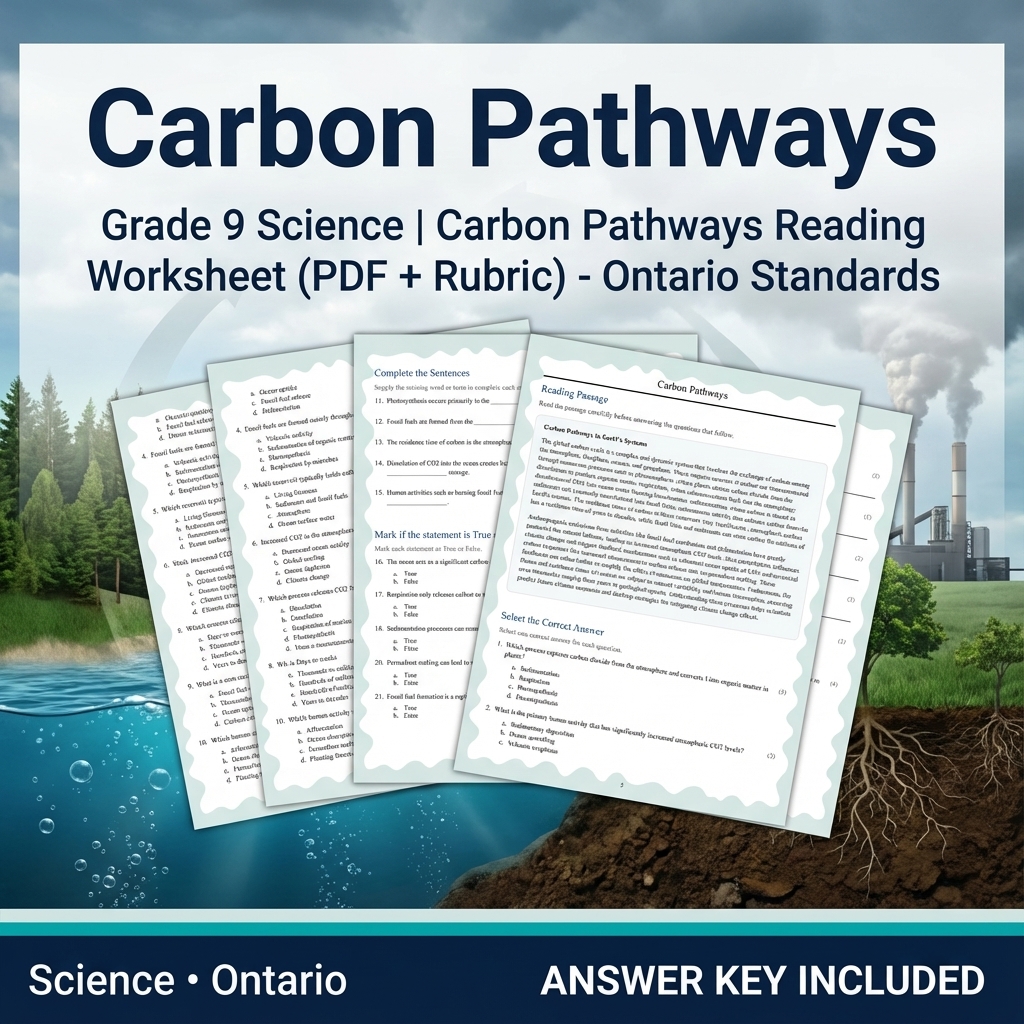
Grade 9 Science | Carbon Pathways Reading Worksheet (PDF + Rubric)
JCreated byJ.S SheetsLearning Objectives
- Identify major carbon reservoirs and understand the fluxes that move carbon among different Earth systems.
- Quantify the residence times of carbon in atmosphere, biosphere, oceans, and geosphere.
- Describe processes such as photosynthesis, respiration, dissolution, and sedimentation in the carbon cycle.
Also included in: Grade 9 Science | Earth Processes & Celestial Phenomena Worksheets Collection +1 more
Instant download
About Grade 9 Science Worksheets
Find Science worksheets built for Grade 9. All 6,986 cover core skills, practice, and review, each an instant PDF download.
Every worksheet on MyTeachingSheets is created by independent teacher-authors and reviewed before publication. All resources download as printable PDFs for classroom, homework, or at-home practice, and many include answer keys. Preview any worksheet free before buying.