
Science Worksheets
44,295 subject resources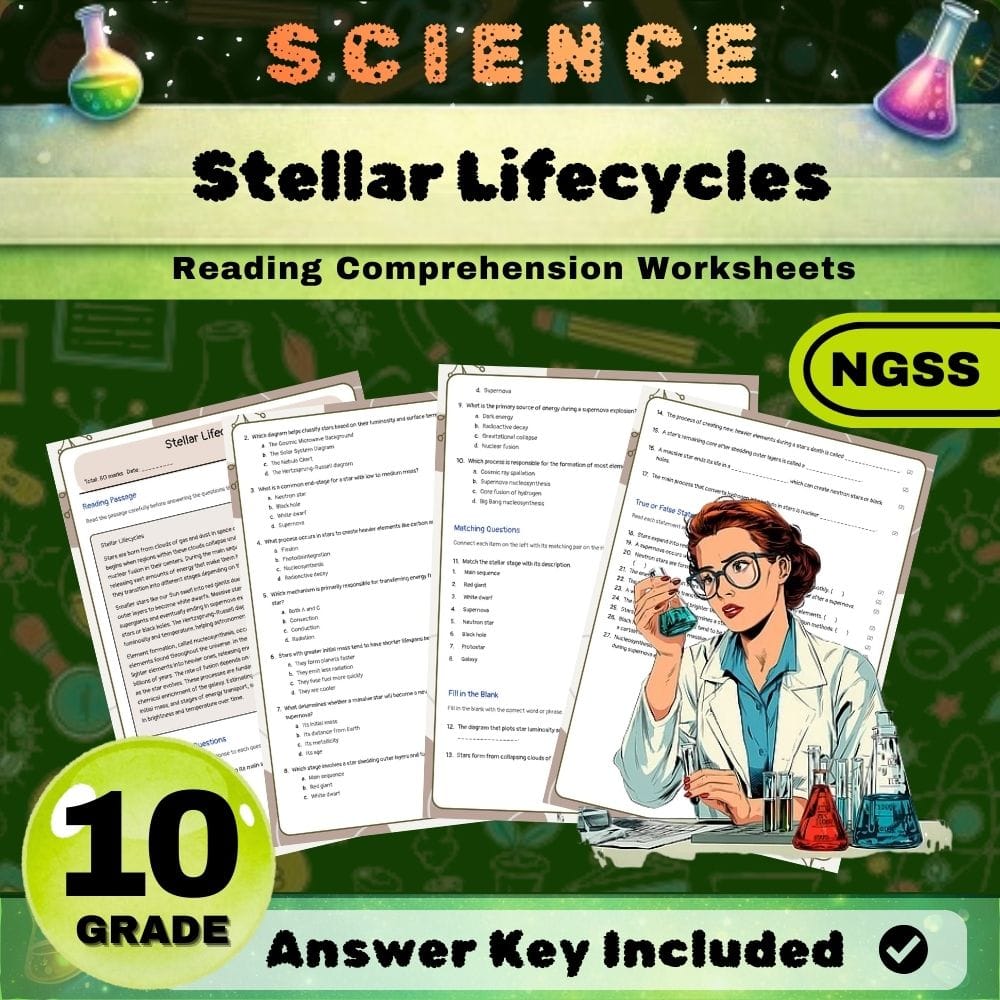
Grade 10 Science | Stellar Lifecycles Worksheet (NGSS) – PDF
 Created byMaple Path Learning
Learning Objectives
- Describe the processes involved in stellar evolution, including nuclear fusion, energy transfer, and changes in luminosity and temperature.
- Interpret the Hertzsprung-Russell diagram to understand different stages of star development.
- Explain nucleosynthesis pathways that create heavier elements during stellar evolution.
Also included in: Grade 10 Science Earth’s Place in the Universe NGSS Lesson Bundle | Framework +1 more
Instant download
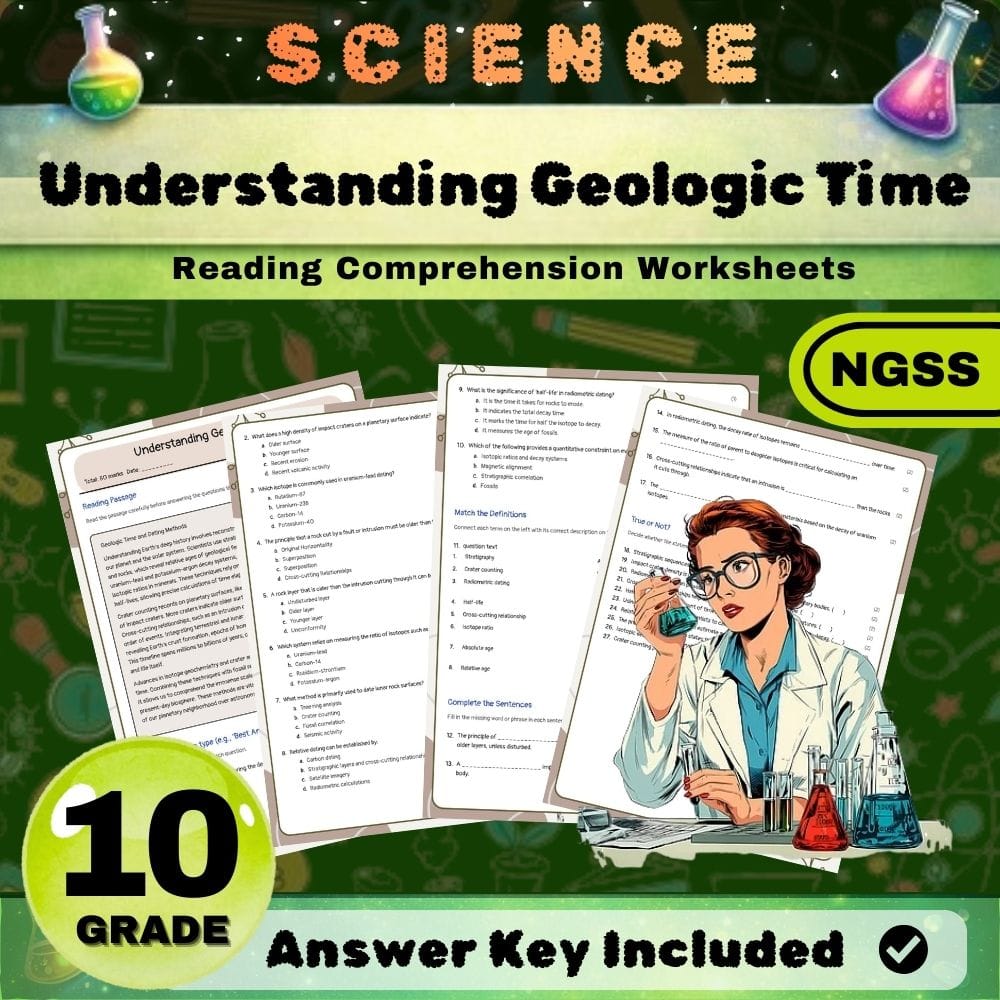
Grade 10 Science – Understanding Geologic Time Worksheet (PDF) NGSS
Created byMaple Path LearningLearning Objectives
- Explain the methods used to establish Earth's geologic history, including stratigraphy, radiometric dating, and crater counting.
- Describe how isotopic ratios and half-life decay systems help determine the age of rocks and planetary surfaces.
- Analyze the significance of cross-cutting relationships and relative dating techniques in constructing geologic timelines.
Also included in: Grade 10 Science Earth’s Place in the Universe NGSS Lesson Bundle | Framework +1 more
Instant download
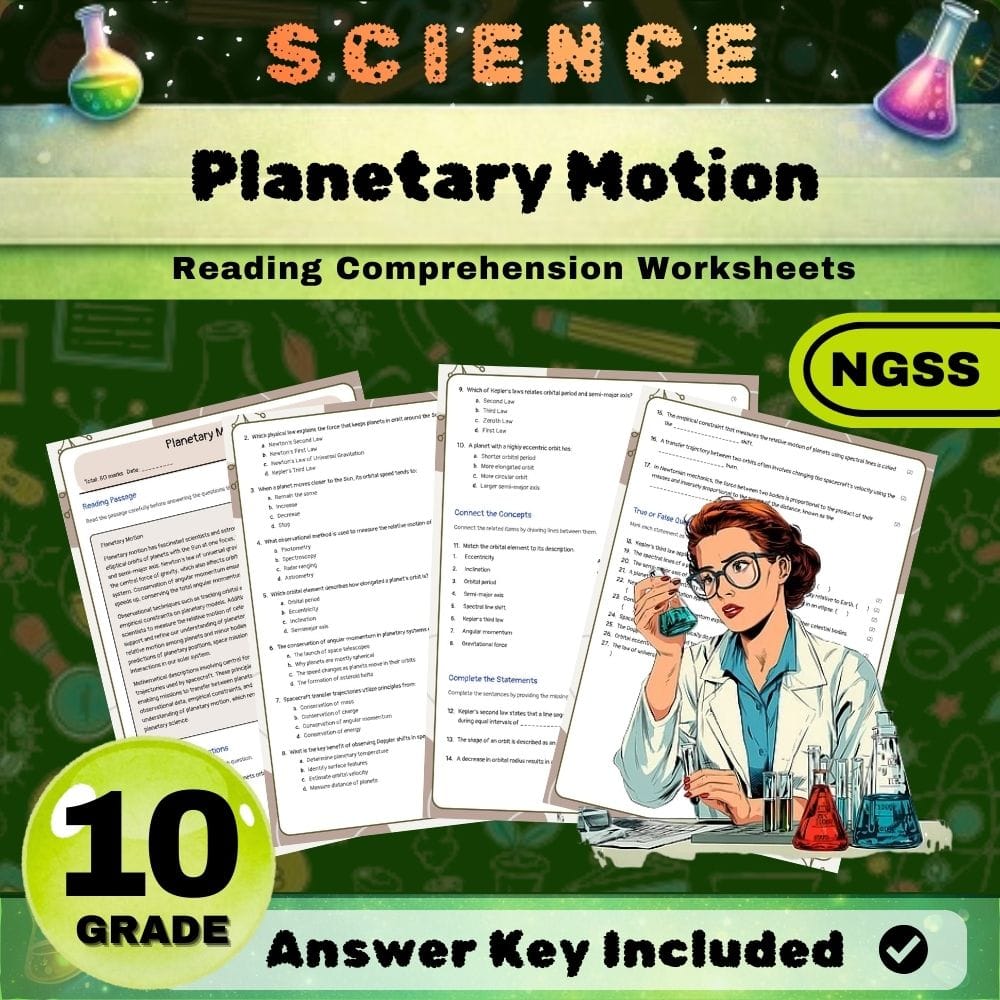
Grade 10 Science | Planetary Motion Worksheet (NGSS) - PDF
Created byMaple Path LearningLearning Objectives
- Explain the principles of Kepler's laws and Newtonian gravitation as they relate to planetary orbits.
- Describe how conservation of angular momentum influences planetary motion.
- Analyze observational data such as orbital elements and spectral line shifts to understand orbital dynamics.
Also included in: Grade 10 Science Earth’s Place in the Universe NGSS Lesson Bundle | Framework +1 more
Instant download
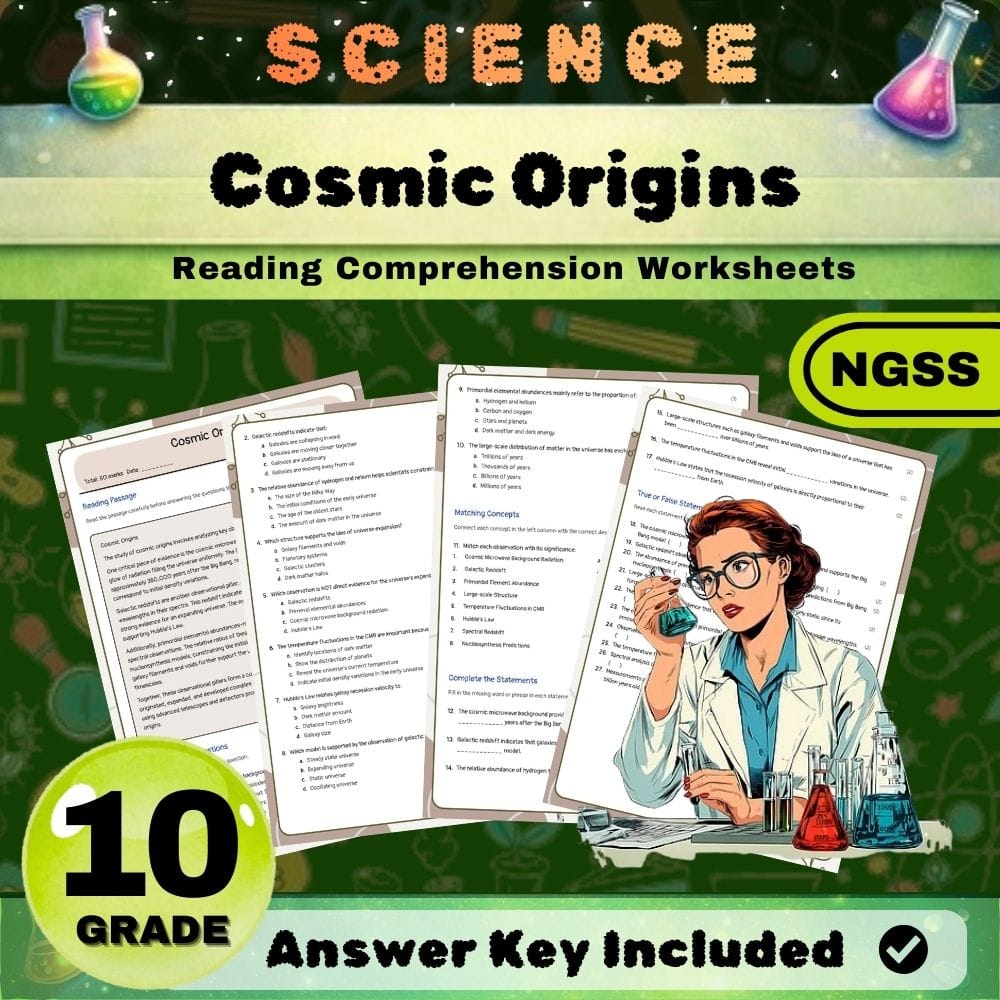
Grade 10 Science NGSS Worksheet – Cosmic Origins | PDF & Answer Key
Created byMaple Path LearningLearning Objectives
- Describe observational evidence supporting models of the universe's cosmic origins.
- Explain how cosmic microwave background radiation and galactic redshifts inform our understanding of universe expansion.
- Identify the significance of primordial elemental abundances in constraining early-universe conditions.
Also included in: Grade 10 Science Earth’s Place in the Universe NGSS Lesson Bundle | Framework +1 more
Instant download

Grade 11 Science – Earth System & Subsystems | Daily Reading Worksheet
 Created byBright Mind Resources
Learning Objectives
- Understand key concepts related to Science
- Apply knowledge through practice questions
- Demonstrate comprehension of the material
Also included in: Earth Systems Grade 11 Science Daily Reading Worksheets Lesson Bundle | AP +2 more
Instant download

Grade 11 Science – Atmospheric Layers & Features | Daily Reading Worksheet
Created byBright Mind ResourcesLearning Objectives
- Identify and describe main atmospheric layers: troposphere, stratosphere, mesosphere, thermosphere, and exosphere
- Understand the composition, temperature, and pressure profiles of each layer
- Explain how thermodynamic principles influence atmospheric phenomena such as lapse rates and inversion layers
Also included in: Earth Systems Grade 11 Science Daily Reading Worksheets Lesson Bundle | AP +2 more
Instant download

Reaction Signatures Worksheet | Grade 8 Science Standards-Aligned Assessment
JCreated byJ.S SheetsLearning Objectives
- Identify observable signatures of chemical change such as temperature change, precipitate formation, color change, and gas release.
- Explain how multiple indicators can be combined to confirm chemical transformations in environmental and industrial contexts.
- Describe real-world examples of chemical change signatures, including corrosion, effervescence, and combustion residues.
Also included in: Grade 8 Matter and Chemical Change Science Lesson Bundle – Alberta Framework +1 more
Instant download

Producers & Consumers Review & Practice Worksheet | Grade 9 Science
 Created byPrism Point Learning
Learning Objectives
- Explain how photosynthesis and cellular respiration transfer energy through ecosystems.
- Analyze how net primary productivity (NPP) and biomass accumulation affect food availability for consumers.
- Describe how organisms cycle carbon and oxygen through photosynthesis and respiration.
Also included in: Grade 9 Ecosystem Dynamics Science Lesson Bundle: NGSS Review Worksheets
Instant download

Human Impacts Practice Worksheet | Grade 9 Science NGSS Review
Created byPrism Point LearningLearning Objectives
- Explain how land-use change, invasive species, pollution, and resource extraction can reduce biodiversity.
- Interpret evidence from real-world examples (deforestation, coral reef degradation, agricultural runoff) to evaluate ecosystem impacts.
- Describe trade-offs between conservation goals, provisioning services, and socioecological outcomes.
Also included in: Grade 9 Ecosystem Dynamics Science Lesson Bundle: NGSS Review Worksheets
Instant download

Grade 8 Pascal Principle Worksheet | Ontario Science Hydraulics PDF
 Created byClear Sky Classroom
Learning Objectives
- Explain Pascal's principle and how pressure in a confined fluid is transmitted.
- Use the pressure idea to relate piston areas to force multiplication in hydraulic systems.
- Identify real-world hydraulic applications and describe key limitations (compressibility, seals, leaks).
Instant download

Grade 8 Science Worksheet – Mass Conservation (Standard Alberta) PDF
 Created byEvergreen Desk Education
Learning Objectives
- Explain conservation of mass and describe what it means in a closed system.
- Use mass conservation to account for reactants and products in physical and chemical changes.
- Interpret measurements from controlled processes (sealed reactions, combustion chambers, and waste containment) using the idea of constant total mass.
Instant download
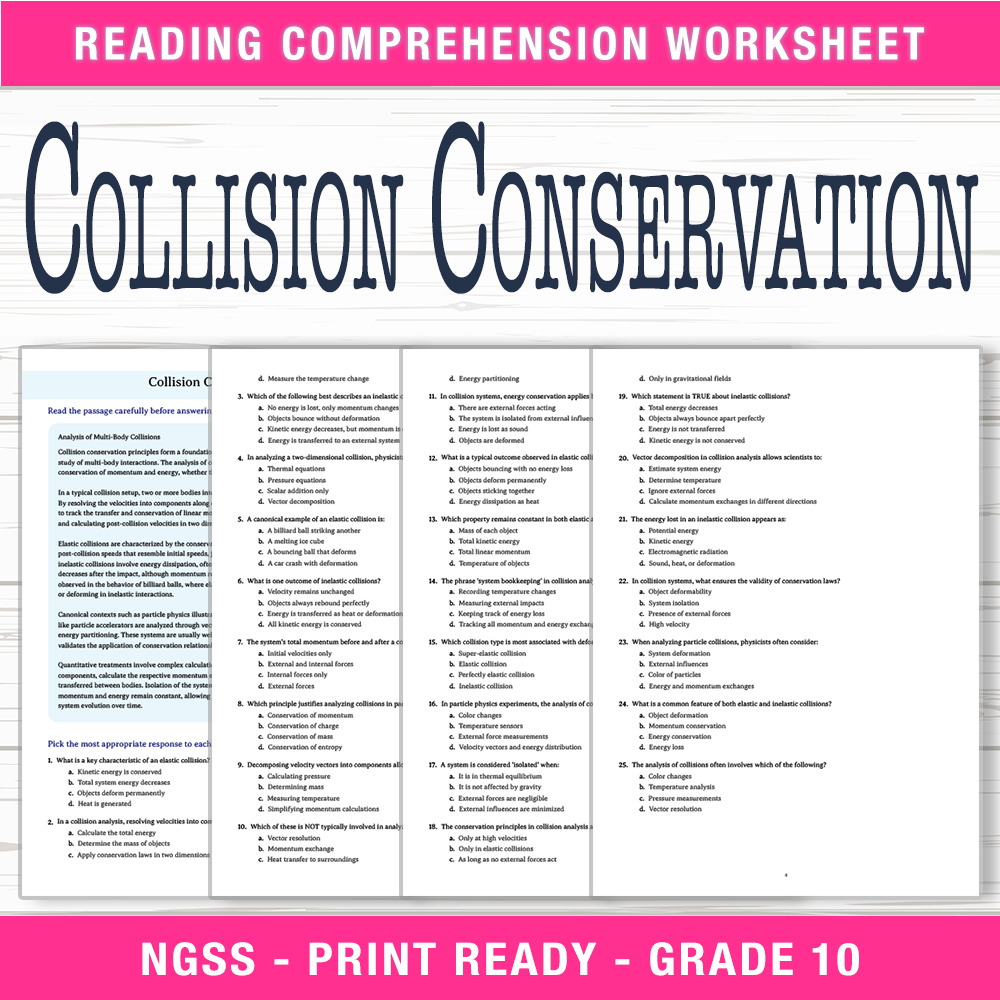
Grade 10 Science | Collision Conservation Worksheet (PDF + Answer Key)
 Created byRiverstone Classroom
Learning Objectives
- Understand the principles of conservation of momentum and energy in multi-body collisions.
- Apply vector resolution techniques to analyze two-dimensional collisions.
- Differentiate between elastic and inelastic collisions using speed distributions and energy partitioning.
Instant download

Population Drivers Worksheet for Grade 8 Science | Alberta Standards
JCreated byJ.S SheetsLearning Objectives
- Understand how abiotic and biotic factors influence population size and distribution.
- Identify examples of population dynamics in Alberta ecosystems.
- Explain concepts such as birth, death, immigration, emigration, and density dependence.
Instant download
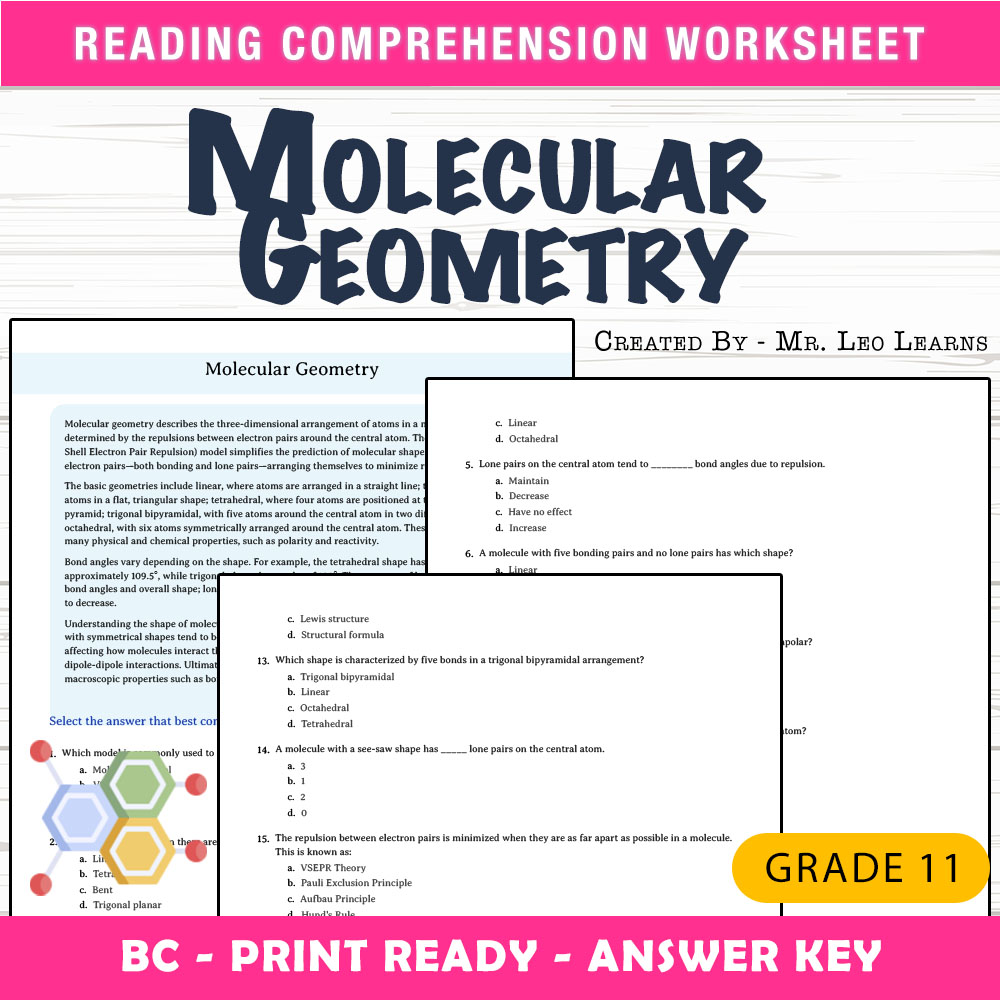
Grade 11 Science — Worksheet MCQ Paper for Mastering Molecular Geometry
 Created byThe Resource Hub
Learning Objectives
- Describe the principles of the VSEPR model and how electron pairs influence molecular shape.
- Identify common molecular geometries such as linear, trigonal planar, tetrahedral, trigonal bipyramidal, and octahedral.
- Explain how molecular geometry impacts properties like polarity, boiling point, and molecular interactions.
Also included in: Grade 11 Science – Chemistry Unit Worksheet Bundle (BC) +1 more
Instant download
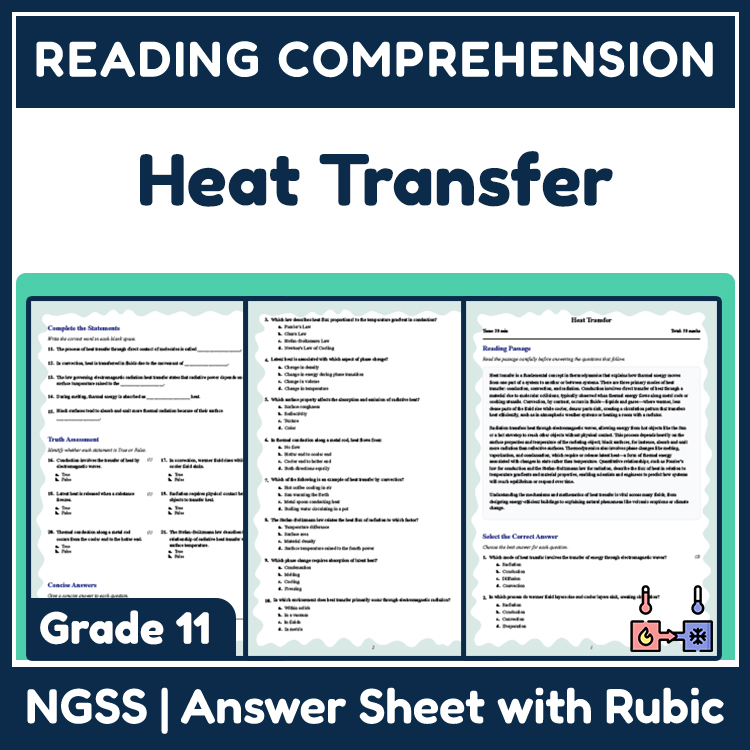
11th Grade Science | Heat Transfer Reading Worksheet & Answer Key (PDF)
JCreated byJ.S SheetsLearning Objectives
- Explain the three main mechanisms of heat transfer: conduction, convection, and radiation.
- Describe examples of heat transfer processes and their roles in temperature change and phase transitions.
- Apply quantitative relationships among heat flux, temperature gradients, and material properties to predict thermal behavior.
Instant download
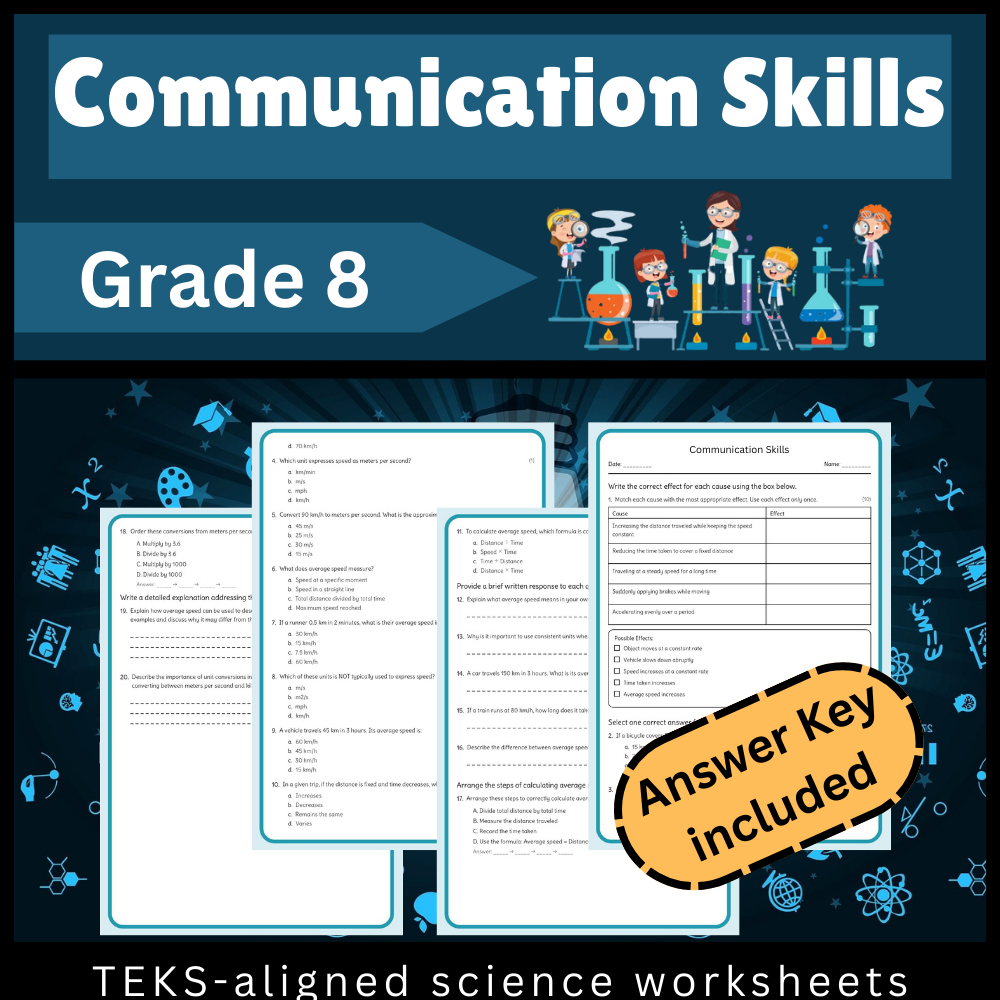
Grade 8 Science | Communication Skills in Science Worksheet (PDF) TEKS-Aligned
Created byBright Mind ResourcesLearning Objectives
- Understand and construct clear, evidence-based scientific explanations.
- Apply standard scientific conventions in graphs, tables, and citations.
- Use claim–evidence–reasoning structure to support scientific arguments.
Also included in: Grade 8 Science Unit Bundle | Scientific Inquiry, Data & Measurement Skills +1 more
Instant download
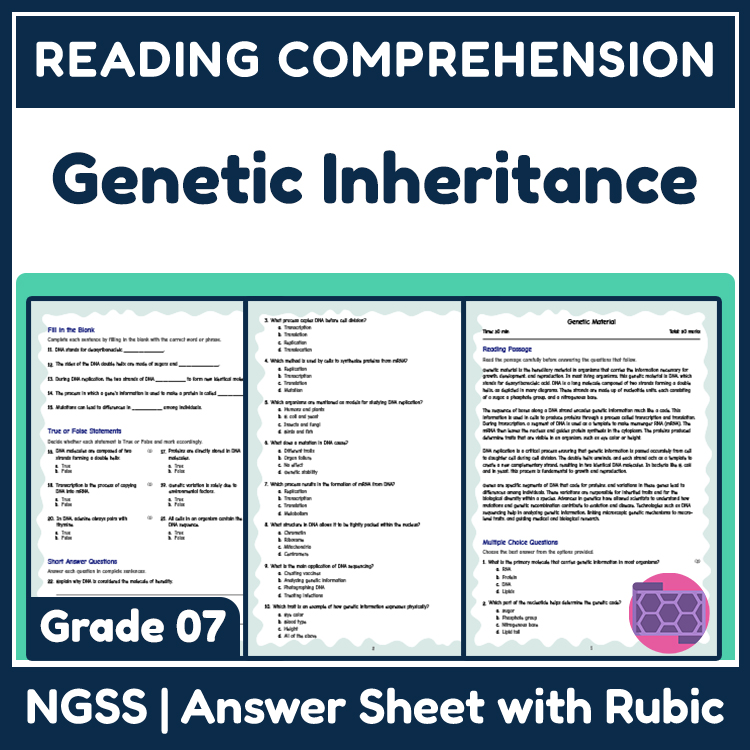
7th Grade Science | Genetic Material Reading Worksheets (Answer Key)
JCreated byJ.S SheetsLearning Objectives
- Understand the structure of DNA and its role in storing genetic information.
- Explain the process of DNA replication and protein synthesis.
- Describe how genetic information is transmitted and expressed in organisms.
Instant download
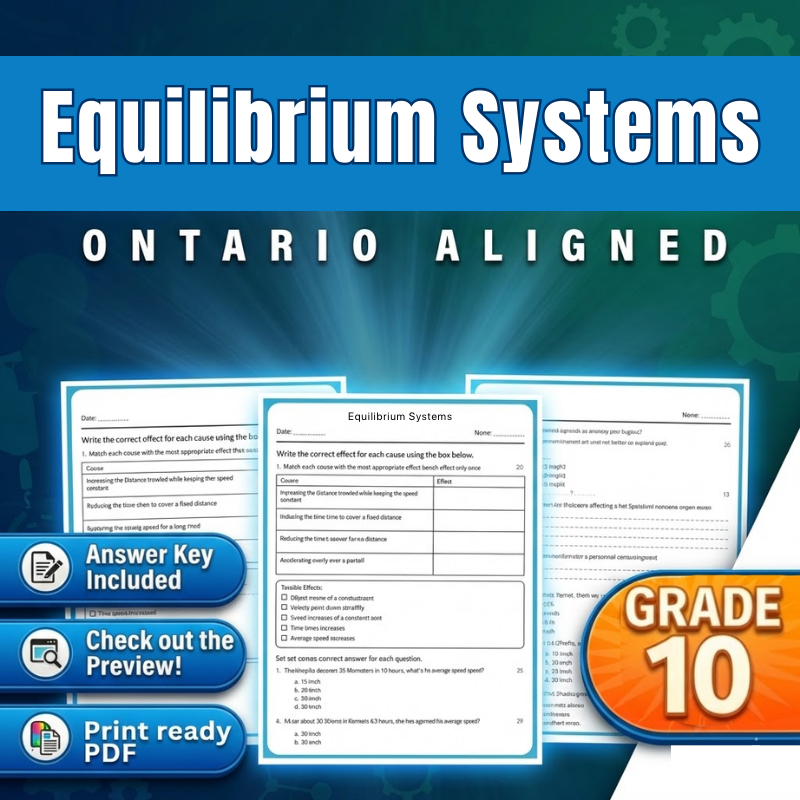
Grade 10 Science | Equilibrium Systems Worksheet (PDF) – Ontario Standards
Created byBright Mind ResourcesLearning Objectives
- Understand the conditions for static equilibrium through vector analysis of forces and moments.
- Apply the equilibrium criteria ΣF = 0 to various supported and suspended bodies.
- Interpret equilibrium as the absence of net acceleration rather than the lack of individual forces.
Instant download

Grade 11 Science – Species Interactions Worksheet (TEKS) (PDF)
Created byEvergreen Desk EducationLearning Objectives
- Explain how species interactions (competition, predation, herbivory, mutualism, commensalism, and parasitism) affect community structure and population sizes.
- Analyze how trophic interactions can create top-down and bottom-up controls and produce cascading effects.
- Evaluate how abiotic factors (temperature, moisture, nutrients) modulate interaction strength and outcomes in terrestrial and aquatic systems.
Instant download

Grade 7 Science | Environmental Change Impacts Worksheet | General Standards
 Created byLumora Learning
Learning Objectives
- Explain how changes in climate and habitat conditions can affect ecosystem survival and reproduction
- Describe how changes in water quality and pollution can alter growth, mortality, and population size
- Analyze how shifts in key species can change predation, competition, and symbiosis within an ecosystem
Instant download
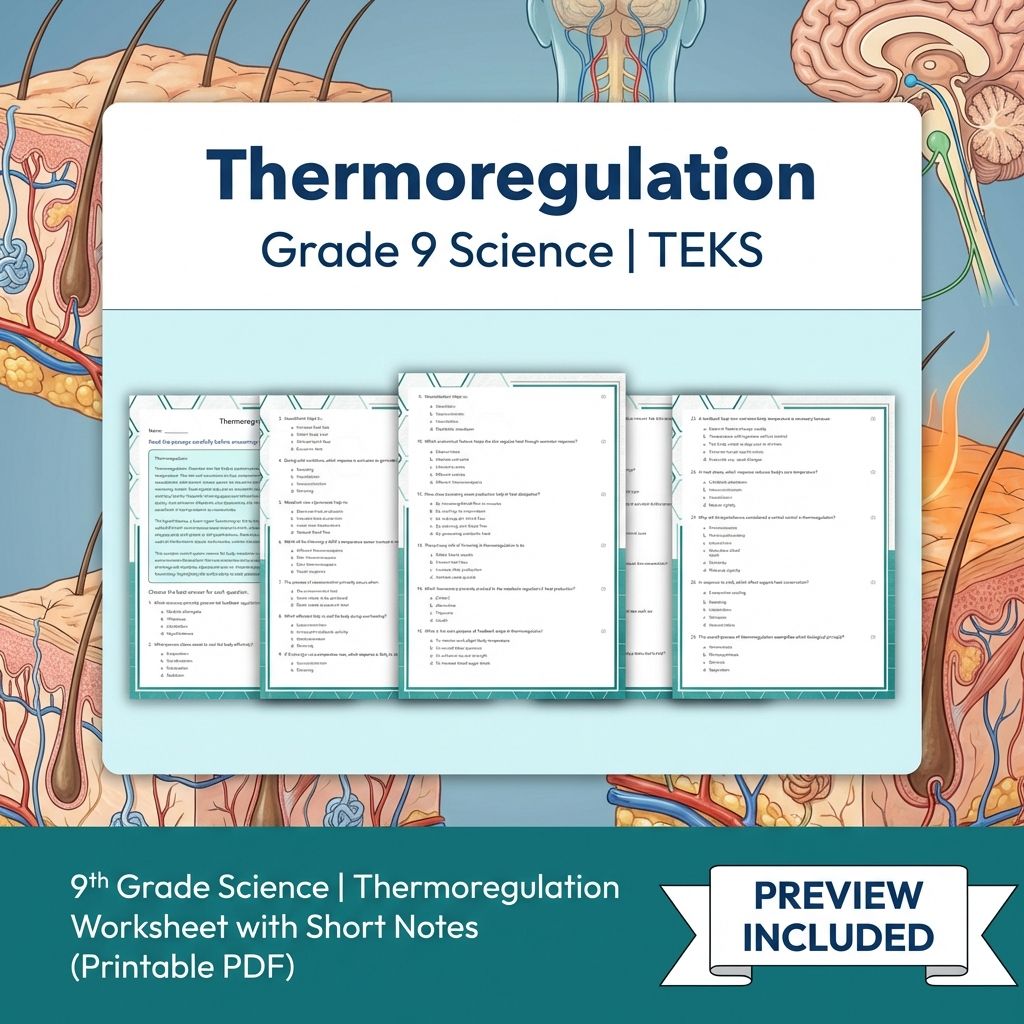
9th Grade Science | Thermoregulation Worksheet with Short Notes (Printable PDF)
 Created byMeadowlark Worksheets
Learning Objectives
- Understand the mechanisms involved in human body temperature regulation.
- Identify the roles of skin, vasculature, sweat glands, muscles, and the hypothalamus in thermoregulation.
- Explain how feedback loops maintain thermal homeostasis under varying environmental conditions.
Instant download
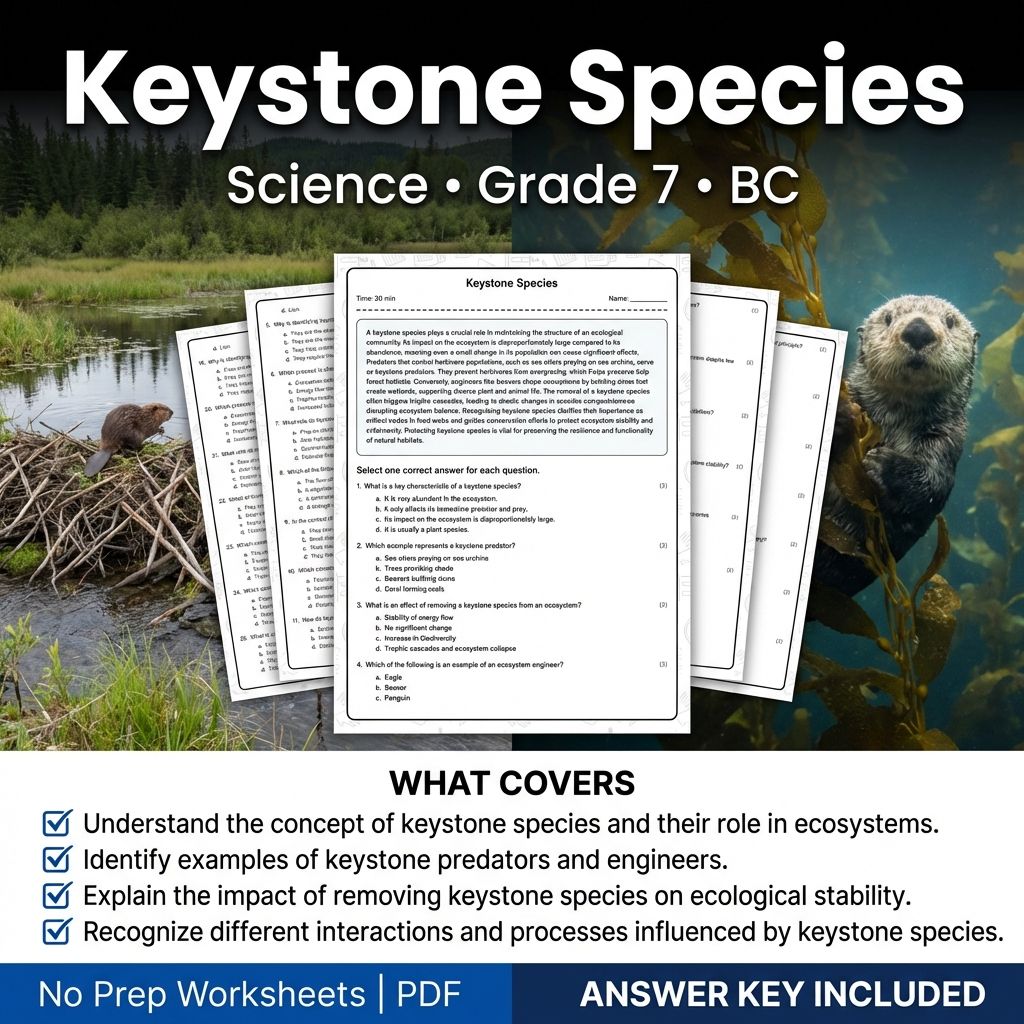
7th Grade Science | Keystone Species Worksheet & Answer Key (Printable PDF)
 Created byCoral Reef Learning
Learning Objectives
- Understand the concept of keystone species and their role in ecosystems.
- Identify examples of keystone predators and engineers.
- Explain the impact of removing keystone species on ecological stability.
Instant download
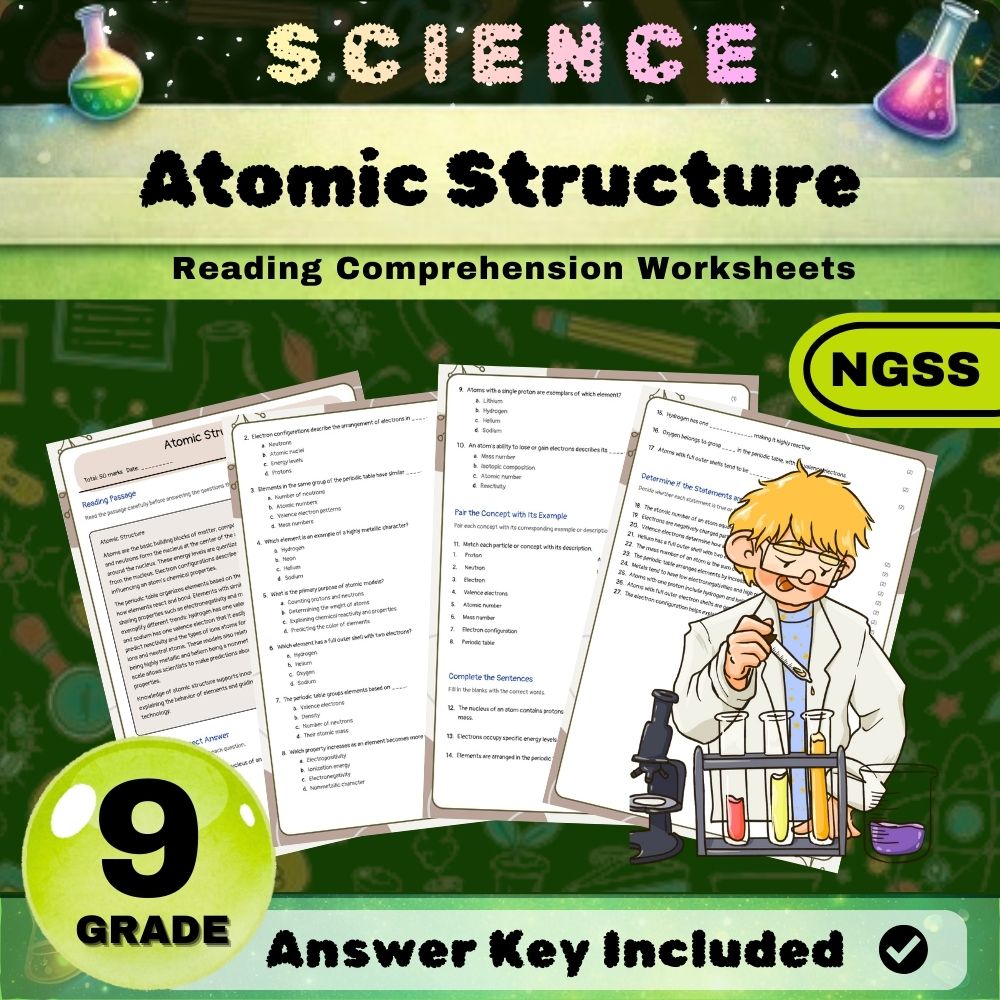
Grade 9 Science - Atomic Structure Worksheet (NGSS) PDF (Practice Set)
Created byMaple Path LearningLearning Objectives
- Understand the fundamental particles composing atoms, including protons, neutrons, and electrons.
- Describe electron configurations and their relation to energy levels.
- Explain how the periodic table organization reflects valence electrons and chemical behavior.
Also included in: Grade 9 Science | Matter and Its Interactions NGSS Unit Bundle – Worksheets +1 more
Instant download
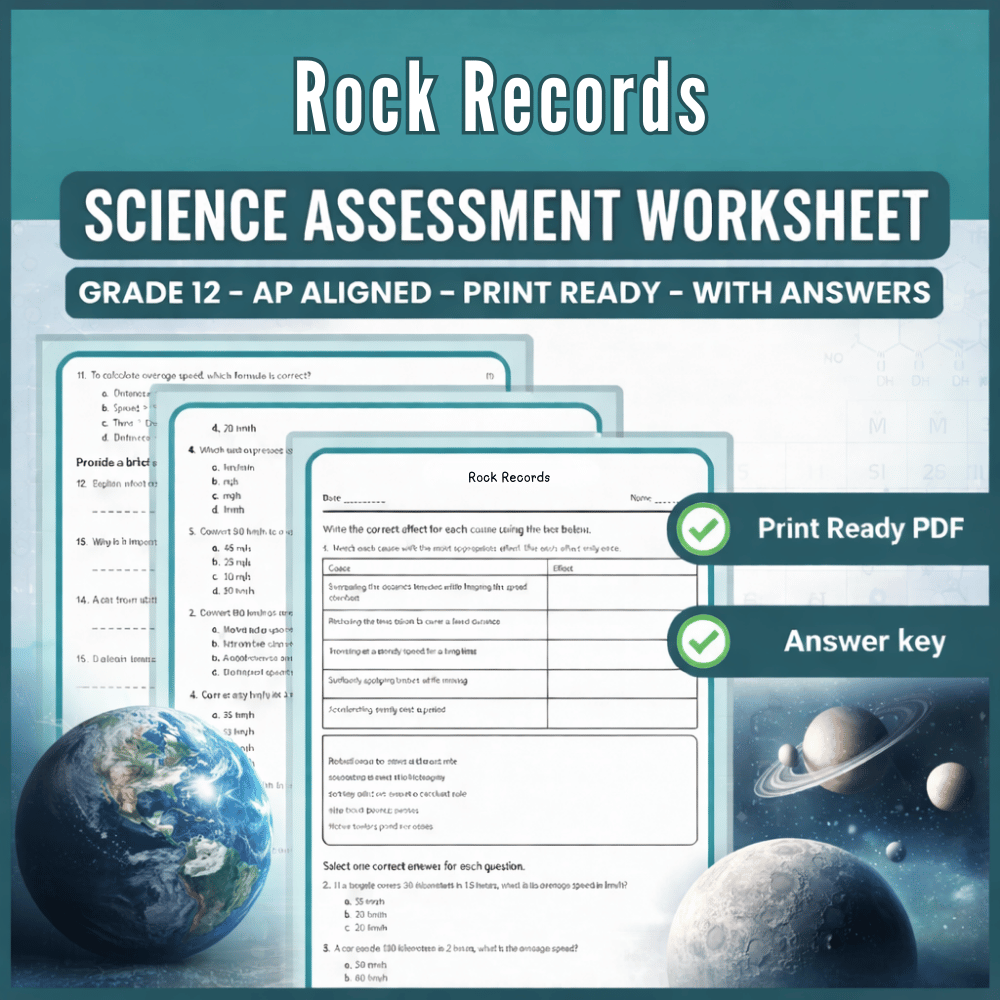
Grade 12 Science | Rock Records AP Worksheet (PDF)
Created byBright Mind ResourcesLearning Objectives
- Interpret stratigraphic sequences, fossil assemblages, and radiometric age data to reconstruct Earth history.
- Apply sedimentary facies models, cross-section interpretations, and isotopic systematics for correlation.
- Understand the limits of temporal resolution, unconformities, and the integration of multiple evidence types in geologic timelines.
Instant download

Grade 7 Science | Biotic and Abiotic Factors Worksheet (Alberta Standards) (PDF)
 Created bySilver Birch Teaching
Learning Objectives
- Explain how abiotic factors (sunlight, water, temperature, soil, and topography) influence where organisms can survive
- Describe how biotic interactions (plants, animals, and microbes) respond to changing abiotic conditions
- Use cause-and-effect reasoning to predict how ecosystem patterns differ across regional environmental gradients
Also included in: Grade 7 Ecosystems & Biodiversity Science Lesson Bundle for Alberta Framework +1 more
Instant download

Grade 7 Science | Migration Patterns Worksheet (Alberta Standards) PDF
Created bySilver Birch TeachingLearning Objectives
- Explain how food availability and breeding needs drive seasonal and annual migration patterns.
- Describe how timing cues and energetic demands influence when organisms move between habitats.
- Interpret how migratory connectivity links ecosystems and supports biodiversity across regions.
Also included in: Grade 7 Ecosystems & Biodiversity Science Lesson Bundle for Alberta Framework +1 more
Instant download

Grade 7 Science | Food Webs Worksheet – Alberta Standards (PDF)
Created bySilver Birch TeachingLearning Objectives
- Explain how energy flows through producers, consumers, and decomposers in a food web
- Describe how organisms are connected through feeding relationships and dependency chains
- Analyze how removing or adding a species can change trophic connections and affect ecosystem stability
Also included in: Grade 7 Ecosystems & Biodiversity Science Lesson Bundle for Alberta Framework +1 more
Instant download

Grade 7 Science | Wetland Functions Worksheet (Alberta Standards) (PDF)
Created bySilver Birch TeachingLearning Objectives
- Describe how wetlands regulate water at the landscape scale through storage, slow release, and flood buffering.
- Explain how wetlands support ecosystem services through nutrient cycling and filtration.
- Identify how wetland type (e.g., peatlands vs. marshes) relates to different habitats and biological functions.
Also included in: Grade 7 Ecosystems & Biodiversity Science Lesson Bundle for Alberta Framework +1 more
Instant download

Grade 7 Science – Symbiosis Types Worksheet (Alberta) | PDF & Answer Key
Created bySilver Birch TeachingLearning Objectives
- Identify and distinguish mutualism, commensalism, and parasitism using key features
- Explain how symbiosis relationships affect population size, resource use, and survival
- Use examples from Alberta habitats to describe real-world ecological consequences
Also included in: Grade 7 Ecosystems & Biodiversity Science Lesson Bundle for Alberta Framework +1 more
Instant download

Grade 7 Science Worksheet – Biodiversity Measures (PDF) | Alberta Standards
Created bySilver Birch TeachingLearning Objectives
- Explain how biodiversity can be described using richness, evenness, and habitat heterogeneity.
- Interpret what different biodiversity metrics may indicate about ecosystem resilience and ecological function.
- Connect habitat complexity to changes in species assemblages in Alberta-like environments.
Also included in: Grade 7 Ecosystems & Biodiversity Science Lesson Bundle for Alberta Framework +1 more
Instant download

Population Patterns Worksheet Grade 8 Science Activities
Created byPrism Point LearningLearning Objectives
- Explain how exponential growth, logistic growth, and cyclical fluctuations differ in population models
- Describe how carrying capacity, reproduction, predation, and time lags influence real population trajectories
- Connect population dynamics concepts to real Alberta examples such as snowshoe hare–lynx cycles
Instant download
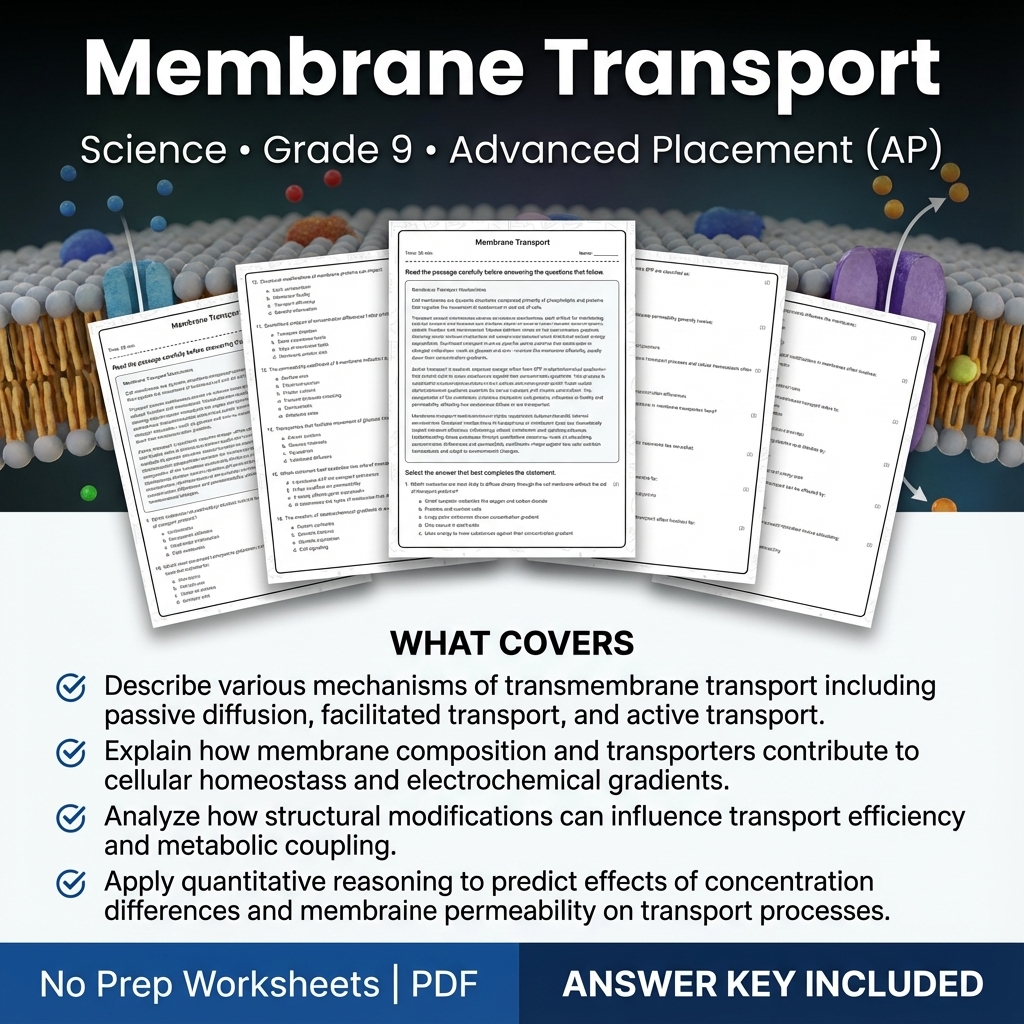
9th Grade Science | Membrane Transport Worksheet (Printable PDF + Answer Key)
Created byCoral Reef LearningLearning Objectives
- Describe various mechanisms of transmembrane transport including passive diffusion, facilitated transport, and active transport.
- Explain how membrane composition and transporters contribute to cellular homeostasis and electrochemical gradients.
- Analyze how structural modifications can influence transport efficiency and metabolic coupling.
Also included in: Grade 9 Science Unit Worksheet Bundle | Cell Function to Ecosystem Dynamics +2 more
Instant download
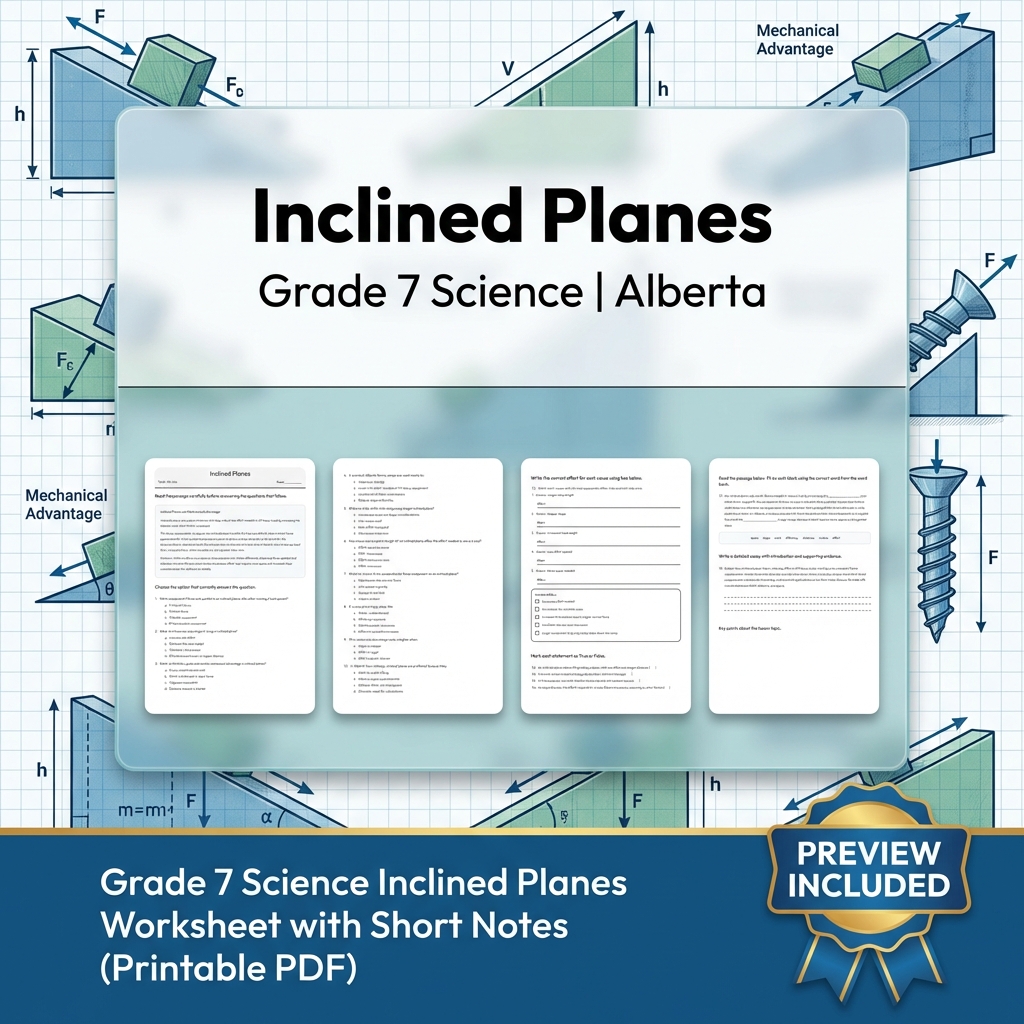
Grade 7 Science Inclined Planes Worksheet with Short Notes (Printable PDF)
Created byMeadowlark WorksheetsLearning Objectives
- Understand how inclined planes distribute applied force and work over distance.
- Identify the force components parallel and perpendicular to a slope.
- Calculate the mechanical advantage of inclined planes in practical contexts.
Also included in: Grade 7 Science | Forces, Structures & Motion UNIT Worksheet Bundle
Instant download
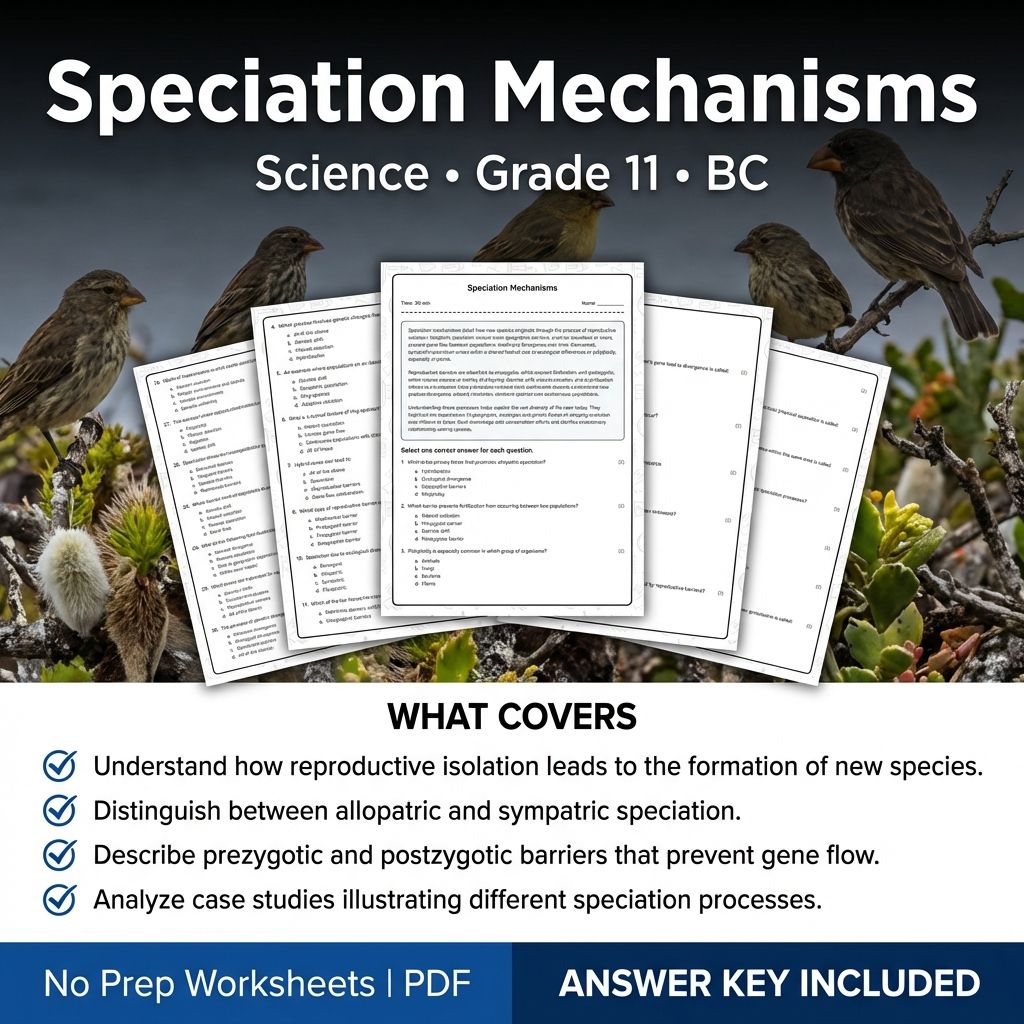
Grade 11 Science | Speciation Mechanisms Worksheet & Answer Key (Printable PDF)
Created byCoral Reef LearningLearning Objectives
- Understand how reproductive isolation leads to the formation of new species.
- Distinguish between allopatric and sympatric speciation.
- Describe prezygotic and postzygotic barriers that prevent gene flow.
Instant download
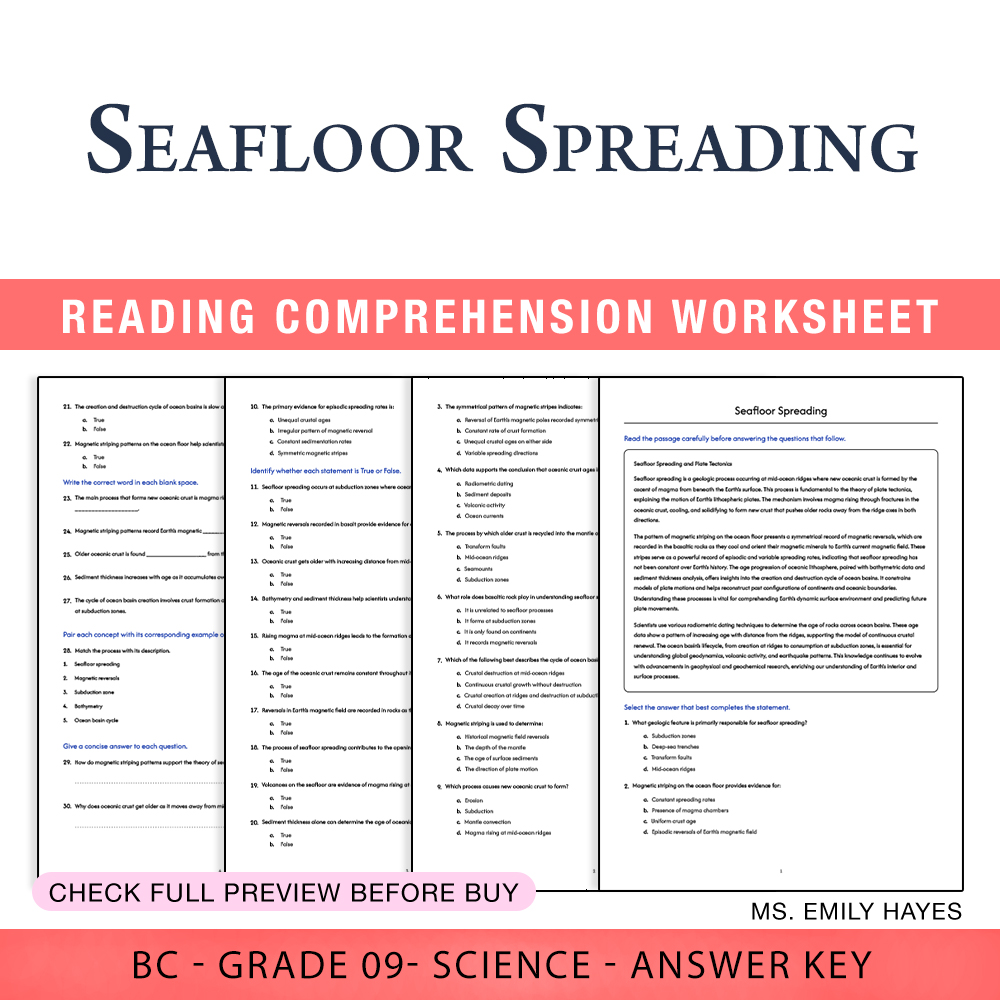
9th Grade Science | Seafloor Spreading Worksheet (PDF+ Answer Key)
 Created byCopper Leaf Classroom
Learning Objectives
- Describe the process of seafloor spreading at mid-ocean ridges and how it creates new oceanic crust.
- Explain how magnetic striping provides evidence for episodic spreading rates and plate movements.
- Analyze the age progression of oceanic lithosphere and its implications for ocean basin cycles.
Also included in: Grade 9 Science Worksheet Bundle | Earth's Dynamic Processes (PDF + Answer Key) +1 more
Instant download
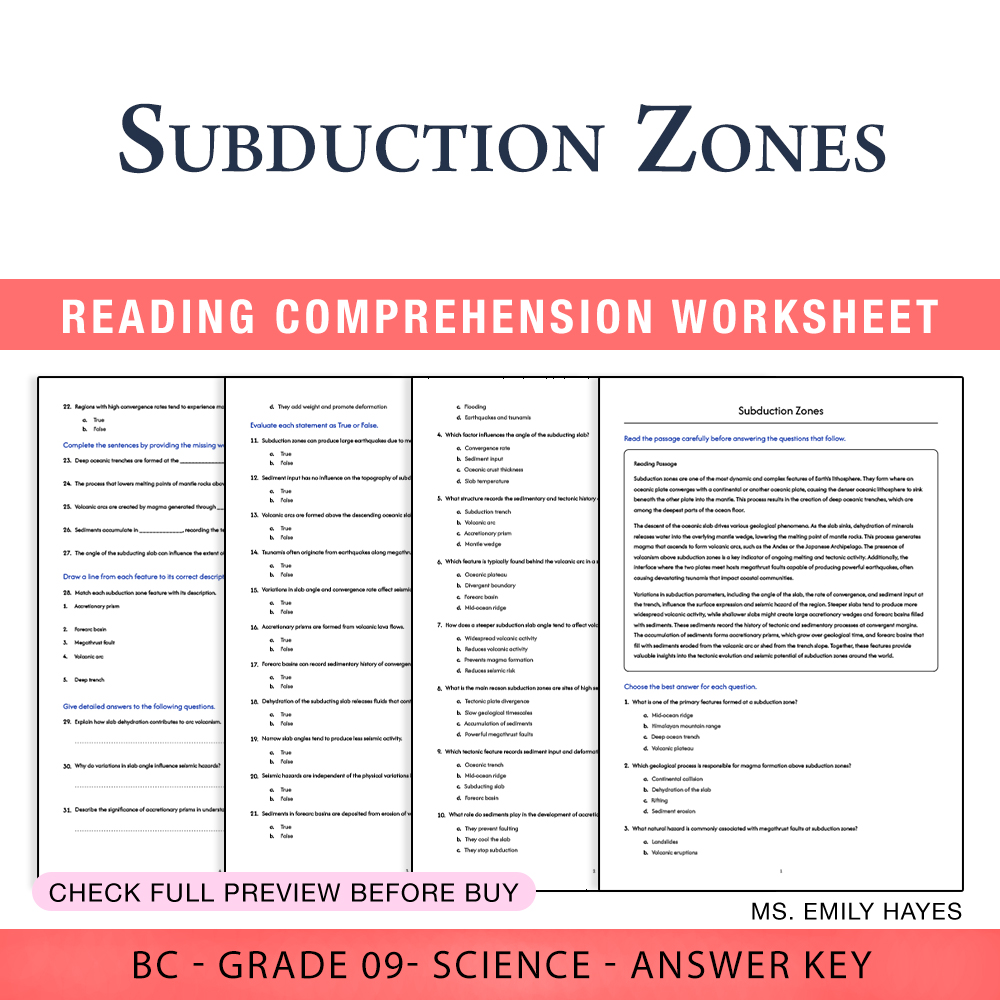
Grade 9 Science | Subduction Zones Worksheet (PDF+ Answer Key)
Created byCopper Leaf ClassroomLearning Objectives
- Understand the geological processes involved in subduction zones and their effects on Earth's surface.
- Identify key features and hazards associated with subduction zones, such as earthquakes, tsunamis, and volcanic activity.
- Explain how variations in subduction parameters influence topography and seismic hazards.
Also included in: Grade 9 Science Worksheet Bundle | Earth's Dynamic Processes (PDF + Answer Key) +1 more
Instant download
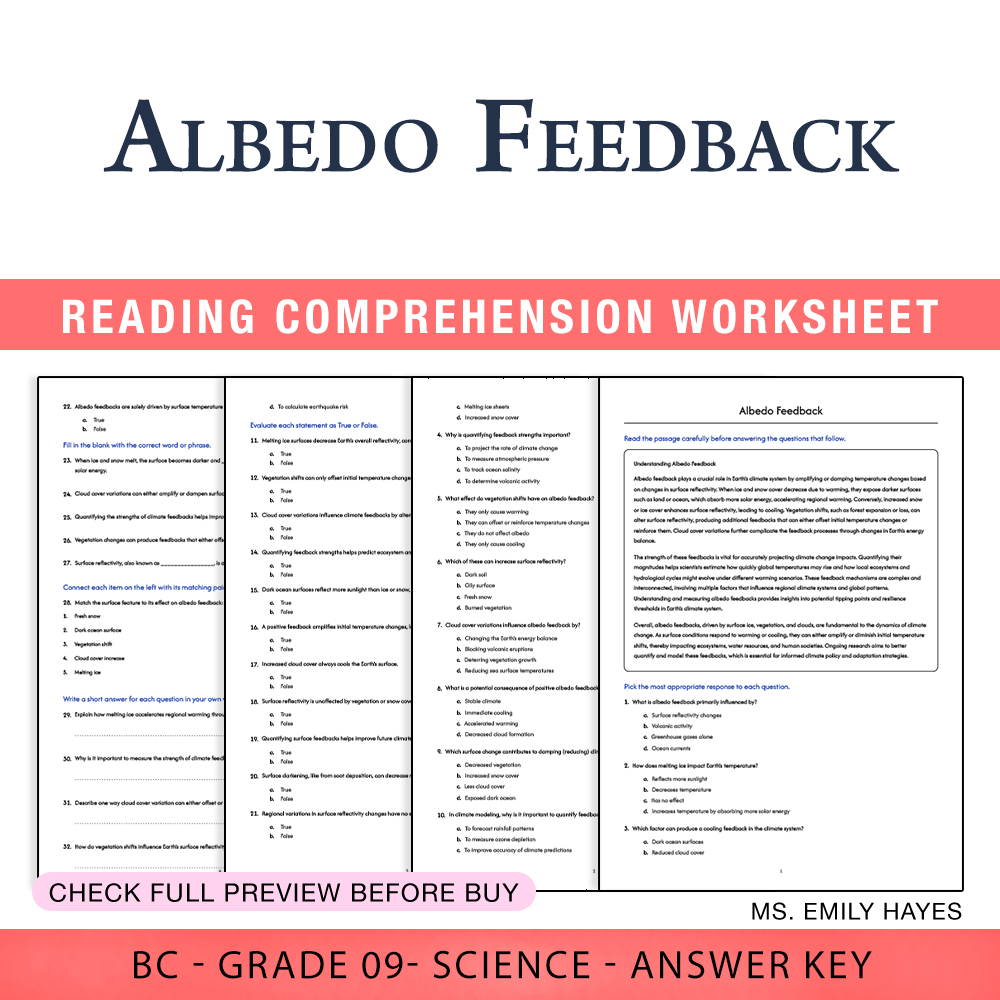
Grade 9 Science | Albedo Feedback Worksheet (PDF+ Answer Key)
Created byCopper Leaf ClassroomLearning Objectives
- Understand the concept of albedo and how surface reflectivity affects climate.
- Identify the various feedback mechanisms related to surface reflectivity changes.
- Analyze the role of ice, snow, vegetation, and clouds in albedo feedback processes.
Also included in: Grade 9 Science Worksheet Bundle | Earth's Dynamic Processes (PDF + Answer Key) +1 more
Instant download
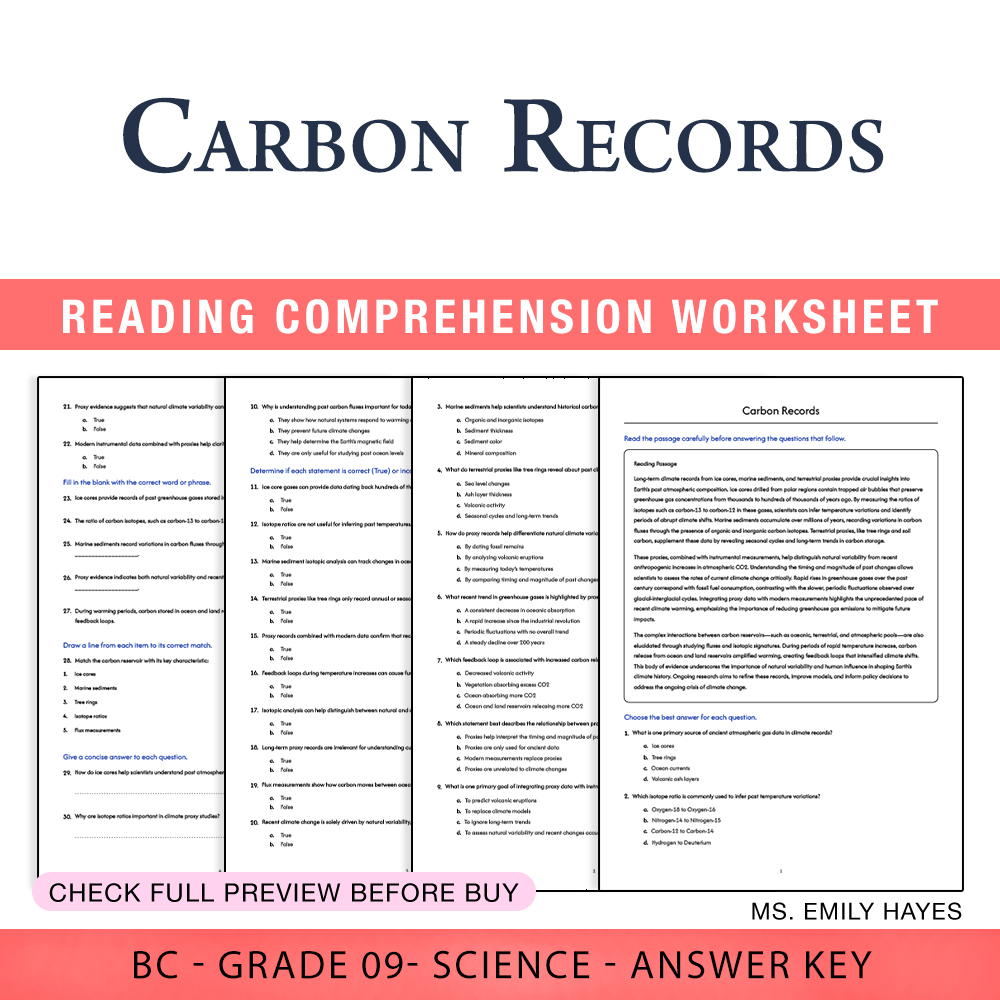
Grade 9 Science | Carbon Records Worksheet (PDF+ Answer Key)
Created byCopper Leaf ClassroomLearning Objectives
- Understand how ice cores, sediments, and proxies record past atmospheric carbon levels.
- Interpret isotope ratios and gas measurements to identify climate patterns and shifts.
- Analyze the relationship between carbon fluxes and global temperature changes.
Also included in: Grade 9 Science Worksheet Bundle | Earth's Dynamic Processes (PDF + Answer Key) +1 more
Instant download
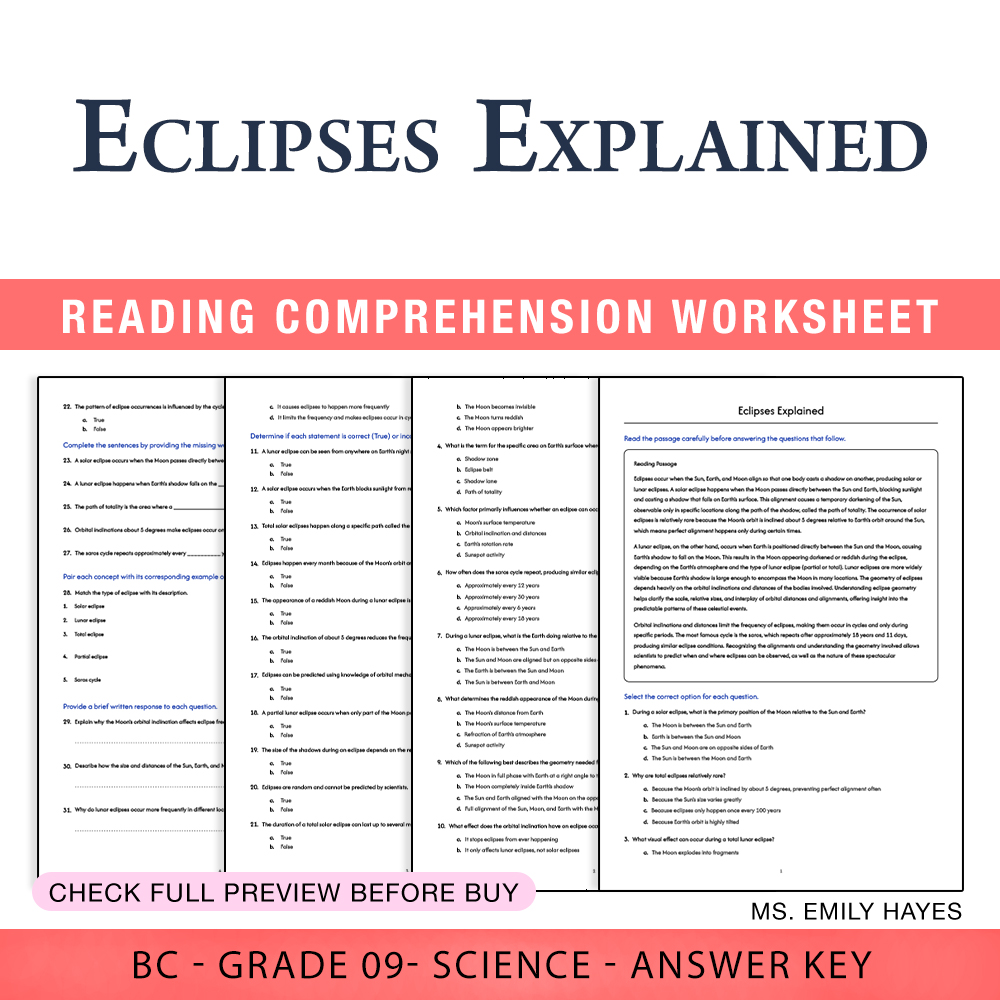
Grade 9 Science | Eclipses Explained Worksheet (PDF+ Answer Key)
Created byCopper Leaf ClassroomLearning Objectives
- Understand the basic geometry of solar and lunar eclipses.
- Identify the positions of the Sun, Earth, and Moon during different types of eclipses.
- Explain how orbital inclinations influence the occurrence and visibility of eclipses.
Also included in: Grade 9 Science Worksheet Bundle | Earth's Dynamic Processes (PDF + Answer Key) +1 more
Instant download
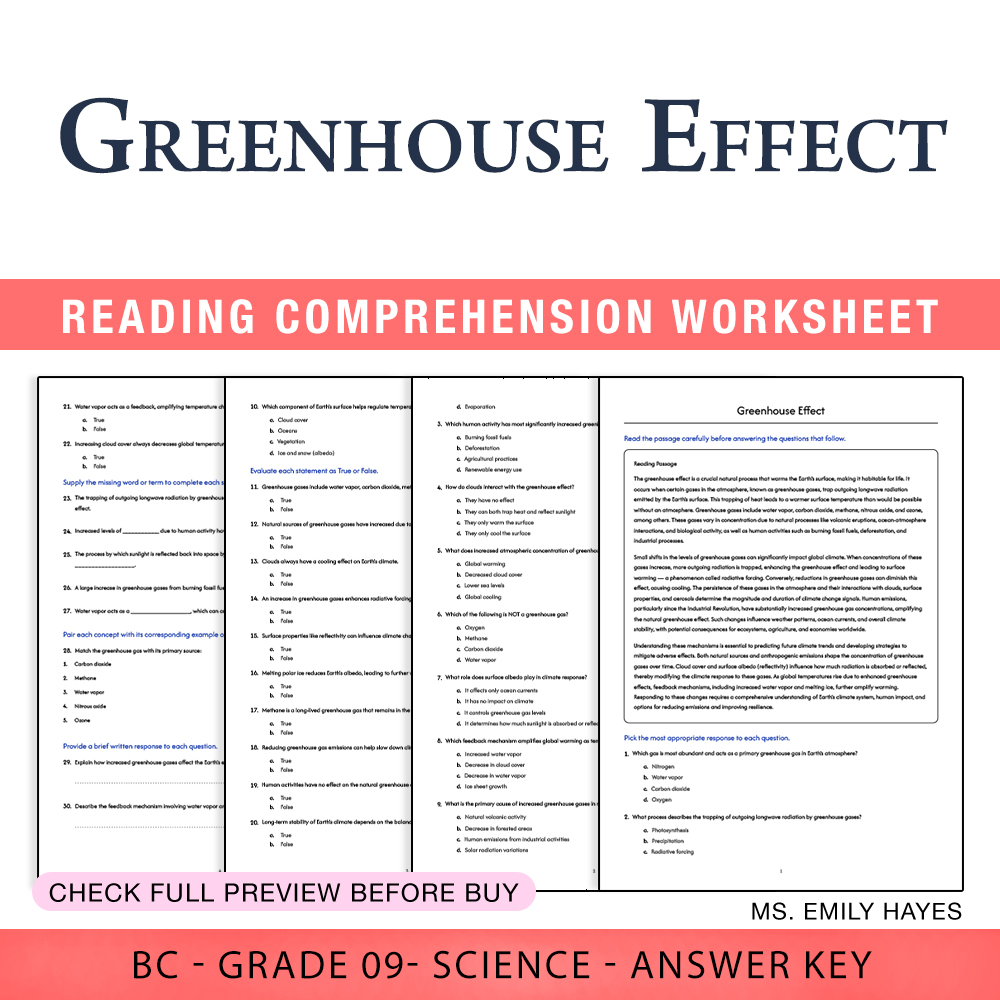
Grade 9 Science | Greenhouse Effect Worksheet (PDF+ Answer Key)
Created byCopper Leaf ClassroomLearning Objectives
- Explain the greenhouse effect and identify key greenhouse gases.
- Analyze how natural and human activities influence Earth's climate.
- Describe how changes in atmospheric composition affect radiative forcing and surface temperature.
Also included in: Grade 9 Science Worksheet Bundle | Earth's Dynamic Processes (PDF + Answer Key) +1 more
Instant download
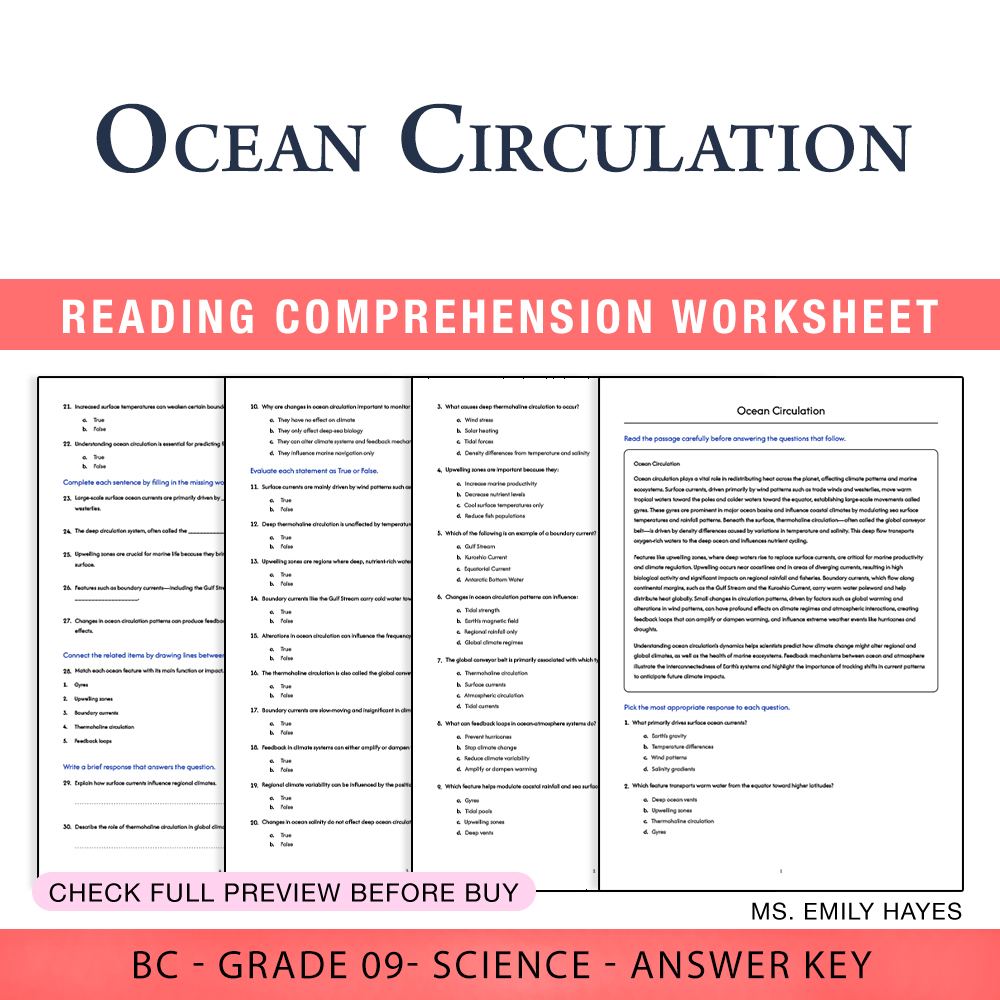
Grade 9 Science | Ocean Circulation Worksheet (PDF+ Answer Key)
Created byCopper Leaf ClassroomLearning Objectives
- Understand the mechanisms driving ocean surface and deep currents.
- Describe features such as gyres, upwelling zones, and boundary currents.
- Explain how ocean circulation influences regional climates and feedback systems.
Also included in: Grade 9 Science Worksheet Bundle | Earth's Dynamic Processes (PDF + Answer Key) +1 more
Instant download
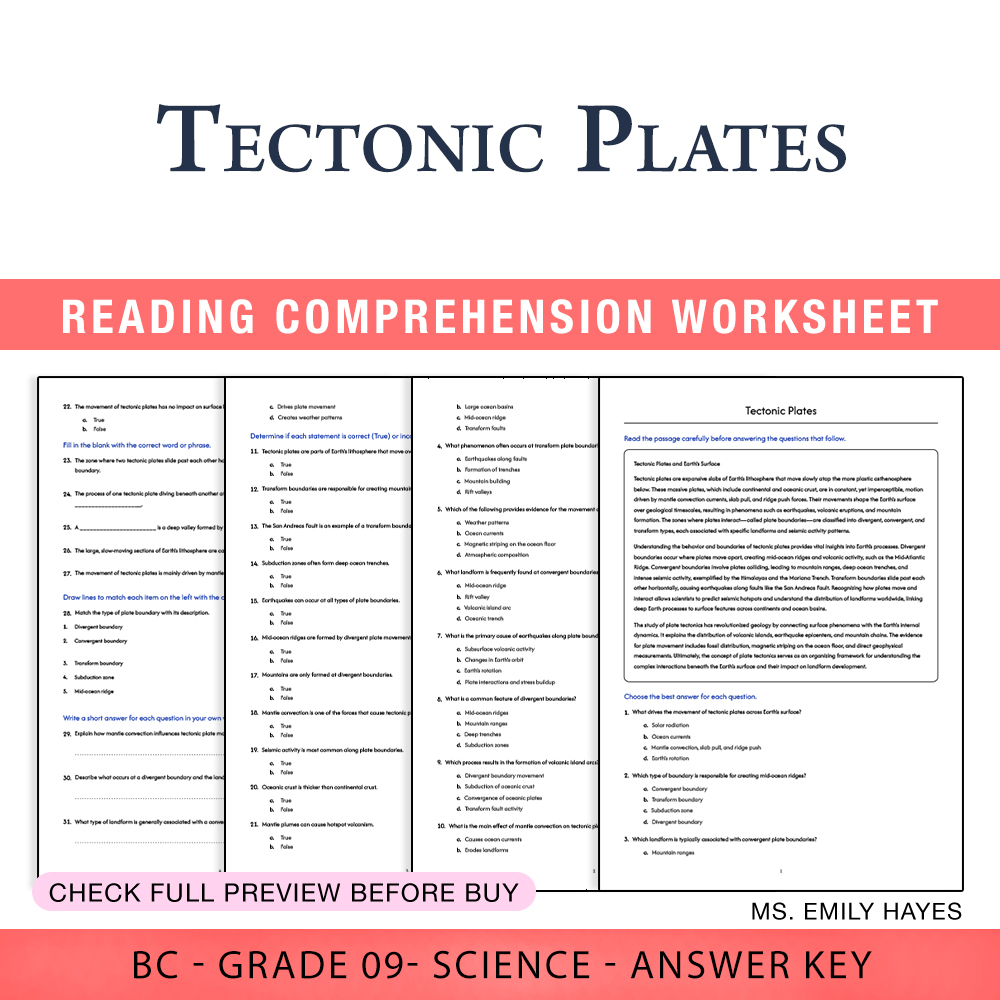
9th Grade Science | Tectonic Plates Worksheet (PDF+ Answer Key)
Created byCopper Leaf ClassroomLearning Objectives
- Understand the concept of tectonic plates and their movement.
- Identify causes and effects of plate interactions.
- Explain the types of plate boundaries and associated landforms and seismic activity.
Also included in: Grade 9 Science Worksheet Bundle | Earth's Dynamic Processes (PDF + Answer Key) +1 more
Instant download
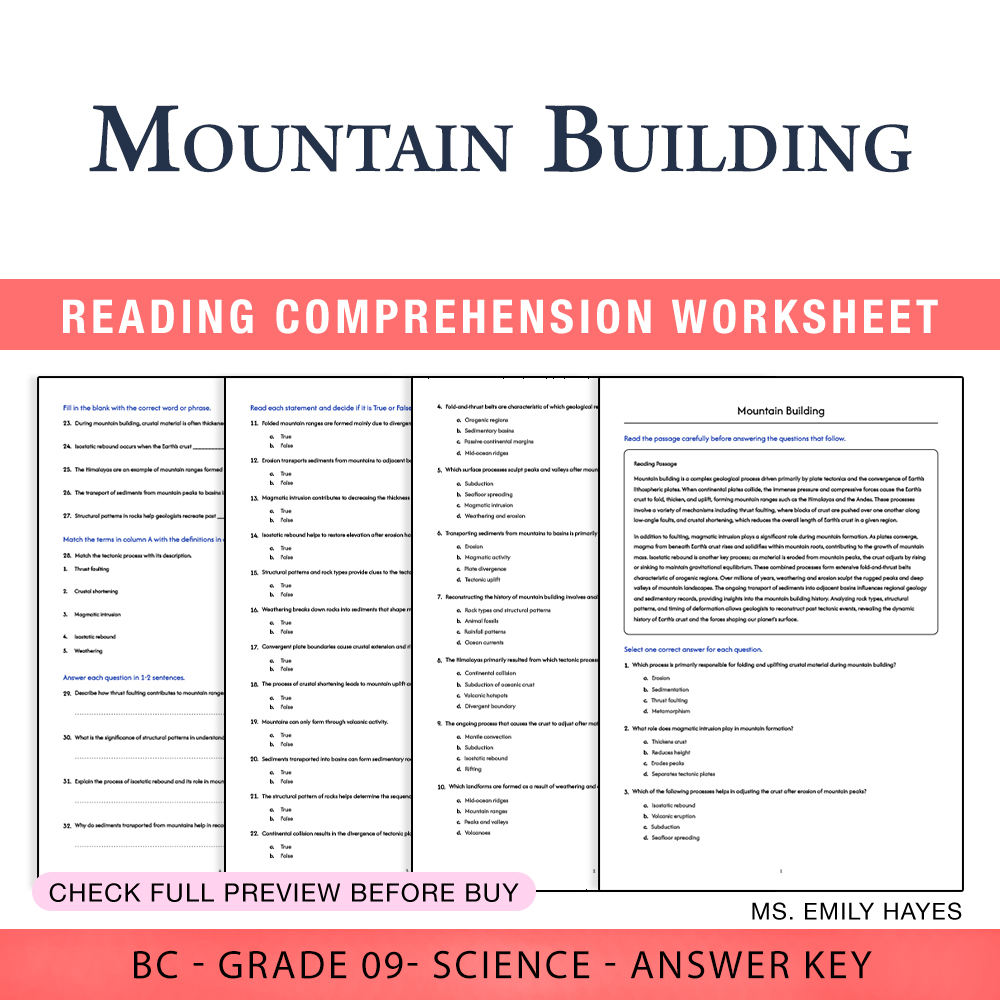
9th Grade Science | Mountain Building Worksheet (PDF+ Answer Key)
Created byCopper Leaf ClassroomLearning Objectives
- Understand the geological processes involved in mountain building resulting from plate convergence and continental collision.
- Identify the various tectonic mechanisms such as thrust faulting, crustal shortening, magmatic intrusion, and isostatic rebound.
- Explain how weathering and erosion shape mountain landscapes and transport sediments.
Also included in: Grade 9 Science Worksheet Bundle | Earth's Dynamic Processes (PDF + Answer Key) +1 more
Instant download
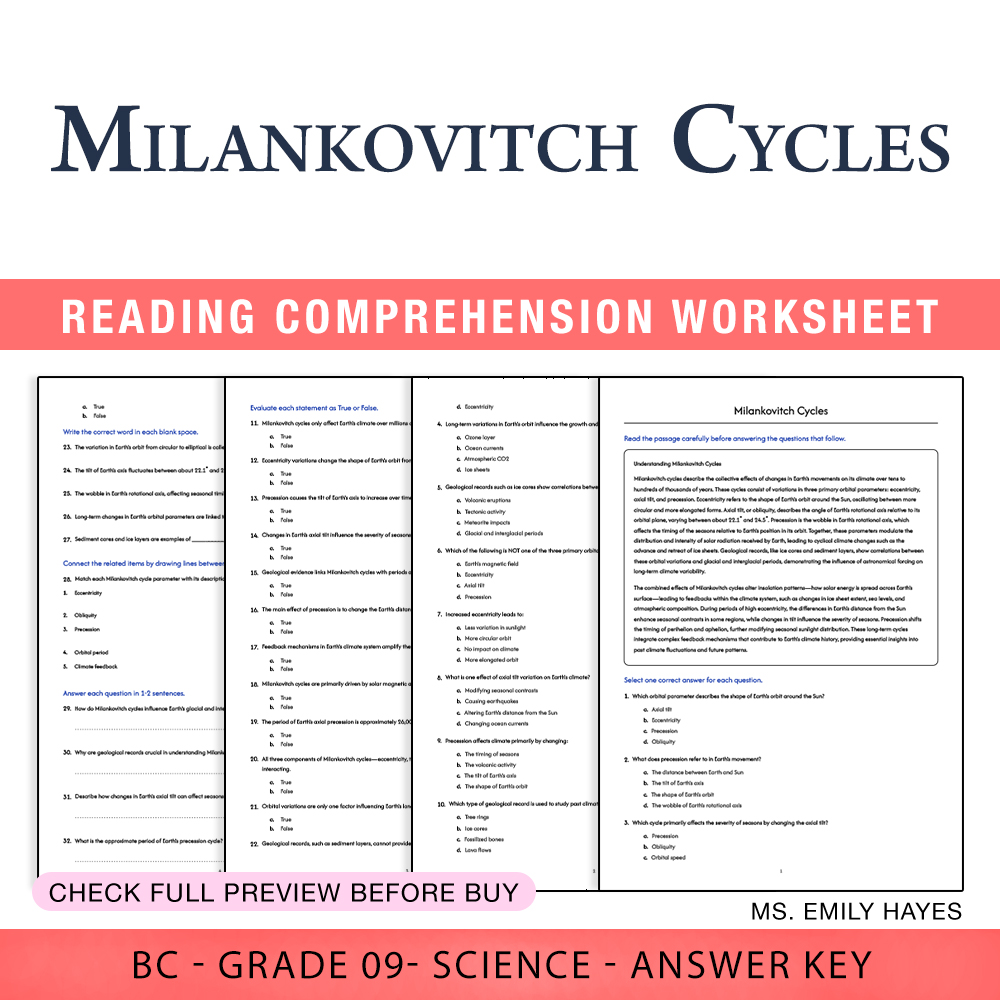
9th Grade Science | Milankovitch Cycles Worksheet (PDF+ Answer Key)
Created byCopper Leaf ClassroomLearning Objectives
- Understand the concept of Milankovitch cycles and their impact on Earth's climate.
- Identify the three main orbital parameters involved in the cycles: eccentricity, axial tilt, and precession.
- Explain how these cycles influence glacial and interglacial periods over long timescales.
Also included in: Grade 9 Science Worksheet Bundle | Earth's Dynamic Processes (PDF + Answer Key) +1 more
Instant download
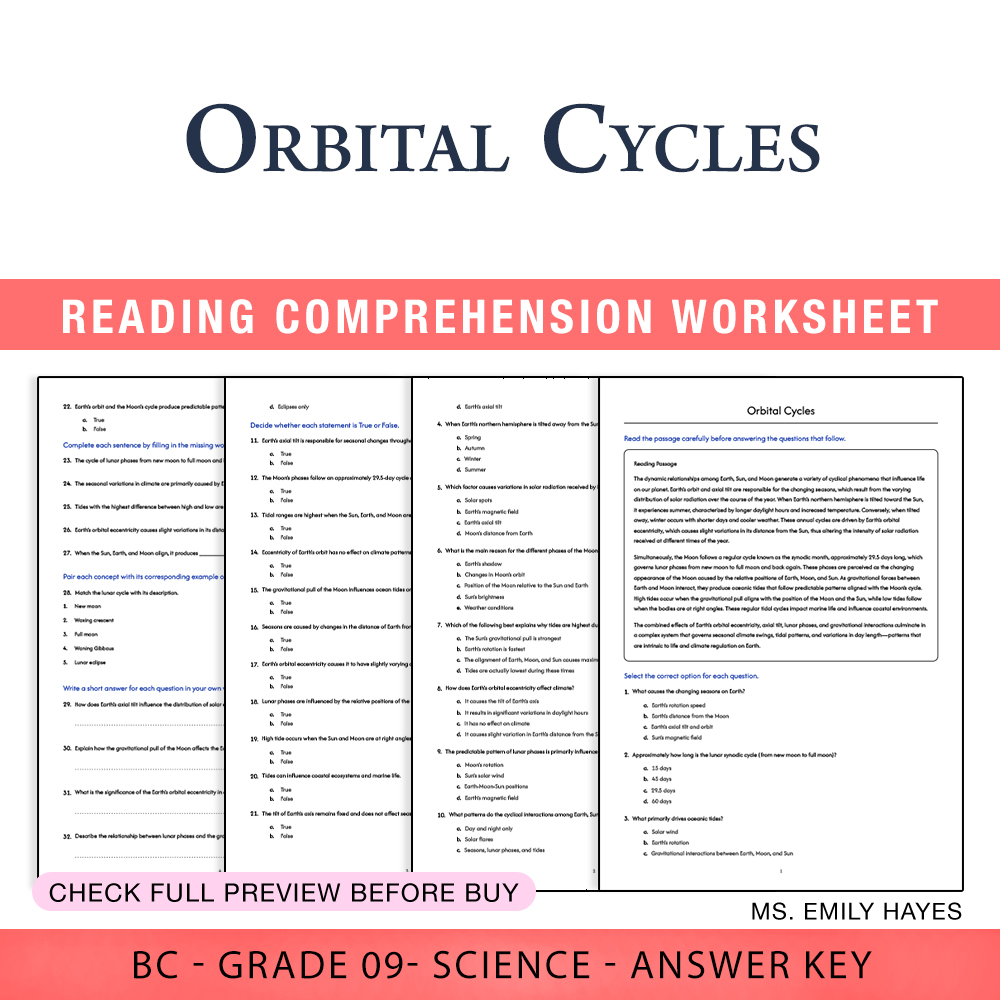
Grade 9 Science | Orbital Cycles Worksheet (PDF+ Answer Key)
Created byCopper Leaf ClassroomLearning Objectives
- Explain how Earth's axial tilt and orbital eccentricity influence seasons and climate cycles.
- Describe the variations in lunar phases and their underlying synodic cycle.
- Analyze how gravitational interactions among Earth, Moon, and Sun produce tidal patterns.
Also included in: Grade 9 Science Worksheet Bundle | Earth's Dynamic Processes (PDF + Answer Key) +1 more
Instant download
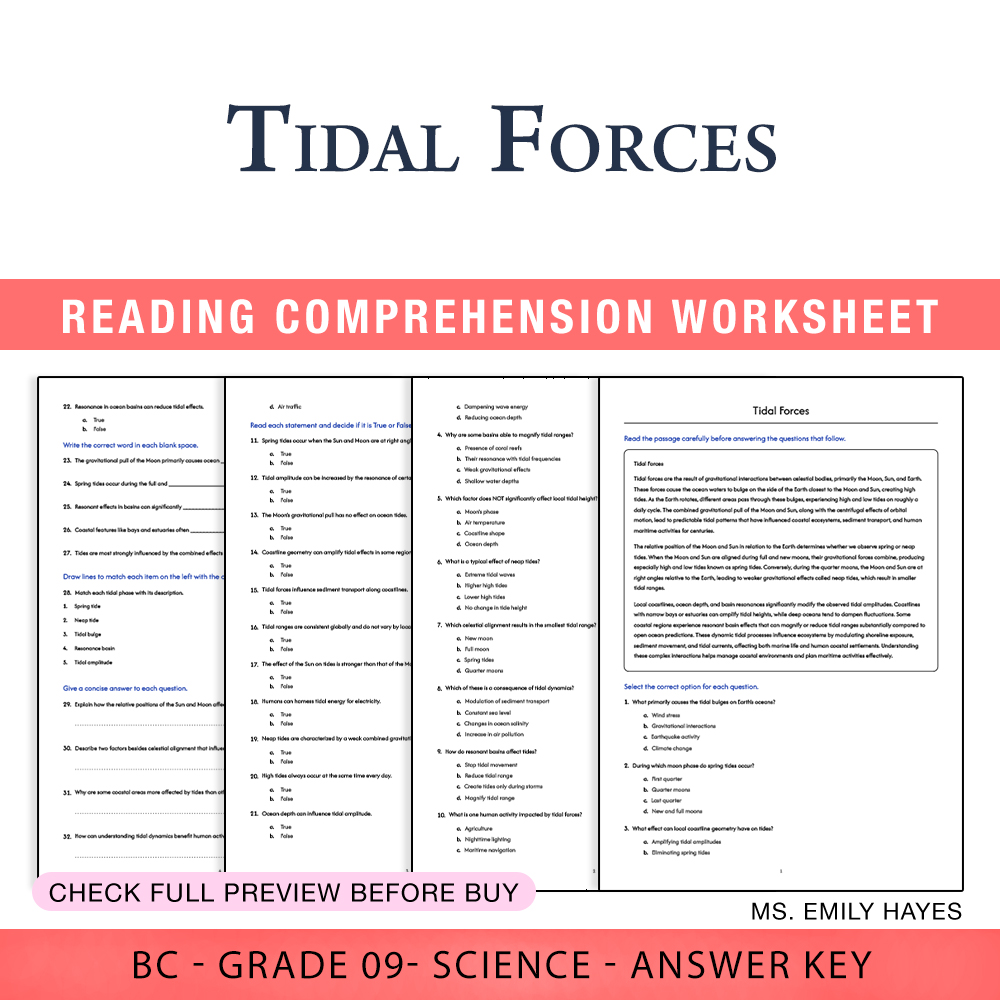
9th Grade Science | Tidal Forces Worksheet (PDF+ Answer Key)
Created byCopper Leaf ClassroomLearning Objectives
- Explain how gravitational interactions among the Moon, Sun, and Earth produce tidal forces.
- Describe the phenomena of spring and neap tides and their relation to celestial alignments.
- Analyze how local geography and basin resonance influence tidal amplitudes.
Also included in: Grade 9 Science Worksheet Bundle | Earth's Dynamic Processes (PDF + Answer Key) +1 more
Instant download
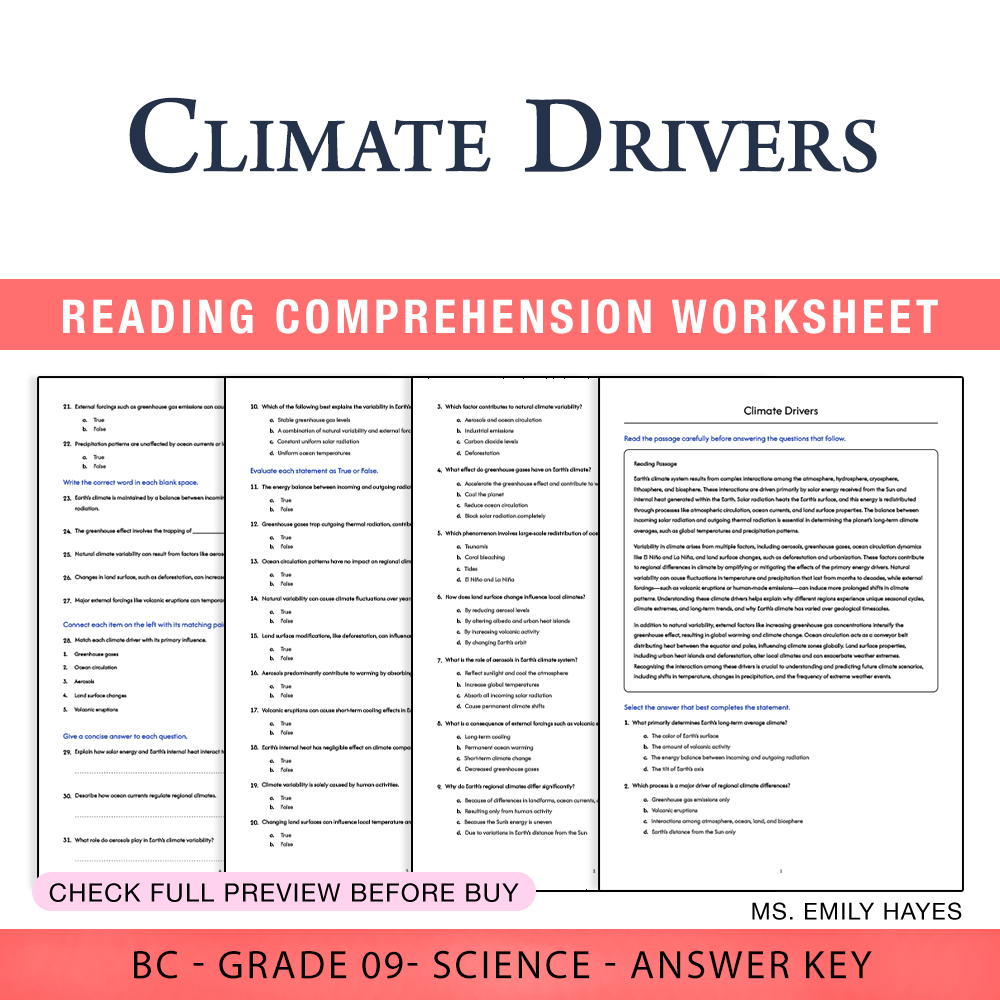
9th Grade Science | Climate Drivers Worksheet (PDF+ Answer Key)
Created byCopper Leaf ClassroomLearning Objectives
- Understand the main components influencing Earth's climate system.
- Identify how energy balance affects climate stability.
- Describe the roles of natural variability and external forcings in climate change.
Also included in: Grade 9 Science Worksheet Bundle | Earth's Dynamic Processes (PDF + Answer Key) +1 more
Instant download
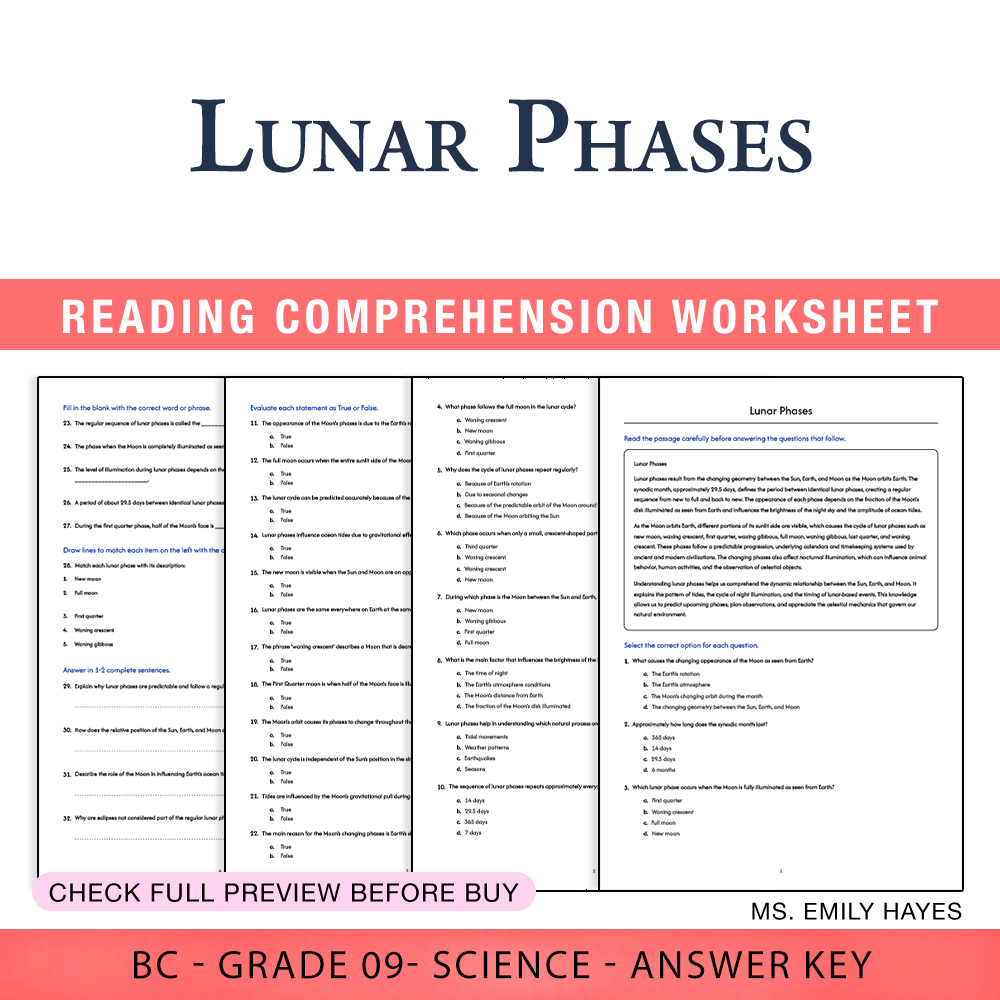
9th Grade Science | Lunar Phases Worksheet (PDF + Answer Key)
Created byCopper Leaf ClassroomLearning Objectives
- Explain the sequence of lunar phases and their causes.
- Describe how the Moon's position affects its visible appearance from Earth.
- Predict the lunar phase based on the geometry between Sun, Earth, and Moon.
Also included in: Grade 9 Science Worksheet Bundle | Earth's Dynamic Processes (PDF + Answer Key) +1 more
Instant download
Browse more categories
About Science Worksheets
Find Science worksheets spanning core skills, practice, and review. All 44,295 resources are instant PDF downloads for the classroom or home.
Every worksheet on MyTeachingSheets is created by independent teacher-authors and reviewed before publication. All resources download as printable PDFs for classroom, homework, or at-home practice, and many include answer keys. Preview any worksheet free before buying.