
Science Worksheets
44,628 subject resources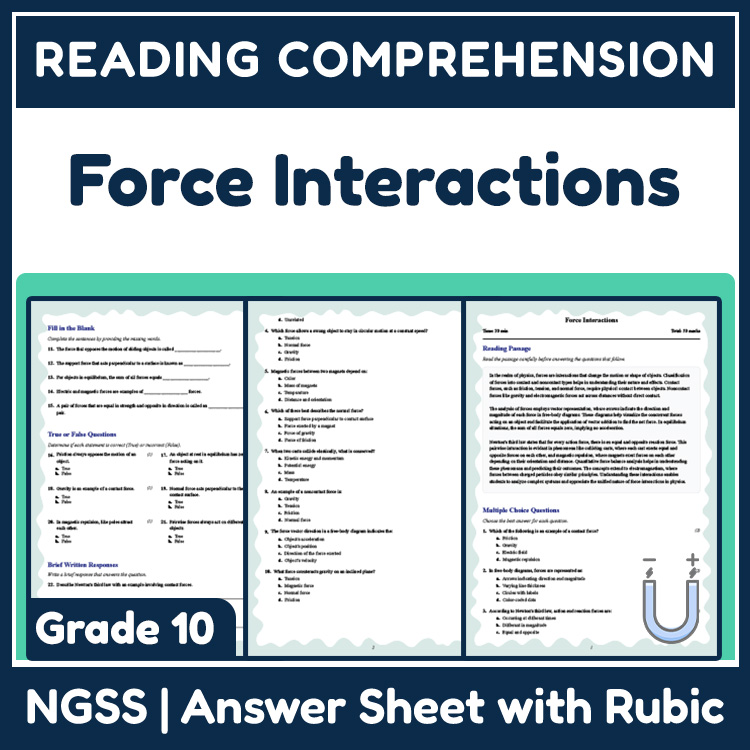
10th Grade Science | Force Interactions Reading Worksheet (PDF + Rubric)
JCreated byJ.S SheetsLearning Objectives
- Understand and classify contact and noncontact forces, including examples like friction, normal force, tension, and electromagnetism.
- Represent forces graphically using vectors and free-body diagrams to analyze contact and pairwise interactions.
- Explain Newton's third law and recognize action-reaction pairs in various physical scenarios.
Instant download
6th Grade Science | Phase Energy Reading Worksheet (PDF & Answer Key)
JCreated byJ.S SheetsLearning Objectives
- Explain how energy transfer causes phase changes without changing chemical identity.
- Identify the energy requirements for melting, boiling, freezing, and condensation.
- Link latent heat to particle interactions and temperature plateaus during phase changes.
Instant download
Sex-Linked Traits Worksheet for Grade 9 Science | Alberta Standard
 Created byCoral Reef Learning
Learning Objectives
- Understand the structure and function of sex chromosomes in mammals.
- Explain how sex-linked inheritance affects trait expression differently between sexes.
- Identify examples of X-linked recessive conditions in Alberta fauna and livestock.
Instant download
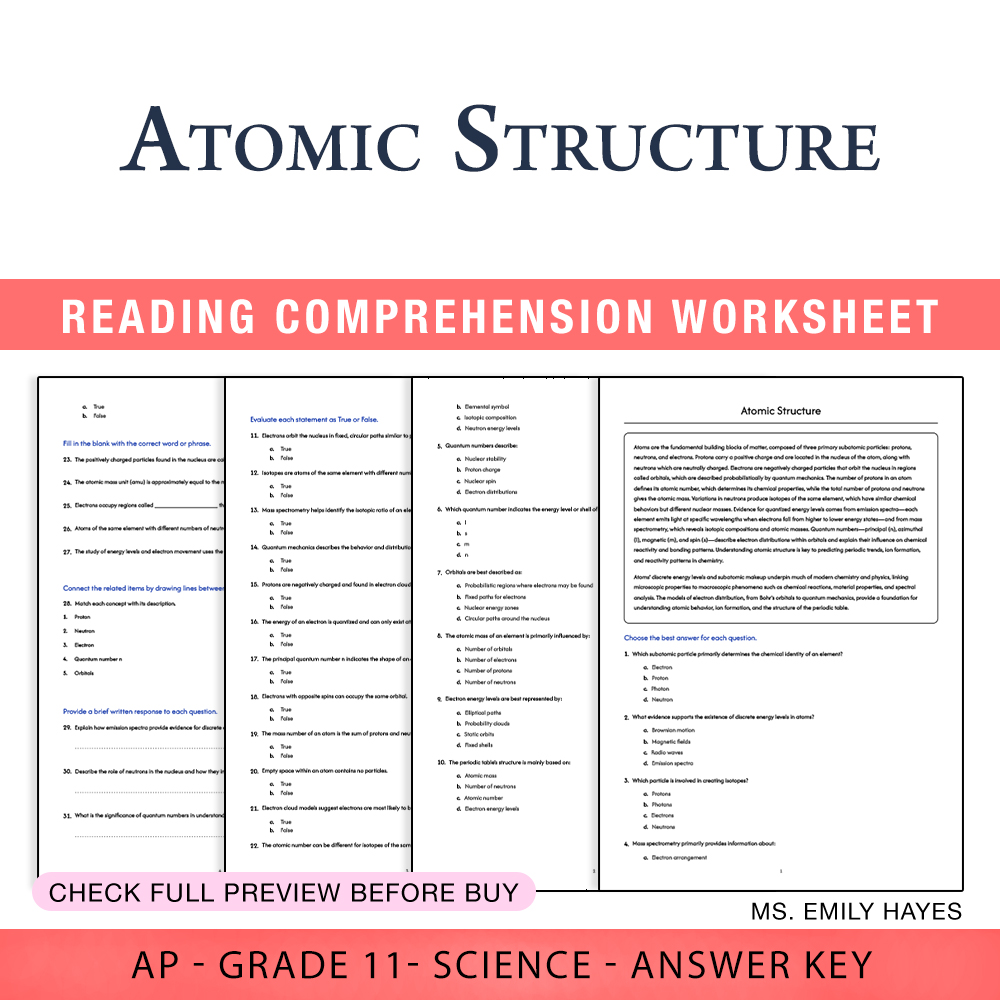
11th Grade Science | Atomic Structure Worksheet (PDF+ Answer Key)
 Created byCopper Leaf Classroom
Learning Objectives
- Explain the subatomic composition of atoms including protons, neutrons, and electrons.
- Describe evidence supporting discrete energy levels through emission spectra and mass spectrometry.
- Understand the roles of isotopes and how atomic mass is calculated.
Also included in: Grade 11 Science | Chemistry Foundations AP Worksheet Bundle (PDF+ Answer Keys) +1 more
Instant download
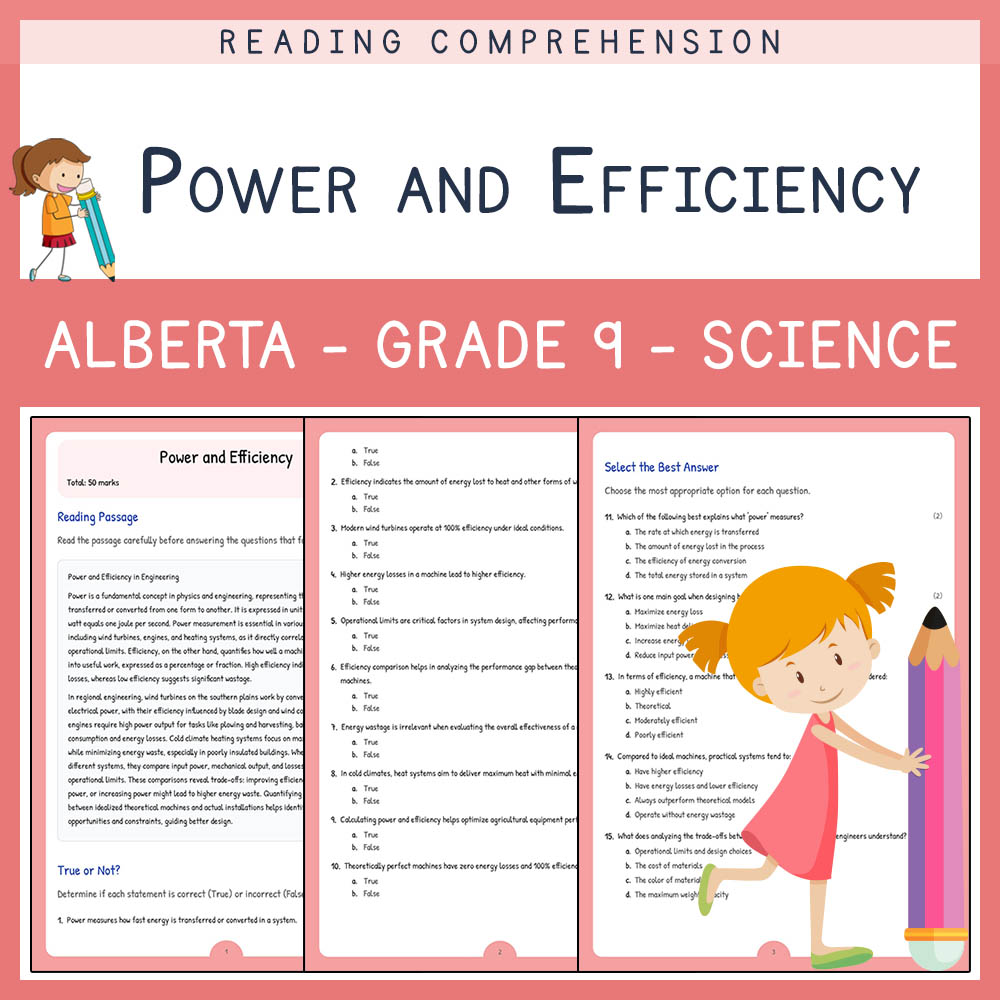
Grade 9 Science | Power and Efficiency Worksheet | Alberta Standards
 Created byLumora Learning
Learning Objectives
- Understand the definitions of power and efficiency in energy transfer systems.
- Analyze regional engineering examples related to power output and energy losses.
- Compare input power, mechanical output, and energy wastage in various machines.
Instant download

Design Optimization Assessment | NGSS Standards Grade 7 Science
 Created byPrism Point Learning
Learning Objectives
- Analyze test data and refine parameters to improve design solutions.
- Apply quantitative comparisons to assess performance changes.
- Use evidence-based justification for iterative modifications within constraints.
Also included in: Grade 7 Science Lesson Unit: Engineering Design Standards-Aligned Not Specified +1 more
Instant download
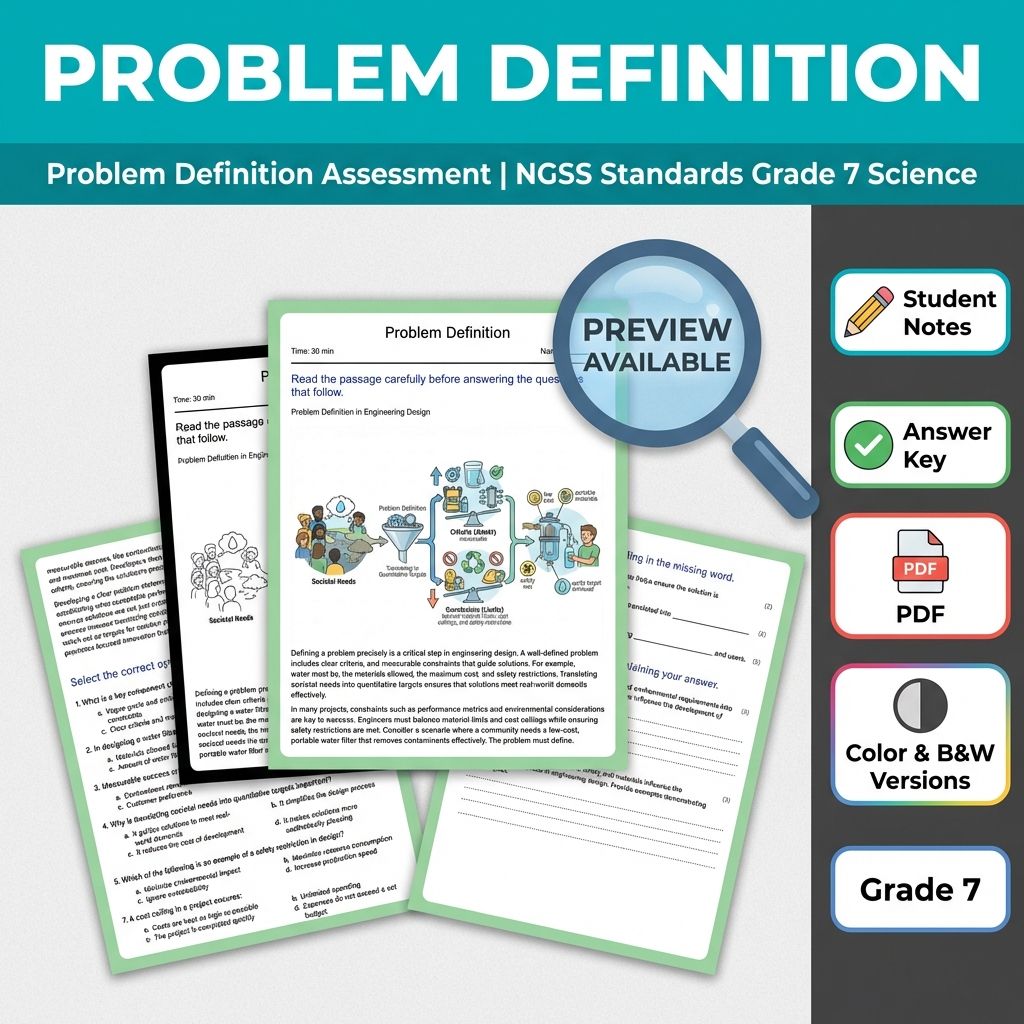
Problem Definition Assessment | NGSS Standards Grade 7 Science
Created byPrism Point LearningLearning Objectives
- Understand how to define design problems with clear criteria and measurable constraints.
- Learn to translate societal and environmental needs into quantitative targets.
- Identify real-world examples of specifying success measures and constraints in product design.
Also included in: Grade 7 Science Lesson Unit: Engineering Design Standards-Aligned Not Specified +1 more
Instant download
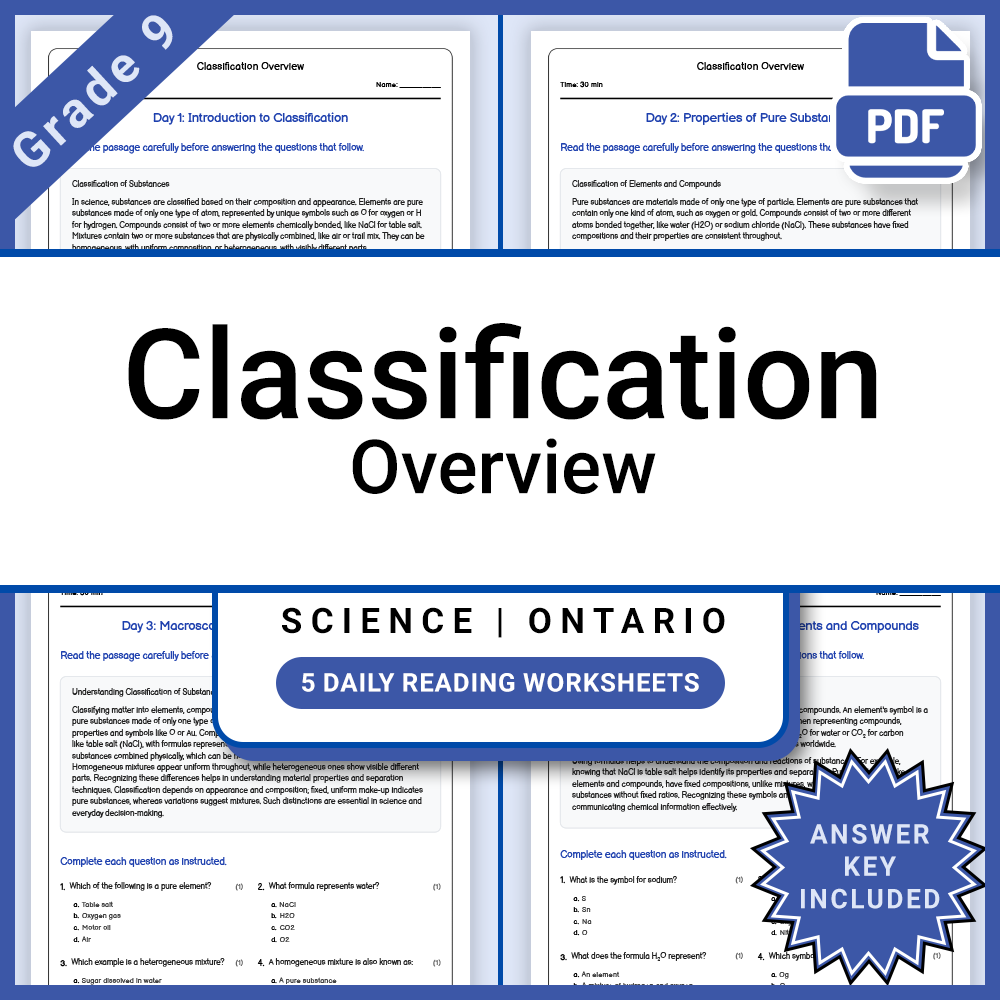
Grade 9 Science Classification Overview Daily Reading Worksheet with Answer Key
JCreated byJ.S SheetsLearning Objectives
- Define and distinguish between elements, compounds, and mixtures.
- Understand the criteria for classifying substances as pure or impure.
- Identify examples of elements, compounds, and mixtures.
Also included in: Grade 9 Science Lesson Group: Ontario Curriculum Daily Reading Worksheets +1 more
Instant download
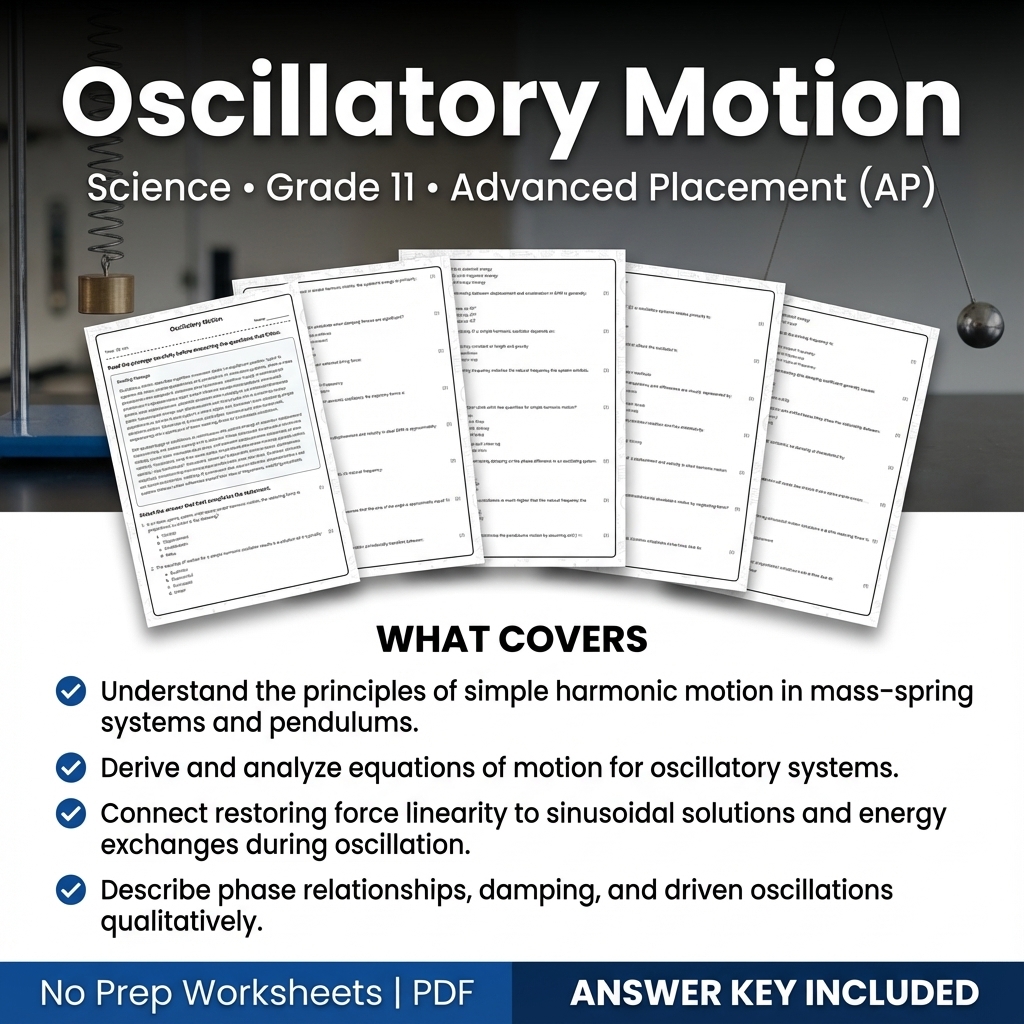
Grade 11 Science | Oscillatory Motion Worksheet (Printable PDF + Answer Key)
Created byCoral Reef LearningLearning Objectives
- Understand the principles of simple harmonic motion in mass–spring systems and pendulums.
- Derive and analyze equations of motion for oscillatory systems.
- Connect restoring force linearity to sinusoidal solutions and energy exchanges during oscillation.
Also included in: Grade 11 Science Unit | Physics Worksheets on Work, Power & Motion PDF Bundle +1 more
Instant download
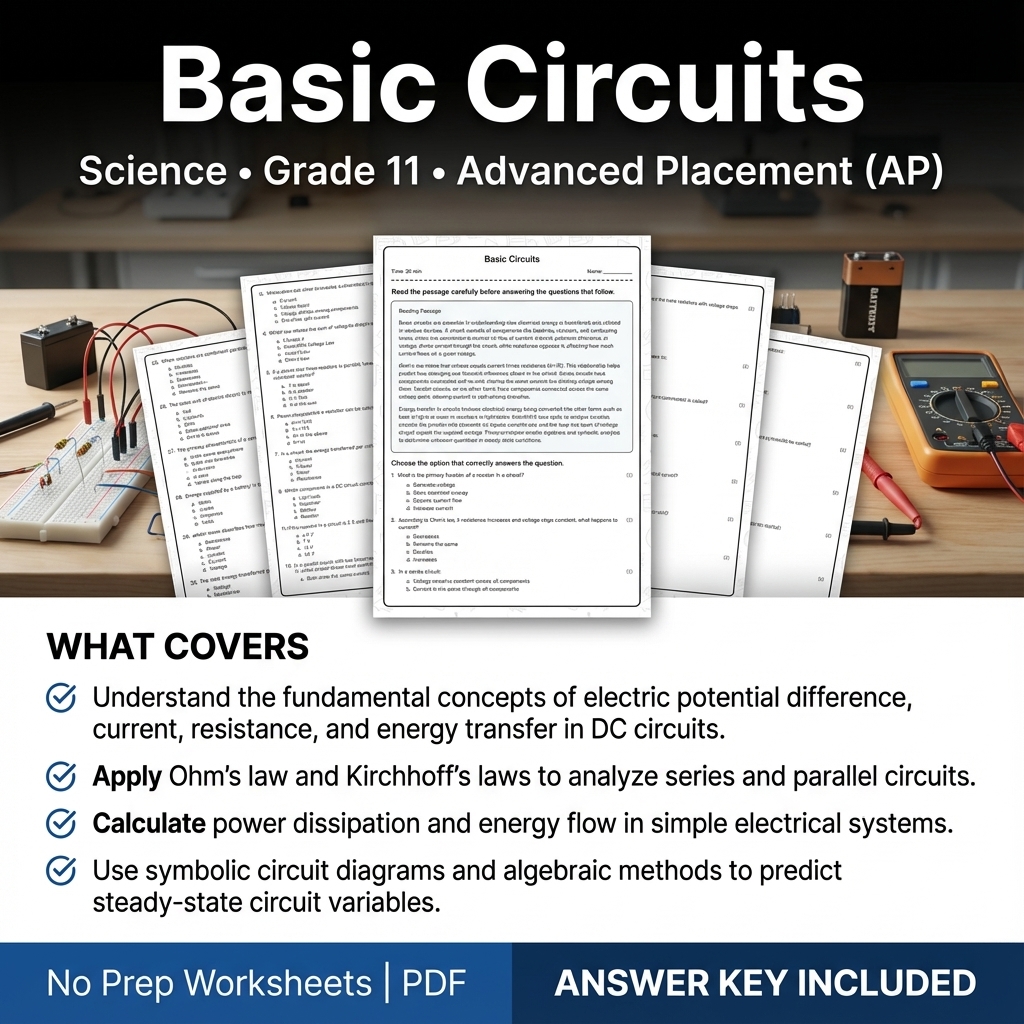
Grade 11 Science | Basic Circuits Worksheet (Printable PDF + Answer Key)
Created byCoral Reef LearningLearning Objectives
- Understand the fundamental concepts of electric potential difference, current, resistance, and energy transfer in DC circuits.
- Apply Ohm’s law and Kirchhoff's laws to analyze series and parallel circuits.
- Calculate power dissipation and energy flow in simple electrical systems.
Also included in: Grade 11 Science Unit | Physics Worksheets on Work, Power & Motion PDF Bundle +1 more
Instant download
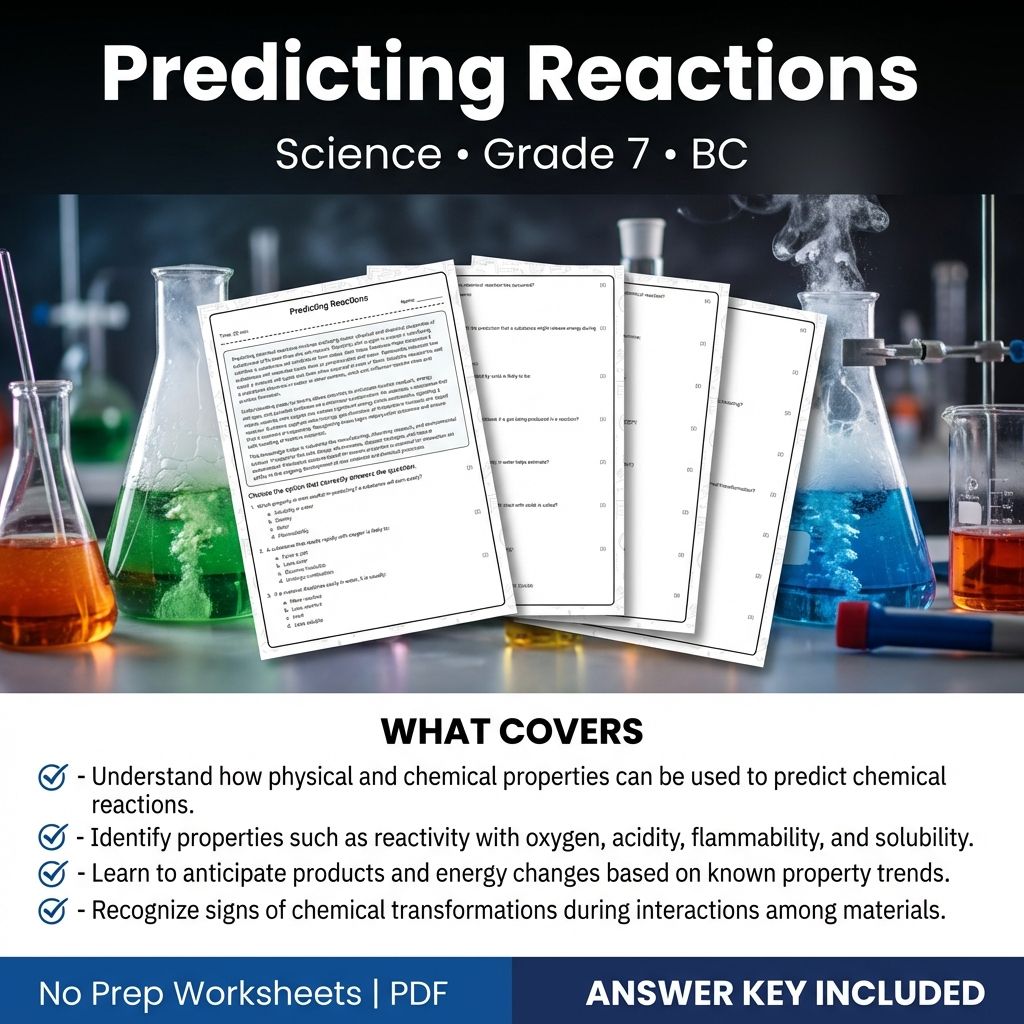
Grade 7 Science | Predicting Reactions Worksheet & Answer Key (Printable PDF)
Created byCoral Reef LearningLearning Objectives
- Understand how physical and chemical properties can be used to predict chemical reactions.
- Identify properties such as reactivity with oxygen, acidity, flammability, and solubility.
- Learn to anticipate products and energy changes based on known property trends.
Instant download
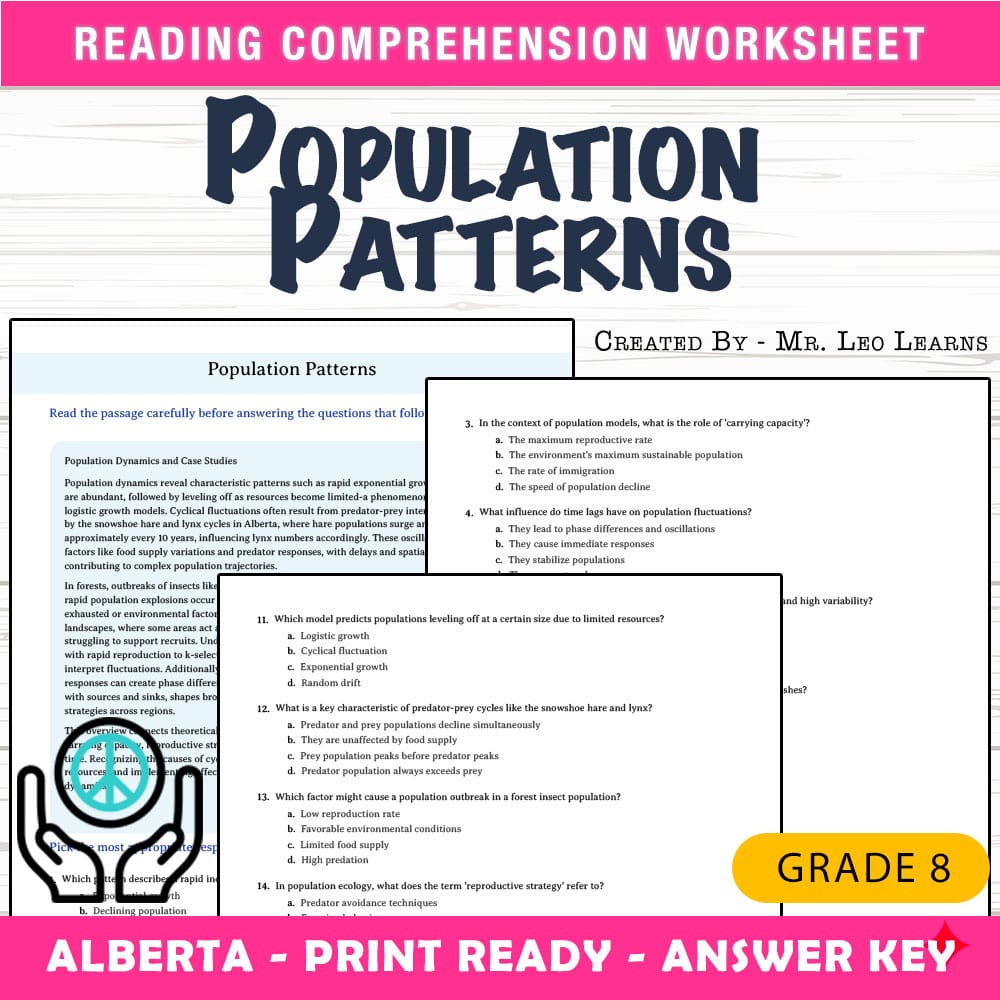
Grade 8 Science — Population Patterns Worksheet MCQ Paper
 Created byThe Resource Hub
Learning Objectives
- Understand different types of population growth curves including exponential, logistic, and cyclical patterns.
- Recognize factors such as food supply, predation, and carrying capacity that influence population dynamics.
- Link theoretical population models to real-world case studies like snowshoe hare–lynx cycles and insect outbreaks.
Also included in: Grade 8 Science Bundle | Interactions and Ecosystems Worksheets +1 more
Instant download

Grade 7 Science | Climate Interactions - Daily Reading Comprehension
Created byCoral Reef LearningLearning Objectives
- Interpret temperature and CO2 records related to climate change.
- Identify evidence indicating climate change drivers.
- Understand how land-use change affects climate.
Instant download
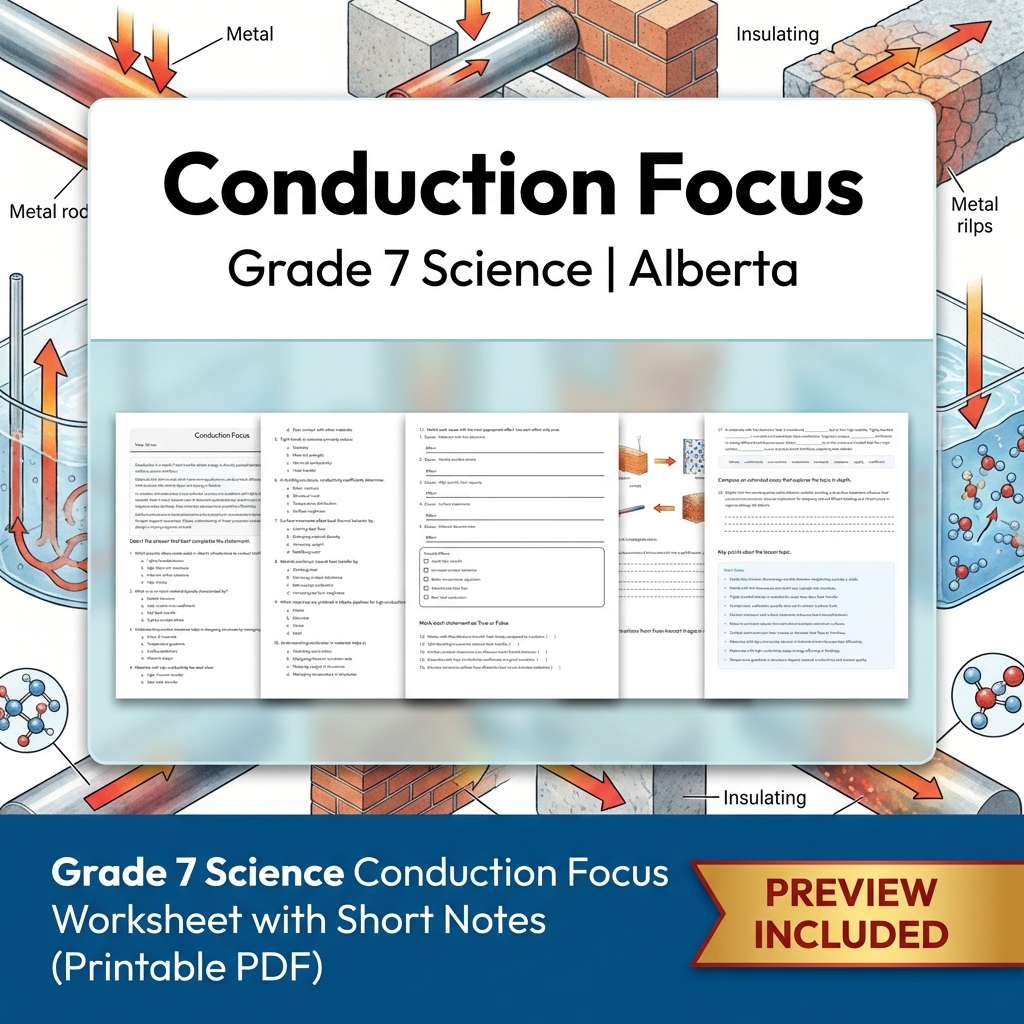
Grade 7 Science Conduction Focus Worksheet with Short Notes (Printable PDF)
 Created byMeadowlark Worksheets
Learning Objectives
- Explain the process of conduction and how particles transfer kinetic energy within solids.
- Identify materials with high and low thermal conductivity and their applications in infrastructure.
- Understand the concepts of conductivity coefficients and contact resistance in heat transfer.
Instant download
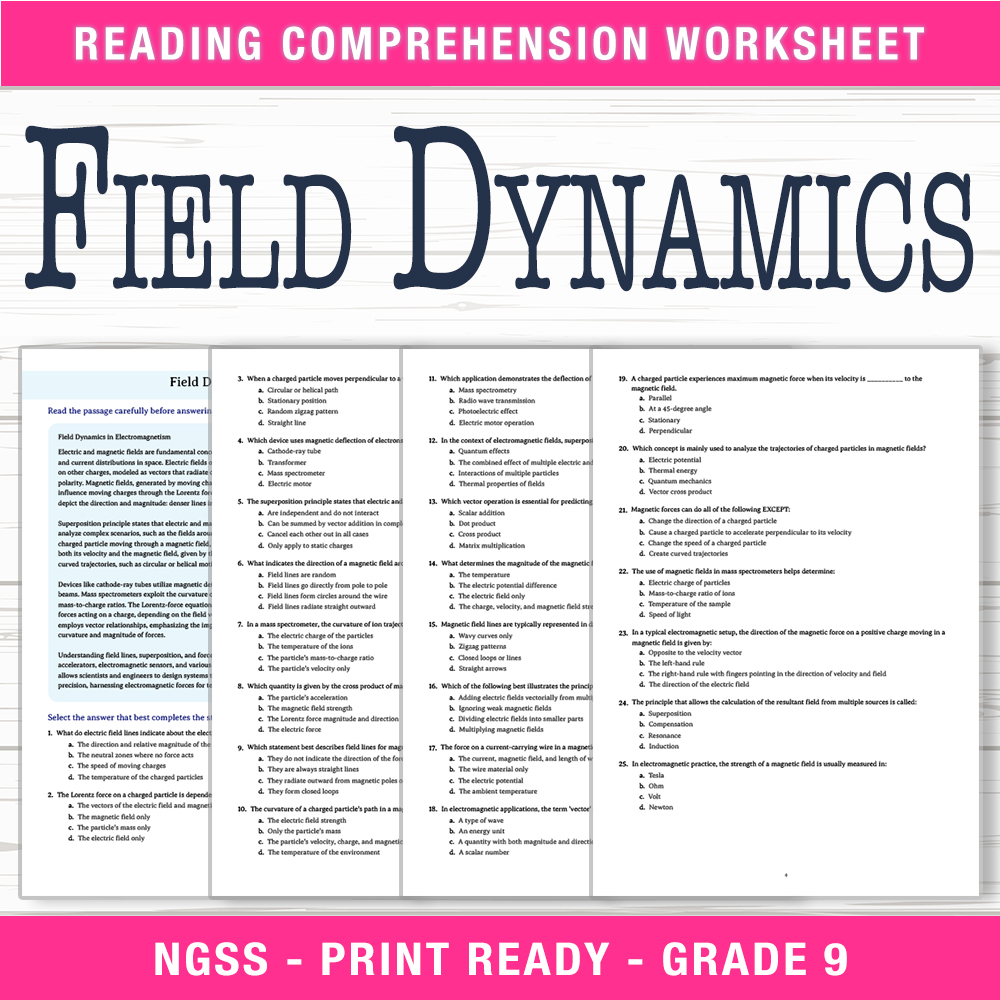
Grade 9 Science | Field Dynamics Worksheet (PDF + Answer Key)
 Created byRiverstone Classroom
Learning Objectives
- Describe the characteristics of electric and magnetic fields using field vectors and field lines.
- Explain the concept of superposition of electric and magnetic fields and how they affect moving charges.
- Analyze forces on charged particles in magnetic fields, including curvature of trajectories and deflection phenomena.
Instant download

Grade 8 Science – Force Diagrams & Physics | Daily Reading Worksheet
 Created byBright Mind Resources
Learning Objectives
- Understand the concept of force and how to represent it using vectors
- Learn to create and interpret free-body diagrams for different systems
- Distinguish between contact and non-contact forces
Also included in: Grade 8 Mechanical Systems Science Reading Worksheets – Lesson Bundle | Ontario +1 more
Instant download
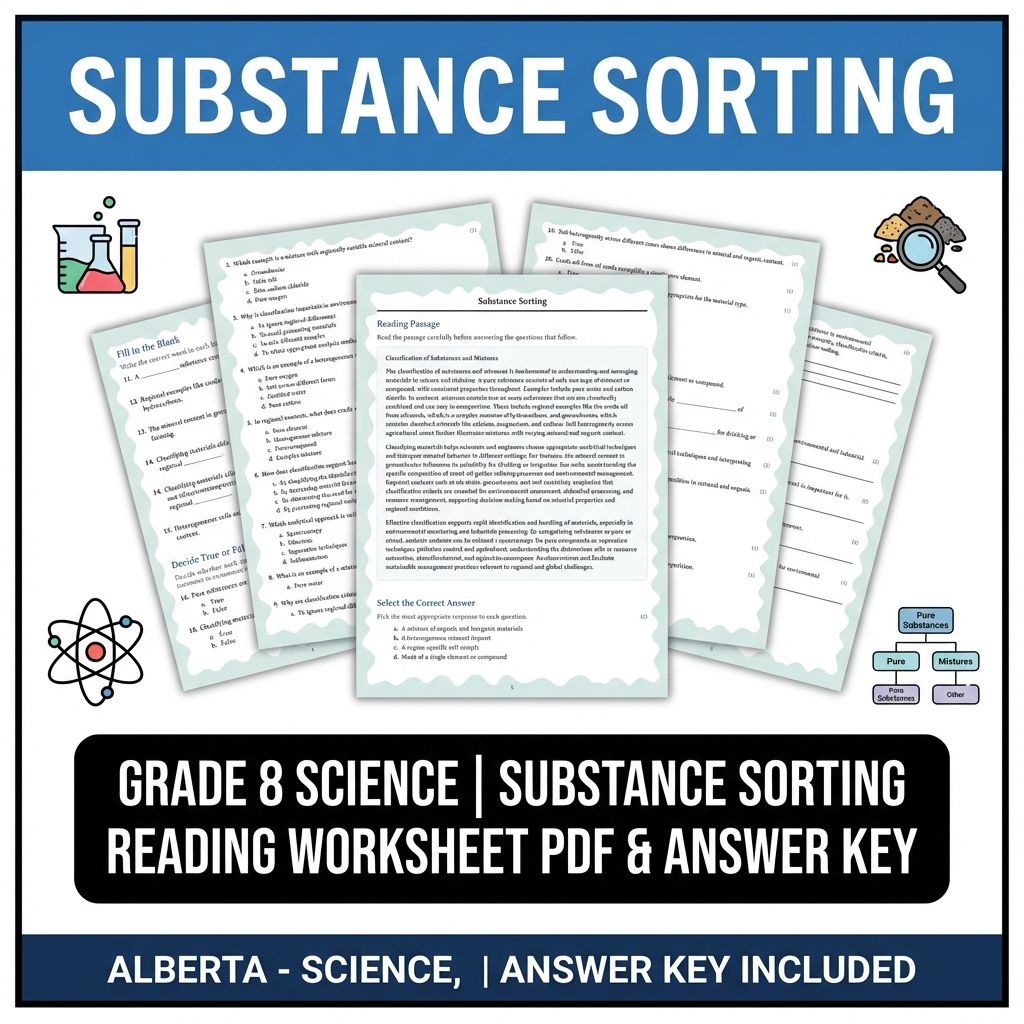
Grade 8 Science | Substance Sorting Reading Worksheet PDF & Answer Key
JCreated byJ.S SheetsLearning Objectives
- Understand classifications of pure substances and mixtures.
- Identify criteria used for classifying materials in environmental contexts.
- Analyze regional examples of substances and mixtures.
Also included in: Grade 8 Science | Essential Concepts & Processes Pack (Answer Key Included) +1 more
Instant download
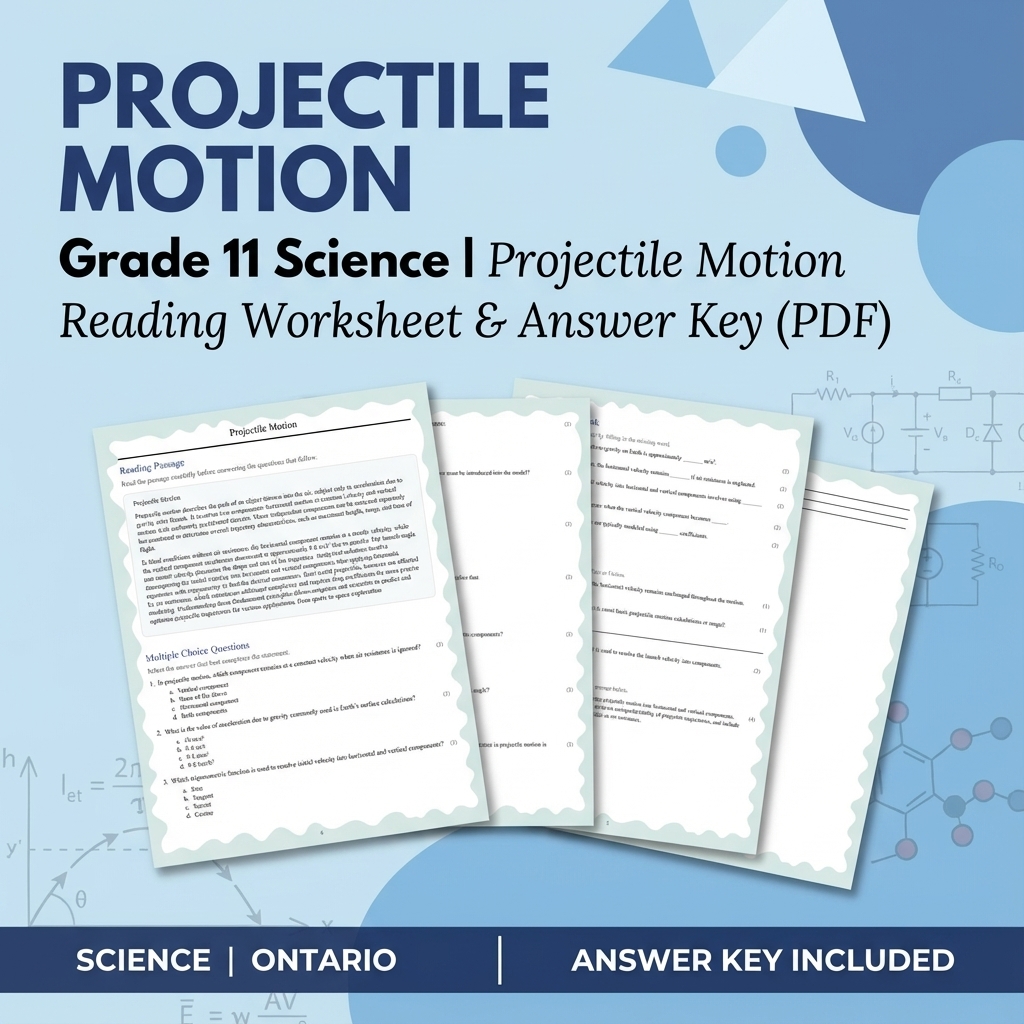
Grade 11 Science | Projectile Motion Reading Worksheet & Answer Key (PDF)
JCreated byJ.S SheetsLearning Objectives
- Explain the principles of two-dimensional projectile motion and analyze trajectories.
- Decompose motion into horizontal and vertical components using kinematic equations.
- Apply trigonometric relations to determine launch angles and speeds.
Also included in: Grade 11 Science Unit Bundle: Physics, Waves & Motion (Answer Keys Included) +1 more
Instant download
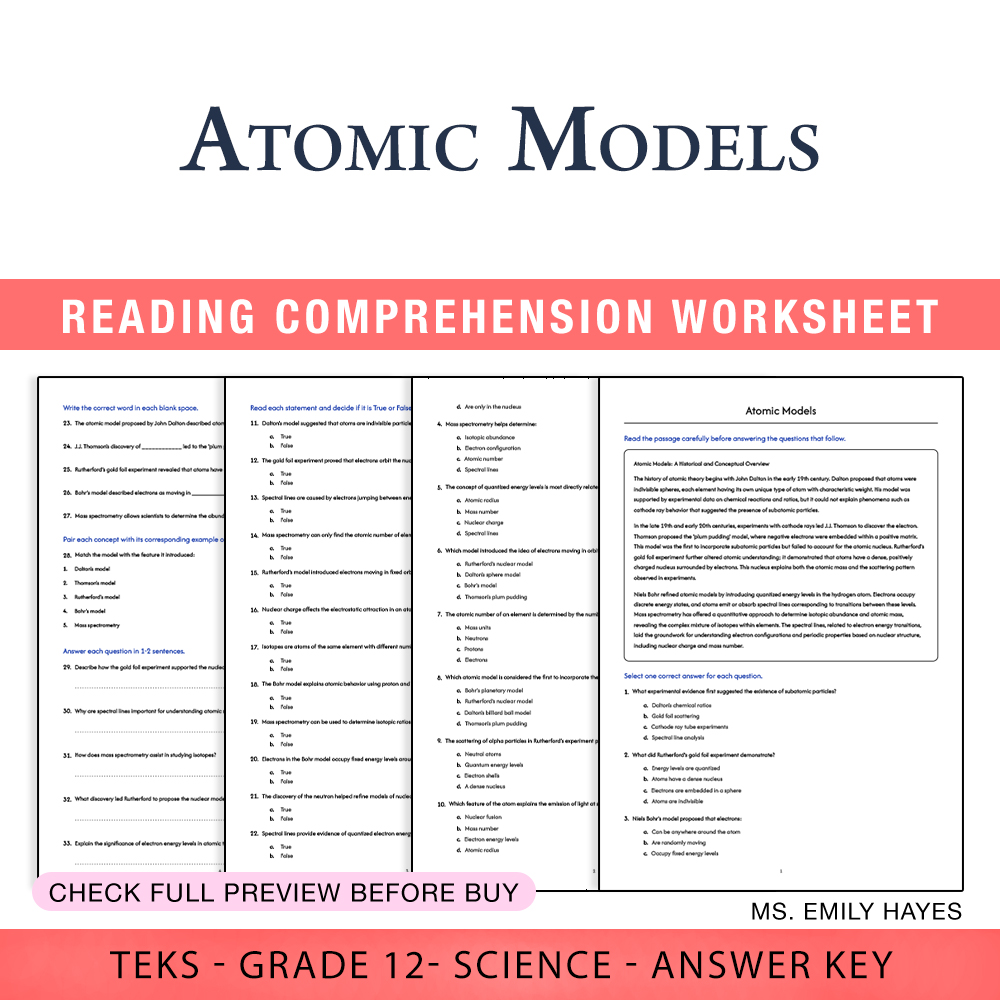
12th Grade Science | Atomic Models Worksheet (PDF+ Answer Key)
Created byCopper Leaf ClassroomLearning Objectives
- Trace the development of atomic models from Dalton to Bohr with emphasis on empirical evidence.
- Explain how cathode ray experiments and gold foil scattering led to new atomic theories.
- Understand properties such as nuclear charge, mass number, and isotopic abundance, including mass spectrometry.
Instant download

Grade 10 Science – Statistical Reasoning & Data Interpretation | Worksheet
Created byBright Mind ResourcesLearning Objectives
- Understand and calculate measures of central tendency: mean, median, and mode.
- Interpret how measures of central tendency summarize data.
- Recognize the importance of variability and evidence strength in scientific data.
Also included in: Inquiry Grade 10 Science Daily Reading Worksheets Lesson Bundle | Ontario +1 more
Instant download

Grade 7 Science DNA and Chromosomes Worksheet | NGSS Genetics Activity
 Created byNorthstar Worksheets
Learning Objectives
- Explain how DNA forms genes and how genes influence observable traits.
- Describe how DNA is organized into chromosomes inside cells.
- Model how chromosomes are segregated during gamete formation and recombined at fertilization.
Also included in: NGSS Genetics & Inheritance Lesson Bundle – Grade 7 Science (NGSS) +1 more
Instant download
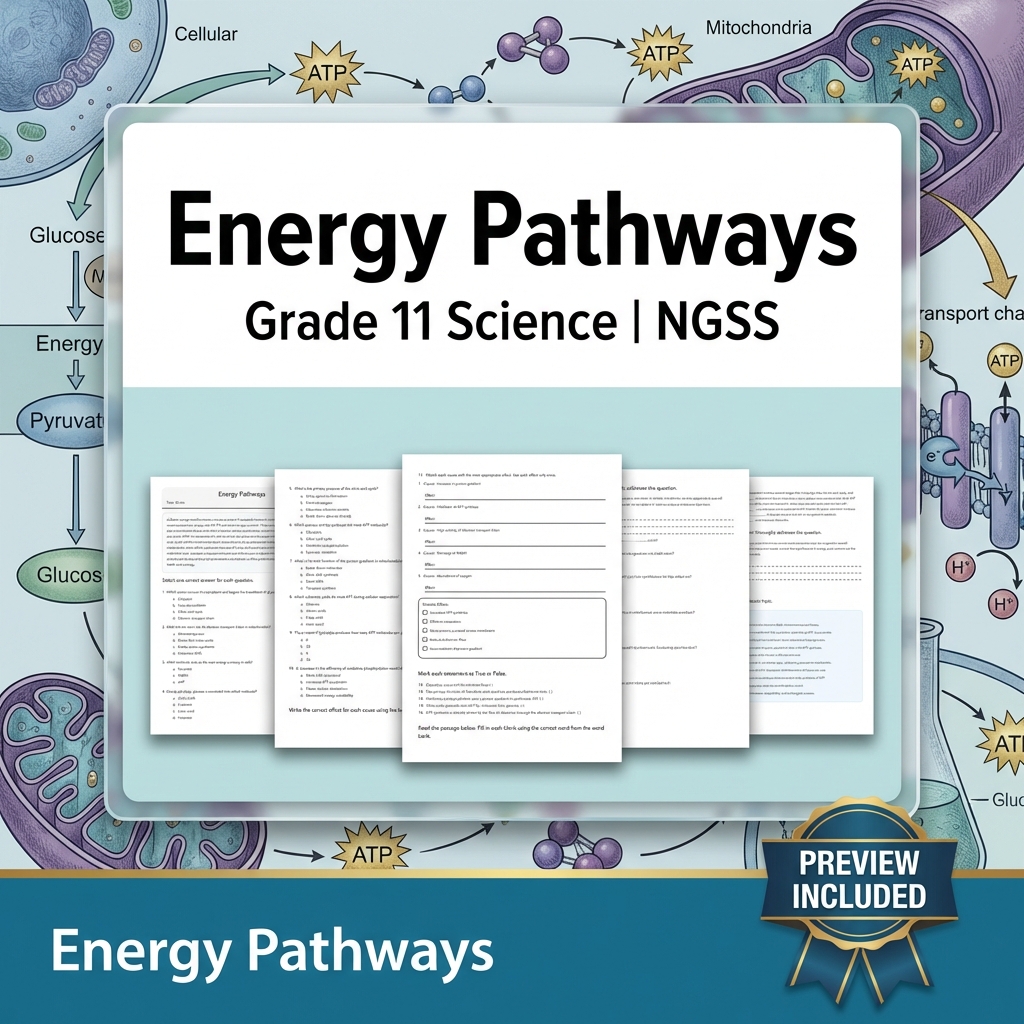
Grade 11 Science | Energy Pathways Worksheet with Short Notes (Printable PDF)
Created byMeadowlark WorksheetsLearning Objectives
- Describe the main stages of cellular energy transformations, including glycolysis, pyruvate oxidation, the citric acid cycle, and oxidative phosphorylation.
- Explain the role of electron transport chains and proton gradients within mitochondria.
- Quantitatively analyze energy yield per substrate and understand its impact on organismal metabolism.
Also included in: Grade 11 Science NGSS | From Molecules to Organisms: Structures & Processes +1 more
Instant download
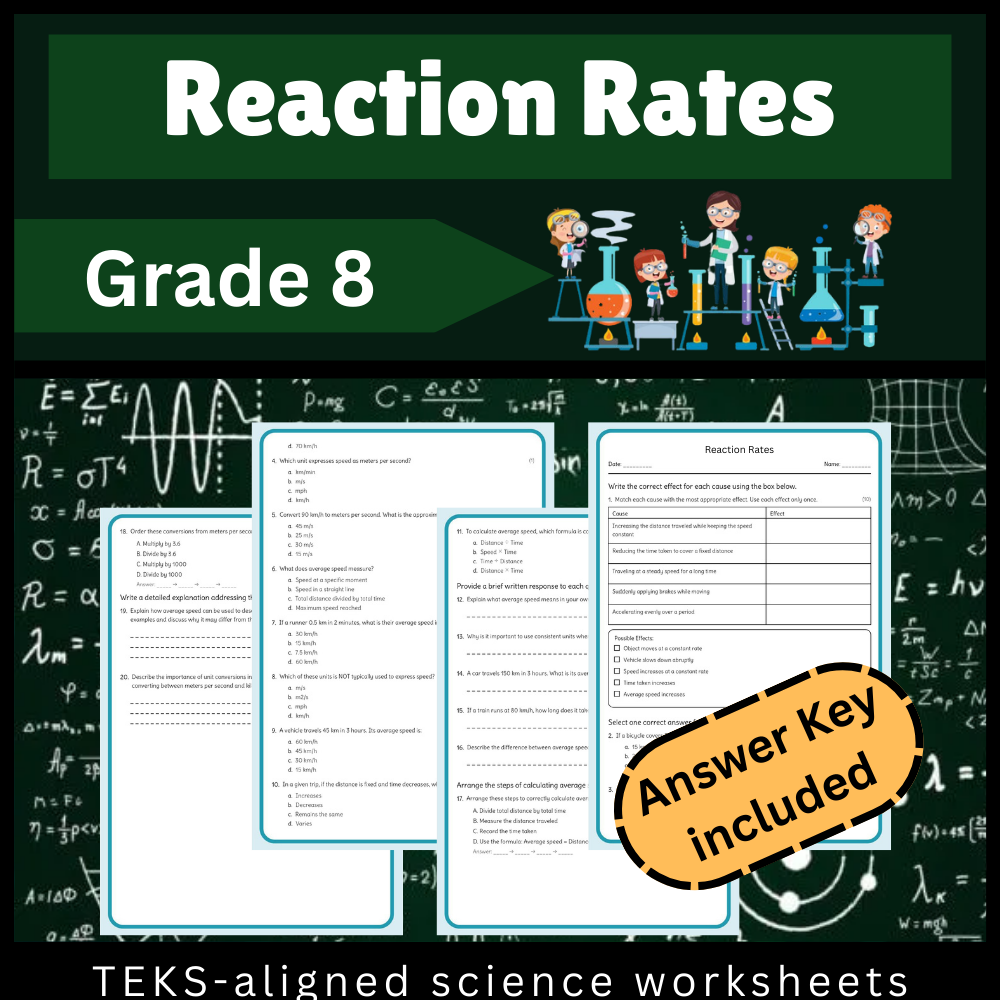
Grade 8 Science | Reaction Rates Worksheet (Answer Key) – TEKS Aligned
Created byBright Mind ResourcesLearning Objectives
- Identify factors that influence the speed of chemical reactions
- Explain how temperature, concentration, surface area, and catalysts affect reaction rates
- Connect molecular collision frequency and activation energy to observable rate changes
Also included in: Grade 8 Science Unit Bundle | States of Matter & Reaction Rates Worksheets- TEKS +1 more
Instant download
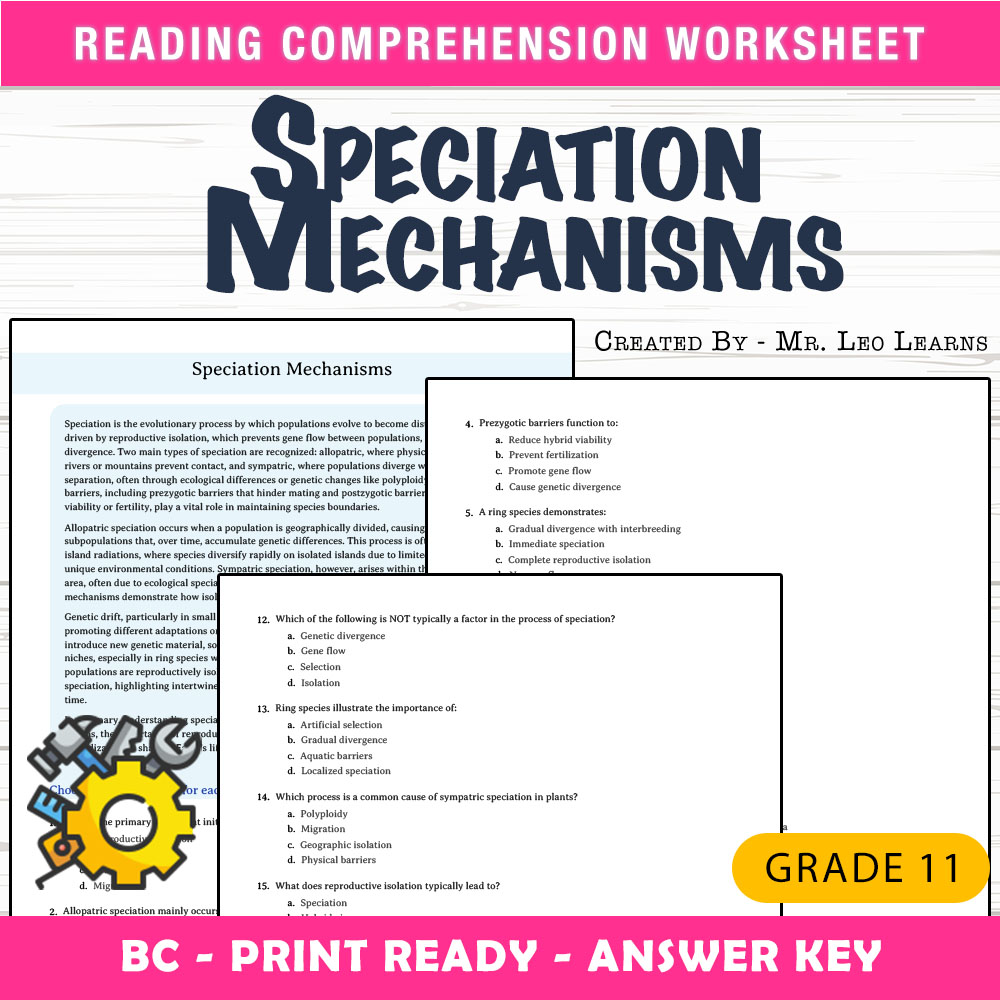
Grade 11 Science — Worksheet MCQ Paper for Mastering Speciation Mechanisms
Created byThe Resource HubLearning Objectives
- Understand the process of speciation and reproductive isolation.
- Identify different mechanisms such as allopatric, sympatric, prezygotic, and postzygotic barriers.
- Explain how genetic drift, selection, and hybridization influence divergence.
Also included in: Grade 11 Science Bundle | Biology Unit Worksheets for Mastery (BC Framework) +1 more
Instant download
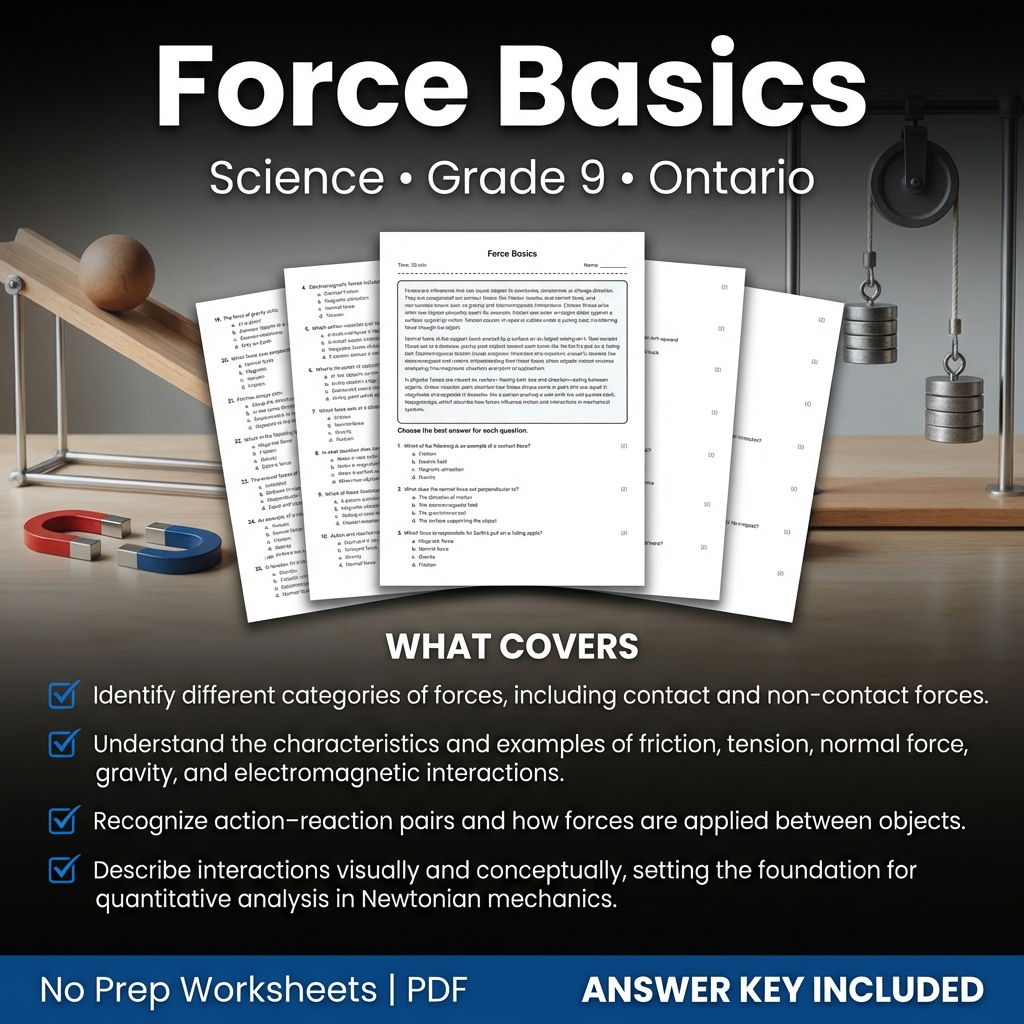
Force Basics Science Worksheet Grade 9 | Ontario Standards Practice
Created byCoral Reef LearningLearning Objectives
- Identify different categories of forces, including contact and non-contact forces.
- Understand the characteristics and examples of friction, tension, normal force, gravity, and electromagnetic interactions.
- Recognize action–reaction pairs and how forces are applied between objects.
Instant download
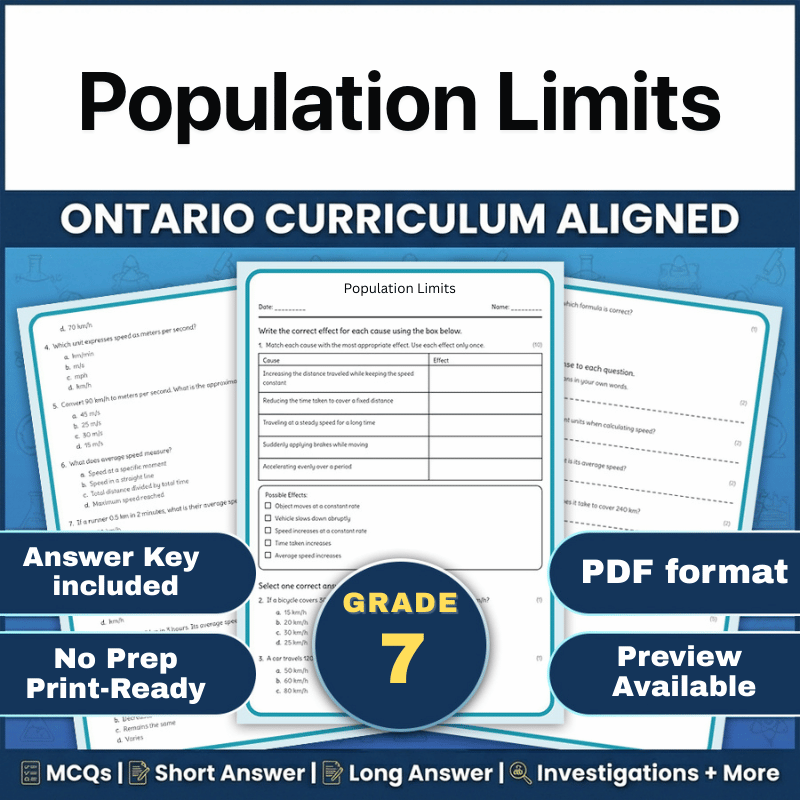
Grade 7 Science | Population Limits Worksheet (Ontario) – Science 1 (PDF)
Created byBright Mind ResourcesLearning Objectives
- Understand basic population growth models, including exponential and logistic growth.
- Identify factors that limit population size such as food availability, predation, disease, and abiotic stresses.
- Distinguish between density-dependent and density-independent factors affecting populations.
Instant download

Science Worksheet Internal External Processes | Standards-Aligned Grade 11
JCreated byJ.S SheetsLearning Objectives
- Explain how internal Earth processes (plate tectonics, volcanism, uplift) create major landforms and expose rock layers.
- Describe how external Earth processes (weathering, erosion, deposition) transport and reshape Earth’s surface.
- Analyze how uplift and erosion together influence river profiles, valley shapes, and sediment distribution.
Also included in: Grade 11 Earth and Space Evidence Systems Science Lesson Bundle: General +1 more
Instant download
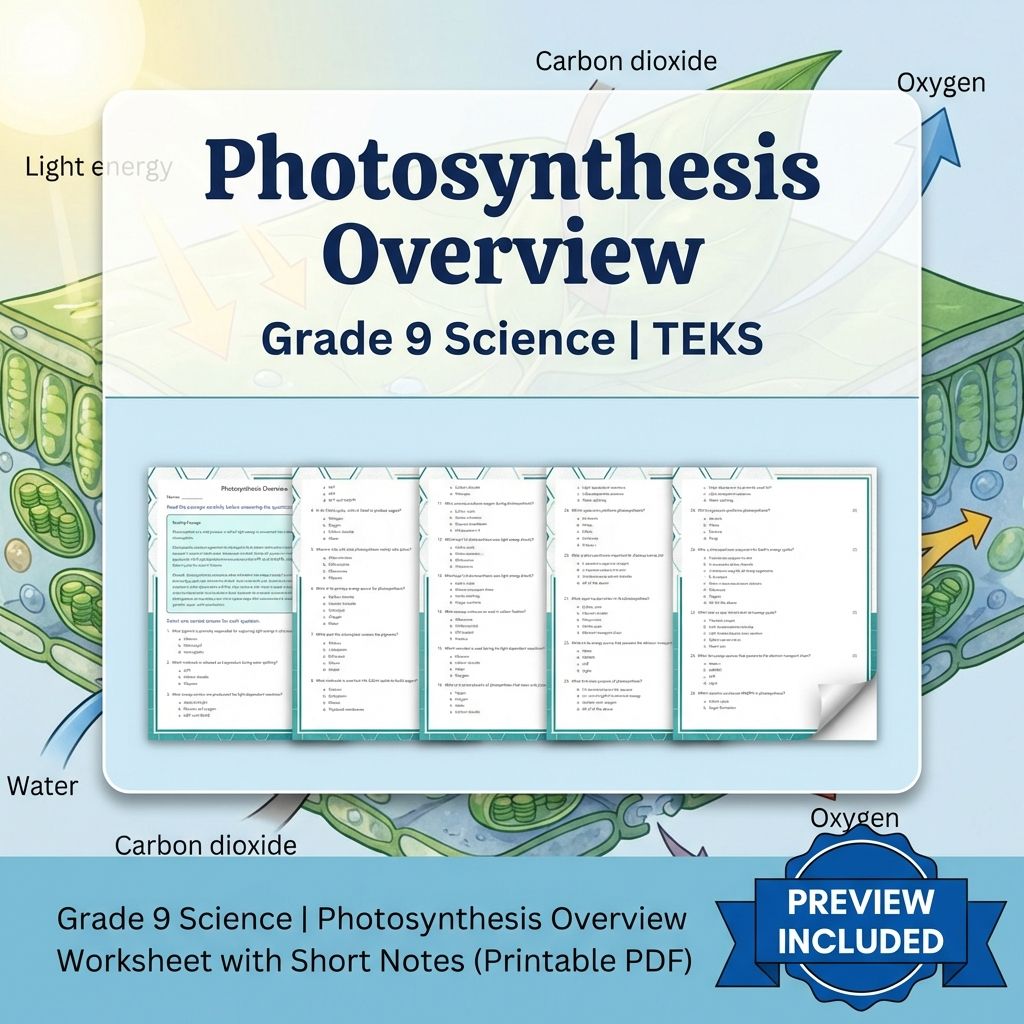
Grade 9 Science | Photosynthesis Overview Worksheet with Short Notes (PDF)
Created byMeadowlark WorksheetsLearning Objectives
- Describe the main inputs, outputs, and steps involved in photosynthesis.
- Identify the role of pigments in capturing light energy.
- Explain how water oxidation releases oxygen during photosynthesis.
Instant download
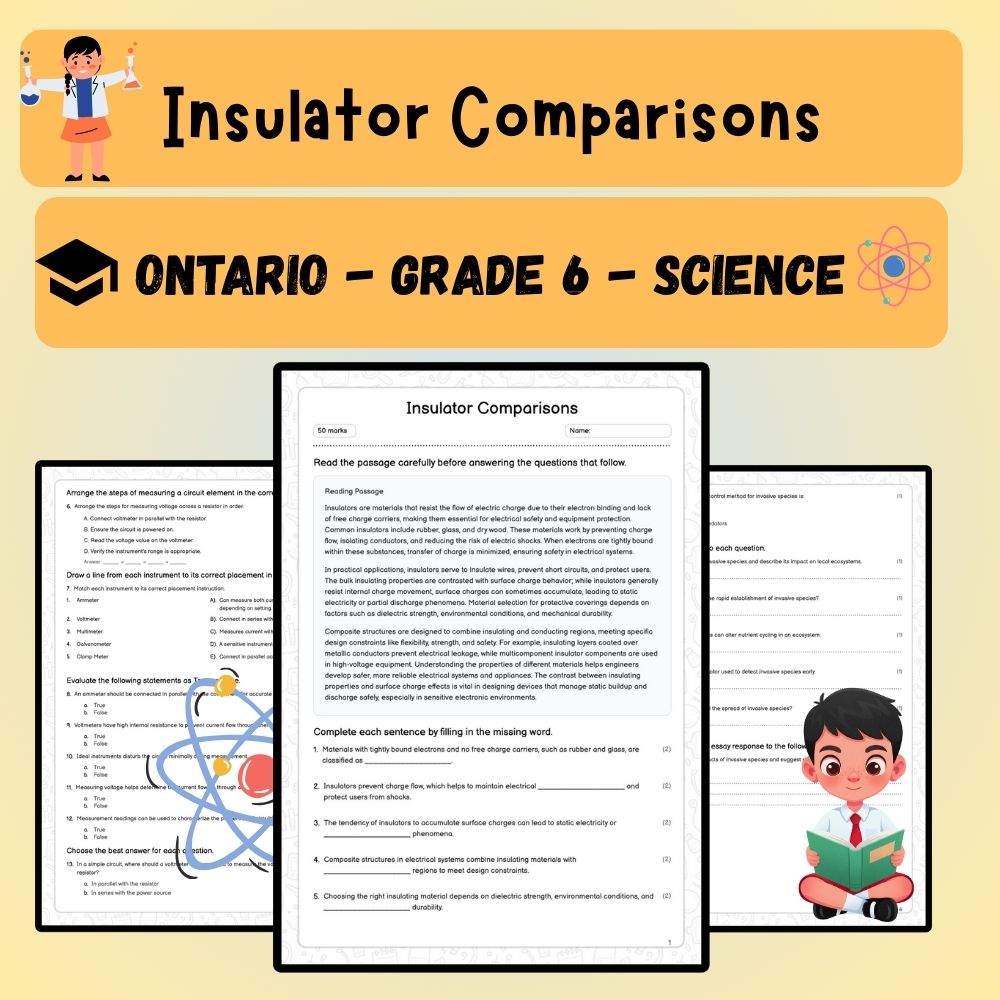
Grade 6 Science | Insulator Comparisons Worksheet with Answer Key (PDF )
Created byPrism Point LearningLearning Objectives
- Understand how insulating materials prevent charge flow and support electrical safety.
- Identify common insulating materials and their properties in electrical applications.
- Compare bulk insulating properties with surface charge behaviors.
Also included in: Grade 6 Science Unit – Circuits & Electricity Worksheet Bundle
Instant download
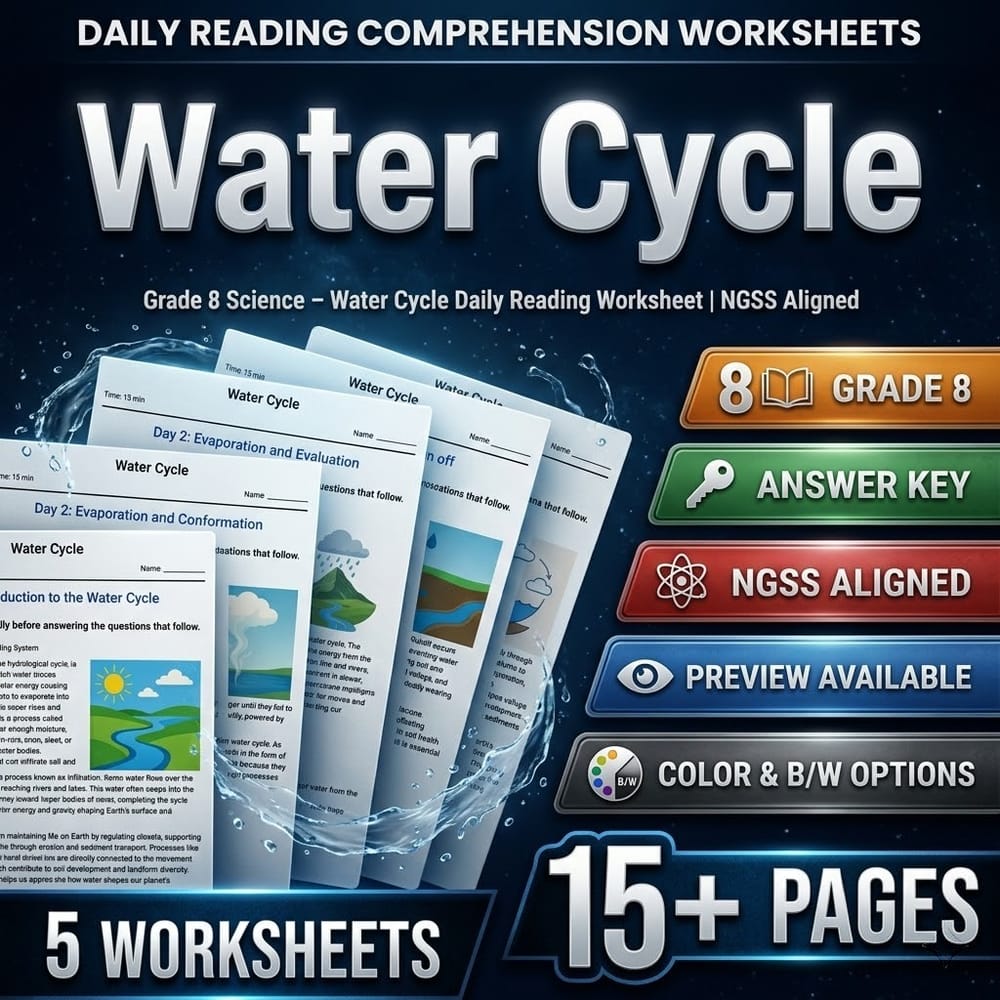
Grade 8 Science – Water Cycle Daily Reading Worksheet | NGSS Aligned
 Created byElena Brooks
Learning Objectives
- Understand the basic processes of the water cycle, including evaporation, condensation, precipitation, infiltration, runoff, and groundwater flow.
- Recognize the role of sunlight and gravity in driving the water cycle.
- Identify how water cycle processes influence landforms and weathering.
Instant download
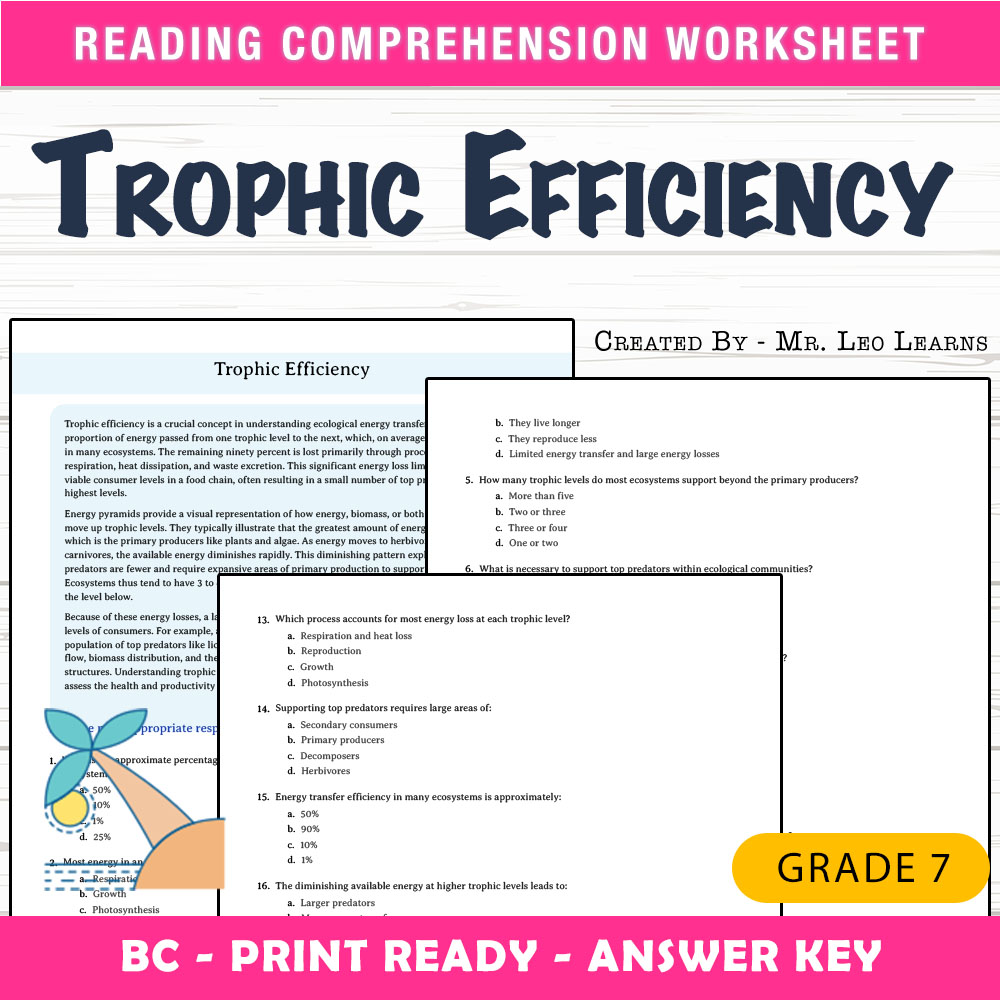
Grade 7 Science — Trophic Efficiency Worksheet for Mastery
Created byThe Resource HubLearning Objectives
- Understand the concept of trophic efficiency and its role in energy transfer.
- Identify factors that lead to energy loss at each trophic level.
- Interpret energy pyramids and their significance in ecosystems.
Also included in: Grade 7 Science Ecosystems & Interactions Worksheet Bundle +1 more
Instant download
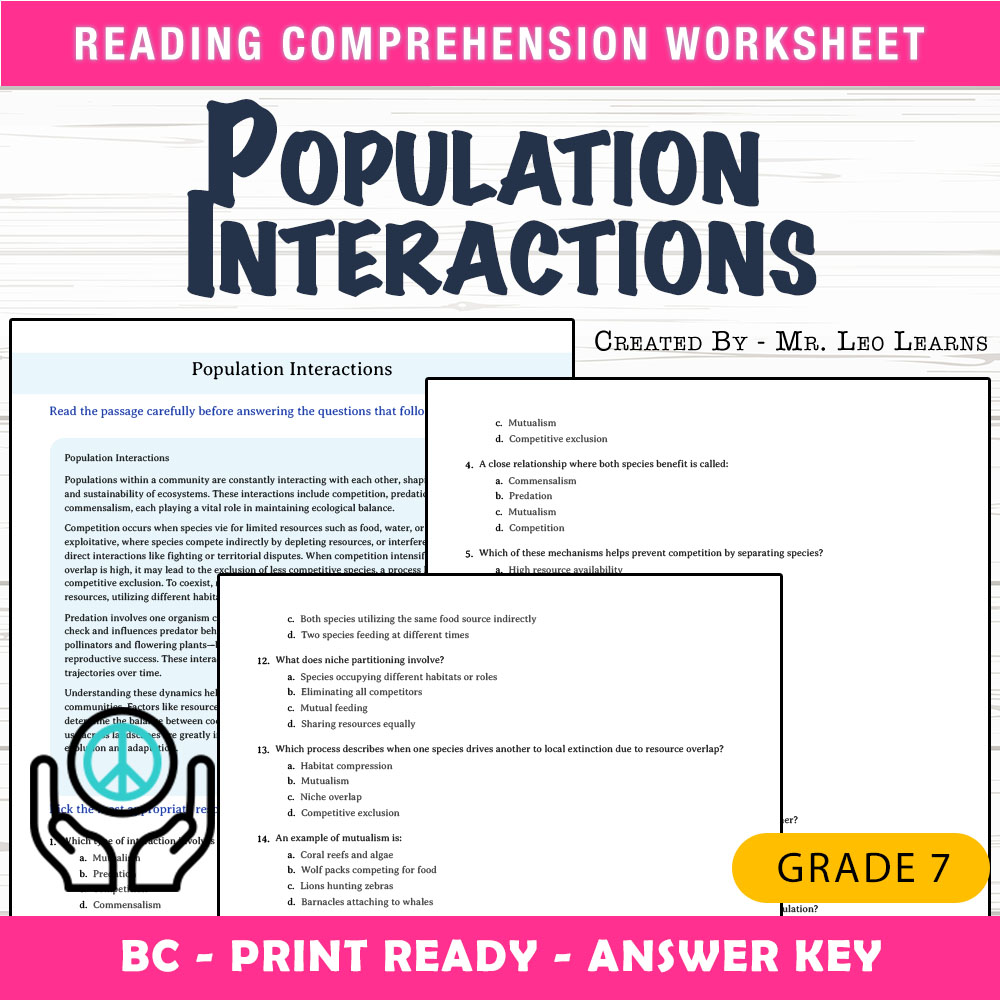
Grade 7 Science — Population Interactions Worksheet MCQ Paper
Created byThe Resource HubLearning Objectives
- Understand the different types of population interactions such as competition, predation, and mutualism.
- Identify how resource partitioning, habitat differentiation, and temporal separation allow species to coexist.
- Analyze the impact of interactions on community stability and diversity.
Also included in: Grade 7 Science Ecosystems & Interactions Worksheet Bundle +1 more
Instant download
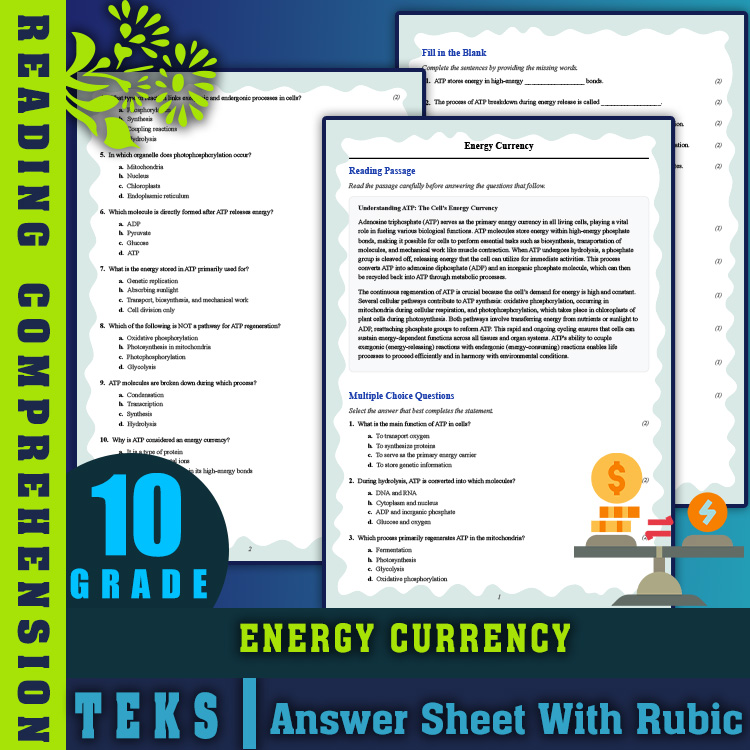
Grade 10 Science | Energy Currency Reading Worksheets (PDF + Answer Key)
JCreated byJ.S SheetsLearning Objectives
- Understand the role of ATP as the primary energy carrier in cells.
- Describe how ATP stores and releases energy during cellular processes.
- Explain how ATP is regenerated in cells through metabolic pathways.
Instant download

Grade 11 Science | Strong & Weak Acids and Bases - Daily Reading Comprehension
Created byCoral Reef LearningLearning Objectives
- Understand the difference between strong and weak acids and bases
- Identify examples of strong and weak acids and bases
- Explain how ionization affects pH levels in solutions
Also included in: Acids, Bases and pH Lesson Bundle – Grade 11 Science Alberta +1 more
Instant download
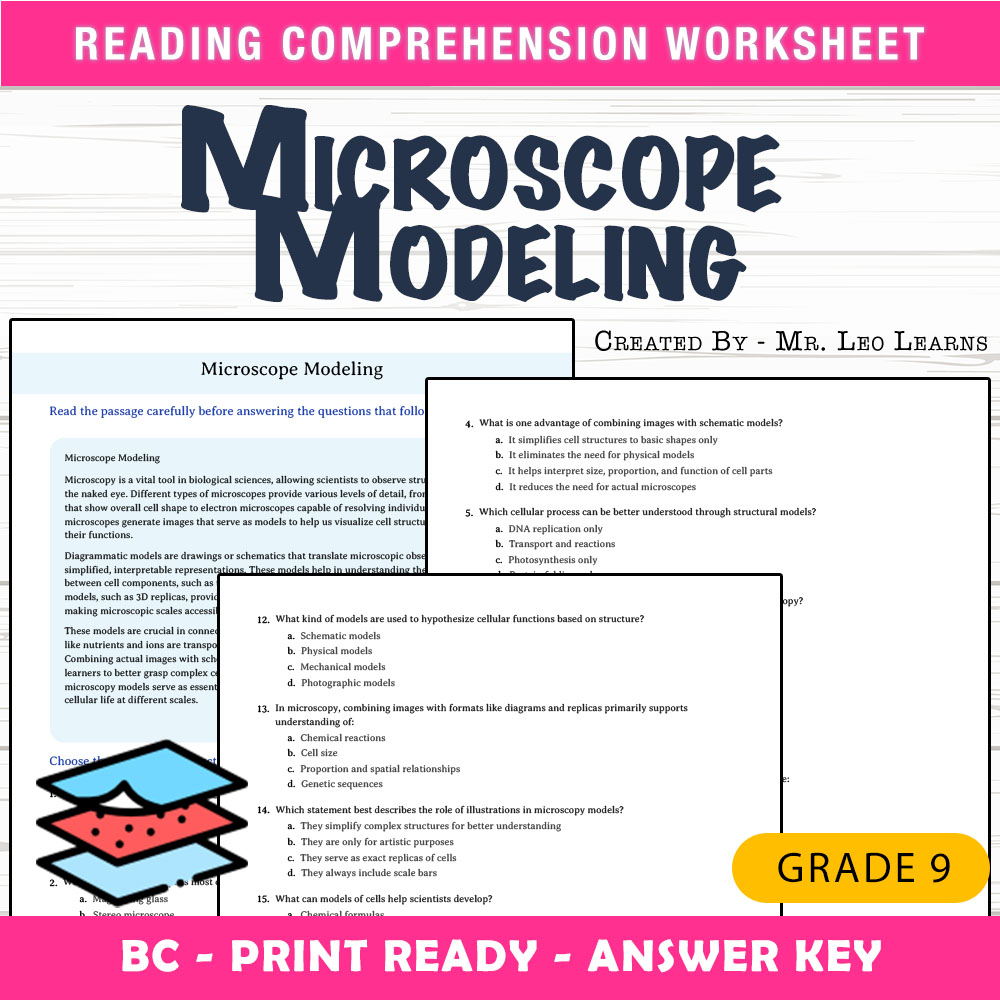
Grade 9 Science — Microscope Modeling Worksheet for Mastery
Created byThe Resource HubLearning Objectives
- Understand how different microscope models represent cell structures and scales.
- Identify the purpose of diagrammatic and physical models in microscopy.
- Explain how visual models help interpret cellular functions and spatial relationships.
Also included in: Grade 9 Science Cells & Body Systems Worksheet Bundle | BC Curriculum Resources +1 more
Instant download
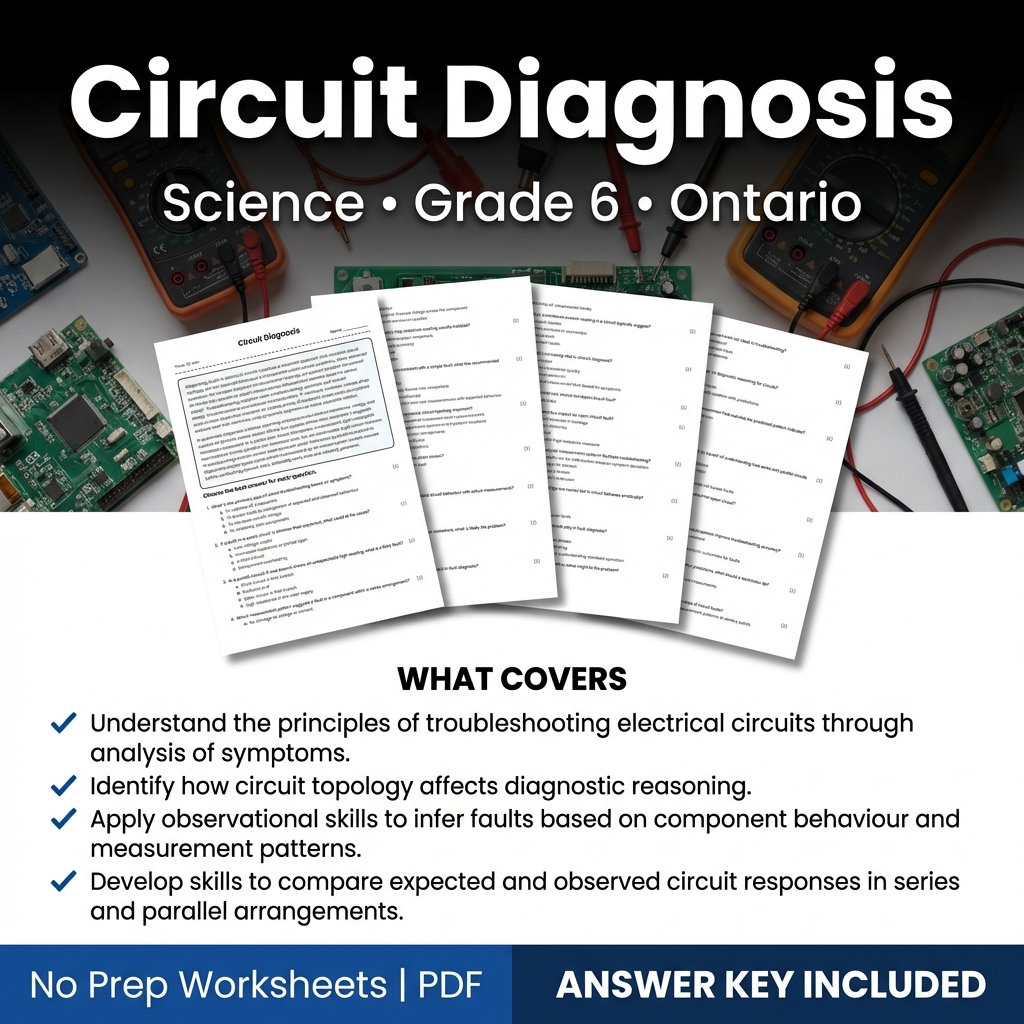
Grade 6 Science Worksheet | Circuit Diagnosis Practice | Ontario Standards
Created byCoral Reef LearningLearning Objectives
- Understand the principles of troubleshooting electrical circuits through analysis of symptoms.
- Identify how circuit topology affects diagnostic reasoning.
- Apply observational skills to infer faults based on component behaviour and measurement patterns.
Instant download
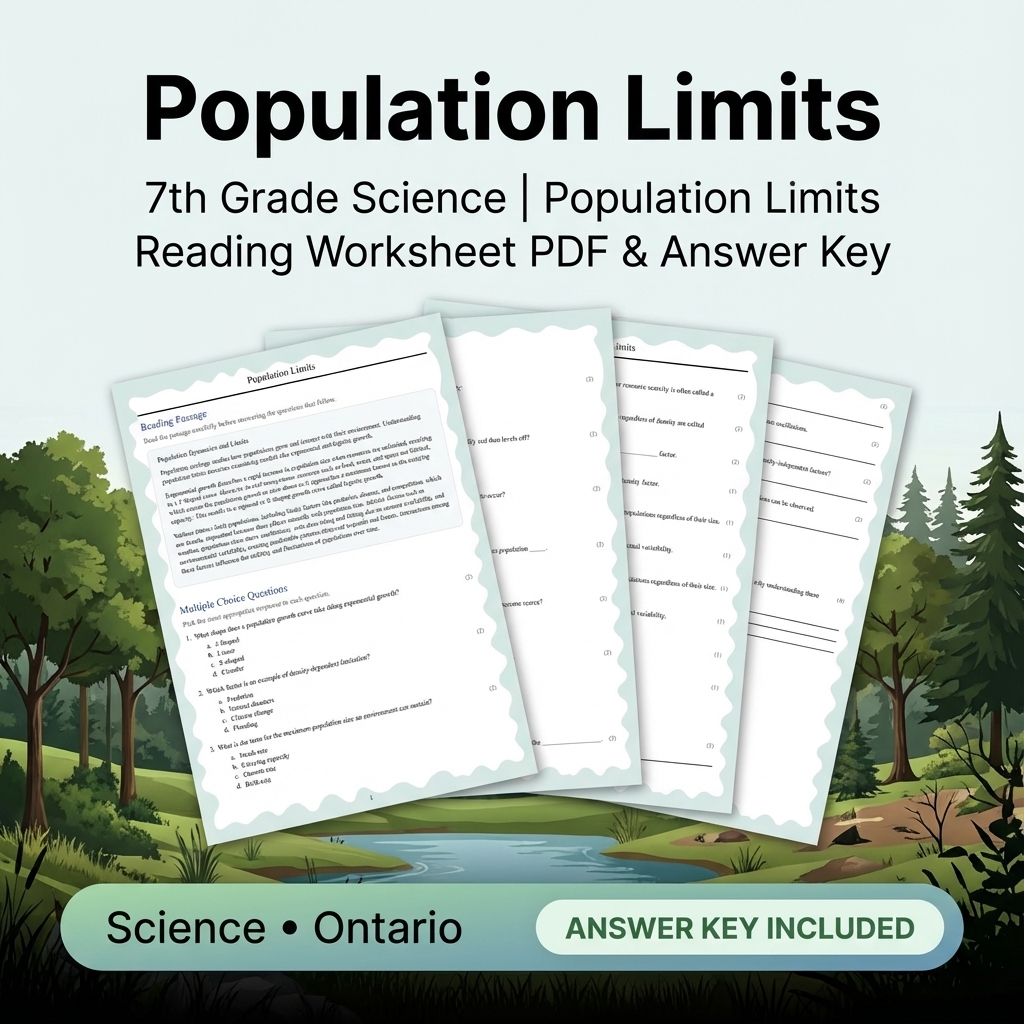
7th Grade Science | Population Limits Reading Worksheet PDF & Answer Key
JCreated byJ.S SheetsLearning Objectives
- Understand basic population growth models, including exponential and logistic growth.
- Identify and distinguish between limiting factors affecting populations.
- Differentiate between density-dependent and density-independent influences on populations.
Also included in: Grade 7 Science | Ecosystems, Biodiversity & Environmental Stewardship +1 more
Instant download
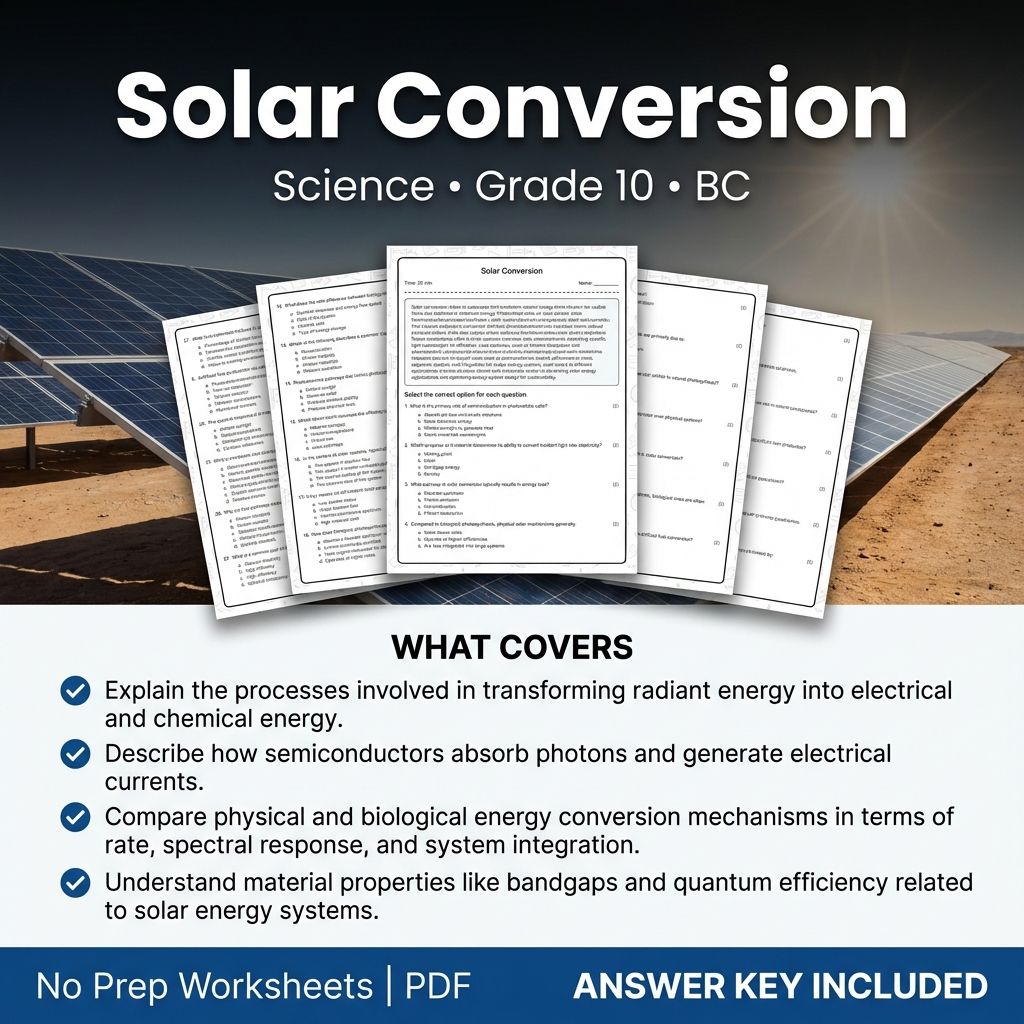
10th Grade Science | Solar Conversion Worksheet & Answer Key (PDF)
Created byCoral Reef LearningLearning Objectives
- Explain the processes involved in transforming radiant energy into electrical and chemical energy.
- Describe how semiconductors absorb photons and generate electrical currents.
- Compare physical and biological energy conversion mechanisms in terms of rate, spectral response, and system integration.
Instant download
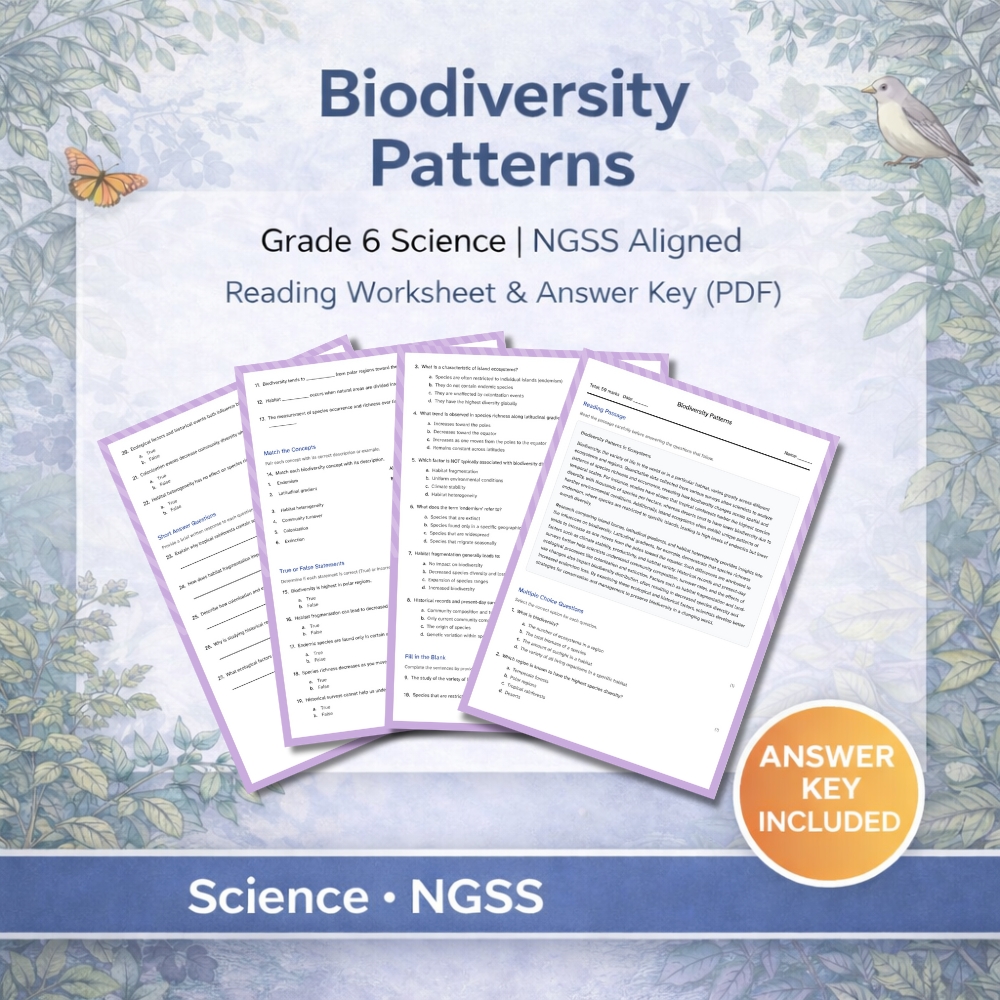
6th Grade Science | Biodiversity Patterns | NGSS Worksheet & Answer Key
 Created byCedar Grove Learning
Learning Objectives
- Understand how species occurrence and richness reveal biodiversity patterns across different ecosystems.
- Analyze and interpret data related to biodiversity, endemism, and community composition.
- Compare biodiversity variations across islands, latitudinal gradients, and habitats.
Also included in: Grade 6 Science | Ecosystems, Evolution & Biodiversity | NGSS Worksheet Bundle +1 more
Instant download

Population Change Worksheet | AP Science Assessment for Grade 12
JCreated byJ.S SheetsLearning Objectives
- Understand mechanisms such as natural selection, genetic drift, gene flow, and mutation that alter allele frequencies in populations.
- Analyze case examples of phenotypic shifts and quantitative models relating fitness differences to frequency change.
- Evaluate evidence from morphology, molecular markers, and experimental populations to explain evolutionary patterns.
Instant download
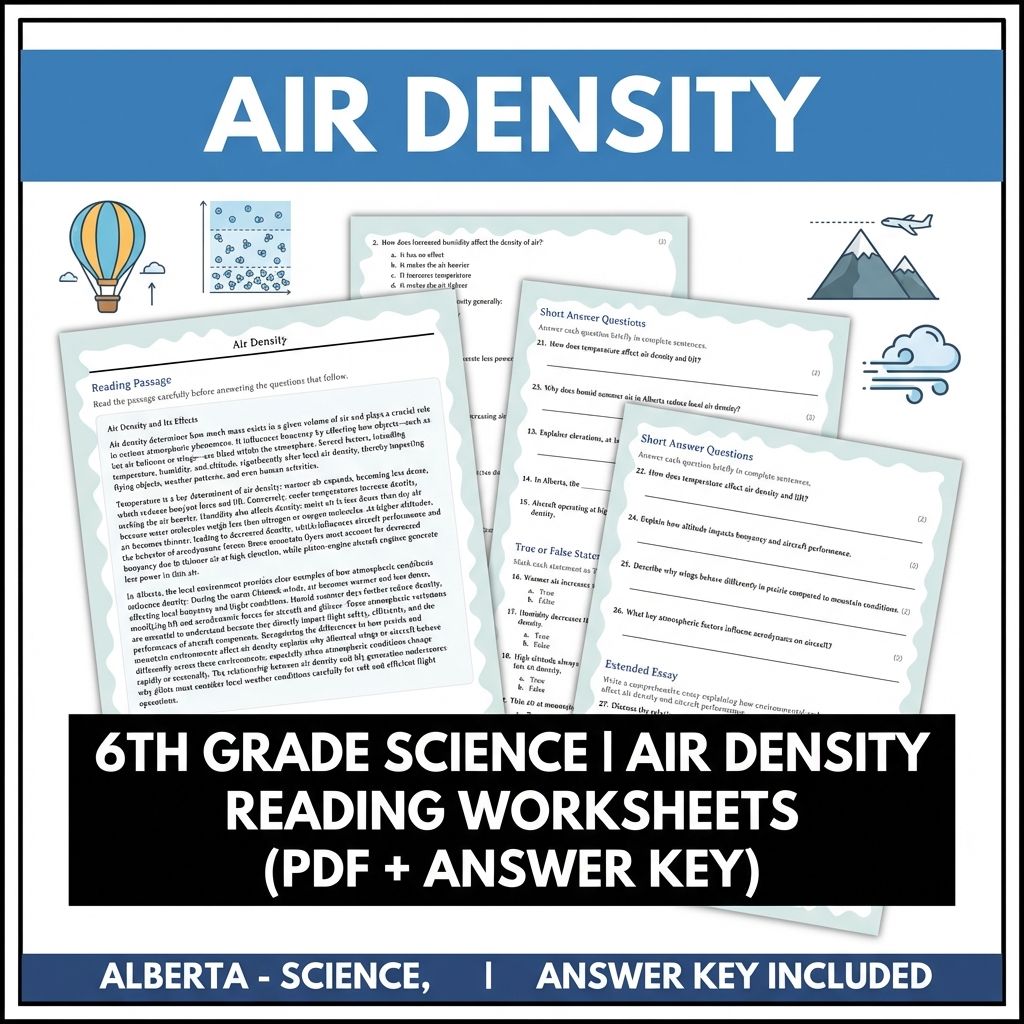
6th Grade Science | Air Density Reading Worksheets (PDF + Answer Key)
JCreated byJ.S SheetsLearning Objectives
- Explain how temperature, humidity, and altitude affect air density.
- Understand the relationship between air density and buoyancy.
- Describe how atmospheric conditions influence aerodynamic forces.
Also included in: Grade 6 Science | Flight Physics & Aerodynamics UNIT Pack (Answer Keys Included) +1 more
Instant download
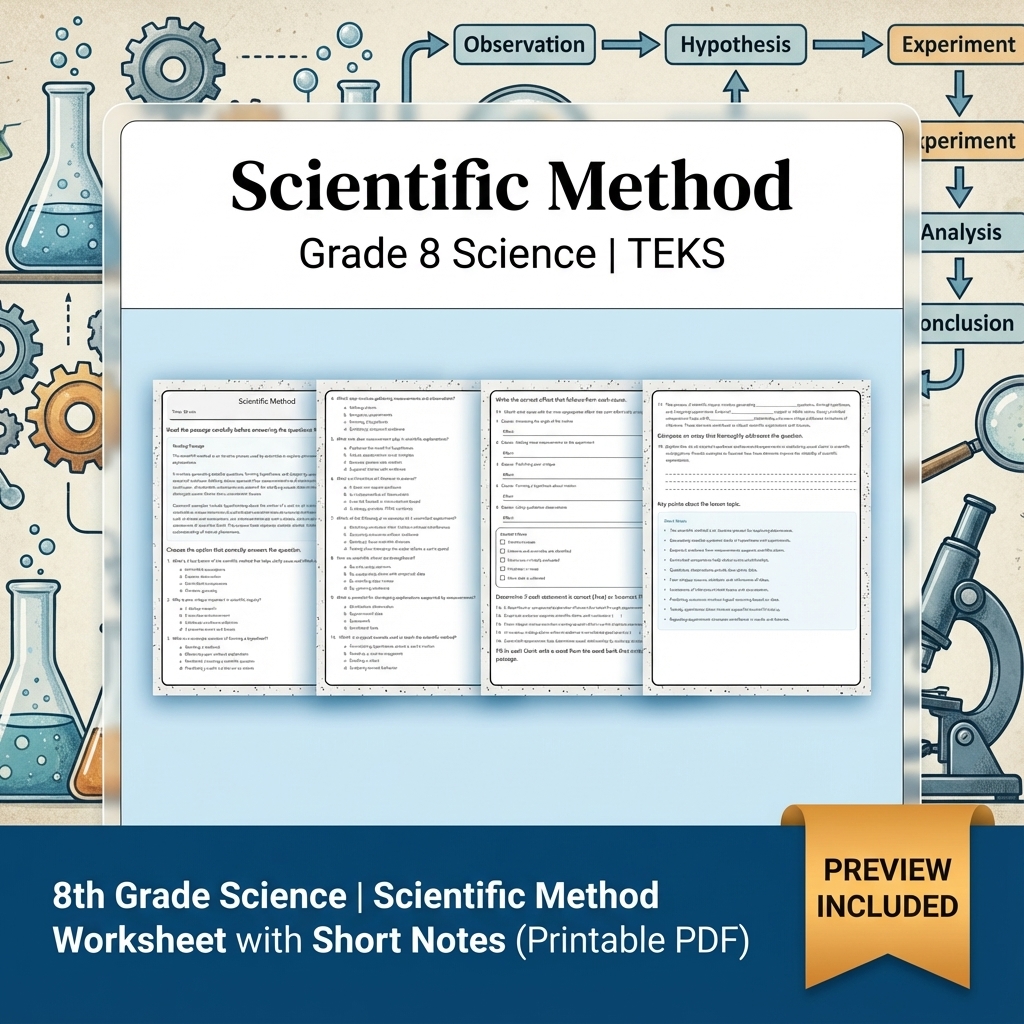
8th Grade Science | Scientific Method Worksheet with Short Notes (Printable PDF)
Created byMeadowlark WorksheetsLearning Objectives
- Understand the steps involved in the scientific method and inquiry.
- Describe how empirical evidence supports scientific claims.
- Explain the importance of controlled experiments and peer critique.
Instant download
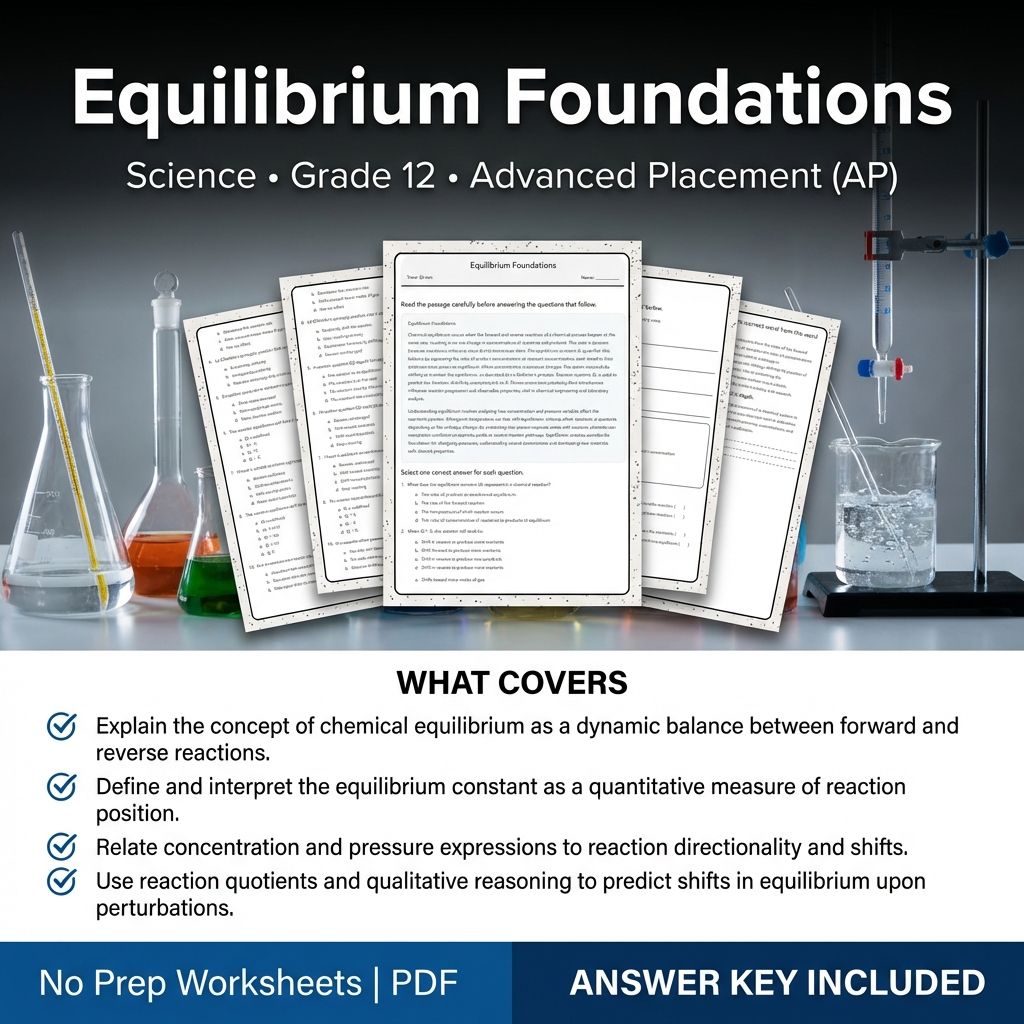
12th Grade Science | Equilibrium Foundations Worksheet & Answer Key (Printable PDF)
Created byCoral Reef LearningLearning Objectives
- Explain the concept of chemical equilibrium as a dynamic balance between forward and reverse reactions.
- Define and interpret the equilibrium constant as a quantitative measure of reaction position.
- Relate concentration and pressure expressions to reaction directionality and shifts.
Also included in: Grade 12 Science Unit Worksheet Bundle – Advanced Chemistry Concepts & Topics +1 more
Instant download

Grade 8 Science | Reaction Evidence Worksheet (PDF) aligned to TEKS
 Created byEvergreen Desk Education
Learning Objectives
- Identify common evidence of chemical reactions, including color change, gas evolution, precipitate formation, temperature change, and irreversible transformation.
- Differentiate chemical changes from physical changes using observable indicators and reasoning.
- Explain conservation ideas in closed systems when interpreting reaction evidence.
Instant download
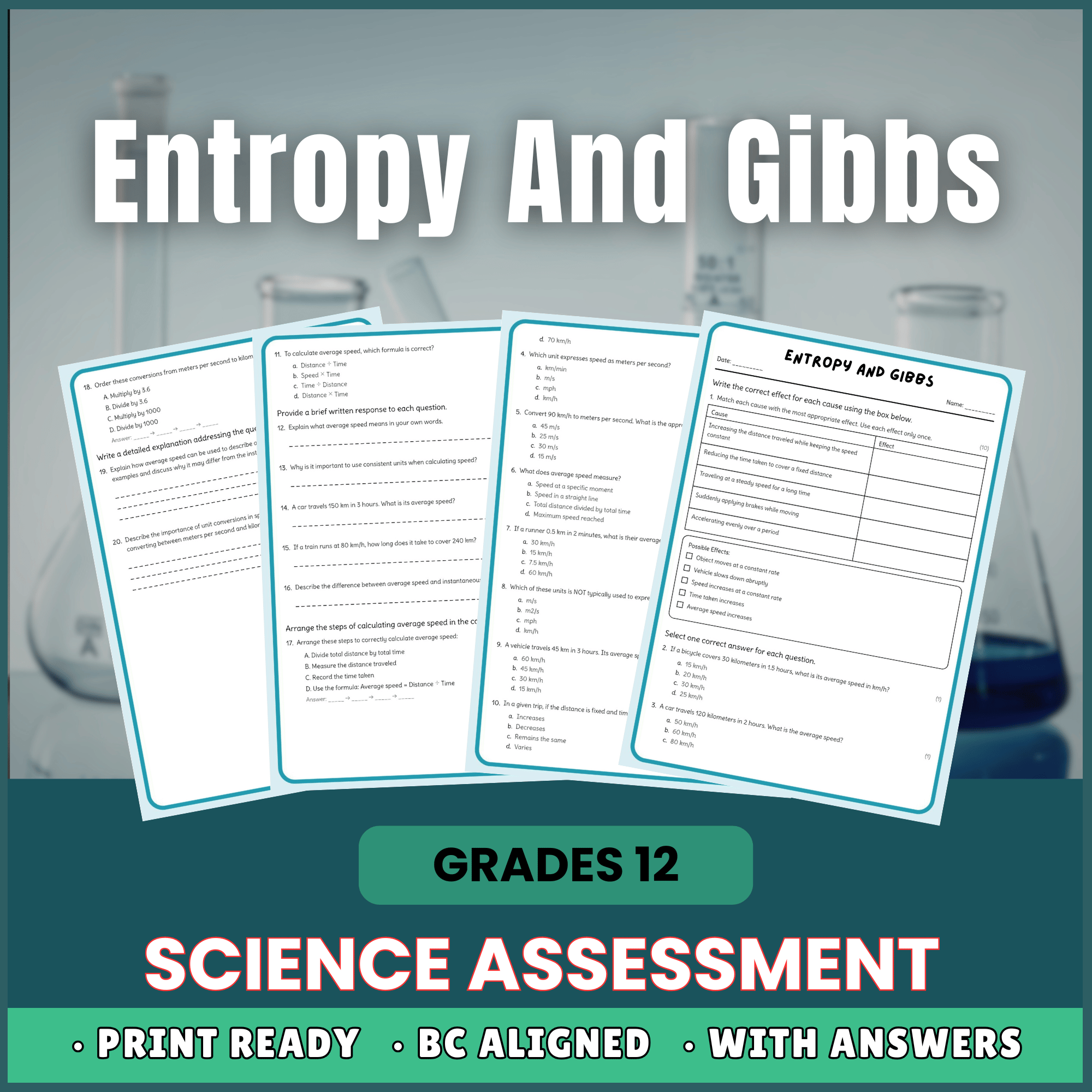
Grade 12 Science | Equilibrium Concepts Worksheet (Answer Key) – BC Standards
Created byBright Mind ResourcesLearning Objectives
- Understand the definition and components of chemical equilibrium.
- Identify factors that influence equilibrium position and constant.
- Explain how temperature changes affect equilibrium and energetics.
Instant download
Equilibrium Concepts Assessment for Grade 12 Science BC Standards
Created byPrism Point LearningLearning Objectives
- Explain the principle of chemical equilibrium in reversible reactions.
- Describe how reaction conditions influence the position of equilibrium.
- Relate the magnitude of the equilibrium constant to the favored side of a reaction.
Also included in: Grade 12 Science Mini Bundle – Thermochemistry & Equilibrium Assessment
Instant download
Grade 12 Science — Worksheet MCQ Paper for Mastering Equilibrium Concepts
Created byThe Resource HubLearning Objectives
- Describe the principle of chemical equilibrium in reversible reactions.
- Explain how the equilibrium constant relates concentrations of reactants and products.
- Analyze how temperature changes affect the position of equilibrium and reaction energetics.
Also included in: Grade 12 Science | Chemistry 12 MCQ Worksheet Bundle – BC Curriculum Review Pack +1 more
Instant download

Grade 11 Science| Statistical Reasoning Worksheet | AP Aligned
Created byLumora LearningLearning Objectives
- Understand how to interpret sampling distributions and their role in inferential statistics.
- Identify and evaluate hypotheses using p-values, effect sizes, and confidence intervals.
- Apply concepts of statistical variability and robustness in real-world contexts such as ecology and material testing.
Instant download
Browse more categories
About Science Worksheets
Find Science worksheets spanning core skills, practice, and review. All 44,628 resources are instant PDF downloads for the classroom or home.
Every worksheet on MyTeachingSheets is created by independent teacher-authors and reviewed before publication. All resources download as printable PDFs for classroom, homework, or at-home practice, and many include answer keys. Preview any worksheet free before buying.