
Science Worksheets
44,773 subject resources
Systems Analysis Worksheet for Grade 10 Science | NGSS Aligned
JCreated byJ.S SheetsLearning Objectives
- Understand the principles of systems thinking and how they apply to engineering problems.
- Identify subsystem interactions, boundary definitions, and emergent behaviors in complex systems.
- Model interfaces and feedback loops to predict system-level performance.
Also included in: Grade 10 Engineering Design Science Lesson Bundle worksheets – NGSS
Instant download

Wave Relationships Worksheet | NGSS Grade 11 Science MCQ Practice
 Created byCedar Grove Learning
Learning Objectives
- Understand the mathematical relationship among wave speed, frequency, and wavelength.
- Apply the equation v = fλ to solve problems involving wave properties.
- Describe differences and similarities between transverse and longitudinal waves.
Instant download
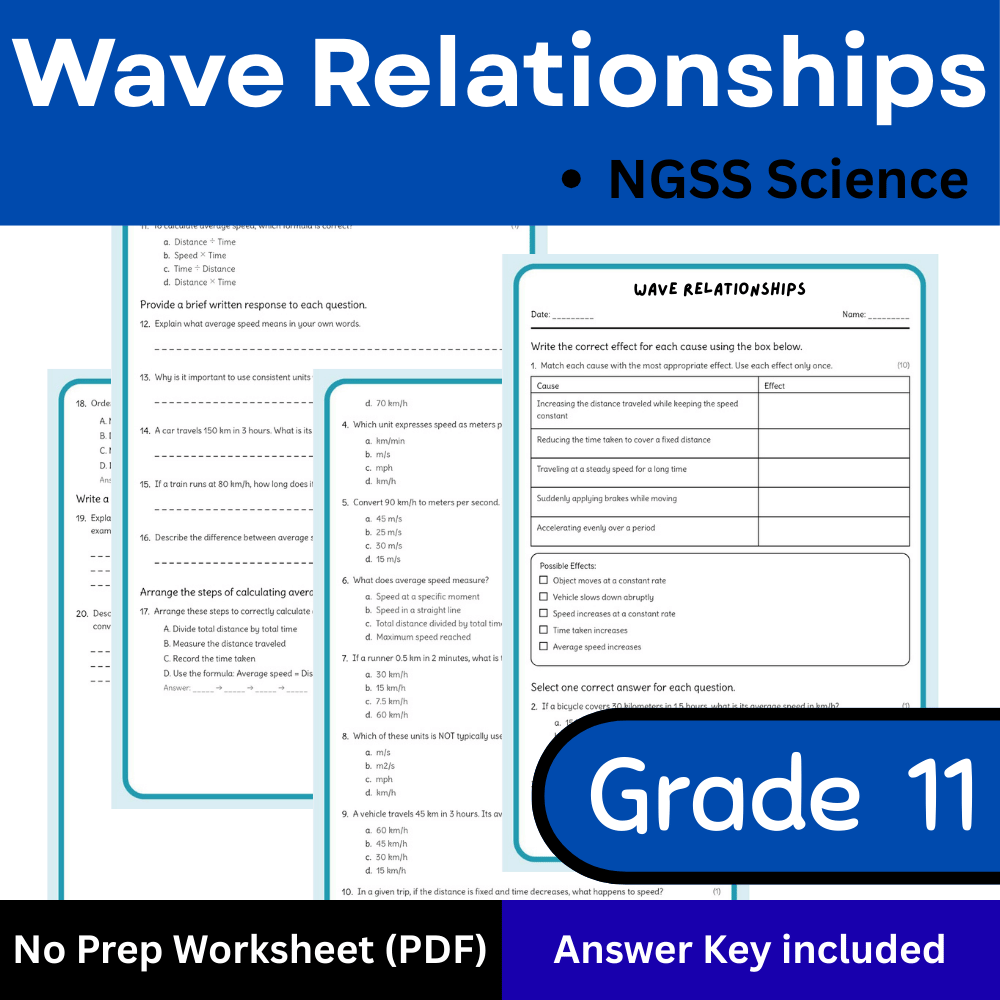
11th Grade Science | Wave Relationships Worksheet (Answer Key) – NGSS
 Created byBright Mind Resources
Learning Objectives
- Understand the mathematical relationships among wave properties such as speed, frequency, and wavelength.
- Describe the differences and similarities between transverse and longitudinal waves using examples.
- Analyze wave behaviors like refraction and dispersion through graphs and calculations.
Instant download
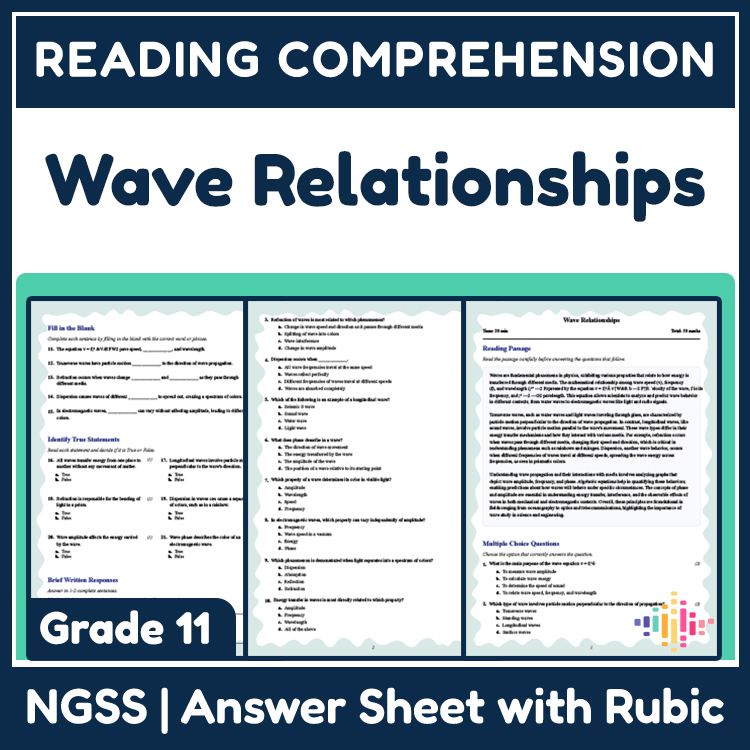
11th Grade Science | Wave Relationships Reading Worksheet & Answer Key (PDF)
JCreated byJ.S SheetsLearning Objectives
- Explain the mathematical relationships among wave properties such as wavelength, frequency, and wave speed using the formula v = fλ.
- Describe the differences and similarities between transverse and longitudinal waves through examples like water waves, sound waves, and light in glass.
- Analyze wave behavior across different media and understand phenomena such as refraction and dispersion using graphs and algebraic representations.
Instant download

Wave Relationships Worksheet for Grade 11 Science | NGSS-Aligned Practice
JCreated byJ.S SheetsLearning Objectives
- Understand the mathematical relationship v = fλ and apply it to calculate wave speed, frequency, or wavelength.
- Describe differences between transverse and longitudinal waves with examples such as water waves, sound, and light.
- Analyze how wave properties change across different media and interpret wave graphs and algebraic representations.
Also included in: Grade 11 Electromagnetic Spectrum and Imaging Science Lesson Bundle: NGSS +1 more
Instant download

Grade 11 Science | Wave Relationships - Daily Reading Comprehension
 Created byCoral Reef Learning
Learning Objectives
- Understand key concepts related to Science
- Apply knowledge through practice questions
- Demonstrate comprehension of the material
Instant download

Natural Selection Worksheets | Grade 11 Biology Evolution Practice
 Created bythe curious pencil
Learning Objectives
- Explain how heritable variation contributes to natural selection.
- Describe how mutation and recombination produce genetic variation.
- Analyze how environmental pressures affect trait frequencies.
Also included in: Evolution & Population Genetics Lesson Bundle – Grade 11 Science NGSS +2 more
Instant download
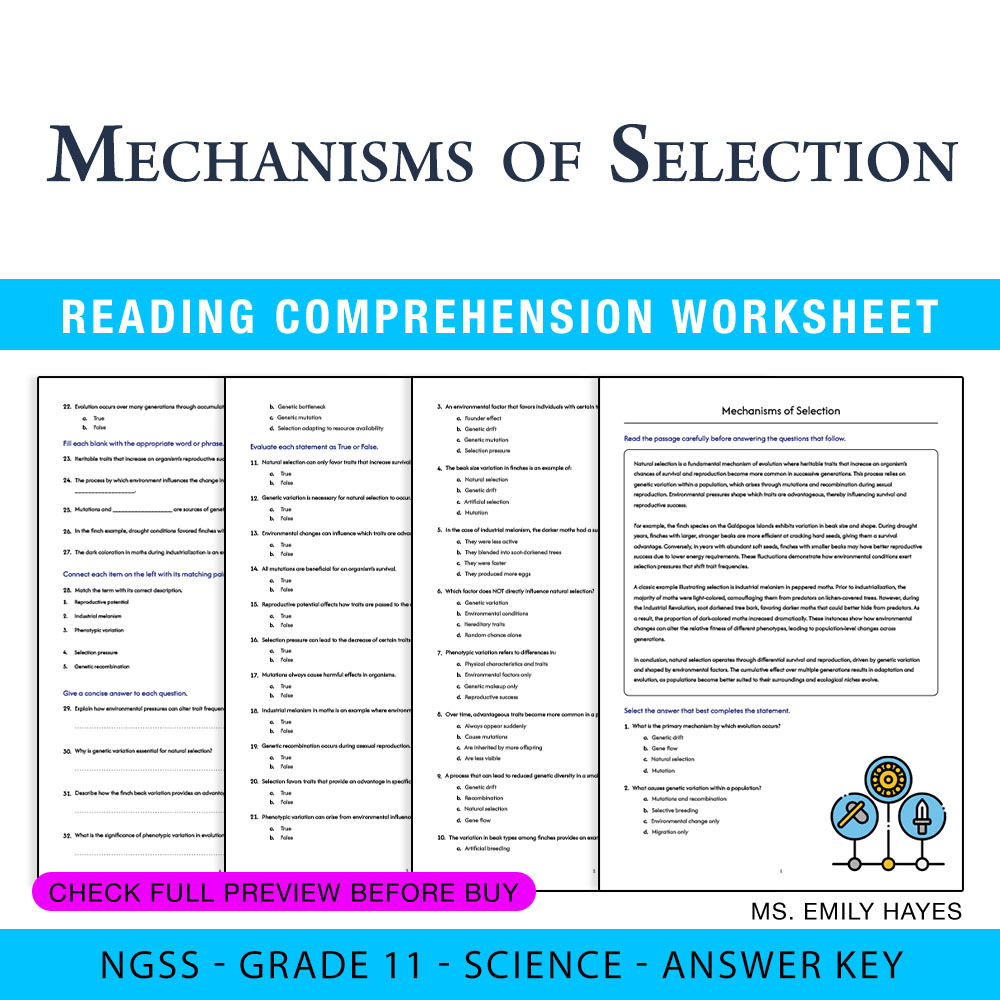
Grade 11 Science | Mechanisms of Selection Worksheet (PDF+ Answer Key)
 Created byCopper Leaf Classroom
Learning Objectives
- Explain the process of natural selection and its role in evolution.
- Identify factors that influence selection pressures and trait frequencies.
- Analyze real-world examples like finch beak variation and industrial melanism.
Instant download

Grade 11 Science Daily Reading: Mechanisms of Selection | NGSS Biology Worksheet
 Created byBRIGHT PATH RESOURCES
Learning Objectives
- Summarize the three key steps of natural selection.
- Explain how heritable variation and environmental pressures can change trait frequencies over generations.
- Define fitness in the context of differential survival and reproduction.
Also included in: Biological Evolution Unity & Diversity Grade 11 Science Lesson Bundle | NGSS +1 more
Instant download
11th Grade Science | Mechanisms of Selection Worksheet + Answer Key (NGSS)
Created byBright Mind ResourcesLearning Objectives
- Understand the fundamental concepts of natural selection as a driving mechanism of evolution.
- Identify the factors that influence genetic variation, survival, and reproduction.
- Analyze classic examples such as finch beak variation and industrial melanism to illustrate selection pressures.
Instant download

Grade 11 Science | Mechanisms of Selection - Daily Reading Comprehension
Created byCoral Reef LearningLearning Objectives
- Define natural selection and its role in evolution.
- Identify factors that influence natural selection such as variation, survival, and reproduction.
- Understand examples like finch beak variation and industrial melanism.
Instant download

Mechanisms of Selection MCQ Worksheet | NGSS Grade 11 Science
Created byCedar Grove LearningLearning Objectives
- Understand the process of natural selection as a key mechanism of evolution.
- Identify factors that influence selection pressures and their effects on populations.
- Analyze examples such as finch beak variation and industrial melanism to illustrate selection.
Instant download

Mechanisms Of Selection Worksheet for Grade 11 Science | NGSS-aligned Practice
JCreated byJ.S SheetsLearning Objectives
- Explain the key processes involved in natural selection, including heritable variation and differential survival.
- Identify factors influencing selection pressures such as genetic variation, environmental factors, and reproductive potential.
- Analyze classic examples like finch beak variation and industrial melanism to understand selection dynamics.
Also included in: Grade 11 Evolutionary Models and Evidence Science lesson bundle: NGSS +1 more
Instant download

Grade 11 Science – Mechanisms of Selection Worksheet (NGSS PDF)
 Created byMaple Path Learning
Learning Objectives
- Understand the biological mechanisms underlying natural selection.
- Identify key factors that influence evolutionary change.
- Analyze how genetic variation contributes to adaptation.
Also included in: Grade 11 Biological Evolution Unity and Diversity Science Lesson Bundle (NGSS) +1 more
Instant download
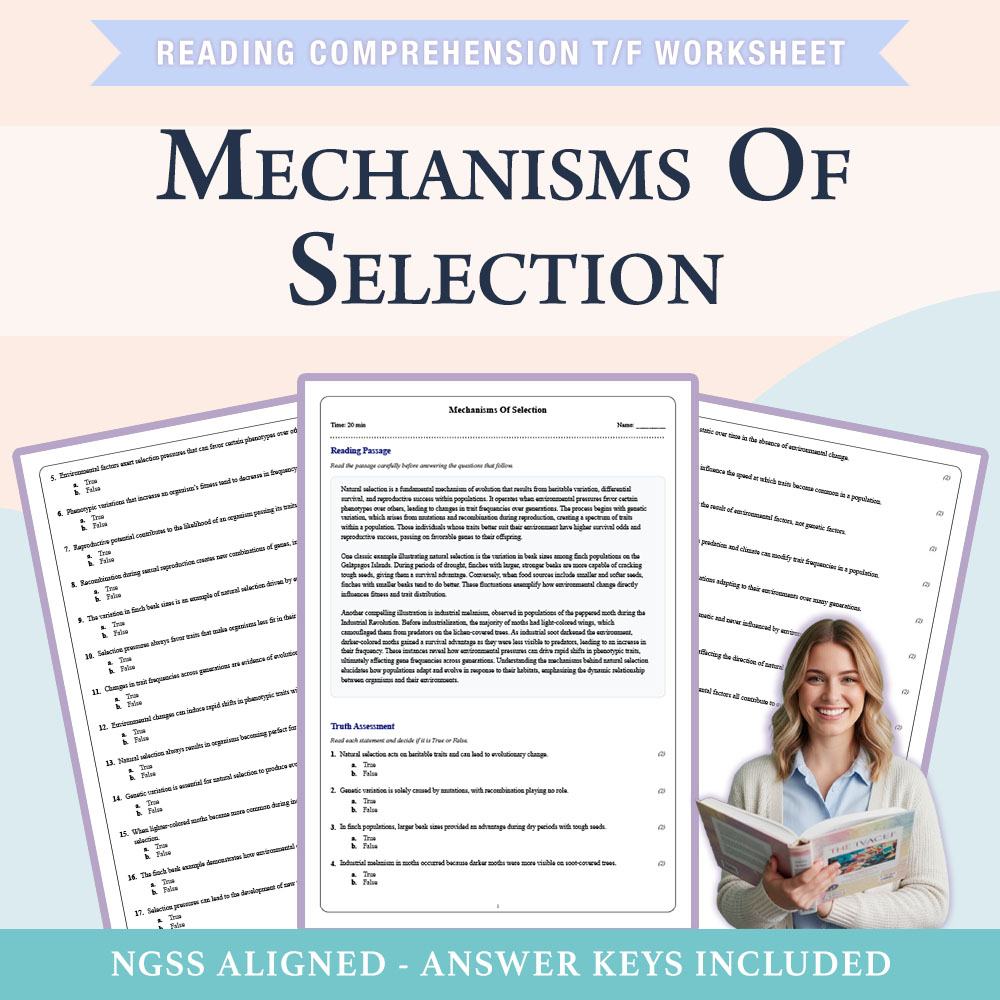
11th Grade Science | Mechanisms of Selection Worksheet (PDF + Answer Key)
Created byCopper Leaf ClassroomLearning Objectives
- Understand the concept of natural selection as a primary mechanism of evolutionary change.
- Identify factors influencing selection pressures, including genetic variation and environmental factors.
- Analyze examples such as finch beak variation and industrial melanism to comprehend how selection affects traits.
Also included in: Grade 11 Science | Evolutionary Biology & Genetics Bundle (PDF + Answers) +1 more
Instant download

Grade 5 Evaporation And Condensation Worksheet | NGSS Practice PDF
 Created byClear Sky Classroom
Learning Objectives
- Explain evaporation and condensation as changes of state involving energy transfer.
- Use observations (puddles drying, water droplets forming) to identify which process is occurring.
- Describe how temperature affects whether a substance appears as a liquid or a gas.
Instant download

Kindergarten Science | Weather Patterns Worksheet with Short Notes (PDF)
 Created byMeadowlark Worksheets
Learning Objectives
- Understand how weather observations like temperature, precipitation, wind, and cloud cover reveal patterns over time.
- Recognize how daily changes relate to seasonal differences in weather.
- Identify common weather phenomena such as sunny, rainy, windy, and snowy conditions.
Also included in: Kindergarten Science Unit | Earth's Systems NGSS Worksheet Bundle +1 more
Instant download
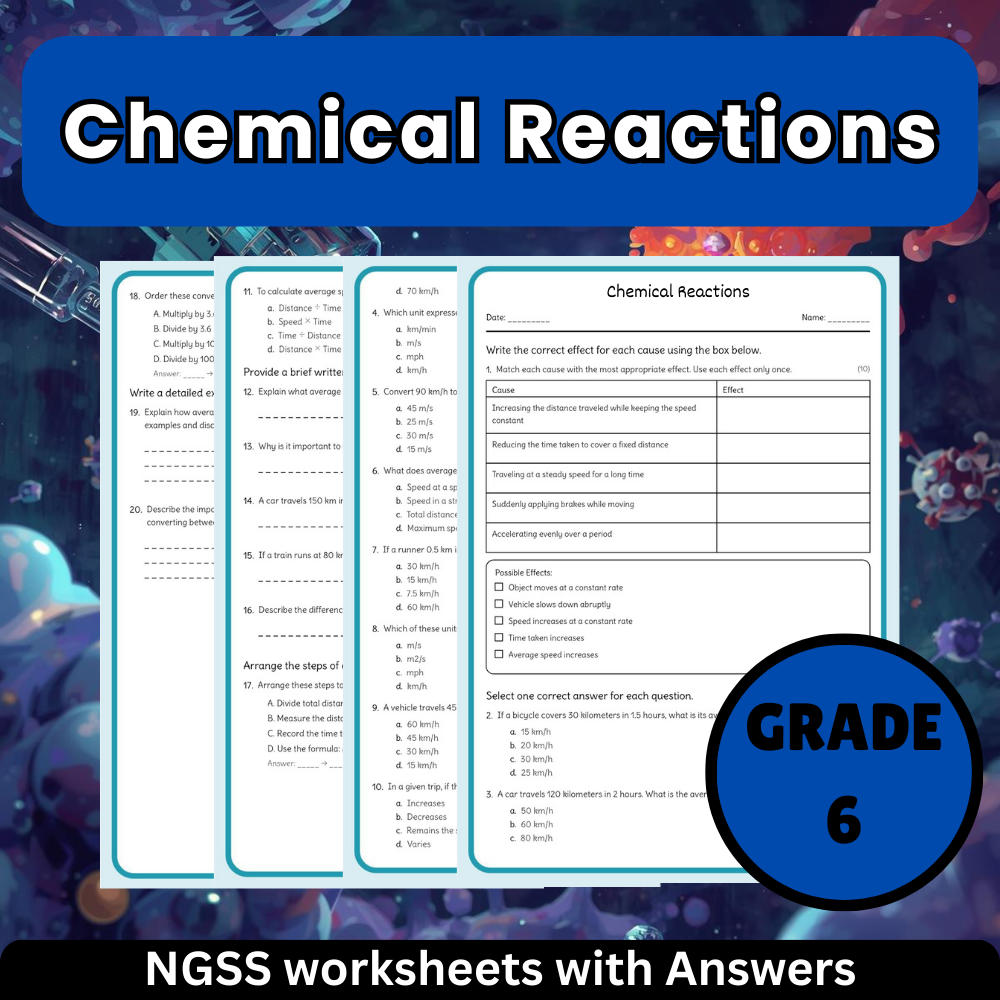
Grade 6 Science | Chemical Reactions Worksheet (NGSS Aligned & Answer Key)
Created byBright Mind ResourcesLearning Objectives
- Identify criteria that indicate a chemical reaction has occurred using qualitative data.
- Analyze quantitative data such as mass and temperature changes to determine if new substances are formed.
- Interpret indicators like color change, gas evolution, precipitate formation, and temperature change in chemical reactions.
Also included in: Grade 6 Science Unit Bundle | Chemical Reactions & Atomic Structure - NGSS +2 more
Instant download
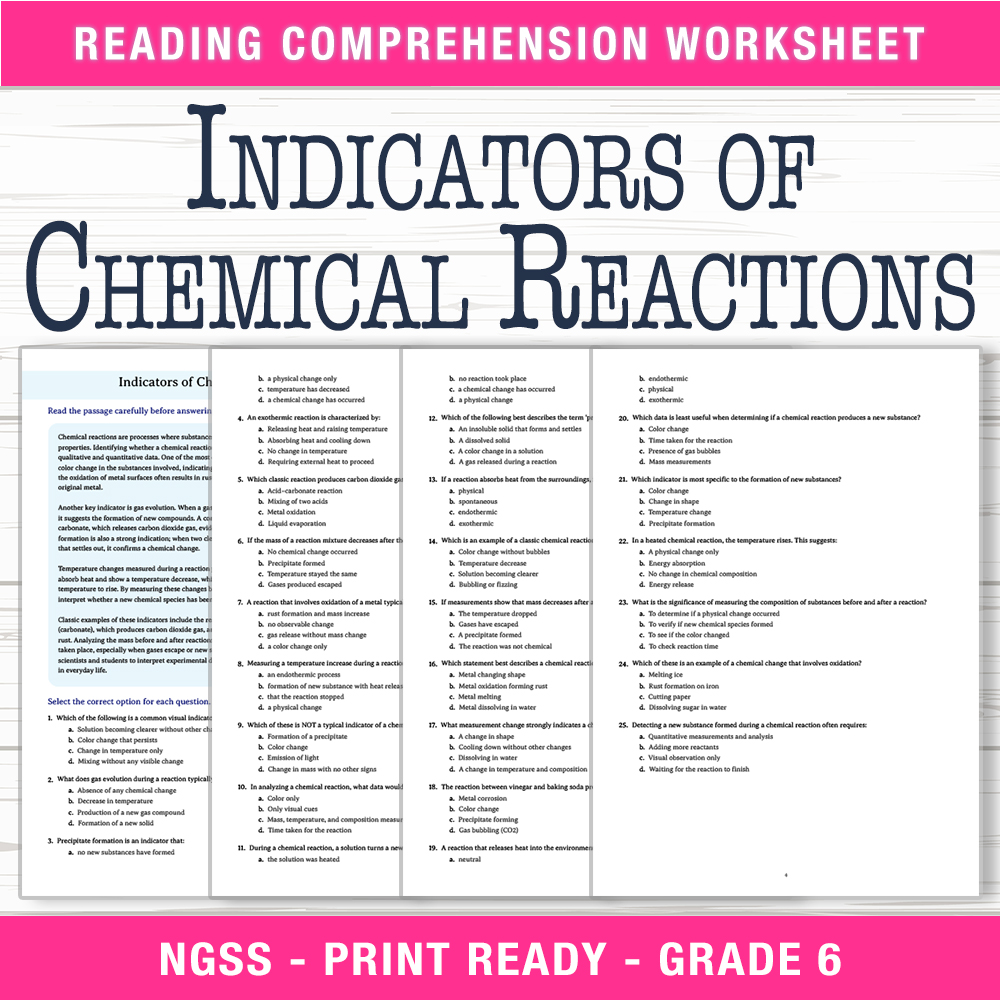
Grade 6 Science | Indicators of Chemical Reactions Workbook (PDF +Answer Key)
 Created byRiverstone Classroom
Learning Objectives
- Identify key indicators that suggest a chemical reaction has occurred.
- Analyze qualitative and quantitative data to determine if a new substance has formed.
- Interpret measurements such as mass, temperature, and composition before and after reactions.
Instant download
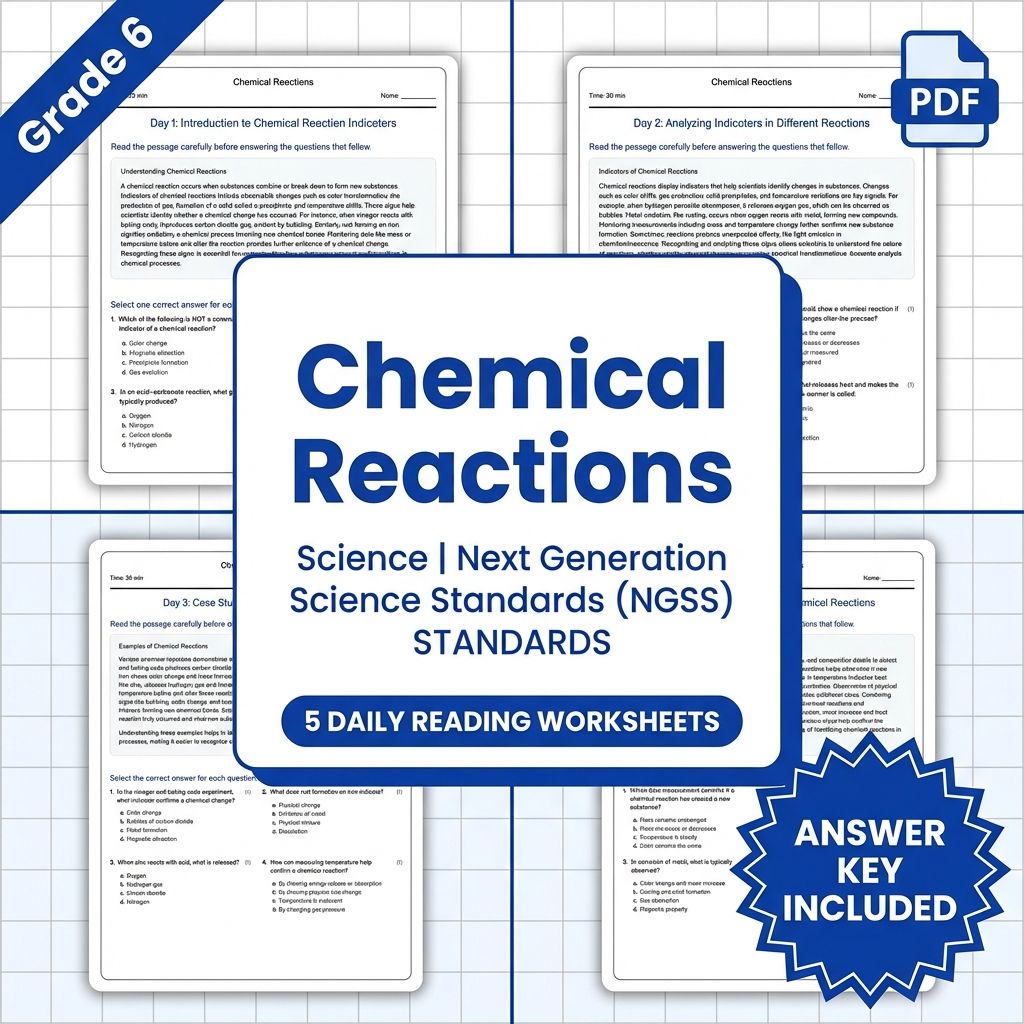
Grade 6 Science –Chemical Reaction Indicators Worksheet (PDF+ Answer Key)
Created byCopper Leaf ClassroomLearning Objectives
- Identify key indicators that suggest a chemical reaction is occurring.
- Analyze qualitative and quantitative data to determine if a new substance has formed.
- Understand classic examples such as acid–carbonate reactions and metal oxidation.
Instant download

Grade 6 Chemical Reactions Worksheet | NGSS Physical Science Activity
Created byBRIGHT PATH RESOURCESLearning Objectives
- Identify indicators that suggest a chemical reaction is occurring.
- Analyze qualitative data such as color change, gas evolution, and precipitate formation.
- Interpret quantitative measurements like temperature and mass changes to determine chemical reactions.
Also included in: Matter and Its Interactions Grade 6 Science Lesson Bundle | NGSS +2 more
Instant download
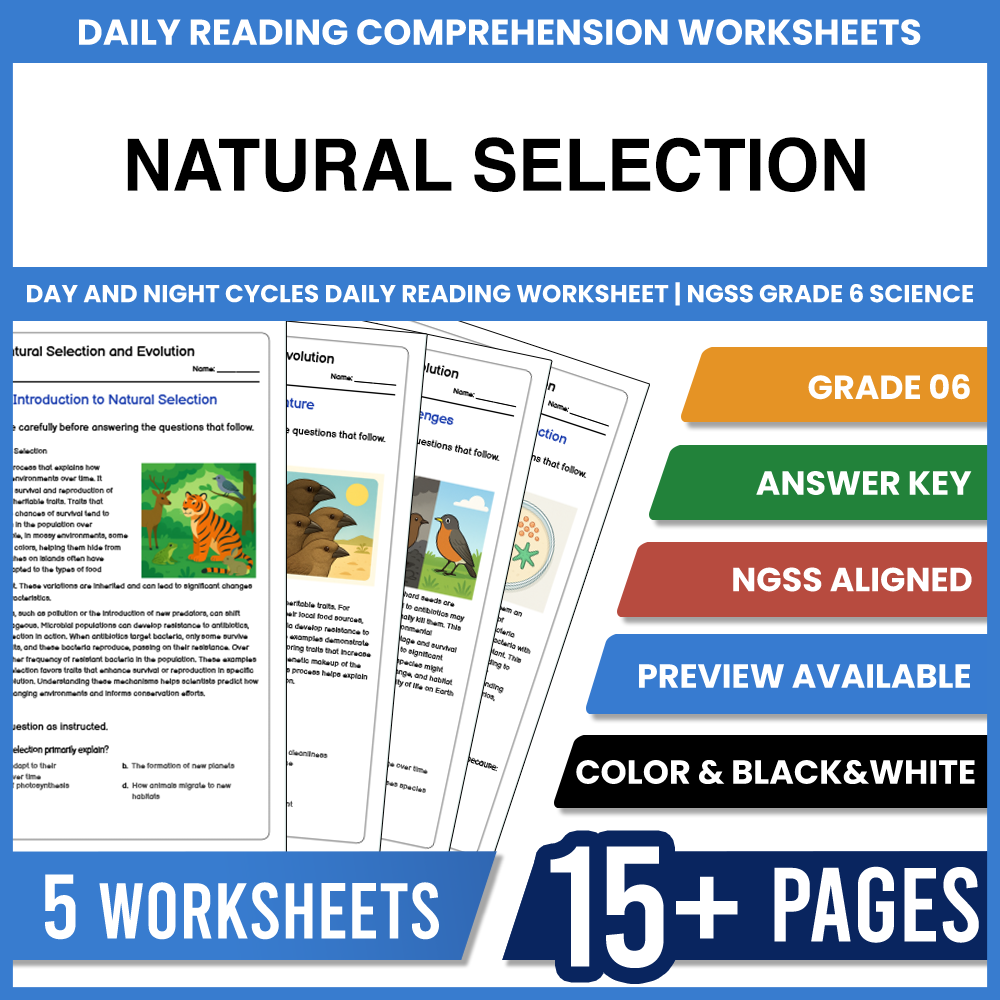
Grade 6 Science – Chemical Reactions & NGSS Daily Reading Worksheet
 Created byElena Brooks
Learning Objectives
- Identify key indicators of chemical reactions such as color change, gas evolution, precipitate formation, and temperature change.
- Analyze qualitative and quantitative data to determine if a chemical reaction has occurred.
- Understand basic examples of chemical reactions like acid–carbonate reactions and metal oxidation.
Also included in: Grade 6 Science Matter and Its Interactions Lesson Bundle | NGSS +1 more
Instant download

Grade 6 Science | Chemical Reactions - Daily Reading Comprehension Practice
Created byCoral Reef LearningLearning Objectives
- Identify indicators of chemical reactions such as color change, gas evolution, precipitates, and temperature change.
- Analyze qualitative and quantitative data to determine if a chemical reaction has occurred.
- Understand classic examples of chemical reactions like acid–carbonate reactions and metal oxidation.
Instant download

Grade 6 Chemical Reactions Worksheet | Practice & Assessment PDF
Created byClear Sky ClassroomLearning Objectives
- Identify key indicators that signify a chemical reaction through analysis of qualitative and quantitative data.
- Describe common examples and interpret pre- and post-interaction measurements to determine if a new substance has formed.
- Understand the significance of indicators such as color change, gas evolution, precipitate formation, and temperature change in chemical reactions.
Also included in: Grade 6 Matter & Chemical Reactions Science Lesson Bundle—NGSS Worksheets +1 more
Instant download

Chemical Reactions Indicators of New Substances Worksheet | NGSS Grade 6 Science
 Created bySkylark Worksheets
Learning Objectives
- Identify evidence of chemical reactions using qualitative indicators such as color change, gas formation, and precipitate formation.
- Use quantitative data (mass, temperature, and measurements of reactants/products) to determine whether a new substance forms.
- Interpret before-and-after observations from common reactions such as acid–carbonate reactions and metal oxidation.
Also included in: Grade 6 Matter and Chemical Reactions Science Lesson Bundle NGSS Worksheets +1 more
Instant download
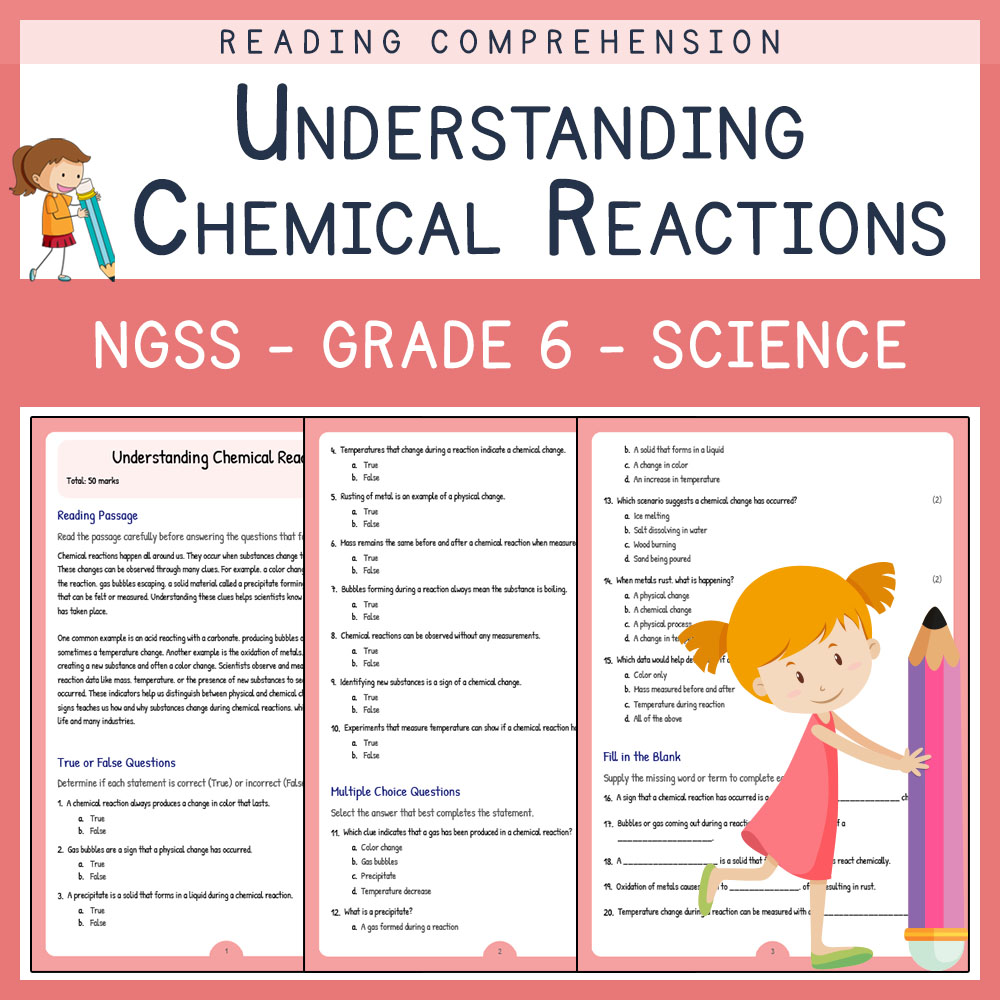
Grade 6 Science | Chemical Reactions Worksheet (PDF) | NGSS Aligned
 Created byLumora Learning
Learning Objectives
- Identify observable signs that indicate a chemical reaction has occurred.
- Analyze pre- and post-reaction data to determine if a new substance has formed.
- Describe examples of chemical reactions, such as acid–carbonate reactions and metal oxidation.
Instant download
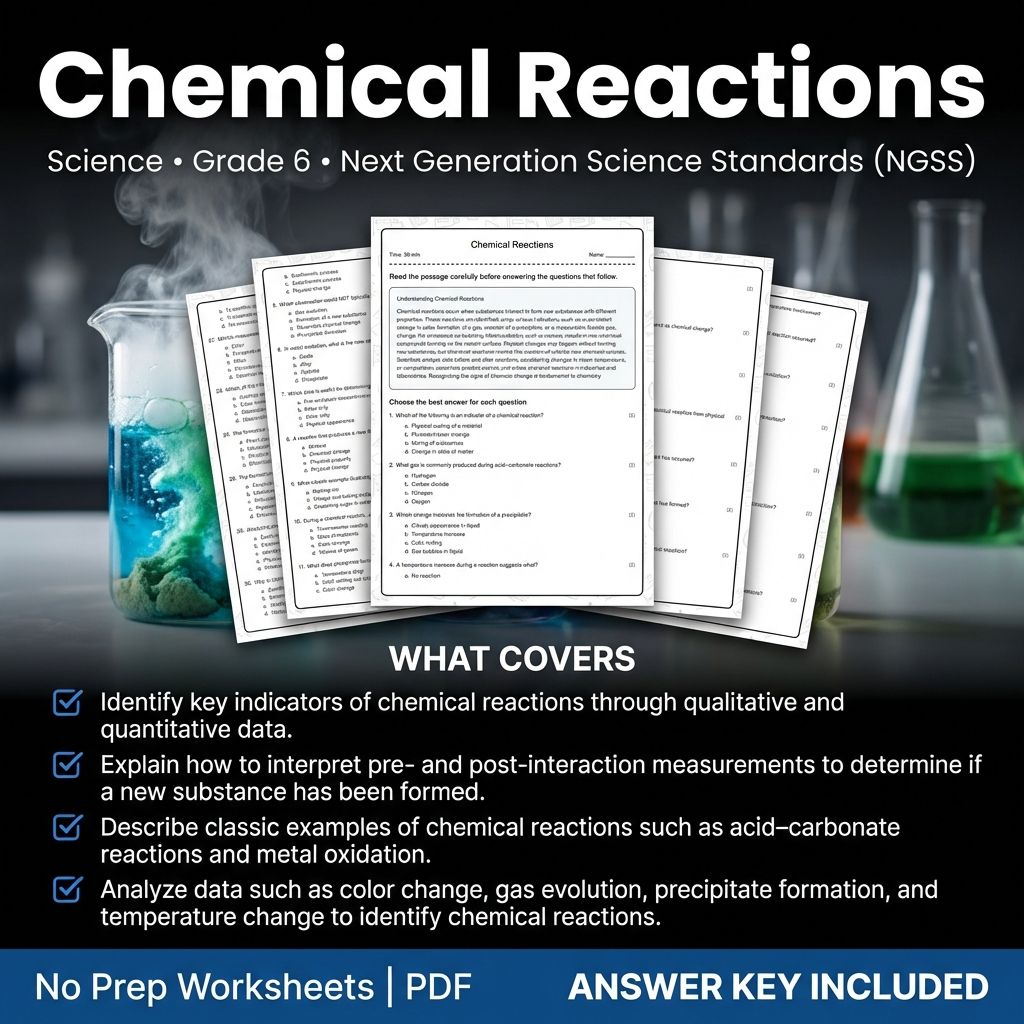
6th Grade Science | Chemical Reactions Worksheet & Answer Key (Printable PDF)
Created byCoral Reef LearningLearning Objectives
- Identify key indicators of chemical reactions through qualitative and quantitative data.
- Explain how to interpret pre- and post-interaction measurements to determine if a new substance has been formed.
- Describe classic examples of chemical reactions such as acid–carbonate reactions and metal oxidation.
Instant download
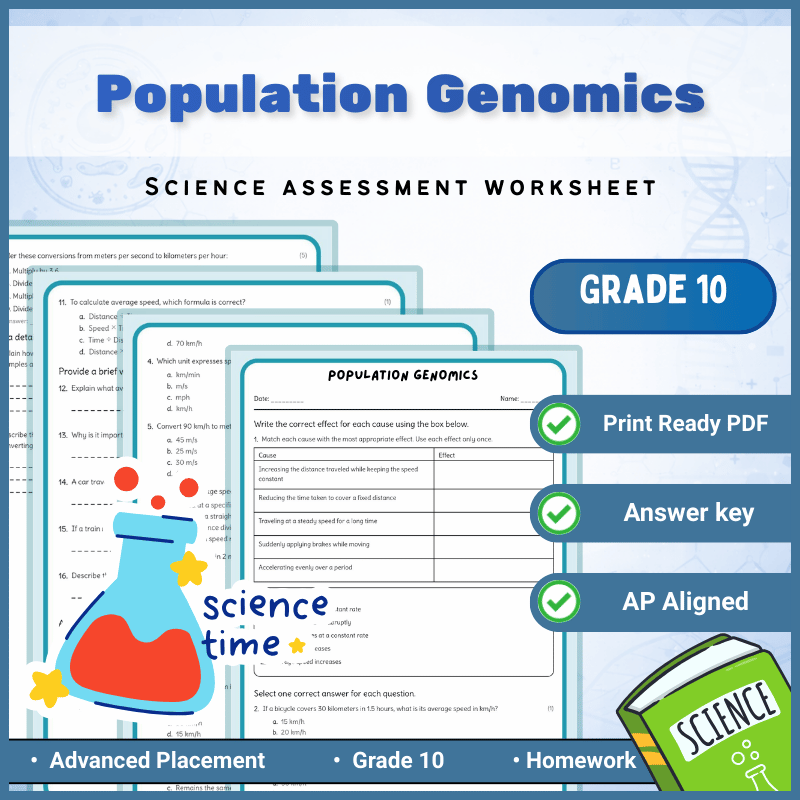
Grade 10 Science | Population Genomics AP Worksheet (PDF) with Answer Key
Created byBright Mind ResourcesLearning Objectives
- Understand how molecular variation contributes to population diversity.
- Analyze how mutation, gene flow, selection, and drift shape genomes.
- Interpret sequence-based evidence to infer population history and adaptation.
Instant download

Grade 10 AP Science Population Genomics Worksheet | Practice Pack
 Created byPrism Point Learning
Learning Objectives
- Explain how mutation, gene flow, selection, and genetic drift influence allele frequencies in populations
- Interpret population-genomic data using allele-frequency models and representations of population structure
- Describe how phylogenetic inference uses sequence variation to infer evolutionary and demographic history
Also included in: Grade 10 AP Science Life Systems Lesson Bundle | Worksheet Pack
Instant download

Grade 10 Science | Population Genomics Worksheet (AP Standards) (PDF)
 Created byEvergreen Desk Education
Learning Objectives
- Explain how allele frequency models connect molecular variation to population-level patterns in evolution.
- Describe how mutation, gene flow, selection, and genetic drift shape genomic diversity and allele frequencies.
- Interpret population structure and phylogenetic evidence from sequence data to infer evolutionary and demographic histories.
Also included in: Grade 10 Genetics & Cell Systems Science Lesson Bundle – Advanced Placement (AP) +1 more
Instant download

Grade 10 Science | Population Genomics Worksheet | AP Aligned
Created byLumora LearningLearning Objectives
- Understand how molecular variation relates to population-level patterns using allele frequency models.
- Describe how mutation, gene flow, selection, and drift influence genomic diversity.
- Interpret sequence-based evidence to connect molecular mechanisms with population processes and evolutionary trajectories.
Also included in: Grade 10 Science | Biology and Ecosystems Custom Bundle | AP
Instant download

Grade 10 Population Genomics Worksheet | AP Practice & PDF
Created byClear Sky ClassroomLearning Objectives
- Explain how allele frequency changes are shaped by mutation, genetic drift, gene flow, and natural selection
- Interpret how population structure and demographic history can be inferred from genomic data
- Use basic allele frequency and phylogenetic ideas to connect molecular variation to population-level patterns
Also included in: Grade 10 Population, Genetics, and Cellular Processes Science Lesson Bundle AP +1 more
Instant download
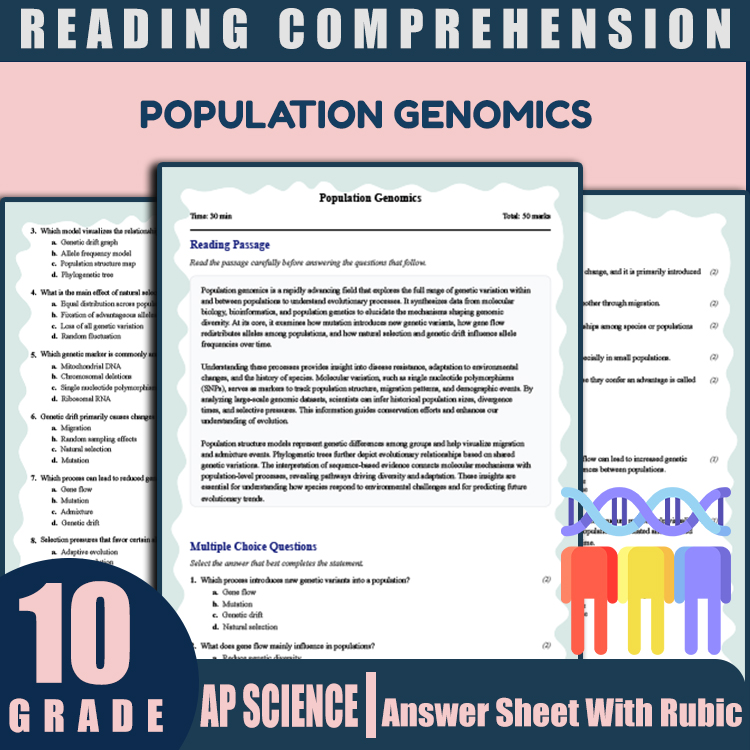
10th Grade Science | Population Genomics Reading Worksheet (PDF + Answer Key)
JCreated byJ.S SheetsLearning Objectives
- Understand how molecular variation contributes to population diversity.
- Interpret allele frequency models and their role in population structure.
- Describe the processes of mutation, gene flow, selection, and genetic drift.
Also included in: Grade 10 Science Unit | Cell Biology, Genetics, & Ecosystems Worksheet Pack +1 more
Instant download

States Overview Worksheet | TEKS-Aligned Science Practice for Grade 6
JCreated byJ.S SheetsLearning Objectives
- Compare solids, liquids, and gases using particle arrangement and relative particle motion.
- Relate macroscopic properties (shape retention and compressibility) to the state of matter.
- Use everyday examples such as ice, liquid water, and water vapor to explain differences in density and molecular spacing.
Instant download

6th Grade Science Worksheet – States of Matter TEKS (PDF)
Created byEvergreen Desk EducationLearning Objectives
- Compare solids, liquids, and gases using particle arrangement and relative motion.
- Describe macroscopic traits such as shape retention and compressibility for each state of matter.
- Use everyday examples (ice, liquid water, water vapor) to connect state changes with density and molecular spacing.
Instant download
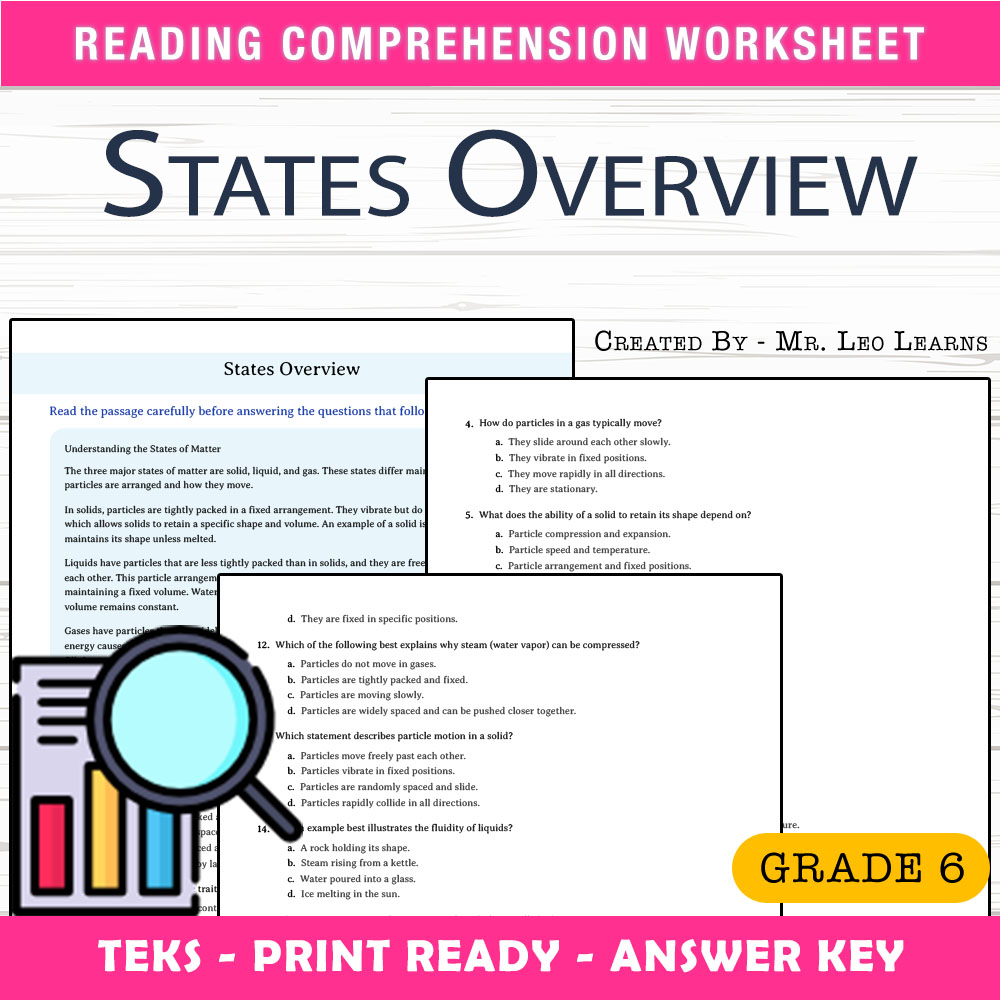
Grade 6 Science — States Overview Worksheet for Mastering States of Matter
 Created byThe Resource Hub
Learning Objectives
- Describe the differences between solid, liquid, and gas in terms of particle arrangement and movement.
- Identify everyday examples of each state of matter and explain their macroscopic traits.
- Understand the concept of phase transitions and how matter changes between states.
Also included in: Grade 6 Science Unit Bundle | States, Matter, Forces & Energy Mastery
Instant download

Grade 6 Science – States of Matter & Visuals | Daily Reading Worksheet
Created byBright Mind ResourcesLearning Objectives
- Understand key concepts related to Science
- Apply knowledge through practice questions
- Demonstrate comprehension of the material
Also included in: Matter & Energy Grade 6 Science Daily Reading Worksheets Bundle | TEKS +2 more
Instant download
6th Grade Science | States Overview Worksheet (PDF) Aligns with TEKS Standards
Created byBright Mind ResourcesLearning Objectives
- Describe the three main states of matter: solid, liquid, and gas
- Explain the differences in particle arrangement and motion in each state
- Contrast macroscopic traits such as shape retention and compressibility among states
Instant download
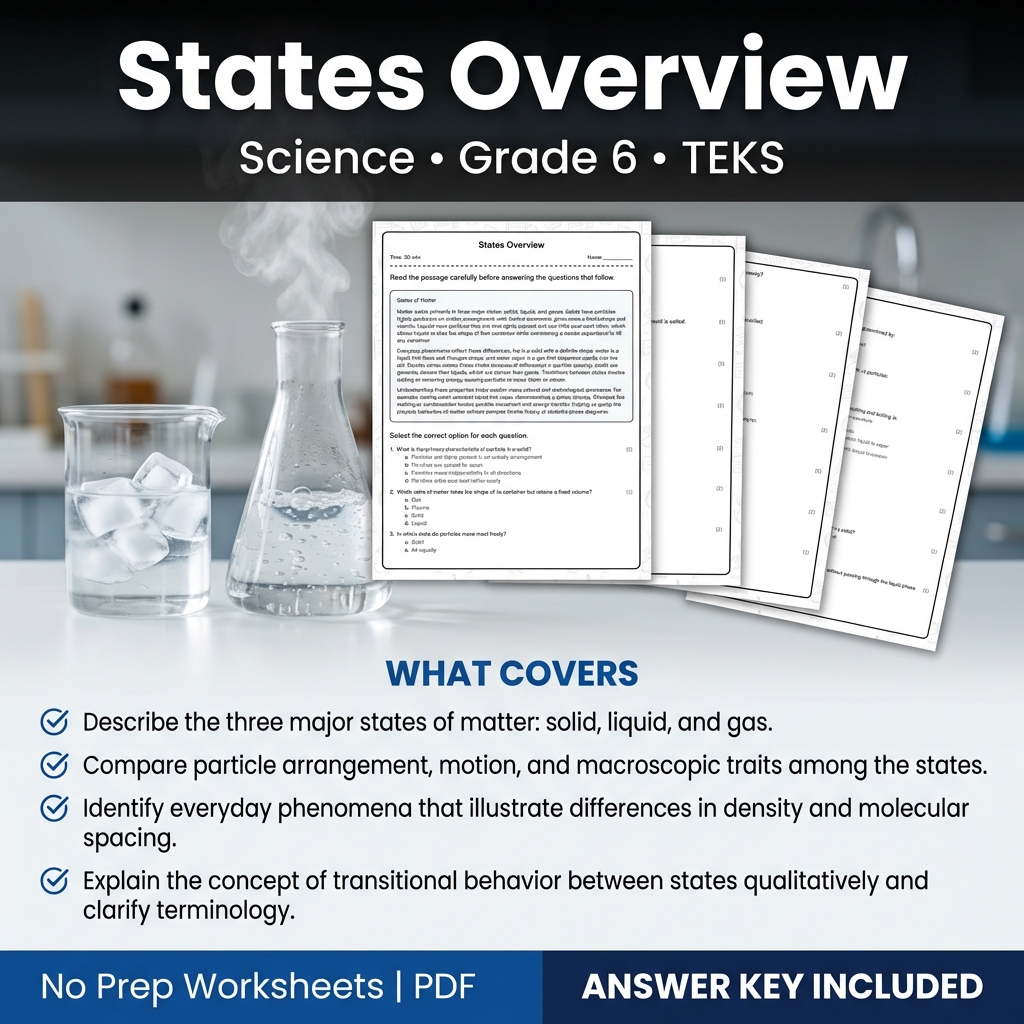
States Overview Science Worksheet Grade 6 TEKS | Printable PDF & Answer Key
Created byCoral Reef LearningLearning Objectives
- Describe the three major states of matter: solid, liquid, and gas.
- Compare particle arrangement, motion, and macroscopic traits among the states.
- Identify everyday phenomena that illustrate differences in density and molecular spacing.
Instant download
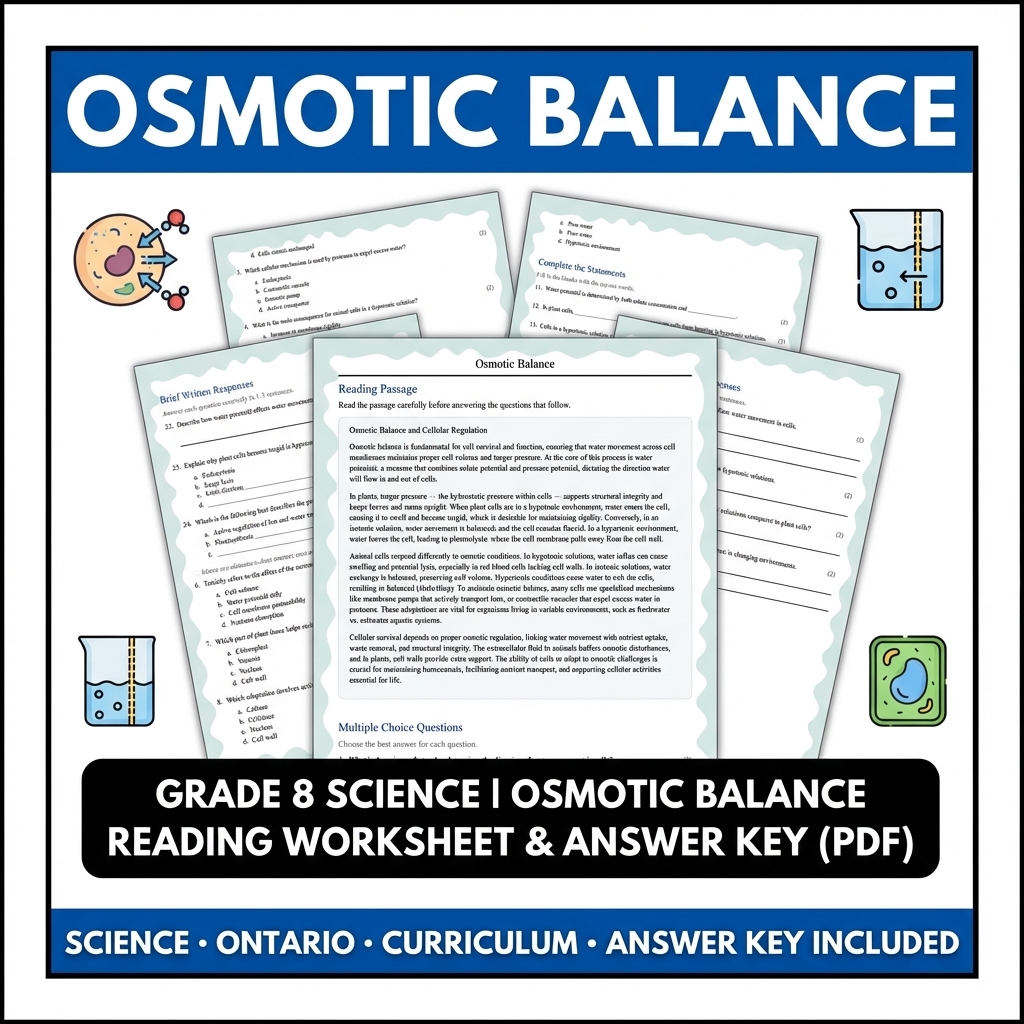
Grade 8 Science | Osmotic Balance Reading Worksheet & Answer Key (PDF)
JCreated byJ.S SheetsLearning Objectives
- Explain the principles of water potential and tonicity in cells.
- Differentiate between hypotonic, isotonic, and hypertonic environments.
- Describe cellular responses to osmotic changes in plant and animal cells.
Also included in: Grade 8 Science Unit Bundle – Cell Structure & Function (Answer Keys Included) +1 more
Instant download

Osmotic Balance Worksheet | Grade 8 Science Assessment Practice Ontario
Created byPrism Point LearningLearning Objectives
- Explain how water potential affects the movement of water across cell membranes
- Compare the effects of hypotonic, isotonic, and hypertonic solutions on plant and animal cells
- Describe how cells maintain volume and turgor pressure using osmoregulatory mechanisms
Also included in: Grade 8 Cell Organization & Homeostasis Science lesson bundle: Ontario
Instant download
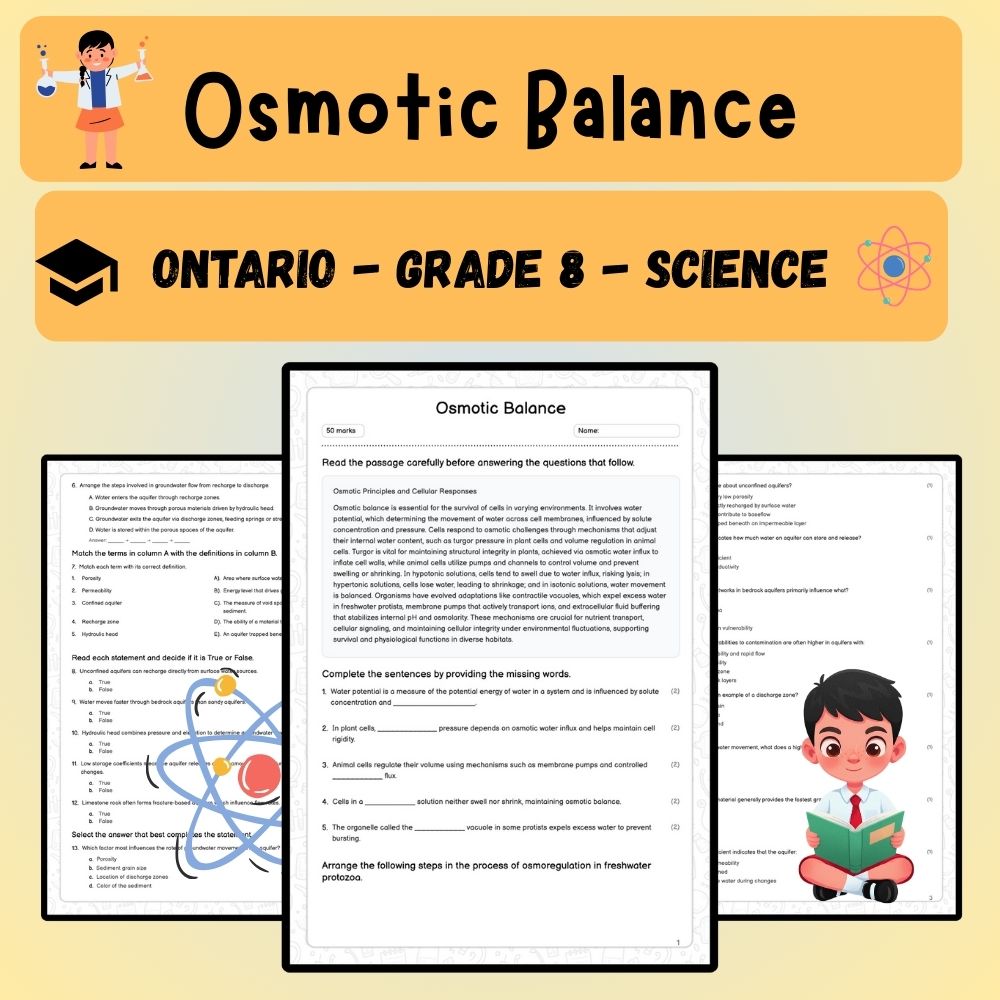
Grade 8 Science | Osmotic Balance Worksheet (PDF) – Ontario Standards
Created byPrism Point LearningLearning Objectives
- Understand the principles of osmotic pressure and water potential in cells.
- Explain cellular responses to hypotonic, isotonic, and hypertonic environments.
- Describe mechanisms like contractile vacuoles, membrane pumps, and extracellular fluid buffering in osmoregulation.
Also included in: Grade 8 Science Unit Bundle | Cell Structure & Function Worksheets +1 more
Instant download
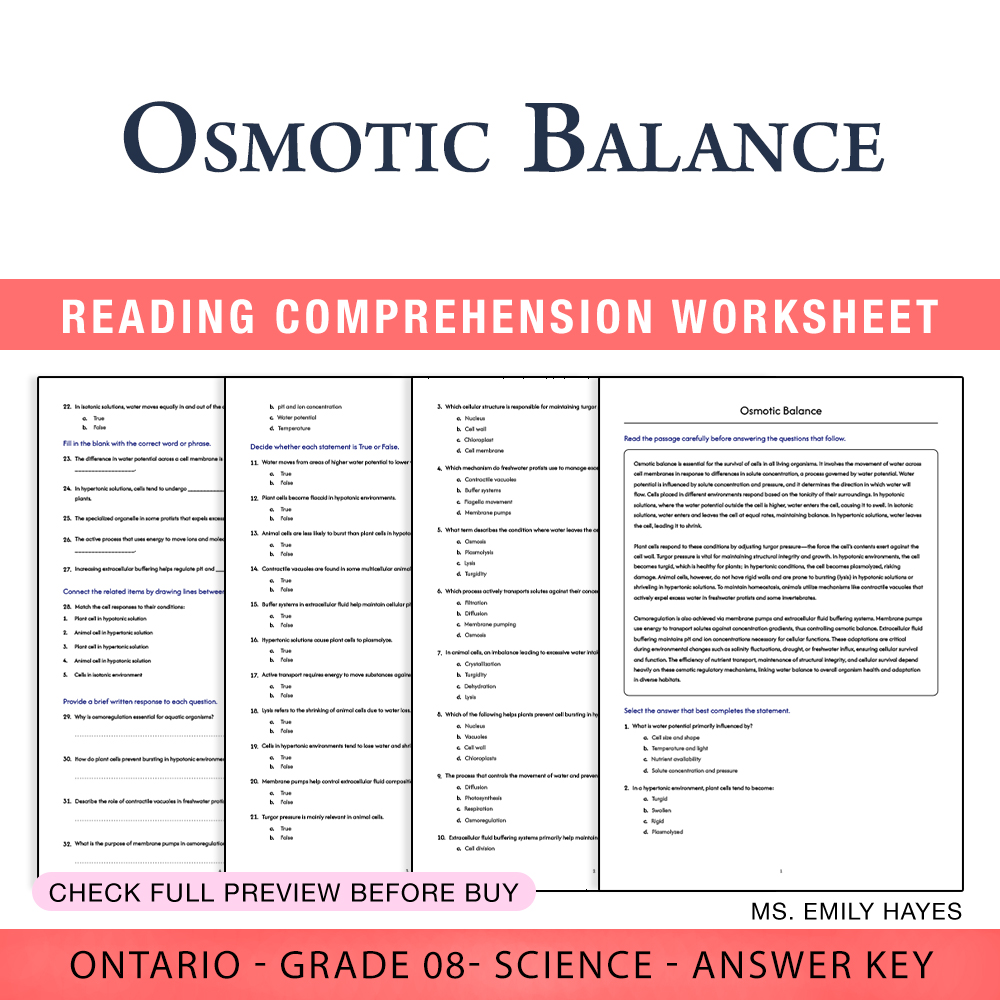
8th Grade Science | Osmotic Balance Worksheet (PDF+ Answer Key)
Created byCopper Leaf ClassroomLearning Objectives
- Understand the principles of water potential and tonicity in cells
- Describe cellular responses to hypotonic, isotonic, and hypertonic environments
- Compare mechanisms maintaining turgor in plant cells and volume in animal cells
Instant download

Grade 8 Science Worksheet on Osmotic Balance | Ontario Standards | Assessment
Created byLumora LearningLearning Objectives
- Explain the principles of osmotic water movement and its effects on cells
- Describe mechanisms that regulate cellular volume in plants and animals
- Identify adaptations like contractile vacuoles and membrane pumps involved in osmotic regulation
Instant download

Grade 8 Osmotic Balance Worksheet | Ontario Science Cells & Transport
Created byClear Sky ClassroomLearning Objectives
- Explain how water potential and tonicity determine the direction of water movement across cell membranes
- Compare how plant cells and animal cells respond to hypotonic, isotonic, and hypertonic environments
- Describe osmoregulatory adaptations (contractile vacuoles, membrane pumps, and buffering of extracellular fluid) and why they help cells survive
Instant download

Grade 8 Science | Understanding Osmotic Balance - Daily Reading Comprehension
Created byCoral Reef LearningLearning Objectives
- Define water potential and explain its role in osmotic regulation.
- Differentiate between hypotonic, isotonic, and hypertonic environments.
- Describe cellular responses to different osmotic conditions.
Instant download

Grade 8 Science – Osmosis & Water Potential | Daily Reading Worksheet
Created byBright Mind ResourcesLearning Objectives
- Understand the principles of osmosis and water potential in cellular contexts.
- Differentiate between hypotonic, isotonic, and hypertonic environments and their effects on cells.
- Describe mechanisms such as turgor pressure and volume control that cells use to maintain osmotic balance.
Also included in: Grade 8 Life Systems Science Daily Reading Worksheets Lesson Bundle | Ontario +1 more
Instant download
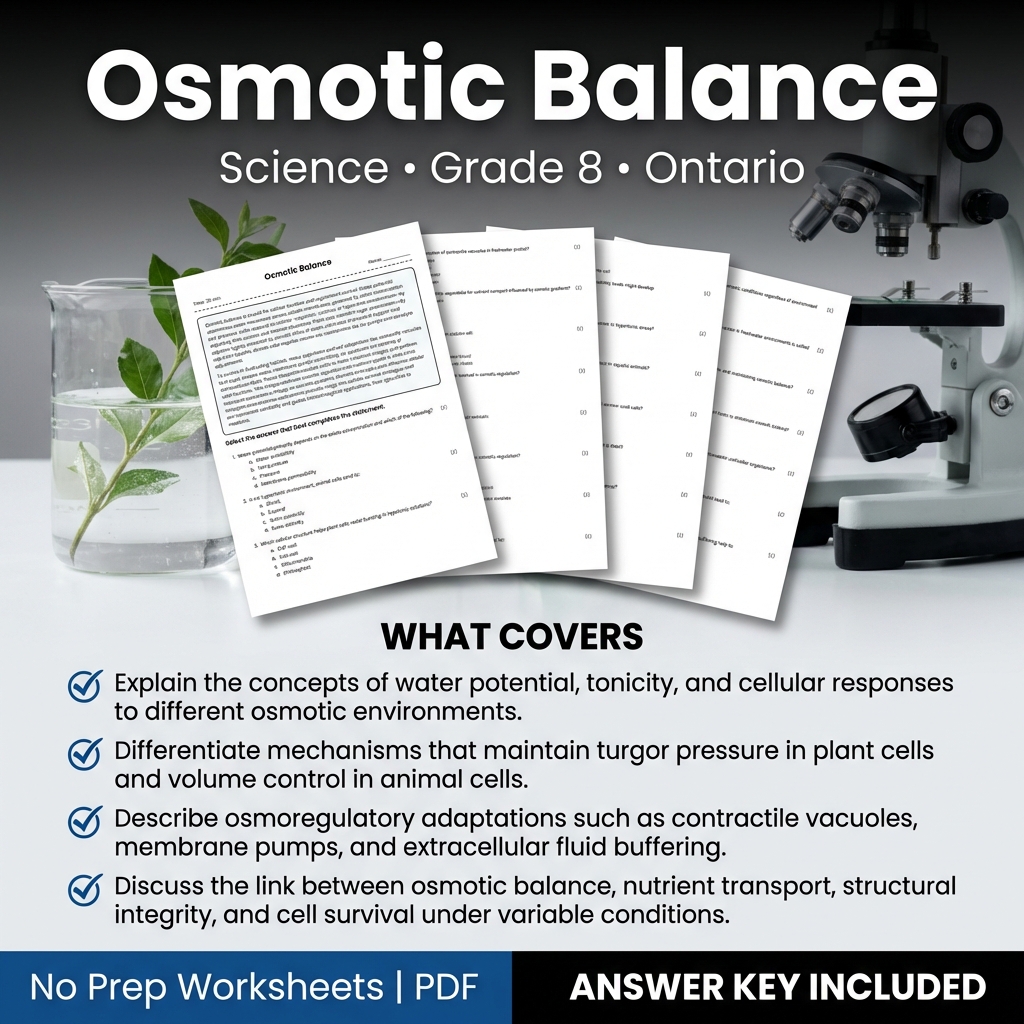
Grade 8 Science Worksheet on Osmotic Balance | Ontario Standards
Created byCoral Reef LearningLearning Objectives
- Explain the concepts of water potential, tonicity, and cellular responses to different osmotic environments.
- Differentiate mechanisms that maintain turgor pressure in plant cells and volume control in animal cells.
- Describe osmoregulatory adaptations such as contractile vacuoles, membrane pumps, and extracellular fluid buffering.
Instant download
Browse more categories
About Science Worksheets
Find Science worksheets spanning core skills, practice, and review. All 44,773 resources are instant PDF downloads for the classroom or home.
Every worksheet on MyTeachingSheets is created by independent teacher-authors and reviewed before publication. All resources download as printable PDFs for classroom, homework, or at-home practice, and many include answer keys. Preview any worksheet free before buying.