
Science Worksheets
45,024 subject resources
Biogeochemical Cycles Worksheet | NGSS-Aligned Grade 11 Science Practice
JCreated byJ.S SheetsLearning Objectives
- Understand the key processes involved in the carbon, nitrogen, and phosphorus cycles.
- Identify reservoirs and fluxes of matter within biogeochemical cycles.
- Analyze the impact of human activities on nutrient fluxes and reservoir balances.
Also included in: Grade 11 Earth Systems Modeling Science Lesson Bundle - NGSS Practice +1 more
Instant download

Grade 11 Worksheet B: Biogeochemical Cycles Practice | NGSS PDF
 Created byClear Sky Classroom
Learning Objectives
- Explain how matter moves among reservoirs in biogeochemical cycles using the language of flux and residence time
- Compare the key reservoirs and major flux pathways in the carbon, nitrogen, and phosphorus cycles
- Predict how natural processes and anthropogenic activities can change atmospheric composition and biosphere productivity
Also included in: Grade 11 Earth Systems Modeling Science Worksheet B Lesson Bundle NGSS +1 more
Instant download
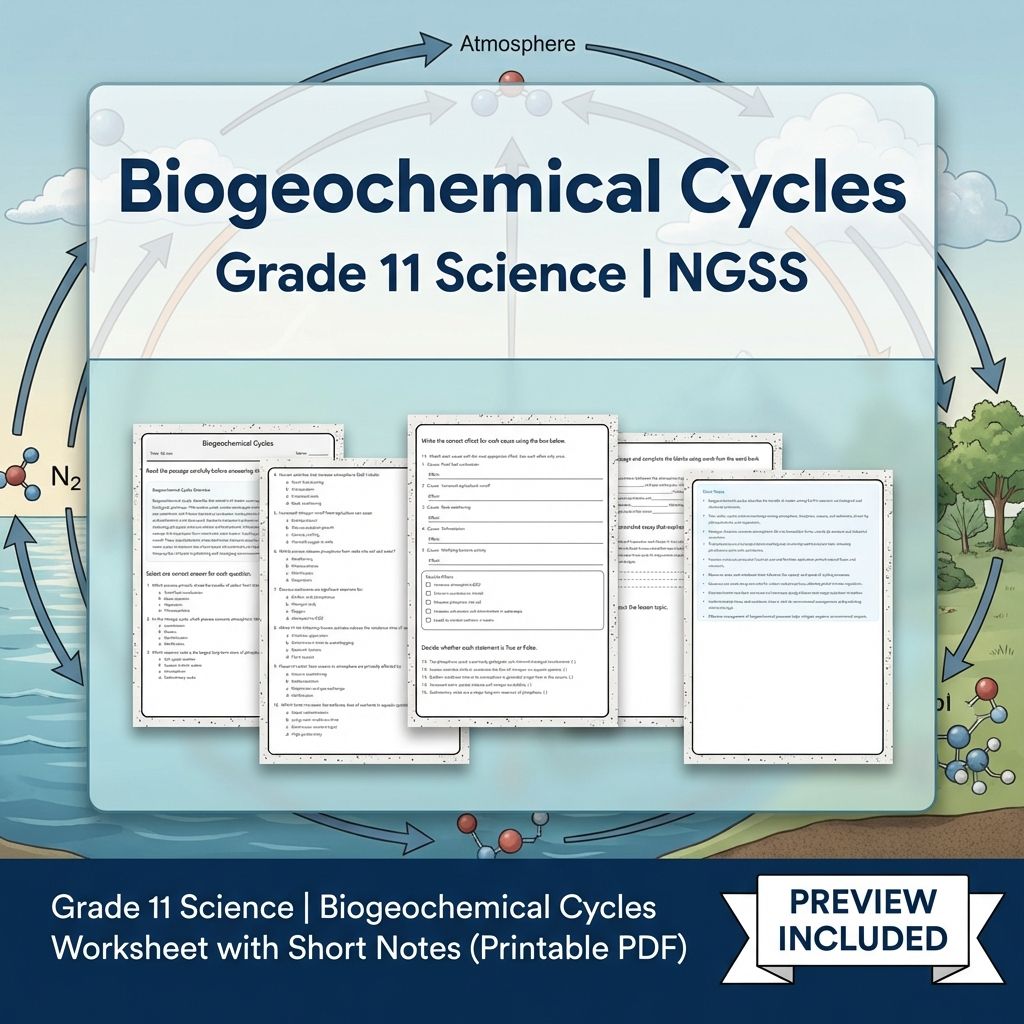
Grade 11 Science | Biogeochemical Cycles Worksheet with Short Notes (PDF)
 Created byMeadowlark Worksheets
Learning Objectives
- Describe the main reservoirs and fluxes involved in the carbon, nitrogen, and phosphorus cycles.
- Explain the importance of biogeochemical cycles in regulating atmospheric composition and biosphere productivity.
- Analyze human impacts such as fossil fuel combustion and fertilizer runoff on nutrient fluxes and reservoir balance.
Also included in: Grade 11 Science | Earth’s Systems NGSS Unit Bundle – Classroom-Ready Worksheets +1 more
Instant download

Grade 11 Science – Understanding the Carbon Cycle | Daily Reading Worksheet
 Created byBright Mind Resources
Learning Objectives
- Identify major reservoirs of carbon in the Earth's system.
- Describe fluxes of carbon between reservoirs.
- Explain human impacts on the carbon cycle.
Also included in: Earth Systems Grade 11 Science Daily Reading Worksheets Bundle | NGSS +2 more
Instant download

Biogeochemical Cycles Practice Test | Grade 11 Science
 Created byPrism Point Learning
Learning Objectives
- Explain how matter moves through reservoirs in the carbon, nitrogen, and phosphorus cycles using chemical and biological pathways.
- Compare major reservoirs and fluxes for terrestrial, freshwater, and marine settings, including how residence time affects atmospheric composition and productivity.
- Analyze how human activities perturb biogeochemical cycles and predict likely environmental consequences.
Instant download
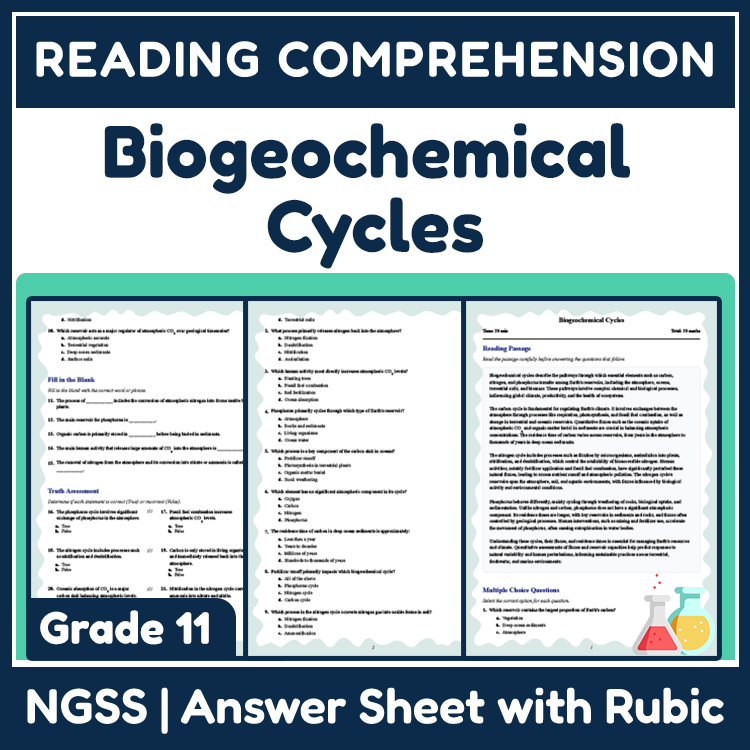
Grade 11 Science | Biogeochemical Cycles Reading Worksheet & Answer Key (PDF)
JCreated byJ.S SheetsLearning Objectives
- Understand the major biogeochemical cycles (carbon, nitrogen, phosphorus) and their reservoirs.
- Analyze the fluxes and residence times of key elements within different reservoirs.
- Evaluate the impact of natural processes and human activities on these cycles.
Also included in: Grade 11 Science | Ecosystems & Earth Systems Worksheet Bundle
Instant download
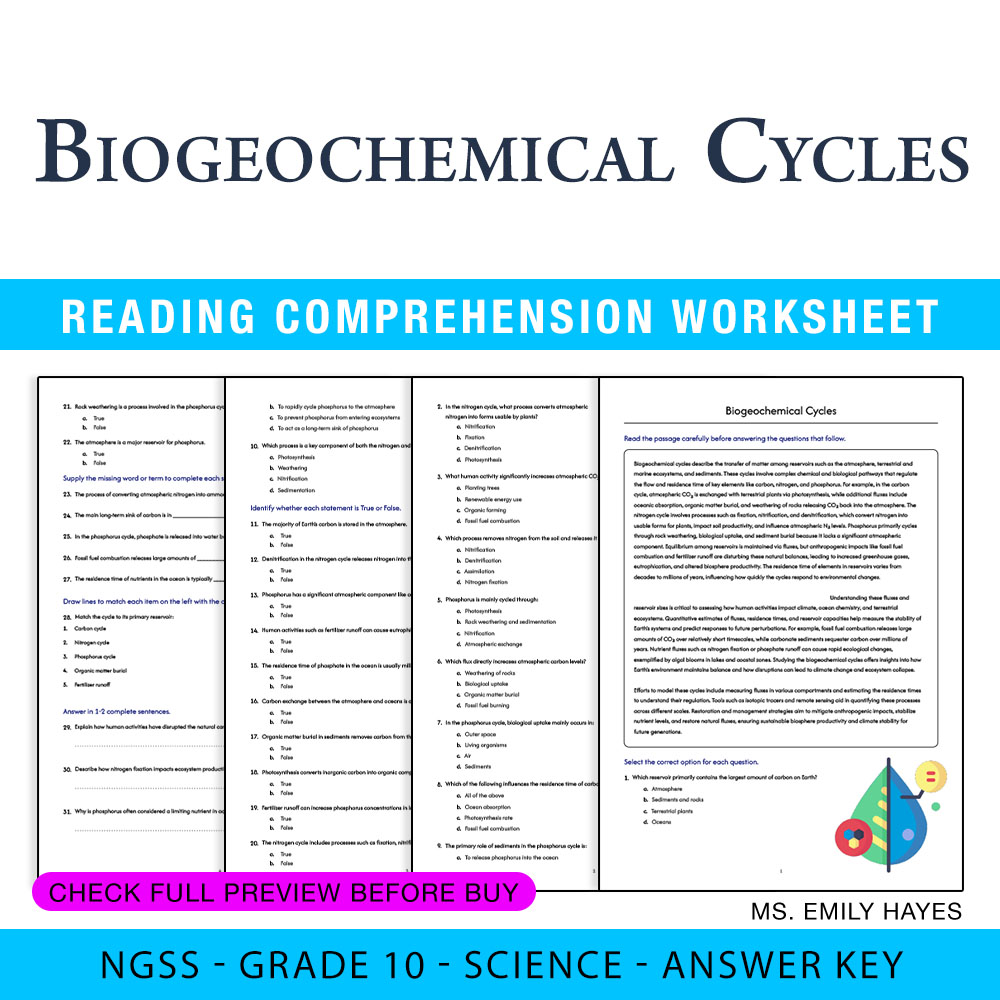
Grade 11 Science | Biogeochemical Cycles Worksheet (PDF+ Answer Key)
 Created byCopper Leaf Classroom
Learning Objectives
- Describe the main reservoirs and fluxes involved in the carbon, nitrogen, and phosphorus cycles.
- Explain how human activities perturb natural biogeochemical cycles.
- Calculate residence times of key reservoirs in biogeochemical cycles.
Instant download
Grade 11 Science | Biogeochemical Cycles Worksheet (Answer Key) – NGSS Aligned
Created byBright Mind ResourcesLearning Objectives
- Understand the pathways and reservoirs involved in carbon, nitrogen, and phosphorus cycles.
- Identify various fluxes and residence times within biogeochemical cycles.
- Explain the impact of natural and anthropogenic perturbations on nutrient cycles and atmospheric composition.
Instant download

Grade 11 Science | Biogeochemical Cycles - Daily Reading Comprehension
 Created byCoral Reef Learning
Learning Objectives
- Understand key concepts related to Science
- Apply knowledge through practice questions
- Demonstrate comprehension of the material
Instant download
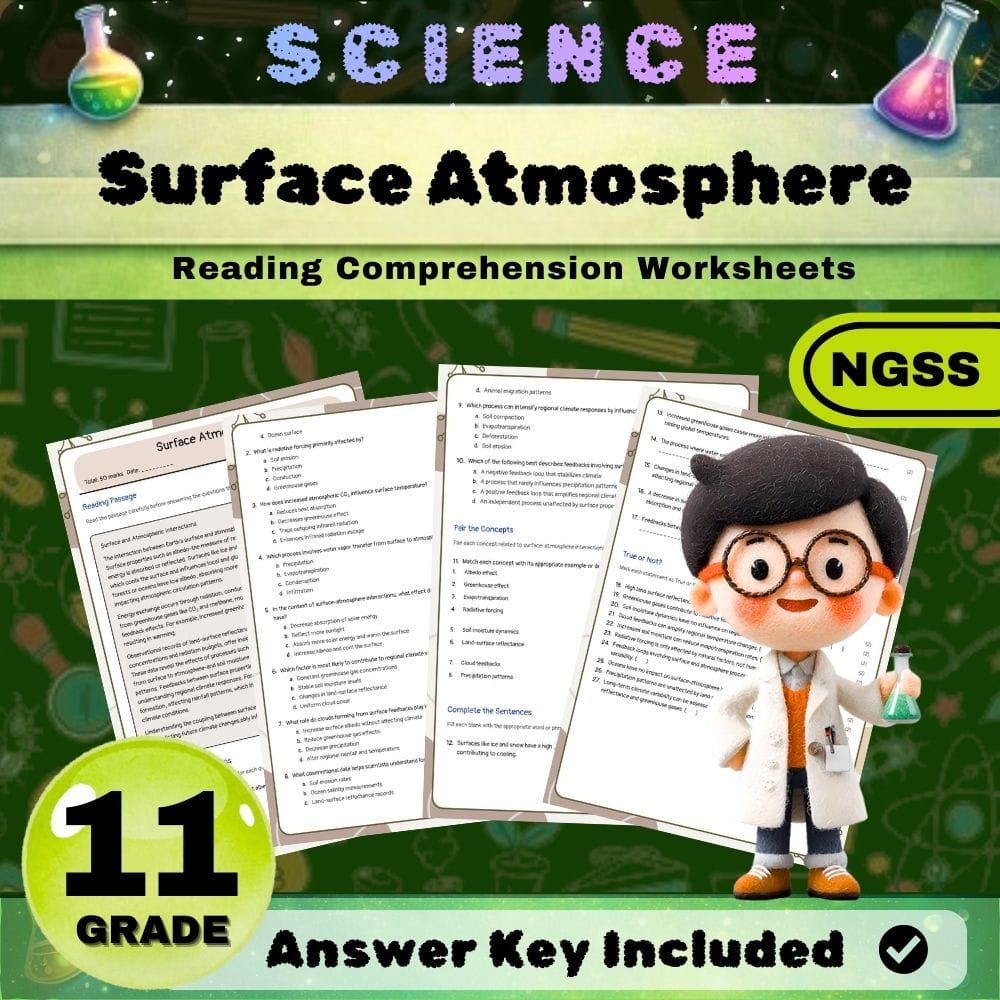
Grade 11 Science - Biogeochemical Cycles NGSS (Worksheet + Answer Key)
 Created byMaple Path Learning
Learning Objectives
- Describe the main reservoirs and fluxes involved in carbon, nitrogen, and phosphorus cycles.
- Explain how biological and chemical pathways transfer matter among reservoirs.
- Analyze the impact of human activities on biogeochemical cycles and climate regulation.
Also included in: Grade 11 Earth Systems Science Lesson Bundle – NGSS Modeling Worksheets +1 more
Instant download

Biogeochemical Cycles: Carbon, Nitrogen & Phosphorus Worksheets
 Created byTeachers Club
Learning Objectives
- Explain matter movement among carbon, nitrogen, and phosphorus reservoirs
- Identify major reservoirs and fluxes in biogeochemical cycles
- Interpret residence time and flux direction in cycle changes
Instant download
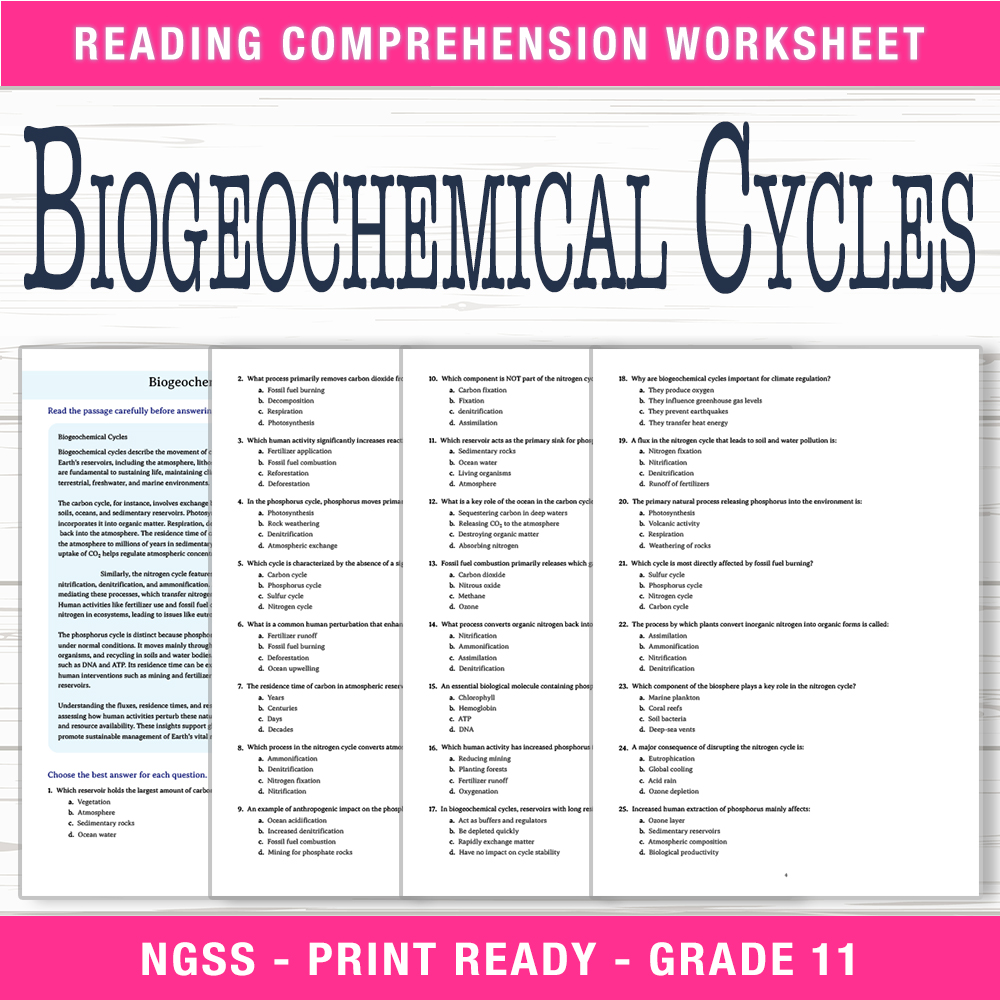
Grade 11 Science | Biogeochemical Cycles Worksheet (PDF + Answer Key)
 Created byRiverstone Classroom
Learning Objectives
- Describe the main reservoirs involved in the carbon, nitrogen, and phosphorus cycles.
- Explain the pathways and fluxes that transfer matter among reservoirs in biogeochemical cycles.
- Analyze the impact of human activities on biogeochemical cycles and their fluxes.
Instant download

Grade 11 Biogeochemical Cycles Worksheet | NGSS Earth Science Activity
 Created byBRIGHT PATH RESOURCES
Learning Objectives
- Understand the components and flow of the carbon cycle
- Identify reservoirs and fluxes involved in the carbon cycle
- Assess human impacts on the carbon cycle
Also included in: Earths Systems Lesson Bundle | Grade 11 Earth Science | NGSS +1 more
Instant download
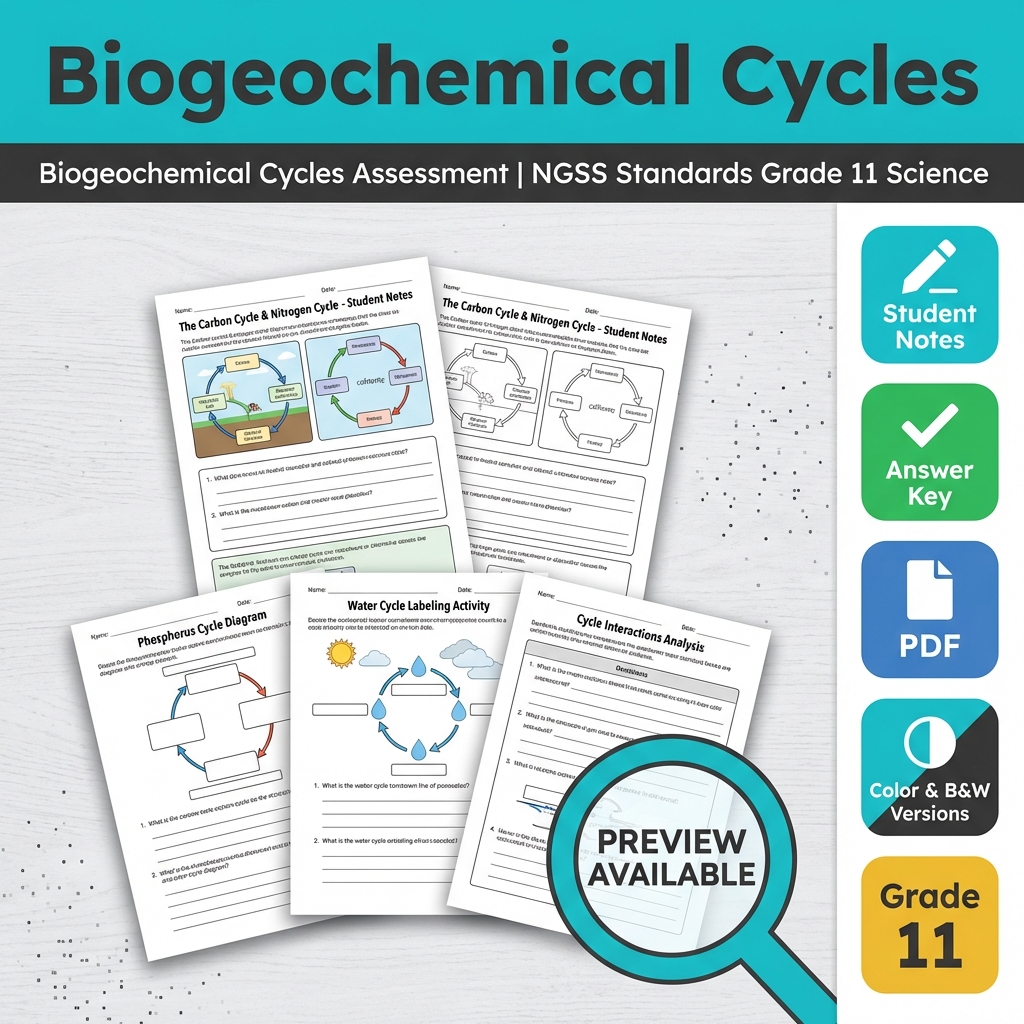
Biogeochemical Cycles Assessment | NGSS Standards Grade 11 Science
Created byPrism Point LearningLearning Objectives
- Understand the components and processes of carbon, nitrogen, and phosphorus cycles.
- Identify reservoirs and fluxes involved in biogeochemical cycles.
- Analyze the impact of human activities on nutrient cycling and reservoir balances.
Instant download

Biogeochemical Cycles Worksheet | NGSS Grade 11 Science MCQ Assessment
 Created byCedar Grove Learning
Learning Objectives
- Understand the pathways and reservoirs involved in the carbon, nitrogen, and phosphorus cycles.
- Analyze the fluxes and residence times of nutrients within different reservoirs.
- Evaluate the impact of human activities on biogeochemical cycles and atmospheric composition.
Instant download

Grade 3 Feeding Structures and Survival Worksheet | NGSS Practice PDF
Created byClear Sky ClassroomLearning Objectives
- Explain how different beaks, teeth, and mouthparts help animals get specific types of food.
- Describe how feeding structures support survival and growth in an animal’s habitat.
- Identify examples of how diet differences lead to different body structures for feeding.
Instant download

Grade 11 Science | Genetic Code - Daily Reading Comprehension
Created byCoral Reef LearningLearning Objectives
- Understand the molecular structure of DNA and RNA
- Learn base-pairing rules and how nucleic acids replicate
- Describe the processes of transcription and translation
Also included in: Biology and Ecosystems Lesson Bundle | Grade 11 Science AP +1 more
Instant download
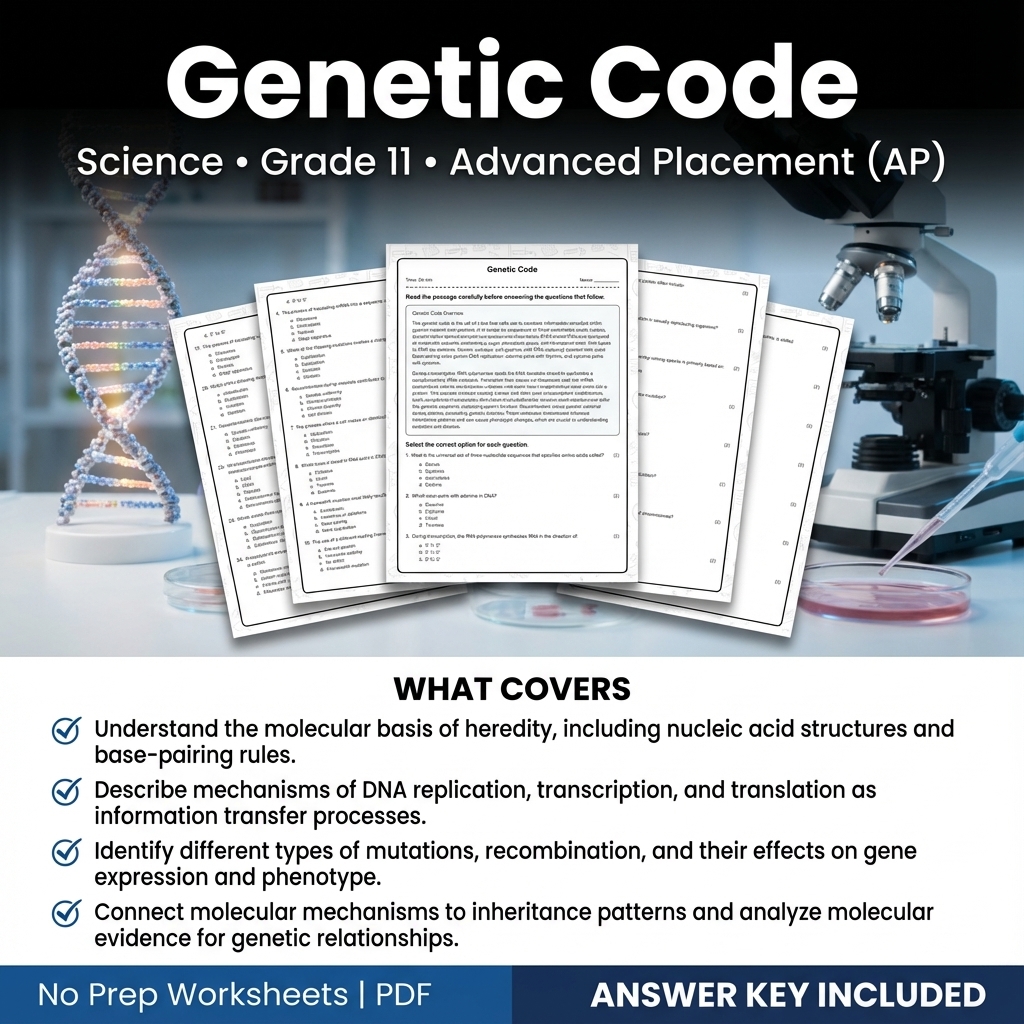
11th Grade Science | Genetic Code Worksheet (Printable PDF + Answer Key)
Created byCoral Reef LearningLearning Objectives
- Understand the molecular basis of heredity, including nucleic acid structures and base-pairing rules.
- Describe mechanisms of DNA replication, transcription, and translation as information transfer processes.
- Identify different types of mutations, recombination, and their effects on gene expression and phenotype.
Also included in: Grade 11 Science Unit Worksheet Bundle – Biological Systems & Molecular Concepts +1 more
Instant download

Grade 11 Science | Genetic Code Worksheet | AP Aligned
 Created byLumora Learning
Learning Objectives
- Describe the molecular basis of heredity, including nucleic acid structure and base-pairing rules.
- Explain mechanisms of DNA replication, transcription, and translation.
- Identify different types of mutations and their effects on gene expression.
Also included in: Grade 11 Science | Biology and Ecosystems Custom Bundle | AP Framework
Instant download

Grade 11 Science – Genetic Code & Molecular Biology | Daily Reading Worksheet
Created byBright Mind ResourcesLearning Objectives
- Understand the structure of DNA and RNA
- Describe the base-pairing rules in nucleic acids
- Explain the processes of transcription and translation
Also included in: Grade 11 Cell Organelle Science Daily Reading Worksheets Lesson Bundle | AP +2 more
Instant download

Genetic Code Worksheet | Grade 11 AP Biology Practice Activities
Created byPrism Point LearningLearning Objectives
- Explain how DNA base-pairing and nucleic acid structure support faithful information storage and inheritance.
- Describe how transcription and translation transfer genetic information using codons, reading frames, and genetic code rules.
- Analyze how mutations and recombination can change gene expression and phenotype.
Also included in: AP Biology Systems Integration Lesson Bundle: Grade 11 Science | AP
Instant download
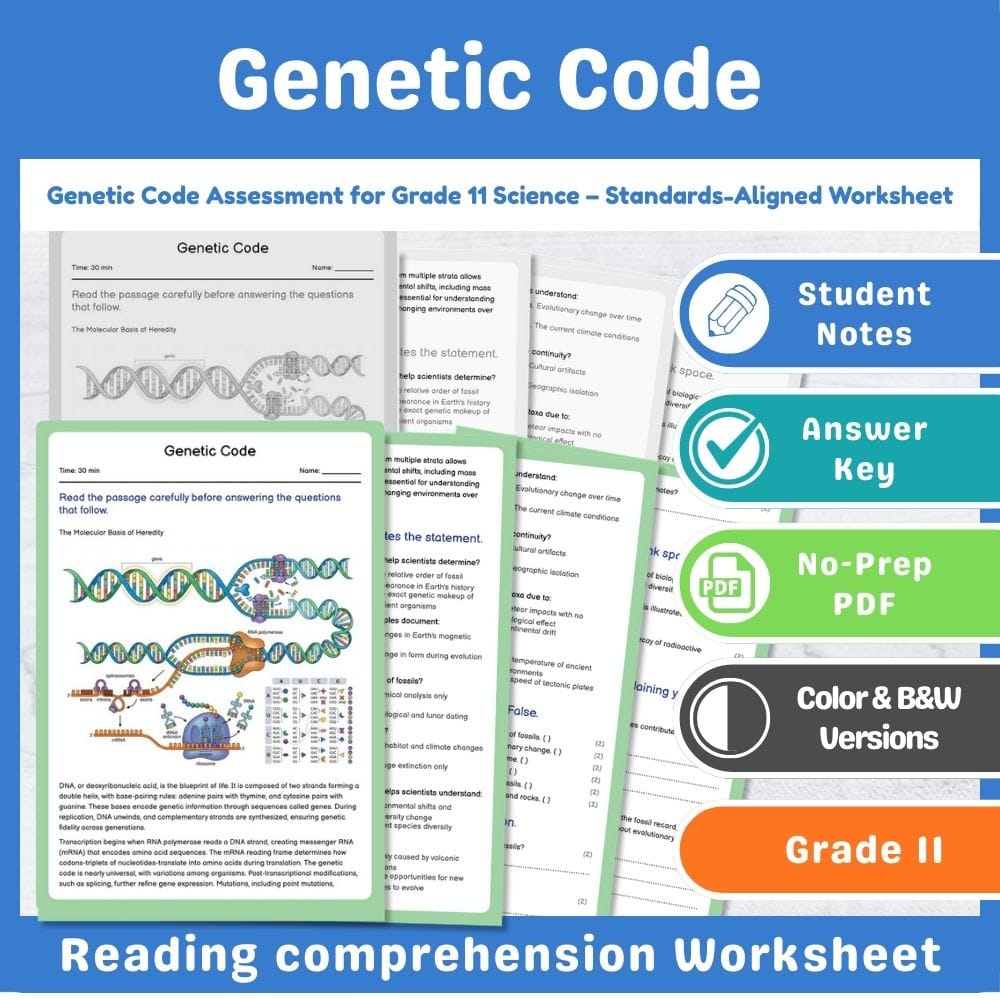
Genetic Code Assessment for Grade 11 Science – Standards-Aligned Worksheet
Created byPrism Point LearningLearning Objectives
- Understand the molecular basis of heredity through nucleic acid structure and base-pairing rules.
- Describe the processes of transcription and translation, including codon usage and reading frames.
- Identify mechanisms of mutation, recombination, and their effects on gene expression and phenotype.
Instant download
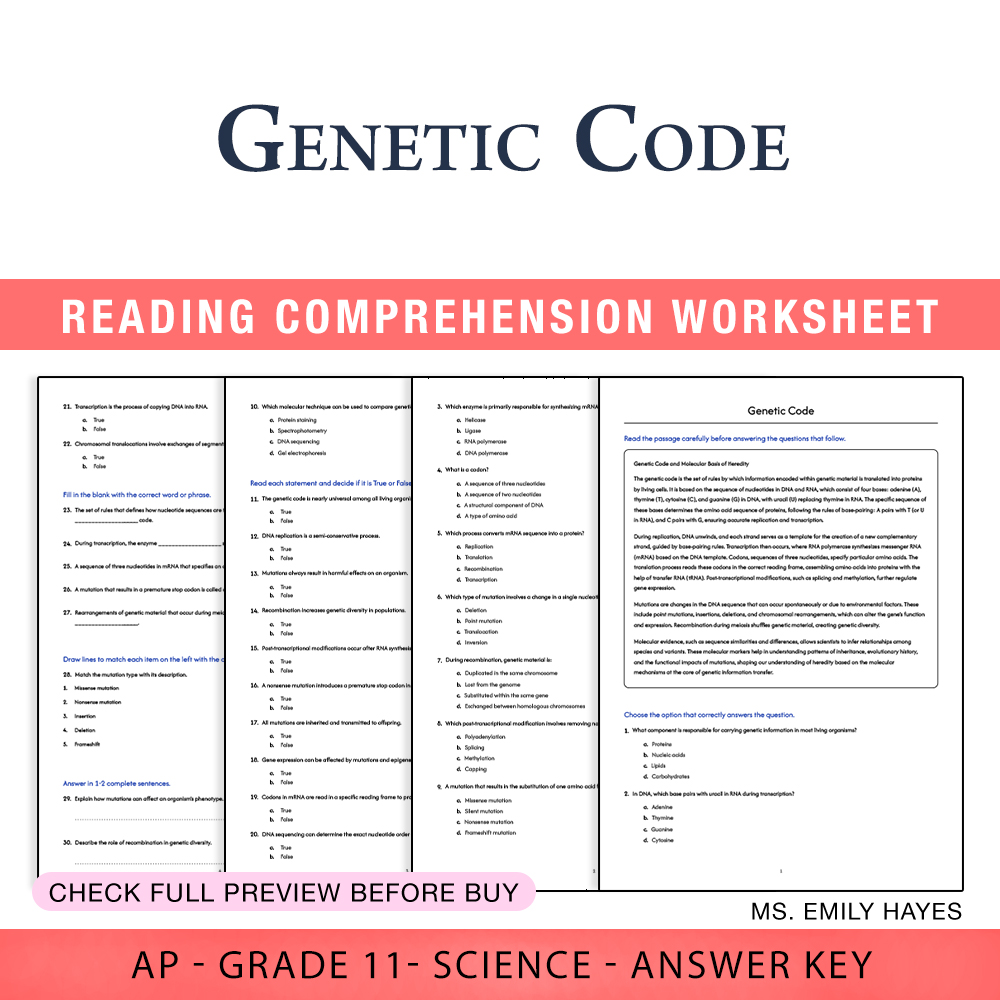
11th Grade Science | Genetic Code Worksheet (PDF+ Answer Key)
Created byCopper Leaf ClassroomLearning Objectives
- Understand the molecular basis of heredity including nucleic acid structure and base-pairing rules.
- Describe the processes of transcription and translation, including codon usage and reading frames.
- Identify different types of mutations and recombination and analyze their effects on gene expression and phenotype.
Also included in: Grade 11 Science | Biology & Ecosystems AP Worksheet Bundle (PDF+ Answer Keys) +1 more
Instant download

High School Biology | Genetic Code Worksheet (AP Standards) (PDF)
 Created byEvergreen Desk Education
Learning Objectives
- Explain how the structure of nucleic acids and base-pairing rules encode hereditary information
- Describe how DNA information is copied (replication), transferred (transcription), and converted to protein (translation)
- Evaluate how mutations, recombination, and reading frames can change gene expression and phenotype
Also included in: Grade 11 Biology and Ecosystems Science Lesson Bundle (AP) +1 more
Instant download
Grade 11 Science | Genetic Code Worksheet (AP Standard + Answer Key) (PDF)
Created byBright Mind ResourcesLearning Objectives
- Understand the molecular structure and base-pairing rules of nucleic acids.
- Describe the processes of transcription and translation in protein synthesis.
- Identify different mutation types and their effects on gene expression and phenotype.
Instant download

Grade 11 Genetic Code Worksheet | Practice & Assessment PDF
Created byClear Sky ClassroomLearning Objectives
- Explain how nucleic acid structure and base-pairing rules enable accurate DNA replication and heredity
- Describe transcription and translation as information-transfer processes, including codons, reading frames, and post-transcriptional RNA processing
- Analyze how mutations and recombination can change gene expression and phenotype
Also included in: Grade 11 Systems Integration and Genetics Science Lesson Bundle: AP +1 more
Instant download

11th Grade Science | Genetic Code Worksheet with Short Notes (Printable PDF)
Created byMeadowlark WorksheetsLearning Objectives
- Describe the molecular structure of nucleic acids and the base-pairing rules.
- Explain the processes of transcription and translation in gene expression.
- Identify and analyze different types of mutations and recombination events.
Also included in: Grade 11 Science | Biological Systems & Genetics Unit Worksheet Pack (PDF) +1 more
Instant download
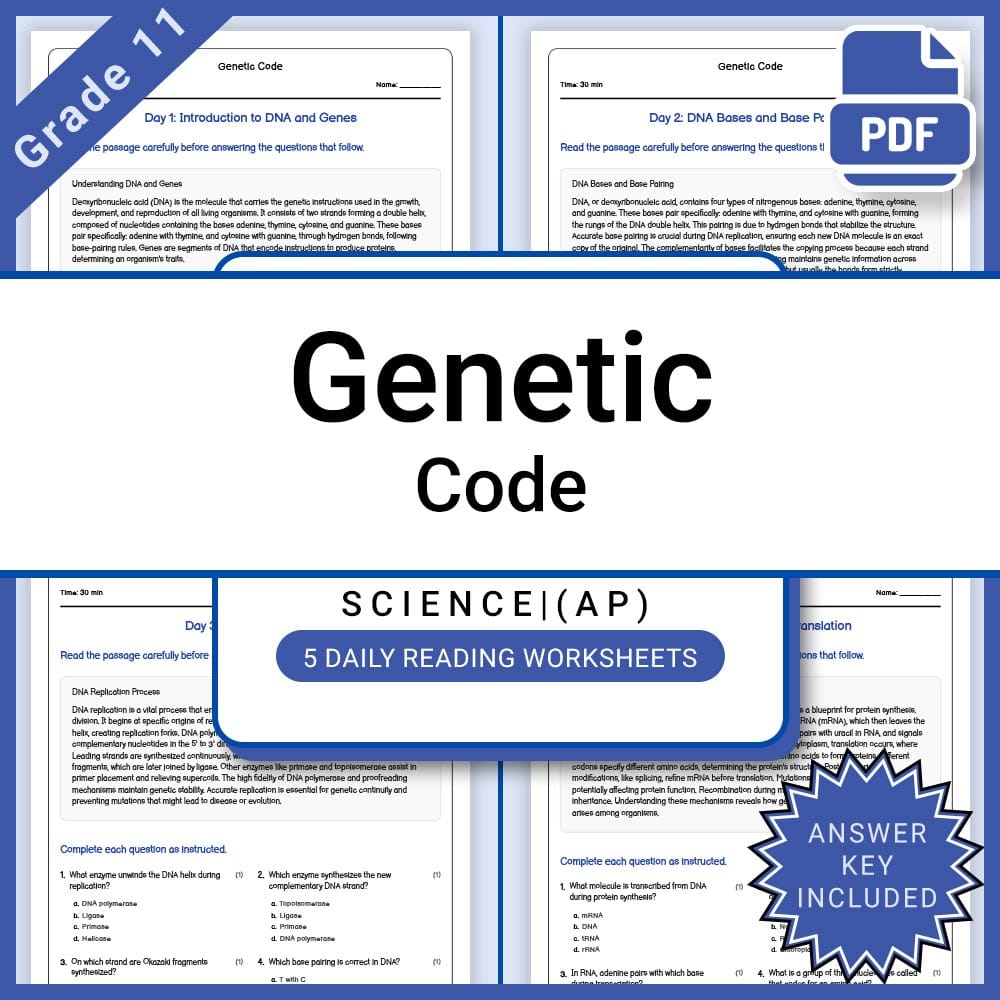
Grade 11 Science – Genetic Code Daily Reading Worksheet + Answer Key
JCreated byJ.S SheetsLearning Objectives
- Understand the structure and function of DNA in heredity
- Explain the processes of transcription and translation
- Identify different types of genetic mutations and their effects
Also included in: Grade 11 Science Biology and Ecosystems AP Lesson Bundle +1 more
Instant download
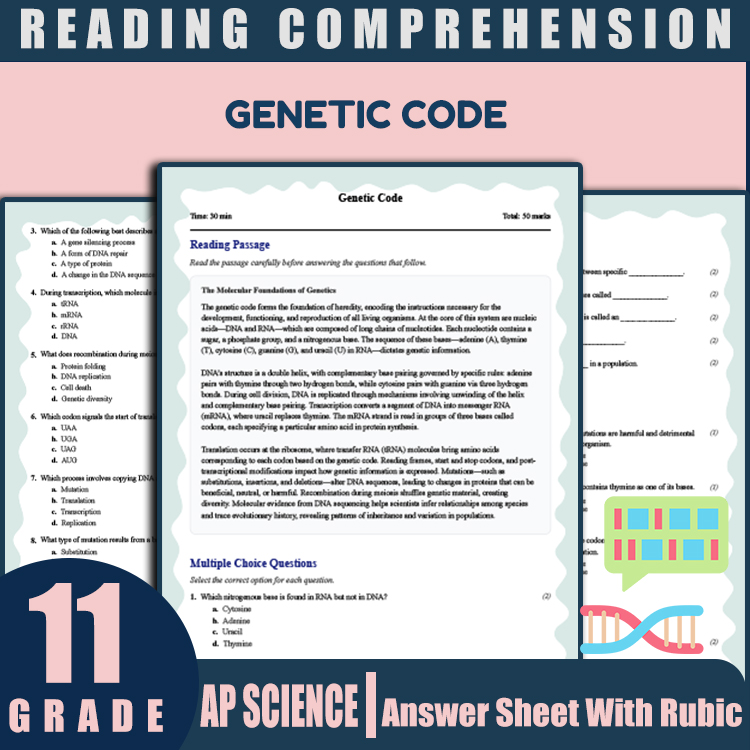
11th Grade Science Reading Worksheets | Genetic Code Mastery (PDF + Answer Key)
JCreated byJ.S SheetsLearning Objectives
- Understand the molecular basis of heredity through nucleic acid structures and base-pairing rules.
- Describe the processes of transcription and translation as mechanisms of genetic information transfer.
- Identify types of mutations and recombination and their effects on gene expression and phenotype.
Also included in: Grade 11 Science Unit Bundle – Cellular Systems, Genetics Ecosystems Worksheets +1 more
Instant download

Digitized Electromagnetic Signals Worksheet Grade 12 Science
JCreated byJ.S SheetsLearning Objectives
- Understand how electromagnetic radiation transmits information through digitized signals.
- Identify the properties of signals that encode information, such as frequency and variation.
- Explain the physics principles that allow electromagnetic waves to carry information across distances.
Also included in: Grade 12 Energy, Forces, and Waves Science Lesson Bundle | California Standards +1 more
Instant download

Grade 12 Digitized Electromagnetic Signals Worksheet | NGSS Practice PDF
Created byClear Sky ClassroomLearning Objectives
- Explain how information can be encoded into digitized electromagnetic signals using controlled changes in signal properties.
- Use evidence-based reasoning to relate measurable wave behaviors (frequency content, modulation, propagation effects) to transmitted digital information.
- Compare how different modulation approaches affect how a receiver reconstructs bits from an electromagnetic wave.
Instant download

Grade 12 Science – Electromagnetic Signals & Communication | Reading Worksheet
Created byBright Mind ResourcesLearning Objectives
- Understand the basic concepts of electromagnetic radiation and signals
- Identify how signals are encoded and transmitted via electromagnetic waves
- Recognize properties of electromagnetic signals relevant to communication technology
Also included in: Energy Grade 12 Science Daily Reading Worksheets Lesson Bundle | CA Standards +1 more
Instant download

Digitized Electromagnetic Signals Worksheet | Grade 12 Physics Activity
Created byPrism Point LearningLearning Objectives
- Explain how digitization encodes information into electromagnetic signals using controlled signal variations
- Describe how electromagnetic waves carry energy through space while the data can be recovered from measurable signal properties
- Use evidence-based reasoning to connect frequency content and signal propagation to communication performance
Instant download

Digitized Electromagnetic Signals Worksheet | Grade 12 Physics Science
Created byEvergreen Desk EducationLearning Objectives
- Explain how digitization encodes information into discrete signal changes represented as bits.
- Describe how electromagnetic waves carry energy and how receivers reconstruct encoded data.
- Use evidence-based reasoning to connect frequency content and propagation effects to received signals.
Instant download

Grade 12 Science | Electromagnetic Signals Worksheet | California Standards
Created byLumora LearningLearning Objectives
- Understand how electromagnetic radiation transmits information through digitized signals.
- Identify the properties of signals that encode information, such as frequency and amplitude.
- Explain how electromagnetic waves carry energy and facilitate communication across distances.
Instant download

Grade 12 Science | Digitized Electromagnetic Signals - Reading Comprehension
Created byCoral Reef LearningLearning Objectives
- Understand the properties of electromagnetic waves
- Learn how electromagnetic signals transmit information
- Recognize the role of signal variations in encoding data
Instant download
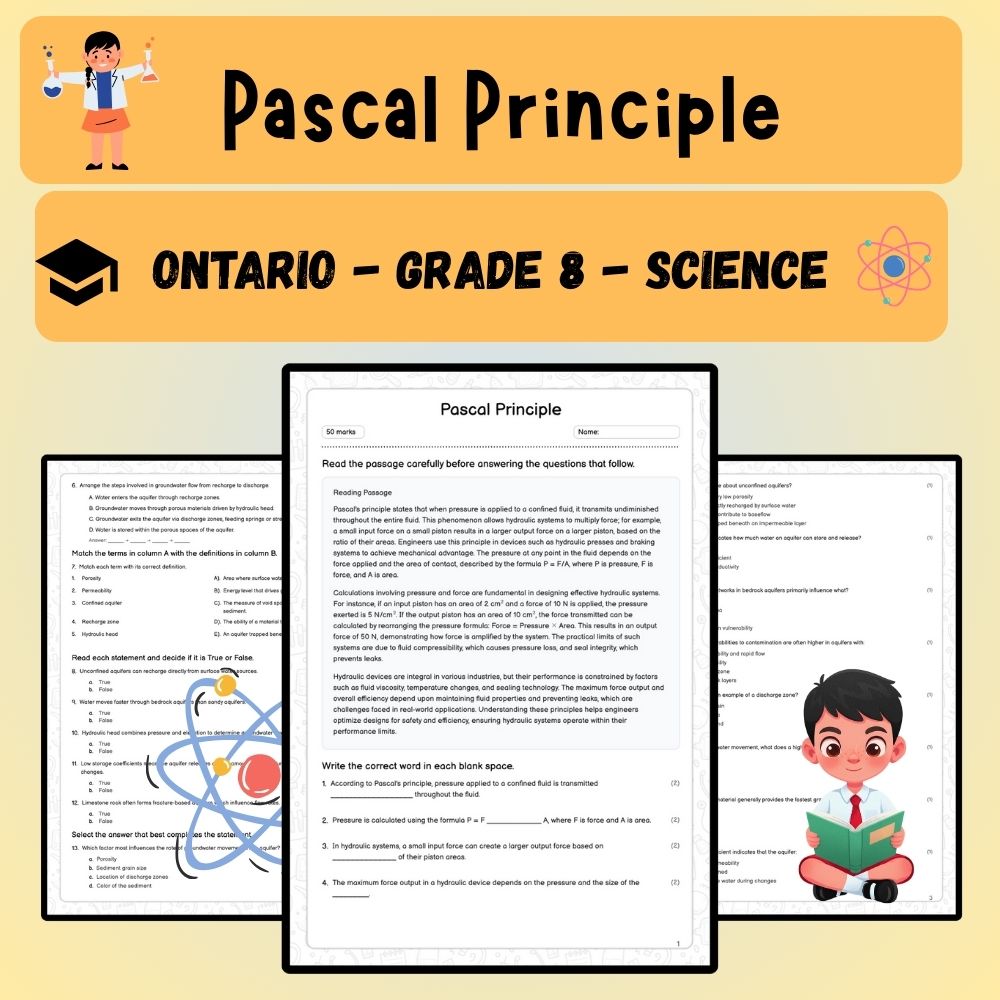
Grade 8 Science | Pascal's Principle Worksheet (PDF )
Created byPrism Point LearningLearning Objectives
- Explain the concept of Pascal's principle and its significance in hydraulic systems.
- Perform calculations involving forces, areas, and pressure in hydraulic devices.
- Identify real-world applications of Pascal's principle such as hydraulic presses and brakes.
Also included in: Grade 8 Science | Fluid Mechanics & Pressure Unit Worksheet Bundle +1 more
Instant download

Grade 8 Science | Pascal's Principle in Hydraulic Systems - Comprehension
Created byCoral Reef LearningLearning Objectives
- Understand the concept of pressure transmission in confined fluids
- Learn how pressure applies equally in all directions within a fluid
- Calculate force amplification using pistons of different areas
Instant download
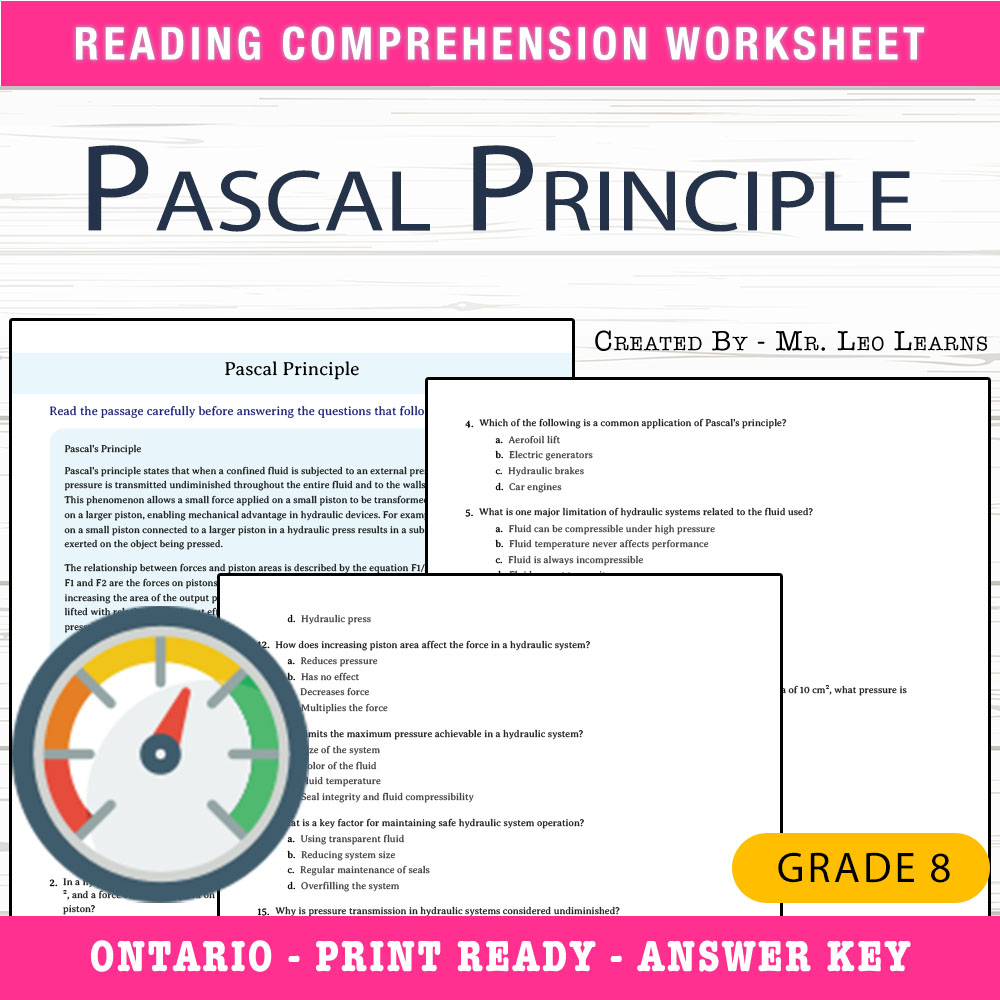
Grade 8 Science — Pascal Principle Worksheet for Mastery
 Created byThe Resource Hub
Learning Objectives
- Explain how pressure is transmitted in a confined fluid according to Pascal's principle.
- Calculate output forces in hydraulic systems using piston areas and applied pressures.
- Identify practical applications of Pascal's principle such as hydraulic presses and braking systems.
Also included in: Grade 8 Science – Fluids & Buoyancy Mastery Unit Bundle (Worksheet Pack) +1 more
Instant download

Grade 8 Science – Understanding Pascal's Principle Daily Reading Worksheet
Created byBright Mind ResourcesLearning Objectives
- Explain the concept of pressure transmission in confined fluids.
- Identify how force and area relate in hydraulic systems.
- Describe real-world applications of Pascal's principle such as hydraulic presses and brake systems.
Also included in: Grade 8 Fluid Mechanics & Pressure Science Lesson Bundle | Ontario +1 more
Instant download
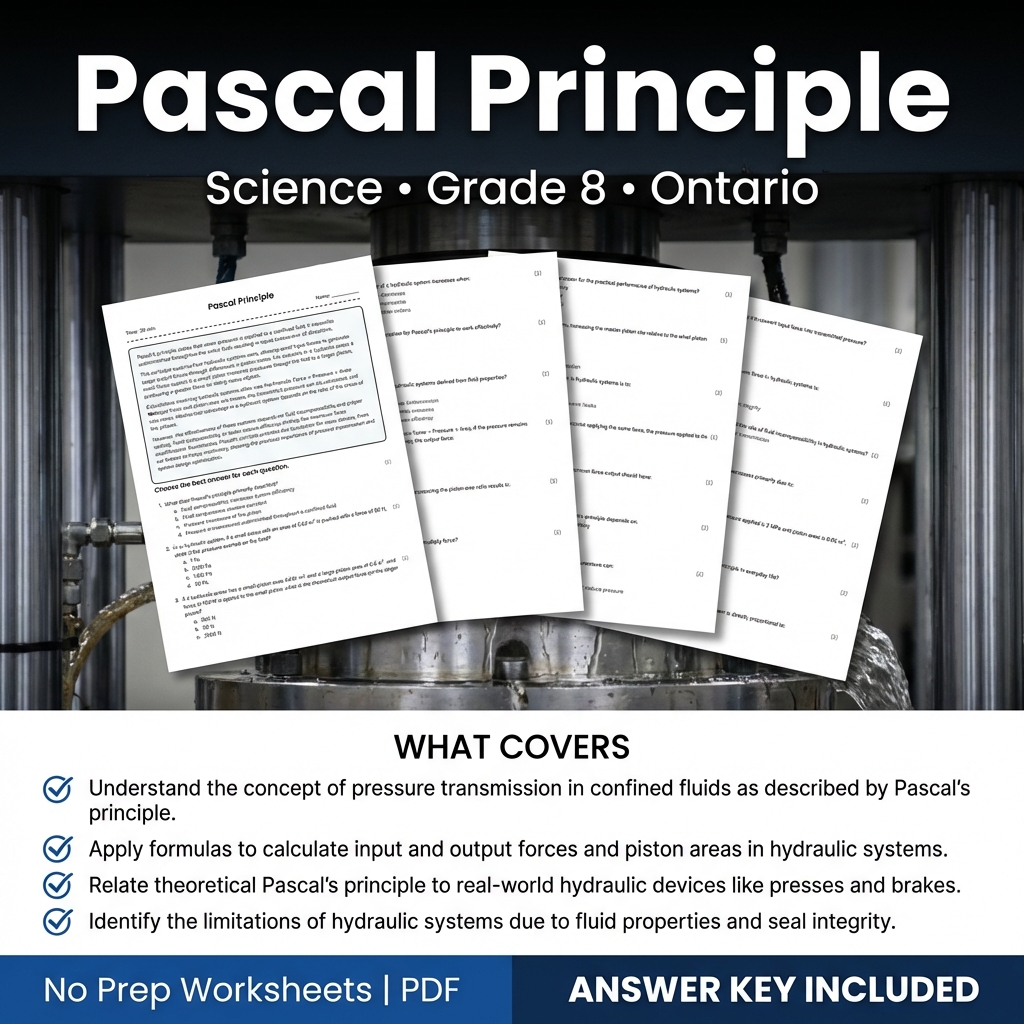
Pascal Principle Worksheet | Grade 8 Science | Ontario Standards
Created byCoral Reef LearningLearning Objectives
- Understand the concept of pressure transmission in confined fluids as described by Pascal's principle.
- Apply formulas to calculate input and output forces and piston areas in hydraulic systems.
- Relate theoretical Pascal's principle to real-world hydraulic devices like presses and brakes.
Instant download

Grade 8 Science – Pascal's Principle & Hydraulic Systems | Daily Worksheet
 Created byQuiet Forest Education
Learning Objectives
- Explain the concept of pressure transmission in confined fluids.
- Calculate input and output forces in hydraulic systems using piston areas.
- Describe real-world devices that utilize Pascal's principle, such as hydraulic presses and brake systems.
Also included in: Fluid Dynamics Grade 8 Science Daily Reading Worksheets Bundle | Ontario +1 more
Instant download

Grade 8 Science Worksheet – Pascal Principle | Ontario Standards (PDF)
Created byEvergreen Desk EducationLearning Objectives
- Explain Pascal’s principle and how pressure is transmitted through a confined fluid
- Use the relationship between pressure, force, and piston area to predict force multiplication in hydraulic systems
- Identify real-world limitations (compressibility, air bubbles, friction, and seal integrity) that affect hydraulic performance
Also included in: Grade 8 Fluid Pressure & Forces Science Lesson Bundle: Ontario Worksheet Set +1 more
Instant download
Grade 8 Science – Pascal's Principle Worksheet (Ontario | PDF)
Created byBright Mind ResourcesLearning Objectives
- Explain the concept of pressure transmission in confined fluids according to Pascal's principle.
- Calculate the relationship between input and output forces and areas in hydraulic systems.
- Identify real-world devices that utilize Pascal's principle, such as hydraulic presses and braking systems.
Instant download
8th Grade Science | Pascal Principle Worksheet (PDF+ Answer Key)
Created byCopper Leaf ClassroomLearning Objectives
- Understand the concept of pressure transmission in confined fluids as explained by Pascal's principle.
- Apply the hydraulic equation relating input and output forces and piston areas to solve problems.
- Explain real-world applications such as hydraulic presses and braking systems that utilize Pascal's principle.
Instant download
Grade 8 Science | Pascal Principle Worksheet with Short Notes (Printable PDF)
Created byMeadowlark WorksheetsLearning Objectives
- Explain how pressure is transmitted equally in a confined fluid according to Pascal's principle.
- Calculate the relationship between input and output forces based on piston areas and pressures.
- Identify real-world devices that utilize Pascal's principle, such as hydraulic presses and brakes.
Also included in: Grade 8 Science Lesson Group Bundle | Hydrostatics & Fluid Mechanics +1 more
Instant download

Grade 8 Pascal Principle Worksheet | Ontario Science Hydraulics PDF
Created byClear Sky ClassroomLearning Objectives
- Explain Pascal's principle and how pressure in a confined fluid is transmitted.
- Use the pressure idea to relate piston areas to force multiplication in hydraulic systems.
- Identify real-world hydraulic applications and describe key limitations (compressibility, seals, leaks).
Instant download

Science Grade 8 Pascal Principle Worksheet | Hydraulics & Pressure Transmission
JCreated byJ.S SheetsLearning Objectives
- Explain Pascal’s principle and describe how pressure in a confined fluid is transmitted
- Use the relationship between pressure, force, and piston area to predict output force in a hydraulic system
- Compare ideal hydraulic behavior with real-world limitations such as fluid compressibility and seal leakage
Instant download
Browse more categories
About Science Worksheets
Find Science worksheets spanning core skills, practice, and review. All 45,024 resources are instant PDF downloads for the classroom or home.
Every worksheet on MyTeachingSheets is created by independent teacher-authors and reviewed before publication. All resources download as printable PDFs for classroom, homework, or at-home practice, and many include answer keys. Preview any worksheet free before buying.